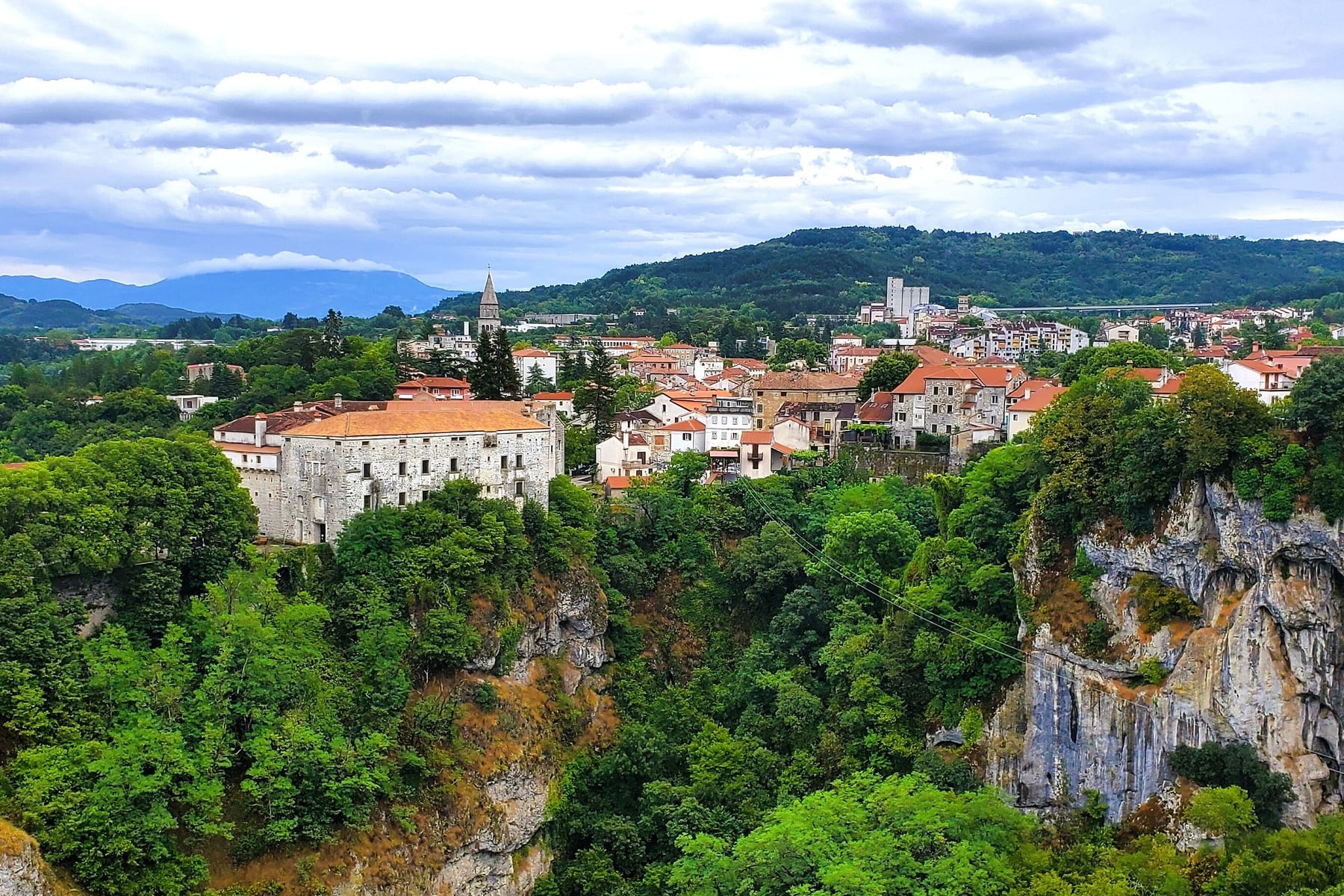
The Istrian Line — Pula to Buzet
Aquamunda / Wikimedia Commons · CC BY 4.0 · cropped
- DistancePula–Buzet · 86 km
- DurationAbout 2 hours end to end
- Best seasonAll year · local trains daily, through trains in summer
Introduction
Istria is the shape of a heart hanging off the top of the Adriatic, and almost every town on it stands on its own hill. You see them from a long way off — a ridge, a ring of pale stone houses, a bell tower in the middle — and between them the land is oak wood and vineyard and the pasture where the truffles are dug. At the bottom of the peninsula, on the water, is Pula, which has a Roman amphitheatre among the six largest still standing anywhere. In the middle is Pazin, a town built to the edge of a limestone chasm that swallows a river. At the top is Buzet, walled, on its ridge above the Mirna valley, with the escarpment of the Ćićarija behind it.
One railway runs the length of all that, and it has been running it since 1876. It is not fast and does not pretend to be: two hours, eighty-six kilometres, twenty-six stops, a single diesel unit working up the spine of the peninsula and back several times a day. What it is, is the cheapest and quietest way to see the inland half of a place most people only ever see from the coast road.
The railway that cannot get home
There is one strange thing about it, and it is strange enough to be worth the telling. This is a Croatian railway that touches no other Croatian railway.
Istria's line was built by Austria to reach its naval base at Pula, and it was built northwards, into what is now Slovenia. Nothing was ever built eastwards, over the mountains to Rijeka and the rest of the country — Istria County's own government records that such a link "was also planned, but it was never realised", and describes the railways it does have as "practically 'cut off' from Croatian railroads (except for the indirect connection through Slovenian railroads)".
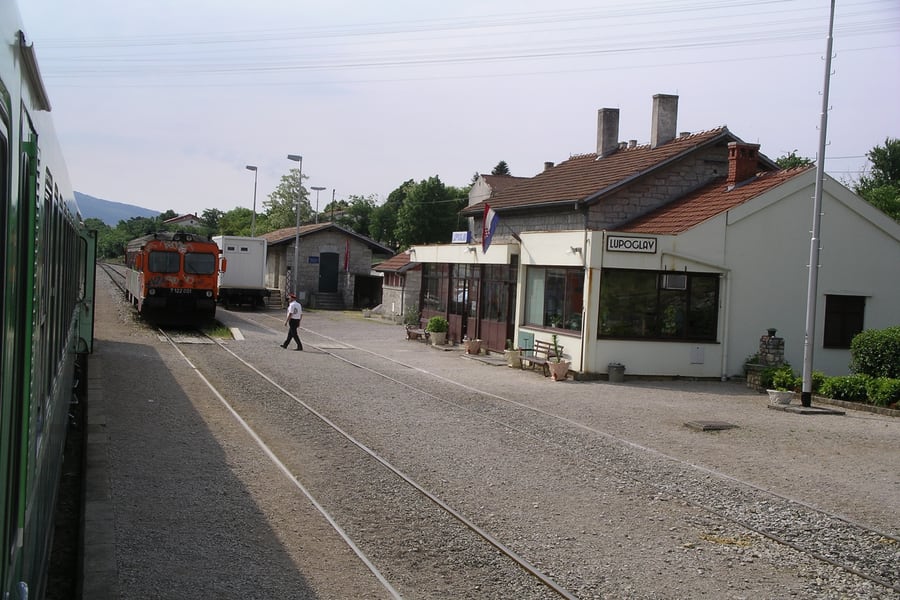
So the Sunday train from Pula to Zagreb leaves Croatia at Buzet, spends five hours crossing Slovenia, and re-enters its own country at Zaprešić on the far side, twenty minutes short of Zagreb. And the connection to Rijeka, sixty kilometres away as the crow flies, is a bus — a bus that appears in the national railway's own timetable, meets the train at Lupoglav with four minutes to spare, and has been doing the job a railway was supposed to do for a century and a half.
The Journey
The train leaves Pula from a station a few minutes' walk from the sea and from the amphitheatre, turns its back on both, and starts inland. Within a quarter of an hour it is at Vodnjan, under the tallest bell tower in Istria, and the coast is gone for good. From there to Buzet the line stays inland the whole way, which is the point of it: this is the Istria of stone villages and dry-stone walls and long views over wooded hills, not the Istria of marinas.
It is a stopping train in the fullest sense. Twenty-six calls in eighty-six kilometres works out at one about every three minutes, and some of them come faster than that — Čabrunići and Čabrunići Selo are two minutes apart, Heki and Heki halt the same. The average speed over the whole run is a little over forty kilometres an hour. Nobody rides this line to save time.
What was built, and what it was built for
Austria conceded the line on 30 April 1873 and opened it on 20 September 1876, as the Istrian State Railway. The reason was naval. Pula had been chosen in 1859 as the empire's principal maritime base, and by the First World War it was home port to the Austro-Hungarian dreadnought fleet; this railway was the only way the fleet's base could be reached by rail. It ran 121.8 kilometres from Divača, on the main line to Trieste, down the length of the peninsula to the dockyard gates.
A branch went west from Kanfanar to Rovinj on the same day, 20.5 kilometres of it. That closed on 20 October 1966 and is a cycle path now. The main line has changed hands four times without moving an inch — Austria-Hungary until 1918, Italy until 1945, Yugoslavia until 1991, and since then Croatia and Slovenia, who share it at the border a few kilometres north of Buzet.
The trains, and the track under them
The Croatian section carries no overhead wire and never has. Electrification stops at the Prešnica junction on the Slovenian side, where it was put up in 1975; everything south of that is diesel, which is why the new trains here are diesel-electric while the rest of Croatia takes delivery of electric units.
Those new trains arrived on 6 March 2023, when a Končar low-floor unit ran out of Pula station for the first time, bound for Kanfanar. The type was assigned to Pula–Pazin and Pula–Buzet and is what you are most likely to be sitting in: 167 seats, up to 120 km/h, four pairs of double-leaf doors a side, two wheelchair ramps, space for bicycles, free wifi.
The rails beneath are the older half of the story. The Croatian line — R101, from the state border through Buzet to Pula, 91 kilometres — is being renewed section by section, and the work is visible in the timetable: through late August and September 2026 the middle of the line closes for hours at a stretch and buses run between Pazin, Lupoglav and Buzet instead. The operator publishes the dates, and they are set out on the timetables page here.
Halfway, at Pazin
If there is one place to get off, it is Pazin, and the timetable half suggests it: most trains pause a minute or two, but the evening working stands seventeen. The station is a short walk from the town, and the town ends abruptly at the lip of the Pazinska jama — the gorge where the Pazinčica river runs into the rock and disappears. The castle sits directly above it. Jules Verne, who never came, sent the hero of Mathias Sandorf down that cliff in 1885, and twenty years later a French caver went down it properly.
North of Pazin the country changes again. The line runs through Borut and Hum u Istri and Roč, three of the smallest stops on it, into a landscape of scattered hamlets and beech; Hum, up on its hill, has fifty-two people living in it. Then it comes down into the Mirna valley, past Buzet's new town on the flat, and stops at the station. The old town is up on the ridge above, two kilometres and some height away — and the railway carries on north without you, over the escarpment and out of the country.
Along the route
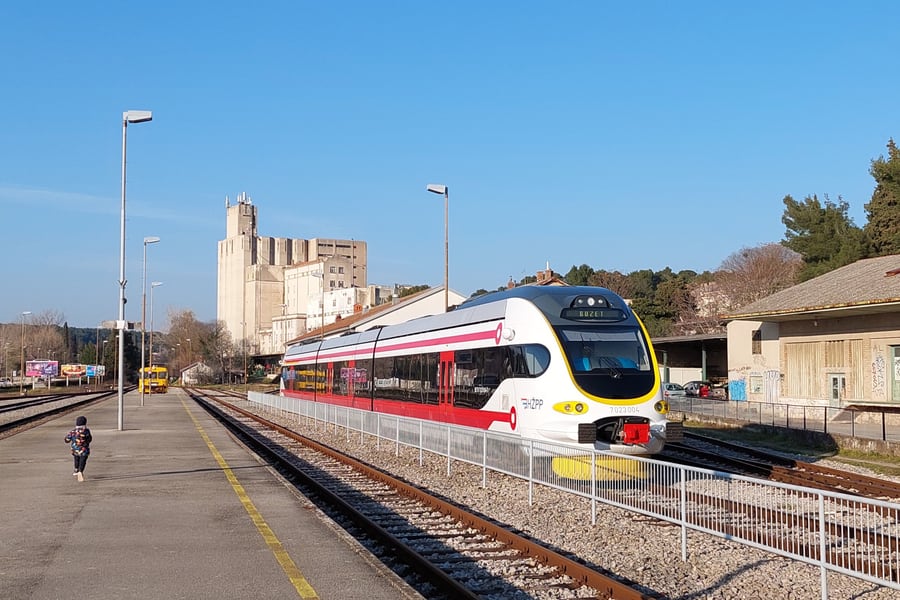
Dguendel / Wikimedia Commons · CC BY 3.0 · croppedA railway with no way home
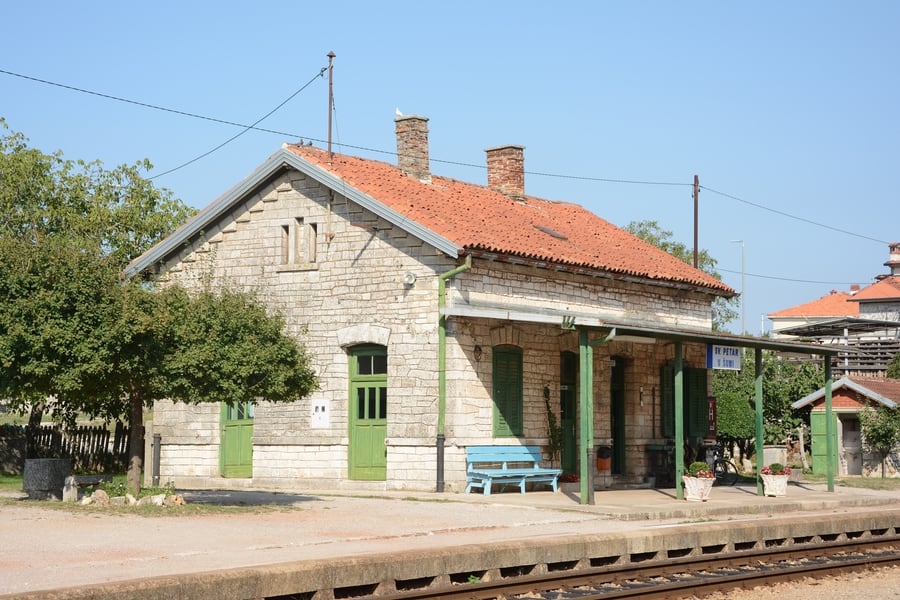
Istria's railway has never been joined to the rest of Croatia's. Its own county government calls it practically cut off from Croatian railroads except through Slovenia. A train from Zagreb to Pula therefore leaves Croatia at Zaprešić, spends five hours in Slovenia and comes back in at Buzet.Janko Hoener / Wikimedia Commons · CC BY-SA 2.0 · croppedBuilt for a navy
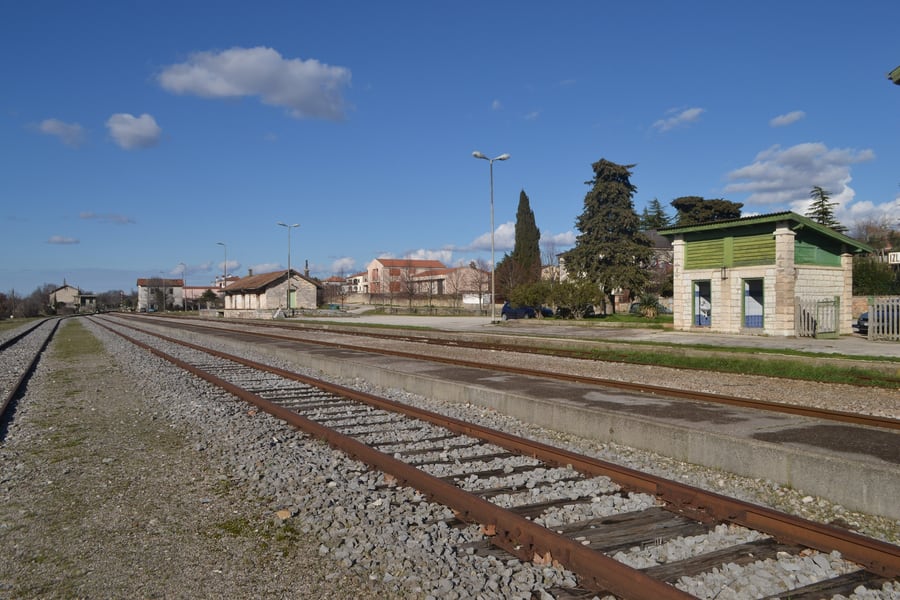
The line opened in 1876 and was never really about Istria. Pula had been chosen in 1859 as Austria's principal naval port, and this was how the empire reached it — the only rail connection its main fleet base had.Orlovic / Wikimedia Commons · CC BY-SA 4.0 · croppedNew trains on old rails
A Končar low-floor unit went into service from Pula in March 2023 and the type now works both routes: 167 seats, up to 120 km/h, wheelchair ramps and bicycle space. The track beneath it is the older half of the equation.A bit of history
Culture & experiences along the way
Nils Öberg / Wikimedia Commons · CC BY-SA 3.0 · croppedThe bus that is part of the railway
Rijeka is the nearest city, and no rail line reaches Istria from it. HŽPP's answer appears in its own timetable as a bus between Rijeka and Lupoglav, and the connections are cut fine on purpose: the 14:35 from Rijeka is in Lupoglav at 15:15 and the train for Pula leaves at 15:20. Coming the other way the 04:37 from Pula reaches Lupoglav at 06:18 and the bus pulls out at 06:22.Petr Štefek / Wikimedia Commons · CC BY 3.0 · croppedTwenty-six stops in eighty-six kilometres
This is a stopping train in the old sense. Between Pula and Buzet it calls twenty-six times — at Čabrunići and then again at Čabrunići Selo, two minutes apart; at Heki and then at Heki halt — and averages a little over forty kilometres an hour. Two hours for eighty-six kilometres is not efficiency. It is the reason you see the country.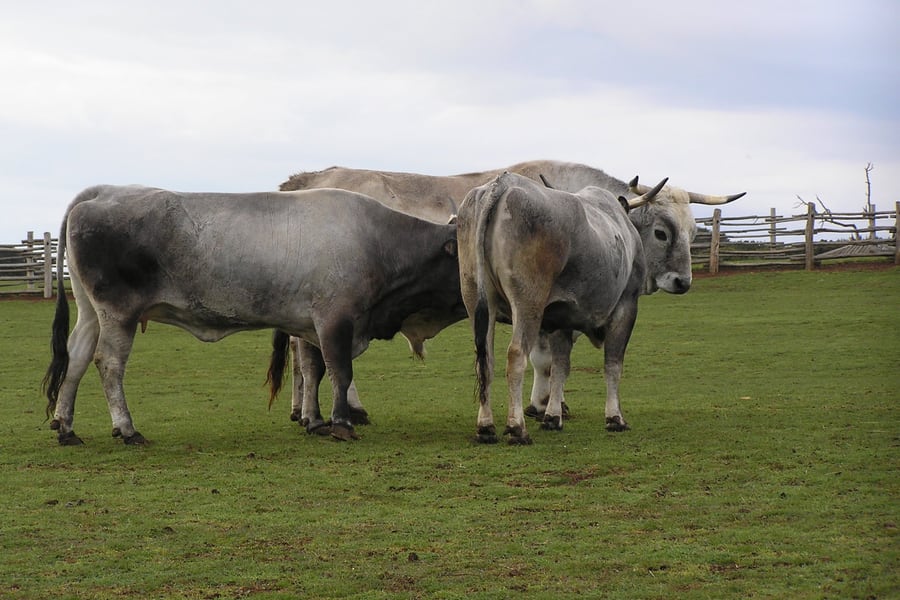 Orlovic / Wikimedia Commons · CC BY-SA 4.0 · cropped
The grey ox that came back
The boškarin is Istria's own ox — long-horned, ash-grey, and the animal that ploughed this peninsula until tractors arrived. It was down to a few dozen head by the 1990s and has been pulled back by a deliberate revival: you will meet it in a field along the line, on a farm menu, and pulling a cart at every village fair in the summer.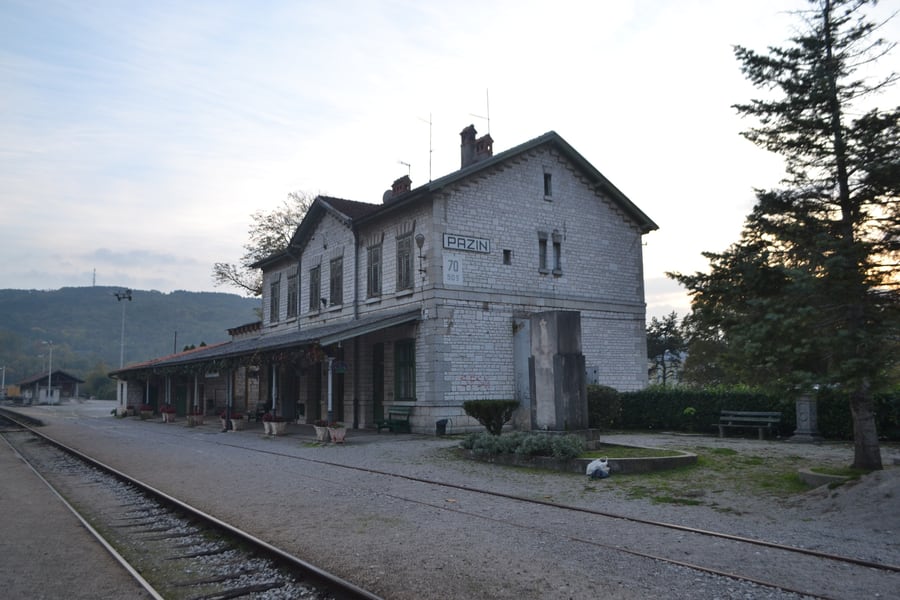 Janko Hoener / Wikimedia Commons · CC BY-SA 2.0 · cropped
The crossing at Pazin
Halfway up the line the train stands a few minutes at Pazin, and on some workings a good deal longer — the evening service waits seventeen. The town is a few minutes' walk from the platform, and so is the edge of the Pazinska jama, the chasm where the Pazinčica river goes underground beneath the castle. It is the one stop worth breaking the journey at even with no plan.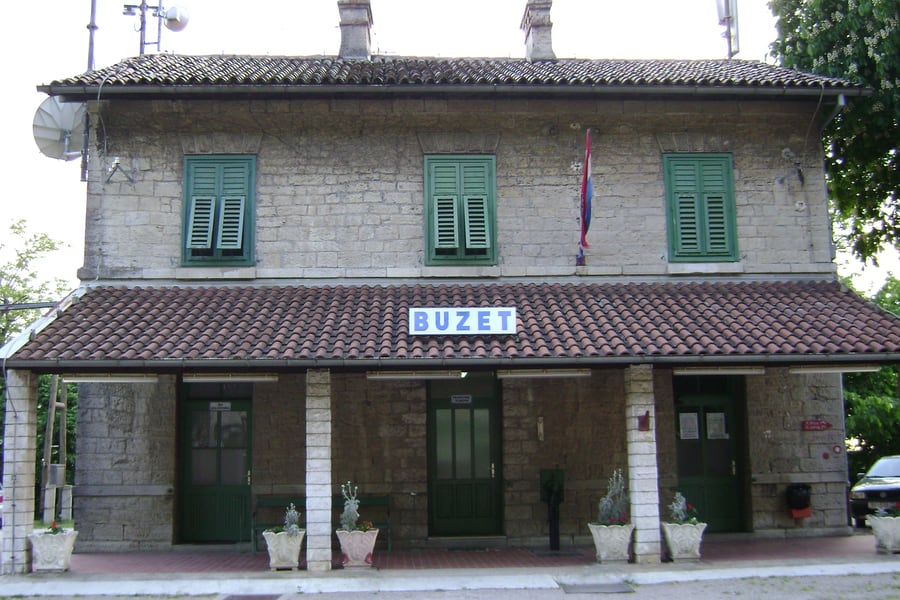 kiki273 / Wikimedia Commons · CC BY-SA 3.0 · cropped
Check for a closure before you book
The Croatian section is being renewed in stages, and the operator shuts the northern stretch between Pazin, Lupoglav and Buzet for blocks of days at a time — usually in late summer and autumn, usually by day, with buses instead of trains. The two ends of the line keep running throughout. HŽPP publishes each closure in advance; read it before you commit.Timetables
Every time below is read from HŽPP's own timetable feed, downloaded on 16 August 2026, and checked against the operator's published notices of the same week. The timetable period runs from 14 December 2025 to 12 December 2026.
The important thing about this line is that it is not seasonal. There are trains up and down it every day of the year, and the summer through workings from Slovenia are an addition to that, not the whole of it.
Northbound — Pula to Pazin, Lupoglav and Buzet
| Train | Pula | Vodnjan | Kanfanar | Pazin | Lupoglav | Buzet | Runs |
|---|---|---|---|---|---|---|---|
| 4700 | 04:37 | 04:53 | 05:16 | 05:45 | 06:23 | 06:43 | Mon–Fri |
| 4702 | 06:29 | 06:51 | 07:14 | 07:49 | 08:23 | 08:43 | Mon–Fri |
| 4704 | 08:31 | 08:48 | 09:13 | 09:50 | 10:24 | 10:44 | daily |
| 4706 | 13:19 | 13:36 | 13:59 | 14:35 | 15:08 | — | Mon–Fri |
| 4708 | 14:22 | 14:38 | 15:07 | 15:55 | 16:32 | 16:52 | daily |
| 4710 | 15:50 | 16:07 | 16:30 | 17:00 | 17:33 | — | Mon–Fri |
| 4712 | 17:30 | 17:46 | 18:09 | 18:44 | 19:16 | — | Mon–Fri |
| 4714 | 19:51 | 20:08 | 20:31 | 21:06 | 21:39 | — | daily |
Southbound — Buzet and Lupoglav to Pula
| Train | Buzet | Lupoglav | Pazin | Kanfanar | Vodnjan | Pula | Runs |
|---|---|---|---|---|---|---|---|
| 4703 | 04:48 | 05:09 | 05:54 | 06:26 | 06:50 | 07:06 | Mon–Fri from Buzet, daily from Lupoglav |
| 4705 | 06:54 | 07:15 | 07:48 | 08:20 | 08:49 | 09:05 | Mon–Fri |
| 4707 | 10:52 | 11:13 | 11:46 | 12:17 | 12:42 | 12:58 | daily |
| 4709 | 13:40 | 14:01 | 14:34 | 15:05 | 15:29 | 15:45 | Mon–Fri |
| 4711 | — | 15:20 | 15:54 | 16:31 | 16:55 | 17:11 | Mon–Fri |
| 4715 | 17:16 | 17:37 | 18:10 | 18:42 | 19:06 | 19:22 | daily |
| 4717 | — | 20:32 | 21:05 | 21:36 | 22:00 | 22:16 | daily |
A few of the weekday workings drop out on public holidays. The trains marked daily run through the weekend as well.
A day out on the line
The pairing that works without any planning is 4704 out of Pula at 08:31, and 4715 back from Buzet at 17:16 — about six and a half hours at the top of the line, or four and a half at Pazin if the return is taken from there at 18:10. For a shorter day, 4704 to Pazin at 09:50 and 4709 back at 14:34 gives most of the middle of the day in the town above the chasm.
The bus to Rijeka, which is part of the railway
Rijeka has no rail link to Istria, so HŽPP runs a bus between Rijeka and Lupoglav and lists it in the railway timetable. The connections are deliberate and they are tight.
| Rijeka | Lupoglav | Connects with | |
|---|---|---|---|
| Bus 90010 | 05:38 | 06:18 | — |
| Bus 90030 | 09:55 | 10:35 | train 4707 to Pula, 11:13 |
| Bus 90050 | 14:35 | 15:15 | train 4711 to Pula, 15:20 |
| Bus 90070 | 19:30 | 20:10 | train 4717 to Pula, 20:32 |
| Lupoglav | Rijeka | Arriving on | |
|---|---|---|---|
| Bus 90020 | 06:22 | 07:02 | train 4700 from Pula, 06:18 |
| Bus 90040 | 10:40 | 11:20 | train 4704 from Pula, 10:23 |
| Bus 90060 | 16:31 | 17:11 | train 4708 from Pula, 16:28 |
| Bus 90080 | 21:42 | 22:22 | train 4714 from Pula, 21:39 |
Three of those give three or four minutes to change. They are timetabled that way, and the two vehicles stand at the same station building.
Through trains from Slovenia and Zagreb
In summer, daily. Trains 1470 and 1471 extend the line north to Divača, on the main line from Ljubljana to Trieste, from 27 June to 30 August 2026:
- 1470 — Divača 08:06, Buzet 08:57, Pazin 09:49, Pula 10:58
- 1471 — Pula 17:30, Pazin 18:44, Buzet 19:45, Divača 20:29
At weekends, all year. Train 1475 leaves Pula at 13:29 on Sundays, is at Buzet at 15:30 and Divača at 16:23, and reaches Zagreb Glavni kolodvor at 20:43 — a little over seven hours, five of them in Slovenia. Coming the other way, 1472 leaves Zagreb at 14:13 on Fridays; outside high summer it runs through to Pula at 21:31, and between 3 July and 28 August the last leg is worked instead by train 1474, out of Buzet at 19:55 and into Pula at 22:16. On Saturdays, train 1473 leaves Pula at 06:29 for Buzet and Divača, with 1474 returning in the evening.
Track work, and what it does to the timetable
The Croatian line is being renewed, and HŽPP has published the closures. Between Pazin, Lupoglav and Buzet the line is shut:
- 17–31 August 2026, every day except Sundays, from 10:00 to 18:00
- 7 September 04:00 – 11 September 18:30
- 14 September 04:00 – 17 September 04:00
- 21 September 04:00 – 25 September 18:30
- 28 September 04:00 – 2 October 18:30
Buses run Pazin–Buzet and Pazin–Lupoglav in both directions during those periods, calling at every station and halt except Nugla, which the minibus cannot reach — the operator's advice there is to use Roč instead. The section between Pula and Pazin is unaffected throughout.
The Slovenian side had its own closure between Divača and Buzet from 15 to 17 August 2026, with buses, for work by Slovenske železnice.
*Times as of August 2026. HŽPP publishes the live timetable, the international timetable and its notices of track work at hzpp.hr (opens in a new tab), and the notices are the page worth checking on this line in particular.*
Tickets
Nothing about buying a ticket for this line is complicated. The local trains are ordinary regional services — no reservation, no supplement, no class distinction that matters — and a ticket is bought at the counter, from the HŽPP website or app, or from the conductor. Where you buy it is the only thing that moves the price: online is 10% cheaper than the ticket office, and buying on board from the conductor is 10% dearer. There are no ticket machines at any station on this line.
One provision is worth knowing for a weekend: a discounted return for up to 100 km bought for a Sunday or a public holiday is valid from 00:01 on the Friday until midnight on the Monday — which covers a whole weekend here, including the Sunday train through to Zagreb. Conditions read from HŽPP, August 2026; fares are not quoted because they change without notice.
Book your tickets
Orlovic / Wikimedia Commons · CC BY-SA 4.0 · croppedA ticket along the line
Pula to Buzet, or any part of it
An ordinary regional fare, no reservation, and 10% cheaper bought online.
Book Tickets (opens in a new tab, on hzpp.hr)via hzpp.hrDguendel / Wikimedia Commons · CC BY 3.0 · croppedThe through train from Zagreb
One a week each way, across Slovenia
An international fare, and the only trains connecting Istria to the rest of the network.
Book Tickets (opens in a new tab, on hzpp.hr)via hzpp.hrRail Passes
This line is one of the clearest cases on the site of a pass being the wrong instrument, and it is worth saying so plainly.
For the line itself, a pass is not worth buying
Pula to Buzet is eighty-six kilometres on a regional train with no reservation and no supplement. An Interrail or Eurail One Country Pass for Croatia would cover it, and it would also cover a whole day of riding it up and down — but the fare it saves is a regional fare, and a pass day costs a good deal more than that. Anyone whose Croatian travel is the Istrian line and nothing else will spend less buying tickets, particularly online, where they are 10% cheaper.
For getting to the line, a Croatia pass does not work at all
This is the part that catches people. Because Istria's railway is only reachable from the rest of Croatia through Slovenia, the journey between Zagreb and Pula is an international one, and Interrail is explicit about what a single-country pass will not do: a One Country Pass cannot be used to travel into or out of the country it covers. A Croatia pass covers the Croatian kilometres at each end and none of the five hours in between.
What covers the whole run is a Global Pass, or a Croatian and a Slovenian pass held together. Either of those only starts to make sense as part of a longer trip through several countries — which is, in fairness, how most people who reach Istria by rail are travelling.
If a pass is already in hand
There is nothing else to arrange. No train on the Croatian section of this line takes reservations, so a pass holder simply boards. The Sunday train from Pula to Zagreb and the Friday one coming back are the only services where an international fare or a Global Pass is doing real work, and neither of them requires a booked seat either.
The bus counts, for a different reason
The Rijeka–Lupoglav bus is not an outside operator's coach that happens to meet the train. It carries HŽPP service numbers, sits in HŽPP's own timetable feed alongside the trains, and is timed to connect with them — which is what makes Rijeka a practical way into Istria without a car. Whether a pass is honoured on it is a question for the counter rather than an assumption, since pass acceptance on rail-operated buses varies.
Pass conditions checked against Interrail's published One Country Pass rules in October 2026.
Places to Visit
Almost everything worth stopping for on this line is within walking distance of a platform, which is unusual and is largely an accident of when the railway was built. In 1876 the towns were where they had been for centuries — up on their ridges — and the engineers put the stations where the gradient allowed, which is generally at the foot of the hill. So the pattern repeats the length of Istria: a station on the flat, a town above it, and ten or twenty minutes of walking in between.
Pula is the exception at one end, where the Roman city comes down to the water and the station is in the middle of it. Buzet is the rule at the other, with two kilometres and a good deal of height between the platform and the old gate.
The six below run in the order the northbound train reaches them.
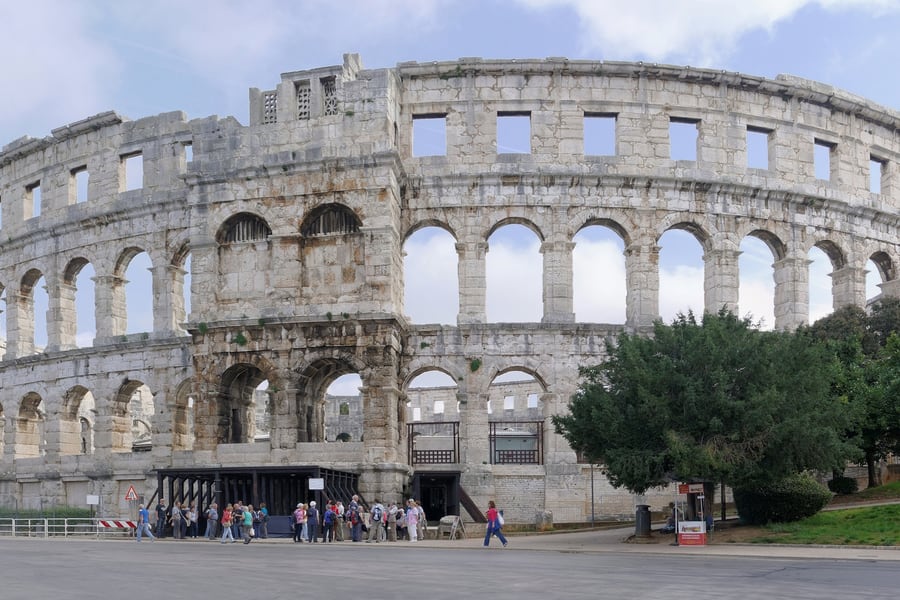 Berthold Werner / Wikimedia Commons · CC BY-SA 3.0 · cropped
The amphitheatre at Pula
Pula's arena was built between 27 BC and 68 AD and is among the six largest Roman amphitheatres still standing, one of the best preserved anywhere and still in use — the summer film festival is held inside it. The city around it was Austria's chief naval port from 1859, which is why this railway exists at all. Two more Roman survivals stand in the old town: the Temple of Augustus of the first century AD, and the Arch of the Sergii, a century older.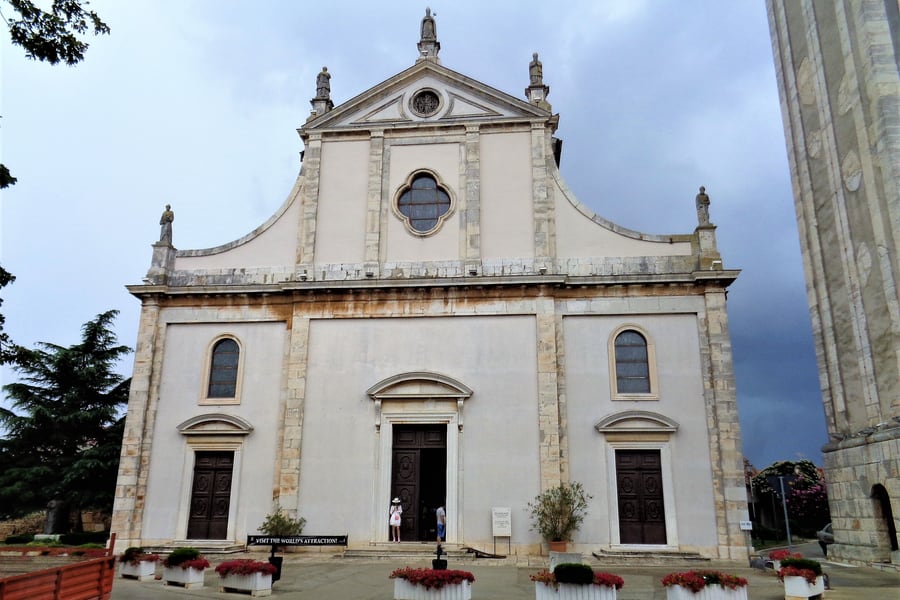 Silverije / Wikimedia Commons · CC BY-SA 4.0 · cropped
Vodnjan and its bell tower
The first town of any size north of Pula, and the tower over it is the tallest in Istria at 62 metres. The church of St Blaise beneath it replaced a Romanesque building pulled down in 1781 and was consecrated in 1800; inside are paintings by Venetian masters, a carved custodia of 1451, and a collection of relics, reliquaries from Murano and the bodies of saints that is the reason most visitors come.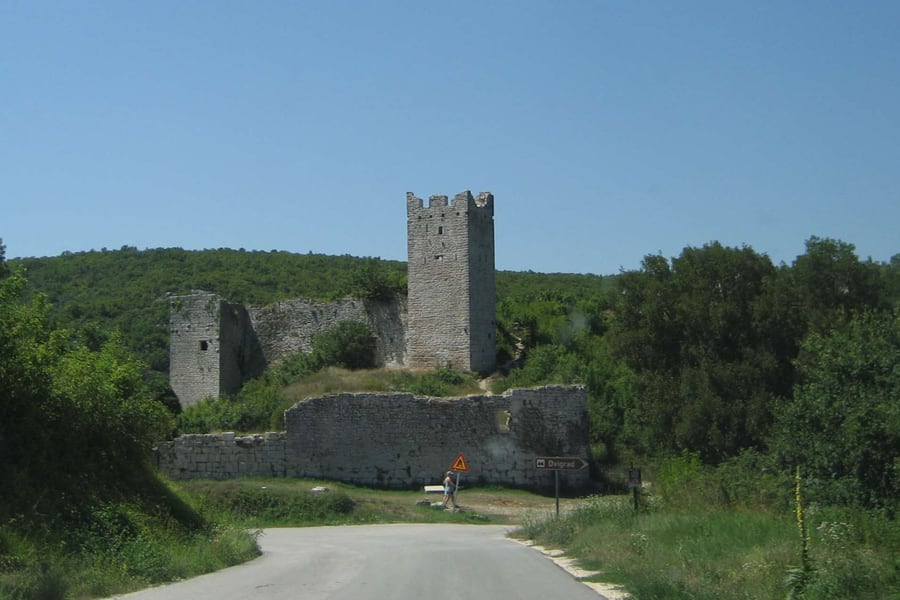 Croq / Wikimedia Commons · CC BY-SA 3.0 · cropped
Dvigrad, the town that emptied
A medieval town left standing and left alone. Dvigrad — "twin town" — was first mentioned in 879, and plague and malaria emptied it: the inhabitants began moving to Kanfanar in 1630, and by 1650 the bishop was blessing three families. What survives is a whole town in outline — two rings of wall, three gates, the defensive towers and the shells of some two hundred houses, with the Romanesque church of St Sophia on the high point. Its relics went down the road to Kanfanar.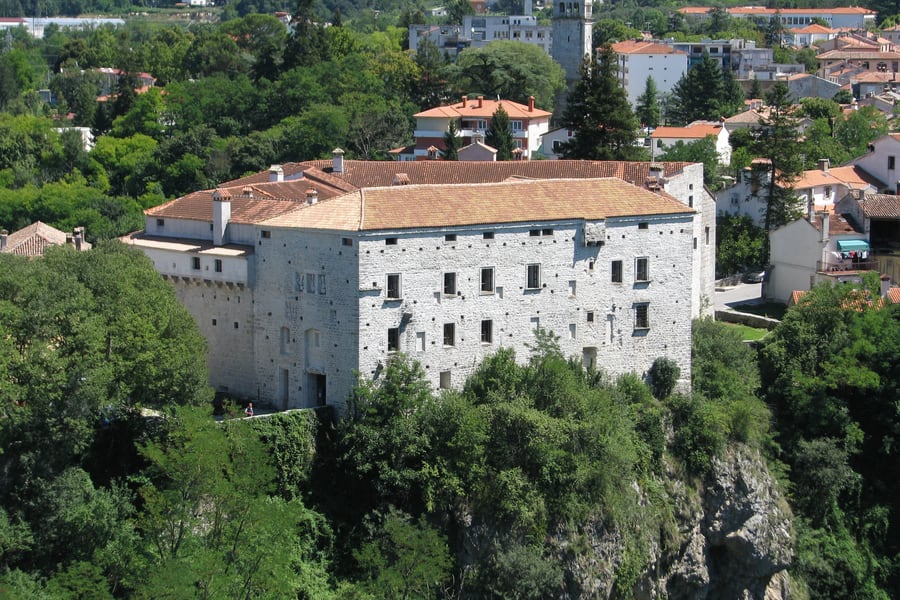 G.F.S. / Wikimedia Commons · CC BY 3.0 · cropped
Pazin, over the chasm
The castle stands on the lip of a limestone gorge into which the Pazinčica river disappears. It was first recorded in 983 as Castrum Pisinum, rebuilt through the fifteenth and sixteenth centuries and is a museum now. The gorge below was partly explored by the French speleologist Édouard-Alfred Martel in 1896 and is reckoned the best example of karst hydrography in Istria. Jules Verne put his hero's escape down it in Mathias Sandorf, published in 1885.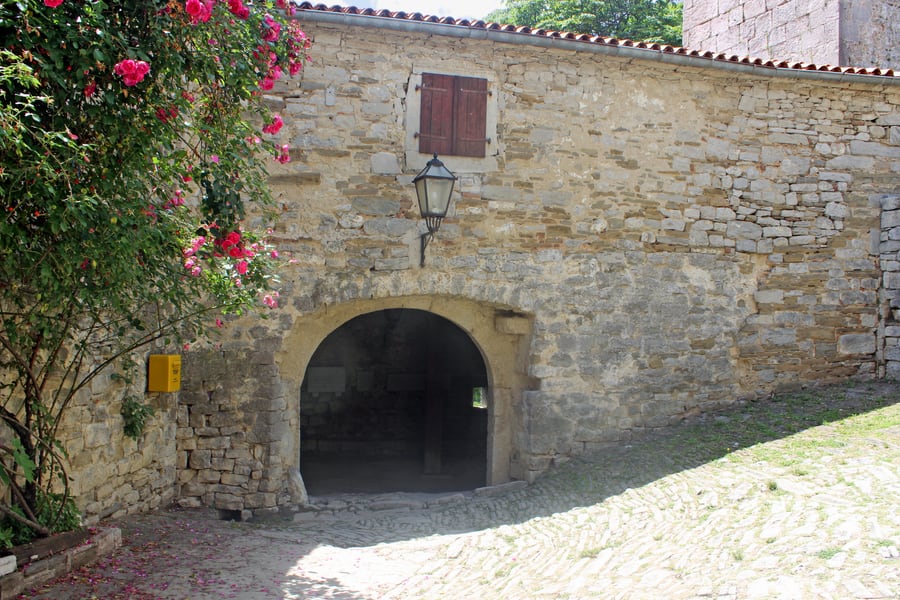 Maesi64 / Wikimedia Commons · CC0 · cropped
Hum, and the walk from Roč
Hum is called the smallest town in the world and had 52 inhabitants at the 2021 census. It was first written down in 1102, its bell and watch tower went up in 1552 and its church in 1802, and Glagolitic wall inscriptions of the twelfth century survive inside. Between Roč and Hum runs the Glagolitic Alley: eleven monuments over seven kilometres, raised between 1977 and 1985 to the Croatian scribal tradition. Both ends of it are stations on this line.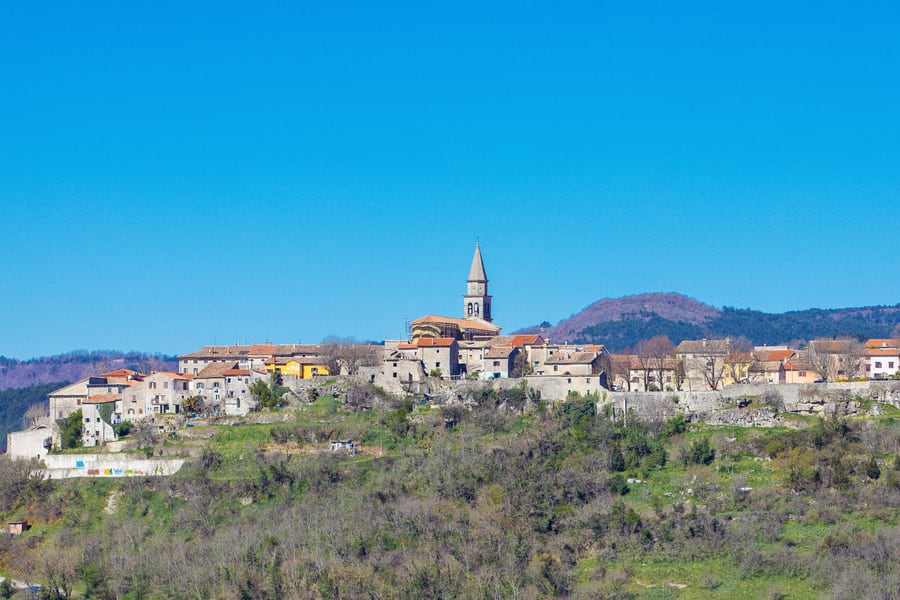 Jernej Furman / Wikimedia Commons · CC BY 2.0 · cropped
Buzet on its ridge
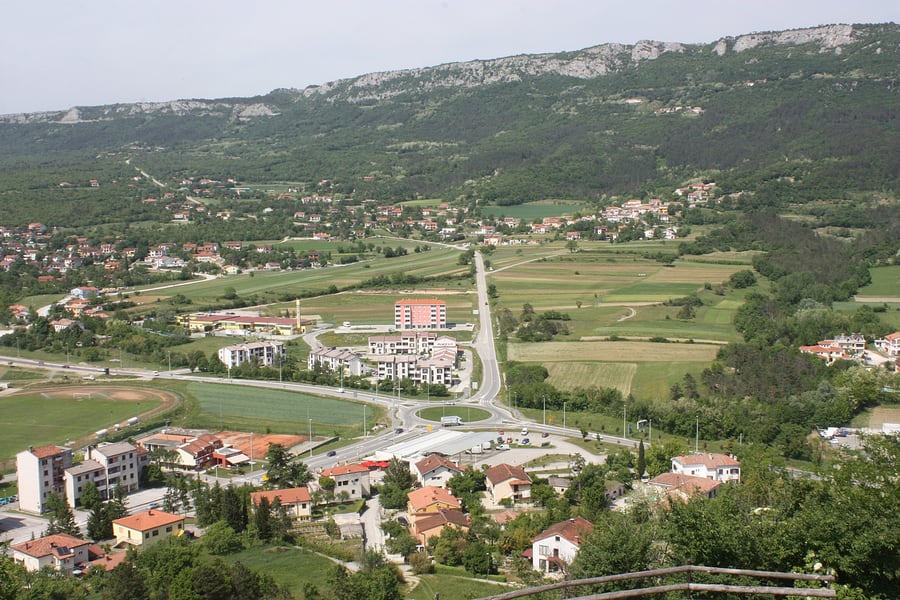
The old town sits on a hill above the Mirna valley, walled, entered through gates, and almost entirely made of the same pale stone. Below it the newer town spreads across the valley floor, and the station is down there with it, about two kilometres from the old gate. Buzet calls itself the town of truffles and the surrounding oak woods are where they are dug; the autumn Subotina festival is built around them.Where to Sleep
The line is short enough to ride in an afternoon, so a night on it is a choice rather than a necessity — but the three towns at the beginning, the middle and the end are each worth waking up in, and they are very different places to wake up in.
Pula is a working city of fifty-odd thousand with a Roman amphitheatre in the middle of it and a naval history underneath everything else; the station is by the water. Pazin is a county town of four thousand standing on the edge of a gorge, quiet after the day visitors have gone, and the geographical centre of the peninsula — half an hour by road from the sea in either direction. Buzet is a walled hill town of a couple of thousand, with the newer part of itself spread out on the valley floor below and the railway station down there with it.
The three hotels below were each opened and read in August 2026. None of them is illustrated here, because there is no freely licensed photograph of any of them — and the two pictures on Wikimedia Commons captioned Vela vrata turn out to be the town gate in Buzet that the hotel is named after, not the hotel. No prices, ratings or star counts appear on these cards, for the same reason they appear nowhere else on this site: we have not verified any of them.
Where to stay
Hotel Scaletta
In Pula, beside the amphitheatre
A twelve-room hotel on Flavijevska, the street that runs past the arena, in the middle of the Austro-Hungarian quarter and a short walk from the station where the line begins. It has a restaurant of its own, breakfast is included, and there is private parking about three hundred metres away that has to be booked before arrival. It lists facilities for disabled guests and does not take pets.
Check Availability (opens in a new tab, on hotel-scaletta.com)via hotel-scaletta.comHotel Lovac
On the cliff above the Pazin chasm
A family hotel and restaurant standing on the rock over the Pazinska jama, with the medieval castle, the town and Učka in view from the rooms and the terrace. It has twenty-six rooms, keeps its restaurant open from seven in the morning until ten at night every day, and stays open all year. There is no online booking: the hotel asks for an enquiry and answers the same day.
Check Availability (opens in a new tab, on hotel-lovac.com.hr)via hotel-lovac.com.hrBoutique Hotel Vela Vrata
Inside the old town of Buzet
Nineteen rooms in a restored building among the stone streets of Buzet's hilltop old town, a hundred and fifty metres above the Mirna valley it looks out over. It has a restaurant cooking Istrian food from local produce, a wellness area and an indoor pool, and it takes its name from the Vela vrata — the Great Gate of the town it stands in. The station is down in the valley, about two kilometres below.
Check Availability (opens in a new tab, on velavrata.net)via velavrata.netQuestions or corrections
Planning this trip and stuck on something, or spotted a time, fare or detail that has changed? Send us a message about The Istrian Line — Pula to Buzet. We read every one, and we update this page when something has changed.