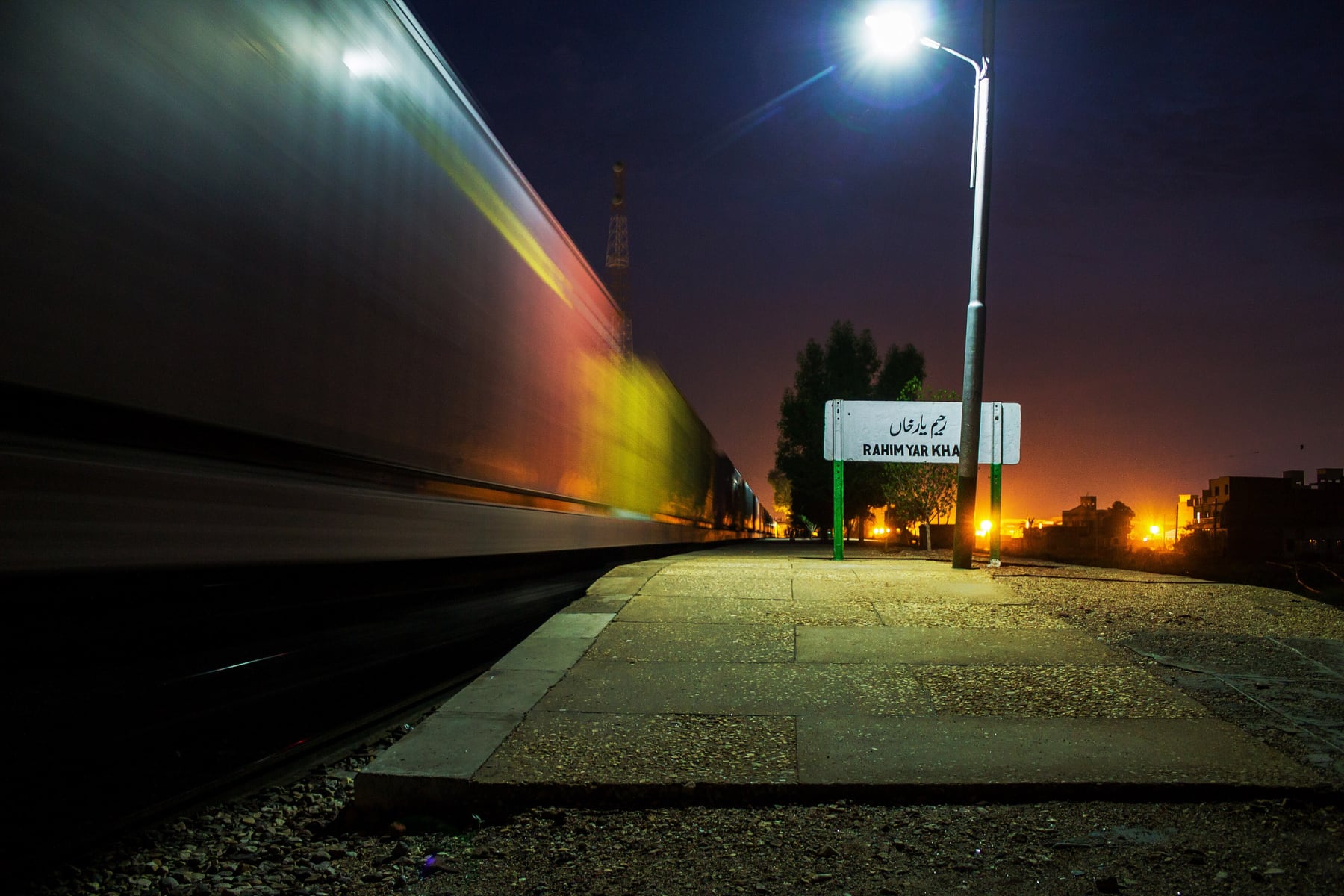
The Khyber Mail
Safeer Ahmad / Wikimedia Commons · CC BY-SA 4.0 · 2015 · cropped
- DistanceKarachi Cantt to Peshawar Cantt · some 1,700 km, the whole of Main Line 1
- DurationAbout 32 hours — two nights on board
- Best seasonNovember to February; the Indus plain passes 40 °C from May to September
Introduction
Travel advisory. The UK Foreign, Commonwealth & Development Office advises against using Pakistan's railway network at all, citing the risk of terrorist attacks and derailments. It also advises against all travel to Peshawar, including the city itself, and against all but essential travel to Nowshera and to every part of Sindh north of and including Nawabshah — which takes in Rohri, Sukkur, Khairpur and Ghotki. That is this train's northern terminus and a long stretch of its middle. The advice was updated on 7 August 2026 and was still current on 4 September 2026. Read it, and your own government's version, before you book. The page below describes a service that runs daily and is used by thousands of people every day; the decision is yours to make with the facts in front of you.
The Khyber Mail has run since 12 February 1920, which makes it the oldest named train in Pakistan and one of the oldest anywhere in Asia still working under its original name. It leaves Karachi Cantonment at night, follows the Indus the whole length of the country, and reaches Peshawar Cantonment on the second morning after — about thirty-two hours and some 1,700 kilometres, with more than forty stops. Nothing about it is fast. It is a mail train in the old sense, the service that ties a country together rather than one that shortens it.
The name is a promise the railway never quite kept. The Khyber Mail stops at Peshawar, and the pass it is named for begins beyond the city, up a switchback line to Landi Kotal that has not carried a scheduled train in years. What the train does instead is run the whole of Main Line 1 — the trunk route built to move troops towards the Afghan frontier, from the sea at Karachi through Sindh, the cotton and mango country of southern Punjab, Multan, Lahore and Rawalpindi to the edge of the mountains. Three-quarters of everything Pakistan Railways carries moves on this alignment, and for a day and a half you are on all of it.
The Journey
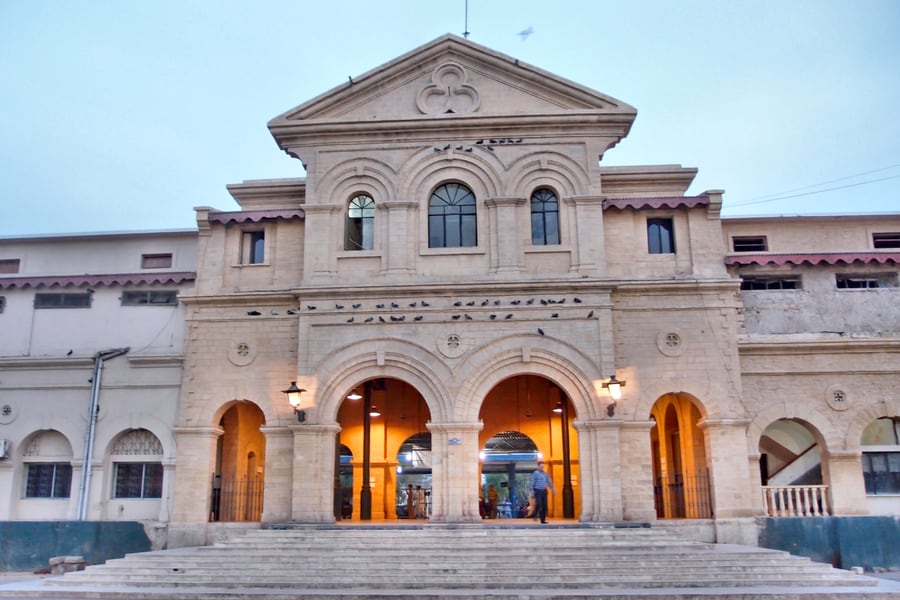
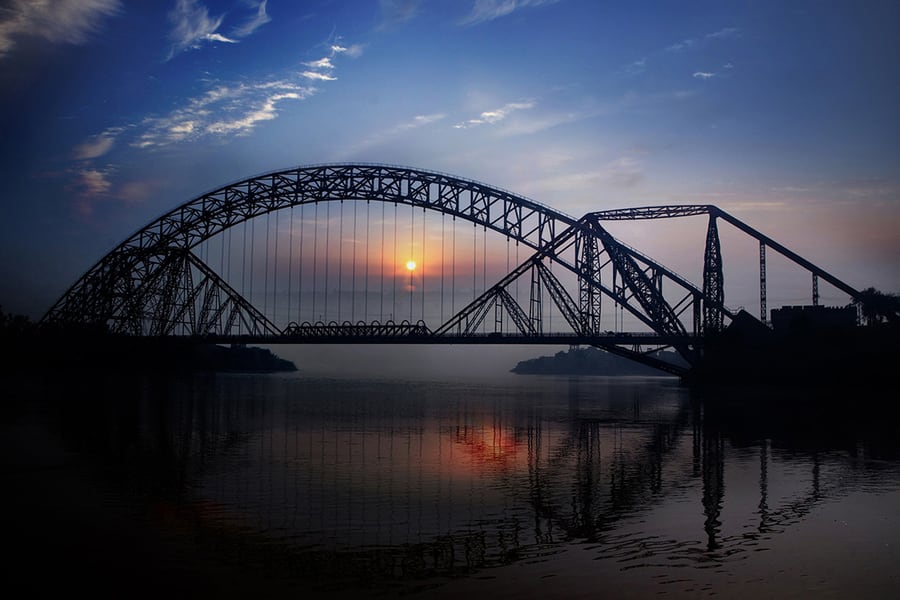
Boarding is at Karachi Cantonment, an arcaded stone station opened in 1898 with eight platforms and a booking hall that never empties, and 1UP goes out into the dark at a quarter past ten. The first two hours are suburban — Drigh Road, Landhi — and then the city stops and there is nothing outside the window but Sindh. You will not see the first three hundred kilometres. The train is at Hyderabad around midnight and at Rohri at dawn, and dawn at Rohri is worth setting an alarm for. The line crosses the Indus here on the Ayub Bridge, a steel arch opened in 1962, and alongside it stands the bridge it replaced: the Lansdowne, a 790-foot cantilever of 1889 by Alexander Meadows Rendel that was the largest cantilever bridge in the world when it was finished, and that carried every train between Sindh and Punjab for seventy-three years. It now takes road traffic, so you see it from the window rather than ride it.
After Rohri the day belongs to the plain. Rahim Yar Khan in the middle of the morning, then Bahawalpur and the edge of the Cholistan desert, then the Sutlej at Lodhran and Multan at lunch time, where the train stands twenty-five minutes and the platform fills with vendors. North of Multan the land turns green — canal country, wheat and cotton and mango orchards — and it stays green all afternoon.
Evening in Lahore, morning on the frontier
Lahore Junction comes at about half past seven in the evening, and the half-hour stand there is the best break of the whole run. The station was begun soon after 1857 and built in the shape of a medieval fort, with thick walls, drum turrets and slits cut to direct gun and cannon fire along the platforms — a railway station designed to be held. Everyone gets off, walks, buys food and gets back on.
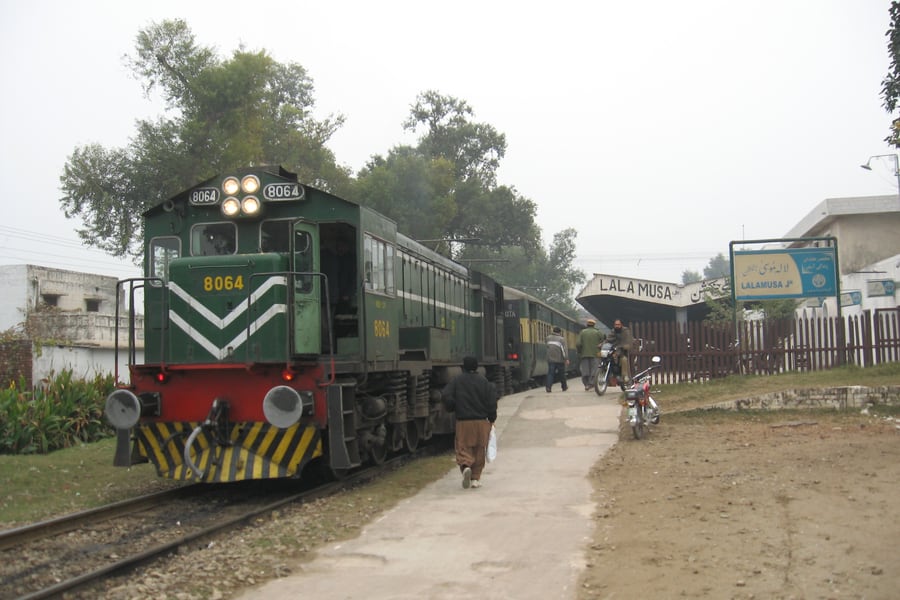
The second night takes the train up the Grand Trunk corridor through Gujranwala, Wazirabad, Gujrat and Lala Musa, over the Jhelum, and into Rawalpindi at about twenty past one in the morning. Beyond Pindi the country changes for the last time. The line drops to the Indus at Attock and crosses on a double-deck wrought-iron truss of 1883, five spans under the walls of Akbar's fort, with the Kabul river coming in from the west and bare hills on both banks. If you wake for one thing on the second night, wake for this. Nowshera, Peshawar City, and then Peshawar Cantonment at about half past five, with the hills of the Khyber grey on the western horizon.
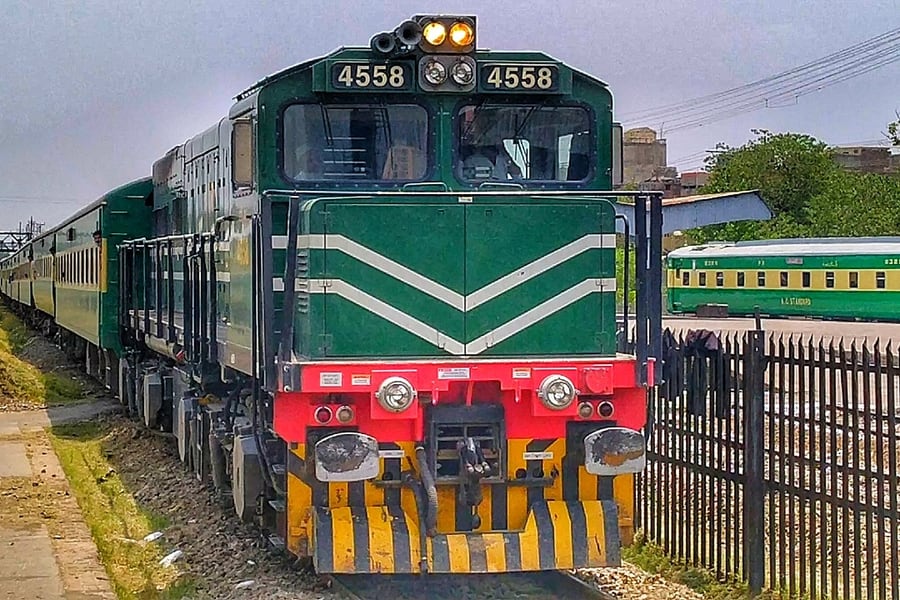
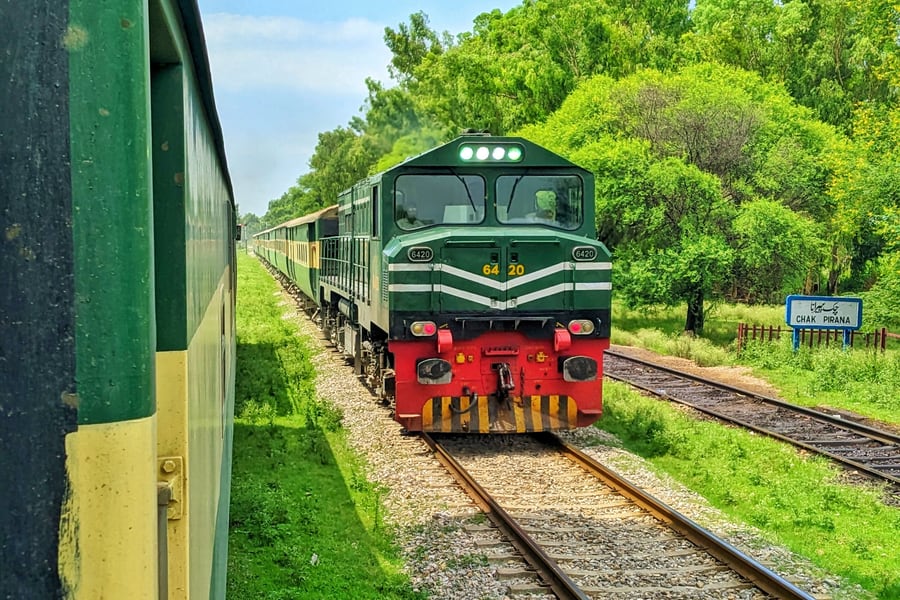
The traction is almost always a hood-unit diesel in Pakistan Railways green — white chevrons on the nose, a red buffer beam and yellow-and-black hazard stripes on the plough. The classes you meet on this line are the ZCU20, the HBU20 and the General Electric GEU family, and every one of them carries its number painted large in yellow on both cheeks, which is how Pakistani railway photographers name them rather than by class at all.
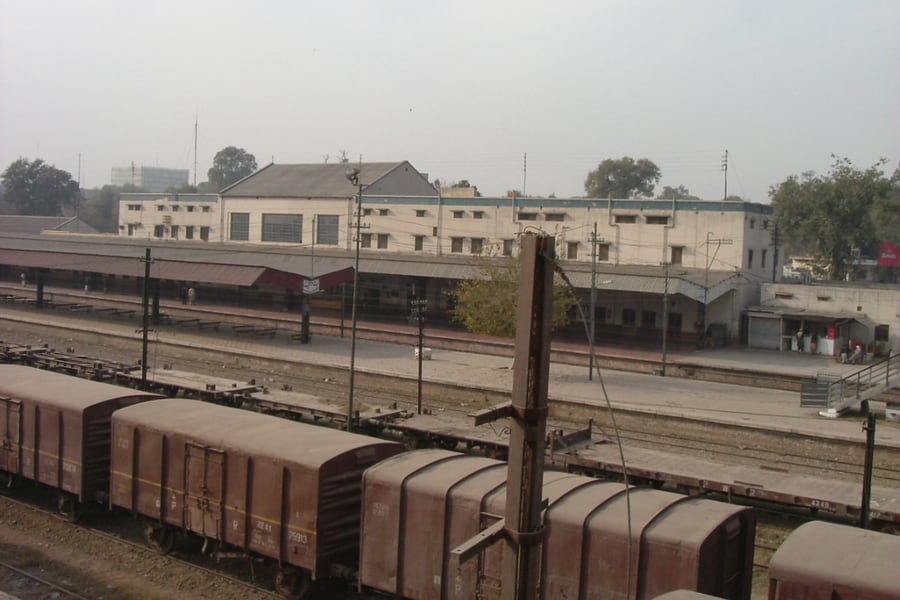
Along the route
 Abdullah Mughal / Wikimedia Commons · CC BY-SA 3.0 · cropped
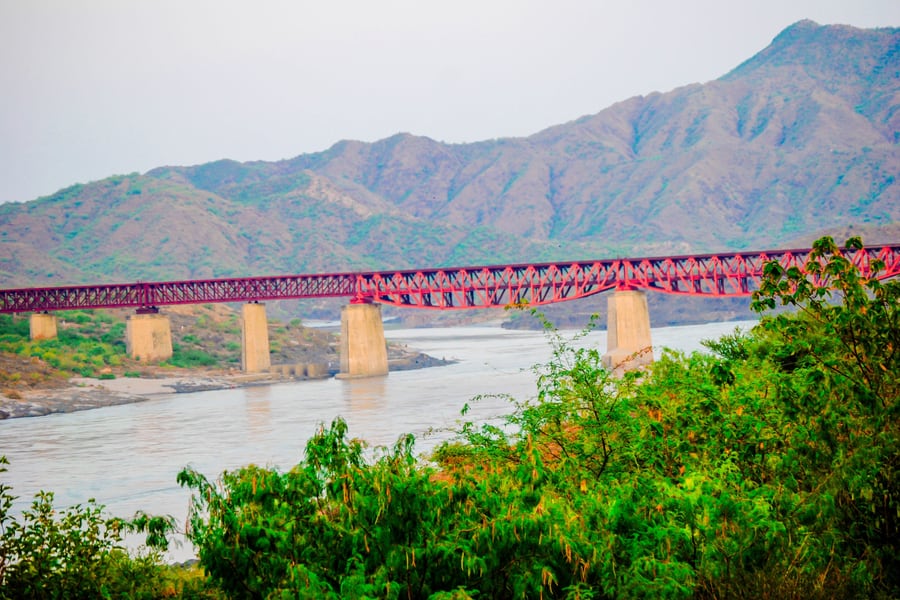
The Indus at Sukkur
Two bridges side by side at the Rohri crossing: the steel arch of 1962 that the trains use, and the 790-foot cantilever of 1889 beside it that they used for seventy-three years.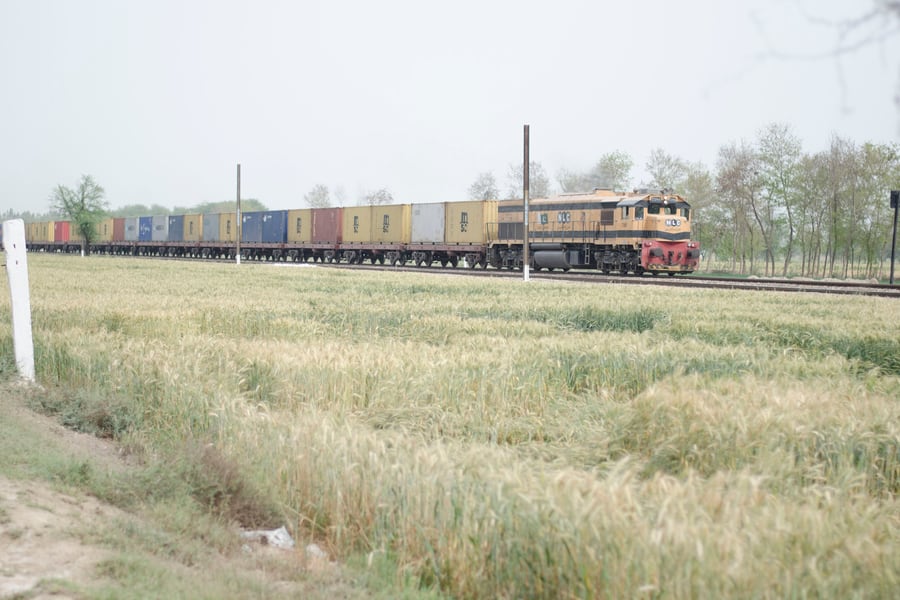 Majid Iqbal / Wikimedia Commons · CC BY-SA 4.0 · 2017 · cropped
The canal country
North of Multan the desert gives way to wheat, cotton and mango, and the train runs through green fields for most of the afternoon on a bank a metre above them.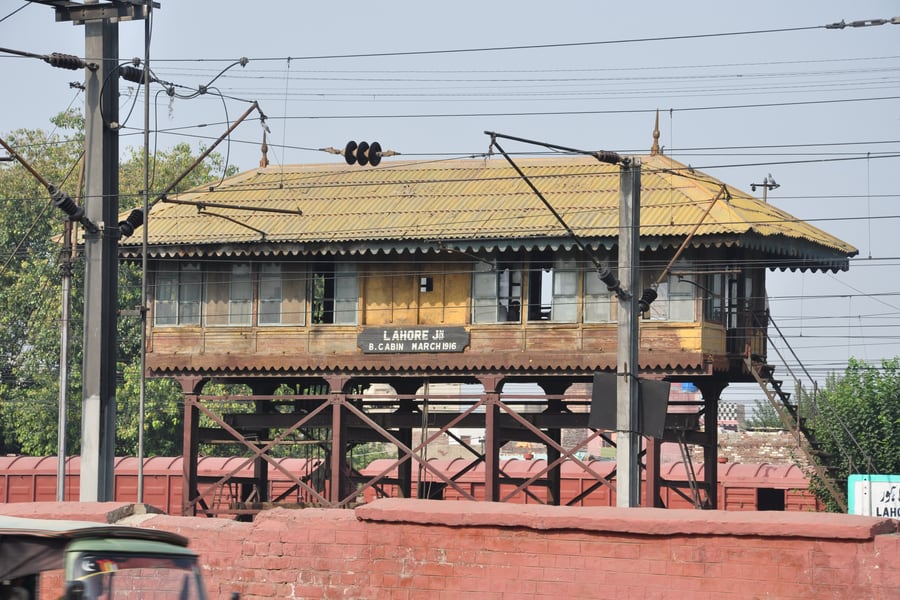 Nadeem Abbas Mushtaq / Wikimedia Commons · CC BY-SA 3.0 · cropped
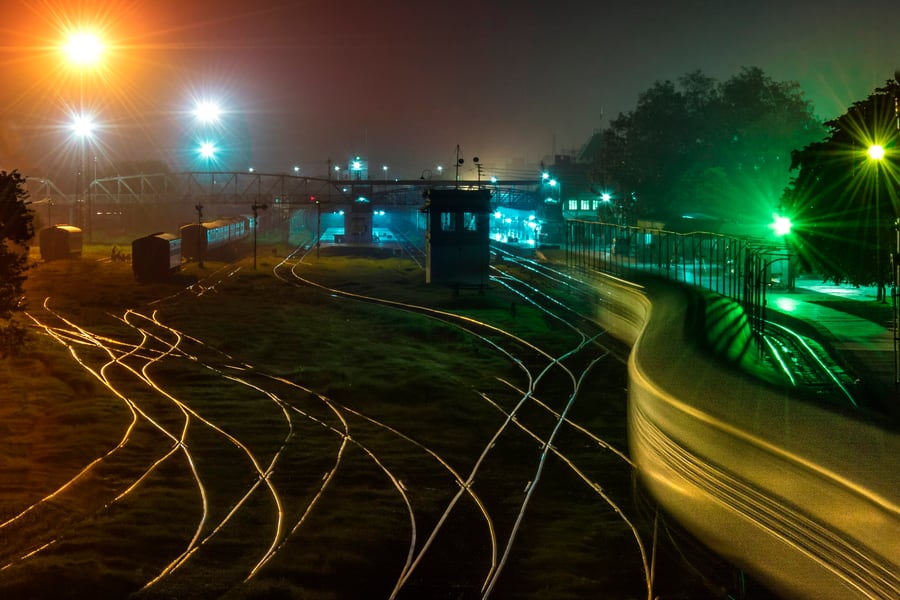
B Cabin, Lahore Junction
A timber signal box on iron stilts at the country end of Lahore Junction, its nameboard still lettered in the style of the North Western Railway that put it there.A bit of history
Culture & experiences along the way
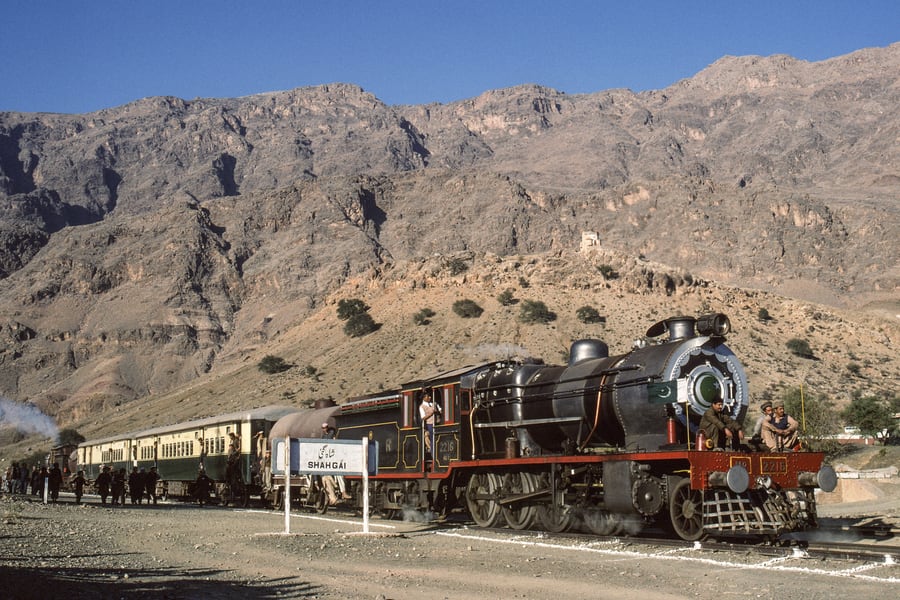 Nigel Tout / Wikimedia Commons · CC BY-SA 4.0 · 1993 · cropped
The pass the train is named for
Beyond Peshawar the line climbs to Landi Kotal on switchbacks and through tunnels, and it is one of the most famous railways ever built. This is it in 1993, a steam-hauled working standing at Shahgai. No scheduled train has run it in years, though Pakistan Railways' own site still advertises a steam charter through the pass.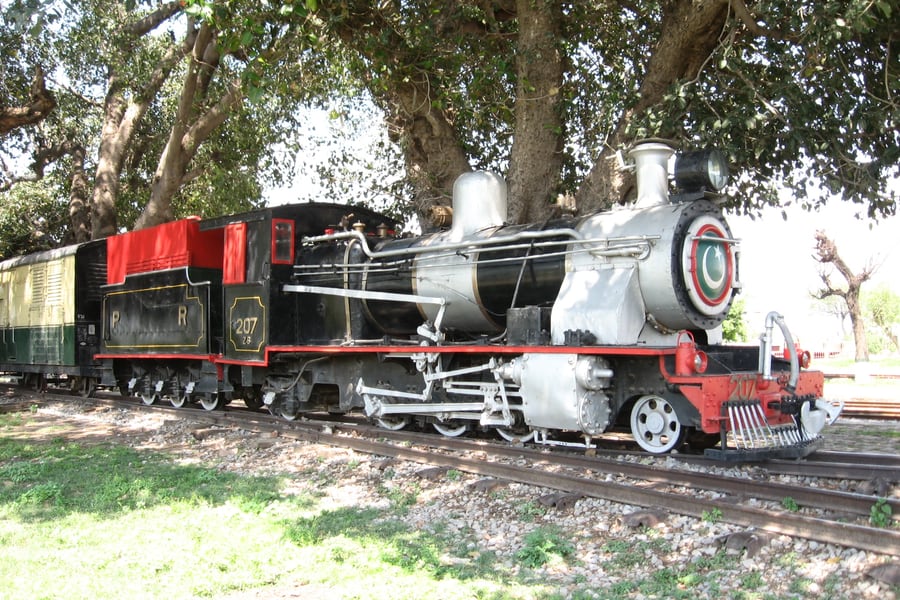 Adnanrail / Wikimedia Commons · CC BY-SA 3.0 · cropped
The museum at Golra Sharif
Pakistan Railways keeps its heritage collection at Golra Sharif Junction, on the Rawalpindi–Peshawar main line at the foot of the Margalla Hills: locomotives, a royal saloon, signalling instruments and station furniture, in the open air and in the old station buildings. The Khyber Mail passes it in the dark, so go by day from Islamabad.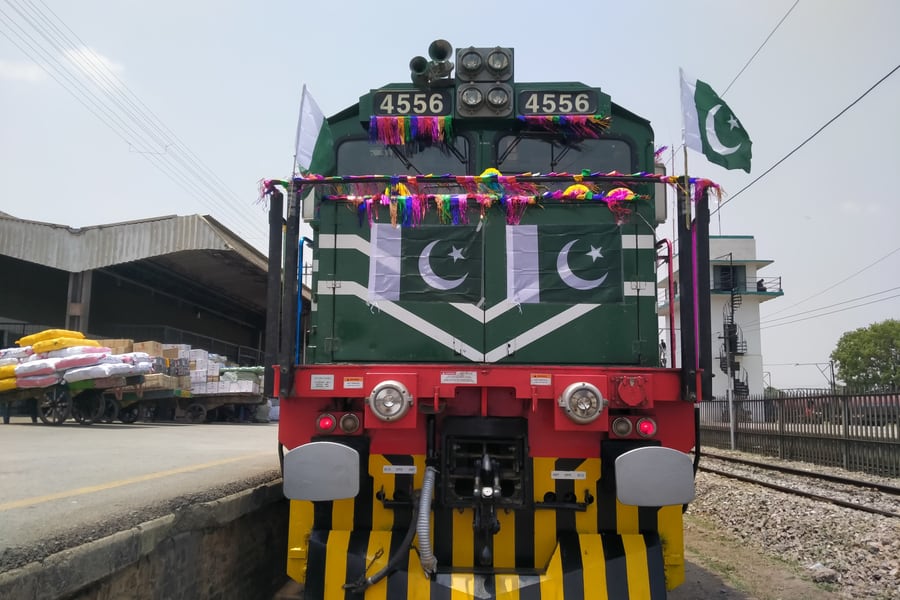 Mazahirshah / Wikimedia Commons · CC BY-SA 4.0 · 2021 · cropped
A locomotive dressed for the occasion
Pakistani decoration does not stop at lorries. For an inauguration, an anniversary or a national day a locomotive gets bunting along the roof line, tinsel round the number plates and flags on the handrails — the instinct that produces truck art, applied to two thousand horsepower of General Electric.Timetables
The Khyber Mail runs every day, in both directions, all year. There is one departure each way: 1UP leaves Karachi Cantonment at 22:15 and 2DN leaves Peshawar Cantonment at 22:00, and both take a little over thirty-one hours, so you sleep two nights on board and arrive on the second morning after you left. Every class is reserved — there is no walk-up carriage.
1UP · Karachi Cantonment to Peshawar Cantonment
| Station | Arrive | Depart |
|---|---|---|
| Karachi Cantt | — | 22:15 |
| Hyderabad Jn | 00:40 | 00:50 |
| Rohri Jn | 05:20 | 05:45 |
| Rahim Yar Khan | 08:30 | 08:34 |
| Bahawalpur | 11:29 | 11:34 |
| Multan Cantt | 13:15 | 13:40 |
| Sahiwal | 16:11 | 16:15 |
| Lahore Jn | 19:25 | 19:55 |
| Jhelum | 23:18 | 23:20 |
| Rawalpindi | 01:20 | 01:50 |
| Attock City Jn | 03:15 | 03:19 |
| Nowshera Jn | 04:13 | 04:17 |
| Peshawar Cantt | 05:20 | — |
2DN · Peshawar Cantonment to Karachi Cantonment
| Station | Arrive | Depart |
|---|---|---|
| Peshawar Cantt | — | 22:00 |
| Rawalpindi | 01:25 | 01:50 |
| Lahore Jn | 07:05 | 07:45 |
| Multan Cantt | 13:20 | 13:45 |
| Bahawalpur | 15:25 | 15:30 |
| Rahim Yar Khan | 18:07 | 18:09 |
| Rohri Jn | 21:25 | 21:50 |
| Hyderabad Jn | 03:05 | 03:15 |
| Karachi Cantt | 05:45 | — |
Those are the principal stops. The full booked schedule has more than forty, and the short ones are two minutes, which is long enough to buy tea on the platform and not much else. The stands worth planning around are Multan (25 minutes), Lahore (30 minutes) and Rawalpindi (25–30 minutes) — the only breaks in the run where you can walk properly.
Expect to be late. Delay on this train is common enough to have been litigated: in August 2026 a consumer court in Karachi ordered Pakistan Railways to pay Rs 50,000 to a passenger whose Khyber Mail reached Karachi four hours behind time. Build slack into anything you plan for the day you arrive.
As of September 2026. Times are Pakistan Railways' published schedule and drift; check the operator's live board before travelling at Pakistan Railways Train Timings (opens in a new tab), which lists this train as 1UP and 2DN, or by calling 117 free from any phone in Pakistan.
Tickets
Pakistan Railways prices by distance, not by train. Its published passenger fare table, in force since 20 April 2025, sets one column of rates for the group of expresses the Khyber Mail belongs to and then reads the fare off the length of your journey; end to end, Karachi to Peshawar falls in the 1,731–1,740 km band. The cards below are the fares in that band. Anything shorter costs proportionately less, and there is no premium for the name.
Tickets are sold at station windows and online through RABTA, the operator's own e-ticketing system, which also has an Android and iOS app. Reservation is compulsory in every class, so buy before the day if you can — the sleeper berths on this train go first, and there are only so many of them.
Book your tickets
Economy
Rs 4,300 end to end
Open seating, no bedding, and the class most of the train is made of.
Book Tickets (opens in a new tab, on pakrailways.gov.pk)via pakrailways.gov.pkAC Standard
Rs 9,800 end to end
Air-conditioned reserved seating, and the sensible minimum for two nights.
Book Tickets (opens in a new tab, on pakrailways.gov.pk)via pakrailways.gov.pkAC Business
Rs 11,550 end to end
Wider reclining seats in an air-conditioned saloon, reserved by seat number.
Book Tickets (opens in a new tab, on pakrailways.gov.pk)via pakrailways.gov.pkAC Sleeper
Rs 15,500 end to end
A four-berth compartment with bedding, and the only way to sleep properly.
Book Tickets (opens in a new tab, on pakrailways.gov.pk)via pakrailways.gov.pkRail Passes
There is no rail pass for Pakistan, and no scheme this journey belongs to. Pakistan Railways is not part of Interrail or Eurail, there is no equivalent national or regional multi-journey ticket, and no international pass is honoured on the network. Tickets are sold train by train and class by class.
That is less of a loss than it sounds. The fares here are low by any international standard — the full 1,700 kilometres in Economy costs about the same as a short intercity hop in western Europe — so there is nothing for a pass to save you. What a pass would buy elsewhere, flexibility, you get here by booking a berth in advance instead: the constraint on this train is not price but availability, and no pass in the world reserves a sleeper for you.
Checked against Pakistan Railways' own fares and ticketing pages, September 2026.
Places to Visit
Thirty-two hours is long enough that most people break the run, and the Khyber Mail makes that easy: it is one train with one ticket, but the cities it threads are among the oldest continuously inhabited places in South Asia, and a stop of a day or two in any of them changes the journey from a transit into a route. The stands below are all on the booked schedule.
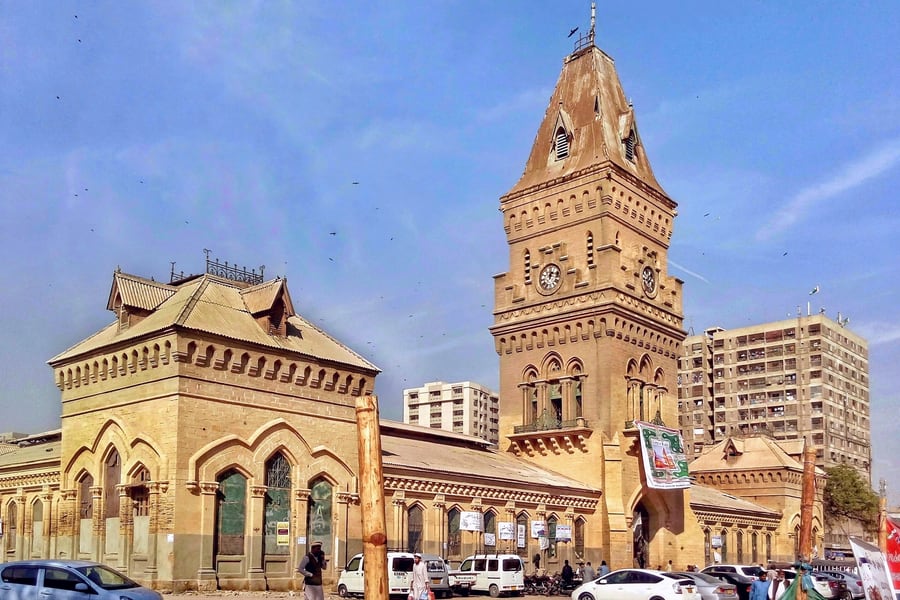 Siddiqi / Wikimedia Commons · CC BY 4.0 · cropped
Karachi, and the Empress Market
The train starts in a city of the sea, and the thing to see near the station is the market the Raj put up in Saddar in the 1880s: a Gothic hall with a clock tower, selling condiments, fruit, meat, textiles, stationery and pets under one roof, and still one of the busiest places in Karachi. It is a short walk from Karachi Cantonment, which makes it the obvious way to spend an afternoon before a 22:15 departure.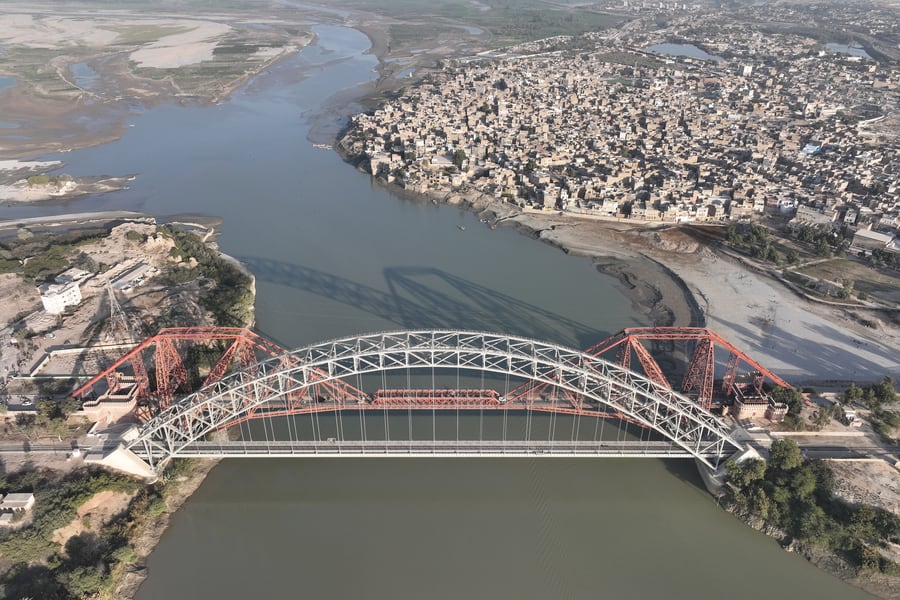 Mhtoori / Wikimedia Commons · CC BY-SA 4.0 · cropped
Sukkur and Rohri
The Indus narrows here between two rock hills — the Gate of Sindh — and the result is the most concentrated piece of railway engineering in Pakistan. Walk out onto the Lansdowne Bridge, which carries road traffic now, and you are standing on the largest cantilever span in the world of 1889 with the trains going past on the arch beside you. Sukkur is the third city of Sindh; Rohri, across the water, is much older.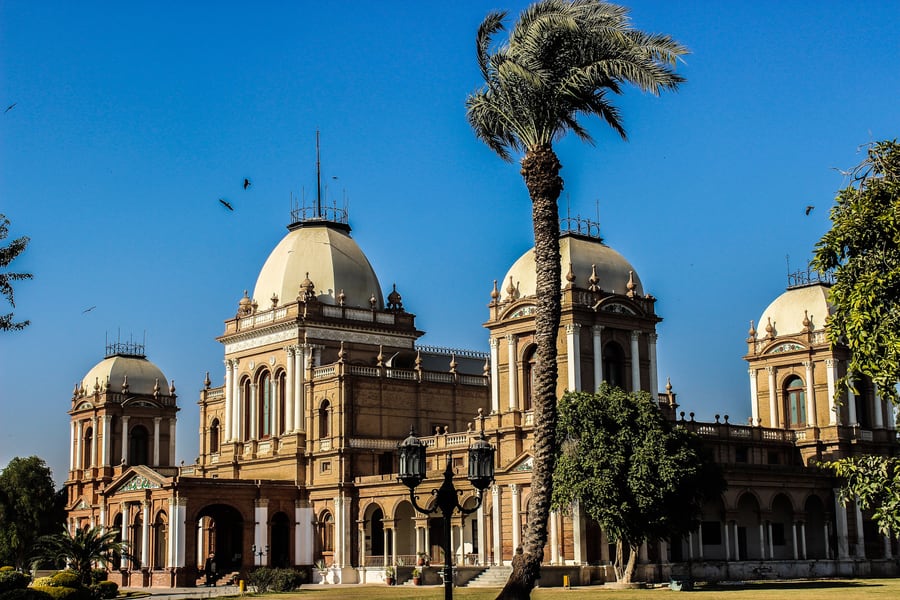 Abdullahvance / Wikimedia Commons · CC BY-SA 4.0 · cropped
Bahawalpur and the Noor Mahal
Bahawalpur was a princely state within living memory and it still looks like one. The Noor Mahal, built in the 1870s as the Nawab's residence and workplace, is an Italianate palace with domes and a colonnade dropped into the edge of the Cholistan desert, and it is open to visitors. The desert fort of Derawar is a couple of hours further out and worth the drive if you have the day.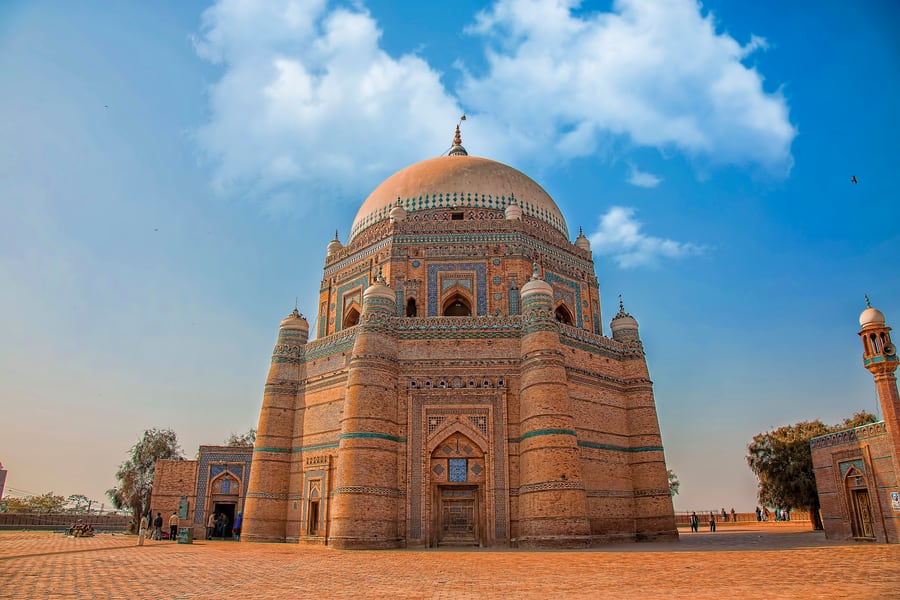 Tahsin Shah / Wikimedia Commons · CC BY-SA 4.0 · cropped
Multan, city of saints
One of the oldest continuously inhabited cities in Asia, and the shrine on the mound above it is the reason to break the journey. The tomb of Shah Rukn-e-Alam, built in the 1320s at the north-western corner of the old fort, is the earliest surviving example of Tughluq architecture — a vast octagon of red brick and blue tile, and the destination of more than a hundred thousand pilgrims at the annual urs.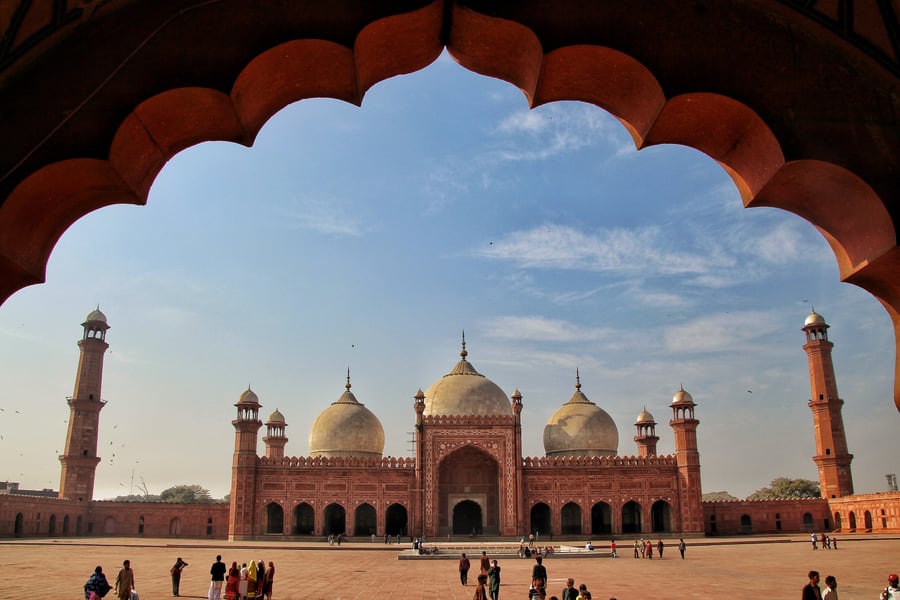 Fassifarooq / Wikimedia Commons · CC BY-SA 4.0 · cropped
Lahore
The half-hour stand is not enough and everybody knows it. Lahore holds the Mughal capital's best surviving set piece: the Badshahi Mosque of 1671–73, built by Aurangzeb facing the Lahore Fort across the Hazuri Bagh, with a courtyard that takes tens of thousands of people and red sandstone that turns the colour of embers at sunset. The Walled City around it is being restored street by street.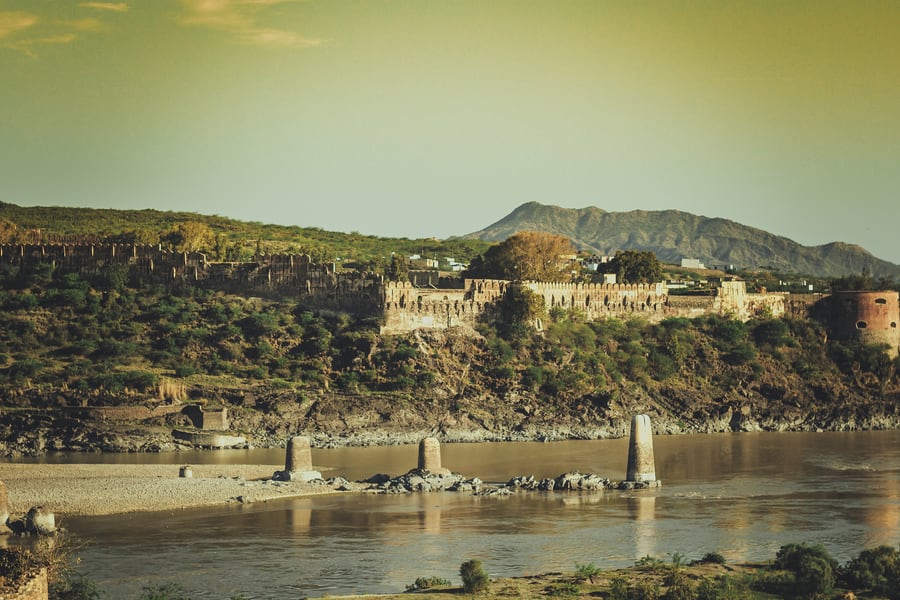 Imkashi94 / Wikimedia Commons · CC BY-SA 4.0 · cropped
Attock, where the rivers meet
Akbar built the fort here between 1581 and 1583 to hold the crossing of the Indus, and the railway came through under its walls three hundred years later. The Kabul river joins the Indus just upstream, and the last flat ground before the frontier has been fought over accordingly. The train crosses at about a quarter past three in the morning northbound, which is the one alarm on this journey worth setting.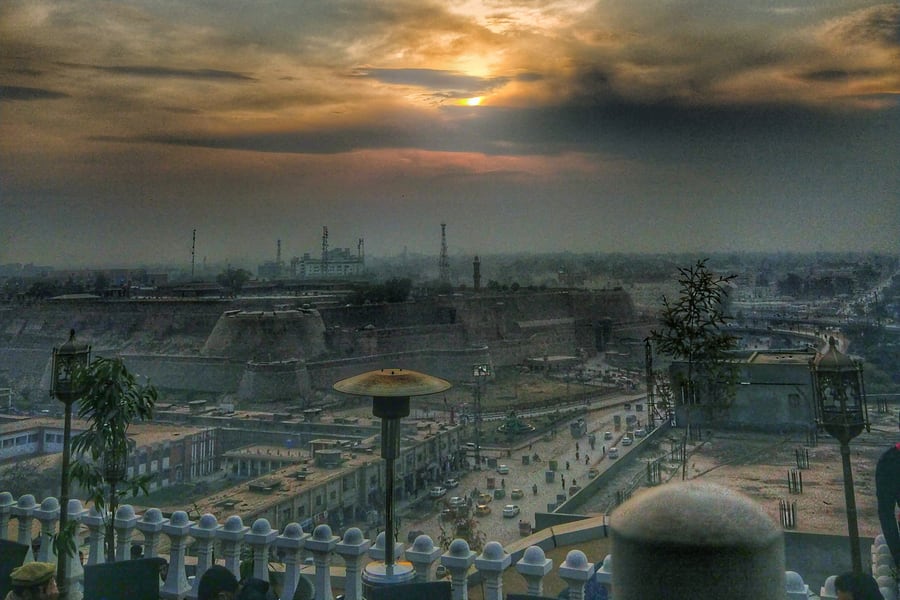 Maximusopti / Wikimedia Commons · CC BY-SA 4.0 · cropped
Peshawar
⚠️ The FCDO advises against all travel to Peshawar, including the city itself. With that said plainly: this is where the train ends, and the Bala Hissar above the old city has been a fortress since a seventh-century Chinese pilgrim wrote it down. It was the Durrani royal residence from 1772, destroyed and rebuilt by the Sikhs in 1823, and rewalled by the East India Company in 1849. The Qissa Khwani — the storytellers' bazaar — is below it.Where to Sleep
The train itself solves two of your nights. AC Sleeper is a four-berth compartment with bedding; AC Business and AC Standard are reclining seats, comfortable enough for one night and long by the second. Book the sleeper if you can get it — on a run of this length the difference is not comfort but sleep.
For the nights either side, the three cards below are hotels with their own websites, in the three cities where the train stands longest. There is no card for Peshawar. The FCDO advises against all travel to the city, and it would be wrong to send a reader to a bed there behind a cheerful "check availability" button. If you are going anyway, arrange the stay through someone with local knowledge rather than off a page like this one.
Where to stay
Avari Towers Karachi
Shahrah-e-Faisal, in the business district
A high-rise with floor-to-ceiling windows, a short ride from Karachi Cantonment.
Check Availability (opens in a new tab, on avari.com)via avari.comPearl-Continental Hotel Lahore
Shahrah-e-Quaid-e-Azam, on the Mall
Six hundred and seven rooms and suites on the Mall, a short ride from Lahore Junction.
Check Availability (opens in a new tab, on pchotels.com)via pchotels.comPearl-Continental Hotel Rawalpindi
Mall Road, in the garrison city
A hundred and eighty-eight rooms on Mall Road, and the usual base for the north.
Check Availability (opens in a new tab, on pchotels.com)via pchotels.comPractical Information
Security first. Read the advisory at the top of this page, then read your own government's version in full. The FCDO's position is that the railway network should be avoided altogether; its stated reasons are terrorism and derailments, and it names the March 2025 hijacking of the Jaffar Express — a different train, on the Quetta line through Balochistan, in which 64 people died. In higher-risk areas local authorities sometimes arrange a police escort for foreign travellers, and they will tell you whether you need a No Objection Certificate from the Ministry of the Interior. Contact them before you go rather than at the station.
Visas. You need a visa and must apply in advance; there is no visa on arrival for tourists. Your passport must be valid for at least six months beyond the date of your visa application. Journalists' visas carry extra travel restrictions.
When to go. November to February. The Indus plain from Sukkur to Multan regularly passes 40 °C from May to September, and air conditioning on a delayed train is a promise rather than a guarantee. Winter brings fog to Punjab, which is the usual cause of the long delays between Lahore and Rawalpindi; the trade is heat for lateness.
On board. Bring water, a torch and a padlock and chain for luggage, and take a light blanket even in the sleeper. Food is sold at every long stand and by vendors working through the train; buy water sealed.
Language. Urdu and English. Pakistan Railways publishes in English, station boards carry both scripts, and staff on the mail trains generally have enough English for anything you need.
Travel advice checked against gov.uk/foreign-travel-advice/pakistan, September 2026.
Questions or corrections
Planning this trip and stuck on something, or spotted a time, fare or detail that has changed? Send us a message about The Khyber Mail. We read every one, and we update this page when something has changed.