Kislovodsk to Mineralnye Vody
Neu-Zwei / Wikimedia Commons · CC BY-SA 4.0 · cropped
- Distance64 km
- Duration57 minutes to 1 h 35 min
- Best seasonYear-round
Introduction
Four towns in the foothills of the Caucasus sit on top of some of the most famous mineral springs in the world, and a single branch line strings all four together. It leaves the main Rostov–Baku railway at Mineralnye Vody, 300 metres above sea level on the open steppe, and climbs 64 kilometres south-west along the Podkumok to Kislovodsk at 815 metres, with Beshtau, Pyatigorsk and Yessentuki on the way. Every one of them is a spa. The whole region is called the Caucasian Mineral Waters — Kavkazskie Mineralnye Vody — and the railway is the thing that made it one place rather than four.
It opened on 17 May 1894, built by the Vladikavkaz Railway company on the authority of Alexander III, and it has been double track throughout since 1912. In November 1936 the wires went up and the first electric train ran: this was the first electrified stretch of railway in the North Caucasus, fed from the Baksan hydro station, and it has been worked by electric trains ever since — direct current until 2006, alternating current now.
What that history has left is one of the most useful short railways in Russia. A train leaves each end roughly every half hour from half past five in the morning until nine at night, four of them each way are fast Lastochka units that do the run in 57 minutes, and a dozen long-distance trains — to Moscow, St Petersburg, Adler, Tynda — start at Kislovodsk and pick up at the spas before turning onto the main line. You do not plan this journey. You turn up and take the next one.
The Journey
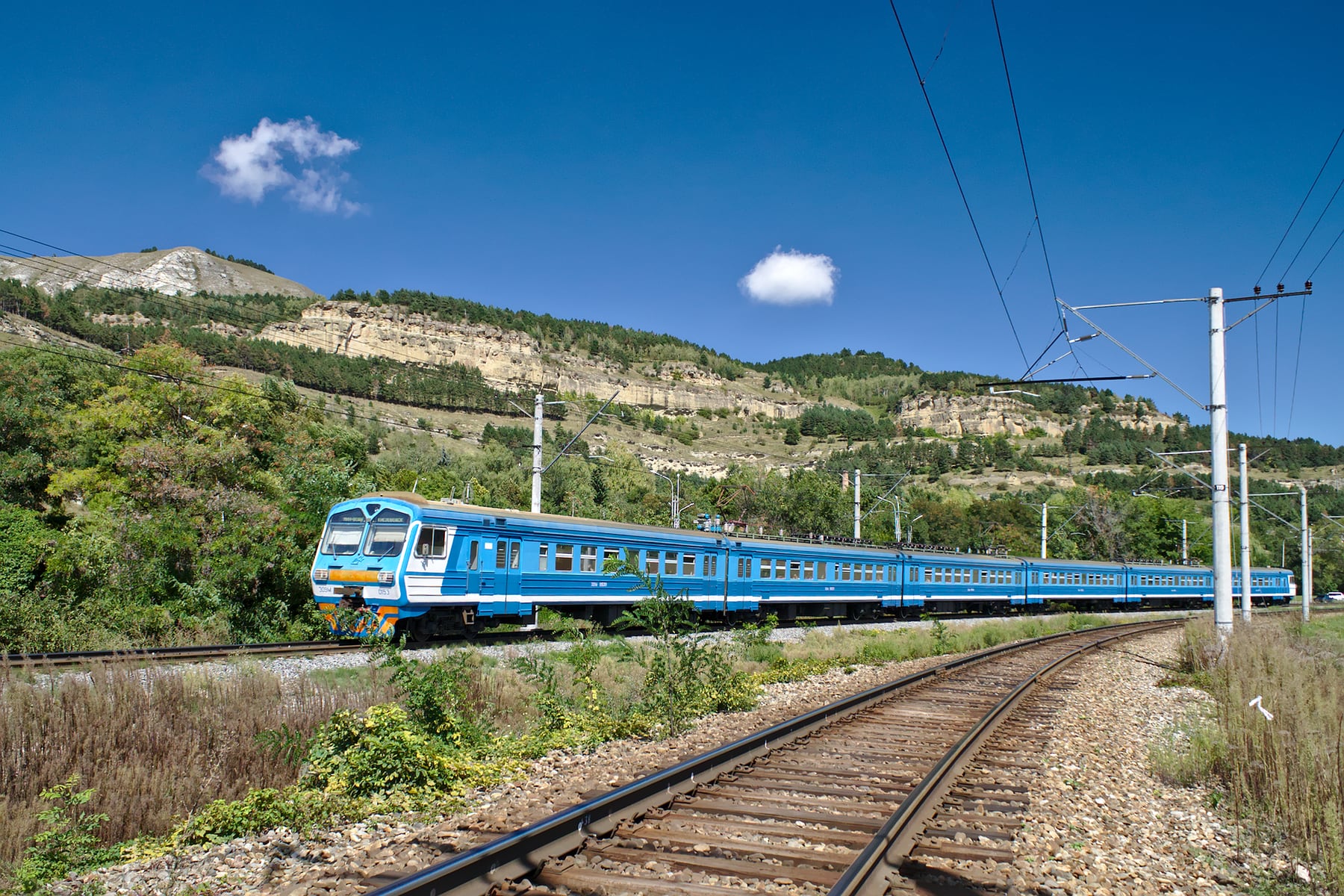
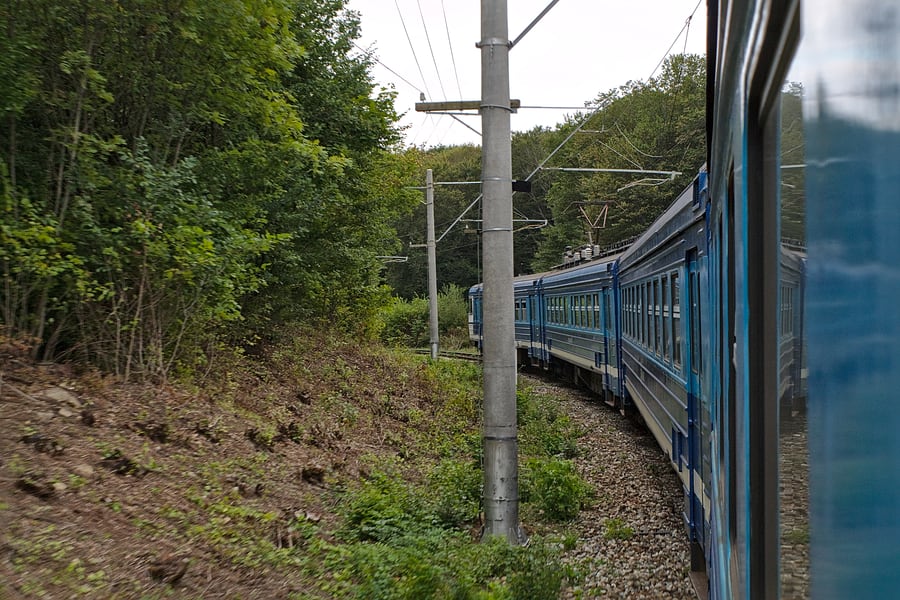
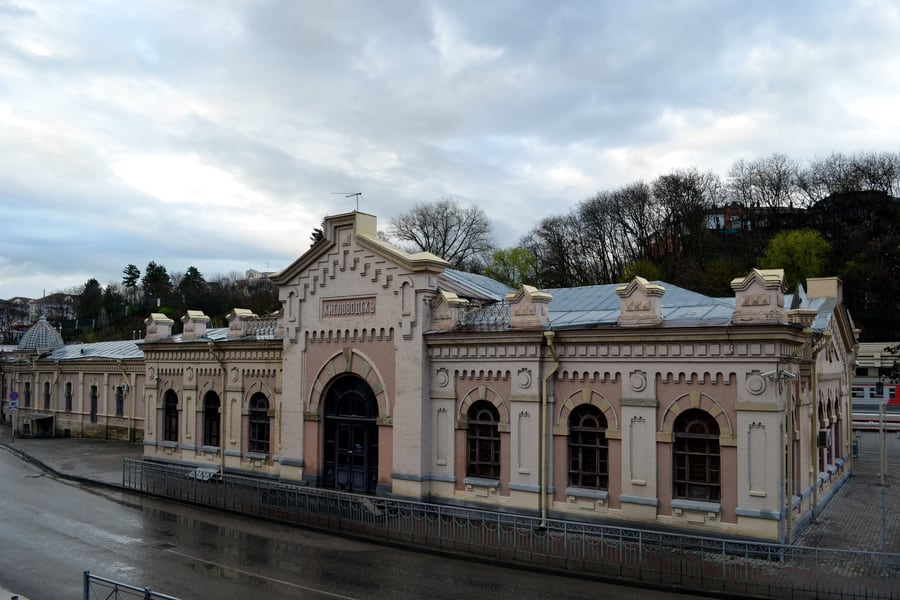
Kislovodsk station is a terminus, and it looks like one: a long single-storey building of 1894 with the town's name in relief across a stepped gable, four high platforms and one low one, and buffer stops about ten minutes' walk from the mineral water. The train is usually four cars of an ЭД9М — the standard alternating-current suburban unit in Russia, built at the Demikhovo works — painted blue and white, with windows that drop and a guard who calls the stations. It leaves downhill, because everything from here is downhill.
Along the Podkumok
The first stretch is the best. Past Minutka, a kilometre out, the line runs on a shelf above the Podkumok under the sandstone cliffs that Kislovodsk's Red, Grey and Blue Stones are weathered out of, and for a few minutes there is nothing in the window but rock, pine and the river. Nine kilometres out is Podkumok, and at 16 km a halt with an odd name: Belyi Ugol, white coal. It is named for the little hydro-electric station Siemens & Halske built on the river here in 1903 to light the spas and run the Pyatigorsk tram — the first industrial hydro station in Russia, and now a museum with its machines still in it.
Yessentuki, 21 km from Kislovodsk, is the first of the big stops, and the busiest intermediate station on the line. The town's medical park starts a few minutes from the platform; so does the most extraordinary building anywhere near this railway, the 1915 mud baths, which look like Roman thermae because that is exactly what the architect intended.
Pyatigorsk and the duel
Between Yessentuki and Pyatigorsk the valley opens and the laccoliths appear — isolated domed mountains that never quite became volcanoes, standing up out of flat country. Pyatigorsk, 38 km out, is the largest town on the line and the oldest spa in the group; Mount Mashuk rises straight behind the station, with a cable car up it and the Aeolian Harp rotunda on the shoulder.
Four kilometres further on, the train stops at Lermontovsky. The halt exists because, on 28 June 1901, the board of the Vladikavkaz Railway agreed to stop trains near the place where Mikhail Lermontov had been killed in a duel sixty years earlier, and built a platform for the visitors. The signboard still reads ЛЕРМОНТОВСКИЙ, the Lastochka still calls there, and it is one of very few railway stations anywhere opened on literary grounds.
Beshtau, and a branch that refused to die
Beshtau, 50 km out, is a junction under the five summits of the mountain it is named for — besh tau, five mountains, 1,402 metres. When the branch was surveyed, Zheleznovodsk was left off it, and passengers had to finish the journey by carriage; so in 1897, again by order of Alexander III, a single track 6 km long was laid up the hillside to reach it. That branch has been closed and reopened repeatedly — no service after October 2008, a fortnight in May 2010, seven months in 2013–14 — and today several trains a day run right through from Kislovodsk to Zheleznovodsk, taking 16 minutes from Beshtau.
Down to the plain
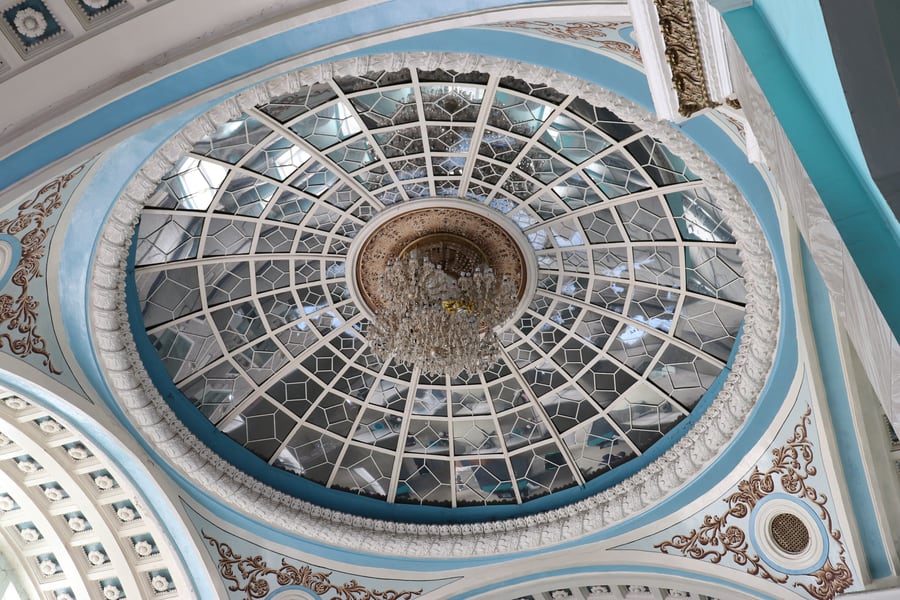
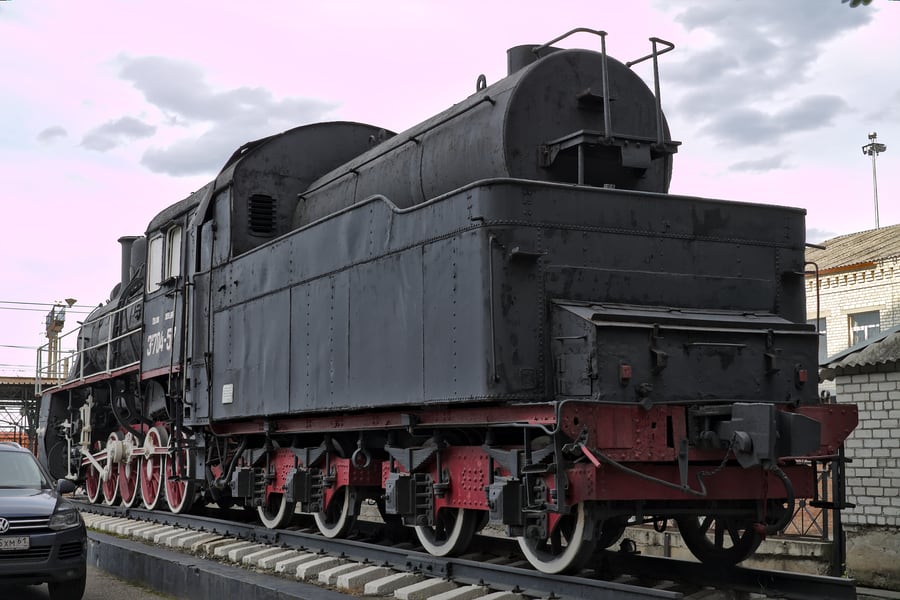
The last 14 kilometres are the least interesting and the quickest: past Zmeyka, another laccolith, across flat ground, and into Mineralnye Vody, which is a junction and an airport town rather than a spa. The station is worth the five minutes it takes to walk round. It was rebuilt in 1955 in confident Stalinist style — a clock tower, a colonnade that bows outwards towards the platforms, a fountain with an eagle on it — and inside, over the booking hall, there is a glazed dome in blue and white with a chandelier hanging from the middle of it. On the forecourt stands Эу-704-57, a 1930s freight locomotive of the class that worked this line before the wires went up.
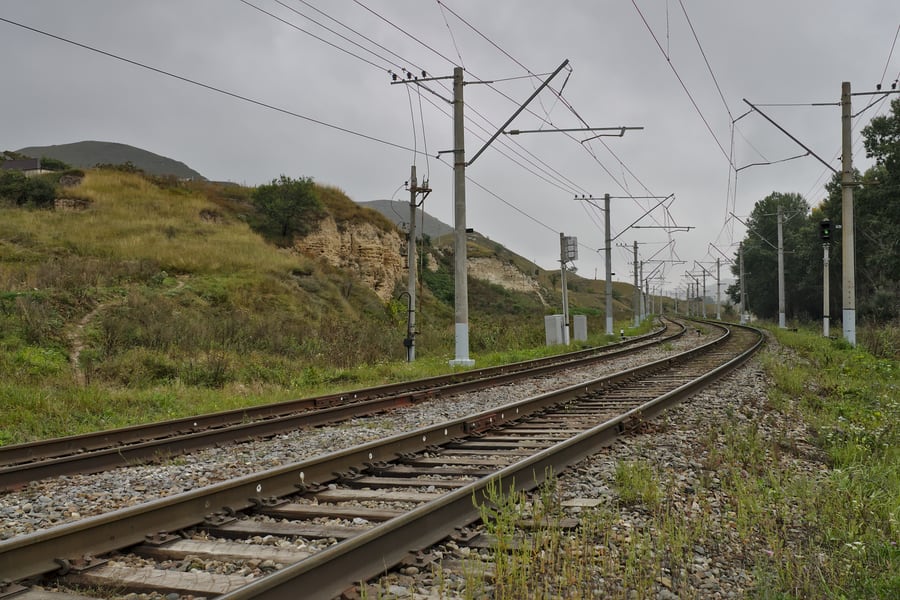
Along the route
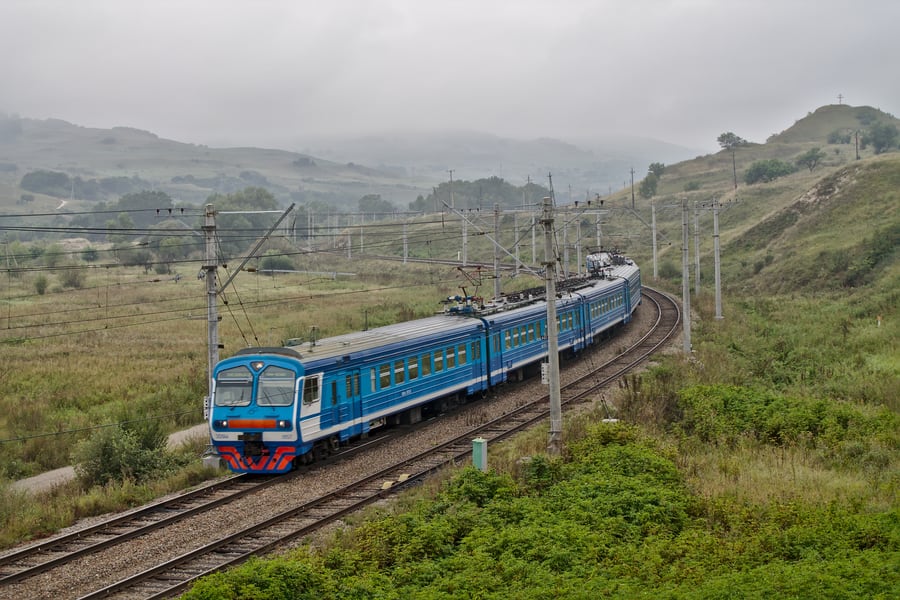 Neu-Zwei / Wikimedia Commons · CC BY-SA 4.0 · cropped
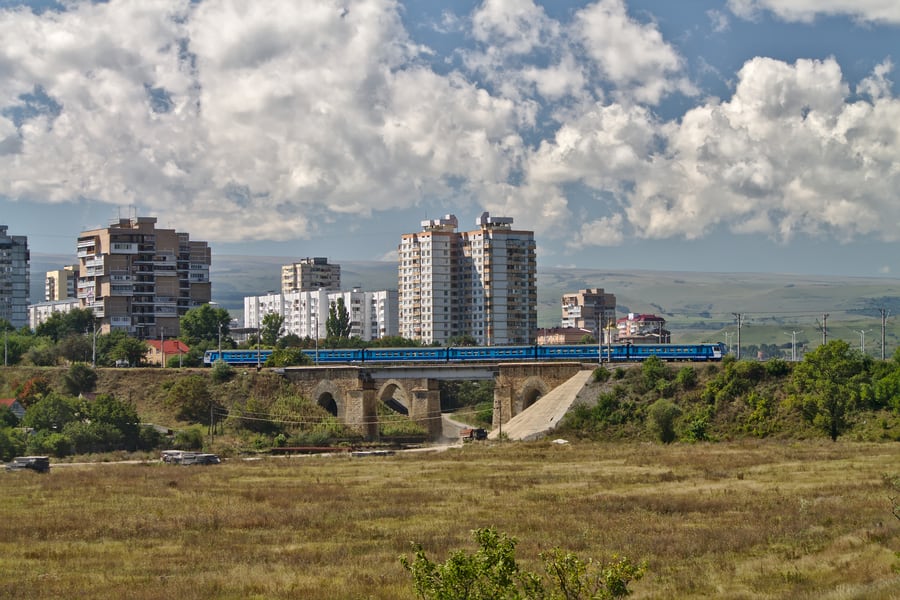
The climb down from Kislovodsk
The first ten kilometres are the best of the line: out of the terminus at 815 m, past Minutka, and along a shelf above the Podkumok under the sandstone cliffs the town's Red, Grey and Blue Stones are cut from.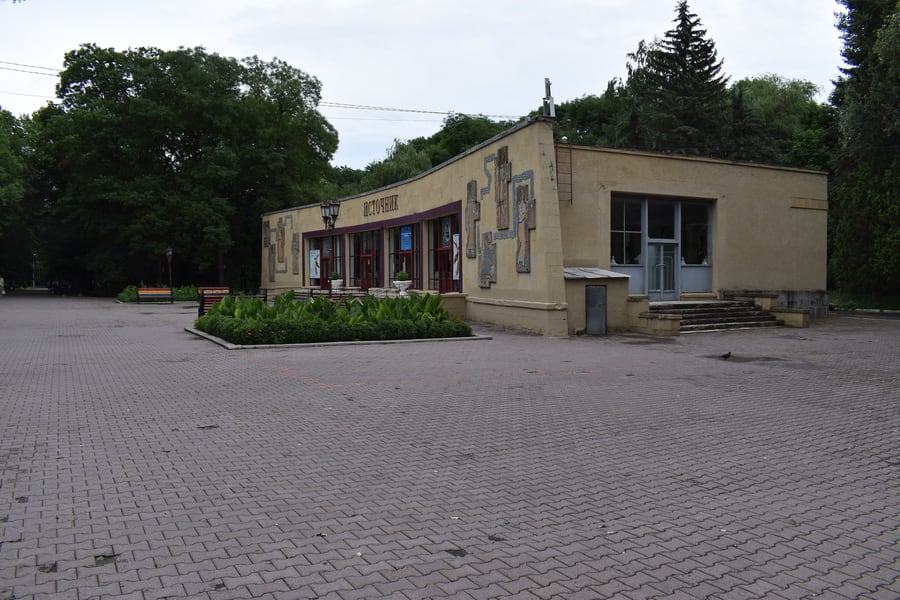 Elenastav / Wikimedia Commons · CC BY-SA 4.0 · cropped
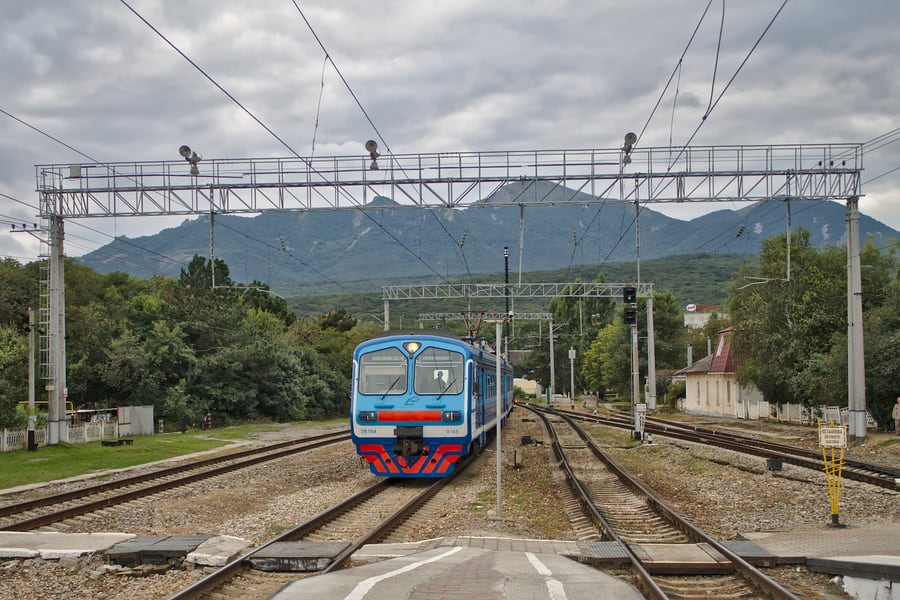
Yessentuki, and the water
Twenty-one kilometres out, and the busiest intermediate stop. The medical park begins a few minutes from the platform, and the pavilion over Spring No. 4 is where most passengers are heading — a drinking gallery rather than a bath house.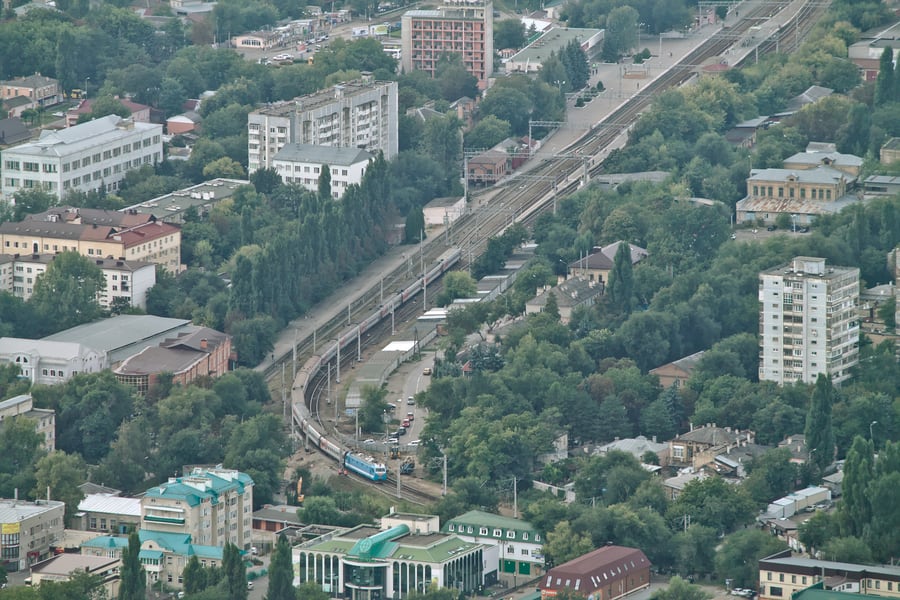 Neu-Zwei / Wikimedia Commons · CC BY-SA 4.0 · cropped
Pyatigorsk from Mount Mashuk
The largest town on the line, 38 km out, and the one place you can see the railway whole: from the cable-car station on Mashuk the track runs across the valley floor in a single curve, with the station in the middle of it.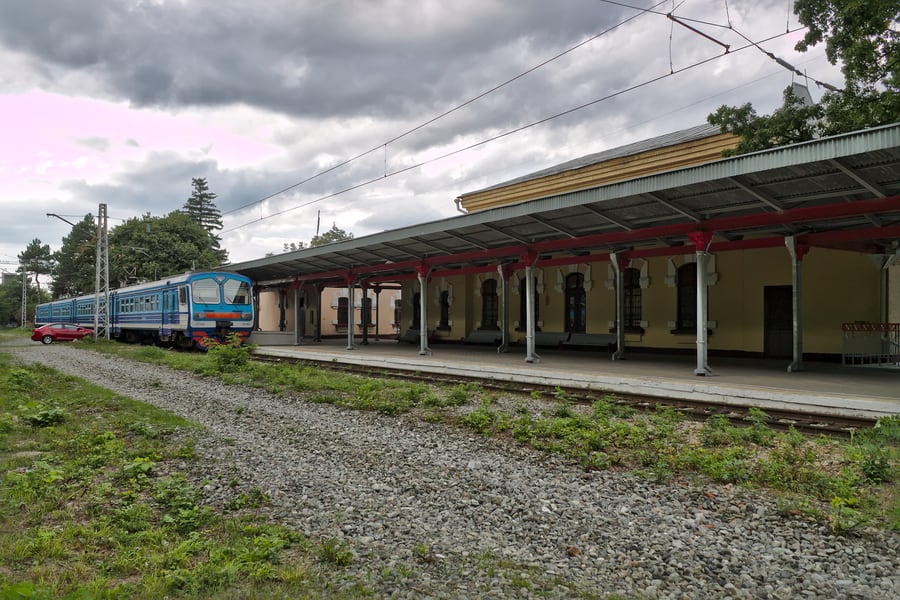 Neu-Zwei / Wikimedia Commons · CC BY-SA 4.0 · cropped
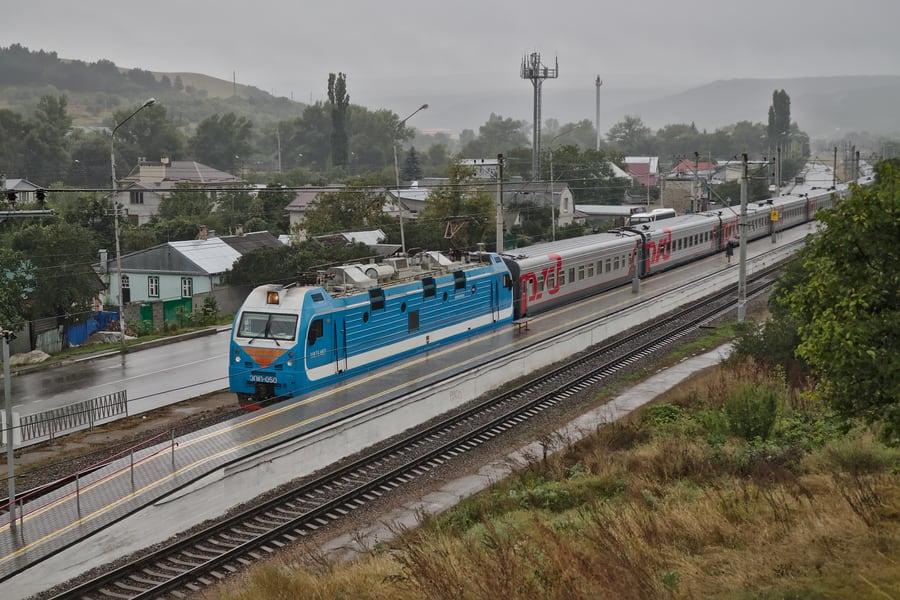
Beshtau and the six-kilometre branch
Fifty kilometres out a single track turns off and climbs 6 km to Zheleznovodsk, opened on 1 January 1897 by order of Alexander III because the main branch had missed the town. Several trains a day still run through from Kislovodsk.A bit of history
Culture & experiences along the way
 Dmitry89 / Wikimedia Commons · CC BY-SA 4.0 · cropped
A concert hall built by a railway company
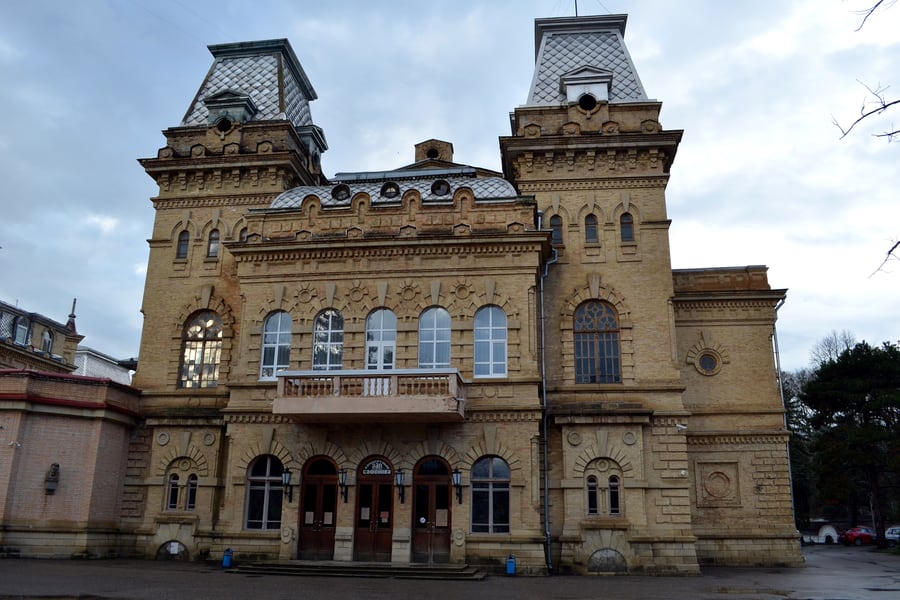
Beside Kislovodsk station stands the Kurzal, paid for by the Vladikavkaz Railway company to entertain its own passengers and opened in 1895. Chaliapin sang here, Rachmaninov played here, and it is still a working concert hall — the North Caucasus Philharmonic, named for Vasily Safonov, who argued the railway into building it.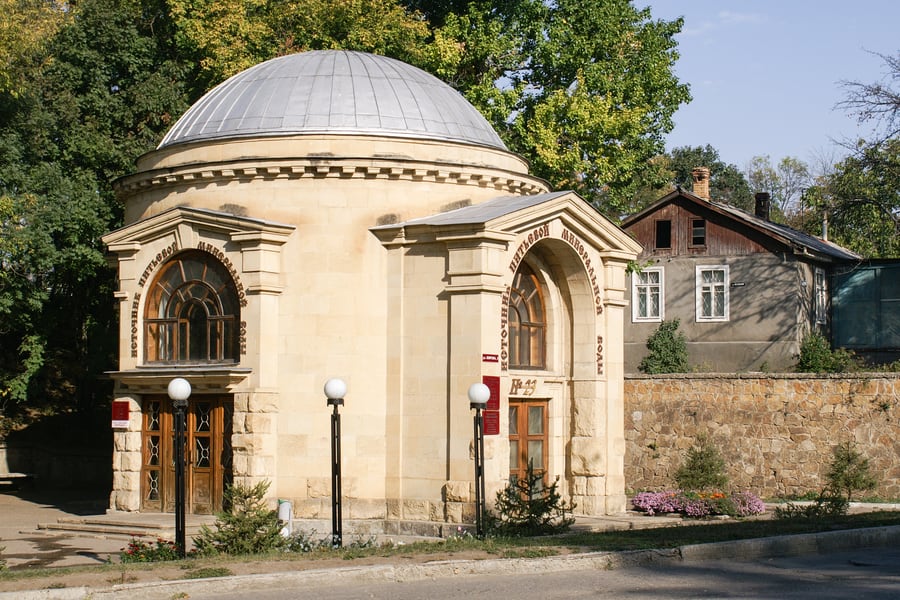 Pedro J Pacheco / Wikimedia Commons · CC BY-SA 4.0 · cropped
Drinking narzan
Narzan is the cold, naturally sparkling water Kislovodsk is named for — kislye vody, sour waters. It is free, it is drunk warm or cold to a doctor's timetable, and you take it standing up in a gallery. The Zhelyabovsky pump room is a two-minute walk from the buffer stops.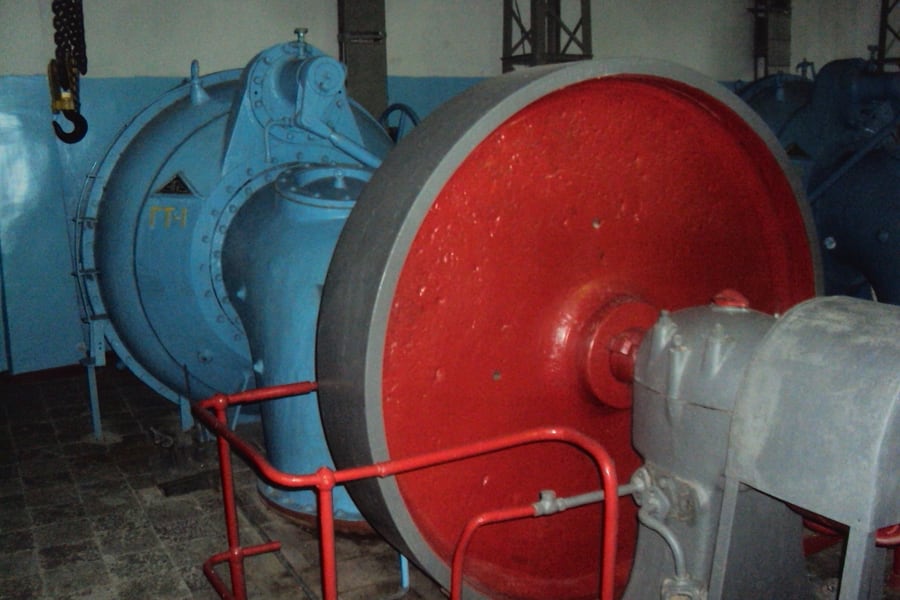 Kemal KOZBAEV / Wikimedia Commons · CC BY-SA 4.0 · cropped
The first hydro station in Russia
Sixteen kilometres out of Kislovodsk is a halt called Belyi Ugol — "white coal", the old name for water power. Siemens & Halske built a small hydro station on the Podkumok here in 1903, the first industrial one in the country, to light the spas and run the Pyatigorsk tram. The building is a museum and its machines are still in it.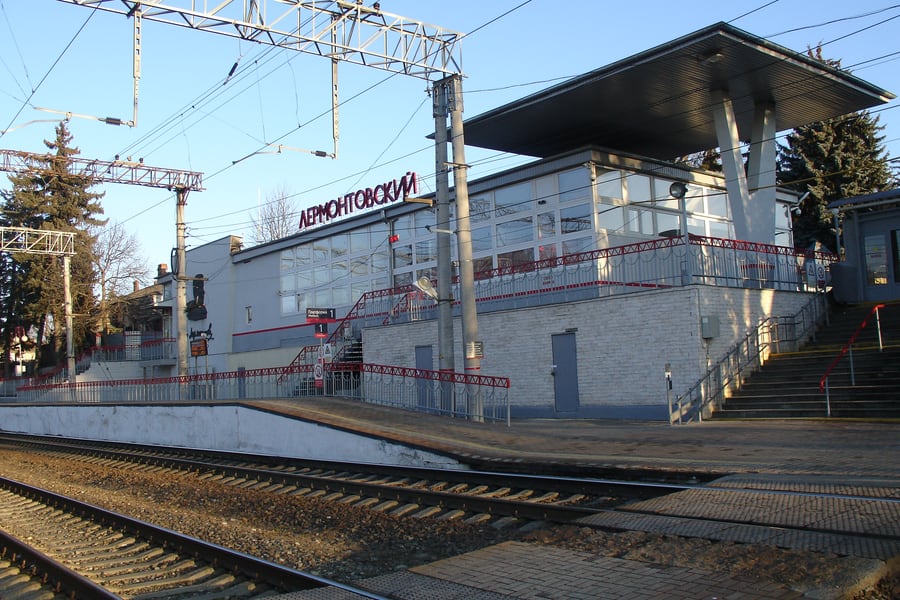 Alexander Roumega / Wikimedia Commons · CC BY-SA 4.0 · cropped
The halt opened for a duel
On 28 June 1901 the Vladikavkaz Railway board authorised a stop near the place where Mikhail Lermontov was shot in 1841, and built a platform for it. The halt is still there, four kilometres beyond Pyatigorsk, still called Lermontovsky, and the fast trains still stop at it.Timetables
This is a turn-up-and-go railway. Twenty-eight trains a day leave Kislovodsk for Mineralnye Vody and twenty-eight come back, from half past five in the morning to nine at night, at roughly half-hourly intervals through the middle of the day. Times below are Moscow time, which is local time here as well as railway time.
Two kinds of train work the branch. The ordinary four-car ЭД9М units call at all seventeen stops and take about 1 h 22 min. The ЭС1 «Ласточка» sets, on the line since 1 September 2019, stop only at Yessentuki, Pyatigorsk and Lermontovsky and do the run in 57 minutes — four of them each way, and they are the ones to aim for if you are simply crossing the region.
Kislovodsk to Mineralnye Vody
A representative day, not the whole book:
| Departs | Arrives | Journey | Calls | Runs |
|---|---|---|---|---|
| 05:30 | 06:52 | 1 h 22 | all stations | daily |
| 06:03 Lastochka | 07:00 | 57 min | 3 stops | daily |
| 06:15 Lastochka 809С | 07:23 | 1 h 08 | on to Rostov-Glavny | daily |
| 07:00 | 08:25 | 1 h 25 | all stations | weekdays |
| 08:00 | 09:23 | 1 h 23 | all stations | daily |
| 10:00 Lastochka | 10:57 | 57 min | 3 stops | daily |
| 11:30 | 12:52 | 1 h 22 | all stations | daily |
| 13:40 Lastochka | 14:37 | 57 min | 3 stops | daily |
| 15:00 | 16:22 | 1 h 22 | all stations | daily |
| 16:14 Lastochka | 17:11 | 57 min | 3 stops | daily |
| 18:30 | 19:52 | 1 h 22 | all stations | daily |
| 21:00 | 22:29 | 1 h 29 | all stations | daily, last train |
Mineralnye Vody to Kislovodsk
The first is at 05:00 and the last at 21:00; the stopping trains take about 1 h 25 min uphill, a few minutes more than they take coming down. The fast runs leave at 08:10, 11:50, 14:50 and 18:30, all of them 57 minutes. Two more Lastochki run up the branch in the evening off the main line, reaching Kislovodsk at 21:35 from Rostov-Glavny and 22:55 from Krasnodar.
The long-distance trains
A dozen trains a day begin their journeys at Kislovodsk and run down this branch before joining the main line, and they will sell you the first hour of them. They call at Yessentuki and Pyatigorsk and take 1 h 28 min to 1 h 34 min to Mineralnye Vody, because they are heavier and stop less often than they wait. The daily ones are 809С to Rostov-Glavny at 06:15, 143Й to Moscow Paveletsky at 10:16, 049С to St Petersburg at 13:49, 343С to Adler at 16:44, and — the one worth seeing whether or not you board it — 003С «Кавказ» to Moscow Kazansky at 20:40, a double-decker.
Trains through to Zheleznovodsk
Several departures a day do not finish at Mineralnye Vody at all: they turn off at Beshtau and climb the six-kilometre branch to Zheleznovodsk, 16 minutes from the junction. From Kislovodsk they leave at 09:25, 12:27 (weekdays), 13:00 (weekends), 16:30 (weekends) and 19:00, taking about 1 h 45 min for the whole run. ⚠️ The pattern changes in the second half of October, when some of the daily workings become weekend-only — check the date before you plan the day.
Seasons and reservations
There is no season on this line. It runs the same service in February as in August, and every suburban train — stopping or Lastochka — is walk-up, bought at the window or in the app for the next departure. The only services that need booking are the long-distance trains, which are sold by the berth like any other Russian sleeper.
Suburban and long-distance times as of September 2026, swept in both directions from the operator's timetable data. Fares and current running dates: АО «СКППК» (opens in a new tab), the company that runs the suburban trains here.
Tickets
Suburban fares here are set by the Stavropol regional tariff commission and published by the operator, and they are charged by the kilometre: since 1 June 2026, ₽4.45 per km on the ordinary 6000-series trains and ₽4.90 per km on the ЭС1 Lastochka. Over the full 64 km that works out at about ₽285 and ₽314. Buy at the station window, from a roving conductor, or in the app; there is no reservation and no seat number.
A long-distance train is a different transaction. The dozen services that start at Kislovodsk sell the branch as the first leg of a journey to Moscow or the Pacific, by the berth rather than the kilometre — from about ₽617 for a seat on the morning Lastochka to Rostov, and considerably more for a compartment on the double-decker Kavkaz. Worth it only if you want the carriage.
Book your tickets
Neu-Zwei / Wikimedia Commons · CC BY-SA 4.0 · croppedSuburban train, all stations
Walk up, no reservation
The ordinary four-car units are charged by the kilometre, which makes the full 64 km about ₽285.
Book Tickets (opens in a new tab, on skppk.ru)via skppk.ruNeu-Zwei / Wikimedia Commons · CC BY-SA 4.0 · croppedLastochka, three stops
57 minutes, walk up
The ЭС1 sets call only at Yessentuki, Pyatigorsk and Lermontovsky and carry a slightly higher per-kilometre tariff.
Book Tickets (opens in a new tab, on skppk.ru)via skppk.ruNeu-Zwei / Wikimedia Commons · CC BY-SA 4.0 · croppedA seat on a long-distance train
Reserved, sold by the berth
The dozen trains that start at Kislovodsk will sell you the first 64 km of their journey, at long-distance prices.
Book Tickets (opens in a new tab, on tutu.ru)via tutu.ruRail Passes
No international rail pass covers this line. Russia does not appear in Interrail's list of railway companies at all — the Russian network has never been part of the scheme, and neither Interrail nor Eurail sells anything valid east of the European Union's eastern border. A pass bought for a European trip is worth nothing at Kislovodsk.
Nor is there anything to buy at a national level. Russian Railways sells tickets, not passes; РЖД Бонус is a loyalty scheme rather than a travel pass, and it earns points on long-distance tickets only. For a visitor, the branch is bought a ride at a time — which, at about ₽285 end to end, is hardly a hardship.
There is one genuine local product, and it is aimed at commuters rather than travellers. АО «СКППК», the company that runs the suburban trains here, sells season tickets — abonementnye bilety — in four shapes: every day, working days, weekends, and named dates. They are loaded onto a contactless card at a company ticket office with no deposit to pay, or bought in the app for the daily, working-day and weekend versions, and each is tied to one route. The card can be re-loaded for a different route when the season runs out.
⚠️ Do the arithmetic before you buy one. A season ticket is priced for someone travelling the same stretch every day for a month. If you are here for a week and want to ride Kislovodsk to Mineralnye Vody twice, single tickets will be cheaper and you will not have to explain yourself at a window in Russian. If you are staying in one spa town and commuting to another daily, it is worth asking at the office.
As of September 2026. Season-ticket conditions from АО «СКППК» (opens in a new tab); pass coverage checked against Interrail's own railway-companies list, which does not include Russia.
Places to Visit
Four spa towns in sixty-four kilometres, each with its own water, its own park and its own century of architecture, and a train between them every half hour: this is a line you get off and on again rather than ride end to end. Kislovodsk has the largest of the parks and the coldest, fizziest water; Yessentuki has the grandest bath house; Pyatigorsk has Lermontov, the cable car and the hole in the mountain; Zheleznovodsk, up its own branch, has the quietest park and the prettiest pavilion. A day gets you two of them. Three days gets you all four, which is what the people who come here for the cure have always done.
 AlixSaz / Wikimedia Commons · CC BY-SA 4.0 · cropped
Kislovodsk National Park
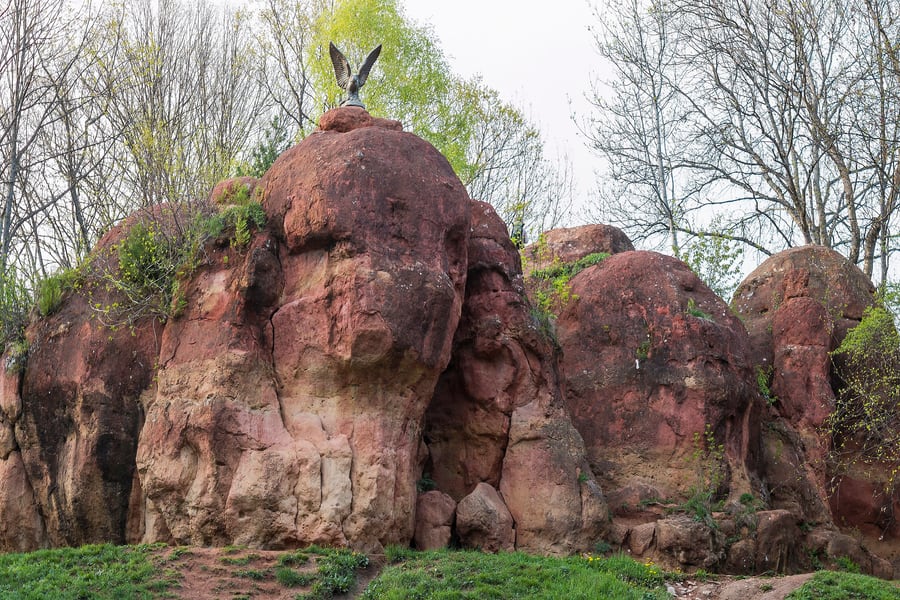
The largest urban park in Europe — 965.8 hectares, begun in 1823 on General Yermolov's orders, with black earth carted in so that trees would grow on the bare riverside rock. It climbs from the Narzan Gallery through the Valley of Roses to the ridges of Maloye and Bolshoye Sedlo, and in 2024 it drew 5.14 million visitors, more than any other national park in Russia. The Red Stones — weathered red sandstone outcrops — are its natural monument.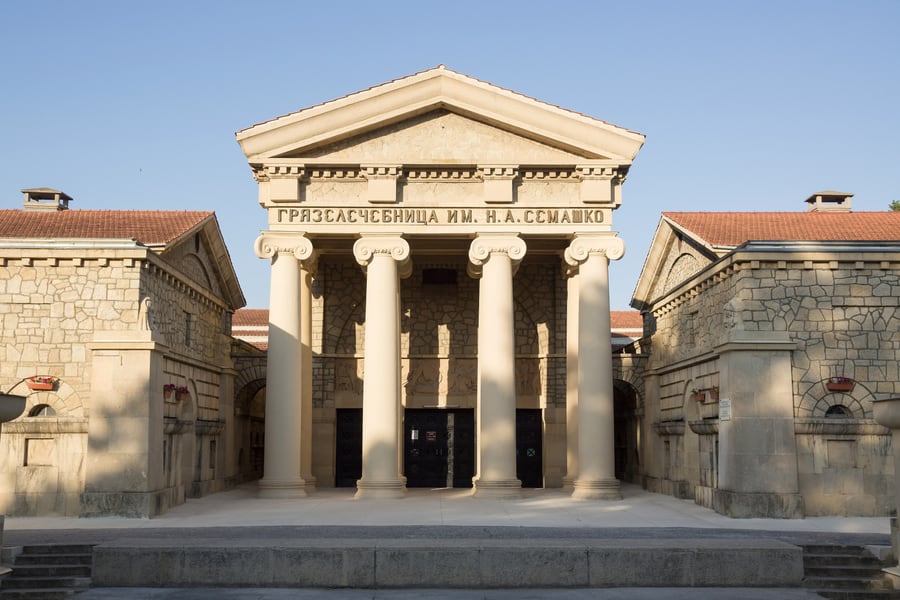 © Vyacheslav Argenberg / http://www.vascoplanet.com/ · CC BY 4.0 · cropped
The Semashko mud baths, Yessentuki
Four linked two-storey blocks filling half a city-centre block, and the most striking building on the line. The St Petersburg Society of Architects ran a competition for it in 1911; the academician Yevgeny Schretter won with a design shaped like a Roman bath house, and it opened on 22 July 1915 as the Alexeyevskaya, for the Tsarevich. It has used mud from Lake Tambukan for more than a century and does so still.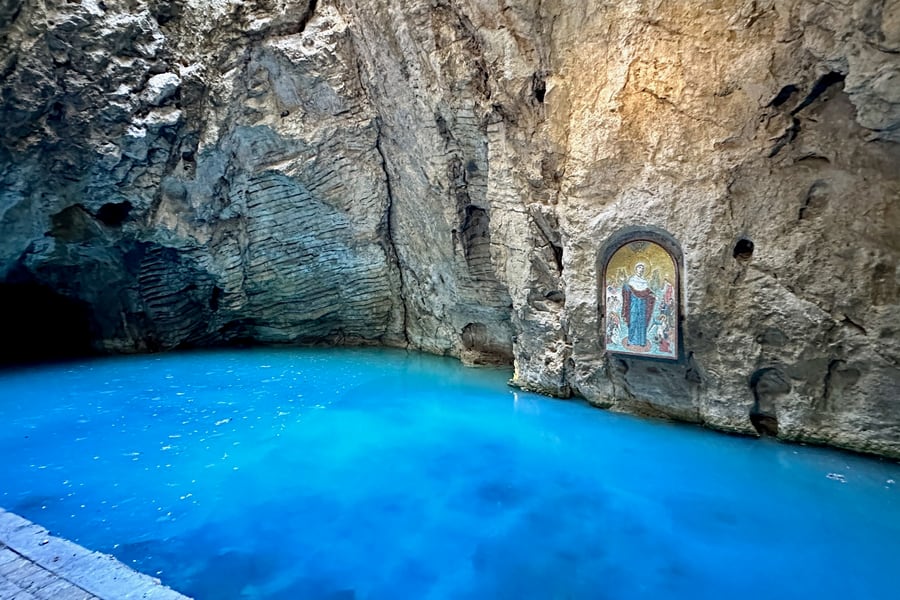 Vyacheslav Bukharov / Wikimedia Commons · CC BY-SA 4.0 · cropped
The Proval, Pyatigorsk
A karst shaft on the southern slope of Mashuk, 15 metres across and 41 metres deep, with a hot mineral lake at the bottom that is 11 metres deep and an unmistakable turquoise — the colour comes from the sulphur and the bacteria in it. Pallas surveyed it in 1793, and in 1837 Prince Golitsyn had a platform built over the hole so that the spa season could dance a quadrille above it. A tunnel now reaches the water at its own level.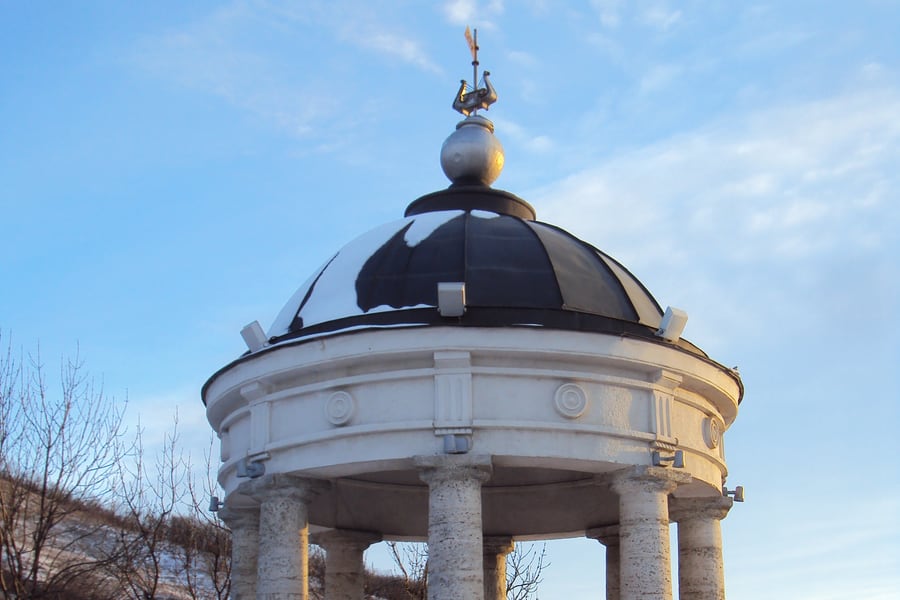 Kemal KOZBAEV / Wikimedia Commons · CC BY-SA 4.0 · cropped
The Aeolian Harp
A small classical rotunda on a 614-metre knoll of Mount Mashuk, built to a design by Iosif Bernardazzi and named for the wind harp once mounted inside it — strings in a box, played by nothing but the air. Lermontov's grotto is just below it, and the whole valley the railway crosses is laid out in front.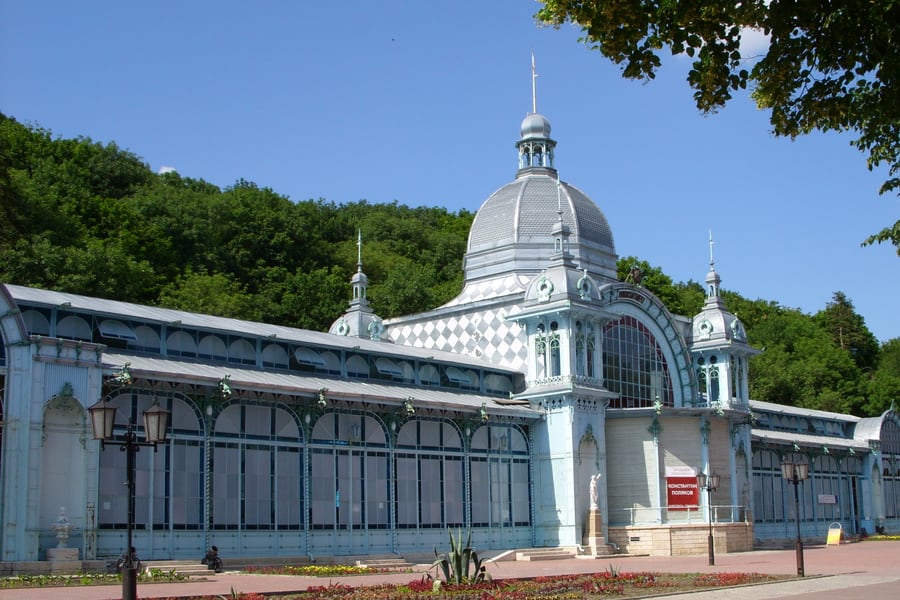 LxAndrew / Wikimedia Commons · CC BY-SA 4.0 · cropped
The Pushkin Gallery, Zheleznovodsk
Iron and glass, painted duck-egg blue, with a silver dome and a diamond-patterned gable — a pavilion of the kind Europe built for world's fairs, standing in the spa park at the foot of Mount Zheleznaya. It is a concert and exhibition hall, and it is a ten-minute walk uphill from the terminus of the 1897 branch.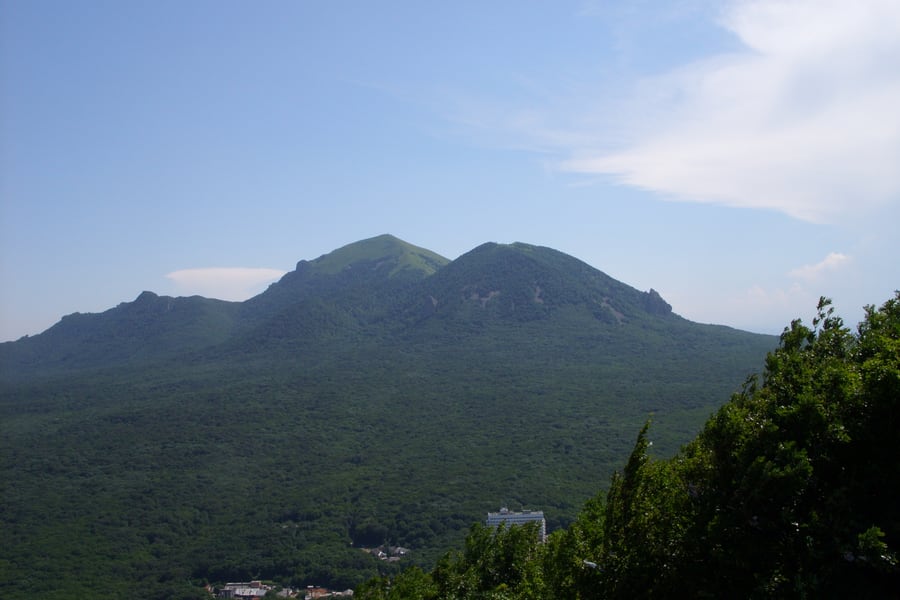 LxAndrew / Wikimedia Commons · CC BY-SA 4.0 · cropped
Mount Beshtau
1,402 metres, five summits, and the reason the junction at km 14 is called what it is — besh tau is Turkic for "five mountains". It is a laccolith: magma that pushed up under the sedimentary rock and never broke through, then had the softer cover weathered off it. Paths go up from Inozemtsevo and from Zheleznovodsk, and the climb takes most of a day.Where to Sleep
Almost everyone who sleeps on this line sleeps in a sanatorium — the spa towns are full of them, they are booked by the course of treatment rather than by the night, and many will want a doctor's referral before they take you. An ordinary hotel is the simpler answer for anyone who is here for the railway and the parks.
Stay at the top of the line if you can. Kislovodsk has the park, the narzan and the first train of the morning, and the spa quarter is a ten-minute walk from the buffer stops. Pyatigorsk is the practical middle, with the widest choice and the cable car. Mineralnye Vody is worth a night only if you are catching an early flight or an early train out — it is the junction, not the reason for the journey.
Where to stay
Park-Otel
By the Colonnade, Kislovodsk
In the middle of the spa quarter beside the park gates, with narzan baths of its own in the basement and the Narzan Gallery a few minutes' walk away.
Check Availability (opens in a new tab, on parc-hotel.ru)via parc-hotel.ruHotel Beshtau
Pervaya Bulvarnaya, Pyatigorsk
On the street the railway crosses between Lermontovsky and Pyatigorsk, with a restaurant, a sports club and a round-the-clock reception.
Check Availability (opens in a new tab, on hotel-beshtau.ru)via hotel-beshtau.ruAsteri Hotel
Sovetskaya Street, Mineralnye Vody
A small hotel in the town at the bottom of the line, useful when the onward train or the flight out goes early.
Check Availability (opens in a new tab, on asteri-hotel.ru)via asteri-hotel.ruQuestions or corrections
Planning this trip and stuck on something, or spotted a time, fare or detail that has changed? Send us a message about Kislovodsk to Mineralnye Vody. We read every one, and we update this page when something has changed.