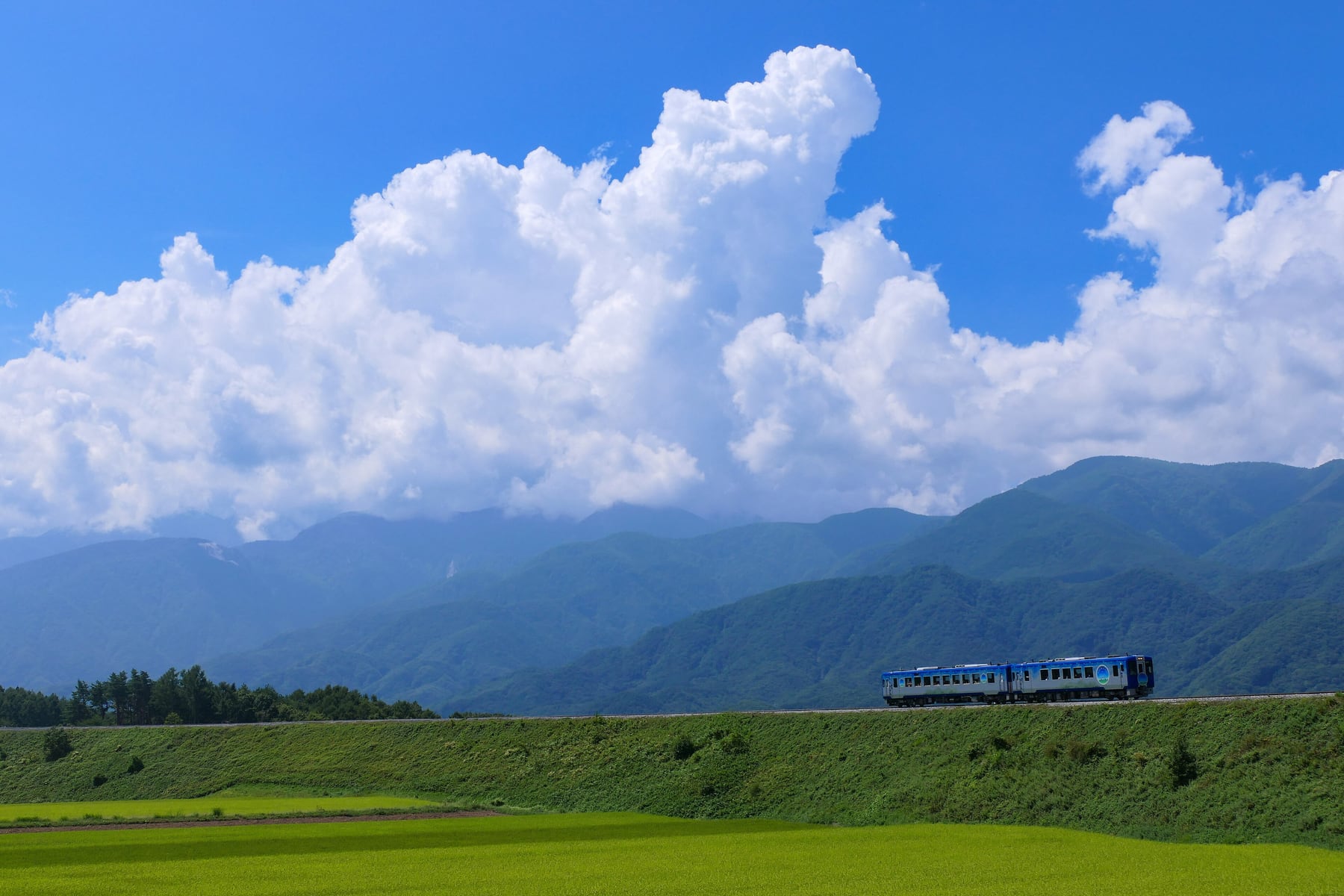
Koumi Line
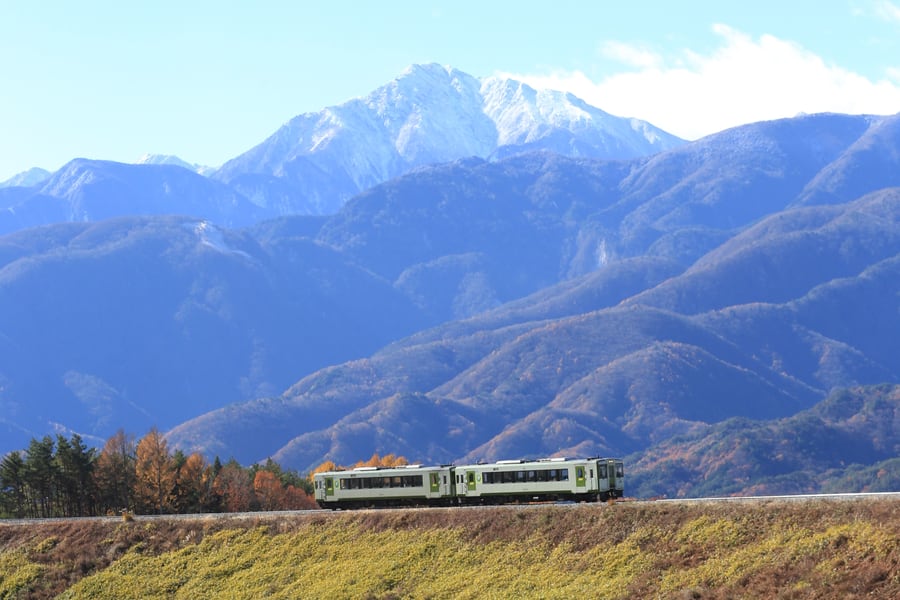
MaedaAkihiko / Wikimedia Commons · CC BY-SA 4.0
- Distance78.9 km
- DurationAbout 2¼ hours end to end, eight through trains a day
- Best seasonYear-round · green highlands May–Oct, autumn colour Oct–Nov, clear cold skies in winter
Introduction
The Koumi Line runs 78.9 km from Kobuchizawa in Yamanashi Prefecture to Komoro in Nagano, around the eastern foot of the Yatsugatake mountains. Between Kiyosato and Nobeyama it crosses 1,375 metres, the highest point on any JR line in Japan, and Nobeyama, at 1,345.67 metres, is the highest JR station. The nine highest stations on the whole JR network are all on this line, one after another.
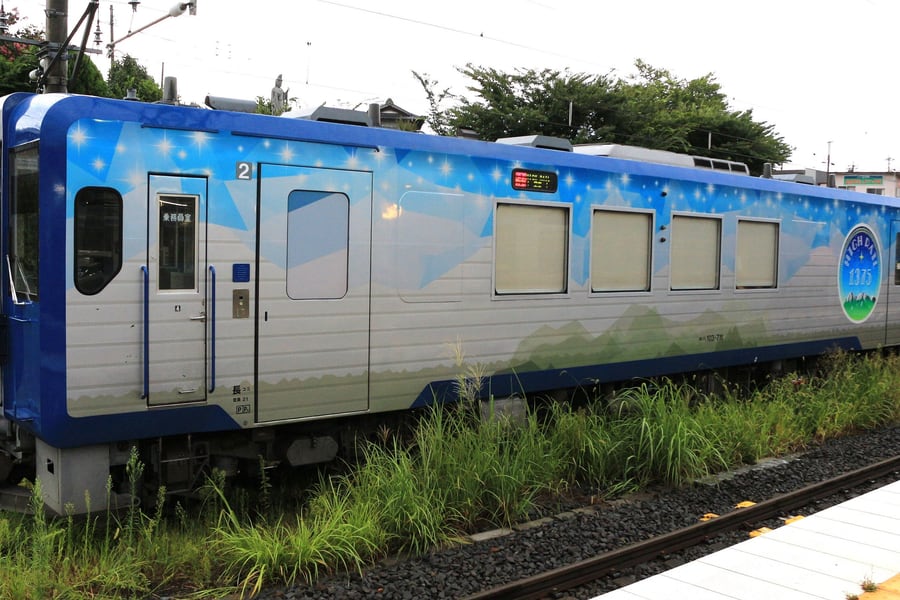
It is a single-track local line, worked by one- and two-car diesel railcars that stop everywhere. From the plateau it drops down the valley of the Chikuma River into the Saku basin and ends at the old castle town of Komoro. JR East calls it the Yatsugatake Kōgen Line, the highland line, and on most Fridays, weekends and holidays it runs HIGH RAIL 1375, a sightseeing train named for the summit.
Eight trains a day run the whole way in each direction, taking a little over two hours. Sit on the left leaving Kobuchizawa for the Yatsugatake.
The Journey
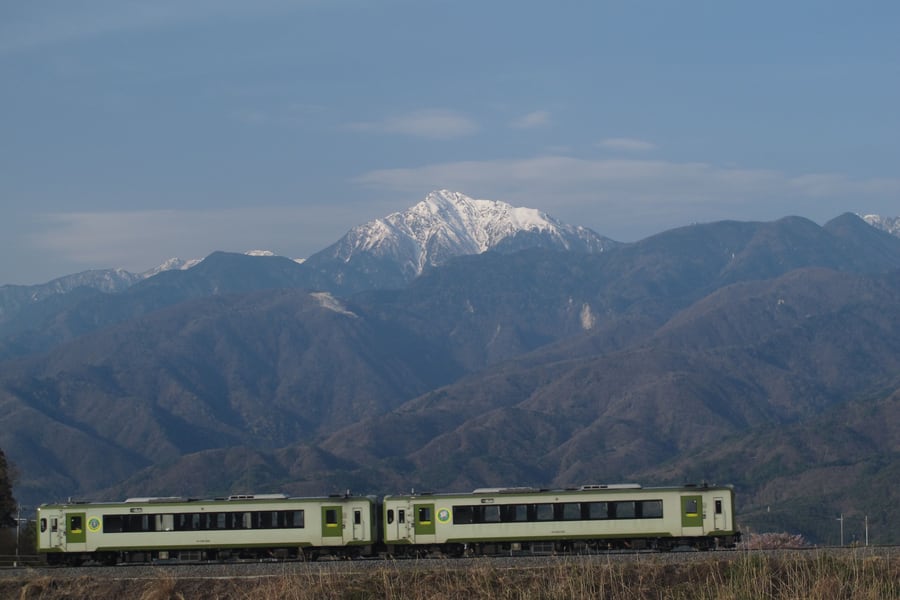
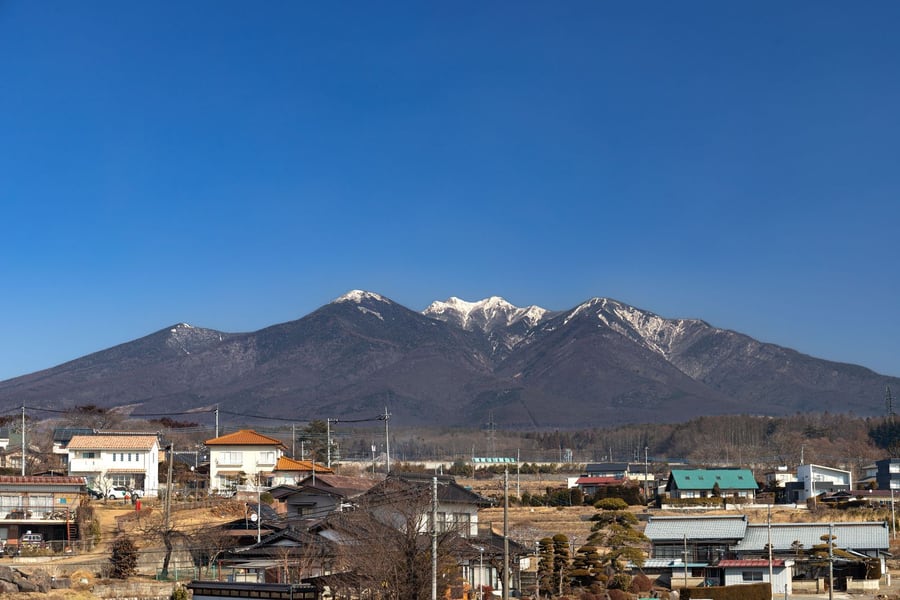
Trains leave Kobuchizawa, a junction on the Chūō Line, and swing round a long curve to start climbing at once. Through woods and holiday villages they reach Kai-Koizumi, Kai-Ōizumi and Kiyosato, the highland resort, already above 1,000 metres. On a clear day Mt Kaikoma and the Southern Alps stand behind, and the Yatsugatake rise ahead.
Over the summit
Beyond Kiyosato the woods open onto the Nobeyama plateau, a high, flat country of lettuce and cabbage fields. At 1,375 metres the line crosses the highest point on the JR network, where trains run slowly; it is also a watershed, with rivers on one side running to the Pacific and on the other to the Sea of Japan. A few minutes later the dishes of the radio observatory appear through the trees, and the train stops at Nobeyama, the highest JR station.
Down the Chikuma
From Shinano-Kawakami the line drops into the valley of the Chikuma River, which it crosses seven times before Koumi, the town at the middle of the line that gave it its name. The valley widens past Yachiho and Usuda, and at Nakagomi, where the railcars are based, the line has become a commuter railway through the Saku basin. It runs on a viaduct over the Hokuriku Shinkansen at Sakudaira and alongside the Shinano Railway into Komoro.
The trains
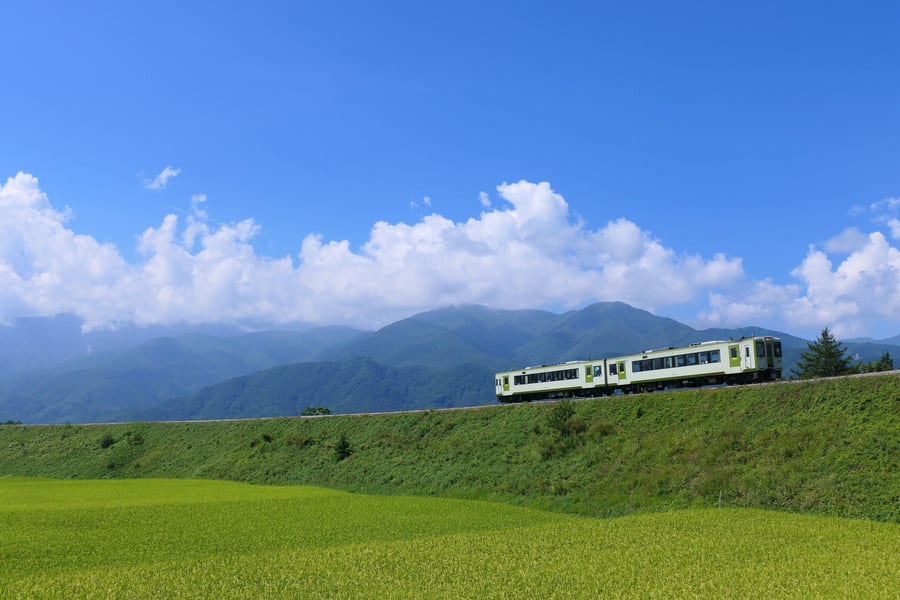
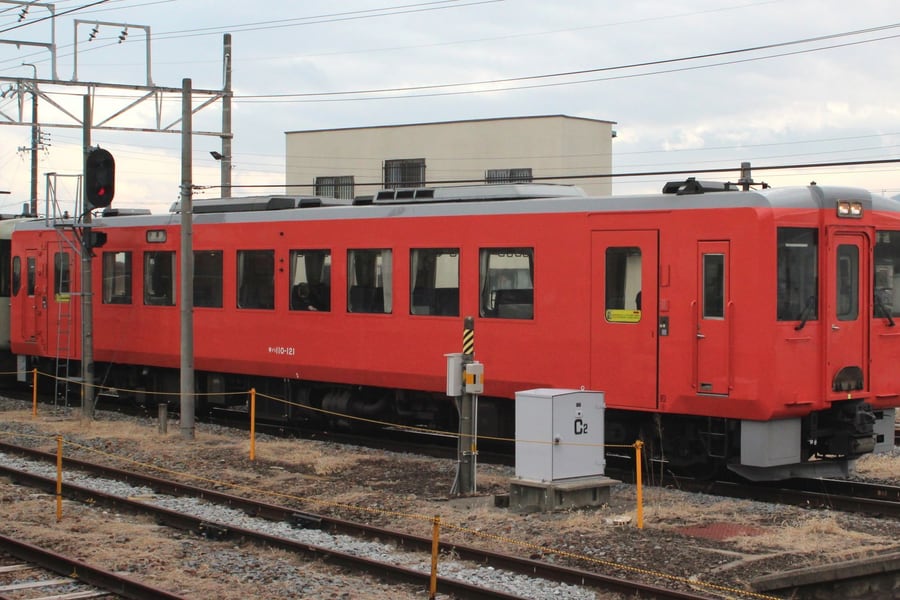
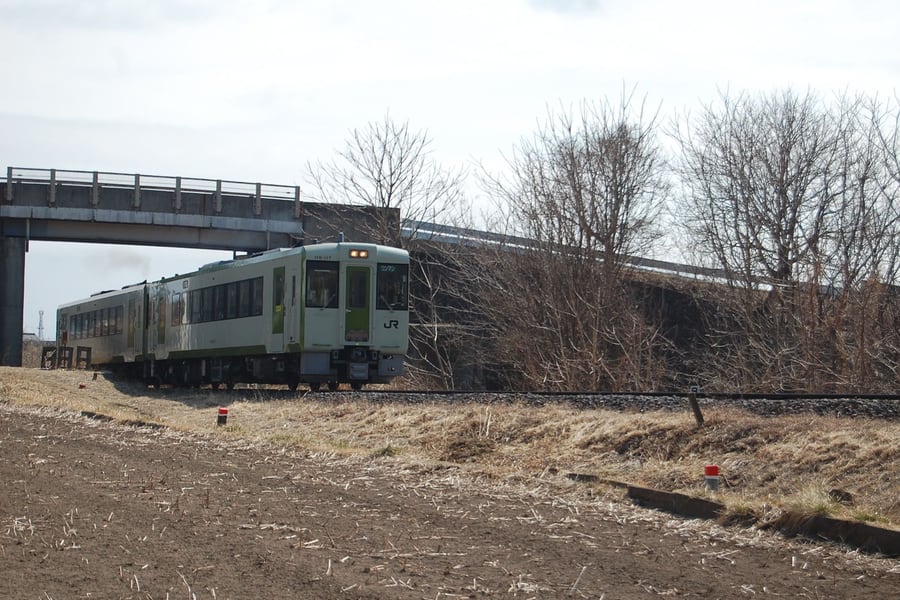
Most trains are KiHa 110 railcars, the green-and-cream diesels that replaced older stock from 1991. Some services are KiHa E200, which when they arrived in 2007 were the world's first hybrid railcars in passenger service. HIGH RAIL 1375 is a pair of cars rebuilt from KiHa 100- and 110-series railcars, painted silver and blue with the Yatsugatake under the stars. The line climbs at up to 33 in 1,000, and even the fastest local takes over two hours.
Along the route
 寝台特急あけぼの / Wikimedia Commons · CC BY-SA 4.0
The climb out of Kobuchizawa
The train leaves Kobuchizawa on a long curve and climbs at once through larch woods and holiday houses. From Kai-Koizumi to Umijiri the track stays above 1,000 metres, and the nine highest stations on the JR network follow one another.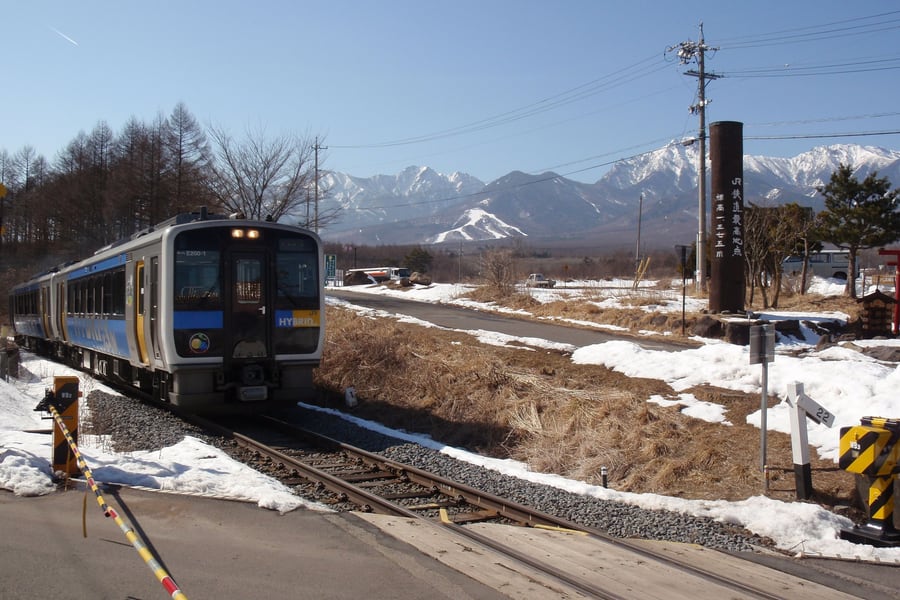 Cassiopeia sweet / Wikimedia Commons · public domain · cropped
1,375 metres
Between Kiyosato and Nobeyama the line crosses the highest point on any JR track, 1,375 metres up, where trains run slowly. A tall marker and a small shrine stand beside the level crossing, about thirty minutes' walk from Nobeyama.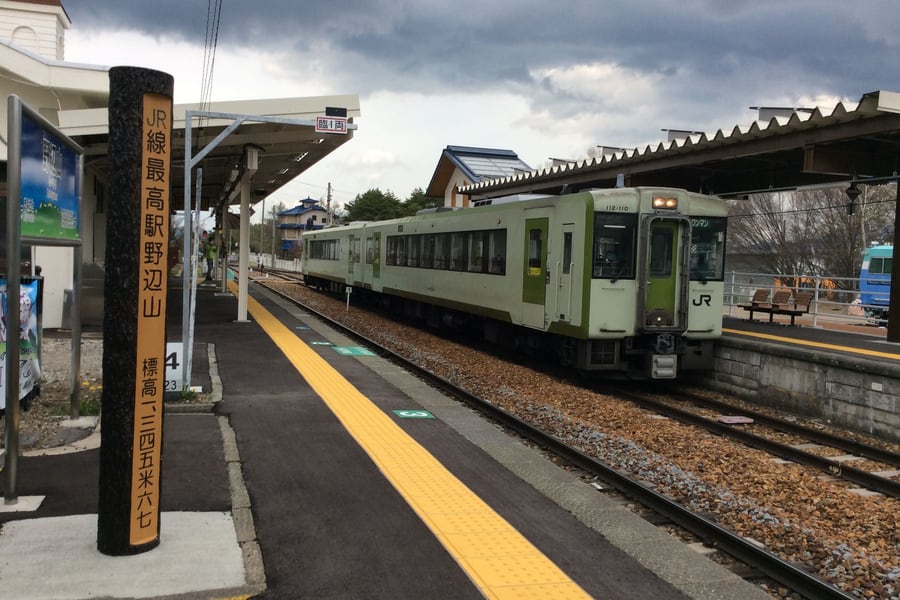 クハ5050の40番代 / Wikimedia Commons · CC BY-SA 4.0 · cropped
Nobeyama
At 1,345.67 metres, Nobeyama is the highest station on the JR network, and a wooden post on the platform says so. Just before the station, the dishes of the radio observatory show through the trees on the right.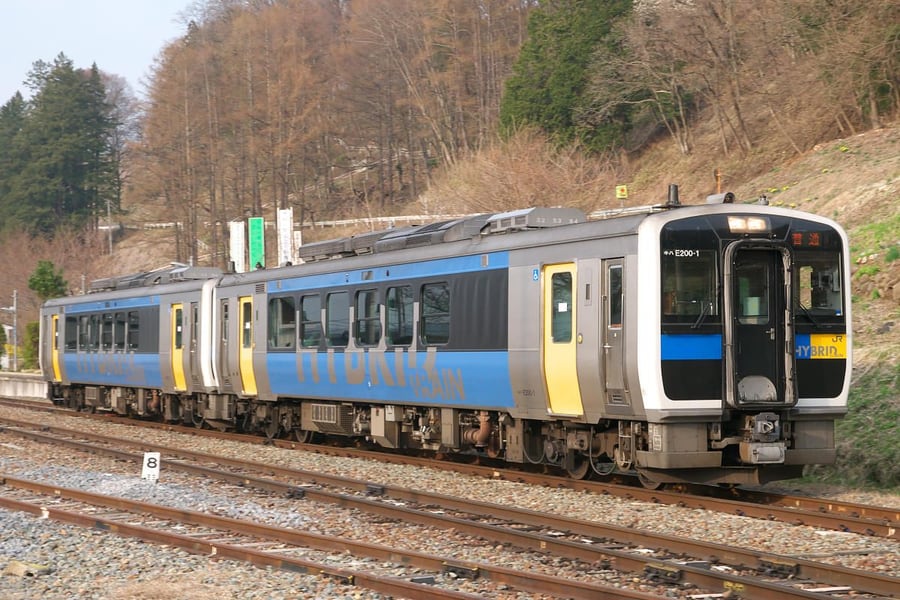 Rs1421 / Wikimedia Commons · CC BY-SA 3.0
Down the Chikuma valley
From Shinano-Kawakami the line follows the young Chikuma River, crossing it seven times before Koumi. Past Koumi the valley widens into the Saku basin, rice fields and towns, and the last stretch to Komoro becomes a commuter railway.A bit of history
Culture & experiences along the way
 ほくほく超高速進行 / Wikimedia Commons · CC0 · cropped
Stargazing at Nobeyama
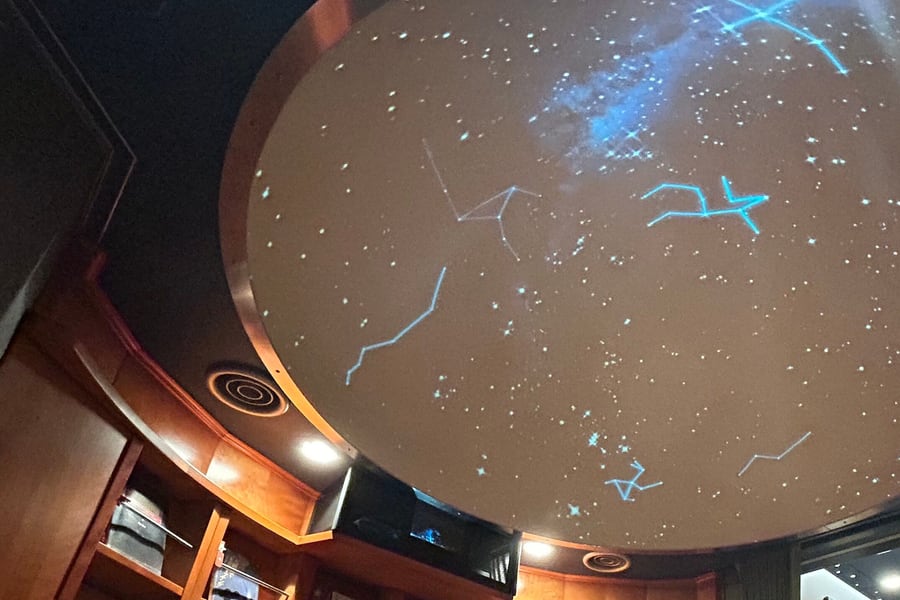
The evening HIGH RAIL Hoshizora stops about forty minutes at Nobeyama, and local star guides lead the passengers out under a sky that astronomers count among Japan's three finest. In bad weather the talk moves indoors, and car 2's gallery shows the stars on its domed ceiling.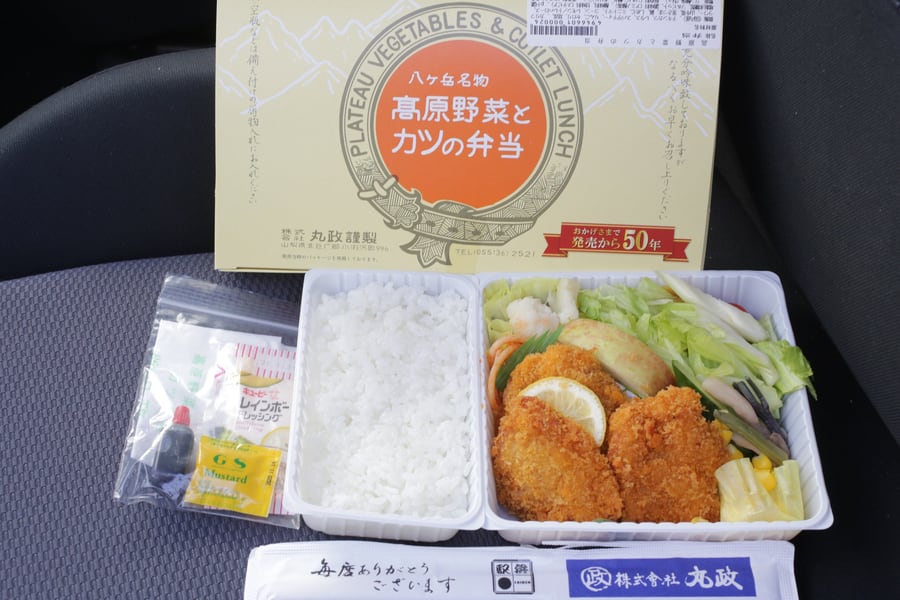 Pcs34560 / Wikimedia Commons · public domain
The highland bento
Marumasa, the station caterer at Kobuchizawa, has sold its highland vegetables and cutlet bento since 1970: chicken cutlets with lettuce and vegetables from the plateau, the first station lunch in Japan with raw vegetables. It costs ¥1,200, from 10:00 at Kobuchizawa station.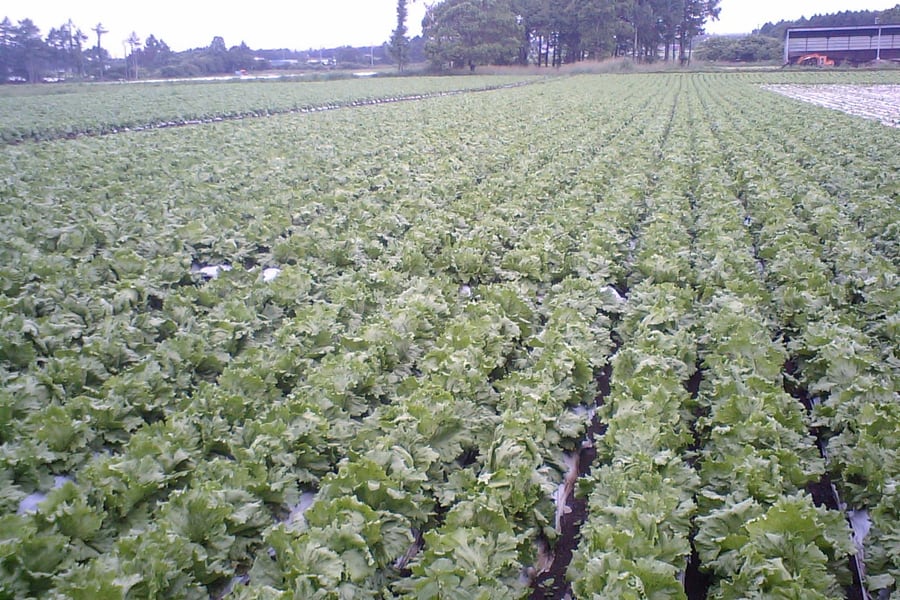 Miyuki Meinaka / Wikimedia Commons · public domain · cropped
Lettuce country
At around 1,300 metres the Nobeyama plateau stays cool all year, and that is why it is famous for highland vegetables, lettuce and cabbage above all. Between Kiyosato and Nobeyama the fields run beside the track in long green rows, with the Yatsugatake on the left.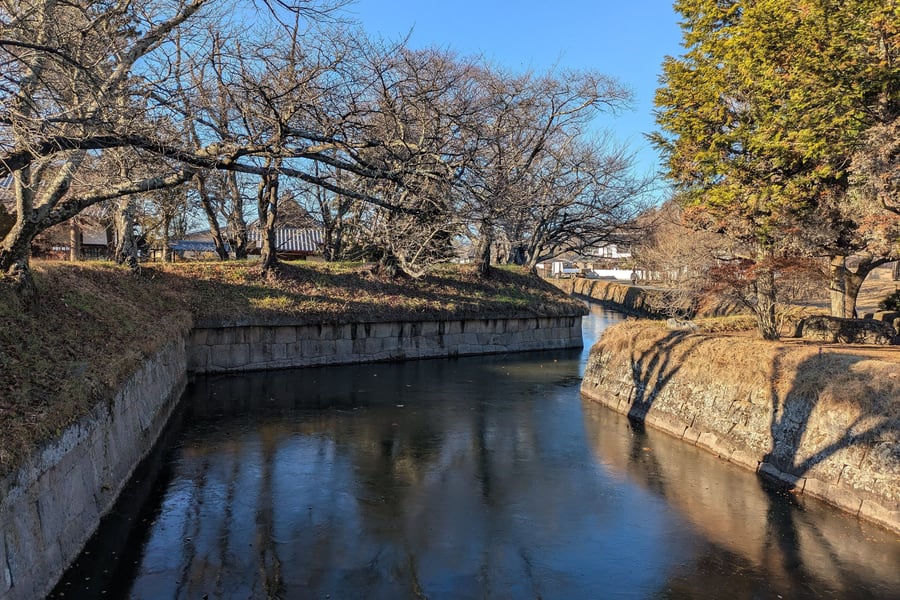 Suikotei / Wikimedia Commons · CC BY 4.0 · cropped
A star-shaped fort
Twenty minutes' walk from Tatsuokajō station, the Tatsuoka fort was built between 1864 and 1867 in the five-pointed star plan of European artillery forts. It is one of only two in Japan, with Hakodate's Goryōkaku; the moat and stone walls survive, open to walk round.Timetables
Eight local trains a day run the whole line in each direction, every day of the year, with the same times at weekends. They stop at every station and need no booking. More trains run only between Komoro and Nakagomi or Koumi at the busy northern end. HIGH RAIL 1375 runs as a rapid on its operating days, with long stops at Nobeyama.
Kobuchizawa to Komoro
| Train | Kobuchizawa | Kiyosato | Nobeyama | Koumi | Komoro |
|---|---|---|---|---|---|
| Local | 06:10 | 06:36 | 06:44 | 07:23 | 08:31 |
| Local | 07:45 | 08:10 | 08:18 | 08:55 | 09:59 |
| Local | 10:07 | 10:33 | 10:41 | 11:20 | 12:16 |
| HIGH RAIL 1 | 10:39 | 11:07 | 11:34 | 12:09 | 12:53 |
| Local | 13:37 | 14:06 | 14:15 | 15:00 | 15:56 |
| Local | 15:05 | 15:30 | 15:40 | 16:22 | 17:24 |
| Local | 16:29 | 16:53 | 17:03 | 17:43 | 18:50 |
| Local | 18:02 | 18:30 | 18:37 | 19:22 | 20:40 |
| Local | 19:02 | 19:27 | 19:35 | 20:46 | 22:17 |
| HIGH RAIL Hoshizora | 19:22 | 19:49 | 20:41 | 21:17 | 21:59 |
Komoro to Kobuchizawa
| Train | Komoro | Koumi | Nobeyama | Kiyosato | Kobuchizawa |
|---|---|---|---|---|---|
| Local | 06:43 | 07:58 | 08:38 | 08:47 | 09:09 |
| Local | 08:16 | 09:29 | 10:07 | 10:15 | 10:37 |
| Local | 12:00 | 13:09 | 13:53 | 14:02 | 14:24 |
| Local | 14:00 | 14:59 | 15:38 | 15:45 | 16:08 |
| HIGH RAIL 2 | 14:46 | 15:29 | 16:23 | 16:32 | 16:59 |
| Local | 15:00 | 16:23 | 17:01 | 17:09 | 17:32 |
| Local | 16:30 | 17:40 | 18:18 | 18:27 | 18:51 |
| Local | 18:11 | 19:20 | 19:59 | 20:07 | 20:31 |
| Local | 19:26 | 20:22 | 21:02 | 21:10 | 21:34 |
Good to know:
- HIGH RAIL days, autumn 2026. Most Fridays to Mondays and holidays until 30 November: 2–5, 9–12, 16–19, 24–25 and 30–31 October; 1–3, 6–9, 13–16, 20–23 and 27–30 November. JR East had not yet published the winter dates. Every seat is reserved.
- The Nobeyama stops. HIGH RAIL 1 waits 18 minutes at Nobeyama; HIGH RAIL Hoshizora arrives at 19:58 and stays over forty minutes for the stargazing. The times above are departures.
- Maintenance days. On 13–15 October, 17–19 November and 15–17 December 2026 the 10:07 and 13:37 from Kobuchizawa and the 08:16 and 12:00 from Komoro do not run, nor the midday short trains to and from Nobeyama.
- Weekend extras. On weekends and holidays until 18 October the Yatsugatake Kōgen Ressha adds extra trains from Kobuchizawa to Nobeyama and back.
Times as of October 2026, from JR East's timetable. Check your date on JR East's Kobuchizawa station timetable (opens in a new tab).
Tickets
The local trains need only an ordinary ticket, priced by distance: ¥1,600 from Kobuchizawa to Komoro, half for children. Buy it at the station before boarding; IC cards such as Suica work only at Kobuchizawa, Kiyosato and Nobeyama, so a paper ticket is simpler for the whole line. The trains are driver-only.
HIGH RAIL 1375 also needs a reserved seat, ¥840, half for children. Seats go on sale at 10:00 one month before travel, at JR ticket offices and machines and on JR East's online booking site; every seat is reserved. Fares checked October 2026 against JR East's timetable and its March 2026 fare table; Japanese yen.
Book your tickets
Kobuchizawa to Komoro
One way, adult · ordinary ticket
The whole line on any local train, bought at Kobuchizawa or Komoro; children pay half.
Book Tickets (opens in a new tab, on JR East)via JR EastHIGH RAIL 1375 reserved seat
Added to the fare · any section
A reserved seat on HIGH RAIL 1, HIGH RAIL 2 or the evening HIGH RAIL Hoshizora, on sale one month ahead.
Book Tickets (opens in a new tab, on JR East)via JR EastRail Passes
The Koumi Line is a JR East line, and the JR passes cover it end to end, HIGH RAIL 1375 included. The JR EAST PASS, ¥35,000 for five days, covers every JR East line, and so does the Japan Rail Pass, ¥50,000 for seven days. A pass holder still needs a seat reservation for HIGH RAIL 1375, which is free with the pass.
For this journey alone, a pass is not worth buying: the whole line costs ¥1,600, and ¥2,440 with a HIGH RAIL seat. It pays when the Koumi Line is one day of a longer trip. Kobuchizawa is on the Chūō Line from Shinjuku, and Sakudaira, near the northern end, is on the Hokuriku Shinkansen back to Tokyo, so the line makes a loop out on one and back on the other; price that loop as single tickets before buying a pass.
Checked October 2026 against the JR EAST PASS (opens in a new tab) page, JR East's HIGH RAIL 1375 page and the Japan Rail Pass prices (opens in a new tab).
Places to Visit
With a train every two hours or so, a stop costs a morning or an afternoon, so pick one or two: the distillery or the highland resort at the southern end, the observatory and the summit at Nobeyama, the castle park at Komoro to finish.
 Keeezawa / Wikimedia Commons · CC BY-SA 4.0 · cropped
Kobuchizawa
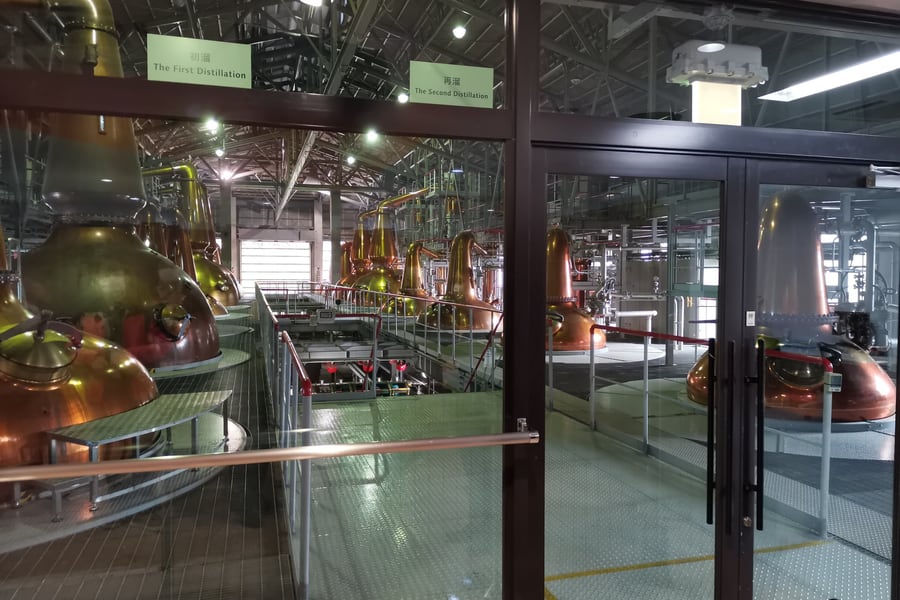
About fifteen minutes by taxi from the station, Suntory's Hakushu distillery makes its whisky in the forest at the foot of the Southern Alps. Its tours are booked ahead on Suntory's site. Kobuchizawa is also on the Chūō Line, with limited expresses from Shinjuku.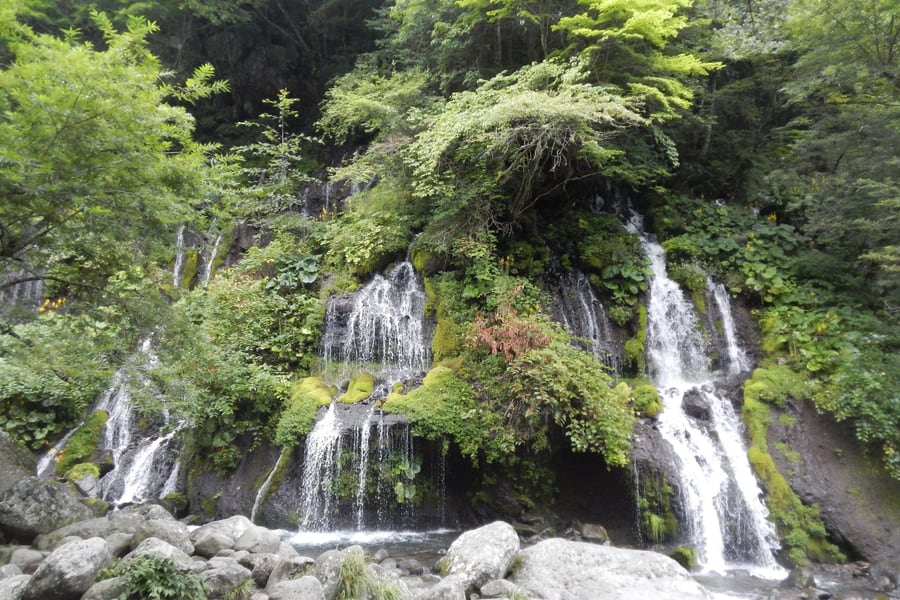 kiwa dokokano / Wikimedia Commons · CC BY-SA 3.0 · cropped
Kiyosato
Five minutes by taxi, Seisenryo is the lodge and farm begun by an American, Paul Rusch, in 1938; its soft-serve is made with milk from its own Jersey herd. Ten minutes by taxi and a fifteen-minute walk, the Doryu Falls spill from mossy rock, and part of them can be seen from the train.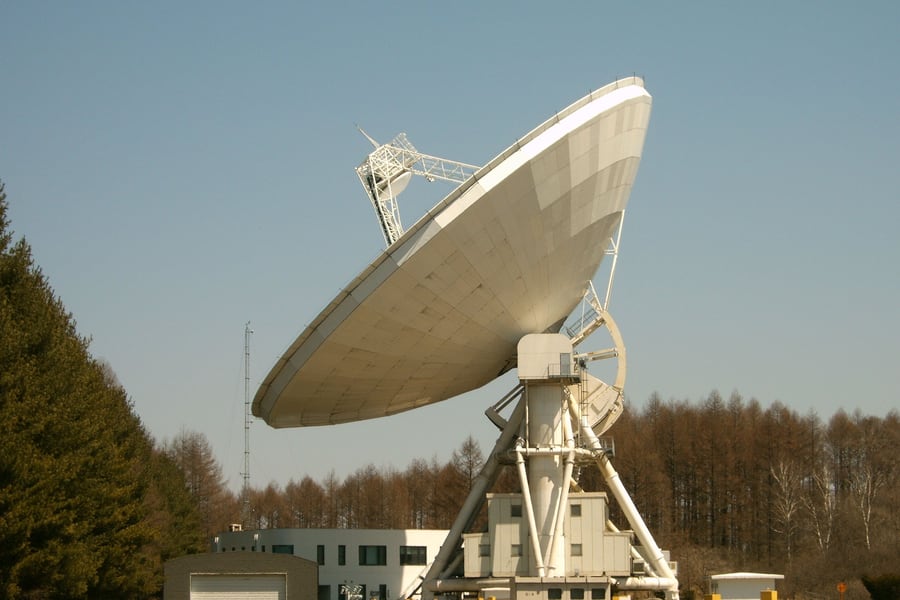 Lapinov / Wikimedia Commons · CC BY 4.0 · cropped
Nobeyama
About forty minutes' walk from the station, the Nobeyama Radio Observatory opens its grounds free every day from 8:30 to 17:00, except over the New Year; sign in at reception. Its 45-metre dish is one of the largest millimetre-wave telescopes in the world. Bicycles are for hire at the tourist office beside the station.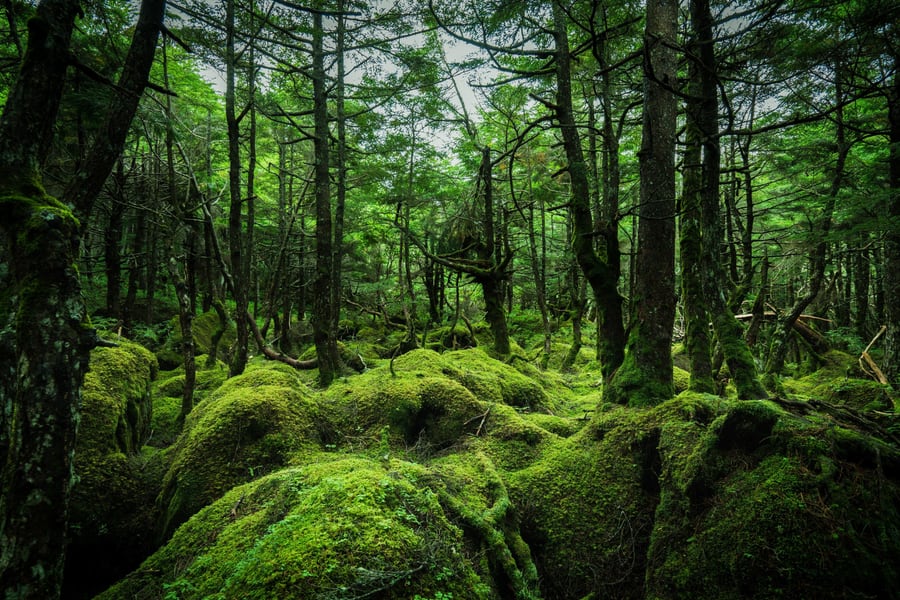 TAKAO_Tsushima / Wikimedia Commons · CC BY 4.0
Yachiho
About forty minutes by car from Yachiho or Koumi, high in the northern Yatsugatake, Shirakoma Pond lies in old-growth forest carpeted with moss, one of the moss forests listed as precious in Japan. A path runs right round the water.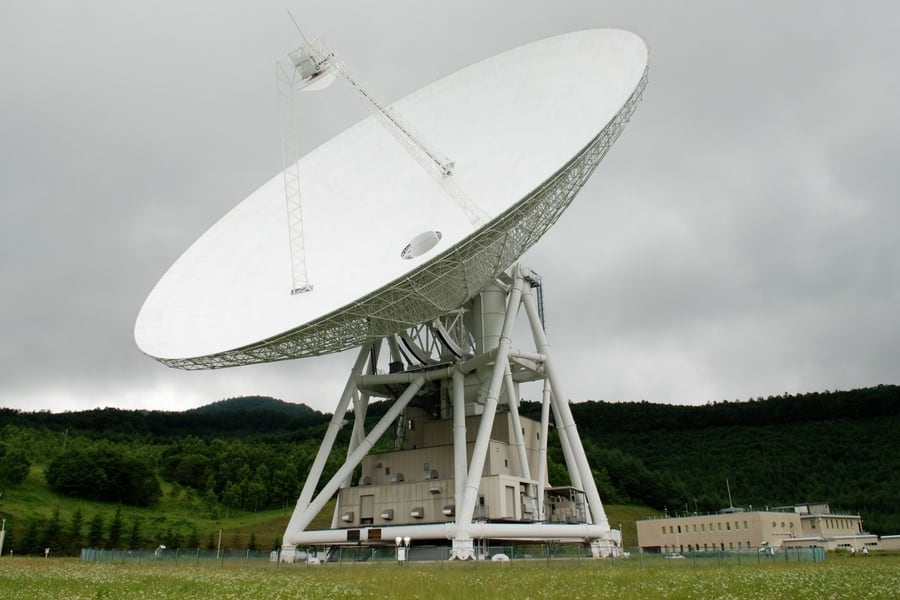 Sota-k / Wikimedia Commons · CC BY-SA 2.0
Usuda
Fifteen minutes by car from the station, the Usuda Star Dome is a public observatory with a 60-centimetre reflector and a viewing session every night it is open. Half an hour by taxi, JAXA's Usuda Deep Space Center sends commands to planetary probes through a 64-metre dish, and has an exhibition hall.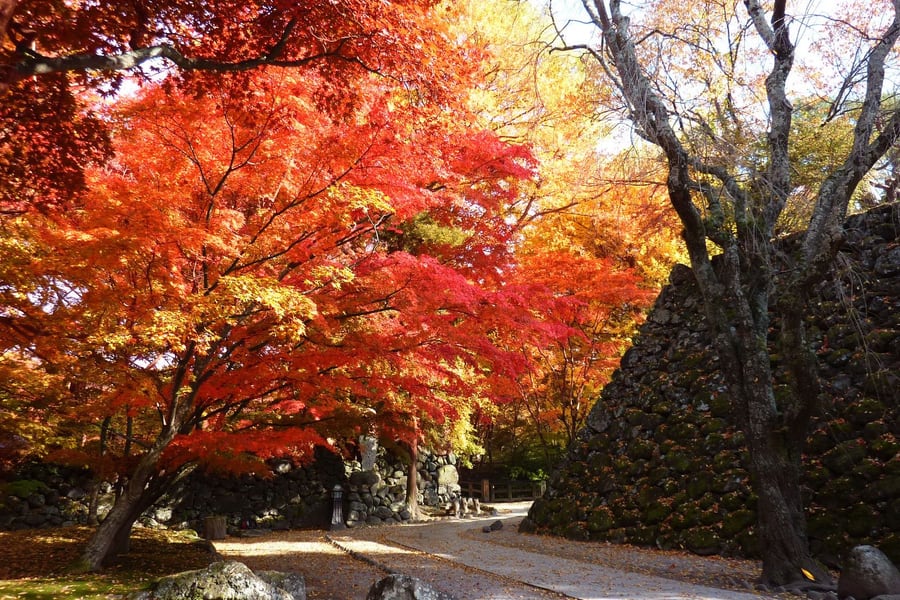 Mocchy / Wikimedia Commons · public domain · cropped
Komoro
Three minutes from the station, Kaikoen is the park laid out in the ruins of Komoro Castle, said to be the only castle in Japan built lower than its town. One ¥500 ticket covers the grounds, the zoo and the museum of the poet Shimazaki Tōson; it is one of Japan's hundred best places for cherry blossom.Where to Sleep
A night at Kobuchizawa puts you on the morning trains up to the summit. Kiyosato is the place to stay among the highlands, and Komoro, at the end of the line, is a short walk from the castle park and on the Shinano Railway towards Karuizawa.
Where to stay
RISONARE Yatsugatake
Kobuchizawa · free shuttle, 5 minutes from the station
A 172-room resort by the architect Mario Bellini, laid out as a European street on the foot of the Yatsugatake.
Check Availability (opens in a new tab, on hoshinoresorts.com)via hoshinoresorts.comSeisenryo
Kiyosato · free station shuttle for guests, booked ahead
The lodge Paul Rusch founded in 1938 on the Kiyosato highlands, with its own Jersey farm.
Check Availability (opens in a new tab, on seisenryo.jp)via seisenryo.jpKomoro Grand Castle Hotel
Komoro · about 5 minutes' walk from the station
A city hotel with a hot-spring bath, a minute's walk from the gates of Kaikoen.
Check Availability (opens in a new tab, on itoenhotel.com)via itoenhotel.comQuestions or corrections
Planning this trip and stuck on something, or spotted a time, fare or detail that has changed? Send us a message about Koumi Line. We read every one, and we update this page when something has changed.