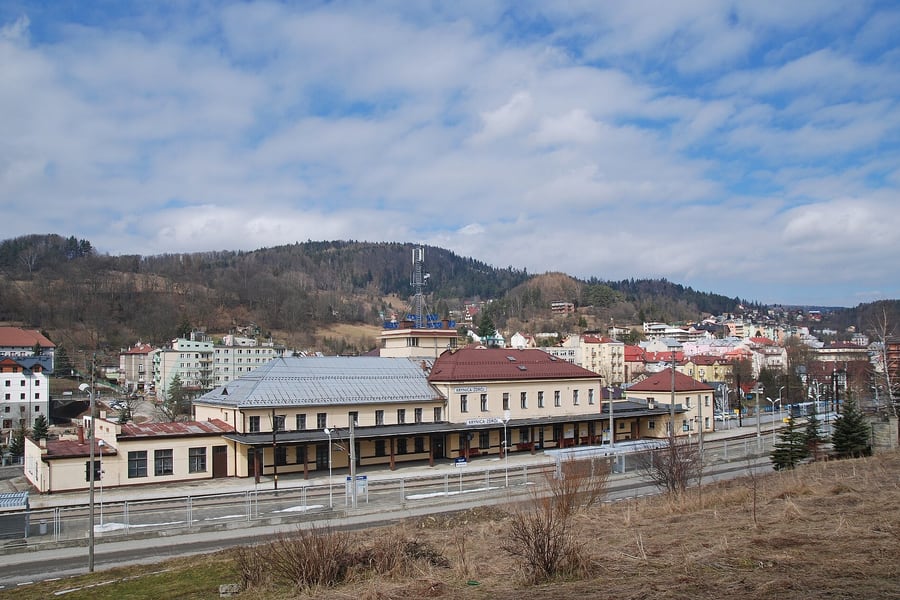
The Krynica Line
Fallaner / Wikimedia Commons · CC BY-SA 4.0 · cropped
- Distance149 km from Tarnów · 227 km from Kraków
- DurationAbout 3 hours from Tarnów, 4 hours from Kraków
- Best seasonAll year · buses replace trains March to June 2027
Introduction
Nikifor, the Lemko painter of Krynica, made his long journeys by train, and mostly without a ticket. Conductors would put him off at the next station. He did not much mind: it gave him time to look the building over and draw it before the following train came. The stations along this line, from Krynica through Tarnów and on towards Lwów, turned up in his pictures one after another, and railway stations are now listed among the subjects at the museum that carries his name.
One of the regional trains between Kraków and Krynica is called Nikifor.
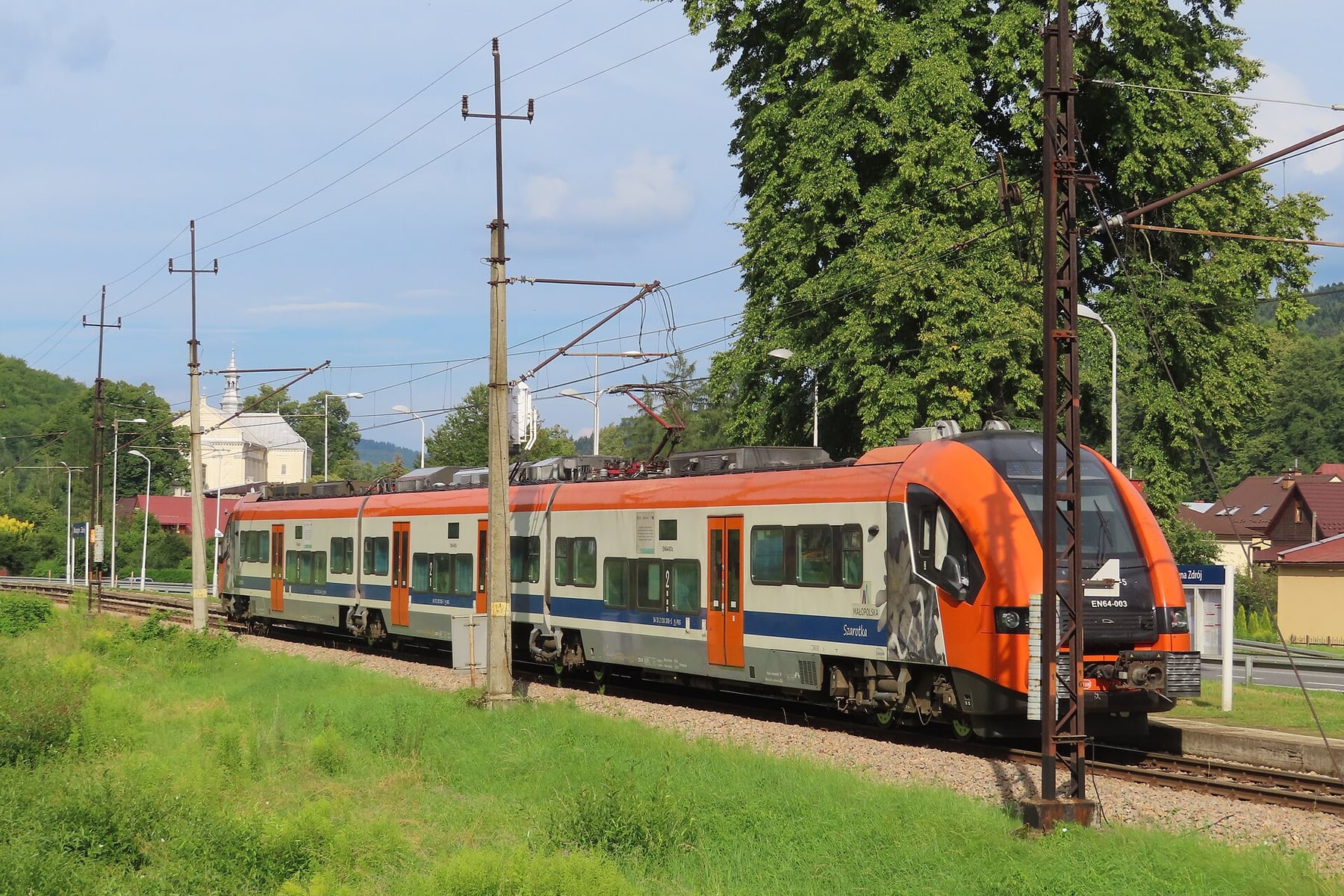
The line runs 149 km from Tarnów through the Beskid foothills to Nowy Sącz, then up the Poprad valley past a string of spa towns to Muszyna, where an 11 km branch climbs to Krynica-Zdrój. It is an ordinary working railway, served by POLREGIO's regional trains and PKP Intercity's TLK and IC services from Kraków, which take around four hours. Replacement buses are planned between Tarnów and Stróże from March to June 2027.
The Journey
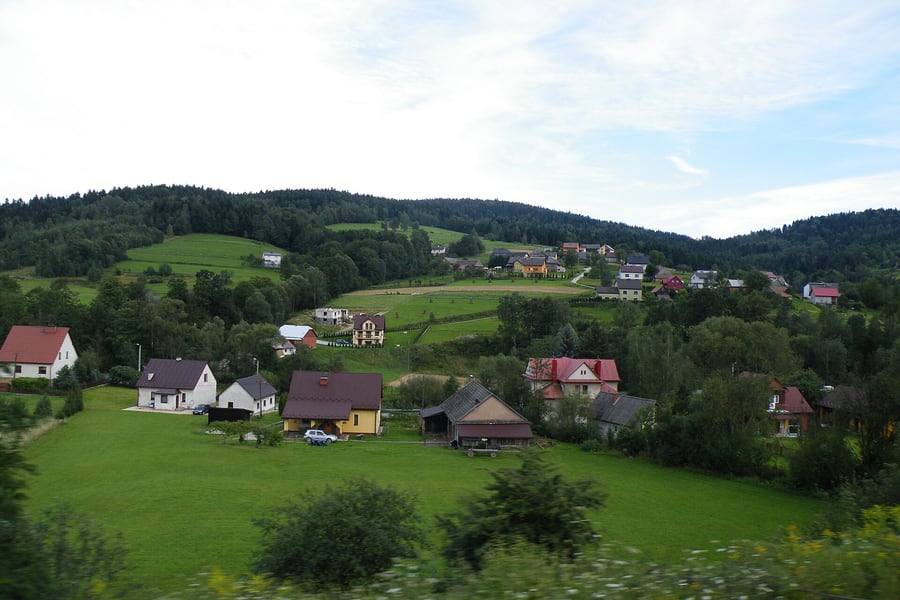
Trains leave the Kraków–Rzeszów main line at Tarnów and turn south, following PKP line 96 into the Beskid foothills through Tuchów and Bogoniowice Ciężkowice, and on to Bobowa-Miasto and the junction at Stróże. Most of the way is single track on a line opened on 18 August 1876, the emperor's birthday.
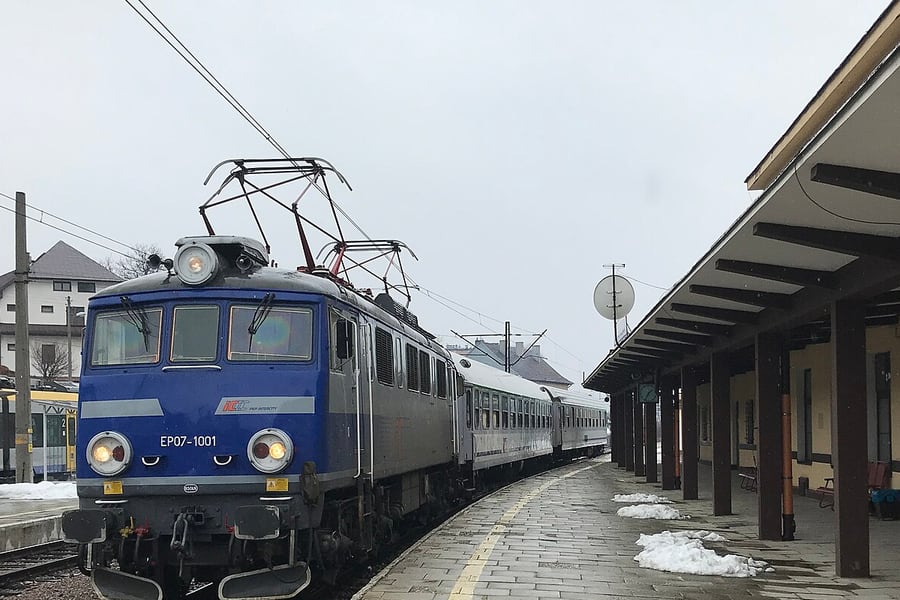
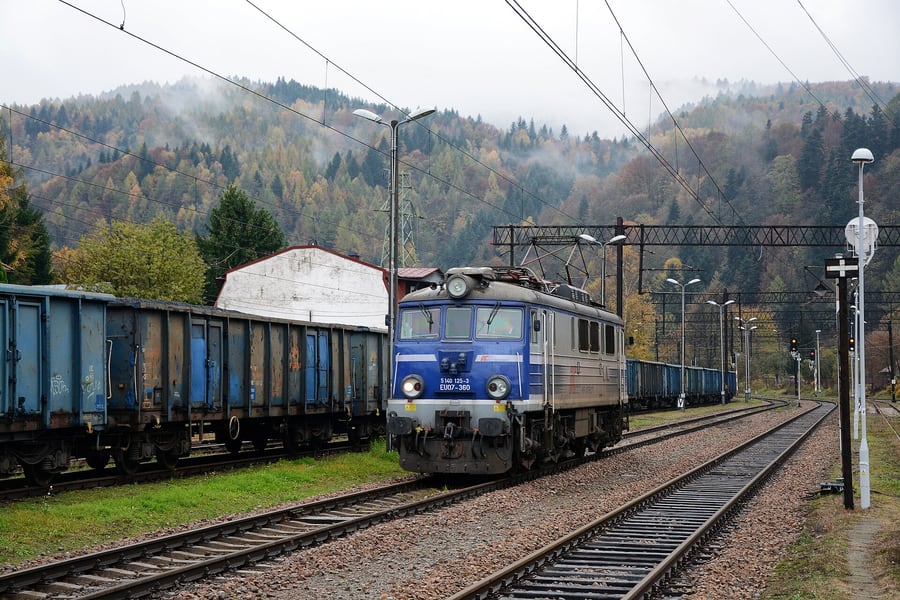
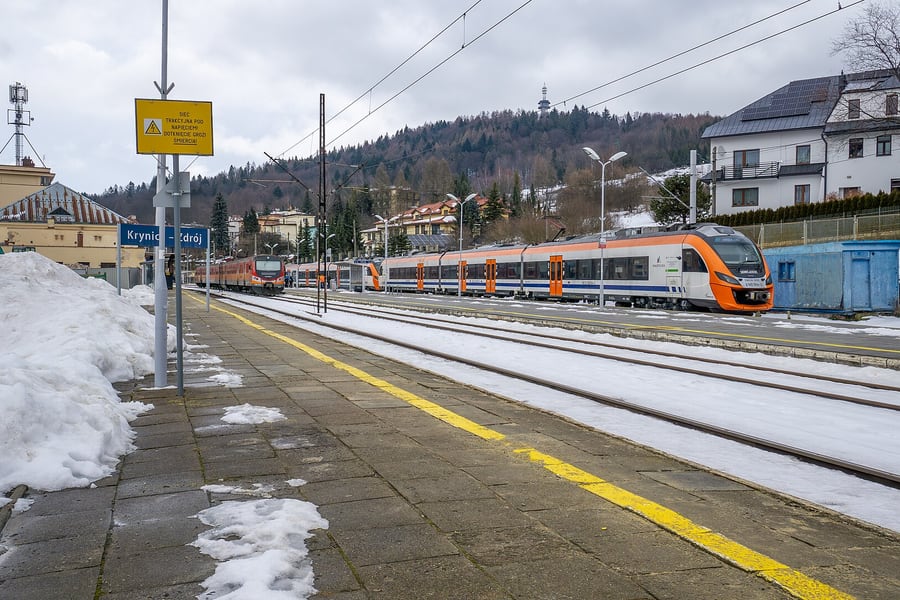
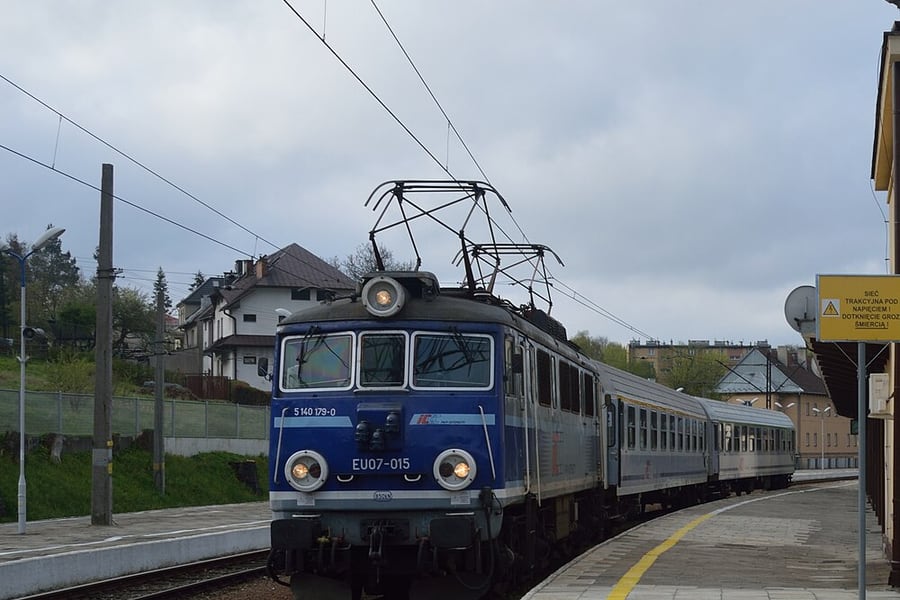
PKP Intercity's TLK Karpaty and Małopolska and the IC Malinowski are locomotive-hauled, by electrics such as the blue EU07 and EP07 in the photographs here. POLREGIO's regional services run as electric multiple units and carry names of their own: Jaworzyna, Dolina Popradu, for the Poprad valley, and Nikifor.
The painter and the conductors
Zbigniew Wolanin, writing in the Almanach Muszyny in 1999, set out how Nikifor travelled. He walked around the Lemko villages to sketch their wooden churches, and took the train for everything further. He seldom paid, so conductors often put him off at the next station, where he drew the building before boarding the next train. Wolanin traced the sequence of stations in his pictures along the line from Krynica through Tarnów and Przemyśl to Lwów, and in the Nowy Sącz museum's archive found a pre-war timetable on which a morning train from Krynica reached Lwów by the afternoon.
The line took Nikifor's neighbours away as well. Stations at Grybów and Nowy Sącz were loading points for transports of Lemkos to the east in 1945, and in the summer of 1947 those of the Nowy Sącz district were deported west under Operation Vistula. Nikifor was sent with them, and returned to Krynica, by Wolanin's account fairly soon after, carrying watercolours of ports and ships.
Up the Poprad
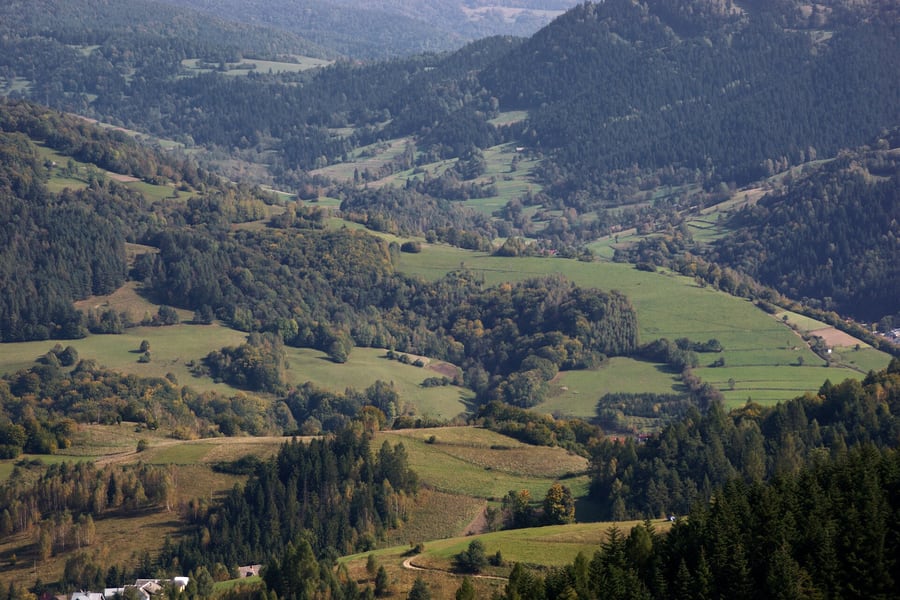
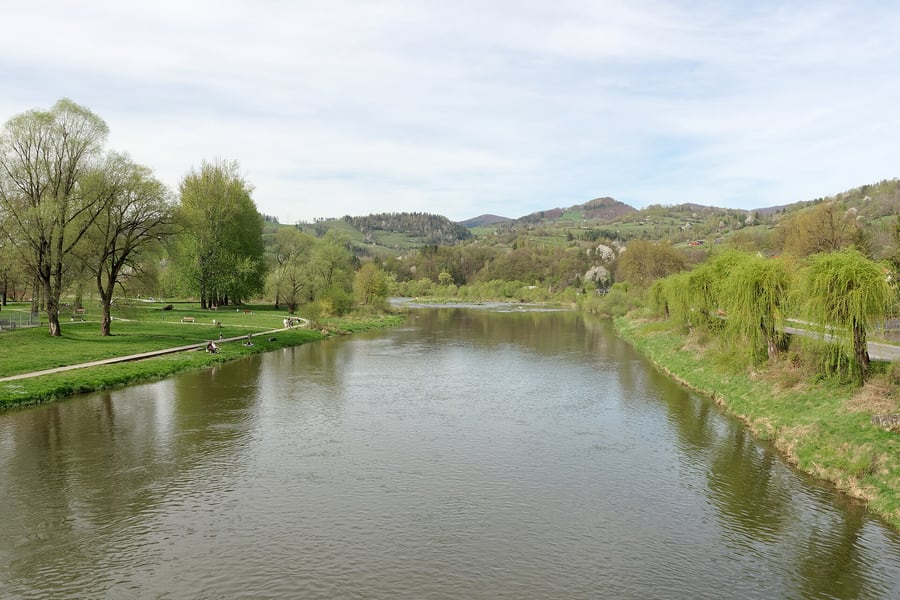
Beyond Nowy Sącz the line crosses the Poprad to Stary Sącz, near where the river meets the Dunajec, and turns up the valley. The Poprad runs north out of Slovakia, and for about 30 kilometres the Polish–Slovak frontier follows it. The section between Rytro and Piwniczna is known as the gorge: forest comes down to the water on either side, and the track shares the narrow floor of the valley with the river and the road.
Past Piwniczna-Zdrój the trains call at Łomnica-Zdrój, Wierchomla Wielka and Żegiestów, where the 513-metre tunnel was blown up twice. Sappers destroyed it in September 1939 and retreating German troops in January 1945. For three years afterwards the train stopped short and passengers crossed the hill to carry on.
The branch
At Muszyna the 1876 main line goes on to the Slovak frontier at Leluchów, and the Krynica trains leave it for an 11 km branch. Krynica had spent 35 years at the end of a carriage road, and the local company's line opened only on 29 May 1911, one of the last built in Galicia. During the First World War the branch shut for the winter, and the head of the Krynica commune wrote to the Polish members in Vienna that moving one wagon the 11 kilometres to Muszyna meant 204 kilometres of light-engine running, four trips of 51 kilometres from Nowy Sącz.
The trains stand for up to 19 minutes at Muszyna. Then they climb through Powroźnik, where an old wooden church is on the World Heritage list, to the terminus at Krynica-Zdrój.
Along the route
 Flyz1 / Wikimedia Commons · CC BY 3.0 · cropped
Grybów
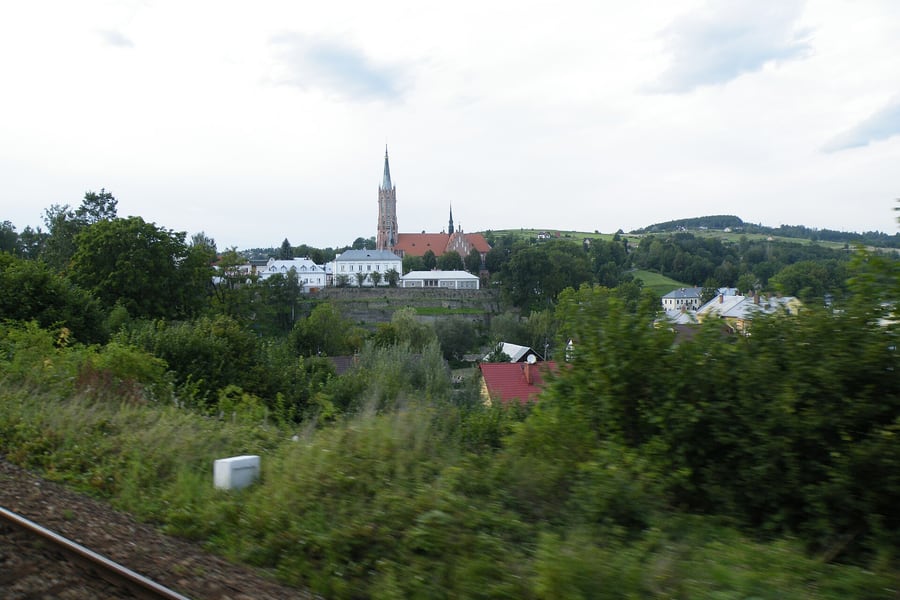
Beyond the junction at Stróże the line runs to Grybów, where the tall spire of St Catherine's basilica stands over the town. It then passes through a short tunnel at Kamionka Wielka on the way to Nowy Sącz.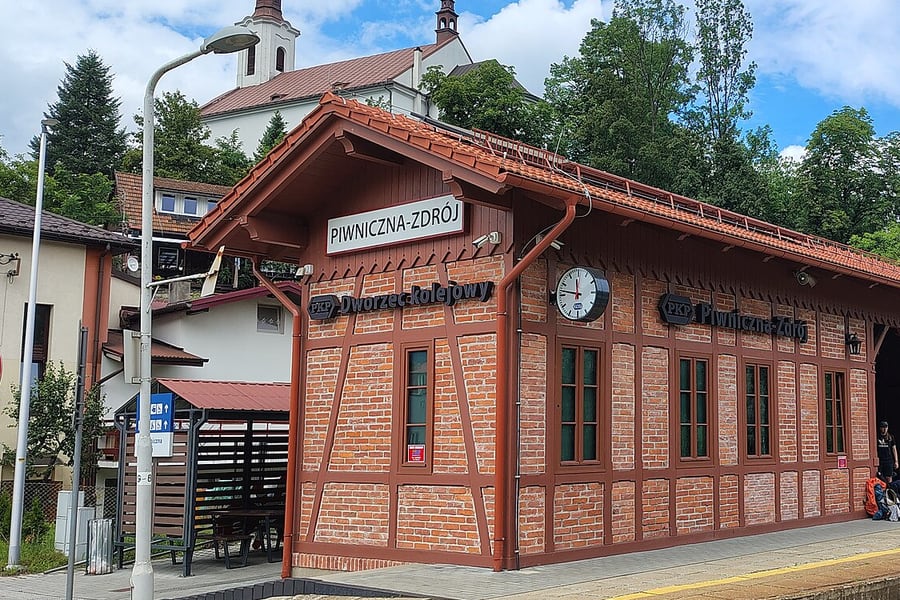 Vrabcak / Wikimedia Commons · CC0 · cropped
Piwniczna-Zdrój
A timber-framed station on the Poprad, where the river forms the Polish–Slovak border for about 30 kilometres upstream. Rytro's ruined castle lies a short way back along the valley, in the section known as the gorge.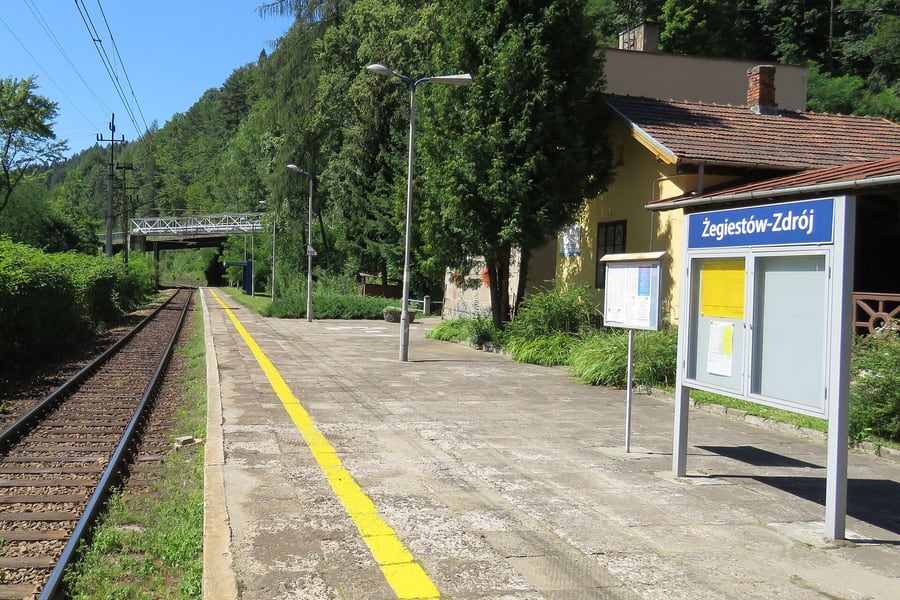 Andrzej Błaszczak / Wikimedia Commons · CC BY-SA 4.0 · cropped
Żegiestów-Zdrój
The 513-metre tunnel here was blown up in 1939 and again in January 1945. From 1946 until it reopened in 1948, passengers left the train and went about two kilometres over the hill on foot or by lorry to join another.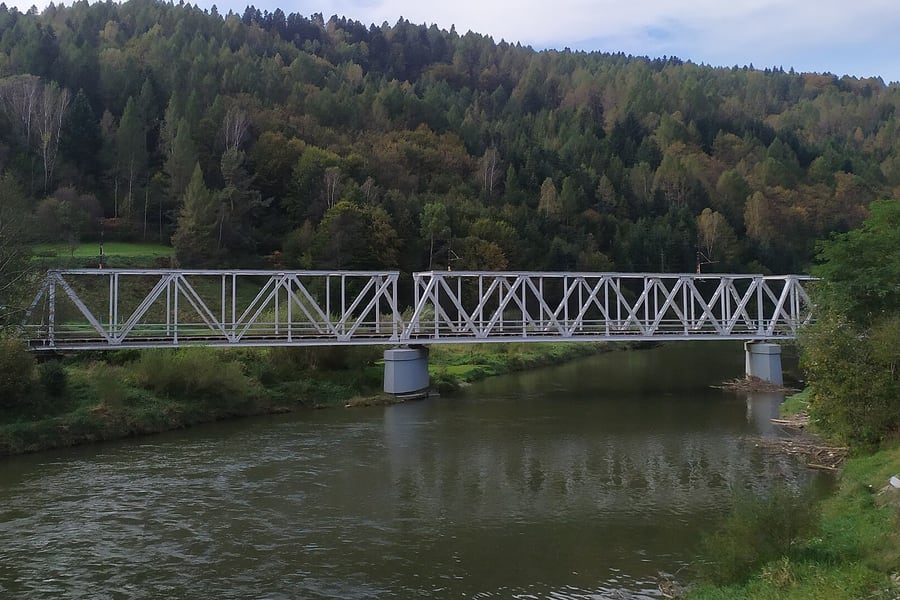 Mathieu Mars / Wikimedia Commons · CC BY-SA 4.0 · cropped
The Poprad at Muszyna
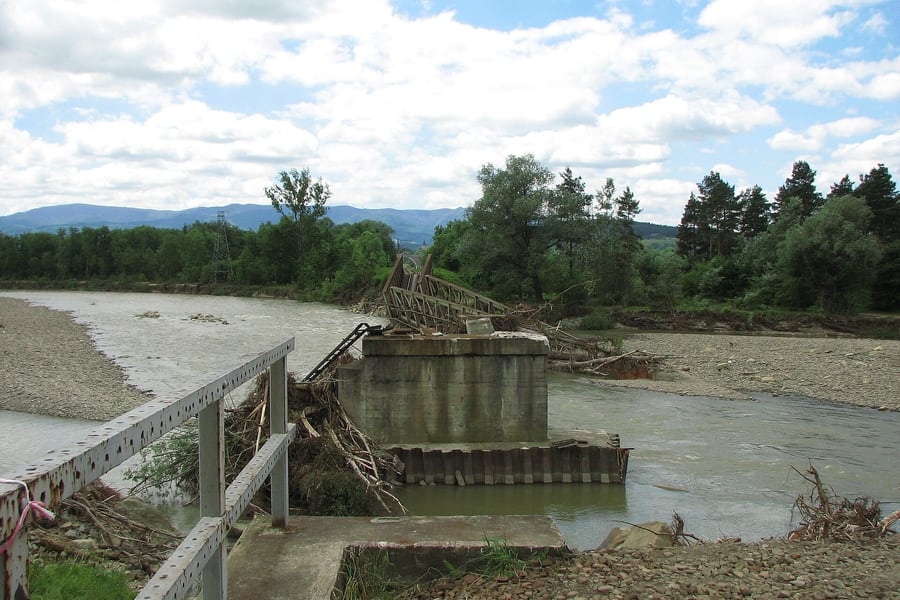
The line follows the Poprad to Muszyna. Retreating German sappers blew the railway bridge at the Nowy Sącz end of the town on the night of 19 to 20 January 1945, and railwaymen had the broken bridges rebuilt by the summer of 1946.A bit of history
Culture & experiences along the way
 Andrzej Otrębski / Wikimedia Commons · CC BY-SA 3.0 PL · cropped
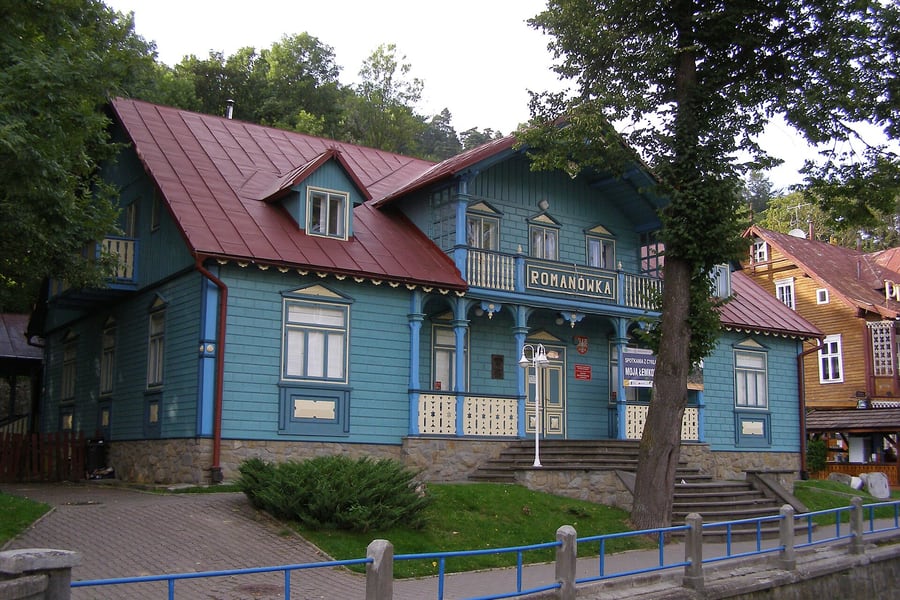
The Nikifor Museum
The wooden villa Romanówka on Bulwary Dietla has shown Nikifor's work since 1995: watercolours and drawings of churches, Krynica's buildings and railway stations. It closes on Mondays, and Thursday entry is free.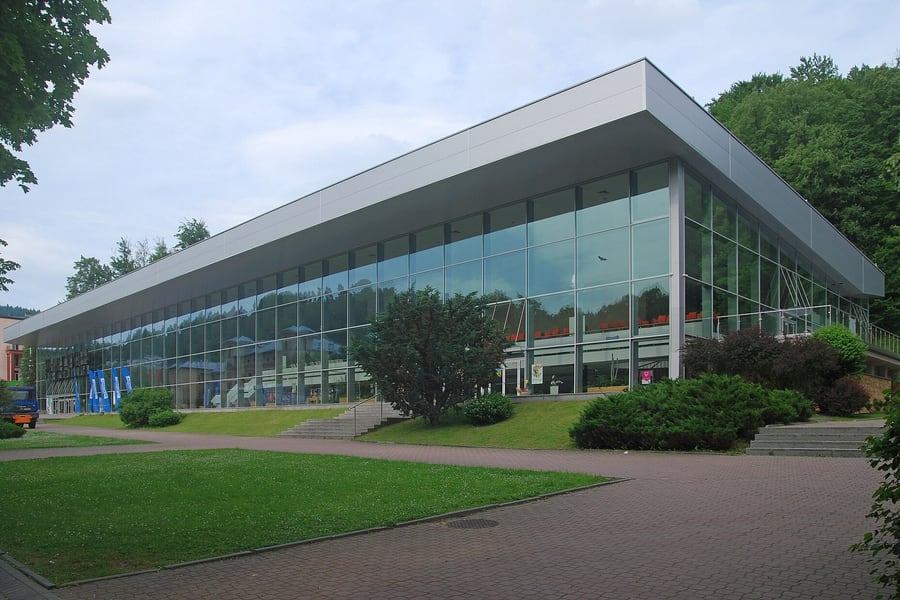 Henryk Bielamowicz / Wikimedia Commons · CC BY-SA 4.0 · cropped
The waters of Krynica
Taste the springs in the glass-walled Main Pump Room of 1971 on the promenade. The town's springs include Zuber, a strong alkaline sparkling water named after Rudolf Zuber, the geologist who drilled to about 810 metres to find it.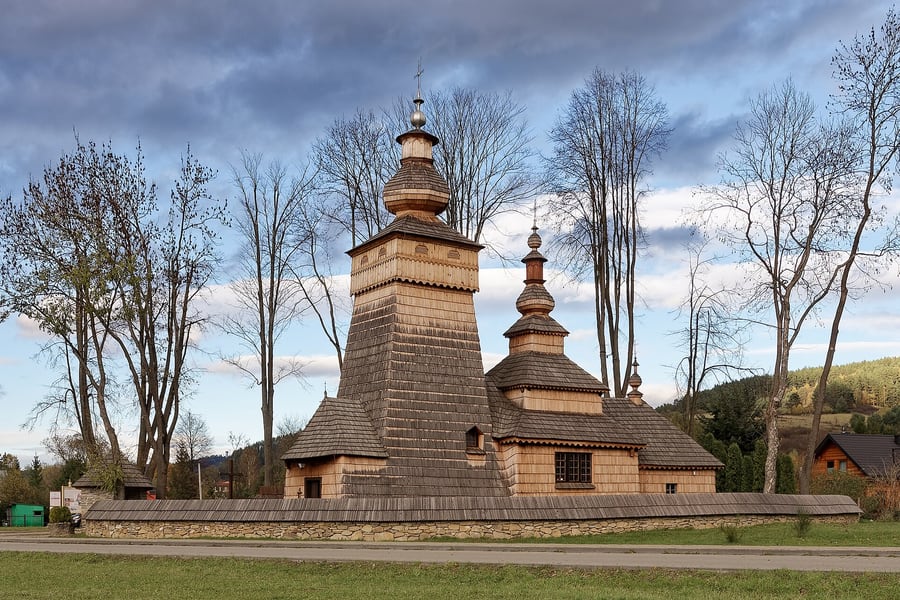 Jakub Hałun / Wikimedia Commons · CC BY 4.0 · cropped
The wooden church of Powroźnik
One stop short of Krynica, this Lemko church of St James dates from around 1600 and is part of a UNESCO World Heritage listing of 2013. It is a Roman Catholic parish church today, with a sacristy painted in 1607.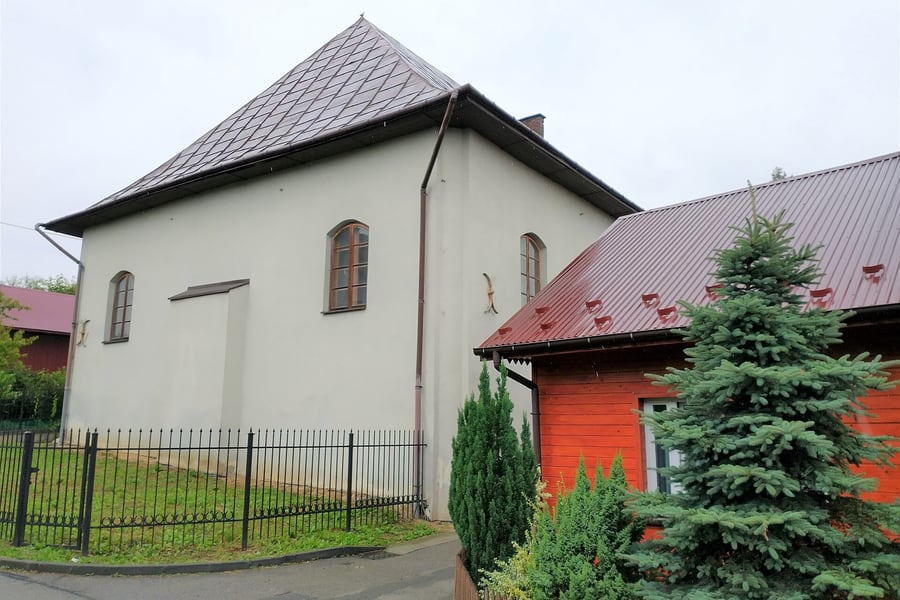 MOs810 / Wikimedia Commons · CC BY-SA 4.0 · cropped
The synagogue at Bobowa
Built in 1756 and reopened in 2003 before Bobov Hasidim from abroad, whose pilgrims still come to the graves of their tzaddikim. The stucco Torah ark of 1777–78 survives inside, and services are held only occasionally.Timetables
POLREGIO and PKP Intercity between them run about eight trains a day each way along the whole line, and most of them come through from Kraków. Kraków to Krynica-Zdrój takes about four hours; the fastest direct train, the TLK Małopolska, takes 3 hours 59 minutes. From Tarnów the journey is about three hours.
Direct trains, Wednesday 18 November 2026
| Train | Kraków Główny | Tarnów | Krynica-Zdrój |
|---|---|---|---|
| TLK 30171 Karpaty | 04:19 | 05:10 | 08:40 |
| POLREGIO 33151 Jaworzyna | 05:34 | 06:44 | 09:52 |
| POLREGIO 33153 Dolina Popradu | 07:30 | 08:33 | 11:38 |
| IC 30100 Malinowski | 08:56 | 09:58 | 13:08 |
| TLK 53105 Małopolska | 13:58 | 14:56 | 17:57 |
| POLREGIO 33155 Nikifor | 16:58 | 17:57 | 21:07 |
| Train | Krynica-Zdrój | Tarnów | Kraków Główny |
|---|---|---|---|
| POLREGIO 34054 Nikifor | 05:08 | 08:06 | 09:25 |
| TLK 35104 Małopolska | 10:25 | 13:33 | 14:25 |
| POLREGIO 30684 Słomka | 13:10 | 16:25 | 18:11 |
| POLREGIO 30608 Dolina Popradu | 14:17 | 17:34 | 18:40 |
| IC 33100 Malinowski | 15:50 | 18:50 | 19:53 |
| POLREGIO 33158 Jaworzyna | 17:41 | 20:40 | 21:48 |
| TLK 33171 Karpaty | 19:41 | 22:45 | 23:46 |
Other POLREGIO trains run between Tarnów and Krynica without continuing to Kraków. The next timetable starts on 13 December 2026.
Replacement buses in 2027
PKP Intercity's notice for the 2026/27 timetable says that from March to June 2027 track work will close line 96 between Tarnów and Stróże, and that replacement buses will run towards Krynica-Zdrój. The exact dates are not yet published, so check before travelling in those months.
As of November 2026, from KOLEO's timetable (opens in a new tab) for 18 November 2026 and PKP Intercity's notice (opens in a new tab) of 16 October 2026.
Tickets
Tickets for the POLREGIO regional trains are priced under the Małopolska tariff, and seats are not reserved. PKP Intercity's TLK and IC trains are sold with a reserved seat and priced by date, so the cheapest seats go early: promotional fares from Kraków to Krynica were 19 zł on the Karpaty and 34.80 zł on the Małopolska.
Tickets for all of them are on sale at KOLEO (opens in a new tab) as well as the operators' own sites. Fares for 18 and 19 November 2026, as of November 2026.
Book your tickets
Kraków to Krynica-Zdrój, POLREGIO
28.50 zł · Małopolska regional tariff
The regional fare for the direct POLREGIO trains, valid for seven hours from the departure you choose.
Book Tickets (opens in a new tab, on POLREGIO)via POLREGIOKraków to Krynica-Zdrój, TLK
From 19 zł · second class, promotional fare
PKP Intercity's cheapest seats on the Karpaty and Małopolska trains, which vary by date and sell out early.
Book Tickets (opens in a new tab, on PKP Intercity)via PKP IntercityRail Passes
Interrail and Eurail passes are valid on the POLREGIO, TLK and IC trains on this line, on a Global Pass or a Poland Pass. POLREGIO's trains need no reservation. Interrail's table of railway companies recommends one on TLK trains, where they are often full, and lists some IC trains with a mandatory reservation, so check the train before travelling.
For this trip alone a pass is not worth buying: the POLREGIO fare from Kraków to Krynica is 28.50 zł. It pays only when the line is one stop on a longer journey through Poland.
Checked November 2026 against Interrail's table of railway companies (opens in a new tab), last updated 21 October 2026.
Places to Visit
The stops below are all on the line. The spa towns of the upper valley suit a slow day out from Krynica.
 Andrzej Otrębski / Wikimedia Commons · CC BY-SA 4.0 · cropped
The Stone City at Ciężkowice
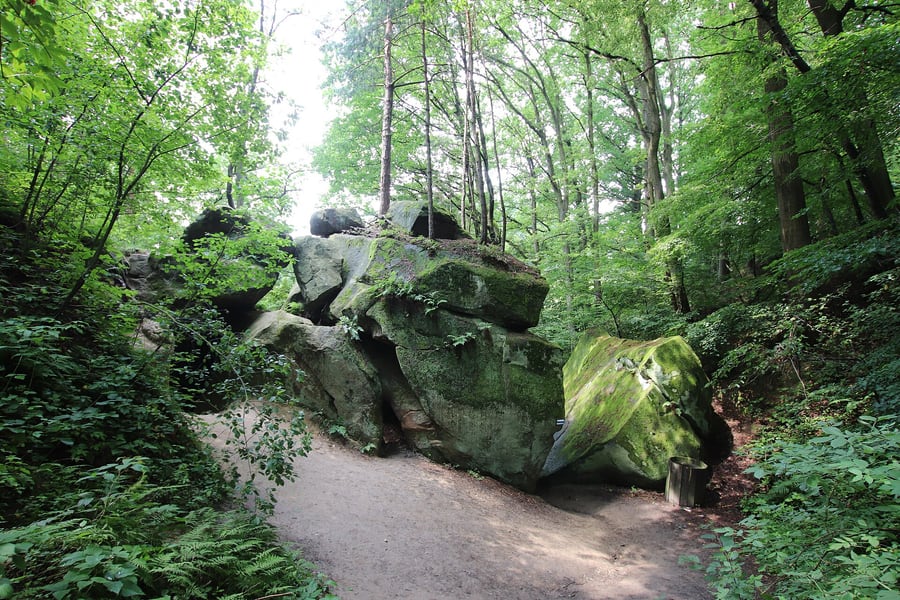
A nature reserve of sandstone towers and tumbled blocks in the woods above Ciężkowice, created in 1974. The rocks have names such as Grunwald, a 17-metre tower, and the Town Hall, and a marked blue path links them. It is one of the Pogórze's few protected rock outcrops and takes about two and a half hours to walk.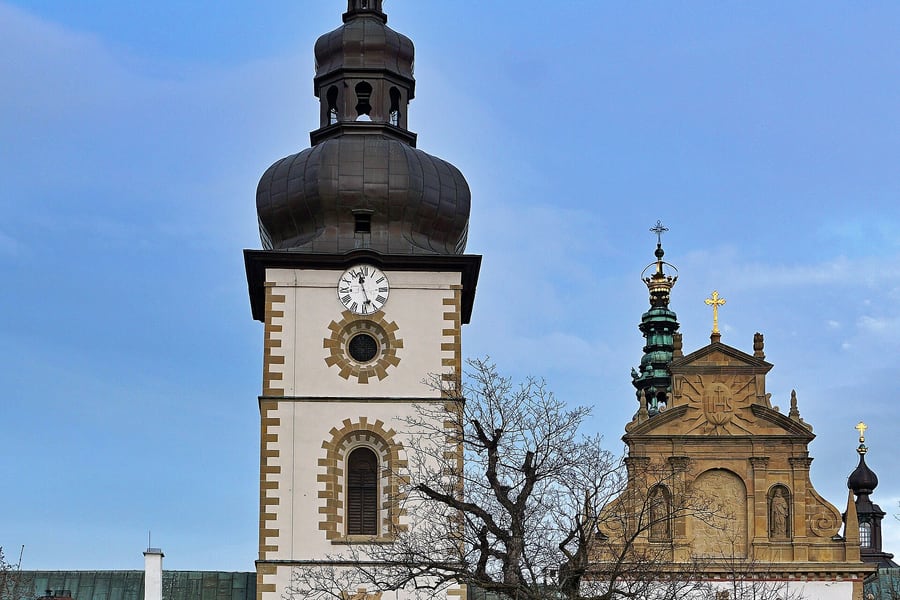 Igor123121 / Wikimedia Commons · CC BY 4.0 · cropped
Stary Sącz
St Kinga founded a convent of Poor Clares here in 1280, and the town stands between the Dunajec and the Poprad. The convent's Church of the Holy Trinity and St Clare, with its domed tower, rises over a market town that the region's tourist board calls one of the oldest and most beautiful in Poland.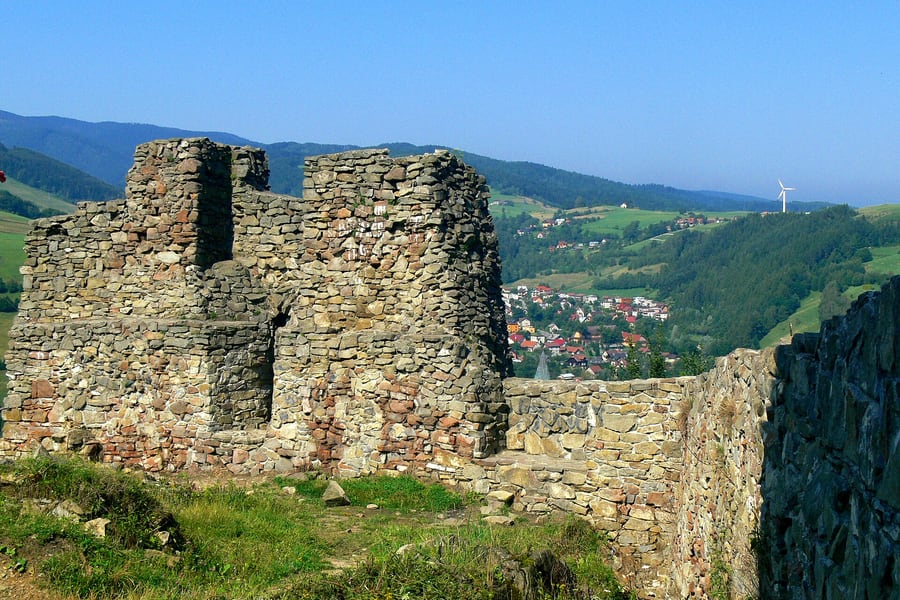 Piotr Widerski / Wikimedia Commons · CC BY-SA 3.0 PL · cropped
Rytro Castle
A ruined royal castle on the 463-metre hill called Zamczysko, built around the start of the fourteenth century to guard the road along the Poprad. In 1312 the Poor Clares won the right to collect tolls below it, and it was plundered in 1657. The surviving tower stands about 10 metres high, and the site was renovated in 2025.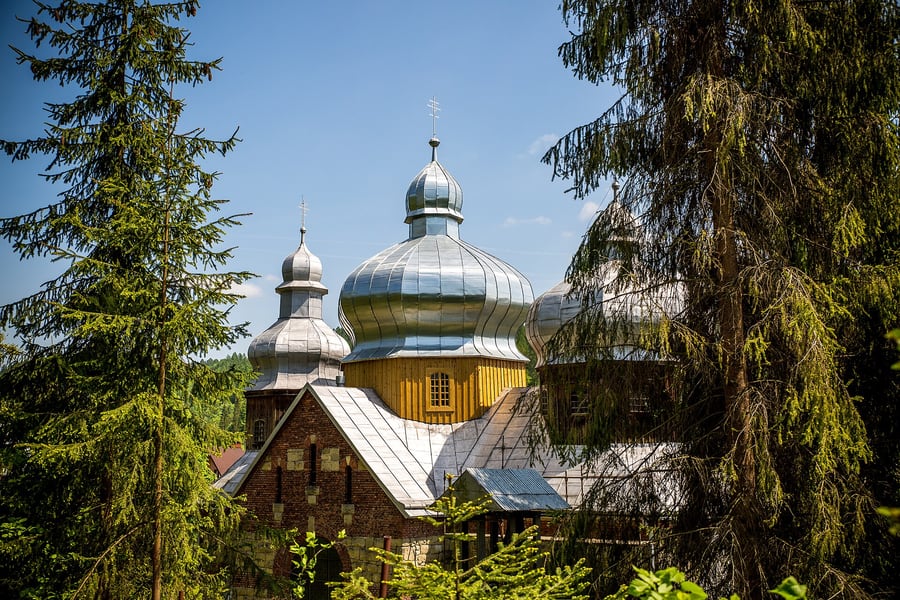 Pelnykadrtwojezdjecia / Wikimedia Commons · CC BY-SA 4.0 · cropped
The church at Żegiestów
A Greek Catholic church built in the Boyko style between 1917 and 1925, with three towers and silver cupolas, and now the Roman Catholic parish church of St Anne and St Michael. Żegiestów itself is a spa village set on a high escarpment above the river, full of villas hidden in the trees.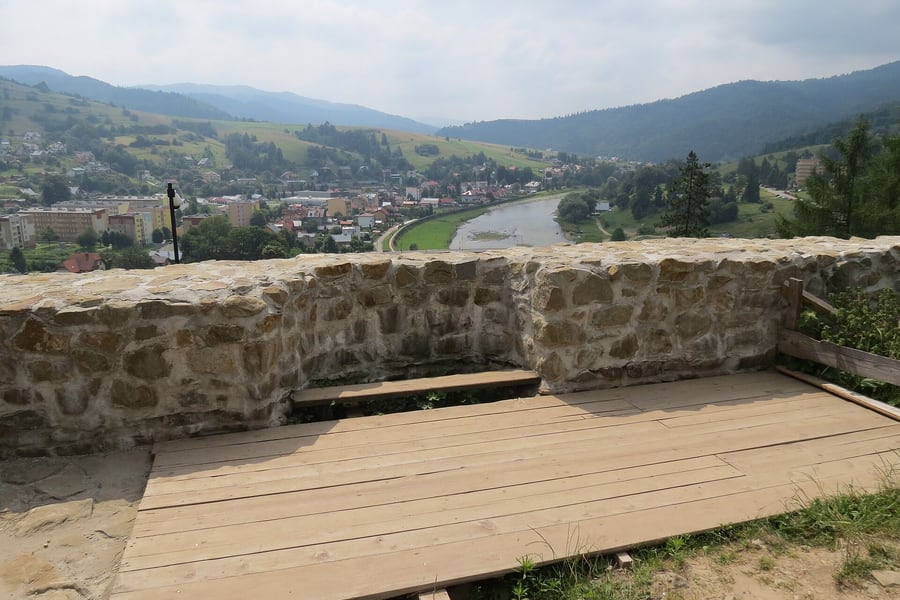 Bazie / Wikimedia Commons · CC BY-SA 3.0 PL · cropped
Muszyna Castle
The ruins stand on a steep hill called Baszta, 527 metres above the sea, on the right bank of the Poprad. Renovation between 2020 and 2023 raised the tower to 14 metres and gave it a glazed viewing terrace, looking along the valley and over the town the railway reached in 1876.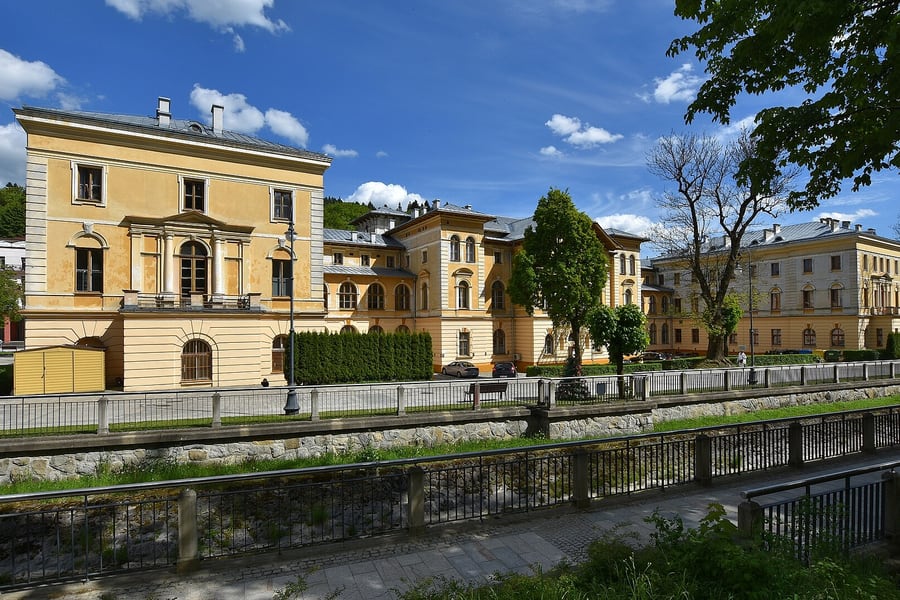 Henryk Bielamowicz / Wikimedia Commons · CC BY-SA 4.0 · cropped
The promenade at Krynica-Zdrój
The neo-Renaissance Old Spa House of 1889 faces the promenade, with the Main Pump Room further along it and the funicular of 1937 climbing Góra Parkowa behind. The town spreads between 560 and 650 metres above the sea, around the end of the railway.Where to Sleep
Krynica-Zdrój, at the end of the line, is the natural base. Nowy Sącz suits a stop halfway along it, and Tarnów an early start.
Where to stay
Hotel Tarnovia
Tarnów, at the start of the line
A city-centre hotel opened in 1976 and modernised by new owners from 2022, with a restaurant and fitness room.
Check Availability (opens in a new tab, on tarnovia.pl)via tarnovia.plHotel Beskid
Nowy Sącz, in the town centre
A town-centre hotel at ul. Limanowskiego 1, with a pool, spa and bowling alley.
Check Availability (opens in a new tab, on hotelbeskid.pl)via hotelbeskid.plHotel NAT Krynica-Zdrój
Krynica-Zdrój
A hotel with a treatment and relaxation area, part of the NAT group of holiday hotels.
Check Availability (opens in a new tab, on nat.pl)via nat.plQuestions or corrections
Planning this trip and stuck on something, or spotted a time, fare or detail that has changed? Send us a message about The Krynica Line. We read every one, and we update this page when something has changed.