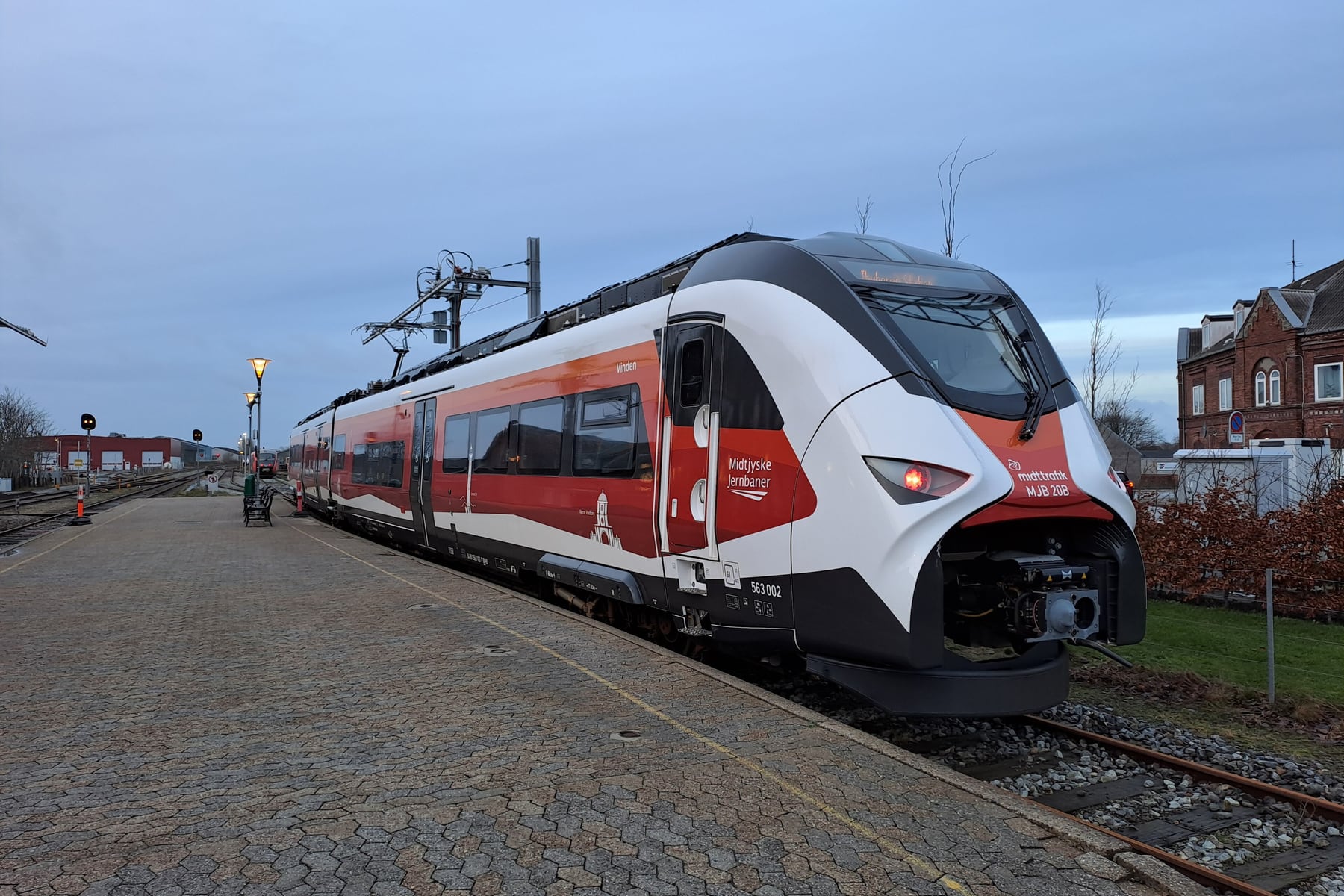
Vemb to Thyborøn: the Lemvigbanen
Pfefferdose / Wikimedia Commons · CC BY 4.0
- Distance57 km · 20 stops
- Duration1 hr 17 min – 1 hr 20 min end to end
- Best seasonAll year · seven trains a day from Vemb
Introduction
Lemvig has spent a century and a half at the back of the queue. When the West Jutland main line was being planned in the 1870s, the town asked for it to be carried on from Ringkøbing through Lemvig and up to Struer. The answer was no: in 1874 the rails went inland instead, from Ringkøbing by way of Vemb to Holstebro, and Lemvig was left eleven kilometres off the network with a fjord in the way.
So the town built its own. A company was formed, the money was found locally, and on 20 July 1879 the Vemb–Lemvig Jernbane began running three trains a day in each direction. It was built as cheaply as a railway can be built. The rails weighed 17.4 kilograms per metre, laid on untreated sleepers. There was no fencing, no guarding at the level crossings and no signals at all — the first Danish railway to open in that condition. The whole stock was three small tank engines, one of them second-hand, six compartment carriages and seven goods wagons, and that was the railway.
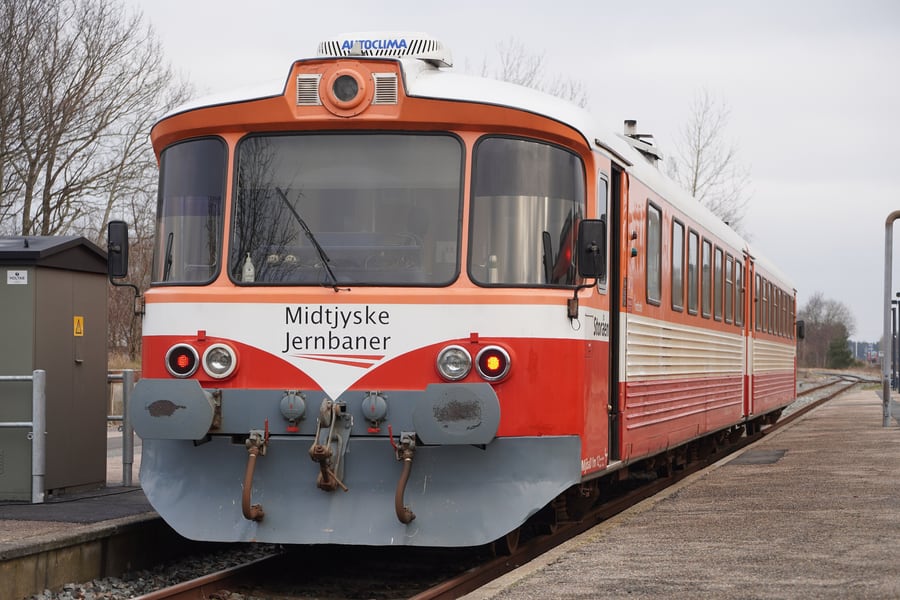
The pattern held for the next hundred years. When Denmark's private railways were re-equipped with railbuses in 1948, this one was passed over, and bought other companies' worn-out ones in the 1960s. When the private railways got the Y-tog in the 1960s, it was passed over again, and made do with four second-hand Swedish railbuses from 1973. Its first factory-new trains did not arrive until 1983. By 2020 it was the last railway in Denmark still working its traffic with Y-tog, the boxy red-and-orange railcars everyone else had retired.
And then, in 2025, the line that had never been first at anything became the first at the thing that matters now. The Y-tog went, and Denmark's first battery trains took over the 57 kilometres between Vemb, Lemvig and Thyborøn — running silently across a landscape of wind turbines and sea dikes, charging from an overhead wire that is only a few hundred metres long. A railway assembled out of other people's cast-offs for 146 years had leapfrogged the entire country.
The Journey
The train leaves from platform 1 at Vemb, alongside the main-line trains to Holstebro and Skjern — though for the railway's first eighty years it did not. Until 1959 the Lemvig company kept its own separate station immediately west of the state one, which is the sort of arrangement that follows from being told no in 1874.
From Vemb the line turns north-west across farmland, and seven halts go by in less than half an hour: Amstrup, Bækmarksbro, Sinkbæk, Fåre, Ramme, Bonnet and Armose. Most of these are trinbrætter — bare halts, a platform and a nameboard. At every one of them, and at every station on the line except Thyborøn Havn, Lemvig and Vemb, the timetable carries the same instruction: the platform signal has to be switched on, and passengers should be visible on the platform when the train comes into sight. Armose is the summit of the whole railway, at 45 metres above the sea.
Lemvig, where the wire is
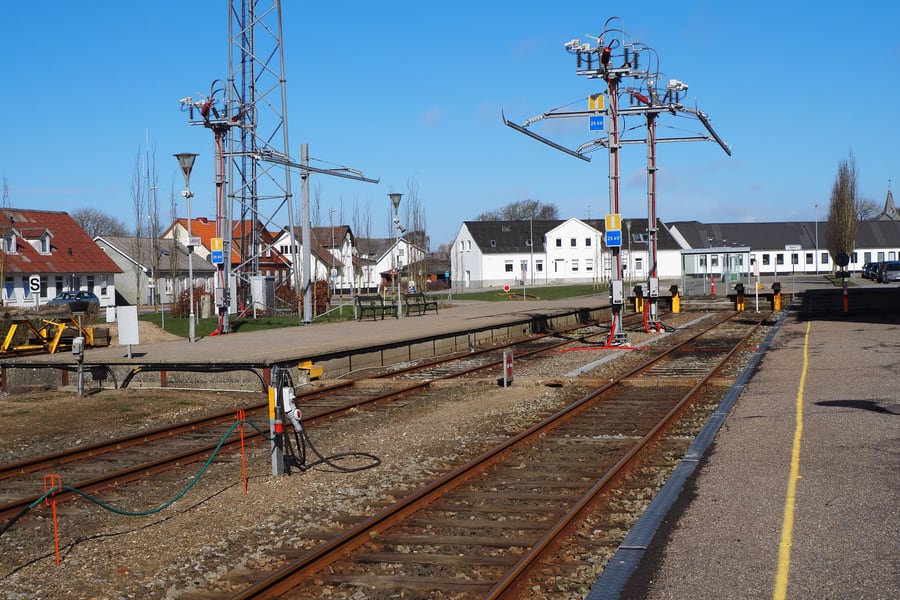
Lemvig is the hinge of the line and its headquarters, and the train stands here for a quarter of an hour on the through working. The station sits up on the plateau rather than down in the town, because in 1879 taking the line the last stretch down to the harbour would have cost 80,000 kroner more than the company had. Above the platform is the reason the stop is long: a short island of overhead wire at 25,000 volts, one of three on the two lines Midtjyske Jernbaner runs, where the battery train draws its charge. Four to eight minutes is enough — about as long as it takes passengers to get on and off.
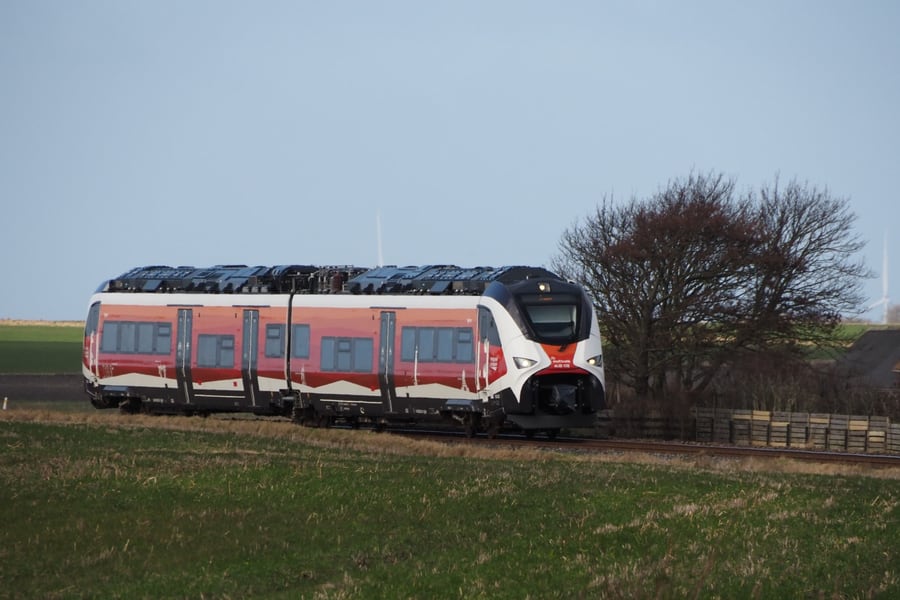
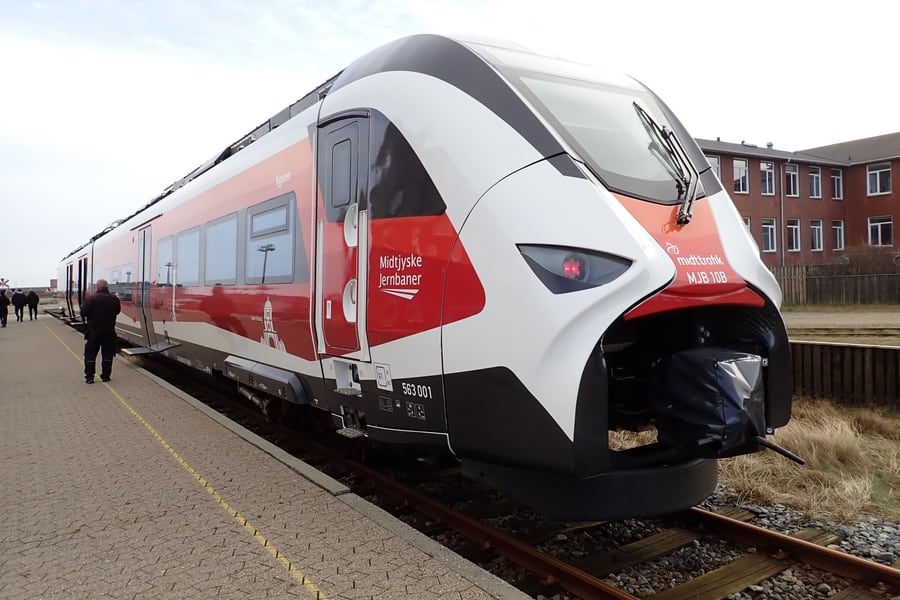
The trains are Siemens Mireo Plus B units, Denmark's first battery-electric passenger stock, running on lithium-titanate cells with a range of 80 to 120 kilometres. They weigh 93 tonnes, hold 282 people, and replaced diesels that had been putting out something like 1,900 tonnes of carbon dioxide a year. The livery deliberately keeps the old Y-tog's colours, and each unit carries illustrations of ten landmarks from the districts the railway passes through, chosen with local people: the wind turbines, Lemvig church with its onion dome, Bovbjerg lighthouse, a fishing cutter, the gate tower of Nørre Vosborg near Vemb.
Down to the harbour, and why you cannot follow
Below Lemvig station the ground falls more than thirty metres to the water, and in 1892 the company built a goods branch down it — 1.8 kilometres of track that zig-zags, the train reversing halfway at a single-tongued point because no other alignment would fit. Its bridge over Vesterbjerg, put up the same year, is still an emblem of the town; the old VLTJ arms are on the arch. The branch never had scheduled passengers, but preserved trains worked it on and off from 1991 under the name Bjergbanen, the mountain railway. That has stopped. The society's own timetable page says the line must be renovated before it can carry passengers again, so the descent is one to look at rather than ride.
The tange
North of Lemvig the character changes completely. Balleby, Klinkby, Nejrup and Strande come and go, then Victoria Street Station — a halt whose sign went missing in the 1920s, after which residents put up one of their own devising, and the invented English name became official in May 1991.
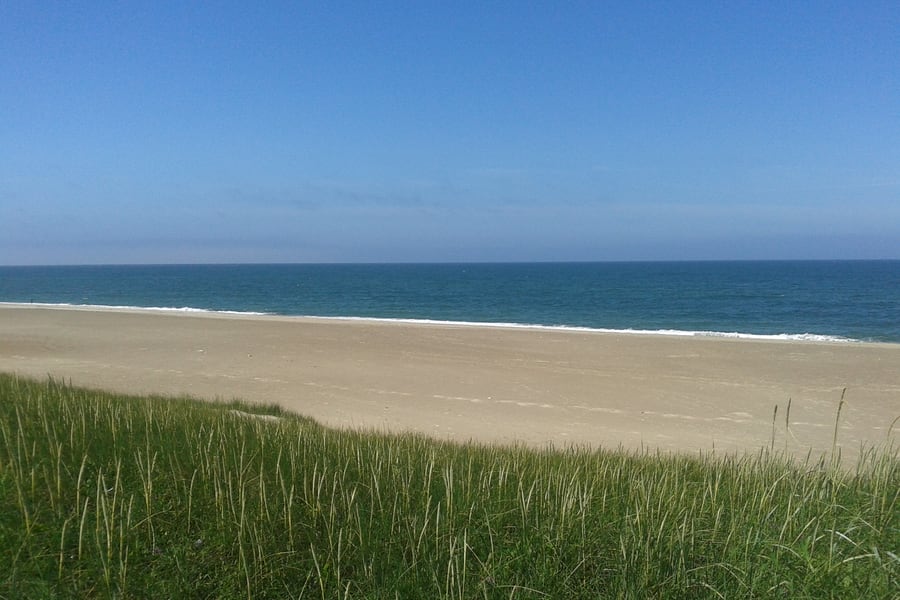
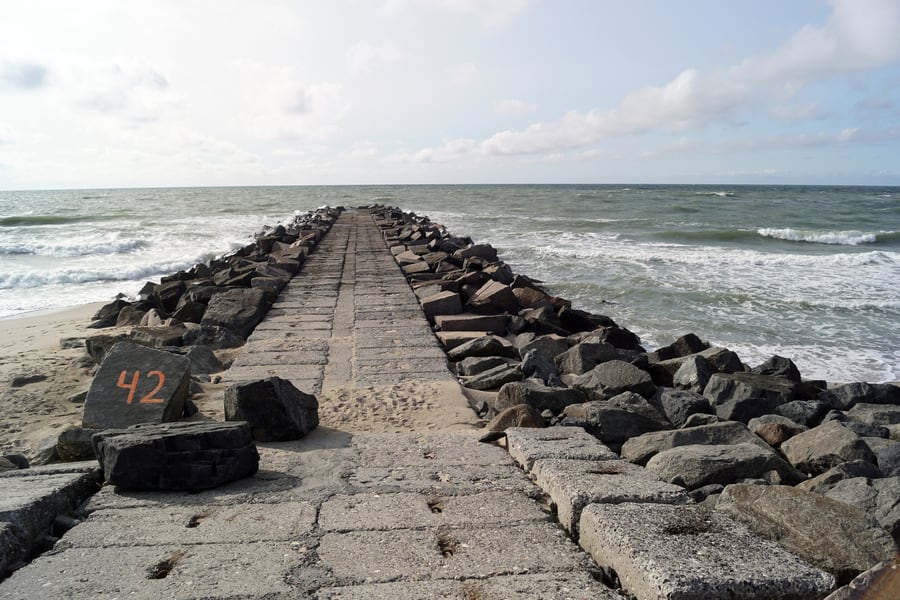
From Vrist the railway is out on the Harboøre Tange, a sand spit between the North Sea and Nissum Bredning that has been overtopped and breached repeatedly since 1550. The original alignment ran along the low beach meadow and flooded; the track was lifted a metre onto an embankment in the summer of 1921, and in 1955 the whole northern section was moved about two kilometres east to run beside the road on the new sea dike. Two stops were lost in the move and one gained — Rønland, which exists to serve the chemical works. On a clear day the sea is on one side and the fjord on the other, with turbines turning on both horizons.
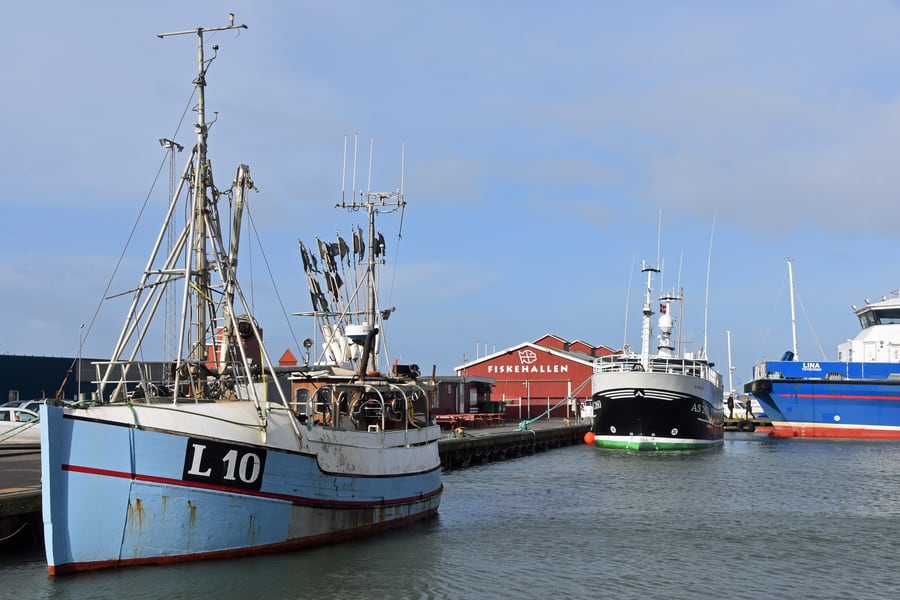
Thyborøn Kirke, then Thyborøn Havn, and the line stops among the fishing boats it was built for.
Along the route
 Svein Julton / Wikimedia Commons · CC BY 4.0 · cropped
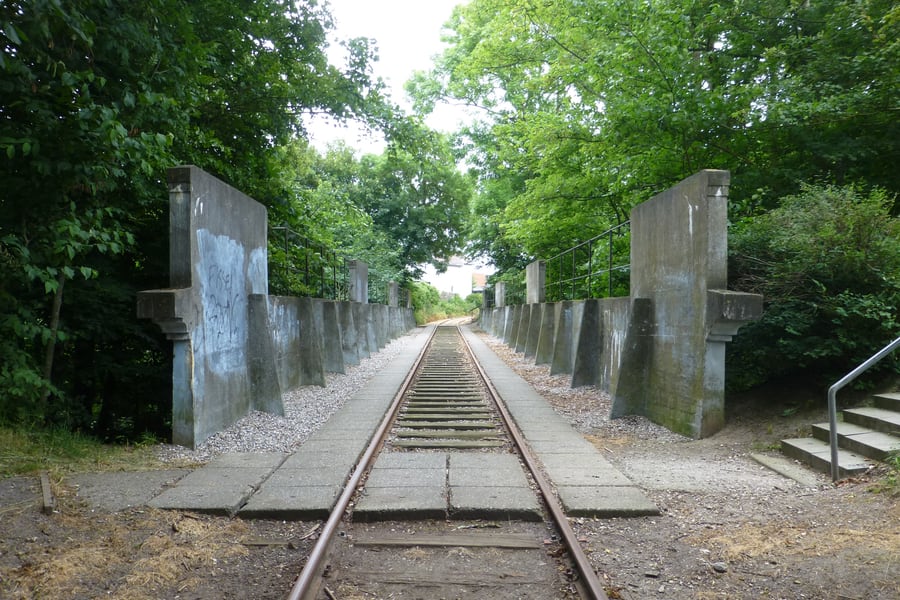
The railway Lemvig had to build itself
When the state's West Jutland line bypassed the town in 1874 and Lemvig's request to be included was refused, the town raised the money and built its own. It opened in July 1879 with three trains a day, on rails of 17.4 kg per metre, with no fencing and no signals at all.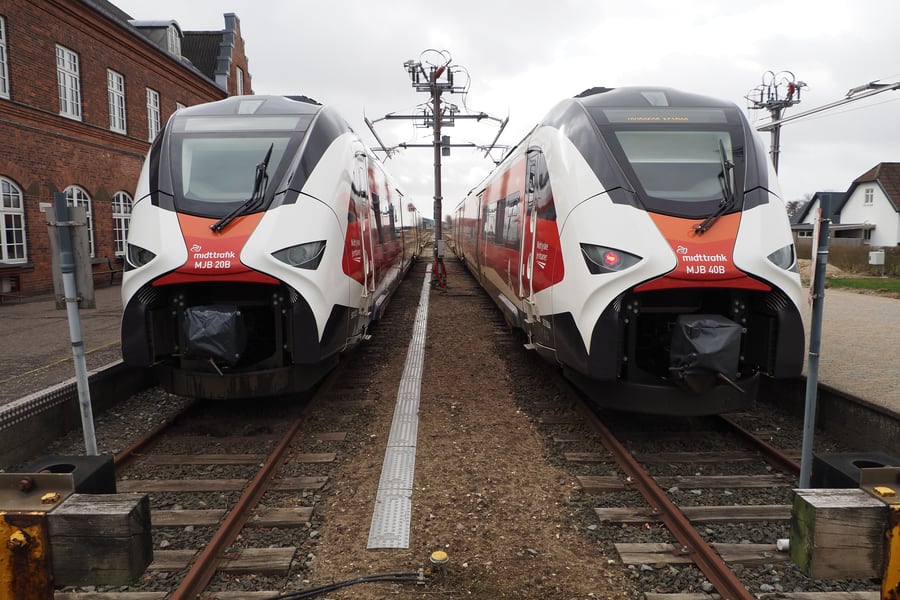 Svein Julton / Wikimedia Commons · CC BY 4.0 · cropped
Denmark's first battery trains
The Siemens Mireo Plus B units that took over in 2025 are the first battery-electric passenger trains in the country. They charge from three short stretches of wire, needing only four to eight minutes at a platform, and replaced diesels emitting some 1,900 tonnes of carbon dioxide a year.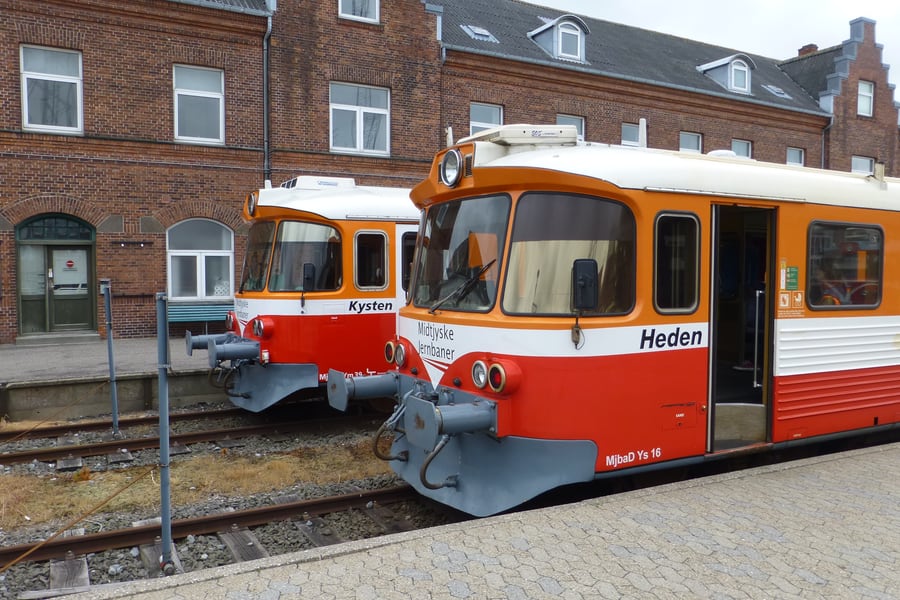 Leif Jørgensen / Wikimedia Commons · CC BY-SA 3.0 · cropped
The last Y-tog in Denmark
The line was passed over when Denmark's private railways were re-equipped in the 1950s, and again in the 1960s. The consequence came round the other way: by 2020 this was the last railway in the country still working its traffic with Y-tog.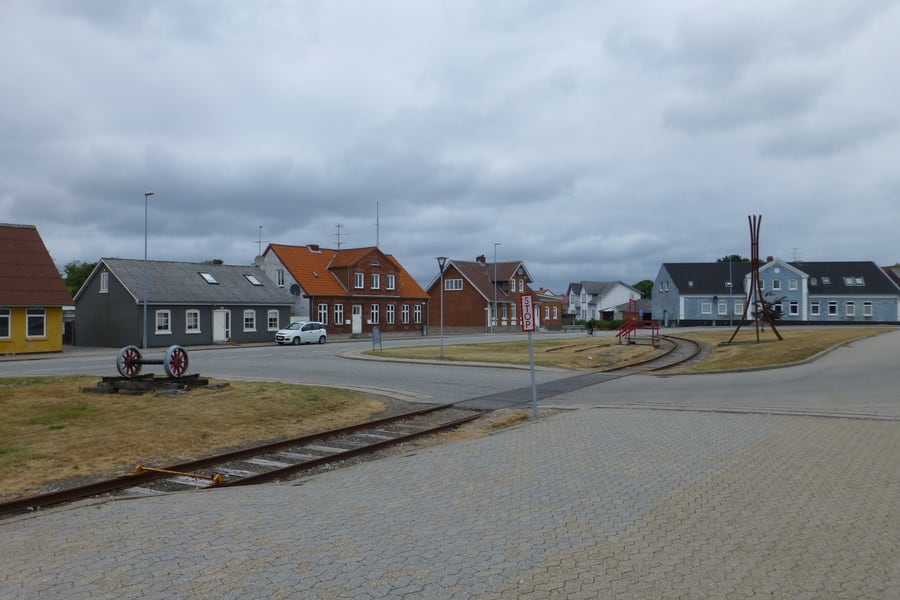 Leif Jørgensen / Wikimedia Commons · CC BY-SA 3.0 · cropped
The Bjergbanen, which no longer runs
Lemvig station stands on the plateau and the harbour is more than thirty metres below it. The goods branch of 1892 solved that in 1.5 kilometres by zig-zagging. Preserved trains carried passengers down it from 1991; they do not now, pending track renewal.A bit of history
Culture & experiences along the way
 Ragnar1904 / Wikimedia Commons · CC BY-SA 4.0 · cropped
The house made of shells
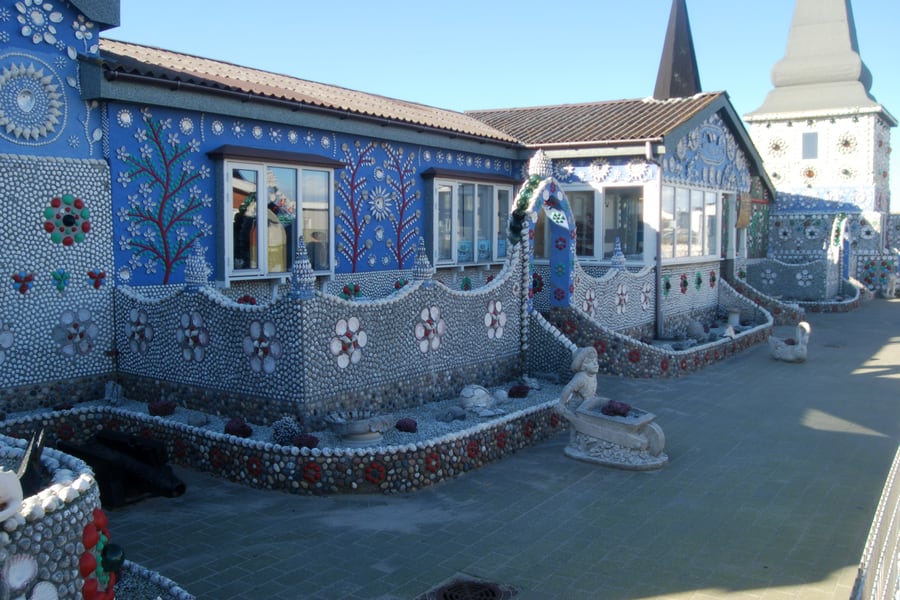
A Thyborøn fisherman, Alfred Chr. Pedersen, promised his wife a house like no other and then spent from 1949 to 1974 proving it, facing the whole thing inside and out with tens of thousands of shells and conchs in hearts, flowers and rosettes. It is still there, and you can walk round it.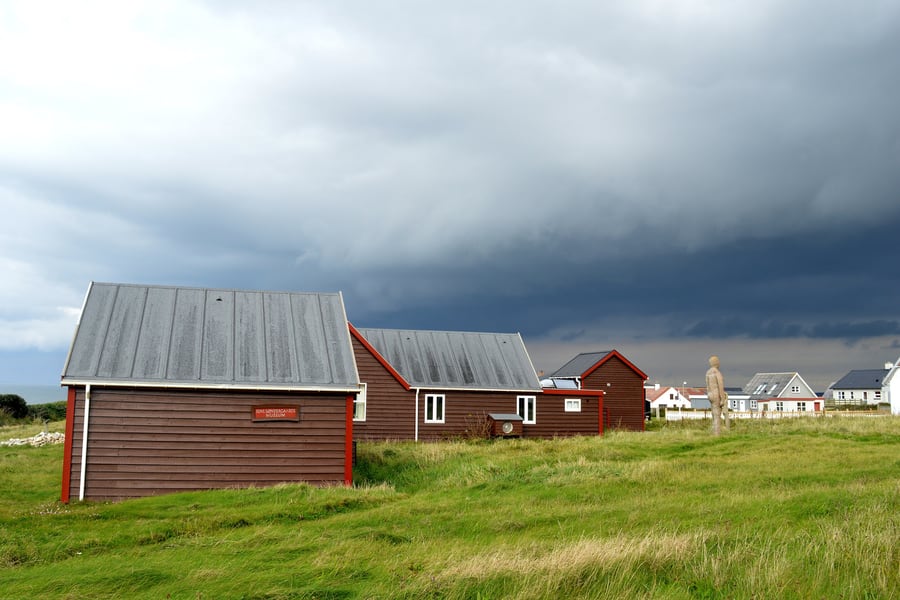 Ragnar1904 / Wikimedia Commons · CC BY-SA 4.0 · cropped
The painter who stayed on the coast
Jens Søndergaard (1895–1957) spent his summers at Ferring, a few kilometres down the coast below Bovbjerg, painting the North Sea in heavy dark colour until it looked as uneasy as it feels. His house and studio are kept as a museum, hung with his work and facing the water that produced it.Timetables
Midtjyske Jernbaner brought in a new timetable on 27 June 2026, built around the battery trains and around Vemb as an interchange, so that arrivals there connect on to Holstebro, Skjern and Lemvig without a long wait. The figures below are from the operator's own printed timetable for line 93, valid from that date, checked against live journey data in August 2026.
Weekdays
Seven trains a day leave Vemb for the Lemvig direction: 07:10, 09:05, 10:55, 12:55, 14:55, 16:55 and 19:55. Two of those — the 07:10 and the 09:05 — run straight through to Thyborøn Havn without a change, taking 1 hour 20 minutes and 1 hour 17 minutes respectively for the full 57 kilometres. The rest terminate at Lemvig.
From Lemvig to Thyborøn there are eight departures: 06:10, 08:00, 09:52, 12:40, 14:00, 15:40, 17:40 and 20:40, about 30 minutes for the 23 kilometres. From Lemvig back to Vemb: 03:54, 06:07, 09:39, 12:10, 14:00, 15:30 and 19:10, around 34 minutes.
Coming the other way, every departure from Thyborøn Havn ends its run at Lemvig, so the journey out to the main line involves a change there. Weekday departures are 07:05, 08:40, 10:32, 13:20, 14:43, 16:20, 18:20 and 21:20. A worked example: the 13:20 reaches Lemvig at 13:50, and the 14:00 gets into Vemb at 14:34 — 1 hour 14 minutes end to end.
Weekends
Saturdays and Sundays run to a thinner pattern, nine departures from Lemvig on each. Thyborøn Havn has four trains on a Sunday: 09:05, 12:25, 15:25 and 19:10.
The June 2026 timetable added something the line has not had before: a direct train from Lemvig to Holstebro at 06:00 on Saturday and Sunday mornings, with no change at Vemb. The operator's own worked example is that leaving Lemvig at 06:00 on a Saturday puts you into Copenhagen Central at 12:00 with a single change, and that the 16:02 out of Copenhagen on a Sunday gets back to Lemvig at 21:26. Later evening departures from Lemvig and Thyborøn were added in the same revision.
Stopping the train
At every station except Thyborøn Havn, Lemvig and Vemb, the train calls only if asked. The platform signal has to be switched on, and the timetable adds a second instruction that matters on an unlit halt in winter — that passengers should be visible on the platform once the train is in sight.
Timetables and any planned changes are published at mjba.dk (opens in a new tab), and the line appears on Rejseplanen as line 93.
Tickets
The Lemvigbanen is an ordinary part of the West Jutland public transport network, priced by Midttrafik on the same zone system as the region's buses, and the operator prints the zone number against every station in its timetable. End to end, Vemb to Thyborøn is six zones: 66.00 kr for an adult single, or 63.00 kr on Rejsekort. An adult may take two children under 12 free, and for a day out there is a family ticket at 109.00 kr covering two adults and four children.
Two quirks are worth knowing. Six departures on school days carry everybody free — no ticket, no check-in, no clip. And there are no ticket machines anywhere on the line, so the ticket or the Rejsekort check-in has to be sorted out before boarding rather than on the train. Bicycles and prams travel free, but reckon on lifting your own.
Book your tickets
Single, six zones
66.00 kr adult · 63.00 kr on Rejsekort
Vemb to Thyborøn, the whole line, with two children under 12 carried free.
Book Tickets (opens in a new tab, on mjba.dk)via mjba.dkFamily ticket
109.00 kr all day, two adults and four children
Sold in the app and over the counter at shops and cafés along the line.
Book Tickets (opens in a new tab, on mjba.dk)via mjba.dkShorter journeys
46.00 kr Vemb–Lemvig · 36.00 kr Lemvig–Thyborøn
Four zones and three; there is no machine at any station, so buy before boarding.
Book Tickets (opens in a new tab, on mjba.dk)via mjba.dkRail Passes
This is one of the few journeys in Denmark where the honest answer about a rail pass is no.
Interrail and Eurail publish a table of the railway companies their passes cover, country by country, with a column for excluded trains. On the edition last updated 28 August 2026, Denmark's excluded column contains exactly one entry, and it is Midtjyske Jernbaner — the company that runs the Lemvigbanen. Everything else in the Danish list is included: DSB's S-tog, InterCity and InterCity Lyn, Lokaltog, GoCollective, Nordjyske Jernbaner, Öresundståg and Nordjyllands Trafikselskab, all on Regional (RE) terms.
So a pass does not carry you between Vemb, Lemvig and Thyborøn, and the same exclusion applies to Midtjyske Jernbaner's other line, Holstebro–Skjern.
What the pass does do
It gets you to the junction. The trains that bring you to Vemb — and to Holstebro and Skjern at the far ends of the operator's other route — are run by DSB and GoCollective and are covered in full. From Vemb the missing piece is a six-zone Midttrafik single at 66.00 kr, or 46.00 kr if Lemvig is as far as you are going. Reservations are not required on Danish domestic trains, and none is possible on this line.
That is a small enough sum that it does not change how anyone plans a trip, and it is worth knowing in advance mainly so that a pass holder does not board assuming the pass covers it. Ticket inspection here ends in a penalty fare, and there is no machine on any platform to put things right after the fact.
The cheaper answers
Two of them are better than a pass on this line in any case. The family ticket at 109.00 kr covers two adults and four children for a whole day, which beats six-zone singles before the second journey. And six departures a day on school days are free to everyone, listed on the operator's site and set out under Tickets above — a Danish railway giving away seats is not something a pass can improve on.
Interrail also sells the Nordic Pass (opens in a new tab), valid in Denmark, Norway, Sweden and Finland and across the borders between them: €218 for 3 travel days in a month for an adult in second class, against €137 for the Denmark Pass. It cannot be used in the country you live in, only in the other three. It pays only when the trip goes on into another Nordic country. Midtjyske Jernbaner is excluded whichever pass you hold. Checked October 2026.
Pass conditions were checked against Interrail's own railway-companies table in October 2026.
Places to Visit
This is a coast that has been counting its drowned for four hundred years, and most of what there is to see along the line says so in one way or another — an anchor outside a churchyard, a memorial park in the dunes, a lighthouse put up after too many ships had come ashore in the dark.
The stops are close enough together that a day ticket and a bicycle cover a great deal of it. The operator's own family ticket is built for exactly this, and bicycles ride free. Thyborøn's museums are within a few minutes' walk of the two stations in the town; Harboøre church is a short walk from Harboøre station; Bovbjerg Fyr is the one that needs planning, about ten kilometres from Lemvig by bus or bike.
 Nils Jepsen / Wikimedia Commons · CC BY-SA 4.0 · cropped
Lemvig, and the water it hides from
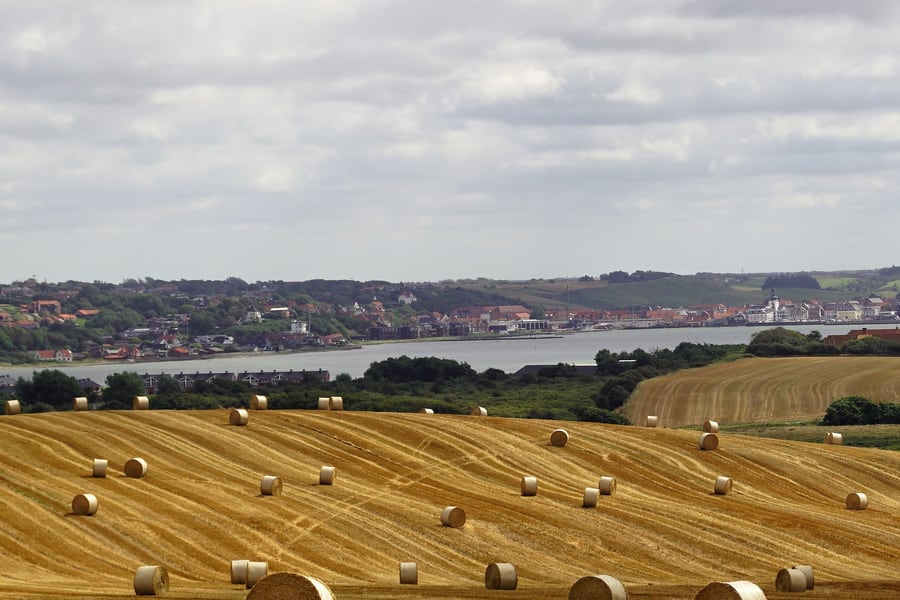
The largest town on the line, about 6,750 people, set in a valley between the fjord and Lemvig Sø — the Vesterbjerg road climbs out through one of the very few hairpin bends in Denmark. A concrete wall about a metre high runs along the harbour, holding back the North Sea when a westerly gale pushes it into the Limfjord. Denmark's first planet path was laid out here in 1987: at one to a billion, sun and earth stand 150 metres apart and Neptune is 4.5 km away.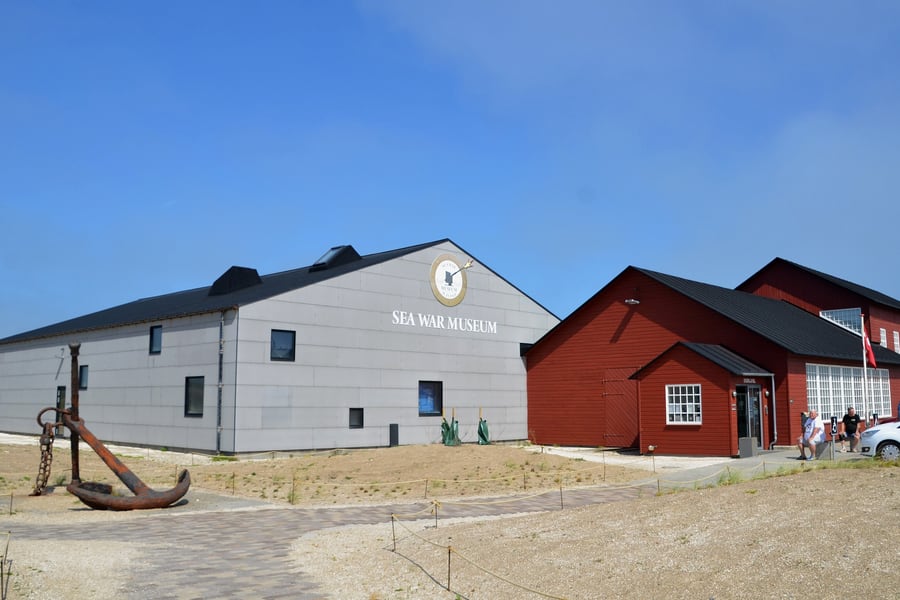 Hjart / Wikimedia Commons · CC BY-SA 4.0 · cropped
Sea War Museum Jutland, Thyborøn
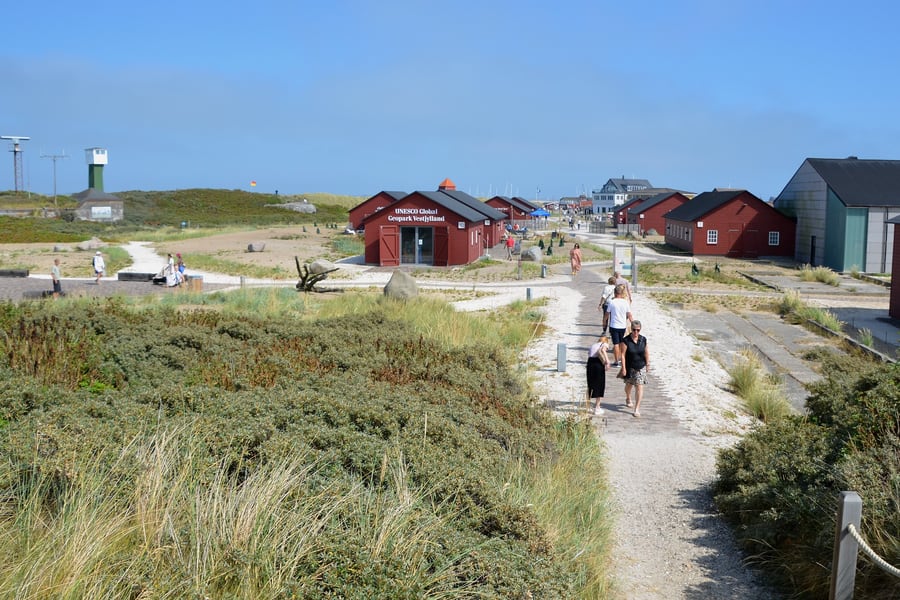
The Battle of Jutland was fought about 100 kilometres west of here in 1916 — the largest naval battle in history, 100,000 men on 250 German and British ships contesting the North Sea for twelve hours, the gunfire audible from this shore. Twenty-five ships went down and 8,645 sailors died. In the dunes outside the museum stands a memorial park of granite blocks cut like ships' prows — one stone for each ship sunk, carrying the number of its dead.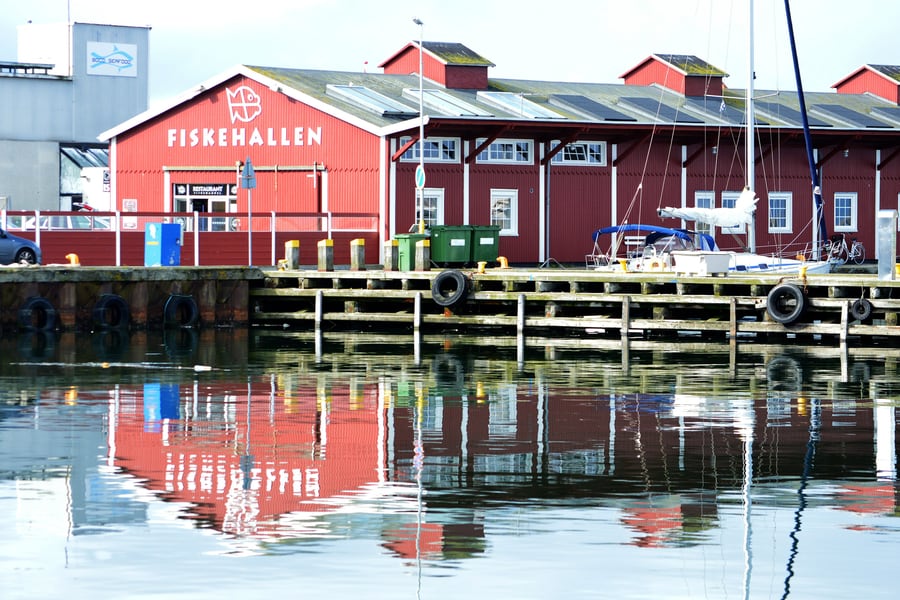 Ragnar1904 / Wikimedia Commons · CC BY-SA 4.0 · cropped
Thyborøn Havn
A fishing harbour that still fishes, a few minutes from the end of the line. The extension from Lemvig was built in 1899 largely to move fish, and the station on the quay followed in 1924 once the harbour proper had been dug. The cutters lie along the basins, the red Fiskehallen stands over the water, and the town of about 1,700 people exists because of what comes ashore here.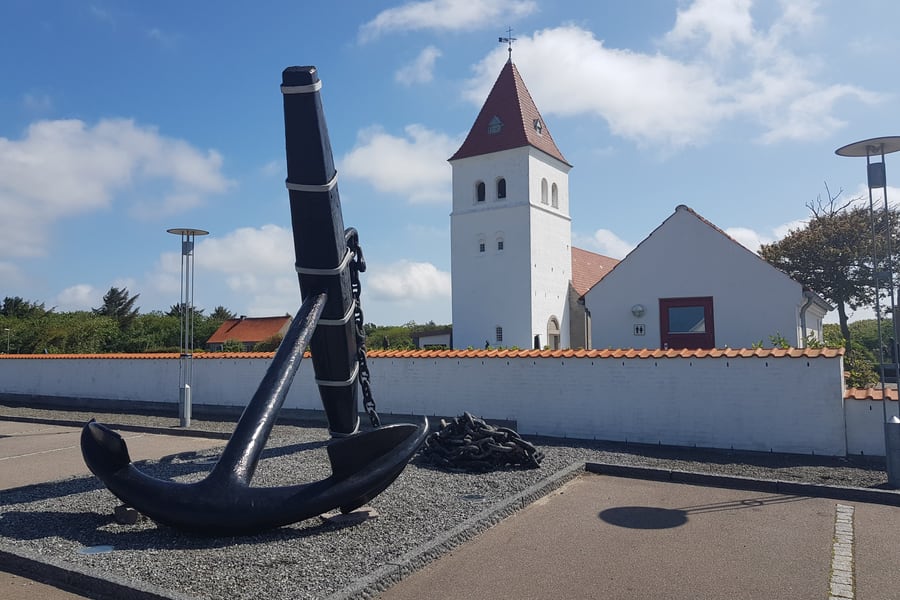 Hjart / Wikimedia Commons · CC BY-SA 4.0 · cropped
The Alexander Nevskij's anchor, Harboøre
A five-metre, five-tonne anchor stands outside Harboøre churchyard, a short walk from the station. It came off the Russian frigate Alexander Nevskij, wrecked on the bar at Knopper on 25 September 1868 with 724 people aboard, among them a son of the Tsar. The lifeboat broke up and the rocket line parted; in the end her own launch was hauled to and fro on a rope and the local fishermen took their boats out, and all but five were ashore by evening. The other anchor is in Thyborøn.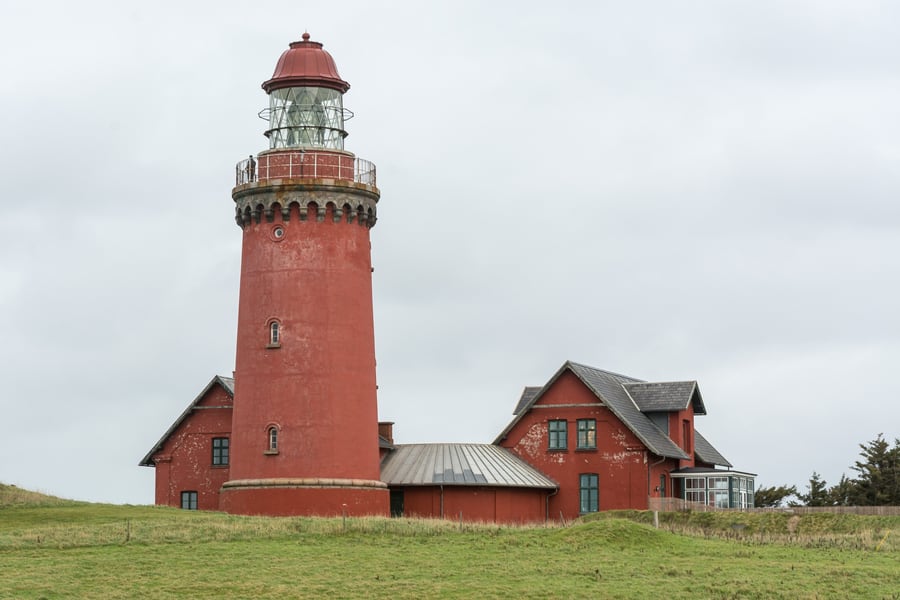 Ajepbah / Wikimedia Commons · CC BY-SA 3.0 de · cropped
Bovbjerg Fyr
The lighthouse on the cliff south-west of Lemvig, first lit on 30 December 1877. The tower is only 26 metres, but stands on a bluff about forty metres high, so the light is 62 metres above the sea and carries 16 nautical miles — still through its original 1877 Fresnel lens, two white flashes every ten seconds. The state sold it to Lemvig council in 2006 for a million kroner; the council passed it on a year later for one krone. Ten kilometres from Lemvig, by bus or bicycle.Where to Sleep
There is not a great deal of hotel accommodation along the Lemvigbanen, and what there is sits at the northern end, where the summer visitors go. Both of the places below are a few minutes from a station, and both are ordinary working hotels rather than resorts — this is a coast of fishing harbours, holiday cottages and campsites, and the pattern of somewhere to stay reflects that.
Lemvig itself, the largest town on the line, is better supplied with self-catering and guest-house accommodation than with hotels. Thyborøn's tourist office lists a campsite, a Danhostel, holiday apartments and larger summer houses alongside the hotel below.
Where to stay
Harboøre Hotel
An 1899 station hotel by the line
Built in 1899 beside Harboøre station and run as a holiday and bathing hotel through the twentieth century. It has 10 rooms, each with its own bath, last renovated in 2021, and a penthouse apartment sleeping five with a balcony looking out over the sea, the fjord and Thyborøn. The hotel describes its own setting as having the VLTJ railway just across the road, which is accurate.
Check Availability (opens in a new tab, on harboorehotel.dk)via harboorehotel.dkThyborøn Hotel
In the fishing town, 200 metres from the sea
In the middle of Thyborøn, about 200 metres from the North Sea and walking distance from both stations in the town, the harbour and the museums. There are 15 double rooms with their own bath and 8 renovated holiday apartments, a restaurant called Bølgen, and guests are given free entry to the Vandwærket swimming pool about a kilometre and a half away.
Check Availability (opens in a new tab, on thyboronhotel.dk)via thyboronhotel.dkQuestions or corrections
Planning this trip and stuck on something, or spotted a time, fare or detail that has changed? Send us a message about Vemb to Thyborøn: the Lemvigbanen. We read every one, and we update this page when something has changed.