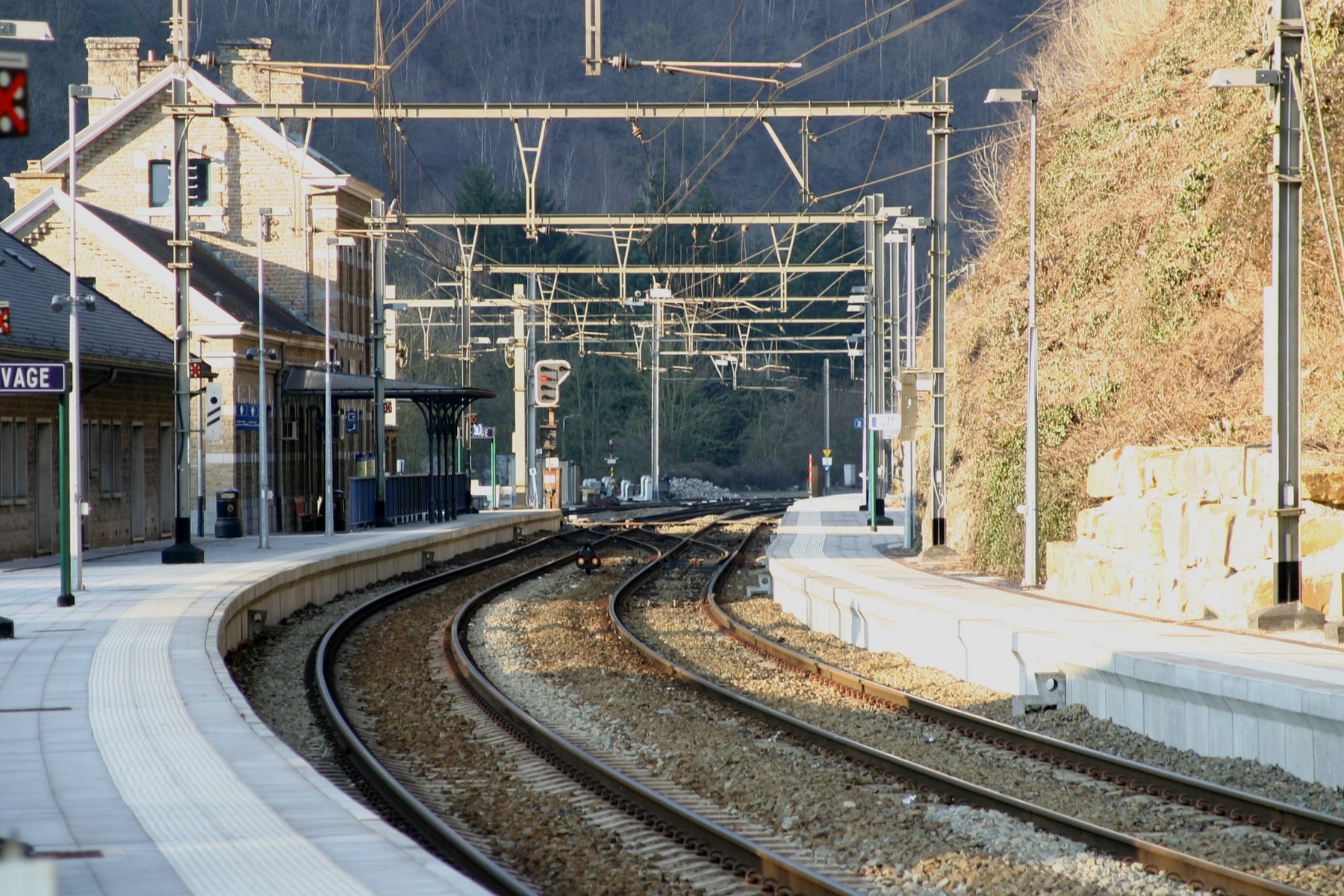
Liège to Gouvy: the Amblève Valley Line
Les Meloures / Wikimedia Commons · CC BY-SA 3.0
- Distance60.2 km line · 1 h 14 Liège–Gouvy
- Duration≈1 h 14 · 2 h 39 to Luxembourg
- Best seasonYear-round, hourly on weekdays
Introduction
Belgium's railway journeys, as this site has told them so far, all have a season. The steam lines at Mariembourg, Dendermonde, Maldegem and Spontin run on selected Sundays between spring and autumn, behind locomotives kept alive by volunteers, and if you turn up on the wrong date you find a locked gate and an empty platform.
This one is different, and that is the whole reason it is here. An intercity train leaves Liège-Guillemins at seven minutes past every hour, and by the time it has been going forty minutes it is deep in the Ardennes, running along a river at the bottom of a wooded gorge. It costs whatever an ordinary Belgian ticket costs. It carries commuters and schoolchildren. It runs in February.
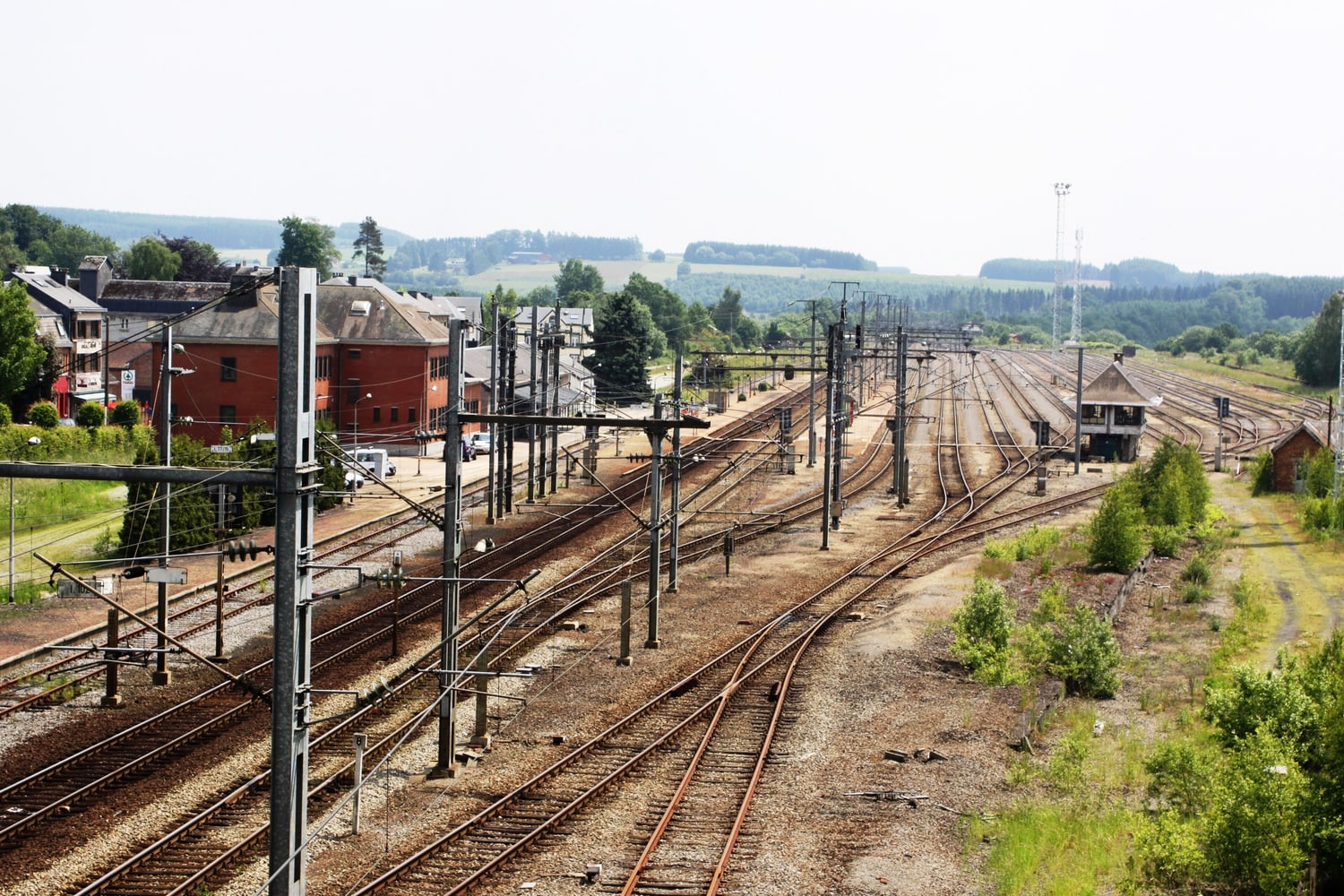
The scenic part begins at Rivage, where the train leaves the Ourthe and joins Line 42 — sixty kilometres of single track that follows the Amblève upstream to Trois-Ponts, then swaps rivers and climbs the Salm towards its source. Between them the two valleys forced the engineers into eight tunnels and a 186-metre viaduct, and the line took twenty-three years to finish because the difficult end was the end nearest the city.
An hour and a quarter out of Liège the train reaches Gouvy, the last station in Belgium, where the valleys give out onto open plateau. Most of the trains keep going, over the border and down through the Luxembourg Ardennes to reach Luxembourg City two hours and thirty-nine minutes after leaving Liège.
You do not need to plan around it, book it, or pay extra for it. You just need to be at Liège-Guillemins at seven minutes past an hour.
The Journey
The train starts at Liège-Guillemins, Santiago Calatrava's great white vault of steel and glass, which is worth twenty minutes on its own before you board. For the first half hour the journey is unremarkable: Angleur, Esneux, Poulseur, suburbs thinning into the Ourthe valley.
Rivage, and the turn into the Amblève
At Rivage, thirty-one minutes out, the train leaves the Ourthe and turns onto Line 42. This is where the journey becomes worth taking. The Amblève joins the Ourthe here, and the railway follows it upstream into a valley that narrows steadily — wooded limestone slopes, the river running fast and shallow over rock, villages squeezed onto whatever flat ground there is.
Nine minutes later comes Aywaille, the largest town on this stretch, and after it the valley closes in properly. The line spends the next stretch in and out of the rock: eight tunnels pierce this route in total, the longest being Remouchamps at 618 metres, with Trois-Ponts at 345, Targnon at 279, Cheneux at 250, Roanne-Coo at 194, Xhierfomont at 127, Liotte at 82 and Gleize at 59. Between the last two the line crosses the 186-metre Roanne-Coo viaduct.
Coo, and the change of river
Fifty-seven minutes out the train calls at Coo, which is a rarity: a waterfall with a mainline station. Four minutes further on is Trois-Ponts, and the name is literal — the village sits where the Baleur, the Salm and the Amblève all meet, and each stream needed its own bridge.
Here the railway changes rivers. It leaves the Amblève and turns up the Salm, a smaller, steeper valley, climbing towards the river's source near Bovigny. Vielsalm comes at an hour and twelve minutes, and Gouvy — the last station in Belgium, out on open plateau where the valleys have run out — at an hour and fourteen.
On to Luxembourg
Most trains do not stop there. Three minutes after arriving they leave for Gouvy-Frontière and cross into Luxembourg, running down through Troisvierges, Clervaux, Kautenbach and Ettelbruck to reach Luxembourg City two hours and thirty-nine minutes after leaving Liège. The Luxembourg half is a fine ride in its own right, through the Wiltz and Sûre valleys.
What this line is not
Line 42 is the track, not the train. The line proper runs Rivage to Gouvy; the service you ride starts back at Liège and reaches Line 42 only at Rivage. SNCB files its own leaflet for this service under line 43, which catches people out.
And the line has many more stations than the intercity calls at. Remouchamps, Stoumont, La Gleize, Grand-Halleux, Salmchâteau and Bovigny are all on it; your train passes them without stopping. If you are planning to get off somewhere small, check that the train you are on actually serves it.
Nor is there anything special about the rolling stock. This is standard SNCB intercity equipment, electric since 1999–2000, with no observation car, no commentary and no panoramic glass. The window is the window. On this line that turns out to be enough.
Along the route
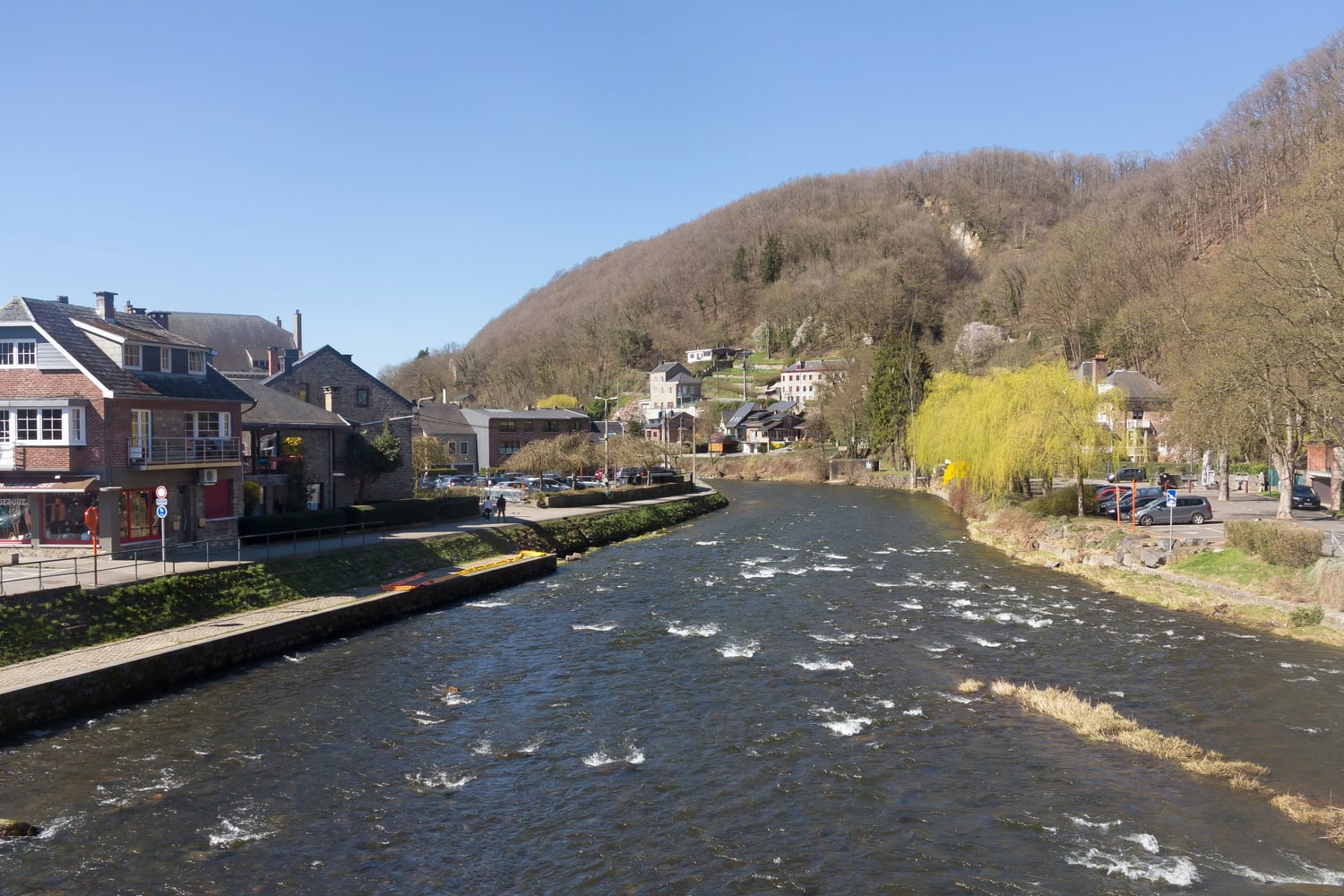
Michielverbeek / Wikimedia Commons · CC BY-SA 4.0Two rivers, eight tunnels
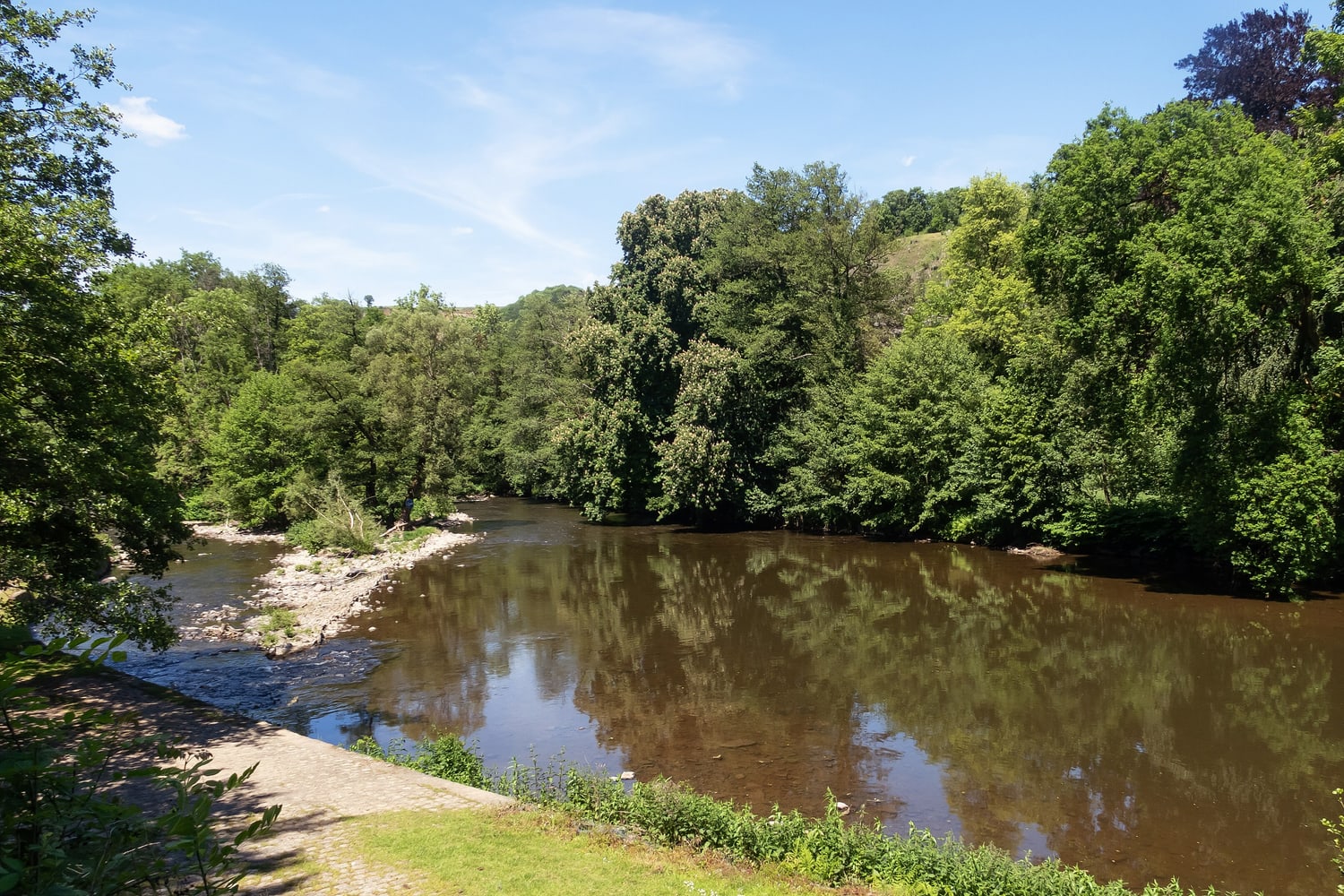
From Rivage the line picks up the Amblève and follows it to Trois-Ponts, then switches to the Salm and climbs towards its source. Eight tunnels punch through the spurs on the way, the longest 618 metres, plus the 186-metre Roanne-Coo viaduct.Les Meloures / Wikimedia Commons · CC BY-SA 3.0An ordinary train, which is the point
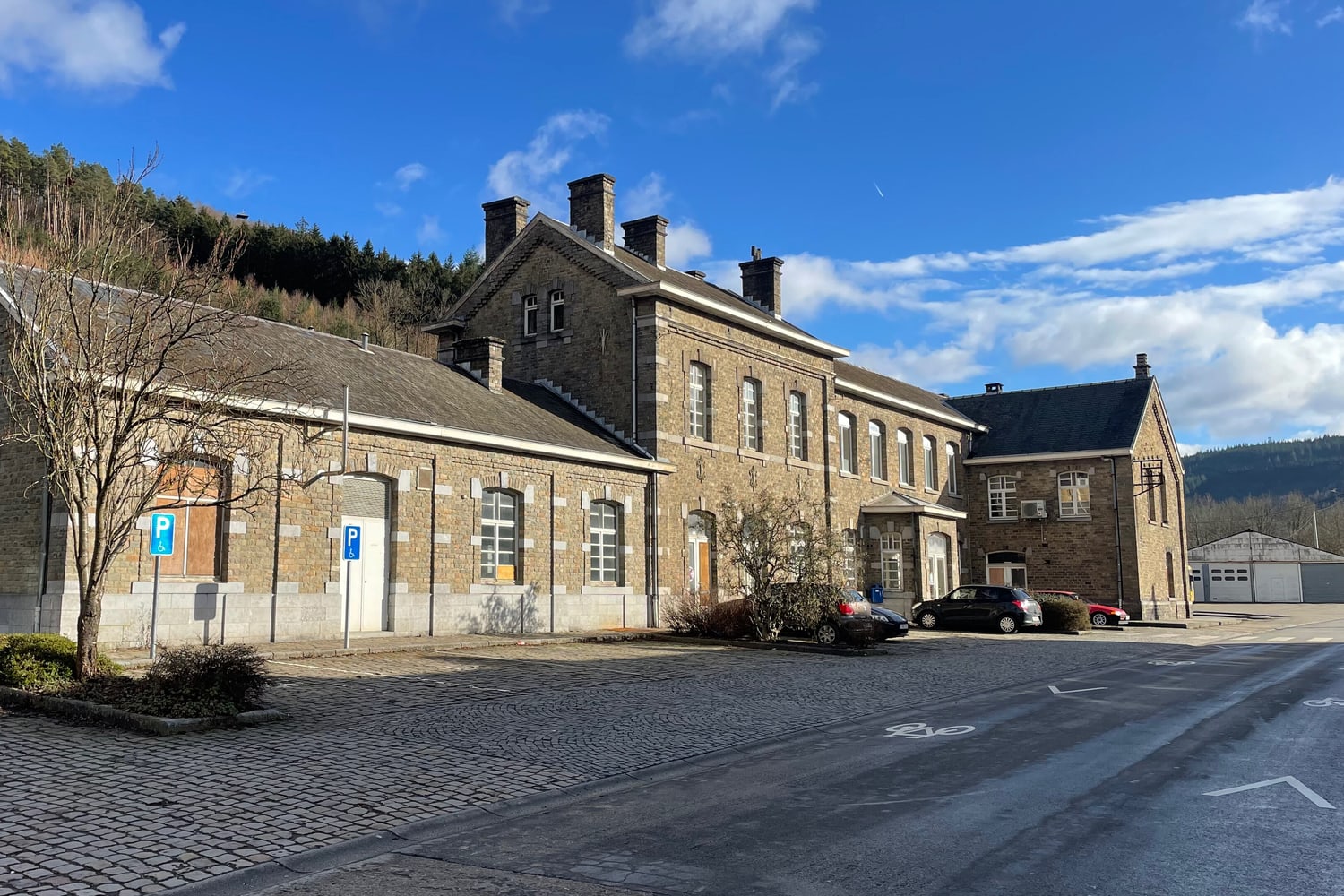
Belgium's other railway journeys run on selected summer Sundays behind volunteers. This one runs every hour, on an ordinary ticket, all year, full of people going to work — so you can ride the Ardennes on a wet Tuesday in February if you want to.Japplemedia / Wikimedia Commons · CC BY-SA 4.0Built back to front
The far end came first: Trois-Ponts to Gouvy opened in February 1867. The stretch down the Amblève to Rivage — the difficult, tunnelled part nearest Liège — took another twenty-three years. The valley was the obstacle, not the destination.A bit of history
Culture & experiences along the way
 CrucialFriend / Wikimedia Commons · CC BY-SA 4.0 · cropped
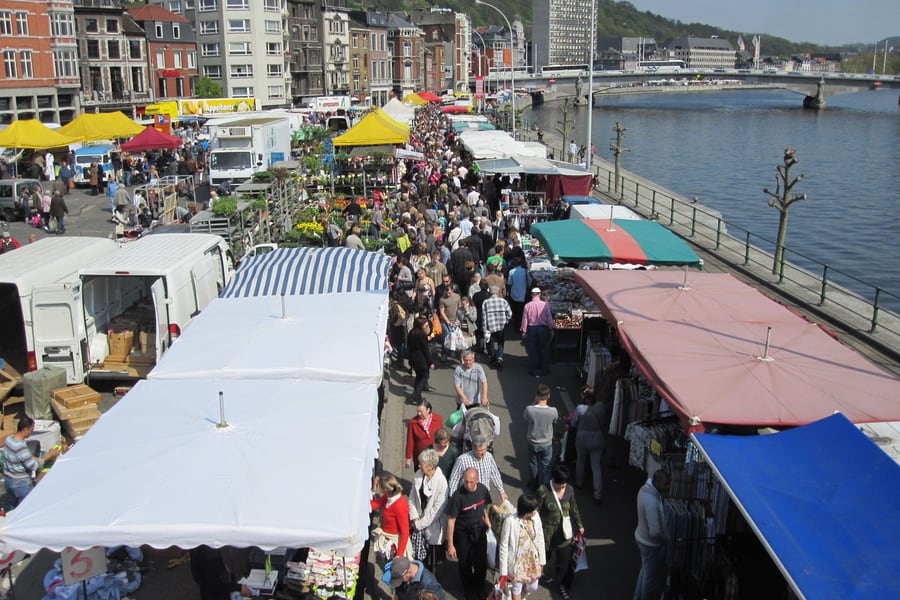
La Batte, on a Sunday morning
Liège's Sunday market runs for kilometres along the Meuse quays and has done since 1561, which makes it the oldest in Belgium. It opens at 8am and is packed away by half past two: food, plants, cheap clothes, live poultry, and peket — the local juniper gin — drunk standing up in the cold.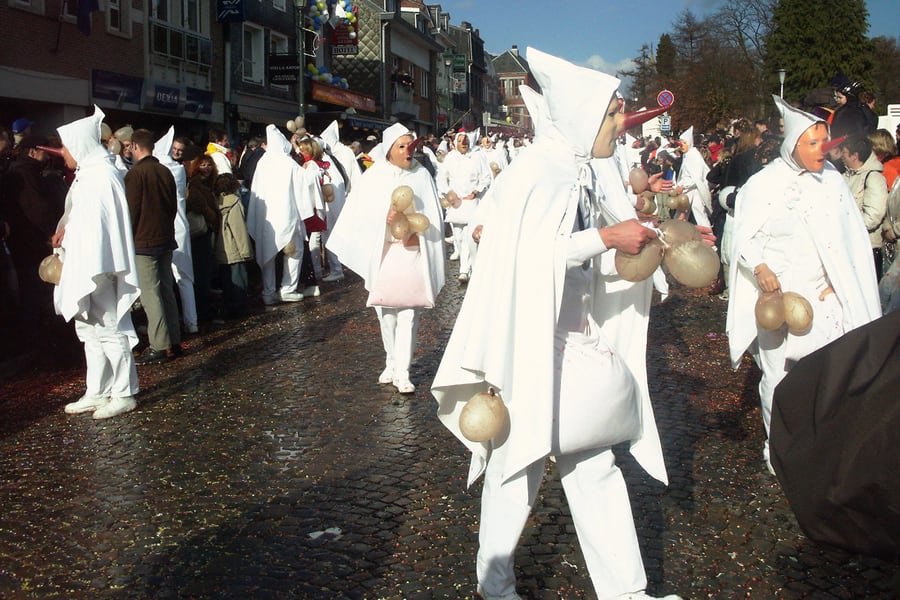 Wolf Meusel / Wikimedia Commons · public domain · cropped
The Blancs Moussis of Stavelot
On the fourth Sunday of Lent, two hundred men in white hooded robes and long red noses take over Stavelot and pelt everyone with confetti and inflated pigs' bladders. The costume dates from 1499, when the prince-abbot banned his monks from the carnival and the town dressed up as them out of spite.Timetables
This is a scheduled national service, so there is no operating calendar to check and no season to plan around — but the times below are the weekday pattern, and weekends differ.
Times are correct as of August 2026, taken from SNCB's published schedules for the timetable period 8 June to 11 December 2026. They apply daily except Saturdays and Sundays.
Liège → Gouvy → Luxembourg
Trains leave Liège-Guillemins at :07 past every hour. The pattern repeats identically hour after hour — verified across five consecutive services — so you can read any departure off this one table by substituting the hour.
| time | |
|---|---|
| Liège-Guillemins dep | :07 |
| Angleur | :11 / :12 |
| Esneux | :22 / :23 |
| Poulseur | :26 / :27 |
| Rivage (joins Line 42) | :31 / :32 |
| Aywaille | :40 |
| Coo | :57 / :58 |
| Trois-Ponts | +1 h :01 / :02 |
| Vielsalm | +1 h :12 |
| Gouvy arr | +1 h 14 |
| Gouvy dep | +1 h :24 |
| Troisvierges (LU) | +1 h :32 |
| Luxembourg arr | +2 h 39 |
So the 16:07 from Liège reaches Rivage at 16:31, Aywaille 16:40, Coo 16:57, Trois-Ponts 17:01, Vielsalm 17:12 and Gouvy at 17:21, going on to Luxembourg at 18:46.
Liège to Gouvy takes about 1 h 14. Liège to Luxembourg is 2 h 39 over roughly 161 kilometres.
The return, and weekends
Northbound times are not printed here. Only the southbound direction was verified train by train, and rather than estimate the return from the outbound pattern — which would be a guess, since crossing times on a mostly single-track line are not symmetrical — check the operator directly. Trains run in both directions through the day.
Weekend services differ: several run as variants starting from Liers rather than Liège-Guillemins, with their own times. If you are travelling on a Saturday or Sunday, do not assume the weekday table above.
Live times, the return direction and weekend patterns: belgiantrain.be (opens in a new tab) — the operator also publishes a PDF leaflet for this service under "Ligne 43: Liège – Marloie/Gouvy – Luxembourg", which is the one to look for.
Tickets
There is nothing to arrange. This is an ordinary SNCB intercity, so a domestic ticket between the two stations is all you need — no reservation, no supplement and no scenic-train premium. Buy at a machine, a counter or in the app, turn up and get on. Belgian fares are distance-based and change, so belgiantrain.be (opens in a new tab) holds the current figure.
Two things are worth knowing. Continuing to Luxembourg crosses a border and is priced separately, so look for SNCB's international offer rather than assuming a domestic ticket carries you through. And because this is a scheduled national service rather than a preserved line, the usual SNCB multi-journey and reduction products are valid on it — which is not true of Belgium's heritage railways. With an hourly service you can break the journey at Aywaille or Coo and pick up a later train.
Book your tickets
Liège-Guillemins to Gouvy
An ordinary SNCB domestic ticket, hourly
No reservation, no supplement, and breaks of journey wherever you like.
Book Tickets (opens in a new tab, on belgiantrain.be)via belgiantrain.beOnward to Luxembourg
A cross-border fare, priced separately
The domestic ticket stops at Gouvy; SNCB's international offer carries you through.
Book Tickets (opens in a new tab, on belgiantrain.be)via belgiantrain.beRail Passes
This is the one Belgian journey on this site where a rail pass is genuinely worth having, because it is the only one that is an ordinary national-network train.
Interrail and Eurail
A Global Pass covers this journey outright. Interrail and Eurail passes are valid on SNCB/NMBS services, and Belgian domestic trains — this one included — need no reservation and carry no supplement. You show the pass and board.
SNCB's own guidance is that on most European trains "no reservation is necessary and you just have to show your Interrail Pass to board", with paid reservations confined to night trains and certain high-speed services. None of those apply between Liège and Gouvy.
Crossing into Luxembourg on the same train is also covered by a Global Pass, since it is an ordinary cross-border service rather than a high-speed one. What a pass does not cover is a Belgium-only ticket bought separately for the domestic leg — if you hold a pass, use it for the whole run rather than buying to Gouvy and starting again.
⚠️ Watch the day count rather than the distance. On a flexi pass this journey burns a whole travel day, and at 1 h 14 to Gouvy it is a short one. If you are passing through anyway — Liège to Luxembourg is a legitimate way to move between countries — the scenery is free. If you are making a special trip out and back from Liège, an ordinary return ticket will usually be the cheaper choice.
SNCB's own products
If you are not on a European pass, the national operator's range is worth a look for anything more than a single trip:
- Age-based fares. SNCB prices by age band — Youth (under 26), Senior (65+) and Child (under 12) all pay less than the standard adult fare.
- Train+, a subscription costing a few euros a month, which lowers off-peak and weekend fares and caps the fare per journey. Worth it only if you are making several trips.
- Season tickets in Standard, Unlimited, Flex and Student forms, for regular travel rather than a day out.
- Mini-group (4–14 people) and group (15+) fares, which matter if you are travelling as a family or a walking party — a common way to do this line.
What none of them cover
No pass or SNCB product is valid on Belgium's heritage railways. The steam lines at Mariembourg, Spontin, Dendermonde and Maldegem are run by independent non-profit associations on their own concessions, sell their own tickets, and are not SNCB services. A pass will get you to the nearest national-network station and no further.
Current products and prices: belgiantrain.be (opens in a new tab). Correct as of August 2026.
Places to Visit
Because the service is hourly, this is a line you can get off and on again — which makes the stops worth as much as the ride. The Amblève valley between Aywaille and Trois-Ponts is walking country, and every station on it is a trailhead.
 Zairon / Wikimedia Commons · CC BY-SA 4.0
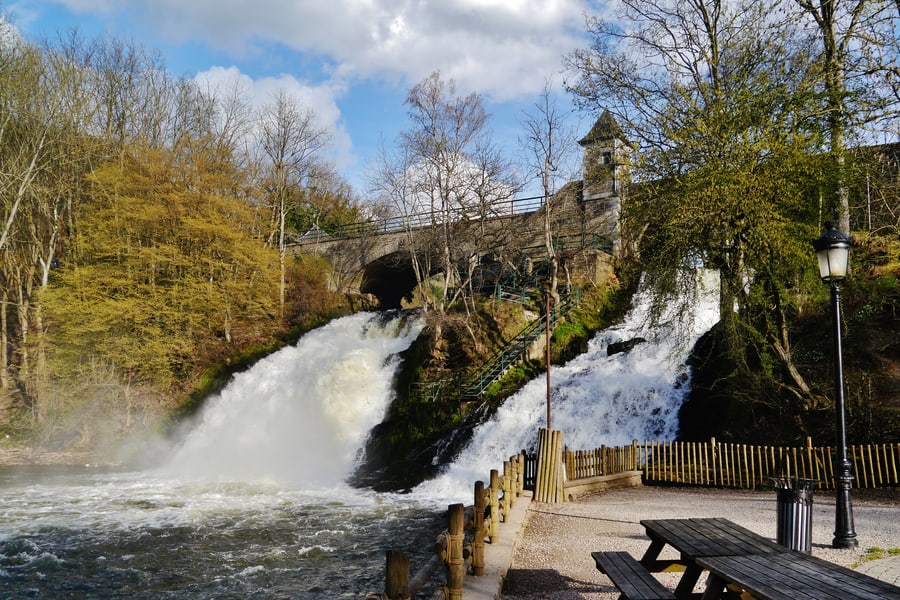
The Cascade de Coo
The best-known sight on the line, and the train stops at it. The Cascade de Coo falls 15 metres in two stages — and it is only half natural: a small fall appeared here in the 15th century, and in the 18th the monks of Stavelot abbey dug the great drop straight through the neck of a river bend to protect the village of Petit-Coo from flooding. Be warned that it is not a quiet spot: there is a chairlift, restaurants and the Plopsa Coo amusement park beside it.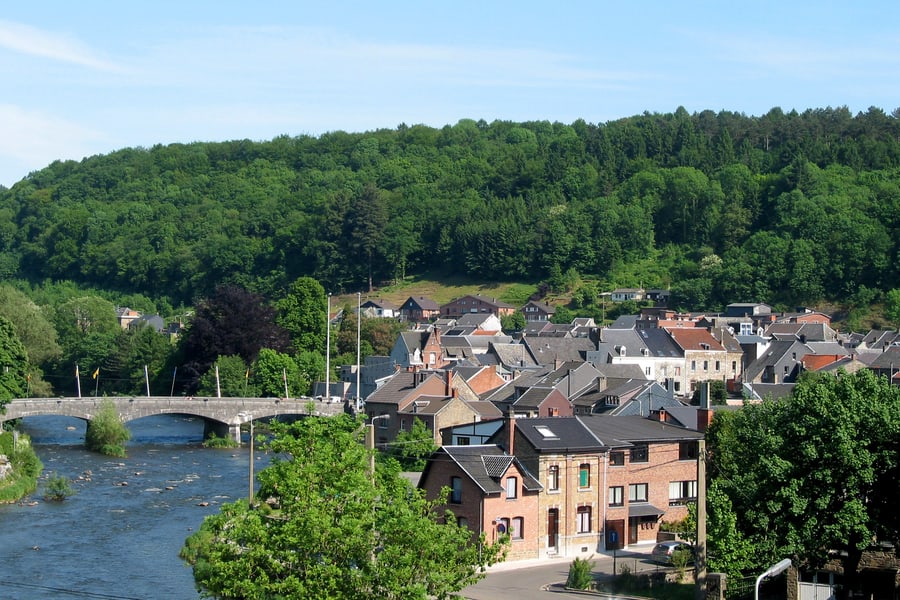 Jean-Pol GRANDMONT / Wikimedia Commons · CC BY 2.0
Aywaille
The largest town on the Amblève stretch, sitting where the valley briefly opens out, with the river running fast and shallow over rock right through the middle of it. It is the usual base for walking this part of the Ardennes, and the station is a short walk from the bridge.Where to Sleep
The hourly service changes the calculation here. On Belgium's heritage lines you plan the day around two or three departures; on this one you can stay at either end, or anywhere along it, and still move whenever you like.
Liège is the obvious base and the best-connected. It is a large, slightly rough-edged city on the Meuse with hotels at every price, a serious food culture, and Liège-Guillemins on the high-speed network — direct trains from Brussels, Cologne and beyond. Stay here and the Ardennes are a forty-minute ride away.
Aywaille is the choice if you want to be in the valley rather than commuting into it. It is the largest town on the Amblève stretch, it has hotels and guesthouses aimed at walkers, and the station is a short walk from the river. From here you are among the woods and the rock in the evening rather than in a city.
Trois-Ponts and Vielsalm are smaller again — villages with a scattering of hotels, gîtes and campsites, well used by hikers and kayakers in summer. Trois-Ponts in particular puts you at the junction of three rivers with paths leading off in every direction.
Gouvy, at the far end, is quiet and mostly useful if you are breaking a longer journey towards Luxembourg.
Luxembourg City, two hours and forty minutes down the line, works as the other bookend if you are riding the whole route rather than turning back — a compact, expensive capital with the best onward connections in the region.
One practical note: this is the Ardennes, and it is genuinely seasonal for walking rather than for trains. The line runs all year, but the valley is at its best from late spring to autumn, and the villages have fewer beds open in winter than the summer trade suggests.
Where to stay
Royal Hôtel Restaurant Bonhomme
Remouchamps, on the bank of the Amblève
A coaching inn that opened on the Liège road in 1768 and has been kept by the same family — the Daussaint-Bonhomme — for eight generations since. It calls itself the oldest hotel-restaurant in Belgium. It stands on the Amblève a short way from Aywaille station, which puts it about forty minutes from Liège by train.
Check Availability (opens in a new tab, on hotelbonhomme.be)via hotelbonhomme.beR hotel experiences
Four-star, above the Amblève valley at Remouchamps
A four-star hotel set in green ground beside La Redoute, the climb famous from Liège–Bastogne–Liège, with a panoramic view over the Amblève valley. The modern alternative to the old coaching inn down in the village, and the better choice if you want the view rather than the history.
Check Availability (opens in a new tab, on r-hotel.be)via r-hotel.beQuestions or corrections
Planning this trip and stuck on something, or spotted a time, fare or detail that has changed? Send us a message about Liège to Gouvy: the Amblève Valley Line. We read every one, and we update this page when something has changed.