Ligne des Hirondelles
Julien Carnot / Flickr · CC BY-SA 2.0 · cropped
- Distance123 km · standard gauge
- DurationAbout 2 h 45 for the whole line
- Best seasonAll year · autumn colour and winter snow
Introduction
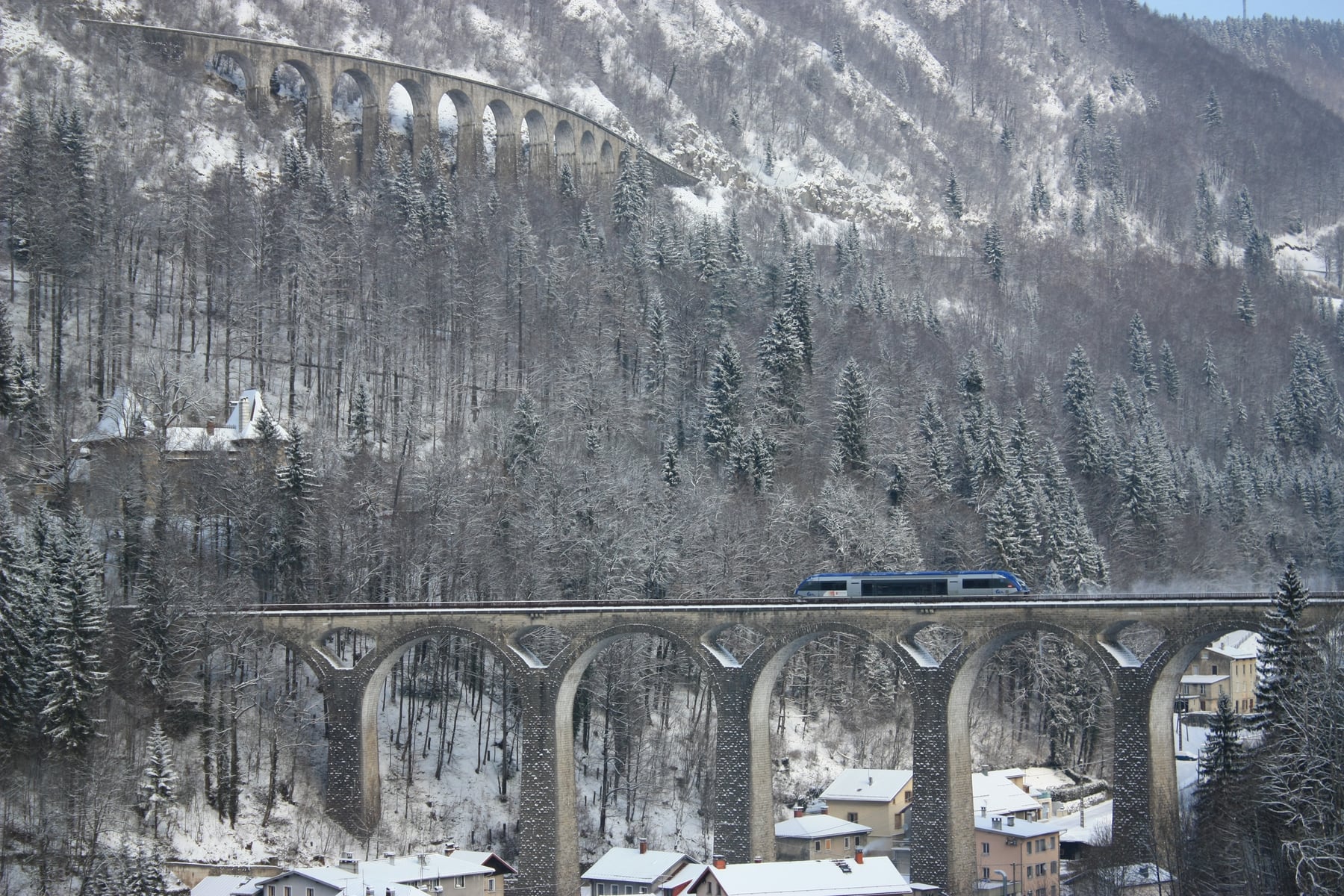
The line is named not for its trains or its views but for the men who built it. The people of Morez, the story goes, watched the workers on the scaffolds of the viaducts high above the town and said they were keeping company with the swallows.
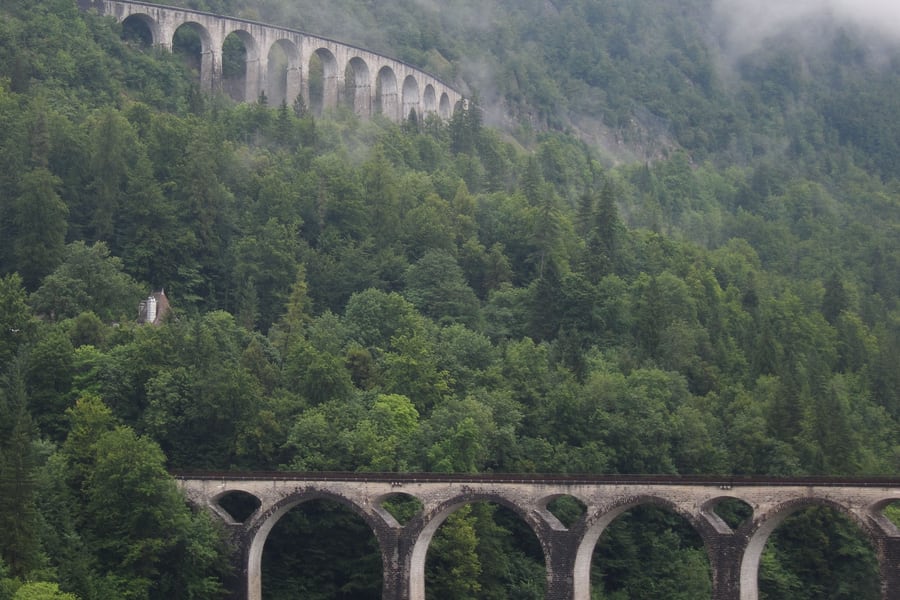
The Ligne des Hirondelles runs 123 kilometres from Dole, on the plain of the Doubs, to Saint-Claude, deep in the Haut-Jura. Its mountain half took nearly fifty years to build: the first section, from Andelot to Champagnole, opened in 1867, the railway reached Morez in 1900, and the last stretch down to Saint-Claude opened in 1912. On the way it passes through 36 tunnels and over 18 viaducts, and tops out at 948 metres at La Savine.
It is not a tourist train. The service is an ordinary regional line run by TER Bourgogne-Franche-Comté under the name TRAIN Mobigo, with no reservations and the usual regional fares, and the trains carry schoolchildren as well as visitors.
The Journey
The first hour is easy country. From Dole the train follows the main line east past the edge of the Forêt de Chaux to Arc-et-Senans, home of the royal saltworks, and Mouchard, close to the vineyards of Arbois. At Andelot it turns off the main line and starts to climb, through woods and pasture, to Champagnole.
Above Champagnole the line crosses the high plateau of the Grandvaux around Saint-Laurent, a country of meadows, spruce and long winters, and reaches its summit at the old halt of La Savine, 948 metres up, before entering the 2,080-metre tunnel under the col.
Morbier, Morez and the Bienne
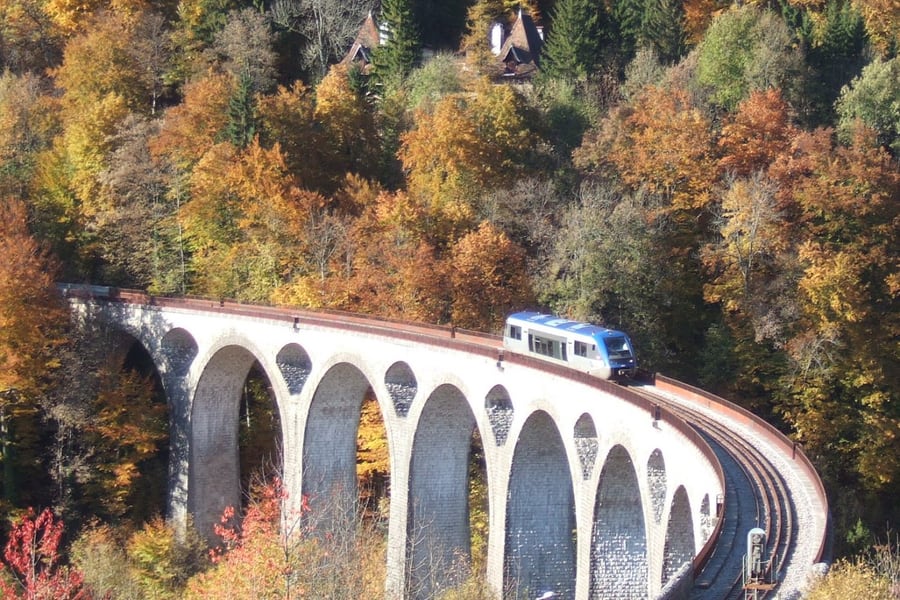
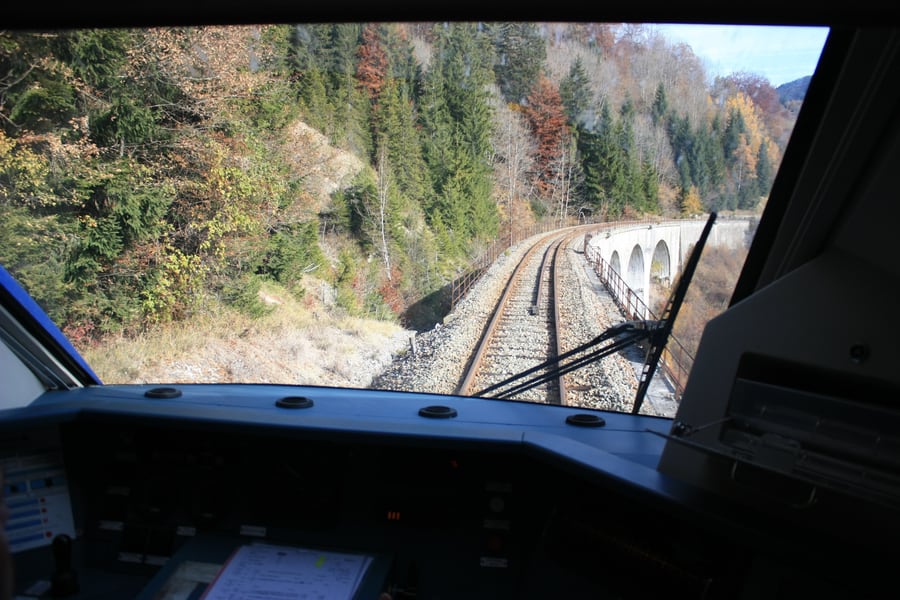
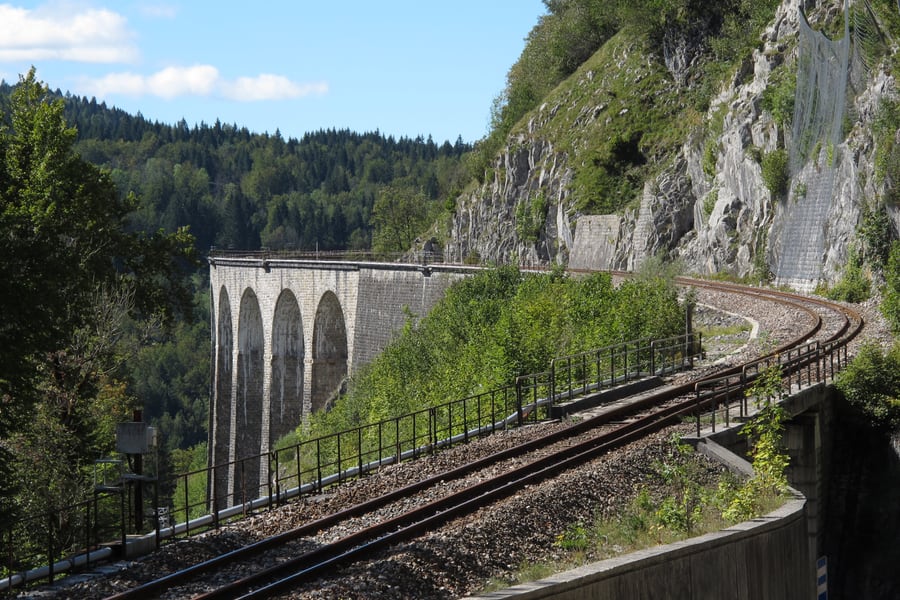
Beyond Morbier comes the stretch the line is famous for. The railway drops towards the Bienne in a series of loops on the valley side, so that the train crosses the same slopes more than once at different heights, on curving stone viaducts and through tunnels in the rock. The Frasses tunnel is a near-closed horseshoe, its exit almost directly below its entrance.
Morez station is a dead end: the train runs in, the driver changes ends, and it leaves the way it came before turning south down the Bienne. The last section, finished in 1912, follows the river through forest and over the Pain-de-Sucre viaduct to Saint-Claude, a town wedged into a valley more than 450 metres deep.
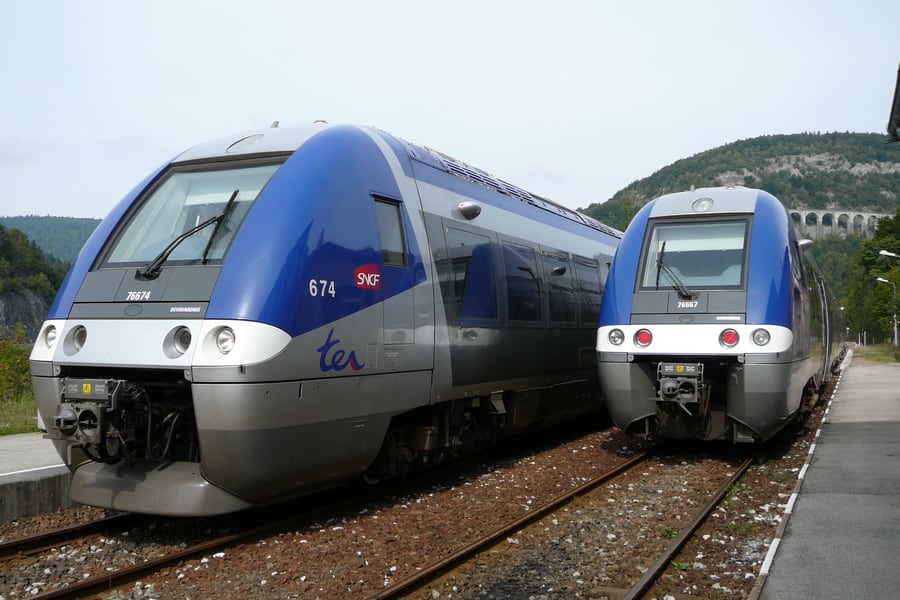
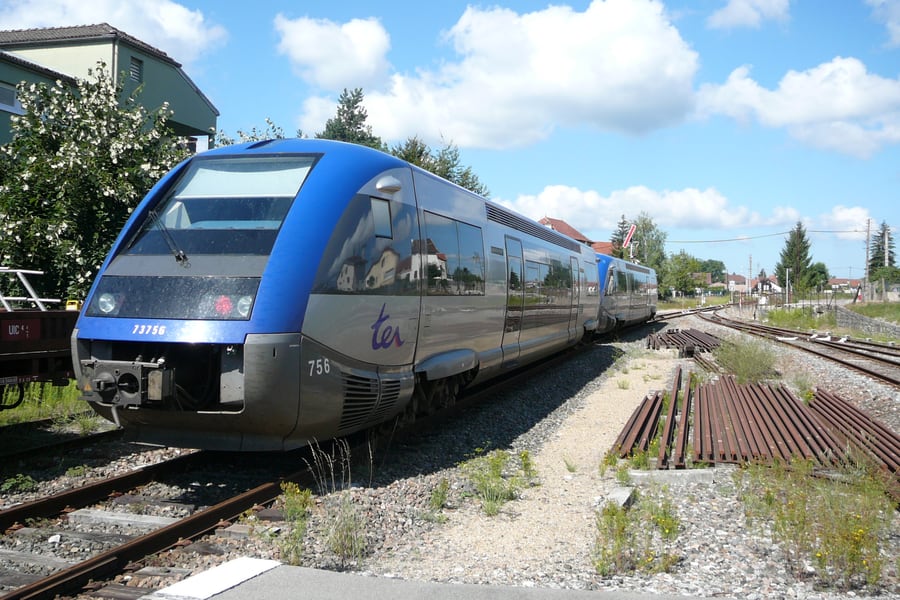
The trains are diesel railcars: single-car X 73500s, and AGC units of the X 76500 class. They replaced the line's old X 2800 railcars in 2003 and 2006.
Along the route
 Momox de Morteau / Wikimedia Commons · CC BY-SA 3.0 · cropped
Up from the plain
From Dole the train runs east along the edge of the Forêt de Chaux to Arc-et-Senans and Mouchard, then leaves the main line at Andelot and climbs to Champagnole, where the first section of the mountain line opened in 1867.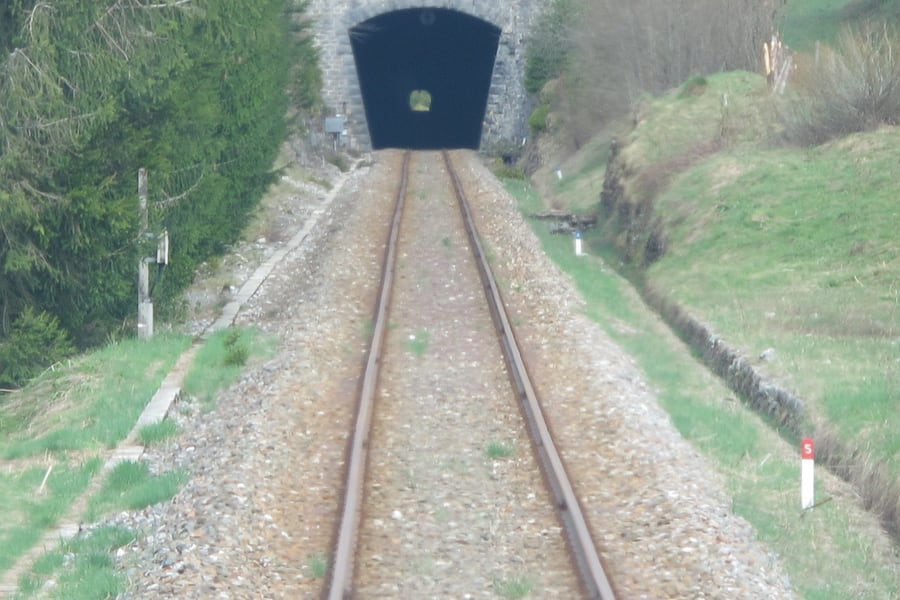 KlausFoehl / Wikimedia Commons · CC BY-SA 3.0 · cropped
The summit at La Savine
Past the Grandvaux plateau and Saint-Laurent the line reaches its highest point, 948 metres at the old halt of La Savine, then dives into a 2,080-metre tunnel under the col.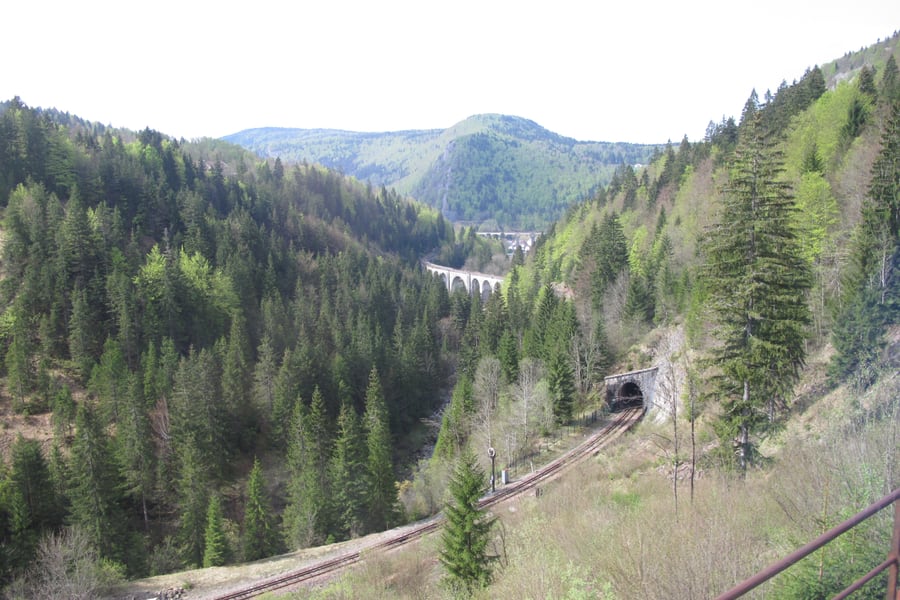 KlausFoehl / Wikimedia Commons · CC BY-SA 3.0 · cropped
Morbier to Morez
The steepest stretch drops into the Bienne valley in loops, viaducts and tunnels, including the Frasses tunnel, a near-closed horseshoe whose exit lies almost below its entrance. Morez is a dead end, and the train reverses there.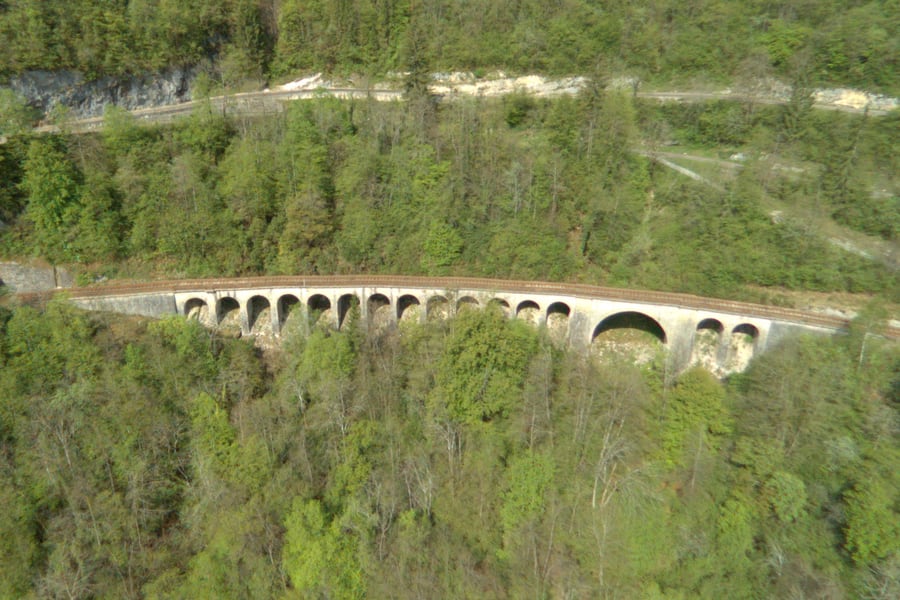 KlausFoehl / Wikimedia Commons · CC BY-SA 4.0 · cropped
Down the Bienne
The last section, opened in 1912, follows the Bienne south through forest and over the Pain-de-Sucre viaduct to Saint-Claude, in its deep valley where the Tacon joins the Bienne.A bit of history
Culture & experiences along the way
 Pierre-Yves Beaudouin / Wikimedia Commons · CC BY-SA 4.0 · cropped
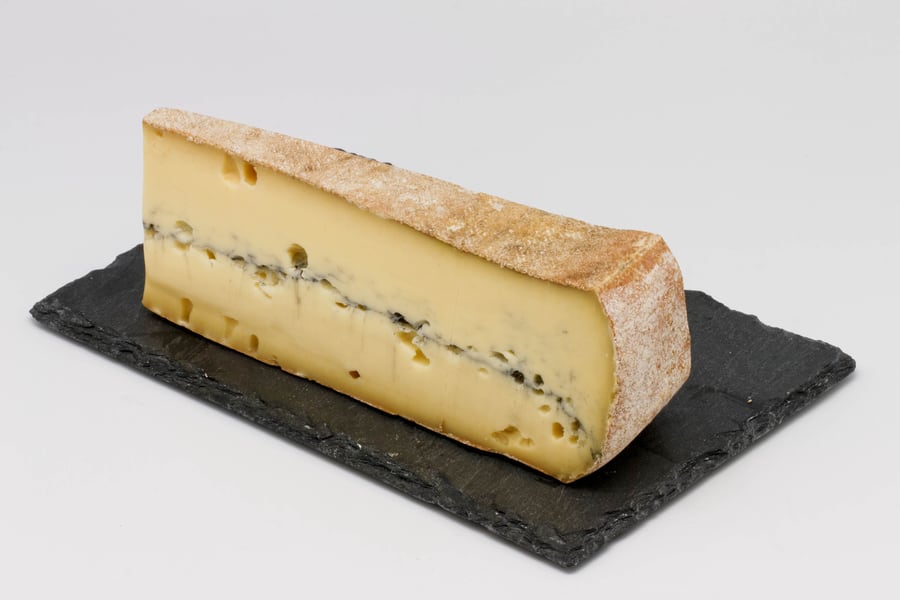
Morbier and its black line
The cheese named after Morbier, a stop on the line, is cut through by a thin dark stripe. Farmers once dusted the evening's curd with soot to protect it until the morning milk went on top; today the line is vegetable charcoal, and the cheese is protected and aged for at least 45 days.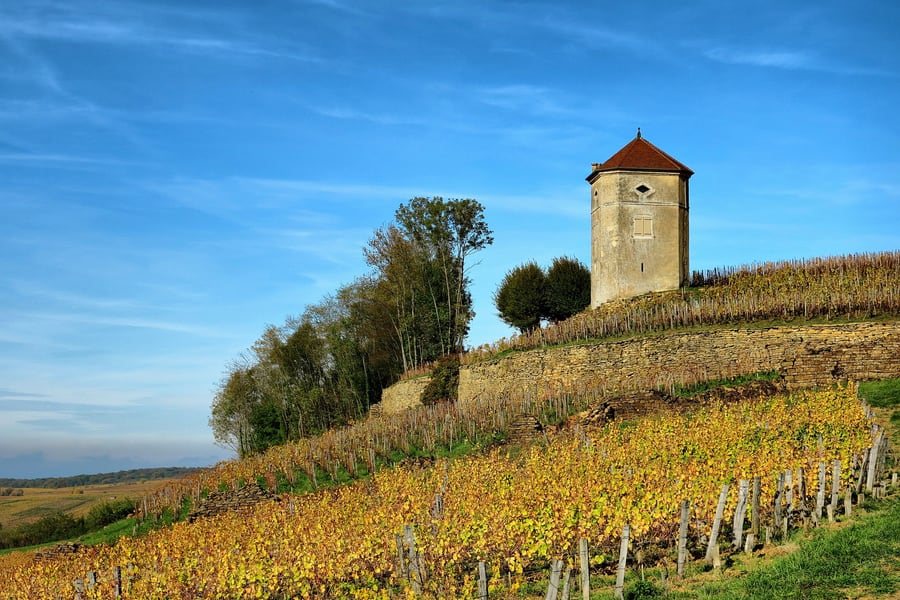 JGS25 / Wikimedia Commons · CC BY-SA 4.0 · cropped
Vin jaune at Arbois
Arbois, a few minutes by train from Mouchard, is the capital of Jura wine and was France's first appellation, in 1936. Its vin jaune is made from Savagnin and aged under a veil of yeast for six years and three months before it goes into its squat clavelin bottle.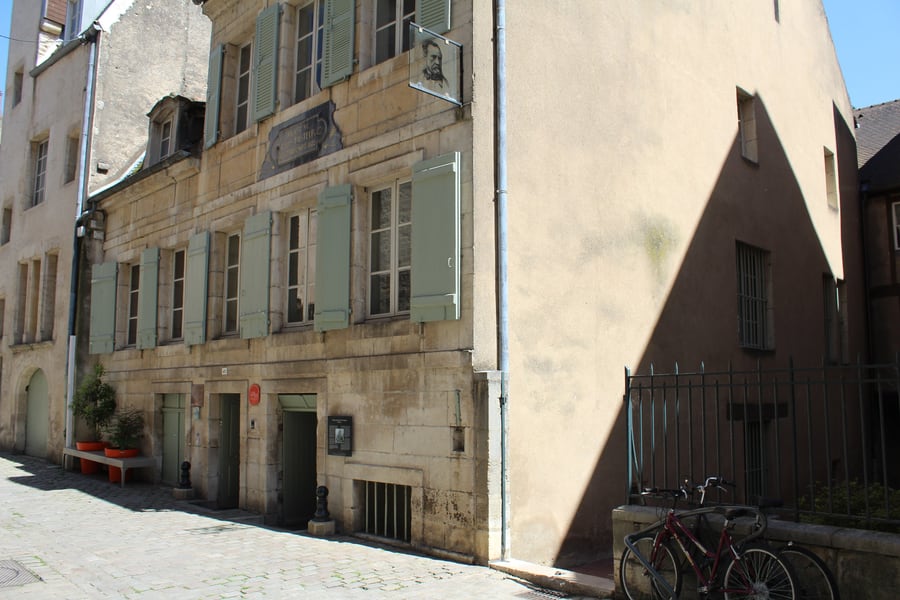 Chabe01 / Wikimedia Commons · CC BY-SA 4.0 · cropped
Where Pasteur was born
Louis Pasteur was born in Dole, and the house of his childhood is now a museum. The family later moved to Arbois, where he set up a laboratory in the family home and worked on the wine and the vines that led to pasteurisation.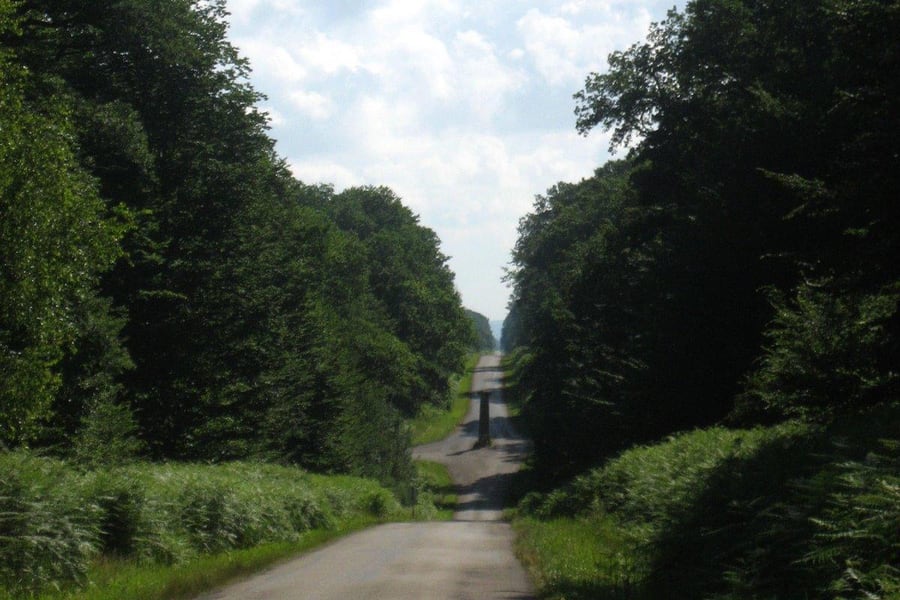 Maarten Sepp / Wikimedia Commons · CC BY-SA 3.0 · cropped
The Forêt de Chaux
The train skirts France's second-largest broadleaf forest, more than 20,000 hectares of oak and beech east of Dole. Its wood is why the royal saltworks was built at Arc-et-Senans, and eight stone columns put up in the 19th century still mark the crossings on its central road.Timetables
The line runs all year, but only a few trains a day go the whole way, and fewer than before: since October 2025 the timetable has been slower and thinner. From the timetable that starts on 13 December 2026, two trains a day run through from Dole to Saint-Claude and one comes back.
Dole to Saint-Claude
| Station | Mon–Fri | Daily |
|---|---|---|
| Dole Ville | 06:34 | 10:14 |
| Arc-et-Senans | 06:52 | 10:36 |
| Mouchard | 06:59 | 10:42 |
| Andelot | 07:22 | 11:05 |
| Champagnole | 07:44 | 11:20 |
| Saint-Laurent | 08:24 | 11:55 |
| Morbier | 08:37 | 12:08 |
| Morez | 08:51 | 12:22 |
| Saint-Claude | 09:29 | 13:01 |
On Sundays the early train starts at Andelot rather than Dole. The 10:14 is the one to take for the scenery: from Paris, the 07:54 TGV from Gare de Lyon reaches Dole at 09:53 to meet it.
Saint-Claude to Dole
The only through train back leaves Saint-Claude at 05:59, Monday to Saturday, reaching Dole at 08:41. Later in the day you change trains:
- 09:37 to Andelot, then on to Dole at 12:46, every day.
- 17:04 to Andelot, then on to Dole at 19:43, on Mondays, Tuesdays, Thursdays, Saturdays and Sundays.
- On Fridays the afternoon train leaves Saint-Claude at 14:50 instead and reaches Dole at 18:18, with a change.
- On Wednesdays no afternoon train runs back towards Dole.
So a day out from Dole works on most days: the 10:14 up, around four hours in Saint-Claude, and the 17:04 back. Every train calls at all the stations listed.
Times as of November 2026, for the timetable from 13 December 2026, from SNCF's timetable data. Check them on TER Bourgogne-Franche-Comté (opens in a new tab) before you travel, especially around holidays.
Tickets
This is an ordinary TER line, so there is nothing special to book: buy a TRAIN Mobigo ticket from TER Bourgogne-Franche-Comté online or at the station, and get on any train that day. Standard fares in the region run from €6 to €41, and Bons plans tickets, sold online only and tied to one train, cost €3, €6 or €13 while they last. Children aged 4 to 11 pay €2, under-26s pay half, and the €20 Carte TRAIN Mobigo + takes 60% off at weekends and in school holidays.
Dole Tourisme and the Saint-Claude tourist office also sell guided days on the line, with the return train, a commentary, a visit and lunch. Fares as of November 2026, from TER Bourgogne-Franche-Comté's fare pages.
Book your tickets
TRAIN Mobigo ticket
Standard fares €6–41 · children 4–11 €2 · under-26 half price
An ordinary regional ticket, valid on any train on the day, with no reservation.
Book Tickets (opens in a new tab, on TER Bourgogne-Franche-Comté)via TER Bourgogne-Franche-ComtéBons plans
€3, €6 or €13 · limited numbers, on sale 60 days ahead
Cheap tickets tied to one train, not exchangeable or refundable.
Book Tickets (opens in a new tab, on TER Bourgogne-Franche-Comté)via TER Bourgogne-Franche-ComtéRail Passes
Interrail passes are valid on the Ligne des Hirondelles. Interrail's table of railway companies lists SNCF's regional TER trains as covered by both the Global Pass and the One Country Pass for France, with no reservation needed in Bourgogne-Franche-Comté.
For this line alone a pass is not worth buying: a regional ticket is cheap, and a Bons plans ticket cheaper still. It pays only as one day of a longer trip across France or Europe, where the TGVs and night trains carry the cost; those need a reservation.
Checked November 2026 against Interrail's table of railway companies (opens in a new tab).
Places to Visit
The line climbs from the old capital of Franche-Comté to the clock-, spectacle- and pipe-making towns of the Haut-Jura, and most of its stops are worth a few hours. With only a few through trains a day, it is easier to see more than one by staying a night along the way.
 Patrick from Compiègne / Wikimedia Commons · CC BY-SA 2.0 · cropped
Dole
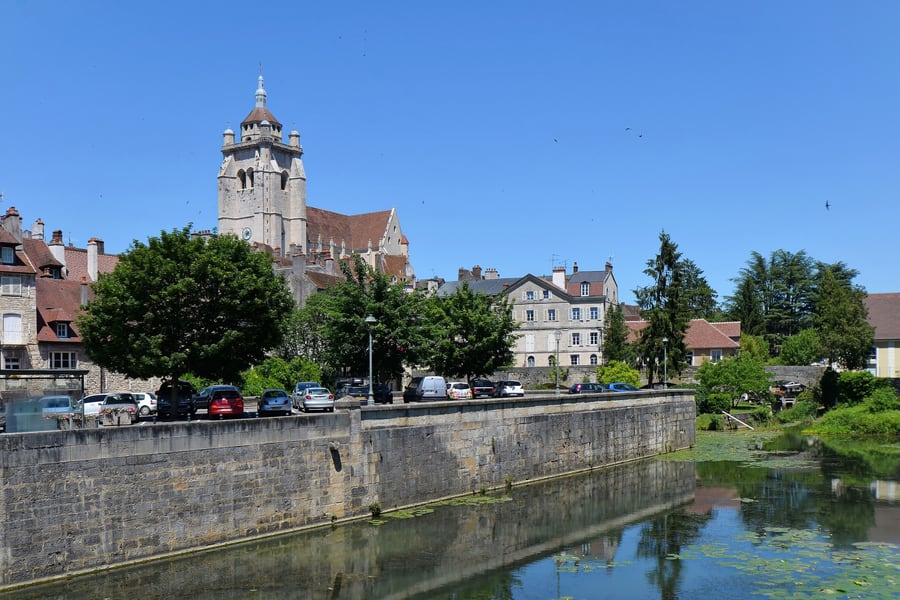
The capital of Franche-Comté until 1676, Dole keeps an old centre of steep streets around the bell tower of its collegiate church, Notre-Dame, which rises above the Canal des Tanneurs and the Doubs. Pasteur's birthplace is a few streets away, and the station is on the main line from Dijon.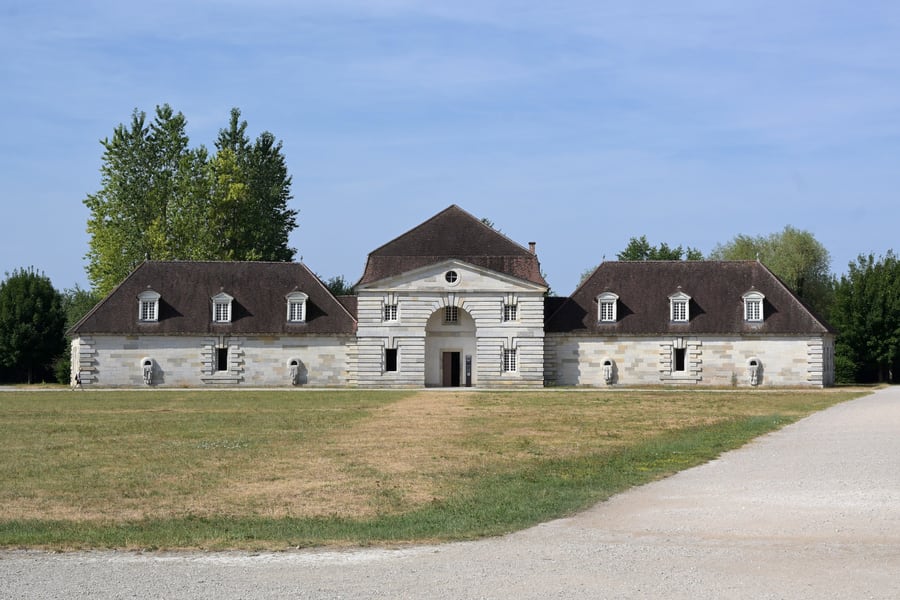 DimiTalen / Wikimedia Commons · CC0
Saline royale d'Arc-et-Senans
Claude-Nicolas Ledoux built the royal saltworks between 1775 and 1779 as a half-circle of buildings around the director's house, to boil brine piped 21 km from Salins-les-Bains with wood from the Forêt de Chaux. It made salt until 1895 and has been a UNESCO World Heritage Site since 1982.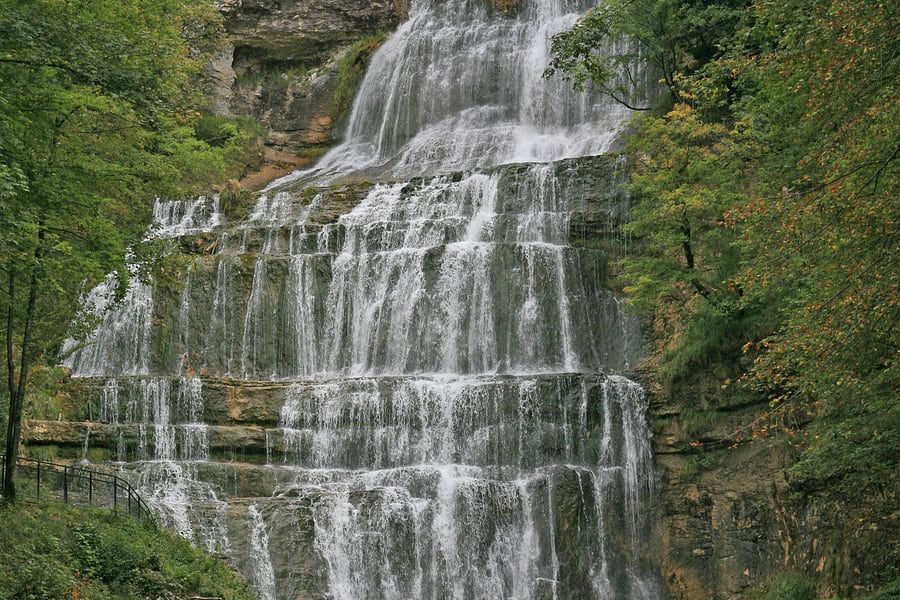 W. Bulach / Wikimedia Commons · CC BY-SA 4.0 · cropped
Cascades du Hérisson
South of Champagnole the Hérisson falls nearly 300 metres in 3 km down a wooded valley, in 31 leaps. The Éventail, 65 metres high and spread like a fan, and the 60-metre Grand Saut are the best known, and a path runs to the foot of the falls.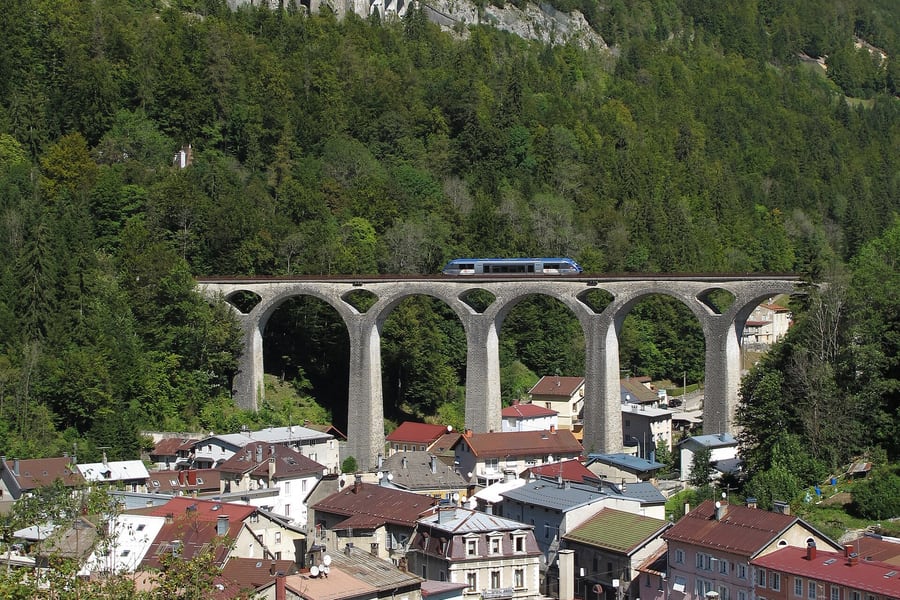 KlausFoehl / Wikimedia Commons · CC BY-SA 3.0 · cropped
Morez
Morez stretches for 3 km along the floor of the Bienne valley, and its skyline is the railway's viaducts. It was the capital of the Comtoise clock in the 19th century and of French spectacles since, and its Musée de la Lunette tells that story from 1796, when a nail-maker first bent iron wire into a pair of glasses.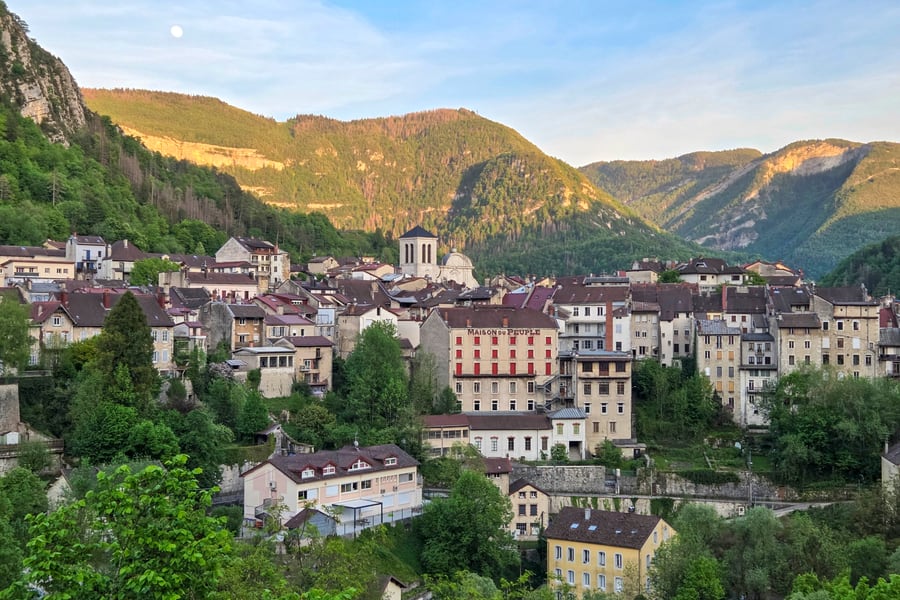 Wikipedro / Wikimedia Commons · CC BY-SA 4.0 · cropped
Saint-Claude
The town grew around an abbey at the meeting of the Bienne and the Tacon, in a valley more than 450 metres deep. Its cathedral of Saint-Pierre began as the abbey church in the 14th century, and the town's pipe-making took off in 1855 with the briar pipe.Where to Sleep
Dole, at the start of the line, has a direct TGV from Paris, which makes it the natural place to stay before the 10:14. At the far end, a night in Saint-Claude gets round the thin afternoon service back, and puts the morning train to Dole on your doorstep.
Where to stay
Hôtel de la Cloche
On Place Grévy, Dole
An 18th-century house with 35 rooms facing the Cours Saint-Mauris, a short walk from the collegiate church and Pasteur's birthplace.
Check Availability (opens in a new tab, on la-cloche.fr)via la-cloche.frJura Hôtel
Opposite the station, Saint-Claude
A hotel of 35 rooms facing the station, some looking over the town and mountains, with a panoramic restaurant.
Check Availability (opens in a new tab, on jurahotel.com)via jurahotel.comQuestions or corrections
Planning this trip and stuck on something, or spotted a time, fare or detail that has changed? Send us a message about Ligne des Hirondelles. We read every one, and we update this page when something has changed.