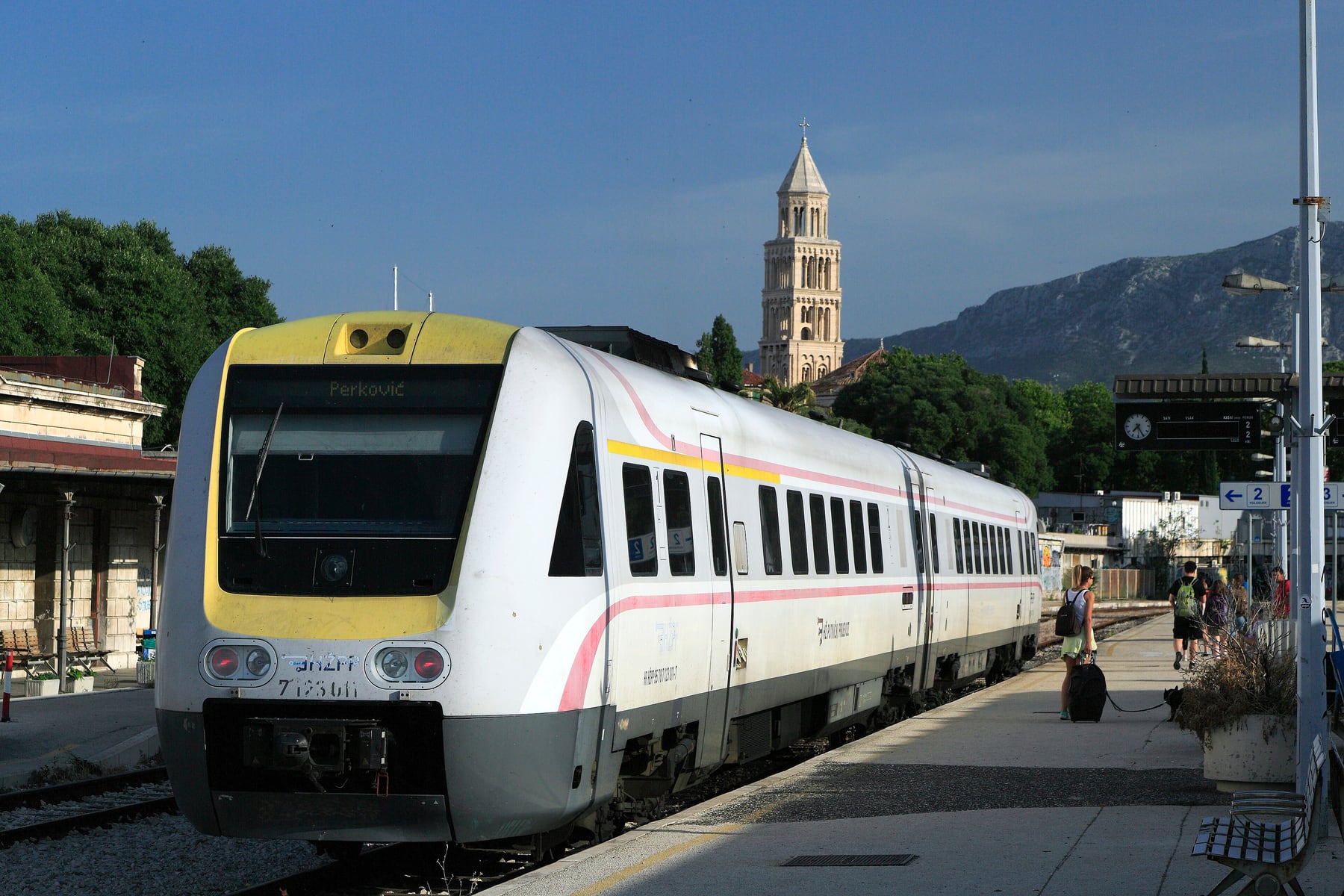
The Lika Railway — Zagreb to Split
Falk2 / Wikimedia Commons · CC BY-SA 4.0 · cropped
- DistanceZagreb–Split · 429 km
- Duration7 h 01 on the summer day train · about 8 h otherwise
- Best seasonLate June to late August for the direct day train · the line runs all year
Introduction
In the spring of 1913, Austria-Hungary began building a railway from the Croatian interior down to the Dalmatian coast. It never saw it finished. The empire got as far as Vrhovine — a bleak, beautiful spot on the Lika plateau — by June 1918, and within five months it had ceased to exist. The last rails into Knin were laid on 25 July 1925 by the Kingdom of Serbs, Croats and Slovenes, a country that had not been imagined when the first sod was cut.
Twelve years for two hundred and eighteen kilometres. The reasons are written into the opening dates. Ogulin to Plaški opened on 14 October 1914, with the war already two months old. Plaški to Vrhovine followed on 12 June 1918, and then nothing at all for nearly two years, because mobilisation had taken the workforce, the supply of materials had failed, and the authority that had commissioned the whole thing was gone. Vrhovine to Gospić came in 1920, Gospić to Gračac in 1922, and Gračac to Knin three years after that.
What the delay produced is a railway that runs through the emptiest part of Croatia. The Lika is a high limestone country of thin villages, sinkholes and forest, hemmed by the Velebit on one side and the Plješivica on the other, and the coach road and the motorway both skirt it. The train goes straight through the middle. For seven hours it climbs out of the Sava basin, crosses the plateau, drops into the karst valley at Knin, and then comes down through the last hills to arrive on the waterfront at Split, a few minutes' walk from the walls of a Roman palace that has been lived in continuously for seventeen hundred years.
It is 429 kilometres in all, and only the first 103 of them are electrified. Beyond Oštarije the wire simply stops and the train carries on under its own power, which is the plainest possible statement of what kind of line this is: a mountain railway that was built late, expensively, by a state in its last years, and that has been quietly doing the job ever since.
The Journey
The train leaves Zagreb Glavni kolodvor and spends its first hour on flat, fast, electrified track through Jastrebarsko to Karlovac, the old fortress town where four rivers meet. This stretch is shared with the Rijeka main line and looks like it: double track in places, overhead wire, a general air of a railway that matters.
That ends at Oštarije. The Rijeka line swings west; this one turns south, the wire finishes, and the character of the journey changes within a few minutes. From here to Split — 326 of the 429 kilometres — the railway is single track, unelectrified, and climbing.
Onto the plateau
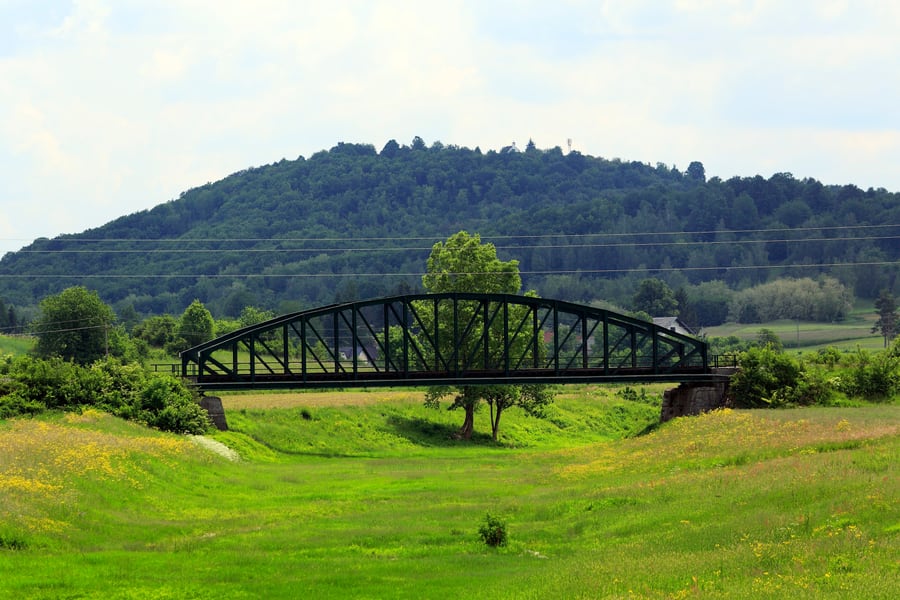
Josipdol and Plaški come next, and then the long pull up to Vrhovine, which was as far as Austria-Hungary ever got. The line runs through forest and open karst, over a succession of steel bridges and through short tunnels, on curves tight enough that the train spends much of the time leaning into them. Ličko Lešće, Perušić and Gospić follow at fifteen-minute intervals down the length of the Lika valley.
Gospić is the largest town the railway touches between Karlovac and Knin, and it is the point at which the emptiness becomes obvious. A few kilometres west, at Smiljan, is the house where Nikola Tesla was born; his father was the priest at the church next door. The plateau here sits open and high, and the light on it is quite unlike the light on the coast three hours further south.
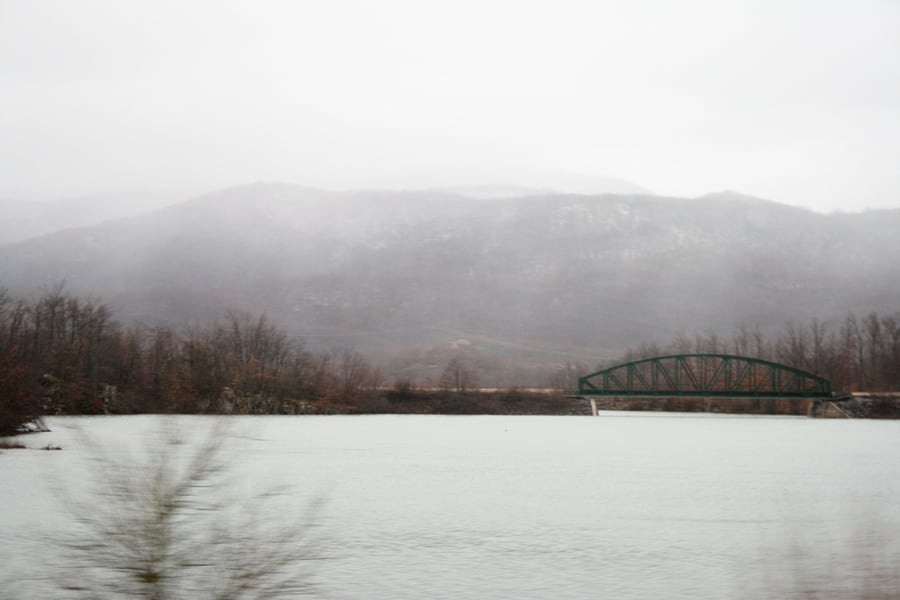
After Lovinac the line reaches Gračac, where southbound trains stand for eleven minutes — the one pause long enough to get out onto the platform. Just beyond, the railway crosses the Štikada reservoir on a steel bridge. This is the top of the journey in every sense: the climbing is done, and what follows is a descent.
Down to the sea
The drop from Gračac to Knin takes an hour and covers some of the most dramatic country on the line, the railway working down through the karst under the wall of the Dinara. Knin, when it arrives, is a junction in a broad valley with an enormous fortress strung along the ridge above it — the point where the Lika railway proper ends and where the branch towards Šibenik and Zadar leaves.
Drniš, Unešić and Perković follow through the Dalmatian hinterland, dry and stony after the green of the plateau. Perković is the junction for Šibenik, and after it the line makes its final turn towards the water. It comes down through Kaštel Stari onto the shore of the Kaštela bay and runs beside it for the last few minutes into Split, where the tracks end beside the harbour.
What is actually pulling it
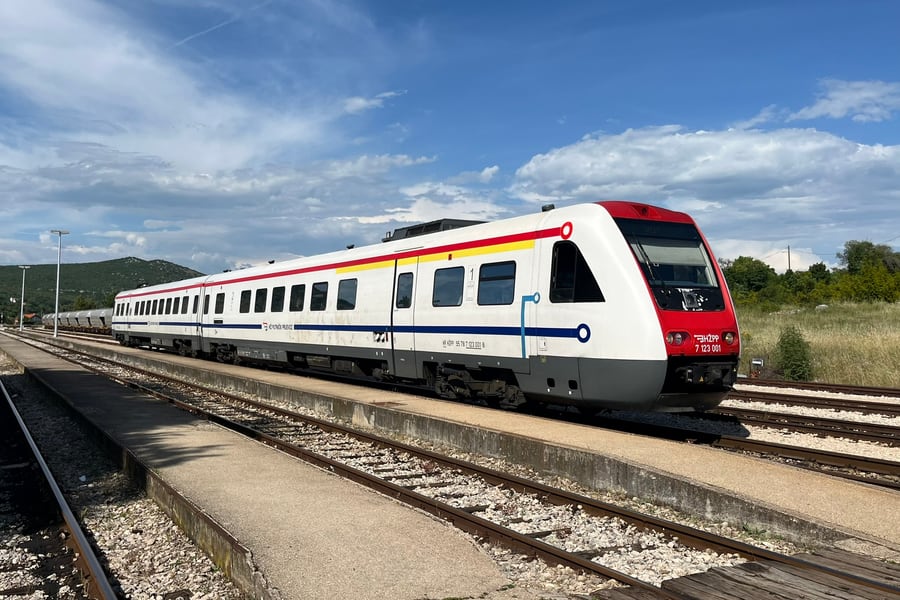
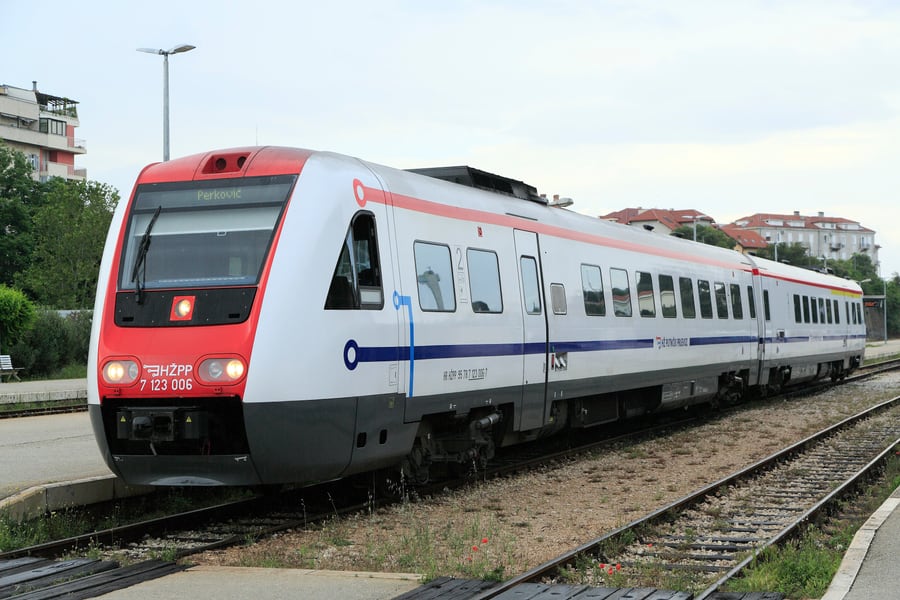
Eight two-car tilting units were bought in 2004 to work this route, capable of 160 km/h and of leaning into curves above 70. Two of the eight were destroyed in accidents and six remain. Their replacement has been contracted: six Končar electro-diesel units, signed for on 23 July 2024 at €57.3 million on a European Investment Bank loan, designed to run off the wire as far as Oštarije and on diesel beyond it. At the production launch in March 2026 none had yet been delivered, with the first expected that July.
So the honest position is that this is a service in the middle of changing its rolling stock, and the timetable is the reliable part. The trains are booked as ICN — reservation compulsory, supplement payable — whatever turns up to work them.
Along the route
Falk2 / Wikimedia Commons · CC BY-SA 4.0 · croppedBegun by one country, finished by another
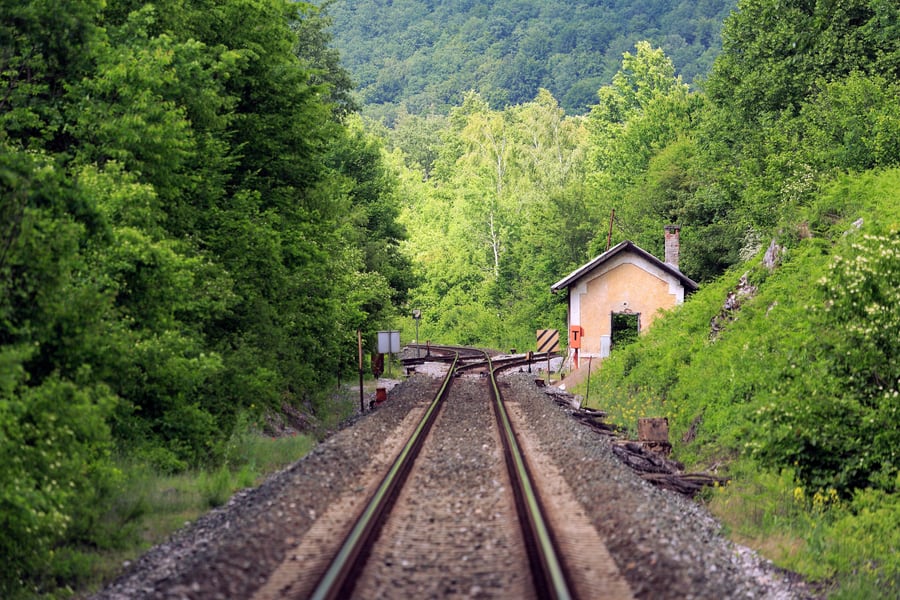
Austria-Hungary started work in the spring of 1913. The first stretch opened in October 1914, by which time the war was two months old, and the section of June 1918 was the last piece the empire ever completed. The rest was opened by its successor state, the final part in 1925.Falk2 / Wikimedia Commons · CC BY-SA 3.0 de · croppedWhy twelve years
The delays were not engineering ones. Mobilisation took the workforce and the supply of materials failed; the empire extended its own deadline to 1920 and then ceased to exist. What followed was chaos on the works. The new authorities restarted, more slowly.Modswag / Wikimedia Commons · CC BY-SA 4.0 · croppedOne hundred and three kilometres of wire
Of the 429 kilometres between Zagreb and Split, only the first 103 carry overhead line. Everything after that is diesel territory, which is why the trains that work it have always been self-powered units rather than anything from the electric fleet.A bit of history
Culture & experiences along the way
 Highonsteep / Wikimedia Commons · CC BY-SA 4.0 · cropped
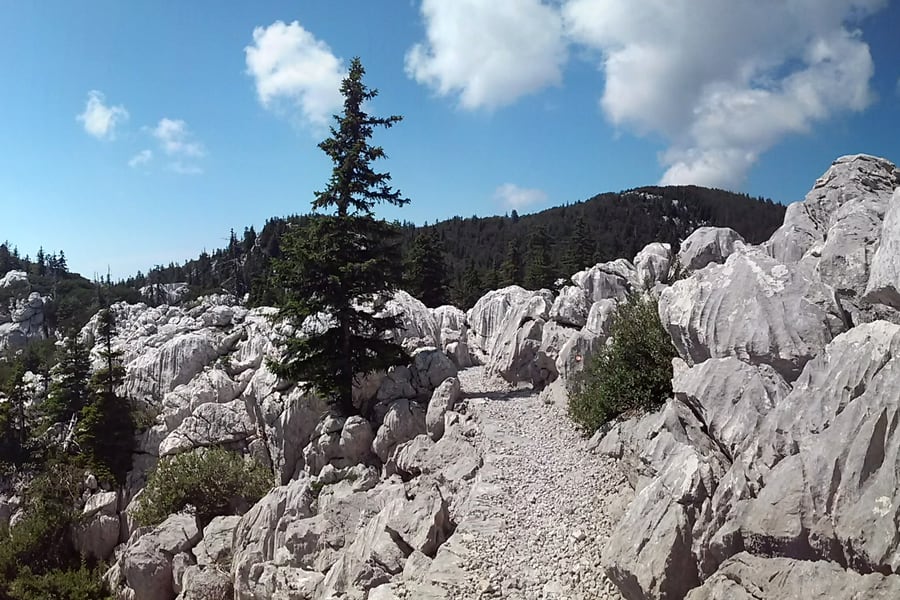
The path a forester drew across the Velebit
The forestry engineer Ante Premužić laid a path along the crest of the Velebit between 1930 and 1933 and graded it so gently it can be walked in ordinary shoes — 57 kilometres from Zavižan to Baške Oštarije, built dry-stone without a bag of cement, through limestone that is otherwise close to impassable.SpeedyGonsales / Wikimedia Commons · CC BY-SA 2.5 · croppedThe direct day train is a summer train
For most of the year the daytime run is 523, leaving Zagreb at 13:49 and reaching Split at 21:47 — a fine ride, but the last two hours are in the dark for much of the year. The train that does the whole thing in daylight is ICN 521, and it runs only from 27 June to 29 August. If seeing the Lika is the point, that window is the journey. Smiley.toerist / Wikimedia Commons · CC0 · cropped
An eleven-minute pause at Gračac
Southbound trains stand at Gračac for eleven minutes — 11:21 to 11:32 on the summer ICN, and longer still on some workings. It is the one scheduled break long enough to get down onto the platform in the middle of the Lika, at the point where the line has finished climbing and has not yet begun the drop towards Knin.Falk2 / Wikimedia Commons · CC BY-SA 3.0 de · croppedWhat the last hour looks like
After Perković the line turns for the sea and comes down through Kaštel Stari, running along the Kaštela bay with the water on one side for the final approach. The train arrives at Split beside the harbour, a few minutes' walk from the walls of Diocletian's Palace — one of the shortest distances between a mainline terminus and a Roman monument anywhere.Timetables
Times below are read from HŽPP's own published GTFS feed, downloaded on 15 August 2026. The timetable period runs 14 December 2025 to 12 December 2026, with amendments in force from 14 June 2026.
Southbound, Zagreb to Split
ICN 521 is the one that does the whole journey in daylight, and it runs daily from 27 June to 29 August 2026 only.
| Zagreb Glavni kolodvor | 07:08 |
| Karlovac | 08:16 / 08:18 |
| Oštarije | 09:07 / 09:08 |
| Vrhovine | 10:08 / 10:09 |
| Gospić | 10:46 / 10:48 |
| Gračac | 11:21 / 11:32 |
| Knin | 12:23 / 12:25 |
| Perković | 13:10 / 13:11 |
| Split | 14:09 |
Train 523 runs all year, every day: Zagreb 13:49, Karlovac 14:49, Oštarije 15:46, Gospić 17:46, Gračac 18:25 (departing 18:36), Knin 19:39, Perković 20:35, Split 21:47.
Northbound, Split to Zagreb
Train 520 leaves Split at 07:54 and reaches Zagreb at 16:04, calling at Knin 10:03, Gračac 11:18 (departing 11:29), Gospić 12:05, Oštarije 14:01 and Karlovac 14:53. It runs daily except Sundays for most of the year, and daily from late June to the end of August.
Train 522 leaves Split at 14:10 and reaches Zagreb at 21:24, calling at Knin 15:53, Gračac 16:46, Gospić 17:21 and Karlovac 20:15. It runs Sundays only for most of the year, and daily from late June to the end of August.
What that means in practice
For roughly nine weeks of the summer there are two trains each way, one of them making the crossing in daylight in seven hours and one minute. For the rest of the year there is one southbound and one northbound working a day, and the southbound arrives in Split after dark.
The eleven-minute stand at Gračac on southbound trains, and the equivalent pause northbound, is the only scheduled break of any length.
A third pair, trains 1880 and 1881, runs overnight in high summer between Osijek and Split and covers this same line between Zagreb and the coast in the small hours — useful as a way of reaching Split, and no use at all for seeing the Lika.
The operator publishes the live timetable and sells tickets at prodaja.hzpp.hr (opens in a new tab), and its downloadable domestic and international timetables are linked from hzpp.hr (opens in a new tab).
Tickets
The line is run by HŽ Putnički prijevoz, and a seat reservation is compulsory on the Zagreb–Split day trains at €1.06 on top of the fare — including for passengers travelling free under Croatia's concession schemes. HŽPP sells through its own booking system as well as at counters, and its published terms make the online ticket 10% cheaper than the same one bought at the window.
A summer offer sells tickets to the Adriatic at 40% off at the counter, though not on journeys under 25 kilometres, and the reservation is payable regardless. Because reservations are compulsory the seats on any train are finite, and on summer weekends in the seven-week window when the daylight ICN runs they are the scarcest thing on the Croatian network. Booking ahead is the difference between riding this line in daylight and riding it in the dark.
Book your tickets
Modswag / Wikimedia Commons · CC BY-SA 4.0 · croppedZagreb – Split, the whole line
429 km, second class, reservation compulsory
Seats on the Zagreb–Split day trains must be reserved, and the reservation is €1.06 on top of the fare. HŽPP sells online as well as at station counters, and its own terms make the online ticket 10% cheaper than the same ticket bought at the window. Fares and the day's departures are shown by the operator's booking system.
Book Tickets (opens in a new tab, on HŽ Putnički prijevoz)via HŽ Putnički prijevozFalk2 / Wikimedia Commons · CC BY-SA 3.0 de · croppedThe summer seaside discount
40% off, on the trains to the coast
HŽPP runs a seasonal offer on the trains to the Adriatic covering this route and the Šibenik branch, with tickets sold at 40% off at the counter. It does not apply to journeys under 25 kilometres, and the reservation fee is payable regardless. Children, students, pensioners and people with disabilities travel free under separate schemes, still paying the reservation.
Book Tickets (opens in a new tab, on HŽ Putnički prijevoz)via HŽ Putnički prijevozRail Passes
The pass that covers this line is the Interrail Croatia One Country Pass, a flexi pass giving a set number of travel days inside one month. Prices read from Interrail's own site on 15 August 2026, adult second class:
| Travel days | Adult, 2nd class |
|---|---|
| 3 days within 1 month | €67 |
| 4 days within 1 month | €84 |
| 5 days within 1 month | €100 |
| 6 days within 1 month | €118 |
| 8 days within 1 month | €150 |
Youth passes, for travellers aged 12 to 27, start at €50 for three days. A travel day runs until 23:59 local time, and covers as many trains as you can fit into it.
Whether it is worth buying
For this journey on its own, almost certainly not. A single Zagreb–Split ticket costs a fraction of the cheapest pass, and the three-day pass only starts to make sense if you are going to use all three days on long runs — Zagreb to Split, then Split back up to Zagreb, then Zagreb to Rijeka or Osijek, for instance. Croatia's network is small and its fares are low, which is exactly the combination that makes a country pass hard to justify.
Two conditions matter more than the price. Reservation fees are not included, so the compulsory €1.06 on the Zagreb–Split day trains is payable on top of the pass, and the seat still has to be booked. And a One Country Pass does not cross a border — if the trip includes Ljubljana, Vienna or Sarajevo, this is the wrong pass and a Global Pass is the one to look at.
There is a further catch worth knowing: Interrail passes cannot be bought for the country you live in, so a Croatian resident cannot use this pass at home.
Where a pass does earn its keep on this line is as part of a wider Balkan or central European trip already running on a Global Pass, in which case the Zagreb–Split run is included and only the reservation is left to pay.
Places to Visit
This is a line whose best stops are not towns. Between Karlovac and Knin the railway passes two of Croatia's most visited natural places and one of its quietest historic ones, and at the far end it delivers you into a Roman palace.
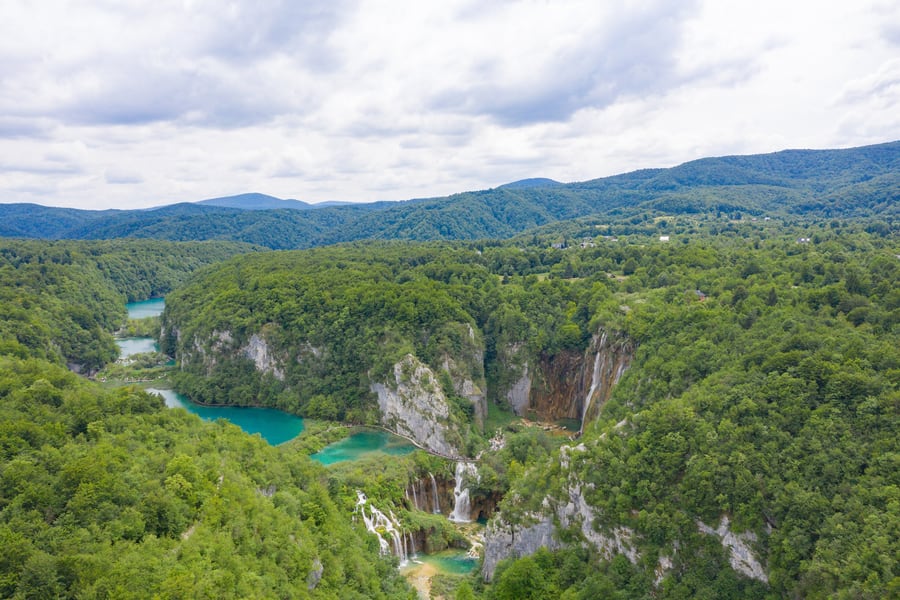
Plitvice Lakes is the reason many people come to this part of the country at all — sixteen lakes stepping down into one another over travertine barriers the water deposits as it flows. The park lies east of the railway, and the nearest stations are Vrhovine and Ličko Lešće, both about three and a quarter hours out of Zagreb, with a short road transfer beyond them to the entrances.
Smiljan, a few kilometres from Gospić, is where Nikola Tesla was born, and the memorial centre there keeps his birth house and the church his father served in. It is the sort of place the train makes easy and nothing else does.
Knin is worth breaking the journey for if the fortress appeals: a very long defensive site along the ridge above the town, with a view down over the whole valley and across to the Dinaric wall.
Nearer the coast, Drniš and Perković put the Krka waterfalls within reach, where the river drops through limestone in a run of falls that the park has made walkable on boardwalks. Perković is also the junction for Šibenik, at the river's mouth.
And then Split, where the station stands on the harbour front and the walls of Diocletian's Palace begin a few minutes away. The emperor built it as a retirement residence around the start of the fourth century; the city moved in and has never left, which is why the cathedral bell tower rises out of what was his mausoleum.
 dronepicr / Wikimedia Commons · CC BY 2.0 · cropped
Plitvice Lakes
Sixteen terraced lakes falling into one another over barriers of travertine the water builds as it goes, in a forested karst basin the railway skirts to the east. It became Croatia's first national park in 1949 and went onto the UNESCO World Heritage list in 1979. The nearest stations on this line are Vrhovine and Ličko Lešće; the park entrances are a short road transfer beyond them.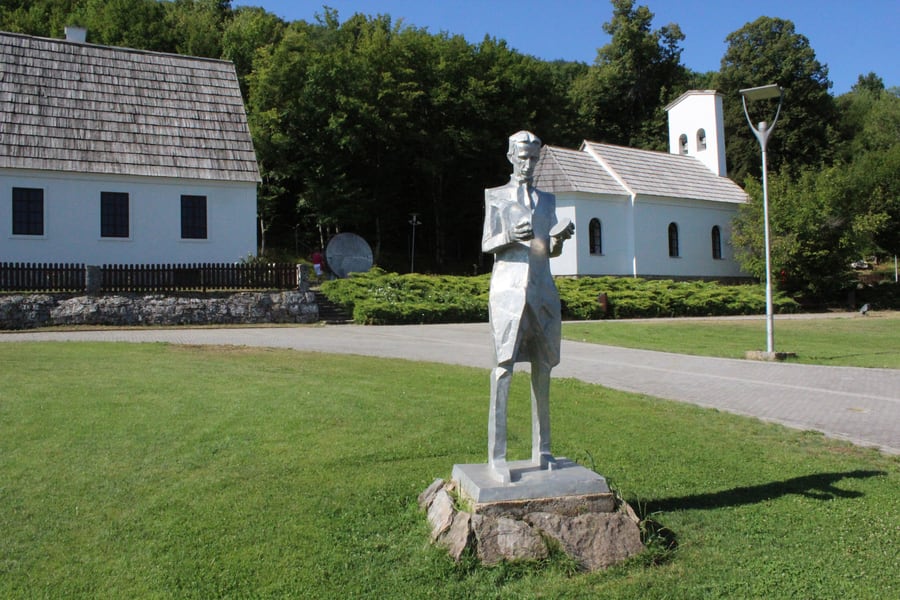 Zátonyi Sándor, (ifj.) Fizped / Wikimedia Commons · CC BY 3.0 · cropped
Where Nikola Tesla was born
Tesla was born at Smiljan, a village a few kilometres west of Gospić, where his father served as an Orthodox priest. The memorial centre there keeps the birth house and the church beside it, with the statue standing on the grass between them. Gospić is the largest town on the Lika section and every train on the line calls there.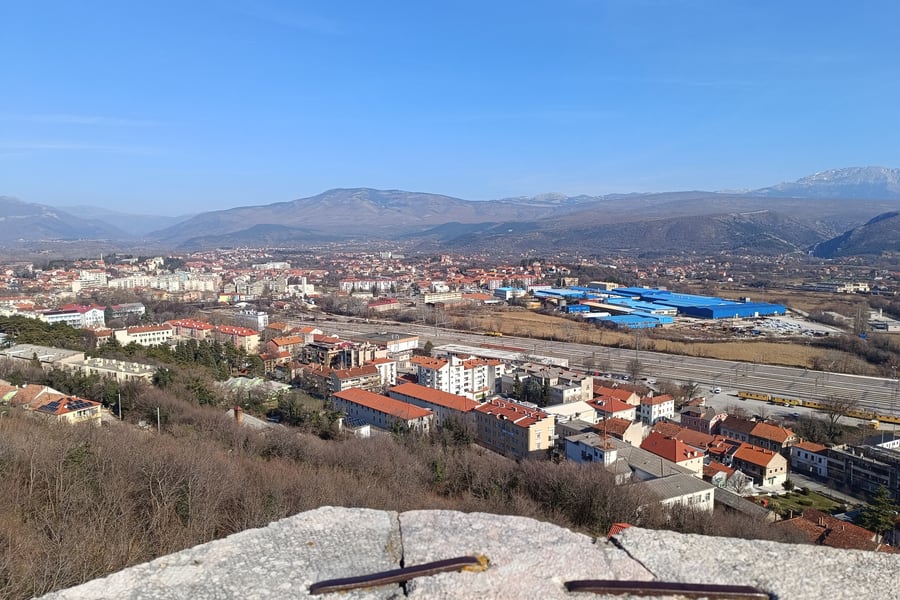 CroatianPalpatine / Wikimedia Commons · CC BY-SA 4.0 · cropped
Knin, from the fortress walls
The fortress above Knin is one of the largest in Croatia, strung along a ridge over the town, and what it is really worth climbing for is this — the whole of Knin below, the railway running through the middle of it, and the Dinaric wall closing the far side of the valley. Knin is where the Lika section ends and where the branch to Šibenik and Zadar leaves.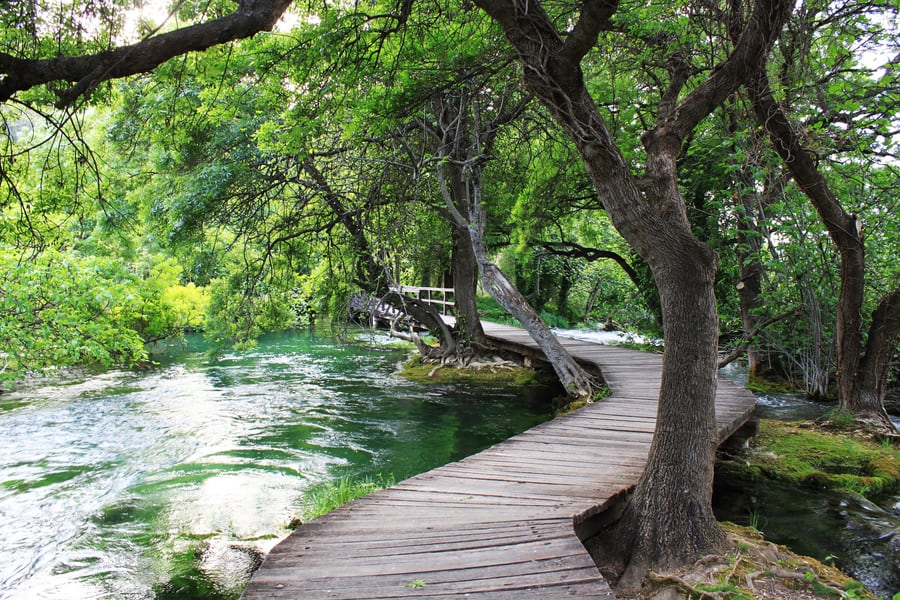 Matea Bolčević / Wikimedia Commons · CC BY-SA 4.0 · cropped
The Krka waterfalls
The Krka cuts down through limestone in a series of falls and pools, and the park has laid boardwalks over and beside the water so the whole thing can be walked. Drniš and Perković are both on this line and both within reach of the park; Perković is also where you change for Šibenik, at the river's mouth.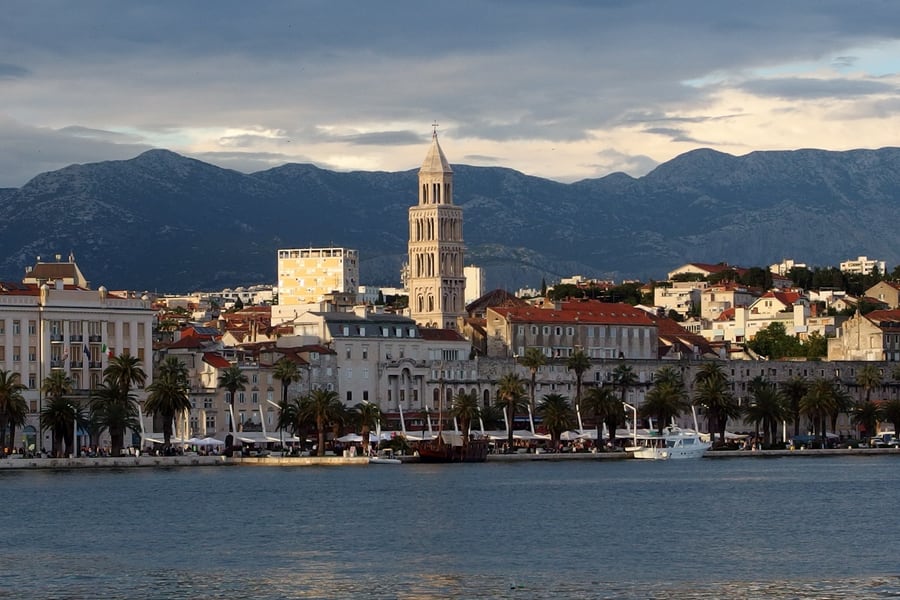 Mark Ahsmann / Wikimedia Commons · CC BY-SA 3.0 · cropped
Diocletian's Palace
The Roman emperor Diocletian built himself a retirement palace on this shore around the beginning of the fourth century, and the city simply moved into it and never moved out. The bell tower rising out of the middle of it belongs to the cathedral that was built into his mausoleum. The station stands on the waterfront a few minutes' walk from the walls.Where to Sleep
The two ends of this line are easy; the middle takes a little thought.
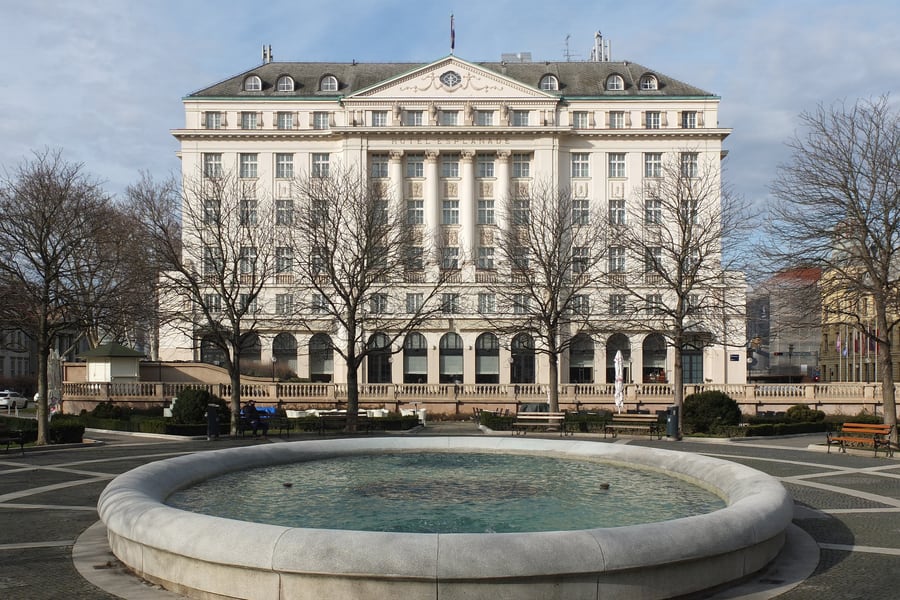
At the Zagreb end, the station is surrounded by the city's nineteenth- and twentieth-century core, and the grandest option is directly beside it. The Esplanade opened in 1925 — the same year the last section of this railway was completed — and its own account of itself is that it was built as a refuge for passengers coming off the Orient Express. It stands at Mihanovićeva 1, which is close enough that the walk to a 07:08 departure is a matter of minutes.
In the middle, the obvious base is Plitvice, and the national park runs its own hotels beside the entrance. Staying inside the park includes an extended park ticket, which is the practical argument for it — the lakes take longer to walk than a day ticket comfortably allows.
Along the Lika itself, Gospić and Gračac are small towns with small guesthouses rather than hotels, and there is no need to plan a stop there unless Smiljan or the plateau is the reason for the trip.
At the Split end there is no shortage of anything, and the useful detail is that the railway station, the bus station and the ferry terminal are all in the same corner of the harbour, ten minutes' walk from the old town. Anywhere describing itself as near the Riva is near the train.
One warning that applies to all of it: in July and August the Dalmatian coast fills completely, and rooms in Split go well before seats on the train do.
Where to stay
 Palauenc05 / Wikimedia Commons · CC BY-SA 4.0 · cropped
Esplanade Zagreb Hotel
Beside the station, and the same age as the line
The Esplanade's own account of itself is that it opened in 1925 as a refuge for passengers off the Orient Express, and it reopened in 2004 after a full renovation. It has 208 rooms and suites, three places to eat and drink — Zinfandel's, Le Bistro and the Esplanade 1925 lounge — and a health club. It stands at Mihanovićeva 1, beside Zagreb Glavni kolodvor, which is where this journey begins.
Check Availability (opens in a new tab, on esplanade.hr)via esplanade.hrHotel Jezero
Plitvice Lakes, run by the national park
The park's own hotel, next to the entrance and close to Lake Kozjak, with 205 rooms and 19 suites, two of them adapted for guests with disabilities. There is a main restaurant, an à la carte restaurant called Waterfall, and a lobby bar; guests have free use of the whirlpool, Finnish sauna and fitness room. Staying there includes an extended park ticket.
Check Availability (opens in a new tab, on np-plitvicka-jezera.hr)via np-plitvicka-jezera.hrHotel Luxe Split
Ten minutes' walk from the terminus
A thirty-room hotel that puts itself five minutes' walk from Diocletian's Palace and the seafront, and ten from the railway station, the bus station and the ferry terminal — which between them are all in the same corner of the harbour. It has a restaurant, a lobby bar and a cigar lounge, and a spa with a sauna, jacuzzi and fitness room.
Check Availability (opens in a new tab, on hotelluxesplit.com)via hotelluxesplit.comQuestions or corrections
Planning this trip and stuck on something, or spotted a time, fare or detail that has changed? Send us a message about The Lika Railway — Zagreb to Split. We read every one, and we update this page when something has changed.