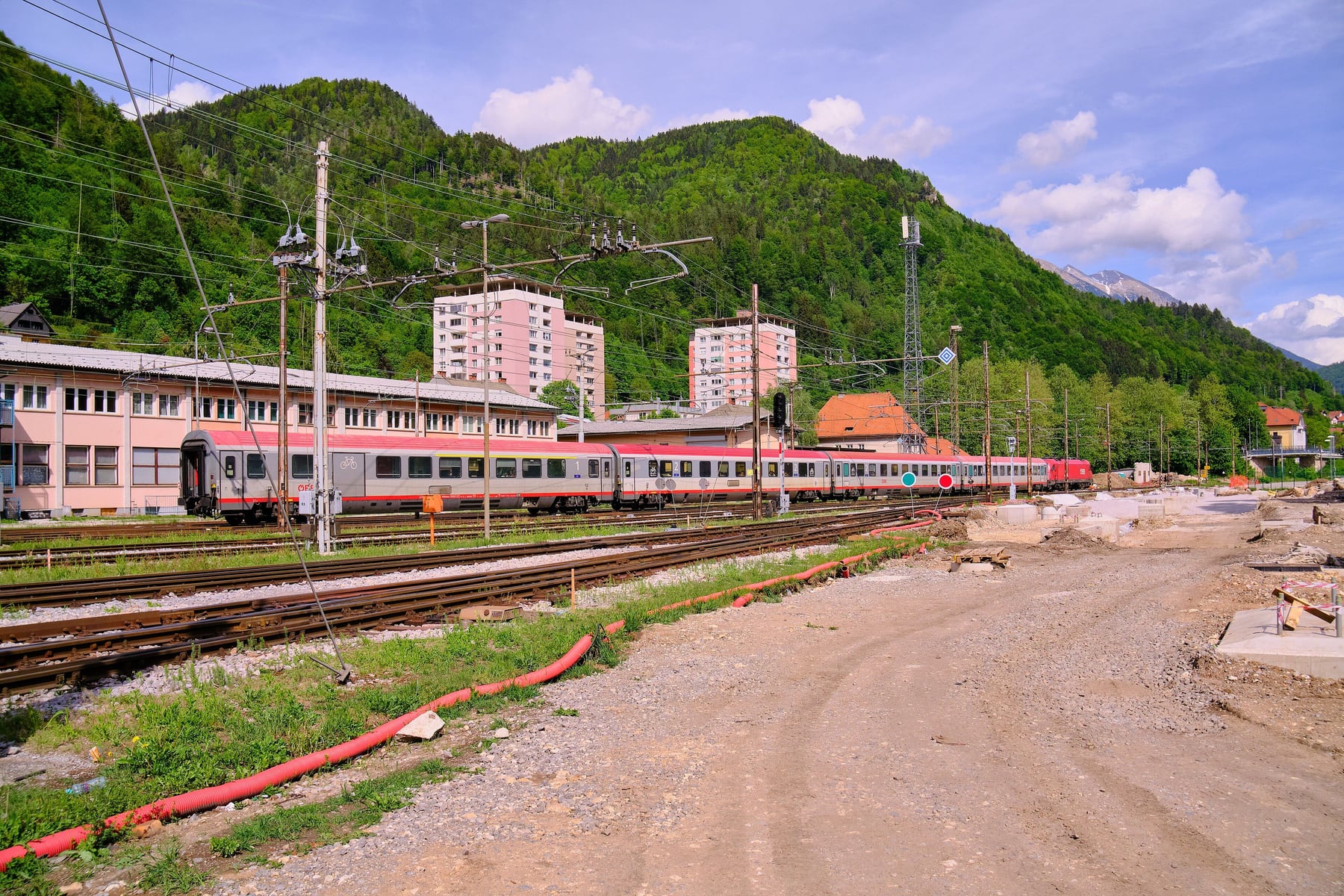
Ljubljana to Villach
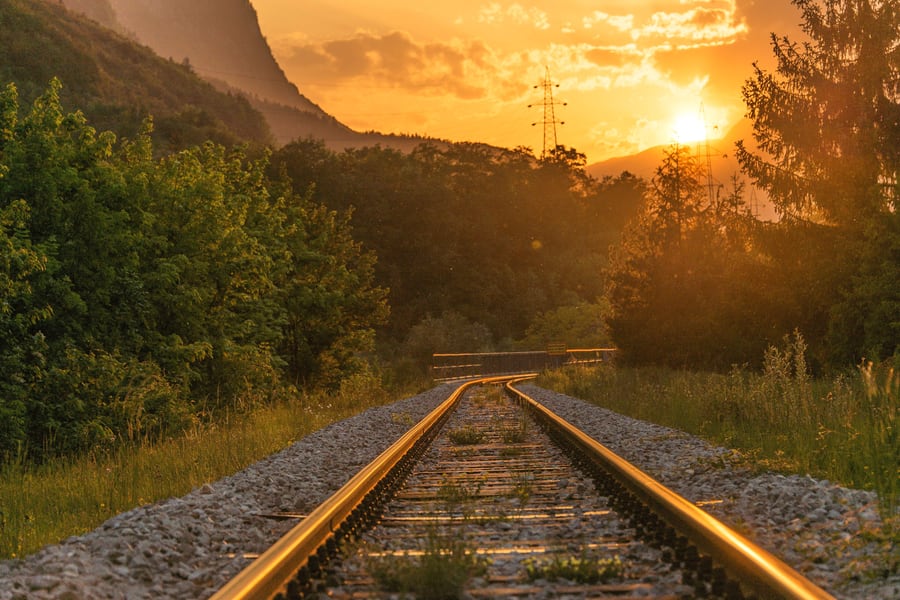
Bvcmz248.5 / Wikimedia Commons · CC0
- DistanceLjubljana–Villach Hbf · about 100 km
- Duration1 h 31 to 2 h 07
- Best seasonAll year · clear days for the Karawanks
Introduction
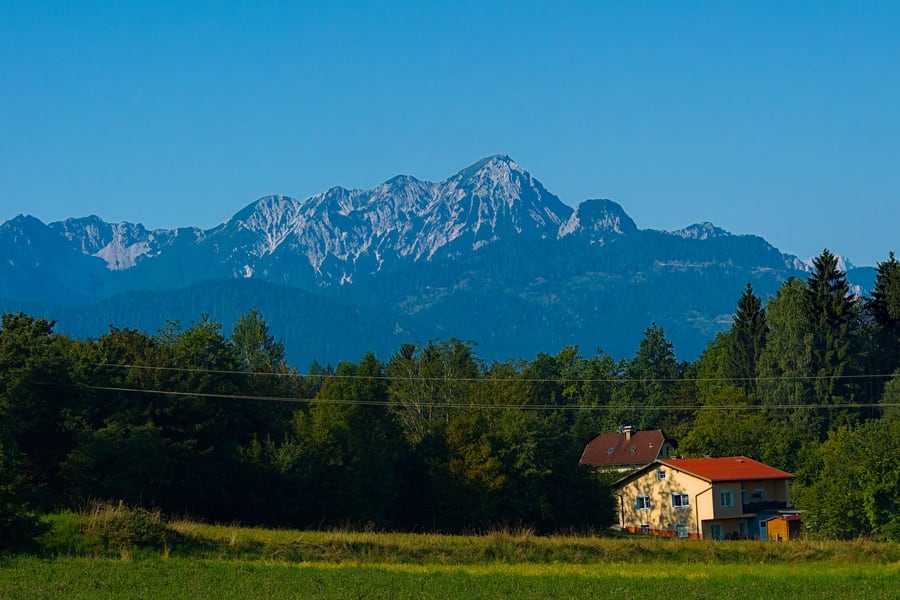
The Karawanks stand between Slovenia and Austria, a long mountain range whose highest summit, Stol, reaches 2,236 metres on the border itself. Since 30 September 1906 the railway has gone through them rather than round. The Karawanks Tunnel is almost eight kilometres long, and the frontier lies somewhere in the dark inside it.
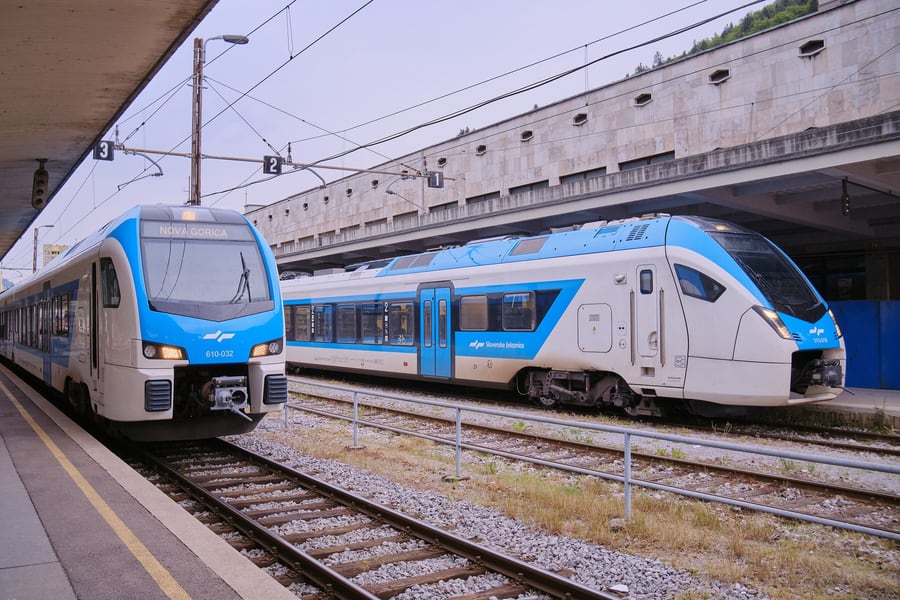
Austria built the tunnel in 1901–1906 as part of its New Alpine Railways: a second line from the north to the port of Trieste, to break the private Southern Railway's hold on the traffic. Today it carries the trains between Ljubljana and Villach. They run about every two hours, most of them Slovenske železnice's new Stadler FLIRT units, and take 1 hour 31 minutes to just over 2 hours for about 100 kilometres.
The first hour follows the Sava north-west out of Ljubljana, past Škofja Loka, Kranj and Radovljica, to Lesce-Bled, the station for Bled, and the old ironworks town of Jesenice under the mountains. Then the train turns into the tunnel, comes out in Carinthia, runs beside the turquoise Faaker See, and ends at Villach, one of the main railway junctions in Austria.
The Journey
The line out of Ljubljana is one of the oldest in Slovenia. The Crown Prince Rudolf Railway opened it on 14 December 1870 as its line to Tarvisio, and the 64.5 kilometres to Jesenice are still single track, electrified at 3,000 volts. Faster trains stop only at Kranj, Lesce-Bled and Jesenice. The stopping trains call at about a dozen more, including Medvode, Škofja Loka, Podnart and Radovljica.
Kranj, Slovenia's fourth-largest city, comes 22 to 35 minutes out. Its old town stands on conglomerate where the Kokra meets the Sava, and both rivers have cut canyons forty metres deep into the rock. Beyond Kranj the valley narrows and the Karawanks rise on the right. Radovljica stands near the meeting of the Sava Dolinka and the Sava Bohinjka, and a few minutes later the train reaches Lesce-Bled. Lake Bled is a few kilometres west, and the Bohinj railway has its own station above it.
From Lesce the train follows the Sava Dolinka up to Jesenice, which grew around the ironworks moved down to the river in 1538. It became a railway junction in 1906, when the Bohinj railway to Trieste and the Karawanks railway to Villach both opened there. In 2026 its station is being rebuilt, so expect a building site. Trains stop for about five minutes before the border. Austria's 15,000-volt current comes through the tunnel as far as Jesenice, and SŽ's FLIRT 510 units are built for both systems, so they run through to Villach without changing anything.
Through the Karawanks
North of Jesenice the line enters the Karawanks Tunnel at Hrušica. Around 4,000 workers dug it from both ends between 1901 and 1906, through rock that crushed the timber supports and leaked firedamp; an explosion on 21 November 1904 killed fifteen men. Inside, the line climbs gently to a summit of 637 metres and drops again to the north. The tunnel is 7,975 metres long by ÖBB's figure, and the train crosses the border inside it.
Built for two tracks, the tunnel has carried only one since a renovation that closed it from October 2020 to July 2021. That work also replaced the overhead wire with a rigid conductor rail and raised the speed limit from 50 to 120 km/h. The train comes out at Rosenbach in Carinthia.
From Rosenbach the line runs 22.6 kilometres to Villach, single track. It passes the Faaker See, beneath the Mittagskogel, and crosses the Finkenstein moor. Through trains do not stop again until Villach Hauptbahnhof, about 35 minutes after Jesenice. From Villach, trains run on to Salzburg, Klagenfurt, Lienz and Tarvisio in Italy.
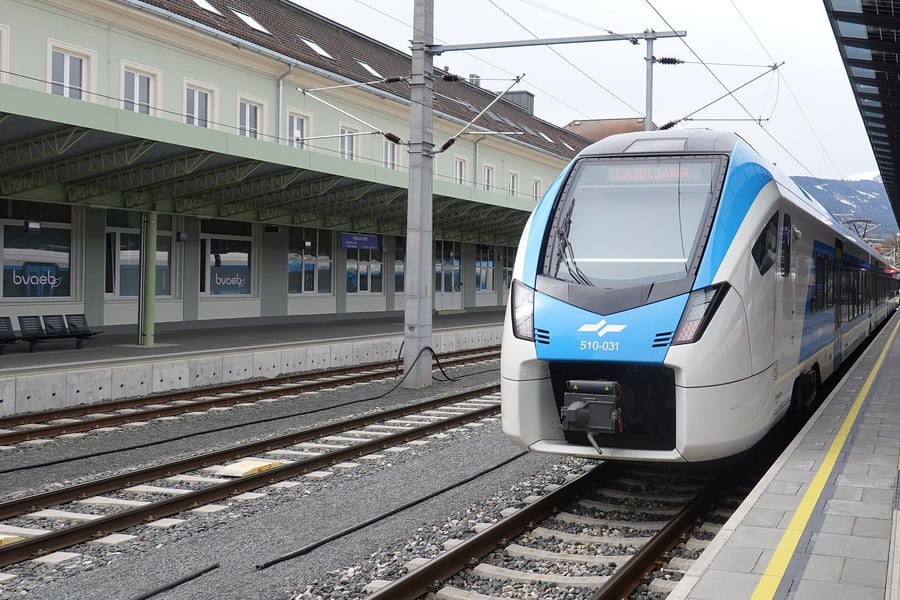
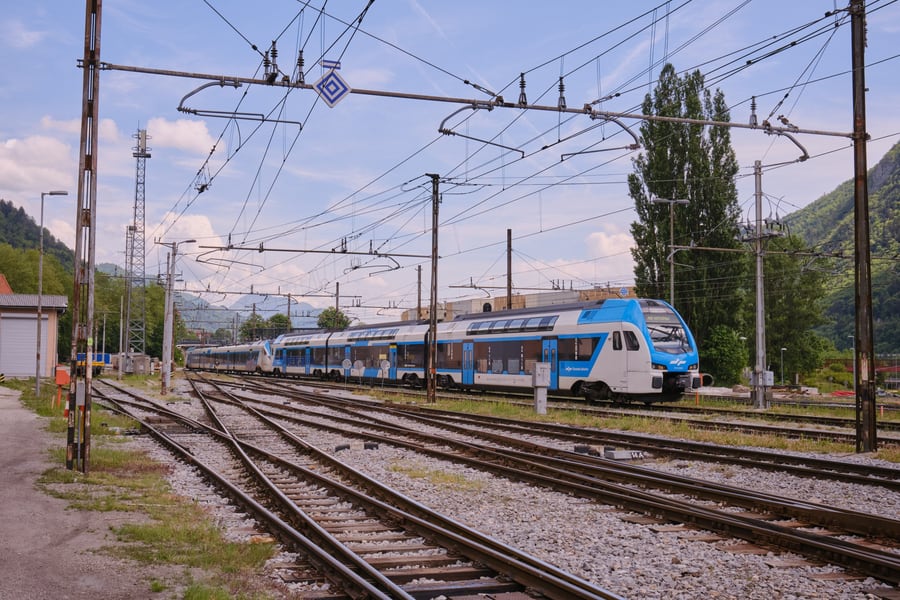
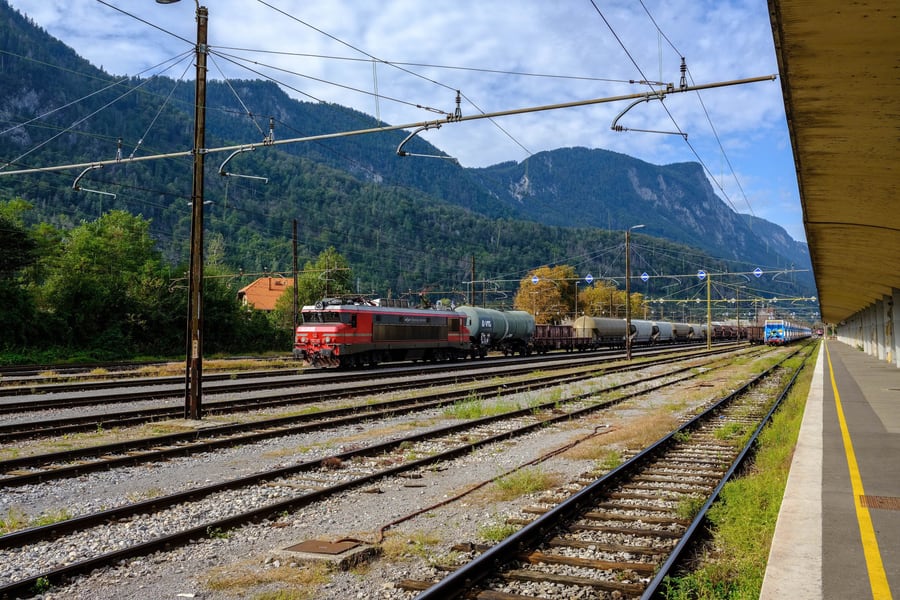
Along the route
 Bvcmz248.5 / Wikimedia Commons · CC0 · cropped
Jesenice, two railways
Here the Bohinj line leaves for Nova Gorica, worked by SŽ's diesel FLIRTs because it has no wires. Austria's 15,000-volt current comes through the tunnel to meet Slovenia's 3,000 volts at Jesenice, and the electric FLIRT 510s run under both.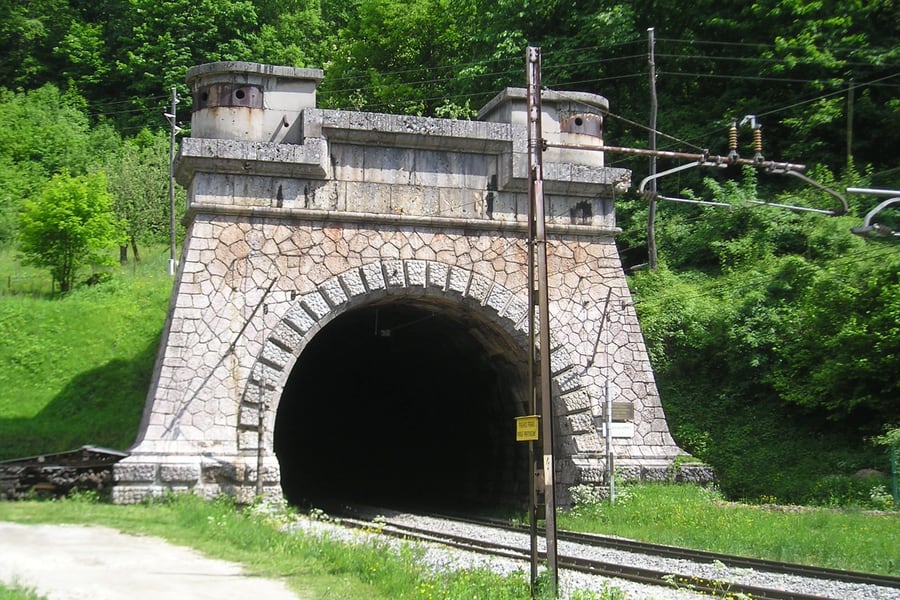 Ajznponar / Wikimedia Commons · CC BY-SA 3.0 · cropped
The Karawanks Tunnel
The south portal stands at Hrušica, just above Jesenice. Inside, the line climbs to 637 metres and crosses the border; ÖBB gives the length as 7,975 metres. The stone portals are listed monuments and were restored in the 2020–21 renovation.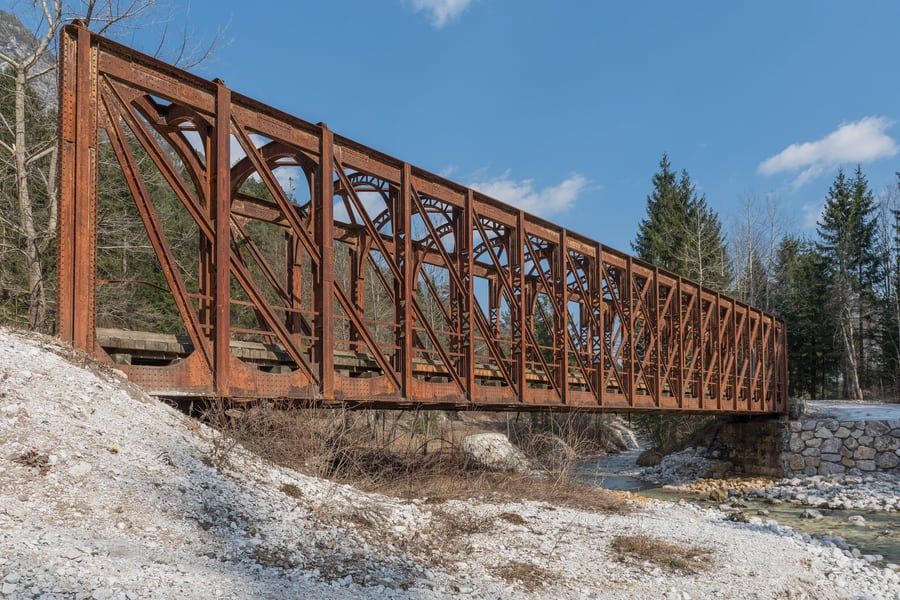 Johann Jaritz / Wikimedia Commons · CC BY-SA 3.0 AT
The line to Tarvisio
From 1870 the Rudolf Railway ran on west from Jesenice, up the Sava Dolinka to Tarvisio in Italy. It closed in the late 1960s. The trackbed is now a cycle path, and its iron bridges still cross the river at Gozd Martuljek.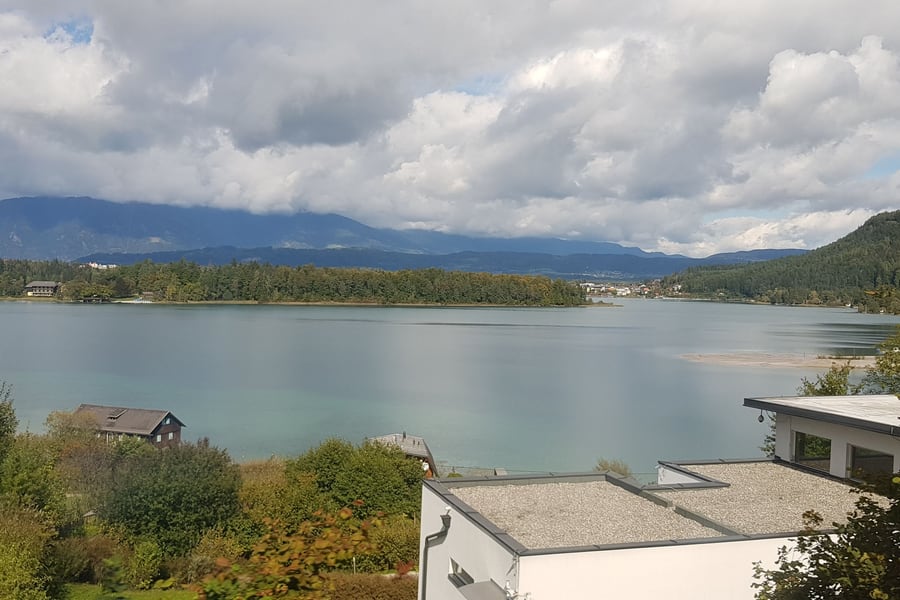 johanwe / Flickr · CC BY 2.0 · cropped
The Faaker See
North of the tunnel the line runs beside the Faaker See, Carinthia's fifth-largest lake, coloured turquoise by fine lime silt from the Worounitza stream. The Mittagskogel rises over its southern shore.A bit of history
Culture & experiences along the way
 Unknown painter, 1848 / Wikimedia Commons · Public domain · cropped
Painted beehive panels
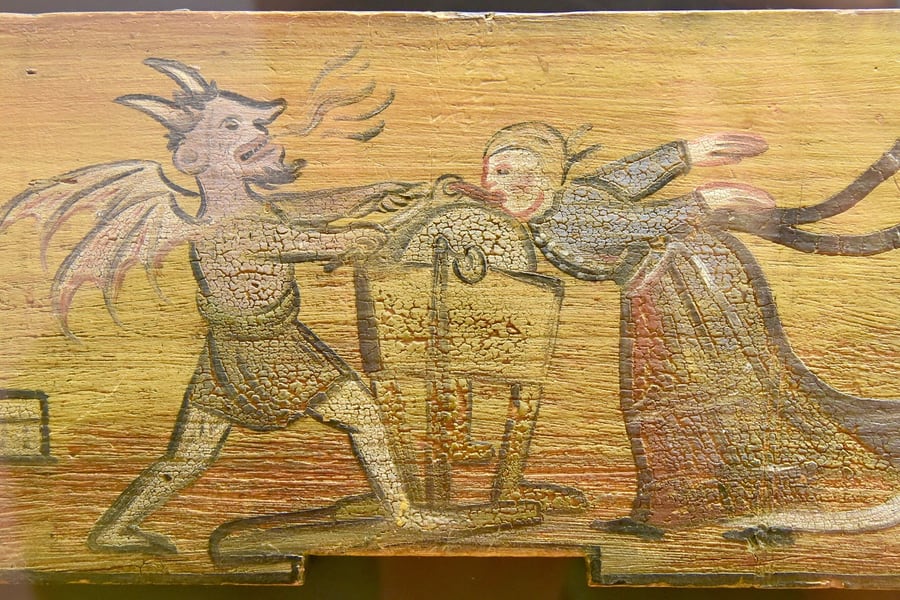
Beekeepers in Upper Carniola painted the front boards of their hives from the mid-18th century, more than 50,000 of them, with over 600 motifs: saints, hunts, and here a devil sharpening a woman's tongue. The Museum of Apiculture in Radovljica, open since 1959, displays them.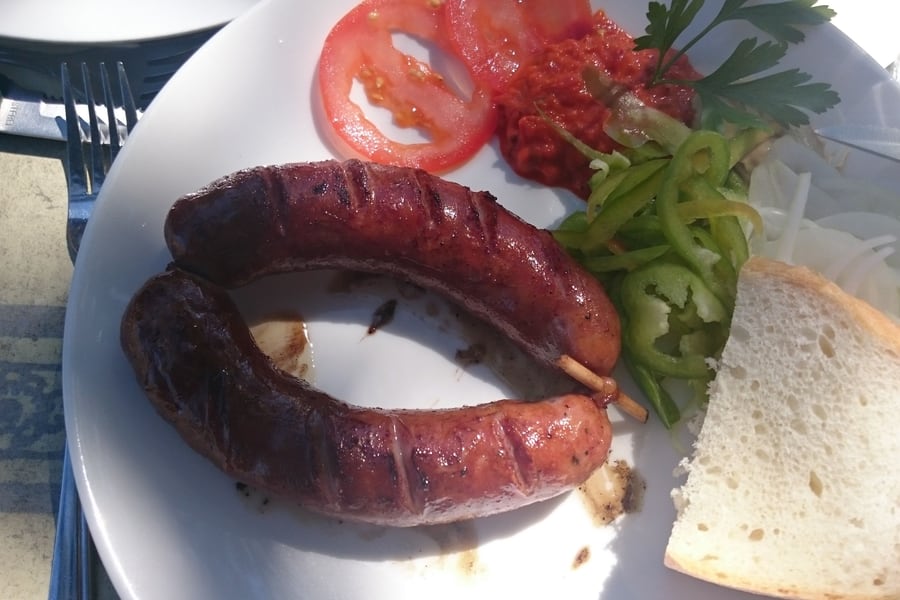 J.O. / Wikimedia Commons · CC BY-SA 4.0 · cropped
Kranjska klobasa
The Carniolan sausage is pork with up to a fifth bacon, sea salt, garlic and pepper, smoked in pairs joined by a wooden skewer. Since 2015 the name has been protected across the European Union. It is eaten hot, with mustard and bread.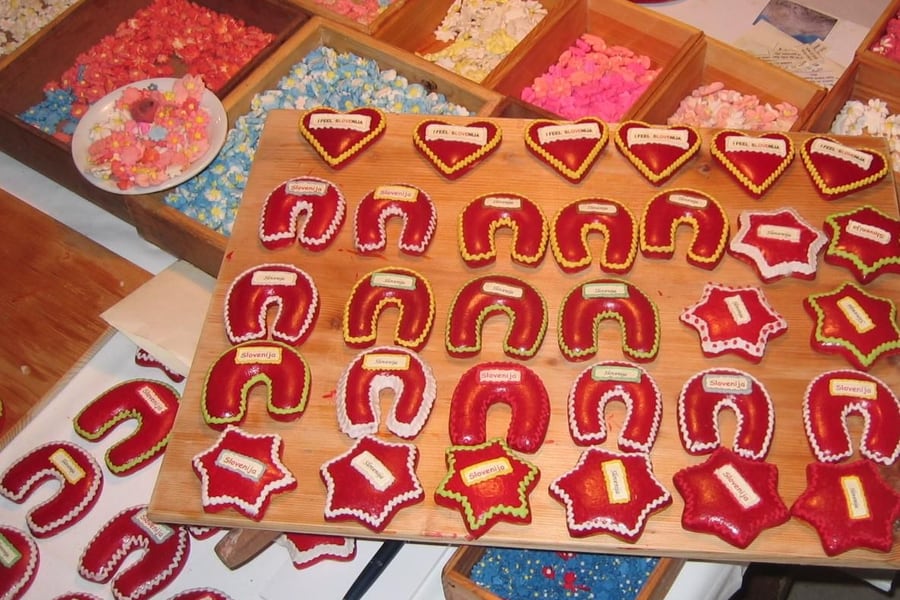 Žiga / Wikimedia Commons · Public domain · cropped
Lect hearts
Lect is honey dough with no eggs, baked into hearts, horseshoes and stars and painted red, meant for giving rather than eating. In Radovljica, Jakob Krivic opened a lect workshop in 1766 in the house that is now the Gostilna Lectar, which still bakes them.Timetables
Eight direct day trains run each way, every day, roughly every two hours, plus a night train on most nights. There is no reservation on the day trains. The trains marked S are Slovenske železnice's FLIRT 510 units; the two EuroCity trains run through from Zagreb and Munich.
Times as of November 2026, from ÖBB's journey planner and Slovenske železnice's Villach timetable and fares (opens in a new tab), in the timetable valid since 14 December 2025. The timetable from 13 December 2026 was only partly published when this page was written; check before travelling from mid-December.
Ljubljana to Villach
| Train | Ljubljana | Kranj | Lesce-Bled | Jesenice | Villach Hbf |
|---|---|---|---|---|---|
| 38 S | 05:42 | 06:06 | 06:33 | 06:47 | 07:22 |
| 318 S | 07:42 | 08:14 | 08:32 | 08:47 | 09:22 |
| 316 S | 09:35 | 10:08 | 10:30 | 10:47 | 11:22 |
| EC 214 | 11:08 | 11:32 | 11:58 | 12:30 | 13:15 |
| 314 S | 13:30 | 14:05 | 14:27 | 14:47 | 15:22 |
| 312 S | 15:32 | 16:13 | 16:32 | 16:47 | 17:22 |
| 310 S | 17:27 | 18:01 | 18:23 | 18:47 | 19:22 |
| 18 S | 19:29 | 20:04 | 20:24 | 20:47 | 21:22 |
| EN 40414 | 22:10 | 22:35 | 22:55 | 23:17 | 23:53 |
Villach to Ljubljana
| Train | Villach Hbf | Jesenice | Lesce-Bled | Kranj | Ljubljana |
|---|---|---|---|---|---|
| EN | 06:06 | 06:54 | 07:06 | 07:27 | 07:49 |
| 311 S | 08:38 | 09:18 | 09:31 | 09:49 | 10:17 |
| 313 S | 10:38 | 11:19 | 11:32 | 11:55 | 12:27 |
| 315 S | 12:38 | 13:18 | 13:29 | 13:49 | 14:14 |
| EC 115 | 14:45 | 15:35 | 15:48 | 16:13 | 16:40 |
| 317 S | 16:38 | 17:18 | 17:29 | 17:47 | 18:09 |
| 319 S | 18:38 | 19:25 | 19:41 | 20:04 | 20:36 |
| 19 S | 20:38 | 21:18 | 21:29 | 21:47 | 22:09 |
| 39 S | 21:38 | 22:18 | 22:30 | 22:55 | 23:18 |
Intermediate times are departures. The 09:35, 13:30 and 17:27 from Ljubljana and the 10:38 and 18:38 from Villach are the stopping trains, calling at Škofja Loka, Radovljica and the smaller stations. The night trains do not run every night, and between Jesenice and Villach no train stops.
Tickets
A second-class single from Ljubljana to Villach Hbf costs €19.80 at Slovenske železnice's ticket offices, and a return €39.60. SŽ and ÖBB also share a limited First Minute fare from €9.90, on sale until the train leaves: children aged 6 to 15 travel free with an adult, but the ticket is valid for two days and cannot be refunded, exchanged or broken on the way.
SŽ recommends buying international tickets in advance at a station ticket office. On board, it sells only full-price tickets as far as the border. Seat reservations on the day trains are optional.
Book your tickets
Ljubljana to Villach Hbf
€19.80 single · €39.60 return
A second-class ticket from Slovenske železnice's station ticket offices.
Book Tickets (opens in a new tab, on potniski.sz.si)via potniski.sz.siFirst Minute single
From €9.90 · limited numbers
A non-refundable SŽ and ÖBB single, valid for two days, with children aged 6 to 15 free.
Book Tickets (opens in a new tab, on potniski.sz.si)via potniski.sz.siRail Passes
An Interrail Global Pass covers these trains, with no reservation needed by day. Interrail's list of railway companies includes Slovenske železnice's international and EuroCity trains and ÖBB's in Austria. A One Country Pass covers only the part of the journey in its own country: the Slovenia pass as far as the border inside the tunnel, the Austria pass from there to Villach. On the EuroNight a reservation is compulsory.
For this journey alone a pass is not worth buying: the full single is €19.80, and First Minute fares start at €9.90. It pays only as one leg of a longer trip, onward from Villach to Salzburg or Vienna.
Pass conditions checked against Interrail's railway-companies page, last updated 21 October 2026. Conditions change with each season, and the pass issuer's page is the one that binds.
Places to Visit
Every stop on the Slovene side is a short ride from Ljubljana, so the line works as a string of day trips as well as a way into Austria. The stopping trains serve Škofja Loka and Radovljica; Kranj and Lesce-Bled have every train. Bled itself, with its lake and island, belongs to the Bohinj railway.
 Jorge Franganillo / Wikimedia Commons · CC BY 2.0
Škofja Loka
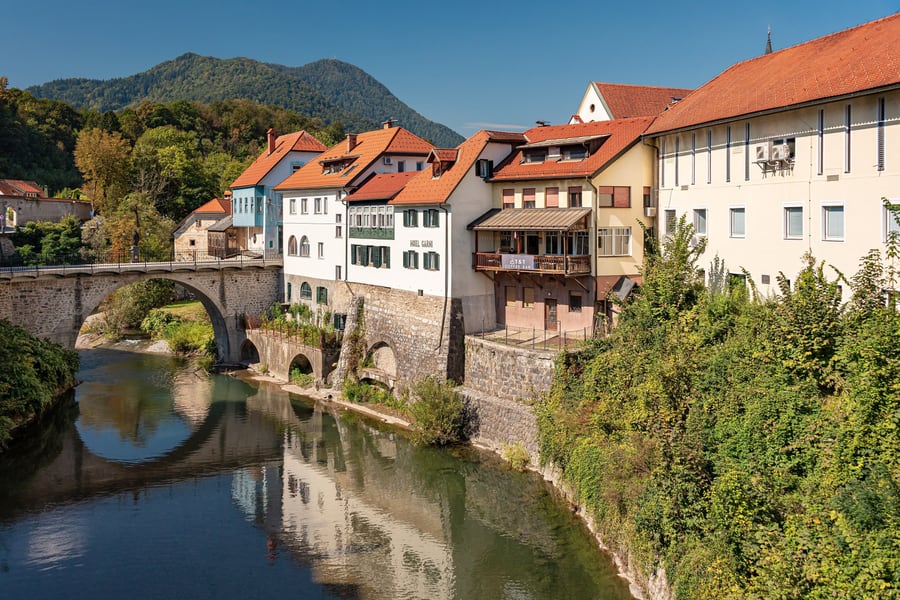
In 973 the emperor gave Loka to the Bishops of Freising, and for the next eight centuries this was their town. It gained town rights in 1274, and its old core of two squares still stands below the castle, which now holds the Loka Museum. The stone Capuchin Bridge crosses the Sora at the edge of the old town.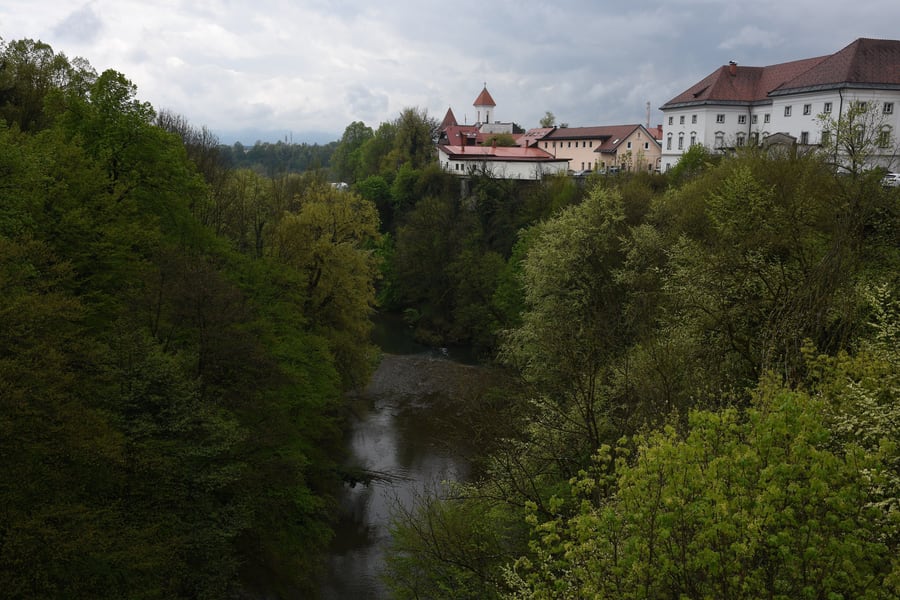 Iswoar / Wikimedia Commons · CC BY-SA 4.0
Kranj
Slovenia's fourth-largest city has its old town on a spur of conglomerate where the Kokra meets the Sava. The Kokra has cut a canyon 40 metres deep beside it, parts of it on a walking trail. The poet France Prešeren spent his last years here and died in Kranj in 1849; his Zdravljica has been the national anthem since 1989.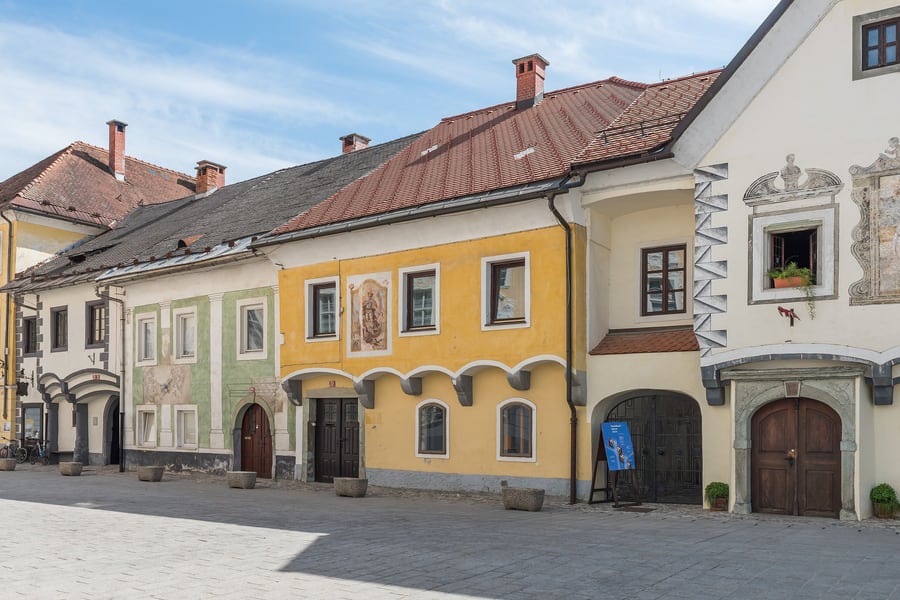 Johann Jaritz / Wikimedia Commons · CC BY-SA 3.0 · cropped
Radovljica
A market town since 1333, at the meeting of the Sava Dolinka and the Sava Bohinjka. Its old centre is Linhart Square, lined with painted houses and named for the playwright Anton Tomaž Linhart, born on it in 1756. A Baroque mansion on the square holds the Museum of Apiculture, devoted to the Carniolan honey bee.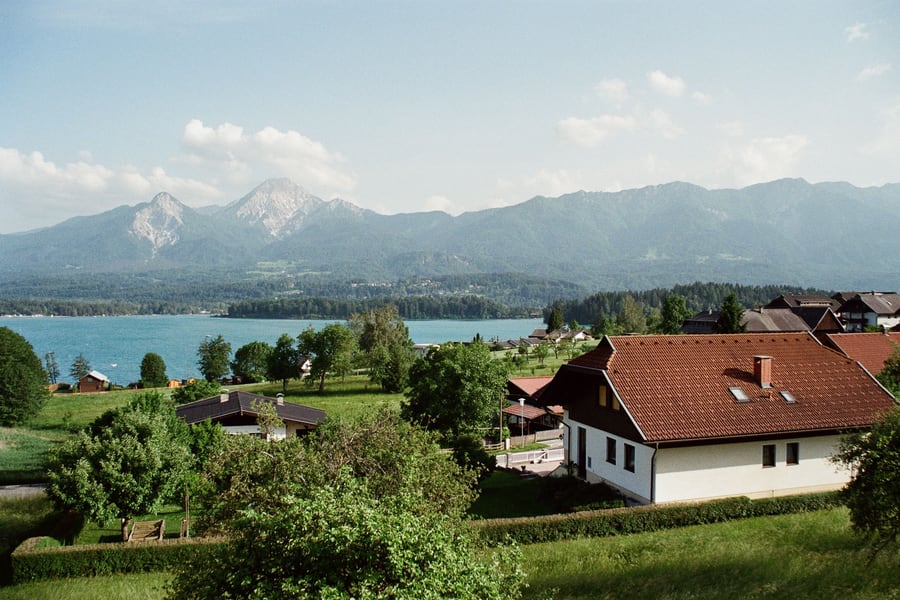 Herbert wie / Wikimedia Commons · CC BY-SA 4.0
The Faaker See
A lake of 220 hectares under the Mittagskogel, with a wooded island in the middle and water coloured turquoise by fine lime silt. Lake and island are privately owned: they came to the Liechtensteins in 1831, who sold them in 1918 to Ludwig Wittgenstein, uncle of the philosopher. Carinthia's S5 runs from Villach to Faak am See.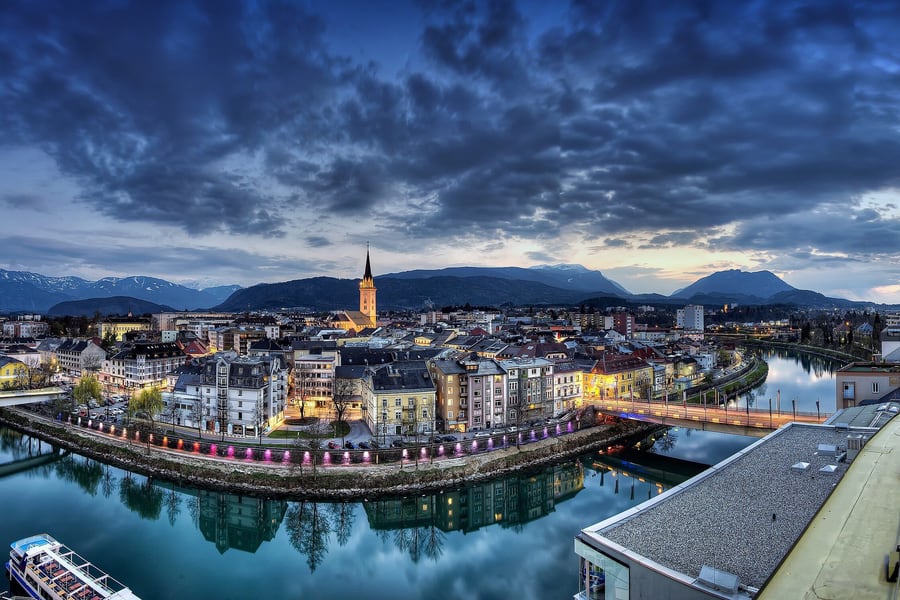 Roland Ster / Wikimedia Commons · CC BY-SA 3.0 · cropped
Villach
Austria's seventh-largest city, home to about 66,000 people, stands where the Gail meets the Drava, a short walk from the station across the river. The long Hauptplatz goes back to the 12th century; at No. 18, a Renaissance arcaded courtyard carries a tradition, which historians doubt, that Paracelsus worked there.Where to Sleep
The whole ride takes under two and a quarter hours, so it is easily done in a day from either end, and the last day trains leave Villach at 21:38 and Ljubljana at 19:29. To spend a night in Carinthia, stay in Villach, a short walk from the station to the old town across the Drava.
Where to stay
Hotel City Villach
A few minutes' walk from Villach Hbf
A hotel in the centre of Villach, a few minutes on foot from the station, with its own sauna.
Check Availability (opens in a new tab, on hotelcity.at)via hotelcity.atQuestions or corrections
Planning this trip and stuck on something, or spotted a time, fare or detail that has changed? Send us a message about Ljubljana to Villach. We read every one, and we update this page when something has changed.