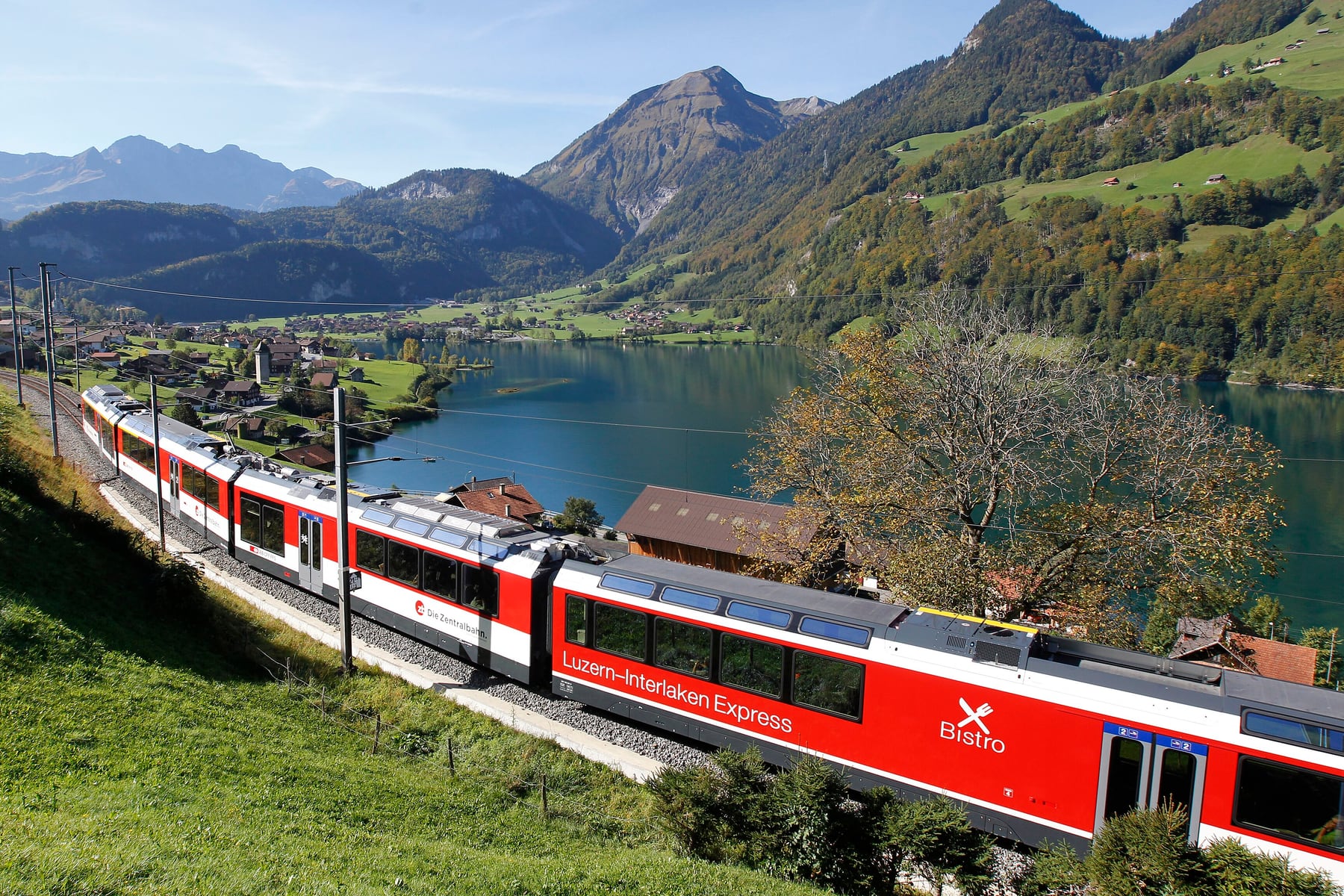
Luzern – Interlaken Express
Zentralbahn / Wikimedia Commons · Public domain
- Distance74 km
- Duration1 h 48 westbound · 1 h 51 back
- Best seasonAll year; hourly every day, with two extra trains each way from May to November
Introduction
For a hundred and two years the Swiss Federal Railways ran one line that broke every rule of the Swiss Federal Railways. The federal network is standard gauge; the Brünig line is built a metre apart. The federal network climbs by adhesion; the Brünig line drops a cogwheel into a ladder of steel teeth and hauls itself over a pass at a hundred and twenty-eight parts in a thousand. From 1 May 1903, when the Jura–Simplon Railway was nationalised, until 31 December 2004, this was the only narrow-gauge line and the only rack railway SBB owned — and it kept its own locomotives, its own carriages and its own workshops, because nothing else on the federal system would fit on it.
The exception has now been given a room of its own. On 30 June 2004 the Federal Council authorised SBB to hand the Brünig line to the little Lucerne–Stans–Engelberg Railway; the enlarged company renamed itself Zentralbahn on 1 January 2005 and issued shares in return, which is why SBB still holds two thirds of it. The oddity survived the tidying-up intact: same gauge, same rack, same three climbing sections, worked now by a company that describes itself as SBB's leisure railway.
What a passenger gets is seventy-four kilometres from Lucerne to Interlaken Ost in one hour and forty-eight minutes, hourly, every day of the year, on an ordinary ticket. The train is called the Luzern–Interlaken Express, it carries a bistro car in the middle and panorama windows down both sides, and it charges no supplement at all. Between the two lakes it climbs to 1,001 metres at Brünig-Hasliberg, reverses at Meiringen, and runs the last half-hour along the turquoise edge of Lake Brienz.
The Journey
The train leaves Lucerne from platform 13, on the metre-gauge side of a station whose other platforms are standard gauge, and is underground within a minute. The Allmend tunnel, 1,325 metres, opened on 12 November 2012 and replaced a slower surface approach with four level crossings on it; a new station, Luzern Allmend/Messe, was built inside the tunnel and opened a month later. Out in daylight the line runs down the west shore of Lake Lucerne to Hergiswil, where the Engelberg branch turns off, and then through the Lopper I tunnel under a shoulder of Mount Pilatus to Alpnachstad. At 435 metres that is the lowest point on the whole Zentralbahn network, and it is where the Pilatus rack railway begins — a different gauge, with no track connection between them.
The express does not stop before Sarnen, eighteen minutes out. Then Sachseln, then Giswil, and at Giswil the character of the journey changes. This is where the commuter trains stop: the Lucerne S-Bahn turns back here, because beyond it the line needs cogs, and only stock fitted for both can go on.
Three rack sections and a pass
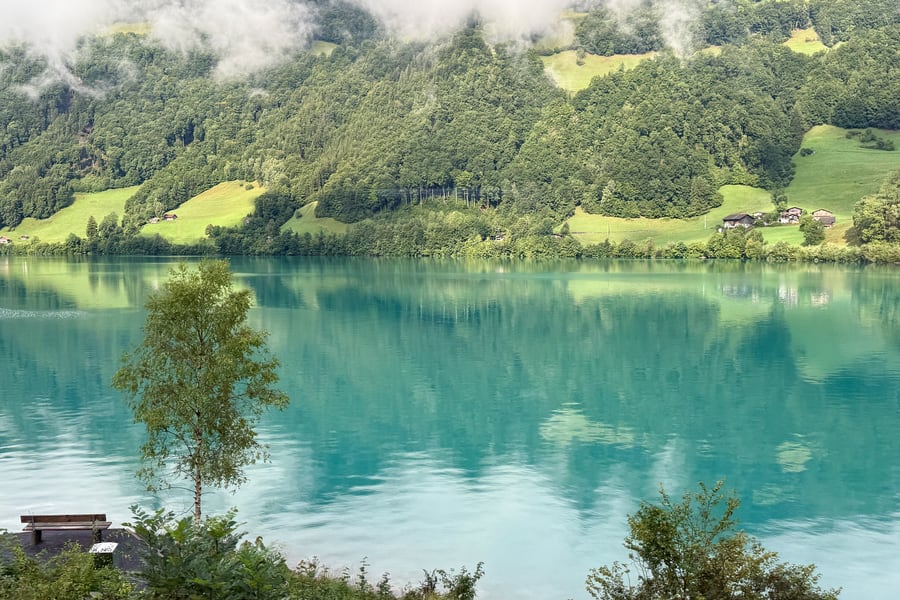
There are three of them. The first lifts the line out of Giswil to Kaiserstuhl; the second carries it from Lungern, on its own turquoise lake at 712 metres, up to the summit; the third takes it down the far side. All three use the Riggenbach system — a ladder of steel rungs bolted between the rails, into which the train's pinions drop. The valley stretches in between are built to main-line standard and worked at up to 100 km/h.
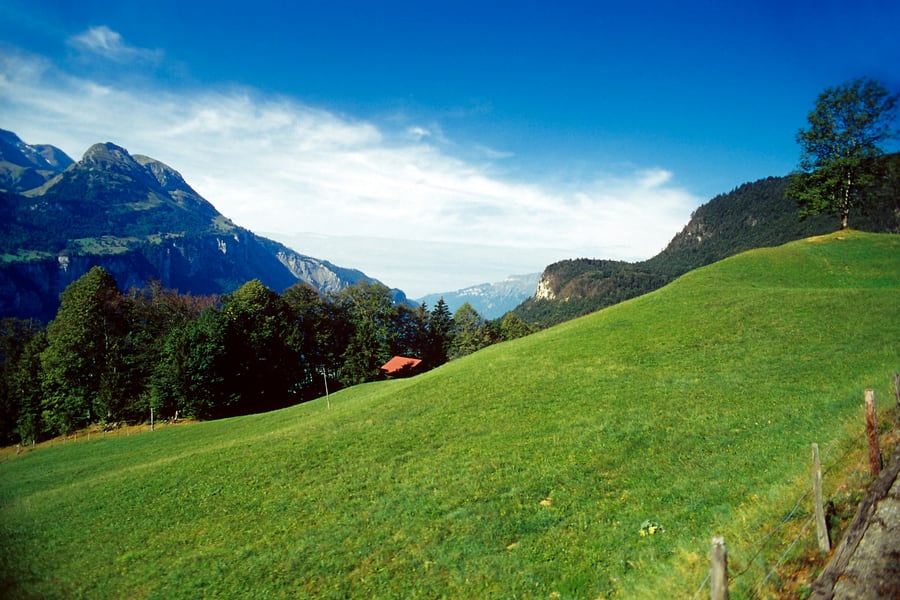
Brünig-Hasliberg is the top. The tracks cross the pass in a cutting at 1,001 metres and the station stands a metre higher, in the canton of Bern and in the municipality of Meiringen, though the village of Meiringen is five kilometres away and four hundred metres below. The road pass is at 1,008 metres, just above the platforms, and a PostBus route to Hasliberg meets the trains there.
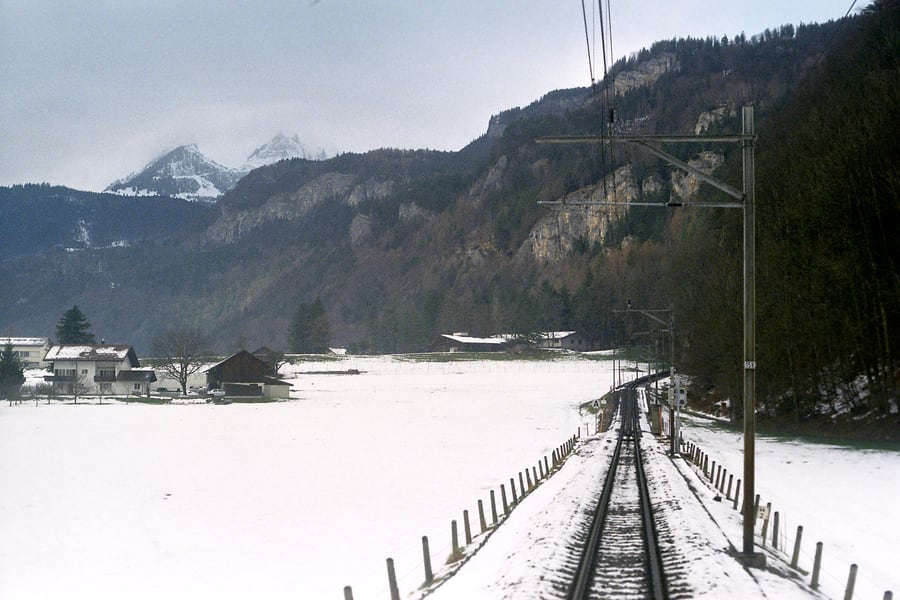
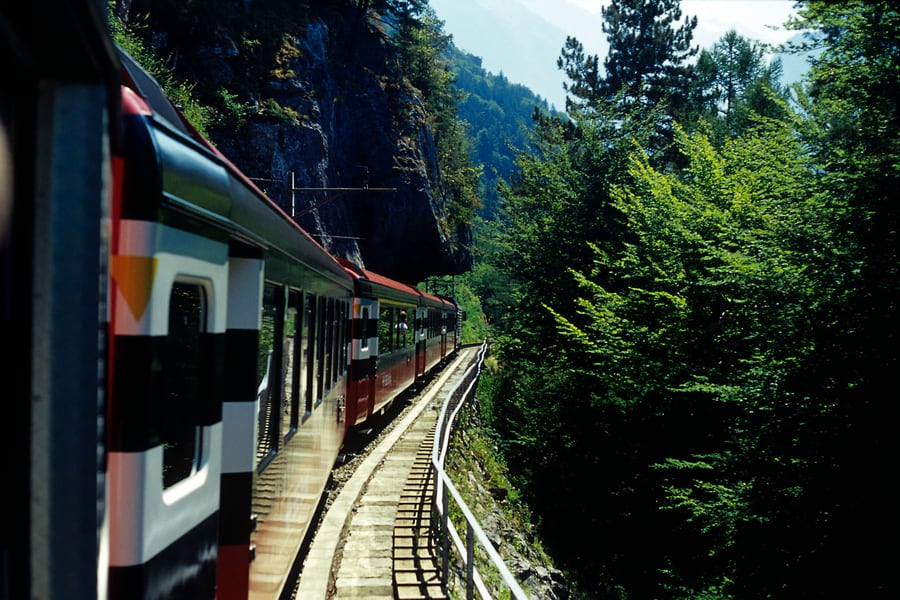
The south side is the steep one. It falls to Meiringen as a single unbroken rack section at 128 parts in a thousand — since the old Engelberg ramp was abandoned in 2010, the steepest stretch of metre-gauge railway anywhere on the Zentralbahn or its Bernese Oberland neighbour. Riggenbach ladder rack cannot be bent to fit, so the whole descent is laid to one curve radius and one only: 120 metres. The line passes under a rock overhang, drops through the forest, and comes out on the flat of the Haslital where the rack simply ends and the wheels take over again.
The reversal, and the lake
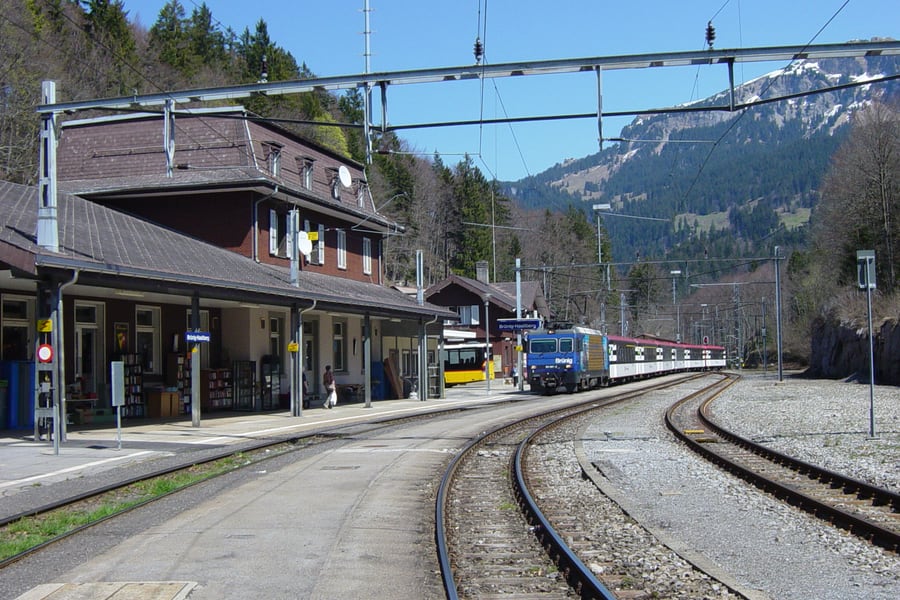
At Meiringen the train stops for six minutes and then leaves the way it came in. The station is a dead end for the Brünig line — trains enter and leave from the west — so whichever side of the carriage was the good one for the climb becomes the other one for the rest of the journey. The Meiringen–Innertkirchen line uses the east end of the same station, and although the rails are joined the two electrical systems are not, so no train runs through.
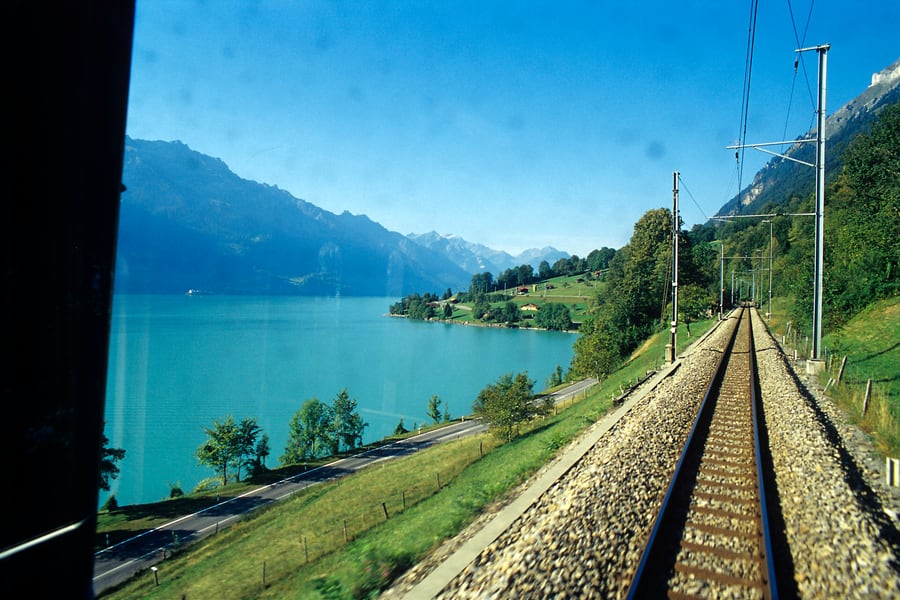
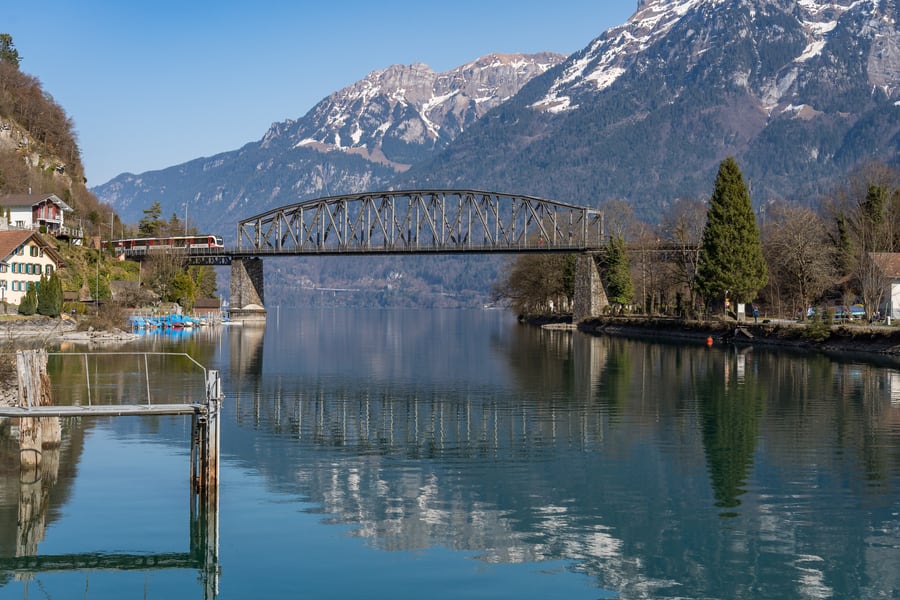
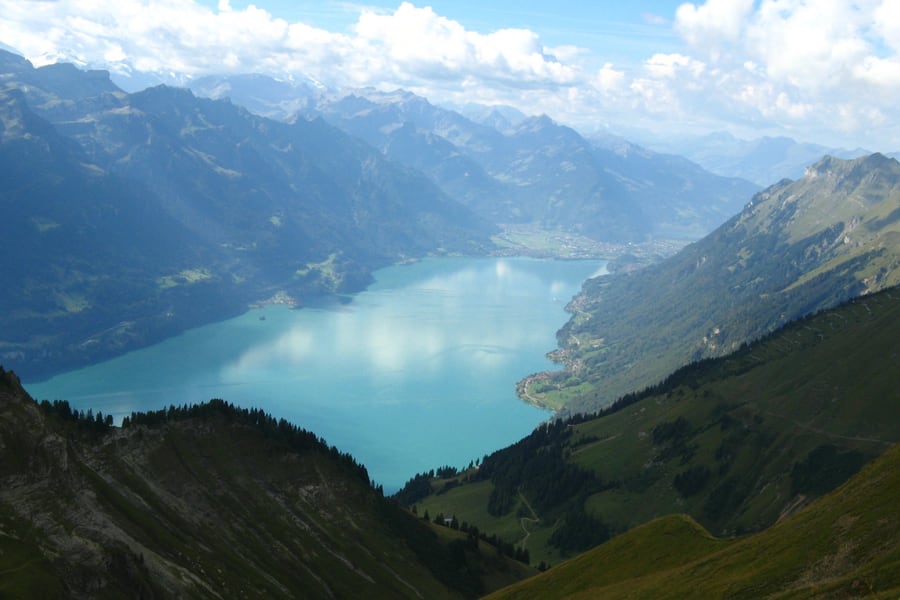
From Brienz the last half-hour is spent on the north shore of Lake Brienz, close enough to the water to see the bottom of it. This is the part of the line the mountain takes an interest in: on 12 August 2024 a debris flow out of the Milibach buried about a kilometre of track at Brienz West and the trains did not run again until 25 November. At Oberried the railway crosses the Hirscherengraben on a steel truss bridge built for the avalanche that comes down it, which has carried away the wooden road bridge underneath more than once. The journey ends over the Aare on a bridge held high enough for the Lake Brienz steamers to pass beneath it, and then down into Interlaken Ost.
What the cog has to put up with
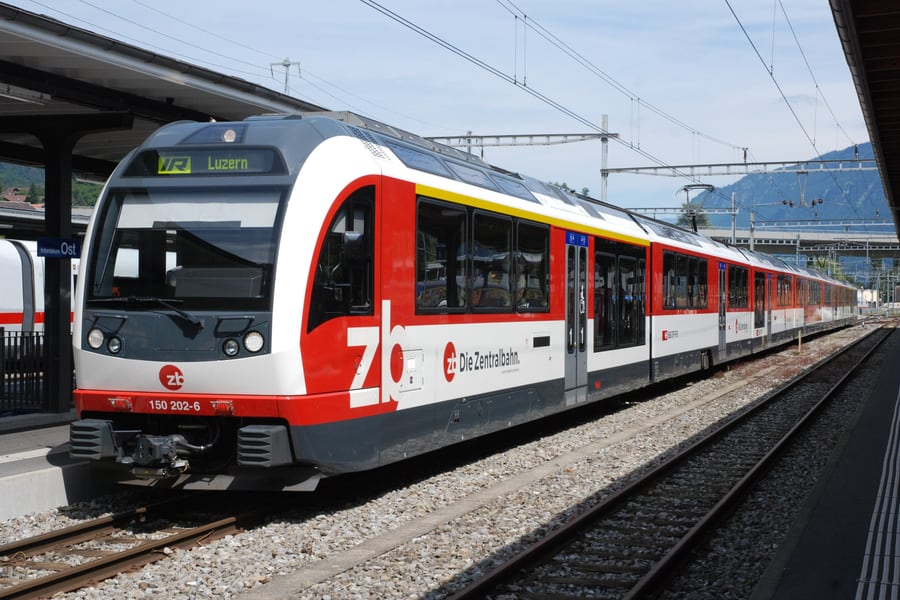
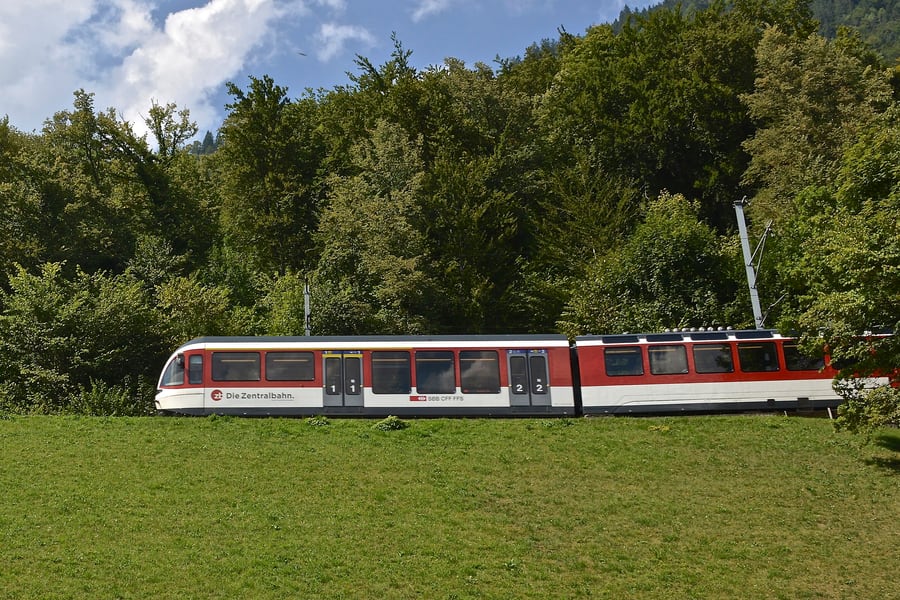
The trains are Stadler's ADLER — four seven-car sets, 126 metres long, 313 seats, ordered in 2009 and in service from 2012. Each is two three-car half-trains with an unpowered bistro car between them. The adhesion and rack drives are mechanically separate, so neither can slip against the other, and the end bogies keep pulling on the rack sections, where they supply about a third of the effort.
The neat part is underneath. A driving wheel wears down; a cogwheel has to stay exactly as deep in the rack as it was on the first day. So the pinions do not sit on the axle at all — they sit on a hollow shaft joined to it by eccentric discs, and turning those discs lowers the cog in seven steps of five millimetres to follow the tyre down. It buys 35 millimetres of wheel wear where an ordinary arrangement allows 12.
Along the route
 Falk2 / Wikimedia Commons · CC BY-SA 4.0 · cropped
One rack, one radius
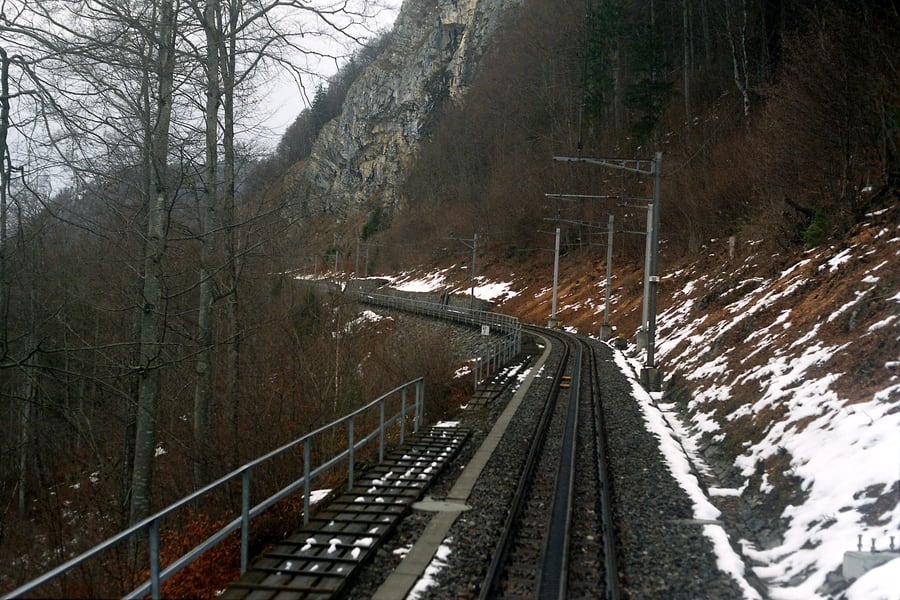
The Riggenbach rack is a ladder, and a ladder does not bend to order. The south ramp down to Meiringen is a single unbroken rack section at 128 parts in a thousand, and because of that rigidity the whole of it is laid to one curve radius only: 120 metres.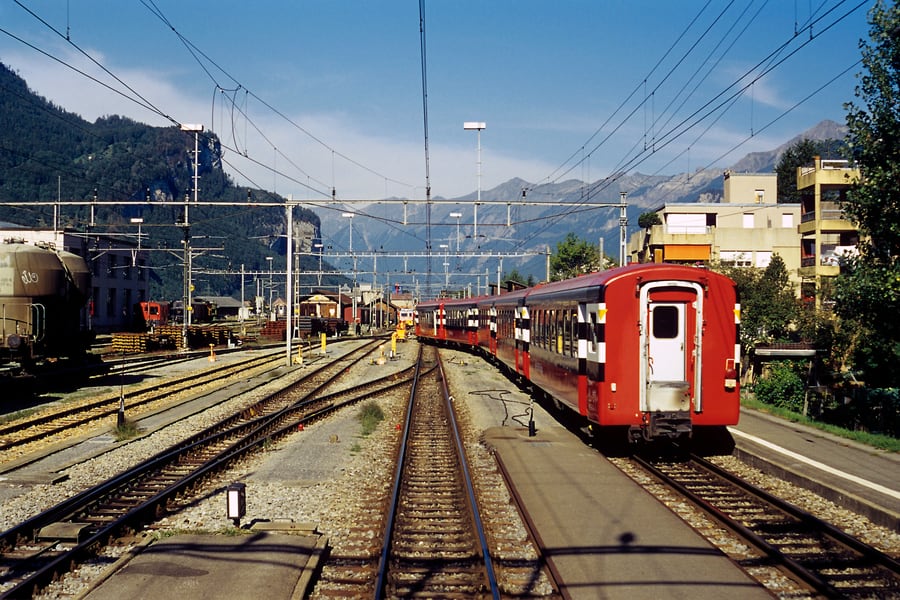 Falk2 / Wikimedia Commons · CC BY-SA 4.0 · cropped
The station where the train goes back out the way it came in
Meiringen is a dead end for the Brünig line. Trains from Lucerne arrive from the west and leave for Interlaken from the west, which is what the six-minute stand in the timetable is for. The station also keeps a hand-operated turntable.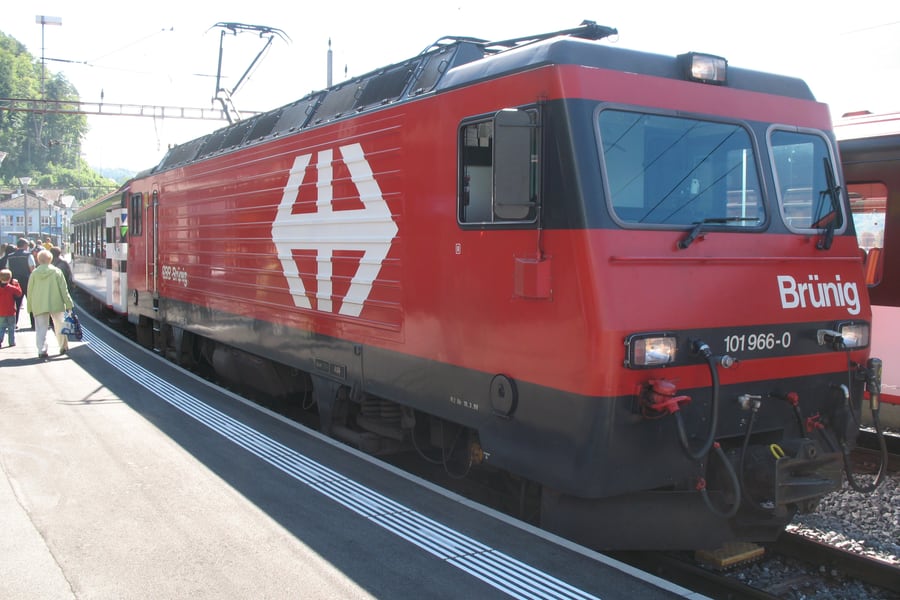 Andrew Bossi / Wikimedia Commons · CC BY-SA 2.5 · cropped
The federal railway's one exception
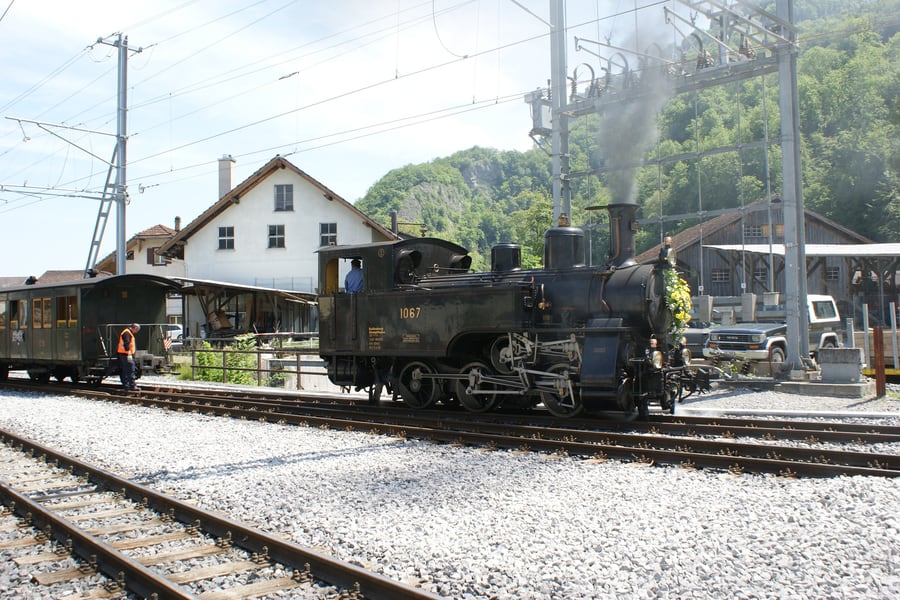
For a hundred and two years the Brünig was the only narrow-gauge line SBB owned and the only rack railway it owned, and it needed a fleet nothing else on the network shared. The class still works relief trains over the pass; the paint is Zentralbahn's now.A bit of history
Culture & experiences along the way
 Falk2 / Wikimedia Commons · CC BY-SA 4.0 · cropped
The Aare Gorge
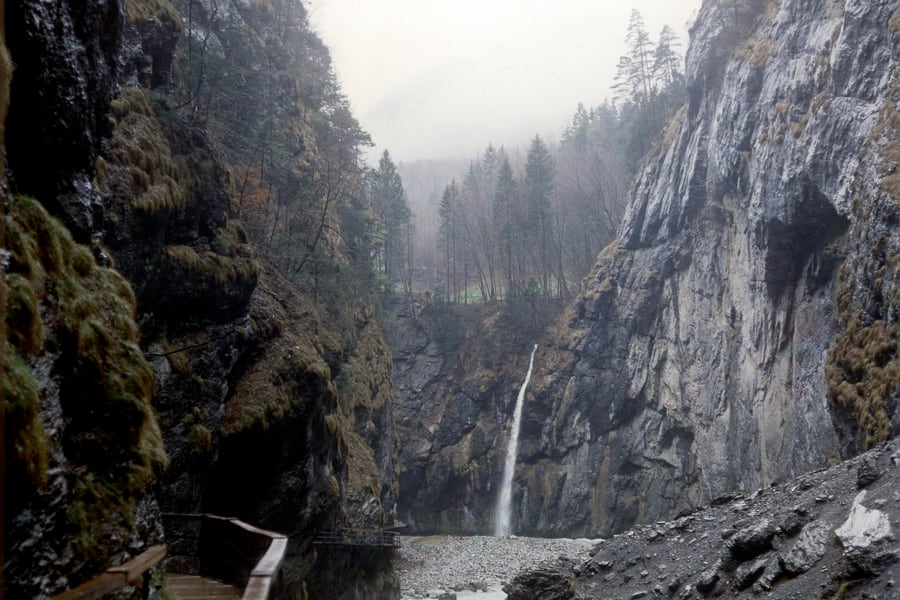
Fourteen hundred metres of slot the river has cut through the Kirchet behind Meiringen, up to two hundred deep, walked in about forty-five minutes on footbridges and through tunnels.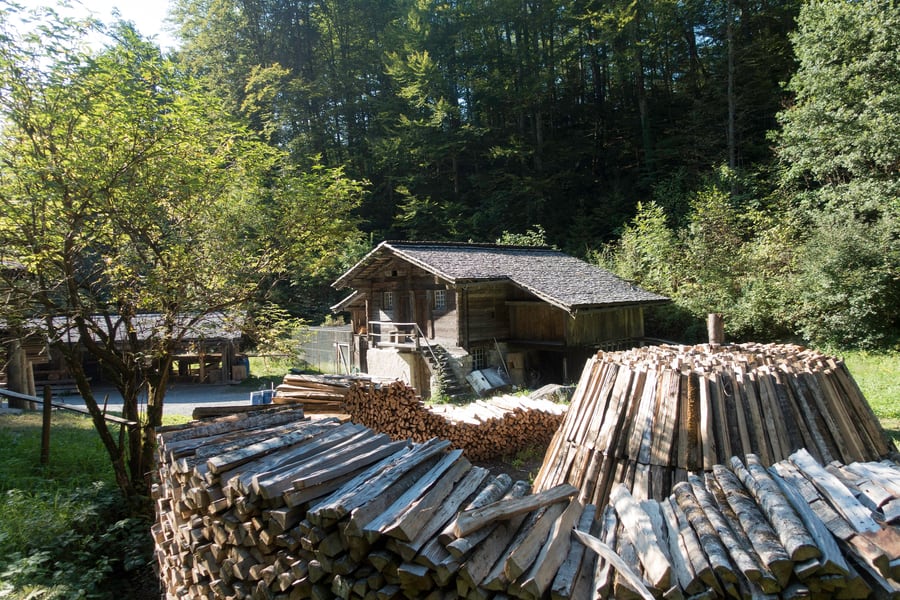 Foto-Max 1234 / Wikimedia Commons · CC BY-SA 4.0 · cropped
Ballenberg
An open-air museum above Brienz with more than a hundred historic buildings from every part of Switzerland rebuilt on the hillside, and over two hundred farm animals. April to November.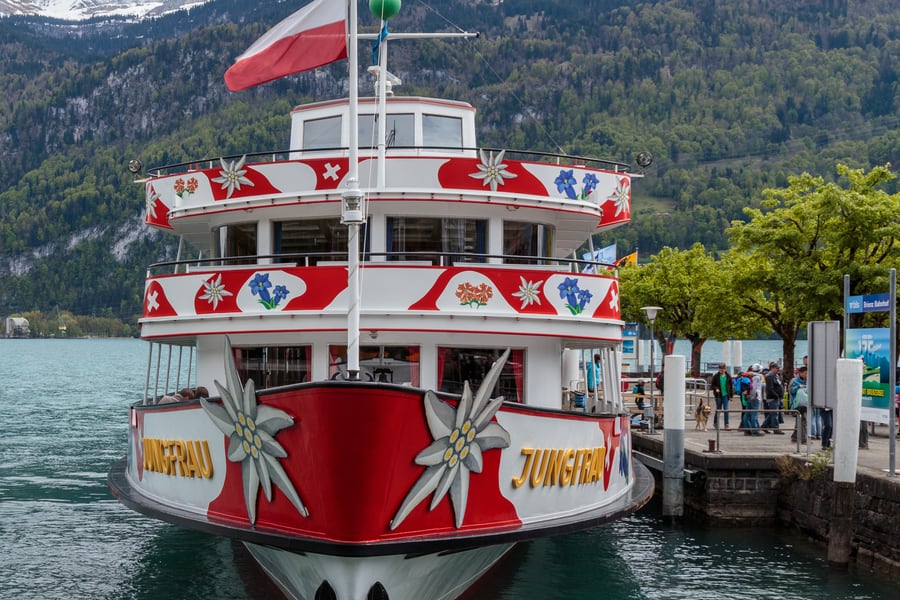 JoachimKohler-HB / Wikimedia Commons · CC BY-SA 4.0 · cropped
The boats on Lake Brienz
BLS runs its lake fleet from the pier beside Brienz station, calling at Giessbach and Iseltwald on the way to Interlaken — the same water the train runs along.Timetables
The Luzern–Interlaken Express runs every hour, all day, every day of the year, at six minutes past from Lucerne and four minutes past from Interlaken Ost. There is no seasonal timetable to check and no summer-only service: the clock-face pattern is the same in February as it is in August. The run takes 1 hour 48 minutes westbound and 1 hour 51 minutes back.
Times below were read from the Swiss timetable in August 2026, for the timetable year that runs to 12 December 2026. The operator sets out the service at zentralbahn.ch (opens in a new tab) and sends the live timetable itself to SBB.
Lucerne to Interlaken Ost
| Lucerne | Interlaken Ost | Lucerne | Interlaken Ost | |
|---|---|---|---|---|
| 06:06 | 07:54 | 14:06 | 15:54 | |
| 07:06 | 08:54 | 15:06 | 16:54 | |
| 08:06 | 09:54 | 16:06 | 17:54 | |
| 09:06 | 10:54 | 17:06 | 18:54 | |
| 10:06 | 11:54 | 18:06 | 19:54 | |
| 11:06 | 12:54 | 19:06 | 20:54 | |
| 12:06 | 13:54 | 20:06 | 21:54 * | |
| 13:06 | 14:54 | 21:06 | 22:55 |
* The 20:06 is the one departure that does not go the whole way as an express: it terminates at Meiringen, and the last stretch is covered by the R70 local at 21:21, arriving 21:54.
Interlaken Ost to Lucerne
| Interlaken Ost | Lucerne | Interlaken Ost | Lucerne | |
|---|---|---|---|---|
| 07:04 | 08:55 | 14:04 | 15:55 | |
| 08:04 | 09:55 | 15:04 | 16:55 | |
| 09:04 | 10:55 | 16:04 | 17:55 | |
| 10:04 | 11:55 | 17:04 | 18:55 | |
| 11:04 | 12:55 | 18:04 | 19:55 | |
| 12:04 | 13:55 | 19:04 | 20:55 | |
| 13:04 | 14:55 | 20:04 | 21:55 |
After the 20:04 there is one more through train, the 21:04, which runs the full route as an R70 local and reaches Lucerne at 22:55.
Where it calls
The express skips the suburban stops at the Lucerne end and calls at every station on the mountain, because between Giswil and Meiringen it is the only train there is. A representative working, the 10:06 from Lucerne:
| dep | arr | |||
|---|---|---|---|---|
| Lucerne | 10:06 | Brünig-Hasliberg | 11:03 | |
| Sarnen | 10:24 | Meiringen | 11:16 (dep 11:22) | |
| Sachseln | 10:28 | Brienz | 11:33 (dep 11:37) | |
| Giswil | 10:37 | Interlaken Ost | 11:54 | |
| Kaiserstuhl OW | 10:44 | |||
| Lungern | 10:51 |
The six minutes at Meiringen are the reversal. Coming the other way the 10:04 from Interlaken Ost calls at Brienz 10:21, Meiringen 10:35 (departing 10:41), Brünig-Hasliberg 10:50, Lungern 11:03, Kaiserstuhl 11:09, Giswil 11:18, Sachseln 11:28 and Sarnen 11:32, reaching Lucerne at 11:55.
The extra summer trains
Between 2 May and 1 November 2026 the operator adds two relief workings a day in each direction, branded «S-LIX» and shown in the timetable as InterRegio rather than Panorama Express. They leave Lucerne at 09:24 and 10:24 (Interlaken Ost 11:17 and 12:17) and Interlaken Ost at 15:10 and 16:10 (Lucerne 17:04 and 18:04). They take five minutes longer, they stop additionally at Alpnach Dorf, Kaiserstuhl OW and Lungern, they usually have no air conditioning, and no seat reservation is sold on them. What they do have is the cheapest fare on the line — saver tickets on these trains run to 70 per cent off, against 50 per cent on the ordinary ones. The same season also brings one extra Meiringen–Interlaken Ost working each way, at 15:10 southbound and 11:40 northbound.
Connections at each end
Lucerne is a terminus on the standard-gauge network as well, with fast trains to Zurich, Basel and Olten and the IR26 Treno Gottardo over the Gotthard mountain line towards Locarno. The metre-gauge platforms are in the same station. Interlaken Ost is shared with BLS, whose IC61 runs to Bern and on to Basel, and with the Berner Oberland Bahn for Lauterbrunnen, Grindelwald and the Jungfraujoch — the BOB is also metre gauge and the rails are joined, but the electrical systems are not, so nothing runs through. The GoldenPass Express for Zweisimmen and Montreux starts from the same platforms.
Tickets
There is no special ticket for this train, and that is the operator's own answer to its most common question: a normal ticket for the whole route, or for the piece of it you want, is all it takes. There is no supplement, no compulsory reservation and no premium fare — where the Glacier Express asks CHF 54 to sit down and the Bernina Express CHF 32 to 44, this one asks nothing. Lucerne to Interlaken Ost is CHF 34.00 second class, valid until 05:00 the next morning, so breaking the journey at Lungern or Brienz costs nothing.
Zentralbahn also sells supersaver tickets on its own lines, up to 50 per cent off outside the peaks; its worked example is CHF 10.20 instead of CHF 34.00. They are quantity-limited and do run out. A reservation is optional at CHF 16 in summer and CHF 12 in winter, and worth thinking about in July. The operator's advice on where to sit is unambiguous: the right-hand side in the direction of travel, from either end.
Book your tickets
Lucerne – Interlaken Ost, 2nd class
CHF 34.00 full fare · CHF 17.00 with a Half Fare Travelcard
An ordinary point-to-point ticket, valid until 05:00 the next morning, with no supplement of any kind.
Book Tickets (opens in a new tab, on sbb.ch)via sbb.chLucerne – Interlaken Ost, 1st class
CHF 58.00 full fare · CHF 29.00 with a Half Fare Travelcard
The first-class saloons are at the two ends of the train, furthest from the bistro car in the middle.
Book Tickets (opens in a new tab, on sbb.ch)via sbb.chSeat reservation
CHF 16 in summer · CHF 12 in winter
Optional in either class, and worth considering in July. None is sold on the seasonal relief trains.
Book Tickets (opens in a new tab, on zentralbahn.ch)via zentralbahn.chRail Passes
This is the Swiss mountain crossing where the passes actually work. Nothing on the Brünig line is excluded, discounted-only or capped, and no supplement is charged on top, so a pass holder simply boards.
Swiss Travel Pass and GA
The operator's own FAQ puts it in one line: the route is fully included in the Swiss Travel Pass and the GA Travelcard. That is unusual enough on a Swiss rack railway to be worth saying plainly — the Gornergrat, the Pilatus, the Jungfraujoch and the Schilthorn all give a Swiss Travel Pass holder a discount and no more, and the pass is free outright on only three mountains in the country. Here there is no mountain surcharge to escape: the rack is inside an ordinary InterRegio service, and the ordinary rules apply to it. A Half Fare Travelcard or Swiss Half Fare Card halves the fare in the normal way, to CHF 17.00 second class.
Interrail and Eurail
Valid, in full. This one repays checking rather than assuming, because the two Interrail sources disagree in appearance. The railway-companies table on the website lists ZB (Zentralbahn) with "Regional (R)" as its included train type, and names four Panorama Express services separately — the Bernina, the Glacier, the GoldenPass and the Gotthard — without mentioning this one, which runs under the same PE code. Read literally, that would leave the Luzern–Interlaken Express outside the pass.
The detailed Swiss validity list the table links to settles it. Under Free ride in SWITZERLAND, it names the line rather than the company: "ZB Zentralbahn: Luzern–Interlaken Ost / Stans–Engelberg." Both sections, no exclusions, no bonus-rate footnote. Since reservation on this train is optional anyway, a pass holder pays nothing to travel and CHF 12 or CHF 16 only if they want a guaranteed seat. Checked against the 2026 edition of the map in August 2026.
Regional passes
Two regional cards cover the route between them, and either is worth the arithmetic if the Brünig is part of a longer stay rather than a single crossing.
- The Lucerne Travel Pass covers train, bus and boat in the Lucerne–Lake Lucerne region for 2 to 10 days, with many of the mountain railways included.
- The Berner Oberland Pass covers train, bus, boat and mountain railway across the Bernese Oberland — and its area explicitly reaches from Lucerne, so it takes in the whole of this journey. Second class, valid to 31 December 2026: 3 days CHF 240 · 4 days 280 · 6 days 350 · 8 days 395 · 10 days 435, and holders of a Swiss Travel Pass, Half Fare Travelcard or GA pay 168 / 196 / 254 / 287 for the first four of those.
For a single one-way crossing at CHF 34, none of the passes pays for itself. That is the honest answer: buy the ticket. The passes earn their keep the moment the Rothorn, the Pilatus, the boats or the Jungfrau region come into the plan as well.
Places to Visit
Seven stops, and the ticket is valid to 05:00 the next morning on the route it was bought for, so any of them can be an hour's break rather than a glimpse from the window. They run from a city on one lake to a resort between two others, by way of a cantonal capital, a lake that has been drained and dammed in turn, a pass that holds a wrestling festival once a year, and the town where Sherlock Holmes was killed off.
 Ikiwaner / Wikimedia Commons · CC BY-SA 3.0 · cropped
Lucerne
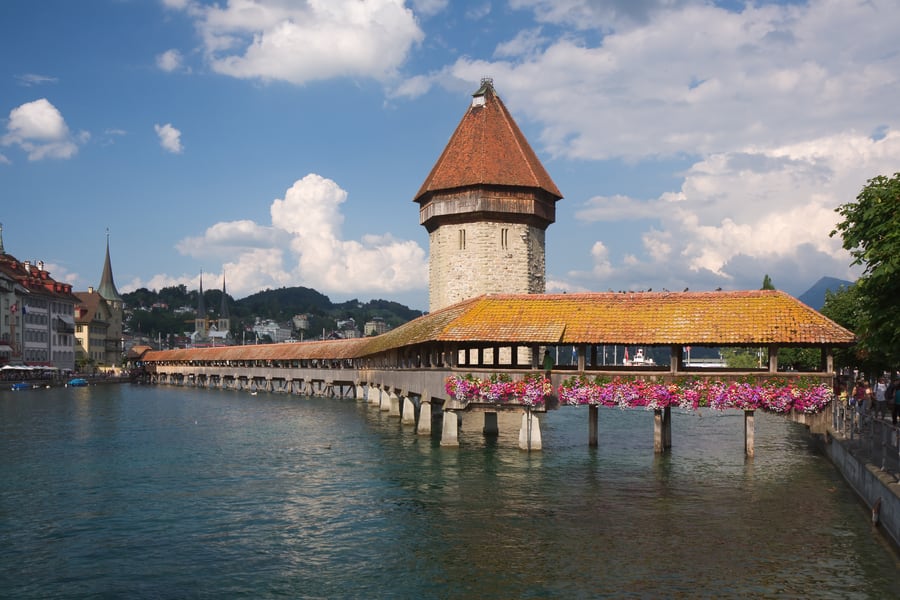
A city wrapped around the end of its own lake, with the fourteenth-century Kapellbrücke running diagonally across the Reuss and the octagonal Wasserturm standing in the water beside it. The metre-gauge platforms for the Brünig are inside the main station, alongside the standard-gauge ones. The Swiss Museum of Transport is a few minutes along the shore — 20,000 square metres of road, rail, air and water, with a planetarium and a walkable aerial map of the country in it.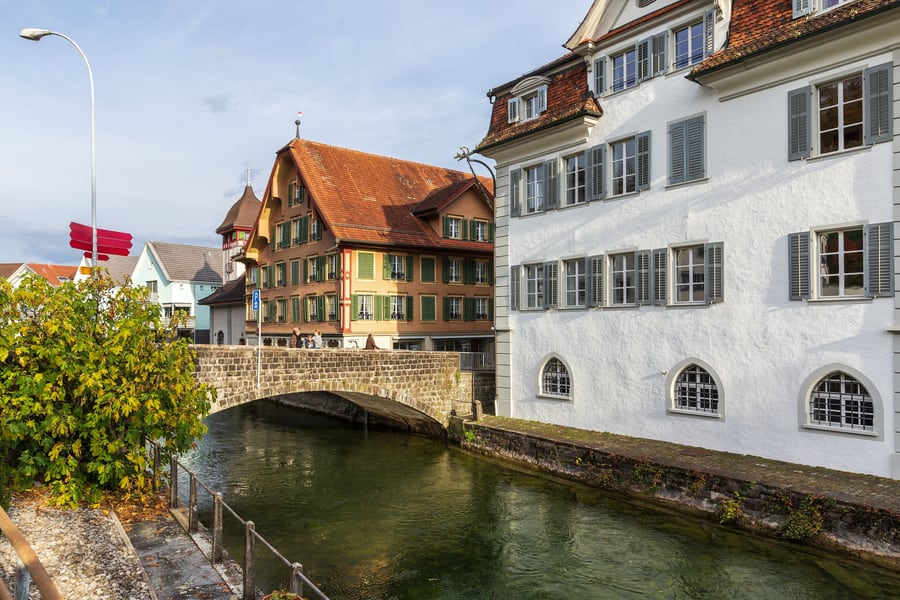 JoachimKohler-HB / Wikimedia Commons · CC BY-SA 4.0 · cropped
Sarnen
The capital of the canton of Obwalden, on the Sarner Aa where it leaves Lake Sarnen, with the town hall and the old painted houses standing directly over the water. The Landenberg, the low hill above the village square, was the seat of the medieval reeves, and the Historical Museum is on the square itself. Down at the lake, Seefeld Park has a bathing beach, a playground, water slides and volleyball courts.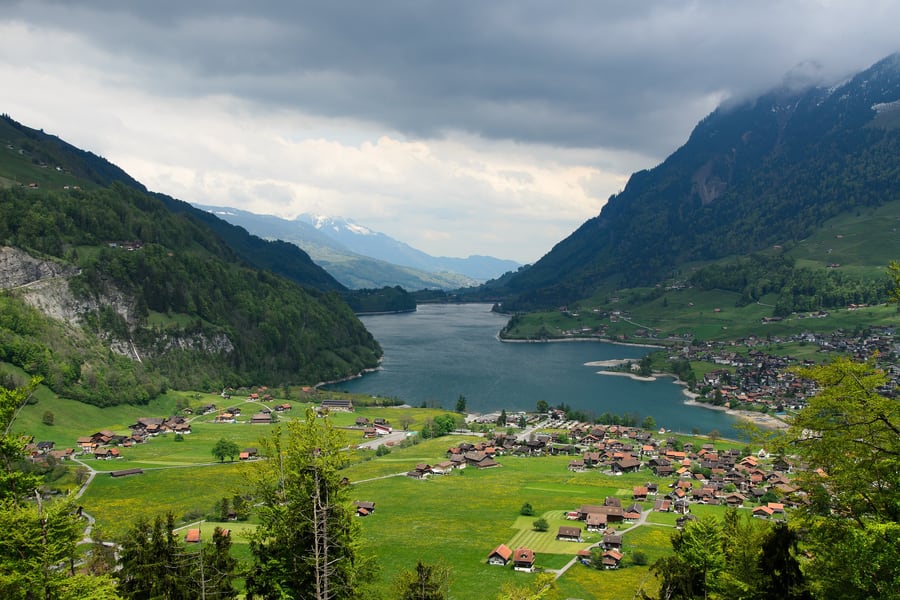 Arwin Meijer / Wikimedia Commons · CC BY-SA 3.0 · cropped
Lungern
A village on a turquoise lake at 712 metres, and the lake has been argued over for three centuries. Between 1790 and 1836 Lungern dug a 420-metre tunnel to drain 18 metres off it and win 170 hectares of farmland, splitting the village into the Wet and the Dry; in 1921 it was dammed again for a power station and the fields went back under. The water still runs the turbines at Giswil that supply the public grid — and the Zentralbahn.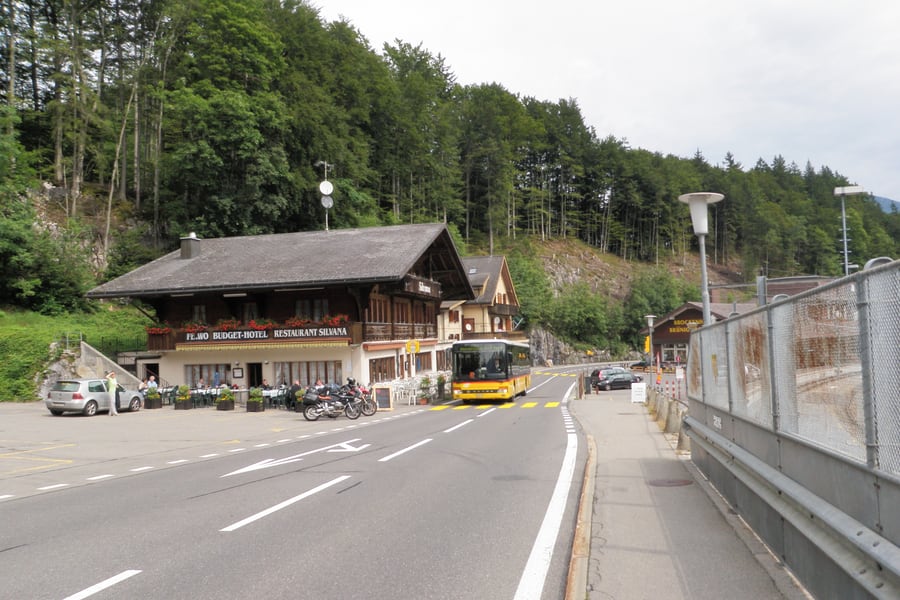 Adrian Michael / Wikimedia Commons · CC BY 2.5 · cropped
Brünig-Hasliberg
The top of the line, in a cutting a hundred metres from the road pass, and the boundary between Obwalden and Bern runs just to the Lucerne side of it. There is a station, an inn, a car park and a PostBus up to the Hasliberg terraces; there is also a walking route along the ridge to the summit station of the Brienz Rothorn railway. Once a year the pass holds the Brünigschwinget, one of the six great mountain wrestling festivals of Switzerland.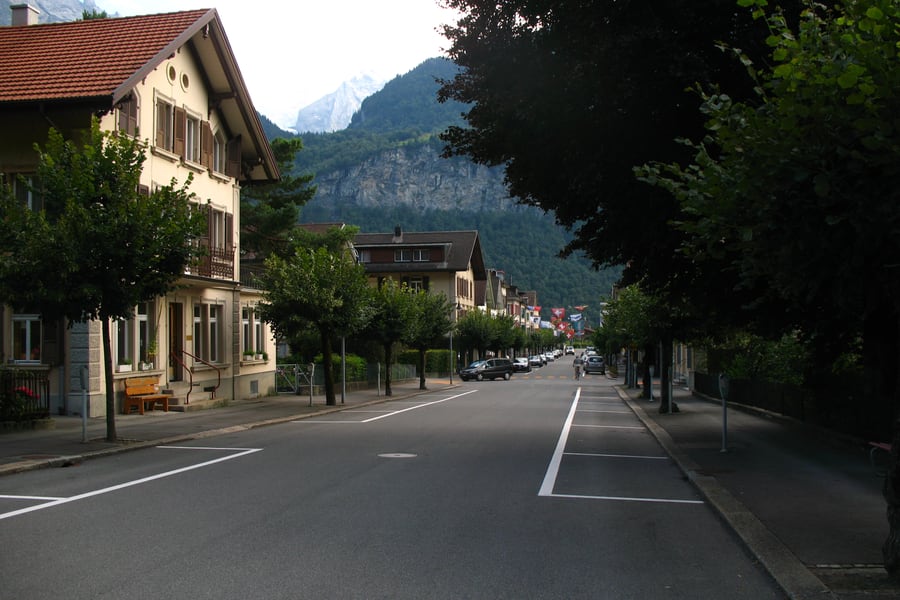 Andrew Bossi / Wikimedia Commons · CC BY-SA 2.5 · cropped
Meiringen
A valley town under the Aare Gorge, and the place Arthur Conan Doyle chose to kill Sherlock Holmes. The Reichenbach Falls come down 110 metres above the village, and the funicular that goes up to them was laid in 1899 as a goods line — it still runs wooden 24-seat cars to three viewing terraces at the top. The Sherlock Holmes Museum is on the Bahnhofstrasse, a few minutes' walk from the platform.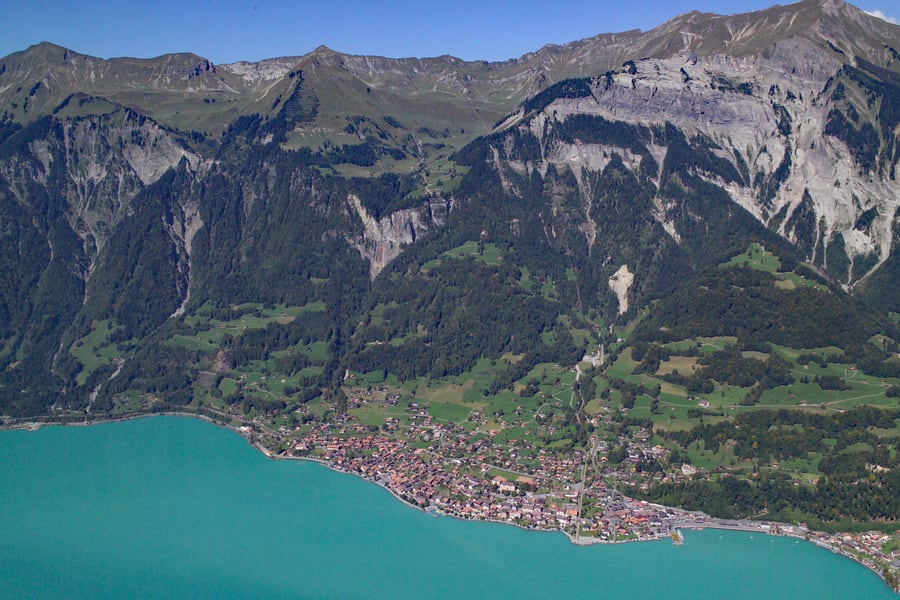 Richard Ziebold / Wikimedia Commons · CC BY 4.0 · cropped
Brienz
A chalet village strung along the north shore, backed by the Brienzergrat and facing water the colour of glacier flour, which is what it is. Switzerland's only woodcarving school is here and its only violin-making school, the BLS lake boats leave from the pier beside the platform, and on the other side of the tracks the Brienz Rothorn Bahn climbs to 2,244 metres behind a steam engine.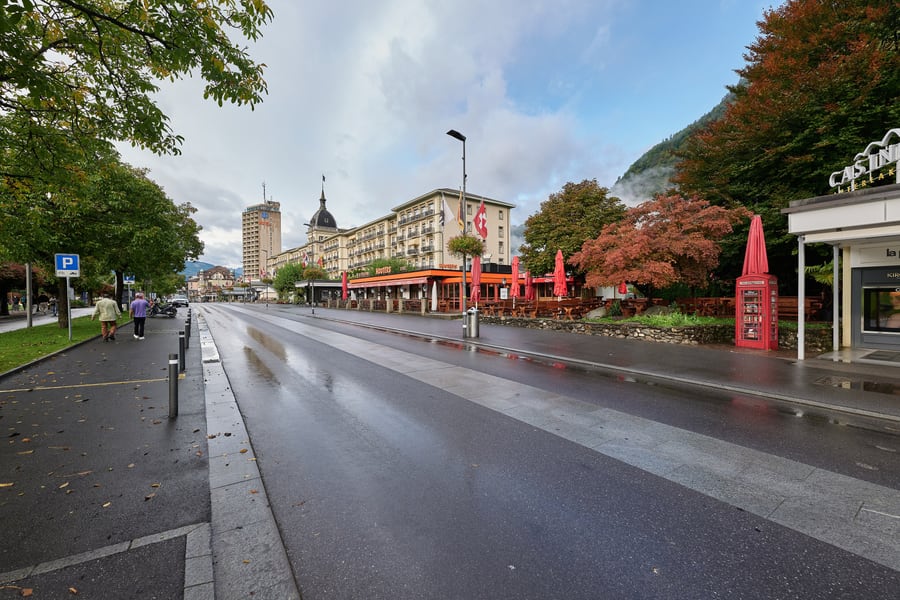 Leonhard Lenz / Wikimedia Commons · CC0 · cropped
Interlaken
A resort on the Bödeli, the flat alluvial ground that separates Lake Thun from Lake Brienz with the Aare running between them. It was called Aarmühle until 1891 and grew up around a monastery of 1133; the hotels now stand along the Höheweg, looking across open meadow at the Eiger, Mönch and Jungfrau. Interlaken Ost is the junction for the Berner Oberland Bahn to Grindelwald and Lauterbrunnen, and for the trains up to the Jungfraujoch.Where to Sleep
Both ends of this line are places people come to stay rather than pass through, and the middle is not: Brünig-Hasliberg has a pass, a station and a bus stop, and the nearest beds are down in the valley. So the choice is Lucerne, Interlaken, or breaking the journey at Brienz — which is the one stop where the lake, the boats and the Rothorn railway are all within a few minutes of the platform.
Where to stay
 W. Bulach / Wikimedia Commons · CC BY-SA 4.0 · cropped
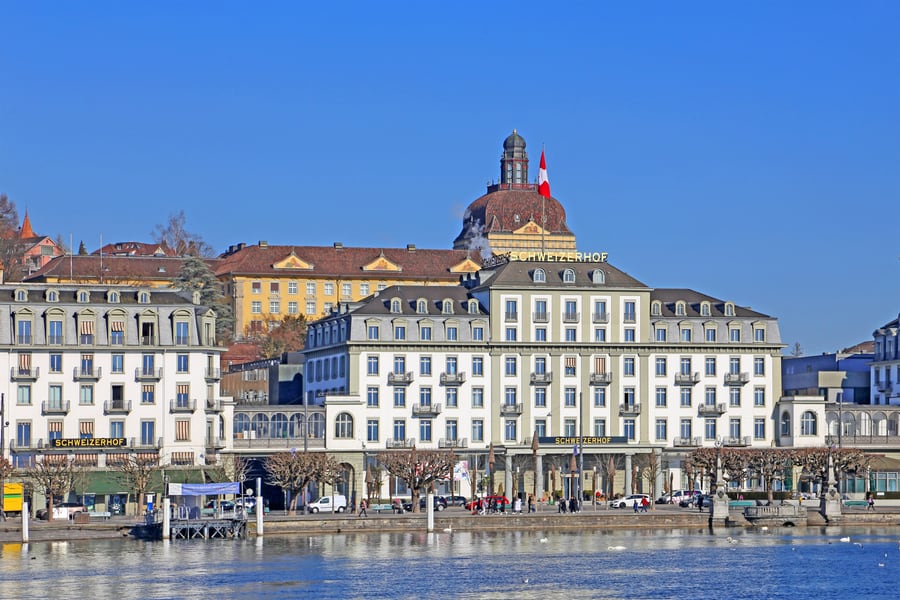
Hotel Schweizerhof Luzern
On the quay, five minutes from the station
A hundred and one rooms and suites on the shore of Lake Lucerne, a short walk from the city centre, run by the Hauser family for more than 180 years. Two restaurants, a wellness area and a run of banquet rooms; the house also hosts the Lucerne Blues Festival and the World Band Festival.
Check Availability (opens in a new tab, on schweizerhof-luzern.ch)via schweizerhof-luzern.chSeehotel Bären, Brienz
On the lakefront, a few minutes from the platform
A small hotel on the Hauptstrasse at Brienz, directly on the lake and under the steep wall of the Brienzergrat, with a history the house dates back over centuries. Individually furnished rooms, breakfast, and the pier and the Rothorn railway both within a short walk.
Check Availability (opens in a new tab, on baeren-brienz.ch)via baeren-brienz.ch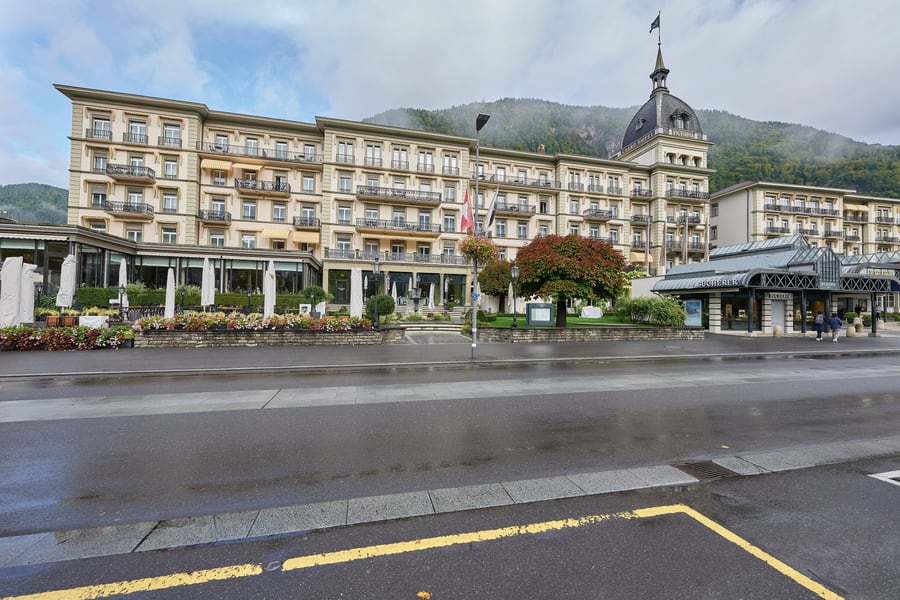 Leonhard Lenz / Wikimedia Commons · CC0 · cropped
Victoria-Jungfrau Grand Hotel & Spa
On the Höheweg, ten minutes from Interlaken Ost
The grande dame of the Höheweg, facing the Höhematte and the Jungfrau across it, with a 5,500-square-metre spa, several restaurants including Radius by Stefan Beer, and a bar under stuccoed ceilings. Rooms run from superior doubles to suites.
Check Availability (opens in a new tab, on victoria-jungfrau.ch)via victoria-jungfrau.chQuestions or corrections
Planning this trip and stuck on something, or spotted a time, fare or detail that has changed? Send us a message about Luzern – Interlaken Express. We read every one, and we update this page when something has changed.