Mariager to Handest: Denmark's Longest Heritage Railway
Jan Pešula / Wikimedia Commons · public domain
- Distance17 km · Mariager to Handest
- Duration45 min each way · two return trips
- Best seasonLate May to mid-October · Sundays, plus school holidays
Introduction
The crown jewel of this railway has now spent longer standing still than it ever spent working.
M 4 is a wooden motor coach built at the Vognfabrikken Scandia works in 1926, and it changed hands and identities four times before it got here: MB 2 on the Sydfyenske railways, MBF 482 when the state took it over in 1949, OMB Mh 6 for the Nordvestfynske line in 1952, and finally M 4 in 1966 when the Randers–Hadsund railway bought it and the district gave it the name it still carries — Hadsund-Peter. In 1969 it came to Mariager. And there it stopped, mostly outdoors, for fifty-four years.
A restoration was begun around 1980 and stalled. A second attempt started in 2020, and this one finished: about fifteen thousand working hours, both ends rebuilt from nothing, the teak boarding renewed and screwed back on with four thousand new brass screws. In 2023 Hadsund-Peter moved under its own power again. On 20 June 2026 it turned a hundred, and the railway put that in its calendar as a running day.
Which is a fair description of the whole line. Denmark's longest heritage railway runs seventeen kilometres from the market town of Mariager, on the fjord, up over the hills to Handest, a village of about two hundred people — over the surviving stub of a railway that closed in 1966, using locomotives and carriages built between 1900 and 1950 and gathered in from private lines all over the country, from Skagen in the north to Thyborøn and Nr. Nebel in the west.
Nothing here was saved because it was convenient. It was saved because somebody put the hours in.
The Journey
The line the veteran trains run on was one of the last railways built in Denmark, and it never had time to settle. Mariager was the last market town in Jutland to get a railway at all.
Twenty-two years of argument about a junction
A local committee proposed a line to Mariager in 1905. Randers objected: a railway running west would pull traffic away from the town and make it harder to find money for rebuilding the Randers–Hadsund line. The Railway Act of 1908 offered two versions of a Mariager branch. At the same time Viborg wanted a line down the Nørreå valley, and the question there was whether it should end at Randers or at Fårup. Randers would pay more if the trains came to Randers. Viborg, afraid of Randers, would only pay if they did not.
The compromise reached the statute book in the Railway Act of 1918: both lines built, both meeting at Fårup — and built as two separate companies. The reason was purely financial. Mariager–Fårup had already been promised 75 per cent state support under the 1908 Act; the 1918 Act offered Viborg–Fårup only 50. The two halves could not be incorporated together on those terms, so a single 58.4-kilometre railway with one head office, one management and one timetable spent its entire life as two companies on paper.
What it was for
Both halves opened on 1 July 1927 and were worked as one. The head office was at Viborg, but Mariager was the biggest station, with the sheds, the workshops and the train control for the whole line.
What the railway really did was give an inland city a seaport. With the line open, Viborg had Mariager as its harbour town, and for most of the railway's life coal moving from Mariager Havn to the Viborg gasworks and the Viborg fuel company made up about three-quarters of its goods traffic. In the early 1960s two more customers arrived: a bitumen plant at Mariager, and a new crushed-stone works at True that was to supply most of the ballast for the state railway's network in western Denmark.
Then it ended, and it ended as two railways rather than one. Viborg–Fårup closed on 29 May 1965, goods following on 31 March 1966. Mariager–Fårup closed on 31 March 1966 — but its goods traffic, the harbour traffic, kept running for another nineteen years, to 1985. That is the half with the trains on it today.
Seventeen kilometres, at thirty kilometres an hour
Dansk Jernbane-Klub opened the veteran railway on 2 May 1970, and the mayor of Mariager, Ib Frederiksen, cut the tape. The ticket is still brown card.
Leaving Mariager the train climbs away from the fjord and settles to about 30 km/h — the society's own description is that you go slowly enough to bring your soul along. It runs south past Lunddalen and Fjelsted, both request stops, to True at kilometre 8, which is a proper station and holds the railway's office. Beyond it come Brødløs, Vester Tørslev and Glenstrup, with Glenstrup Sø off to the west — four and a half kilometres of lake in a meltwater valley, 384 hectares of it, and nearly thirty-one metres deep in places, which makes it one of the deepest in the country. Handest is the end, at kilometre 16.6.
The carriages have open balconies at each end, and standing out on one is the point: the engine audible ahead, the beech woods closing in, and the fjord appearing and disappearing behind. The run takes 45 minutes each way.
At the far end, a station nobody modernised
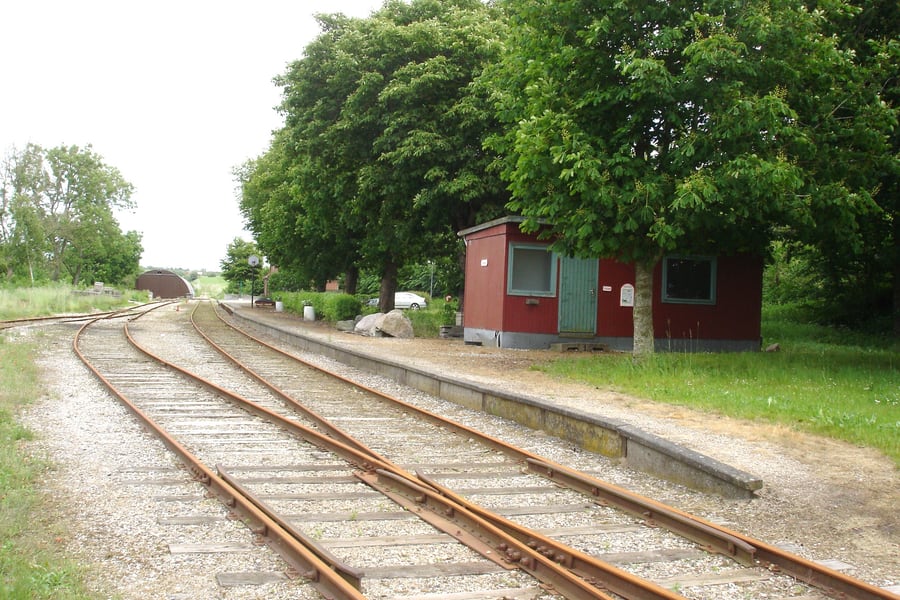
Handest station is listed. The waiting room and the booking office stand very nearly as they were when the railway opened, and there are tables and benches outside, a kiosk on the platform and a model railway in the goods shed. All four station buildings on the Mariager–Fårup half survive; they were designed by Carl Lundquist, who also drew the Mariager engine shed.
What runs
The 2026 service is worked by the motortog — the railway's historic motor stock — and the fleet is the argument for coming. Nothing in it was built for this line. The locomotives and carriages date from 1900 to 1950 and came from private railways across Denmark, which is what the museum is actually about: not one company's history but the Danish privatbane as a type, with period-typical uniforms to match. The society reckons on about ten thousand visitors a year.
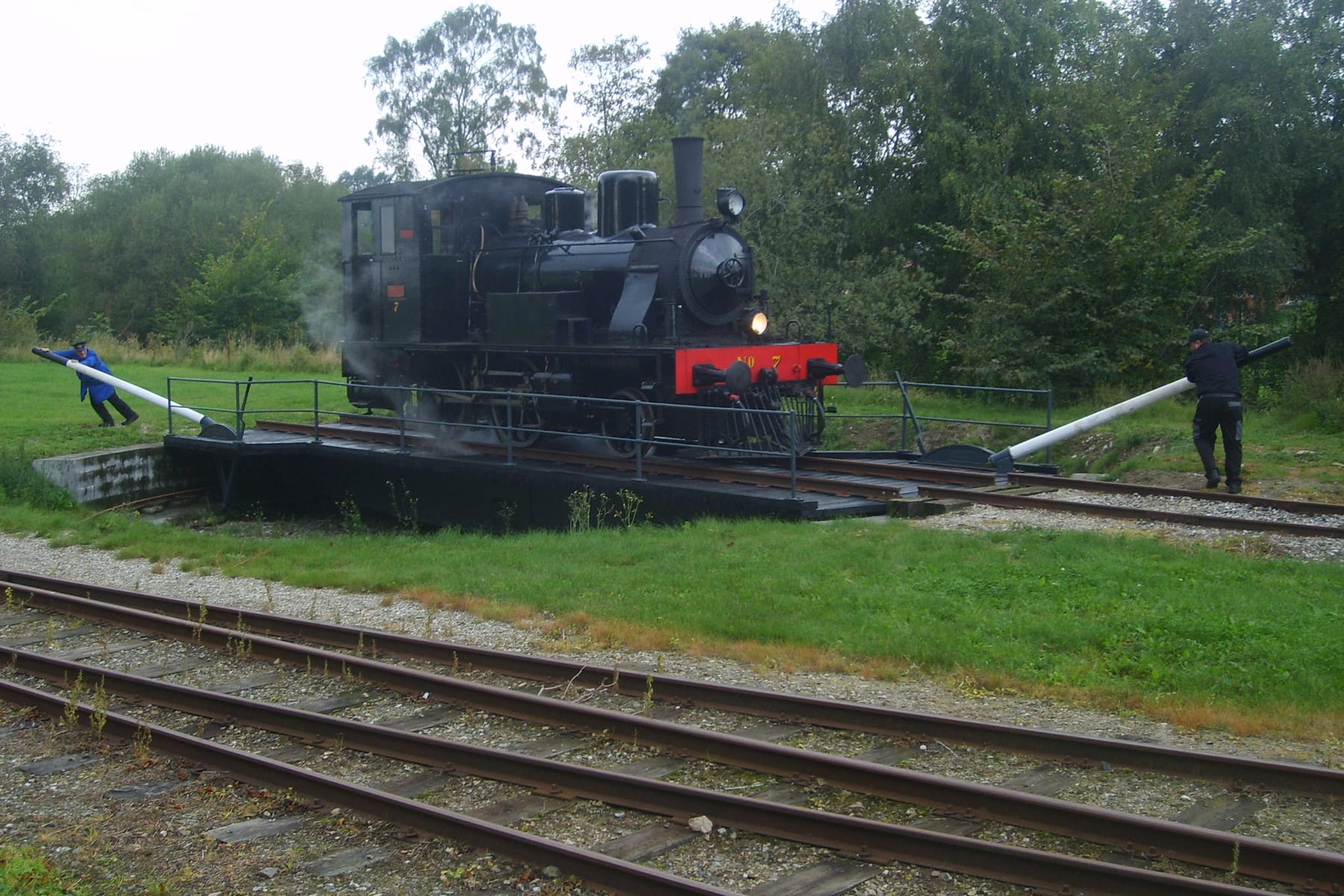
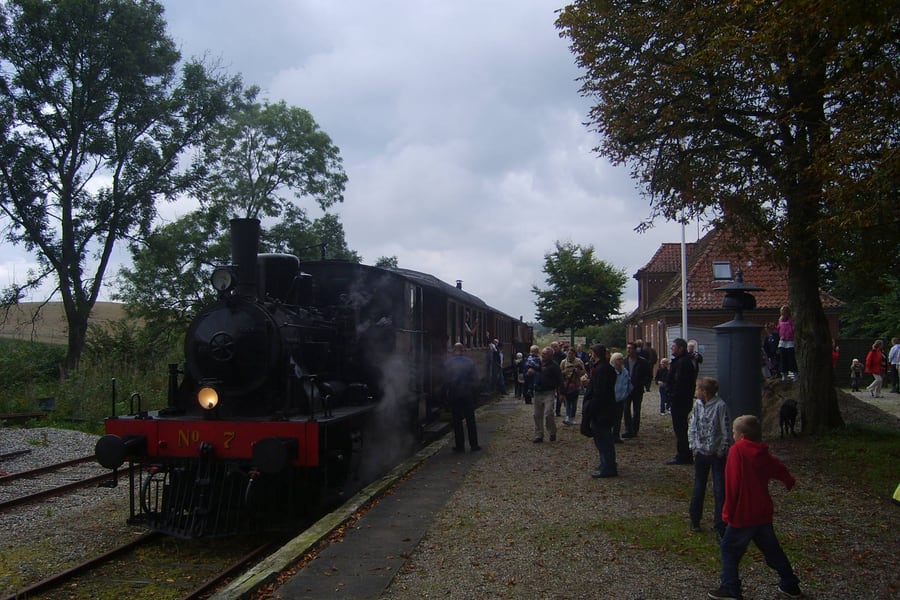
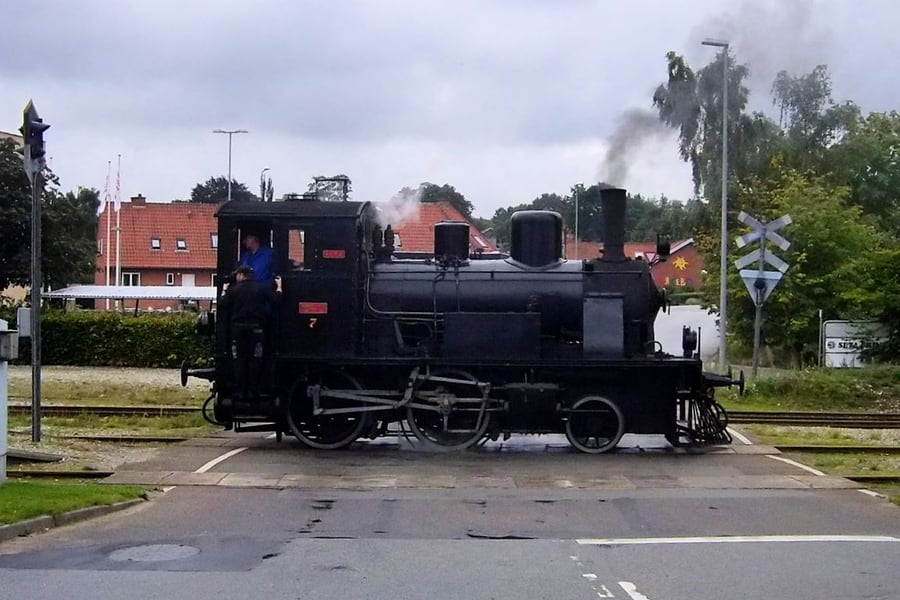
Steam has worked here too. The photographs on this page from 2010 show No. 7, a tank engine built by Henschel & Sohn of Kassel in 1909, works number 9482, being turned by hand on the Handest turntable and shunting across the road at Mariager.
Along the route
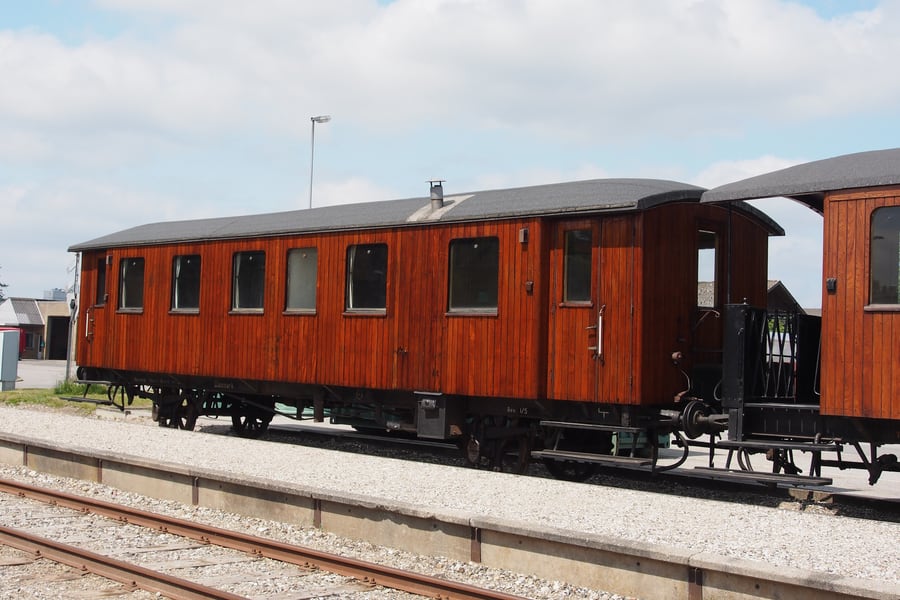
Hadsund-Peter, and fifty-four years outdoors
Built in 1926, it worked forty-three years under four owners and four numbers before coming to Mariager in 1969 and stopping. One restoration stalled around 1980; a second, from 2020, took some 15,000 hours and renewed the teak with 4,000 brass screws. It ran again in 2023.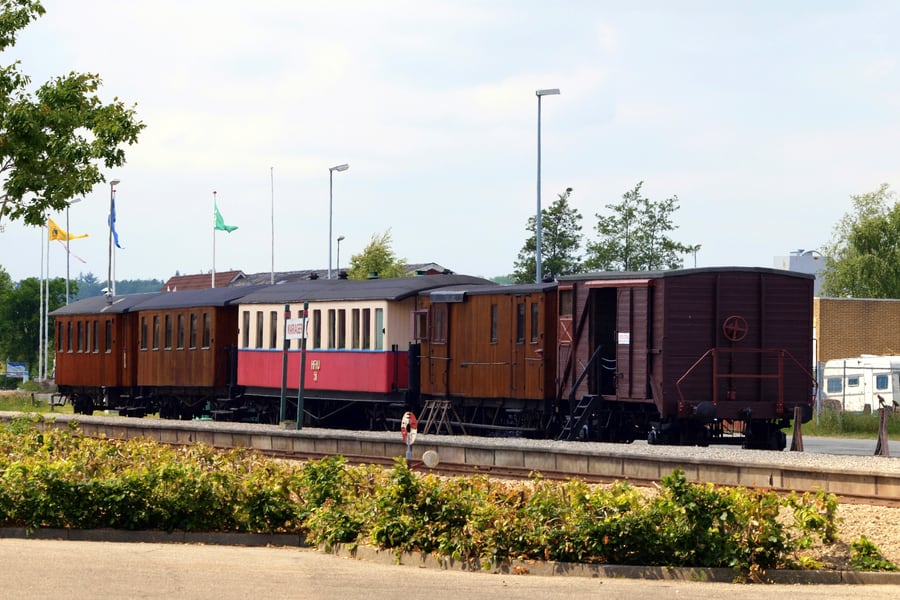 Alf van Beem / Wikimedia Commons · CC0 · cropped
A fleet from everywhere but here
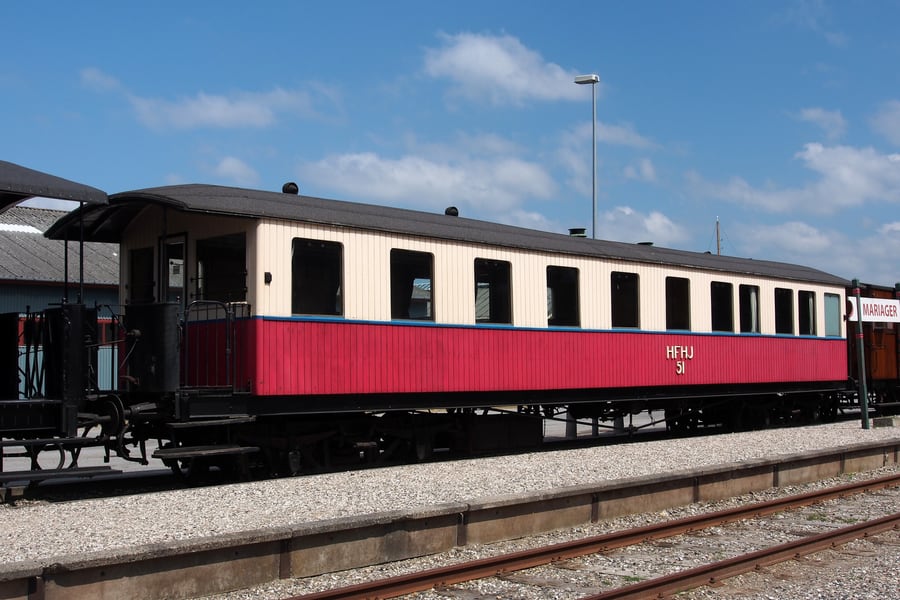
The museum's subject is not this railway but the Danish privatbane as a type, and the stock was gathered in from lines all over the country. The carriages date from 1900 to 1950 and keep their open balconies at each end, which is where the journey is best spent.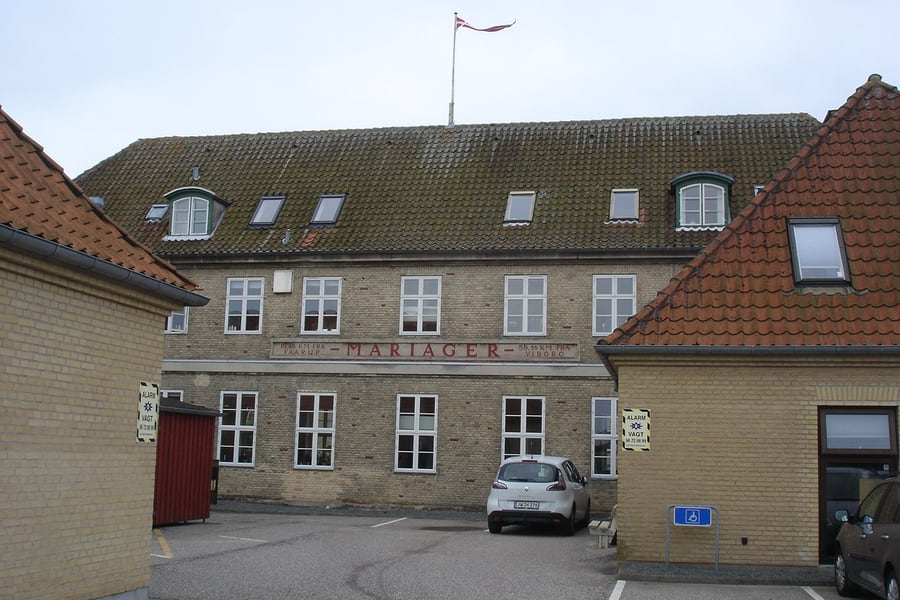 Beethoven9 / Wikimedia Commons · CC BY-SA 3.0 · cropped
One railway, two companies
Two halves of the same route had been promised different rates of state support, and could not be incorporated together on those terms. So 58.4 kilometres opened in 1927 with one head office, one management, one timetable — and two company names.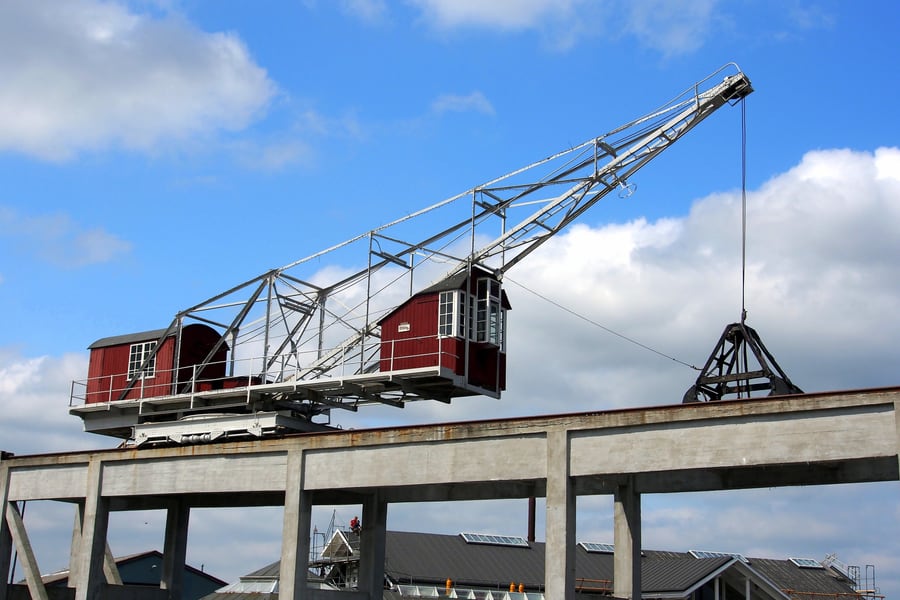 Alf van Beem / Wikimedia Commons · CC0 · cropped
The half that had the harbour
The railway's real work was giving an inland city a seaport. Coal from Mariager Havn to the Viborg gasworks was about three-quarters of its goods traffic. When the passengers went in 1966 the Viborg half closed outright; the Mariager half kept its freight until 1985.A bit of history
Culture & experiences along the way
 Alf van Beem / Wikimedia Commons · CC0 · cropped
Boiled salt, and a bath you float in
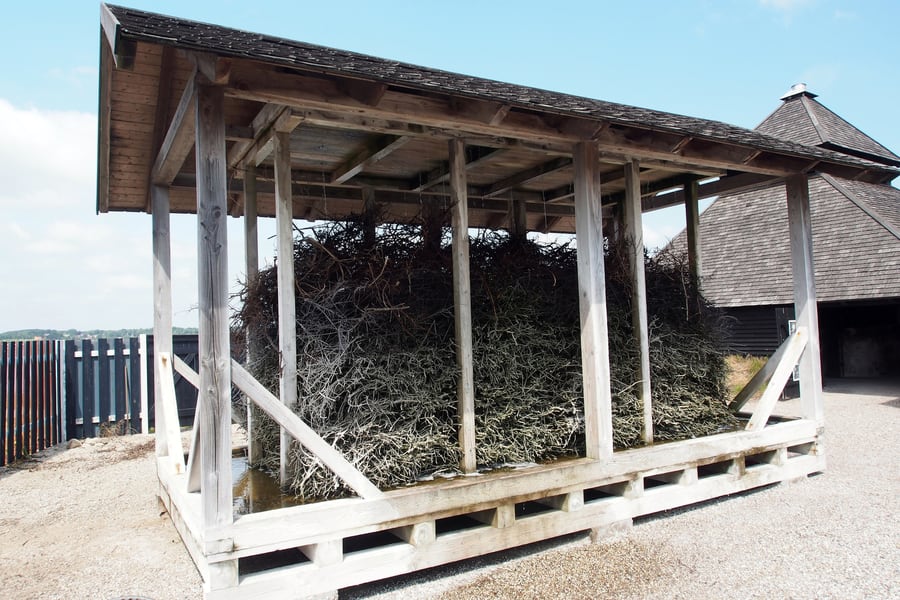
Mariager grew rich on salt and the Saltcenter still boils it the medieval way in an open pan, in front of you, in a hut that smells of wet brine and woodsmoke. Then there is the reason most people come: a 30 % brine pool kept at about 39°C, in which you cannot sink however hard you try.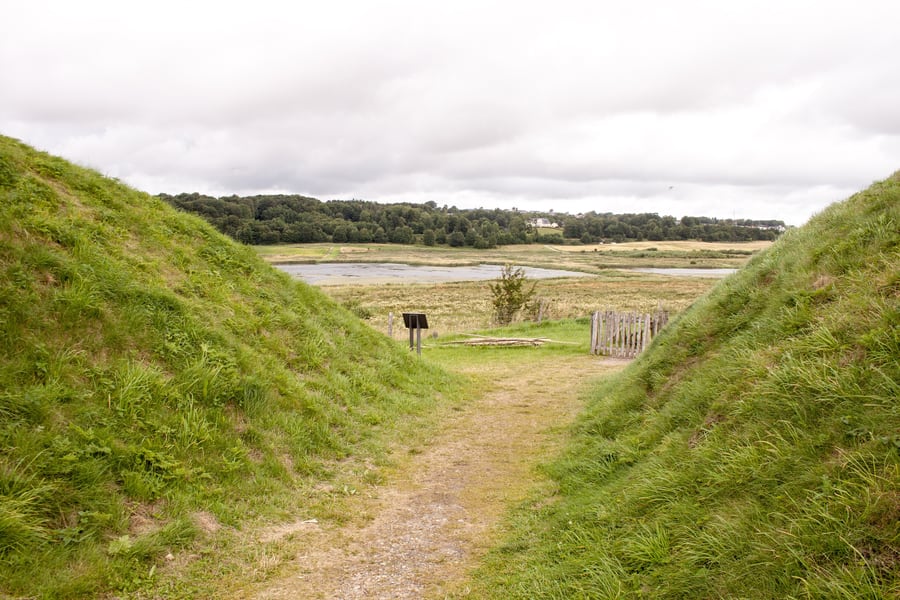 Szilas / Wikimedia Commons · CC0 · cropped
A Viking fortress laid out with a ruler
Fyrkat, above Hobro, is a ring of earth about 120 metres across, quartered by two streets and built around the year 980 — one of the five Danish ring fortresses put on the UNESCO list in September 2023. A reconstructed longhouse and a Viking farm stand below the rampart.Timetables
The railway publishes its whole year as a colour-coded calendar with two departures each way on it. The times below apply on every ordinary running day.
The 2026 service, both directions
| Mariager → Handest | Handest → Mariager | ||||
|---|---|---|---|---|---|
| Mariager dep. | 10:50 | 14:15 | Handest dep. | 12:10 | 15:35 |
| Lunddalen* | 11:02 | 14:27 | Glenstrup* | 12:16 | 15:41 |
| Fjelsted* | 11:06 | 14:31 | Vester Tørslev* | 12:22 | 15:47 |
| True | 11:14 | 14:39 | Brødløs* | 12:28 | 15:53 |
| Brødløs* | 11:18 | 14:43 | True | 12:33 | 15:58 |
| Vester Tørslev* | 11:23 | 14:48 | Fjelsted* | 12:40 | 16:05 |
| Glenstrup* | 11:29 | 14:54 | Lunddalen* | 12:44 | 16:09 |
| Handest arr. | 11:35 | 15:00 | Mariager arr. | 12:55 | 16:20 |
Stops marked * are request stops — the operator's note is that the trains call there only if somebody wants them to. Dogs, bicycles and prams travel free.
Which days it runs
The summer season runs from late May to the end of August and the autumn one into mid-October. Ordinary running days in 2026 are Sundays from early June, with Tuesdays, Thursdays and Saturdays added through the school holidays from the end of June to early August. October brings the kastanjetog, the chestnut train, in the autumn-holiday week.
Themed days are a large part of what this railway does, and in 2026 they were: M4's centenary on 20 June, suitcase day on 5 July, a Second World War theme day on 15 August, teddy-bear day on 16 August, ELRO day on 5 September — when a local foundation pays everybody's fare and the trains run all day — the Lysregatta evening run on 12 September, the Halloween train on 15 October, fetching Father Christmas on 15 November, and the Christmas train and market on 29 November.
The calendar is the authoritative source and it changes each year: mhvj.eu (opens in a new tab).
Getting there
Neither end of this railway is on the national network, and Mariager has not had a scheduled train since 1966.
Hobro is the nearest main-line station, on the Randers–Aalborg line, and it is the hinge of the railway's own combined ticket — the Trekantruten, described under Tickets below, links Hobro Havn to Handest station by bus in 15 minutes and Mariager Havn to Hobro Havn by boat in 1 hour 15. Handest itself lies about 6 km northwest of Fårup and 9 km south of Hobro; Mariager is on the fjord, and the train ends on the harbour there.
Times and running days read from the operator's own Køreplan 2026 folder, published as images on mhvj.eu; checked August 2026.
Tickets
Fares are simple and low: a return from Mariager to Handest is 140 kr for an adult and 70 kr for a child of 4 to 11, and to True 90 kr and 45 kr. Tickets are bought at the station or through the railway's own shop, and the ticket itself is brown card, which the society mentions before it mentions anything else.
The unusual thing on sale here is a triangle. The Trekantruten is run jointly with the tour boat Svanen and the regional bus company: boat from Mariager to Hobro, bus to Handest station, and the veteran train back — ridden in either direction, 275 kr for an adult, and it includes entry to Mariager Museum. A second combined day, the Salt Tour, adds brunch and a guided tour of the salt centre. ⚠️ The salt centre's Dead Sea bath was out of action with no reopening date in August 2026.
Book your tickets
Mariager – Handest return
140 kr adult · 70 kr child 4–11
The whole line and back, on a brown card ticket bought at the station.
Book Tickets (opens in a new tab, on mhvj.eu)via mhvj.euTrekantruten
275 kr adult · 125 kr child 4–11
Boat, bus and veteran train round three sides of the fjord, museum entry included.
Book Tickets (opens in a new tab, on fjordtours.dk)via fjordtours.dkThe Salt Tour
598 kr adult · 448 kr child
A historic motor coach, brunch, the salt centre, the boat and a bus back.
Book Tickets (opens in a new tab, on saltcenter.dk)via saltcenter.dkRail Passes
No rail pass is valid on this railway, and none is worth buying for it. The Mariager–Handest Veteranjernbane is a museum operation run by Dansk Jernbane-Klub on a line that left the national network in 1966. Its fares are its own — 140 kr return for an adult — and they are cheap enough that no pass discount would change the arithmetic.
Where a pass earns its keep is the journey to Hobro, the nearest main-line station and the corner of the railway's own Trekantruten.
Getting to Hobro on a pass
Hobro is on the Randers–Aalborg line, served by Danish State Railways InterCity and regional trains. Interrail and Eurail list DSB as fully included, along with S-tog in Copenhagen, Nordjyske Jernbaner and Lokaltog on Zealand, and seat reservations are optional on domestic Danish services. Coming up from Germany, the Eurocity Express and Railjet services between Hamburg and Copenhagen are covered, but reservations are compulsory between 26 June and 16 August — which overlaps the heritage line's busiest weeks.
⚠️ Denmark's excluded list is short but real: Midtjyske Jernbaner is excluded from Interrail passes. It is nowhere near here, and matters only to someone combining this trip with the Lemvig line further west.
Whether it is worth it
For a visitor coming to ride seventeen kilometres of heritage railway, no. A single DSB ticket to Hobro, or a DSB Orange fare booked ahead, will normally beat a pass day — Orange fares are valid between DSB, GoCollective and Nordjyske Jernbaner stations, and expressly not on bus, metro, light rail or local and private railways.
The calculation changes if Hobro is one stop on a longer Danish or Danish–German itinerary. In that case the main-line legs ride free on the pass you already hold, and the only fare you pay for the railway itself is the 140 kr on the brown card.
Interrail also sells the Nordic Pass (opens in a new tab), valid in Denmark, Norway, Sweden and Finland and across the borders between them: €218 for 3 travel days in a month for an adult in second class, against €137 for the Denmark Pass. It cannot be used in the country you live in, only in the other three. It pays only when the trip goes on into another Nordic country. Checked October 2026.
Pass conditions checked against Interrail's own Denmark page and DSB's Orange conditions, August 2026.
Places to Visit
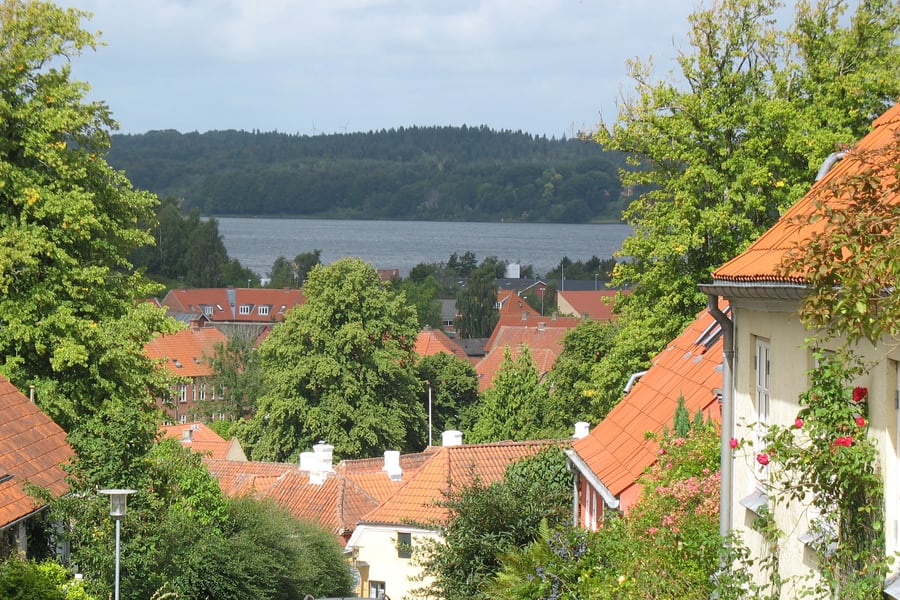
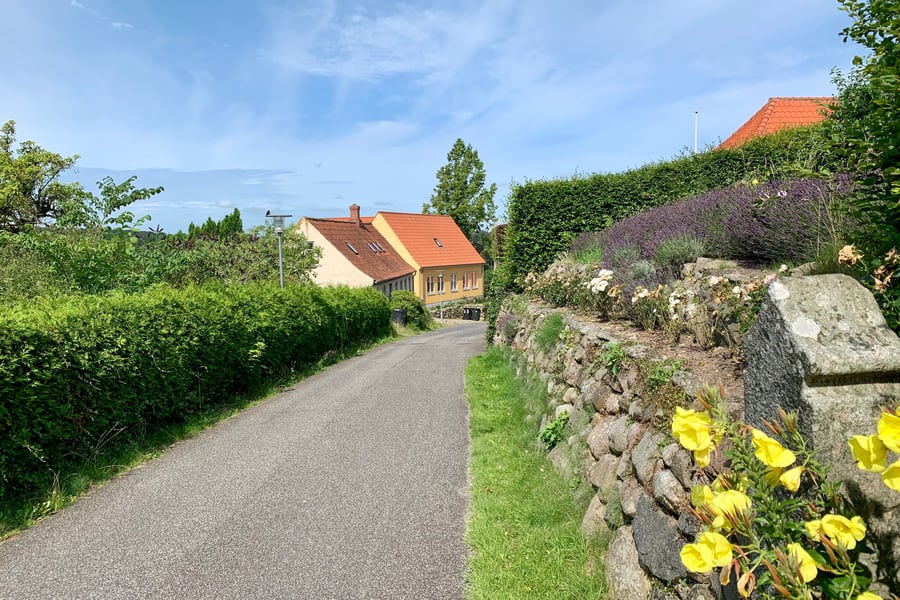
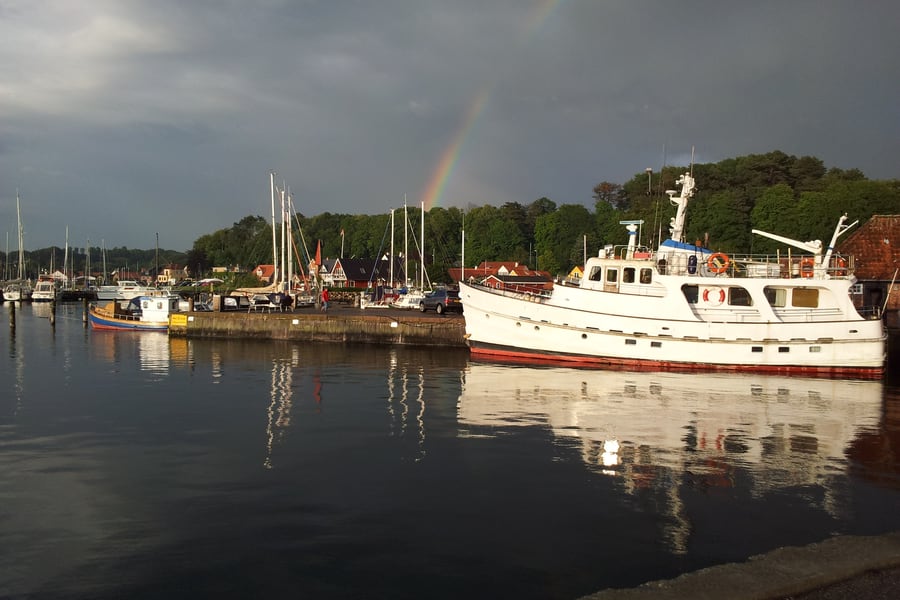
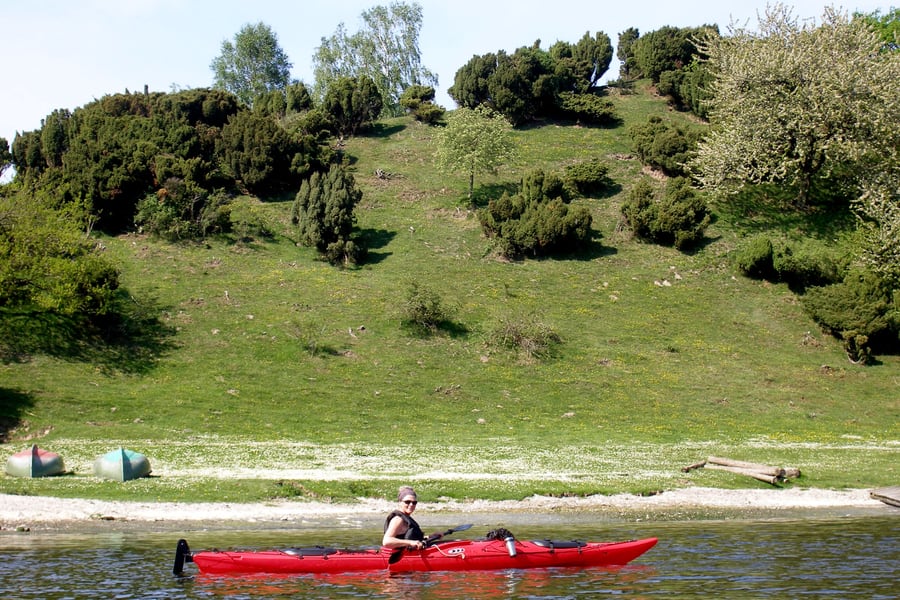
Mariager is the reason most people come. It is a købstad of about 2,650 people on the south shore of Mariager Fjord — Denmark's longest, some thirty-five kilometres of it — with cobbled streets, half-timbered houses and a monastery church at the top of the hill. The train ends on its harbour.
Handest, seventeen kilometres away, has about two hundred and eighteen inhabitants and a listed station. In between there is a lake in a meltwater valley that is among the deepest in the country.
 Carsten Wiehe / Wikimedia Commons · CC BY-SA 3.0 · cropped
Mariager, and the walk up from the harbour
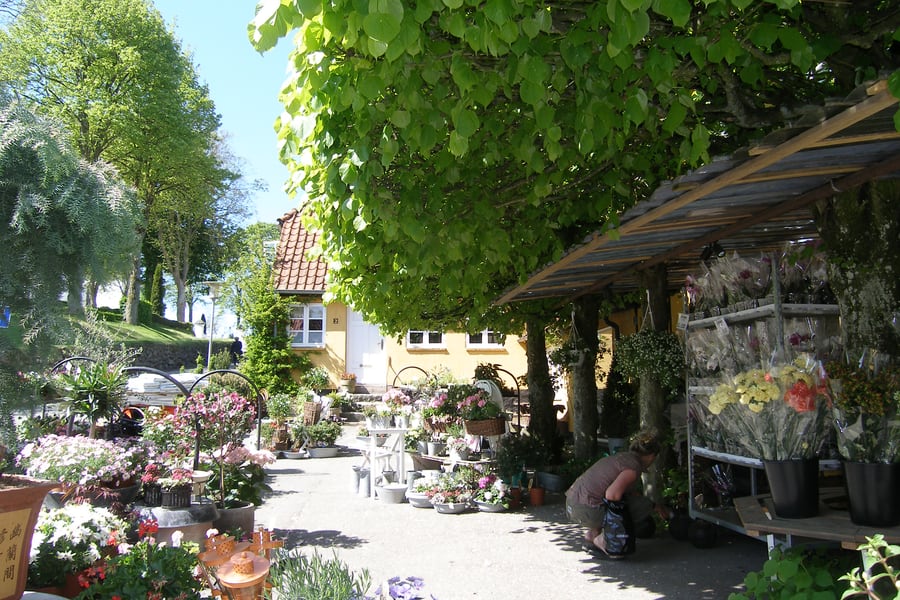
The town grew up around a Birgittine monastery in the early 1400s and was given market rights in 1592; it has about 2,650 people now. Cobbled streets, half-timbered houses and gardens climb from the quay where the train ends to the church at the top, and the fjord is in view most of the way. Flowers are something of a local industry — the stalls under the limes on Kirkebakken are a fixture — and the walk from the station to the top of the hill takes about ten minutes.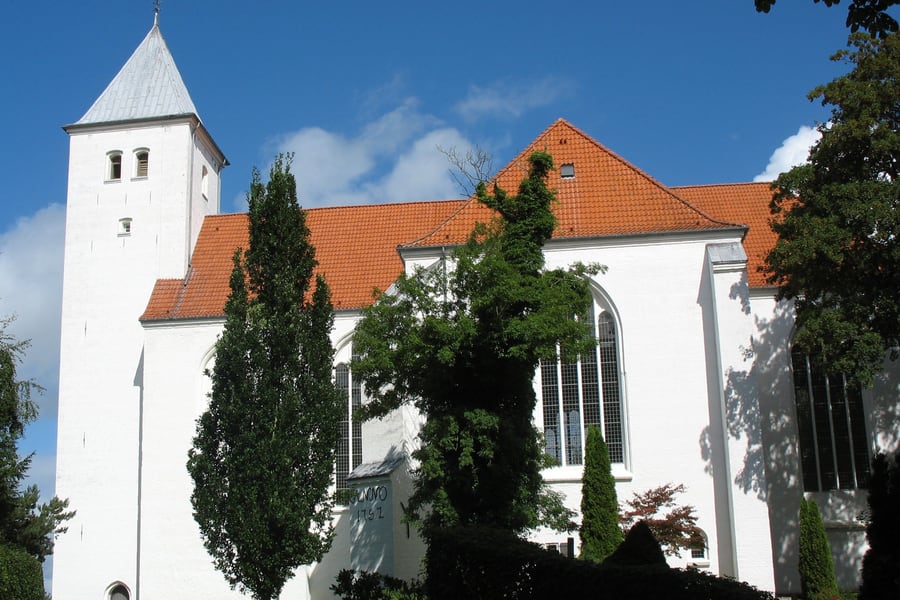 Hubertus45 / Wikimedia Commons · CC BY-SA 3.0 · cropped
Mariager Kirke
The white church at the top of the town is what is left of the Birgittine monastery that Mariager grew around — a 1400s building, and the reason the place is called Marias Ager, Mary's field. What survives is a fragment of a much larger complex: the monastery's own stones, carved faces and friezes turn up around the town and in the churchyard, and a memorial tablet inside records the convent's last nuns.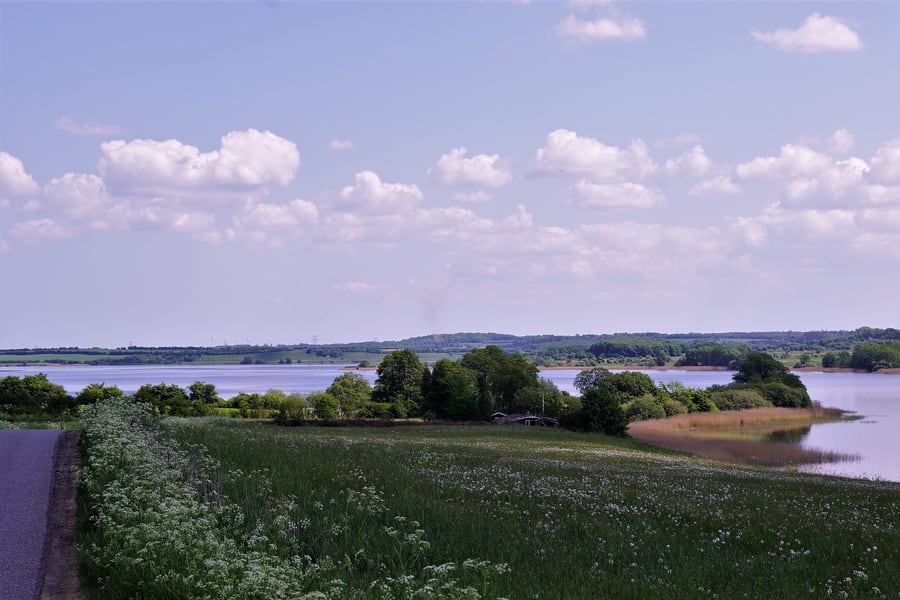 Nils Jepsen / Wikimedia Commons · CC BY-SA 4.0 · cropped
Glenstrup Sø
The train passes the head of it at the Glenstrup request stop. The lake is about 4.5 kilometres long, lies in a meltwater valley some five kilometres south of Hobro, and at 384 hectares is the third largest in North Jutland. It is also one of the deepest bodies of water in the country — close to thirty-one metres in places — fed by the Østerkær Bæk and by springs all round its banks, and draining west to the Kongsvad Å.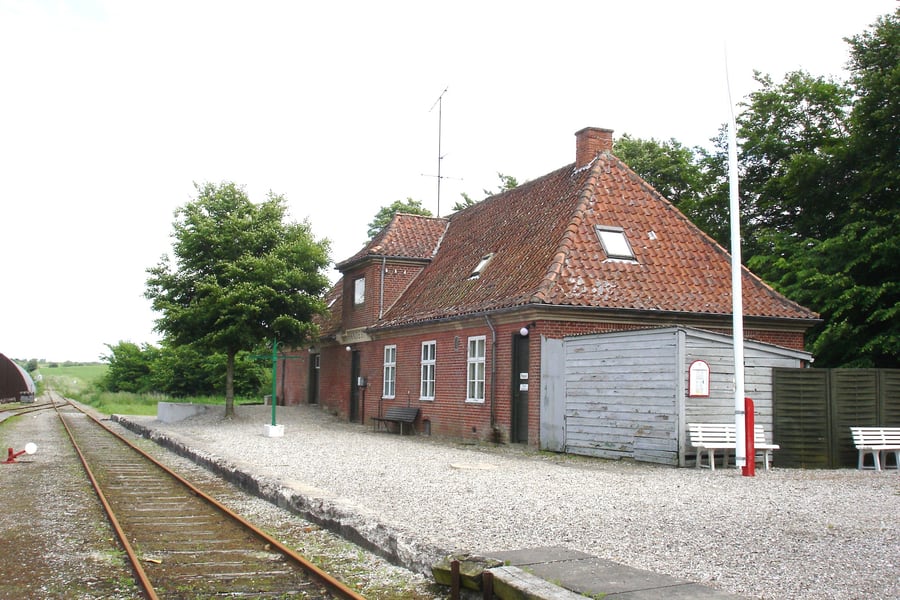 Beethoven9 / Wikimedia Commons · CC BY-SA 3.0 · cropped
Handest station
A listed station building at the end of the line, in a village of 218 people. The waiting room and the booking office stand very nearly as they were when the railway opened in 1927 — the society's own phrase is "næsten urørt", almost untouched. There are tables and benches outside for anyone who brought lunch, a kiosk on the platform, and a model railway set up in the goods shed. The European Agricultural Fund paid 200,000 kr towards the platform.Where to Sleep
Mariager has the obvious base: the train ends there, the boat leaves from there, and the town is small enough to walk. Hobro, nine kilometres from Handest, is the other end of the triangle and the nearest main-line station.
Two of the three houses below are older than the railway by a wide margin. Each is listed for what can be checked — where it stands, how many rooms, and what it is.
Where to stay
Hotel Postgaarden Mariager
On the market square, and older than the town's railway by 267 years
The house can be dated to 1660, when the property belonged to the alderman and merchant Anders Jensen. Hans Christian Andersen called in 1865, and Mariager's first telephone was installed here in 1886. It took the name Hotel Postgaarden in 1903, when the inn became a fixed stop for the stagecoaches. It stands on Torvet, the market square, a few minutes' walk uphill from where the train ends, and has standard, comfort and family rooms with their own bathrooms, plus a restaurant that is the main event.
Check Availability (opens in a new tab, on hotelpostgaardenmariager.dk)via hotelpostgaardenmariager.dkBramslevGaard
A manor house in the protected hills above the fjord
A herregård on Mariager Fjord that has taken guests since 1959. The original farmhouse is thought to date from 1865; the estate ran to about 700 tønder land before sales up to 1920 cut it to roughly 127, of which 50 are the hills and woods running down to the water. Those are Bramslev Bakker, protected in 1933 and open to the public ever since — juniper slopes and a shore path, in a district with around ninety recorded ancient monuments. There are manor, standard and superior rooms, suites and apartments.
Check Availability (opens in a new tab, on bramslevgaard.dk)via bramslevgaard.dkHotel Amerika
In the woods at Hobro, the main-line end
67 rooms and suites on Amerikavej, set in park and forest on the edge of Hobro — the nearest station on the national network and the corner where the Trekantruten's boat and bus legs meet. Every room has its own bathroom and free wireless internet; parking is free and there are chargers for electric cars. It works mainly as a conference house, so what is going on varies, and the restaurant and function rooms all open onto a terrace facing the trees.
Check Availability (opens in a new tab, on hotelamerika.dk)via hotelamerika.dkQuestions or corrections
Planning this trip and stuck on something, or spotted a time, fare or detail that has changed? Send us a message about Mariager to Handest: Denmark's Longest Heritage Railway. We read every one, and we update this page when something has changed.