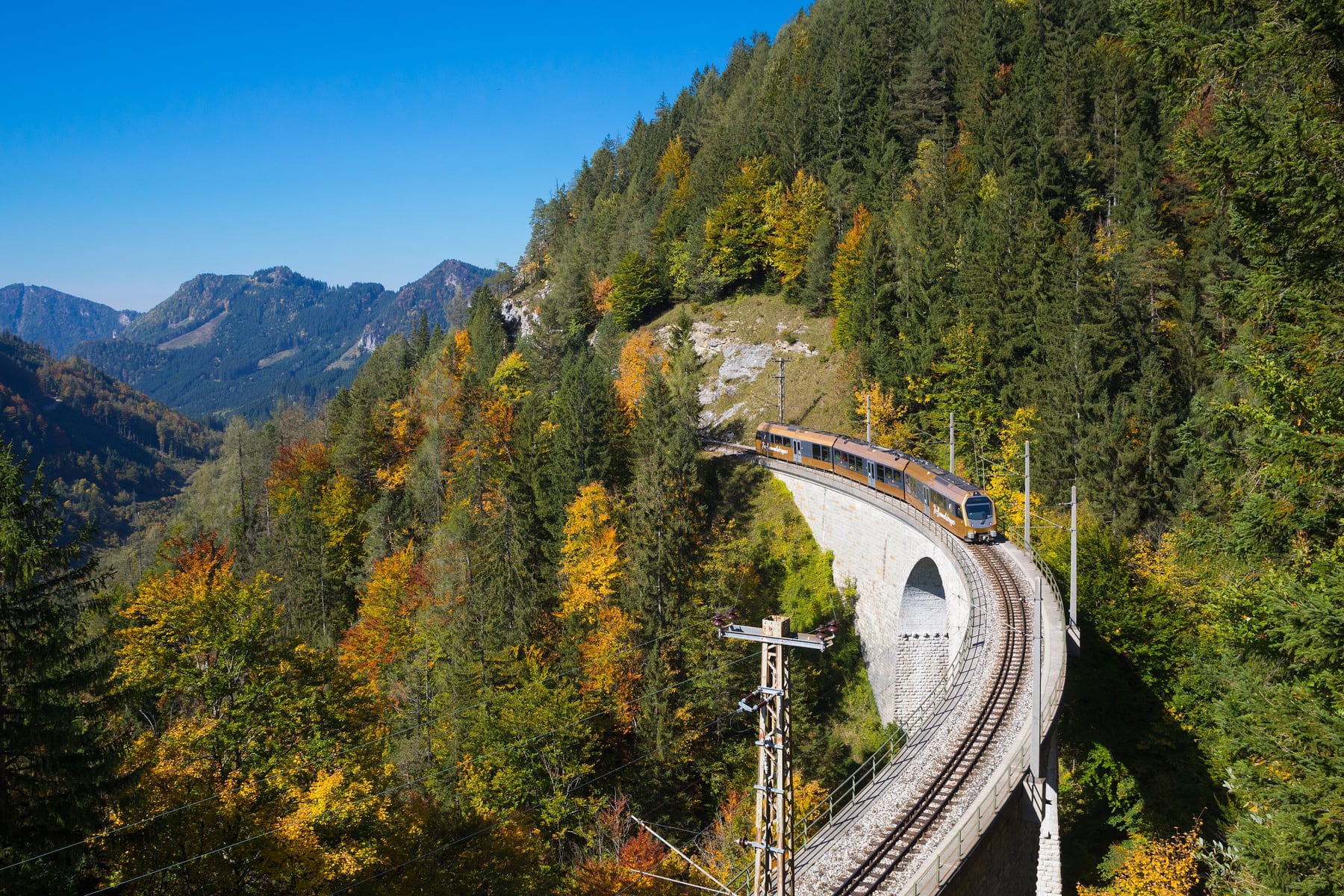
Mariazellerbahn
Liberaler Humanist / Wikimedia Commons · CC BY-SA 3.0
- Distance84 km
- Duration2 hours 16 minutes; under 2 hours by the weekend express
- Best seasonAll year, daily; heritage trains at weekends from May to 1 November and in Advent
Introduction
Within a few years of reaching Mariazell, the railway had more passengers than it could carry.
The narrow-gauge line from St. Pölten opened in stages, through the Pielach valley in 1898 and over the mountains in May 1907 to Mariazell, a pilgrimage town that was among the most visited places in Austria-Hungary. The steam engines built for the climb could not keep up. The crowds were so great that, for a time, the railway stopped advertising altogether. The answer it chose was one nobody had tried: Eduard Engelmann, the director of the provincial railway office, proposed running the whole line on alternating current, at a time when electric traction meant trams and light local lines. The plan was approved in December 1907, a power station was built for it in the gorge at Wienerbruck, and on 7 October 1911 electric trains took over. Steam had worked the mountain for less than five years.
Today the Mariazellerbahn runs 84 kilometres on a 760-millimetre gauge, from the state capital of Lower Austria to the Styrian pilgrimage town, through the gentle Pielach valley and then up, in loops, viaducts and tunnels, into the Ötscher-Tormäuer nature park. The highest point, 892 metres, lies inside the 2,369-metre Gösing tunnel.
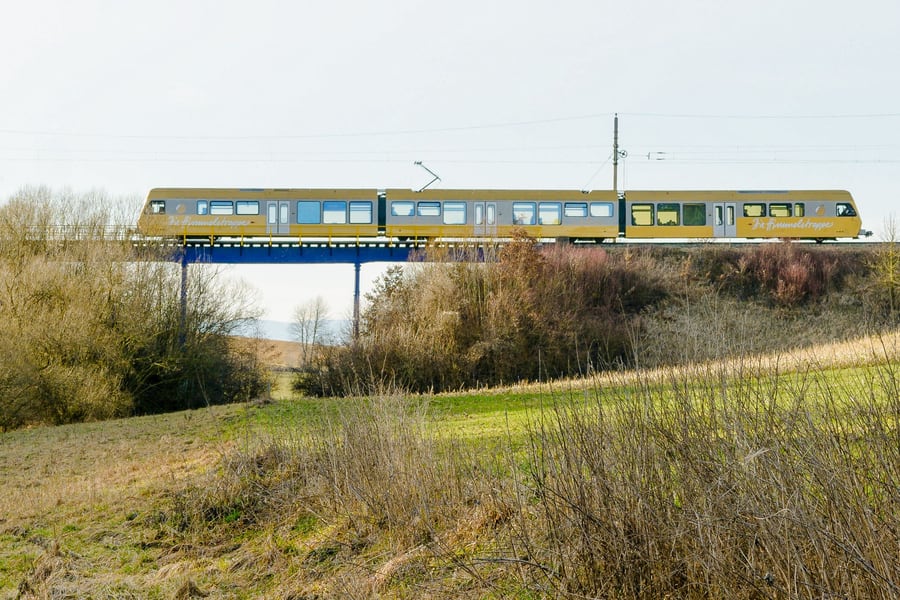
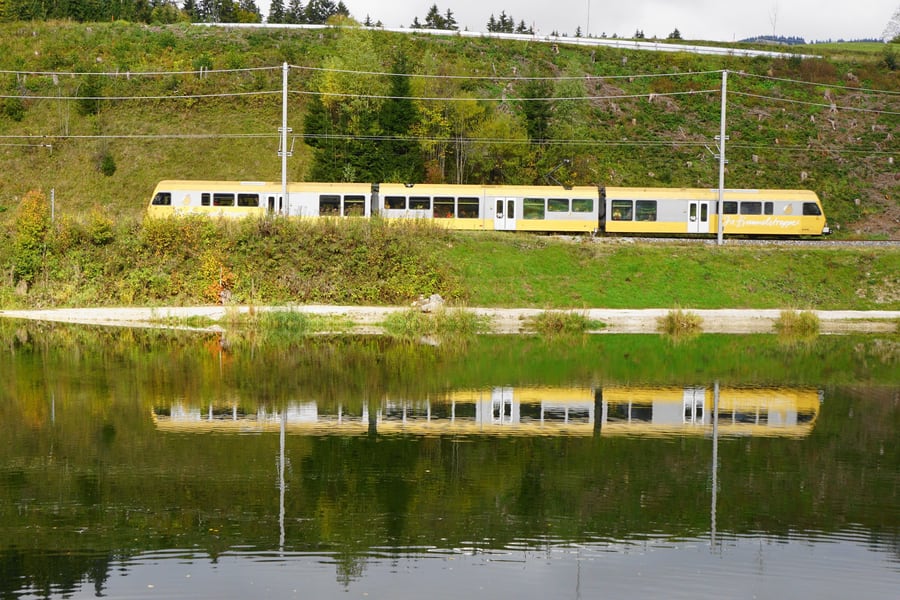
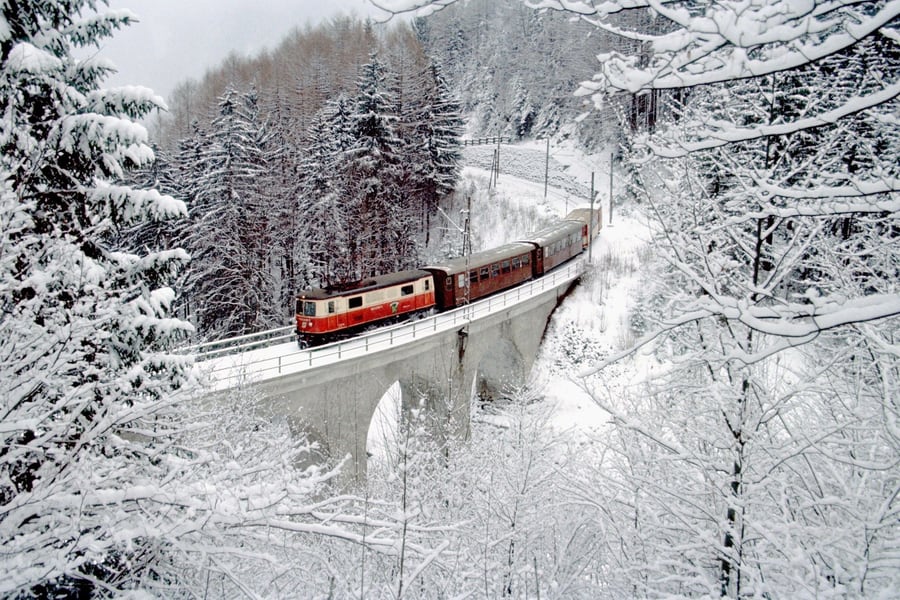
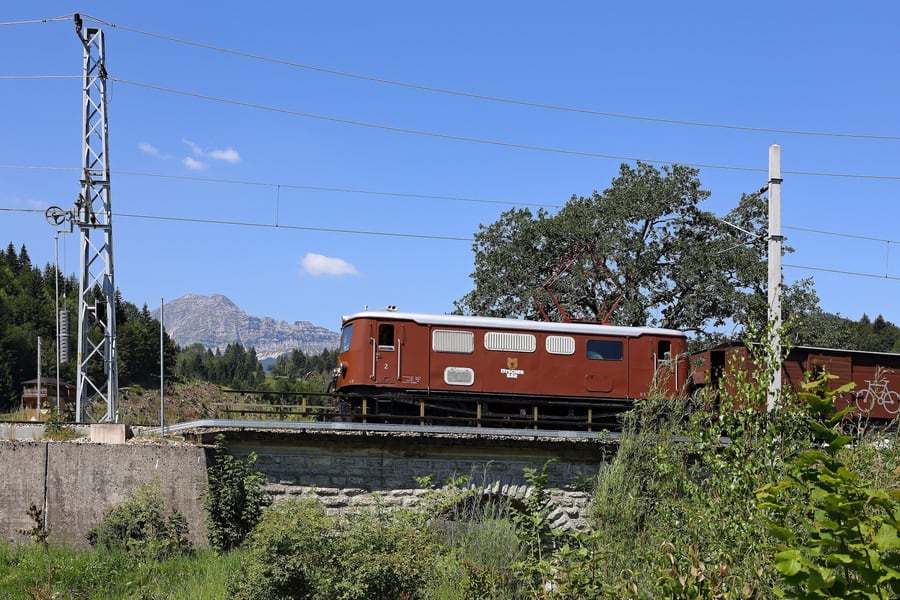
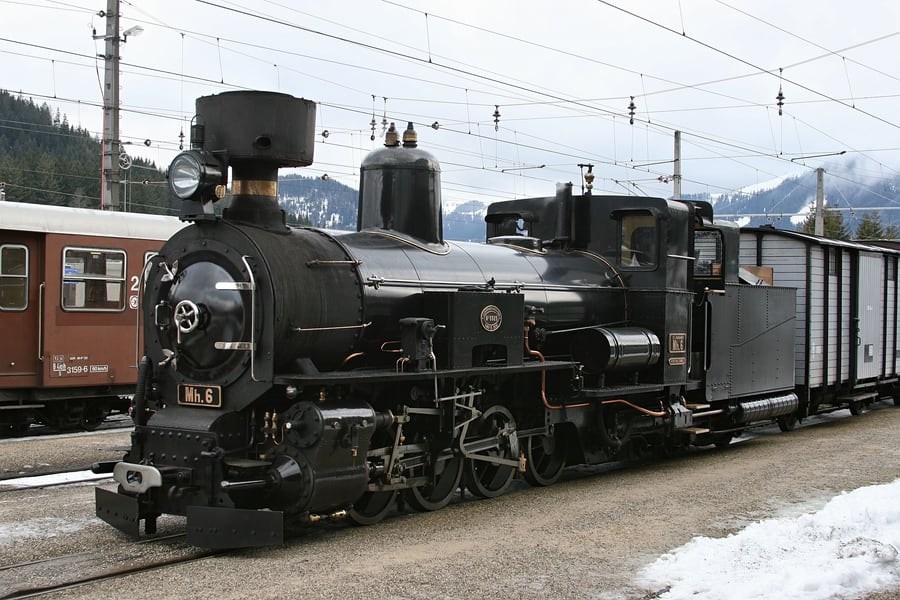
Since 2013 the everyday trains have been the Himmelstreppe, the Stairway to Heaven: low-floor electric units built by Stadler. But on summer weekends the Ötscherbär still runs behind one of the 1911 locomotives, which the operator counts among the oldest narrow-gauge electric engines in the world, and on a few Sundays the steam engine Mh.6, built for the line in 1908, comes back to the climb it lost.
The Journey
Trains leave from St. Pölten Hauptbahnhof, beside the main line from Vienna, and duck through two short tunnels to the Alpenbahnhof, the railway's depot and workshops. For the first hour the line is a country railway: it crosses farmland into the valley of the Pielach, the Dirndltal, named for the cornel cherries grown on its slopes, and calls at village after village on request. At Ober-Grafendorf the old engine shed, with its turntable, is home to the club that keeps the steam engine Mh.6.
The valley
Past Kirchberg an der Pielach the valley narrows until there is barely room for the river, the road and the track. The tunnels from here on were built for narrow-gauge stock only, which is why goods traffic on transporter wagons ended at Loich. Beyond Schwarzenbach the line leaves the Pielach for the gorge of the Nattersbach and reaches Laubenbachmühle, 535 metres up, where a modern operations centre now stands. Here the valley section ends and the mountain section begins.
The mountain
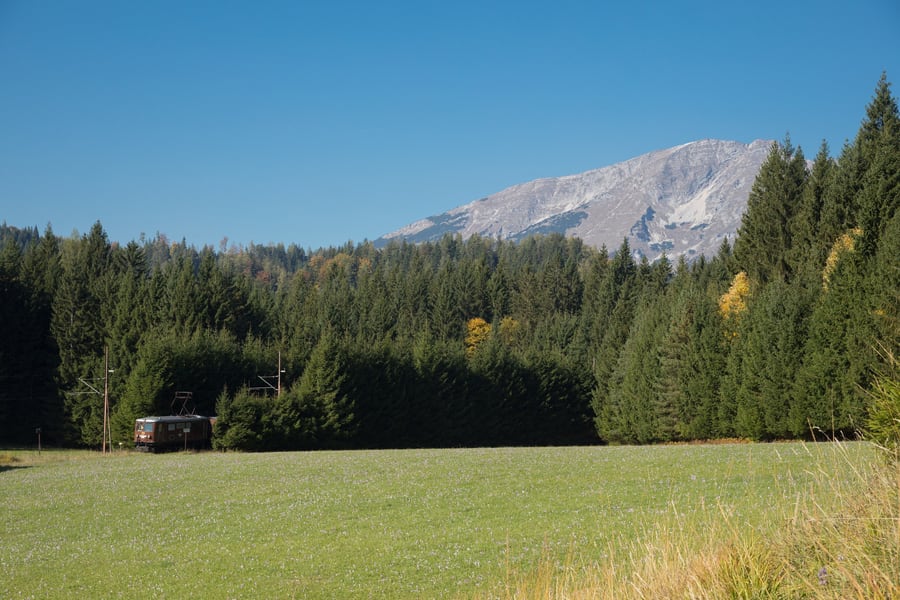
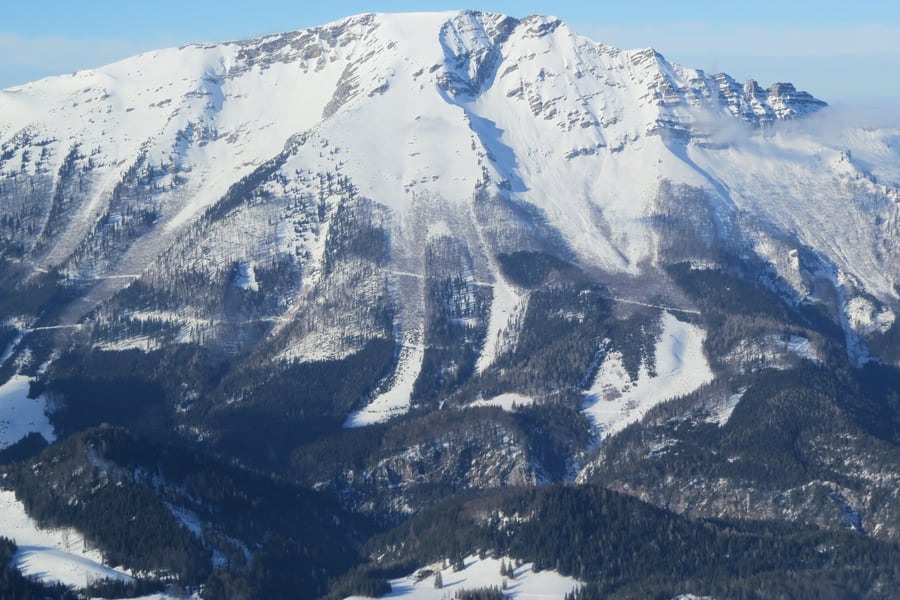
The line gains height in a long double loop above the Natters valley, across viaducts and through short tunnels, to Winterbach at 719 metres and Puchenstuben at 804. The gradient reaches 28 per mille only on two short stretches; the average is about 23, the figure the engines were built for. The line's summit, 892 metres, is inside the Gösing tunnel, 2,369 metres long and the longest on any Austrian narrow-gauge railway. Trains come out of it into Gösing station, where passengers get their first view of the Ötscher, 1,893 metres, across the valley.
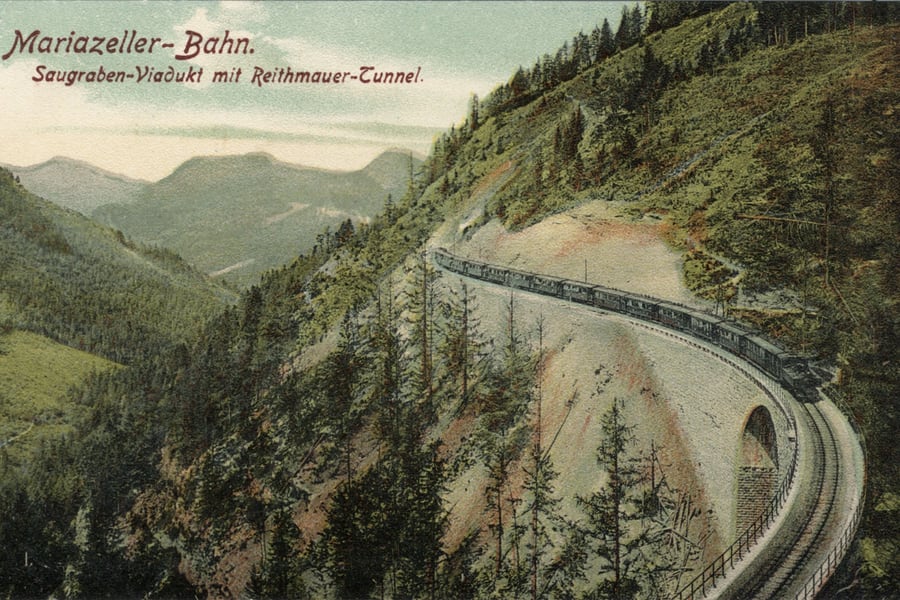
From Gösing the line runs downhill along a steep wooded mountainside, over the Saugraben viaduct, the highest on the line, to Annaberg, and then round the reservoir that feeds the Wienerbruck power station. Between Wienerbruck and Erlaufklause, in a run of short tunnels, the train looks down into the Zinken, the rocky gorge of the Erlauf, the stretch usually counted the finest on the line. Soon after Mitterbach, the last stop in Lower Austria, the train crosses into Styria and stops at Mariazell, 849 metres up and some way outside the town centre; buses meet the trains for the short run into town. The line once continued 7 kilometres to Gußwerk; that section closed in 1988.
The trains
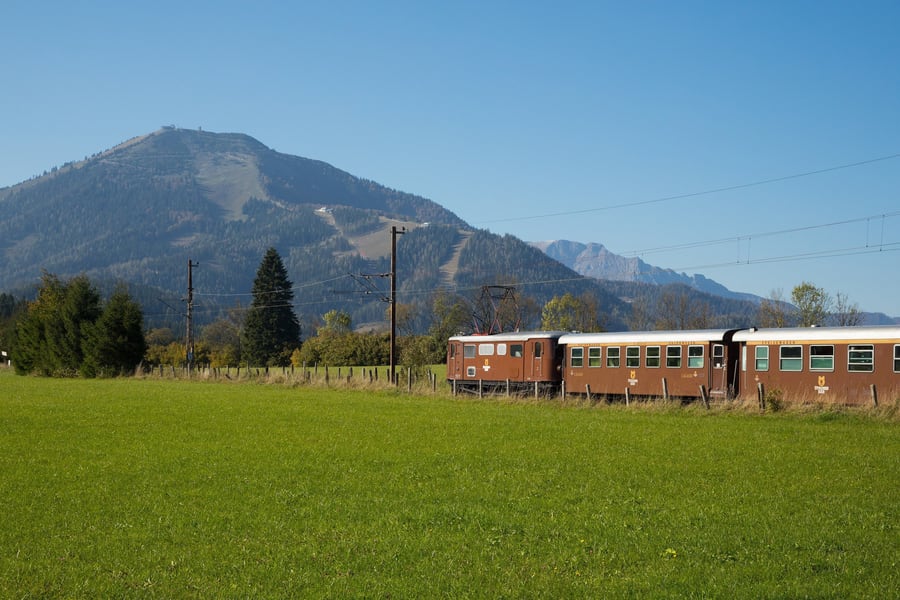
The everyday trains are the nine three-car Himmelstreppe units built by Stadler, which took over the whole timetable in October 2013. They are air-conditioned, step-free and take bicycles if booked. At weekends in summer, Panoramawagen coaches with wooden tables and large windows run with them, serving breakfast, ordered in advance, on the way up. The Ötscherbär is a heritage train of old coaches, a buffet car, a play car for children and, in summer, an open observation car, hauled by one of the electric locomotives of 1911, rebodied from 1960 and known as class 1099. And on a handful of Sundays the Mh.6 takes a train of old coaches, a dining car and a first-class saloon all the way to Mariazell.
Along the route
 Grubernst / Wikimedia Commons · CC0 · cropped
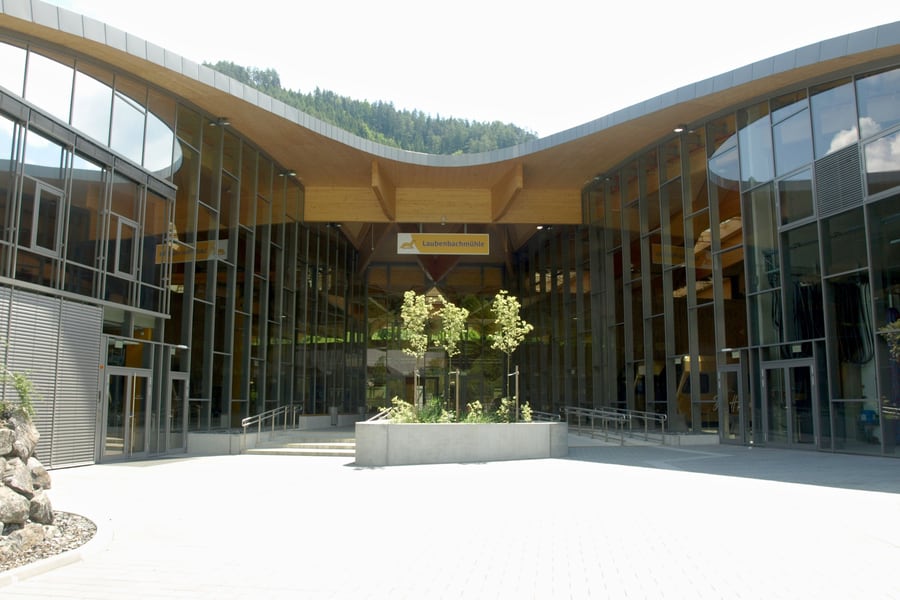
Laubenbachmühle, where the climb begins
The valley section ends here, 535 metres up. The operations centre, finished in 2013, holds the workshop, the control centre, a bistro and a visitor portal, and won Lower Austria's timber-building prize. Guided tours are given if booked ahead.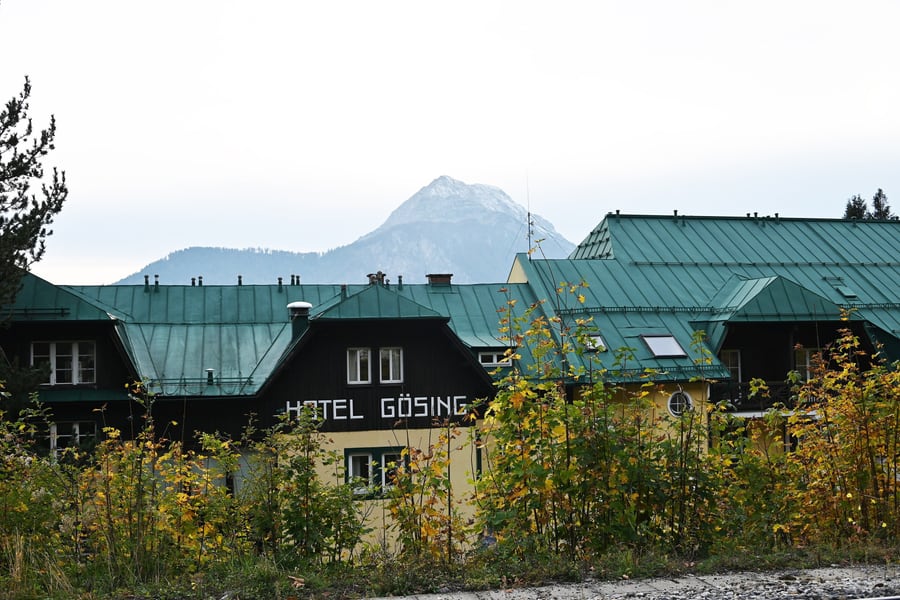 Josef Moser / Wikimedia Commons · CC0
Gösing and the Ötscher
Out of the 2,369-metre tunnel that holds the line's summit, the train stops at Gösing, 891 metres up, facing the Ötscher. The hotel beside the station began as lodgings for the railway's engineers and opened as the Alpenhotel in 1922; it has been closed since 2022.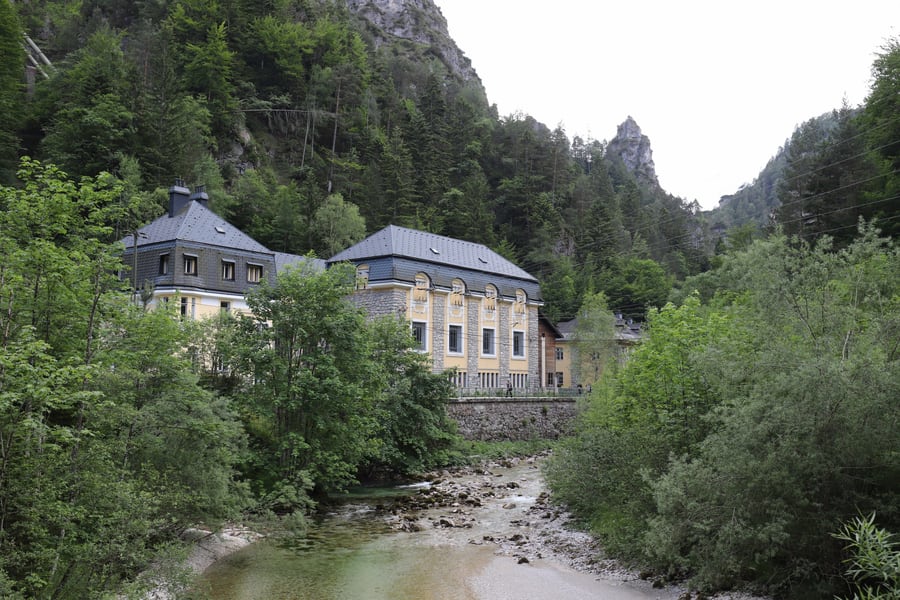 Herbert Ortner / Wikimedia Commons · CC BY 4.0
The railway's own power station
Built from 1908 to 1911 to power the electric line, the Wienerbruck station was the largest storage power station in Austria-Hungary when it opened. The trains have drawn on newer supplies since 2014; in May 2025 it stopped making railway current altogether. Josef Moser / Wikimedia Commons · CC BY-SA 4.0 · cropped
Into the Zinken
Between Wienerbruck and Erlaufklause the line threads short tunnels above the Zinken, the rocky gorge of the Erlauf, usually counted the finest stretch of all. Erlaufklause is a request stop for walks through the Ötschergräben or along the reservoir to Mitterbach.A bit of history
Culture & experiences along the way
 Marion Schneider & Christoph Aistleitner / Wikimedia Commons · Public domain
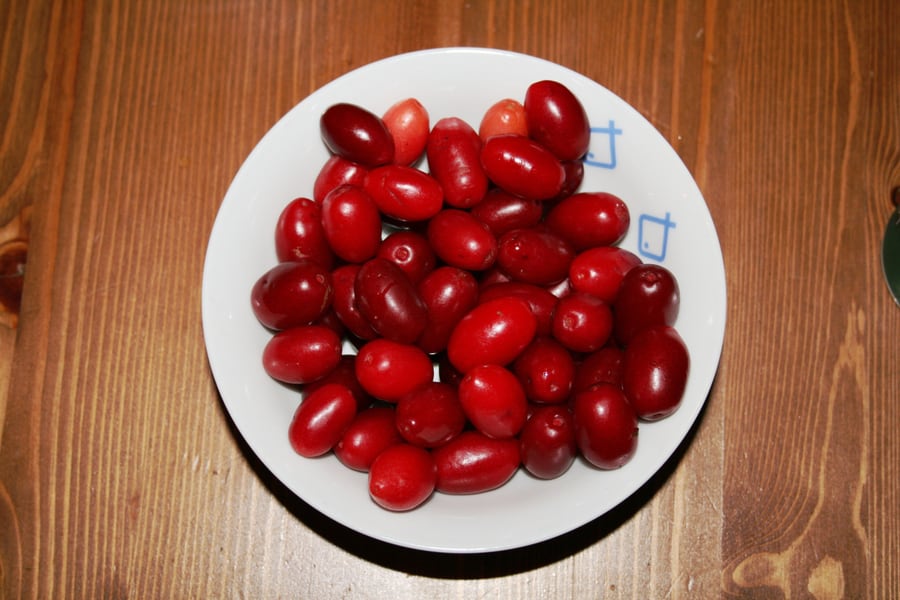
The Dirndl
The Pielach valley is the Dirndltal, named for the cornel cherry, a small sweet-sour red fruit it has been preserving for centuries from some 70,000 shrubs. The yellow blossom comes in late February, before the leaves, with guided walks; in autumn the Dirndlkirtag, in a different village each year, sells the spreads and liqueurs.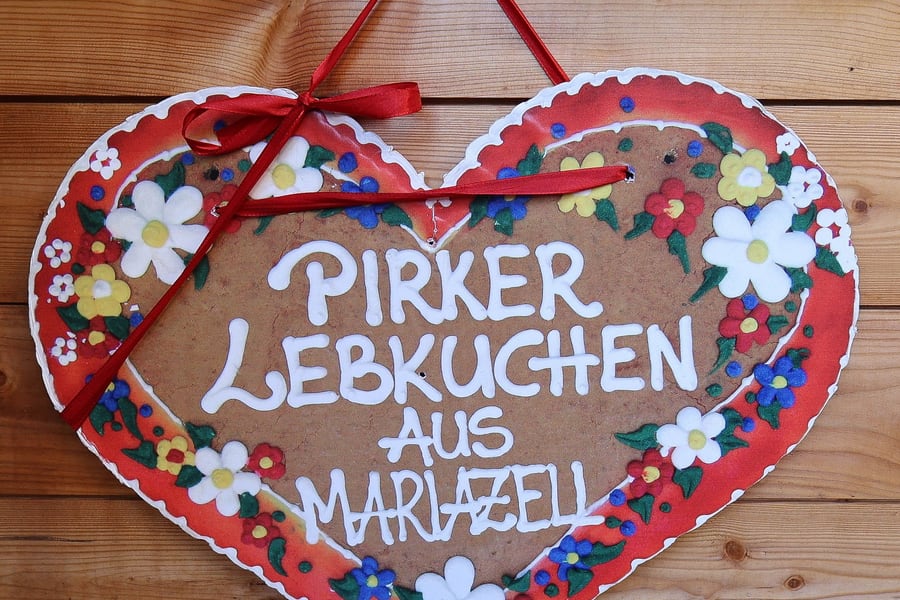 Naturpuur / Wikimedia Commons · CC BY-SA 4.0 · cropped
Mariazell gingerbread
Gingerbread-baker, wax-chandler and mead-maker were the trades of a pilgrimage town, and pilgrims bought honey gingerbread, which keeps, for the road. The Pirker family's recipes go back to 1826; at their erLebzelterei in the town centre you walk past the whole glass bakery and taste on the way.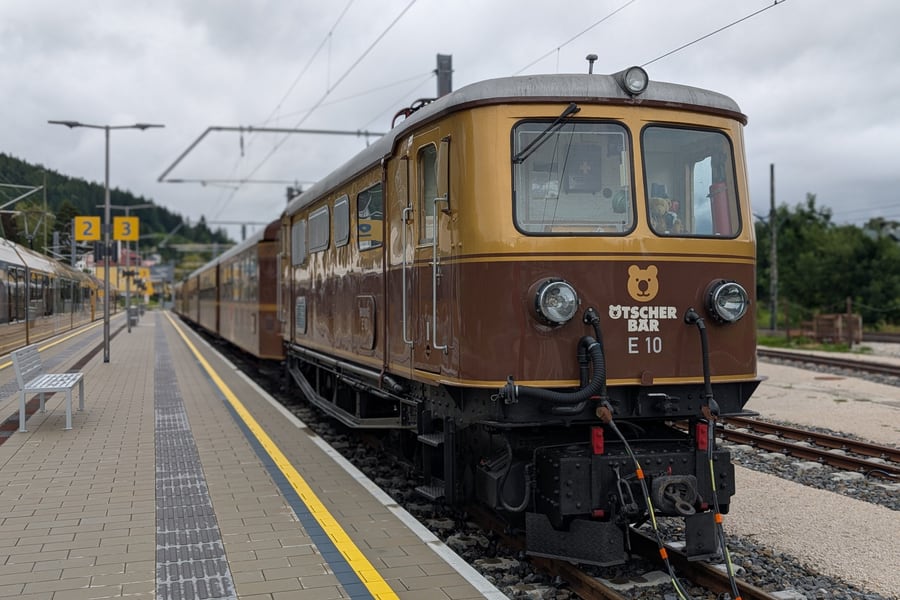 Sebastian Hausegger / Wikimedia Commons · CC BY 4.0 · cropped
A locomotive of 1911
The Ötscherbär runs behind one of the engines delivered for the electrification, which the operator counts among the oldest narrow-gauge electric locomotives in the world. Behind it come old coaches, a buffet car with food from the valley, a play car for children and, in summer, an open observation car.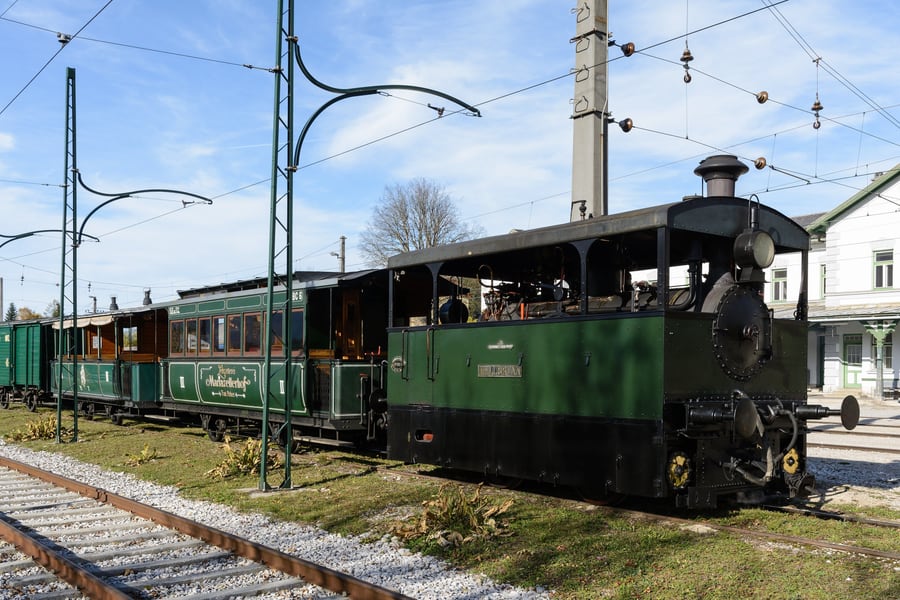 Uoaei1 / Wikimedia Commons · CC BY-SA 4.0
The steam tram to the Erlaufsee
Beside the narrow-gauge terminus starts a standard-gauge museum tramway, built new as a museum line rather than revived, that runs to the Erlaufsee in summer. Its collection, protected as a monument, includes the Vienna tramway's only working steam tram engine. In 2026 the season opened on 23 May.Timetables
The Mariazellerbahn runs every day, all year. The Himmelstreppe trains take 2 hours 16 minutes from end to end, and most of the day there is a through train about every hour, with gaps around midday. Many trains in the valley run only as far as Laubenbachmühle; the ones below go all the way.
Through trains, Monday to Friday
| St. Pölten Hbf | Mariazell | Mariazell | St. Pölten Hbf | |
|---|---|---|---|---|
| 06:37 | 08:53 | 09:06 | 11:22 | |
| 07:37 | 09:53 | 11:06 | 13:22 | |
| 08:37 | 10:53 | 12:06 | 14:22 | |
| 10:37 | 12:53 | 13:06 | 15:22 | |
| 11:37 | 13:53 | 15:06 | 17:22 | |
| 12:37 | 14:53 | 16:06 | 18:22 | |
| 14:37 | 16:53 | 17:06 | 19:22 | |
| 16:37 | 18:53 | 19:06 | 21:22 |
At weekends the same trains run, with an extra 09:37 up (arriving 11:53) and extra departures from Mariazell at 14:06 and 18:06, from 1 May to 1 November and from 21 November. From May to October a weekend express leaves St. Pölten at 08:05 and reaches Mariazell at 10:03, in under two hours.
The heritage trains
The Ötscherbär runs at weekends and on public holidays from 1 May to 1 November, and on Saturdays in Advent from 21 November 2026: St. Pölten 08:42, Mariazell 11:23; back from Mariazell at 15:21, in St. Pölten at 17:57. Seat reservations are strongly recommended.
The steam train with the Mh.6 runs on the second Sunday of each month from May to October (in 2026: 10 May, 14 June, 12 July, 9 August, 13 September and 11 October) and on the Sundays of Advent from 22 November: St. Pölten 09:02, Mariazell 12:23; back at 15:36, in St. Pölten at 18:57. On those Sundays it runs in place of the Ötscherbär.
Engineering work
From 2 to 20 November 2026 the whole line is closed for track work and buses replace the trains between St. Pölten and Mariazell.
Getting to St. Pölten
St. Pölten is on the main line west from Vienna. ÖBB trains from Wien Hauptbahnhof take about half an hour, and the operator's timetable shows a connection into every Mariazell train.
Times as of October 2026, from the Mariazellerbahn's 2026 timetable (opens in a new tab), valid until 12 December 2026, checked against ÖBB's journey planner.
Tickets
The Himmelstreppe and the Ötscherbär are part of the regional transport network, so they cost the same: a single from St. Pölten to Mariazell is €22, and a day return, on which you can get on and off as often as you like, is €42.90. Tickets are sold online, at ÖBB ticket machines and counters, in the ÖBB and VOR apps, and on board at no extra charge, in cash or by card. Children under six travel free, two per adult; from six to fourteen they pay half.
The Panoramawagen and the steam train have their own fares, and breakfast in the Panoramawagen must be booked at least 24 hours ahead. An ÖBB Vorteilscard takes 40 % off the regular fares. Bicycles need a reservation: €5 for the whole line. Fares as of February 2026, read from the operator in October 2026.
Book your tickets
St. Pölten – Mariazell, single
€22 adult · €11 child 6–14 · Himmelstreppe or Ötscherbär
The regional fare, also sold at ÖBB machines and on board at no extra charge.
Book Tickets (opens in a new tab, on Mariazellerbahn)via MariazellerbahnDay return, hop on and off
€42.90 adult · €21.50 child 6–14
Any number of journeys along the line on one calendar day.
Book Tickets (opens in a new tab, on Mariazellerbahn)via MariazellerbahnPanoramawagen
€40 adult · €20 child, one way
A seat in the panorama coach at weekends in summer and in Advent, with breakfast to order.
Book Tickets (opens in a new tab, on Mariazellerbahn)via MariazellerbahnSteam train with the Mh.6
€68 return, second class
The whole line behind the 1908 engine on the steam Sundays.
Book Tickets (opens in a new tab, on Mariazellerbahn)via MariazellerbahnRail Passes
Interrail and Eurail do not cover the Mariazellerbahn. It is listed by name among the Austrian lines the pass is not valid on, so pass holders buy an ordinary ticket from St. Pölten.
The KlimaTicket Österreich does. Austria's annual all-network ticket is valid on the Himmelstreppe and the Ötscherbär, as are the regional VOR KlimaTickets, and on the Panoramawagen a KlimaTicket holder pays only the upgrade. Holders of an ÖBB Vorteilscard get 40 % off. The steam train is sold at its own special fare.
An Interrail pass still pays for the train from Vienna or Linz to St. Pölten, but the Mariazellerbahn itself is a separate €22 ticket each way. For this trip alone a pass is not worth buying; it earns its keep only on a longer journey through Austria.
Checked October 2026 against Interrail's table of railway companies (opens in a new tab) and the Mariazellerbahn's fares page (opens in a new tab).
Places to Visit
The line runs from a state capital to a shrine, and the best of the day lies in between: a valley of fruit orchards, a nature park whose gorges are reached only on foot, and a mountain and a lake on either side of the terminus. These six follow the train from St. Pölten to Mariazell.
 Karl Gruber / Wikimedia Commons · CC BY-SA 4.0 · cropped
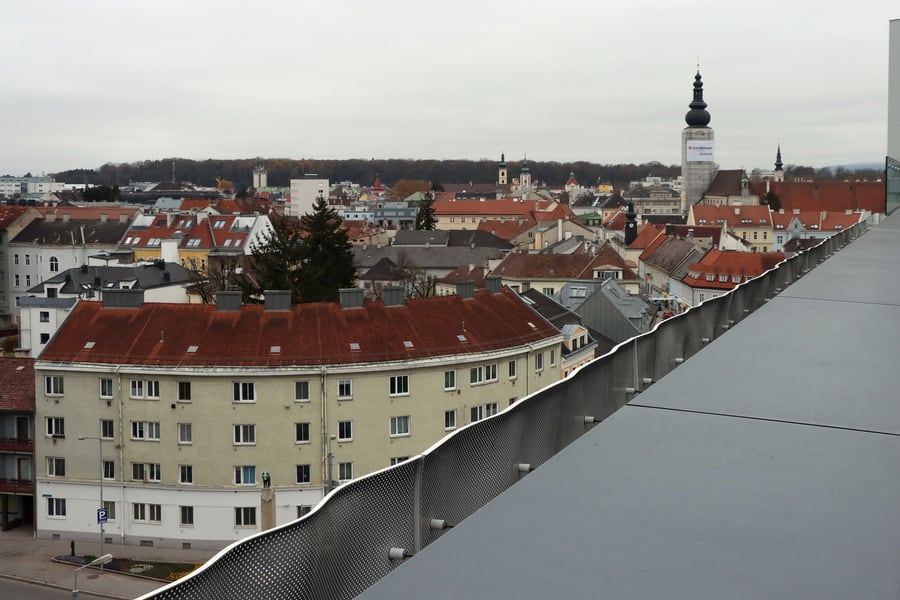
St. Pölten
The capital of Lower Austria, which the operator calls the country's oldest town and its youngest state capital. Baroque and Art Nouveau shape the old centre, and the government quarter and cultural district beside it add contemporary architecture. The Mariazellerbahn leaves from the main station, alongside the trains from Vienna.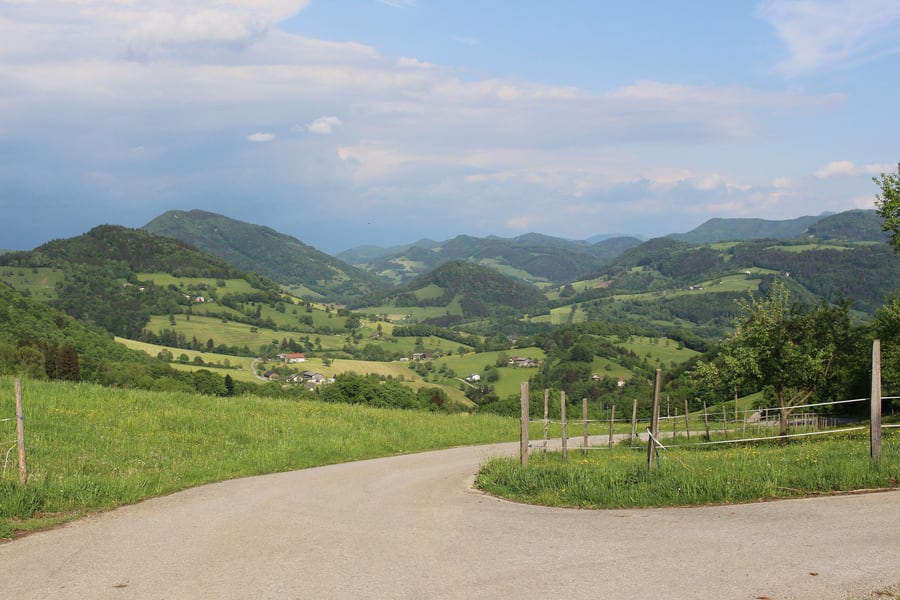 Braveheart / Wikimedia Commons · CC BY-SA 4.0
Kirchberg and the Dirndltal
The main village of the Pielach valley, in rolling farmland planted with cornel cherry. At the station, a model railway museum lays out the 30-kilometre mountain section at 1:87 on 120 square metres, with its 16 tunnels, nine viaducts and seven bridges. A walk round the village starts at the station.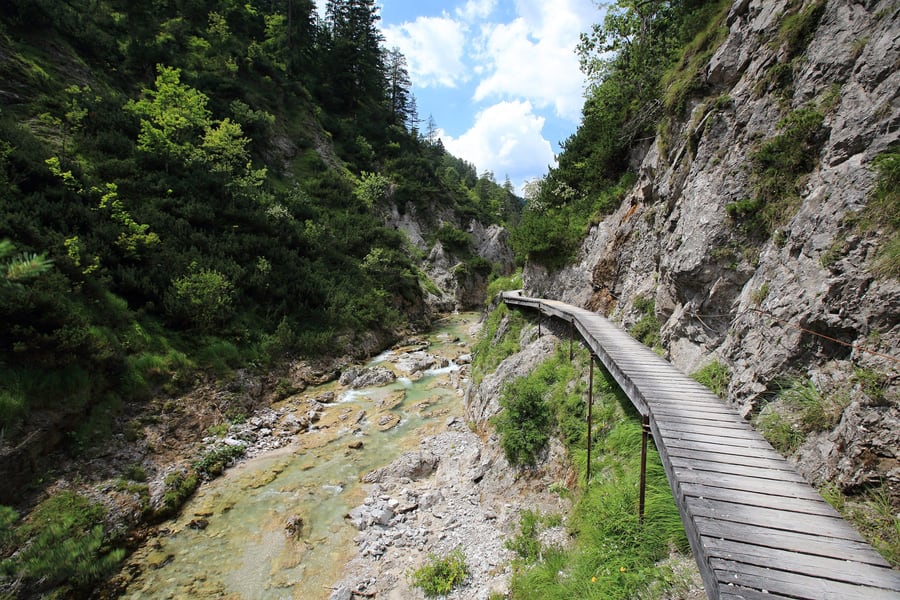 Martin Cígler / Wikimedia Commons · CC BY-SA 3.0
The Ötschergräben
The gorges below the Ötscher, which the operator calls Austria's Grand Canyon, are the heart of the Ötscher-Tormäuer nature park, the largest in Lower Austria; its founding stopped a planned dam on the Erlauf. From the nature-park centre at Wienerbruck, paths lead through the gorges past the Lassingfall, the state's highest waterfall, to Erlaufklause.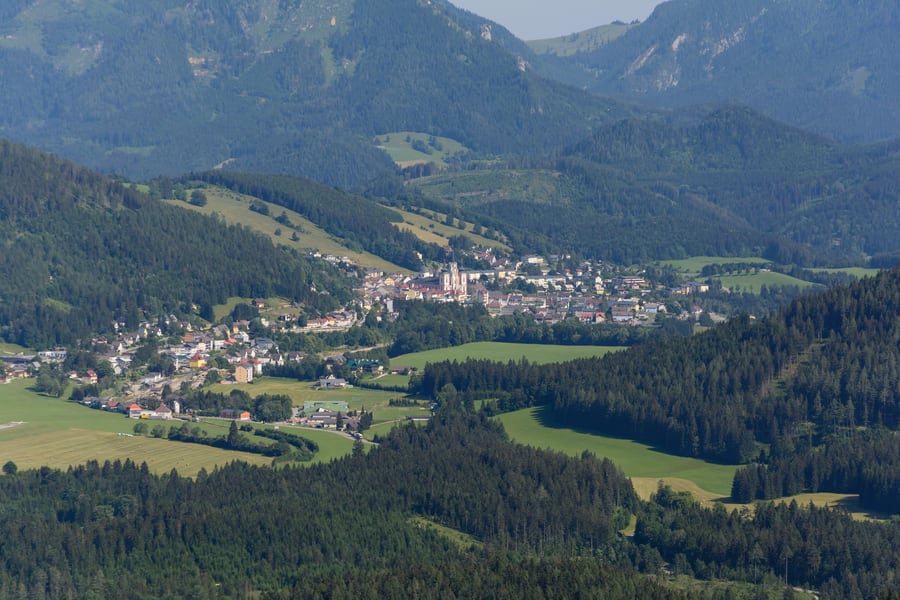 Uoaei1 / Wikimedia Commons · CC BY-SA 4.0
The Gemeindealpe
About 500 metres from Mitterbach station, two chairlifts climb from 800 to 1,626 metres, to a summit restaurant, an 800-metre panoramic loop path and a view across the Mariazellerland. In summer mountain carts run 4.6 kilometres back down from the middle station; in winter it is a ski area.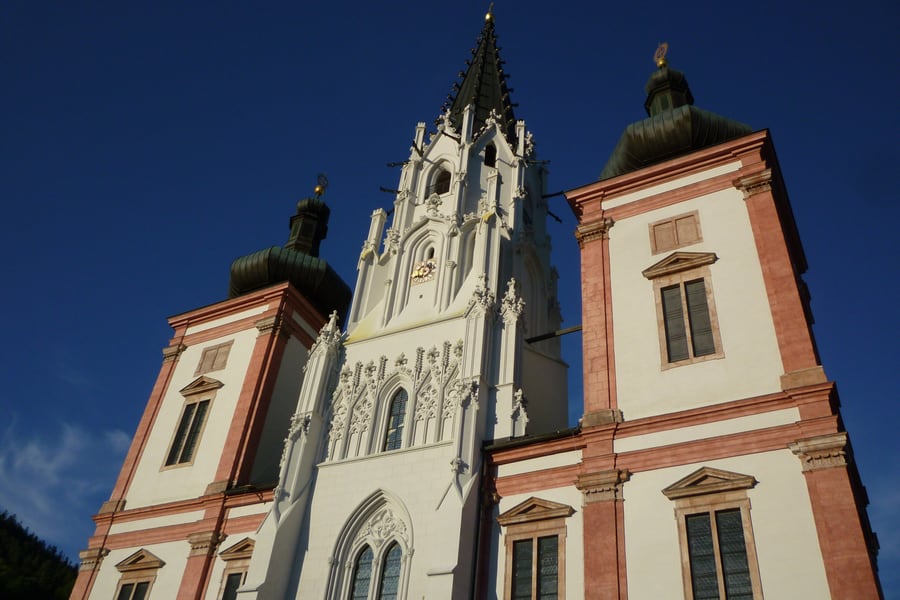 Uoaei1 / Wikimedia Commons · CC BY-SA 3.0 · cropped
The Basilica of Mariazell
Austria's most important place of pilgrimage. Tradition dates the first cell, built by monks of St. Lambrecht, to 1157. Domenico Sciassia rebuilt the Gothic church in the Baroque style from 1644, keeping its spire between two new towers. Inside is the Magna Mater Austriae, a limewood Madonna 48 centimetres tall. It was made a basilica in 1907, the year the railway arrived.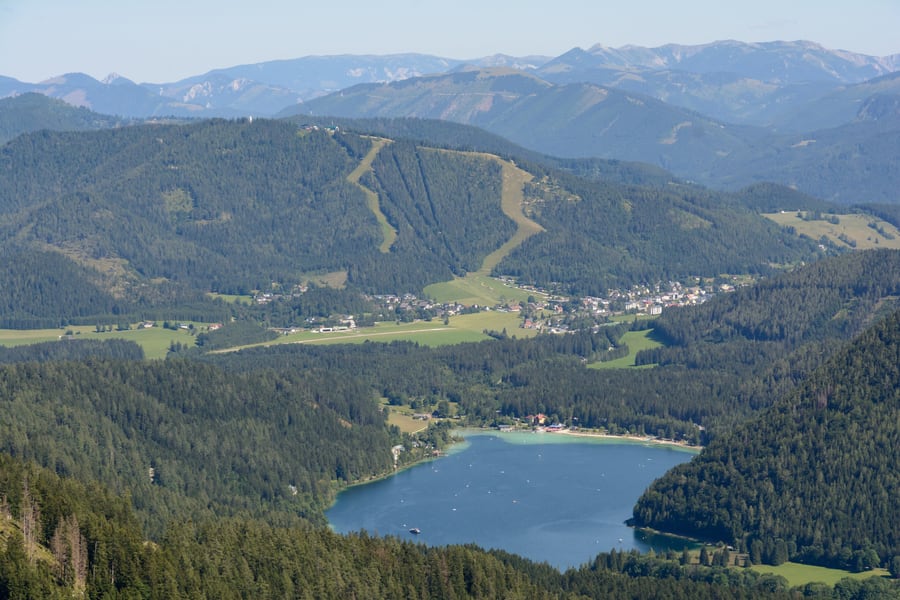 Uoaei1 / Wikimedia Commons · CC BY-SA 4.0
The Erlaufsee
A mountain lake at the foot of the Gemeindealpe, with the border between Lower Austria and Styria running through the middle of it and the Erlauf flowing through. There is a natural shingle beach on the south shore, and in summer the steam museum tramway runs to the lake from Mariazell station.Where to Sleep
Mariazell is the obvious place to stay, with the basilica a few minutes' walk away. For somewhere quieter, there is a hotel on the mountain section itself, at Winterbach.
Where to stay
 Naturpuur / Wikimedia Commons · CC BY-SA 4.0 · cropped
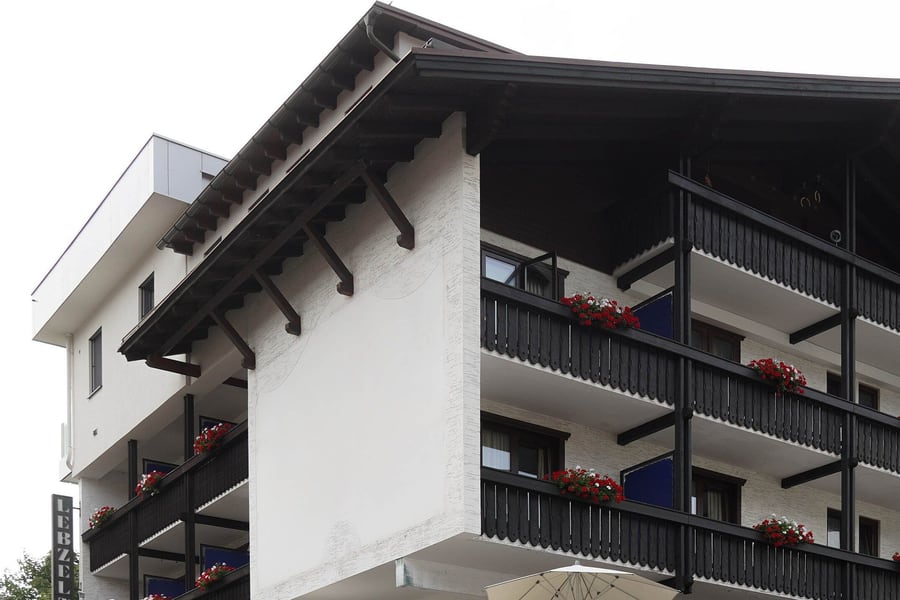
Pirkers Mariazellerhof
In the centre of Mariazell
The gingerbread family's hotel, with its café, cake shop and gingerbread shop on the ground floor, double rooms and junior suites and a terrace that looks onto the basilica.
Check Availability (opens in a new tab, on lebkuchen-pirker.at)via lebkuchen-pirker.at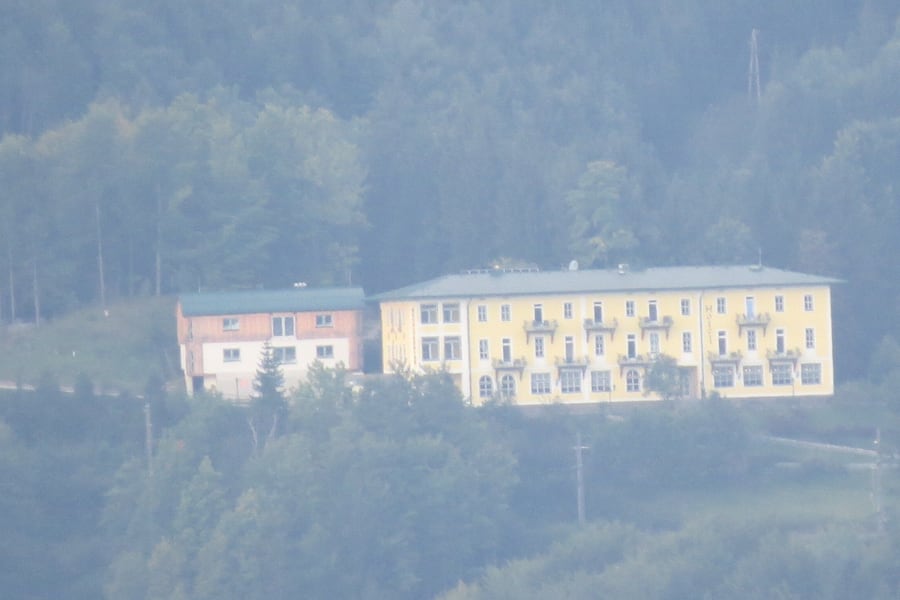 GT1976 / Wikimedia Commons · CC BY-SA 4.0 · cropped
Hotel Winterbach
On the mountain section, 740 metres up
A country hotel at Winterbach, the first stop on the climb, where meals are brought to the table on an LGB model railway; it has a 20-metre pool, a herb garden and holiday flats.
Check Availability (opens in a new tab, on hotel-winterbach.at)via hotel-winterbach.atQuestions or corrections
Planning this trip and stuck on something, or spotted a time, fare or detail that has changed? Send us a message about Mariazellerbahn. We read every one, and we update this page when something has changed.