Maribo to Bandholm: Denmark's oldest heritage railway
Leif Jørgensen / Wikimedia Commons · CC BY-SA 4.0
- Distance8 km · 27 min each way
- DurationAbout 2 hours return
- Best seasonEaster to early December · steam Thu & Sun, diesel Wed in summer
Introduction
Denmark's oldest heritage railway is eight kilometres long, and it begins by going backwards.
The Museumsbanen Maribo–Bandholm runs on the line that opened on 2 November 1869 as the Maribo–Bandholm Jernbane: the first railway on Lolland and Falster, and the country's first private railway. It exists because Maribo is one of the few Danish market towns set inland, with no water of its own. The town's harbour was eight kilometres away at Bandholm, on the north coast, and the grain, coal, lime and sugar that made Maribo prosperous had to be carted there. A horse-drawn railway was proposed in 1861; the company that got the concession in 1869 built a real one instead, and had it open for traffic before the year was out.
Nobody worked out how it would meet the rest of the Danish network, because there was no rest of the network to meet. For its first five years the line ran from a temporary station in a merchant's yard on Maribo's market square to the quay at Bandholm, and touched nothing else. When the Lollandsbanen arrived in 1874 and gave Maribo a proper station, the Bandholm line crossed it at almost a right angle, and the only way to connect the two was to have Bandholm trains reverse into the station and reverse out again. The junction was rebuilt at the other end of the station in 1924. The trains still reverse today.
Scheduled passengers stopped in October 1952. Goods carried on to the harbour for another forty-seven years. In between, in 1962, the newly founded Dansk Jernbane-Klub was given permission to run museum trains here on Sundays and public holidays — when no goods train needed the track. That arrangement started what is now Denmark's oldest heritage railway, and it still runs steam and diesel over the same eight kilometres, from Easter to the Christmas trains in early December.
The Journey
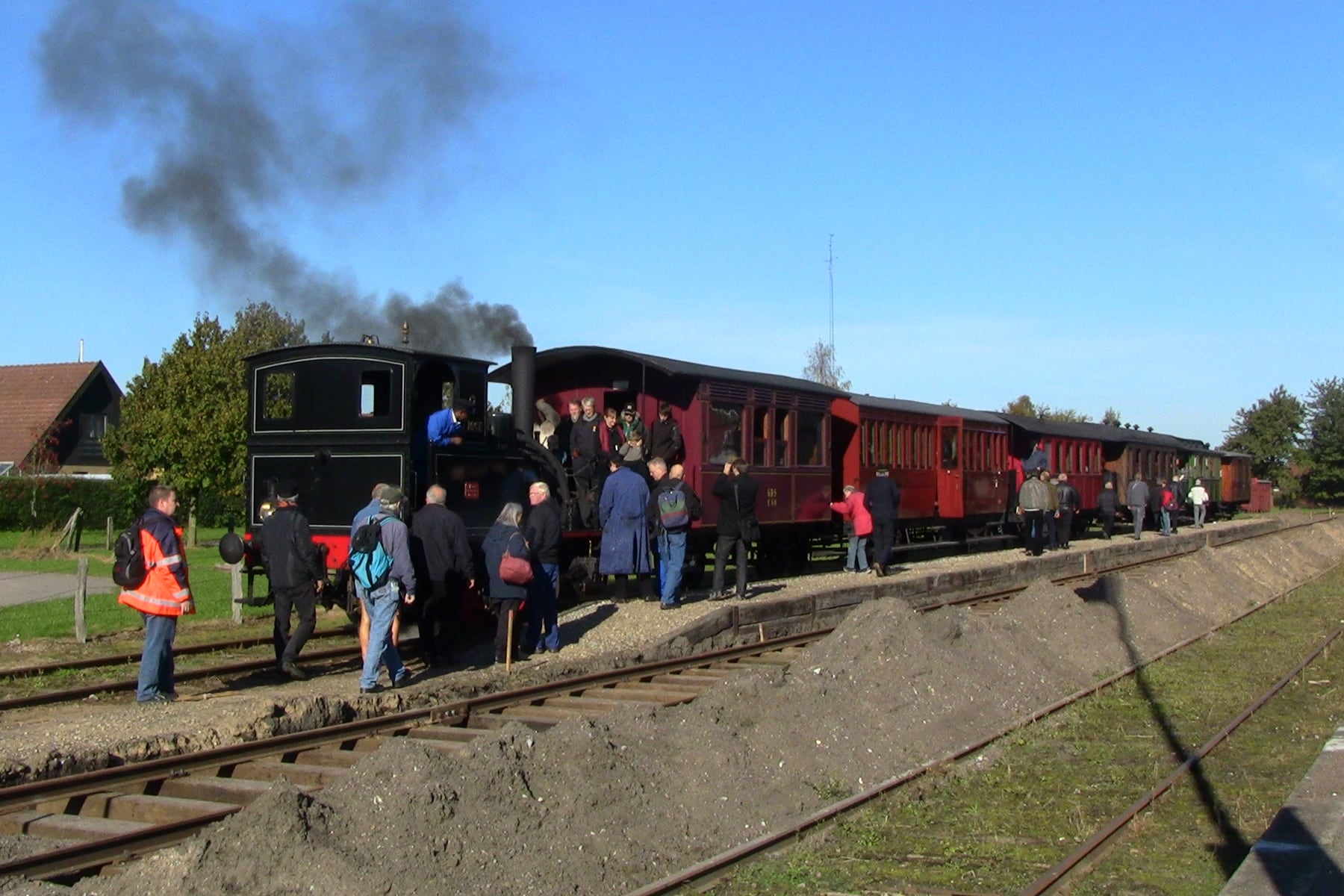
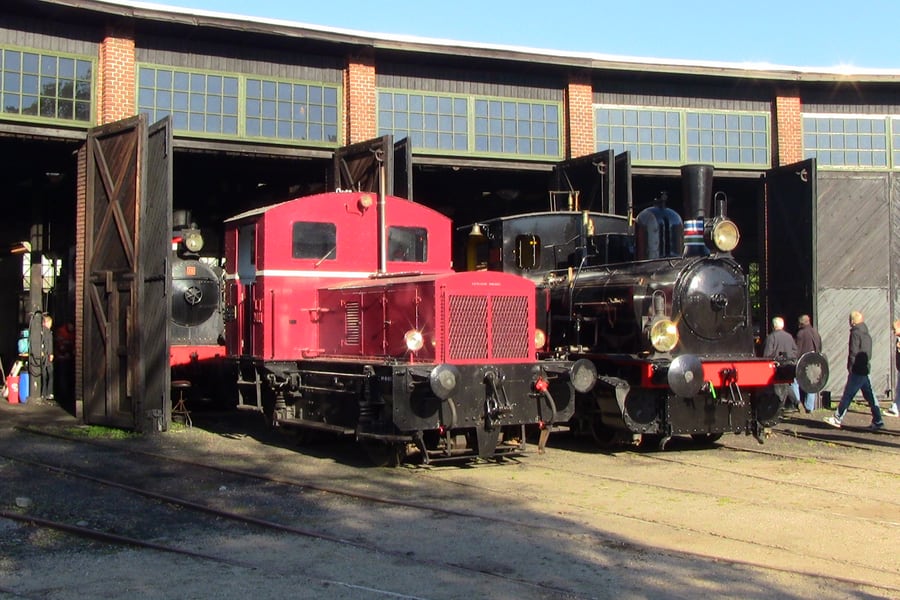
The train stands at platform 2 at Maribo, which is the museum railway's own. Tracks one and three belong to Lokaltog, whose modern railcars work the Lollandsbanen between Nykøbing Falster and Nakskov; platform two is where a steam locomotive built in 1879 waits with a rake of wooden carriages. Because the two railways were never designed to meet, the departure is a reversal: the train draws back out of the station before setting off north, past the museum's own roundhouse, a semicircular shed built between 1918 and 1924 and now the workshop where the collection is kept running.
The locomotives
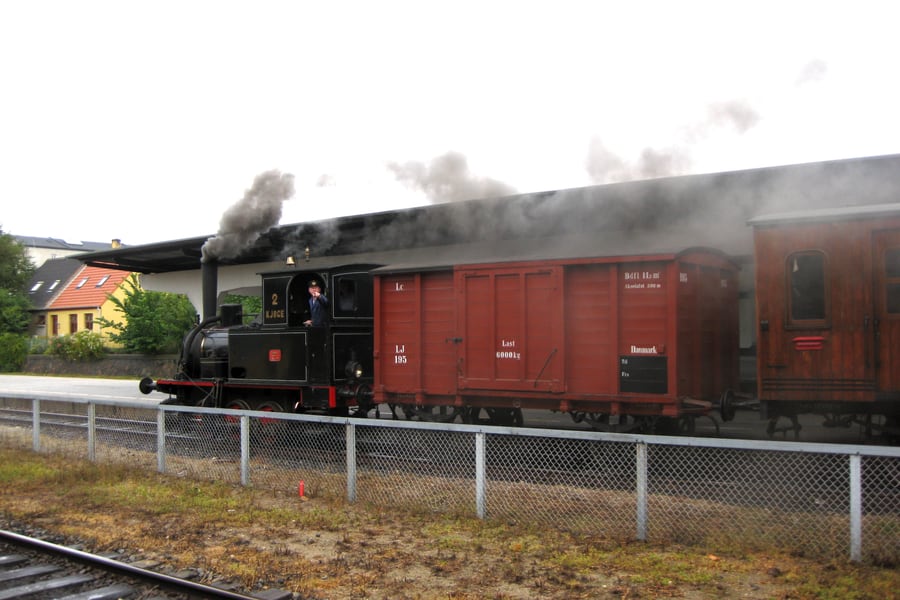
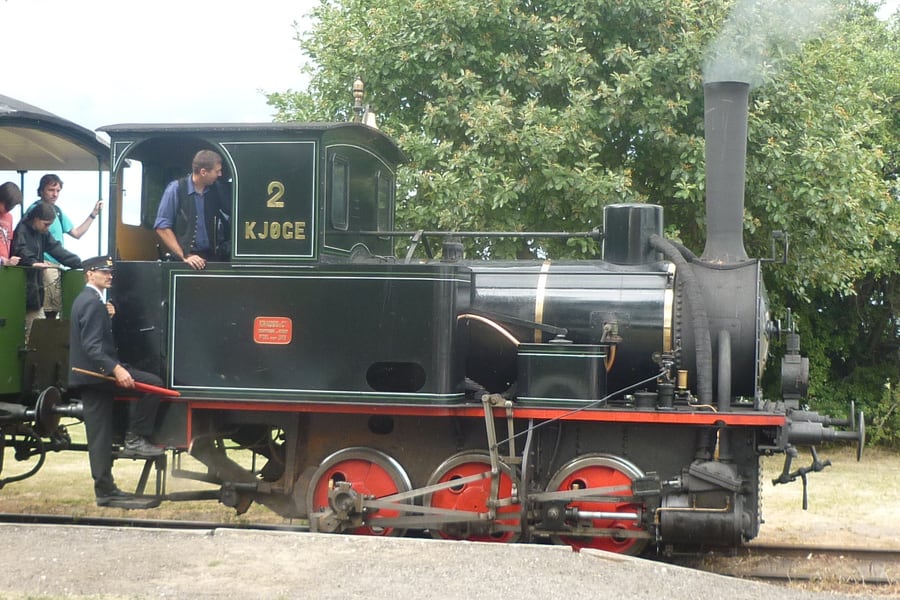
The engine most likely to be on the front is ØSJS 2 "KIØGE" — built by Krauss in 1879, 18.3 tonnes, 800 mm driving wheels, and a maximum permitted speed of 30 km/h, which is more than this line asks of it. The museum describes it as one of the oldest working steam locomotives in Denmark. The newest steam engine in the collection is LJ 19, a Henschel of 1920. On diesel days the train is worked by a motor locomotive rather than steam, and the collection's strangest exhibit stays at Maribo: LJ M 1 of 1921, reckoned to be the world's oldest working diesel locomotive.
Behind the engine, the carriages date from 1869 to 1917 and no two are alike — first-class compartments with upholstered sofas, third class with bare wooden benches, and a packvogn at the end that still carries the luggage, the prams and the bicycles, as the old operating practice required. One carriage in the train, MBJ A1, was built for the opening of the Maribo–Bandholm Jernbane in 1869 as the count's saloon. The Knuthenborg estate was one of the railway's two main shareholders and owns the harbour at the far end of it, so the count had a carriage of his own in the train.
Eight kilometres, twenty-seven minutes
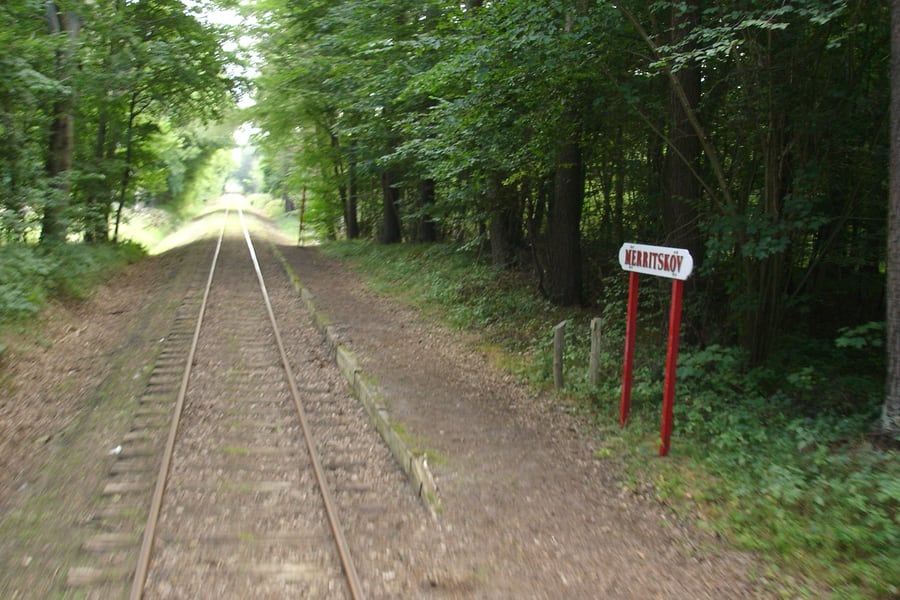
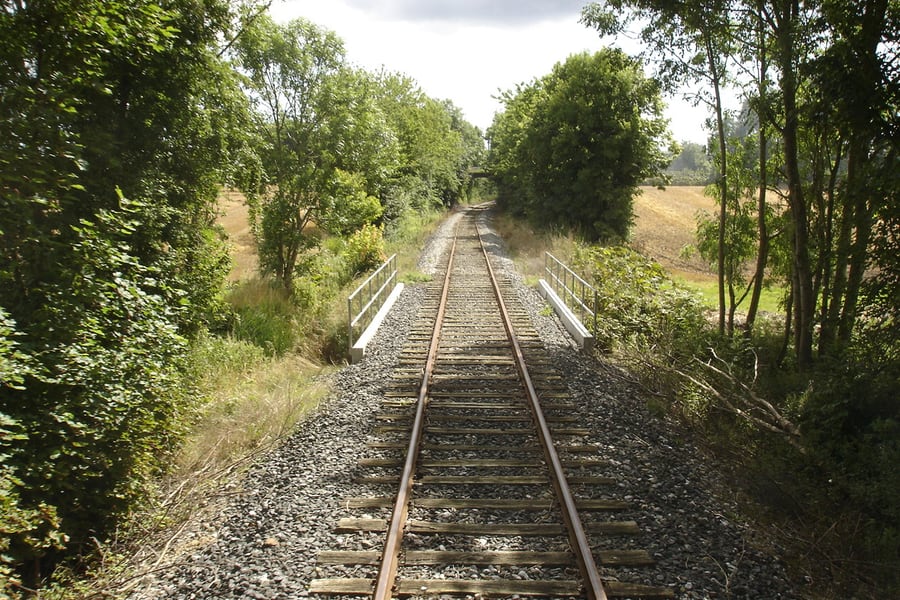
Out of Maribo the line runs north across flat Lolland farmland, past the halt at Grimstrup and over the bridge across the Hunse Å — a small stream doing a large job, since it is the single outflow of all four Maribo lakes into the Smålandshavet. Maglemer, at kilometre 4.1, is the one intermediate stop the working railway itself ever had. Grimstrup and Merritskov exist only on the heritage railway — two of the three halts on this line are there for the museum train and for nothing else.
Beyond Merritskov the track runs into an avenue of beech, close on both sides, and this is the prettiest stretch of the eight kilometres. Then the trees open, the line crosses Birketvej, and Bandholm station comes up ahead — twenty-seven minutes out of Maribo, at an average of about eighteen kilometres an hour.
Bandholm, and the run down to the quay
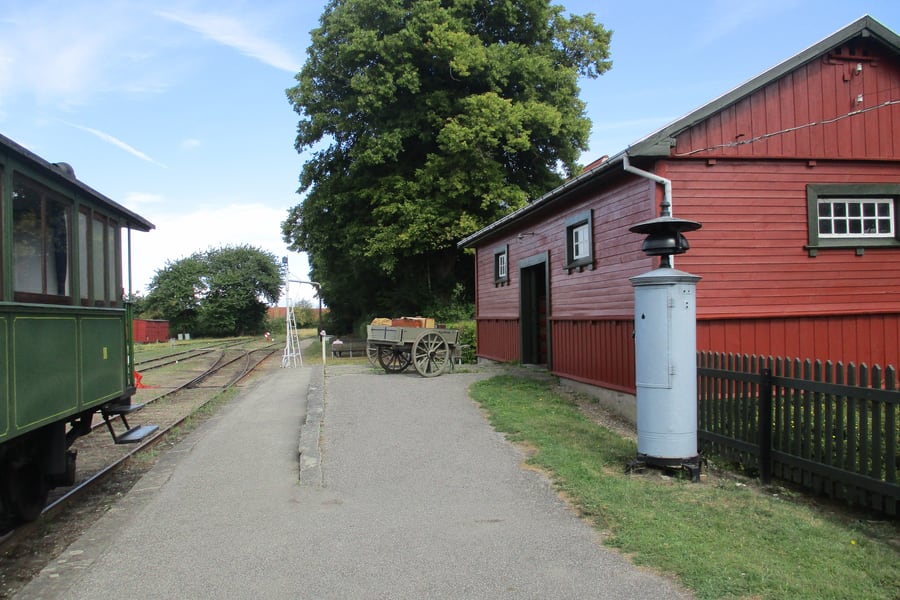
The station building of 1869 was listed in 1972 and bought outright by Dansk Jernbane-Klub in 1984, and what has been rebuilt around it since is a working station of about 1920: waiting room, ticket office and station office inside; goods shed, signals and water crane outside. The last stationmaster's parlour is kept as a permanent exhibition, furnished with his own things, given to the railway by his descendants. Coffee, ice cream and souvenirs are sold on the platform.
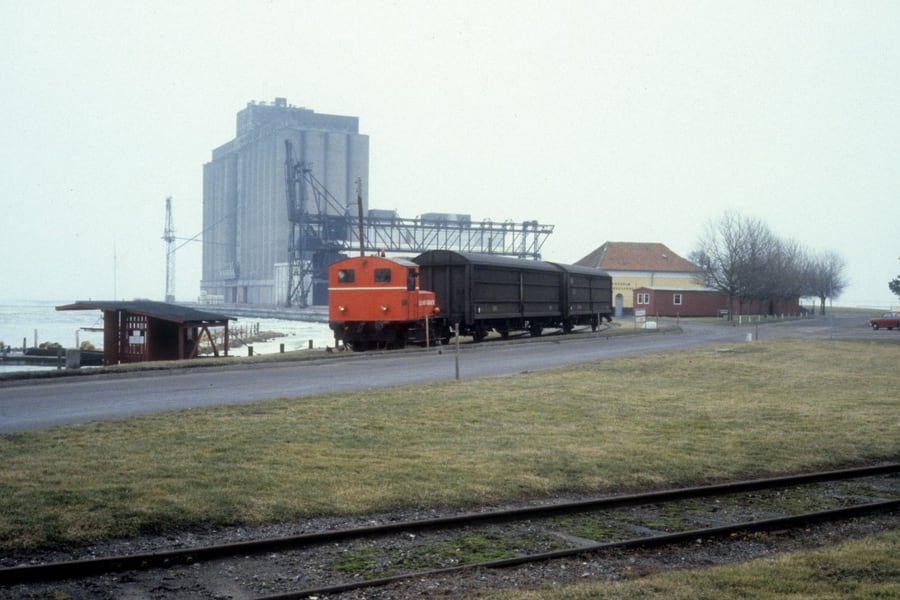
Most departures do not stop there. After a pause at the station the train carries on for another three minutes down to Bandholm Havn, the harbour that the whole railway was built to reach, waits ten minutes on the quayside and comes back. The sprawl of sidings that once served the grain, coal and sugar traffic was lifted in 2011; the single line the museum train uses is what survives of it. The round trip, with the stop at Bandholm, takes about two hours.
Along the route
Hubertus / Wikimedia Commons · CC BY-SA 3.0 · croppedThe junction nobody planned
The railway opened in 1869 and spent five years connected to nothing. When the Lollandsbanen arrived in 1874 it crossed this line at almost a right angle, and the only way to join them was to reverse the trains in and out of the new station. The trains still reverse.WSee / Wikimedia Commons · CC BY 3.0 · croppedA harbour eight kilometres away
Maribo is one of the few Danish market towns set inland, with no water of its own — its harbour was at Bandholm. The Knuthenborg estate, which owns the harbour, was one of the two main shareholders, and the count's own saloon carriage of 1869 still runs in the train.Kurt Rasmussen / Wikimedia Commons · Attribution licence · croppedAdmitted between the goods trains
Scheduled passengers ended in 1952, but the freight did not. When the preservation society was allowed in during 1962, the permission was conditional: museum trains on Sundays when no goods trains are running. It worked around the traffic for another thirty-seven years.A bit of history
Culture & experiences along the way
 Toxophilus / Wikimedia Commons · CC BY-SA 4.0 · cropped
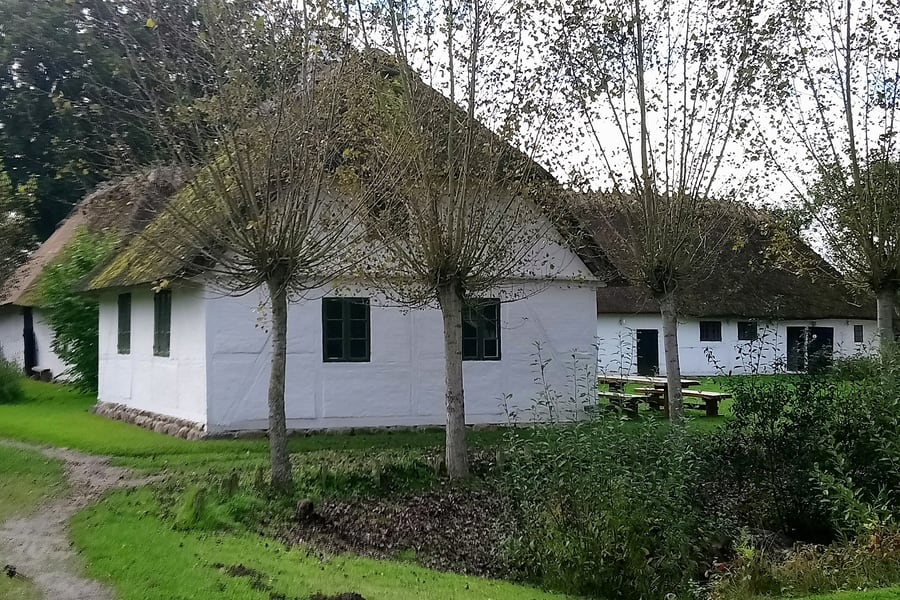
Lolland with the roofs still on
The open-air museum on the lake shore at Maribo is a working village of Lolland farm buildings taken down where they stood and rebuilt here — thatch, whitewash, box hedges, a smithy and a school. It is the countryside the train runs through, a hundred and fifty years earlier and standing still.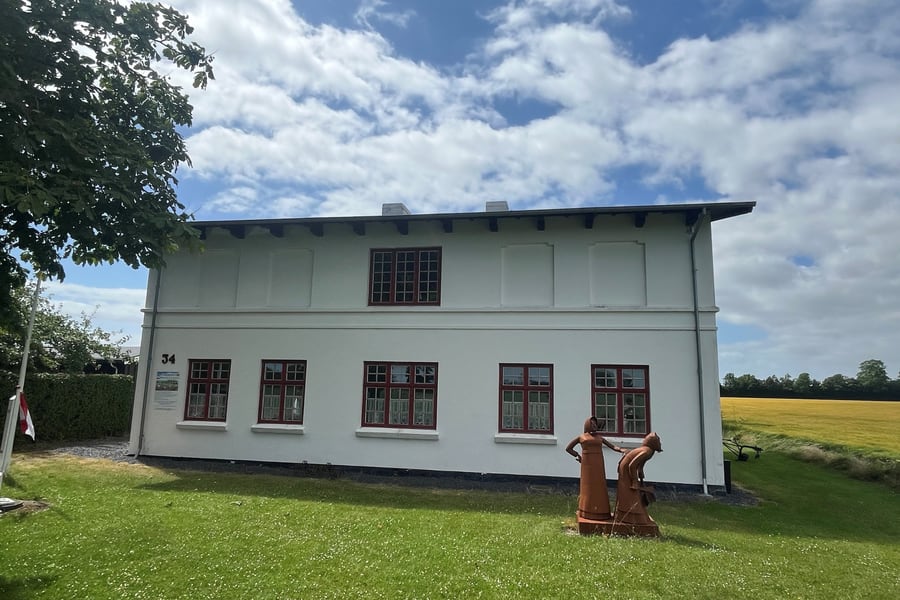 Økonom / Wikimedia Commons · CC BY-SA 4.0 · cropped
The Polish barracks
Lolland's sugar beet was thinned and lifted by hand, and from 1893 until 1929 the hands were Polish — mostly young women, housed out in the fields in dormitory blocks called polakkaserner. One of 1911 survives at Tågerup as a museum, and it is the plainest possible account of how this flat green island was actually worked.Timetables
This is a seasonal railway with a published operating calendar, not a daily service. The 2026 season opens with an Easter train in April and closes with the Christmas trains in early December, and the railway runs 50 to 60 operating days a year in total, worked entirely by unpaid volunteers.
Times below are the operator's own summer timetable, valid June to August 2026 and correct as of August 2026.
Steam — Thursdays and Sundays
Four departures are timetabled from Maribo. Not every one runs on every operating day: the railway's calendar marks each date with the departures on sale, so a given Thursday may offer A, C and D, and a given Sunday all four.
| A | B | C | D | |
|---|---|---|---|---|
| Maribo platform 2 dep | 10.15 | 12.15 | 13.15 | 15.15 |
| Bandholm arr | 10.42 | 12.42 | 13.42 | 15.42 |
| Bandholm dep | 11.10 | 12.45 | 14.10 | 16.10 |
| Bandholm Havn arr | 11.13 | 12.48 | 14.13 | 16.13 |
| Bandholm Havn dep | 11.23 | 12.52 | 14.23 | 16.23 |
| Bandholm arr | 11.26 | 12.55 | 14.26 | 16.26 |
| Bandholm dep | 11.35 | 14.05 | 14.35 | 16.35 |
| Maribo arr | 12.03 | 14.33 | 15.03 | 17.03 |
Diesel railcar — Wednesdays
Three departures, of which F and G include the run down to the harbour and E does not.
| E | F | G | |
|---|---|---|---|
| Maribo platform 2 dep | 10.15 | 12.45 | 14.45 |
| Bandholm arr | 10.42 | 13.12 | 15.12 |
| Bandholm dep | — | 13.40 | 15.40 |
| Bandholm Havn arr | — | 13.43 | 15.43 |
| Bandholm Havn dep | — | 13.53 | 15.53 |
| Bandholm arr | — | 13.56 | 15.56 |
| Bandholm dep | 11.05 | 14.05 | 16.05 |
| Maribo arr | 11.33 | 14.33 | 16.33 |
Outside the summer months the pattern changes: the season also carries Easter departures, a steam rally in late May, evening dining trains, coffee trains, a Halloween train and the December Christmas trains, each with its own times. The calendar on museumsbanen.dk (opens in a new tab) lists every operating date, and marks whether the train that day is steam or diesel.
Getting to Maribo
Maribo is on the Lollandsbanen, worked by Lokaltog as line 710R between Nykøbing Falster and Nakskov. From Nykøbing Falster the journey takes 26 minutes, with departures at :06 and :36 past the hour on weekdays — half-hourly from early morning to about 19.30 — and hourly at weekends. Nykøbing Falster itself is a direct 1 hour 15 minutes from Copenhagen Central, hourly.
That makes the museum railway a comfortable day out from Copenhagen: the 08.08 from København H reaches Maribo at 10.00, fifteen minutes before the first steam departure, and the 18.01 back gets in at 19.55. Times checked against the operator's published timetables in August 2026.
Tickets
The museum railway sells its own tickets and is not part of the Danish national fare system: a Rejsekort, a DSB ticket or a zone fare will not carry you on this train. An adult return is 120 kr and a single 60 kr; a child of 4 to 11 pays half, under-fours travel free, and a family of two adults and up to four children is 310 kr. A first-class supplement is 20 kr, bought on the train, and a bicycle 30 kr if there is room.
Returns from Maribo are sold on museumsbanen.dk (opens in a new tab), and the railway recommends buying ahead if being certain of a place matters; singles and anything starting at Bandholm are sold at that station or on the train. ⚠️ The carriages date from 1869 to 1917 and their doors are too narrow for a wheelchair to pass — passengers are carried as far as their own companions can lift them in and out.
Book your tickets
Return
120 kr adult · 60 kr child 4–11 · under-4s free
Maribo to Bandholm and back, bought online or from the crew on the day.
Book Tickets (opens in a new tab, on museumsbanen.dk)via museumsbanen.dkFamily ticket
310 kr for two adults and two to four children
The cheapest way for a family, and the usual purchase on a summer Sunday.
Book Tickets (opens in a new tab, on museumsbanen.dk)via museumsbanen.dkSingle
60 kr adult · 30 kr child 4–11
Sold at Bandholm station or on the train, not through the web shop.
Book Tickets (opens in a new tab, on museumsbanen.dk)via museumsbanen.dkRail Passes
No rail pass is valid on the museum railway. It is a private preservation society running its own trains on its own timetable, and its 60 kr single is the only ticket it accepts. That is the short answer, and it does not change with the season.
Where a pass does help is getting to Maribo. Interrail and Eurail are valid on DSB, which runs the Copenhagen–Nykøbing Falster service, and Interrail's own guidance lists Lokaltog among the local operators fully included in the pass — Lokaltog works the Lollandsbanen from Nykøbing Falster through Maribo to Nakskov. No reservation is needed on either leg. Checked against Interrail's published country information in August 2026.
Whether a pass is worth it for this trip
For the day out described here, almost certainly not. Copenhagen to Maribo and back is a short domestic return on a route where ordinary tickets are inexpensive, and a pass day spent on it is a pass day not spent on something longer. The Interrail Denmark Pass, a one-country pass, only starts to pay if Lolland is one stop on a wider Danish itinerary — Copenhagen, Odense, Aarhus, Aalborg — rather than the object of the journey.
The honest version: an ordinary DSB ticket to Maribo, the museum railway's own ticket on arrival, and the pass saved for a trip that covers more ground.
Interrail also sells the Nordic Pass (opens in a new tab), valid in Denmark, Norway, Sweden and Finland and across the borders between them: €218 for 3 travel days in a month for an adult in second class, against €137 for the Denmark Pass. It cannot be used in the country you live in, only in the other three. It pays only when the trip goes on into another Nordic country. Checked October 2026.
Places to Visit
Eight kilometres of railway does not take long, and both ends of it repay the time saved. Maribo is a small cathedral town wrapped around a lake system; Bandholm is a working harbour of 451 people with Northern Europe's largest safari park immediately to the south-east. The timetable is built around a stop of roughly half an hour at Bandholm, but a ticket back on a later train costs no more, which is what makes any of the four below possible in a day.
 Sorenknudsen / Wikimedia Commons · CC BY-SA 3.0 · cropped
Knuthenborg Safaripark
Northern Europe's largest safari park, on the estate that part-financed the railway and still owns Bandholm harbour, immediately south-east of the village. More than 500 animals across over 40 species live loose in areas laid out to match where they come from, and visitors drive or walk through them; about 300,000 people a year come. The park is open daily from 28 March to 18 October 2026, 10.00 to 17.00, and is still run by the Knuth family.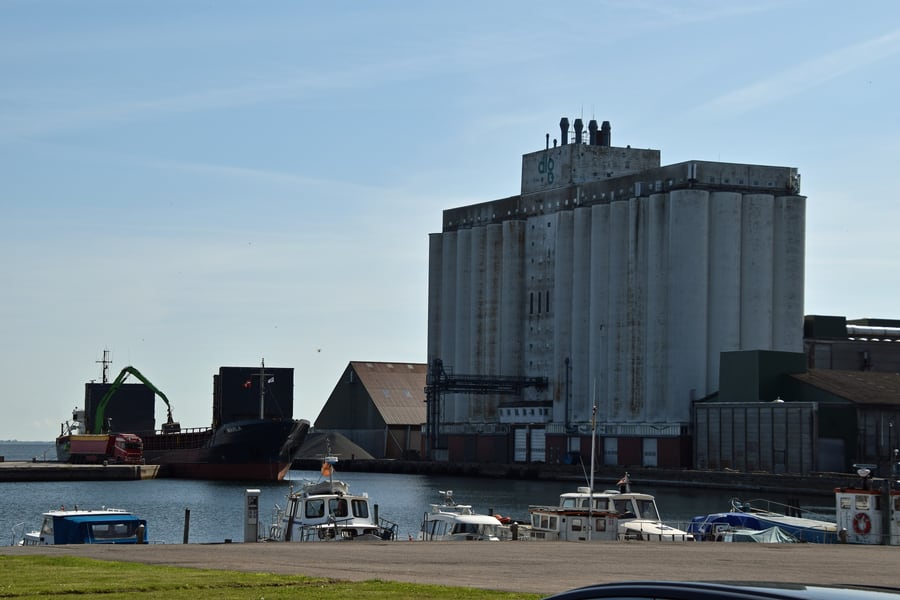 Thomas Dahlstrøm Nielsen / Wikimedia Commons · CC BY 4.0 · cropped
Bandholm Havn
The reason the railway exists, and the end of the line — the train runs right down onto the quay. Bandholm was a junction of sea and land traffic: ferries to the small islands of Askø, Fejø and Femø, and a port of call for shipping between Copenhagen and the western Baltic. The grain silo still stands over the harbour, and the village around it has 451 inhabitants.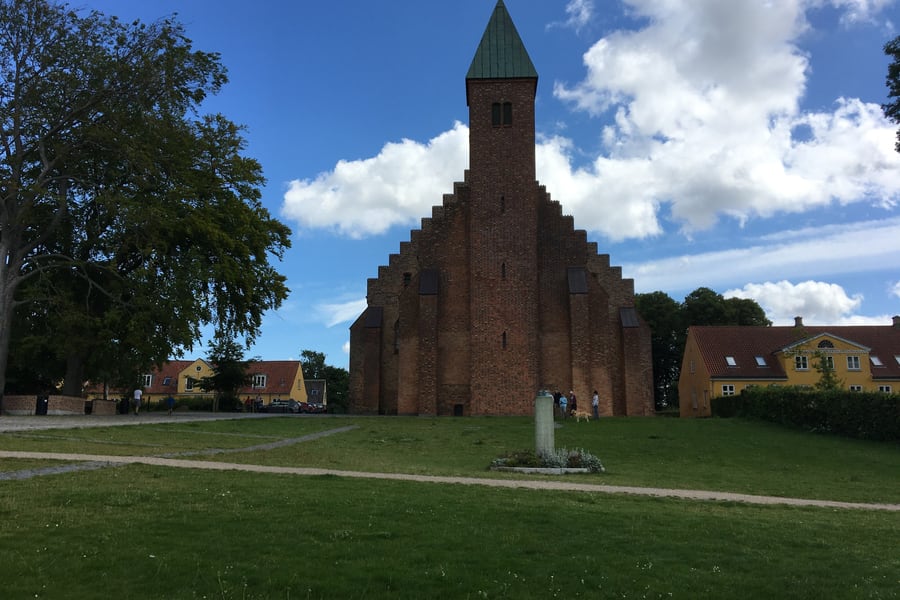 Toxophilus / Wikimedia Commons · CC BY-SA 4.0 · cropped
Maribo Domkirke
Monks and nuns were sent from Vadstena in 1416 to found a Brigittine convent at what was then called Skimminge; the town that grew around it took the name Maribo. The convent was dissolved in 1536, and when the old town church burned down in 1596 the abbey church took its place. It became a cathedral only in 1804, when Lolland-Falster was made a diocese of its own. It stands a short walk from Maribo station, beside the lake.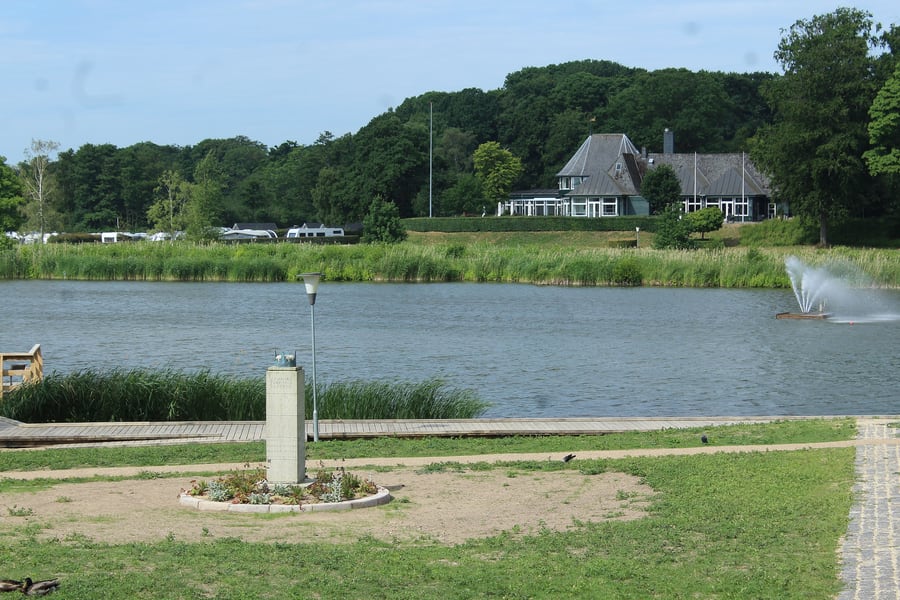 Dguendel / Wikimedia Commons · CC BY 4.0 · cropped
Naturpark Maribosøerne
Maribo sits on the edge of four connected lakes — Søndersø, Nørresø, Røgbølle and Hejrede — with 1,140 hectares of open water between them, ringed by woodland and bog. The whole system drains through a single stream, the Hunsåen, which the railway crosses on its way north. 1,195 hectares were protected in 1957, and a tour boat works the lakes in summer.Where to Sleep
Most people ride this railway as a day out — the trains do not start until mid-morning and the last one is back in Maribo by early evening, which fits a return from Copenhagen without a bed at either end. For a longer stay on Lolland, there is one obvious choice at each end of the line.
Where to stay
 Thomas Dahlstrøm Nielsen / Wikimedia Commons · CC BY 4.0 · cropped
Bandholm Badehotel
On the harbour at the end of the line
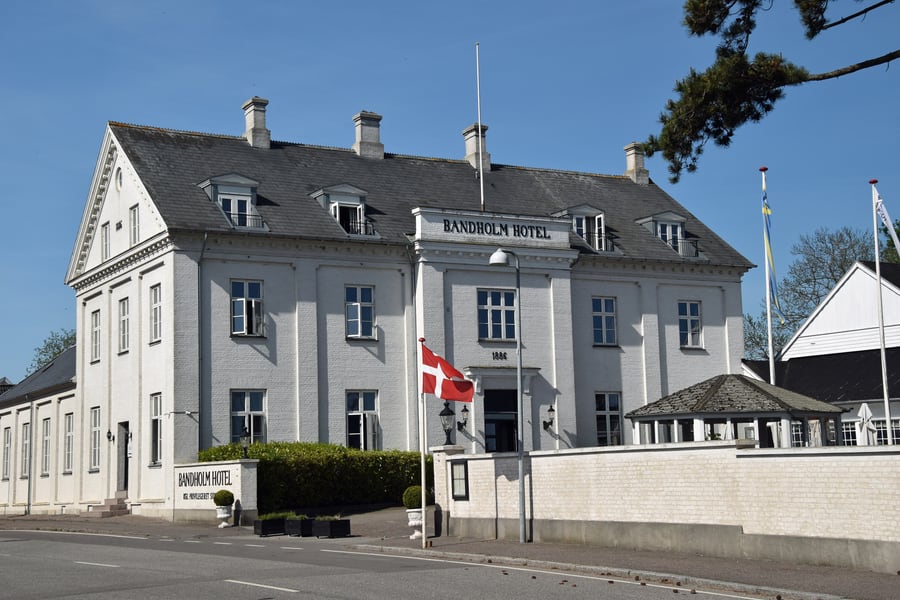
Established in 1886 and still carrying the date on its pediment, a short walk from Bandholm station and the quay the museum train runs down to. It has 43 rooms and a restaurant, and has been under new management since April 2025.
Check Availability (opens in a new tab, on bandholmhotel.dk)via bandholmhotel.dkMilling Hotel Søpark
In Maribo, above the Søndersø
A 110-room hotel on Vestergade in the middle of Maribo, looking out over the Søndersø and the lakes of the nature park, with its own restaurant open mornings and evenings. Maribo is small enough that platform 2, where the museum train starts, is a walk away.
Check Availability (opens in a new tab, on millinghotels.dk)via millinghotels.dkQuestions or corrections
Planning this trip and stuck on something, or spotted a time, fare or detail that has changed? Send us a message about Maribo to Bandholm: Denmark's oldest heritage railway. We read every one, and we update this page when something has changed.