The Marschbahn to Sylt
Michael Gäbler / Wikimedia Commons · CC BY-SA 3.0
- Distance237 km (Hamburg-Altona–Westerland)
- DurationAbout 3 hours
- Best seasonYear-round · the light is best in late summer
Introduction
There is no road to Sylt. Germany's most fashionable island resort — its dunes, its thatched Frisian villages, its red cliff and its long North Sea beach — can be reached without a boat only by train, and everybody who arrives with a car arrives with the car loaded onto a railway wagon.
The line that does it is the Marschbahn, and the last half-hour of it is the reason to come. From Hamburg-Altona the train runs three hours north through the flattest country in Germany: reclaimed marsh, sea dikes, sheep, wind turbines and horizons with nothing on them. Then, eleven minutes past Niebüll, the embankment leaves the mainland at Klanxbüll and simply keeps going, out into the North Frisian Wadden Sea, with tidal flats on both sides and no land in sight ahead. Eleven minutes after that you are on Sylt.
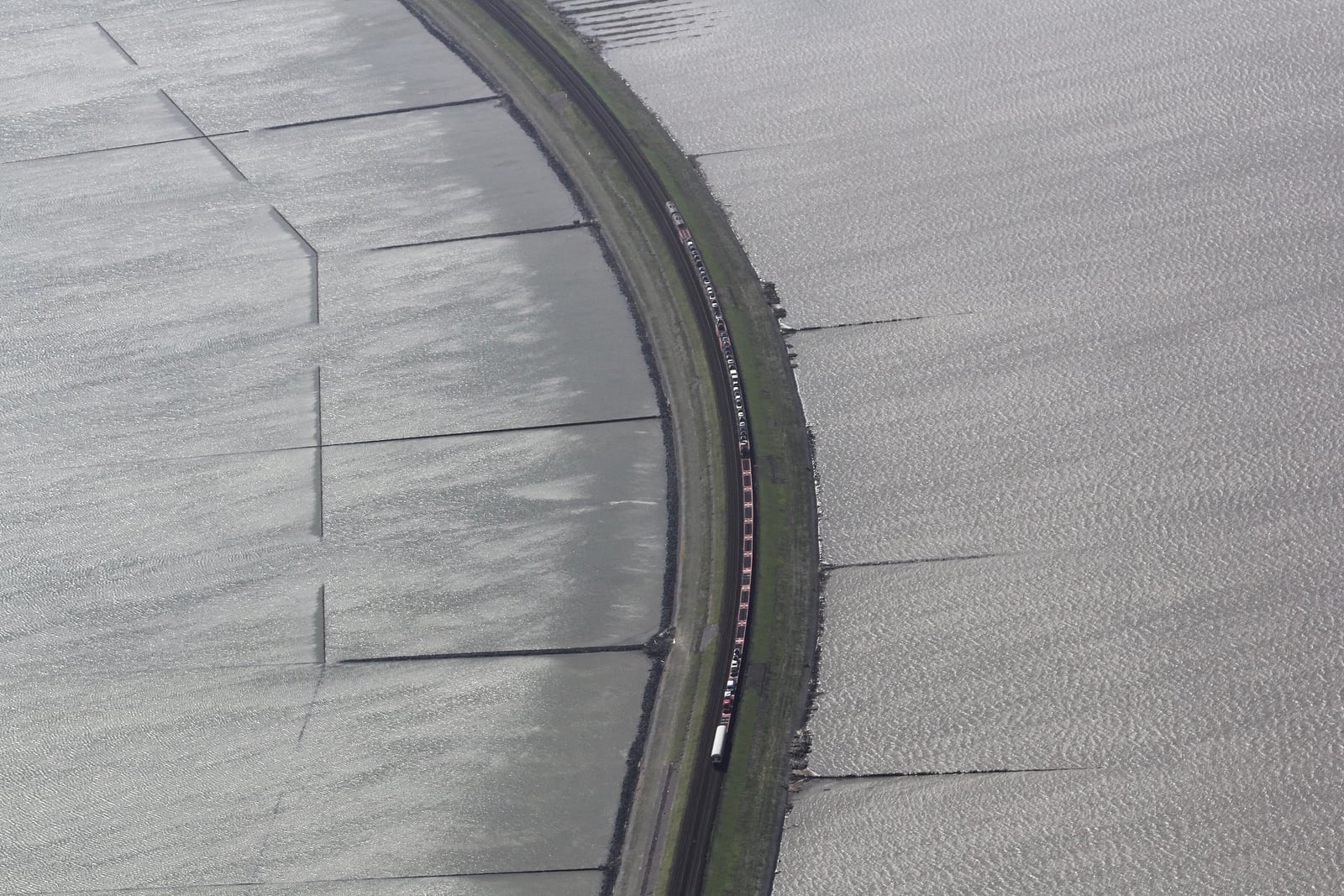
That embankment is the Hindenburgdamm, opened on 1 June 1927, and it is what turns an ordinary regional train into a journey worth taking deliberately. It carries railway traffic and nothing else — no road was ever built on it, and none is planned.
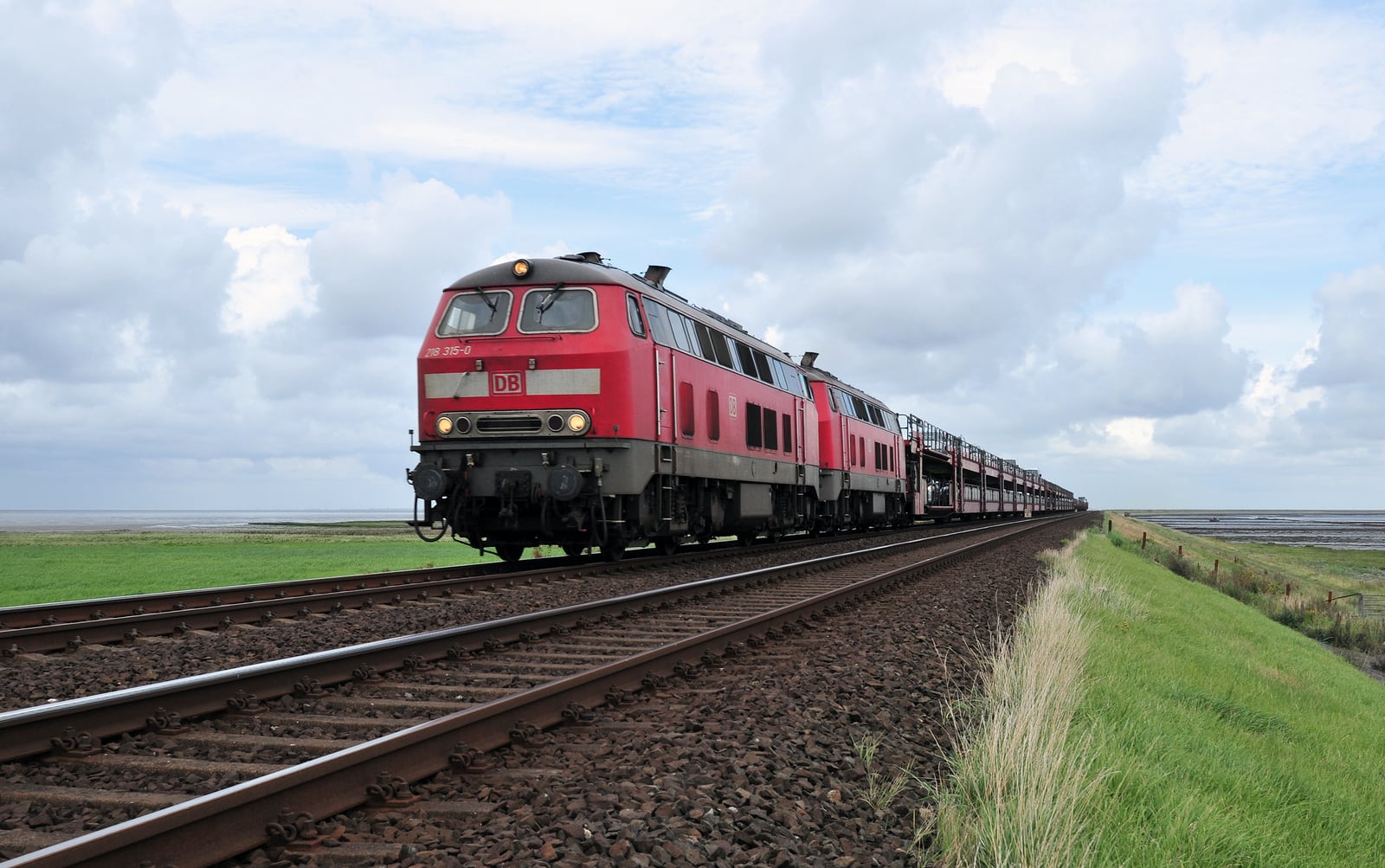
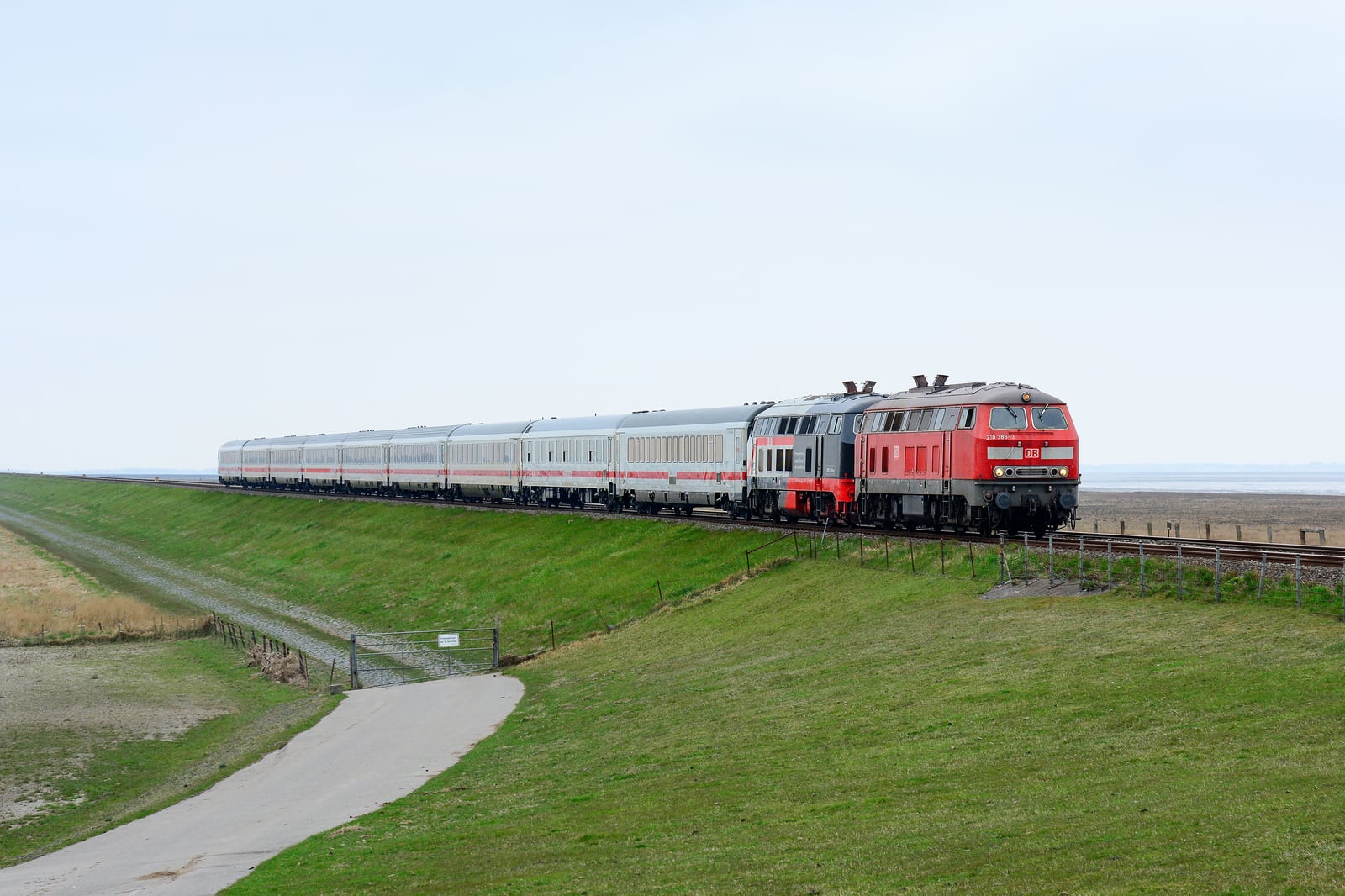
The train itself is not a special. It is the RE 6, an hourly regional service run by DB Regio Schleswig-Holstein, and you can ride the whole thing on a monthly Deutschland-Ticket. It is also, surprisingly, a diesel: the overhead wires stop at Itzehoe, an hour out of Hamburg, and the whole run from there to Germany's smartest beach resort is worked by diesel locomotives — which is why the Intercity trains from Cologne and Frankfurt swap to a pair of red class 218s at Itzehoe before carrying on north.
About five million passengers a year use this line. Almost none of them think of it as a scenic railway. It is one anyway.
The Journey
The Marschbahn leaves the Hamburg–Kiel main line at Elmshorn and turns north-west into the marsh. For the first half-hour it is a busy commuter railway under wires; then it changes character entirely, and keeps changing, four or five times, before it reaches the sea.
Marsh, canal and geest
The oldest part of the line is also the flattest. The Glückstadt–Elmshorn company opened the first stretch, Elmshorn to Glückstadt, on 20 July 1845, and pushed on to Itzehoe on 6 August 1857 — a railway built to move cattle and agricultural produce into Hamburg long before anybody thought of taking holidaymakers to the coast. It crosses the Kollmar and Kremper marshes, low green fields below the level of the Elbe behind their dikes, and reaches Itzehoe on the river Stör.
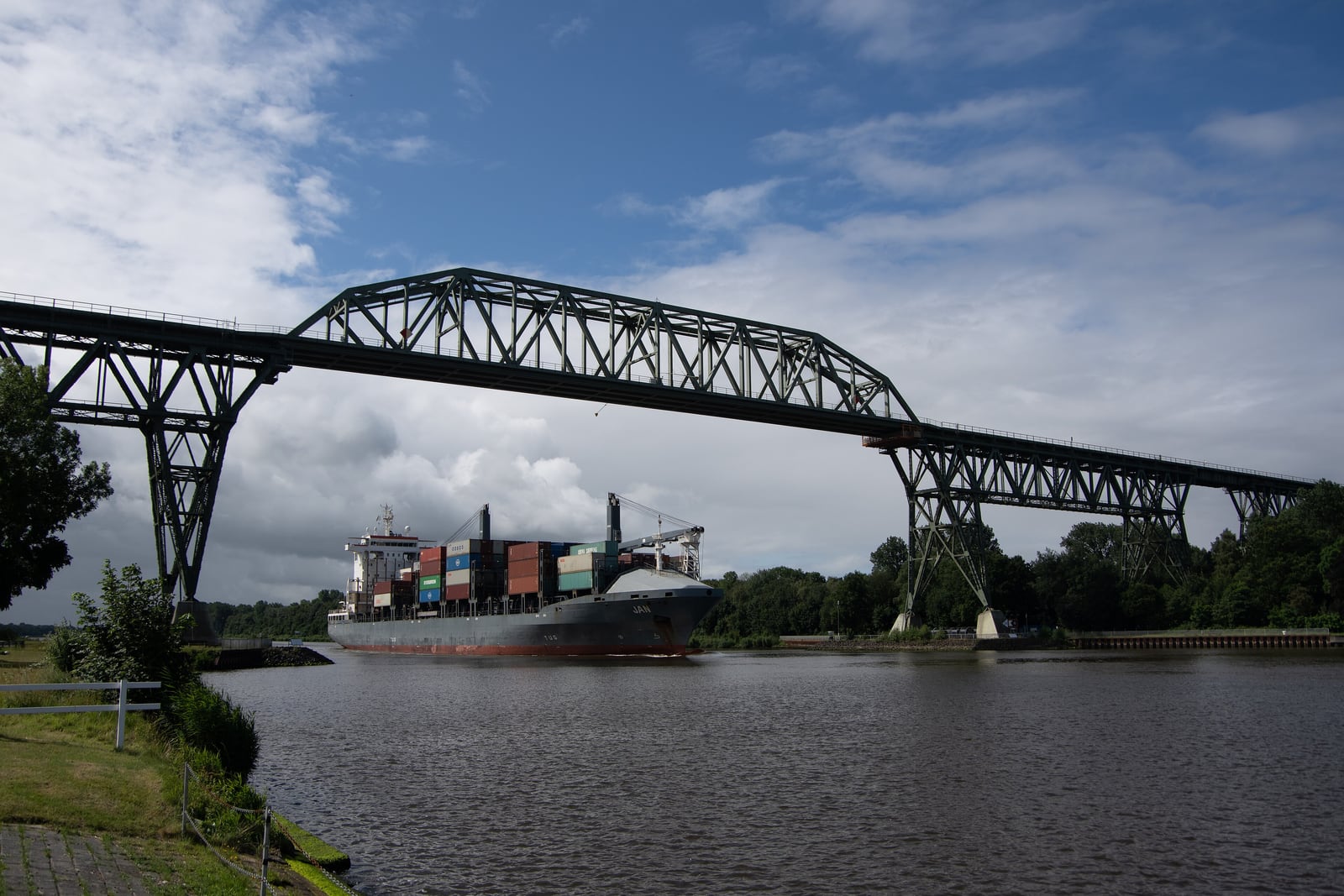
North of Itzehoe the electrification ends, and the line climbs onto its one real structure. The Hochbrücke Hochdonn carries it 42 metres above the Kiel Canal on a steel span of 143 metres, part of a bridge 2,218 metres long end to end, opened in 1920 to replace a swing bridge that the widening of the canal had made impossible. On a clear day you can see west down the canal towards Brunsbüttel and the industry at its mouth. The detour that the new bridge forced — north through Wilster and St. Michaelisdonn instead of straight across — added 5.8 kilometres to the journey, and the line has run that way ever since.
Beyond the bridge the ground rises very slightly onto the Dithmarschen geest, and the train swings north through Meldorf to Heide. The RE 6 runs the whole 35 minutes from Itzehoe to Heide without stopping; the small stations in between — Wilster, Burg, St. Michaelisdonn, Meldorf — are served by the RB 62, which shadows it.
North Frisia
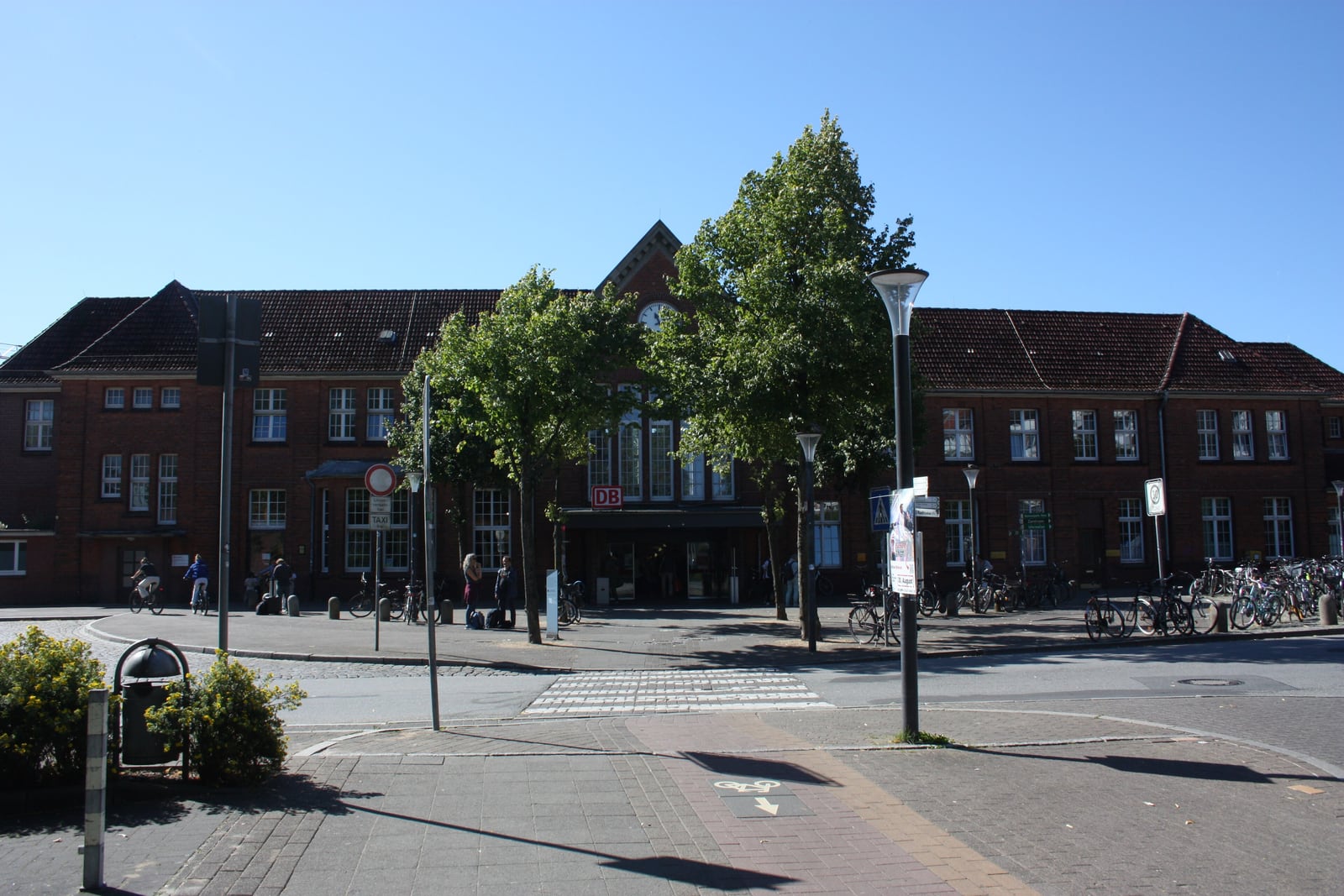
After Heide the line crosses the Eider between Lunden and Friedrichstadt and enters Nordfriesland, the strip of reclaimed polder and salt marsh that runs up the coast to the Danish border. Husum is the one town of any size, and the junction where the branch from Kiel and Flensburg comes in; the train sits for two minutes and then goes on through Bredstedt and Langenhorn to Niebüll.
Niebüll is where the journey narrows to a single purpose. The old main line used to continue north to Tønder in Denmark; since 1927 that has been the branch, and the important track is the one that turns left. It was laid to Klanxbüll on 9 October 1922 for one reason: to bring building material out to the edge of the sea.
The dam
Klanxbüll is the last stop on the mainland. From there the train runs 11.3 kilometres across open water — 8.1 of them still in the Wadden Sea, the rest silted and reclaimed since — on an embankment built to the cross-section of a two-sided sea dike, 50 metres wide at the base and 11 metres across the crown. Over three million cubic metres of sand and clay and 120,000 tonnes of stone were brought out from the mainland to make it, and four months into construction a storm surge washed away everything that had been built.
It was opened on 1 June 1927 after four years' work, single track at first and double throughout since 1972. There is a signal box out on the dam, the Blockstelle Hindenburgdamm; since 1996 it has worked automatically, with nobody in it.
Why it exists is the better half of the story. Before 1927 you reached Sylt by a tide-dependent ferry from Hoyer, on a line that after the 1920 border settlement lay in Denmark — so a German going to a German island crossed an international frontier twice. The dam removed both problems at once. It also killed what it replaced: the ferry stopped, and the little Sylter Inselbahn lost its traffic from Munkmarsch into Westerland overnight.
Arrival
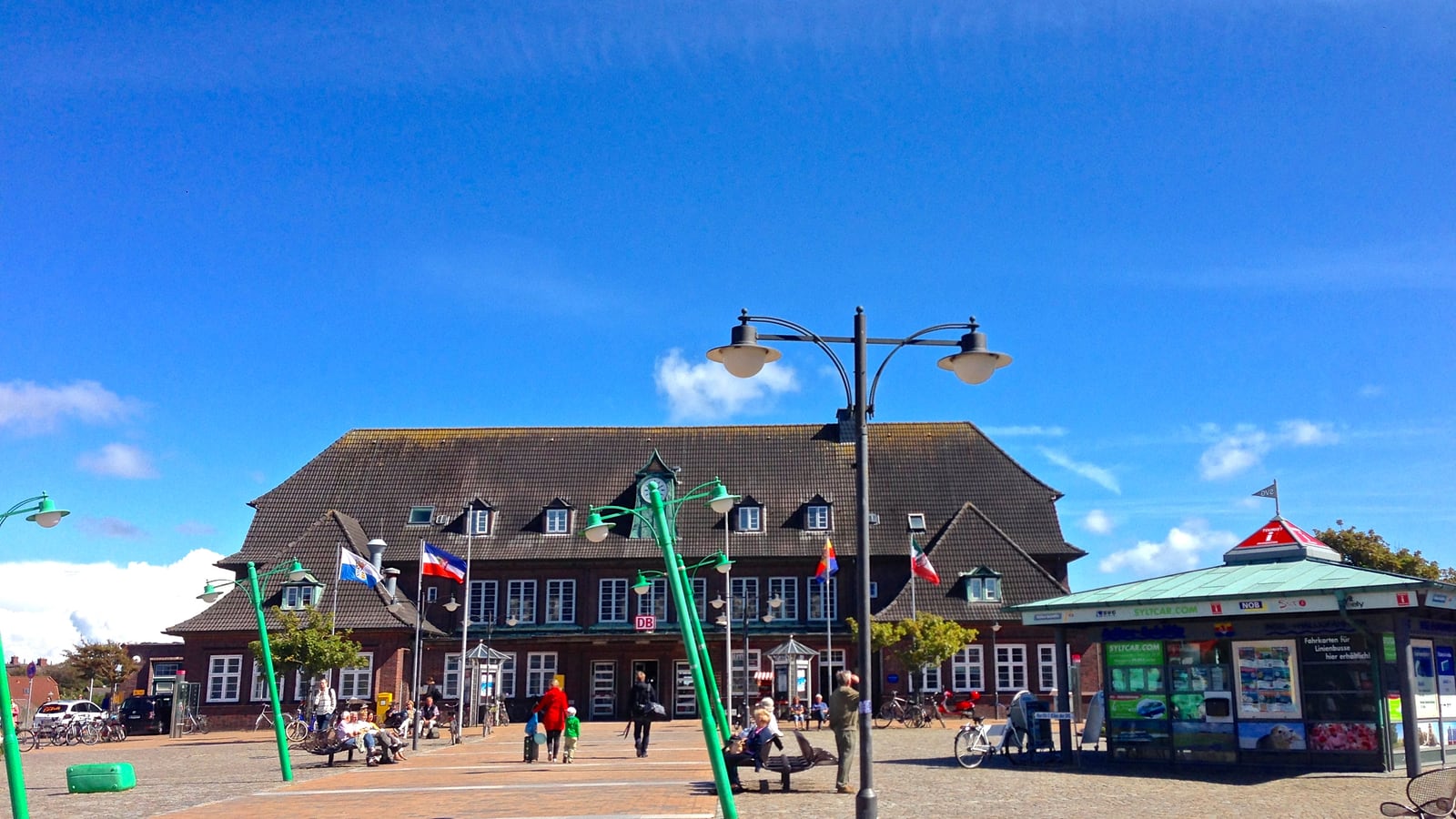
The train touches down on Sylt at Morsum eleven minutes after leaving the mainland, calls at Keitum, and runs into Westerland twelve minutes after that. The station was built with the dam and opened the same day; its Oldenburg-brick building, with half-hipped roofs and two wings reaching out to the forecourt, was reckoned the largest and most modern on the Schleswig-Holstein west coast when it was finished, and it stands on timber piles because the ground would not take it otherwise. It has been a listed building since 1986.
Four platform tracks serve the passengers. The two tracks flanking them, numbers 5 and 7, are where the cars come off.
Along the route
Walter Rademacher / Wikipedia · CC BY-SA 3.0 · croppedA causeway with no road on it
The Hindenburgdamm runs 11.3 kilometres from Klanxbüll to Morsum, 8.1 of them in the open Wadden Sea, and it was built for railway traffic alone. No road was ever laid across it, which is why every car on Sylt arrived there on a railway wagon.Michael Gäbler / Wikimedia Commons · CC BY-SA 3.0Built to dodge a border
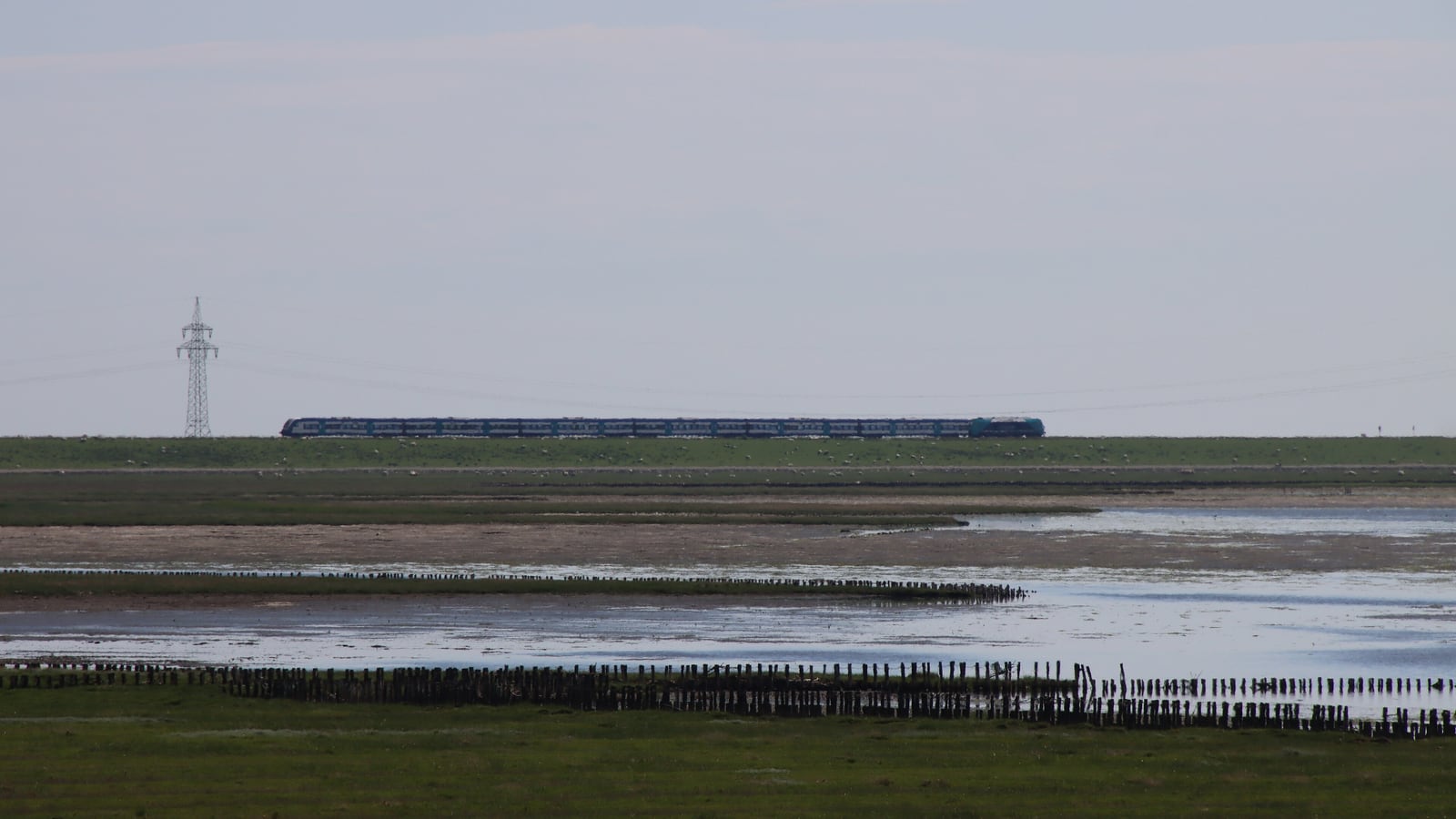
Before 1927 you reached Sylt by a tide-dependent ferry from Hoyer, which after 1920 was in Denmark — so a German going to a German island crossed a frontier twice. Four months into construction a storm surge washed away everything built so far.Nelso Silva / Wikimedia Commons · CC BY-SA 2.0Diesel to the smartest address in Germany
The overhead wires end at Itzehoe, an hour out of Hamburg, and have done since 1998. Everything beyond — the RE 6, the Intercity, the car shuttles, the freight — is diesel-hauled.A bit of history
Culture & experiences along the way
Fabian Horst / Wikimedia Commons · CC BY-SA 4.0 · croppedSit on the left going north
It matters for about twenty minutes and not at all for the rest. Going north the left window gives you the open Wadden Sea and the tide going out; the right gives you the same thing slightly later. The real answer is to stand in the vestibule between Klanxbüll and Morsum, where both windows are yours.Clemensfranz / Wikimedia Commons · CC BY-SA 4.0 · croppedTake the slow train between Itzehoe and Heide
The RE 6 covers those 35 minutes without a single stop. The RB 62 shadowing it calls at Wilster, Burg, St. Michaelisdonn and Meldorf — four marsh towns nobody photographs, and the only way to see the Dithmarschen geest at walking pace. It costs you an hour, which is exactly one RE 6.www.fleno.de / Wikimedia Commons · CC BY-SA 3.0Go up and come back the same day
A Schleswig-Holstein-Ticket, the 05:32 out of Altona and the 18:19 back gives you nearly nine hours on Sylt and two crossings of the dam for the price of one day ticket. It is the cheapest serious day out in northern Germany.Timetables
The RE 6 runs hourly, all year, in both directions, and the clock face barely moves between summer and winter. Times below are read from NAH.SH's own RE 6 / RB 62 timetable in the Fahrplanbuch 2025/26, as of August 2026.
The timetable's own validity: winter 14 December 2025 – 27 March 2026 and 2 November – 12 December 2026; summer 28 March – 1 November 2026.
Northbound — Hamburg-Altona to Westerland (Sylt)
Departures at :32 past the hour, arrival at :34, three hours and two minutes end to end. A late-afternoon working, traced the whole way:
| Hamburg-Altona | dep 15:32 |
| Elmshorn | 15:57 / 15:58 |
| Itzehoe | 16:21 / 16:23 |
| Heide (Holst) | 16:58 / 17:01 |
| Husum | 17:28 / 17:30 |
| Niebüll | 17:59 / 18:00 |
| Klanxbüll | 18:11 |
| Morsum (Sylt) | 18:22 |
| Keitum | 18:28 |
| Westerland (Sylt) | arr 18:34 |
The same offsets repeat through the day: the 05:32 from Altona is in Westerland at 08:34, the 16:32 at 19:34, the 20:32 at 23:34.
Southbound — Westerland to Hamburg-Altona
Departures at :19 past the hour, arrival at :22, about three hours and three minutes. 13:17 → 16:22, 14:19 → 17:22, 15:19 → 18:22, 16:19 → 19:22, 18:19 → 21:22, all confirmed across consecutive hours.
The bit you came for
Klanxbüll to Morsum — the crossing of the Hindenburgdamm — takes eleven minutes. Niebüll to Westerland, the whole island run, takes 34.
Extra trains at the island end
Between Husum and Westerland the service is denser than one an hour: additional RE 6 workings start and terminate at Husum, so Niebüll sees departures for Sylt at :00 and :30. If you are only going to the island and back, you rarely wait more than half an hour.
The other trains on this line
- RB 62 shadows the RE 6 between Itzehoe and Heide, calling at Wilster, Burg (Dithmarschen), St. Michaelisdonn and Meldorf — the four stations the RE 6 runs through. It is worked by LINT 54 railcars.
- Intercity trains run through from Cologne, Frankfurt, Stuttgart and Berlin. They use Hamburg Hbf and Dammtor and do not call at Hamburg-Altona, and they change to diesel haulage at Itzehoe. From April to October they carry through coaches for Dagebüll, shunted out at Niebüll.
- Car-carrying shuttles run Niebüll–Westerland all day, separately from the passenger service — see Tickets.
Two footnotes worth reading
Several trains in the printed timetable carry seasonal restrictions — "fährt nur vom 11.7.2026 bis 12.12.2026" and similar — and a handful run only on Schleswig-Holstein school days (Schule) or only in the school holidays (Ferien). The hourly RE 6 skeleton above is not affected; the extras are.
Source: NAH.SH, RE 6 / RB 62 timetable, Fahrplanbuch 2025/26 (opens in a new tab), read August 2026.
Tickets
There is no supplement, no reservation and no special fare for the Hindenburgdamm. The RE 6 is an ordinary German regional train sold on ordinary German regional tariffs, so a Deutschland-Ticket at €63 a month covers it, and so does a Schleswig-Holstein-Ticket at €34 for one person plus €6 for each of up to four more — the cheapest way to do the journey as a group. A single fare is the answer for one trip in one direction.
The Intercity trains from Cologne, Frankfurt and Berlin run the same rails and take about the same time north of Hamburg, but they are long-distance services on long-distance fares and neither regional ticket is valid on them. Cars cannot be driven to Sylt at all; they cross on car-carrying trains from Niebüll, which a foot passenger needs nothing to do with. Fares checked against NAH.SH and Deutsche Bahn, August 2026.
Book your tickets
The RE 6 to Westerland
Hourly, three hours, ordinary regional fares
A class 245 diesel and Married-Pair coaches, bicycles carried, the Hindenburgdamm included.
Book Tickets (opens in a new tab, on NAH.SH · DB Regio Schleswig-Holstein)via NAH.SH · DB Regio Schleswig-HolsteinIntercity from Cologne, Frankfurt and Berlin
One seat all the way, long-distance fare
Worth it from the south, not from Hamburg, and not covered by the regional tickets.
Book Tickets (opens in a new tab, on Deutsche Bahn)via Deutsche BahnAutozug Sylt
For the car, not for you
The only way to bring a vehicle to the island — a foot passenger needs none of it.
Book Tickets (opens in a new tab, on autozug-sylt.de)via autozug-sylt.deRail Passes
Passes work cleanly on this line, because every train on it is an ordinary scheduled service on the national network. The only question worth asking is whether buying one pays.
The Deutschland-Ticket
€63 a month, subscription only, in your own name. Valid on "allen Nahverkehrszügen (RB, RE, S-Bahn) und öffentlichen Verkehrsmitteln" — every regional train, bus, tram and U-Bahn in Germany.
The RE 6 is exactly that, so one Deutschland-Ticket covers the whole three hours from Hamburg-Altona to Westerland, the Hindenburgdamm included, as often as you like for a calendar month. For a journey of this length that is remarkable value: a single month costs less than many people expect one crossing to.
⚠️ It is not valid on the Intercity trains that share the track — "nicht in Zügen der DB Fernverkehr AG (IC, EC, ICE)". On this line that matters more than usual, because the ICs look identical on the departure board and run at almost the same times. Check the letters before you board.
Interrail and Eurail
Fully valid. Interrail's own operator list covers Regionalbahn (RB), Regional-Express (RE), Interregio-Express (IRE) and S-Bahn run by DB and the regional carriers, and DB's own Intercity and ICE.
The excluded column for Germany names FlixTrain and GoVolta, neither of which comes anywhere near Nordfriesland, and then adds that anything not named falls to the linked list of German companies a pass is valid on. That list is closed, and it is what keeps the country's heritage and mountain lines outside a pass — but DB Regio, which works the RE 6, is squarely on it.
So a pass covers both options here — the hourly RE 6 and the through Intercity from Cologne, Frankfurt, Stuttgart or Berlin — which makes Sylt an unusually easy add-on to a Global Pass itinerary.
No reservation is needed. Interrail's own advice is that "most slower national and regional trains don't require seat reservations", and the RE 6 is one of them: turn up and board.
The Schleswig-Holstein-Ticket
Not a rail pass in the Interrail sense, but the one that most often wins. €34 for the first person and €6 for each of up to four more, valid for a day on regional buses and trains across Schleswig-Holstein and into Hamburg — the entire route of this journey and then some.
⚠️ The one exclusion to know: it does not cover journeys that both begin and end inside the Hamburg hvv area. Getting to Altona from elsewhere in Hamburg is a separate matter.
Is a pass worth buying for this journey?
For a single trip to Sylt and back, no — buy a Schleswig-Holstein-Ticket for the day and you are done, and with two or more of you it is cheaper than anything else on offer.
For a week or more in Germany, the Deutschland-Ticket is close to unanswerable. It costs €63, the Hamburg–Westerland return alone would eat much of that, and it then covers every other regional train, bus and tram in the country for the rest of the month.
An Interrail Global Pass earns its keep here only if you already hold one. Sylt is a spur, not a corridor: you come up, you go back down the same way. But if the pass is already in your pocket, this is three hours of it very well spent — and one of the few places in Europe where a pass takes you out into the middle of the sea.
Pass conditions checked against Deutsche Bahn (opens in a new tab), Interrail's own railway-company list (opens in a new tab) and NAH.SH (opens in a new tab), August 2026.
Places to Visit
This is a line worth breaking. The RE 6 runs every hour and the towns along it are small enough to see in an afternoon, so getting off costs you sixty minutes and nothing else.
The stops below run in the order the northbound train reaches them: Hamburg at the start, three towns strung along the marsh, and then the island, where the train calls at Morsum and Keitum before it stops for good at Westerland. Only the last of them, Kampen, needs a bus.
 Frank Schulenburg / Wikimedia Commons · CC BY-SA 4.0 · cropped
Hamburg
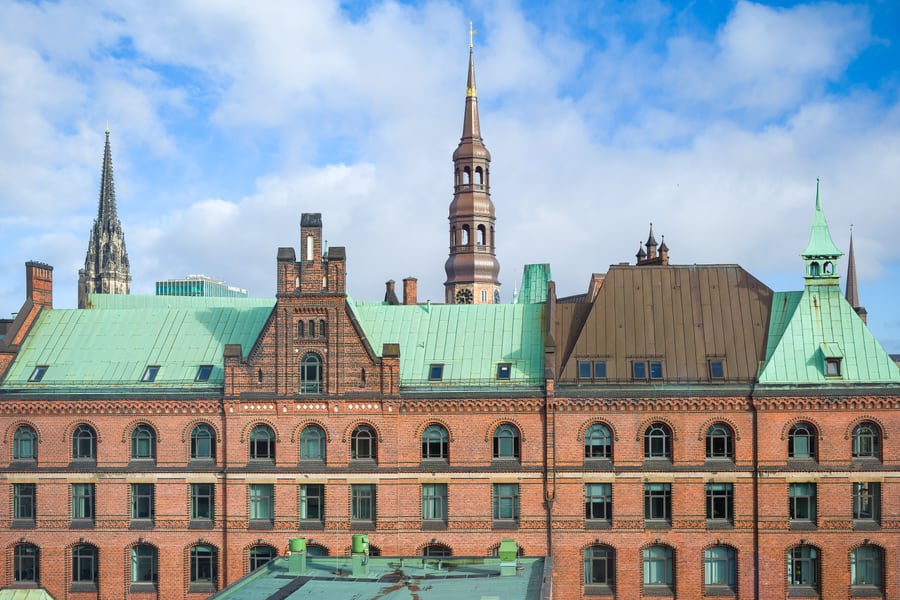
The Speicherstadt is the largest historic warehouse complex in the world, built between 1883 and 1927 on two former Elbe islands as part of the free port, and on the UNESCO list since 5 July 2015 together with the Kontorhausviertel next door. Red brick, green copper, iron bridges over the fleets, and about fifteen minutes on the S-Bahn from the platform your train to Sylt leaves from.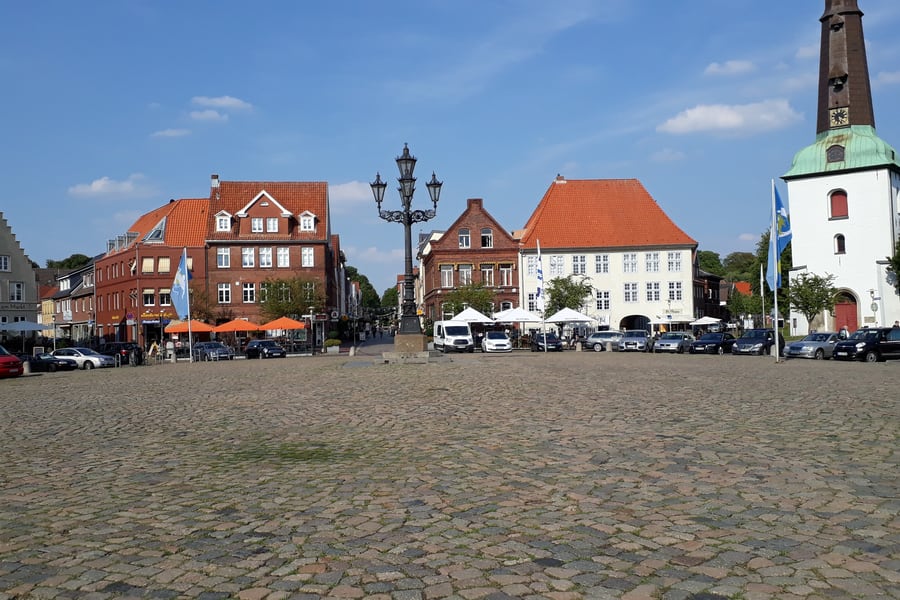 Christian Alexander Otto / Wikimedia Commons · CC BY 4.0 · cropped
Glückstadt
Founded in 1617 by Christian IV of Denmark and laid out by a French fortress engineer in the Dutch manner — an impregnable fortified port on the lower Elbe, meant to take Hamburg's trade. It never did, which is why the seventeenth-century plan survives intact around the market square. The town is still known across Germany for its Matjes herring.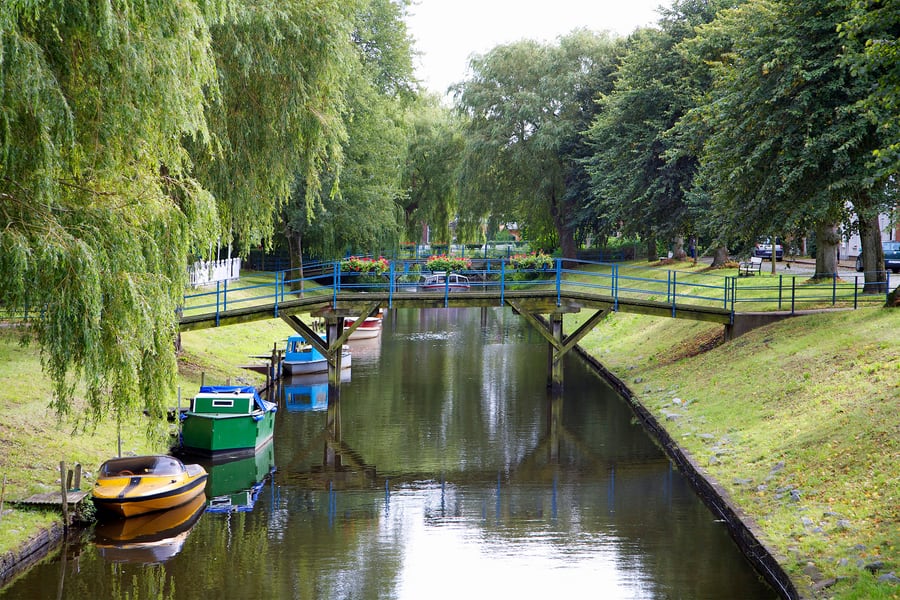 W. Bulach / Wikimedia Commons · CC BY-SA 4.0 · cropped
Friedrichstadt
Duke Friedrich III founded it in 1621 and filled it with Dutch citizens — above all persecuted Remonstrants — by granting them freedom of religion, after which other refugees followed and it became known as the town of the tolerant. What they built is still what you see: Dutch brick-Renaissance gables along two canals cut through the old town, on an artificial island between the Eider and the Treene.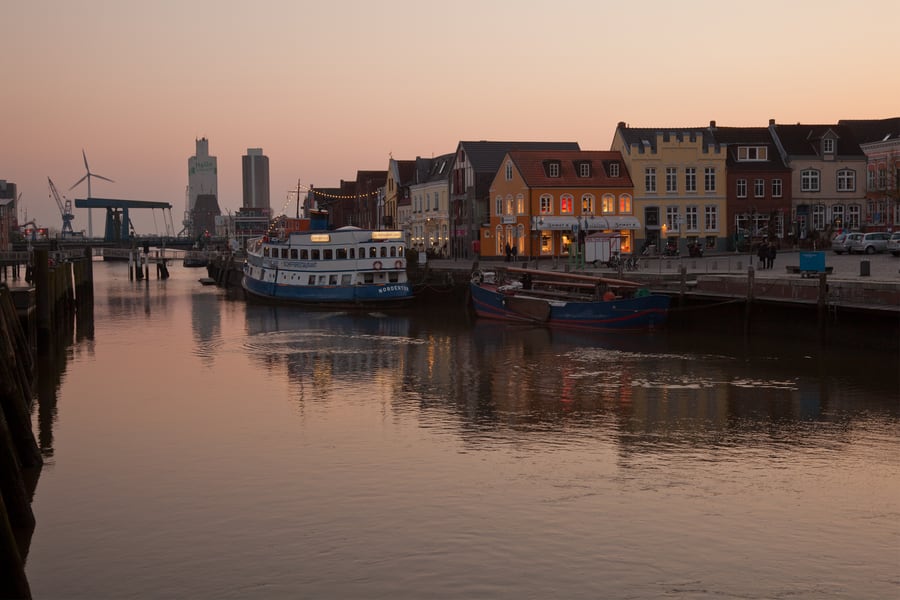 Unukorno / Wikimedia Commons · CC BY 3.0 · cropped
Husum
Theodor Storm's poem gave his birthplace its nickname, and the inner harbour he knew still runs right into the middle of town, boats moored against the gabled houses. His house on Wasserreihe, where he wrote several of the novellas, is a museum. In March and April around five million crocuses come up in the castle park, which is a genuinely famous sight and lasts about a fortnight.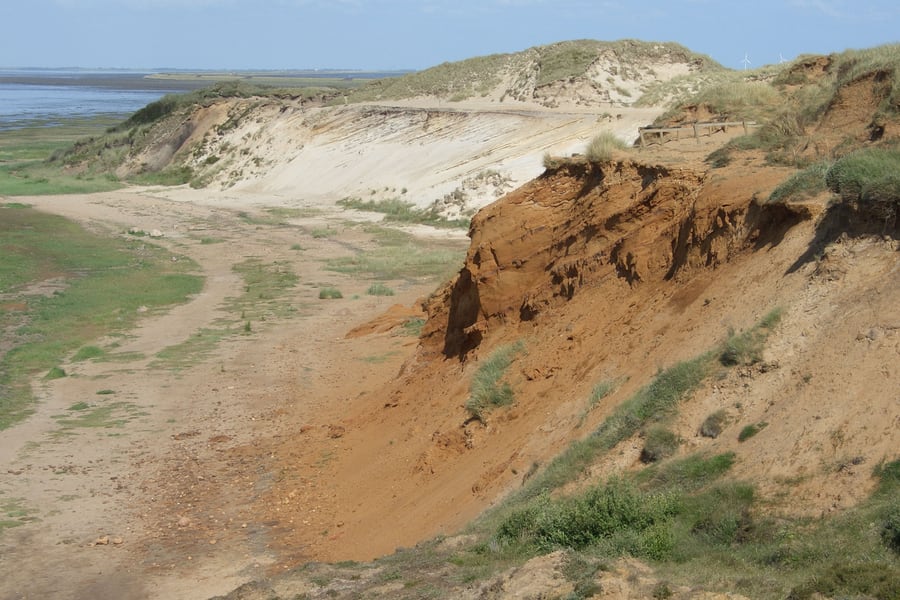 Holger Weinandt / Wikimedia Commons · CC BY-SA 3.0 de · cropped
Morsum-Kliff
Two kilometres of cliff along the Wadden Sea shore between the dam and Morsum village, protected since 1968. Saale-age glaciers shoved the strata into upended slices, so the formations that should lie on top of one another stand side by side instead — seven or eight million years of geology read left to right, in orange limonite sandstone, mica clay and white kaolin sand. The station is a walk away.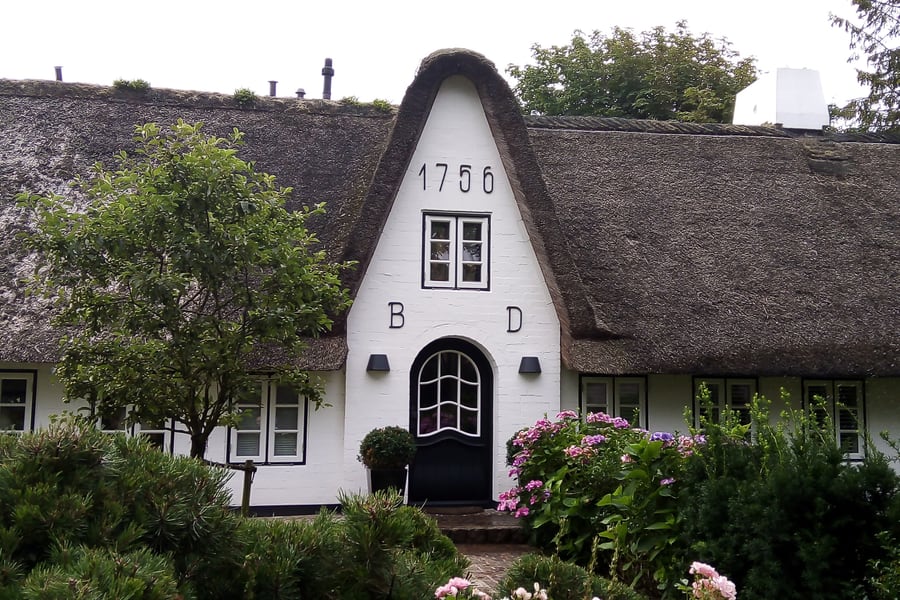 Wilhelm II. Hohenzollern / Wikimedia Commons · CC BY-SA 4.0 · cropped
Keitum
Until the early twentieth century Keitum, not Westerland, was the chief place on Sylt, and it still looks the part: thatched Frisian houses behind dry-stone Friesenwälle, avenues of old trees that make it the island's green village, and the medieval church of St. Severin standing apart on the heath. It sits on the Wadden Sea side, which is the quiet side.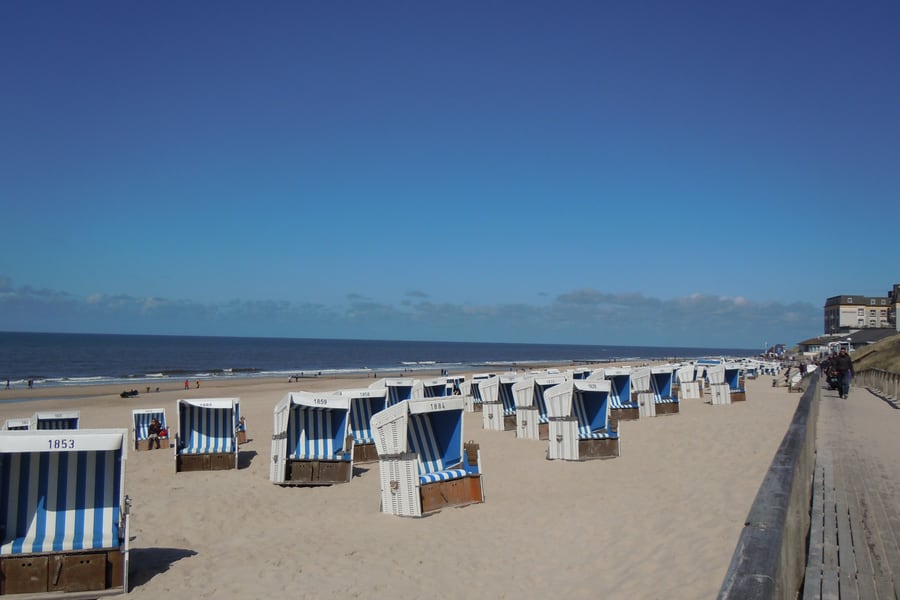 Sebastian Martin Dicke / Wikimedia Commons · CC BY-SA 4.0 · cropped
Westerland
The youngest village on Sylt but for Hörnum, founded by the survivors of Eidum after the All Saints' flood of 1436 destroyed it, and a nothing place until it was granted the title of seaside resort in 1855 — after which it took the island over. The promenade, the beach and the ranks of hooded Strandkörbe start a few minutes' walk from the station buffers.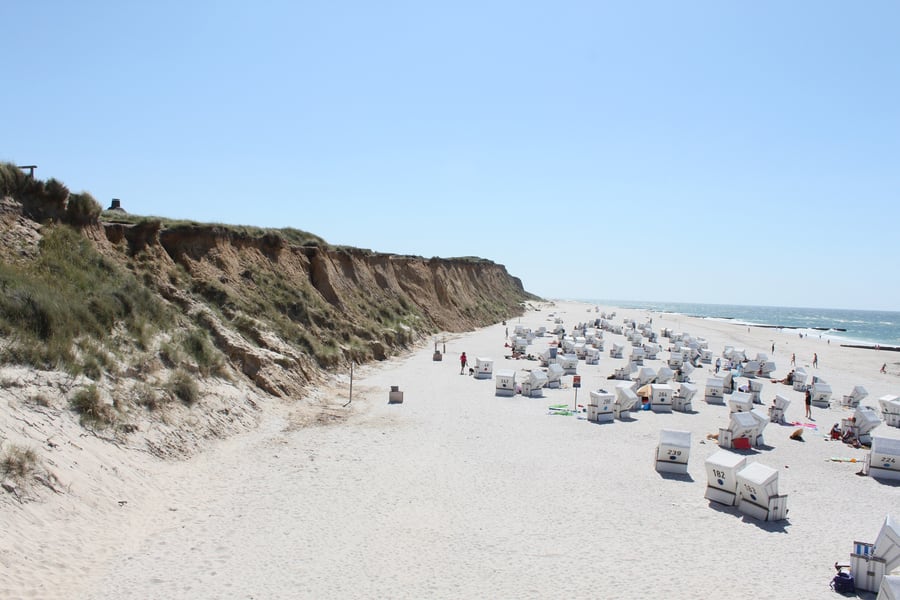 Bin im Garten / Wikimedia Commons · CC BY-SA 3.0 · cropped
Kampen and the Rotes Kliff
About thirty metres of red cliff facing the open North Sea between Wenningstedt and Kampen, and a landmark for so long that Dutch sea charts of 1584 and 1585 already draw it and name it Roet Kliff. Storm surges take metres off it at a time. Behind it stands the Uwe-Düne, at roughly 52 metres the highest point on Sylt — and, being blown sand rather than glacial till, a much younger thing than the cliff.Where to Sleep
Sylt is expensive and books early; the mainland along the line is neither. Two of the three below are on the island; the third is halfway up the line, in Husum. All three are a short walk from a station the RE 6 calls at — which on this route is the whole point, because there is no car to park at the other end.
If you are going up for the day, you need none of them. If you want the island in the evening, when the day-trippers have gone back over the dam, you do.
We list no prices and no star ratings, because we have checked neither.
Where to stay
Genießer Hotel Altes Gymnasium
A former grammar school in Husum
Schoolrooms that took pupils for about a hundred years are now the bedrooms, and the old assembly hall is the function room. The restaurant is named for Rudolf Eucken, the Nobel laureate who once taught here. On Süderstraße, in the old town, a short walk from the station the RE 6 stops at.
Check Availability (opens in a new tab, on geniesserhotel-altes-gymnasium.de)via geniesserhotel-altes-gymnasium.deBenen-Diken-Hof
Ten thatched Frisian houses in Keitum
A working farmstead turned private hotel on Keitumer Süderstraße — white houses under reed, arranged as a yard rather than a block, in the village that used to be the capital of the island. Keitum has its own station, one stop before Westerland.
Check Availability (opens in a new tab, on benen-diken-hof.de)via benen-diken-hof.deHotel Miramar
On the dune at Westerland, since 1903
The house has stood above the beach on Friedrichstrasse since 1903, facing straight out to sea. It is the closest thing on Sylt to arriving by train and walking to the water: the station is at the other end of the town centre, about fifteen minutes on foot.
Check Availability (opens in a new tab, on hotel-miramar.de)via hotel-miramar.deQuestions or corrections
Planning this trip and stuck on something, or spotted a time, fare or detail that has changed? Send us a message about The Marschbahn to Sylt. We read every one, and we update this page when something has changed.