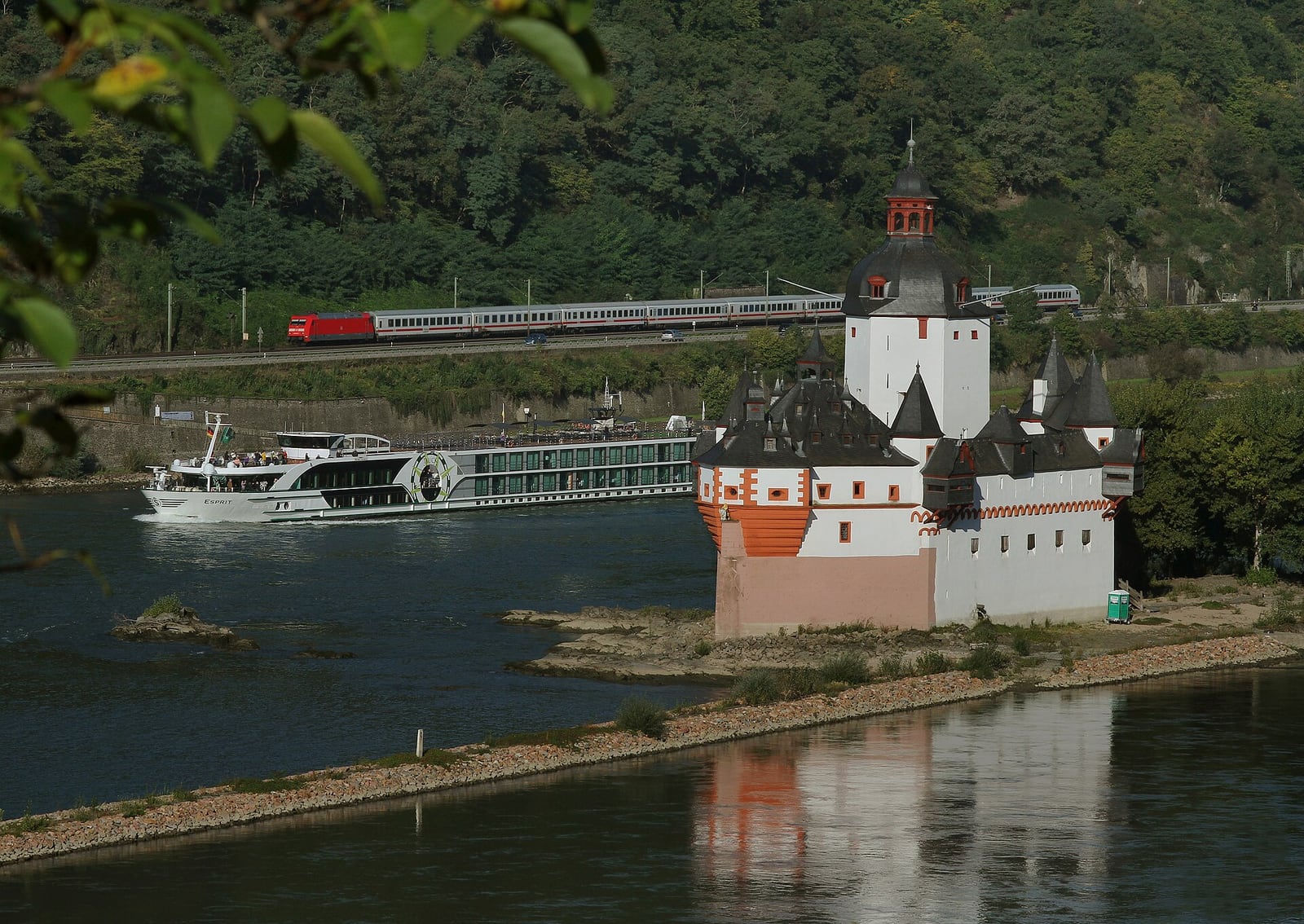
The Middle Rhine
Joachim Seyferth / Wikimedia Commons · CC BY 4.0
- Distance60.7 km (Koblenz–Bingen)
- DurationAbout 50 minutes
- Best seasonYear-round · vineyards turn in October
Introduction
Let us be clear about what this is, because most of the great railway journeys on this site are special trains and this one is not.
The Middle Rhine journey is an ordinary hourly regional service. No excursion, no reservation, no supplement, no season. You walk into Koblenz Hauptbahnhof, buy a ticket the way a commuter would, and fifty minutes later you are in Bingen, having travelled 61 kilometres along the bottom of the Upper Middle Rhine Valley — on the UNESCO World Heritage list since 27 June 2002 — with the river a few metres from the window and a castle on more or less every crag.
That is the whole appeal. This is the cheapest World Heritage site in Europe to see properly, and you see it from a train that runs every hour of every day.
The line
It is the West Rhine Railway, the linke Rheinstrecke, which runs the left bank all the way from Cologne to Mainz. The first section, Cologne to Bonn, opened on 15 February 1844; the last, Bingen to Mainz, on 17 October 1859. It has been double track throughout since the 1860s and electrified since 1959, and away from the gorge it is good for 160 km/h.
Inside the gorge it is good for nothing of the kind, because there is nowhere to go. Between Koblenz and Bingen the Rhine has cut 65 kilometres of trench through the slate, and the flat ground at the bottom is a strip a few dozen metres wide with a river on one side and a cliff on the other. The road, the railway and the villages share it. Three short tunnels — the Bank, Bett and Kammereck, none longer than 367 metres — take the line through the spurs it cannot get round.
The trains
Four kinds of train use this stretch, and any of them will do.
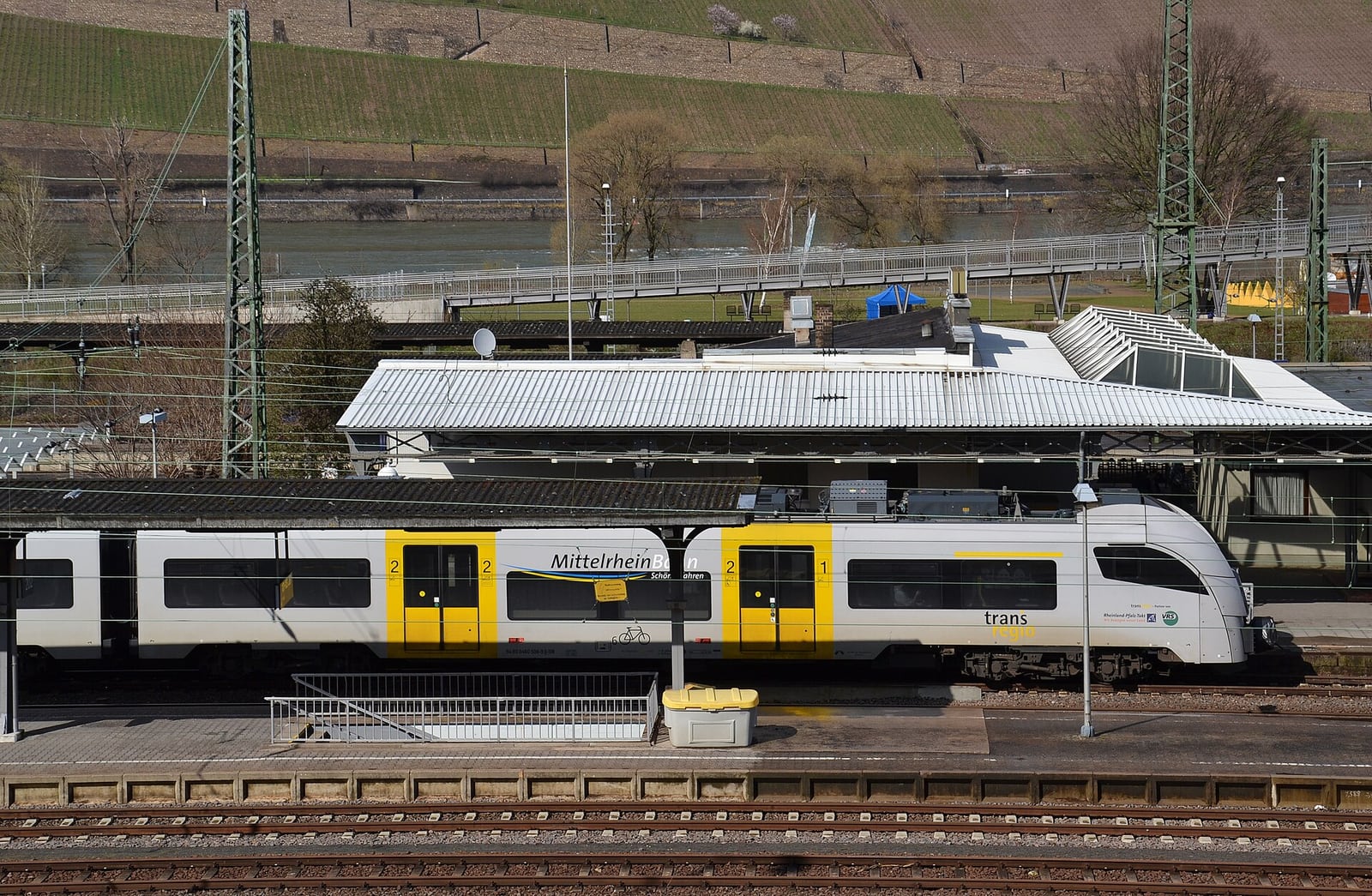
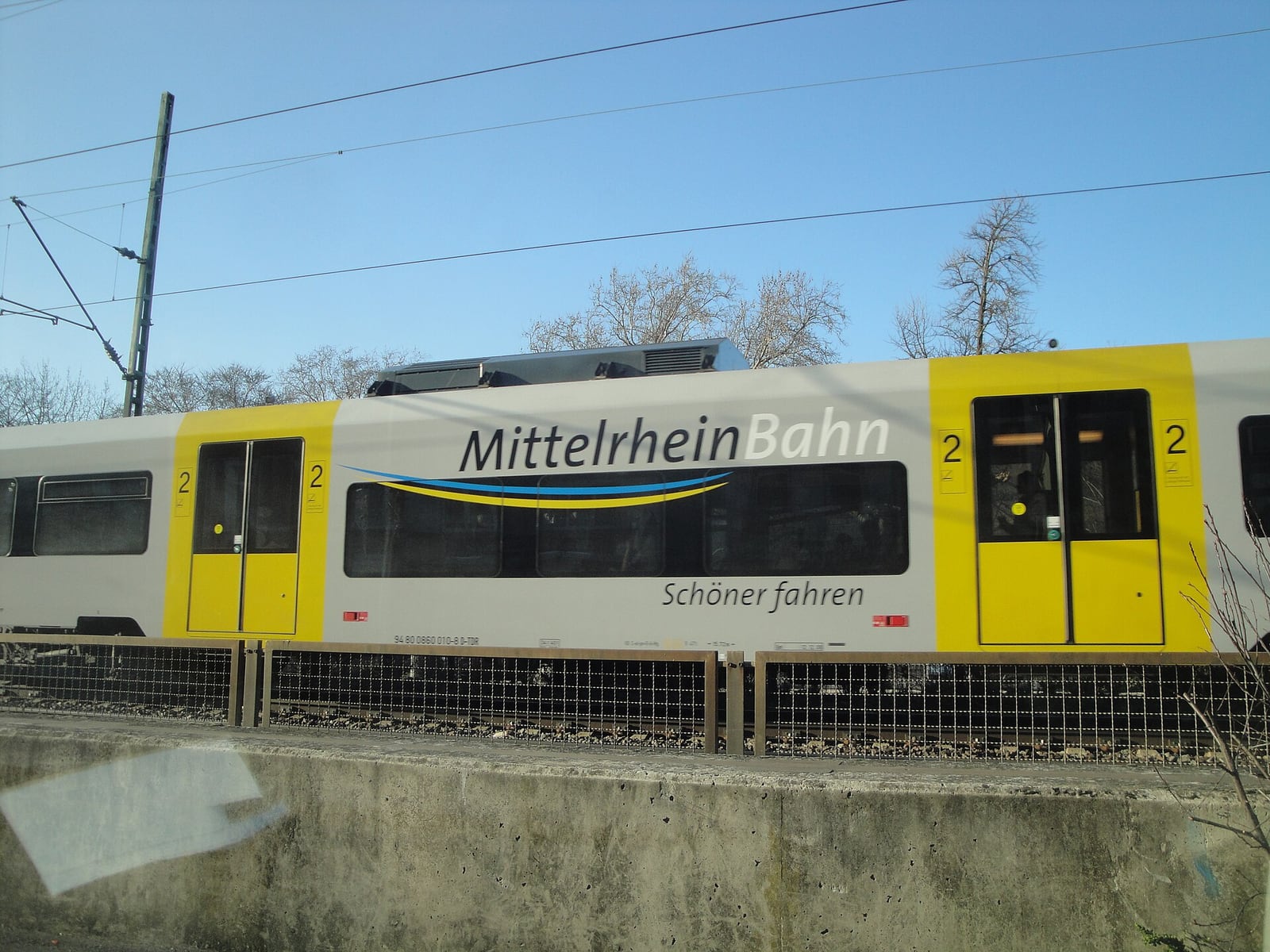
The one to aim for is the RB 26 MittelrheinBahn, run by Trans Regio, part of the Transdev group. It works hourly from Köln Messe/Deutz to Mainz Hbf, stopping at every village in the gorge, in yellow-fronted Siemens Desiro and Mireo units that take bicycles. It is the slow one, and slow is the point.
Above it run RE regional expresses and Intercity trains on the same track at the same speed limits, calling only at the towns. They are quicker and no less scenic, and if you are simply passing through, you will see everything the stopping train sees. You will just not be able to get off at Bacharach.
The Journey
Southbound from Koblenz, sit on the left. The railway runs the river bank for almost the whole gorge, and the right-hand window gives you a rock face and a retaining wall.
Koblenz to Boppard — 19 kilometres
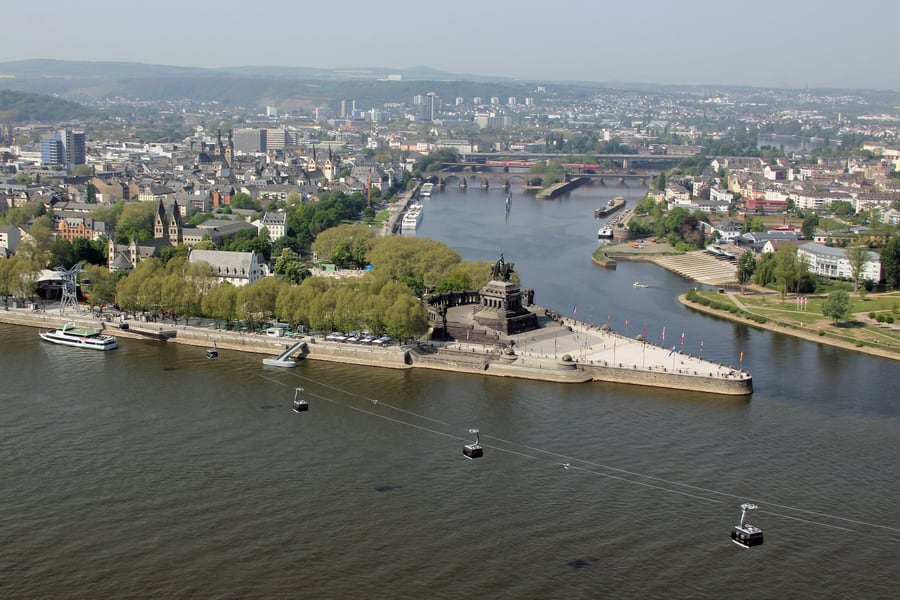
Koblenz Hauptbahnhof is a main-line junction with Intercity trains to everywhere, and it is a couple of kilometres back from the point that makes the city famous — the Deutsches Eck, the spit where the Mosel runs into the Rhine.
The train leaves the city southwards and is on the water within minutes. Rhens and Spay are the first two stops, small and quick, and the slopes on the far bank begin to steepen and terrace. Then the river swings hard right into the Bopparder Hamm, its biggest bend, almost a full circle around a wooded hill, and the train takes the inside of it into Boppard.
Boppard to St. Goar — 15 kilometres, and the gorge closes in
South of Boppard the valley narrows properly. Bad Salzig and Hirzenach are village stops on a shelf between the water and the hillside, with vineyard terraces stacked up the slate above them.
St. Goar is the first place worth a whole afternoon. Burg Rheinfels stands on the hill directly above the station — the biggest castle ruin in the gorge, and one you can spend two hours inside. Across the water is Sankt Goarshausen, and above that, Burg Katz.
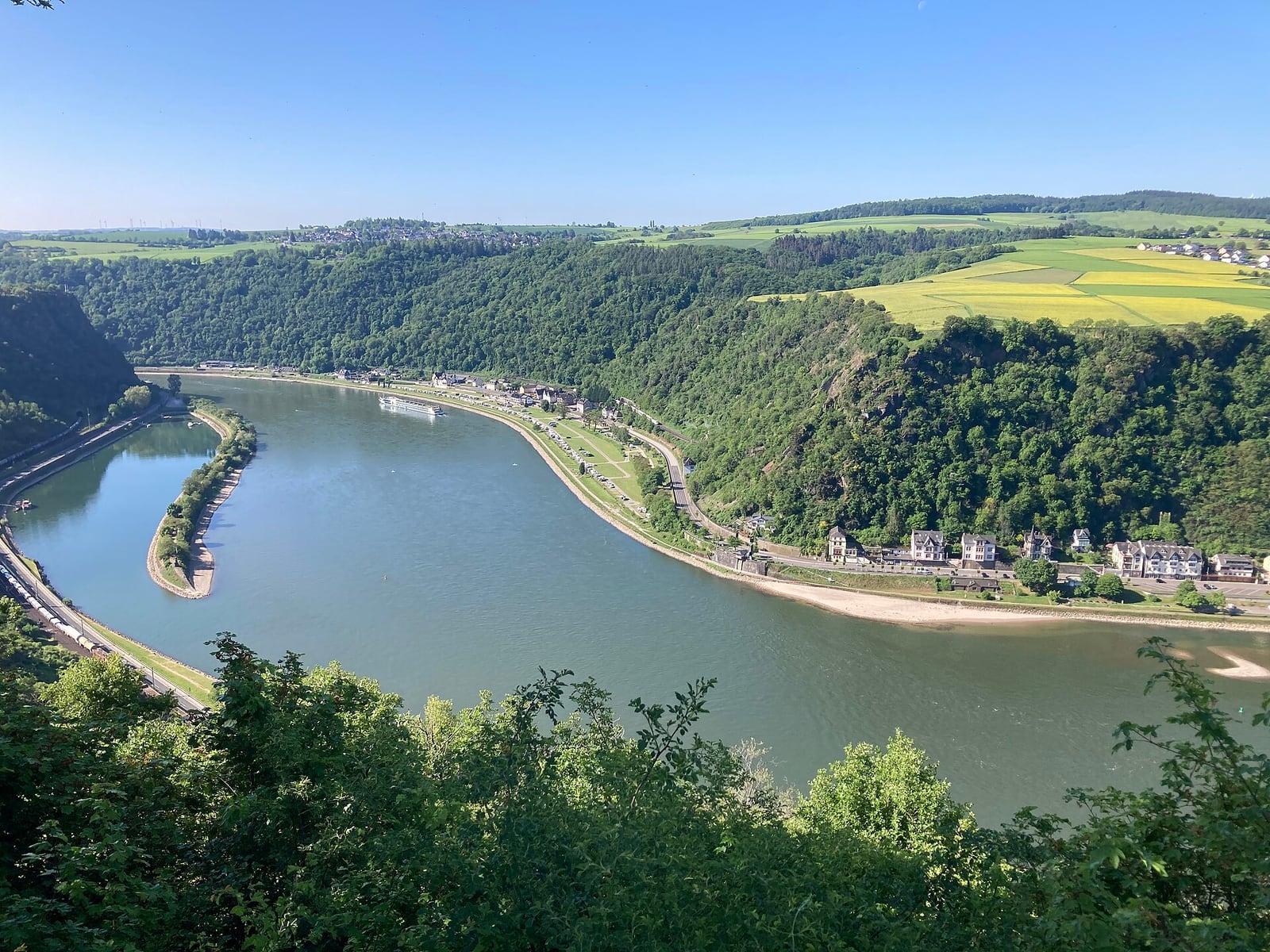
Immediately after St. Goar comes the bit everybody is here for. The river bends, the cliffs pinch in, and on the opposite bank a 132-metre wall of slate stands over the water: the Loreley. The Rhine squeezes past it 160 metres wide and 25 metres deep. Watch on the left; it is over in a minute and a half.
St. Goar to Bingen — 27 kilometres of castles
Oberwesel arrives with its town wall and the Schönburg above it. Then the water widens briefly and Pfalzgrafenstein appears — a white-and-red toll castle standing on a rock in the middle of the river, off Kaub, looking exactly like a ship at anchor. There is no station for it, and no need: it is fifty metres from the train.
Bacharach is the other place to get off. Half-timbered houses, sixteen towers of medieval wall, and Burg Stahleck on the crag.
The last stretch runs through Niederheimbach and Trechtingshausen, where Burg Rheinstein and Burg Reichenstein sit in the vineyards, and finishes at Bingen (Rhein) Hauptbahnhof. Just beyond the platform end the gorge opens out, the Mäuseturm stands on its island, and the Rhine goes back to being a wide, ordinary, hard-working river.
If you carry on
The RB 26 does not stop at Bingen. It runs on through Gau Algesheim and Ingelheim to Mainz Hbf, about 37 minutes further, on flat vineyard country that is pleasant and entirely unlike what you have just come through.
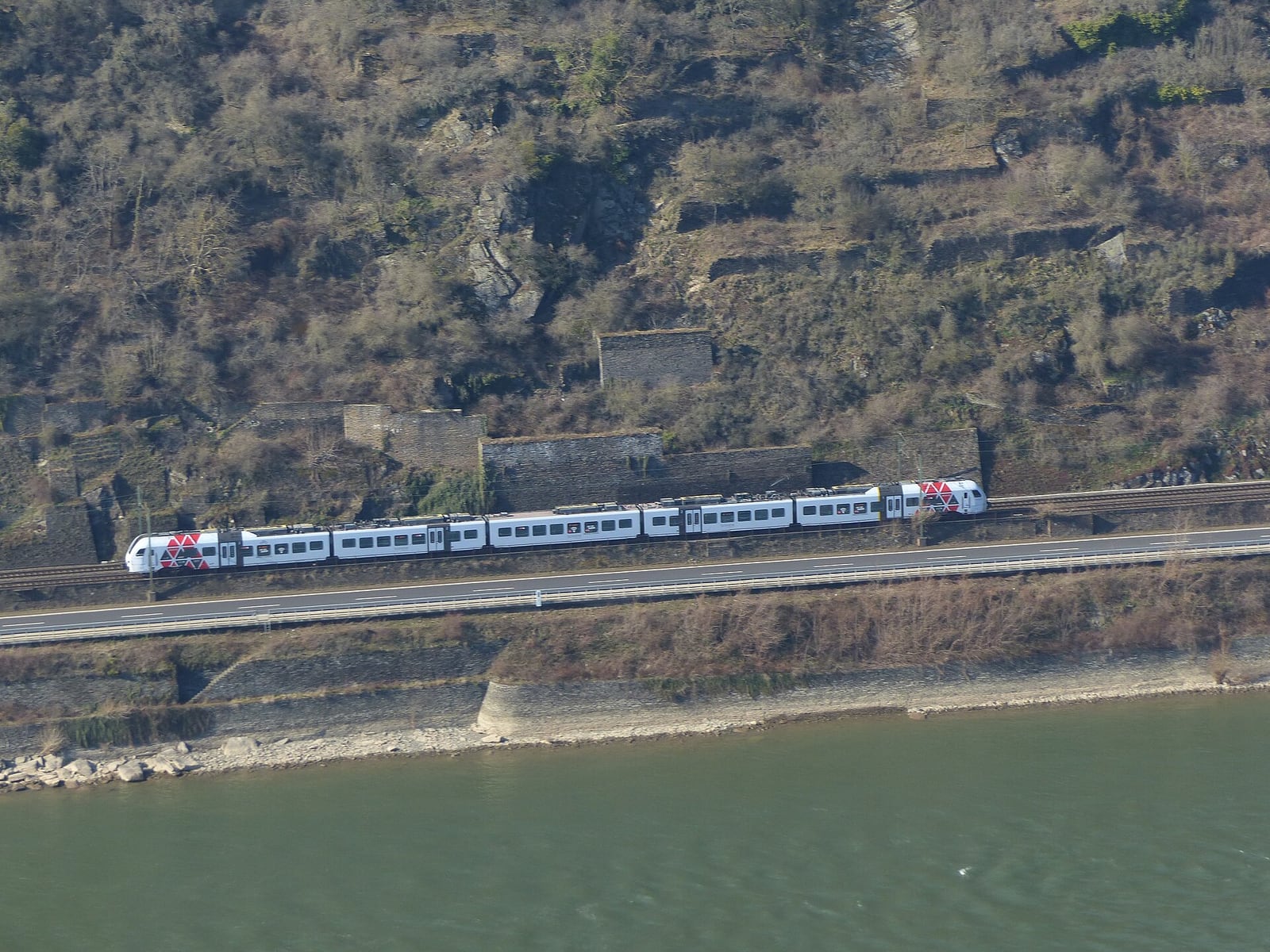
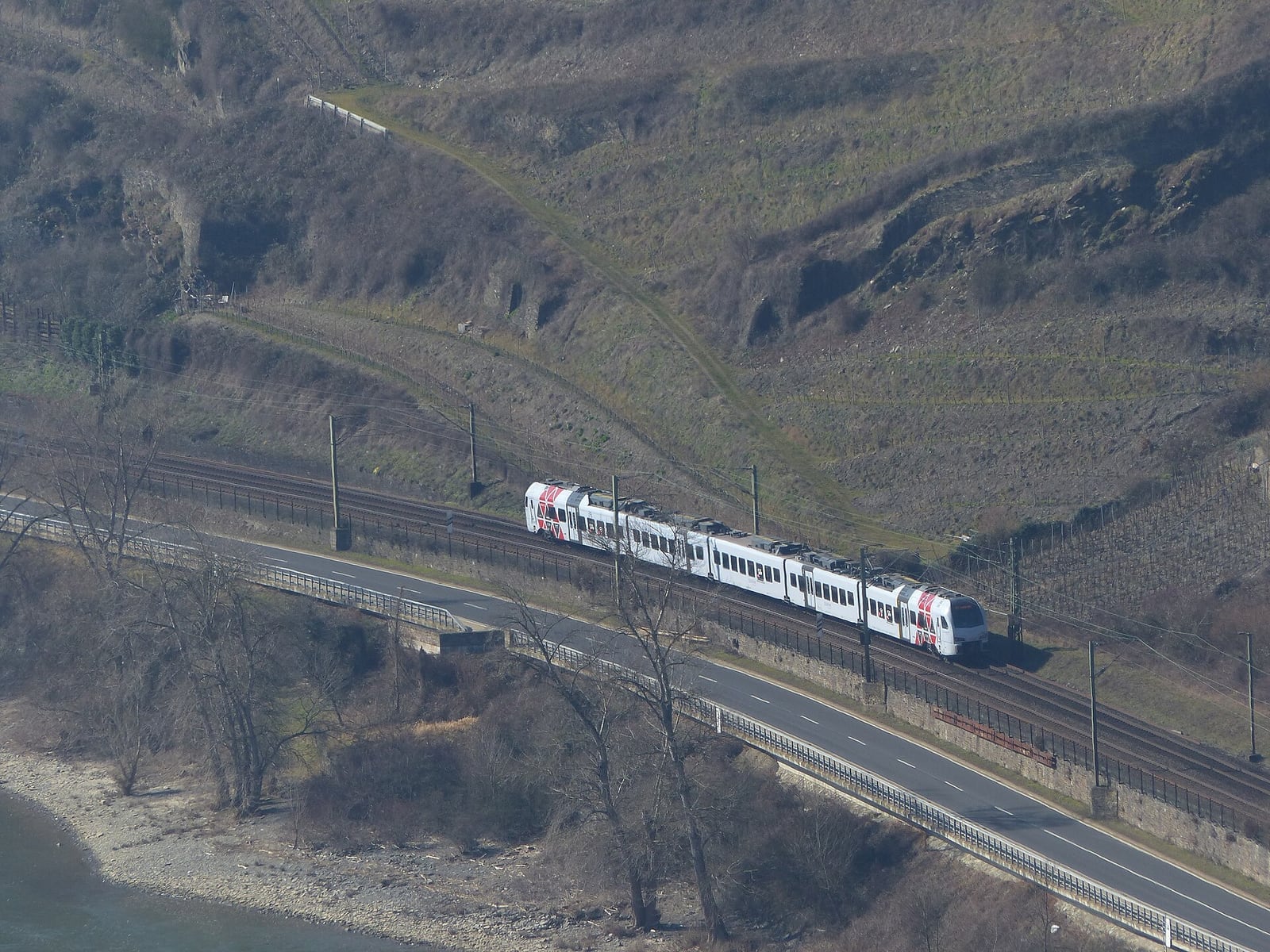
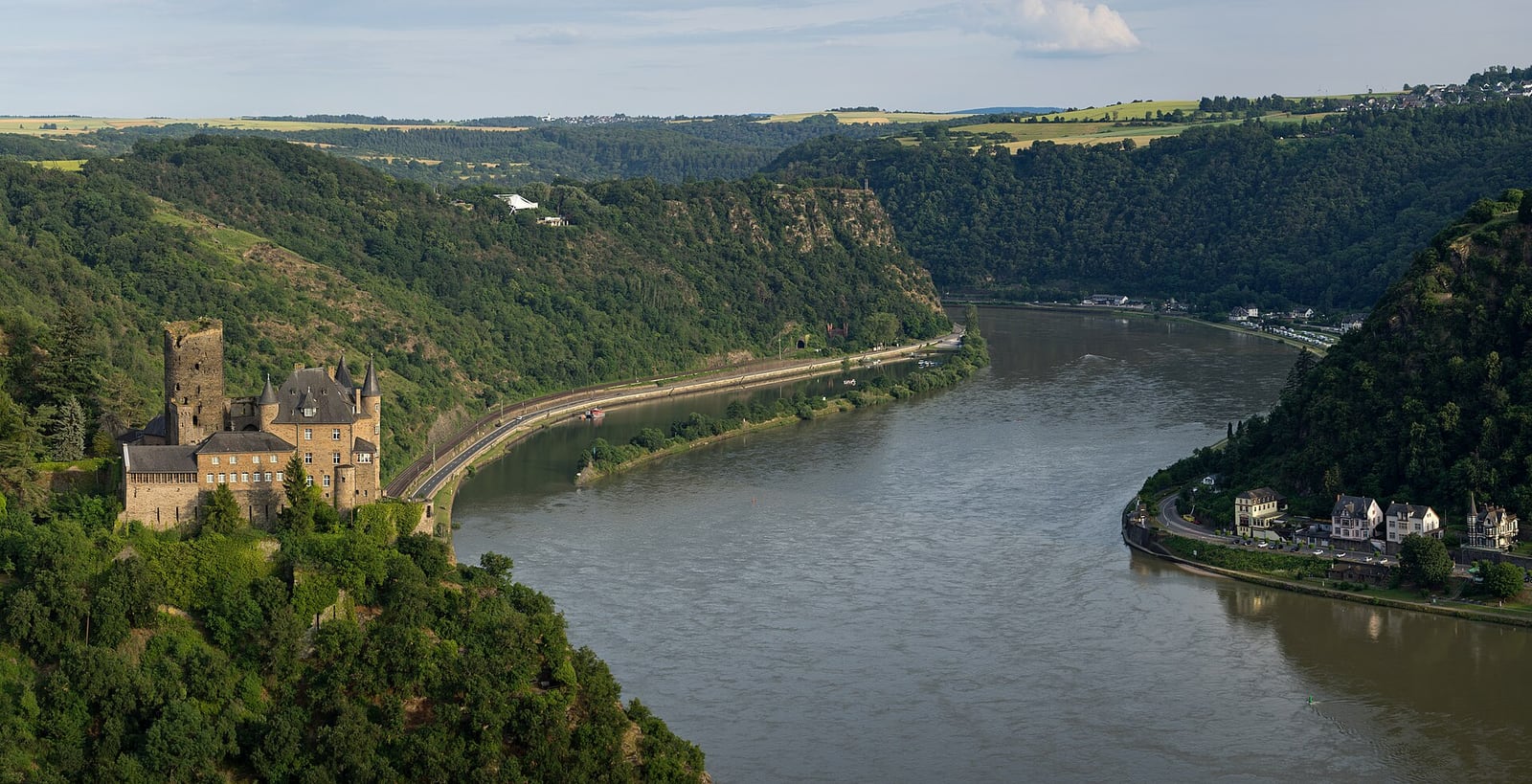
Along the route
Whgler / Wikimedia Commons · CC BY-SA 4.0A World Heritage site on a commuter ticket
The Upper Middle Rhine Valley has been on the UNESCO list since 2002 — 65 kilometres of gorge, terraced for wine since the Middle Ages and fortified by everybody who ever wanted to tax the river. The train through it is an hourly stopping service with a bicycle space and a coffee machine.Joachim Seyferth / Wikimedia Commons · CC BY 4.0Castles, most of the way
Rheinfels, the Schönburg, Stahleck, Rheinstein, Reichenstein — and Pfalzgrafenstein standing on its own rock in the middle of the water. They were built to stop boats and charge them, which is why they sit where the river is narrowest, and why they are all visible from a train window.Jörg Braukmann / Wikimedia Commons · CC BY-SA 4.0The Loreley, from the wrong side
The rock is 132 metres of slate above the water, and it is on the right bank. This railway runs the left, so you get the view of it rather than the view from it — which is the better half of the bargain, and the reason to sit on the left going south.A bit of history
Culture & experiences along the way
Whgler / Wikimedia Commons · CC BY-SA 4.0Sit on the river side
Going south from Koblenz that is the left-hand side of the train, and it matters more here than on most lines: the railway runs on the water's edge for most of the gorge, and the other window gives you a rock face.Pudelek (Marcin Szala) / Wikimedia Commons · CC BY-SA 3.0Break the journey twice
Trains are hourly and the stations are five to ten minutes apart, so getting off is almost free. St. Goar for Rheinfels, Bacharach for the old town and Stahleck, and you are still in Bingen by the evening.Whgler / Wikimedia Commons · CC BY 4.0Go in October
The terraces that make this a World Heritage landscape are cut into slate at angles no machine can work. They turn in October, the villages hold their wine festivals, and the gorge does the one thing that no photograph of it in July manages.Timetables
The service through the gorge is hourly in each direction, all year, worked by the RB 26 MittelrheinBahn between Köln Messe/Deutz and Mainz Hbf. Regional expresses and Intercity trains use the same track and call at the bigger towns.
Southbound — Koblenz to Bingen
The RB 26 leaves Koblenz Hauptbahnhof at :30 past each hour and reaches Bingen (Rhein) Hauptbahnhof at :19 — about 50 minutes for 60.7 kilometres:
| Station | km | Time |
|---|---|---|
| Koblenz Hbf | 0.0 | :30 (depart) |
| Rhens | 8.6 | :34 |
| Spay | 12.2 | :37 |
| Boppard Hbf | 19.5 | :43 · :46 |
| Boppard-Bad Salzig | 24.5 | :50 |
| Boppard-Hirzenach | 28.2 | :53 |
| St. Goar | 34.1 | :58 |
| Oberwesel | 40.9 | :03 |
| Bacharach | 47.3 | :08 |
| Niederheimbach | 50.8 | :11 |
| Trechtingshausen | 55.4 | :14 |
| Bingen (Rhein) Hbf | 60.7 | :19 (arrive) |
Trains carry on to Mainz Hbf, arriving at :56.
Northbound — Bingen to Koblenz
The other way, trains leave Mainz Hbf at :03, are at Bingen (Rhein) Hbf at :33 and away again at :39, and reach Koblenz Hbf at :27 — 48 minutes through the gorge. Intermediate times run Trechtingshausen :43, Bacharach :50, Oberwesel :54, St. Goar :00, Boppard :12, Rhens :20.
Good to know:
- ⚠️ These times come from a timetable valid only from 11 July to 12 December 2026. German timetables change every December, and this one was reissued in mid-July as well. Check before you travel; the clock-face pattern is stable, the exact minutes are not.
- ⚠️ A few trains run in only part of that window. The operator's table footnotes several workings nur 11.7.–18.9. or nur 19.9.–12.12. — mostly early and late services rather than anything in the middle of the day.
- Extra trains between Mainz and Bingen. Monday to Friday the RB 26 is reinforced to half-hourly on that section, which does not help inside the gorge but does help getting to it from the south.
- Sitting on the left going south puts the river on your side for the whole gorge, including the Loreley. Northbound, sit on the right.
- Bicycles travel on every RB 26.
Times from the operator's own published RB 26 timetables — MittelrheinBahn / Trans Regio, both directions, valid 11 July to 12 December 2026 — read in August 2026. Kilometre posts are the operator's, measured from Koblenz Hbf.
Tickets
This is a normal German regional railway, so it is sold like one — no journey-specific ticket, no reservation and no scenic supplement. The Deutschland-Ticket at €63 a month covers the RB 26 through the gorge, so anyone already carrying one rides all day and hops off at every village for nothing extra. ⚠️ It is not valid on IC, EC or ICE trains, and those run this line too.
The trap for a single fare is that the gorge is split between two fare unions, and the boundary falls between Oberwesel and Bacharach — in the middle of the best part of the ride — so a ticket bought for one half will not carry you across it. A through DB ticket prices the whole journey regardless. Day tickets exist in both unions and are worth pricing if you mean to break the journey more than once, which you should.
Book your tickets
The RB 26 MittelrheinBahn
Hourly, stopping everywhere, ordinary fares
The local service on the left bank, run by Trans Regio. It calls at every village in the gorge, takes bicycles, and is sold on the same regional tariff as any other German regional train — no reservation and no supplement.
Book Tickets (opens in a new tab, on MittelrheinBahn · Trans Regio)via MittelrheinBahn · Trans RegioIntercity through the gorge
Faster, fewer stops, same scenery
Long-distance trains use this line too, and they run the same riverbank at the same speed limits. Worth knowing if you are passing through rather than stopping — but they skip the villages that make the journey worth breaking.
Book Tickets (opens in a new tab, on Deutsche Bahn)via Deutsche BahnRail Passes
This is the German journey where passes work best, because everything through the gorge is an ordinary scheduled train on the national network.
The Deutschland-Ticket
€63 a month, sold only as a rolling digital subscription in your own name, and valid on "allen Nahverkehrszügen (RB, RE, S-Bahn) und öffentlichen Verkehrsmitteln" — every regional train, bus, tram and U-Bahn in Germany.
The RB 26 through the gorge is exactly that, so a Deutschland-Ticket covers Koblenz to Bingen and every stop between, all day, as often as you like.
⚠️ It is not valid on the Intercity and ICE trains that use the same track — "nicht in Zügen der DB Fernverkehr AG (IC, EC, ICE)". If the next train is an IC, wait for the RB.
Interrail and Eurail
Fully valid. Interrail's own operator table covers "DB and all other Regional carriers" for RB, RE and IRE services, and DB's own S-Bahn, IC and ICE. Trans Regio, which runs the MittelrheinBahn, is on the list of German companies that table links, so the RB 26 is covered like any DB train.
The excluded column names FlixTrain and GoVolta, neither of which comes near this line, and adds that anything not named falls to that same linked list. It is closed rather than illustrative — the reason a German mountain railway is outside a pass even when the regional train beneath it is not.
⭐ The pass bonus worth knowing here: Interrail lists the KD Rhine Line — the Rhine cruise boats — as a discounted service. Train down the gorge and boat back up, or the other way round, is the classic way to do this stretch, and a pass takes money off the boat half.
No reservations are needed on any regional train here, and none can be made. Turn up and board.
The Rheinland-Pfalz/Saarland-Ticket
If you are not carrying a pass and there is more than one of you, this is usually the cheapest answer. €30 for the first person and €10 for each of up to four more, covering "Alle Nahverkehrszüge aller Eisenbahnunternehmen (S-, RB, RE)" — so the RB 26 and the REs, but not the Intercity.
The whole gorge is in Rhineland-Palatinate, so one ticket covers Koblenz to Bingen and on to the state boundary beyond.
⚠️ Watch the clock: Monday to Friday it is only valid from 09:00, running to 03:00 the next morning. At weekends and on public holidays it works from midnight.
Is a pass worth it for this journey?
On its own, no. A single Koblenz–Bingen fare is small, and neither an Interrail pass nor a monthly subscription pays for itself on one 50-minute ride.
It becomes worth it in two situations, and both are common: you are already crossing Europe on a Global Pass and this is a free detour worth building a day around; or you are in Germany for a month, in which case the Deutschland-Ticket turns the whole gorge into a place you can wander for nothing.
Pass conditions checked against Deutsche Bahn and Interrail's own operator list, August 2026.
Places to Visit
Twelve stations in 61 kilometres, an hourly train, and no ticket that penalises you for getting off — this is a journey built for stopping. Everything below is within a few minutes' walk of a platform, except the Loreley, which is on the wrong bank and says so.
If you only have a day and have to choose: St. Goar for the castle and Bacharach for the town. If you have two, add Boppard for the view down the loop.
 Holger Weinandt / Wikimedia Commons · CC BY-SA 3.0 de · cropped
Koblenz
The Mosel joins the Rhine on a spit of land called the Deutsches Eck, and the whole city arranges itself around the junction. A cable car crosses to the Ehrenbreitstein fortress on the far bank, the old town runs back from the water in squares and narrow streets, and the World Heritage gorge starts immediately upstream.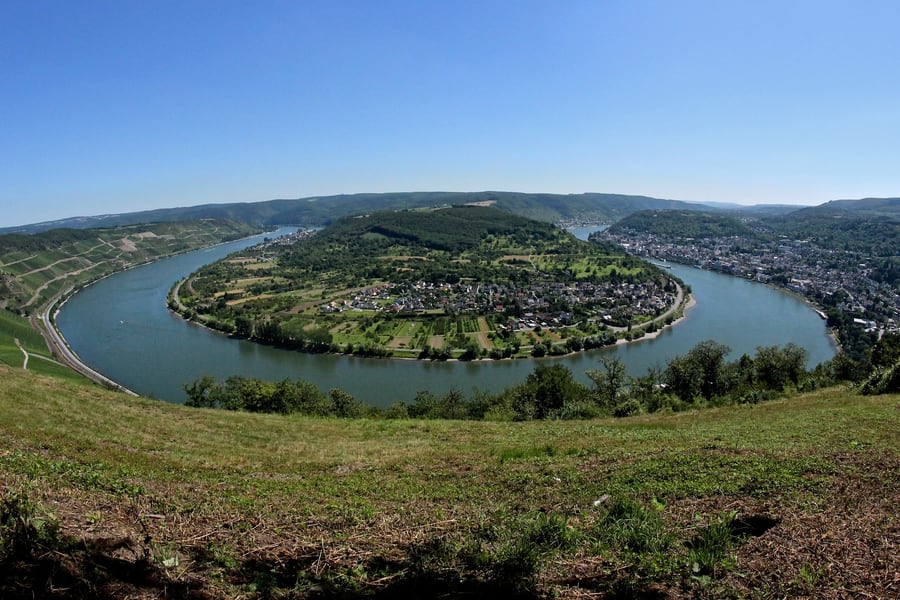 Leokowalski / Wikimedia Commons · CC BY-SA 3.0 · cropped
Boppard
Just north of the town the Rhine makes its biggest bend, the Bopparder Hamm, swinging almost a full circle around a wooded hill; a chairlift from the edge of town lifts you to the Vierseenblick, where the loop is folded up so tightly that the river reads as four separate lakes. Boppard itself grew up inside a late Roman fort and has a long promenade between the houses and the water.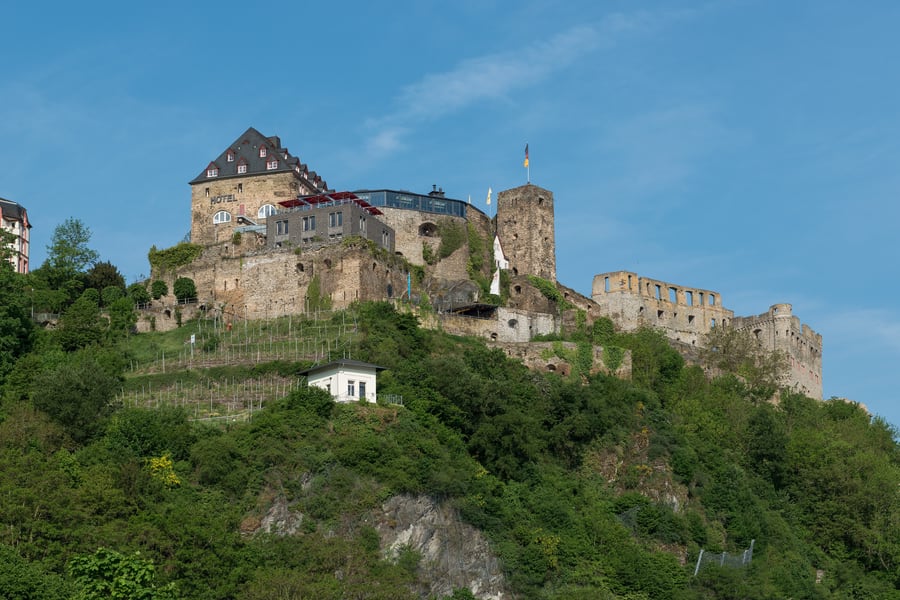 DXR / Wikimedia Commons · CC BY-SA 4.0 · cropped
Burg Rheinfels, St. Goar
Built in 1245 by Diether V of Katzenelnbogen to tax boats, and it worked: the castle survived a siege by the Rhenish League of Towns in 1256 and grew into the largest fortification in the gorge. French revolutionary troops took it in 1794 without a shot and blew it up three years later. What is left is a vast, walkable ruin with tunnels under it, right above the station.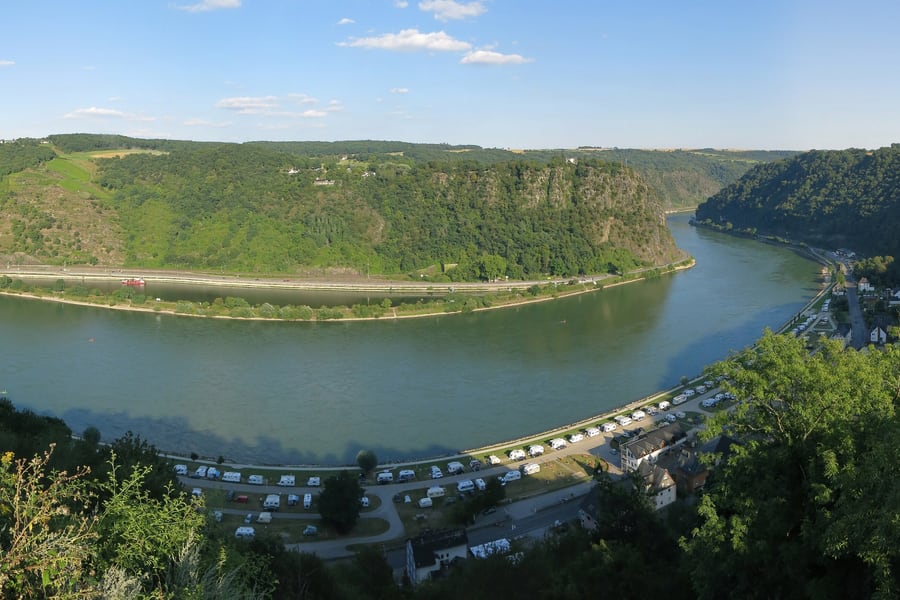 Milseburg / Wikimedia Commons · CC BY-SA 4.0 · cropped
The Loreley
A 132-metre slate cliff where the Rhine narrows to 160 metres and drops to 25 deep — the reason so many boats came to grief here, and the reason Brentano invented a siren to explain it in 1801. It stands above Sankt Goarshausen on the right bank, so from this train you see it rather than climb it; the ferry from St. Goar crosses in a few minutes if you want both.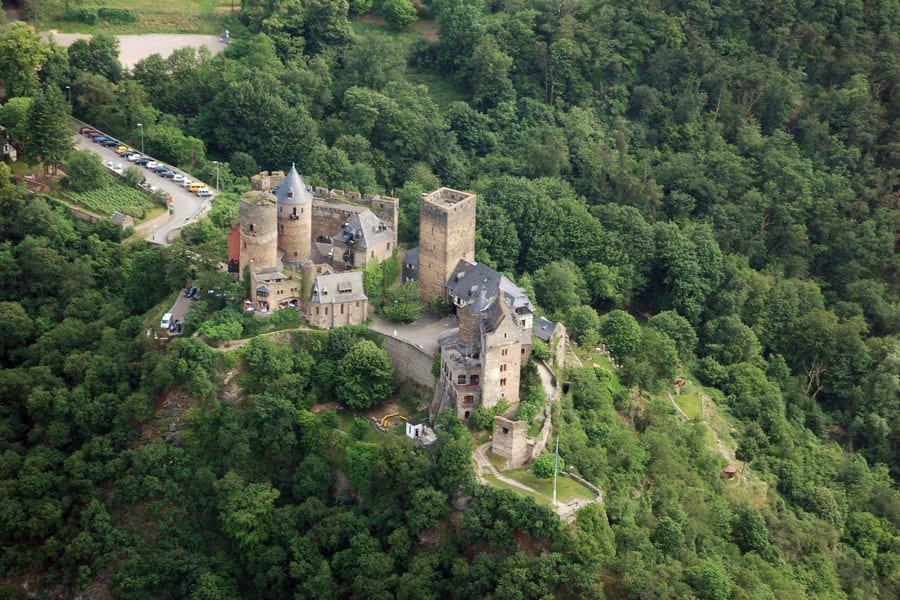 Fritz Geller-Grimm / Wikimedia Commons · CC BY-SA 3.0 · cropped
Oberwesel
A town that kept two and a half kilometres of medieval wall, under the Schönburg — a castle strung along the ridge above it. Two big Gothic churches stand at either end of the old town, the Liebfrauenkirche and St. Martin, and the vineyard terraces start where the houses stop.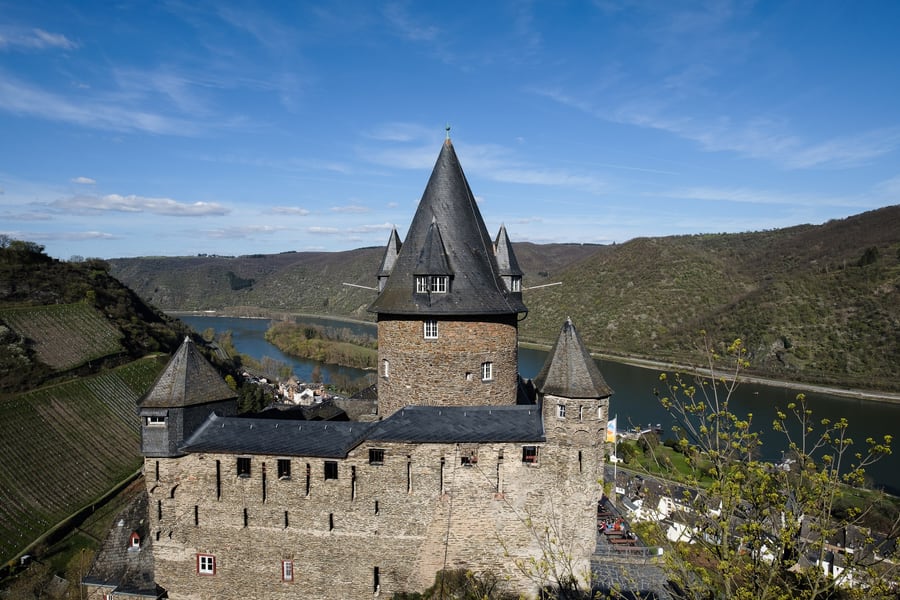 abbilder / Wikimedia Commons · CC BY 2.0 · cropped
Bacharach
Half-timbered houses inside one of the best-preserved town walls in Rhineland-Palatinate — sixteen fourteenth-century towers, and much of it walkable — with the roofless shell of the Wernerkapelle on the slope and Burg Stahleck on the crag above, which is a youth hostel, so anyone can sleep in it. Victor Hugo came in 1840 and called it one of the most beautiful old towns in the world.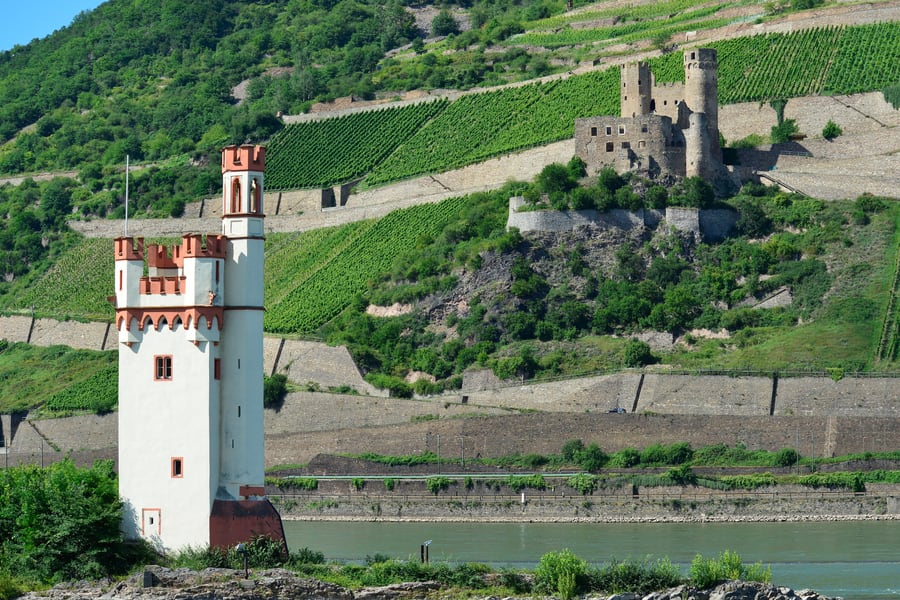 Arcalino / Wikimedia Commons · CC BY-SA 3.0 · cropped
Bingen
The Mäuseturm stands on its own island where the gorge opens out, built in the first half of the fourteenth century as a toll and watch tower for Burg Ehrenfels — whose ruin is in the vineyards on the slope opposite. The legend that gave it its name has an archbishop eaten alive by mice on that island for burning the starving in a barn. It was restored in 2015 and is occasionally opened for guided tours.Where to Sleep
The gorge has been in the tourist business since the Romantics found it two centuries ago — Brentano wrote the Loreley in 1801, Victor Hugo turned up in 1840 — and it shows: for 61 kilometres there is barely a village without somewhere to stay, from wine-growers' guest rooms to castles.
Staying inside the gorge rather than at either end is the whole trick. Boppard and St. Goar are the two obvious bases — both are on the line, both have an hourly train in each direction, and both put you in the middle of the World Heritage stretch rather than commuting into it from Koblenz or Mainz. Bacharach is smaller and prettier and works just as well.
⭐ Anyone can sleep in a castle here. Burg Stahleck, the one on the crag above Bacharach, is a youth hostel — no card is shown for it below because we have no photograph of it we can stand behind, but it is worth knowing about.
Neither of the cards below carries a price or a booking link: we have no affiliate arrangement, and we do not quote figures we have not checked.
Where to stay
 giggel / Wikimedia Commons · CC BY 3.0 · cropped
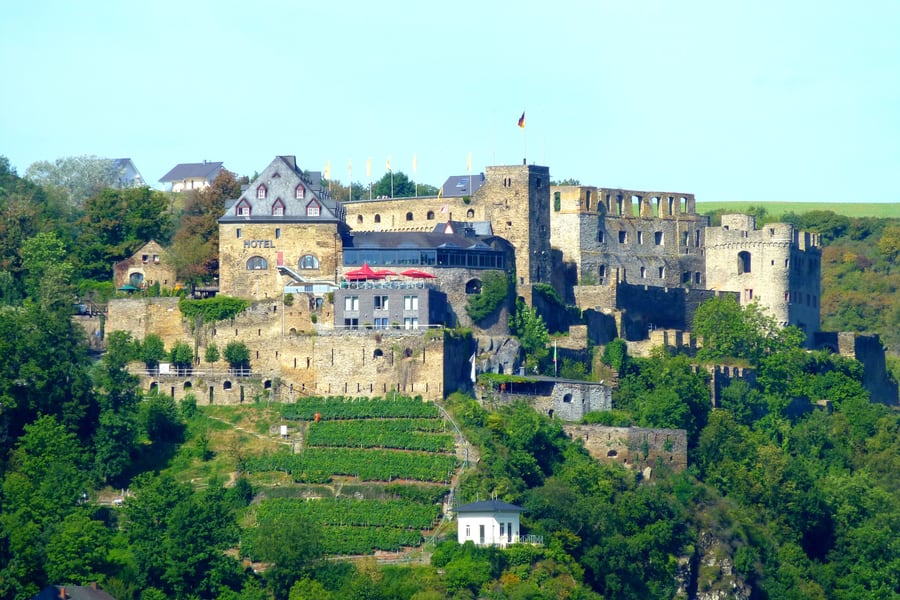
Schlosshotel Rheinfels
Inside the castle walls, above St. Goar
A hotel built into the surviving range of Burg Rheinfels, sharing the hilltop with the ruin and looking straight down the gorge. The town and the station are a steep walk or a short shuttle below.
Check Availability (opens in a new tab, on schloss-rheinfels.de)via schloss-rheinfels.de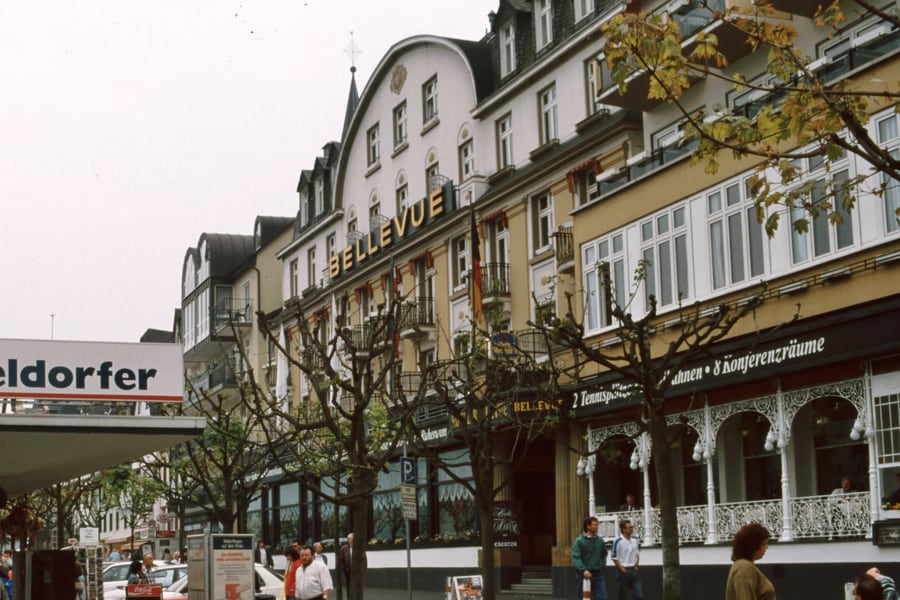 qwesy qwesy / Wikimedia Commons · CC BY 3.0 · cropped
Bellevue Rheinhotel
On the promenade at Boppard
A Belle Époque and Jugendstil house standing directly on the Rhine promenade, with three restaurants, a bar and a pool behind the balconied front. Boppard station is a few minutes' walk behind it.
Check Availability (opens in a new tab, on bellevue-boppard.de)via bellevue-boppard.deQuestions or corrections
Planning this trip and stuck on something, or spotted a time, fare or detail that has changed? Send us a message about The Middle Rhine. We read every one, and we update this page when something has changed.