The Moldava Mountain Railway
Phil Richards / Wikimedia Commons · CC BY-SA 2.0
- DistanceMost–Moldava · 40 km
- Duration1 h 16 from Most · 1 h 33 from Ústí nad Labem
- Best seasonDaily from late May to early October · weekends and holidays all year
Introduction
The Moldava mountain railway climbs out of a coal basin and stops, three hundred metres short of Germany, at a station far too big for the trains that use it. Both of those facts have the same cause. The line was built in the 1870s and 1880s by the Prague–Duchcov Railway to carry brown coal from the Most field over the Ore Mountains into Saxony, and it was designed to hand that traffic to a Saxon company at a shared frontier station. On 8 May 1945 Red Army tank units occupied the trackbed. Cross-border working never resumed, and the rails on the German side were lifted in the spring of 1953.
What is left is one of the most rewarding branch lines in the Czech Republic. In forty kilometres it rises 497 metres, at gradients reaching 36 per mille and round curves as tight as 250 metres, through two tunnels and over a series of stone viaducts. Since 1998 the whole mountain section, from Louka u Litvínova to the terminus, has been protected as a cultural monument of the Czech Republic — not a preserved railway with a museum timetable, but a listed one that carries an ordinary public service. Czechs call it the Teplice Semmering, after the Austrian mountain line it was measured against when it was new.
The gap at the top has never quite been accepted as permanent. A working railway still runs to Holzhau on the Saxon side, 8.3 kilometres beyond the buffer stop at Moldava, and municipalities on both sides of the border have been arguing for the missing link since 1989. A feasibility study presented at the end of 2022 confirmed that rebuilding it is technically possible. It also found that on nearly half the route the ground has become protected habitat in the seventy years since the track came up — which is now the largest single obstacle to putting it back.
The Journey
Trains start from Most, a town of 225 metres' altitude and almost no age. The old city stood over a brown-coal seam and was demolished for it between the 1960s and the 1980s; what stands now was built alongside. The railway shared in that upheaval, and sections of this line between Most and Louka u Litvínova were relocated in the 1960s and 1970s to keep clear of the workings. The first quarter of an hour therefore crosses ground that has been dug out and then reshaped — spoil heaps rounded off and planted, water where pits used to be, the volcanic cone of Hněvín standing over it all.
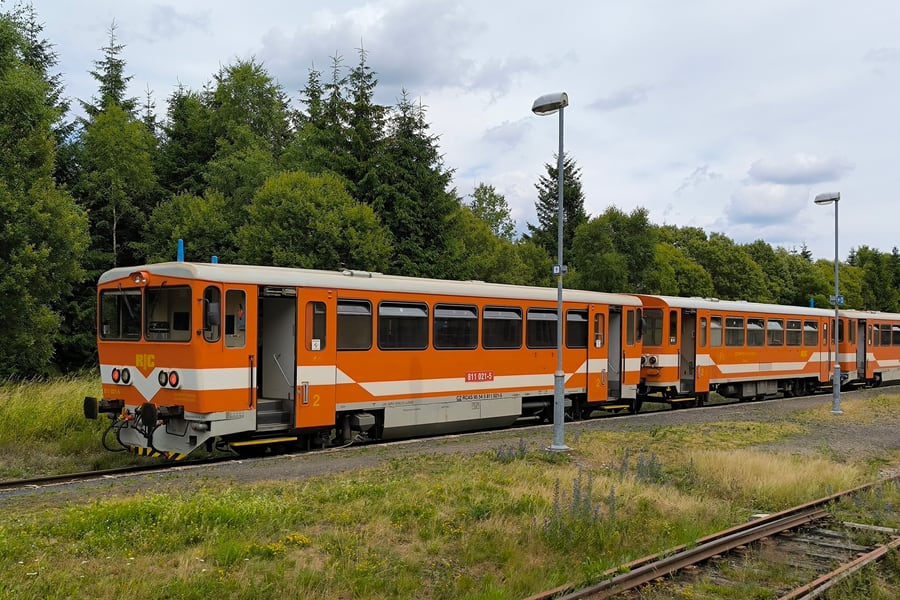
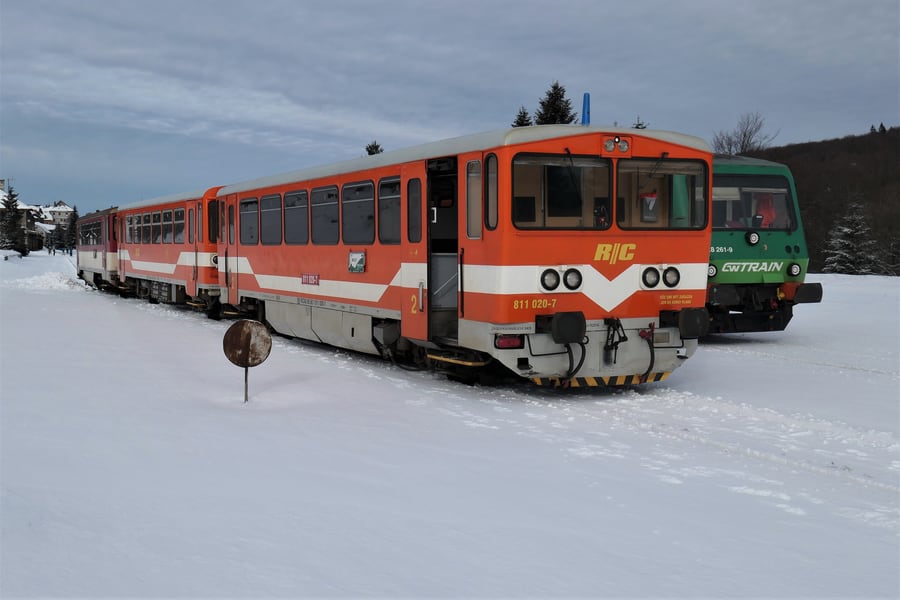
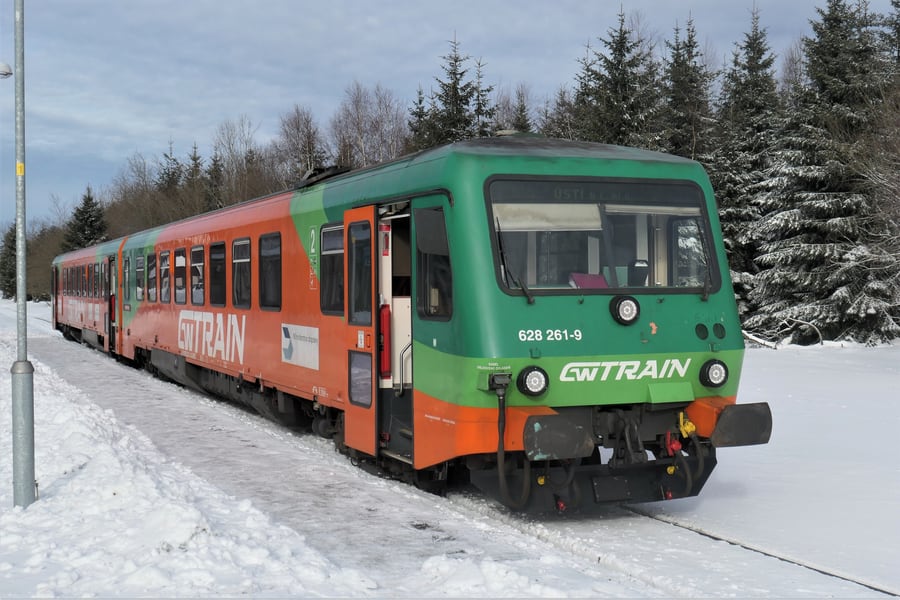
The train itself is worth a word. Railway Capital works the line with class 811 cars — rebuilds of the class 810, the light four-wheeled railcar that Vagónka Studénka turned out to the number of 680 between 1973 and 1982 and which has been the standard branch-line vehicle in Czechoslovakia and then Czechia ever since. Railwaymen call it the orchestrion, among a long list of less flattering names. It seats 55, stands 40 more, and runs to 80 km/h, which on a line limited to 60 is more than enough. The GW Train Regio services from Ústí nad Labem use their own units.
At Louka u Litvínova the electric wires end. From here the mountain railway proper begins, and the line has been listed since 1998: everything from this station to the terminus is a protected cultural monument, alignment and structures together.
The valley section
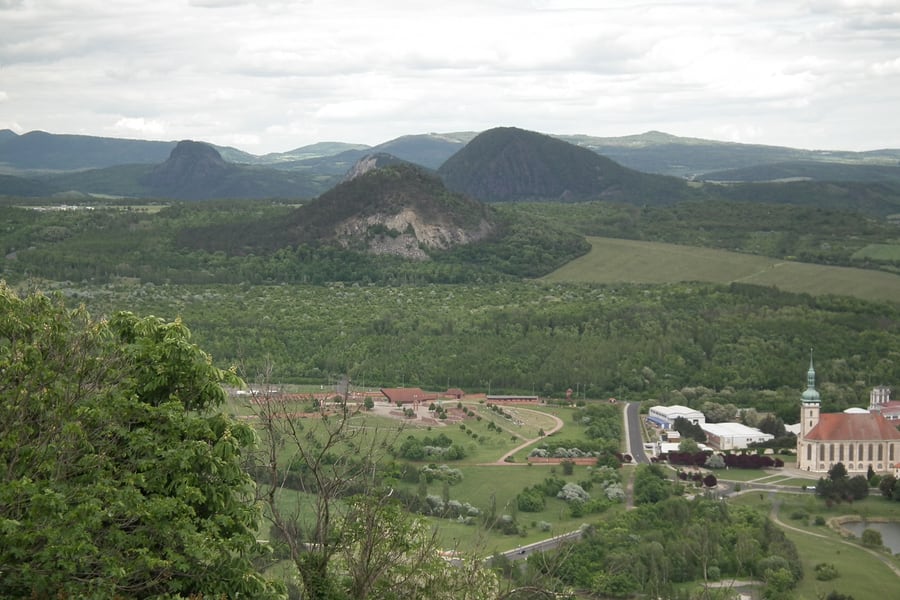
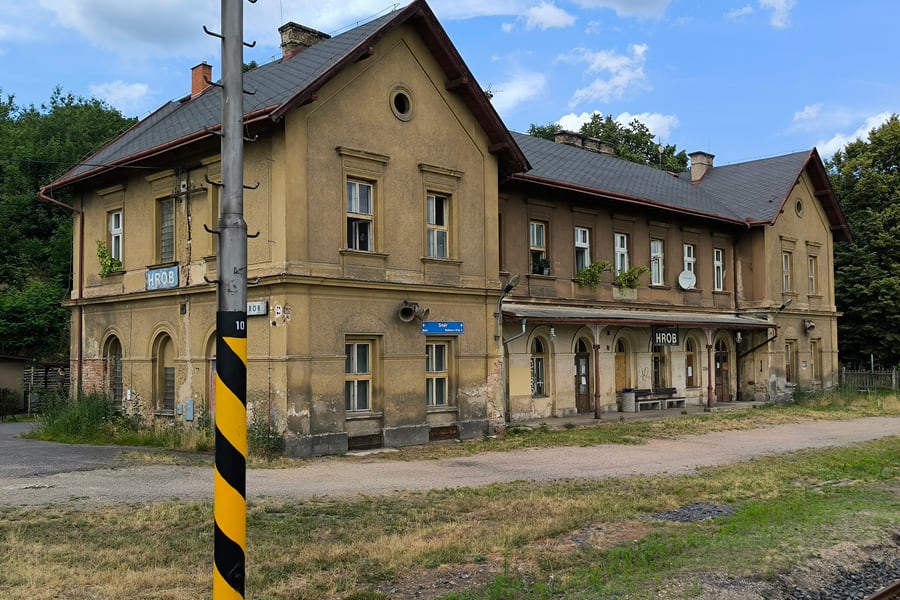
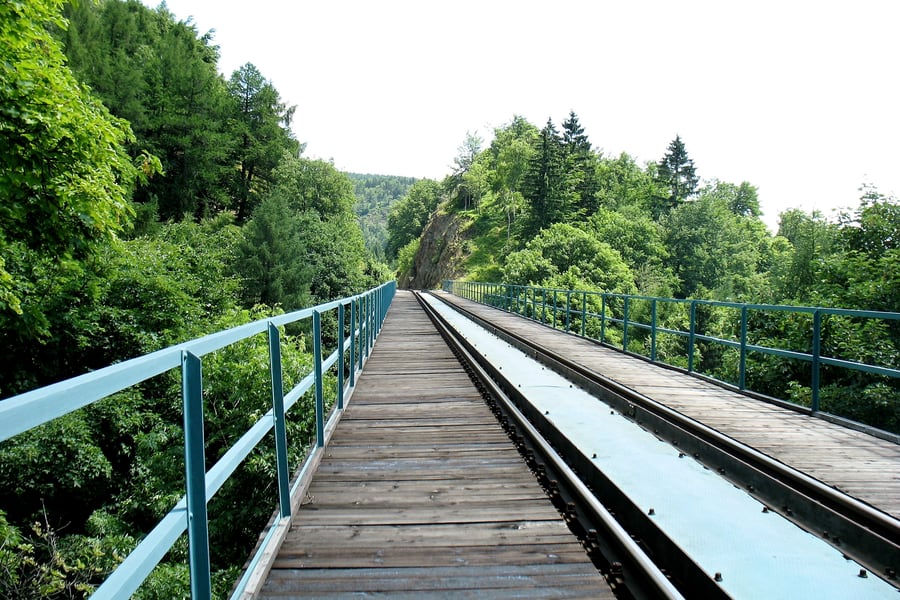
The railway runs along the foot of the mountains through Lom u Mostu and Osek město, gaining height gently — 305 metres at Louka, 345 at Osek, 392 by Hrob. Osek město is the stop for the Cistercian abbey, whose baroque front is visible from the train. Just before Hrob the line crosses the Křižanov viaduct, and then two more at Hrob itself; the largest of them runs 146 metres long and 34 metres above the valley floor.
This is where the railway's construction history shows. The section from Louka to Osek město opened on 18 December 1876 and Osek město to Hrob on 15 May 1877, but the mountain section beyond took another seven years and did not open until 6 December 1884. Financial and engineering difficulties had held it up since the first schemes of the 1860s.
The climb
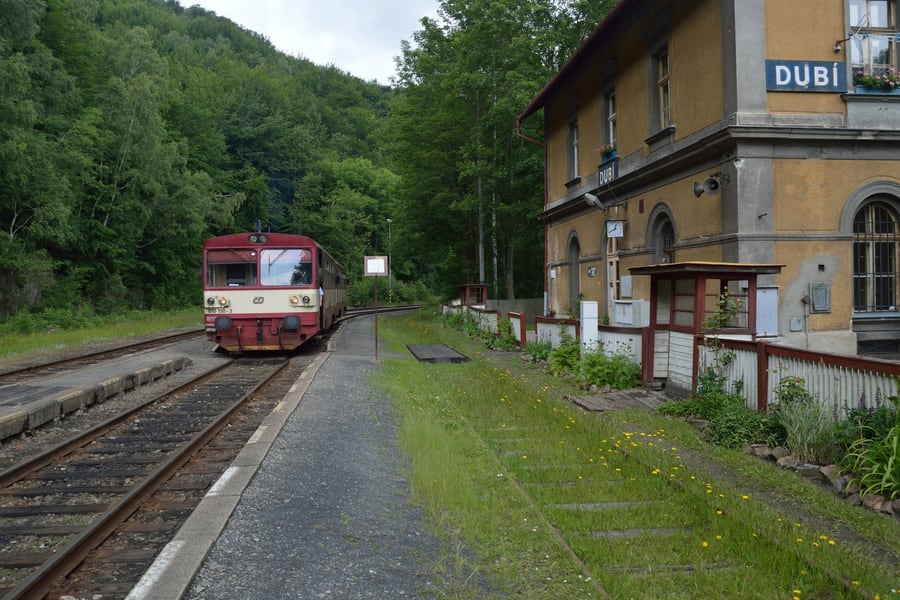
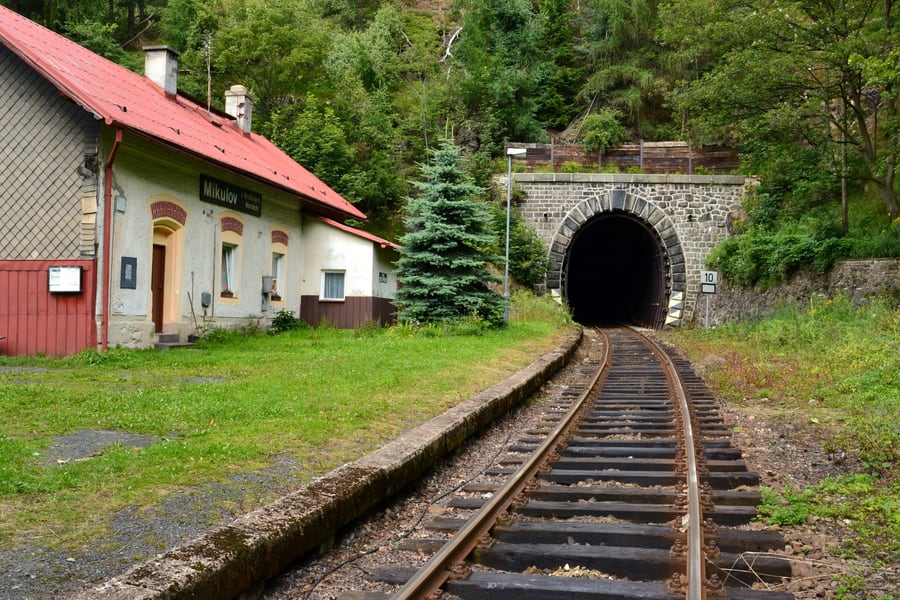
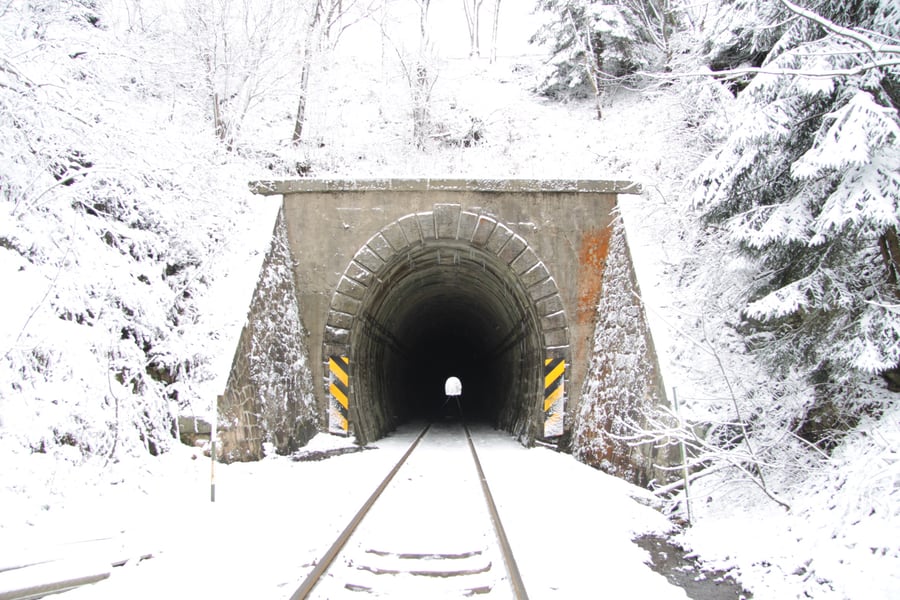
Above Střelná the gradient hardens. Dubí, at 570 metres, sits in a wooded valley above the spa village of the same name, and from there the line turns onto the hillside and begins the work it was built for. In the last eight kilometres it gains more than two hundred metres, on gradients reaching 36 per mille, through the 334-metre Mikulovský tunnel and the 210-metre Novoměstský tunnel, and over a viaduct 117 metres long and 31 metres above the ground.
Mikulov v Krušných horách stands at 720 metres with the tunnel mouth immediately beside its platform. Mikulov-Nové Město follows at 775. Both are request stops. Between them, in March 2017, the embankment and its retaining wall moved and put a measurable kink in the track; the line above Mikulov was closed for nineteen months and reopened on 31 October 2018.
Moldava
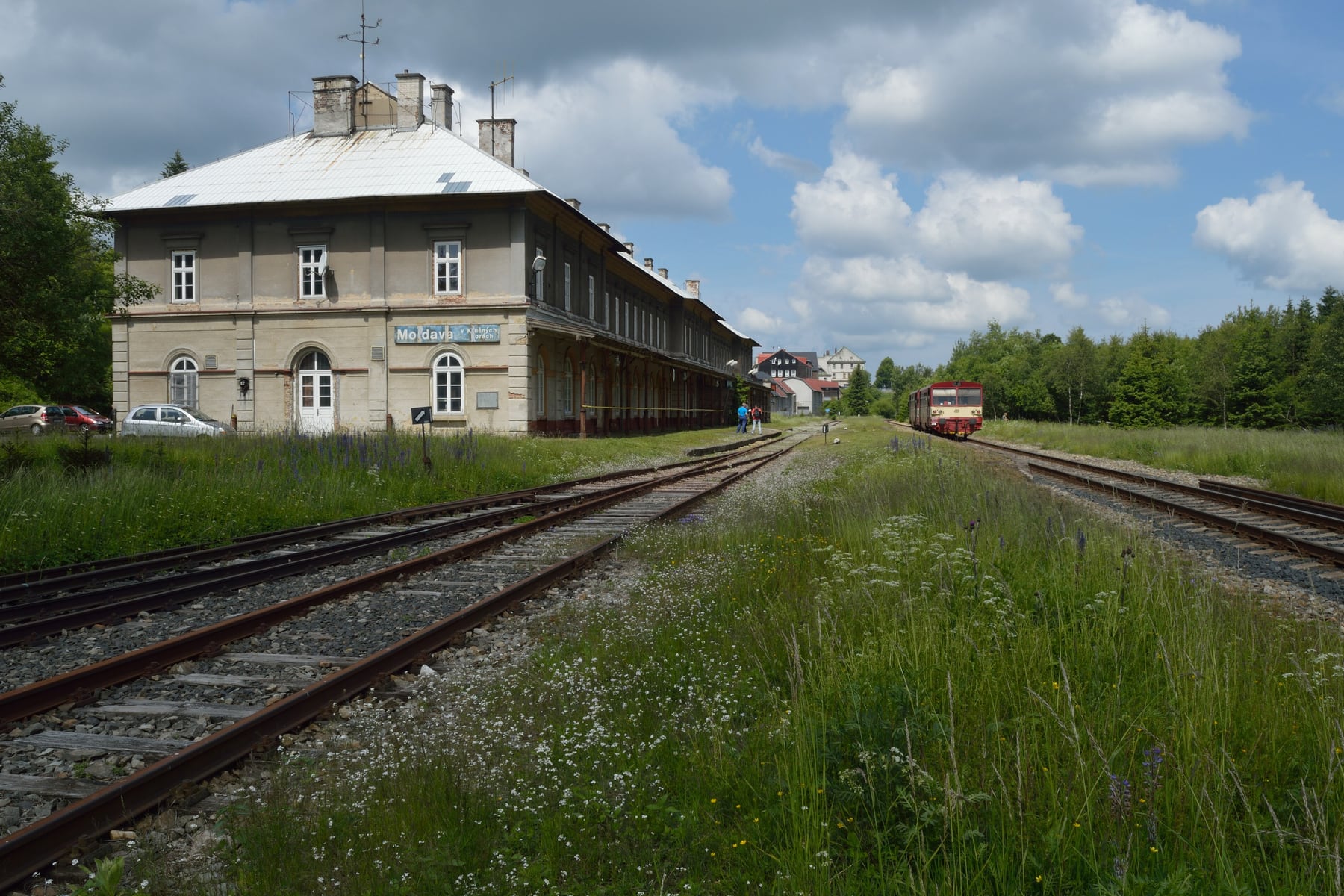
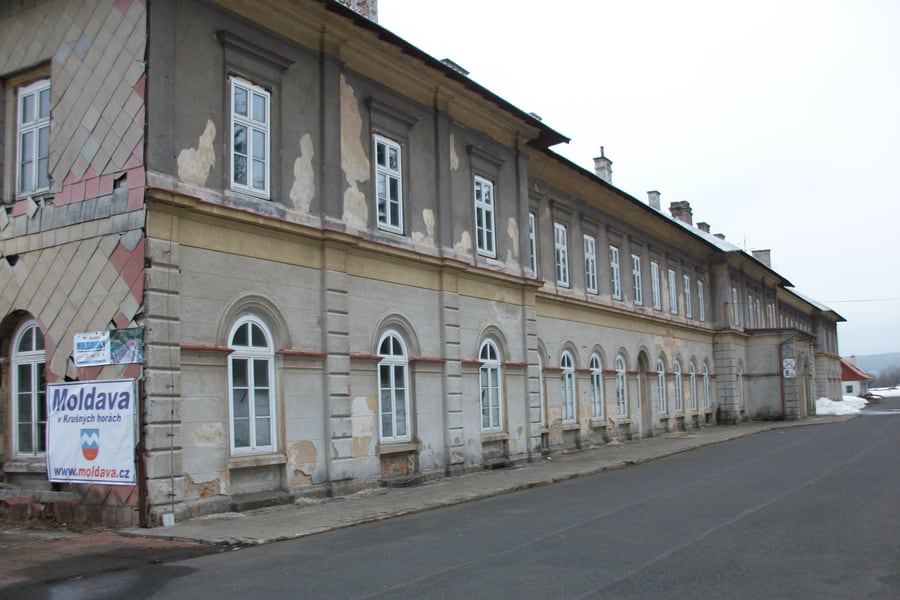
The terminus is at 782 metres, and it is the most eloquent thing on the line. Moldava was built as an international interchange station where the Bohemian company met the line coming up from Freiberg, and the reception building is long out of all proportion to what happens there now — a handful of trains a day, and grass growing between the sidings. Passenger services across the border began on 18 May 1885 and ended in 1945. The state frontier is three hundred metres beyond the buffer stop.
On the far side, the formation runs another 8.3 kilometres to Holzhau, where the Freiberger Eisenbahngesellschaft still operates to Freiberg — hourly on weekdays, two-hourly at weekends, carrying around 160,000 passengers a year. The section between Hermsdorf-Rehefeld and the Moldava border was dismantled in the spring of 1953; Holzhau to Hermsdorf-Rehefeld closed on 7 February 1972.
The case for closing the gap has been made steadily since 1989, and the 2022 feasibility study found no engineering reason against it. The difficulty it did find is a quieter one: on nearly half the route the abandoned formation has become protected biotope, much of it inside the Natura 2000 site of the upper Freiberg Mulde valley. The cost has been put at around 66 million euros. Since June 2024 a cross-border Interreg project has held 700,000 euros, running to the end of 2026, to establish what the legal requirements for a rebuild would actually be.
Along the route
Petr Kinšt / Wikimedia Commons · CC BY-SA 3.0A railway that is itself the monument
Most protected railways are museums. This one carries a public service under a timetable, and the whole section from Louka u Litvínova to Moldava has been a cultural monument of the Czech Republic since 1998 — alignment, viaducts, tunnels and station buildings together.Marie Čcheidzeová / Wikimedia Commons · CC BY-SA 4.0Four hundred and ninety-seven metres
From Most at 225 metres the line climbs to Moldava at 782, at gradients reaching 36 per mille on curves as tight as 250 metres. The steepest work comes above Dubí: two tunnels and a viaduct 31 metres up, in the last eight kilometres alone.Aagnverglaser / Wikimedia Commons · CC BY-SA 4.0Three hundred metres short of Saxony
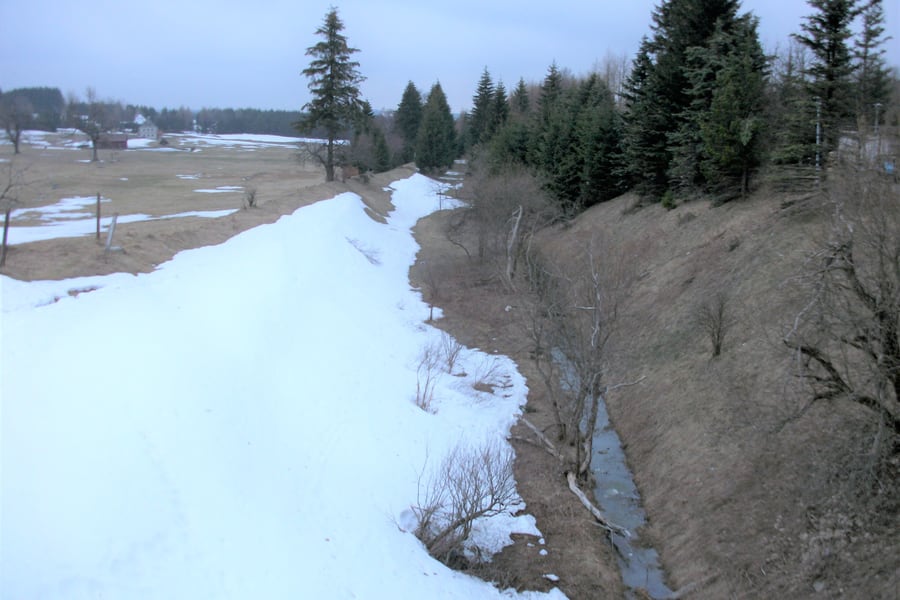
The rails end at Moldava and the border is three hundred metres further on. Beyond it the formation runs another 8.3 kilometres to a working German railway. The track between was lifted in 1953, so the two halves have now been apart longer than they were ever joined.A bit of history
Culture & experiences along the way
Phil Richards / Wikimedia Commons · CC BY-SA 2.0The climb above Dubí
Below Dubí the railway is a valley line among villages. Above it, the character changes: the train works up through Mikulov at 720 metres, where the tunnel mouth stands right beside the platform, then over the viaduct and through the second bore to Mikulov-Nové Město at 775. Both of those are request stops, which is a fair measure of how thinly the top of the line is populated.Aagnverglaser / Wikimedia Commons · CC BY-SA 4.0An oversized station at the end
Moldava was built as an international interchange, where the Bohemian company's line met the one coming up from Freiberg. What survives is a long reception building and a yard laid out for traffic that stopped in 1945, serving a handful of trains a day. Grass grows between the tracks. It is an unusually legible place — the mismatch between the buildings and the service explains itself on sight.Stefan Kühn / Wikimedia Commons · CC0A line that starts where a town used to be
The railway was built to move brown coal, and the coalfield eventually consumed its own starting point: old Most was demolished for the seam beneath it, and in the 1960s and 1970s sections of this line between Most and Louka u Litvínova were relocated to keep clear of the workings. The basin the train crosses in its first quarter of an hour is reshaped ground.Timetables
The times below are from Railway Capital's own published table for line T8, valid from 14 December 2025 to 12 December 2026 and read on 16 August 2026. Two operators share the route: Railway Capital works the trains between Most and Moldava, and GW Train Regio runs the semi-fast services that start further east at Ústí nad Labem.
From Most to Moldava v Krušných horách
| Train | Most | Louka u Litvínova | Hrob | Dubí | Moldava |
|---|---|---|---|---|---|
| 26800 | 06:41 | 06:59 | 07:18 | 07:37 | 07:57 |
| 26802 | 09:37 | 09:54 | 10:12 | 10:32 | 10:52 |
| 26804 | 13:16 | 13:33 | 13:51 | 14:11 | 14:31 |
| 26806 | 16:46 | 17:04 | 17:22 | 17:42 | 18:02 |
The full run takes 1 hour 16 minutes.
From Moldava v Krušných horách to Most
| Train | Moldava | Dubí | Hrob | Louka u Litvínova | Most |
|---|---|---|---|---|---|
| 26801 | 08:05 | 08:29 | 08:41 | 08:59 | 09:18 |
| 26803 | 11:57 | 12:21 | 12:33 | 12:51 | 13:10 |
| 26805 | 14:57 | 15:21 | 15:33 | 15:51 | 16:11 |
| 26807 | 18:22 | 18:46 | 18:58 | 19:16 | 19:35 |
The weekend trains from Ústí nad Labem
GW Train Regio adds two semi-fast pairs, which run on Saturdays, Sundays and public holidays throughout the year. They come up from the Elbe valley through Teplice and join the mountain line at Louka u Litvínova, taking 1 hour 33 minutes end to end.
| Train | Ústí nad Labem hl. n. | Teplice | Louka u Litvínova | Moldava |
|---|---|---|---|---|
| Sp 1196 | 08:22 | 08:42 | 09:01 | 09:55 |
| Sp 1198 | 13:17 | 13:37 | 13:56 | 14:50 |
| Train | Moldava | Louka u Litvínova | Teplice | Ústí nad Labem hl. n. |
|---|---|---|---|---|
| Sp 1197 | 11:02 | 11:55 | 12:15 | 12:34 |
| Sp 1199 | 16:02 | 16:55 | 17:15 | 17:34 |
Which days the trains run
This is the part worth checking before travelling, because the line does not have a daily service all year.
All four Railway Capital pairs and both GW Train Regio pairs run on Saturdays, Sundays and public holidays, in every week of the year. The Railway Capital trains also run on ordinary weekdays during the periods the operator lists in its table: 22 December to 2 January, 30 January to 6 February, 16 February to 6 March, 2 April, 30 May to 4 October, and 29 to 30 October. In practice that means a daily service through the whole summer and over the Czech school holidays, and a weekend service the rest of the time. The GW Train Regio trains from Ústí nad Labem keep to weekends and holidays all year.
Six stops on the route are request stops, marked in the operator's table: Litvínov město, Lom u Mostu zastávka, Horní Háj, Střelná v Krušných horách, Mikulov v Krušných horách and Mikulov-Nové Město. The last two of those are the highest on the line.
Engineering closures are posted on the operator's timetable page, which is the place to check close to a date of travel — one closed the line for a week at the end of May 2026.
Current times and any closure notices are published by Railway Capital (opens in a new tab).
Tickets
There is no special ticket for this line and no premium for riding it. It is an ordinary regional service on the regional fare, and the whole route sits inside Doprava Ústeckého kraje, the integrated transport system of the Ústí nad Labem region — whose tickets are valid over its entire length, and, since December 2025, across buses, trolleybuses and boats too. That is why the two different train operators here take the same tickets.
Tickets come from staffed offices, the DÚKapka app, or the conductor on board with no surcharge where a station has no counter — which covers most of the mountain stops. The planning matters more than the fare: from late May to early October there are four return trips a day, and outside that the service is weekends and holidays only. The 18:22 down from Moldava sets how long a day at the top can be.
Book your tickets
Most to Moldava
Railway Capital · four pairs a day
The regional operator works four return trips a day over the full length of the line, taking about an hour and a quarter each way. Tickets are those of Doprava Ústeckého kraje, the regional transport authority, and are valid over the whole route. No reservation is needed.
Book Tickets (opens in a new tab, on Railway Capital)via Railway CapitalThrough from Ústí nad Labem
GW Train Regio · weekends and holidays
Two semi-fast pairs run at weekends and on public holidays between Ústí nad Labem and Moldava, calling at Teplice and joining the mountain line at Louka u Litvínova. They take about an hour and a half, and they are the direct way up from the Elbe valley.
Book Tickets (opens in a new tab, on GW Train Regio)via GW Train RegioRail Passes
For this particular line, a rail pass is not the useful instrument — and saying so is more helpful than listing the passes that exist.
České dráhy, the national operator, stopped running trains over line 135 with the 2022/23 timetable. Everything on the route today is worked by Railway Capital, which holds the Most–Moldava contract from the region, or by GW Train Regio, which runs the weekend semi-fast trains from Ústí nad Labem. Interrail's own coverage table for Czechia sets out pass validity in terms of České dráhy services plus the two open-access operators Leo Express and RegioJet — and beside them it keeps a column of excluded trains. GW Train Regio is named in it, by company, alongside Arriva vlaky, Gepard Express, DLB CZ and RegioJet's buses. Railway Capital is not named at all, which comes to the same thing: the table covers what it lists, and this line's operators are not listed.
An Interrail or Eurail pass is still worth having for the journey to the area, because the trunk routes into Ústí nad Labem and Most are České dráhy services and the pass covers those. It simply does not extend to the mountain railway at the end of them.
What replaces it is the regional ticket. The whole of line 135 is inside Doprava Ústeckého kraje, and a DÚK ticket is valid over its entire length on both operators' trains, as well as on the buses, trolleybuses and city transport that connect with it. For a day spent riding up to Moldava and back that is the cheapest and simplest arrangement available, and it needs no pass at all.
If a pass is already in hand and the plan is to arrive by train from Prague or Dresden, the sensible shape is to use it as far as Ústí nad Labem or Most, then buy a DÚK ticket for the branch. No reservations are required anywhere on this line, in either case.
Checked against Interrail's Czechia page, its published list of railway companies, and Railway Capital's published tariff note, on 20 August 2026.
Places to Visit
The line passes through three quite different countries in forty kilometres: a reshaped industrial basin, a strip of old spa and monastery towns along the foot of the mountains, and then high moorland and spruce forest along the frontier. Each of the stops below is within walking distance of a station on the route.
The one exception worth flagging is Teplice, which is not on the Most line at all but on the branch that the weekend trains from Ústí nad Labem use. It is a substantial spa town in its own right, and anyone travelling on a Saturday or Sunday passes straight through it.
At the top, the attraction is largely the emptiness. Moldava is a scattered village in three parts, the frontier is a few minutes' walk beyond the buffer stop, and the paths from the station lead into open country on the crest of the Ore Mountains. This is border-region landscape that was heavily depopulated in the twentieth century and has stayed that way, which is a large part of why the railway feels the way it does at its northern end.
 Ladislav Faigl / Wikimedia Commons · CC BY-SA 3.0 · cropped
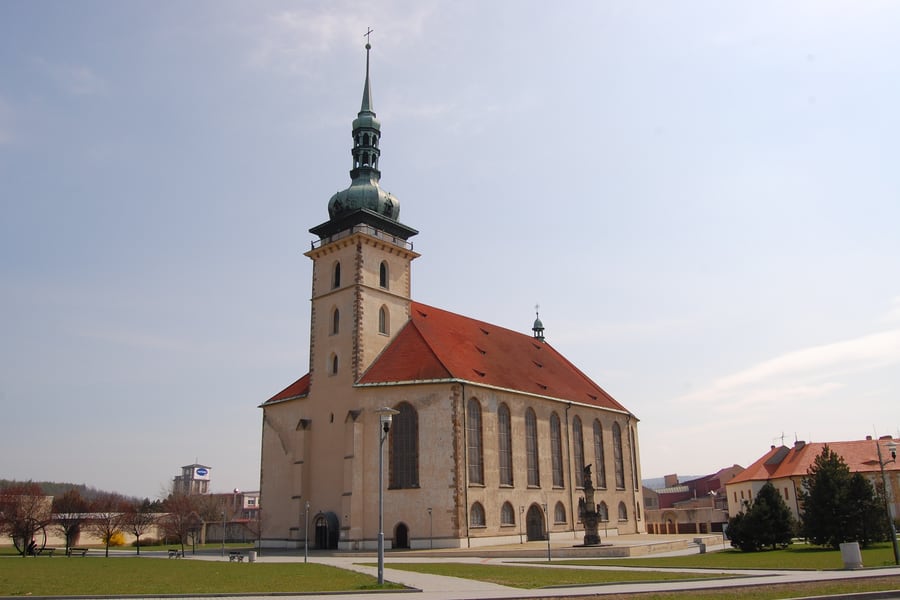
The church that was moved
Old Most was demolished for the coal beneath it. The late-Gothic Church of the Assumption, built 1517–1550, was the one building kept: in 1975 it was jacked up and driven 841 metres to a new site, travelling on rails at between 1.2 and 3.2 centimetres a minute from 30 September to 27 October. It stands slightly apart from everything else, which is the most direct evidence of what happened to the town around it.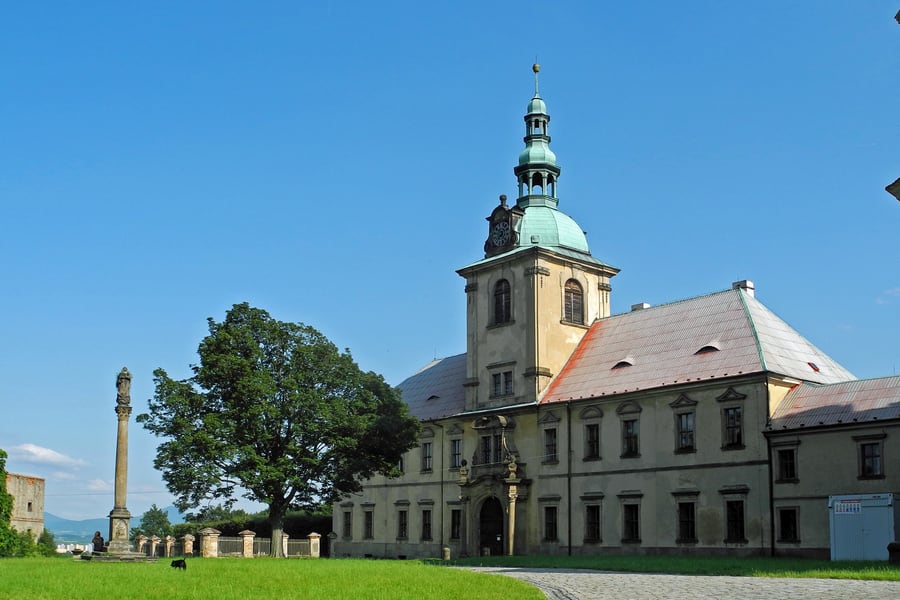 SchiDD / Wikimedia Commons · CC BY-SA 4.0 · cropped
Osek monastery
A Cistercian abbey founded in 1196, rebuilt on a baroque scale in the eighteenth century, sitting at the foot of the mountains a short walk from Osek město station. The prelature and the abbey church face a wide forecourt with a plague column, and the Gothic chapter house survives inside the later work — the most substantial thing to see anywhere along the lower half of the line.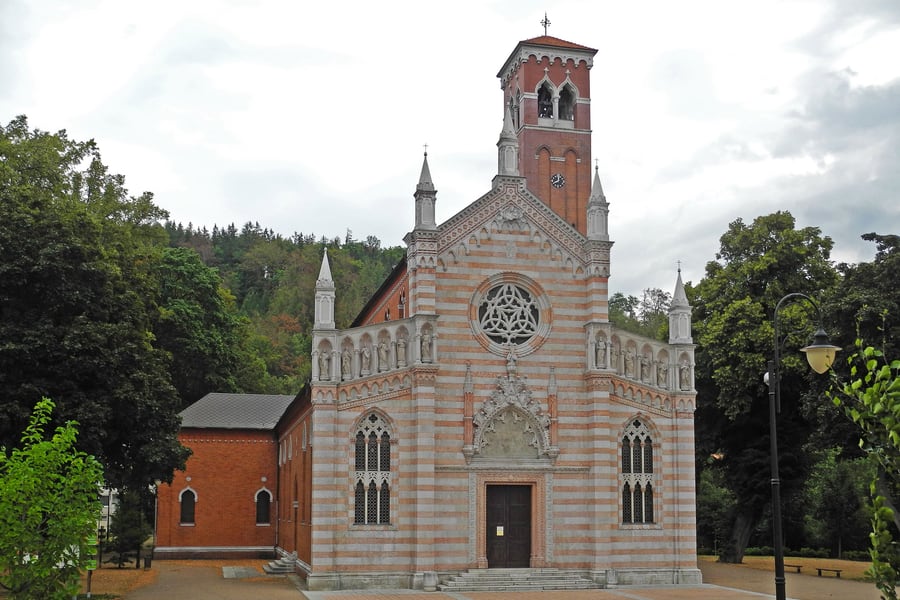 SchiDD / Wikimedia Commons · CC BY-SA 4.0 · cropped
A Venetian church in the Ore Mountains
The Church of the Immaculate Conception at Dubí was built 1898–1906 as a copy of Santa Maria dell'Orto in Venice, with the same banded marble front, and it is an entirely unexpected thing to find in a Bohemian spa village. The station is in the valley below it, on the point where the railway leaves the villages and begins the serious part of the climb.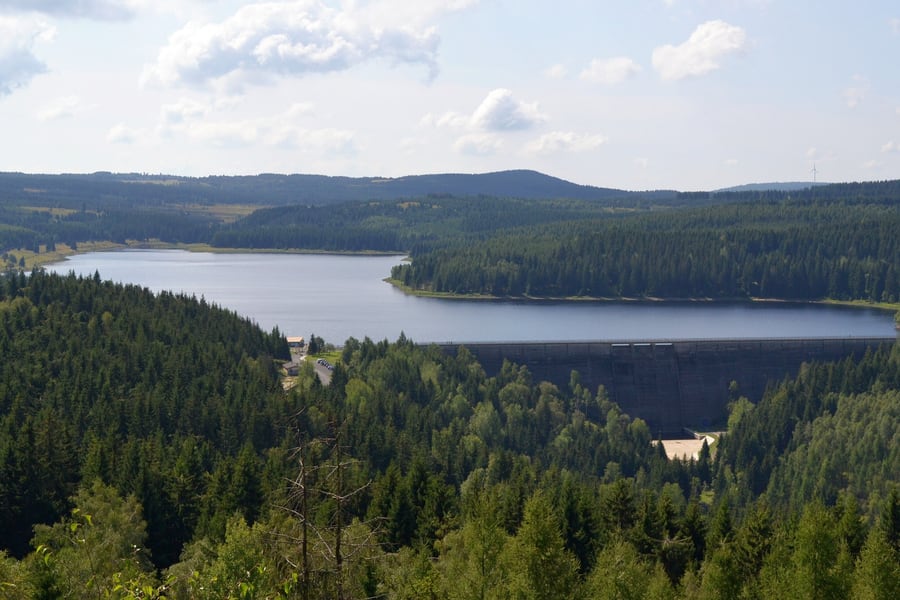 RomanM82 / Wikimedia Commons · CC BY-SA 4.0 · cropped
The Fláje reservoir
West of the top of the line, the Flájská přehrada holds back the Flájský potok in a long reach of water ringed by spruce forest. It is the landscape the last few kilometres of railway run through — high, thinly settled moorland and plantation — and the ridge paths above it give the wide views that the train itself, running in cuttings and trees, mostly does not.Where to Sleep
The line has two natural bases and they suit different trips.
Most, at the bottom, is a working town with the largest hotel on the route and the earliest train up the mountain. It is the practical choice for anyone arriving from Prague or Ústí nad Labem the night before and wanting the 06:41 departure.
Moldava, at the top, is the opposite: a scattered upland village at around 800 metres with guesthouses rather than hotels, and the reason to stay is the walking and the skiing that start at the door. Because the last train down leaves at 18:22, staying at the top is also what turns the line into something more than a there-and-back ride.
Teplice sits between the two in every sense. It is on the branch the weekend trains from Ústí nad Labem use rather than on the Most line, and it is a spa town of some age, with thermal water under the buildings and a spa company that runs six houses in the middle of it.
None of the cards below carries a price, a rating or a star count, because we have verified none of those. Each description reports what the property's own website states, and each site was opened and read in August 2026.
Where to stay
Hotel Cascade
In the middle of Most, by the departure station
The largest hotel in Most, on Radniční in the centre of the rebuilt town, with 127 rooms ranging from twins to family rooms and apartments. Its own site lists a spa area with Finnish, steam and aroma saunas, a restaurant and café, and a wine bar with a dance floor. Parking and wi-fi are free to guests.
Check Availability (opens in a new tab, on hotel-cascade.cz)via hotel-cascade.cz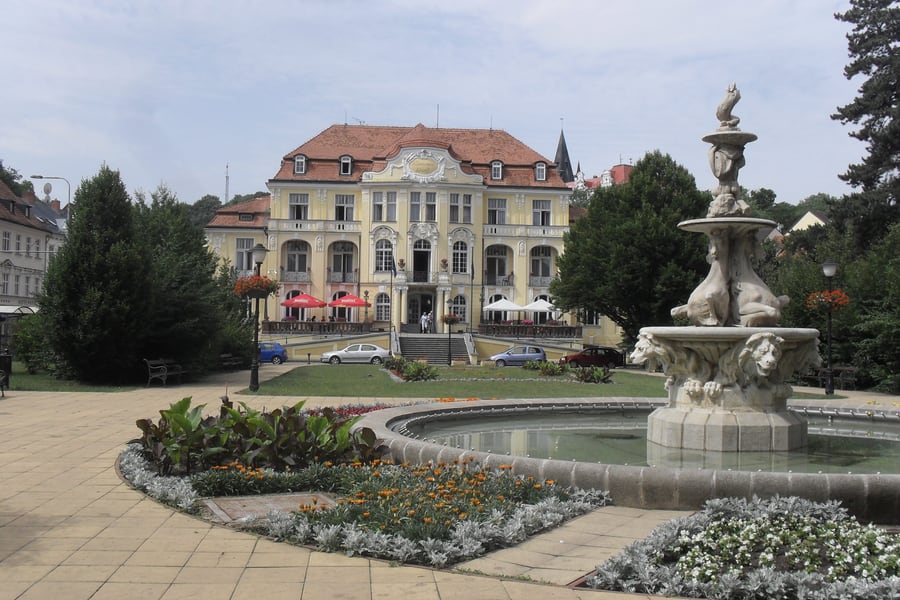 Takmocsekretovanej! / Wikimedia Commons · CC0 · cropped
Lázně Teplice v Čechách
On the Ústí nad Labem branch of the route
The spa company runs six houses in Teplice — Lázně Beethoven, Císařské lázně, Kamenné lázně, Nové lázně, the Lázeňský dům Jirásek and the Sadové lázně annexe, whose full interior rebuild was finished in 2026. Its own site describes thermal springs beneath the buildings, and the weekend trains from Ústí call in the town.
Check Availability (opens in a new tab, on lazneteplice.cz)via lazneteplice.czPenzion Florian
At Moldava, near the top of the line
A guesthouse in two buildings at about 800 metres above the sea in Moldava, with ten rooms sleeping thirty — six twins, two four-bedded and two five-bedded rooms. Its own site lists a restaurant serving guests' breakfasts as well as lunches and dinners, and a hall with a bar for up to fifty people.
Check Availability (opens in a new tab, on penzionflorian.com)via penzionflorian.comQuestions or corrections
Planning this trip and stuck on something, or spotted a time, fare or detail that has changed? Send us a message about The Moldava Mountain Railway. We read every one, and we update this page when something has changed.