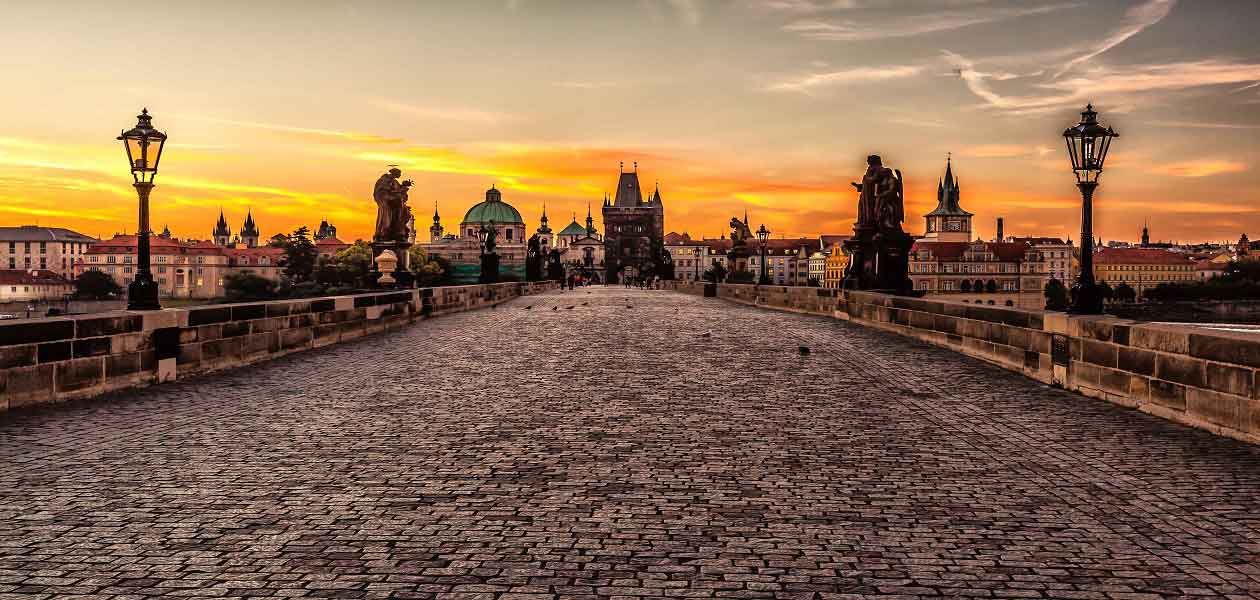
Czech Republic
Czechia is a landlocked country of about 10.9 million people in the middle of Europe, bordered by Germany to the west, Poland to the north-east, Slovakia to the south-east and Austria to the south. Its 78,871 square kilometres are hilly rather than mountainous, with the high ground around the edges and the rivers draining out through gaps in the rim. Most people live in Prague, much the largest city, and then Brno, Ostrava, Plzeň and Liberec; the western half of the country is the historic Bohemia.
Railways arrived here before they arrived almost anywhere: Europe's first horse-drawn railway ran from České Budějovice to Linz from 1832, seven years before the first locomotive-hauled line reached Břeclav from Vienna. What grew out of that is a dense inheritance of Austro-Hungarian branch lines, still carrying 193.5 million passenger journeys a year. Most trains are České dráhy's, but each region buys its own local services, and since 2011 private operators have competed directly with the state railway on the busiest corridors. Standard-gauge lines run into all four neighbouring countries, and passenger trains cross every one of those borders.
Rail journeys in Czech Republic
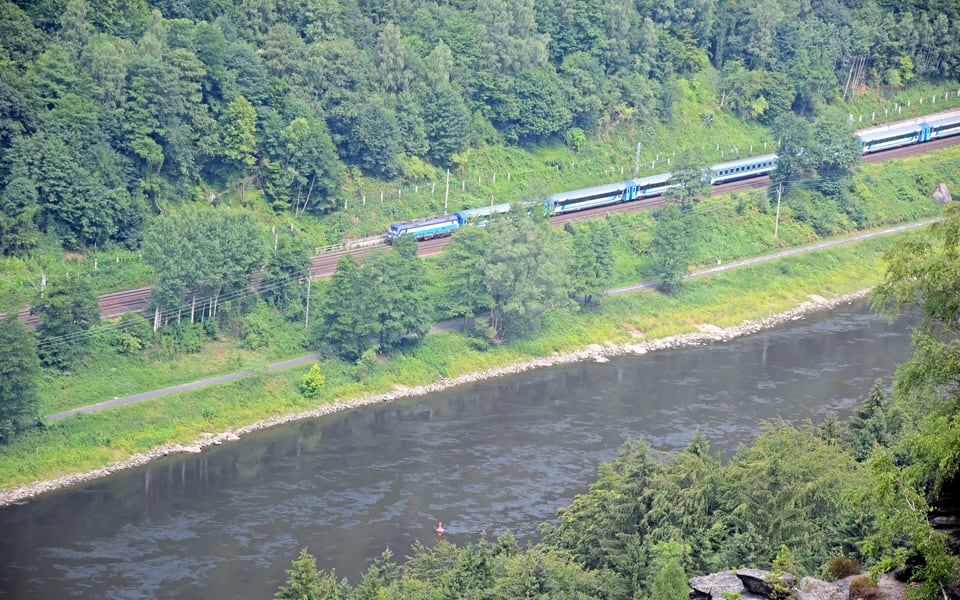
The Elbe Canyon Railway
Sixty-six kilometres along the floor of a sandstone gorge, with room for track on one bank only — so four stations stand across the water from their towns.
View journey →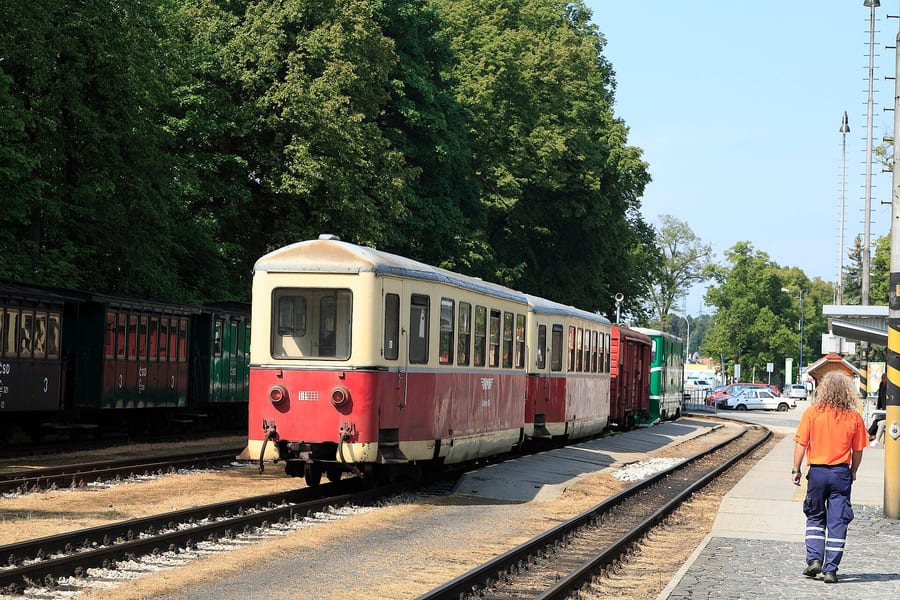
The Jindřichův Hradec Narrow Gauge
Two narrow-gauge lines through the woods and ponds of southern Bohemia: bought for one crown, bankrupt by 2022, and brought back by volunteers in 2025.
View journey →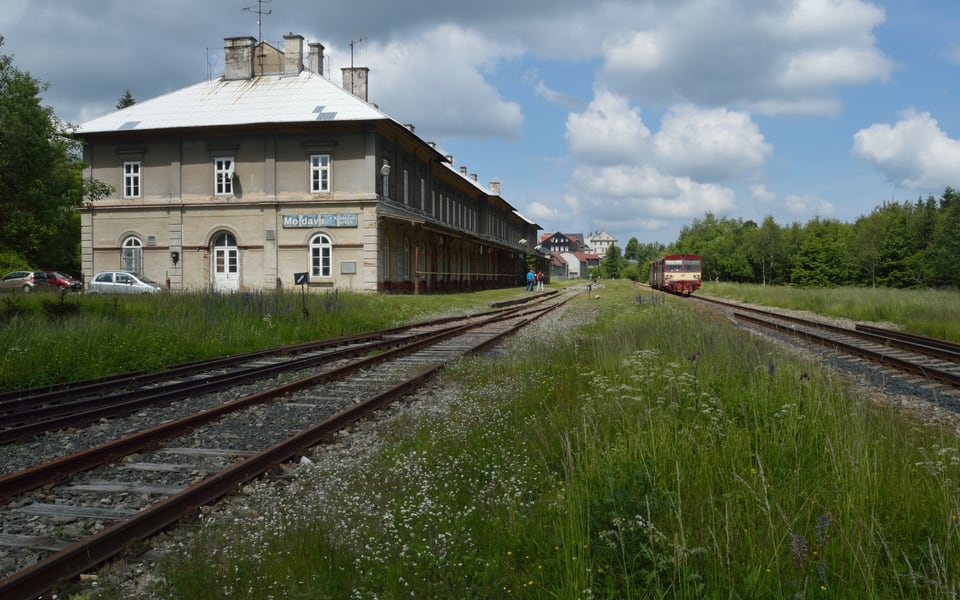
The Moldava Mountain Railway
Forty kilometres of climbing out of a coal basin to a frontier station that stops three hundred metres short of a border it has not crossed since 1945.
View journey →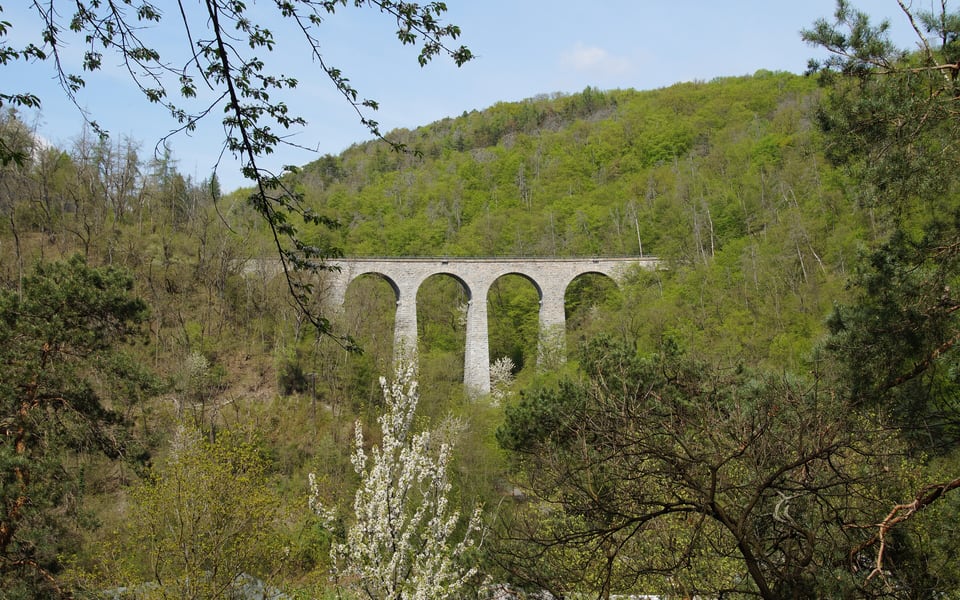
The Posázavský Pacifik
Sixty kilometres out of Prague along two rivers, through seven tunnels and over a viaduct forty-one metres up. Officially line 210; the campers named it.
View journey →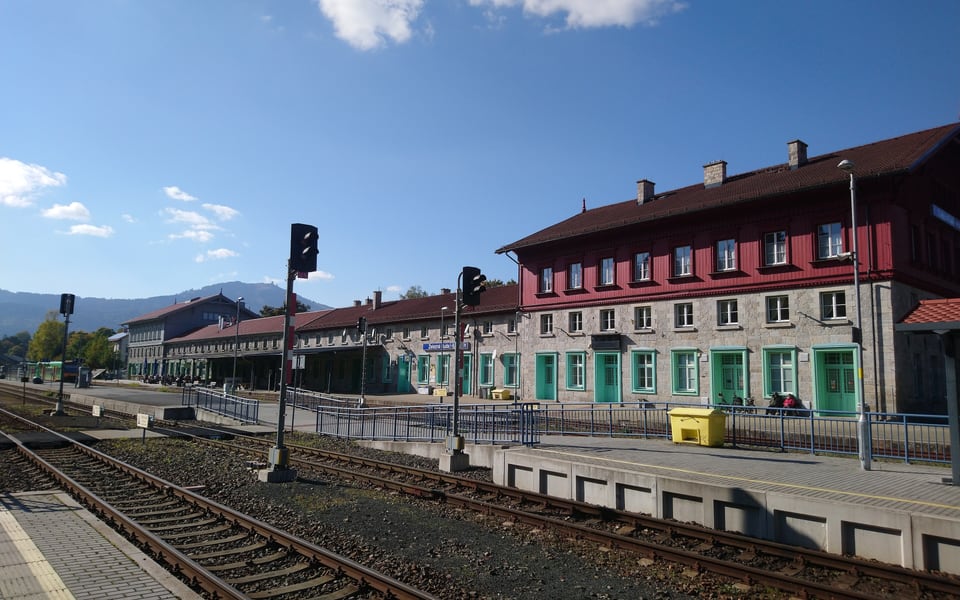
The Šumava Border Railway
Ninety-seven kilometres from Plzeň into the Bohemian Forest, ending at a station two countries share — the frontier runs through the middle of the building.
View journey →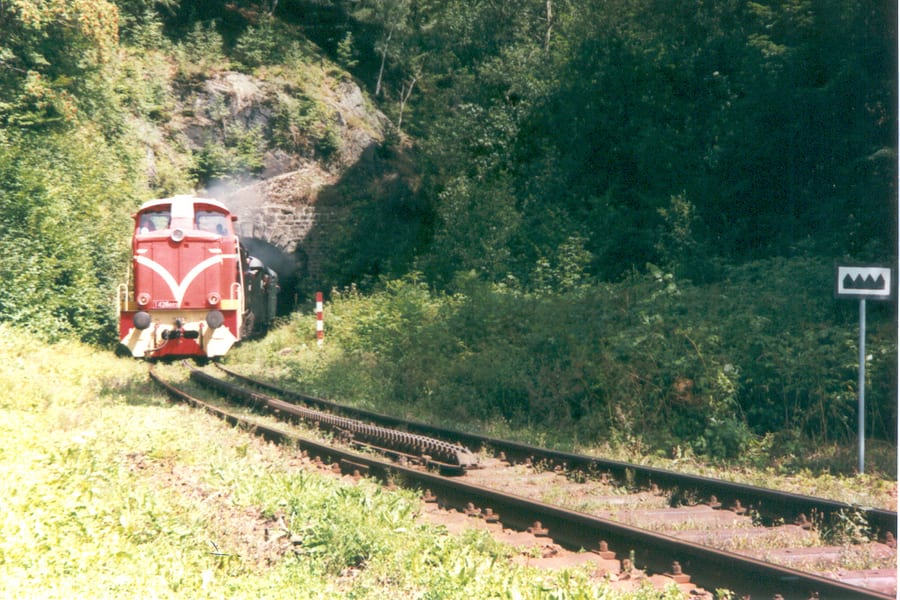
The Zubačka
The only rack railway in the Czech Republic, built in 1902 on the steepest gradient of the network — with one catch: the rack has been idle since 1988.
View journey →Good to know
How does rail travel in Czechia work?
České dráhy runs most passenger trains, and its long-distance services are the fast ones — the railjet and Expres categories between the big cities and out to Berlin, Vienna, Bratislava and Budapest. Underneath that, each region contracts its own local trains, which is why a branch line may be run by a small private company under regional colours; and since 2011, when RegioJet became the first operator to compete head-on with the state railway, the busiest corridors have had genuine open-access competition. The useful consequence for a visitor is that ordinary stopping trains reach almost everywhere, including across all four land borders.
Do I need to book a seat?
Usually not. Czech domestic trains are generally boarded with an ordinary ticket, and reservation is optional even on most long-distance workings. The exception worth knowing is international: České dráhy applies compulsory seat reservation in the summer peak on the Berlin–Prague trains, and the rule is written around the frontier itself — it binds passengers crossing the Czech–German border at Schöna in either direction. In 2025 that window ran from 15 June to 31 August; the operator re-announces the dates each spring, and a reservation bought together with the ticket is free.
What kind of ticket is best value?
For a single long run, České dráhy's own advance fares. For a day of stopping and starting, the regional day tickets are usually the better buy, because each region's transport authority issues its own and they cover buses as well as trains. Some of them cross the border: the Elbe-Labe day ticket, issued jointly by the Ústí region and the Dresden authority, is valid all day on both sides and even on the Elbe ferry between Schöna and Hřensko, from €28.50 / 420 CZK for one adult with up to two children as of April 2026.
When should I go?
The network runs all year and the main lines are unaffected by season. What is seasonal is the part most visitors come for: steam and heritage workings cluster between April and October, and several scenic branches thin out to a weekend service in winter. The mountain lines invert that — their winter trains are the busy ones, because they are what skiers use to gain height. Late spring and early autumn are the compromise, with the summer engineering closures mostly falling in September and October.
Which lines are the scenic ones?
They divide into four kinds, and the cards below have them all. There are narrow-gauge survivors on 760 mm track in southern Bohemia; the country's only rack railway, built in 1902 to join two empires; mountain and border lines in the Ore Mountains and the Bohemian Forest, several of which stop at or just short of a frontier; and river lines that follow the water through sandstone gorges, including the Elbe canyon, where the railway crosses into Saxony at the lowest point on the whole Czech network.