The Posázavský Pacifik
Ivabalk / Wikimedia Commons · CC0
- DistancePraha hl.n.–Čerčany · about 60 km
- Duration1 h 44 southbound · 1 h 47 back
- Best seasonHourly all year · steam on selected dates April to October
Introduction
The railway that leaves Prague along the Vltava and turns up the Sázava has an official name, and nobody uses it. On paper it is line 210, Praha – Vrané nad Vltavou – Čerčany, a single-track regional railway laid down to move sugar beet to a refinery at Modřany. Everyone — the passengers, the tourist board, the national operator and the state body that owns the track — calls it the Posázavský pacifik, the Sázava Pacific.
The name was not chosen by anybody with the authority to choose it. It was given in the 1920s by the trampové: young people from Prague who spent their weekends camping in the river valleys, read Jack London and Ernest Thompson Seton, built themselves cabins on the rocks above the water, and decided that a line threading a canyon on stone viaducts and through tunnels deserved to be named after the railways of the American West. The nickname outlived them. When Správa železnic finished rebuilding the line in 2016 it headlined its own press release Na Posázavském pacifiku se cestuje pohodlněji — travelling on the Sázava Pacific is more comfortable now. When České dráhy put nine new trains on it in March 2026, the release was titled Nové vlaky vyjíždí na legendární Posázavský pacifik.
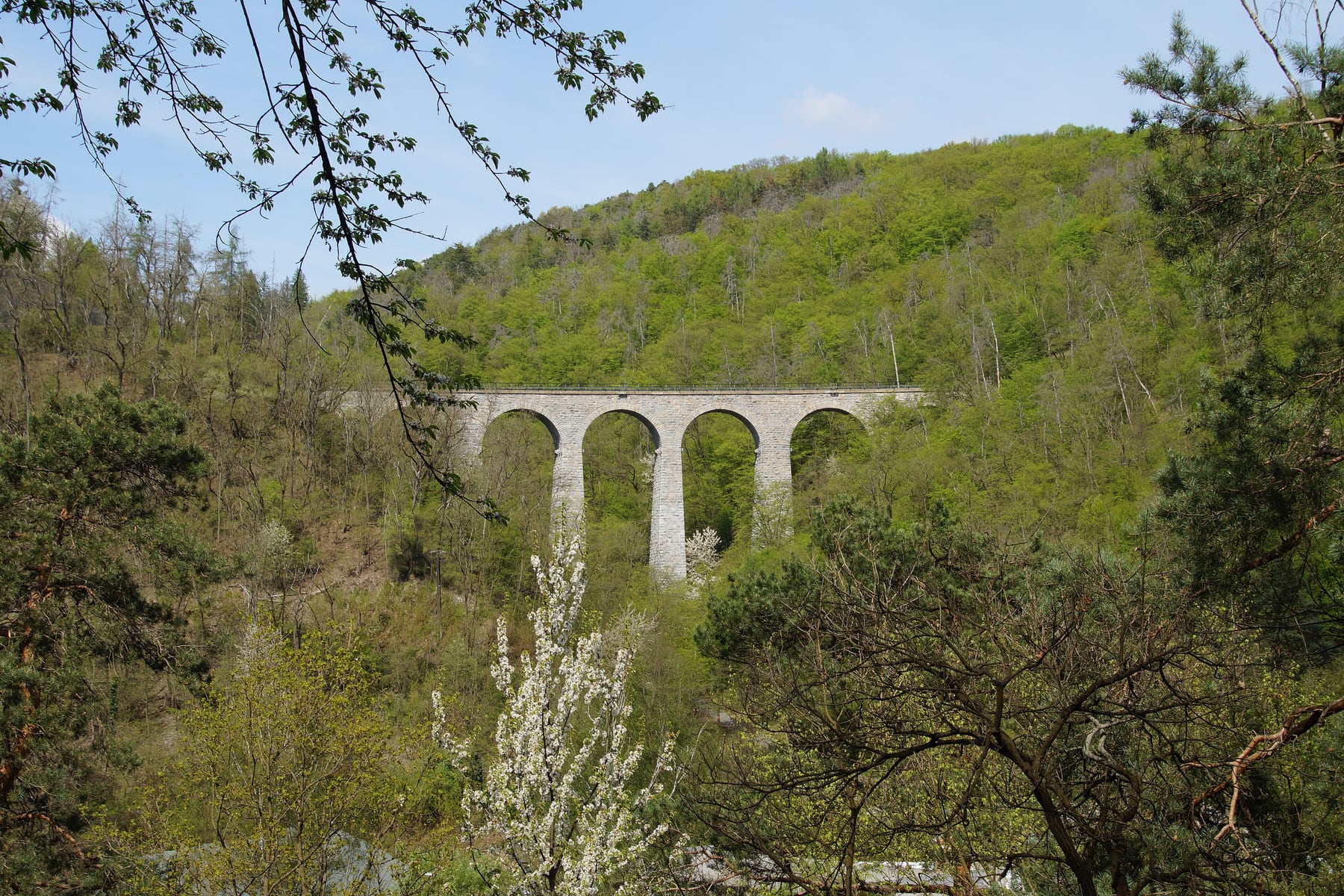
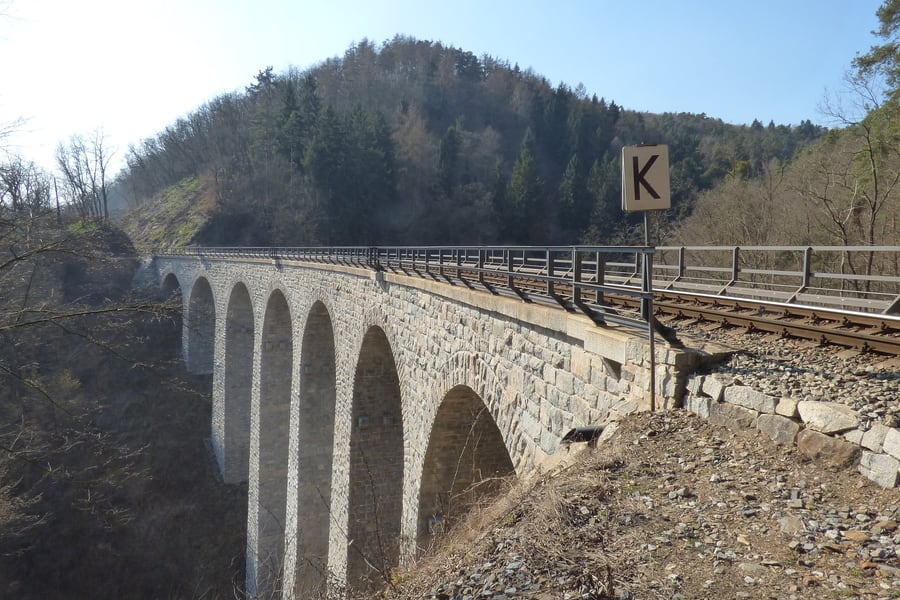
What the train actually does over the sixty kilometres from Praha hlavní nádraží to Čerčany is enough to explain the enthusiasm. It runs south along the Vltava through the edge of the city, turns inland at Davle where the Sázava comes in, and then spends the next twenty kilometres in a gorge — seven tunnels between Praha-Vršovice and Čerčany, rock cuttings that were blasted rather than eased, and the Žampach viaduct: seven arches, 109 metres long, 41.7 metres above the Kocour brook, laid on a curve of 180 metres radius. Its builders finished it in 1900. It has been a protected cultural monument since 1958.
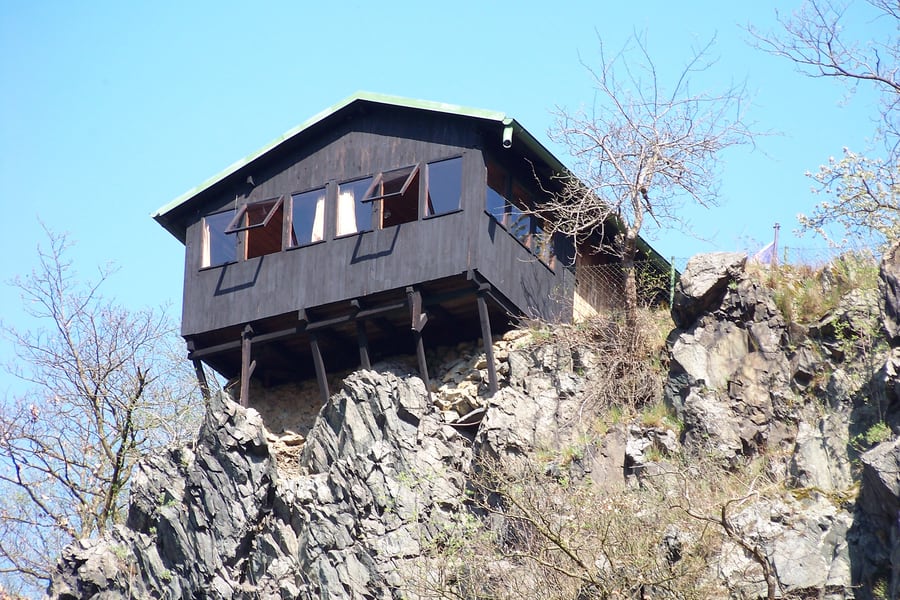
Below it the valley is still full of the cabins that named the line. They stand on ledges and outcrops on both banks, reached by footbridges and ladders, most of them a century old and still in use every summer. The train goes past at 60 to 80 kilometres an hour, close enough to see who is on the veranda. This is not a preserved railway putting on a show — it is the ordinary hourly service out of the capital, and on a weekday morning it carries commuters. That it also happens to be one of the most engaging hours of railway in Bohemia is something the timetable does not mention.
The Journey
The train leaves Praha hlavní nádraží, runs through the Vinohrady tunnels to Praha-Vršovice, and then turns south through the suburbs — Kačerov, where the platform sits beside a metro station, then Krč and Braník. Braník matters to the story: it was from here that the weekend trains for the Sázava left, and at the height of the tramping movement they could run to twelve coaches.
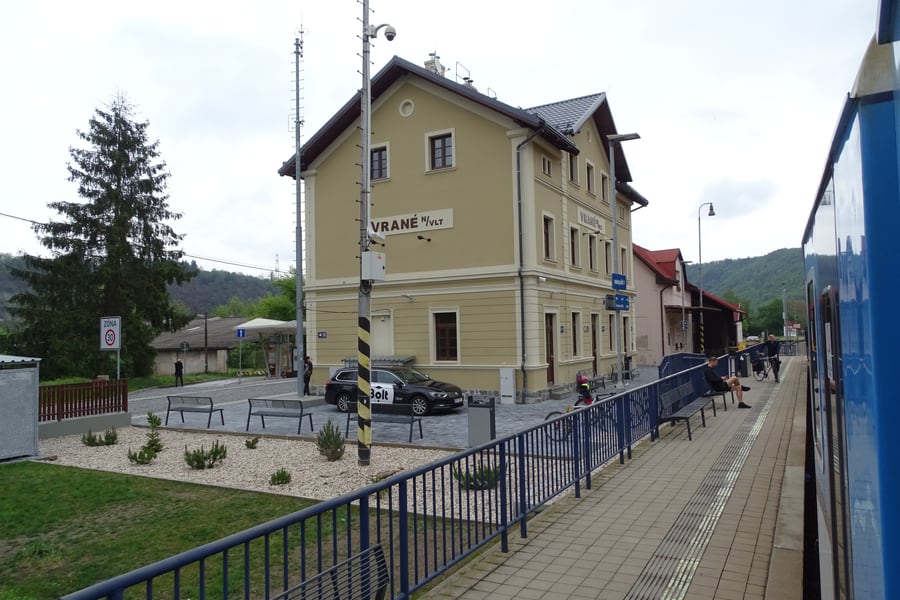
Past Modřany the river arrives and stays. The line runs along the right bank of the Vltava through Komořany and Zbraslav, crosses under the Prague ring road, and then bores through the Jarovský tunnel, at 393 metres the longest on the whole of line 210. It comes out at Vrané nad Vltavou, where the branch for Dobříš goes off across the dam and the Čerčany train carries straight on.
Three tunnels and a change of river
Between Skochovice and Davle the railway is pinned against the hillside above the water, and it takes three tunnels in barely a kilometre to stay there — the Skochovický (209 m), the Libřický (98 m, one of the shortest railway tunnels in the country) and the Davelský (180 m). The three are known collectively as the Davle tunnels. Between the second and the third there was a halt called Libřice until 27 July 1975; its wooden platform on the bridge over the Zahořanský brook is still there, with nothing left to serve.
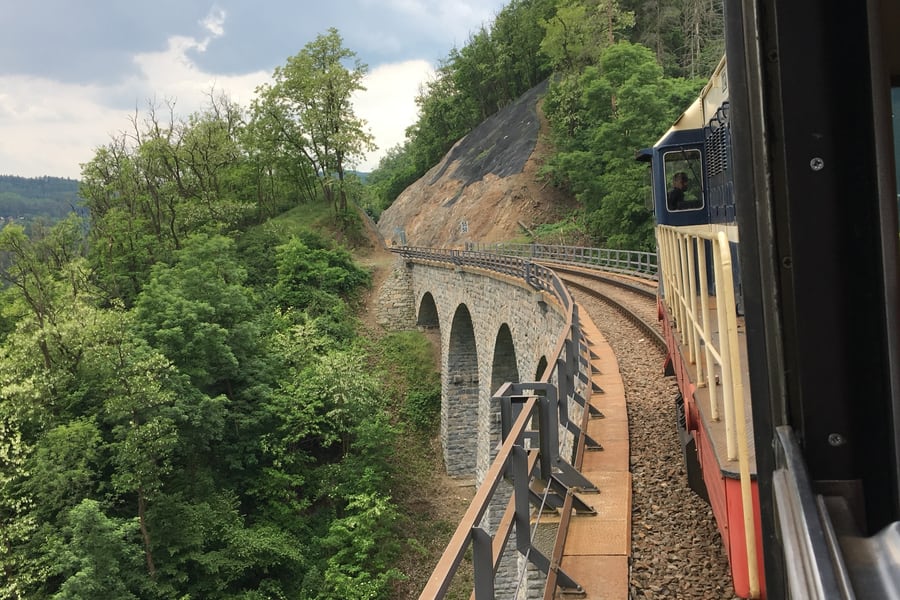
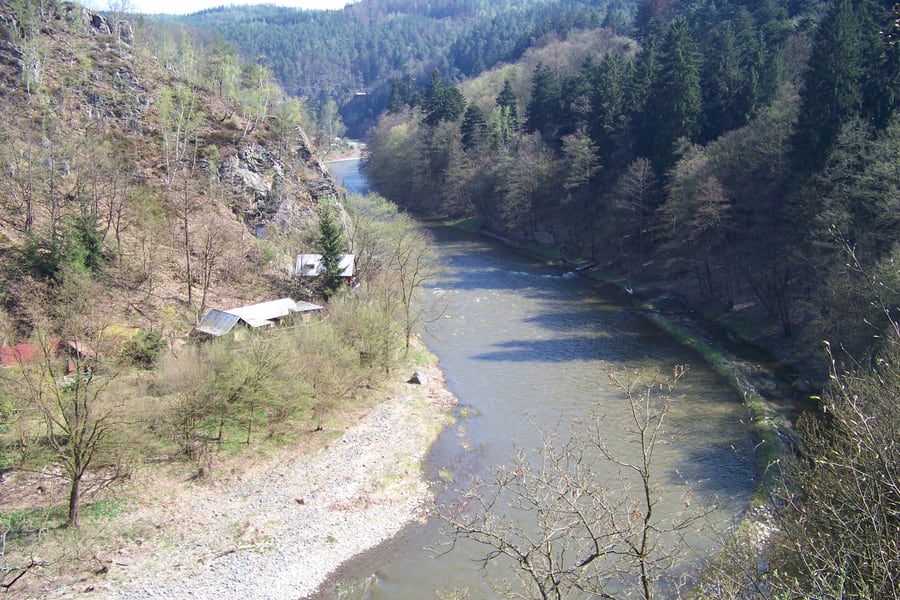
Davle stands at the confluence, and this is where the journey changes rivers. From here the line follows the Sázava, at first along the bank and then, past Petrov, up onto the rock. The stretch from Petrov u Prahy to Jílové u Prahy is the reason the line has a nickname. The valley narrows into what the trampers called the Golden Canyon, the walls close in, and the railway takes the Pikovický tunnel (50 m), then Jílovský tunel II (145 m) — and comes straight out of the portal onto the Žampach viaduct, 41.7 metres above the Kocour brook on a curve, with the Jílovský tunel I (96 m) waiting at the far end. Two tunnels and a bridge in under a kilometre, and no time at all to look at any of them.
Gold, and the rest of the way to Čerčany
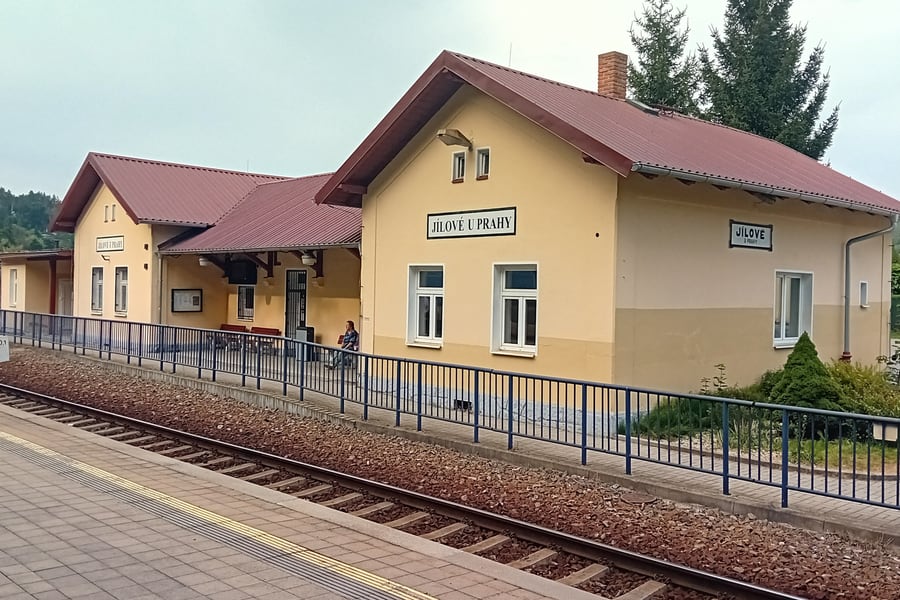
Jílové u Prahy was a royal gold-mining town: Charles IV confirmed its charter around 1350 and gold ducats were struck here. The station is down in the valley, twenty minutes' walk below the town, and its 2015–16 rebuild left it looking newer than anything else on the line.
After Kamenný Přívoz the gorge opens out. Prosečnice, Krhanice and Chrást nad Sázavou are halts in the woods; Týnec nad Sázavou has the Romanesque castle tower on the bluff and a staffed station — after the 2015–16 rebuild only Praha-Braník, Vrané nad Vltavou and Týnec kept anyone on duty. The last few kilometres through Pecerady and Poříčí nad Sázavou are gentle, and the train ends at Čerčany, a junction where the Pacifik meets the main line from Prague to Benešov and České Budějovice — and where line 212 sets off up the Sázava for another ninety-one kilometres.
What runs on it
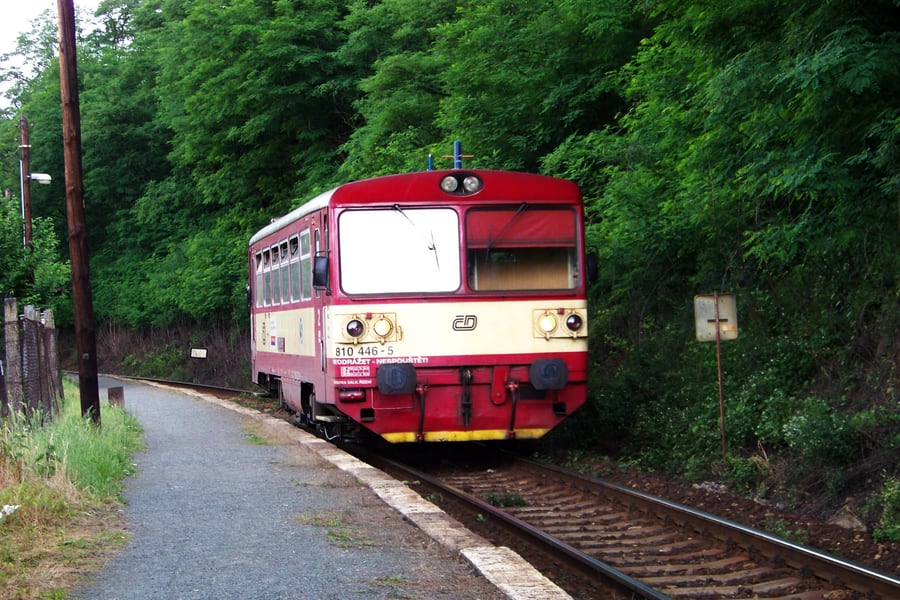
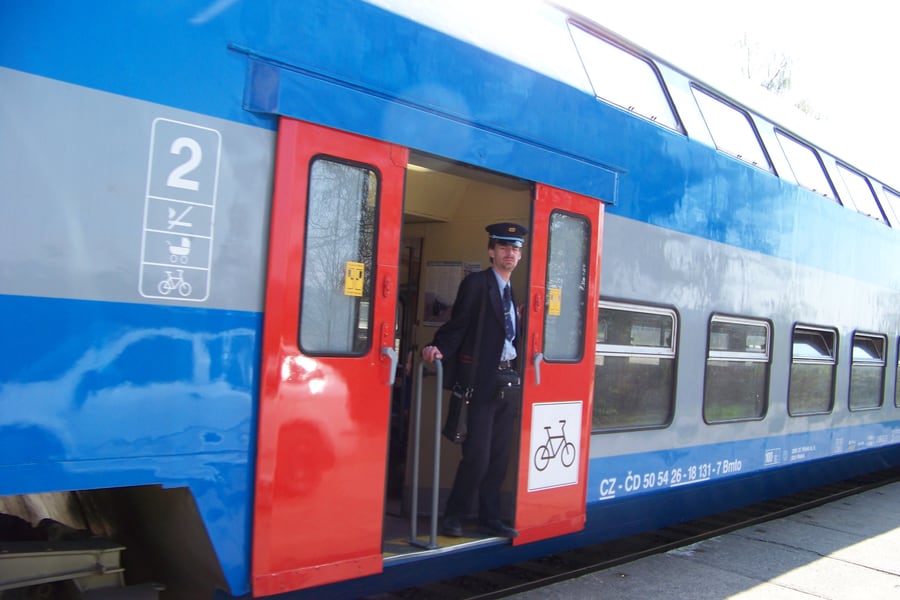
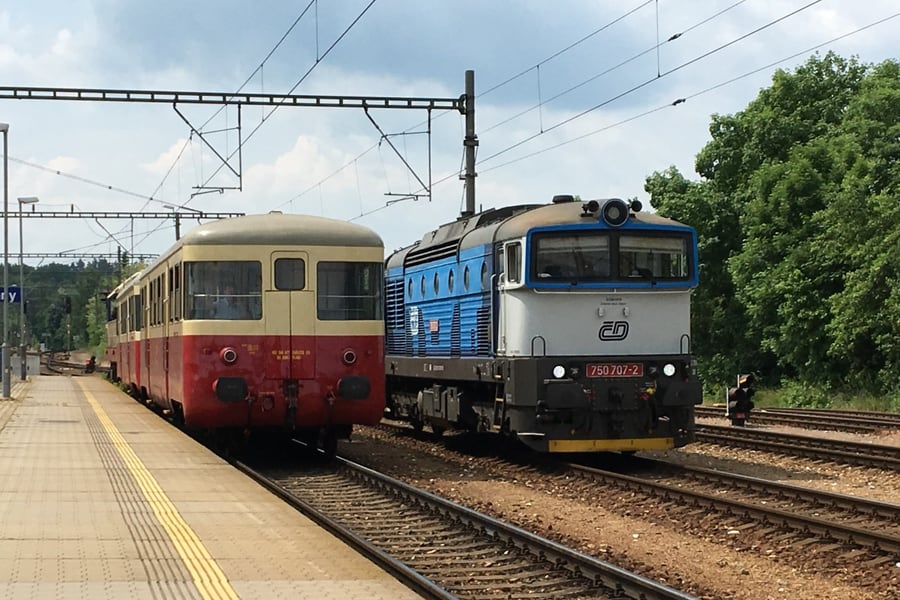
For decades the line belonged to the class 810 railbus and its Regionova rebuilds — a four-wheeled single unit built at Studénka in the 1970s and 1980s, which is what most photographs of the Pacifik show. That changed in March 2026, when České dráhy moved nine RegioFox units onto the S8 and S88. They are class 847, built by Pesa in Bydgoszcz: 44.4 metres long, 115 seats, 120 km/h, air-conditioned, with sockets and wi-fi and step-free access. České dráhy describe the Pacifik as the most heavily used regional line around Prague, with close to 4,500 passengers on a weekday, which is why it was near the front of the queue.
The older machines have not gone. Heritage operators run the line on selected weekends from April to October with steam and with 1970s diesels, and those trains still leave from Praha-Braník, as the tramps' trains did.
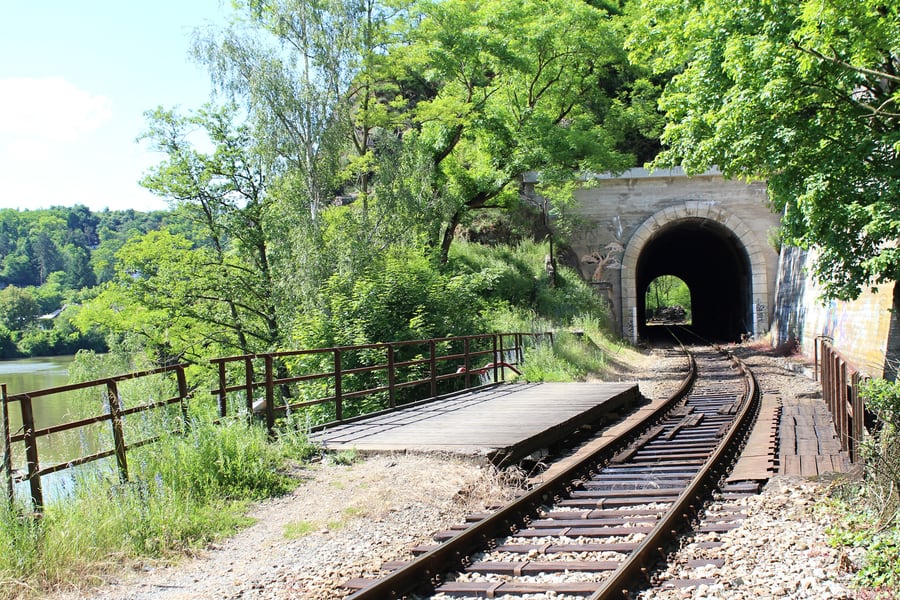
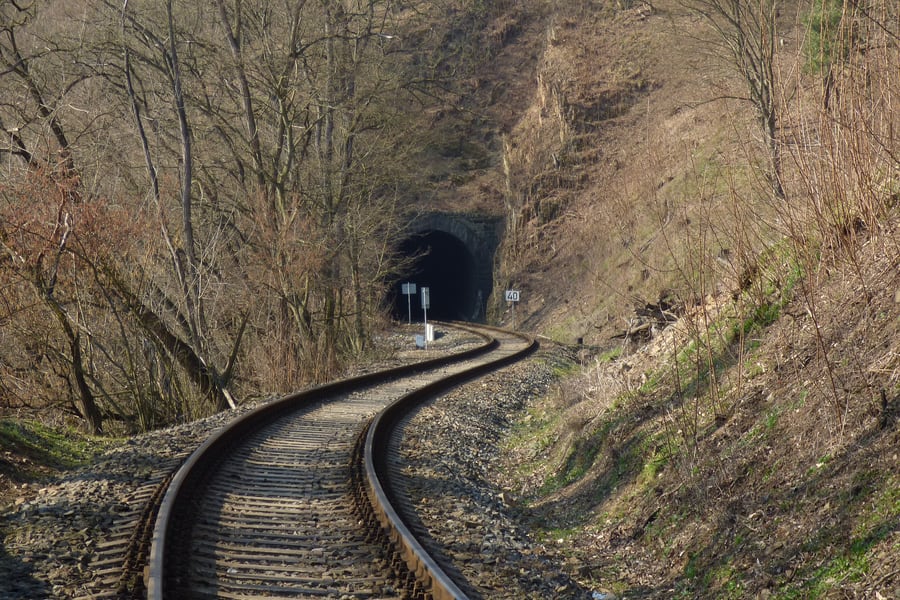
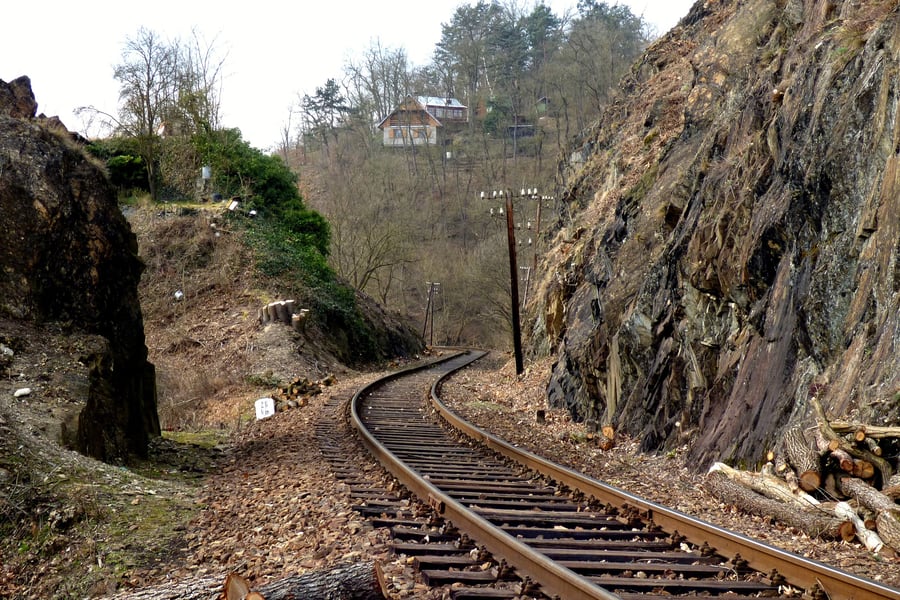
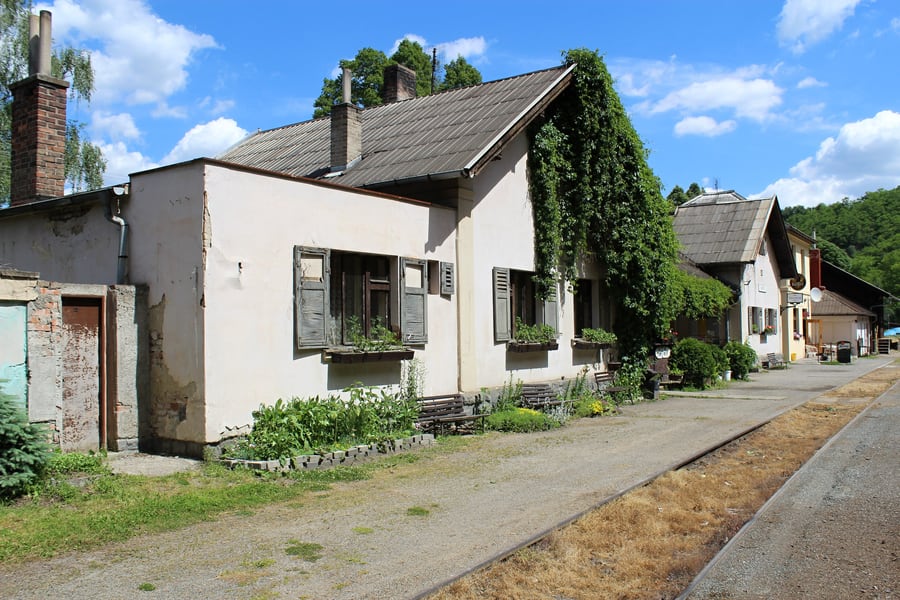
Along the route
 ŠJů / Wikimedia Commons · CC BY-SA 3.0
A nickname that displaced the official name
The railway is line 210 and always has been. The name in use was coined in the 1920s by the trampové, weekend campers out of Prague who read Jack London and named the valley after the American West. A century on, the infrastructure manager uses it in its own press releases.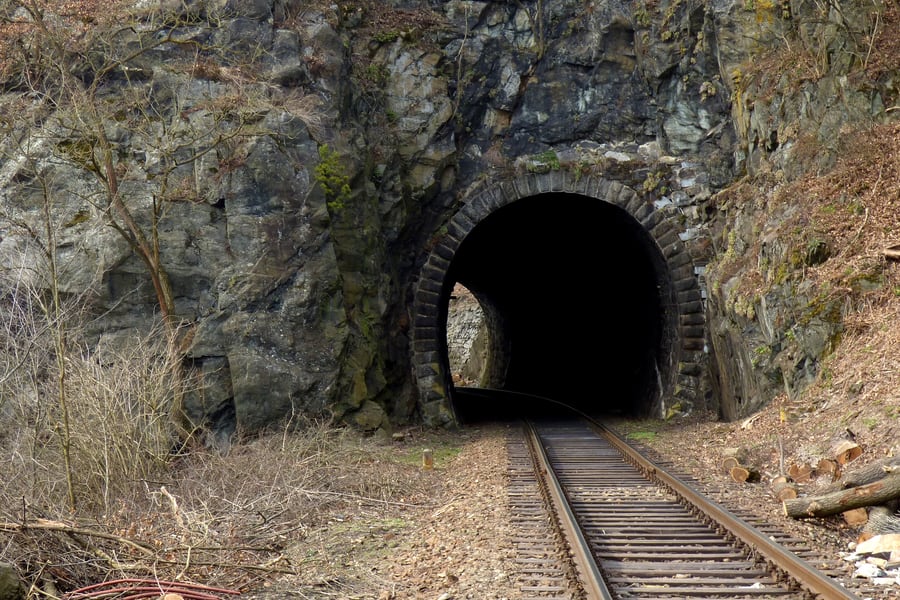 Jiří Bernard / Wikimedia Commons · CC BY-SA 3.0
Seven tunnels, and a bridge between two of them
The sequence that matters comes above Jílové: out of one tunnel, straight onto the Žampach viaduct — 41.7 metres up, on a curve — and into the next at the other end, all inside about a kilometre.Elektracentrum / Wikimedia Commons · CC BY-SA 4.0The tunnels were an aircraft factory
In the last phase of the Second World War the line was closed and its tunnels taken over as underground works, making compressors for Daimler-Benz aero engines. Services resumed after the war using cattle wagons as passenger stock, and the tunnels went back to being tunnels.A bit of history
Culture & experiences along the way
 ŠJů / Wikimedia Commons · CC BY-SA 3.0
The Golden Canyon
The stretch between Kamenný Přívoz and Pikovice is the one the trampers named Zlatý kaňon. The valley walls come in, the railway is cut into the rock above the water, and the cabins start appearing on ledges on both banks. It lasts about ten minutes and it is why people who have ridden this line remember it.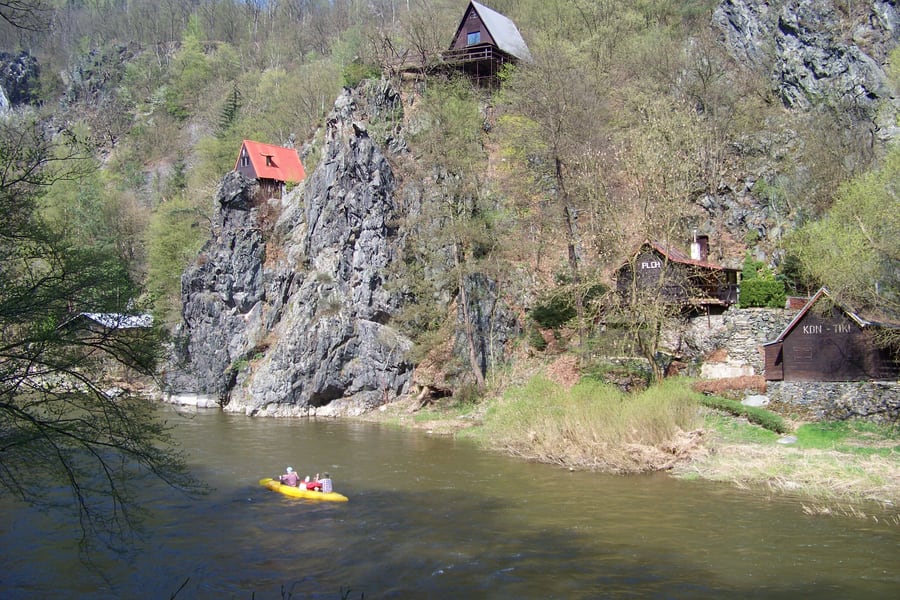 ŠJů / Wikimedia Commons · CC BY-SA 3.0
A hundred years of cabins
The chaty above the Sázava are not scenery — they are private, occupied, and mostly about a century old, reached by footbridges, ladders and paths cut into the rock. Some sit on outcrops with nothing underneath them. The train runs close enough to see who is out on the veranda, which is a strange and rather good way to travel.Vojtasekd / Wikimedia Commons · CC BY 4.0An ordinary train on an extraordinary alignment
Nothing about this is a special working. It is PID line S8, hourly at :55 from Praha hlavní nádraží, and České dráhy count it as the busiest regional line around Prague at close to 4,500 passengers on a weekday. The nine air-conditioned class 847 RegioFox units that arrived in March 2026 are commuter stock that happens to spend twenty of its sixty kilometres in a gorge.Timetables
The Pacifik is line S8 of Prague Integrated Transport, worked by České dráhy. It is an ordinary all-year service, not a seasonal one, and it runs to a clock face.
Times below were read from the operator's own planner in August 2026, for the timetable in force from 14 June 2026. Departures are checked at pid.cz/linka/S8 (opens in a new tab) and cd.cz (opens in a new tab).
Prague to Čerčany
Trains leave Praha hlavní nádraží at 55 minutes past the hour, every hour through the day, from 05:55 to 22:55. They call at Praha-Vršovice four minutes later, and at Praha-Braník about sixteen minutes out.
| departs Praha hl.n. | Vrané nad Vltavou | Davle | Jílové u Prahy | arrives Čerčany | |
|---|---|---|---|---|---|
| first | 05:55 | 06:28 | 06:40 | 06:57 | 07:39 |
| then | 06:55 | 07:28 | 07:40 | 07:57 | 08:39 |
| and hourly at :55 |
The full run takes 1 hour 44 minutes. Not every hourly departure goes the whole way: several turn back at Jílové u Prahy, an hour and two minutes out, which is the point most day trippers get off at anyway. Some late-morning workings sit at Týnec nad Sázavou for half an hour to cross another train, and take a little over two hours end to end.
The pattern holds at weekends, when a second group of trains is added in the middle of the day — in August 2026 there were departures at 08:15 and 09:15 as well as the hourly :55s.
Coming back
Northbound trains leave Čerčany at 17 minutes past the hour and reach Praha hlavní nádraží at four minutes past, taking 1 hour 47. The first is 06:17 and the last is 22:17, arriving in Prague at 00:04, so a long evening in the valley is possible without a car.
Beyond Čerčany
At Čerčany the Pacifik meets line 212, which follows the Sázava for a further 91 kilometres to Světlá nad Sázavou through eight more tunnels, past Český Šternberk and Kácov. There is no through train: services from Čerčany run as far as Zruč nad Sázavou — for example 07:29 → 09:06 on a weekday, 07:16 → 09:00 on a Saturday — with a connection there for Světlá, arriving about 10:00. Some of the weekend workings on that upper section are now RegioFox units too.
Steam and heritage trains
Valenta Rail runs steam over the line on selected dates from Praha-Braník, with locomotive 431.032 "Ventilovka" and historic Balm coaches. On Saturday 17 October 2026 there are three round trips: 09:50–11:40 to Čisovice on the Dobříš branch, then 12:20–14:20 and 14:50–16:50 through the Davle tunnels and over the Žampach viaduct to Jílové u Prahy and back. Each trip takes about two hours. Dates and advance sales are published at valenta-rail.cz (opens in a new tab).
Nostalgic workings by other operators appear on the line between April and October as well, usually at weekends and usually announced only a few weeks ahead.
Tickets
The whole route lies inside Pražská integrovaná doprava, so the ticket for it is a PID ticket rather than a railway ticket, and the same one covers the metro, tram and bus at the Prague end. Nothing here needs a reservation and there is no first class. PID prices by zone and by time, so Praha hlavní nádraží to Čerčany sits at the longer end of the range and a hop out to Davle costs a good deal less.
Tickets come from platform machines, the PID Lítačka app, ČD's own app, or one of the three staffed offices left on the branch; buying on board carries a surcharge. Bicycles need their own PID ticket, and the RegioFox units that took over in March 2026 have a low floor and a proper space for them. ⚠️ The steam and nostalgic workings are run privately and are not part of the PID tariff.
Book your tickets
Prague to Čerčany
PID line S8 · hourly, all year
The regular service, worked by České dráhy and priced on the Prague Integrated Transport tariff. One ticket covers the train and the city's metro, trams and buses, and no reservation is needed. Departures leave Praha hlavní nádraží at 55 minutes past the hour from 05:55 to 22:55.
Book Tickets (opens in a new tab, on pid.cz)via pid.czSteam from Praha-Braník
Valenta Rail · selected dates
Nostalgic trips over the Davle tunnels and the Žampach viaduct behind locomotive 431.032 with historic coaches, leaving from Praha-Braník — the station the weekend trains for the Sázava used. Each round trip takes about two hours. Tickets are sold by the operator and are outside the PID tariff.
Book Tickets (opens in a new tab, on valenta-rail.cz)via valenta-rail.czRail Passes
The trains on the Pacifik are České dráhy trains, and České dráhy services are covered by Interrail and Eurail passes, including regional ones. No reservation is required on this line — Interrail's Czech page lists compulsory reservations only on the long-distance corridors out of Prague towards Brno and Ostrava, not on regional workings. So a pass will get somebody onto the 07:55 out of Praha hlavní nádraží without any further transaction.
Whether that is worth doing is another question, and for this journey the answer is usually no.
Why a pass rarely earns its keep here
A pass is priced by the travel day, and this is a ride of an hour and three quarters that most people make as an out-and-back day trip. Spending a whole pass day on sixty kilometres of regional railway is poor value against a PID ticket, and the PID ticket does something the pass cannot: it is also valid on the metro, the trams and the buses in Prague on the same journey, which matters when the trip starts from a hotel rather than from the main station.
Two situations do change the arithmetic. A pass already being used to reach Prague from elsewhere that day costs nothing extra to ride out to Jílové and back on. And somebody continuing beyond Čerčany — up line 212 towards Zruč nad Sázavou and Světlá nad Sázavou, or south on the main line towards České Budějovice — is covering enough distance for a travel day to make sense.
What a pass does not cover
The heritage and steam trains are privately operated and outside every pass; Valenta Rail and the other nostalgic operators sell their own tickets. Rail passes are also no help with the Prague city network, which is where a PID ticket does the work.
Pass conditions checked against Interrail's Czech Republic page in August 2026. Conditions change with each season, and the operator's page is the one that binds.
Places to Visit
Almost everything worth stopping for on the Pacifik is within walking distance of a platform, which is how the line came to be used the way it is. The stops below run in order from Prague.
Davle sits at the confluence and is the natural break for the lower half. Petrov and Luka pod Medníkem are the tramping heartland, with the Sázava trail running between them along the water. Jílové u Prahy is the old gold town, and the mine workings above it are open in season. Týnec nad Sázavou, near the far end, has the oldest standing building anywhere on the route.
 ŠJů / Wikimedia Commons · CC BY-SA 3.0 · cropped
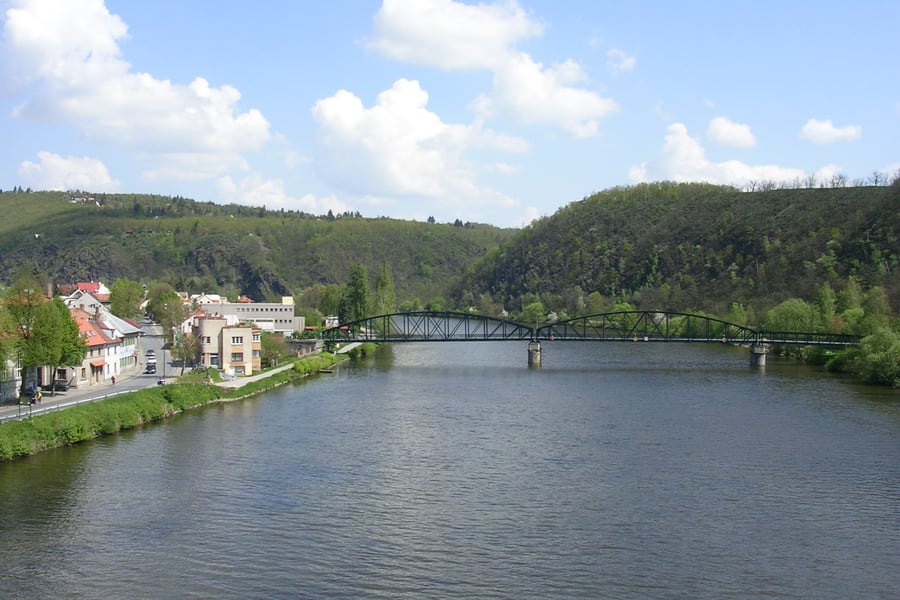
The bridge that played Remagen
The old iron bridge over the Vltava at Davle stood in for the Ludendorff Bridge in The Bridge at Remagen. Fake towers and a fake railway tunnel were built for it, shooting began on 6 June 1968, and it stopped on 20 August when the Soviet army invaded — the unit left behind eight tanks and four cameras of unprocessed film. The bridge is still in use, and the buffet on the station platform is still called Remagen.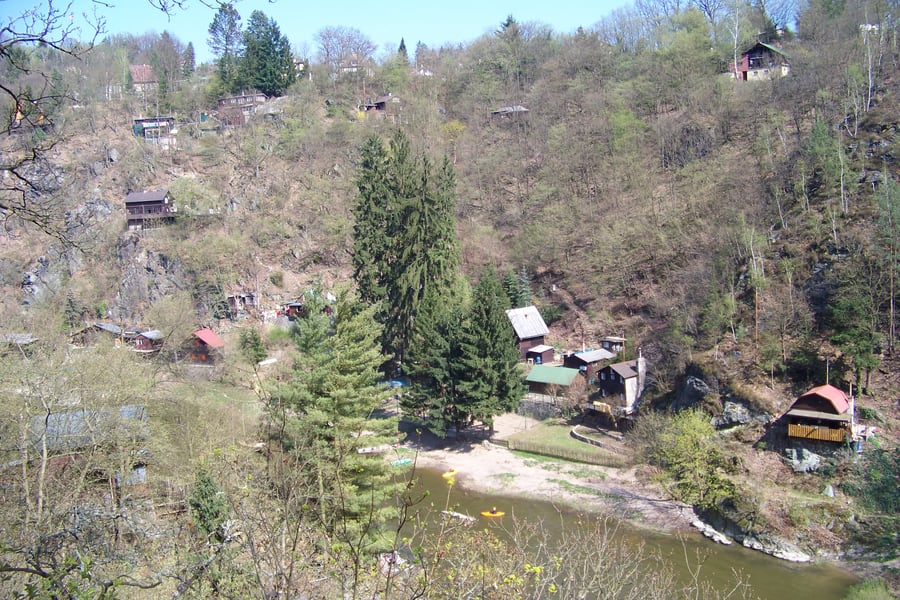 ŠJů / Wikimedia Commons · CC BY-SA 3.0 · cropped
The Sázava trail
The Posázavská stezka runs along the river between the stations, cut into the rock in places and carried on galleries in others, past the cabins and the viewpoints the trampers named. Klimentova vyhlídka looks straight down the gorge. Getting off at one halt and walking to the next is the standard way to spend a day here, and the hourly service makes it work in either direction.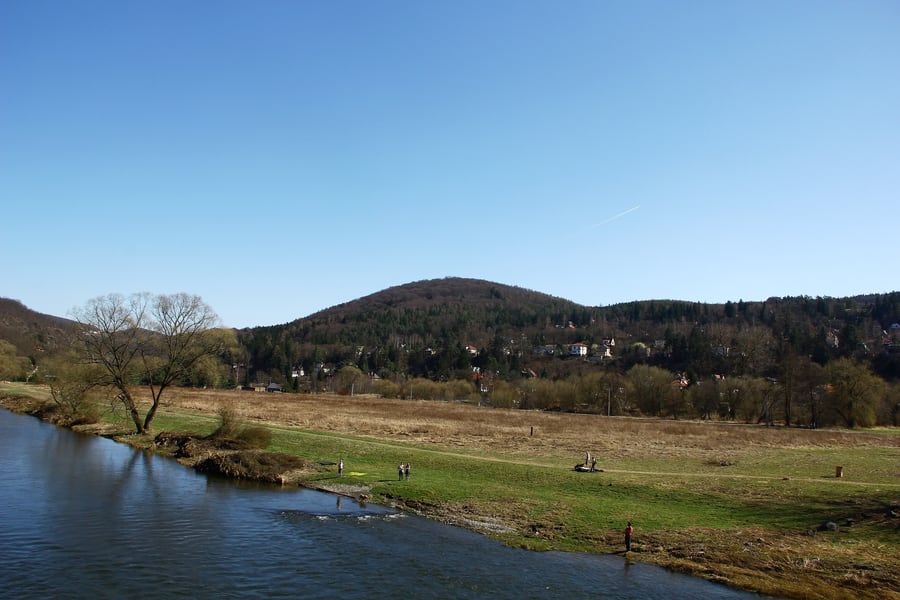 Draceane / Wikimedia Commons · CC BY-SA 3.0 · cropped
The only dog's-tooth violets in the country
Medník, the hill above the halt, has been protected since 1933 and covers about 37 hectares. It is the only place in Czechia where the critically endangered kandík psí zub — the dog's-tooth violet — grows wild, and it flowers in early spring. Medieval gold-workings are still visible as pits and spoil on the plateau, and a nature trail runs across the hill from the station.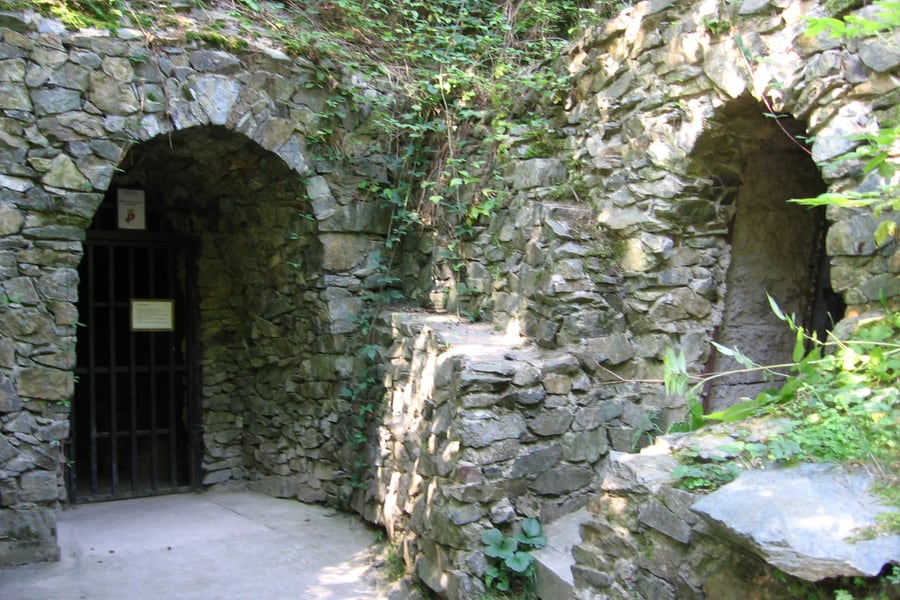 Posázaví / Wikimedia Commons · CC BY-SA 3.0 · cropped
A royal gold town, and a mine you can walk into
Jílové was a royal gold-mining town, confirmed as such by Charles IV around 1350, and gold ducats were struck in it. The workings are still in the hills above the line: the Štola svatého Josefa at Dolní Studené, near the foot of the Žampach viaduct, is open to visitors in season. The town's regional museum covers both the gold and the tramping movement that named the railway.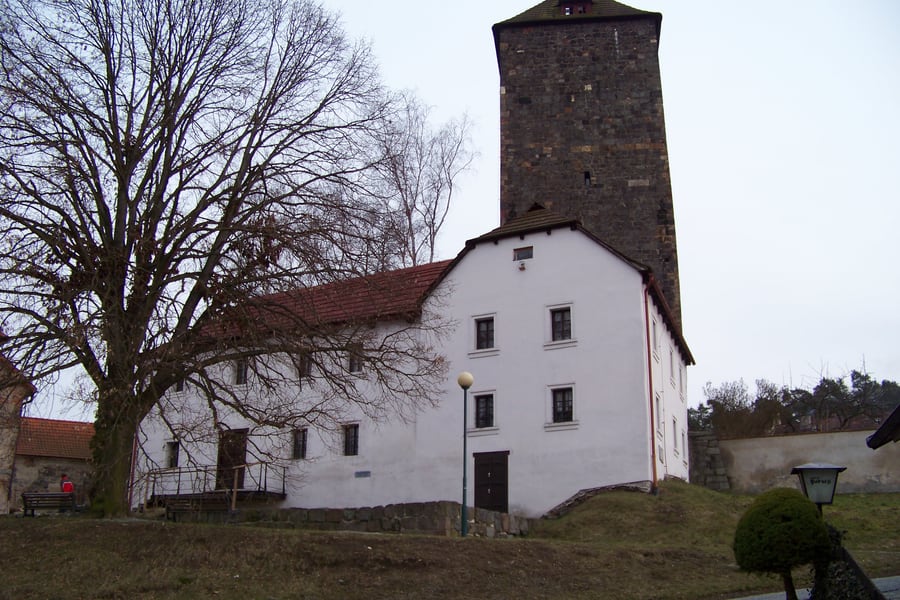 ŠJů / Wikimedia Commons · CC BY-SA 3.0 · cropped
The oldest thing on the line
The castle on the bluff above the Sázava keeps a square Romanesque tower and, built against it, the older rotunda of St Wenceslas, which became the castle chapel. Archaeological work confirmed a castle here in the eleventh century, and the rotunda is the oldest surviving structure in the town. It has been protected since 1965, and the rotunda is a nature monument as well, for the bats that roost in it.Where to Sleep
Most people ride the Pacifik as a day out from Prague, and the hourly service and the 22:17 back from Čerčany make that easy. The valley is nonetheless full of beds, because it has been a weekend destination for a hundred years — the difference is that most of them are private cabins, campsites and canoe-hire places rather than hotels.
Two hotels along the line keep their own websites and take direct bookings. One is on the riverbank at Jílové u Prahy, in the middle of the gorge; the other is in the old stoneware works at Týnec nad Sázavou, near the far end of the route and under the castle. Both are a short walk from their station.
Where to stay
Hotel Troníček
On the Sázava bank at Jílové u Prahy
A hotel on the riverbank in the middle of the gorge, about 25 km from the centre of Prague. Its own site lists 42 beds in single, double and triple rooms plus two apartments for four to six, all with private bathrooms, and a restaurant with a hundred-seat summer garden, a conference room and a Finnish barbecue house. It sits on the Posázavská stezka.
Check Availability (opens in a new tab, on hoteltronicek.cz)via hoteltronicek.czHotel Týnec
In an 1813 stoneware works, below the castle
The hotel occupies the rebuilt buildings of the stoneware manufactory of 1813 that made Týnec ceramics, part of which was already in hotel use before 1900. Its own site lists 11 rooms and 25 beds, extending to 40, free parking, storage for 24 bicycles with e-bike chargers, a historic garden, and a tourist information desk at reception. It received Hotelstars certification in July 2025.
Check Availability (opens in a new tab, on hoteltynec.cz)via hoteltynec.czQuestions or corrections
Planning this trip and stuck on something, or spotted a time, fare or detail that has changed? Send us a message about The Posázavský Pacifik. We read every one, and we update this page when something has changed.