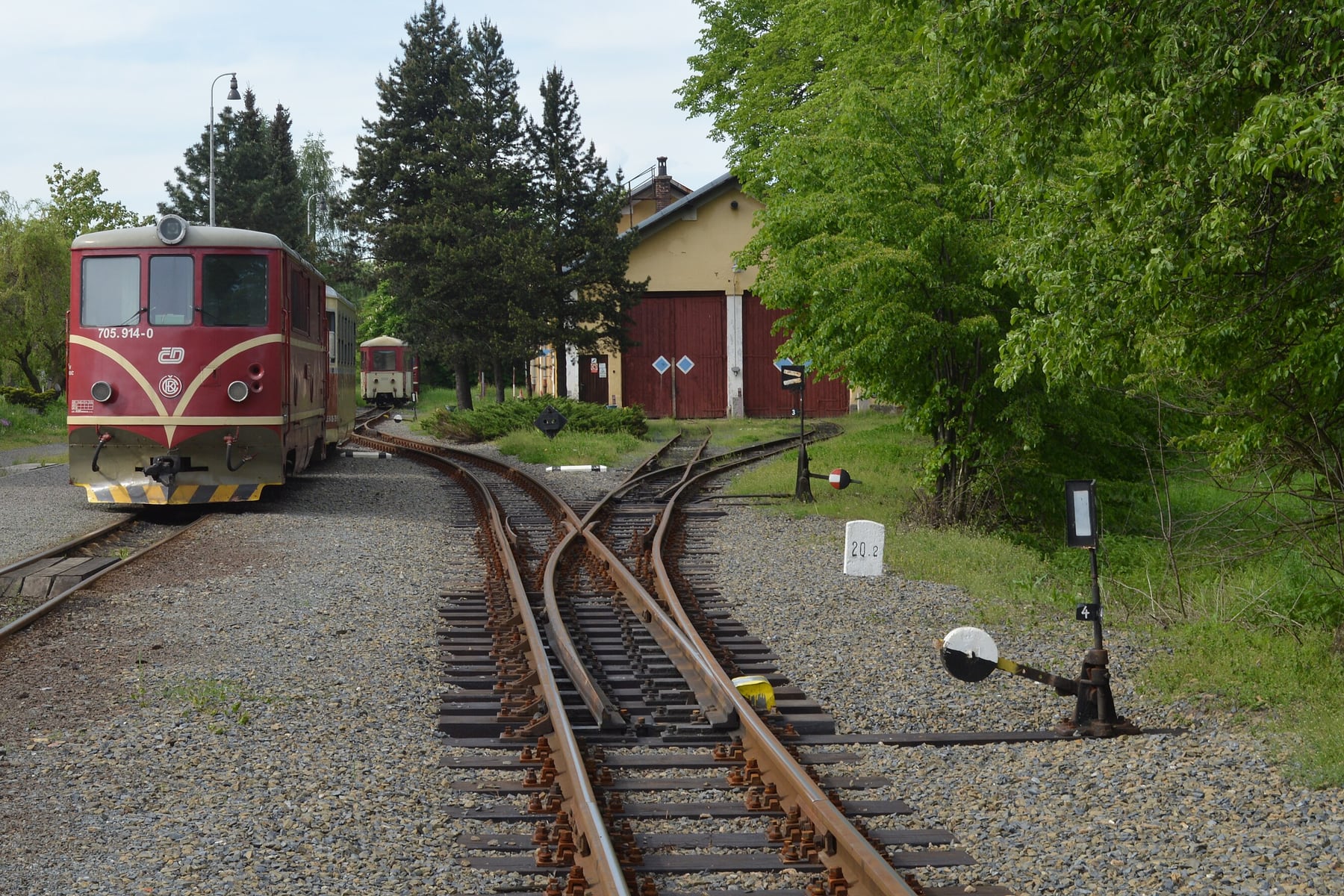
Třemešná to Osoblaha
Phil Richards / Wikimedia Commons · CC BY-SA 2.0 · cropped
- DistanceTřemešná ve Slezsku–Osoblaha · 20.2 km
- DurationAbout 50 minutes each way · longer by steam
- Best seasonDaily all year · steam on summer weekends
Introduction
Osoblaha sits at the tip of a corner of Czechia that pushes north into Poland, with the border on three sides. When the line was planned it was the edge of Austria, and the country beyond was Prussia. In the 1870s the town's sugar mill wanted a railway, and the obvious one ran north, across the frontier, to the Prussian line from Neustadt to Leobschütz. The ministry in Vienna refused it, because it crossed the border. When the state finally agreed to pay, in 1893, it paid only for a branch on its own side of the line, and only at 760 millimetres, a gauge a third cheaper to build. That branch opened on 14 December 1898, and it still ends at the edge of Osoblaha, by the border it was never allowed to cross.
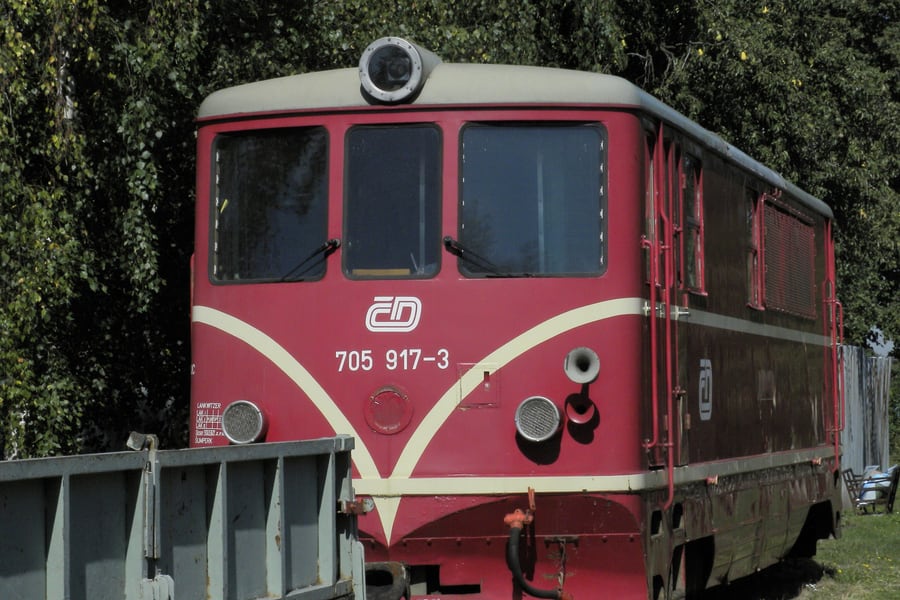
It is 20.2 kilometres long, though Třemešná and Osoblaha are 13 apart, because the track follows the ground round 102 curves. One of them, a 75-metre curve just outside Třemešná, is the sharpest on the Czech railway network. For more than a century the state ran the trains; since December 2025 they have been run by Osoblažská úzkorozchodná dráha, a company set up by the villages along the line, with the same ČKD diesel locomotives that took over from steam in 1958.
The ride takes about fifty minutes, downhill most of the way, through the open farmland of the Osoblaha country and a wooded river valley under a ruined castle. Four trains run each way every day, and on summer weekends a steam train runs as well.
The Journey
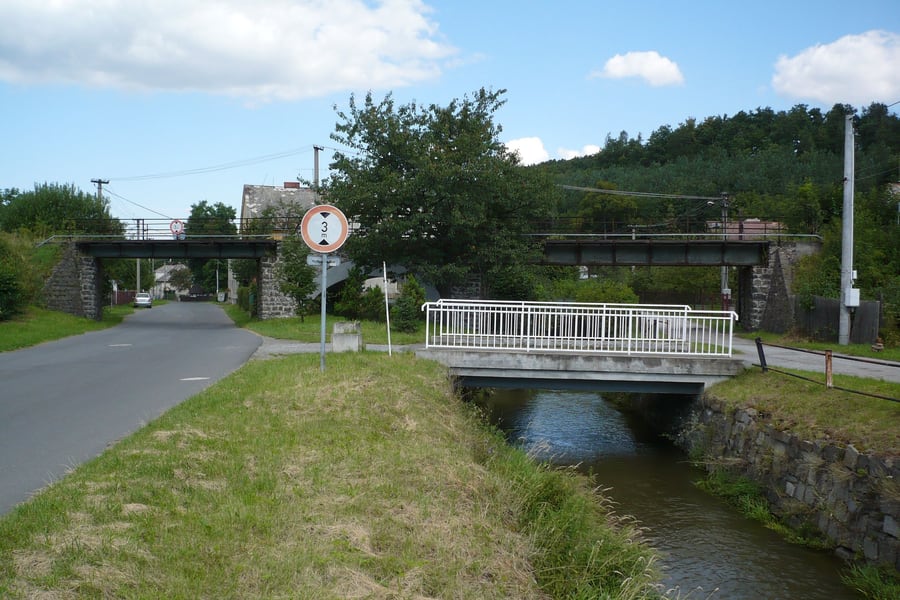
The narrow-gauge trains leave Třemešná ve Slezsku from the far side of the station building, away from the platforms of the main line from Krnov. Straight away the line drops at up to 26 per mille to a three-span steel bridge over the road and the Mušlov brook, then climbs at 27.3 per mille, the steepest on the line, to a summit only a metre lower than the station. Just beyond it comes the 75-metre curve, where the speed limit is 20 km/h. From there the line runs downhill nearly all the way to Osoblaha, 170 metres lower.
Across the plateau
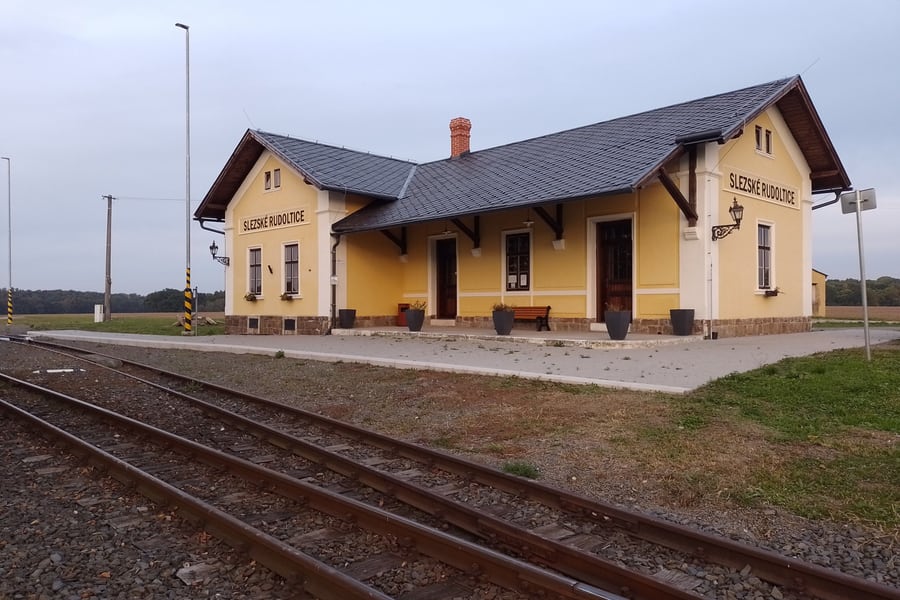
After Liptaň, the first station, the line turns north-east, then swings south-east before Dívčí Hrad and starts the long, gentle descent into the Oder lowland. It winds through open fields by way of Horní Povelice and Amalín, halts where the train stops only on request, to Slezské Rudoltice, where the château of the Hodic family stands in its park. The curves are not there for the view. A popular story says the line was lengthened because Austrian rules allowed only railways longer than 20 kilometres, but the line from Ondrášov to Dvorce, built the same year for the same owner, was 11. The real reason was cost: a track that hugs the ground needs fewer cuttings and embankments.
Down the Osoblaha valley
Beyond Slezské Rudoltice the line turns north with the Lužná brook. After Koberno it enters the wooded valley of the Osoblaha river, passes below the ruin of Fulštejn castle, and reaches Bohušov. The last few kilometres run out of the trees to Osoblaha, where the terminus stands on the edge of the town, right by the Polish border.
A railway for a Moravian island
The Osoblaha country was a piece of Moravia inside Silesia, held by the bishops of Olomouc, and when Austria lost most of Silesia to Prussia in 1742 it was left as a salient of Austrian land running into Prussian territory. The railway it got was a compromise. Its sugar mill and villages could find less than a tenth of the cost of a line towards Albrechtice, and the frontier crossing they wanted was refused. In February 1893 the government provisionally approved a line from Albrechtice through Osoblaha to Deutsch Rasselwitz in Prussia, then granted 278,000 gulden only for the Austrian part, and only for narrow gauge. The Moravian Diet added 237,000 gulden in 1896, and in 1897 the route was changed to meet the main line at Röwersdorf, today's Třemešná.
The first regular train left at ten to four on the morning of 14 December 1898, with no ceremony. The official train arrived at half past eleven to a banquet for more than a hundred guests, and even then, as the line's history records, the region had wanted a standard-gauge railway.
Since then
The Austrian State Railways ran it from the start. In 1938 it passed to the German Reichsbahn, and in 1945 the fighting destroyed most of Osoblaha. Diesel locomotives of class TU47.0, built by ČKD, arrived in 1958, and the last steam train ran on 16 November 1960. The same locomotives, now class 705.9, still haul the trains, with one coach or two. The track was relaid in 1986–88, goods traffic ended on 31 May 1997, and closure was discussed three times. In June 2022 České dráhy ran out of working locomotives and put on buses until January 2023.
The villages along the line had bought the station buildings in 2018, and in December 2025 their company took over the trains as well. A flood in September 2024 damaged the track in many places, and it was repaired between September and November 2025, just before the change.
Along the route
 JanSuchy / Wikimedia Commons · public domain · cropped
Down to the bridge at Třemešná
The trains leave from the far side of Třemešná station, drop at up to 26 per mille to a three-span steel bridge over the road and the Mušlov brook, then climb at 27.3 per mille, the steepest on the line.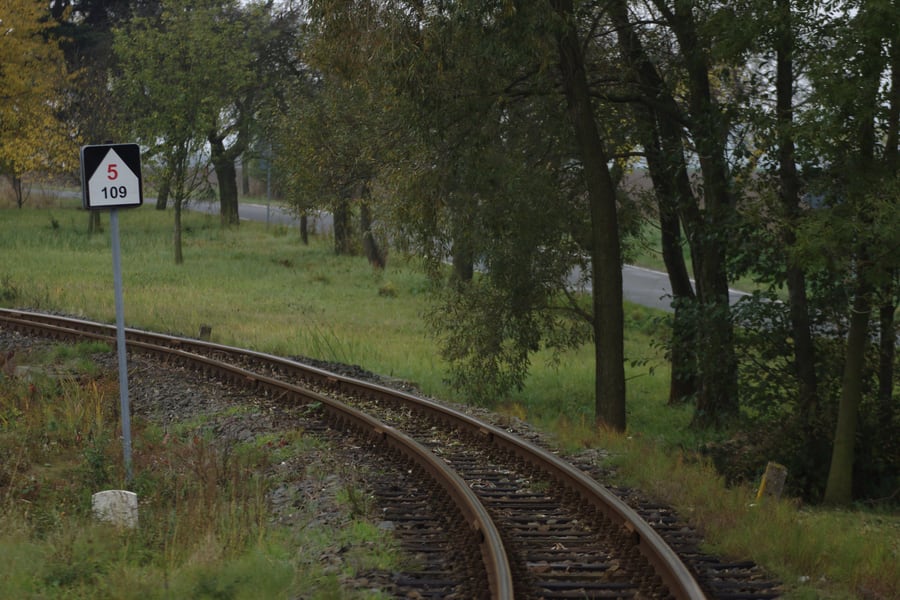 Aktron / Wikimedia Commons · CC BY-SA 4.0 · cropped
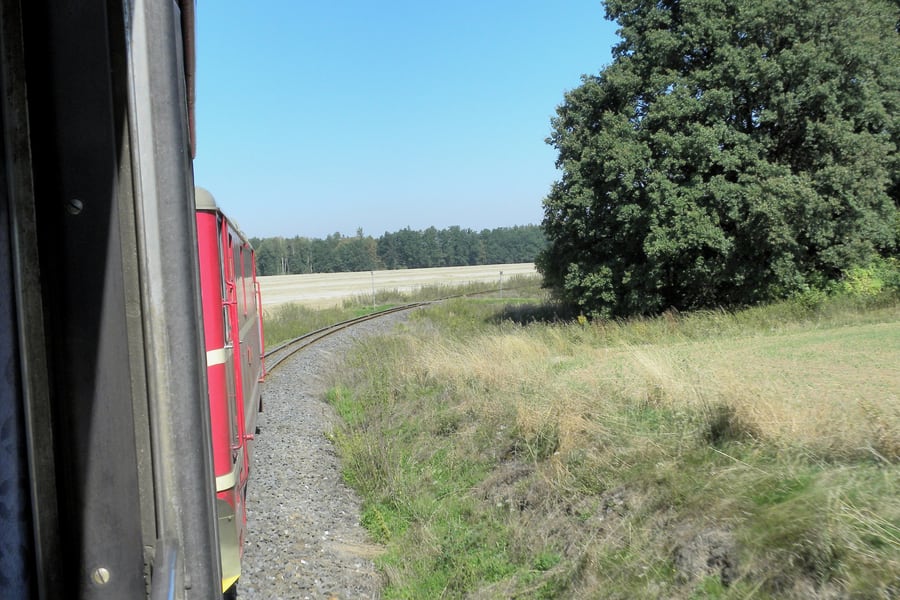
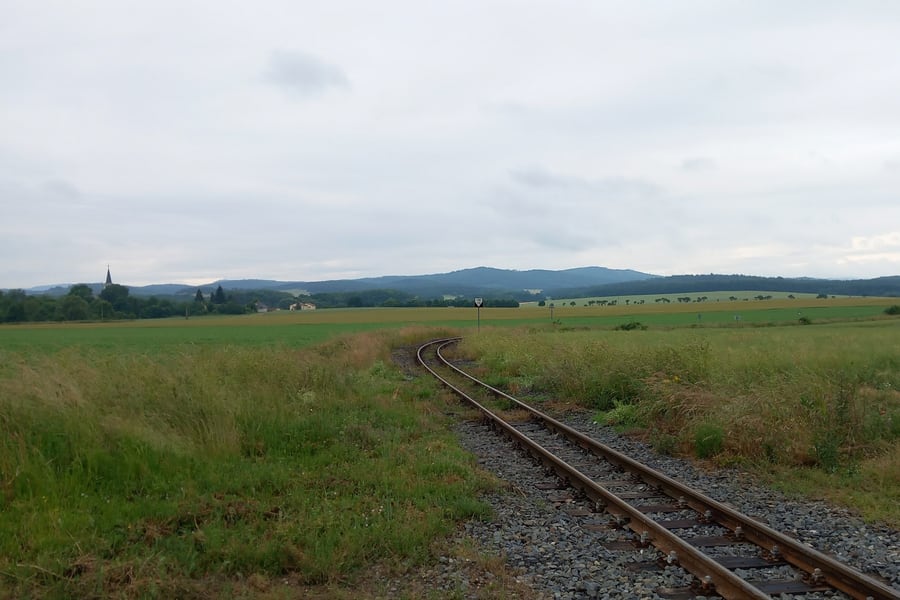
Seven kilometres of curves
Třemešná and Osoblaha are 13 km apart in a straight line; the railway takes 20.2, round 102 curves. Just past the summit comes a 75-metre curve, the sharpest on the Czech network, taken at 20 km/h. The curves hug the ground to keep the cost down.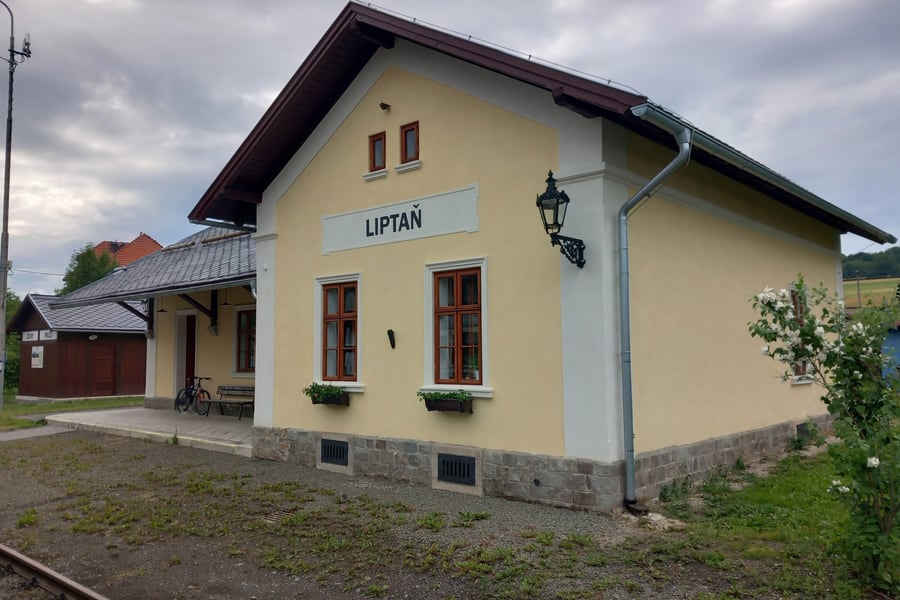 Vojtěch Dočkal / Wikimedia Commons · CC BY-SA 4.0 · cropped
Stations from the First Republic
In 2018 the villages' company bought the station buildings from the state. In 2021 those at Liptaň, Koberno, Bohušov and Osoblaha were restored, with 26 million crowns of EU money, to how they looked in the First Czechoslovak Republic.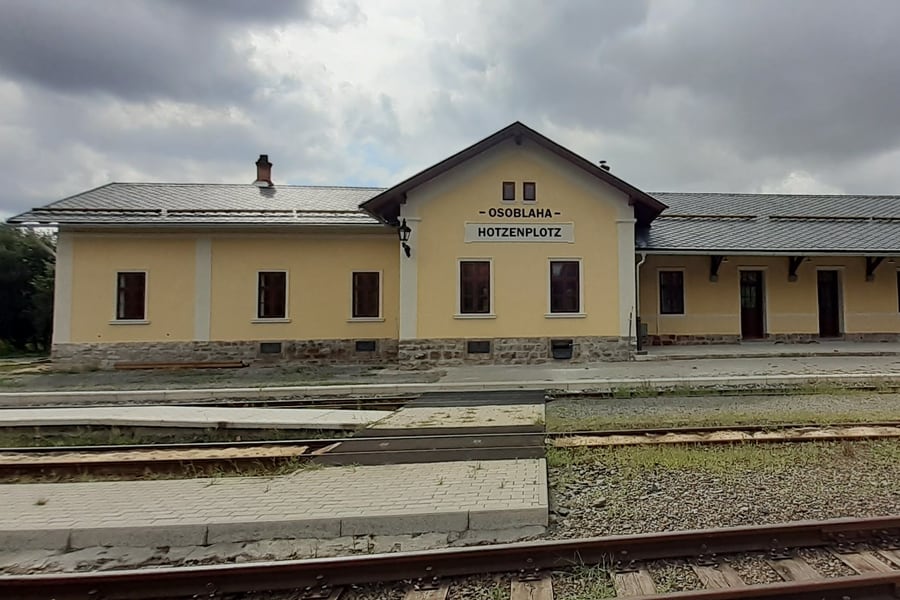 Mikuláš Galuszka / Wikimedia Commons · CC BY-SA 4.0 · cropped
Hotzenplotz
The terminus stands on the edge of Osoblaha, right by the Polish border. Its restored building carries its old name board again, Osoblaha / Hotzenplotz, the German name the town used until 1945. The line has never gone any further.A bit of history
Culture & experiences along the way
 Pendolino53 / Wikimedia Commons · CC BY-SA 4.0 · cropped
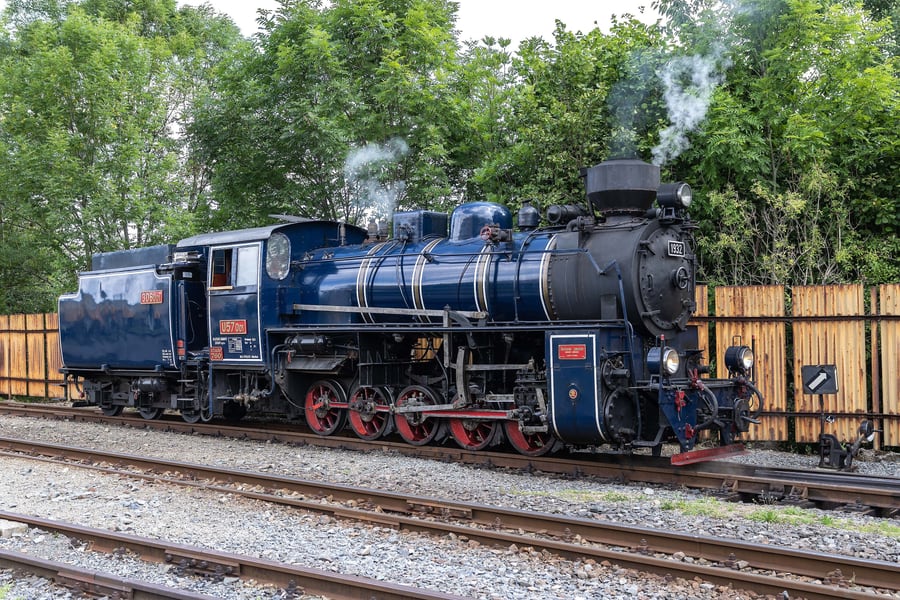
Steam behind the Malý štokr
On summer weekends Slezské zemské dráhy run a steam train behind U57.001, the Malý štokr, built by Škoda in Plzeň for the Yugoslav railways. It is the most powerful steam locomotive ever to work Czechoslovak narrow gauge, and the only one of six that still runs. It leaves Třemešná at 10:45 and Osoblaha at 15:10.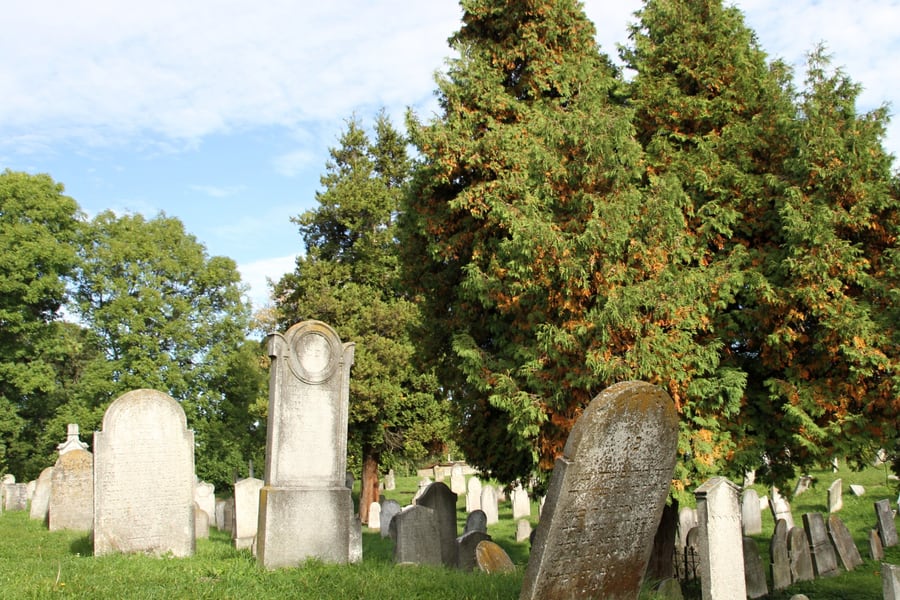 Sylva.Kristianova / Wikimedia Commons · CC BY-SA 3.0 · cropped
A cemetery older than the railway
Osoblaha's Jewish cemetery lies outside the old town wall. It was founded in the first half of the fifteenth century and used until the 1930s, and 313 stones survive, the oldest dated 1694, in a Silesian style found nowhere else in Czechia. It is open to visitors at any time.Timetables
Line 319 is worked by Osoblažská úzkorozchodná dráha every day of the year, with four trains in each direction. No reservation is needed. The run takes 49 to 50 minutes. Dívčí Hrad, Horní Povelice, Amalín and Koberno are request stops.
Times below are from the 2026 timetable published by Správa železnic, valid from 14 December 2025, read in October 2026. Check departures at osoblazsko.com (opens in a new tab).
Třemešná ve Slezsku to Osoblaha
| Train | Třemešná ve Slezsku | Osoblaha | Runs |
|---|---|---|---|
| 20601 | 07:28 | 08:17 | Mon–Sat |
| 20603 | 11:28 | 12:17 | Daily |
| 20605 | 15:28 | 16:17 | Daily |
| 20607 | 19:28 | 20:17 | Daily except 24 and 31 Dec |
Osoblaha to Třemešná ve Slezsku
| Train | Osoblaha | Třemešná ve Slezsku | Runs |
|---|---|---|---|
| 20600 | 05:43 | 06:33 | Mon–Sat |
| 20602 | 09:43 | 10:33 | Daily |
| 20604 | 13:43 | 14:33 | Daily |
| 20606 | 17:43 | 18:33 | Daily except 24 and 31 Dec |
The Monday-to-Saturday trains also run on 24 December, 3 April, 1 and 8 May, 28 October and 17 November, and not on 27 December, 4 April or 2 and 9 May.
From Krnov
Every narrow-gauge train meets a České dráhy fast train on line 318 to and from Krnov, 20 minutes away: from Krnov at 07:05, 11:05, 15:05 and 19:05, and back into Krnov at 06:55, 10:55, 14:55 and 18:55.
Steam
The Slezské zemské dráhy steam train leaves Třemešná at 10:45, reaching Osoblaha at 12:03, and comes back from Osoblaha at 15:10, arriving in Třemešná at 16:39. In 2026 it ran on Saturdays from 6 to 27 June, on Saturdays and Sundays from 4 July to 30 August, and on Saturdays in September until the 19th, with special trains at Easter and on 7 November for the St Martin's feast in Bohušov. A seasonal ČD train from Krnov at 10:15 connects with it. Dates for 2027 had not been published when this page was checked.
Tickets
The regular trains take the fares of ODIS, the Moravian-Silesian Region's integrated transport system, and the national OneTicket tariff, and no reservation is needed. Within the region you can pay by bank card or ODIS card at the validator on board, or in the ODISapka app. For a ticket beyond the region, or to pay in cash, buy it from the driver; cash fares cost 30 to 50 per cent more.
The steam trains are run by Slezské zemské dráhy on a fare of their own: in 2026 a single from Třemešná to Osoblaha cost 240 Kč and a return 390 Kč, with seat reservations available for 40 Kč.
Book your tickets
Třemešná to Osoblaha
Osoblažská úzkorozchodná dráha · daily
An ordinary ODIS or OneTicket fare with no reservation, paid at the validator on board or to the driver.
Book Tickets (opens in a new tab, on osoblazsko.com)via osoblazsko.comSteam train, Třemešná to Osoblaha
Slezské zemské dráhy · summer weekends
The heritage steam train on its own fare, with seats that can be reserved in advance.
Book Tickets (opens in a new tab, on osoblazsko.com)via osoblazsko.comRail Passes
Interrail and Eurail passes do not cover this line. Interrail's list of Czech operators names Slezské zemské dráhy and Osoblažská úzkorozchodná dráha, Osoblaha – Třemešná ve Slezsku, among the trains a pass is not valid on, so both the regular trains and the steam train need a ticket of their own.
A pass can still bring you to the start. The České dráhy trains on line 318 from Krnov to Třemešná are covered, so somebody already travelling in Czechia on a pass can ride to Třemešná and buy an ODIS ticket there for the narrow gauge. Buying a pass for this line alone makes no sense.
Pass conditions checked against Interrail's railway-companies page, last updated 21 October 2026. Conditions change with each season, and the pass issuer's page is the one that binds.
Places to Visit
The villages along the line are small, but they keep a château, a castle ruin and, at the end of the line, the remains of an old border town. The places below run from Slezské Rudoltice to Osoblaha.
The château at Slezské Rudoltice stands in the village, and Fulštejn is on the hill above Bohušov. In Osoblaha the walls, St Nicholas and the Jewish cemetery are all on the edges of the old town.
 Mikuláš Galuszka / Wikimedia Commons · CC BY-SA 4.0 · cropped
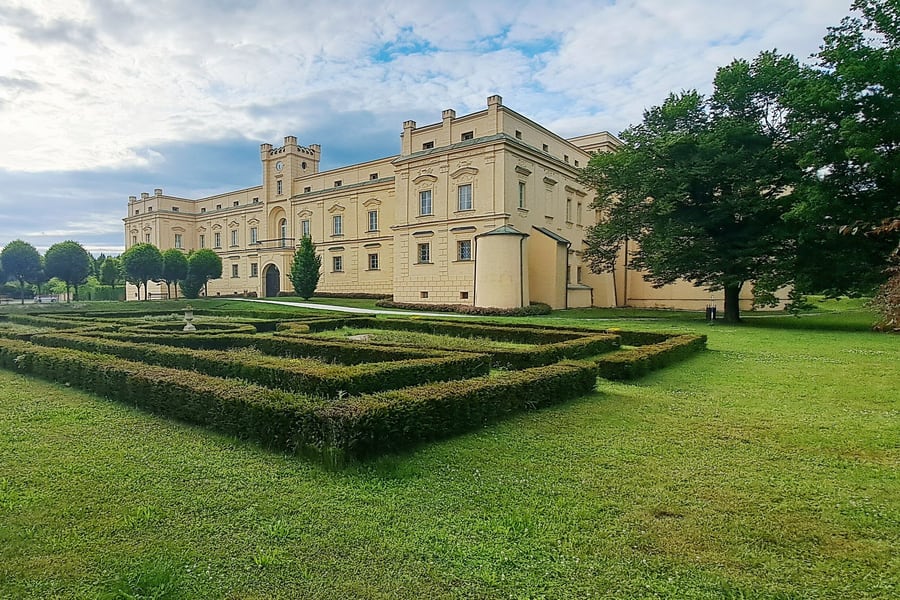
The Silesian Versailles
The Fulštejns built a Renaissance house at Slezské Rudoltice in 1548–65, and the Hodic family made it Baroque. Count Albert Joseph Hodic (1706–1778) kept an orchestra and a theatre here and received Frederick II of Prussia, and the château was called the Silesian Versailles until his debts ruined him; its contents were sold after his death. The village owns it now, and it was restored in 2020–22; it has been protected since 1963.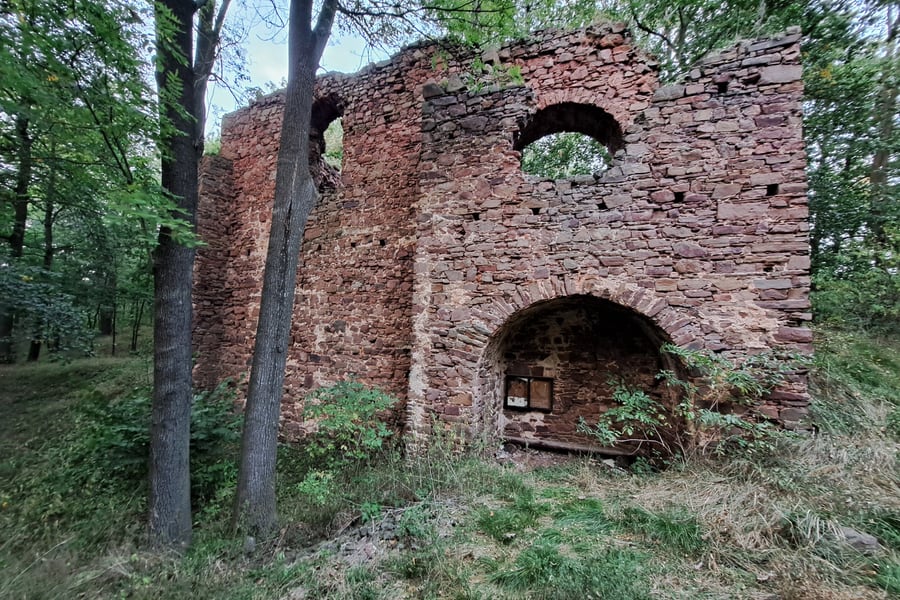 Mikuláš Galuszka / Wikimedia Commons · CC BY-SA 4.0 · cropped
The castle the Swedes blew up
Fulštejn was founded in the thirteenth century by Bruno of Schauenburg, Bishop of Olomouc, on the ramparts of a prehistoric hillfort, and its core was finished in 1255. The Hungarian king Matthias Corvinus took it in 1476; the Swedish garrison of 1642–48 blew it up when it left. A round tower, the gate, the bridge and deep ditches remain.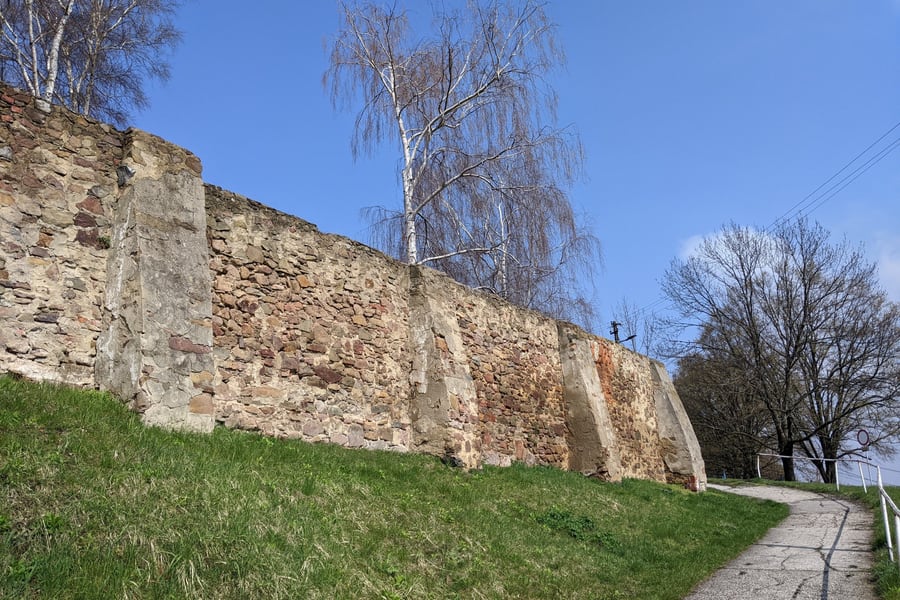 MartinVeselka / Wikimedia Commons · CC BY-SA 4.0 · cropped
A border town's walls
A charter of 1275 already mentions Osoblaha's walls, and in 1389 the bishop granted the town a privilege on condition that it fortify itself, because of its dangerous position on the border. The walls stood on the edge of a spur with three gates. Fragments survive on three sides, and the wall of the Jewish cemetery holds part of a round tower.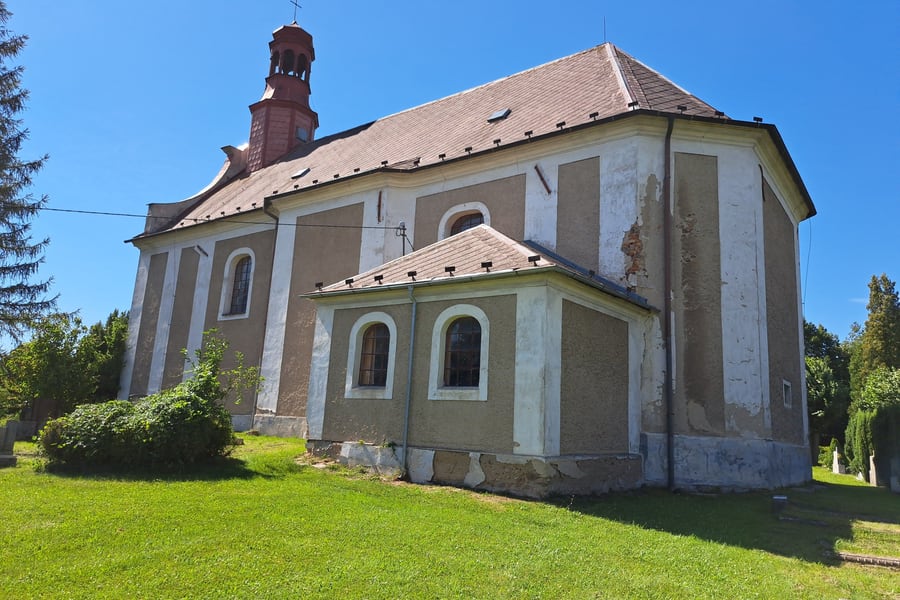 Mikuláš Galuszka / Wikimedia Commons · CC BY-SA 4.0 · cropped
The church that survived
Most of Osoblaha was destroyed in the fighting of 1945, and the ruins of its town church were blown up in 1962. The church of St Nicholas, a Baroque cemetery church of 1756–66 with a volute gable and a polygonal tower, still stands. It is shared by the Catholic and Czech Orthodox churches and is a protected monument.Where to Sleep
The line is under an hour end to end, and every train connects with a fast train to Krnov, so it is easy to ride as a day out from there.
Krnov is the better base. It is the nearest town of any size, 20 minutes from Třemešná by train, with direct trains to Ostrava. The hotel below keeps its own website and takes direct bookings.
Where to stay
Hotel Steiger
In the centre of Krnov
A hotel of apartments and double rooms on Sv. Ducha, with a 50-seat restaurant and a wellness area.
Check Availability (opens in a new tab, on hotelsteiger.cz)via hotelsteiger.czQuestions or corrections
Planning this trip and stuck on something, or spotted a time, fare or detail that has changed? Send us a message about Třemešná to Osoblaha. We read every one, and we update this page when something has changed.