The Šumava Border Railway
MaxEmanuel / Wikimedia Commons · CC0
- DistancePlzeň–Železná Ruda-Alžbětín · 97 km
- DurationAbout 2 hours from Plzeň · 3 h 38 from Prague
- Best seasonWinter for the skiers · summer for the forest
Introduction
Most border stations sit near a border. This one has the border inside it.
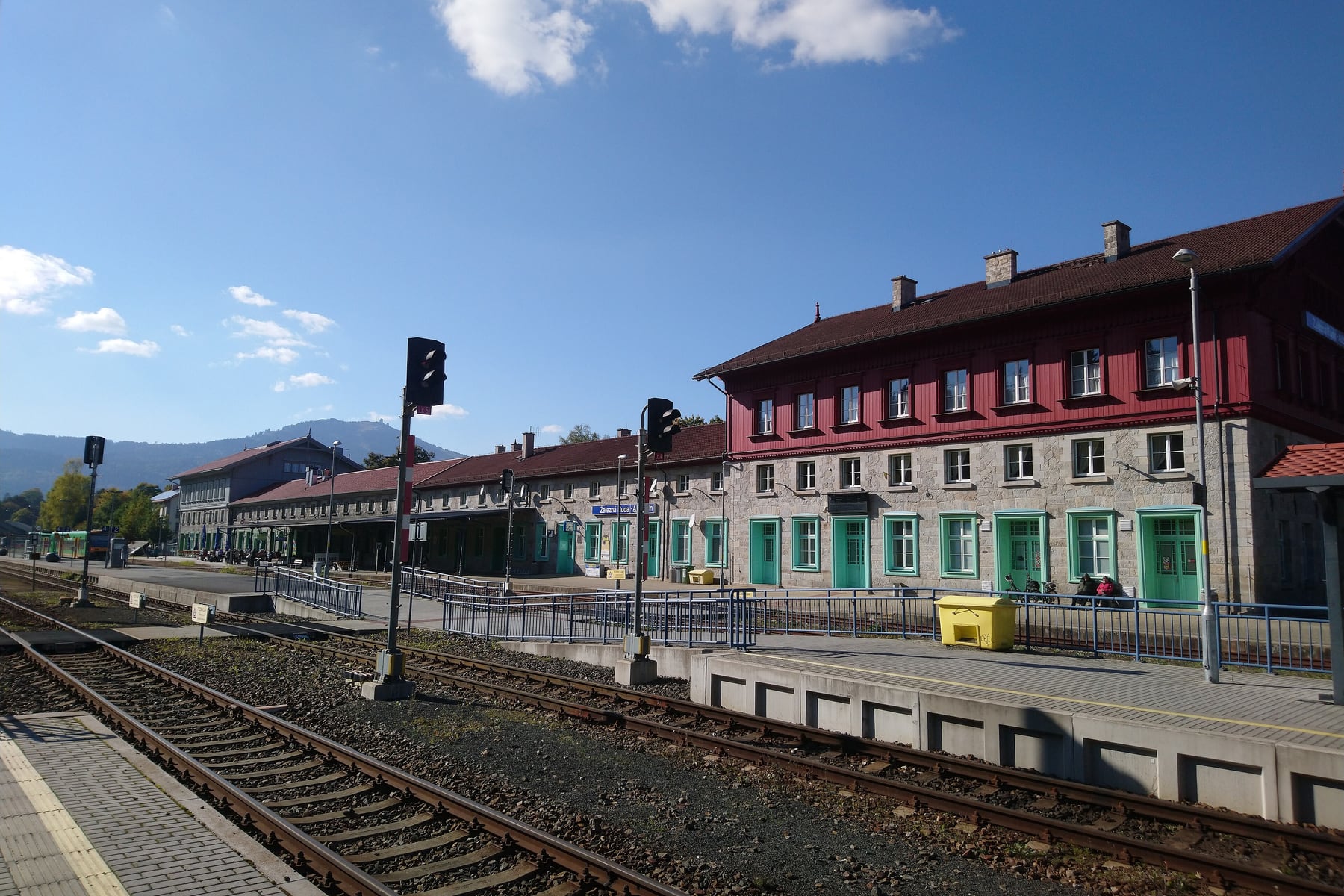
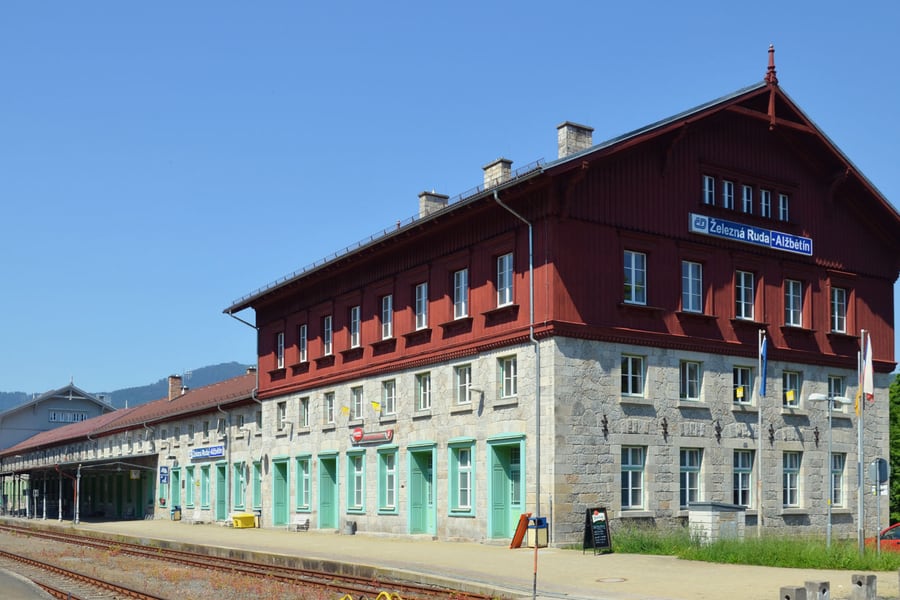
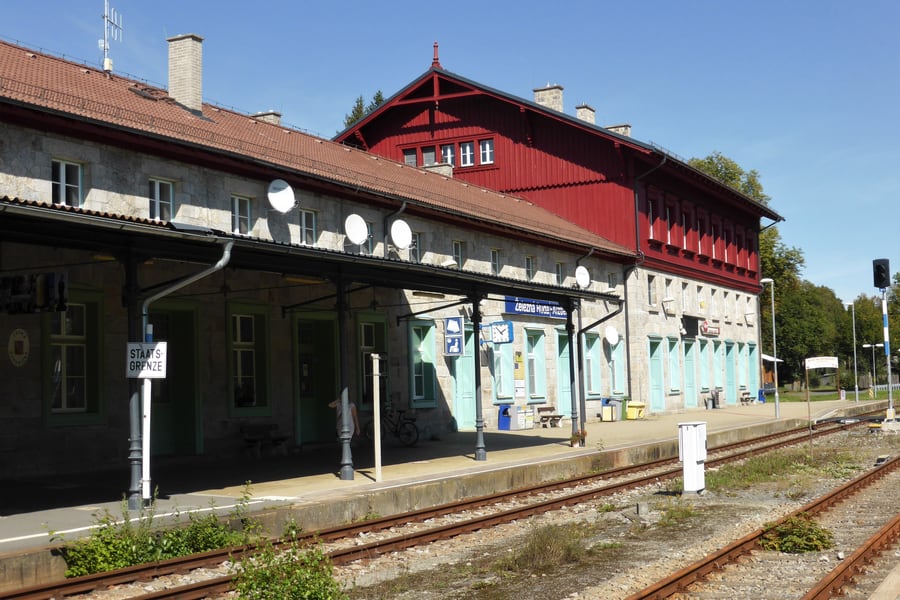
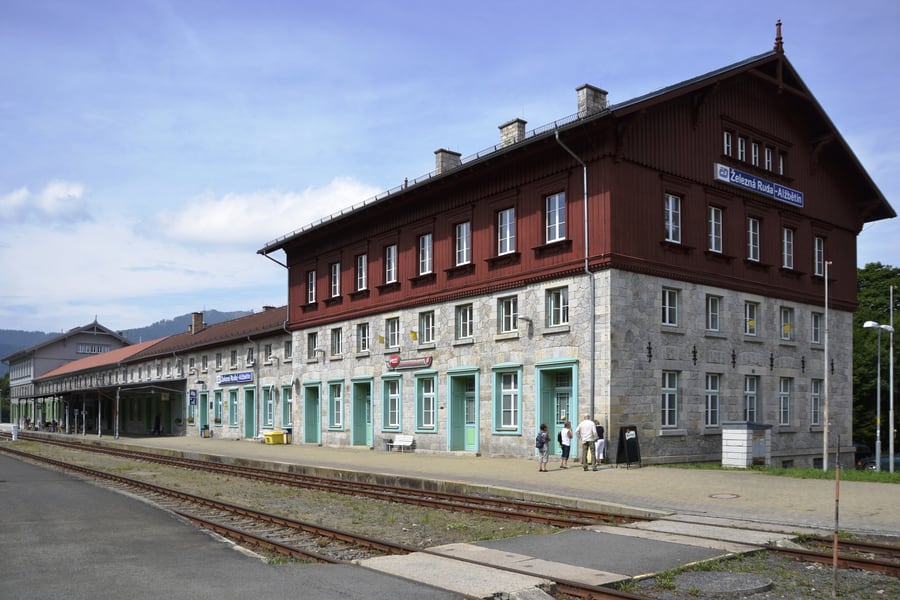
When the reception building at Železná Ruda-Alžbětín was finished in 1878, its centre section was set exactly on the line between Bavaria and Bohemia, with a wing on either side belonging to the railway administration of the country it stood in. The symmetry was the whole design. To this day the building carries two national postal addresses — Bahnhofstraße 54 in Bayerisch Eisenstein, and Debrník 30 in Železná Ruda.
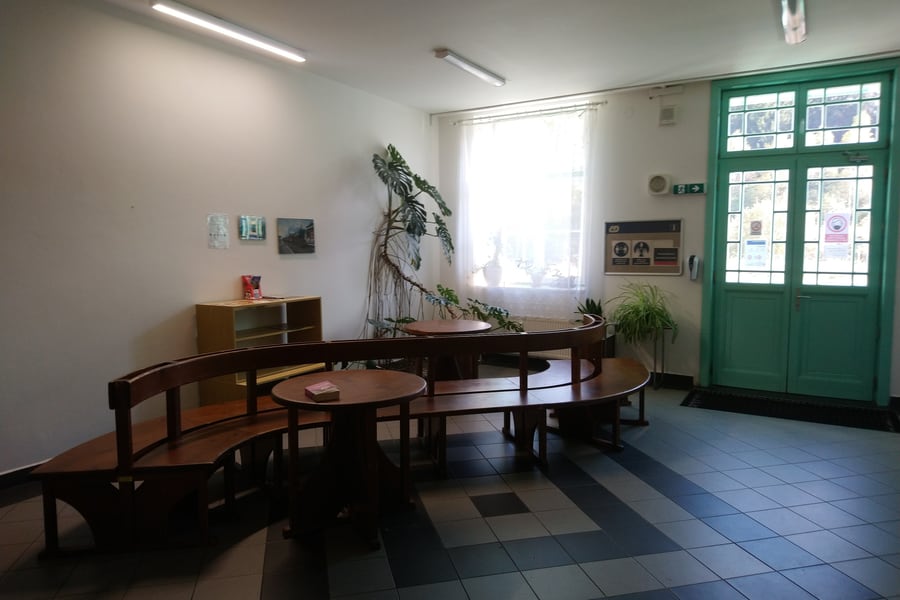
For most of the twentieth century that arrangement stopped being a courtesy and became a problem to be solved with materials. Passenger trains across the frontier ended in 1945. In 1953 Czechoslovakia drew a wire fence across the track layout, the rails were cut, goods traffic finished that September, and walls inside the building completed the division. The Iron Curtain ran through a waiting room. It stayed there for thirty-eight years, until the crossing reopened to rail on 2 June 1991.
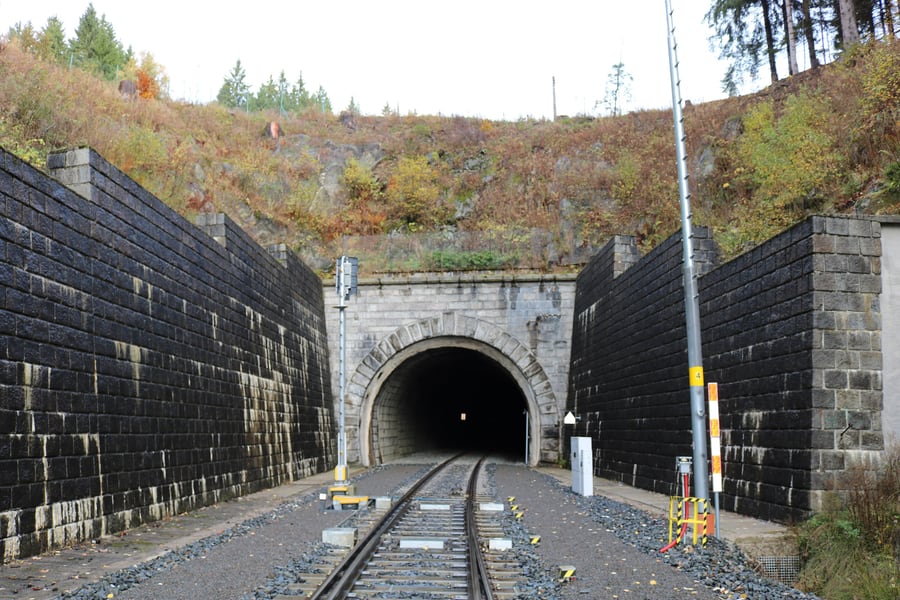
Getting there is a proper journey in its own right. The line climbs 97 kilometres from Plzeň up the Úhlava valley into the Bohemian Forest, and near the top it disappears into the Špičák tunnel — 1,747 metres bored between 1874 and 1877, and the longest railway tunnel in Austria-Hungary when it opened. It held the record on Czech territory for 130 years.
What it is not is a restored through route. Shuttles did run across the border to Špičák from 28 May 2006, but that service ended in December 2014. The German train from Plattling terminates in the building; the Czech train for Klatovy and Prague starts in it. Passengers change by walking from one country to the other, indoors, without going outside at all.
The Journey
The railway leaves Plzeň heading south, and for the first stretch it is an ordinary main line — electrified at 25 kV 50 Hz, under wires strung as recently as 21 September 1996. This is farmland and small towns: Dobřany, Chlumčany, Přeštice. The mountains are somewhere ahead and not yet in the frame.
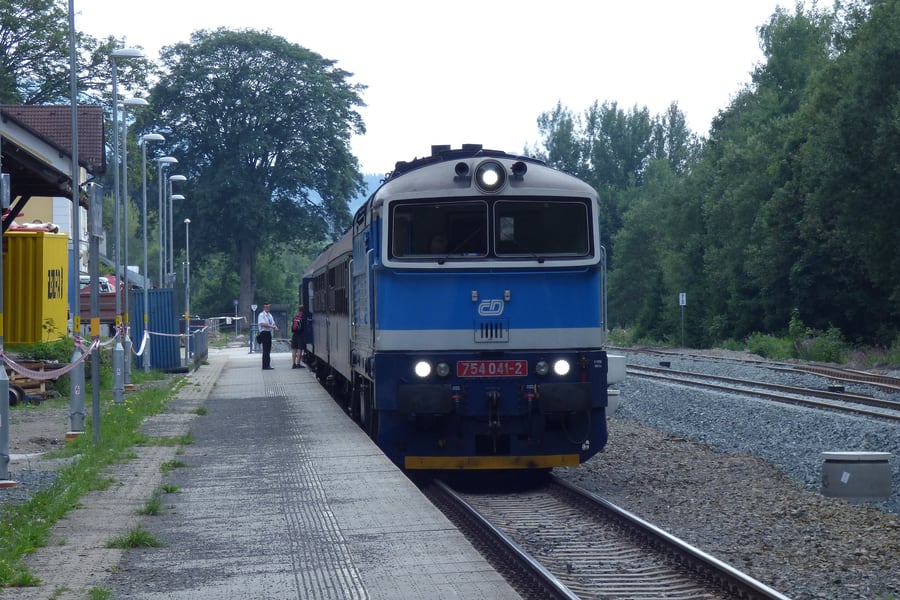
What works the line matters here, because the change of traction is visible from the platform. The electric section is worked by ordinary units out of Plzeň; beyond Klatovy the through expresses are usually in the hands of a class 754 diesel — built between 1975 and 1980, and known to Czech railwaymen as the Brejlovec, the spectacle-wearer, after a front end that looks like a pair of glasses. Eighty-six were built before a factory fire stopped production in July 1980, and their numbers are falling as more of the network is electrified. The local trains up the valley are lighter railcars.
Klatovy, about halfway, is where the character changes. It is the largest town on the route and the end of the electrification: beyond it the remaining 48 kilometres are worked by diesel. A through express pauses here for a good ten minutes, long enough that the break feels deliberate rather than operational.
Up the Úhlava
From Klatovy the line follows the Úhlava upstream through Janovice nad Úhlavou and Nýrsko, and the valley closes in. The gradient stiffens toward its maximum of 21.7 per mille — not severe by mountain-railway standards, but sustained, and the note of the engine changes with it. Zelená Lhota and Hojsova Stráž are small halts among spruce, the sort of stops where one or two people get off and the forest takes them immediately.
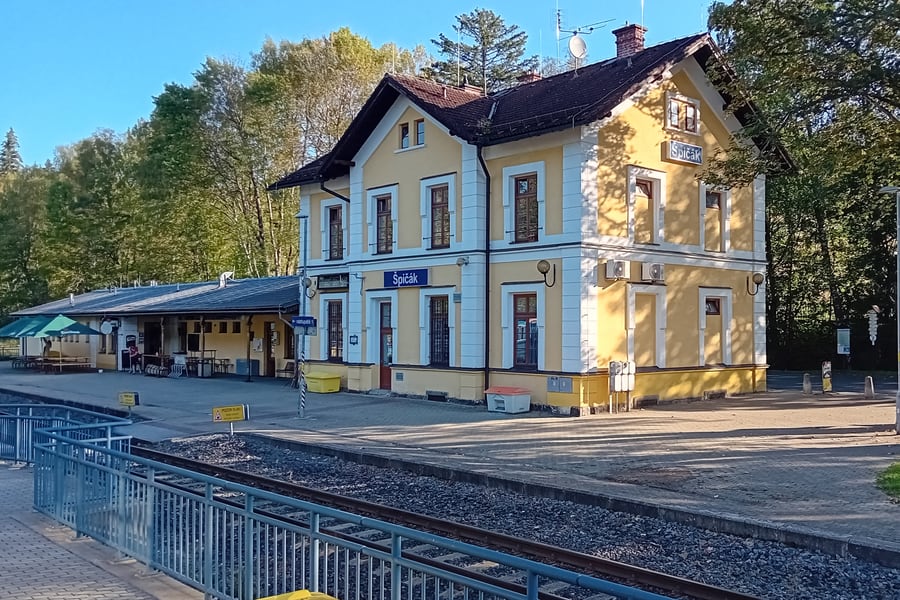
Then the tunnel. The Špičák tunnel is 1,747 metres long, driven between 1874 and 1877 under the direction of Karl Pascher von Osserburg, its portals at roughly 840 and 845 metres above the sea. It was the longest railway tunnel in Austria-Hungary at its opening, and it remained the longest anywhere on Czech territory for 130 years, until the Březenský tunnel beat it in 2007 by eleven metres. The Ejpovický tunnel of 2018, at 4,150 metres, has since pushed it to third. Trains take it at 60 km/h, so the crossing lasts under two minutes.
It is worth knowing who dug it. The workforce was brought from across the empire — from Bosnia, Dalmatia, Croatia and Tyrol — and several dozen of them died during the work. They are buried at the Barabů cemetery near Železná Ruda, which is still there in the trees.
The three stations of Železná Ruda
Out of the southern portal the line reaches Špičák, at the top of the climb, and then drops through Železná Ruda město and Železná Ruda centrum — a town of a few thousand people with three stations on one railway, which tells you what the line was built to serve. Below the town the Železnorudský tunnel, 198 metres, takes the railway on its last stretch to the frontier.
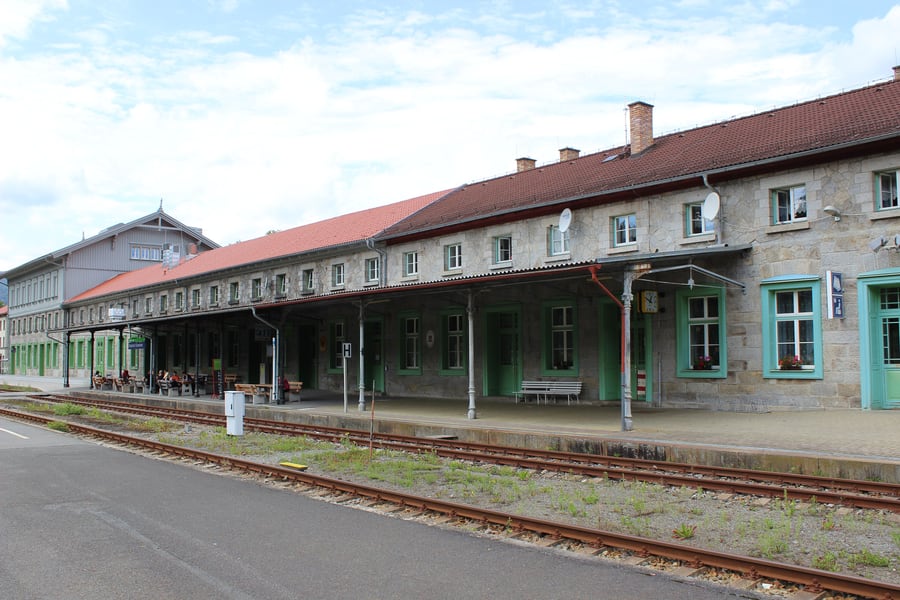
And then the terminus, which is the reason to come. From the platform the building reads as a single long range: a tall gable at one end, a lower wing running away from it, a canopy over the platform face. Nothing about it announces that a state boundary passes through the middle. The Czech half belongs to Správa železnic and was renovated outside in 2018 and inside in 2019; the German half was bought by the Naturpark Bayerischer Wald in 2006 and rebuilt between spring 2010 and mid-2011 at a cost of €5.14 million. It was named Bahnhof des Jahres — station of the year — in 2017.
The connection that is a border crossing
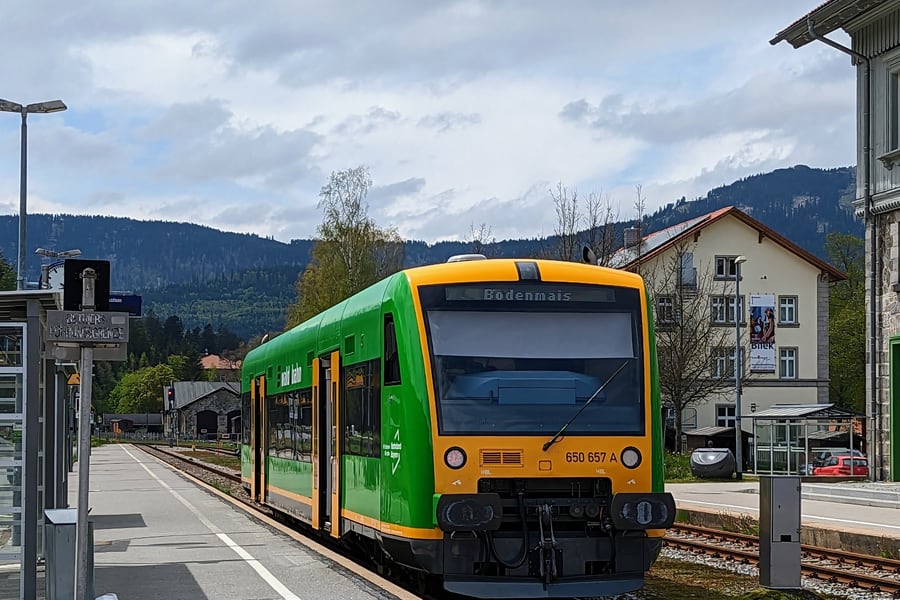
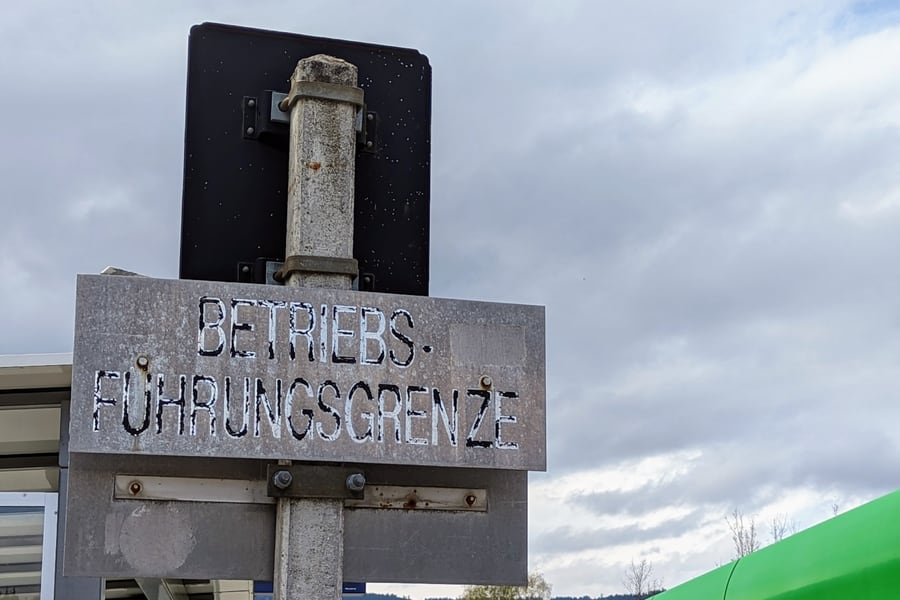
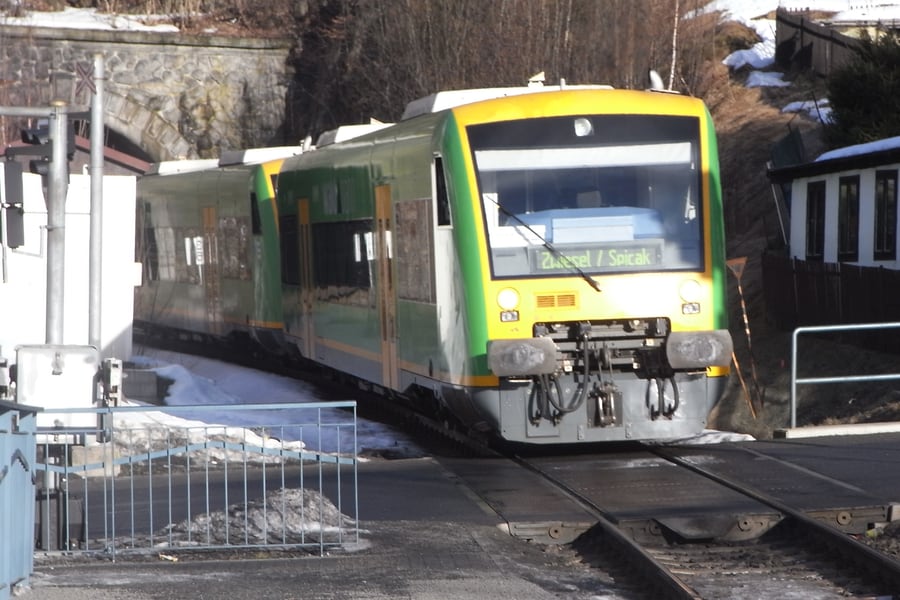
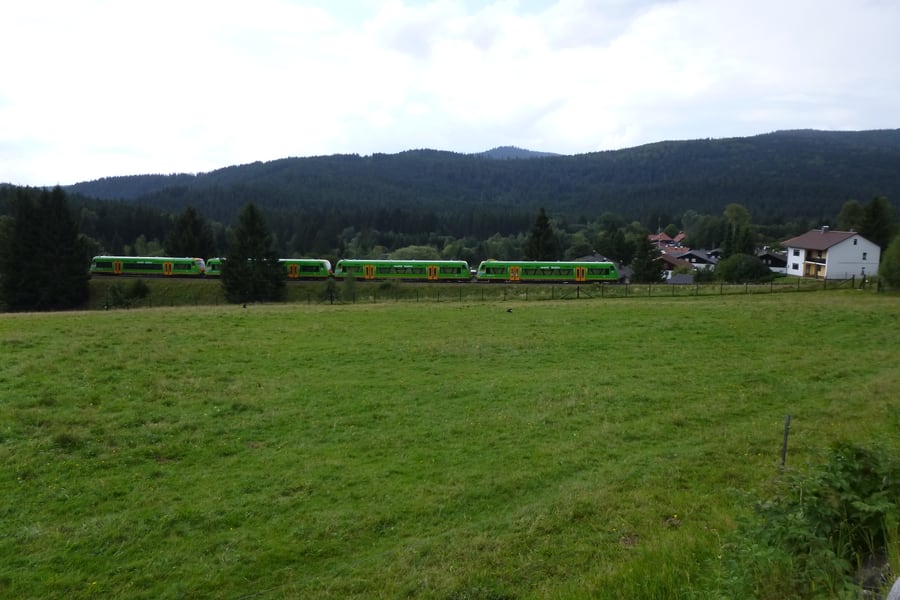
The practical business of the place is worth watching. Czech trains work in and out of tracks on their side; the Bavarian services stand at their own platform in the green and yellow of the Waldbahn, worked by Regio-Shuttle railcars. A sign in the station marks the Betriebsführungsgrenze — the limit of operational control, where responsibility for the track passes from one country's infrastructure manager to the other. Nothing runs through. A passenger going onward from Prague to Bavaria walks the length of a building, crosses an international frontier somewhere around the middle of it, and boards a train belonging to another country's operator — having never been outdoors, shown a document, or done anything that felt like crossing a border at all.
Along the route
Jan Polák / Wikimedia Commons · CC BY-SA 3.0A frontier you can stand on indoors
The reception building was finished in 1878 with its centre section set exactly on the border line, a wing belonging to each railway administration. It has two national postal addresses, one German and one Czech. One roof, two countries, and the line between them runs through the middle of the floor.MaxEmanuel / Wikimedia Commons · CC0Thirty-eight years as a wall
In 1953 Czechoslovakia drew a wire fence across the track layout, the rails were cut, and walls inside the building completed the division. The crossing reopened to rail in 1991. What makes the place worth the journey is that the architecture was always symmetrical: the division was the thing that had to be built.Pbrot / Wikimedia Commons · CC BY-SA 4.0The longest tunnel in the empire
The Špičák tunnel runs 1,747 metres under the ridge, bored between 1874 and 1877. It was the longest railway tunnel in Austria-Hungary when it opened, and the longest on Czech territory for 130 years — until 2007, when another beat it by eleven metres.A bit of history
Culture & experiences along the way
Mkkagain / Wikimedia Commons · CC0Change trains by crossing a border
Through services no longer run: the Waldbahn shuttles that worked across to Špičák from 28 May 2006 stopped in December 2014. The German train ends its journey in the building; the Czech train for Klatovy and Prague begins in the same one. A sign marks the Betriebsführungsgrenze, where responsibility for the track passes from one country to the other — and the connection is made on foot, across a frontier, under one roof.Vojtasekd / Wikimedia Commons · CC BY 4.0The climb to Špičák
From Klatovy the line works up the Úhlava valley through Nýrsko and Zelená Lhota, steepening to 21.7 per mille as it turns into the mountains. Hojsova Stráž sits in the trees; then the tunnel, and Špičák station on the far side at the top of the climb. It is the part of the ride where a regional train stops feeling like a branch-line service and starts feeling like a mountain one.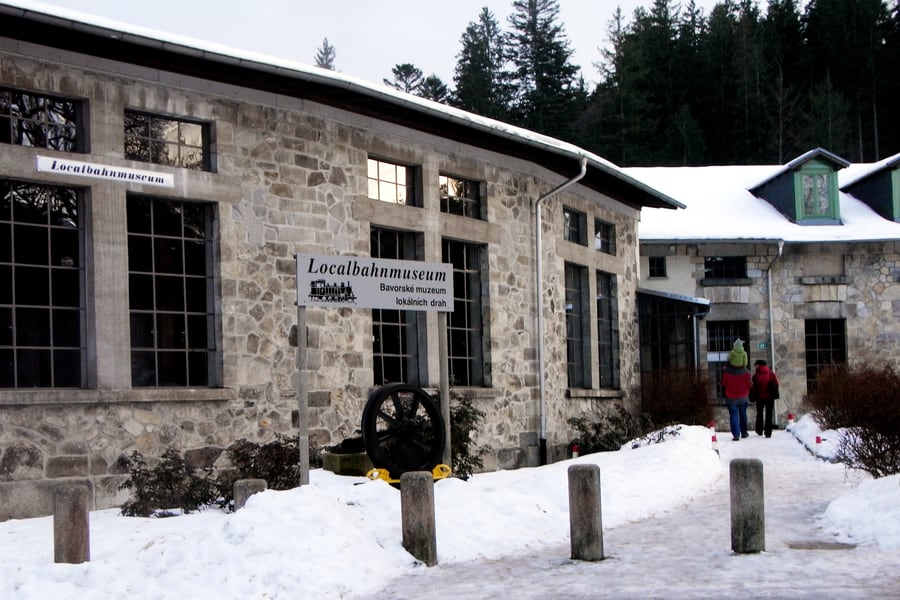 Aisano / Wikimedia Commons · CC0
Two museums in the buildings themselves
The German half of the station holds the NaturparkWelten, opened after a renovation that ran from spring 2010 to mid-2011 and cost €5.14 million, with a restaurant in the old first-class waiting room. West of the platforms, the Localbahnmuseum fills the former depot with more than twenty vehicles. Both are inside the railway, rather than somewhere you go afterwards.Timetables
Times below were read from the live timetable for Tuesday 18 August 2026, and checked again against Tuesday 10 November 2026, which returned an identical pattern — so this is the ordinary year-round service rather than a summer one. As of August 2026.
From the border station toward Bohemia
Departures from Železná Ruda-Alžbětín:
| Train | Departs | Runs to | Arrives |
|---|---|---|---|
| Os 7541 | 05:17 | Klatovy | 06:15 |
| Os 7543 | 06:17 | Klatovy | 07:17 |
| Os 7545 | 08:16 | Klatovy | 09:11 |
| Os 7547 | 09:17 | Klatovy | 10:16 |
| R 763 Berounka | 10:15 | Praha hl.n. | 13:53 |
| Os 7549 | 12:19 | Klatovy | 13:14 |
| Os 7551 | 14:16 | Klatovy | 15:16 |
| R 775 | 16:15 | Praha hl.n. | 19:53 |
| Os 7553 | 18:19 | Klatovy | 19:17 |
| Os 7501 | 19:53 | Plzeň hl.n. | 21:54 |
The two R workings are line R16, the through expresses, and they call at Klatovy, Přeštice, Plzeň, Rokycany, Hořovice, Beroun and Praha-Smíchov on the way in. R 763's calendar reads daily.
From Prague to the border
| Train | Departs Praha hl.n. | Arrives |
|---|---|---|
| R 776 | 06:05 | 09:41 |
| R 768 | 12:05 | 15:41 |
That is the useful shape of the day: leave Prague at six and you are at the frontier before ten, with the whole day in the mountains; leave at noon and you arrive in the middle of the afternoon.
The Bavarian side of the same building
Die Länderbahn's Waldbahn service RB35 runs down to Plattling via Zwiesel and Deggendorf, taking a little over an hour, and departs at roughly the same minute past each hour through the day — 07:08 and 07:42, then 08:42, 09:42, 10:42, 11:42, 12:42, 13:42, 14:42, 15:42, 16:42, 17:42, 18:42, 19:42, 20:42 and 21:40.
⚠️ No train runs through. The German departures terminate at the border station and the Czech ones begin there, so any journey from Bavaria into Bohemia by this route involves a change on foot inside the building. Allow a few minutes for it — the walk is longer than a normal cross-platform connection.
A summer extra worth mentioning: an Sp pair, 1702 and 1707, works directly to and from Plzeň (Plzeň 07:00 → 08:59; 17:40 → Plzeň 19:34). These did not appear on the November board, so they do not run all year.
Timetables in Czechia change with the December national timetable, and the operators publish the current version: České dráhy (opens in a new tab) for the Czech trains and Die Länderbahn (opens in a new tab) for the Waldbahn.
Tickets
Nothing about this journey needs booking in advance. Both halves are ordinary scheduled services on ordinary tickets, and neither requires a reservation. On the Czech side České dráhy sells the whole run from Prague or Plzeň as a single ticket, and buying online is generally cheaper than at a counter; a seat can be reserved on the expresses for a small supplement, worth it only on a summer weekend when the trains fill with walkers. On the Bavarian side the RB35 is part of the ordinary German regional network, so the Deutschlandticket and Bavaria's day tickets apply.
⚠️ One thing catches people out: because no train runs through the border, a single ticket does not span both countries. A journey from Bavaria into Bohemia needs a German ticket to the border station and a Czech one onward. Since the change is a walk across a building rather than a timed connection, that is less awkward than it sounds.
Book your tickets
Prague to Železná Ruda
Line R16, twice a day, all year
České dráhy runs two through express pairs a day between Praha hlavní nádraží and the border station, taking about three and a half hours each way. The morning northbound working, R 763, carries the train name Berounka. Ordinary tickets; no reservation is required to travel.
Book Tickets (opens in a new tab, on České dráhy)via České dráhyThe Bavarian side
RB35 to Plattling, roughly hourly
Die Länderbahn's Waldbahn works the German side from the same building, running down through Zwiesel and Deggendorf to Plattling in a little over an hour. Departures leave at about the same minute past each hour through the day.
Book Tickets (opens in a new tab, on Die Länderbahn)via Die LänderbahnRail Passes
This is a journey where a pass is probably not the answer, and it is worth saying so plainly.
Interrail and Eurail are both valid on České dráhy, including the R16 expresses to the border, and no reservation is compulsory on any train described here — so a pass holder can simply board. The difficulty is arithmetic rather than validity. Plzeň to Železná Ruda-Alžbětín is 97 kilometres of regional railway in a country with low domestic fares, and a single day's use of a pass costs considerably more than the ticket. A pass earns its keep on this line only if the journey is one leg of a much longer trip that is already paying for itself.
The same reasoning applies on the Bavarian side. The RB35 is a regional service in the German fare system, so a pass covers it, but the Deutschlandticket — a flat monthly ticket valid on all regional trains in Germany — covers it too, and for anyone spending a while in Bavaria that is the cheaper instrument by a wide margin.
Because no train crosses the frontier, there is no through product to look for. Whatever you hold on one side stops being relevant at the border, and the second half of the journey is a separate transaction.
⚠️ Pass conditions and prices change; the terms above were current as of August 2026 and are published by the pass issuers and by the two operators.
Places to Visit
The Bohemian Forest — Šumava in Czech, the Böhmerwald on the other side of the ridge — is one of the largest areas of continuous woodland in central Europe, and this railway runs into the middle of it. What the line offers is unusually compact: a mountain town with three stations, two glacial lakes within walking distance of one of them, and, at the terminus, a building that is itself the main sight.
The stops below are all reachable from the railway without a car. Železná Ruda's three stations put the town, the lakes and the border station within a few minutes of one another, and Klatovy makes the natural halfway break for anyone taking the line in two parts rather than one.
 Jan Polák / Wikimedia Commons · CC BY-SA 3.0 · cropped
Železná Ruda
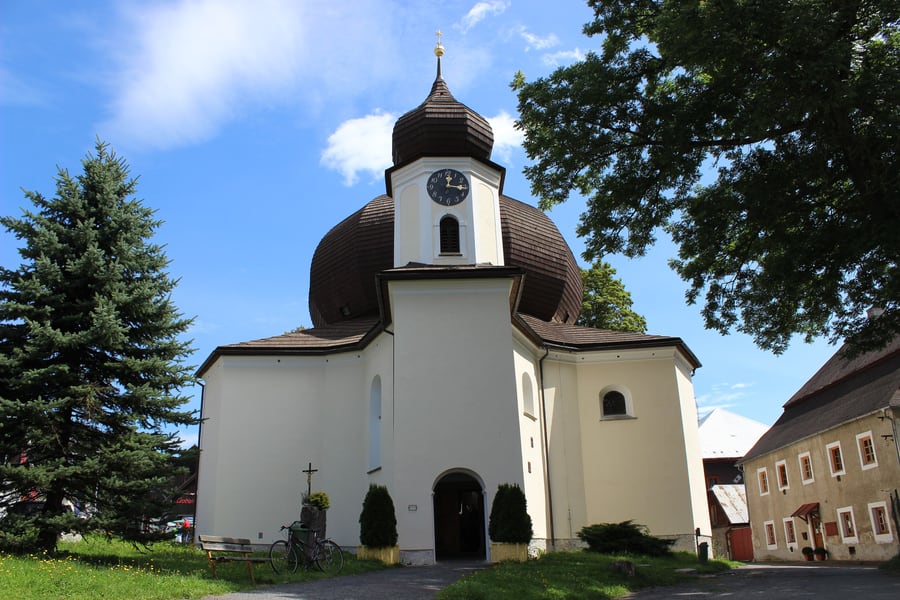
A glass-making and iron-working settlement that became a border resort, gathered round the Church of Our Lady of the Help — a small baroque building whose twin onion domes are the town's signature and are visible from most of it. The town has three stations on this line alone, so the walk from a train to the middle of it is a short one.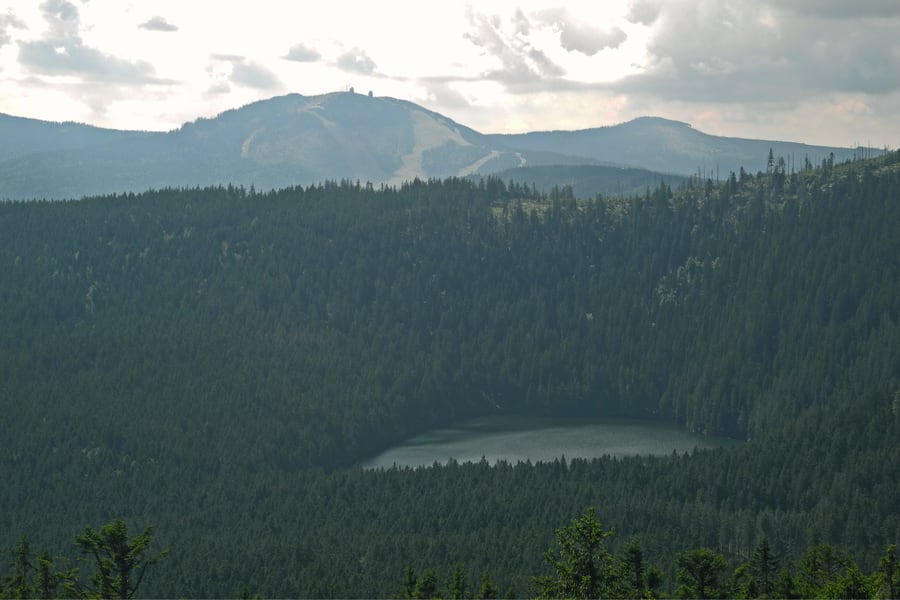 SchiDD / Wikimedia Commons · CC BY-SA 4.0 · cropped
The lakes under Špičák
The ridge the railway tunnels through carries two glacial lakes in cirques on its flanks, Černé jezero and Čertovo jezero — the Black Lake and the Devil's Lake — each sitting in a bowl of spruce below a steep headwall. They are a walk from Špičák station, and they are the reason the mountain is worth climbing rather than only passing under.Aisano / Wikimedia Commons · CC0 · croppedThe Localbahnmuseum
The Bavarian Localbahn Museum occupies the former engine shed just west of the platforms and shows more than twenty vehicles from the branch-line era. It is housed in the railway's own fabric rather than a modern hall, which is much of its appeal — the building is as much an exhibit as the stock inside it.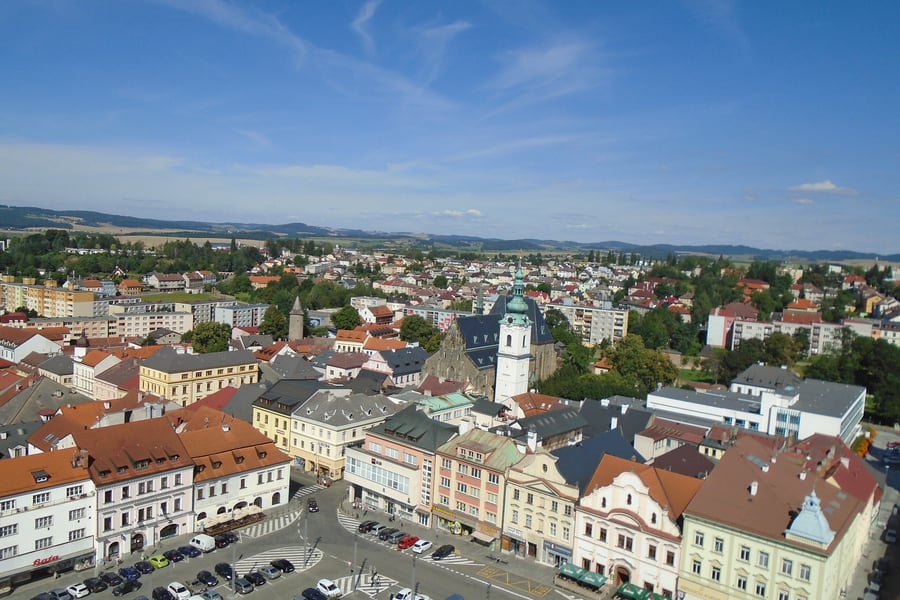 George Smrž / Wikimedia Commons · CC BY 3.0 · cropped
Klatovy
Halfway up the route, and the point where the electric wires end and the diesel section begins. Klatovy's long market square is one of the larger ones in Bohemia, ringed with arcaded houses and watched over by its tower. It makes the natural break in the journey for anyone not going straight through to the border.Where to Sleep
Železná Ruda is a working mountain resort rather than a place with a grand railway hotel, and the accommodation reflects that: family-run mountain houses and ski hotels, most of them geared to guests who arrive with skis in winter and boots in summer. Everything below is in or immediately above the town, within a few minutes of one of its three stations.
Two points worth knowing before booking. The town's season is genuinely two seasons — a winter one built around the Belvedere and Špičák slopes, and a summer one built around walking — so rates and opening patterns move with them, and the quiet weeks between the two are quiet indeed. And on the Bavarian side of the frontier, Bayerisch Eisenstein has its own small stock of guesthouses, which is worth remembering if the Czech town is full: they are a walk away, through the station.
⚠️ The cards below carry no prices, ratings or star counts. Each links to the hotel's own website, which is where the current rates live, and each description says only what that site itself states.
Where to stay
Hotel Belvedér
On the hill above the town
A three-storey mountain hotel standing on a meadow by the forest on the Belveder hill, about 900 metres from Železná Ruda and reached by a paved road. Its own site lists an outdoor heated saltwater pool, a salt cave, saunas and a brewery open daily, and says the hotel is open all year. One practical note from that page: it does not accept payment cards.
Check Availability (opens in a new tab, on hotelbelveder.cz)via hotelbelveder.czEngadin Hotel
Beside the Belvedere ski area
Directly by the Belvedere ski area, with 140 beds in 36 rooms, of which 28 have their own bathrooms. Sauna, restaurant and bar, two common rooms, a children's corner, and storage for skis and bicycles — the shape of a hotel that expects its guests to arrive carrying equipment.
Check Availability (opens in a new tab, on engadinhotel.cz)via engadinhotel.czMagnetit Hotel Šumava
On the town square
In the centre of Železná Ruda, on the square itself, with a wellness area, saunas and massages, and a restaurant cooking Šumava dishes. Seven room categories are listed. Its position is the point: a few minutes from the town's stations and from the paths that start at the edge of it.
Check Availability (opens in a new tab, on magnetithotel.cz)via magnetithotel.czQuestions or corrections
Planning this trip and stuck on something, or spotted a time, fare or detail that has changed? Send us a message about The Šumava Border Railway. We read every one, and we update this page when something has changed.