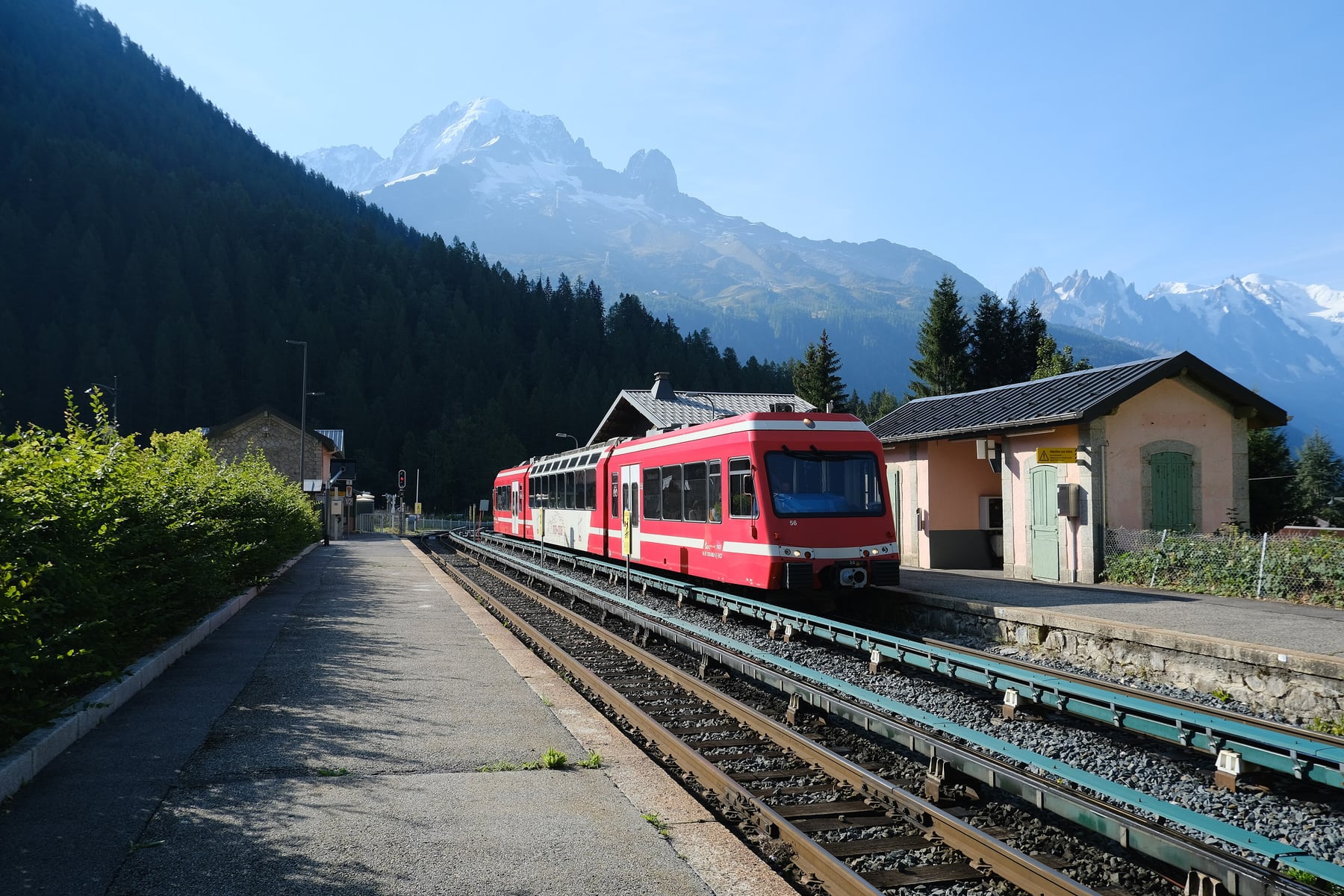
Mont-Blanc Express
Guilhem Vellut / Wikimedia Commons · CC BY 2.0 · 2021 · cropped
- Distance38 km
- Duration1 hr 31 min
- Best seasonEvery day of the year · hourly, with a change at Vallorcine
Introduction
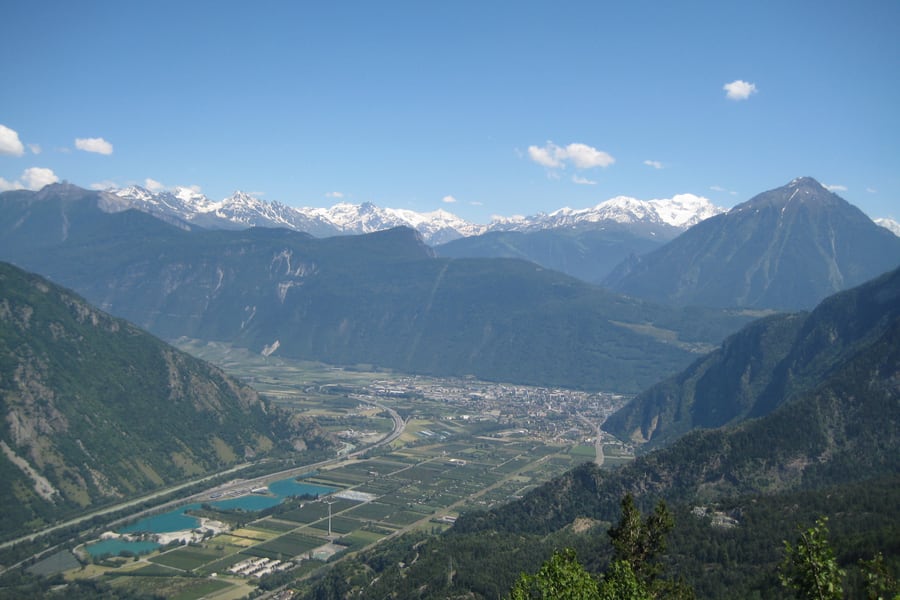
The last train up the Trient valley leaves Martigny at 23:22, and it does not run unless somebody asks for it. There is a form on the railway's own website: fill it in at least half an hour before departure and the train is made ready. On Friday and Saturday nights a second one follows at 00:16. Both of them climb and neither comes back down, because the point of them is not sightseeing. It is getting people home to Salvan, Les Marécottes, Le Trétien and Finhaut, the four villages on the shelf above the gorge that this line has served since 1906.
By day the same railway is the Mont-Blanc Express: thirty-eight kilometres of metre gauge from the orchards of the Rhône valley to Chamonix, eighteen kilometres of it in Switzerland and twenty in France, with a stream called the Eau Noire for a border. It leaves Martigny on the flat, bites into a rack at Vernayaz and climbs two hundred metres in every thousand, then runs for the best part of an hour along a ledge above the Trient, through avalanche galleries and tunnels driven by hand and explosive, to the last Swiss station at Le Châtelard-Frontière.
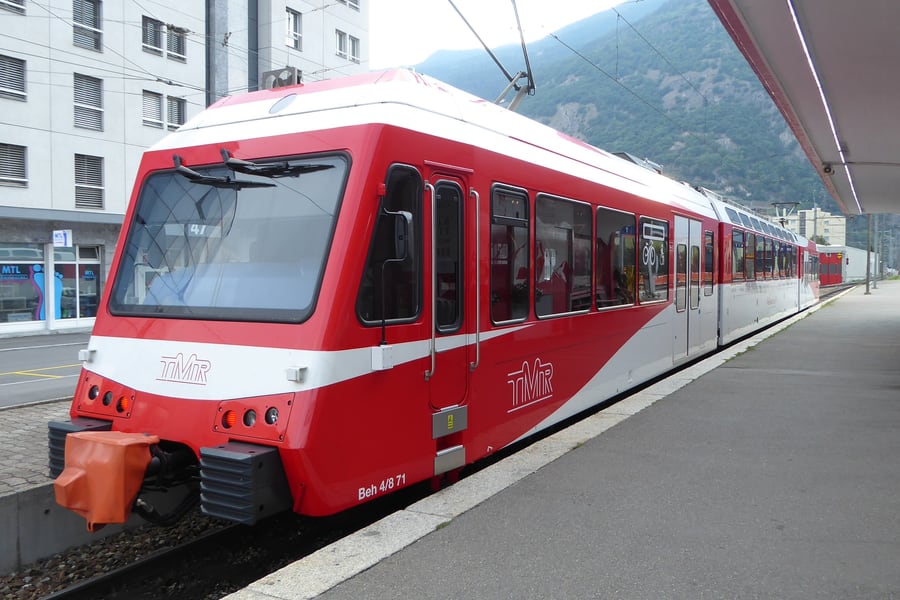
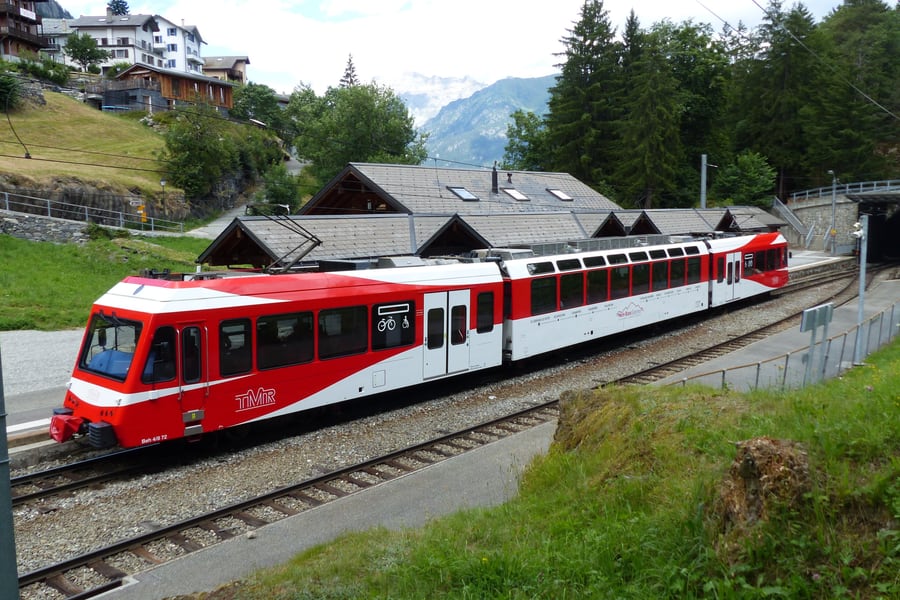
Two companies work it — TMR on the Swiss side, SNCF on the French — and the two halves were designed to fit one another so precisely that a hundred and twenty years later the Swiss track still carries the mark of a French decision. Thirteen through journeys run from Martigny each day and fourteen come back, seven days a week, and the ride takes an hour and a half.
The Journey
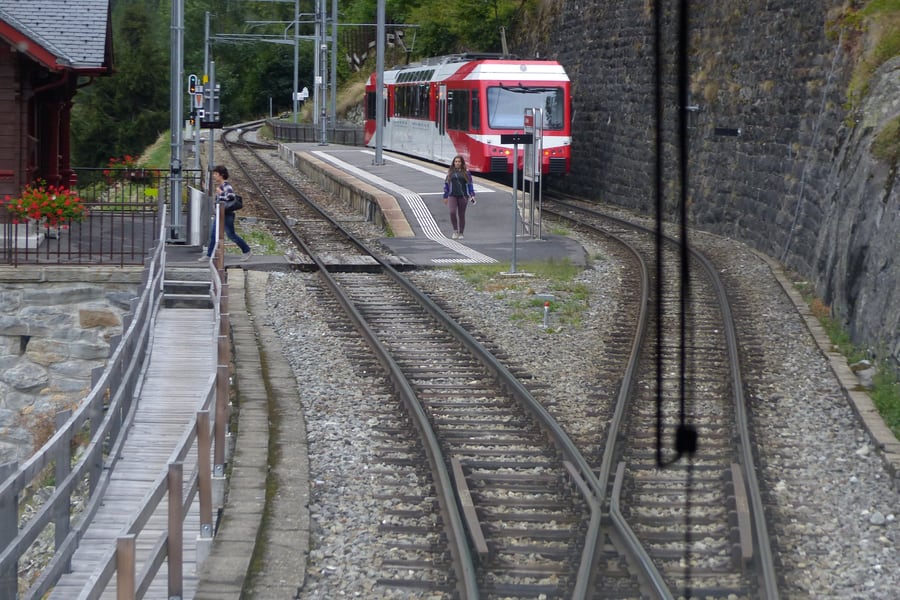
The Mont-Blanc Express starts from a platform, a shelter and two tracks at the side of Martigny's main-line station, where the Simplon expresses from Lausanne and Brig come and go on standard gauge a few metres away. For four kilometres nothing happens. The line runs west between the cantonal road and the main line, through the apricot orchards of the Rhône valley, calling at Les Fumeaux, and reaches Vernayaz at 457 metres on ground that is almost flat. Vernayaz is where the railway actually lives: twelve tracks, the workshops, and the control room from which one signaller has worked the whole line by computer since September 2008.
Immediately beyond the station the track passes under the road, crosses the Trient on an iron bowstring bridge, picks up current from a third rail laid beside the running rails — and starts to climb at two hundred millimetres in the metre.
The rack that clears a rail that is no longer there
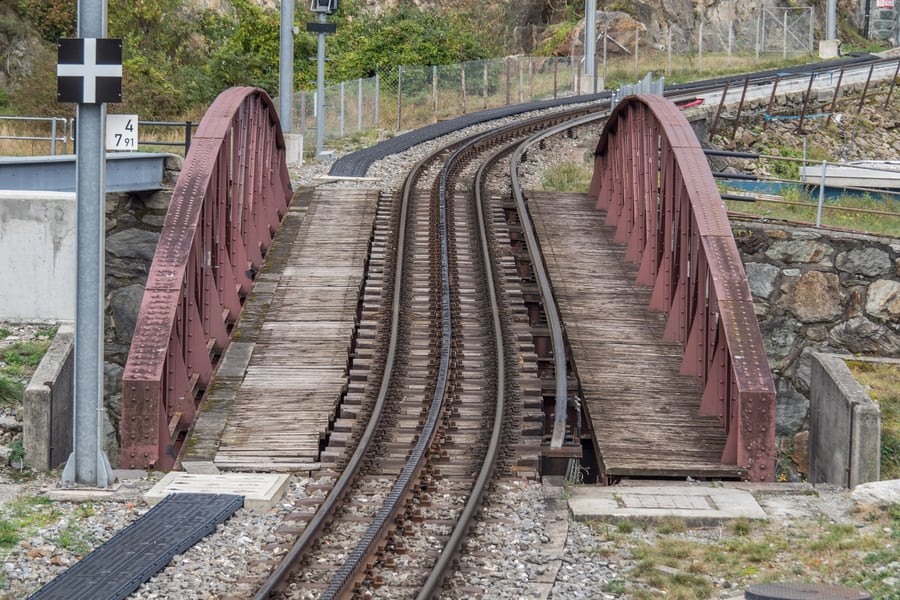
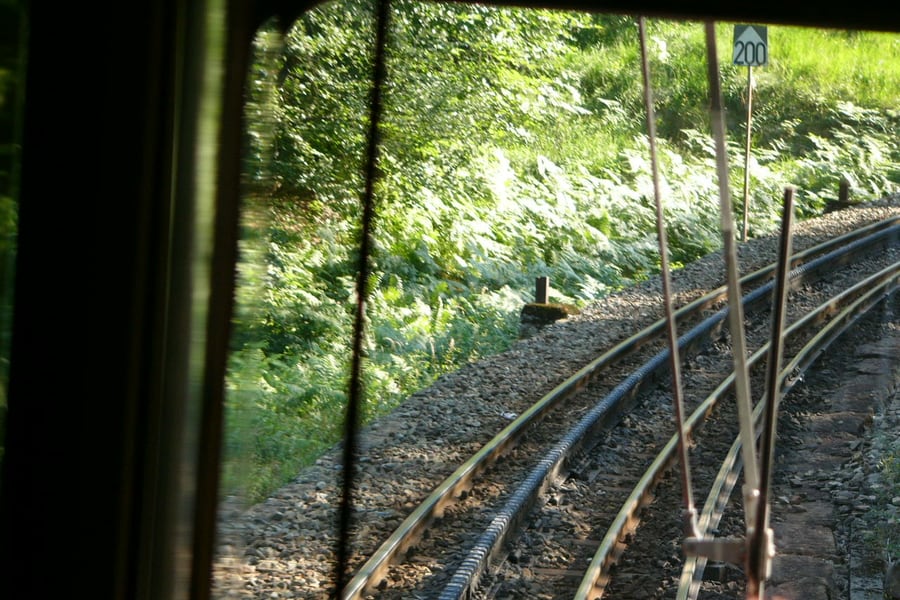
The rack section is about two and a half kilometres long, from just past Vernayaz to the woods below Salvan, and it is a Strub rack: a single toothed bar between the rails, named for the engineer Strub, who was one of the four concessionaires granted this railway on 20 December 1901. What is unusual about it is not the system but the height. The bar sits 138 millimetres above the top of the running rails, which is a good deal higher than a rack needs to be.
It is set that high because of France. When the line beyond the border was built, every stretch steeper than seventy millimetres in the metre carried a central rail that the trains gripped with brake jaws on the way down, and that rail stood 60 millimetres above the railhead. Swiss railcars were expected to run through onto French metals, so their cog wheels had to clear it — and the simplest way to guarantee that was to lift the Swiss rack out of its way. The French braking rail was taken up in the 1980s. The Swiss rack is still exactly where the French put it.
At Le Pontet the teeth run out, the noise stops, and the train arrives at Salvan at 934 metres having gained nearly five hundred metres since the bridge.
An hour on the ledge
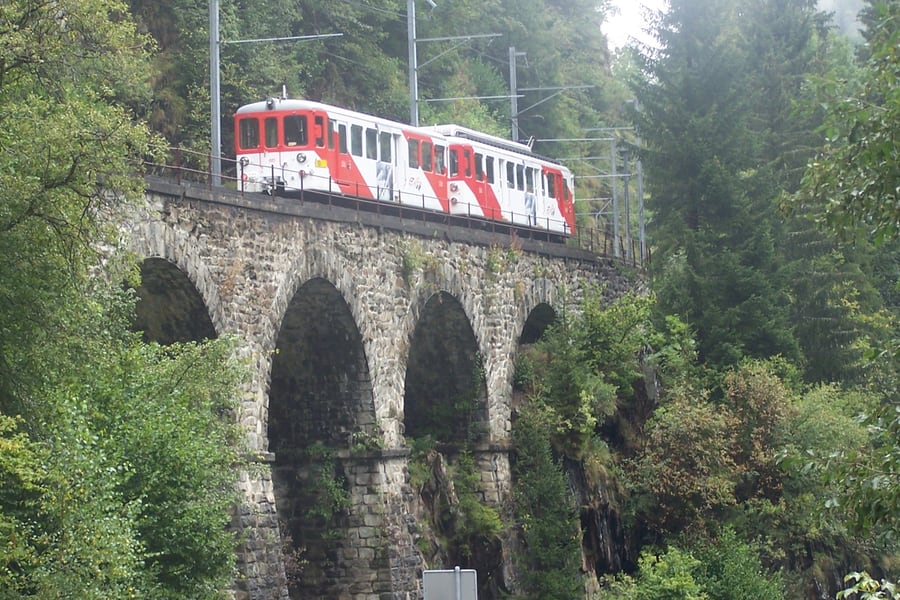
From Salvan the gradients ease to a mere seventy in the thousand and the line settles into what it does best. It calls at Les Marécottes and at the request stop of La Médettaz, crosses the Triège on a single masonry arch of 35.4 metres that stands 43 metres above the torrent, and reaches Le Trétien. Beyond it the railway is cut into the side of the valley for the rest of the Swiss half. There are twelve tunnels on this line, adding up to 1,945 metres, and the two biggest structures of their kinds come one after the other along here: the Lachat, longest tunnel on the railway at 580 metres, and the Lavancher, longest of its avalanche galleries at 589. The tunnels were driven by hand and explosive between 1902 and 1906.
There are also thirteen avalanche galleries, more than a kilometre of them in total. Only four were built with the line. The others date from 1936 to 1938, and they exist because of a decision about the calendar rather than about engineering: for its first twenty-five years the railway shut for the winter, and the galleries are what it took to keep it open once it stopped shutting.
Finhaut, at 1,224 metres, is the highest station on the Swiss side, and the summit of the Swiss half, at 1,228 metres, is close by. After it comes the Torrents viaduct, another 35.4-metre arch, thrown across an avalanche couloir on a gradient of seventy in the thousand and carrying almost no water at all.
The frontier at the Eau Noire
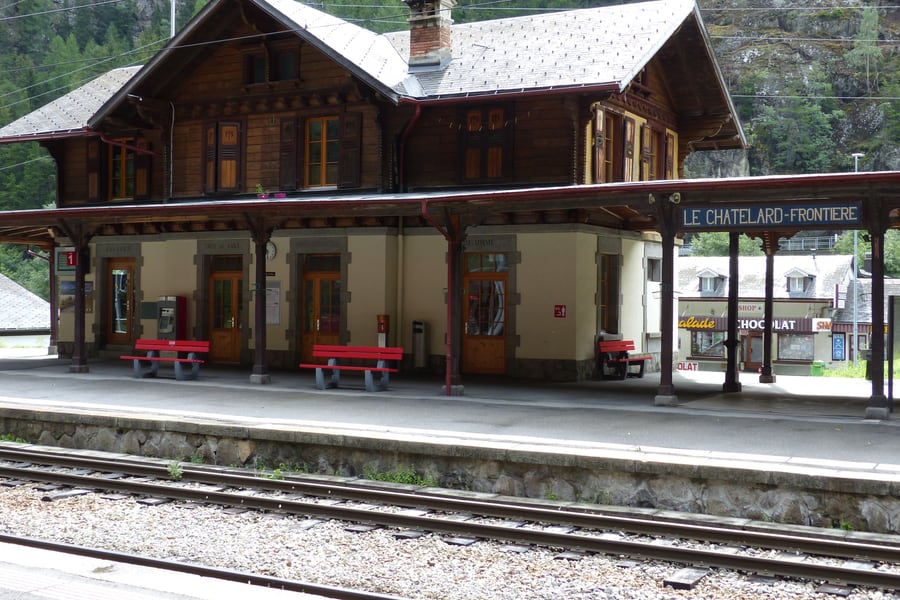
The train now descends. Le Châtelard VS has an SBB power station beside the tracks and, across the road, the bottom station of the funicular up to the Émosson dam. Then the six masonry arches of the Scierie viaduct, and Le Châtelard-Frontière at 1,116 metres, a chalet-fronted station with the name painted along the platform canopy and a customs post behind it.
The border itself is about three hundred metres further on: a single arch over the Eau Noire, a stream that gives no sign of being an international frontier. The Swiss company has been running trains across it since 1 July 1908, when it took over the working of the last three kilometres of the French line as far as Vallorcine and paid the French company a third of the takings for the privilege. Since the timetable change of 2008 the arrangement has grown: TMR crews and TMR railcars work the whole way to Vallorcine on SNCF's behalf.
The half with no rack
France answered the same mountain a different way. When the line from Le Fayet to Chamonix was designed in the 1890s it was to have four and a half kilometres of rack, and then in 1897 its engineers took the decision that shaped everything after it: build two hydroelectric stations of your own, power every axle of every train, and dispense with the rack entirely. The result is a railway that climbs ninety millimetres in the metre on plain adhesion for two thousand metres between Servoz and Les Houches, which is as steep as an unassisted railway anywhere is asked to climb.
The other thing the French half has is the Montets tunnel, 1,882 metres long, containing the highest point the Mont-Blanc Express reaches at 1,386 metres. It was appalling to build. In May 1907 water was coming in at 40,500 litres a minute; the contractor went bankrupt; nearly eight thousand tonnes of cement were injected to seal it, most of which simply washed away; eight men were killed. It was holed through at the end of October 1907.
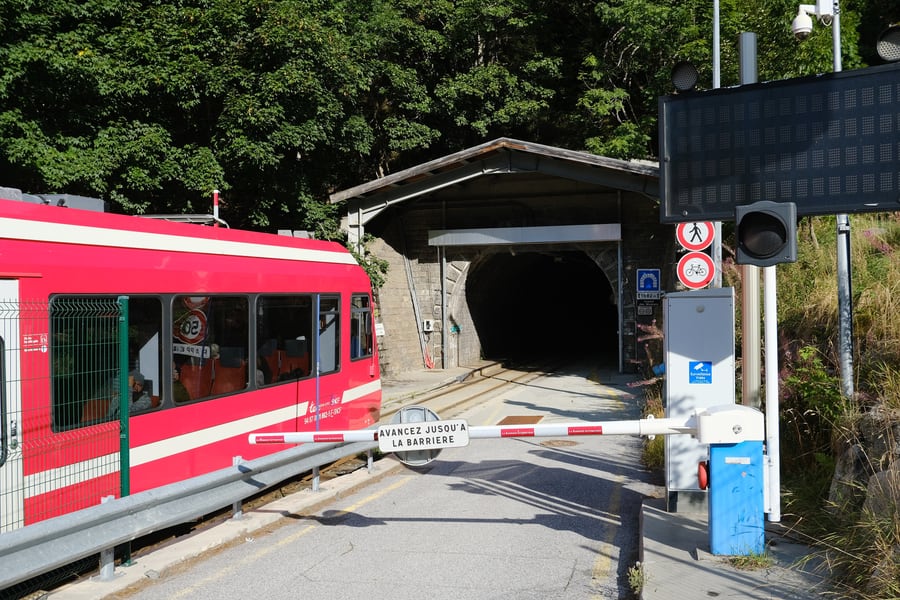
From the beginning it had a footway alongside the track, so that Vallorcine would not be sealed off whenever the pass above was impassable. In 1984 that footway was turned into a carriageway two and a half metres wide, and cars began using the tunnel in alternation with trains whenever the col des Montets road closed. The rebuilding of 2012 to 2014 widened it to nearly four metres and set the rails flush into the surface, tramway fashion. Traffic lights and a barrier stand at the portal.
Changing at Vallorcine
Between 1988 and 1994 the Swiss and French companies designed a train together for exactly this line — the Z800, rack-fitted, third-rail and overhead, five sets shared between them, in service from 1997 and able to run from Le Fayet to Martigny without anyone leaving their seat. Today the timetable does not use them that way: every through journey changes at Vallorcine, with five minutes to walk across the platform, and the Swiss train goes back the way it came.
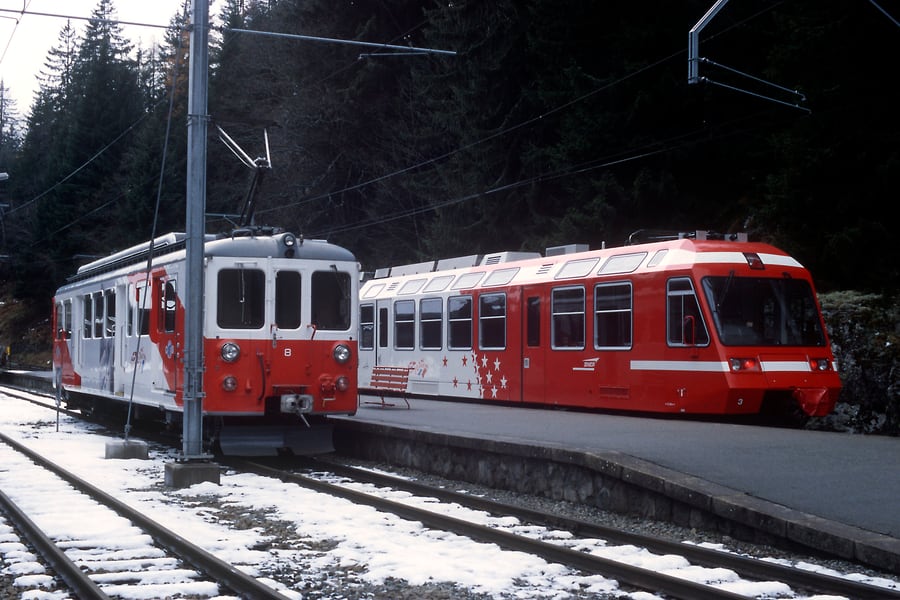
Newer stock is arriving. TMR and SNCF ordered seven Stadler Beh 4/8 units together, 230 seats apiece; the first was delivered in April 2025, and on 2 July 2026 the operator announced that three of them — named Le Rhône, Le Trient and Le Triège, after the three rivers the line crosses or follows — had entered service on the Swiss section from 22 June. Four more are due on the French side in September.
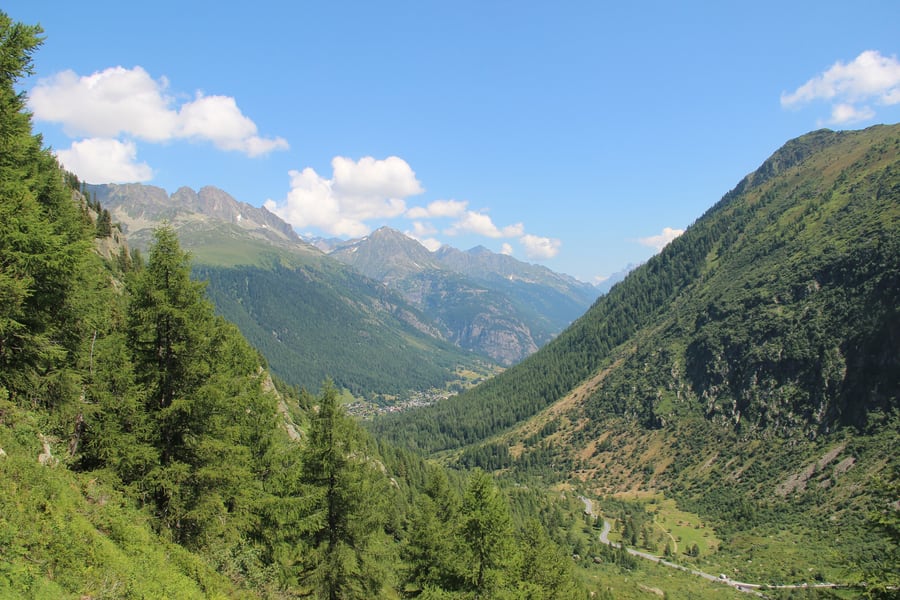
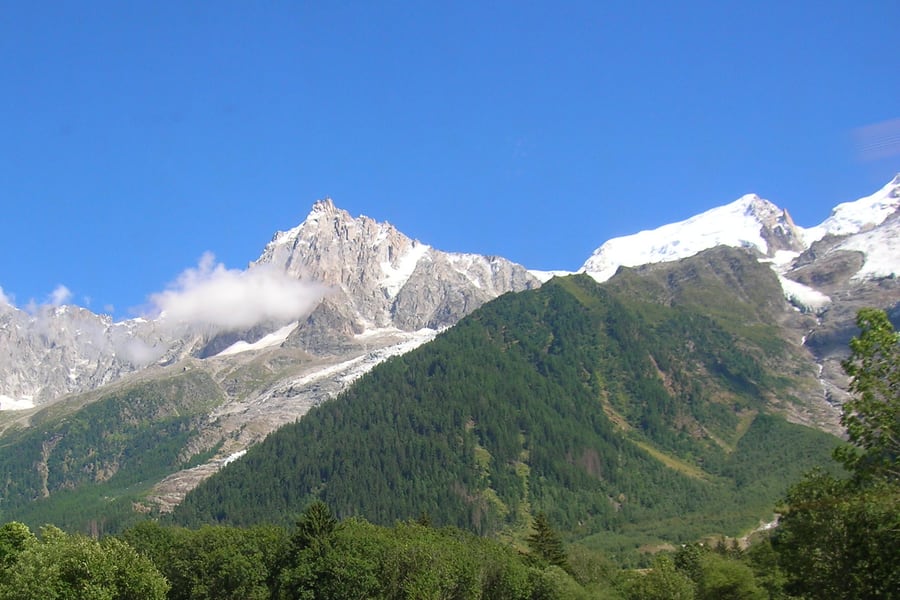
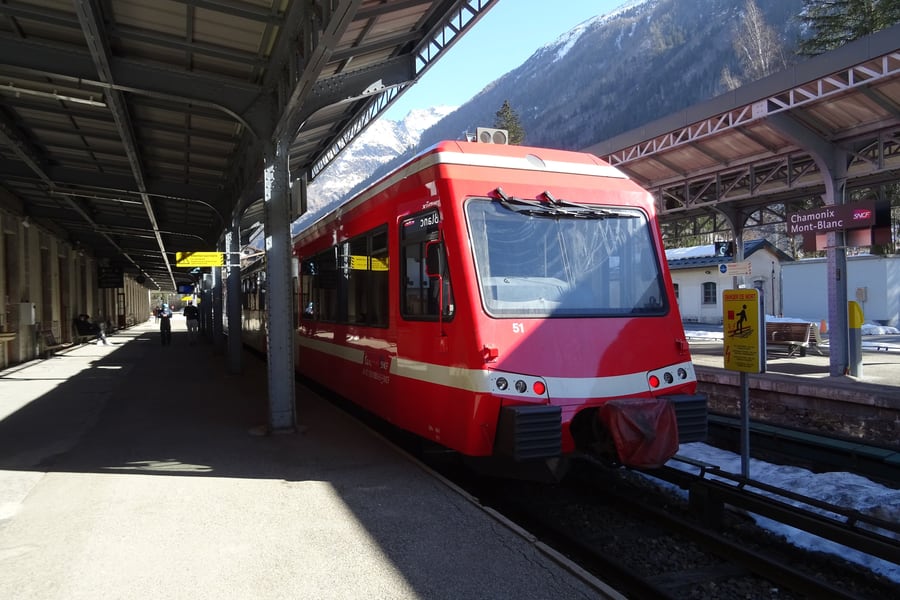
Whatever is standing at Vallorcine, the last half-hour is the one people come for. The train climbs past Le Buet to Montroc, runs through the Montets tunnel, and comes out onto the Arve with the Aiguilles Rouges on one side and the Mont Blanc massif on the other. It calls at Argentière, at Les Tines and at Les Praz, and finishes on three platform tracks at Chamonix, with a footbridge at the end of them to the rack railway that goes up to the Mer de Glace.
Along the route
 Claude Shoshany / Wikimedia Commons · CC BY-SA 3.0 · 2005 · cropped
The rack that clears a rail that is no longer there
The toothed bar out of Vernayaz sits 138 millimetres above the railhead, higher than a Strub rack needs to be, because French metals once carried a central braking rail that Swiss railcars had to clear. The French rail was lifted in the 1980s. The Swiss rack has not moved.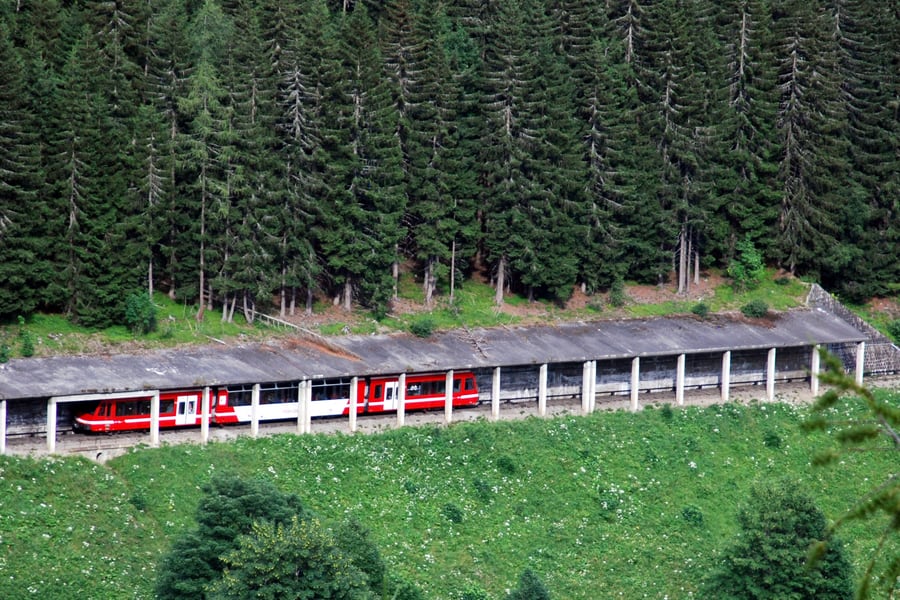 Christophe Jacquet / Wikimedia Commons · CC BY-SA 3.0 · cropped
Thirteen galleries, built by a change of timetable
For its first twenty-five years the Swiss half closed for the winter. What reopened it was concrete: nine of the thirteen avalanche galleries date from 1936 to 1938, when the line first ran the year round. More than a kilometre of the route is roofed.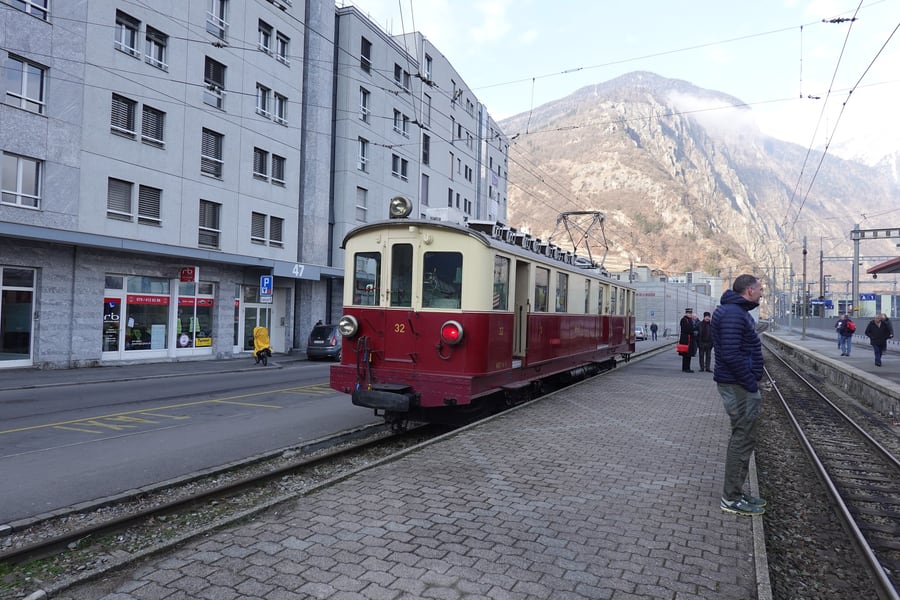 Smiley.toerist / Wikimedia Commons · CC BY-SA 4.0 · 2023 · cropped
The railcars the volunteers keep
The Train Nostalgique du Trient at Salvan has spent thirty years saving the line's historic stock, including a railcar of 1906. ⚠️ The association says running heritage trains is not possible at the moment, so they are a thing to look out for rather than to book.A bit of history
Culture & experiences along the way
 Markus Giger / Wikimedia Commons · CC BY-SA 4.0 · 2019 · cropped
Three more railways above Le Châtelard
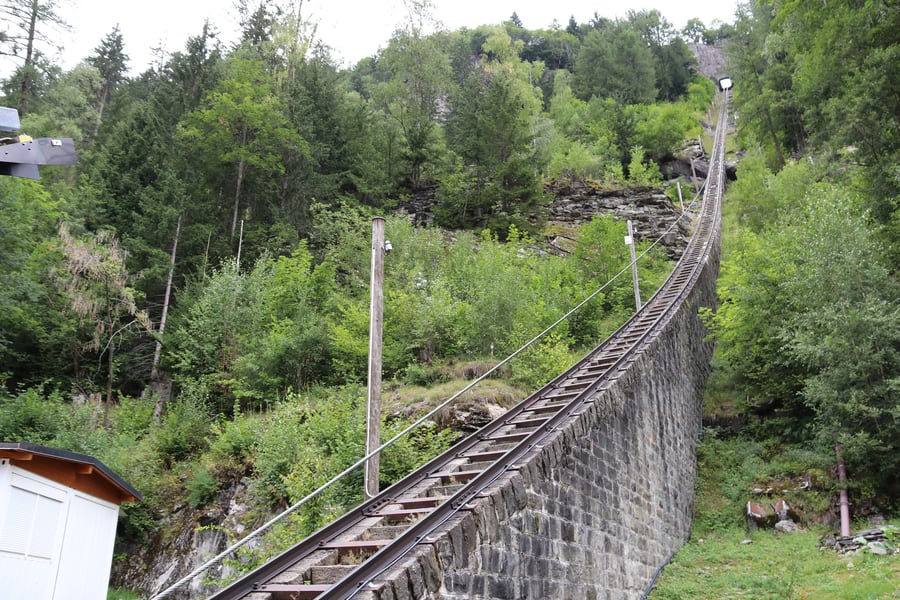
Get off at Le Châtelard VS and the climbing carries on without you doing any of it. The VerticAlp Emosson is three linked railways — a funicular up the mountainside, a small panoramic train along a ledge, and a minifunicular — that between them reach the Émosson dam. The operator sells a combined ticket with the Mont-Blanc Express from any station on the line, and the SBB's museum of the Châtelard-Barberine hydroelectric scheme is in the power station at the bottom, free and by appointment.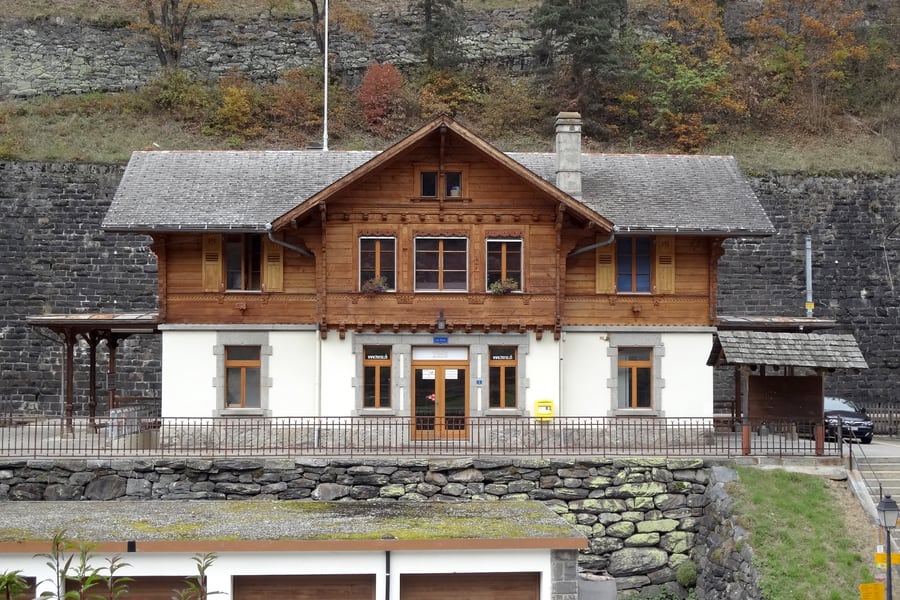 MHM55 / Wikimedia Commons · CC BY-SA 4.0 · 2015 · cropped
The chalet stations
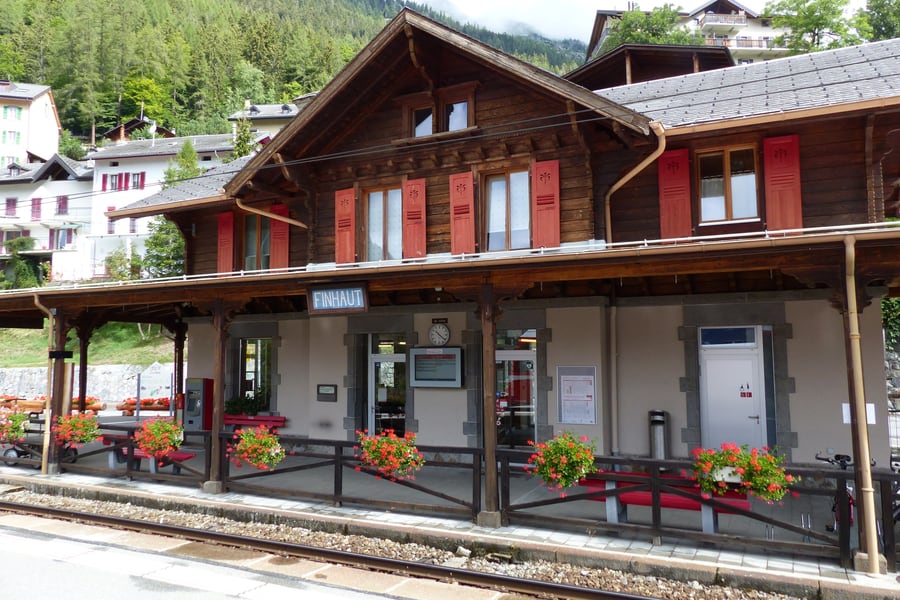
TMR runs two lines out of Martigny. The stations on the one to Orsières are plain masonry; the ones on this line are timber chalets with balconies and shutters, and they are the reason the railway photographs as well as it does. Finhaut is putting on an exhibition about exactly this — why the two lines were built to look so different — at the Galerie Victoria from 27 June to 13 September 2026, daily from two until six. Poudou99 / Wikimedia Commons · CC BY 3.0 · 2006 · cropped
The night train you have to ask for
Two departures from Martigny, 23:22 every night and 00:16 on Friday and Saturday nights, are marked in the timetable as running only on reservation. The form is on the operator's website, it takes no payment, and it has to be in at least thirty minutes before departure — 23:00 for the first, midnight for the second. They run uphill only, as far as Le Châtelard-Frontière, which tells you who they are for.Timetables
The Mont-Blanc Express runs every day of the year, on one timetable valid from 14 December 2025 to 12 December 2026. It is a clockface service: after the first train of the morning, departures from Martigny are at xx:14 and departures from Chamonix at xx:28, hour after hour until the evening.
Every through journey involves a change of train at Vallorcine, the first station inside France, where the two halves meet. The Swiss half is worked by TMR as train R 85, Martigny to Vallorcine; the French half by SNCF as TER P52, Vallorcine to Chamonix and on to Saint-Gervais-les-Bains-Le Fayet. The connection is five minutes and the two trains use the same platform face.
The pattern below was queried against the Swiss national timetable database in August 2026 for a Thursday, a Saturday and a Sunday in September 2026, and corroborated against the operator's own printed table (route 132). All three days returned the same service.
Martigny to Chamonix
Thirteen through journeys: 06:56, then 08:14 and hourly at xx:14 until 19:14. The whole run takes 1 hour 31 minutes — the 06:56 is the exception, because it waits twenty-one minutes at Vallorcine for the first French train of the day. There is no departure at 07:14.
| Station | 09:14 departure |
|---|---|
| Martigny | 09:14 |
| Les Fumeaux | 09:15 |
| Vernayaz MC | 09:19 |
| Salvan | 09:29 |
| Les Marécottes | 09:34 |
| La Médettaz | 09:35 |
| Le Trétien | 09:39 |
| Finhaut | 09:48 |
| Le Châtelard VS | 09:53 |
| Le Châtelard-Frontière | 09:59 |
| Vallorcine — change | 10:05 / 10:10 |
| Le Buet | 10:14 |
| Montroc-le-Planet | 10:21 |
| Argentière | 10:27 |
| La Joux | 10:32 |
| Les Tines | 10:37 |
| Les Praz-de-Chamonix | 10:40 |
| Chamonix-Mont-Blanc | 10:45 |
Chamonix to Martigny
Fourteen through journeys: hourly at xx:28 from 07:28 to 20:28. Westbound the run takes 1 hour 41 minutes, ten minutes longer than eastbound, because a rack descent is worked more slowly than a rack climb: Salvan to Vernayaz takes fourteen minutes down and ten minutes up.
| Station | 10:28 departure |
|---|---|
| Chamonix-Mont-Blanc | 10:28 |
| Les Praz-de-Chamonix | 10:32 |
| Les Tines | 10:37 |
| La Joux | 10:40 |
| Argentière | 10:46 |
| Montroc-le-Planet | 10:52 |
| Le Buet | 10:57 |
| Vallorcine — change | 11:01 / 11:13 |
| Le Châtelard-Frontière | 11:19 |
| Le Châtelard VS | 11:21 |
| Finhaut | 11:30 |
| Le Trétien | 11:39 |
| La Médettaz | 11:42 |
| Les Marécottes | 11:44 |
| Salvan | 11:48 |
| Vernayaz MC | 12:02 |
| Les Fumeaux | 12:05 |
| Martigny | 12:09 |
The night trains, which run only if you ask
Two late departures from Martigny — 23:22 every night, and 00:16 on Friday and Saturday nights — are marked in the operator's timetable circule uniquement sur réservation, and they behave accordingly. They run uphill only, as far as Le Châtelard-Frontière, and they run only if somebody has booked. The booking form is on the operator's website; it must be sent at least thirty minutes before departure and no earlier than thirty days ahead, and the cut-off is 23:00 for the 23:22 and midnight for the 00:16. ⚠️ The operator is not quite consistent with itself about that second one: the national timetable database and the booking form's own dropdown both say 00:16, while the prose on two of the operator's pages says 00:17. Book it and be on the platform for 00:15. The 22:22 from Martigny, which reaches Le Châtelard-Frontière at 23:05 every night of the week, is an ordinary train and needs no reservation.
Engineering work on the French half in autumn 2026
Between 28 September and 6 November 2026 the timetable database returns a replacement bus rather than a train for the Vallorcine–Chamonix leg, at 09:12 rather than 09:10 and calling at Les Iles Grassonet instead of Montroc-le-Planet and La Joux. Trains are shown running again from 7 November. The Swiss half is unaffected throughout. ⚠️ The French timetable data available through the Swiss database stops after 8 November 2026 — a date horizon on the SNCF side, not a closure — so anything later than that is worth checking with the operator before travelling.
Connections at each end
Martigny is on the SBB Simplon main line, with hourly trains to Lausanne and Geneva one way and Sion, Brig and the Lötschberg the other, and it is also the terminus of TMR's second line, the Saint-Bernard Express to Orsières and Le Châble. Chamonix has the Montenvers rack railway to the Mer de Glace, reached by a footbridge from the platform ends, and the Aiguille du Midi and Brévent cable cars. Staying on the TER past Chamonix brings you to Saint-Gervais-les-Bains-Le Fayet in another 45 minutes, where the Tramway du Mont-Blanc climbs towards the Nid d'Aigle and the standard-gauge network begins.
Timetable: Transports de Martigny et Régions route 132 and the Swiss national timetable database, checked August 2026.
Tickets
Two companies, two currencies and two national fare systems meet on this line, and the tidiest way through them is the operator's own Day Pass Martigny–Chamonix: CHF 40 for an adult, CHF 25 for children 6 to 16 and Swiss Half Fare Card holders, valid in both directions for a day. It is easiest to buy in Switzerland, from any Mont-Blanc Express machine or the TMR Voyages counter at Martigny. For a shorter hop — Salvan for the gorge walk, or Finhaut — an ordinary return costs less.
Anyone staying a night in the Chamonix valley is entitled to the carte d'hôte, handed over free on arrival, and it carries free travel between Servoz and Vallorcine. The two night trains, at 23:22 and 00:16 from Martigny, run only if somebody has booked through a form on the operator's site at least thirty minutes ahead — a request to run the train rather than a ticket. Fares checked August 2026.
Book your tickets
Day Pass Martigny–Chamonix
CHF 40 adult · CHF 25 children 6–16 and Half Fare Card holders
The whole line in both directions for a day, across both countries and both operators.
Book Tickets (opens in a new tab, on mont-blanc-express.ch)via mont-blanc-express.chMont-Blanc Express and VerticAlp Emosson
CHF 58 from Martigny · CHF 23 with a Swiss Travel Pass
A return to Le Châtelard-Village plus all three VerticAlp railways up to the dam.
Book Tickets (opens in a new tab, on mont-blanc-express.ch)via mont-blanc-express.chChamonix guest card
Free with a night's stay in the valley
The carte d'hôte carries free travel between Servoz and Vallorcine — the whole French half.
Book Tickets (opens in a new tab, on chamonix.com)via chamonix.comRail Passes
A rail pass is unusually easy to reason about on this line, because the operator publishes the answer itself, and the answer follows the frontier exactly.
On the Swiss half, Martigny to Le Châtelard-Frontière, the operator accepts the GA travelcard, the Half Fare Card, the Swiss Travel Pass and the SBB Day Travel Card. It is treated as an ordinary piece of the Swiss network rather than as a mountain railway with a house tariff, so those passes cover it outright, rack section and all.
On the French half, Chamonix to Le Châtelard-Frontière, none of those is worth anything. What works there is the Chamonix guest card, the carte d'hôte, which anyone staying a night in the valley receives from their accommodation and which carries free travel between Servoz and Vallorcine.
For the whole journey, Martigny to Chamonix, the operator's list is short: its own Day Pass Mont-Blanc Express, Interrail, Eurail, or a rail pass covering both countries.
The pass trap at the border
⛔ An Interrail or Eurail One Country Pass is no use here. Interrail's own conditions are explicit: a One Country Pass cannot be used to travel to or from the country it covers, and it is valid only with the participating operators inside that country. A Switzerland pass will therefore take you as far as Le Châtelard-Frontière and stop; a France pass will bring you up to Vallorcine and stop. To ride the line end to end on an Interrail or Eurail pass you need a Global Pass, which covers both sides.
⭐ If you are travelling as far as Chamonix and staying there, the cheapest combination is often a Swiss pass or a Swiss ticket to the frontier and then the guest card from your hotel — which costs nothing — rather than a product that tries to cover both halves at once.
Reservations
There is no compulsory seat reservation for individual travellers and no panorama supplement in either country — a pass or a ticket is enough on any daytime train. The operator's timetable asks only that groups of eight or more book in advance, on +41 27 721 68 40, and notes that capacity for groups is limited. The other booking on the whole line is the free request form for the two night departures from Martigny.
Pass validity from Transports de Martigny et Régions, the Chamonix-Mont-Blanc tourist office and Interrail's published pass conditions, checked August 2026.
Places to Visit
An hour and a half is short enough to ride in one go and short enough to break wherever you like, and the hourly clockface timetable makes that painless: get off, and the next train is sixty minutes behind. The day pass allows as many stops as you can fit into a day.
The seven places below run west to east, in the order a train from Martigny reaches them. Five are in Switzerland and two in France, and the change at the border is not subtle — the Swiss half is a gorge with villages perched on shelves above it, and the French half opens into the Chamonix valley with the Mont Blanc massif standing over the whole of it.
 Christian David / Wikimedia Commons · CC BY-SA 4.0 · 2022 · cropped
Martigny
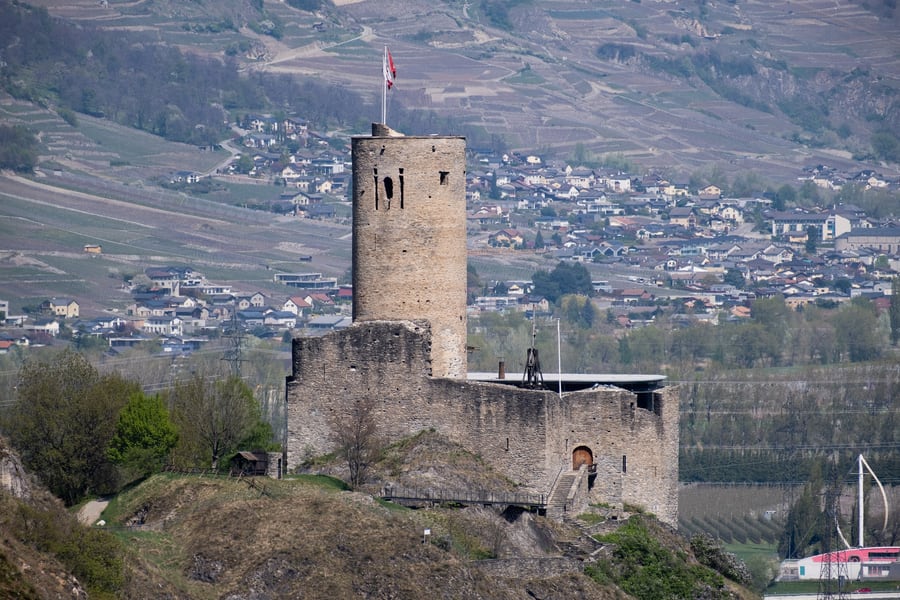
A Roman town at the elbow of the Rhône, where the road over the Great St Bernard comes down out of Italy, and still a junction: two narrow-gauge railways, the Simplon main line and an international bus to Aosta all start here. The tower of the Château de la Bâtiaz stands on a rock above the vineyards; the Fondation Pierre Gianadda shows art around a Roman temple it was built over; and the Barryland museum keeps the St Bernard dogs of the hospice.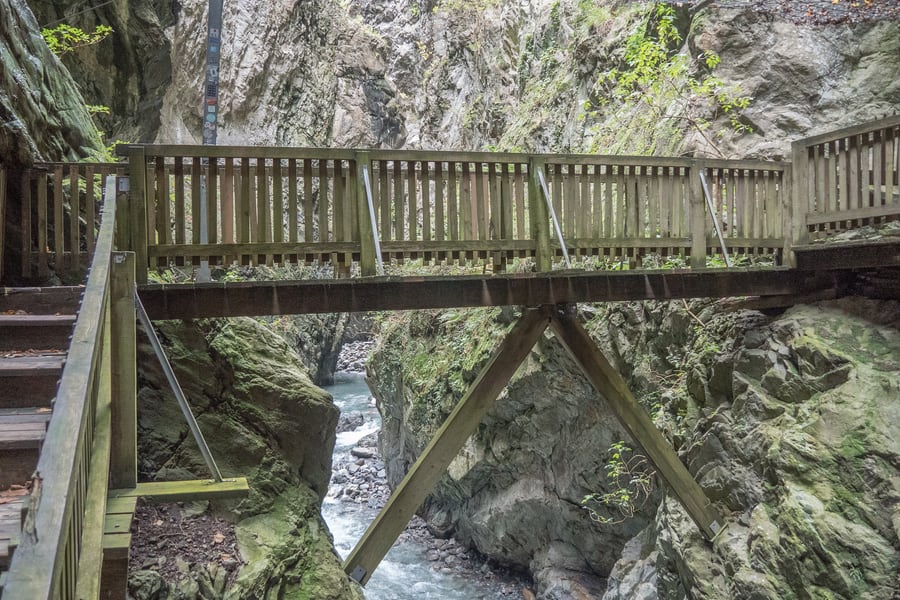 Jag9889 / Wikimedia Commons · CC BY-SA 4.0 · 2024 · cropped
Vernayaz and the Trient gorge
The gorge entrance is a few minutes' walk from the station the train has just called at. Wooden walkways bolted to the rock run six hundred metres into a fault several hundred metres deep, with the glacier torrent below and daylight a long way up; it takes about twenty-five minutes each way, costs CHF 8, and the site closes in heavy rain. The 2026 season opened on 13 May. Above it, the road to Salvan crosses the same gorge on the two Gueuroz bridges, two hundred metres up.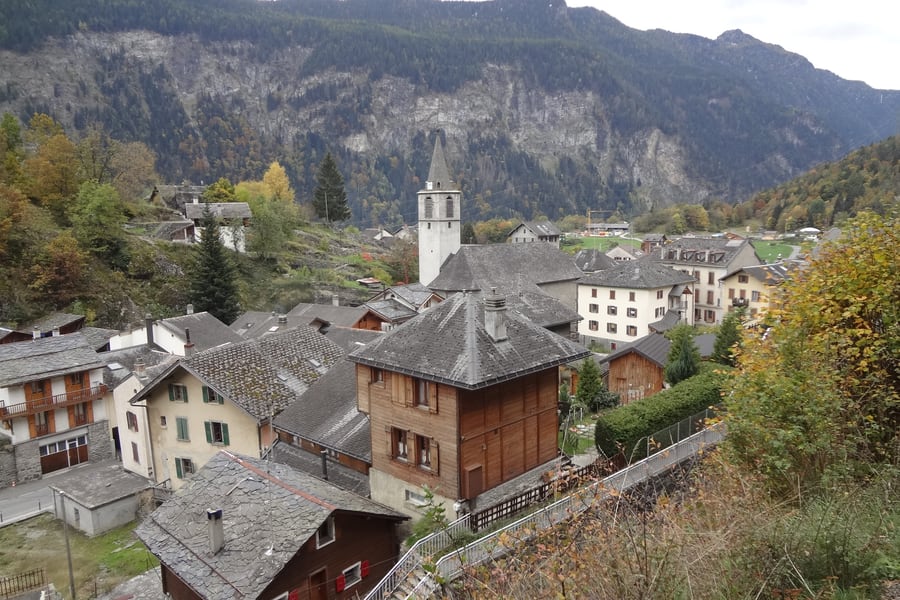 MHM55 / Wikimedia Commons · CC BY-SA 4.0 · 2015 · cropped
Salvan
The first village above the climb, and the one where Guglielmo Marconi spent the summer of 1895 pushing his wireless experiments out from a few metres to a mile and a half across the plain of the Écoteaux. The Fondation Marconi in the village is a museum of radio built around that summer. The Dailley gorge, a rougher and steeper walk than the one at Vernayaz, starts just below at Les Granges.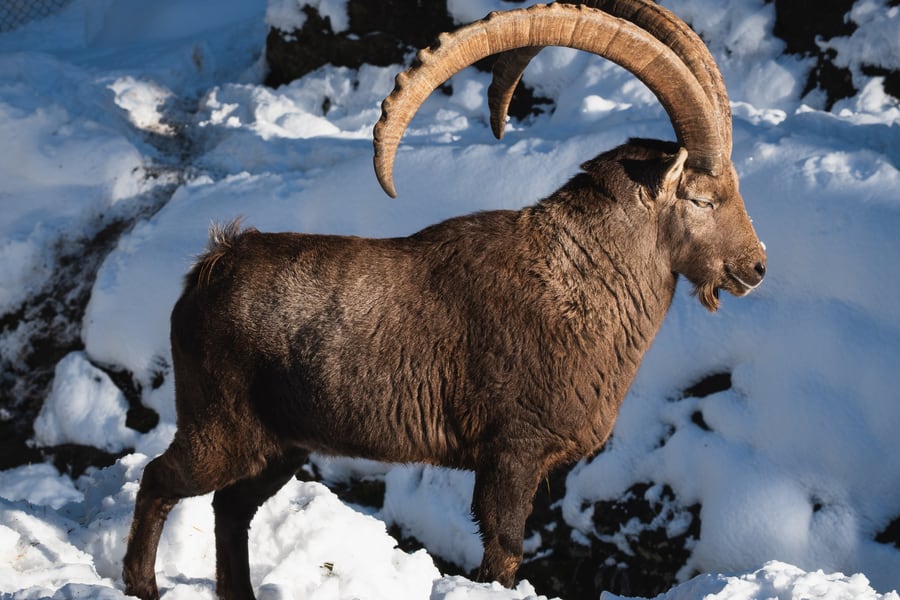 Christian David / Wikimedia Commons · CC BY-SA 4.0 · cropped
Les Marécottes
A chalet village on the shelf with the best-known stop on the Swiss half: an alpine zoo whose enclosures are cut into the forest and the boulder field, holding the animals of these mountains — ibex, chamois, lynx, wolves, bears — and, beside it, a swimming pool blasted out of the granite. Both are a few minutes' walk from the platform. A gondola climbs from the village to La Creusaz for the view down the Rhône valley.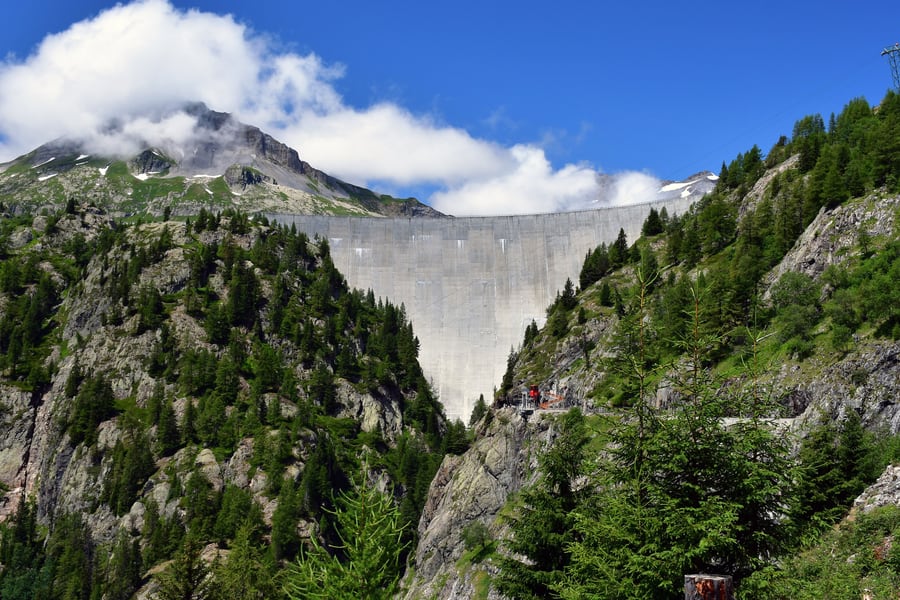 Gzzz / Wikimedia Commons · CC BY-SA 4.0 · cropped
Finhaut and the Émosson dam
Finhaut is a long thin village of hotels built for a nineteenth-century clientele that walked up from the valley. Two stops further on at Le Châtelard the mountain has been rearranged: the Barberine dam went up between 1923 and 1928 with the railway carrying the cement, the far larger Émosson dam drowned it in the 1970s, and the two lakes are now plumbed into the Nant de Drance pumped-storage station inside the mountain.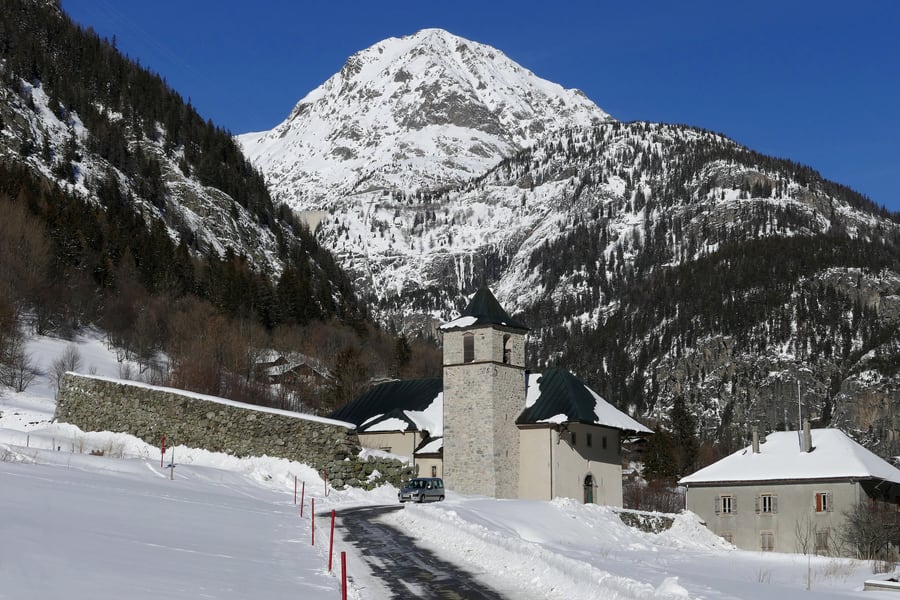 Siren-Com / Wikimedia Commons · CC BY-SA 4.0 · 2021 · cropped
Vallorcine
A scattered commune in a high side valley, shut off from Chamonix by the col des Montets whenever the snow wins, which is why the railway tunnel under the col has a road inside it. The church of Notre-Dame-de-l'Assomption dates from 1687. Above the hamlet of Le Buet the Bérard valley is a nature reserve, and the walk up it to the Bérard waterfall starts a few steps from Le Buet station.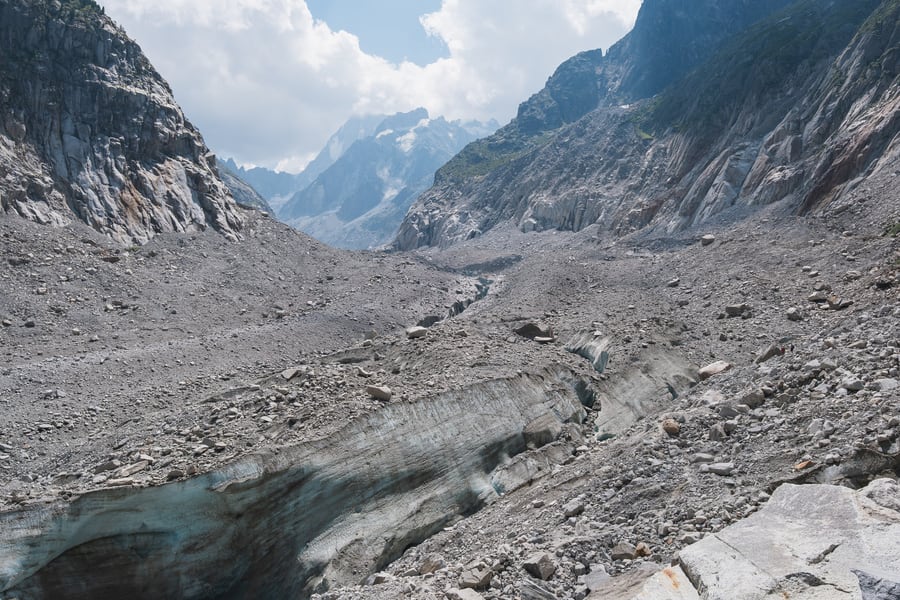 Christian David / Wikimedia Commons · CC BY-SA 4.0 · cropped
Chamonix-Mont-Blanc
The town that invented alpinism, and still the busiest mountain resort in the Alps. From the station a footbridge leads straight to the Montenvers rack railway, which has been climbing to the Mer de Glace since 1908 — the glacier has retreated a long way down since then, and the staircase to the ice cave gets longer every few years, which is its own kind of exhibit. The Aiguille du Midi cable car goes to 3,842 metres from the other end of town.Where to Sleep
Ninety minutes each way makes this a comfortable day out from Martigny or from Chamonix, but the valley in between is worth a night, and staying on the French side has a practical advantage: the guest card your accommodation hands you covers the train from Servoz to Vallorcine for nothing.
The four houses below stand at the Swiss end, at two points along the line and at the French end. Every one of them is within a few minutes of a platform, and one of them is named after the station it sits beside.
Prices and star ratings are not listed here because we have not checked them. What is described is what each house says about itself and what can be verified about where it stands.
Where to stay
Hôtel Alpes & Rhône
In the centre of Martigny, at the Swiss end of the line
A family hotel on the Avenue du Grand-St-Bernard, run by the Kuonen family in the third generation and putting up around nine thousand guests a year. There are economy, standard, comfort and family rooms and a junior suite with a balcony, a restaurant and bistro, a lift, free garage parking, a heated ski room and a night porter — and Martigny station, where the Mont-Blanc Express starts, is a few minutes away on foot.
Check Availability (opens in a new tab, on hotel-martigny.com)via hotel-martigny.comChalet-Hôtel Aux Mille Étoiles
On the Place de la Télécabine, Les Marécottes
A chalet hotel kept by Ingrid and Hansruedi Berner on the square at the foot of the gondola in Les Marécottes, a few minutes from the station the Mont-Blanc Express calls at and from the alpine zoo. It has its own restaurant, rooms of several grades, and rooms for seminars and meetings; the house books direct and says its own website carries its best rates.
Check Availability (opens in a new tab, on mille-etoiles.ch)via mille-etoiles.chHôtel du Buet
Beside Le Buet station, Vallorcine
Twenty-three rooms and fifty-five beds in the hands of the Chamel family for more than a hundred and thirty years, immediately beside Le Buet station on the French half of the line. It is the starting point for the climb of the Buet and for the walk up the Bérard valley, it has the Restaurant de la Poya attached, and a night here comes with the Chamonix guest card, which makes the train free from Servoz to Vallorcine.
Check Availability (opens in a new tab, on hotelbuet.com)via hotelbuet.comHôtel Le Chamonix
In the middle of Chamonix, fifty metres from the tourist office
A small hotel on the rue de l'Hôtel de Ville in the centre of Chamonix, with most rooms facing Mont Blanc, a breakfast and sitting room, and the shops, restaurants and bus stops of the town immediately outside. ⚠️ There are no accessible rooms. The station at the far end of the main street is a walk of a few minutes.
Check Availability (opens in a new tab, on hotel-le-chamonix.com)via hotel-le-chamonix.comQuestions or corrections
Planning this trip and stuck on something, or spotted a time, fare or detail that has changed? Send us a message about Mont-Blanc Express. We read every one, and we update this page when something has changed.