The Moselle Line
Kora27 / Wikimedia Commons · CC BY-SA 4.0
- Distance112 km (Koblenz–Trier)
- Duration1 h 24 by RE 1 · 1 h 55 by RB 81
- Best seasonYear-round · the terraces turn in October
Introduction
Most of the great railway journeys on this site are special trains. This one is a commuter service with a wine list outside the window.
The Moselle line — the Moselstrecke, timetable number 690 — runs 112 kilometres from Koblenz to Trier, hourly, all year, on an ordinary regional ticket. You walk into Koblenz Hauptbahnhof, buy a fare the way anybody going to work would, and somewhere between eighty-four minutes and two hours later you are in the oldest city in Germany. In between, the train spends an hour beside a river that bends back on itself so hard the railway repeatedly gives up trying to follow it.
What you actually get, and what you don't
Here is the thing the tourist boards leave out. This line follows the Mosel for about sixty of its hundred and twelve kilometres, and then it stops.
Out of Koblenz it crosses to the left bank after three kilometres and stays on the water all the way through the terraced villages — Winningen, Kobern-Gondorf, Hatzenport, Moselkern, Treis-Karden — to Cochem at kilometre 48. It cuts one enormous loop with a tunnel, crosses to the right bank, runs down to Bullay and Pünderich, and at kilometre 62 it climbs into the hillside and leaves the valley altogether. The next forty kilometres are a good fast railway across the Eifel plateau to Wittlich, with fields and woods and no river at all. It comes back down to the Mosel at Schweich, twelve kilometres short of Trier.
So the ride is a strong first hour and a plain second one. Knowing that in advance is the difference between a fine day out and a mild sense of having been sold something. If you only want the good part, Koblenz to Cochem is 35 minutes on the fast train, or 49 on the slow one, and Cochem is a better place to spend an afternoon than most of what follows.
The engineering, which is the other reason to come
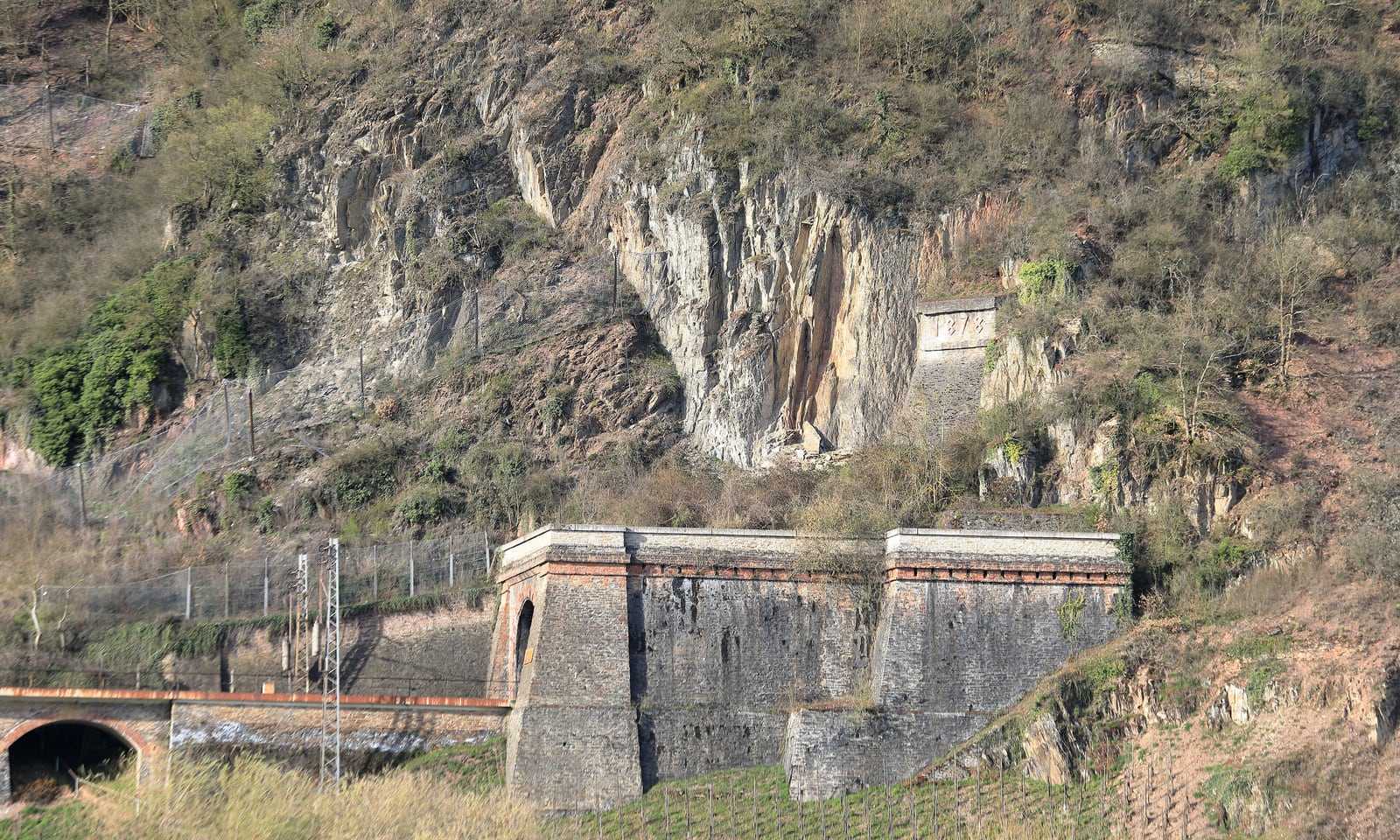
The Prussians built this line between 1874 and 1879, and the Mosel made them work for it. South of Cochem the river swings round the Cochemer Krampen, a loop that would have added thirty kilometres of bank; they drove the Kaiser-Wilhelm-Tunnel straight through the hill instead — 4,205 metres, five kilometres of railway in place of thirty, and the longest railway tunnel in Germany from 1879 until 1988. A second bore opened in 2014 and both tubes have been in use since July 2017.
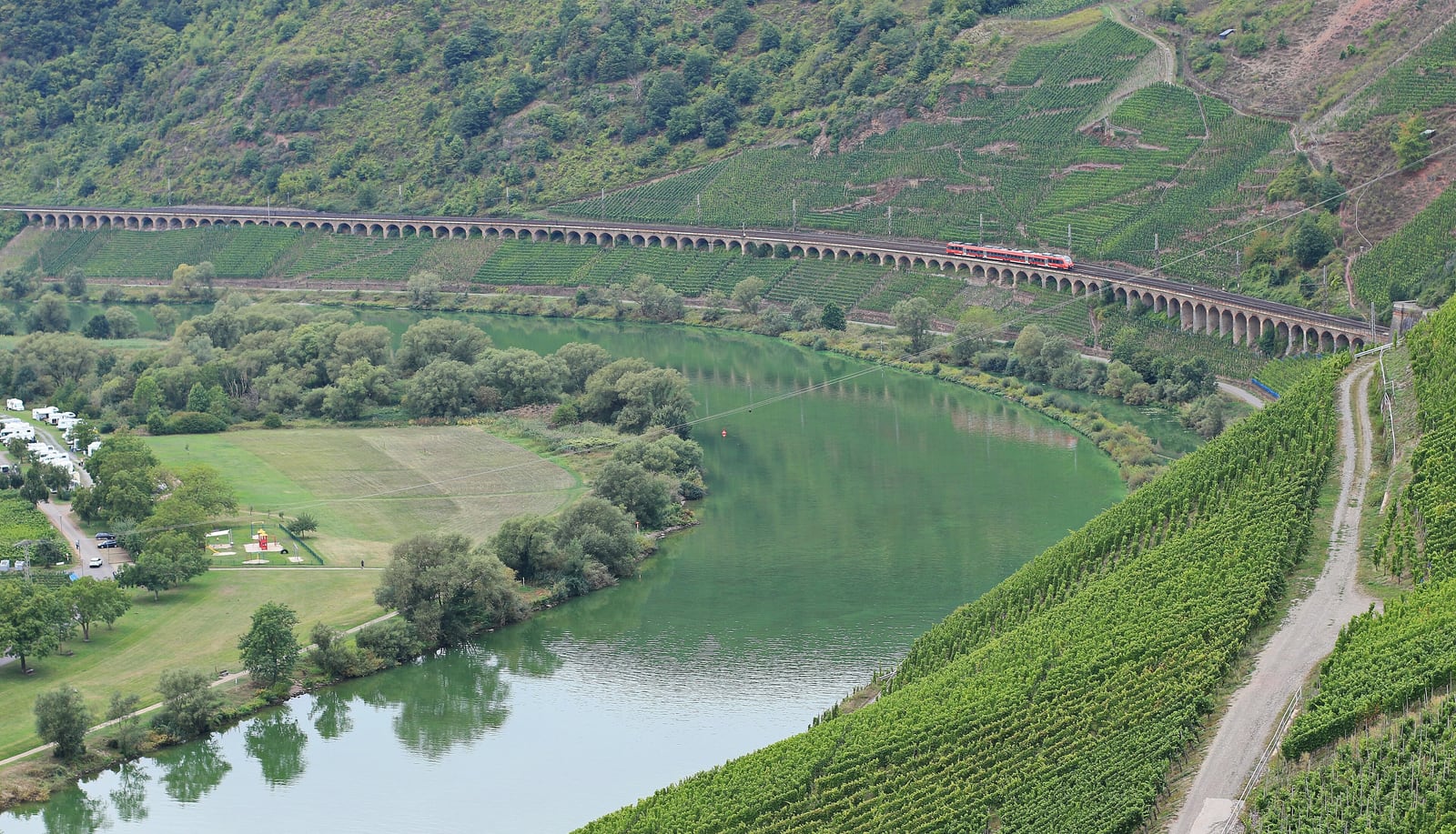
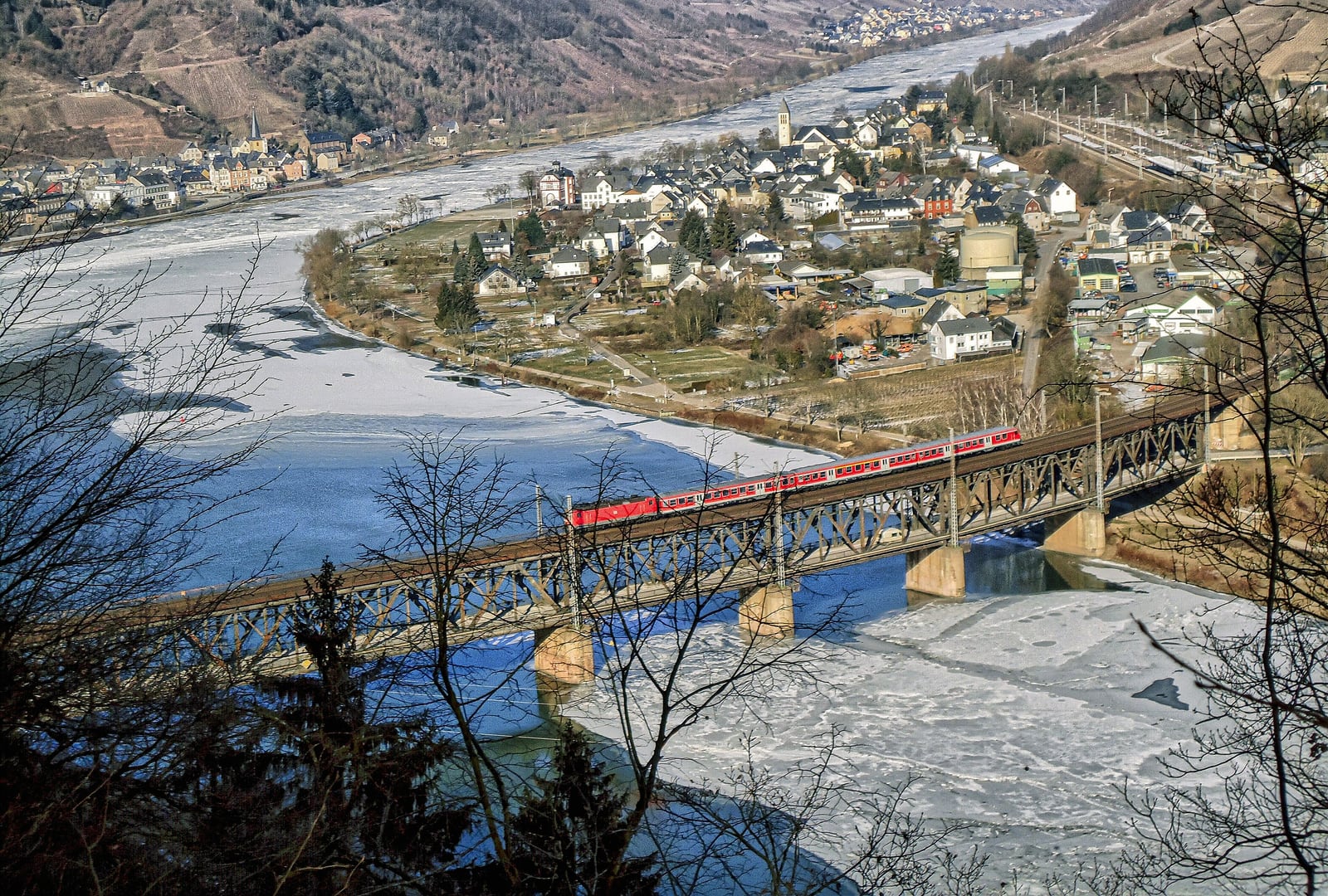
Beyond Bullay the line crosses the water on the Doppelstockbrücke, 314 metres of iron with the trains on the upper deck and the road on the lower, and then runs out along the Pündericher Hangviadukt — 786 metres on 92 arches, stepped across a vineyard slope with no flat ground on it, and the longest hillside viaduct carrying a railway anywhere in Germany. Six tunnels, 6,478 metres of them, and four crossings of the Mosel.
The train
Since the timetable change on 14 December 2025 the all-stations RB 81 has been worked by new Stadler FLIRT 3 XL units — 245 seats, standing room for as many again, space for up to thirty bicycles, free Wi-Fi, sockets at the seats and a level floor from the first door to the last. The faster RE 1 runs the same valley in eighty-four minutes and carries on to Saarbrücken and Mannheim.
Neither needs a reservation. Neither charges a supplement. There is no season and no scenic surcharge — just a river, a lot of Riesling, and a train every hour.
The Journey
Take the southbound train and the journey divides cleanly into three: an hour on the river, a tunnel-and-viaduct finale at Bullay, and then forty kilometres of ordinary countryside to fill in before Trier.
Koblenz to Cochem — the terraces
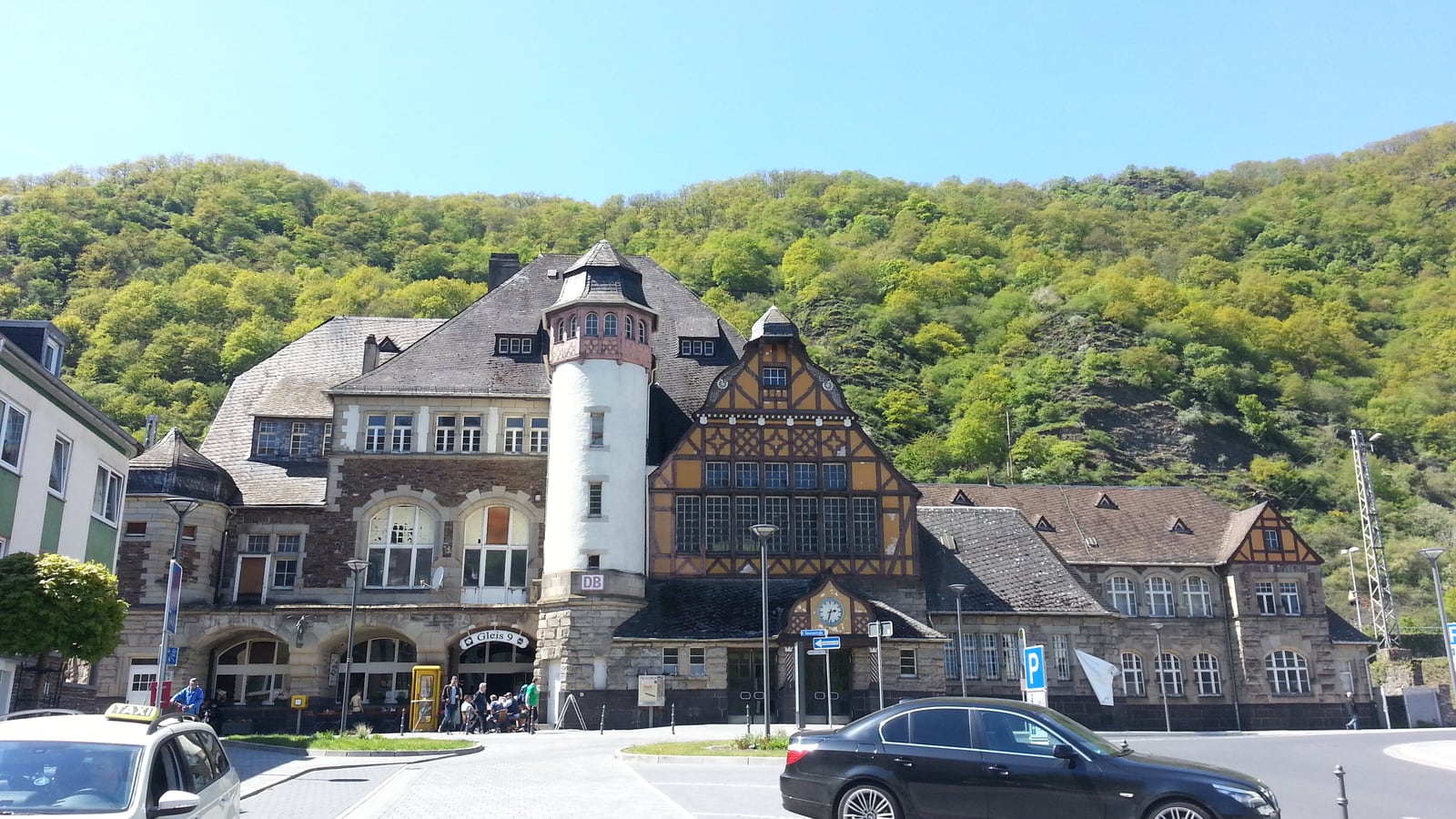
The line leaves Koblenz Hauptbahnhof as a branch off the Rhine route and is over the Mosel within three kilometres, on the Gülser railway bridge. From there it takes the left bank and does not leave it for fifty-five kilometres.
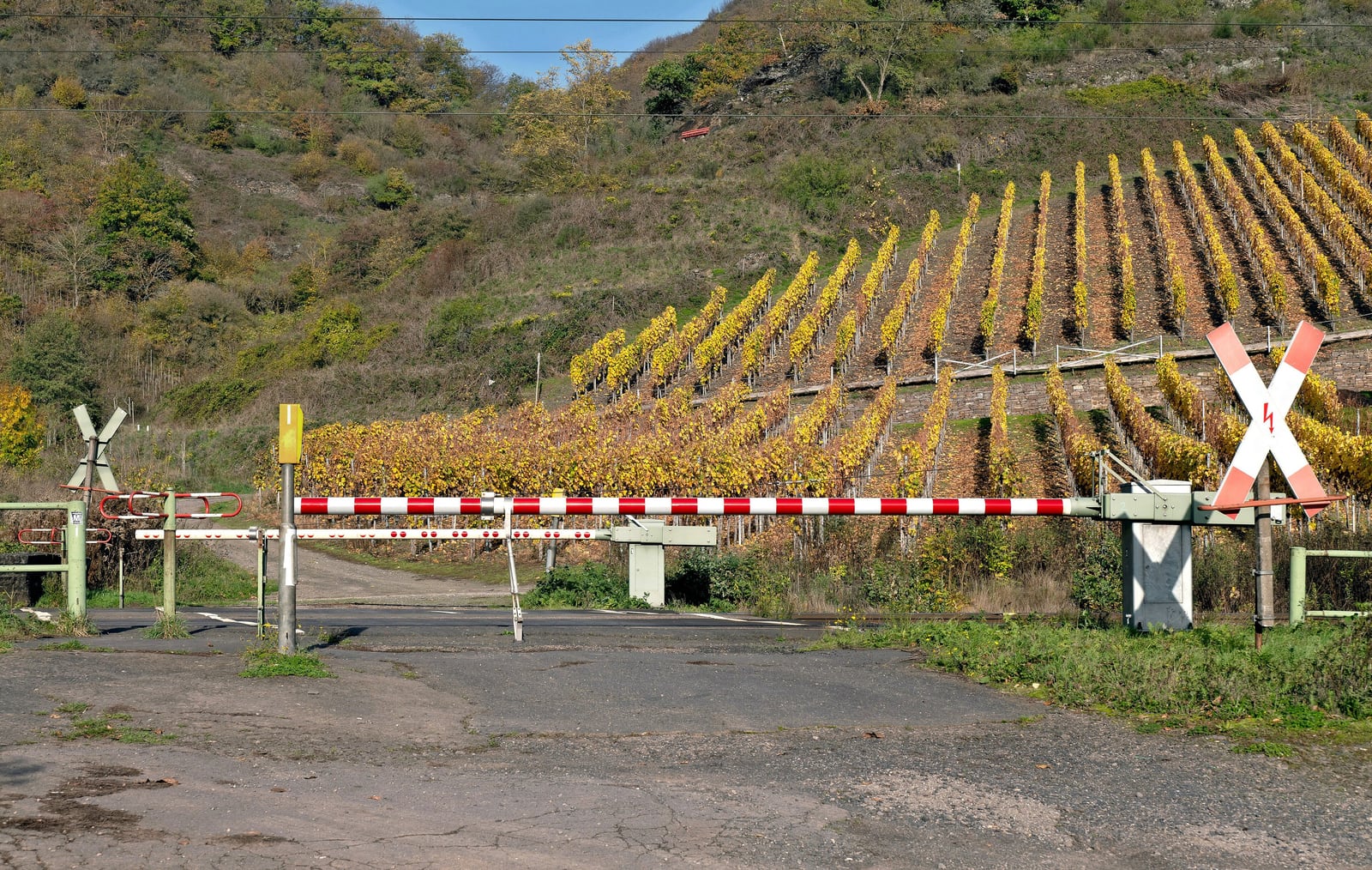
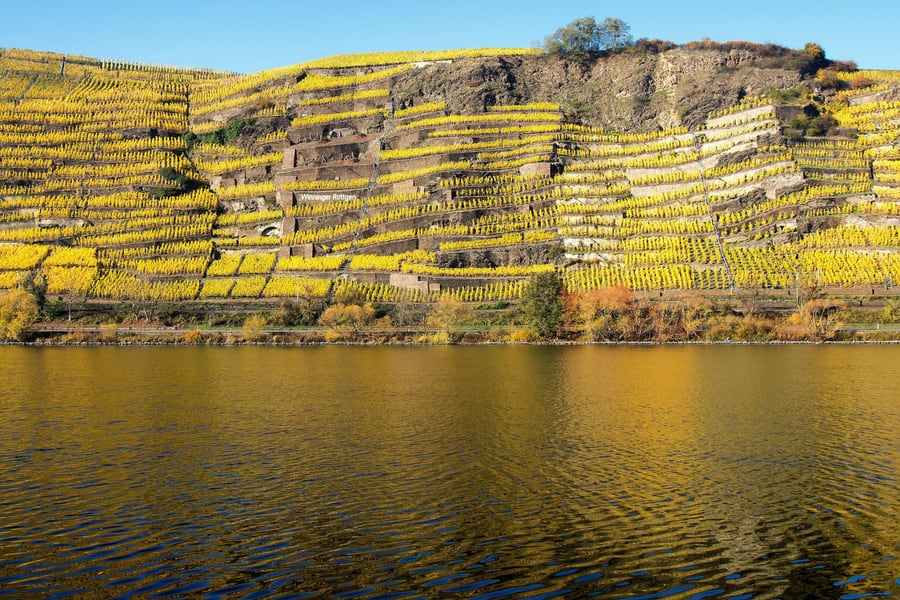
This is the Terrassenmosel, and it looks like nowhere else in Germany. The valley sides are slate, they stand at angles a tractor cannot hold, and they have been cut into stepped terraces and planted with Riesling for centuries — walls and stairs and single rows, worked by hand, with the vines going right down to the railway fence. Winningen at kilometre 8 is the first of them and one of the best. Then Kobern-Gondorf under two ruined castles, Hatzenport, Löf, Kattenes, and at kilometre 31 Moselkern, which is where anybody walking to Burg Eltz gets off.
Treis-Karden at kilometre 37 puts the collegiate church of St Castor directly below the window. Then Pommern, Klotten, and the wide bend into Cochem at kilometre 48 — a station under the town, the Reichsburg on its cone above, and the busiest platform on the line.
Cochem to Pünderich — the good bit
Out of Cochem the train runs a few hundred metres and disappears. The Kaiser-Wilhelm-Tunnel takes four minutes and cuts out thirty kilometres of the Cochemer Krampen, the loop the Mosel makes around the Calmont. Above your head, while you are in there, is the steepest vineyard in the country.
You come out at Ediger-Eller, cross the river on a 281-metre steel bridge, and are suddenly on the right bank with the Calmont slope towering opposite — sixty-eight degrees of Riesling, with the via ferrata that crosses it starting beside the railway bridge you just used. Neef, then Bullay at kilometre 59, where the line crosses back on the Doppelstockbrücke: two decks, road below, railway above, 314 metres.
Immediately after it comes the 458-metre Prinzenkopf tunnel, cutting the neck of the Zell loop, and then the line steps out onto the Pündericher Hangviadukt — 786 metres of masonry on 92 arches, running along the hillside above the vines with the river doubling away underneath. It is the single best minute of the journey and it is over quickly; from the train you mostly notice that there is nothing but air below the window.
Pünderich to Trier — the plateau
Then the Reilerhals tunnel, and the railway climbs out of the valley and abandons the Mosel.
For the next forty kilometres you are on the Eifel plateau: fields, woods, the wine villages of Bengel and Ürzig glimpsed as the line drops briefly towards them, and Wittlich at kilometre 76, the junction and the biggest town between the two ends. It is pleasant and it is not why you came. The Mosel meanwhile goes off on its own for another eighty kilometres of loops, through Traben-Trarbach and Bernkastel-Kues, and the railway simply waits for it.
They meet again at Schweich, kilometre 100. The last stretch runs down the widening valley through the 791-metre Meulenwald tunnel, crosses the Mosel for the fourth and last time at Pfalzel inside the Trier city boundary, and comes into Trier Hauptbahnhof with the Porta Nigra ten minutes' walk away.
What it is like on board
Ordinary, and that is the point. The RB 81 calls at twenty-nine stations in between and takes 1 h 55; the RE 1 calls at six and takes 1 h 24. Both are modern electric units with luggage racks, bicycle space and a toilet, both run hourly until midnight, and on both of them most of the people around you are going to work or to school. Nobody is having an experience. You are just the one looking out of the window.
Along the route
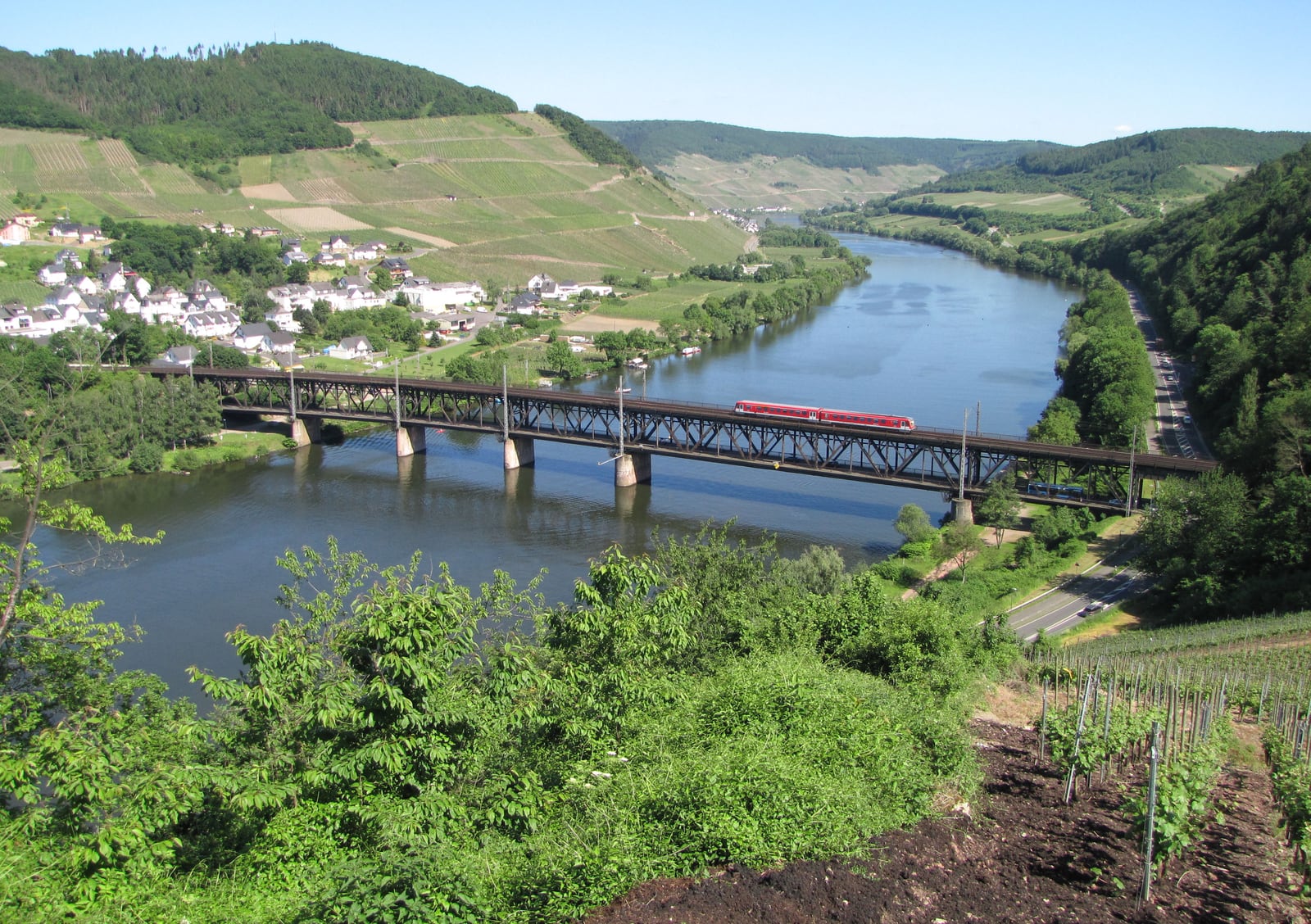
Kora27 / Wikimedia Commons · CC BY-SA 4.0Sixty kilometres of river, and then honesty
From Koblenz the line hugs the Mosel past Cochem out to Pünderich — about sixty kilometres, and the reason to make the trip. Then it climbs into a tunnel and leaves, running fast over the Eifel plateau and not seeing the water again until Schweich.Torsade de Pointes / Wikimedia Commons · CC0The tunnel that cut thirty kilometres to five
South of Cochem the Mosel throws itself round a loop so extravagant that following it would have added thirty kilometres of riverbank. The engineers of the 1870s went straight through the hill instead — 4,205 metres, Germany's longest railway tunnel until 1988.Kora27 / Wikimedia Commons · CC BY-SA 4.0Germany's longest hillside viaduct
Opposite Pünderich the valley wall leaves no shelf to build on, so the railway built its own: 786 metres of masonry on 92 arches, stepped along the slope between the vines. Nothing longer of its kind carries a railway anywhere in Germany.A bit of history
Culture & experiences along the way
Rolf Kranz / Wikimedia Commons · CC BY-SA 4.0Take the slow one
The RE 1 does Koblenz to Trier in 1 h 24 and stops eight times; the RB 81 takes 1 h 55 and stops at everything. The extra half hour buys you Hatzenport, Moselkern for Burg Eltz, Ediger-Eller under the Calmont — the places worth getting off at. Both run hourly, so there is no penalty for changing your mind.Holger Weinandt / Wikimedia Commons · CC BY-SA 3.0 deSit on the right leaving Koblenz
The line crosses to the left bank three kilometres out and stays there to Cochem, so the river is on the right-hand side for the whole terraced stretch. It swaps banks at Eller and again beyond Bullay; if you only want one seat for the good part, that is the one.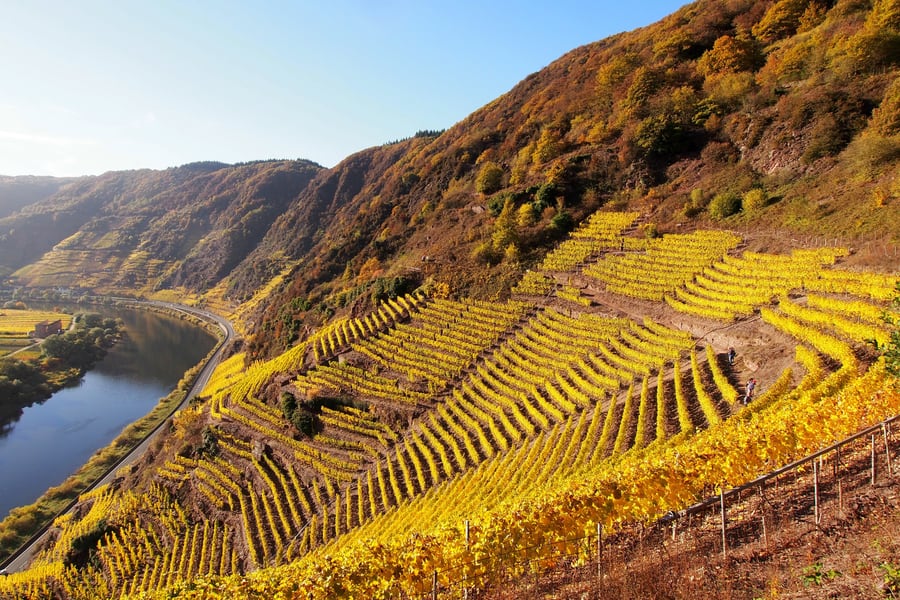 Rolf Kranz / Wikimedia Commons · CC BY-SA 4.0 · cropped
Come in October
The slate terraces above Winningen, Bremm and Ürzig are worked by hand at angles no tractor can hold, and in the second half of October they turn gold from the river up. The villages hold their wine festivals through the autumn, and every one of them is a request stop with an hourly train back.Timetables
Two trains an hour run the whole line in each direction, every day: the RE 1 SÜWEX, which stops six times between the two ends, and the RB 81 Moseltal-Bahn, which stops twenty-nine times. Both are clock-face services, so the minutes below repeat all day.
Southbound — Koblenz to Trier
RE 1 leaves Koblenz Hauptbahnhof at :06 past each hour and is in Trier at :30 — 1 hour 24 minutes for 112 kilometres:
| Station | km | Time |
|---|---|---|
| Koblenz Hbf | 0 | :06 (depart) |
| Kobern-Gondorf | 15 | :18 |
| Treis-Karden | 37 | :33 |
| Cochem (Mosel) | 48 | :41 |
| Bullay (DB) | 59 | :50 · :51 |
| Wittlich Hbf | 76 | :03 |
| Schweich (DB) | 100 | :18 |
| Trier Hbf | 112 | :30 (arrive) |
RB 81 leaves at :25 and arrives at :20, 1 hour 55 minutes, calling everywhere:
| Station | km | Time |
|---|---|---|
| Koblenz Hbf | 0 | :25 (depart) |
| Koblenz-Moselweiß | 3 | :29 |
| Koblenz-Güls | 4 | :31 |
| Winningen (Mosel) | 8 | :35 |
| Kobern-Gondorf | 15 | :40 · :41 |
| Lehmen | 17 | :44 |
| Kattenes | 21 | :47 |
| Löf | 24 | :51 |
| Hatzenport | 26 | :54 |
| Moselkern | 31 | :58 |
| Müden (Mosel) | 35 | :01 |
| Treis-Karden | 37 | :04 |
| Pommern (Mosel) | 39 | :07 |
| Klotten | 44 | :11 |
| Cochem (Mosel) | 48 | :14 · :15 |
| Ediger-Eller | 53 | :19 |
| Neef | 55 | :22 |
| Bullay (DB) | 59 | :25 · :26 |
| Bengel | 67 | :33 |
| Ürzig (DB) | 71 | :37 |
| Wittlich Hbf | 76 | :41 · :42 |
| Salmtal | 84 | :48 |
| Sehlem (Kr Wittlich) | 88 | :51 |
| Hetzerath | 92 | :55 |
| Föhren | 95 | :58 |
| Schweich (DB) | 100 | :02 |
| Quint | 102 | :06 |
| Ehrang Ort | 104 | :09 |
| Trier Hafenstraße | — | :11 |
| Pfalzel | 108 | :14 |
| Trier Hbf | 112 | :20 (arrive) |
Northbound — Trier to Koblenz
The pattern mirrors. RE 1 leaves Trier Hbf at :33 and reaches Koblenz at :56 — 1 hour 23 — calling Schweich :43, Wittlich :57, Bullay :10, Cochem :18, Treis-Karden :27, Kobern-Gondorf :42.
RB 81 leaves Trier at :41 and reaches Koblenz at :36, 1 hour 55, with Wittlich :16, Bullay :32, Cochem :43, Moselkern :01, Kobern-Gondorf :17, Winningen :23.
Good to know
- ⚠️ The evening pattern shifts. From about 19:00 the RE 1 leaves Koblenz at :19 rather than :06. The RB 81 keeps its :25.
- Last trains south: the RE 1 at 22:19 from Koblenz, into Trier at 23:40, and the RB 81 at 23:21, into Trier at 00:42.
- Last trains north: the RE 1 at 22:33 from Trier, into Koblenz at 23:56, with a later working at 23:31 on Fridays and Saturdays. ⚠️ The last RB 81 out of Trier, at 22:41, only runs as far as Cochem — it is not a way of getting to Koblenz.
- At Trier the RE 1 joins and splits. Trains to and from Luxembourg (the RE 11) are coupled to the Koblenz service at Trier, so check the destination on your carriage, not just on the train.
- For Traben-Trarbach, change at Bullay. The RB 85 Moselweinbahn runs hourly up the ten-kilometre branch.
- ⚠️ Connections are not held. The timetable book says plainly that local trains at Trier, Ehrang, Bullay and Koblenz "warten im Allgemeinen nicht auf verspätete Anschlusszüge" — they generally do not wait for late connections.
- Bicycles are carried on both services; the FLIRT 3 XL units on the RB 81 take up to thirty.
Times from the operator-authority timetable: Verkehrsverbund Rhein-Mosel's Fahrplanbuch table ZUG MOS, Kursbuchstrecke 690, for the 2026 timetable year, both directions, read August 2026. German timetables change every December — the clock-face pattern is stable, the exact minutes are not. Kilometres are the timetable's own, printed as distance from Trier and given here as distance from Koblenz.
Tickets
This is a normal German regional railway and it is sold like one — no journey ticket, no reservation and no scenic supplement. The Deutschland-Ticket at €63 a month covers both the RB 81 and the RE 1, so anyone who already holds one rides the whole Mosel valley at no extra cost and can get off at every village. ⚠️ It is not valid on IC, EC or ICE trains, and one Intercity pair a day uses this line.
For a group the Rheinland-Pfalz/Saarland-Ticket is usually cheapest: €30 for the first person and €10 for each of up to four more, though Monday to Friday it only starts at 09:00. One trap for single fares: the line is split between two fare unions at Bullay, so a ticket bought inside one will not carry you across the boundary — a through DB ticket prices the whole journey regardless. Conditions read from Deutsche Bahn, August 2026.
Book your tickets
The RB 81 Moseltal-Bahn
Hourly, every station, new trains since December 2025
Stadler FLIRT 3 XL units — 245 seats, thirty bicycles, step-free end to end.
Book Tickets (opens in a new tab, on DB Regio Rheinland-Pfalz)via DB Regio Rheinland-PfalzThe RE 1 SÜWEX
The fast one — Koblenz to Trier in under 90 minutes
Same scenery, six stops instead of twenty-nine, and it splits at Trier for Luxembourg.
Book Tickets (opens in a new tab, on Deutsche Bahn)via Deutsche BahnThe Deutschland-Ticket
€63 a month, and this line is included
Every regional train, bus and tram in Germany — but not IC, EC or ICE.
Book Tickets (opens in a new tab, on Deutsche Bahn)via Deutsche BahnRail Passes
Everything on this line is an ordinary scheduled train on the national network, which is exactly the situation passes are good at.
Interrail and Eurail
Fully valid. Interrail's own country page for Germany lists Regional Bahn (RB), Regional Express (RE), Interregio-Express (IRE) and S-Bahn among the covered domestic categories, along with IC, EC and ICE. Both trains on this line are in that list.
No reservation is required on either of them — Interrail's page says so for RB, RE, IRE and S-Bahn alike. Turn up and board.
⭐ A pass also covers the RE 11 across the border to Luxembourg, which couples to the Koblenz train at Trier, and the RB 85 branch to Traben-Trarbach from Bullay. If you are passing through on a Global Pass, both are free side-trips off the main run.
The Deutschland-Ticket
€63 a month, sold only as a rolling subscription in your own name, valid on every regional train, bus, tram and U-Bahn in Germany. It covers the RB 81 and the RE 1 in full, and it is the pass that makes hopping off at Winningen, Moselkern, Ediger-Eller and Bullay in one day cost nothing extra.
⚠️ Not valid on IC, EC or ICE — including the one Intercity pair that runs this line.
The Rheinland-Pfalz/Saarland-Ticket
Not a rail pass in the Interrail sense, but the one most people should actually buy: €30 for one traveller and €10 for each of up to four more, valid all day on regional trains across the state. The whole of Koblenz–Trier is inside it. Weekdays it starts at 09:00; weekends and public holidays, midnight.
Is a pass worth buying for this journey?
For this journey alone, no. A single Koblenz–Trier regional fare is modest, the trip takes ninety minutes, and neither an Interrail pass nor a monthly subscription can pay for itself on one ride.
It becomes worth it in three situations, and they are all common here. You are already crossing Europe on a Global Pass, in which case the Mosel is a free day and the Luxembourg branch is a free afternoon. You are staying in Germany for a month, in which case the Deutschland-Ticket turns the entire valley into somewhere you can wander at no marginal cost. Or there are two or more of you doing a day of hopping on and off, in which case the Rheinland-Pfalz-Ticket beats singles before lunch.
Pass coverage checked against Interrail's own Germany page, and ticket prices against Deutsche Bahn, August 2026.
Places to Visit
The stations on the riverside half of this line are five to ten minutes apart and the trains are hourly, so getting off is close to free. That changes how you plan: instead of one journey, you get a series of short ones, and the only real decision is how many stops you can fit into a day.
Everything below is reached on foot from a platform, with two exceptions that say so. Bremm has no station of its own — the Calmont is worked from Ediger-Eller. Traben-Trarbach is not on this line at all: it sits at the end of a ten-kilometre branch, and you change at Bullay.
One place is missing on purpose. Bernkastel-Kues is the most famous wine town on the Mosel and it has no railway. The nearest station is Wittlich, and the rest is a bus. It is a good day out; it is not a stop on this journey, and we are not going to pretend otherwise.
 Rolf Kranz / Wikimedia Commons · CC BY-SA 4.0 · cropped
Winningen
Eight kilometres out of Koblenz and the valley sides have already stood up: slate terraces stacked above the village, cut by hand and too steep for any machine, growing the Riesling that made the lower Mosel's name. Winningen's Moselfest, ten days at the turn of August and September, is the oldest and the longest wine festival on the river, and the half-timbered lanes around the Weinhexbrunnen are three minutes from the platform.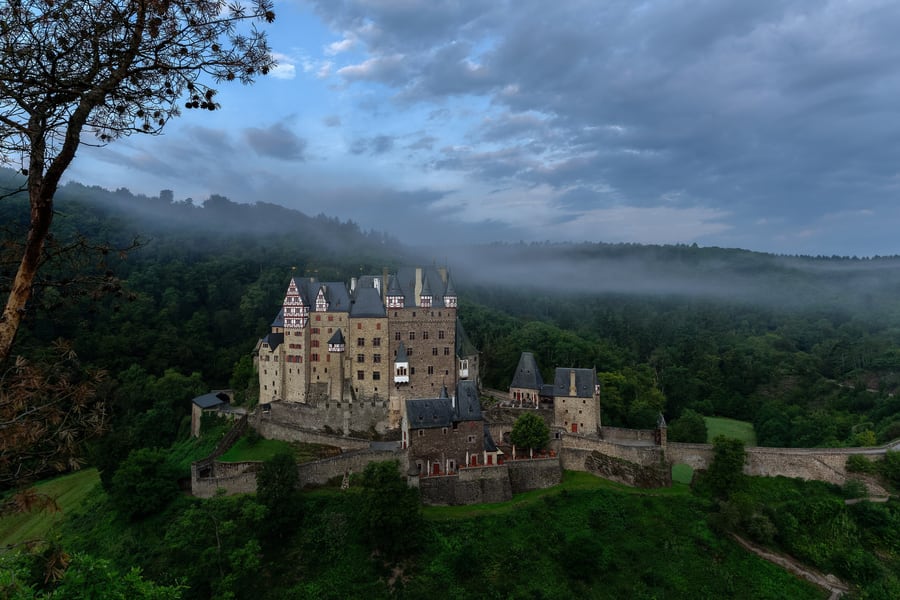 Johannes Dörrstock / Wikimedia Commons · CC BY-SA 4.0 · cropped
Burg Eltz
A castle held by the same family for more than eight hundred years, never taken and never abandoned, standing on its rock in a side valley where nothing else is. The way to it is on foot from Moselkern station up the Elzbach — about four and a half kilometres of streamside woodland, of which the castle's own directions give the last stretch from the Ringelsteiner Mühle as 2.5 km and 45 minutes. Open daily from 29 March to 1 November, 09:30 to 17:00.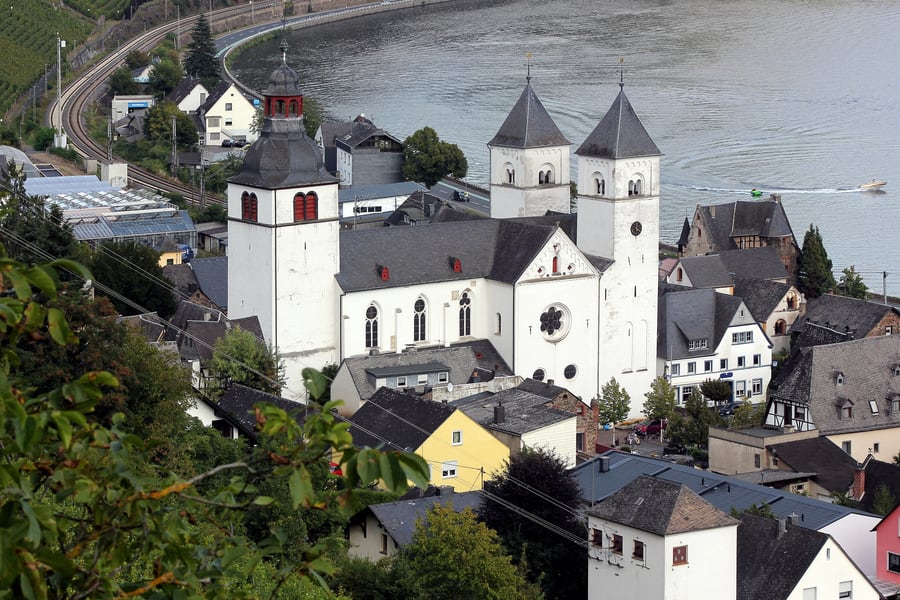 Spurzem / Wikimedia Commons · CC BY-SA 4.0 · cropped
Treis-Karden
Two villages facing each other across the water, sharing one station. Karden, on the railway side, grew up around the collegiate church of St Castor — a big Romanesque and early Gothic pile far out of proportion to the place, with the canons' houses still standing around it. The train runs along the slope directly above the roofs.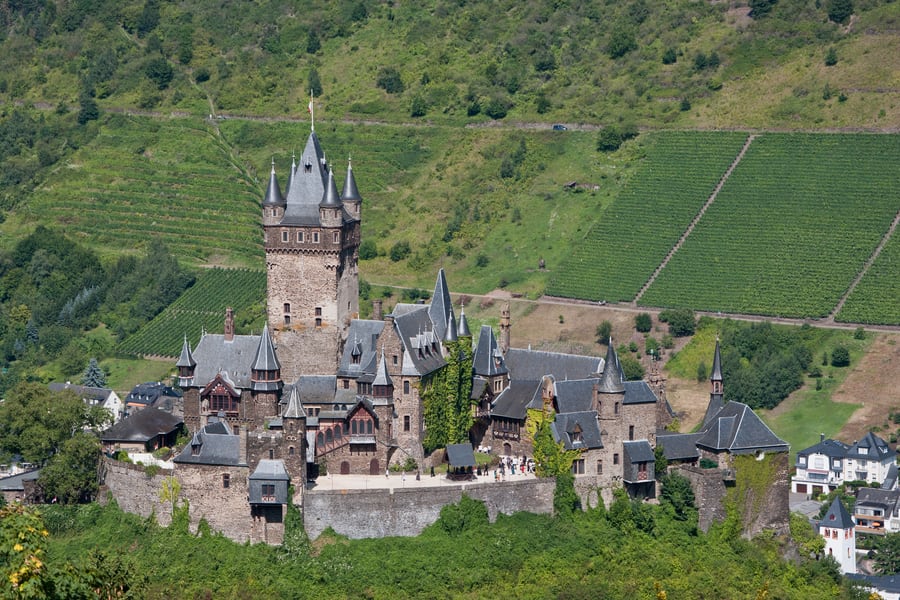 Steffen Schmitz / Wikimedia Commons · CC BY-SA 3.0 de · cropped
Cochem
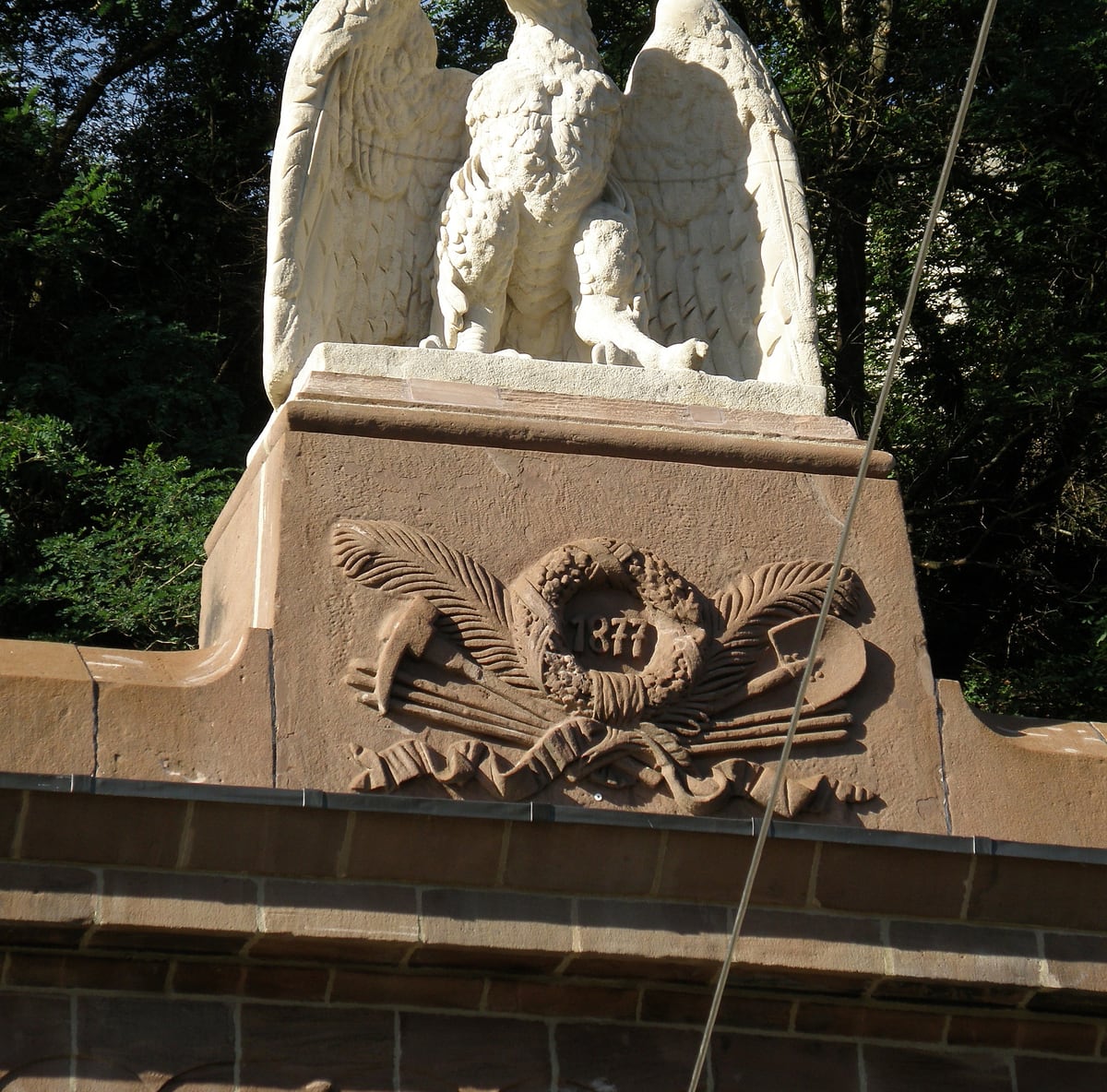
The Reichsburg has been on its cone above the town since about 1100, when it took a toll off every boat that passed. French troops blew it up on 19 May 1689 and it lay in pieces for nearly two centuries, until the Berlin merchant Louis Ravené bought the ruin in 1868 and rebuilt it in neo-Gothic between 1874 and 1877. The town bought it in 1978 and runs it; it is a stiff walk up from the station, and guided tours only.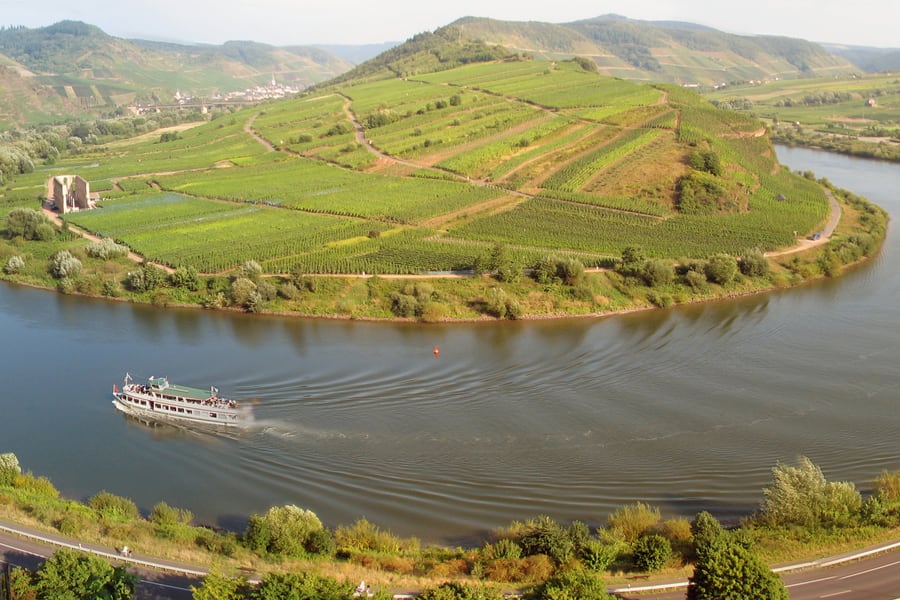 Andreas Lippold / Wikimedia Commons · CC BY-SA 4.0 · cropped
The Calmont, above Bremm
Thirty-three hectares of Riesling on a slope that reaches sixty-eight degrees — steep enough that the vineyard is generally reckoned Europe's steepest, and that the hillside needed a via ferrata before walkers could cross it. The circuit from Eller is six kilometres and four to five hours, on ladders and fixed ropes, and it starts by the railway bridge. Bremm itself is round the loop, on the far side.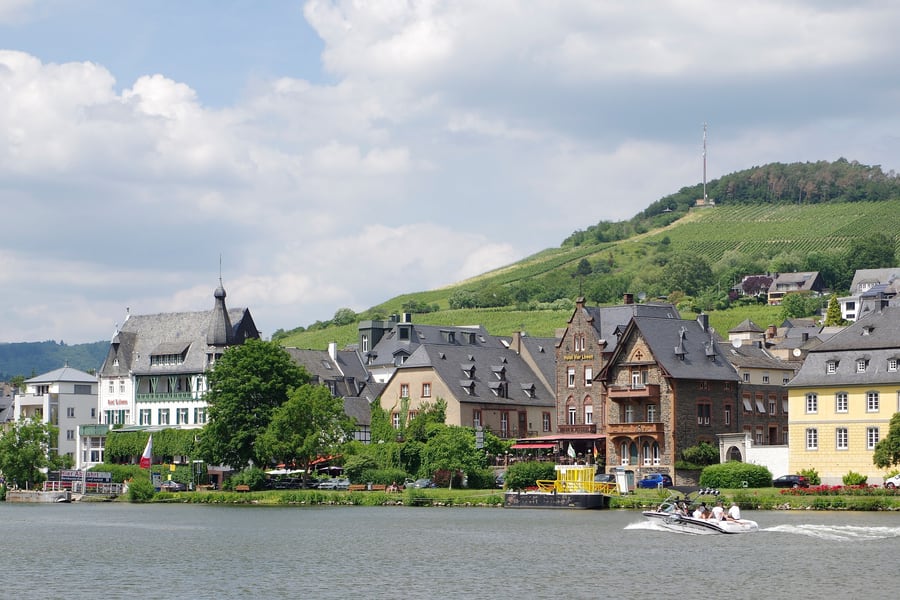 Berthold Werner / Wikimedia Commons · CC BY-SA 4.0 · cropped
Traben-Trarbach
The wine trade made this town rich enough to hire an architect from Berlin, and Bruno Möhring gave it a Jugendstil bridge gate in 1899, the Hotel Bellevue in 1903 and the Villa Huesgen by the station in 1904 — an art nouveau town centre on the Mosel, mostly intact. It is not on this line: the ten-kilometre Moselweinbahn of 1883 branches off at Pünderich, and the connecting RB 85 leaves from Bullay, hourly.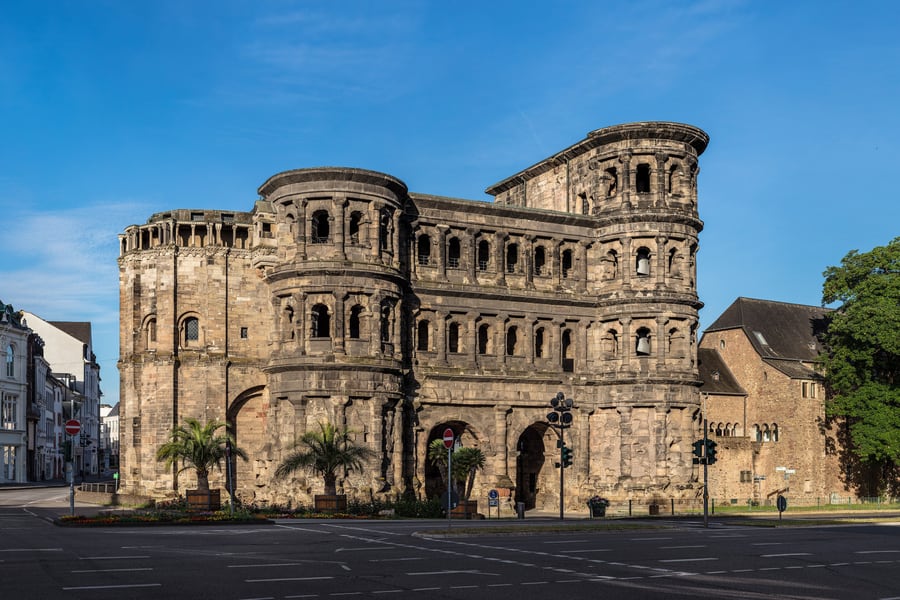 © Thomas Wolf, www.foto-tw.de (CC BY-SA 3.0 DE) · cropped
Trier
The oldest city in Germany, and it can prove it: nine Roman and medieval monuments were inscribed together on the UNESCO World Heritage list in 1986 — the Porta Nigra, the amphitheatre, the Imperial and Barbara baths, the Aula Palatina, the Roman bridge, the Igel column, the cathedral and the Liebfrauenkirche. Trier was one of the four imperial capitals under the Tetrarchy, and the black gate is ten minutes' walk from the Hauptbahnhof.Where to Sleep
The valley is full of places to stay, because it has been taking visitors for a century and a half. Nearly all of them are family houses rather than chains, and nearly all of them are within a few minutes of a platform — this is a line where the hotels grew up around the stations.
Three below, spread along the route: one in the middle of Cochem, one at the end of the branch line in Traben-Trarbach, and one among the vines on the edge of Trier. We give no prices and no star ratings, because we have verified neither. Each card links to the house's own website.
⚠️ One obvious candidate is absent. Cochem's Alte Thorschenke, built into the town gate and trading since 1332, is the first hotel anybody would name on this river. Its two web addresses now lead to a search-engine content farm and a domain broker's parking page respectively, and neither is a place to send a reader — so it has no card here. If it puts a working site back up, it will get one.
Where to stay
Hotel Karl Noss
On the promenade in the middle of Cochem
A family house on the Cochem waterfront, in business under the same name since 1895, with the old town behind it and the castle on the hill above. The station is on the other side of the river, about ten minutes' walk over the bridge.
Check Availability (opens in a new tab, on hotel-noss-cochem.de)via hotel-noss-cochem.de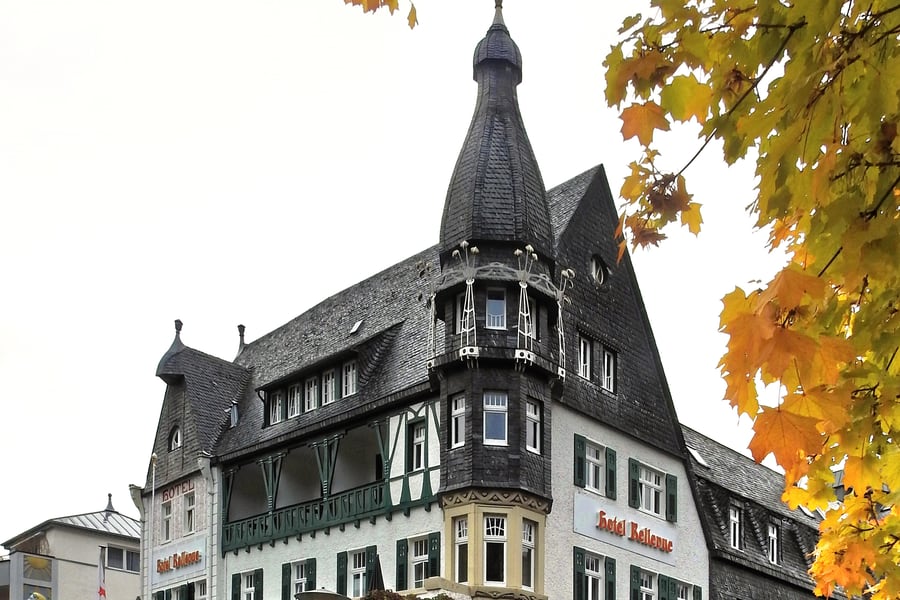 Holger Uwe Schmitt / Wikimedia Commons · CC BY-SA 4.0 · cropped
Romantik Jugendstilhotel Bellevue
Bruno Möhring's 1903 hotel, Traben-Trarbach
Built in 1903 to a design by the Berlin architect Bruno Möhring, in the same art nouveau campaign that gave the town its bridge gate, and still working as a hotel with its Belle Époque dining room. Traben-Trarbach is reached on the branch line from Bullay.
Check Availability (opens in a new tab, on bellevue-hotel.de)via bellevue-hotel.deBecker's
A wine estate with rooms, in Trier-Olewig
Five generations of a Trier winegrowing family, about twenty thousand vines, a traditional wine house and a modern hotel wing beside it, in the vineyard suburb of Olewig a few minutes out of the centre. Rooms, a wine bar and two restaurants on the same site.
Check Availability (opens in a new tab, on beckers-trier.de)via beckers-trier.deQuestions or corrections
Planning this trip and stuck on something, or spotted a time, fare or detail that has changed? Send us a message about The Moselle Line. We read every one, and we update this page when something has changed.