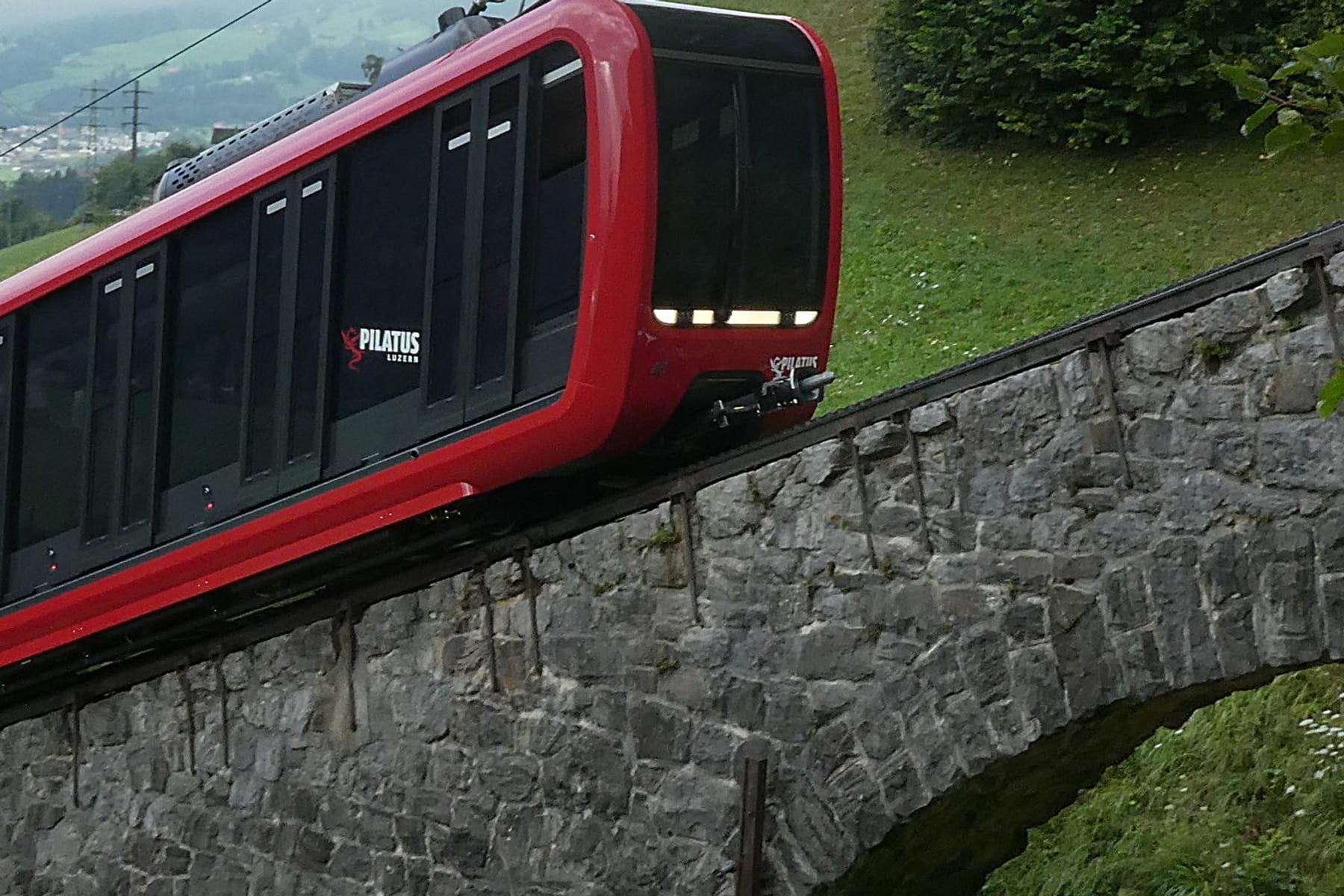
Pilatus Railway
Au des Kolbo / Wikimedia Commons · CC BY-SA 4.0 · cropped
- Distance4.6 km
- Duration27 minutes up · 33 down
- Best season11 May – 29 November 2026; a departure every 35 minutes
Introduction
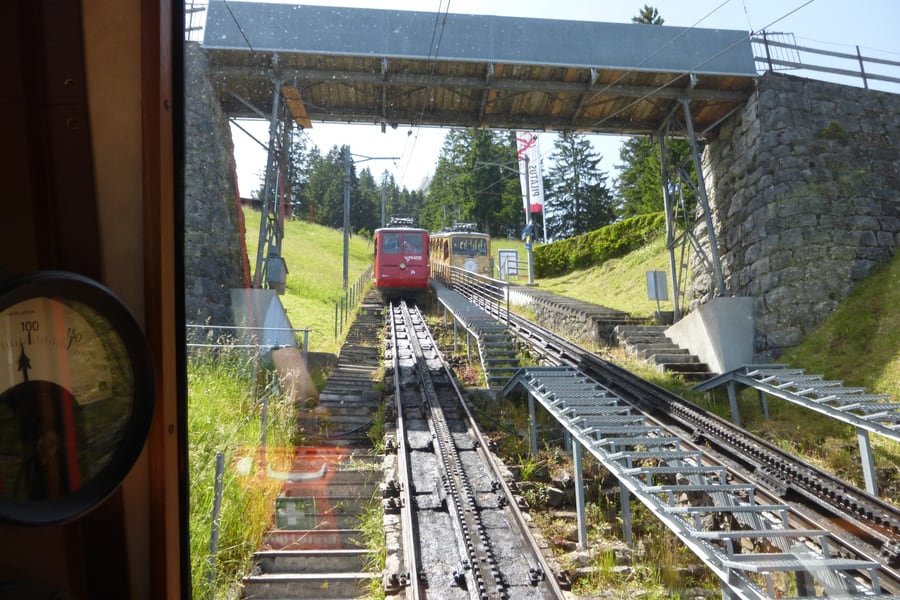
There is not a single set of points on the Pilatus Railway. There cannot be. On every other railway a junction is made by sliding two thin rails sideways against the running rails; here the rack lies flat between them with teeth on both faces, gripped by two cogwheels turning on vertical shafts, and nothing about that arrangement can be nudged aside. So the line does the only other thing available: it moves whole pieces of track. Short lengths of rail rotate about their own long axis to present a different road, and sliding tables carry a railcar bodily across to the next set of rails. Every time two trains pass at the halfway station, a machine picks up the railway and puts it down again somewhere else.
That grip is why the line exists. It climbs 1,635 metres from Alpnachstad, on an arm of Lake Lucerne, to a terminus at 2,073 metres just under the Esel — 4,618 metres long, 800 millimetres between the rails, at an average of 38 per cent and a maximum of 48 per cent. No rack railway anywhere has been built steeper in the hundred and thirty-seven years since it opened on 4 June 1889. A conventional rack of the day, with a cogwheel pressed down onto a toothed bar from above, would have climbed out of its own teeth on a gradient like that; Eduard Locher's answer was to turn the idea on its side, and his grip was strong enough that the first cars ran with no flanges on their wheels at all.
The trains run from May to late November, roughly every thirty-five minutes, taking twenty-seven minutes to the top and thirty-three coming down. Eight new railcars replaced the 1937 fleet in 2023; they seat forty-six each, run in pairs, and feed their braking energy back into the overhead wire on the way down. The rack they run on is the one Locher laid, and the operator's own account of it is that after all these years it shows hardly any sign of wear.
The Journey
Alpnachstad is a hamlet rather than a town: a road, a lake shore, a boat pier, a small yellow station on the Zentralbahn's Brünig line, and across the way the Pilatus Railway's own yellow building of 1889 with its name across the gable. Three ways in meet within a couple of minutes' walk of each other. Trains from Lucerne take seventeen minutes and run about every half hour. The lake steamer from pier 2 in Lucerne, opposite the main station, takes anything from forty-seven minutes to an hour and a half depending on which sailing and how many piers it calls at, and an underpass leads from the landing stage straight to the rack railway's platforms.
There are two of those platforms now. The valley station was rebuilt between 2020 and 2023, the sliding tables that used to shunt railcars about were replaced by three rotary switches, and the whole line — every movement on it, up and down — is now controlled from here by one signaller. A train-protection system watches the speed, the position of each rotary switch, and the distance between vehicles.
The climb begins immediately. In the first kilometre the line leaves the meadows above the lake, crosses the Wolfort stream on a stone viaduct and threads a run of short tunnels: twenty-nine metres, forty-four, twenty-two, then forty-seven and ninety-seven through the Spycher. Curves are tight — the sharpest has a radius of eighty metres — and the gradient is already well past anything an adhesion railway could hold.
Ämsigen, where everything crosses
At two kilometres and 1,355 metres the line reaches Ämsigen, a passing loop on an alp with a sliding table at each end and room on its two tracks for five railcars. Every ascending train meets every descending one here; the whole timetable is built around it. It became a stop the public could use with the summer timetable of 2006, and it is still a request stop — passengers who want to get off tell the driver before departure, and boarding depends on there being room in the car. There is no step-free access.
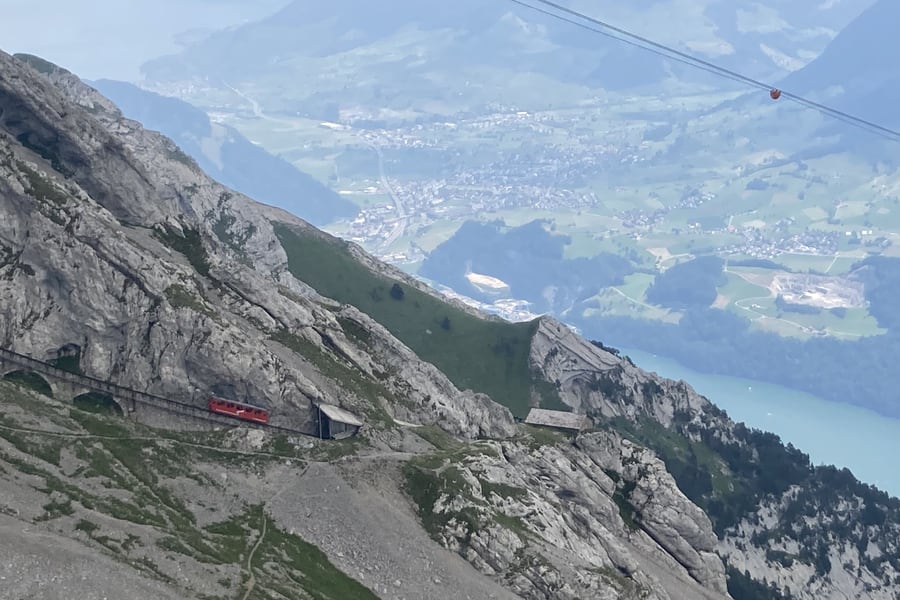
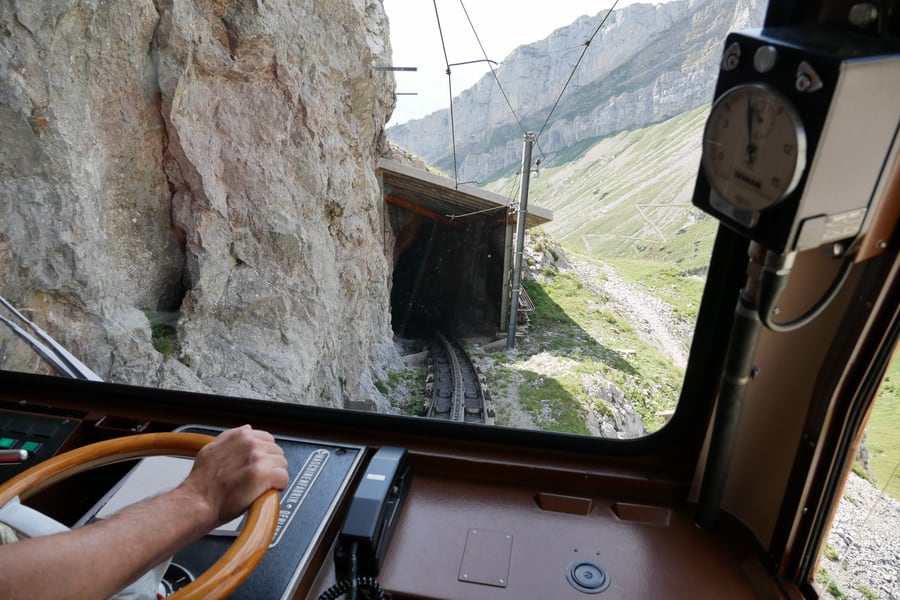
Above Ämsigen the trees thin, the alp opens out and the mountain shows what the rest of the climb looks like. Past the Mattalp at 1,603 metres the line turns onto the south-east face of the Esel and runs along a ledge blasted into the limestone, with the rock overhanging on one side and several hundred metres of nothing on the other. Four short tunnels follow in the last few hundred metres — Rosegg, Eselwand, and the lower and upper Fleimen, the last of them nine metres long — and a stone viaduct carries the track across the final gully to Pilatus Kulm, 2,073 metres, immediately below the Esel summit. Two tracks there hold a pair of railcars each; a third is where the goods railcar is loaded with everything the summit hotels and the alp consume.
The easy railway was the one that failed
A cogwheel line up the Pilatus was first applied for in April 1873, encouraged by the fifteen per cent dividends the Vitznau–Rigi railway was paying. It was to be standard gauge, with a Riggenbach rack and a maximum gradient of twenty-five per cent. It was abandoned: at that gradient the route had to be so long that no plausible traffic would pay for it.
Eduard Locher's proposal of 1885 went the other way. Narrower track, seven tunnels, rails anchored into the rock with steel ties — and an average gradient of thirty-eight per cent with a maximum of forty-eight, which cut the distance in half. The gentler railway was uneconomic; the impossible one was buildable. Work began in April 1886 and went up the mountain in sections, the first steam cars hauling granite on flat wagons to whichever length was being built next, so that the formation and the machinery were tested under load as the line grew. Six hundred labourers, most of them Italian, worked four hundred days spread across the summers of three years. The passenger bodies went onto the running gear last of all; the first passenger trip, on 17 August 1888, carried the company's board of directors.
Those first cars had their boiler mounted crosswise, so that water and fuel stayed roughly level however steep the track. Railcar No. 7 was sent to the Paris Exposition of 1889. The line opened on 4 June that year, carried about thirty-five thousand people in its first season and averaged some thirty-four thousand a year over its first decade, and paid seven per cent — enough to restart mountain-railway building across Switzerland after a decade of hesitation. Locher went on to build the Jungfrau Railway with Adolf Guyer-Zeller.
The rack, and what it does instead of flanges
The Locher rack is a bar laid flat in the middle of the track with teeth cut on both faces. Two pinions on vertical shafts under the car grip it from either side, and discs beneath them stop the car lifting. Because the drive is horizontal, the wheels do not have to guide the vehicle at all: the earliest cars ran with no flanges whatsoever, and the flanges fitted later run down the outside of the rails rather than between them. The rails themselves are laid straight onto solid rock, held by iron ties driven into it, with no ballast.
It is also why the line has no points. A rotary switch — a length of track that turns about its own axis to present a different road on its other face — and a sliding table that shifts a railcar sideways are the only junctions the system allows.
Steam, then wires, then wires both ways
Electrification was first considered in 1905 and shelved as too expensive, revived in 1931 because the steam cars were wearing out, and finished in 1936–37: an overhead line at 1,500 volts direct current, new red railcars, and a reopening on 15 May 1937. By then there had been eleven steam cars and the journey had taken seventy to eighty minutes. Two of them survive — No. 9 in the Swiss Museum of Transport in Lucerne, No. 10 in the Deutsches Museum's transport centre in Munich.
The 1937 electric cars then ran for eighty-five years. They seated forty, climbed at twelve kilometres an hour and came down at nine, took thirty minutes up and forty down, and ran in convoys of up to five vehicles keeping at least fifty metres apart on sight. Their last public day was 20 November 2022.
What replaced them cost about fifty-five million francs: eight Bhe 2/2 railcars from Stadler at Bussnang, a new goods railcar, the rebuilt valley station and work at Ämsigen and the summit. Each car seats forty-six, has 358 kilowatts and weighs 13.1 tonnes empty; they run in pairs, climb at fifteen kilometres an hour and descend at twelve, and — the real change — they use their motors as generators on the way down and put the current back into the overhead line, which the operator reckons cuts the railway's electricity consumption by up to thirty per cent. The new fleet opened the 2023 season on 5 June. Two of the 1937 cars are kept in running order, but they are slower and carry none of the modern train protection, so they can only be used outside the timetable — which is exactly what the sunrise trips are for.
One date is worth remembering on the way past Ämsigen. On the morning of 20 April 1970, during the spring snow clearing about five hundred metres above the station, the Heumattli avalanche caught a gang of twenty men. Four of them were killed: three long-serving employees of the railway and a nineteen-year-old Spanish worker.
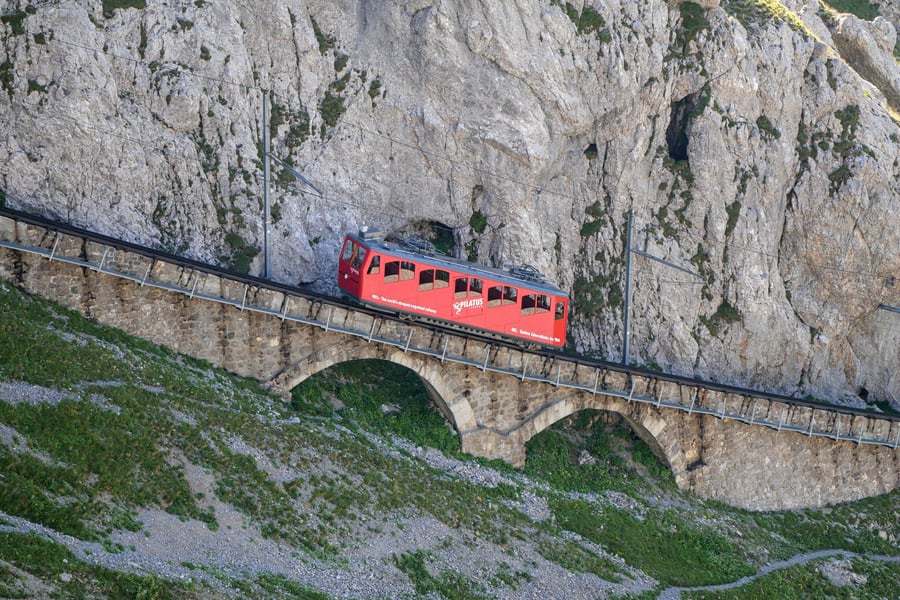
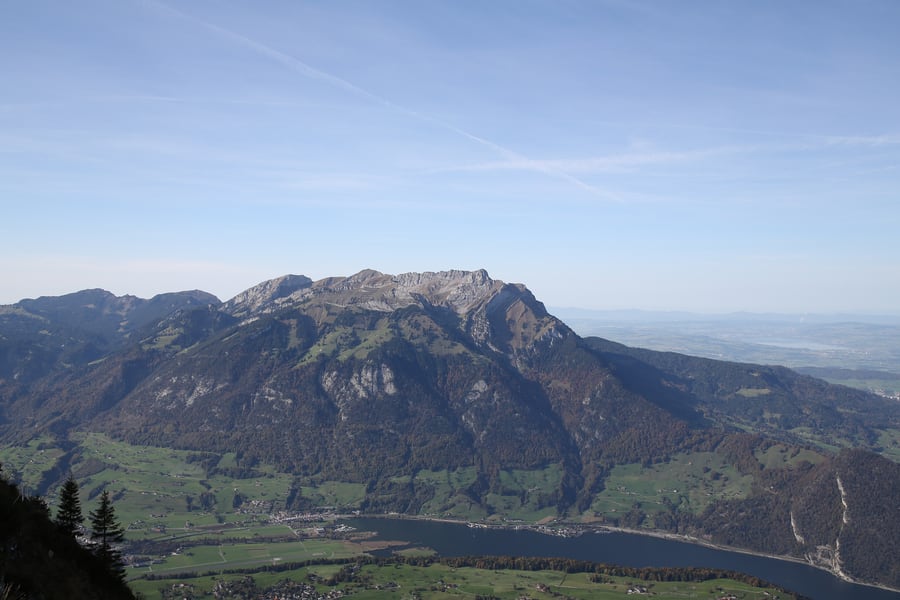
Along the route
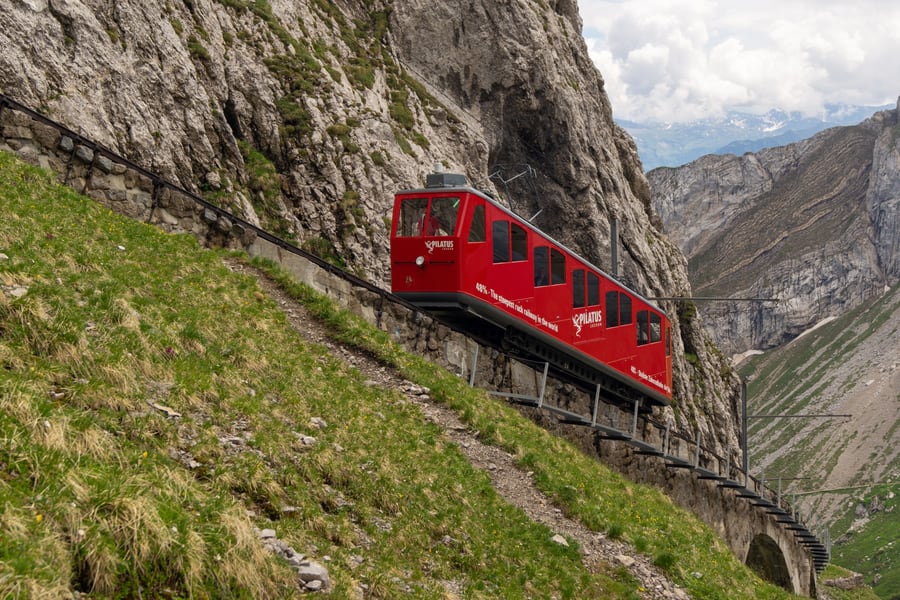 Maria Feofilova / Wikimedia Commons · CC BY-SA 4.0 · 2020 · cropped
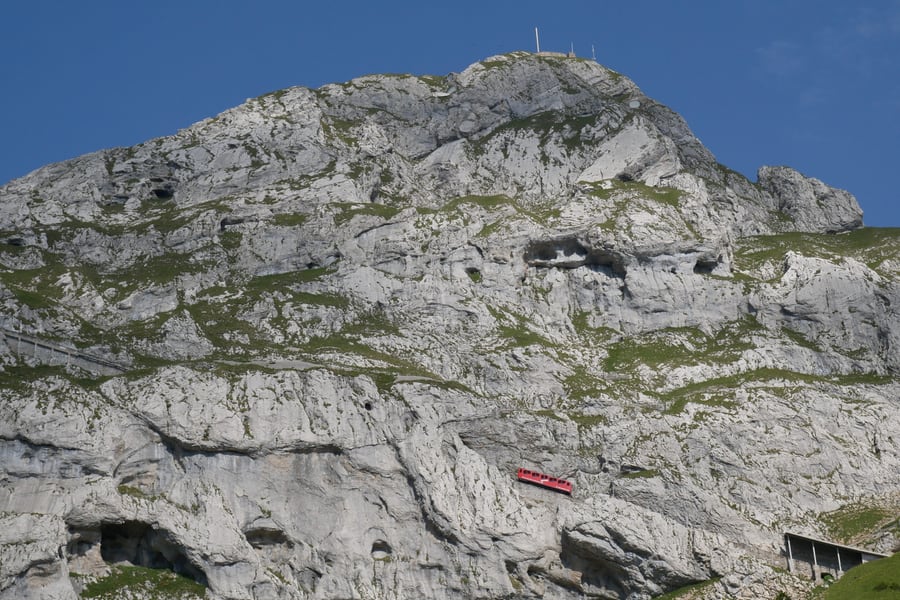
Forty-eight per cent
Almost one metre of height for every two metres forward, on the steepest stretch just below the summit. The average over the whole 4,618 metres is thirty-eight per cent, and no rack railway built anywhere since 1889 has gone steeper.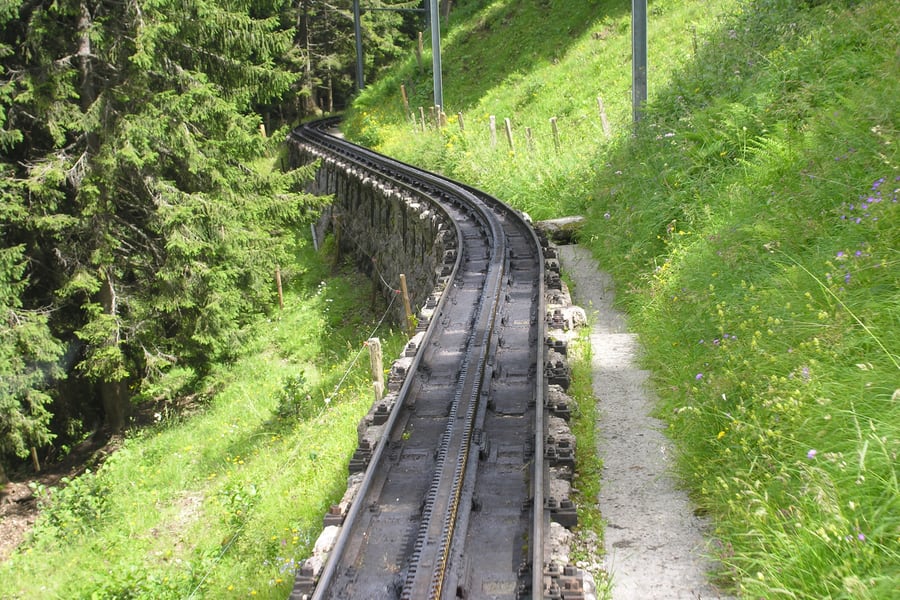 Audrius Meskauskas / Wikimedia Commons · CC BY-SA 3.0 · cropped
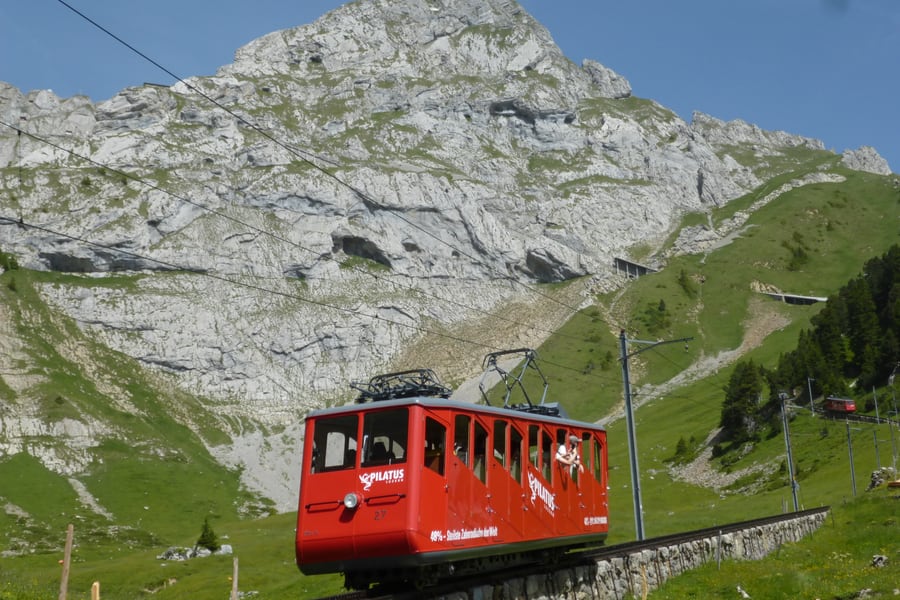
A rack that is gripped, not sat on
Eduard Locher laid his rack flat in the middle of the track with teeth on both faces, and had two pinions grip it from either side. A conventional cogwheel pressed down from above would have climbed out of its teeth on a slope like this.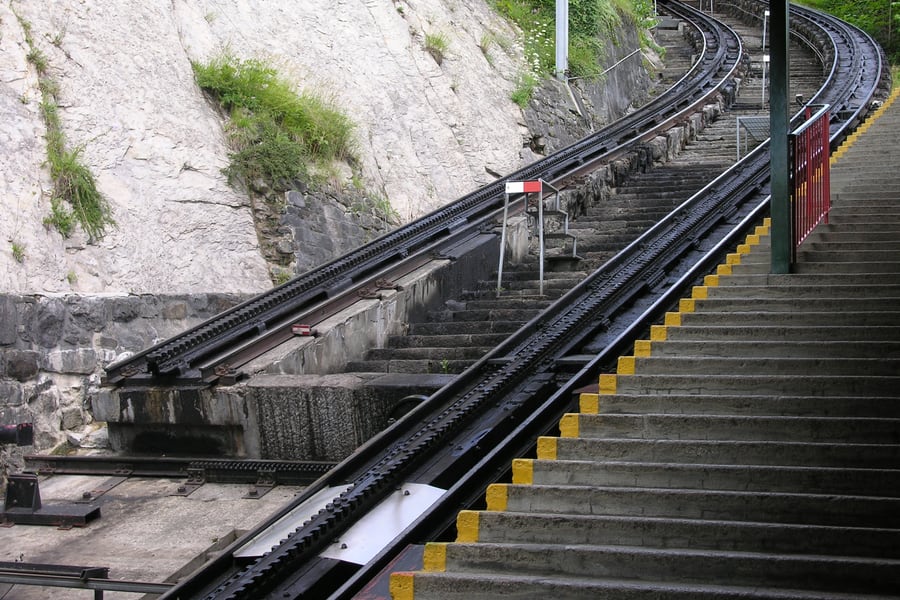 Audriusa / Wikimedia Commons · CC BY-SA 3.0 · cropped
No points, anywhere
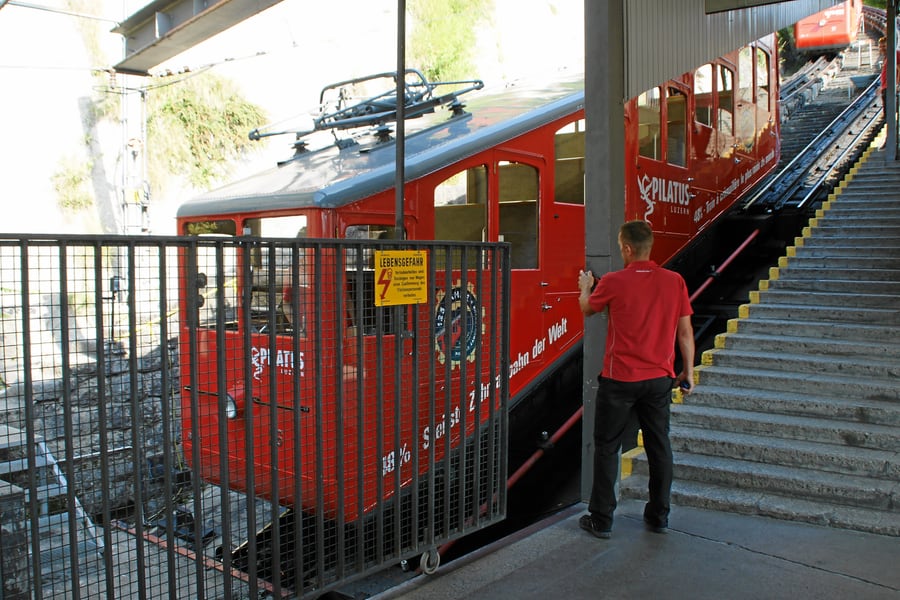
A rack gripped from both sides cannot be nudged sideways, so ordinary points are impossible here. Junctions are made by moving whole pieces of track: a sliding table carries a railcar bodily across to the next road.A bit of history
Culture & experiences along the way
 Mboesch / Wikimedia Commons · CC BY-SA 4.0 · 2016 · cropped
Nostalgic sunrise ride
Up before dawn behind one of the two 1937 railcars still kept in running order, then breakfast at the top.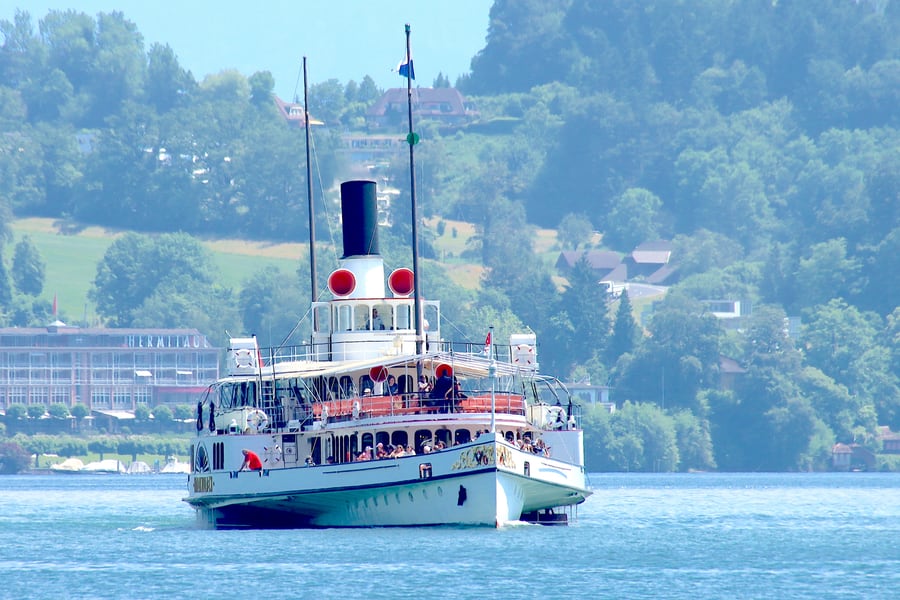 Hp.Baumeler / Wikimedia Commons · CC BY-SA 4.0 · cropped
Golden Round Trip
Paddle steamer from Lucerne, rack railway to the summit, cableway and gondolas down the other side.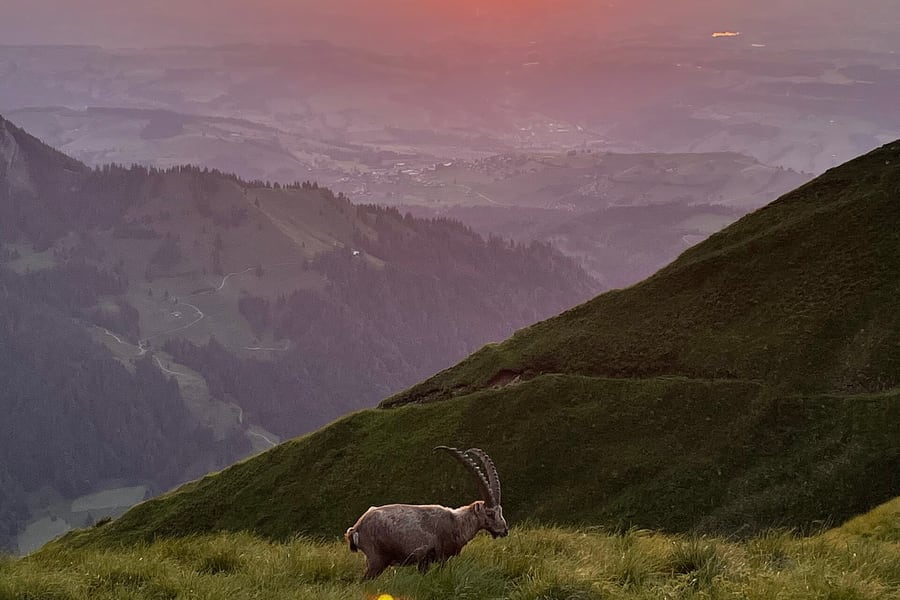 House2022 / Wikimedia Commons · CC BY-SA 4.0 · cropped
Ibex Safari
An evening walk with local guides to the colony that has lived on this mountain for more than sixty years, and a night at the top.Timetables
The cogwheel railway runs from 11 May to 29 November 2026. Outside those dates there is no service on the rack line at all; the cableway from Kriens on the other side of the mountain carries on through the winter, and that is the only way to the summit between December and April.
Times below are the operator's own 2026 timetable, valid 1 January to 31 December 2026 and checked against pilatus.ch in August 2026. There is one pattern all season: a train every thirty-five minutes, seventeen each way.
Alpnachstad → Pilatus Kulm
| Alpnachstad | Ämsigen* | Pilatus Kulm |
|---|---|---|
| 08:10 ᴬ | 08:20 | 08:37 |
| 08:45 | 08:55 | 09:12 |
| 09:20 | 09:30 | 09:47 |
| 09:55 | 10:05 | 10:22 |
| 10:30 | 10:40 | 10:57 |
| 11:05 | 11:15 | 11:32 |
| 11:40 | 11:50 | 12:07 |
| 12:15 | 12:25 | 12:42 |
| 12:50 | 13:00 | 13:17 |
| 13:25 | 13:35 | 13:52 |
| 14:00 | 14:10 | 14:27 |
| 14:35 | 14:45 | 15:02 |
| 15:10 | 15:20 | 15:37 |
| 15:45 | 15:55 | 16:12 |
| 16:20 | 16:30 | 16:47 |
| 16:55 ᴬ | 17:05 | 17:22 |
| 17:30 ᴬ | 17:40 | 17:57 |
Pilatus Kulm → Alpnachstad
| Pilatus Kulm | Ämsigen* | Alpnachstad |
|---|---|---|
| 08:44 ᴬ | 08:55 | 09:17 |
| 09:19 | 09:30 | 09:52 |
| 09:54 | 10:05 | 10:27 |
| 10:29 | 10:40 | 11:02 |
| 11:04 | 11:15 | 11:37 |
| 11:39 | 11:50 | 12:12 |
| 12:14 | 12:25 | 12:47 |
| 12:49 | 13:00 | 13:22 |
| 13:24 | 13:35 | 13:57 |
| 13:59 | 14:10 | 14:32 |
| 14:34 | 14:45 | 15:07 |
| 15:09 | 15:20 | 15:42 |
| 15:44 | 15:55 | 16:17 |
| 16:19 | 16:30 | 16:52 |
| 16:54 | 17:05 | 17:27 |
| 17:29 ᴬ | 17:40 | 18:09 |
| 18:04 ᴬ | 18:15 | 18:37 |
ᴬ — daily from the opening of the season until 24 October only. * — Ämsigen is a request stop. Passengers wanting to get off tell the driver before departure; boarding is possible only if there is room in the railcar, and the stop is not suitable for wheelchairs.
The climb takes twenty-seven minutes and the descent thirty-three, which is the way round a rack railway usually works: the train comes down under brake.
Getting to Alpnachstad
By train, from Lucerne on the Zentralbahn's Brünig line, seventeen minutes, roughly every half hour from 07:42 to 17:12 for the ascent and from 08:59 to 18:59 coming back.
By boat, from pier 2 in Lucerne, opposite the main station. The Lucerne–Alpnachstad sailings run only from 11 May to 18 October 2026, and not all of them run every day: the 08:38 from Lucerne is a high-summer and weekend working, the 16:38 runs daily from 23 May, and the rest fall between those two extremes. Crossings take from forty-seven minutes to an hour and a half depending on how many piers the boat calls at.
Practical notes from the operator
- A seat reservation is recommended but not compulsory. The operator's advice is to book at weekends in good weather and around midday during the week; without one there may be a wait.
- Groups of ten or more have to be registered 24 hours in advance.
- Extra trips outside the normal hours can be arranged from and to Alpnachstad against a surcharge, with at least ten days' notice.
- Bicycles are not carried. Pushchairs travel folded. Hand luggage is free; goods have to be registered in advance and are charged for.
- The cableway side of the mountain — the gondolas from Kriens to Fräkmüntegg and the Dragon Ride from there to the summit — closes for maintenance on 30 and 31 March and from 19 October to 27 November 2026. Its last ascent from Kriens is at 17:00 in summer and 16:00 in winter.
The two seasons are staggered rather than matched, which is worth knowing about. From 19 October to 27 November the cogwheel railway is the only way to the summit, and from 25 October it is running its shorter fourteen-train day. Both work on 28 and 29 November, and from 30 November the position reverses: the rack line is shut for the winter and the cableway is the only way up.
The current timetable and any disruption notices are at pilatus.ch (opens in a new tab).
Tickets
Prices are the operator's own 2026 fare list, valid to 31 December 2026 and confirmed at the Pilatus-Bahnen web shop in August 2026. There are no classes on the mountain and no peak and off-peak. Half fare covers an unusually long list of cards — the SBB Half-Fare Travelcard, the GA Travelcard, the Swiss Travel Pass, the Swiss Half Fare Card, and Interrail and Eurail, which is worth saying loudly because most Swiss mountain railways give the European passes nothing at all. Children from six to fifteen pay the same half fare. Municipal day passes, saver day passes and the Bernese Oberland Pass are not valid.
A seat reservation is CHF 5.00 a ride, booked separately against a departure time. It is not compulsory; the operator recommends one for fine weekends and midday in the week, and warns of a queue without. Discount cards are checked at the turnstile, so they have to be carried.
Book your tickets
Alpnachstad – Pilatus Kulm return
CHF 84 full fare · CHF 42 with a Half-Fare Card, GA, Swiss Travel Pass, Interrail or Eurail
The whole line and back, twenty-seven minutes up and thirty-three down.
Book Tickets (opens in a new tab, on Pilatus-Bahnen AG)via Pilatus-Bahnen AGSeat reservation
Per person, per ride, against a departure time
Not compulsory, but the way to avoid a queue on a fine weekend.
Book Tickets (opens in a new tab, on Pilatus-Bahnen AG)via Pilatus-Bahnen AGGolden Round Trip
Boat, rack railway, cableway, gondolas and bus · May to October
Up the mountain by rack from the lake steamer, down to Kriens by cableway.
Book Tickets (opens in a new tab, on Pilatus-Bahnen AG)via Pilatus-Bahnen AGSilver Round Trip
The same circuit with the train instead of the boat
Cheaper, quicker, and the only difference is the Lucerne–Alpnachstad leg.
Book Tickets (opens in a new tab, on Pilatus-Bahnen AG)via Pilatus-Bahnen AGRail Passes
This is the first Swiss mountain railway in a while where a European pass is worth carrying.
Interrail and Eurail get half fare
The operator's own list of accepted cards names Eurail (50%) and Interrail (50%) alongside the Swiss Travel Pass and the Swiss Half Fare Card, for journeys between Kriens or Alpnachstad and the summit. The validity map that Interrail publishes says the same thing from the other side: under Bonuses for pass holders it prints "PB Pilatusbahn: Kriens–Pilatus–Alpnachstad 50%". And the checkout prints it a third time, as its own fare line — Eurail/Interrail, CHF 42.00 — for the Alpnachstad return that costs everyone else CHF 84.00.
That is unusual. On the Gornergrat, the Brienz Rothorn and Montreux–Rochers-de-Naye the European passes do nothing whatever, and a pass holder pays the full fare. Here they halve it.
The Swiss cards do better on a round trip than they look
A Half-Fare Travelcard, a GA Travelcard, a Swiss Travel Pass or a Swiss Half Fare Card also halve the mountain fare, to CHF 42.00 for the return from Alpnachstad. On the two round trips, though, the GA and the Swiss Travel Pass pull ahead of everything else, because the boat, the Brünig-line train and the Kriens bus are already covered by them:
| Full fare | Interrail / Eurail | GA · Swiss Travel Pass | |
|---|---|---|---|
| Golden Round Trip, 2nd class boat | CHF 119.80 | CHF 60.90 | CHF 42.00 |
| Golden Round Trip, 1st class boat | CHF 136.80 | CHF 69.40 | CHF 42.00 |
| Silver Round Trip, either class | CHF 94.20 – 98.00 | CHF 45.40 | CHF 42.00 |
The gap between the two pass columns is exactly the lake. Interrail and Eurail get a 50 per cent bonus on the Lake Lucerne boats rather than a free ride, so the Golden trip costs them the boat's half fare on top of the mountain; the Silver trip, which uses the train, costs them almost nothing extra because the Zentralbahn's Luzern–Interlaken Ost line and the whole SBB network are free rides on both passes.
What does not work
- Municipal day passes, saver day passes and SBB day-pass offers are not valid, in any form.
- The Bernese Oberland Pass is not valid either, which catches people combining the Pilatus with the Jungfrau region.
- The Lucerne Travel Pass is the exception in the other direction: it carries you up the Pilatus for nothing.
Is a pass worth buying for this journey?
For a single ride up and down, no — a half-fare card of some kind saves CHF 42.00, and nothing about this railway alone justifies the price of a national pass.
For the Golden Round Trip, the arithmetic changes completely. A Swiss Travel Pass holder pays CHF 42.00 for a day that costs CHF 119.80 at the counter, and that is before the rest of the day's travelling. If the Pilatus is one stop on a Swiss trip of a week or more, the pass has already earned a good part of itself here.
For a traveller already holding Interrail or Eurail, the useful decision is which round trip to take. The Silver trip at CHF 45.40 is the better value of the two on a pass; the Golden trip costs CHF 15.50 more and buys a boat crossing of Lake Lucerne, which many people will think worth it.
Checked against the operator's fare list, its web shop and the Interrail validity map for 2026, in August 2026.
Places to Visit
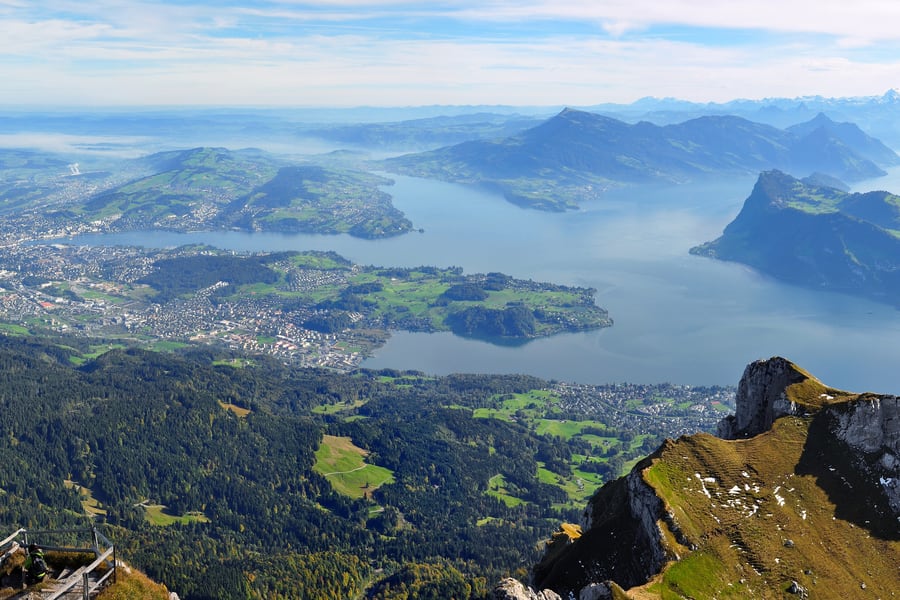
The Pilatus is not one peak but a ridge of them, running east to west on the boundary of three cantons — Lucerne, Obwalden and Nidwalden — and covering some fifty square kilometres. The highest point is the Tomlishorn at 2,128 metres; the Esel, immediately above the railway's terminus, is 2,118; the Oberhaupt is 2,106. The weather station at 2,105 metres records a mean temperature of 2.3 °C over the year and 9.8 °C in July, so it is worth taking something warm up even in August.
In the Middle Ages the mountain was the mons fractus, the broken mountain, and two alps on its flanks are still called Fräkmüntegg and Fräkmünt. The name Pilatus appears from about 1433 and is probably from the Latin for a pillar, or from a felt cap — the cloud that so often sits on the summit. Only later was it attached to Pontius Pilate, and to the story that his body came to rest in a small lake on the Oberalp, that storms broke out wherever anyone tried to bury him, and that he climbs out in full official dress each Good Friday. Lucerne's council forbade anyone to go up the mountain in case they disturbed him; four humanists including Joachim Vadian needed the council's express permission to climb it in 1518, and Conrad Gessner reached the top in August 1555 and wrote it up as the Descriptio montis Fracti. The dragons that were held to live in the crevices are where the Dragon Ride cableway and the summit's Dragon Path get their names; the hotel reception and the Kriens valley station both hand out a booklet of the legends for nothing.
Nothing at the top is more than a few minutes' walk from the station. The Esel viewpoint, reached by a path behind the Hotel Bellevue, is about ten minutes and open from June to October; the Oberhaupt is five, by way of the panorama terrace; the Dragon Path, a circuit through the rock galleries, is about twenty. The ibex that live on the mountain — a colony established more than sixty years ago — are usually seen at dawn and dusk on the slopes below the ridge.
 Bybbisch94 / Wikimedia Commons · CC BY 4.0 · cropped
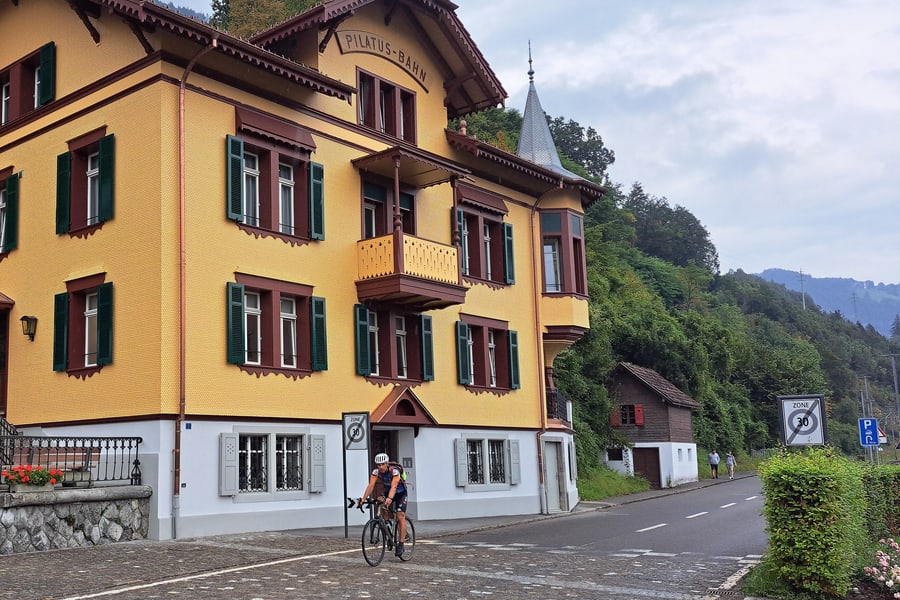
Alpnachstad
A hamlet on an arm of Lake Lucerne, and a place where three ways of travelling meet inside two minutes' walk: the boat pier, the Zentralbahn's Brünig-line platforms, and the rack railway's own building of 1889 with PILATUS-BAHN across its gable. The valley station behind it was rebuilt between 2020 and 2023, gaining a second platform and three rotary switches, and the whole line is now signalled from here.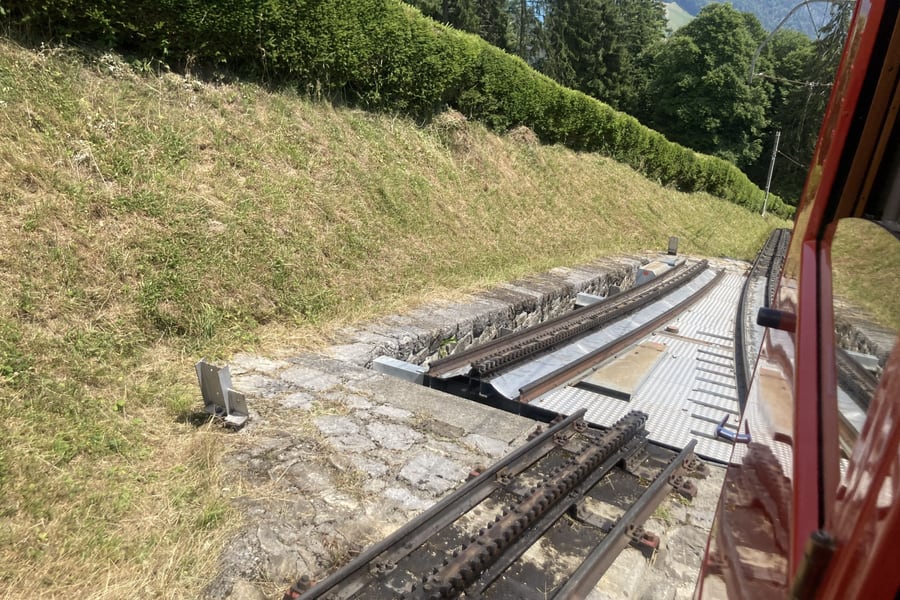 Mattsjc / Wikimedia Commons · CC BY-SA 4.0 · cropped
Ämsigen
Halfway up, on an alp, with a sliding table at each end and room on its two tracks for five railcars. Every train going up meets a train coming down here, which is what fixes the thirty-five-minute interval. It was upgraded to a stop the public could use with the summer timetable of 2006 and is still a request stop: passengers wanting to get off tell the driver before departure, and boarding depends on there being space in the car.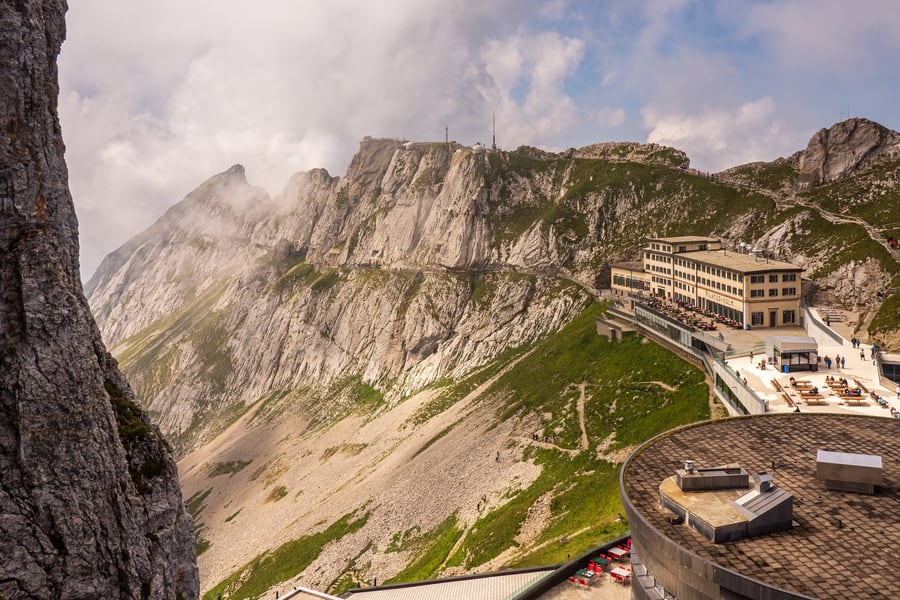 Reinhold Möller / Wikimedia Commons · CC BY-SA 4.0 · cropped
Pilatus Kulm
The top of the line sits in a saddle immediately below the Esel, with two hotels, a panorama gallery cut through the rock, a terrace and the upper station of the aerial cableway from Kriens. Nothing here can be reached by car; everything the summit consumes comes up in the railway's goods railcar. The Oberhaupt is a five-minute walk by way of the terrace, and the Esel viewpoint about ten minutes by a path behind the Hotel Bellevue.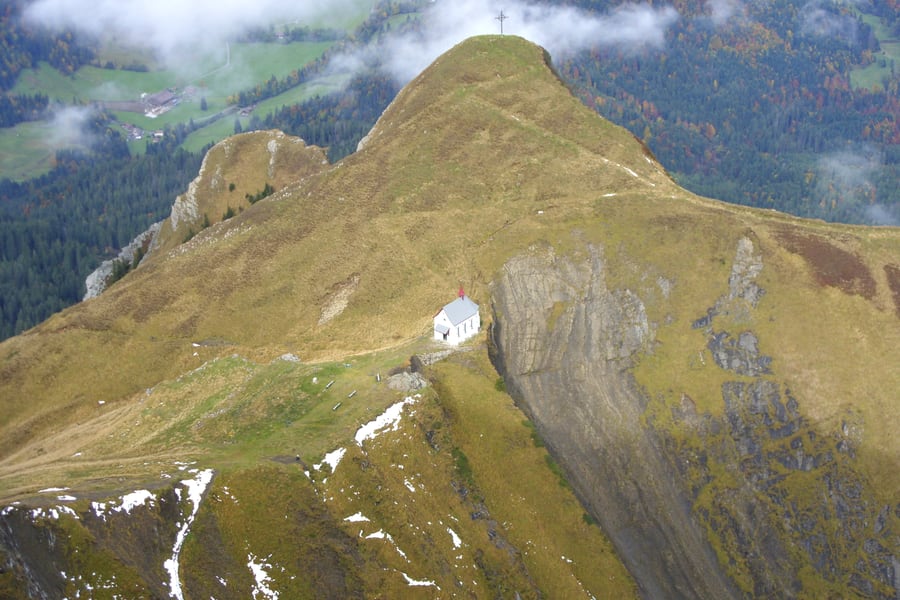 Teelevision / Wikimedia Commons · CC0 · cropped
The Klimsenhorn
A spur standing out to the north-west of the Oberhaupt, with a small white chapel on its shoulder and a footpath down to it from the summit. The Klimsenhaus was built here in 1856 and was the first building on the Pilatus put up purely for visitors — thirty-three years before the railway, and the beginning of the tourist trade that paid for it.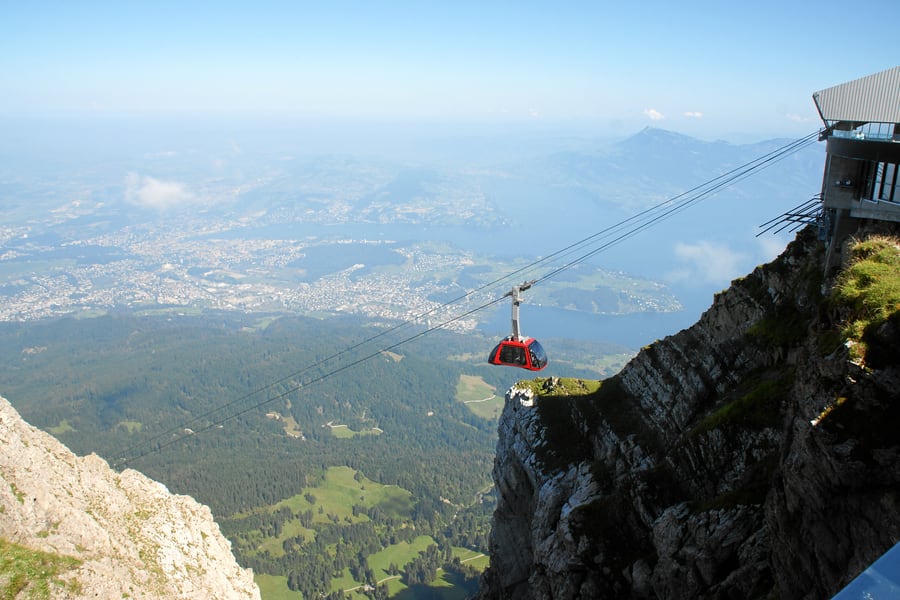 Mboesch / Wikimedia Commons · CC BY-SA 4.0 · cropped
Kriens and the Dragon Ride
The far side of the Pilatus is reached by cableway rather than rack: panorama gondolas from Kriens, on the edge of Lucerne, to Krienseregg and Fräkmüntegg, and then the Dragon Ride aerial cableway to the summit. It takes about forty minutes and runs all year apart from two maintenance periods, which is why the winter fares on this mountain exist at all. The name comes from the dragons medieval Lucerne believed lived in the crevices up here.Where to Sleep
There are two hotels on the Pilatus and both belong to the railway. They stand side by side at the top of the line, at 2,132 metres, and between them they are the reason the last trains of the day run at all: cars cannot get up here, so everyone staying the night arrives by rack railway or cableway and everything they eat comes up in the goods railcar.
The valley end is thinner. Alpnachstad is a hamlet — a pier, two stations and a chalet restaurant — and the nearest choice of hotels is in Lucerne, seventeen minutes away by train, or in Kriens at the foot of the cableway on the other side of the mountain. Anyone building the Golden Round Trip into a Lucerne stay is better served by a bed in the city and a day out on the mountain.
Where to stay
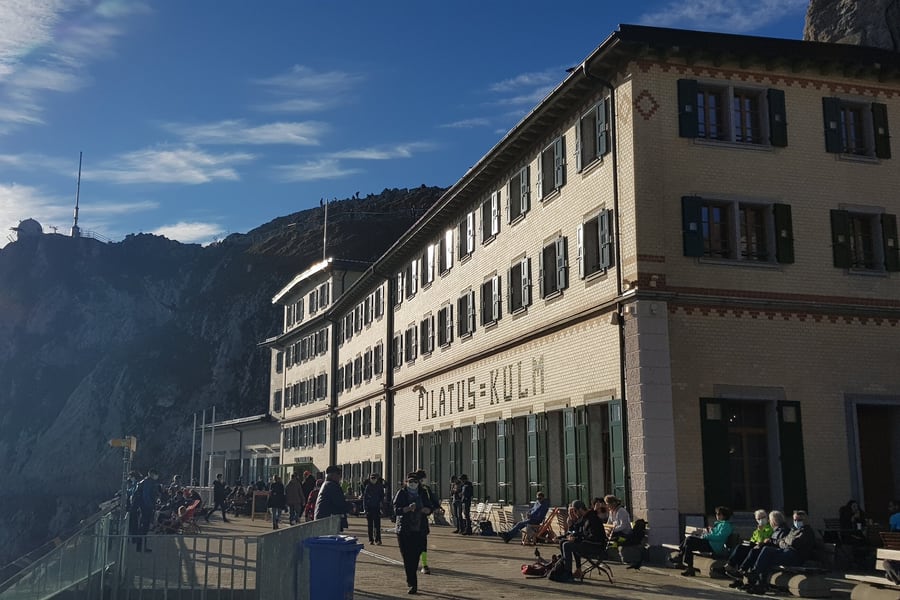 Pascal Niederberger / Wikimedia Commons · CC BY-SA 4.0 · cropped
Hotel Pilatus-Kulm
At the top of the line, built with it
Standing at 2,132 metres above Lake Lucerne since 1890, a year after the railway that serves it, and built in the same Belle Époque burst. The house has superior and grand superior double rooms of twenty-four and twenty-eight square metres and junior suites of forty-six, all of them looking out at the Alps, and the larger rooms and the suites are step-free.
Check Availability (opens in a new tab, on pilatus.ch)via pilatus.chHotel Bellevue
Next door, and the older address of the two
The Bellevue was the first establishment on the mountain. The building that stands there now is a design of the 1960s by Anton Mozatti, open and glazed towards the landscape, and its standard double rooms of twenty square metres look out at either the mountains or the Lake Lucerne basin. The path to the Esel viewpoint starts behind it.
Check Availability (opens in a new tab, on pilatus.ch)via pilatus.chQuestions or corrections
Planning this trip and stuck on something, or spotted a time, fare or detail that has changed? Send us a message about Pilatus Railway. We read every one, and we update this page when something has changed.