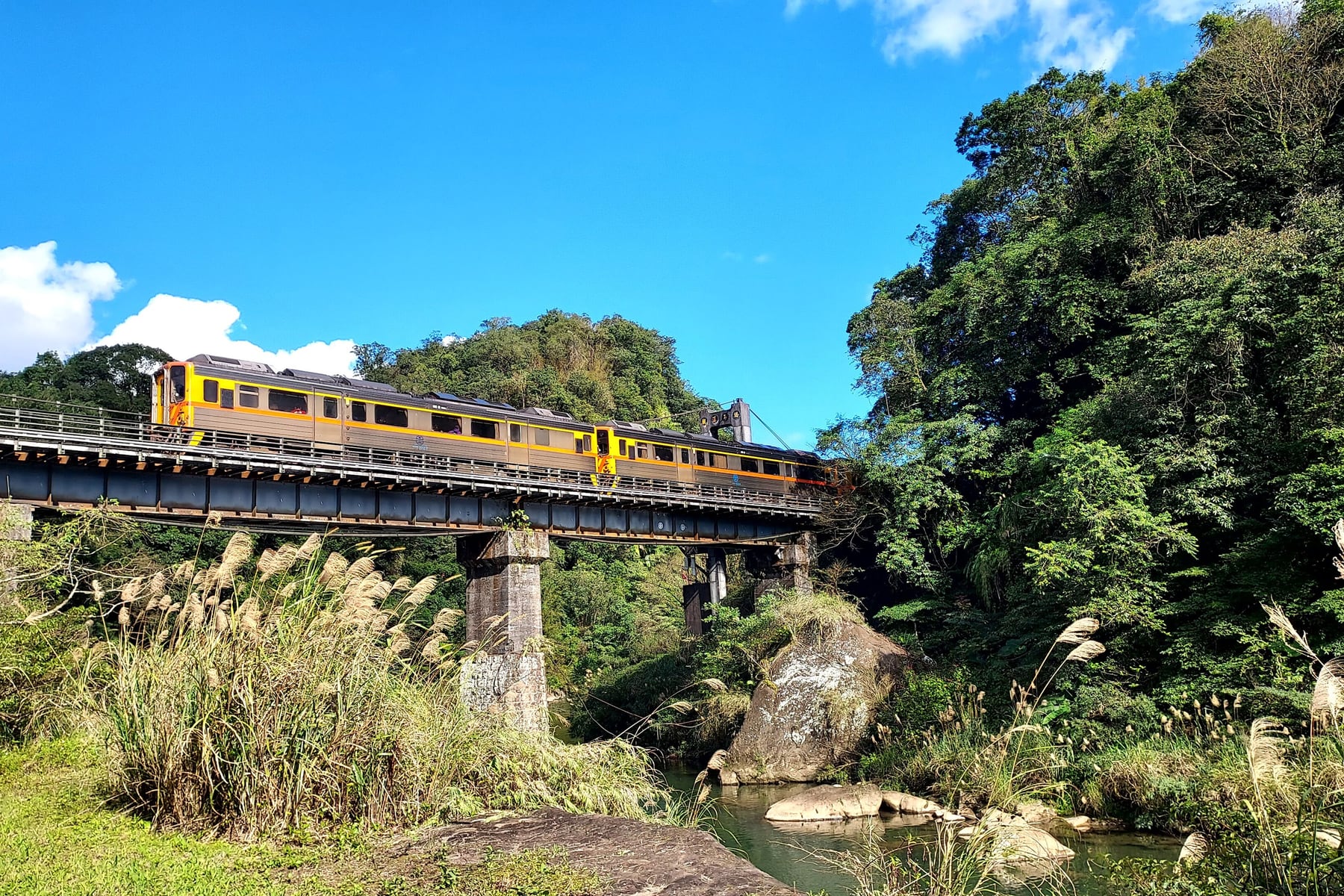
The Pingxi Line
Cypp0847 / Wikimedia Commons · CC BY-SA 4.0 · 2024 · cropped
- Distance12.9 km branch · 20 km from Ruifang
- DurationAbout 50 minutes end to end
- Best season16 trains a day each way, every day, all year
Introduction
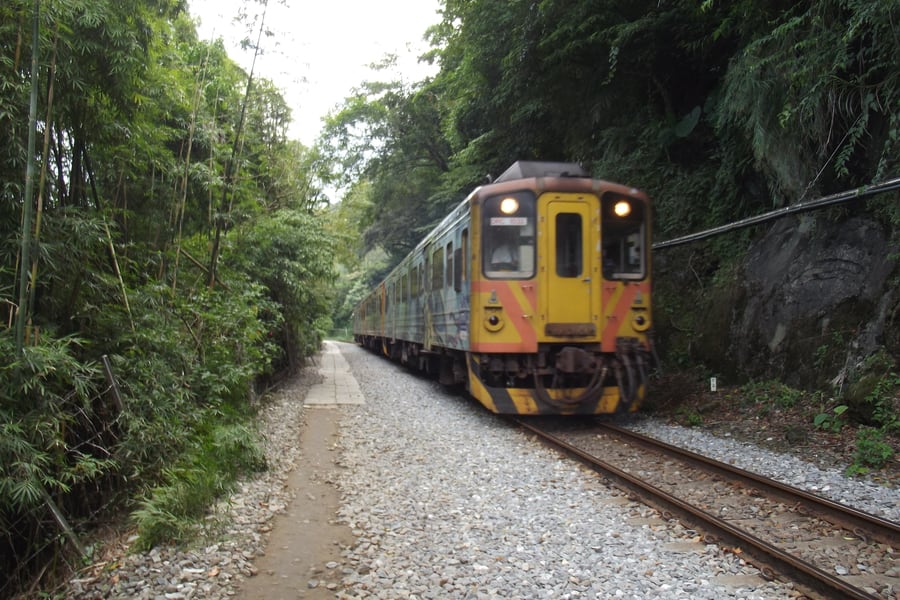
At Shifen the train comes down the middle of the street. There is no fence and no platform edge — the rails run between two rows of shopfronts with a few feet of standing room on either side, and the shopkeepers move their awnings and their tables back as the railcar comes through at walking pace. Half an hour earlier the same train was in a gorge with nothing but bamboo either side of it. That is the Pingxi Line in two pictures: a small industrial railway that has ended up running through the front rooms of the villages it was built to empty of coal.
It is 12.9 kilometres long, from a junction at Sandiaoling to a wooden terminus at Jingtong, on 1,067 mm track that has never been electrified. It was dug out of the Keelung River valley between 1919 and 1921 by a Taipei coal company that wanted its own way down to the main line, and it carried nothing but coal for its first eight years. The colonial railway bureau bought it in 1929, put passengers on it, and gave it the name it still has. The mines closed one after another through the 1980s and 1990s, the valley emptied, and the line survived a proposal to close it because the people who lived along it argued for it.
What saved it was the sky lantern. Pingxi releases paper lanterns on the first full moon of the lunar year and now on most afternoons of the week as well, and the trains that used to bring coal down now bring visitors up — sixteen of them a day in each direction, worked by a brass tablet handed to the driver at every station, one of only two lines in Taiwan where that is still how it is done.
The Journey
The branch proper begins at Sandiaoling, but nobody starts there. Trains work through from the main line, so the ride begins at Ruifang, seven kilometres down the Yilan Line and forty minutes out of Taipei, and the whole run to Jingtong is twenty kilometres and a little under an hour. The first part of it is main-line railway: four tracks, overhead wires, the town packed into the valley floor on both sides. At Houtong the wires are still up and the platforms are long, and cats sleep on the retaining wall above the track — the village put its name to them after the pit closed and has been living off them since.
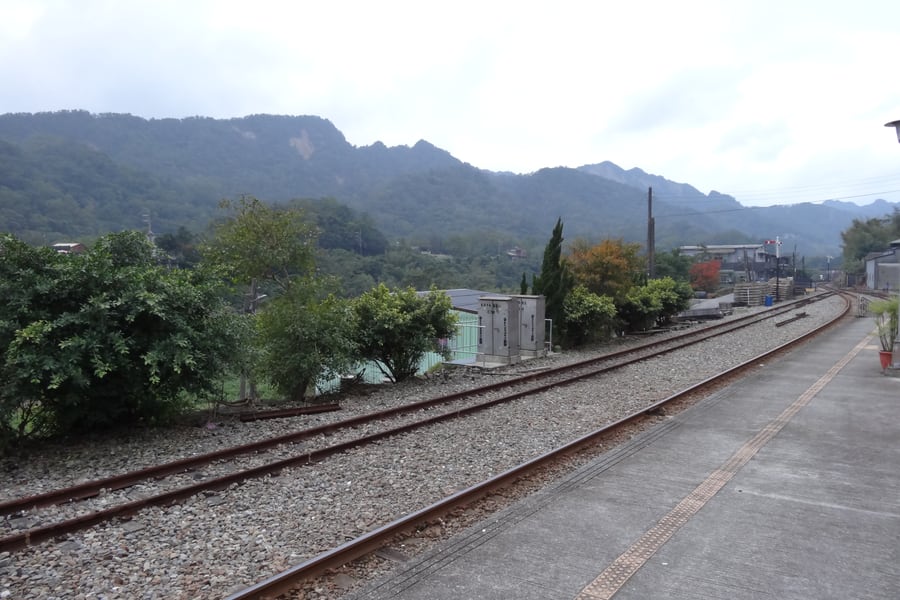
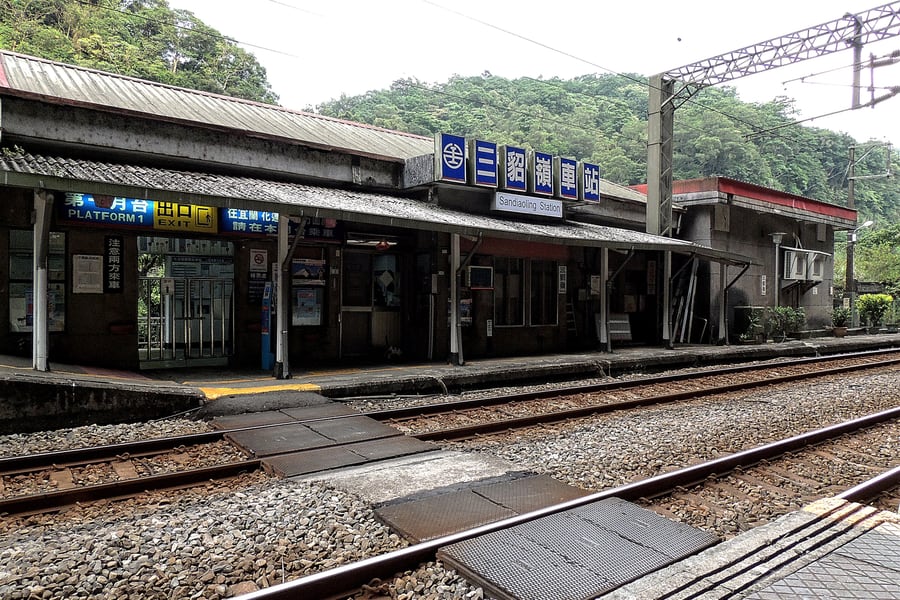
Then the train slows for Sandiaoling and everything changes. The station is wedged against a rock face on the left bank of the Keelung River with no road to it at all, the only one on the whole Taiwan Railway network in that position; until a footbridge was slung alongside the railway bridge in August 2025, the way in and out on foot was the maintenance walkway. The branch curves away east here, drops its second track, and the wires stop. From this point the train is alone on a single line up a gorge.
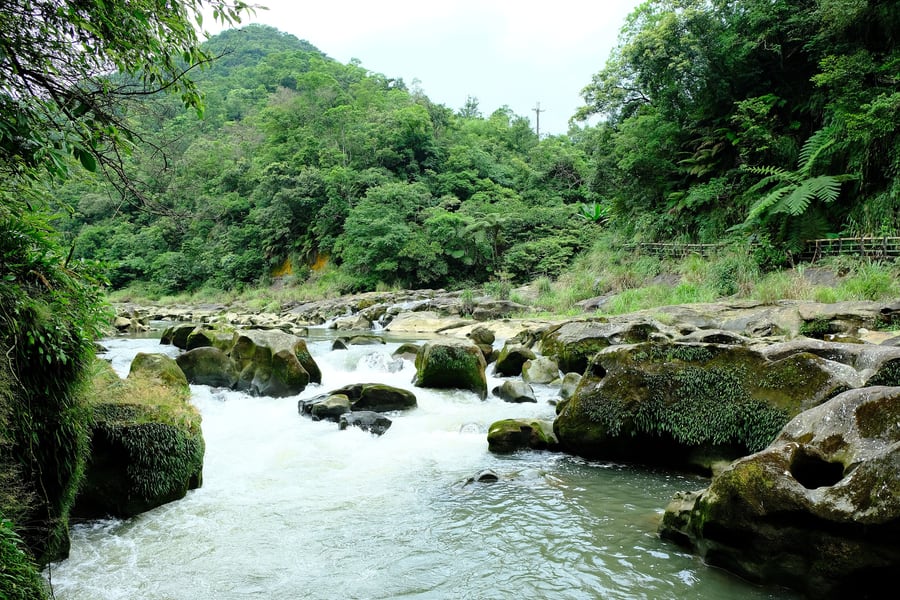
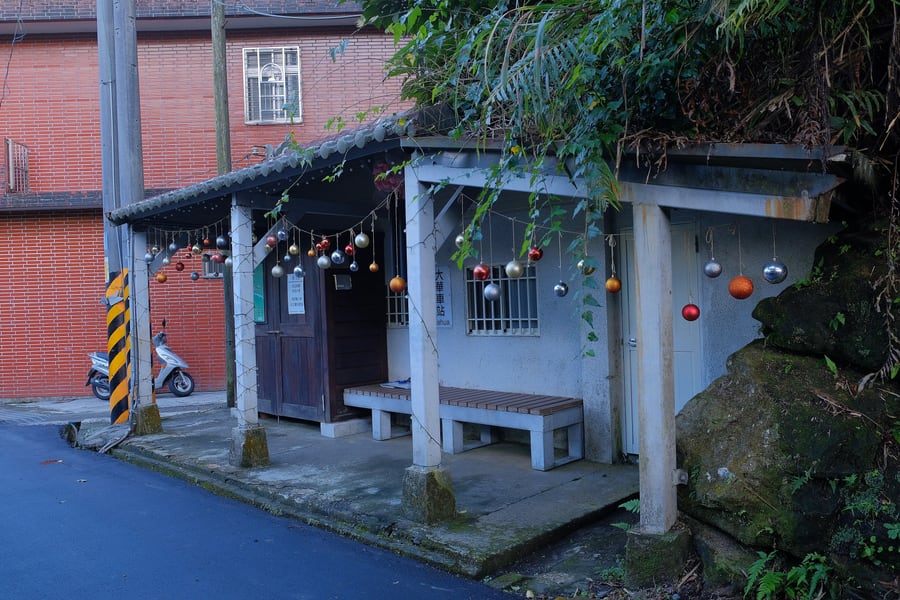
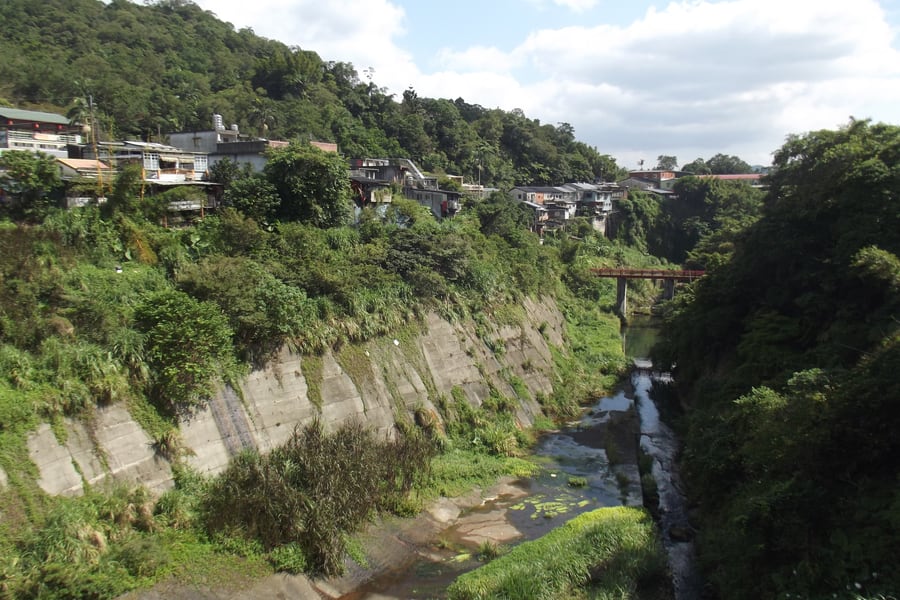
Dahua is the emptiest station on the railway — a concrete shelter under a wooded slope, no village to speak of, and below it the river running over a bed of potholes scoured into the sandstone. The next stretch is the best of the ride: the line crosses the Keelung and its tributaries on plate girders, runs under overhanging bamboo, and comes out of the trees directly into Shifen.
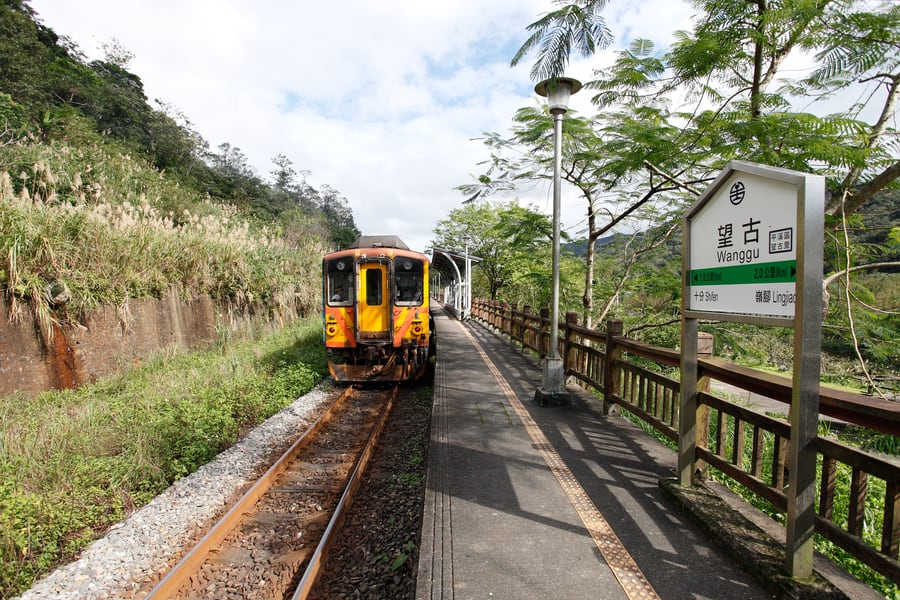
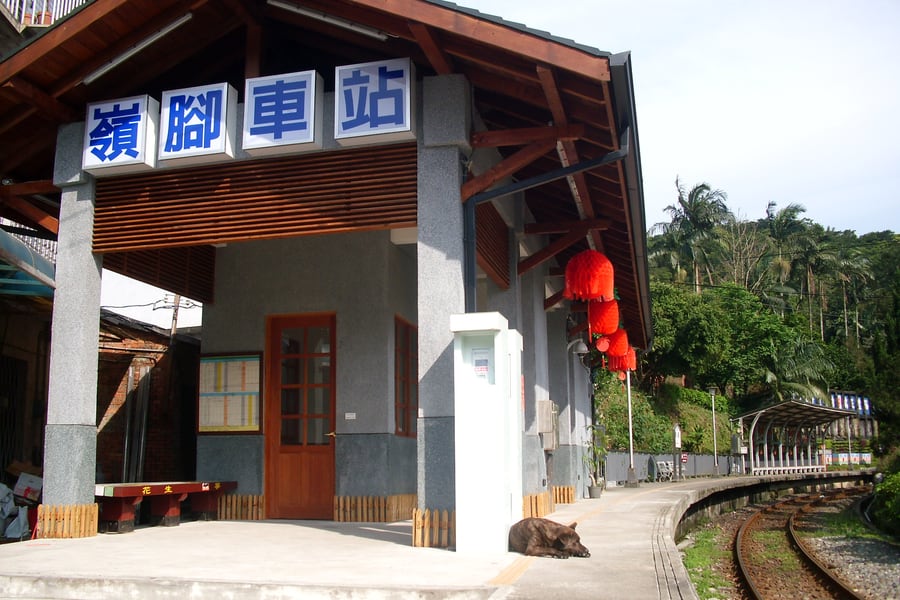
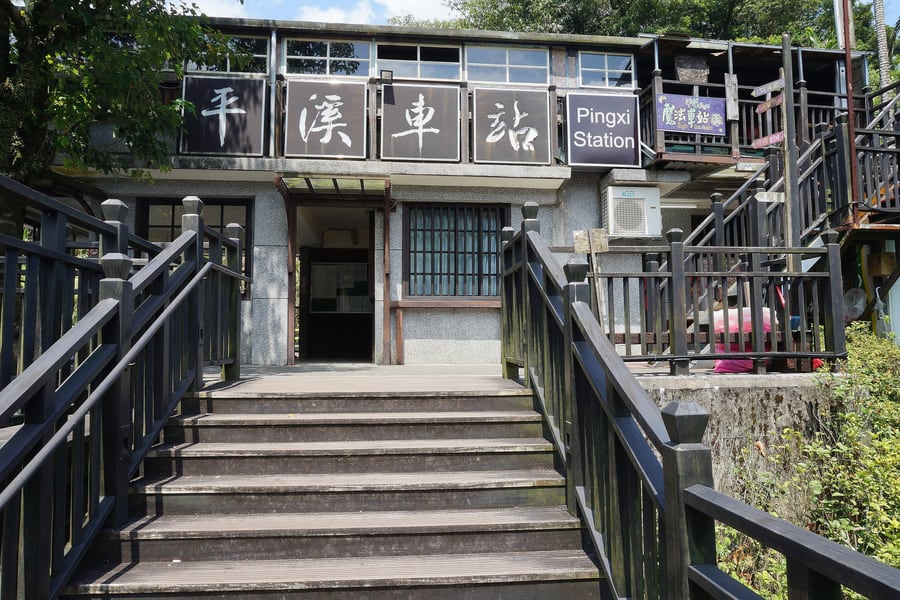
Shifen is the biggest station on the line and the only place two trains can pass, so every service stands here for six or ten minutes while the other one comes. The village is built along the track on both sides — the famous stretch where the rails are the street — and the waterfall is twenty minutes' walk downstream. Above it the line climbs steadily through three small halts. Wanggu is a single platform in a cutting with a nameboard and nothing else. Lingjiao has a wooden station building with a red door and, usually, a dog asleep on the platform. Pingxi, the town that gives the line its name, is on a shelf above the street, reached by a flight of stairs from the old road, with the railway running over the roofs of the shops on a low viaduct. Two minutes later the track crosses Sankeng Creek on a steel bridge, curves once more, and stops at Jingtong.
The trains, and the brass disc
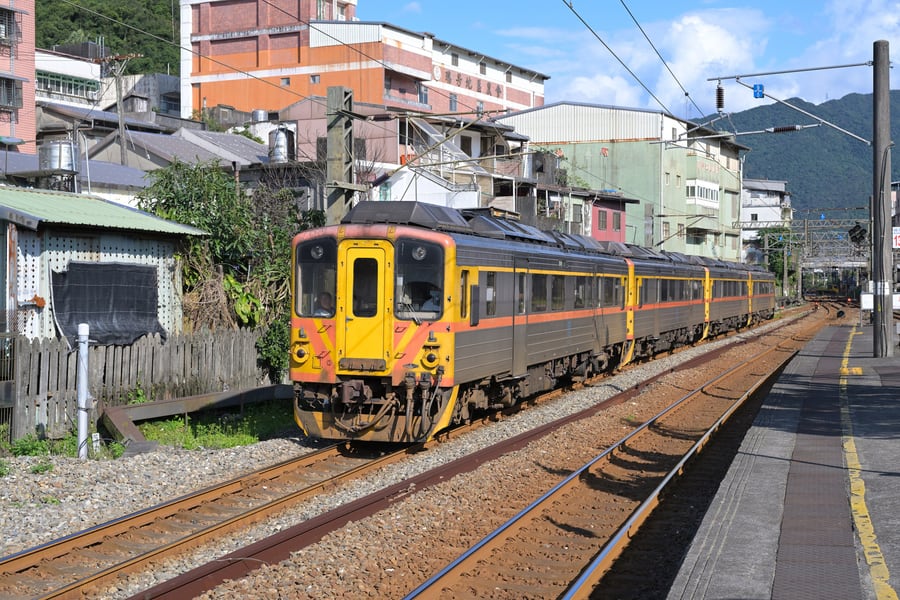
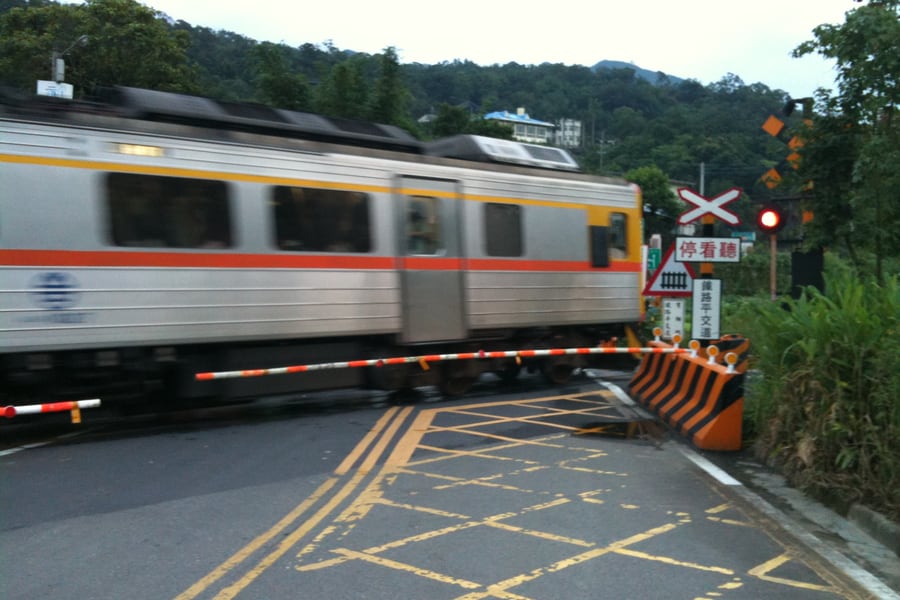
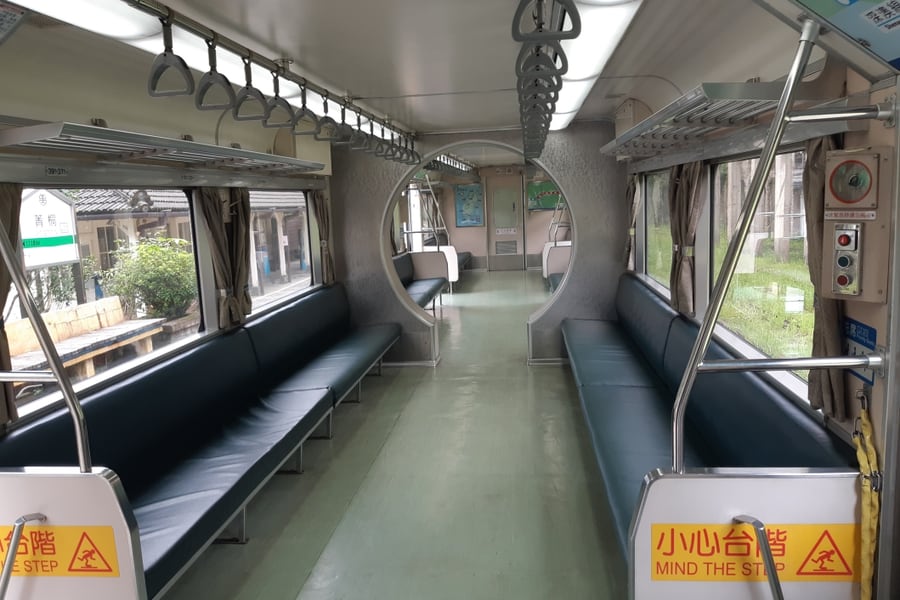
Everything on the branch is worked by a DR1000 diesel railcar: air-conditioned two-car sets built by Nippon Sharyo and put into service on 2 December 1998, with a 385-horsepower Cummins engine under each car, longitudinal bench seats and big square windows. Two or three cars run on an ordinary day and four at holidays. They are not fast and were never meant to be — the average over the branch is about twenty kilometres an hour, which is what a single line with nine stations in twenty kilometres allows.
What is genuinely unusual is how they are kept apart. The Pingxi Line and the Jiji Line in central Taiwan are the last two on the network still worked by the electric train tablet: a brass disc about ten centimetres across and a kilogram in weight, with a shape cut out of the middle — a circle, a square, a triangle or an ellipse — that matches only the section it belongs to. Every pair of neighbouring stations has a pair of instruments wired together, and the two station masters have to work them in a set sequence before either can release a tablet. The driver takes the disc with him as his authority to be on that stretch of track and hands it in at the far end. It is a nineteenth-century system, the operator still describes it in the present tense, and on this line it is the reason a train sits at Shifen until the one coming the other way has arrived.
Along the route
 Woodford Yang / Wikimedia Commons · CC BY 3.0 · 2015 · cropped
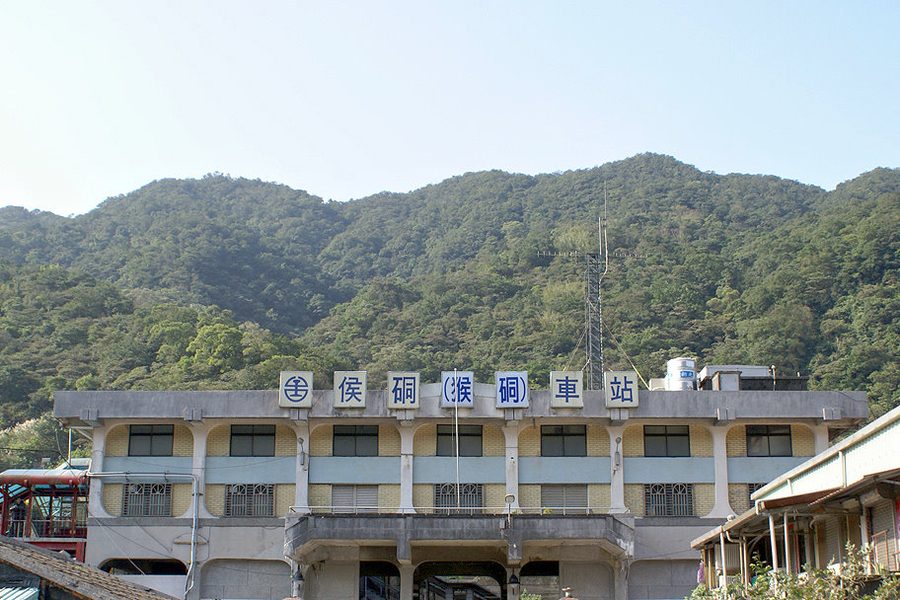
The station no road reaches
Sandiaoling, where the branch leaves the main line, is wedged against a rock face across the Keelung and is the only station on the Taiwan Railway network with no connecting road. A footbridge went up beside the railway bridge in August 2025; before that, residents walked the maintenance way.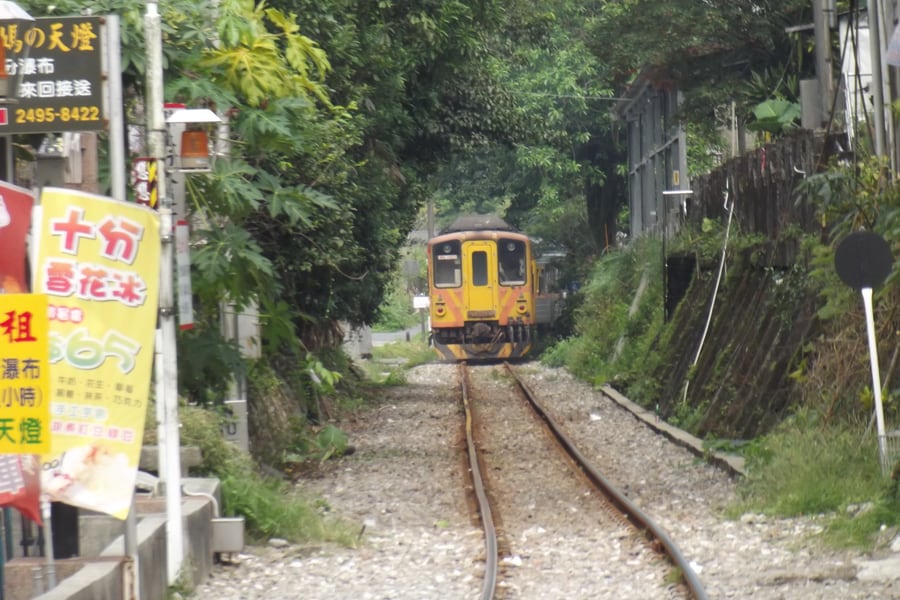 Smiley.toerist / Wikimedia Commons · CC BY-SA 4.0 · 2014 · cropped
The train in the street
At Shifen the rails are the street. For a few hundred metres there is no fence and no platform edge, only two rows of shopfronts with the track between them and the railcar coming through at walking pace while the awnings are folded back. It looks staged. It is an ordinary scheduled service.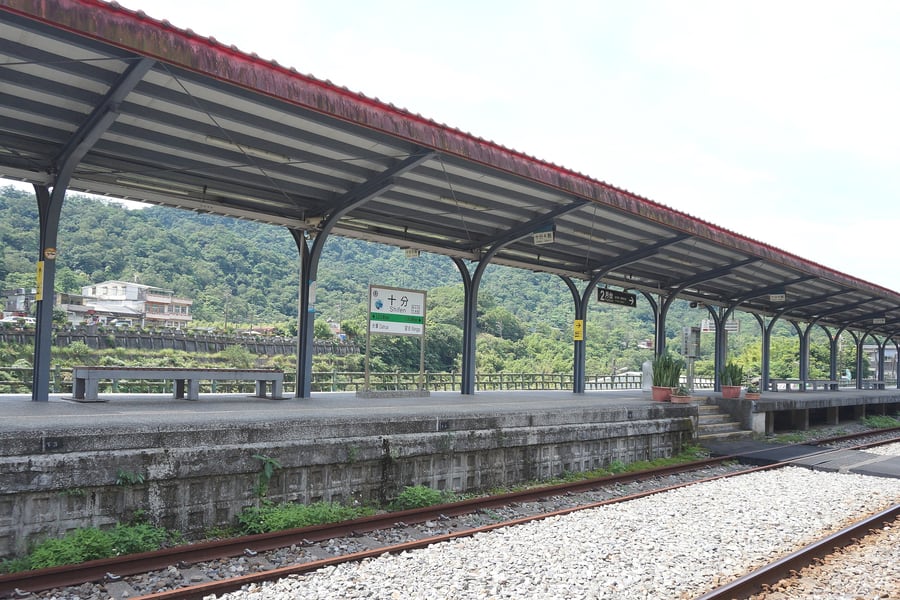 Solomon203 / Wikimedia Commons · CC BY-SA 4.0 · 2020 · cropped
A brass disc, and the wait at Shifen
Shifen is the only place two trains can pass, so every service waits six to ten minutes for the other. What holds it there is a tablet: a kilogram of brass, released by two station masters working paired instruments, carried by the driver as his authority to be on that stretch of line.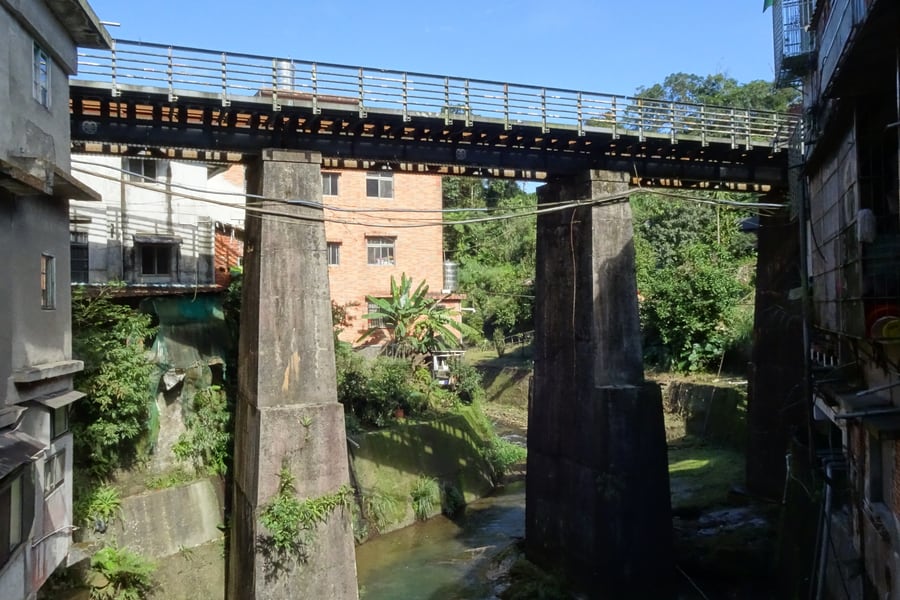 Xingengjiwu / Wikimedia Commons · CC BY-SA 4.0 · 2019 · cropped
Over the water, again and again
The Keelung and its tributaries are why the line curves the way it does, and it crosses them on plate girders every few kilometres. The steel bridge over Sankeng Creek, between Pingxi and Jingtong, is the last of them, with the old street built hard against it on both banks.A bit of history
Culture & experiences along the way
 Yue gowua YT / Wikimedia Commons · CC BY-SA 4.0 · 2019 · cropped
Sending up a lantern
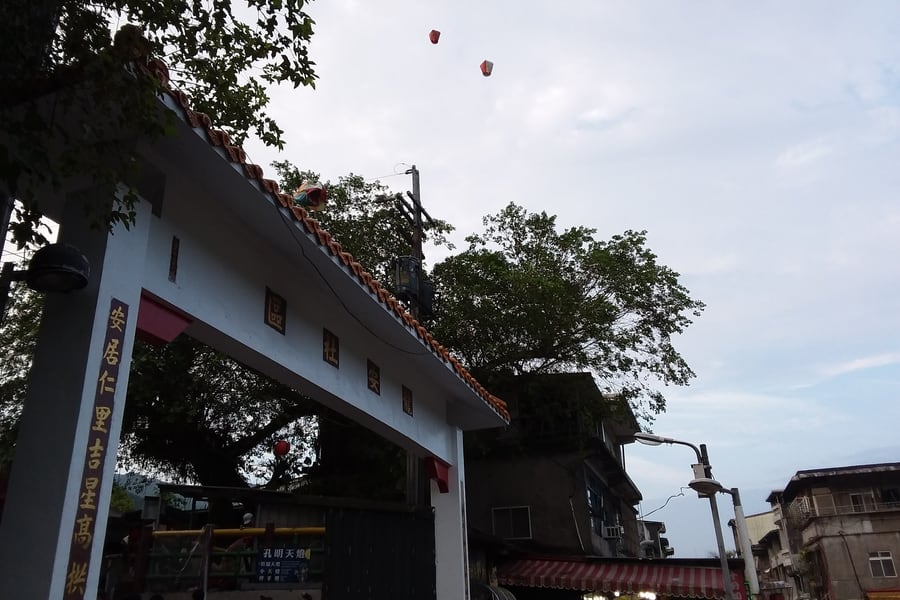
The paper sky lantern arrived with settlers from Minnan in 1821, and it was a signal: released from the hills, it told families in hiding that the bandits had gone and it was safe to come home. The festival that grew out of it runs around the fifteenth day of the first lunar month at Shifen, Pingxi and Jingtong, and was recognised as a New Taipei folk custom in 2008.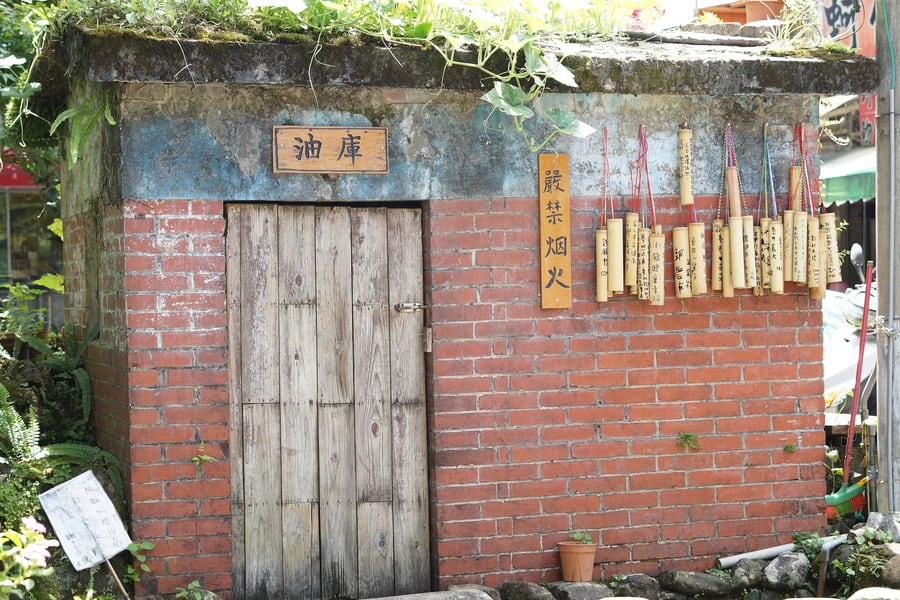 Solomon203 / Wikimedia Commons · CC BY-SA 4.0 · 2020 · cropped
The wishing bamboo at Jingtong
Beside the terminus, on the wall of the old oil store and along the fences of the street below, hang thousands of split lengths of bamboo with wishes written on them in marker pen. Buy a tube, write, hang it up. It is the quieter cousin of the sky lantern, and it costs the valley nothing to clean up afterwards.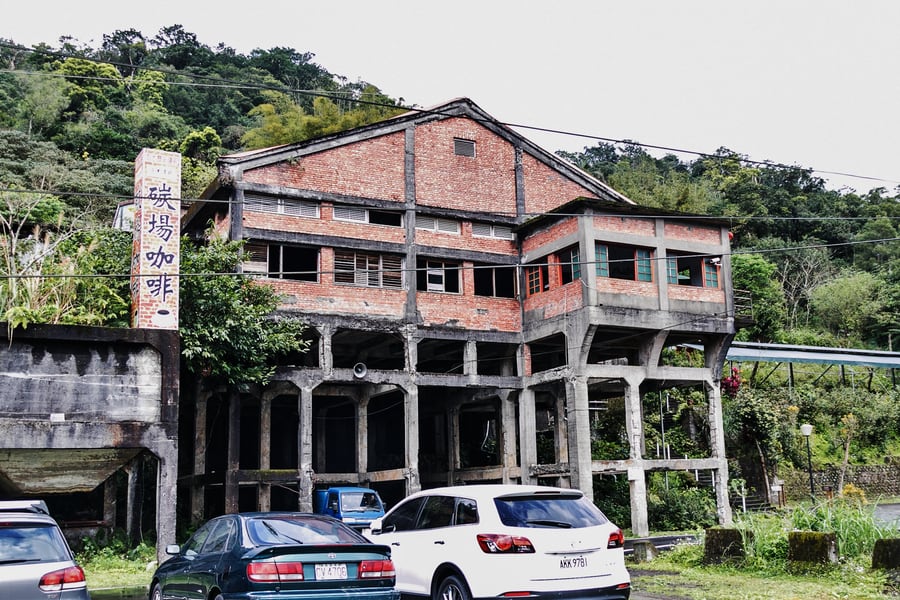 Industrial Wales / Wikimedia Commons · CC BY-SA 2.0 · 2020 · cropped
What the railway was for
Standing on concrete legs opposite Jingtong station is the works the whole line existed to fill — the washing and sorting plant of the Shidi mine, fed by a main incline driven into the hillside behind it from 1937. The mines are gone and the shell is a café now, but it is still the largest thing in the village.Timetables
Sixteen trains a day run each way between Ruifang and Jingtong, from before six in the morning until after nine at night, and they run the same times every day of the week — weekday and weekend timetables are identical on this branch, only the train numbers change. The end-to-end run takes between forty-six minutes and an hour, the difference being how long the train waits at Shifen for the one coming the other way.
Every service works through beyond Ruifang onto the main line: most go on to Badouzi, the far end of the short Shen'ao Line past the National Museum of Marine Science and Technology, and the rest to Badu. That matters if you have the day pass, because it covers that stretch too.
Times below were read from the operator's own English journey planner on 14 September 2026, for Wednesday 16 and Saturday 19 September.
Up the valley
| Station | 4704 | 4714 | 4828 |
|---|---|---|---|
| Ruifang | 05:07 | 09:04 | 15:00 |
| Houtong | 05:14 | 09:11 | 15:07 |
| Sandiaoling | 05:19 | 09:16 | 15:12 |
| Dahua | 05:27 | 09:24 | 15:20 |
| Shifen | 05:35 | 09:31 arr · 09:37 dep | 15:27 arr · 15:36 dep |
| Wanggu | 05:39 | 09:41 | 15:40 |
| Lingjiao | 05:45 | 09:47 | 15:46 |
| Pingxi | 05:48 | 09:51 | 15:50 |
| Jingtong | 05:53 | 09:56 | 15:55 |
The other thirteen departures from Ruifang are at 06:26, 07:12, 07:55, 09:57, 10:55, 11:55, 13:00, 14:00, 15:59, 16:54, 18:33, 19:22 and 21:06, and each takes roughly the same forty-six to sixty-one minutes. There is a seventeenth train, the 22:20, but it runs only as far as Shifen.
Back down
| Station | 4823 |
|---|---|
| Jingtong | 13:11 |
| Pingxi | 13:16 |
| Lingjiao | 13:20 |
| Wanggu | 13:25 |
| Shifen | 13:30 arr · 13:40 dep |
| Dahua | 13:47 |
| Sandiaoling | 13:55 |
| Houtong | 14:00 |
| Ruifang | 14:08 |
Departures from Jingtong run at 05:11, 06:00, 07:27, 08:16, 09:09, 10:09, 11:11, 12:11, 13:11, 14:11, 15:11, 16:09, 17:05, 18:05, 19:27 and 20:30. From the middle of the morning to the middle of the afternoon they leave at eleven minutes past the hour, which is the easiest thing to remember on the whole line.
Getting to the branch
Ruifang is on the main line out of Taipei and has about forty-five trains a day from Taipei Main Station, taking thirty-five to fifty-seven minutes depending on the class of train. A local train — the slower and much more frequent option — was NT$73 in September 2026; a Tze-Chiang limited express, NT$114. Nothing on the Pingxi branch needs booking, and nothing on it is reserved.
Check before you travel on the operator's own English planner: Taiwan Railway Corporation (opens in a new tab).
Tickets
There is nothing to reserve. Every train on the branch is an unreserved local service, so you buy at the window or touch in with a stored-value card and get on. Ruifang to Jingtong, the full length of the ride, was NT$44 in September 2026, with the concession fare at NT$23; Ruifang to Shifen, which is what most people actually travel, was NT$29.
The one thing worth working out in advance is the day pass. The operator sells a one-day ticket covering both branches — Badouzi to Ruifang to Jingtong — for NT$120, with unlimited hops on and off at every station between. It is valid only on the day it is sold and is stamped with that date, so it cannot be bought ahead, and it is non-refundable. Against a NT$44 single each way it pays for itself from about three journeys, which is one stop more than most people make.
Book your tickets
MiNe / Wikimedia Commons · CC BY 2.0 · 2016 · croppedRuifang to Jingtong
NT$44 one way · NT$23 concession
The full length of the ride, unreserved, on any of the sixteen daily trains.
Book Tickets (opens in a new tab, on railway.gov.tw)via railway.gov.twSolomon203 / Wikimedia Commons · CC BY-SA 4.0 · 2020 · croppedThe Pingxi / Shen'ao day pass
NT$120 full · NT$60 concession
Unlimited hops between Badouzi, Ruifang and Jingtong, valid only on the day it is sold.
Book Tickets (opens in a new tab, on railway.gov.tw)via railway.gov.twRuifang to Shifen
NT$29 one way
The half of the branch most people actually ride, for the waterfall and the old street.
Book Tickets (opens in a new tab, on railway.gov.tw)via railway.gov.twRail Passes
The pass that matters here is the operator's own Pingxi / Shen'ao branch-line one-day pass (平溪線/深澳雙支線一日週遊券), and it is the cheapest useful rail ticket in Taiwan. It is NT$120 for an adult and NT$60 for a child, a senior, a disabled passenger or their companion, and it gives unlimited travel for one day between Badouzi, Ruifang and Jingtong — the whole Pingxi Line, plus the short Shen'ao Line out to the marine science museum and the Badouzi coast.
Three conditions are worth knowing before you queue for it. It is valid only on the day it is sold, stamped with that date, so there is no buying it the night before. It is non-refundable once issued. And it is sold at station windows only — Banqiao, Taipei, Songshan, Keelung, Badu, Ruifang, Houtong, Yilan, Luodong and, on the branch itself, Shifen, Pingxi and Jingtong. Buying at Ruifang as you change trains is the obvious move.
Whether it is worth it is simple arithmetic. A Ruifang–Jingtong single is NT$44, so a there-and-back without stopping costs NT$88 and the pass loses. Break the journey twice — Shifen for the waterfall, Jingtong for the old street, back down — and it wins. Anyone hopping off at three or more stations, which is the normal way to do this line, should buy it.
⚠️ The price changed on 23 June 2025, from NT$80 to NT$120, and a great deal of travel writing still quotes the old figure. NT$120 is what the operator's own ticket page states, read on 14 September 2026.
TR-PASS, the operator's island-wide ticket, exists but is the wrong shape for this line: the general version is sold in three- and five-day lengths at NT$2,400 and NT$3,200, which is a tour of Taiwan rather than a day in one valley. Nothing else applies. The Pingxi Line is not part of any high-speed or metro product, and the Taipei metro passes stop a long way short of Ruifang.
Places to Visit
This is a line to get off. Nine stations in twenty kilometres, a train every hour in the middle of the day, and a day pass that lets you hop on and off as many times as you like — the Pingxi Line is built for a day spent in three or four short instalments rather than one ride from end to end. The stops below run in order up the valley, and any three of them make a full day.
A word on timing. The two best-known stops, Shifen and Jingtong, are also the busiest, and both fill up from late morning at weekends. The first train out of Ruifang is at 05:07 and the 09:04 is still quiet; from about eleven o'clock the middle of the line is crowded and stays that way until the light goes. The waterfall park closes at five for most of the year and at six between June and September, so it is the one stop with a hard deadline.
 P1340 / Wikimedia Commons · CC BY-SA 3.0 · 2013 · cropped
Houtong
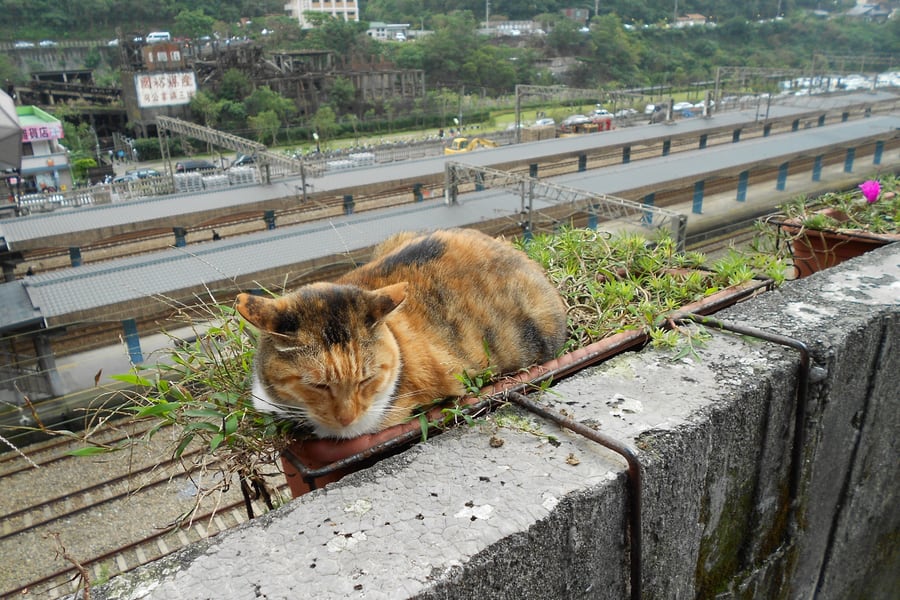
A colliery village that reinvented itself twice. Ruisan Coal stopped working here in 1990 and the place emptied; what refilled it were cats, and Houtong is now known across Asia as the cat village. Beside it is the serious half — the Houtong Coal Mine Ecological Park, opened in 2010 around the pithead buildings and the coal bridge, with the great sorting plant itself restored and opened to visitors in September 2022.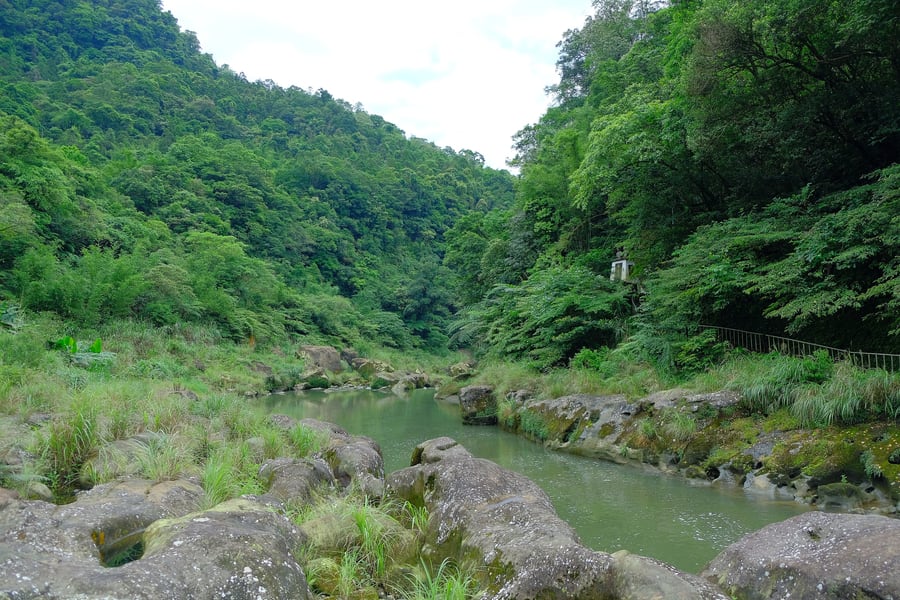 Taiwankengo / Wikimedia Commons · CC BY-SA 4.0 · 2019 · cropped
Dahua
The stop for people who want the gorge without anybody in it. There is no village at Dahua, only a shelter on a curve and a path down to the river, where the Keelung runs over a stretch of potholes — round basins ground deep into the sandstone by stones turning in the current. Usually deserted; the only thing to plan around is that the trains are an hour apart.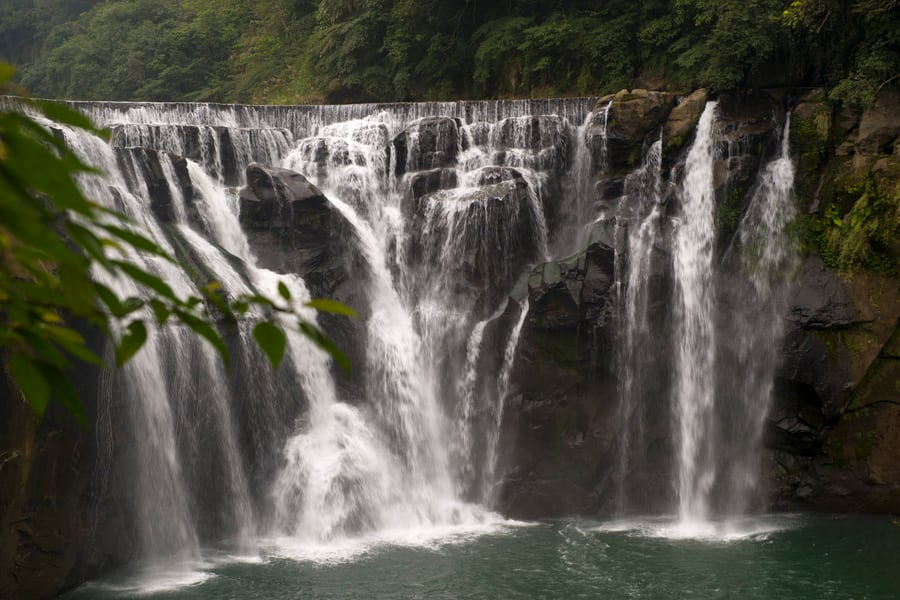 牛糞 / Wikimedia Commons · CC BY-SA 3.0 · 2015 · cropped
Shifen Waterfall
Forty metres across and twenty metres high, the broadest curtain waterfall in Taiwan and inevitably nicknamed the local Niagara. Its other name is the Rainbow Pool, for what the sun does to the spray. New Taipei City bought the land in 2014, made a park of it and dropped the charge. Open 09:00–18:00 June to September and 09:00–17:00 otherwise, last entry half an hour before, shut on Lunar New Year's Eve.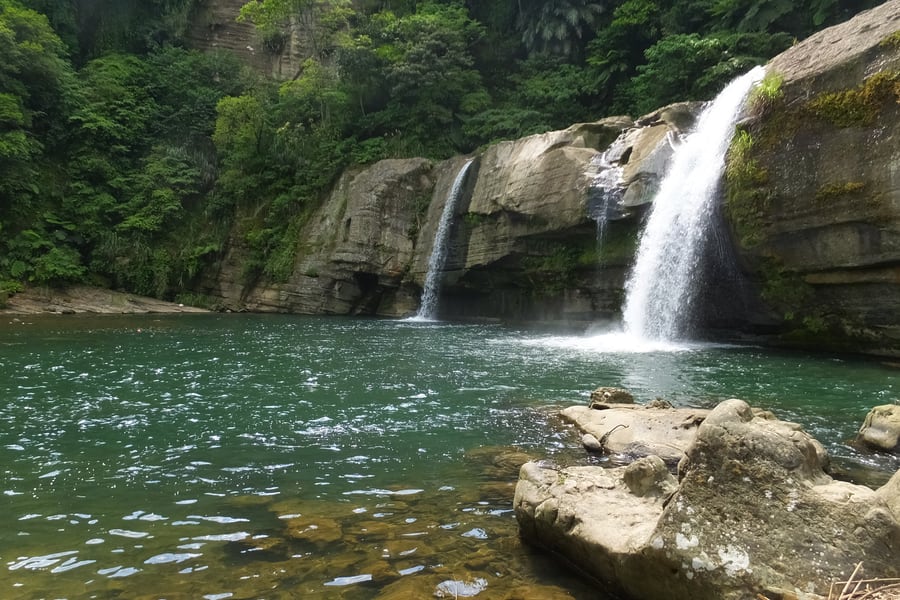 lienyuan lee / Wikimedia Commons · CC BY 3.0 · 2015 · cropped
Lingjiao
Two minutes below Pingxi, and almost everybody stays on the train. Lingjiao has a small wooden station, a short street and its own waterfall — a broad low fall on the Keelung about five minutes from the platform, with none of the coach parties or the boardwalk that Shifen gets. Get off here if the middle of the line has turned out busier than you hoped.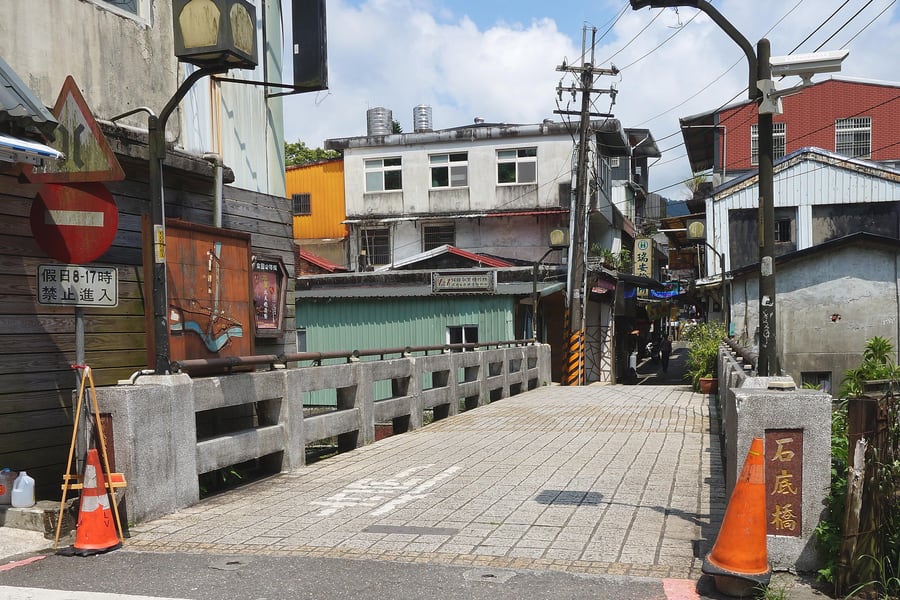 Solomon203 / Wikimedia Commons · CC BY-SA 4.0 · 2019 · cropped
Pingxi
A single old street on a slope, the railway running above the shops on a low viaduct and the Shidi Bridge crossing the river at the bottom of it. This is the centre of the sky lantern trade: the lantern-makers' shops and the Sky Lantern Story House are here. The station is up a flight of stairs from the street, which is how a mining railway fits into a valley this narrow.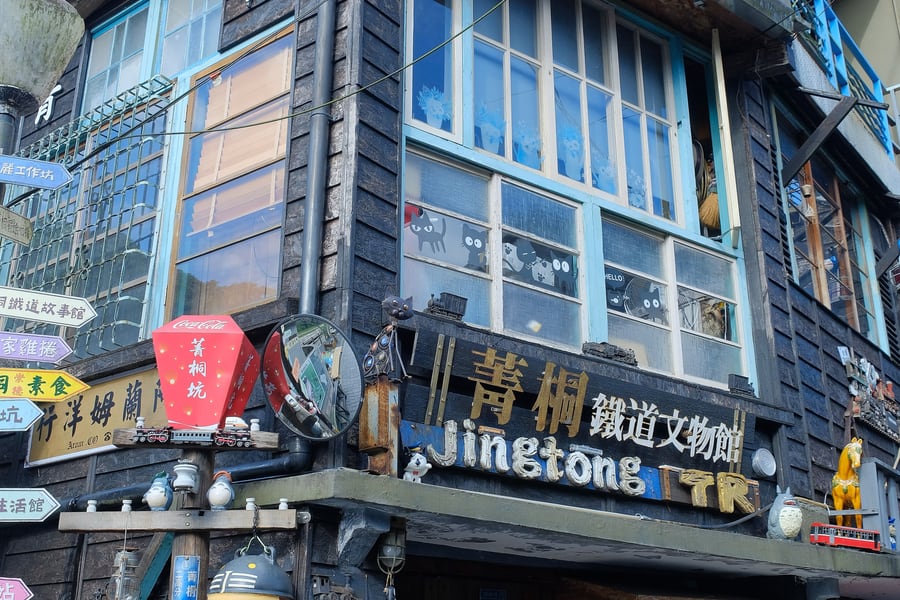 Taiwankengo / Wikimedia Commons · CC BY-SA 4.0 · 2021 · cropped
Jingtong
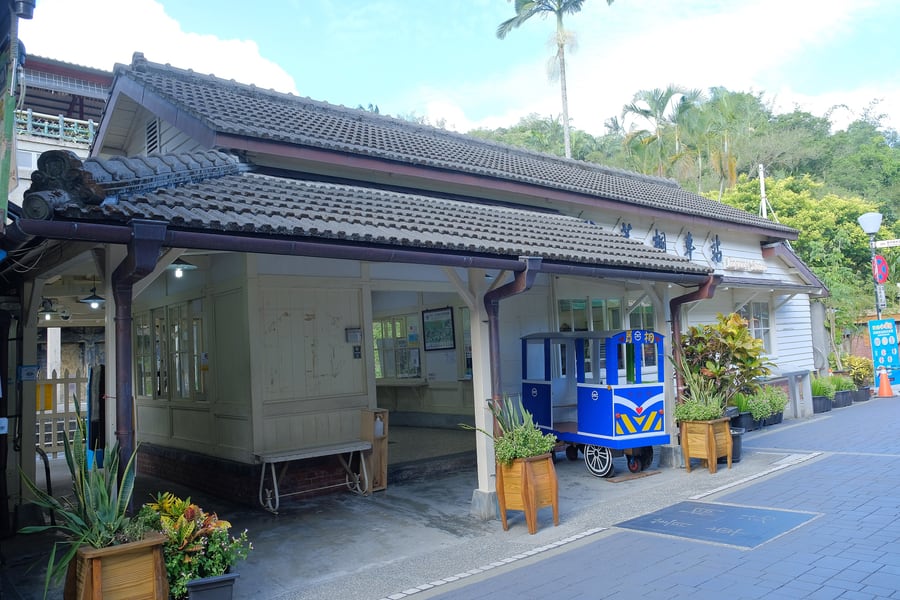
The terminus, and the best-preserved mining village on the branch. The Japanese-style wooden station of 1929 was listed as a historic site in 2003 and still sells tickets; opposite it stands the coal-washing plant, and above the village the mouth of the Shidi main incline. The old street below the platform holds the wishing bamboo and a railway museum in a black timber house, and is ten minutes end to end.Where to Sleep
Most people do the Pingxi Line as a day out from Taipei and go back the same evening, which is perfectly sensible: the last train down from Jingtong leaves at 20:30 and Ruifang has main-line services into Taipei until late. Staying is a different proposition. The valley empties as soon as the day-trippers have gone, and Shifen and Jingtong at eight in the morning — before the first coachload, with the shutters still down and the rails wet — are worth the inconvenience of getting yourself there overnight.
The inconvenience is real, though. Accommodation along the branch is small-scale: a handful of family guesthouses in converted miners' and mine officials' houses, most of them taking bookings by telephone or LINE rather than online, and several with no working website at all. Two of the best-known Jingtong houses — the Japanese-era mine manager's residence among them — could not be reached from here at all when we checked in September 2026, so they are not listed below. The alternative is to stay at the Ruifang end, where there is far more choice around Jiufen and Jinguashi and a train every hour down to the junction.
Where to stay
Adagio Jinguashi
Jinguashi, Ruifang District — above the junction
The hotel's own account of itself: a guest house on the mountainside at Jinguashi, the old gold-mining town above Ruifang, looking east to Teapot Mountain and down on the Yinyang Sea. It runs a set seasonal dinner and an evening walk through the abandoned workings with one of its staff, and it publishes in English. Ruifang station, and the first train up the branch, is a short bus ride below.
Check Availability (opens in a new tab, on theadagio.com.tw)via theadagio.com.twXingfu Shanxing Guest House
Jing'an Road, Pingxi — between Pingxi and Jingtong
A small family guest house on Jing'an Road, the lane that links Pingxi and Jingtong, with five rooms named after magpies and the option of taking the whole house. Its own pages describe plain wooden furniture and a window to sit at with tea, which is an honest description of what this valley offers after the last train down. Bookings are by telephone or LINE; there is no online engine.
Check Availability (opens in a new tab, on pingshihouse.tw)via pingshihouse.twQuestions or corrections
Planning this trip and stuck on something, or spotted a time, fare or detail that has changed? Send us a message about The Pingxi Line. We read every one, and we update this page when something has changed.