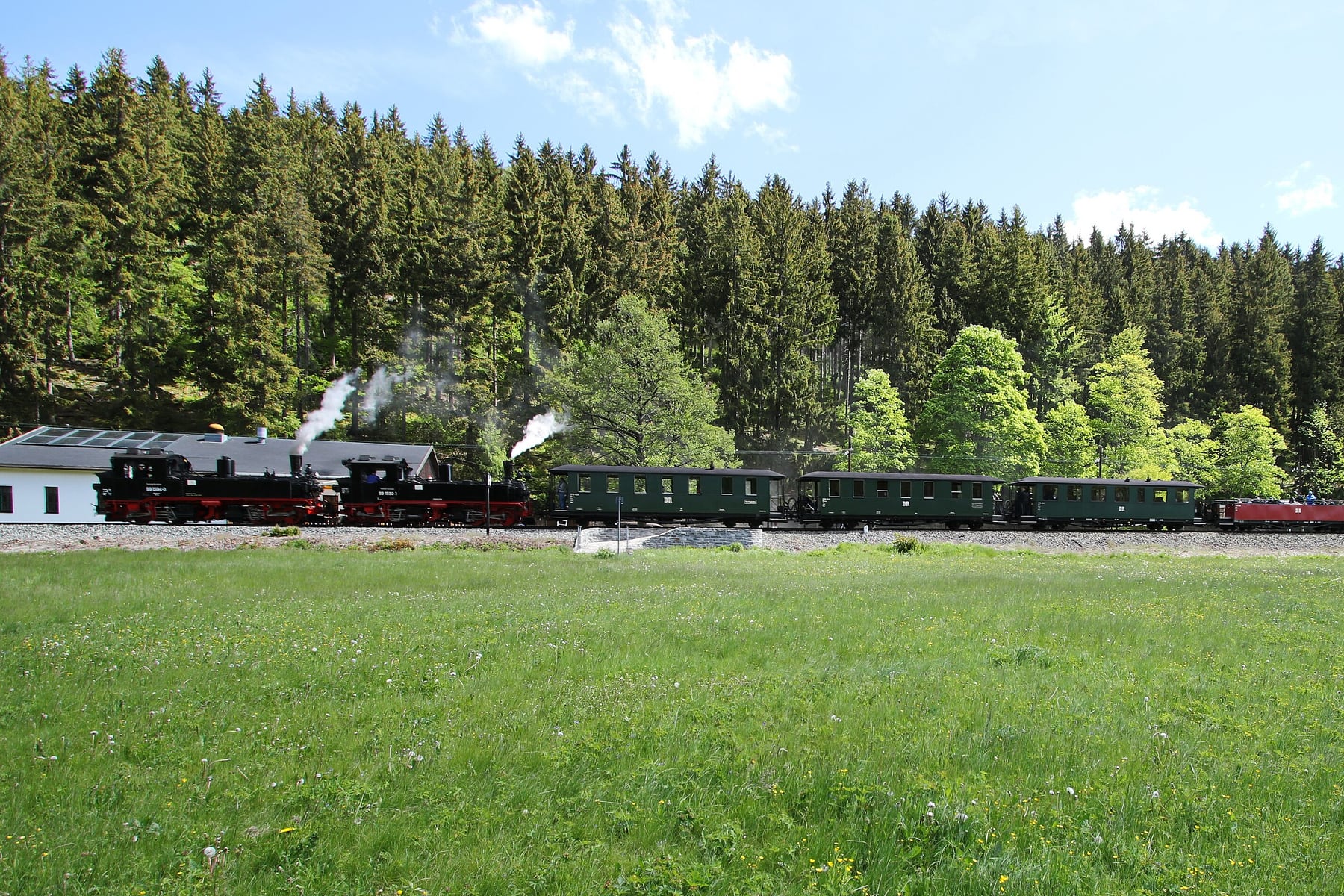
The Preßnitz Valley Railway
Kora27 / Wikimedia Commons · CC BY-SA 4.0 · cropped
- Distance8.5 km, Steinbach to Jöhstadt · 141 m climb
- DurationAbout 40 minutes each way · steam on every train
- Best seasonWeekends late April to early November · Advent and New Year · some winter weekends
Introduction
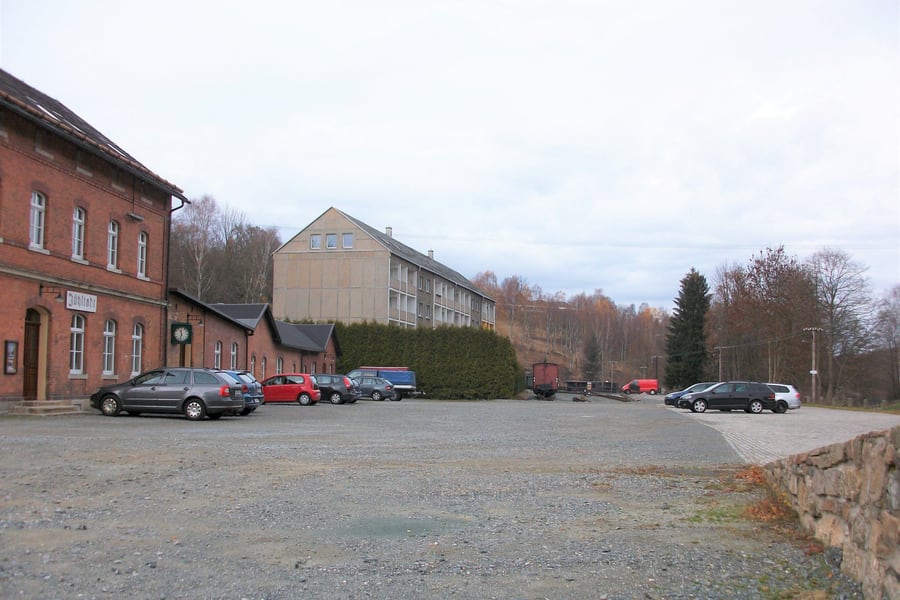
When the Preßnitz Valley Railway closed, the state built on its stations. The last train left Jöhstadt in January 1984, the rails were lifted by the summer of 1989, and the land was put to other use: a kindergarten went up on the yard at Steinbach, and a prefabricated block of 33 flats on the station site at Jöhstadt. When volunteers began relaying the line in 1990, both buildings stood in their way. The kindergarten came down in 1999, and the trains reached Steinbach again in August 2000. The block took longer. The last tenants moved out in April 2026, demolition began that August, and on 22 August the railway held a party: for the first time in 38 years, the whole station site could be seen again.
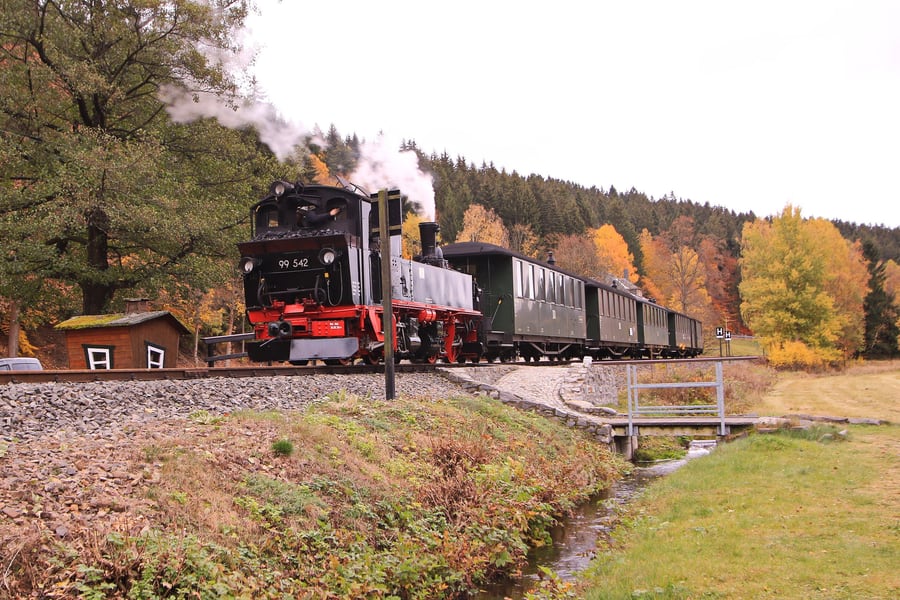
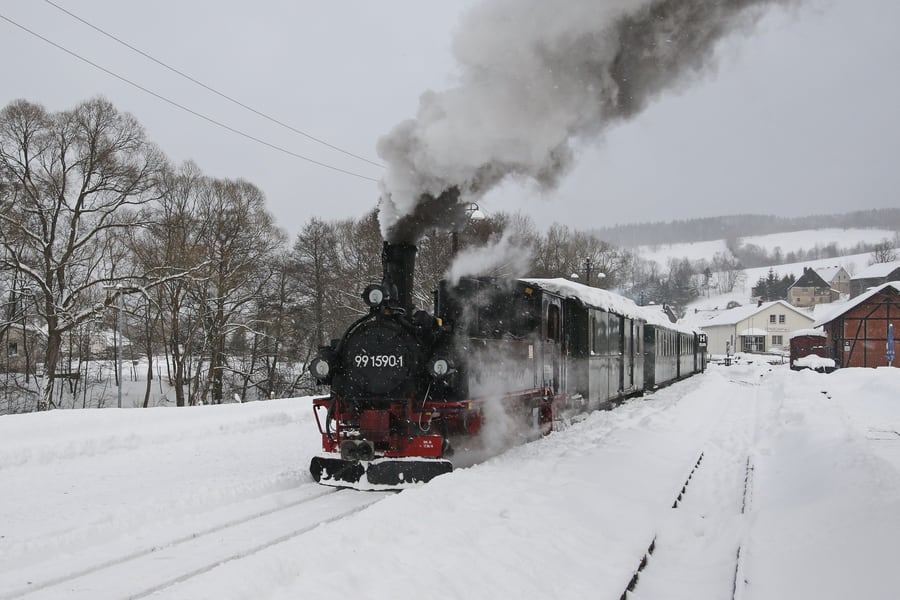
What runs today is the top third of a 23-kilometre line opened in 1892: 8.5 kilometres of 750 mm track from Steinbach, at 543 metres, up the valleys of the Preßnitz and the Schwarzwasser to Jöhstadt, at 684 metres, close to the Czech border. The timetabled trains are all steam-hauled, usually by Saxon IV K tank engines, the class typical of the line, and all of them carry refreshments.
The railway runs on weekends from late April to the start of November, through Advent and the New Year, and on some winter weekends. A trip takes about 40 minutes each way. It is run entirely by the volunteers of the IG Preßnitztalbahn, and tickets bought on the day are paid for in cash.
The Journey
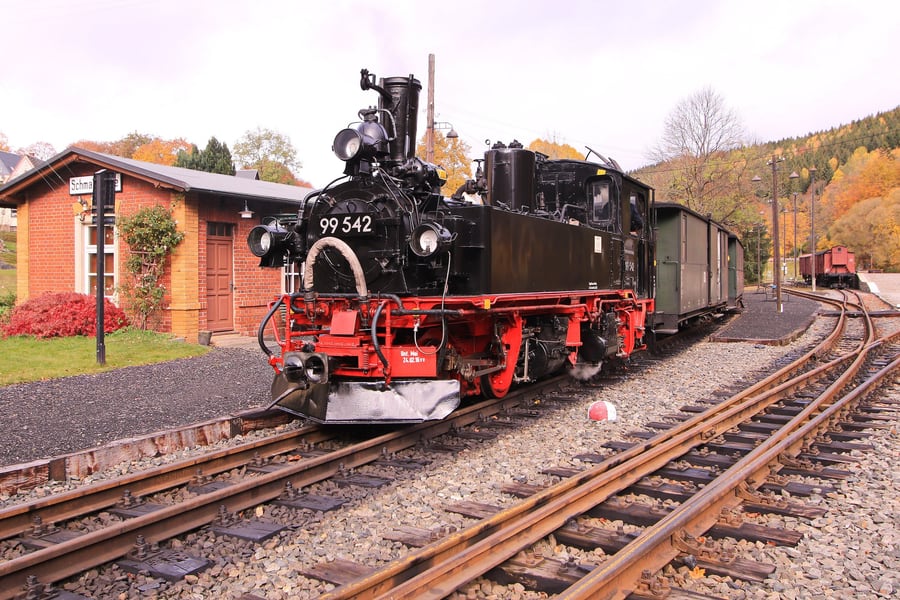
From Steinbach the train climbs gently up the wooded valley of the Preßnitz, with the river beside it. The halts come every few minutes: Wildbach, with its inn by the stream; Stolln, beside an old silver mine; and Forellenhof, beside a restaurant and its trout pond. At Schmalzgrube, the operating centre, trains meet and pass, and the line leaves the Preßnitz to follow the Jöhstädter Schwarzwasser upstream, past the rocks at Loreleifelsen and the station at Schlössel, to the line's exhibition and vehicle hall and the terminus at Jöhstadt. The steepest gradient is 25 in a thousand, about 1 in 40.
A line for the valley's mills
Before the railway the Preßnitz valley had some 60 to 70 water-powered works, mills, sawmills and paper mills among them, and no road along the valley floor. The Royal Saxon State Railways opened the 750 mm line from Wolkenstein, on the main line from Chemnitz, on 1 June 1892, and carried goods to the frontier at Jöhstadt from 1893. Freight always mattered most: from 1911 standard-gauge wagons were carried up the valley on narrow-gauge transporter wagons, and in its last decades the biggest customer was a refrigerator factory at Niederschmiedeberg.
Closed, lifted and built over
The GDR planned the closure from the 1960s and carried it out in the 1980s, putting the money into the valley road instead. The last passenger trains to Jöhstadt ran on Friday 13 January 1984, because the track was no longer safe; the rest of the line closed to passengers that September and to freight in November 1986. The rails were lifted between 1984 and the summer of 1989, the last narrow-gauge line in the GDR to be closed and dismantled. A kindergarten was built on the station at Steinbach, and a block of flats on the station at Jöhstadt.
Rebuilt from the top
The IG Preßnitztalbahn was founded in 1988, and in the summer of 1990 its members began at the top, restoring the ruined engine shed at Jöhstadt and clearing the old sleepers left in the trackbed. They laid the first 180 metres of track in April 1992. Trains ran to Schlössel from October 1993, Loreleifelsen in 1994, Schmalzgrube in 1995, Forellenhof in 1996 and the Stolln halt in 1998. To go further, the kindergarten on Steinbach station had to go. The Steinbach council agreed in its last meeting before the village joined Jöhstadt, demolition began on 21 May 1999, and the line reopened to Steinbach on 18 August 2000. At Jöhstadt the block of flats left the railway a third of its old station until it was demolished in August 2026, to make room for a rebuilt goods shed and a restored station. Work to extend the line down the valley to Oberschmiedeberg began in 2022, and the railway expects to finish it around 2030.
The engines
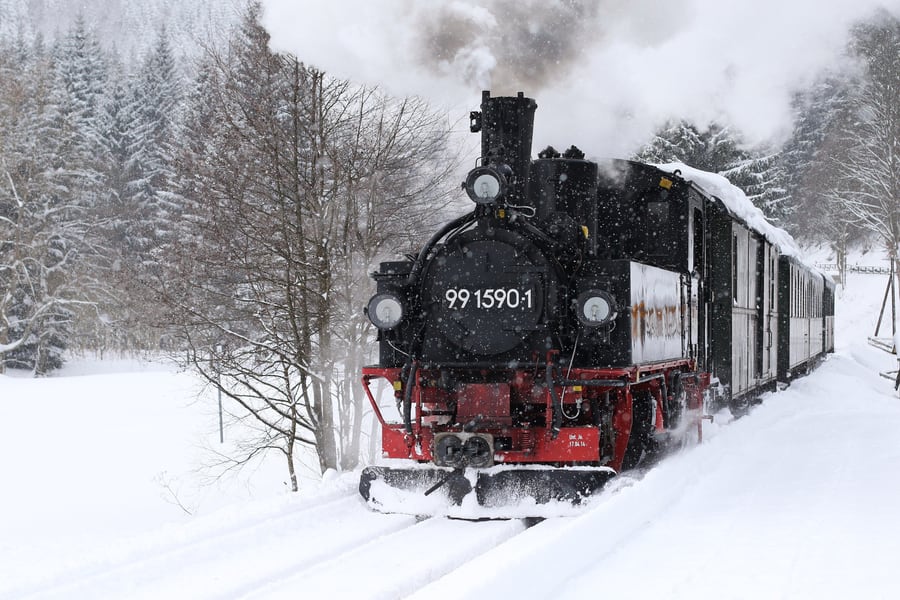
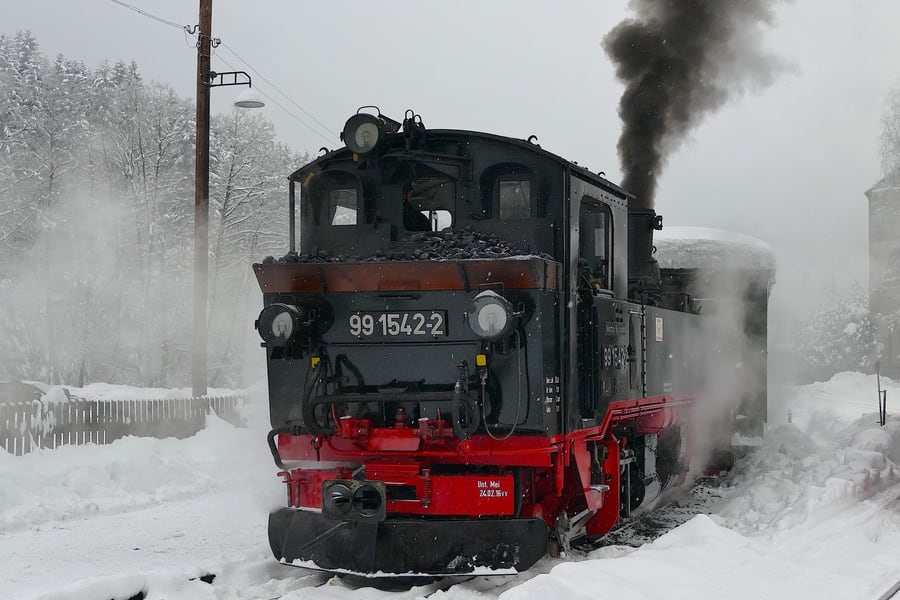
Ten locomotives are kept at Jöhstadt. The mainstay is the Saxon IV K, an articulated tank engine of the Günther-Meyer type with two driven bogies, so that a long, heavy engine can take tight curves; 96 were built between 1892 and 1921, more than any other German narrow-gauge class. The railway also keeps a Saxon VI K; 99 4511, the last steam locomotive built in the GDR; I K No. 54, which the railway counts as Germany's youngest steam locomotive; and three diesels.
Along the route
 Liesel / Wikimedia Commons · CC BY-SA 3.0 · cropped
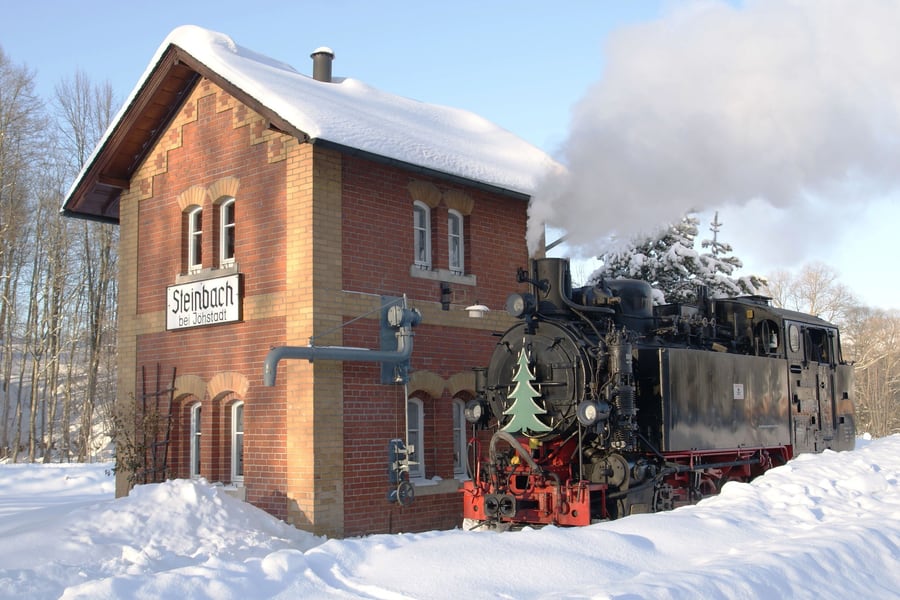
Steinbach and its water house
The lower terminus, at 543 metres, still has its brick water house, where the engines take water. A kindergarten was built over the yard after the line closed; it was pulled down in 1999, and trains returned in August 2000.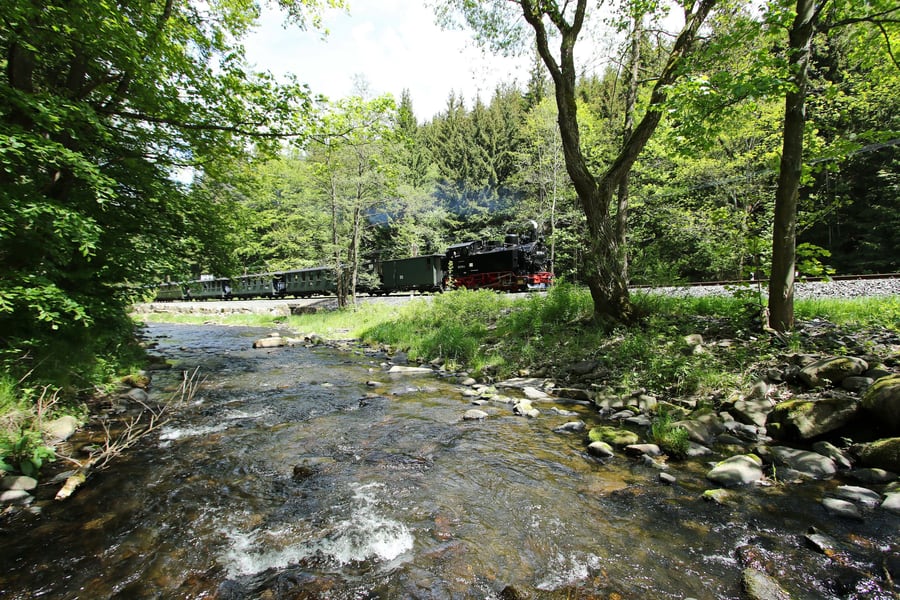 Kora27 / Wikimedia Commons · CC BY-SA 4.0
Along the Preßnitz
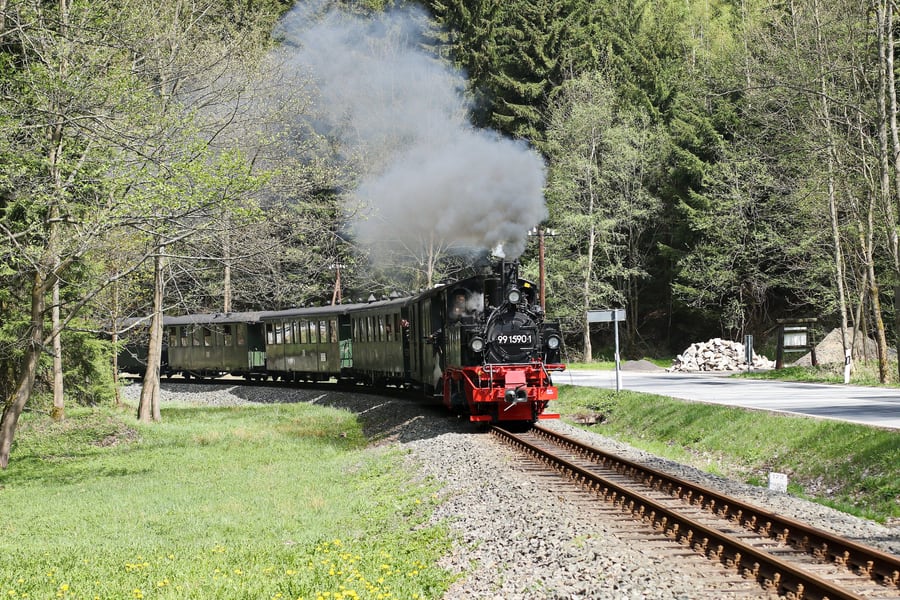
From Steinbach the line follows the Preßnitz upstream through spruce woods, past the Wildbach, Stolln and Forellenhof halts, each a few minutes apart. Wildbach is a request stop, so tell the guard in good time.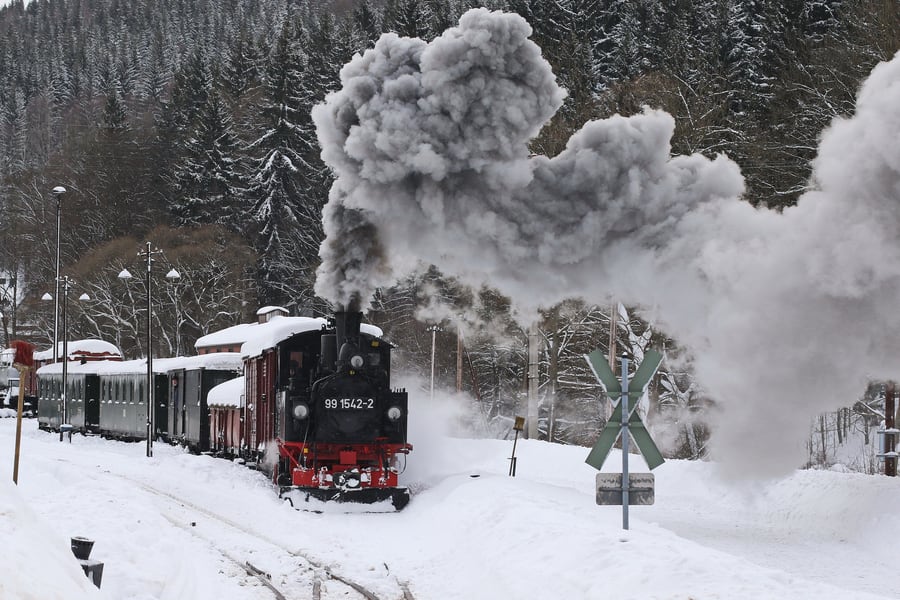 Kora27 / Wikimedia Commons · CC BY-SA 4.0 · cropped
Schmalzgrube, where trains pass
Schmalzgrube is the line's operating centre. On busy days two trains cross here, and the controller works from the station building, a standard design of the Royal Saxon State Railways. Above it the line turns up the Schwarzwasser.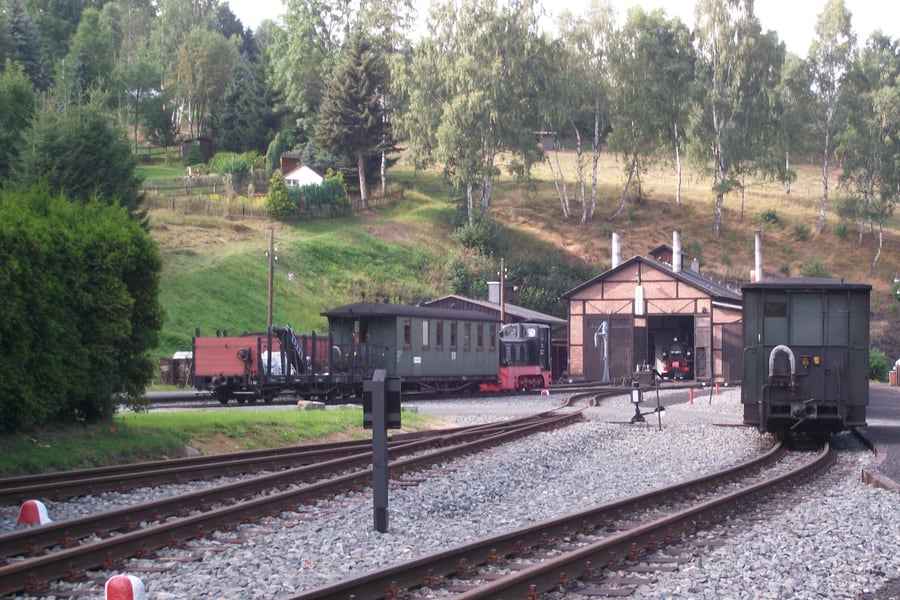 Aagnverglaser / Wikimedia Commons · CC BY-SA 4.0 · cropped
Jöhstadt and the engine shed
At 684 metres, Jöhstadt is the top of the line and home to its locomotives, which live in the old engine shed. A third of the original station site was all the railway had until the block of flats on the rest came down in 2026.A bit of history
Culture & experiences along the way
 Aagnverglaser / Wikimedia Commons · CC BY-SA 4.0 · cropped
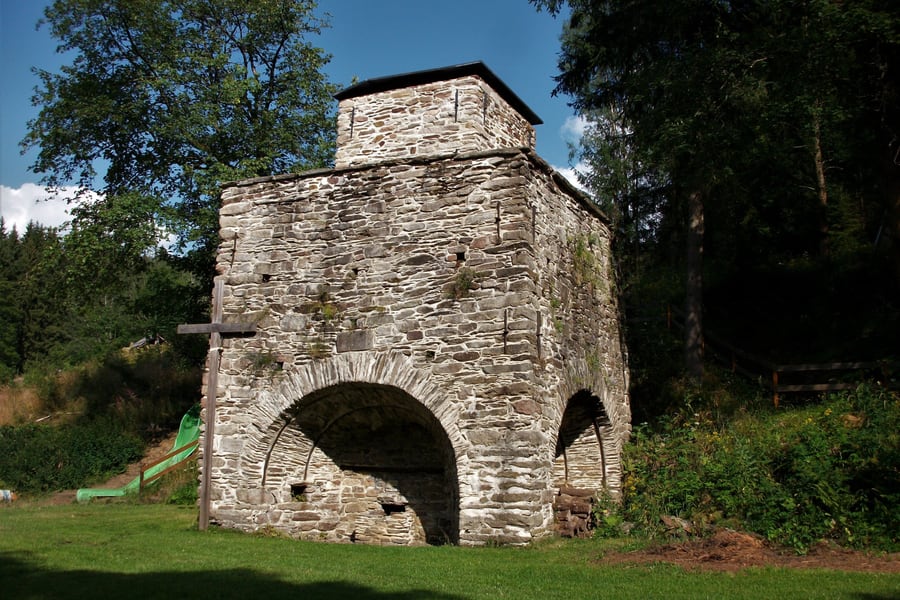
The last blast furnace of the Erzgebirge
Schmalzgrube is named after its smelting works. Gottfried Rubner was licensed to build a blast furnace here in 1659; a plaque dates its rebuilding to 1819, and iron making ended by 1870. The railway calls the stone furnace the last surviving witness of iron smelting in the Erzgebirge, a short walk from the station.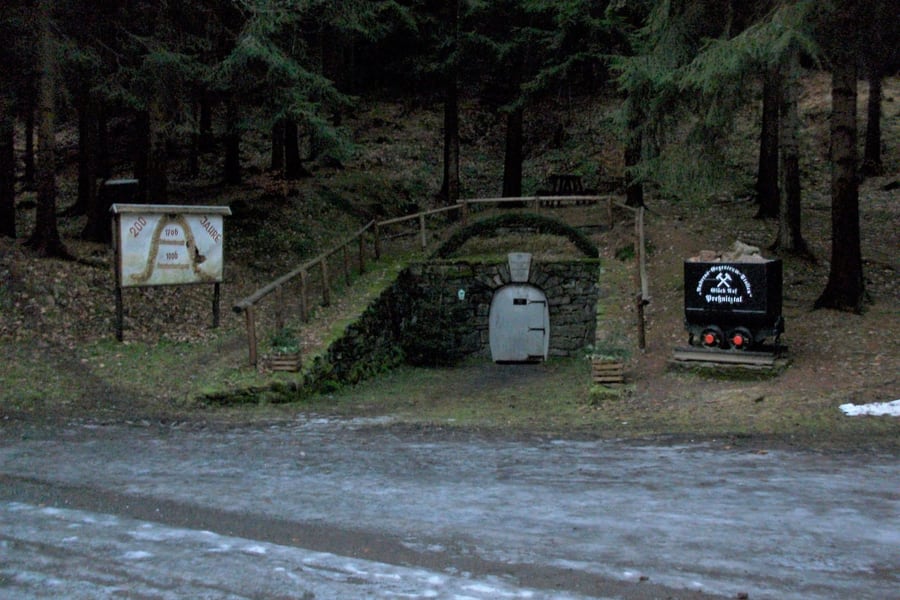 Aagnverglaser / Wikimedia Commons · CC BY-SA 4.0 · cropped
A silver mine and the miners' Advent
A few steps from the Stolln halt, the Andreas-Gegentrum-Stolln was worked for silver and cobalt from 1748 to 1843. Local enthusiasts reopened it in 1984; the show mine closed in 2021, but its signed mining trail remains, and the miners' Mettenschicht is held at the portal on 5 December 2026.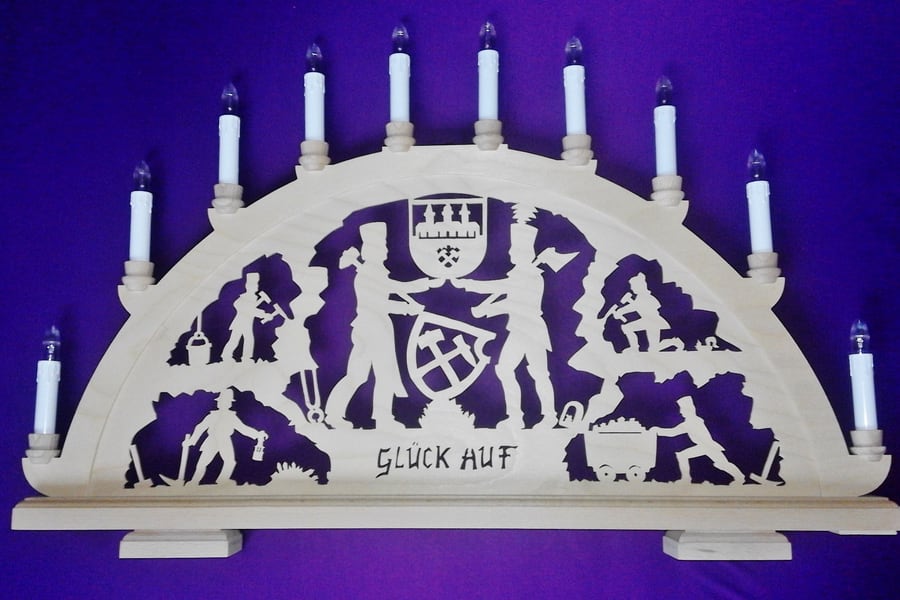 Bergleute / Wikimedia Commons · CC BY-SA 4.0 · cropped
The Schwibbogen
In Advent the windows of the Erzgebirge fill with Schwibbögen, arches of candles framing a cut-out scene, often of miners. The oldest known dates from 1740, in Johanngeorgenstadt. The railway thanked the biggest donors to its station appeal with an arch made by the Niederle workshop in Jöhstadt itself.Timetables
The railway runs on set days, not every day, and publishes the timetable for each one. There are two patterns: on quieter days one train shuttles up and down every two hours, and on busy days two trains give an hourly service, crossing at Schmalzgrube. A trip takes 37 to 45 minutes. Seats are not reserved, and Wildbach, Loreleifelsen and the vehicle hall are request stops.
Times below are from the Preßnitztalbahn's timetables for 28 November and 5 December 2026 and its 2026 annual timetable, read in November 2026. Check the day's timetable at pressnitztalbahn.de (opens in a new tab).
Every two hours: 28 November 2026, and other one-train days
| Down | ||||
|---|---|---|---|---|
| Jöhstadt | 10:05 | 12:05 | 14:05 | 16:05 |
| Steinbach | 10:42 | 12:42 | 14:42 | 16:42 |
| Up | ||||
|---|---|---|---|---|
| Steinbach | 11:00 | 13:00 | 15:00 | 17:00 |
| Jöhstadt | 11:45 | 13:45 | 15:45 | 17:45 |
Hourly: 5 December 2026, and other two-train days
Trains leave Jöhstadt every hour from 09:05 to 17:05, reaching Steinbach 37 minutes later, and leave Steinbach every hour from 10:00 to 18:00, reaching Jöhstadt 45 minutes later.
Running days
In 2026 the regular season was every weekend from 25 April to 1 November, with extra days at Easter, Whitsun and in the school holidays. Steam runs again on the four Advent weekends, 28–29 November and 5–6, 12–13 and 19–20 December 2026, then daily 27 December 2026 to 3 January 2027. Dates announced for early 2027 include the winter weekends of 30–31 January and 6–7, 13–14 and 20–21 February, 20–21 March, and Easter, 26–29 March.
Getting there
The RB 80 from Chemnitz Hbf to Annaberg-Buchholz calls at Wolkenstein, where the line used to begin: the 08:36 from Chemnitz reaches Wolkenstein at 09:25 and Annaberg-Buchholz unterer Bahnhof at 09:43. On some running days in 2026 (Easter, Ascension, Whitsun, 4–5 July, 3–4 October and 5–6 December) the railway's Ausflugslinie bus runs from Wolkenstein to Steinbach: on 5 December it leaves Wolkenstein at 09:28, 10:40, 12:28, 15:28 and 17:28, in about 30 minutes, and comes back from Steinbach at 10:01, 11:47, 14:47 and 16:47. On other days, take bus 430 from Annaberg-Buchholz to Jöhstadt.
Tickets
Tickets are sold at Jöhstadt and Steinbach, at staffed stations and on the train, and are paid for in cash; the railway's online shop sells advance tickets for longer trips only. From 5 January 2026 the whole line costs €10 one way and €16 return for adults, €6 and €8 for children aged 6 to 14, and half the line, such as Schmalzgrube to Jöhstadt, €6 one way or €10 return. A day ticket costs €35, and a family return for two adults and up to five children €35.
Prams, bicycles and dogs travel free. The Deutschland-Ticket is not valid on the line. Special trains and events, such as the evening steam runs, have their own fares.
Book your tickets
Return ticket
Steinbach to Jöhstadt and back
A return over the whole line; children aged 6 to 14 pay €8.
Book Tickets (opens in a new tab, on pressnitztalbahn.de)via pressnitztalbahn.deDay ticket
Ride as often as you like
Unlimited rides on the day's timetabled trains, for anyone stopping off at the halts along the way.
Book Tickets (opens in a new tab, on pressnitztalbahn.de)via pressnitztalbahn.deFamily return
Two adults and up to five children
A return for two adults and up to five children aged 6 to 14.
Book Tickets (opens in a new tab, on pressnitztalbahn.de)via pressnitztalbahn.deRail Passes
Interrail and Eurail passes cover the train to Wolkenstein and Annaberg-Buchholz but not the Preßnitz Valley Railway. Interrail's table of German operators includes regional trains (RB) run by DB "and all other Regional carriers", so the RB 80 from Chemnitz is covered. The museum railway is not on the list, and neither is the Ausflugslinie bus, so both are paid in full. The Deutschland-Ticket is not accepted on the steam train either.
For this journey a pass is not worth buying. The steam train is €16 return, and the regional train from Chemnitz is an ordinary local fare.
Pass conditions checked against Interrail's railway-companies page, last updated 21 October 2026. Conditions change with each season, and the pass issuer's page is the one that binds.
Places to Visit
The railway is half a day on its own, and a full day with a walk between the halts. Wolkenstein, where the line once began, is on the way in by train, and the old trackbed runs down to it from Steinbach. Annaberg-Buchholz, the silver-mining town to the west, and the hammer mill on its edge are reached by bus from Jöhstadt.
 Unukorno / Wikimedia Commons · CC BY 4.0
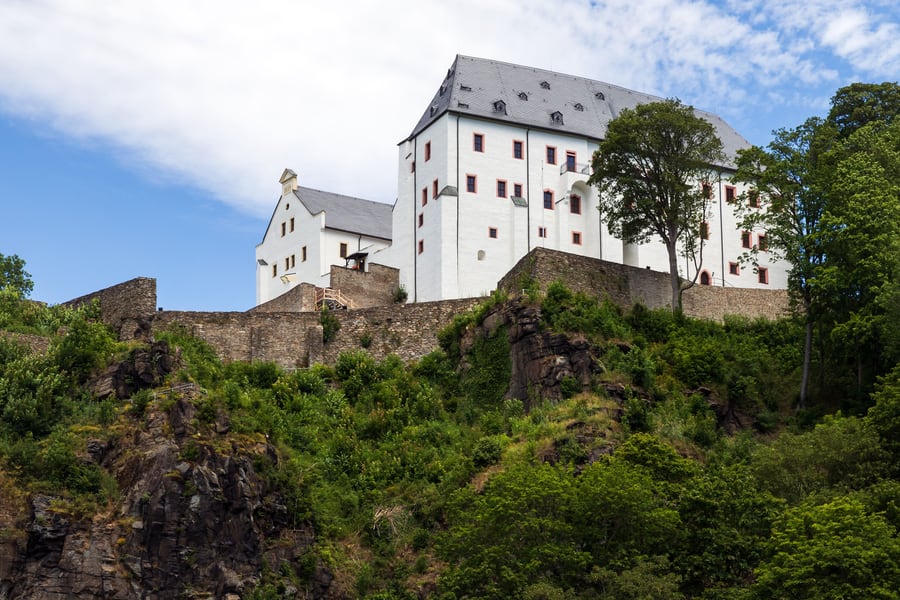
Wolkenstein and its castle
The narrow gauge used to start at Wolkenstein, where it met the main line from Chemnitz, and the regional train still stops there. Above the Zschopau, about 80 metres up on a rock spur, stands Schloss Wolkenstein, a medieval castle first recorded in the 13th century and made a Renaissance residence around 1550 by August, later Elector of Saxony. It has held a museum since 1963.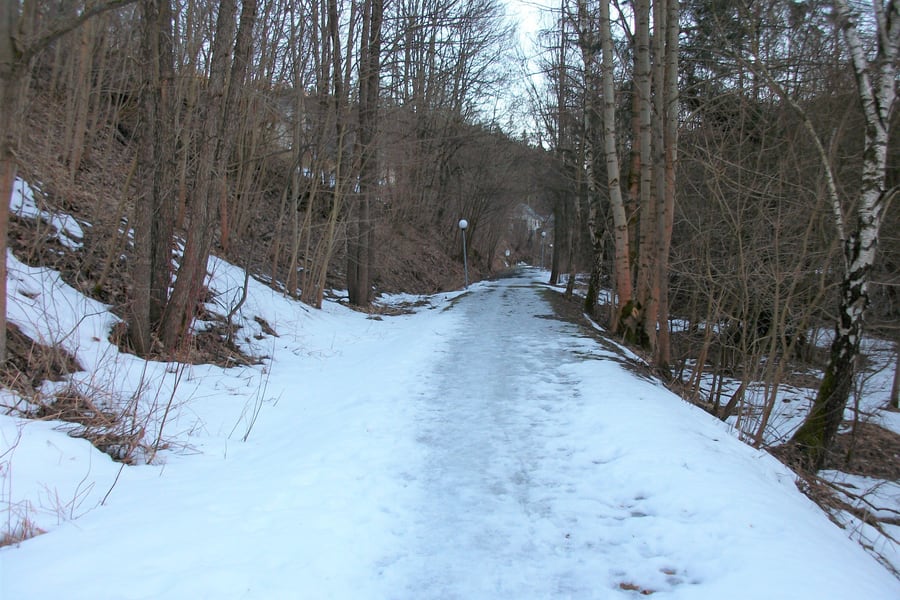 Aagnverglaser / Wikimedia Commons · CC BY-SA 4.0 · cropped
The old trackbed to Wolkenstein
The lower two thirds of the line were never rebuilt, and most of the trackbed is now the Preßnitztal cycle and footpath, which starts at Steinbach station and runs almost to Wolkenstein down the valley. On running days with the Ausflugslinie bus, one way can be walked and the other ridden, and bicycles travel free on the train.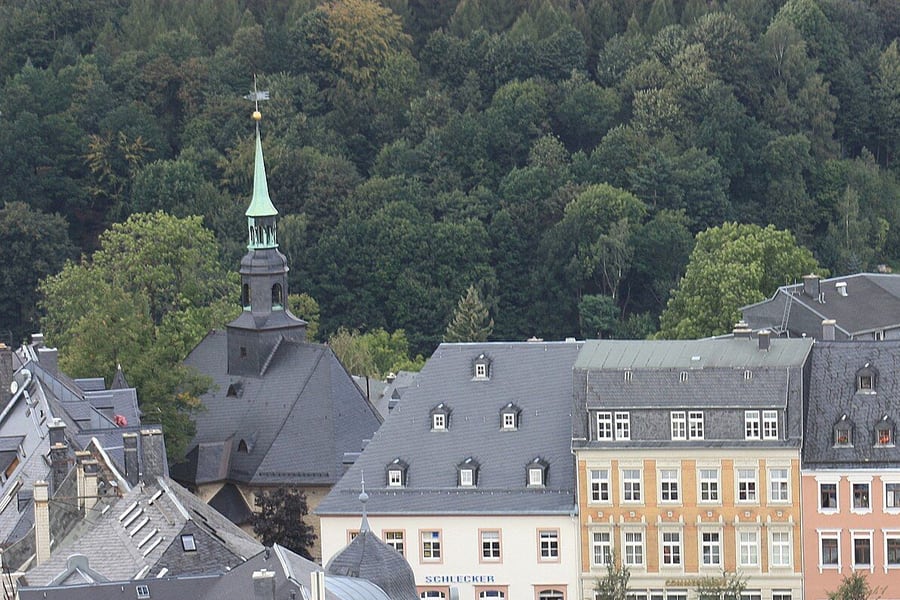 Dguendel / Wikimedia Commons · CC BY 3.0 · cropped
Annaberg-Buchholz
Silver found in 1491 built Annaberg, and the silver paid for St. Anne's Church, begun in 1499: 65 metres long, 40 wide, with a 78-metre tower, it is the largest late-Gothic hall church in Saxony, built as a Catholic church and Lutheran since 1539. The market square below it is the town's centre, and bus 430 links it with Jöhstadt.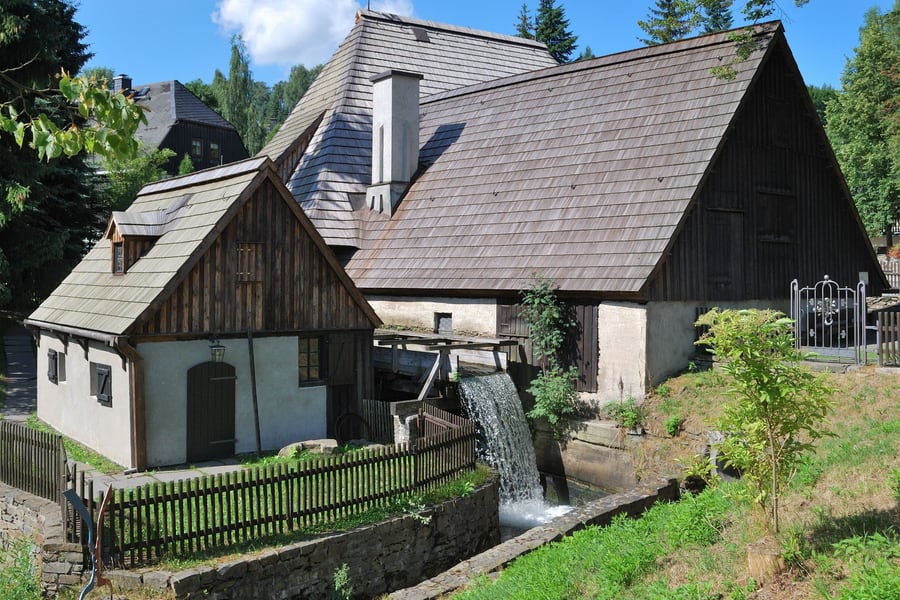 Harke / Wikimedia Commons · CC BY-SA 3.0 · cropped
The Frohnauer Hammer
On the edge of Annaberg, the Frohnauer Hammer is a water-powered hammer mill that grew out of a corn mill; the decision to found Annaberg was taken there in 1496. In 1907 it became Saxony's first technical monument, and it is Germany's oldest forge museum. It is part of the Erzgebirge/Krušnohoří mining region, a World Heritage Site since 2019.Where to Sleep
The line is an easy day out from Chemnitz or Annaberg-Buchholz, but staying in the valley lets you ride the first train and walk between the halts. Two places stand close to the line itself, one beside a station and one above the valley.
The places below keep their own websites and take direct bookings.
Where to stay
Schlösselmühle
A guesthouse by the Schlössel halt
A family-run breakfast guesthouse in Jöhstadt with 12 rooms, across the road from a stop on the line.
Check Availability (opens in a new tab, on schloesselmuehle.de)via schloesselmuehle.deHotel Heilbrunnen
Above the valley, a walk from Loreleifelsen
A hotel with a restaurant at almost 800 metres, reached on foot from the Loreleifelsen halt.
Check Availability (opens in a new tab, on hotel-heilbrunnen.de)via hotel-heilbrunnen.deQuestions or corrections
Planning this trip and stuck on something, or spotted a time, fare or detail that has changed? Send us a message about The Preßnitz Valley Railway. We read every one, and we update this page when something has changed.