Rasender Roland
Matthias Süßen / Wikimedia Commons · CC BY-SA 4.0
- Distance24.1 km (Putbus–Göhren)
- DurationAbout 1 hour 15 minutes
- Best seasonYear-round · most trains May to October
Introduction
The Rasender Roland is a 750-millimetre steam railway that runs along the south-east corner of the island of Rügen, in the Baltic, and it has been doing the same job in the same way since the 1890s: carrying holidaymakers from the little planned town of Putbus out to the seaside resorts of Binz, Sellin, Baabe and Göhren.
It is 24.1 kilometres from end to end, it takes an hour and a quarter, and the line speed is 30 km/h. The island's nickname for it — Racing Roland — is a joke that has outlived everyone who made it.
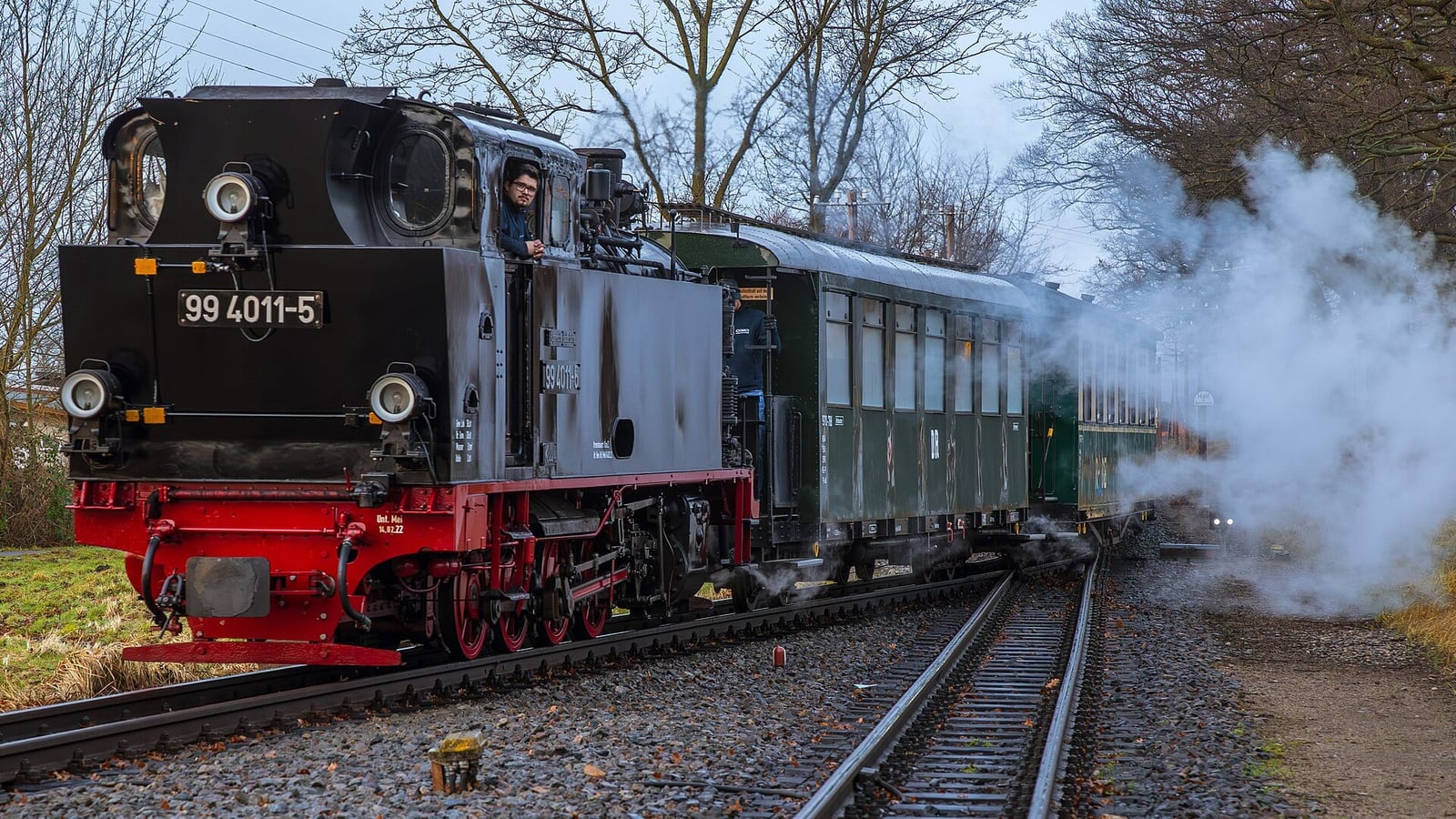
What makes this one worth a day of anyone's holiday is not that it is preserved. It isn't. The Rügensche BäderBahn is a scheduled public railway with published fares, staffed ticket offices and a timetable that runs on the 24th of December as well as the 24th of July — and the operator puts steam locomotives on all of its regular passenger trains, every day, all year. The two diesels on the books shunt the yard at Putbus and work the standard-gauge branch. What arrives at your platform is a black tank engine with red rods and a rake of green wooden-bodied coaches.
How it got here
Prussia passed its Kleinbahngesetz — the light railways act — in 1892, and Rügen built about a hundred kilometres of 750-millimetre line in the seven years that followed. The stretch that survives opened in pieces as the resorts grew: Putbus to Binz on 22 July 1895, on to Sellin West in March 1896 and Sellin Ost that May, and finally down to Göhren on 13 October 1899.
Everything else went. Putbus to Altefähr closed in December 1967 and the rails were lifted; the rest of the island network followed in stages by 1970, and much of it has been ploughed back into fields. What was left survived because it happened to serve the four busiest beaches on Rügen. In 2008 it passed to the Eisenbahn-Bau- und Betriebsgesellschaft Pressnitztalbahn, a private operator from Saxony, which runs it under the Rügensche BäderBahn name — and which also works the standard-gauge line that brings you to Putbus in the first place.
The one modern addition runs the other way. Since 28 May 1999 the narrow gauge has been able to carry on past Putbus down to the harbour at Lauterbach Mole, sharing the standard-gauge branch on a three-rail track with a third rail laid inside the other two. That extension is a summer arrangement: in winter the Roland's timetable stops at Putbus.
The Journey
The ride divides cleanly in three: fields, forest, and then the sea.
Putbus to Binz — across the fields
Putbus is the operating centre and the place to start. The narrow-gauge platforms sit alongside the standard-gauge ones, so the change from the main line is made on foot in a couple of minutes, and the yard beyond the station is where the locomotives live. If a train is being prepared you will hear it before you see it.
From there the line runs east across the middle of the island through Beuchow, Posewald, Seelvitz and Serams — all four of them request stops, all four little more than a nameboard and a strip of platform among arable fields and low hills. This is the flat part, and the part where the engine is doing least, so it is the stretch on which to walk the train, get a coffee and find out which side you want to be sitting on.
Binz LB is the halfway point and by some distance the busiest station. It is the narrow gauge's own station in Binz — the main-line station is a separate one, under a different name — and in summer the platform is full, half of it people going up to the Jagdschloss and half of it people who have come out from the beach for the ride.
Binz to Sellin — through the Granitz
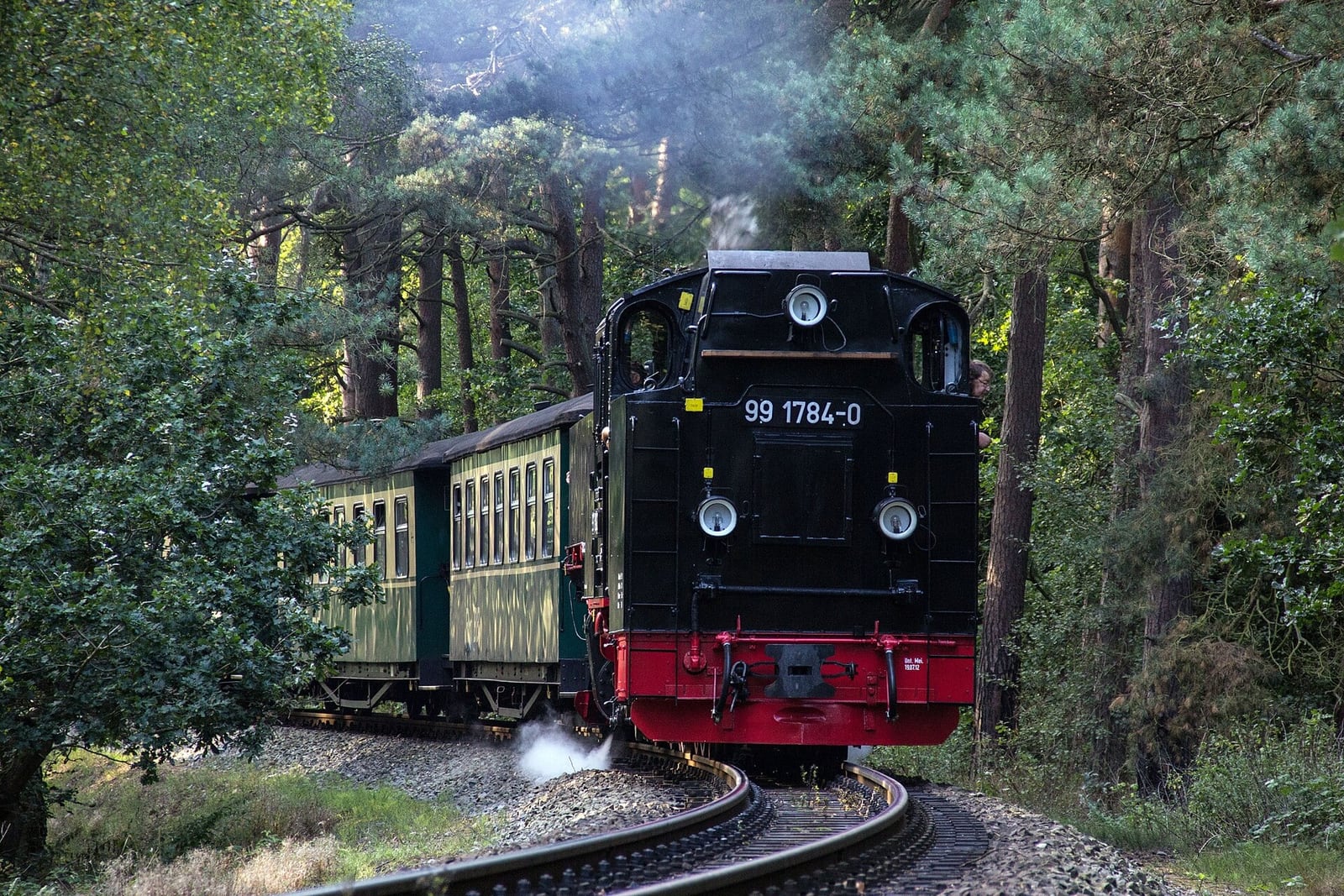
Immediately east of Binz the character changes. The line turns inland and climbs into the Granitz, a wooded ridge of beech and pine inside the South-East Rügen biosphere reserve, 228 square kilometres of coast, lagoon and forest declared in 1990. The gradient here is the steepest on the line, and a 750-millimetre tank engine with a full train behind it makes a proper noise about it.
Jagdschloß, in the middle of the trees, is the highest stop on Rügen — and a request stop, so tell the guard if you want it. There is no village: it exists for the walk up through the woods to the hunting lodge on the Tempelberg. Garftitz and Sellin West follow, both request stops too, before the line comes back out of the forest.
Sellin Ost is the station for Sellin, ten minutes' walk above the cliff and the pier.
Sellin to Göhren — the Mönchgut
The last stretch runs onto the Mönchgut, the peninsula that hangs off the south-east corner of the island. Baabe is quiet and half-buried in pines. Philippshagen, a request stop, is the last one before the terminus.
Göhren is as far east as Rügen goes. The train stops about a hundred metres short of the sea promenade, and then it stays for thirty minutes while the locomotive is worked round to the other end of its coaches for the return trip — which happens out in the open, at the end of the platform, in front of whoever wants to watch.
The trains themselves
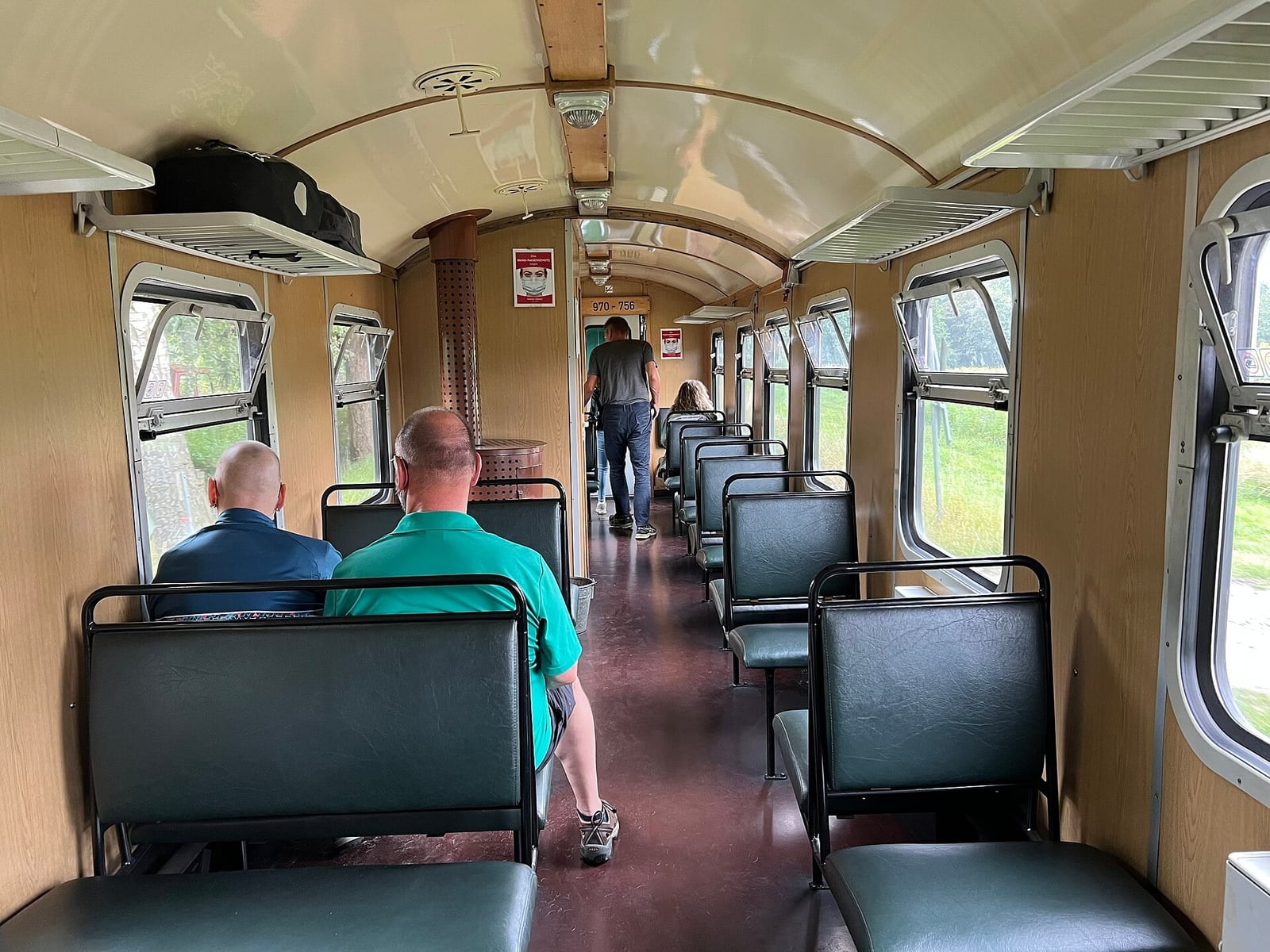
The steam fleet is a mixture: two engines of the old Lenz Gattung Mh, two more from Jerichow, four of the post-war Deutsche Reichsbahn 99.177 class, and 99 4011-5, which spent more than sixty years hauling freight in the Mansfeld copper district before arriving here in 2008. The nineteen passenger coaches are older than any of them — bodies built between 1907 and 1928, rebuilt by the Deutsche Reichsbahn in the 1950s and 60s, and modernised again in the late 1970s. They are open saloons with wooden interiors and windows that drop, and every train takes luggage and bicycles.
Along the route
Derzno / Wikimedia Commons · CC BY-SA 3.0Steam, every train, every day
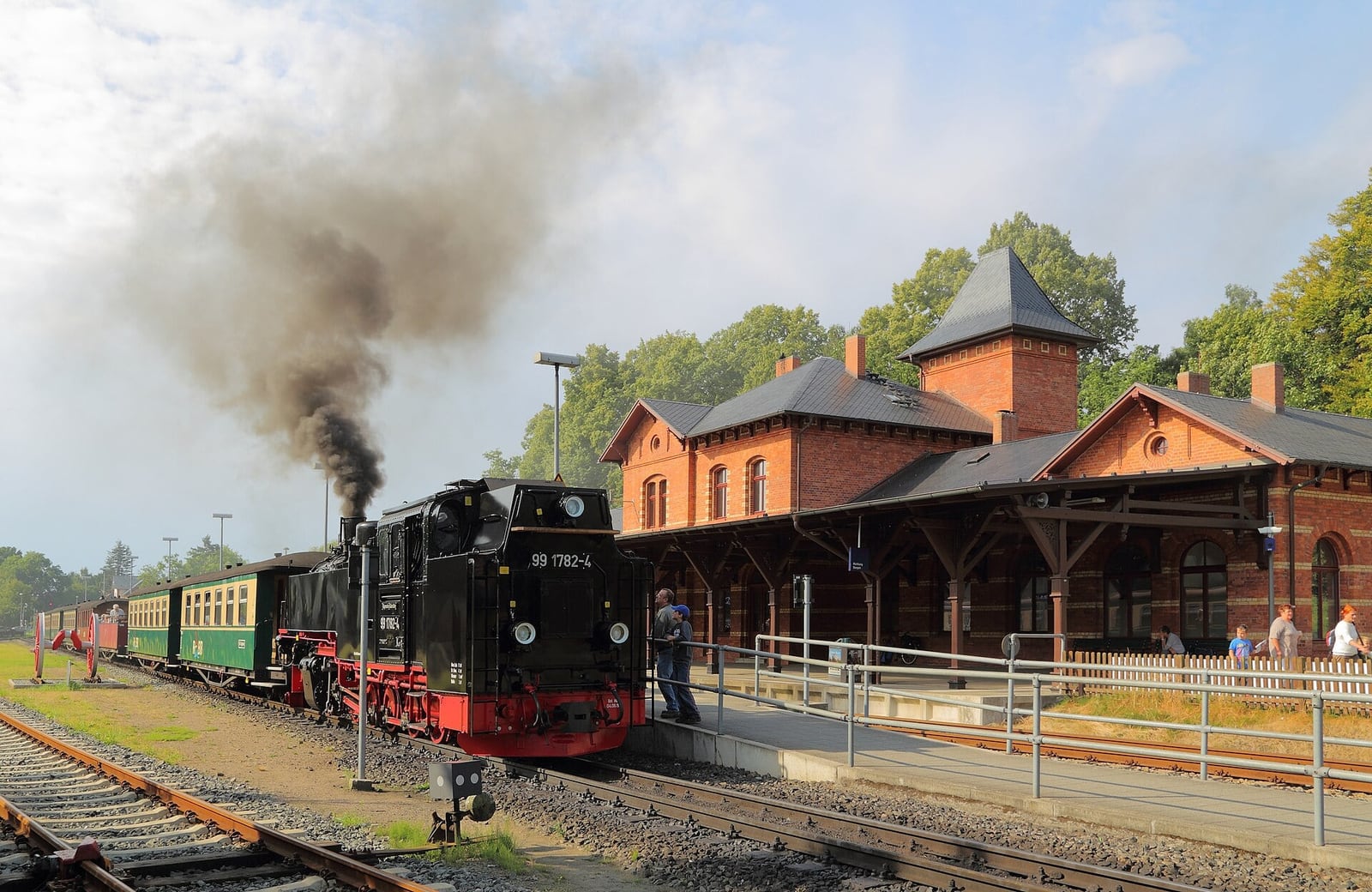
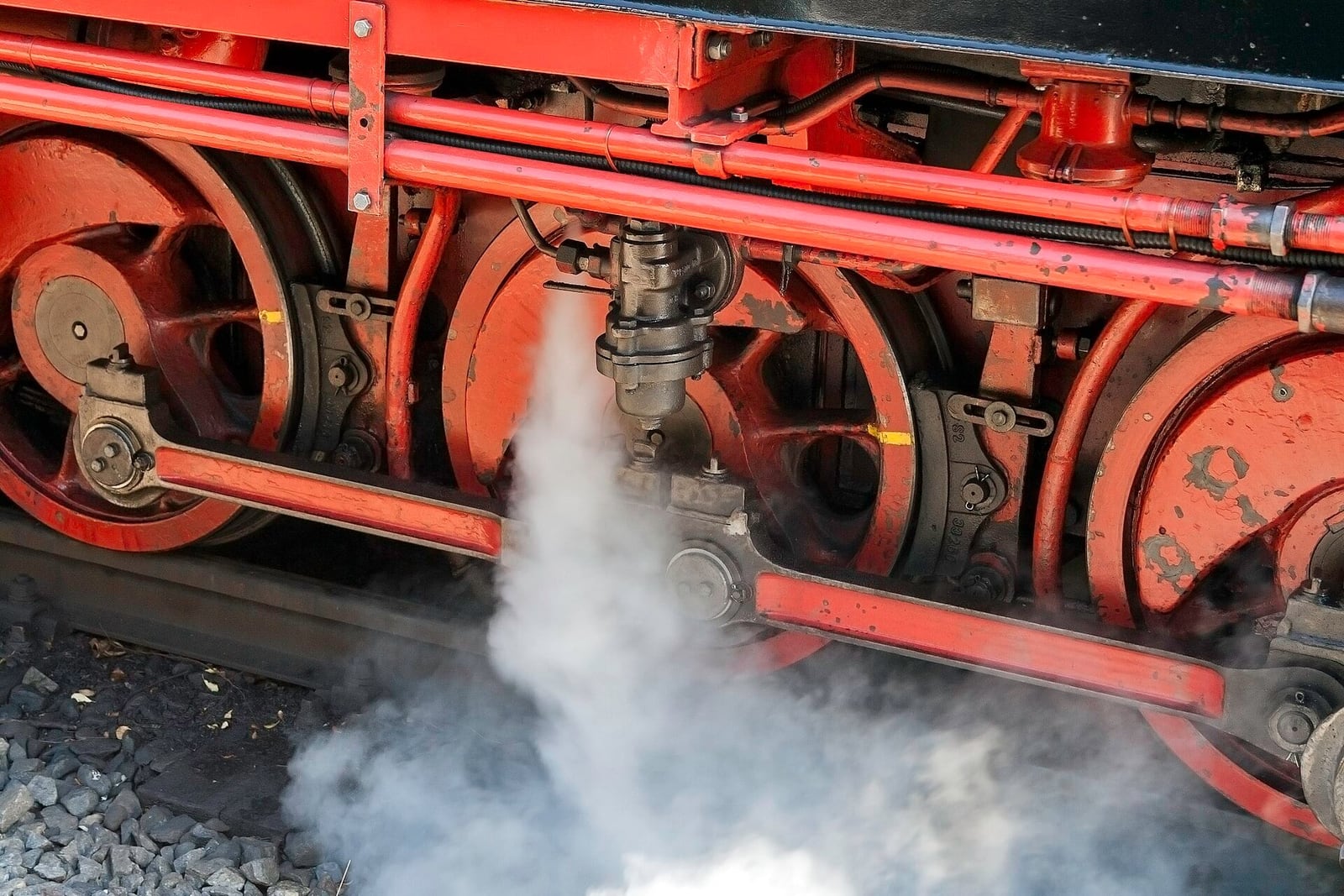
This is not a summer special or a preserved line running on selected weekends. It is a scheduled public railway with its own fares and timetable, and it states plainly that it puts steam locomotives on all of its regular passenger trains — in February as much as in August.Derzno / Wikimedia Commons · CC BY-SA 3.0Through the Granitz
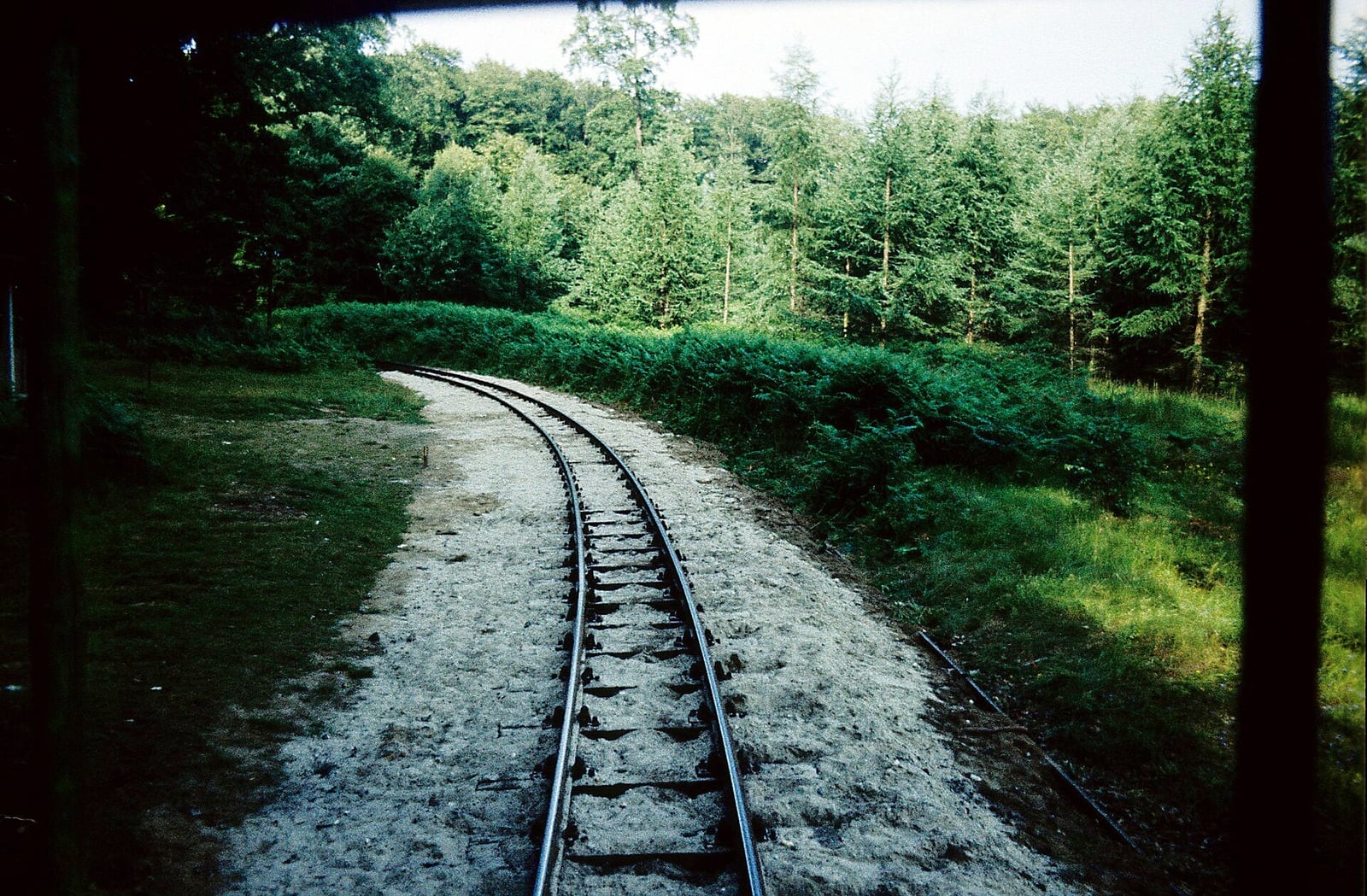
Between Binz and Sellin the line leaves the coast and climbs into the Granitz, a wooded ridge inside a biosphere reserve. The train works hard, the windows fill with trees, and it stops at Jagdschloß — the highest station on the island.Matthias Süßen / Wikimedia Commons · CC BY-SA 4.0A racing name and a 30 km/h line
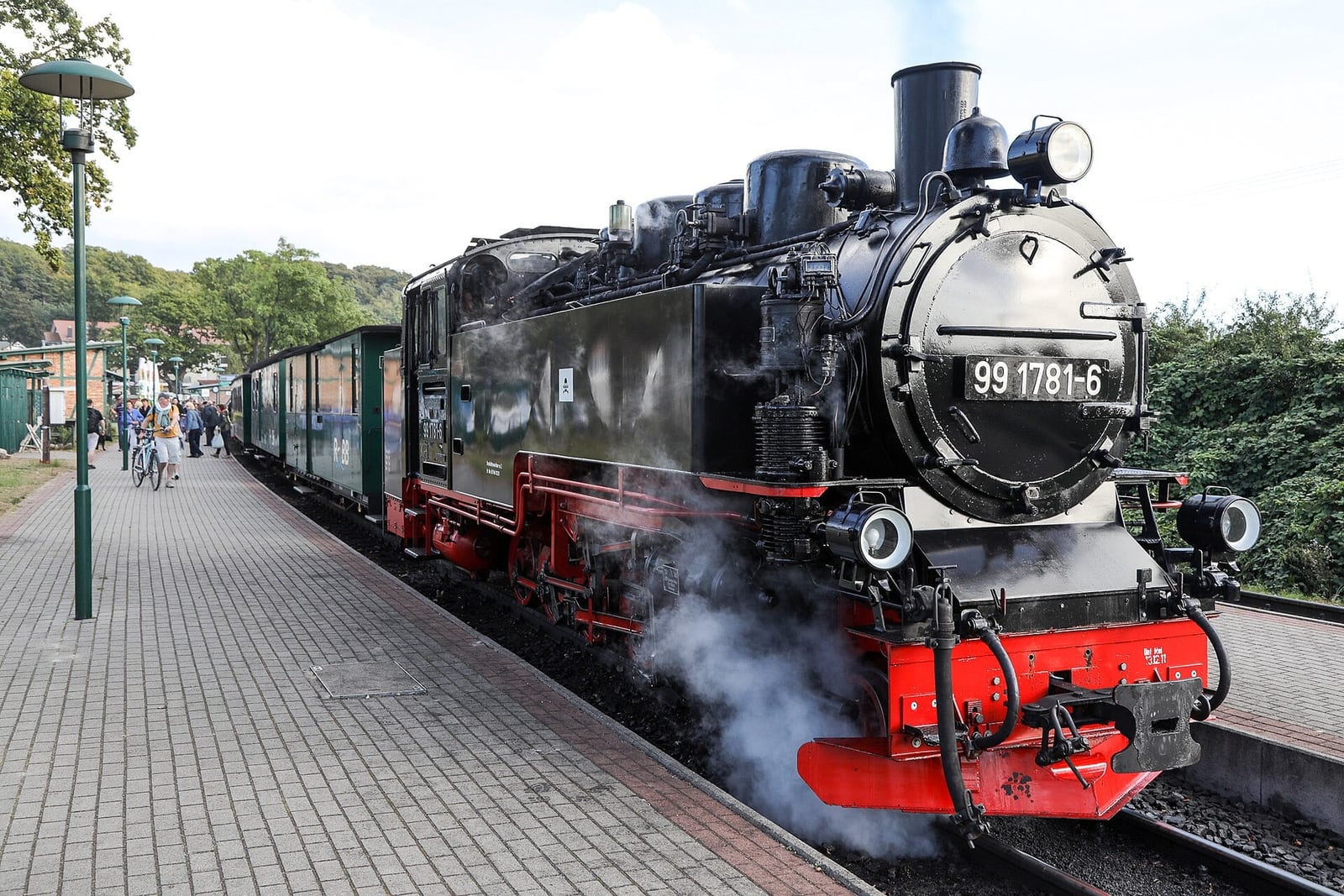
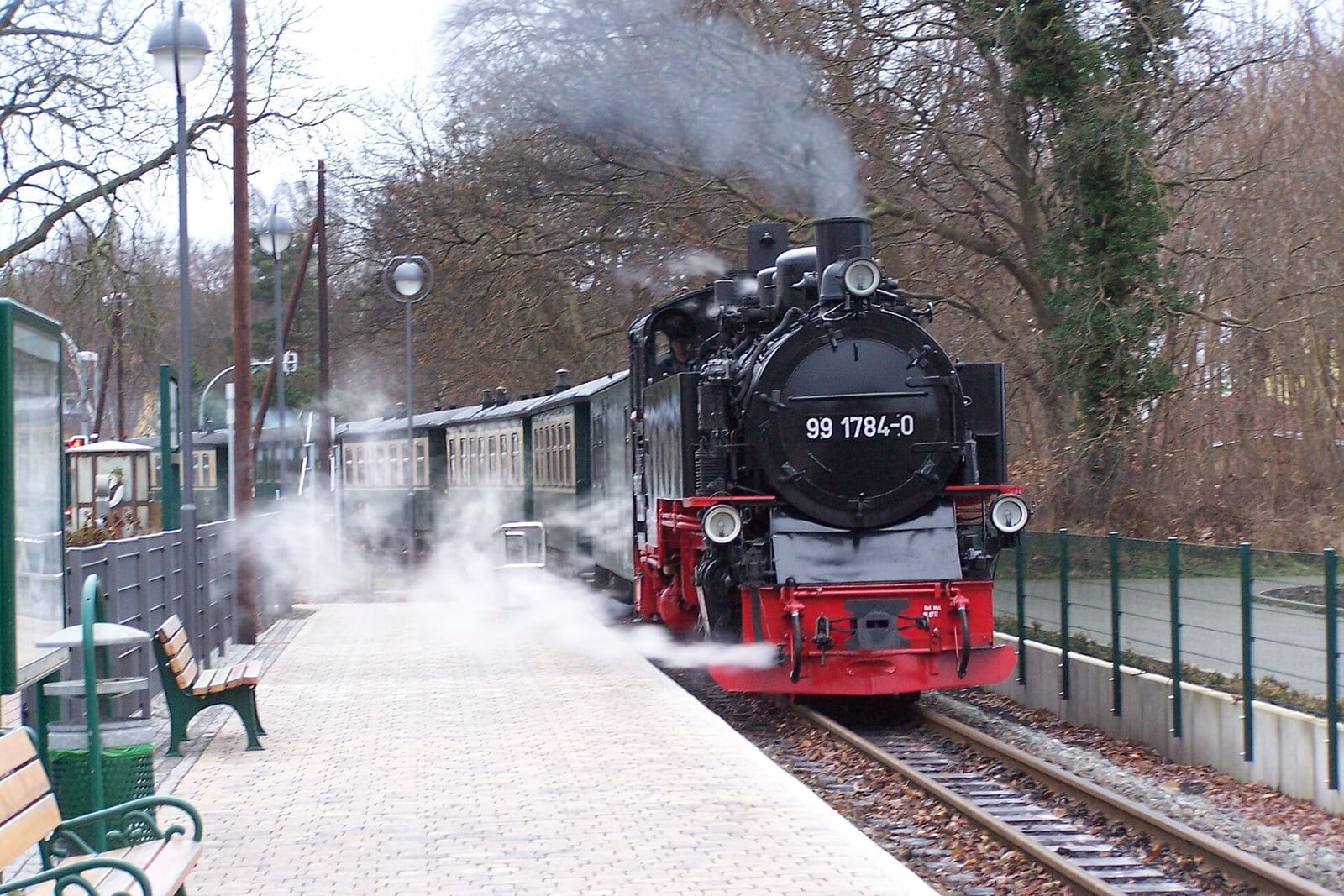
The island calls it Racing Roland and the line speed is thirty kilometres an hour — the 24 kilometres take an hour and a quarter. It is comfortably the slowest way to travel between four resorts that also have a perfectly good bus, and that is the entire point.A bit of history
Culture & experiences along the way
Lukas Beck / Wikimedia Commons · CC BY-SA 4.0Ride with a window open
The coaches are open saloons rather than compartments, with plain wooden interiors and windows that drop — and on this line nobody objects if you use them. Between Binz and Sellin the smoke comes back through the trees and the whole train smells of hot oil and coal.Hoff1980 / Wikimedia Commons · CC BY-SA 3.0Half an hour at Göhren
The timetable gives every train thirty minutes at the eastern end — in at :23, out at :53 — and the locomotive has to be got round to the other end of its coaches within it. It happens in the open at the platform end, in front of anyone who cares to stand and watch, and it is the best half hour on the line.Falk2 / Wikimedia Commons · CC BY-SA 3.0 deGet off at Jagdschloß
A request stop in the middle of the forest with no village attached to it, which is exactly why it is worth using. Ask the guard, step down onto the trees, and walk up to the hunting lodge on the ridge — then flag the next train down and carry on to the coast.Timetables
The Rasender Roland runs to a clock-face timetable every day of the year, with a fuller service in the main season. There are two published timetables: the main season, 9 May to 1 November 2026, and the off season, 2 November 2026 to 7 May 2027.
The through trains — main season
Trains leave Putbus at :08, two-hourly from 08:08 to 20:08, and reach Göhren at :23, one hour and fifteen minutes later.
| Station | Time | |
|---|---|---|
| Putbus | :08 (depart) | |
| Beuchow | request stop | :12 |
| Posewald | request stop | :18 |
| Seelvitz | request stop | :24 |
| Serams | request stop | :29 |
| Binz LB | :35 · :40 | |
| Jagdschloß | request stop | :47 |
| Garftitz | request stop | :53 |
| Sellin West | request stop | :01 |
| Sellin Ost | :05 · :09 | |
| Baabe | :14 | |
| Philippshagen | request stop | :18 |
| Göhren | :23 (arrive) |
Coming back, trains leave Göhren at :53, two-hourly from 09:53 to 19:53, and reach Putbus at :06 — an hour and thirteen minutes. So the first train of the day is the 08:08 from Putbus, arriving 09:23, and the 09:53 back from Göhren is the same train returning after its half-hour turnround.
The extra trains — main season only
- Hourly between Binz and Göhren. On top of the through trains, short workings leave Binz LB at :44 — 09:44, 11:44, 13:44, 15:44 and 17:44 — reaching Göhren at :27. Back the other way they leave Göhren at :49, 08:49 to 18:49. Between Binz and Göhren that gives a train roughly every hour in each direction; the 18:49 from Göhren carries on through to Putbus, arriving 20:02.
- Down to the harbour at Lauterbach Mole. Five trains a day start from Lauterbach Mole at :22 — 11:22, 13:22, 15:22, 17:22 and 19:22 — and are at Putbus seven minutes later, where they wait to form the :08 departure. Returning trains reach Lauterbach Mole at :17.
- ⚠️ Two late trains run high summer only. The 22:44 Binz–Göhren and the 21:49 Göhren–Binz run only from 23 May to 30 August 2026.
Off season, 2 November 2026 to 7 May 2027
The same two-hourly clock face, one round trip shorter, and Putbus to Göhren only:
- Putbus :08, from 08:08 to 18:08.
- Göhren :53, from 09:53 to 19:53.
- No short workings from Binz, and no trains to Lauterbach Mole — the winter timetable is headed Putbus to Göhren and the harbour extension does not appear on it.
- ⚠️ The last pair of trains — the 18:08 from Putbus and the 19:53 from Göhren — do not run on 24 December 2026.
Getting to the start
The narrow gauge connects with the main line at Putbus, where the standard-gauge branch from Bergen auf Rügen to Lauterbach Mole comes into the same station; the same company, Pressnitztalbahn, runs both. Bergen auf Rügen is on the main line from Stralsund.
⚠️ If you are aiming for Binz instead, note that its two stations are not the same place. Long-distance ICE and IC trains and the RE 9 from Stralsund and Rostock serve Ostseebad Binz; the Rasender Roland uses Binz LB, a separate station.
Times taken from the operator's own published timetables — Rügensche BäderBahn, main season (valid 9 May – 1 November 2026) and off season (valid 2 November 2026 – 7 May 2027) — both read in August 2026. Every stop marked "request stop" is a Bedarfshalt: tell the guard, or signal from the platform.
Tickets
The Rügensche BäderBahn sells its own tickets on its own fare scale, in five stages: end to end, Putbus to Göhren, is stage 5 at €16.00 for an adult single, €8.00 for a child of 6 to 13 and €40.00 for a family. Bicycles are €3.00 a journey and every train takes them.
If you plan to get off anywhere, buy the day ticket instead. At €35.00 — €77.50 for a family — it covers the whole line all day in both directions, and two adults doing Putbus to Göhren and back have already spent €64 on singles. ⚠️ Two things that will not work: your resort Kurkarte, which the operator explicitly excludes, and the Deutschlandticket, which is accepted only with a €12.00 daily supplement. Boarding away from a staffed station, buy from the guard at no surcharge.
Book your tickets
Single tickets, by fare stage
Putbus to Göhren is stage 5
The railway has its own fare scale of five stages, sold at the staffed stations, online, or from the guard on the train at no extra charge. End to end is the top stage; hopping two resorts is the bottom one.
Book Tickets (opens in a new tab, on Rügensche BäderBahn)via Rügensche BäderBahnDay ticket
The whole line, all day, in both directions
One price whatever the distance, which turns the railway from a way of getting somewhere into a way of spending a day — off at Jagdschloß for the lodge, on again to Sellin, back for the evening in Binz.
Book Tickets (opens in a new tab, on Rügensche BäderBahn)via Rügensche BäderBahnRail Passes
No rail pass carries you along this line for free, and the operator is unusually clear about it. The Rügensche BäderBahn is a private railway with its own five-stage tariff, outside the arrangements that cover the rest of German rail.
The Deutschland-Ticket: accepted, but only with a supplement
This is the one national ticket the railway does take, and it takes it at a price. Holding a Deutschland-Ticket, you pay a Sonderzuschlag — a special supplement — on top:
| Day supplement | €12.00 |
| Week supplement | €36.00 |
Compare that with the ordinary €35.00 day ticket and the supplement is worth having if you already carry a Deutschland-Ticket, and worth nothing at all if you do not.
Interrail and Eurail
Neither is valid here. The railway publishes nothing about them — no acceptance, no discount, no mention on its fares page or in its tariff conditions — but Interrail answers it from the other side. Its coverage table for Germany names DB and "all other Regional carriers", and then sends everything it has not named to the closed list of German railway companies the table links. The Rügensche BäderBahn is not on that list, so a pass buys nothing at Putbus, Binz LB or Göhren.
⭐ What a pass does do is get you to the island. Rügen is on the national network: Interrail and Eurail cover the main line through Stralsund to Bergen auf Rügen, which is where the approach on a pass ends.
⭐ The last link, the standard-gauge Zugbringer shuttling Bergen auf Rügen to Putbus and on to Lauterbach Mole, is run by the Roland's own parent company — and behaves nothing like the Roland. Its tariff takes the Deutschland-Ticket, the Mecklenburg-Vorpommern-Ticket, the Quer-durchs-Land-Ticket, the Schleswig-Holstein-Ticket and BahnCard reductions. So the national products that stop dead at the narrow gauge do carry you as far as its platform. An Interrail pass is a different question: the Zugbringer is not named on Interrail's list either way, so the counter at Bergen is where that one gets settled.
And the resort cards do not work either
⚠️ Worth repeating from the Tickets section, because it catches people out: the Kurkarten issued by the Baltic seaside resorts are not valid on this train. The operator says so plainly. If you have met the Black Forest's KONUS card, which carries guests free on the trains, do not assume Rügen does the same — it is the exact opposite arrangement.
Is a pass worth it for this journey?
Not for the train itself. Nothing you can buy nationally makes this ride cheaper, except the Deutschland-Ticket supplement, and that only if you were carrying the subscription anyway.
Buy the railway's own day ticket instead. At €35.00 for unlimited travel along the line it beats two end-to-end singles before you have stopped anywhere, and stopping is the entire point of a railway that serves four beaches and a hunting lodge.
Supplements and fares from the operator's published tariff, Rügensche BäderBahn — a branch of Eisenbahn-Bau- und Betriebsgesellschaft Pressnitztalbahn mbH — with the Zugbringer's tariff from the same company and pass coverage from Interrail's published list of railway companies, August 2026.
Places to Visit
Six stops, and no two of them are the same kind of place. The line begins in a planned neoclassical town that never became a city, crosses farmland, climbs through forest to a prince's hunting lodge, and finishes on a peninsula of fishing villages that turned into beach resorts.
The day ticket is what makes this work. Break the journey wherever you like, walk for an hour or two, and pick up the next train — remembering that outside the Binz–Göhren stretch that is two hours later, not one, and that eight of the fourteen stations only stop if you ask.
 Strubbl / Wikimedia Commons · CC BY-SA 4.0 · cropped
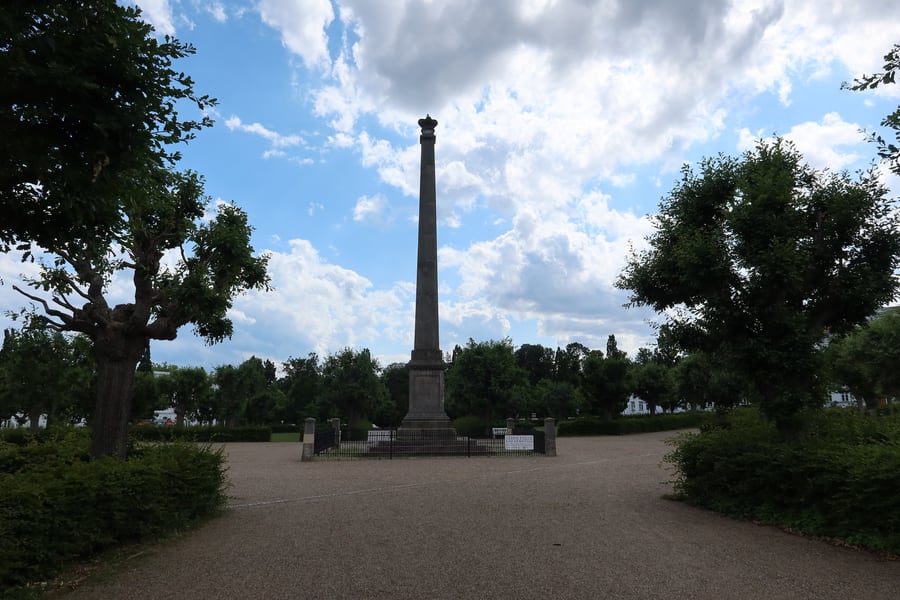
Putbus
A whole town built white. Wilhelm Malte I, Prince of Putbus, founded it in 1810, and its centrepiece is the Circus — a circular place laid out between 1828 and 1845, ringed by neoclassical houses with an obelisk in a formal garden at the middle and avenues running off it like spokes. It is the last such rondel built as a single piece in Germany. The prince's palace is gone, blown up in 1962, but its park is open and the streets still look like an architect's drawing.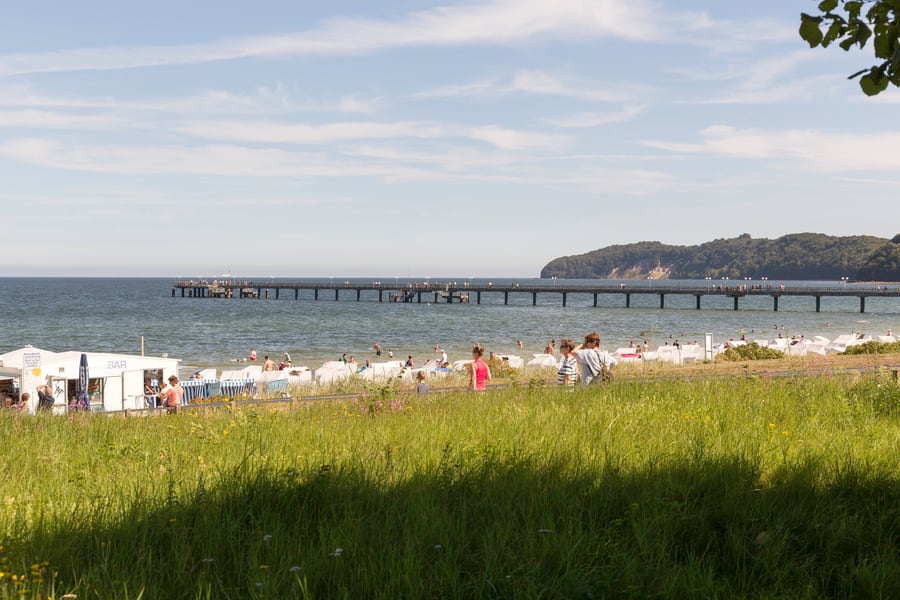 paul muster / Wikimedia Commons · CC BY 3.0 · cropped
Binz
The largest seaside resort on Rügen, with about 5,300 residents and a promenade lined with white Bäderarchitektur — the balconied, fretworked lodging villas the town put up in the late nineteenth century instead of grand hotels. The pier, 370 metres of it, dates from 1994; the one it replaced was destroyed by ice in 1942. The beach runs for kilometres in both directions.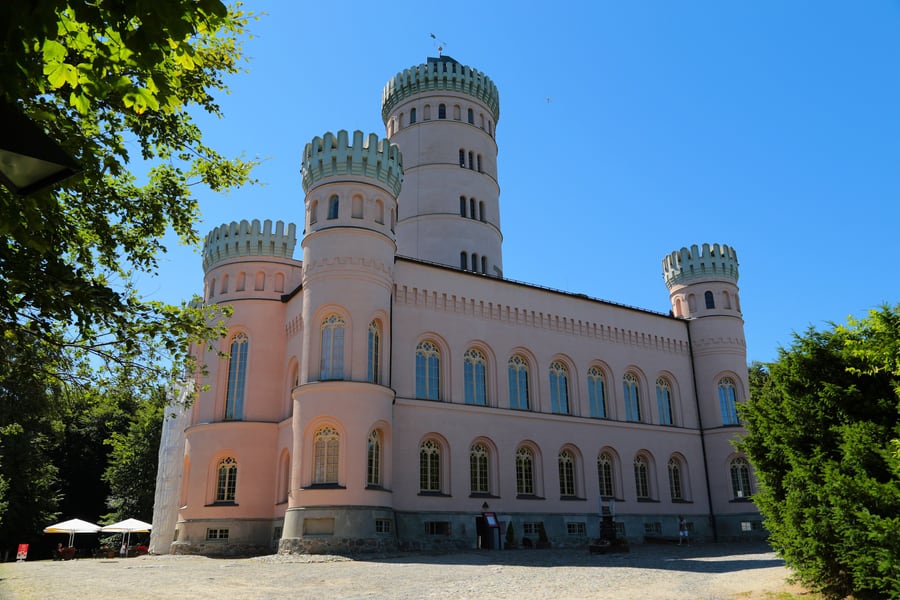 J.-H. Janßen / Wikimedia Commons · CC BY-SA 3.0 · cropped
Jagdschloss Granitz
A pink hunting lodge in the manner of a north Italian Renaissance castle, built for the same Prince Malte between 1837 and 1846 on the Tempelberg, 107 metres up in the Granitz woods. Four round corner towers, and a fifth in the centre: 38 metres, added in 1844 to Karl Friedrich Schinkel's design, with a cast-iron spiral staircase of 154 steps inside it. The platform at the top is 144 metres above the sea, and on a clear day you can see as far as Usedom.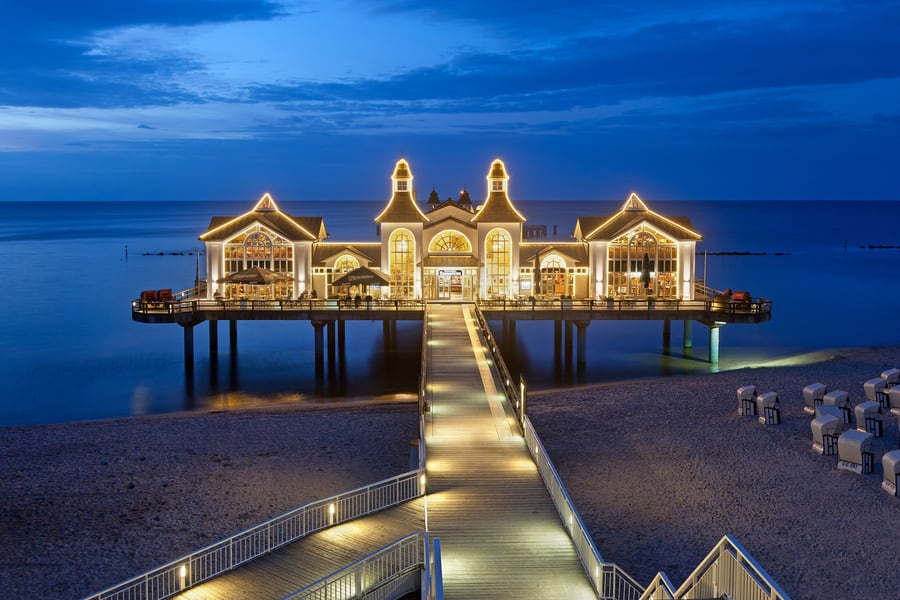 Thomas Wolf, www.foto-tw.de / Wikimedia Commons · CC BY-SA 3.0 · cropped
Sellin
Sellin's Wilhelmstraße runs straight downhill between rows of villas from the first years of Bäderarchitektur and stops at a 30-metre cliff. From there you reach the beach by the Himmelsleiter — the ladder to heaven, a steep flight of steps — or by lift. The pier at the bottom is 394 metres long, the longest on Rügen, opened on 2 April 1998 after six years of rebuilding, and it is lit after dark, which is when most people photograph it.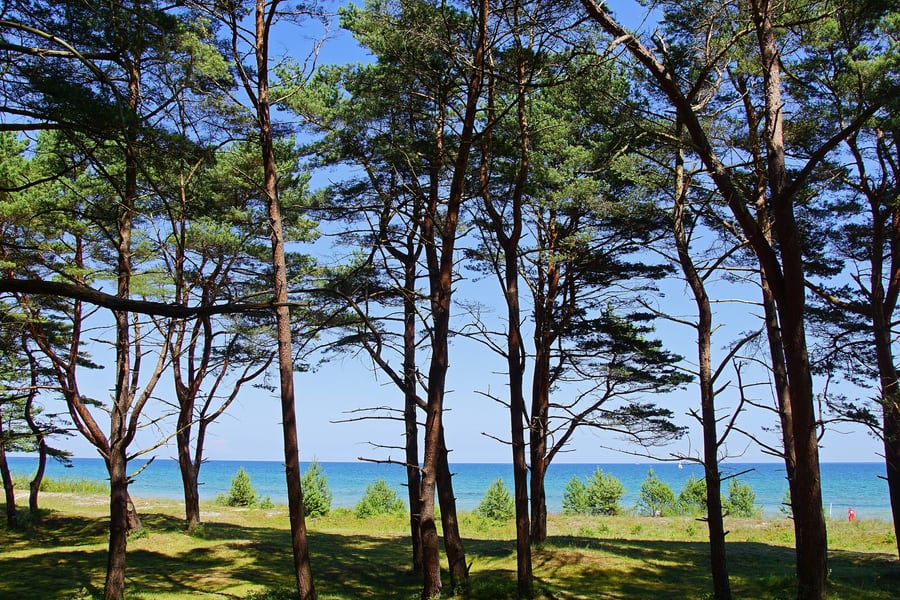 Jürgen Hamann / Wikimedia Commons · CC BY-SA 4.0 · cropped
Baabe
The smallest of the four resorts — 972 people — sitting on the Mönchgraben, the old boundary that divides the Mönchgut peninsula from the rest of Rügen, with the Baltic on one side and the Baaber Beek on the other and the woods of the Baaber Heide coming down almost to the sand. There is not much to Baabe beyond a main street, a beach and the trees, which is exactly why you get off here if you have just come from Binz in August.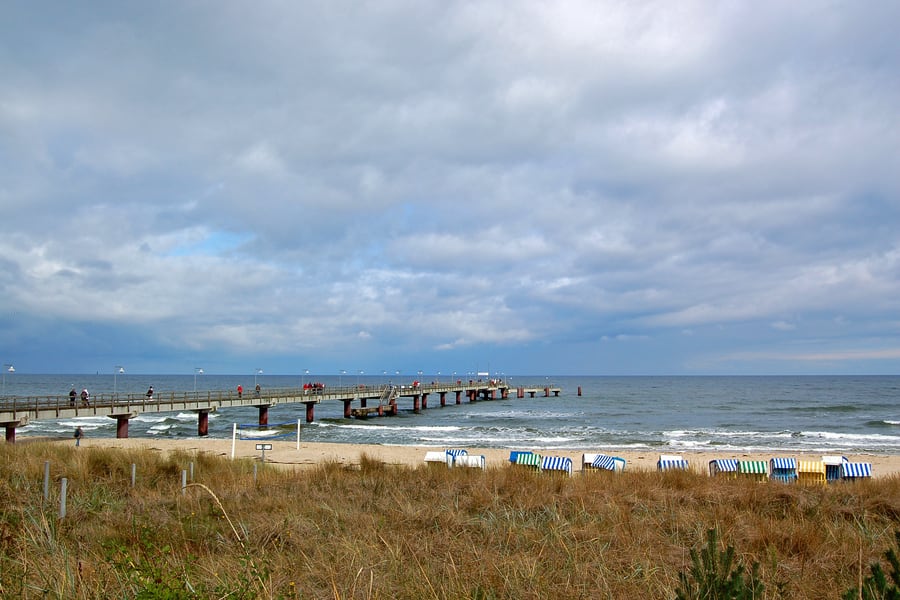 Gerhard Giebener / Wikimedia Commons · CC BY 2.0 · cropped
Göhren
The eastern terminus, out on the Mönchgut peninsula, with the platform about a hundred metres from the sea promenade. The Nordperd — the easternmost point of Rügen — divides the town's two beaches: the wide white Nordstrand with its 270-metre pier, and the stonier Südstrand running away towards Lobbe. Together they come to some five kilometres of sand. In the village, four listed buildings make up the Mönchguter Museen.Where to Sleep
Rügen has been in the accommodation business since 1816, and the choice along this line runs from apartment blocks behind the dunes to the white villas of the Bäderarchitektur — most of which are holiday flats now rather than hotels.
Where you base yourself changes the railway rather than the other way round. Binz sits halfway along and has the hourly service in each direction in summer, which makes it the easiest place to use the train casually. Putbus is the other sensible choice: quiet, inland, and the one station where the narrow gauge and the main line meet, so you can arrive and leave by train without a bus. Göhren at the far end is the furthest from everything, which is either the point or the problem.
Two houses on the line are worth singling out because of what they are, not because anyone is paying us to say so. Neither of the cards below carries a price or a booking link: we have no affiliate arrangement, and we do not quote figures we have not checked.
Where to stay
 Strubbl / Wikimedia Commons · CC BY-SA 4.0 · cropped
Hotel Badehaus Goor
A prince's bathhouse on the Bodden, at Lauterbach
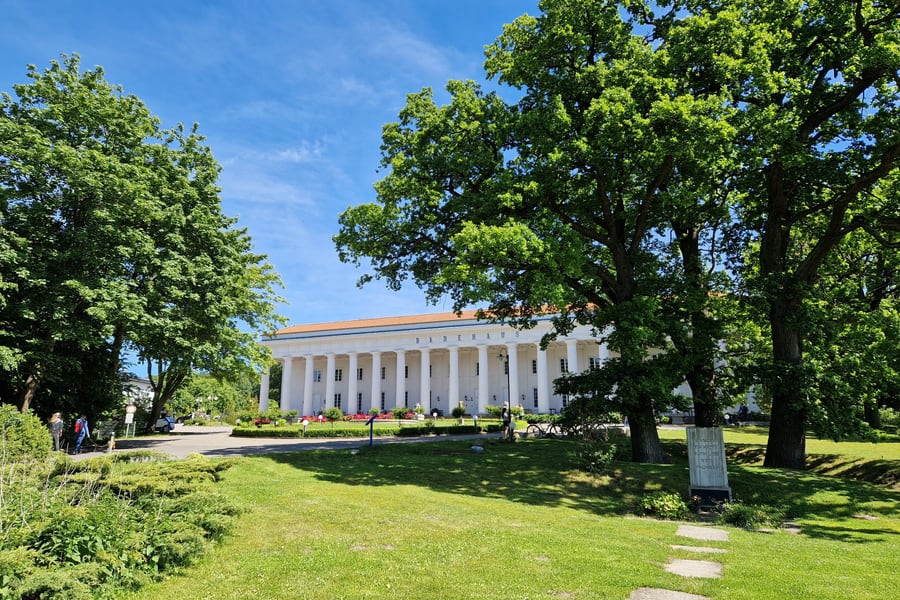
Begun in 1816 by Wilhelm Malte I as the Friedrich-Wilhelm-Bad and reckoned the first seaside bath on Rügen, it got its white colonnade of eighteen stone columns in 1833 and reopened as a hotel in 2007. It stands in the woods facing the water at Lauterbach, a walk from the Lauterbach Mole platform and one stop down the branch from Putbus.
Check Availability (opens in a new tab, on hotel-badehaus-goor.de)via hotel-badehaus-goor.de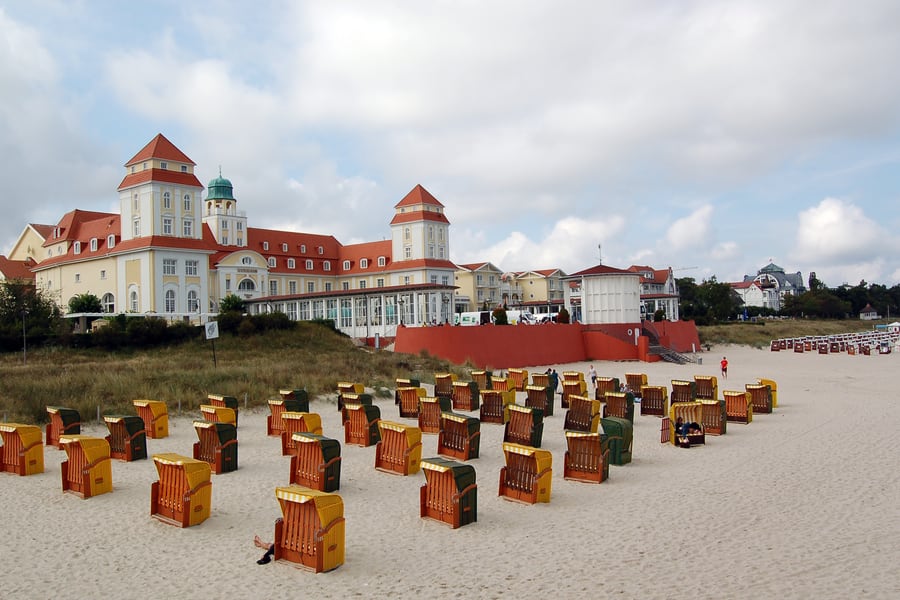 Gerhard Giebener / Wikimedia Commons · CC BY 2.0 · cropped
Kurhaus Binz
On the promenade, above the beach
The grandest building on Binz's seafront, a spa house of more than a century standing directly behind the beach and its ranks of hooded wicker Strandkörbe. The pier is a few minutes one way, the narrow-gauge station a walk inland the other.
Check Availability (opens in a new tab, on arosahotels.de)via arosahotels.deQuestions or corrections
Planning this trip and stuck on something, or spotted a time, fare or detail that has changed? Send us a message about Rasender Roland. We read every one, and we update this page when something has changed.