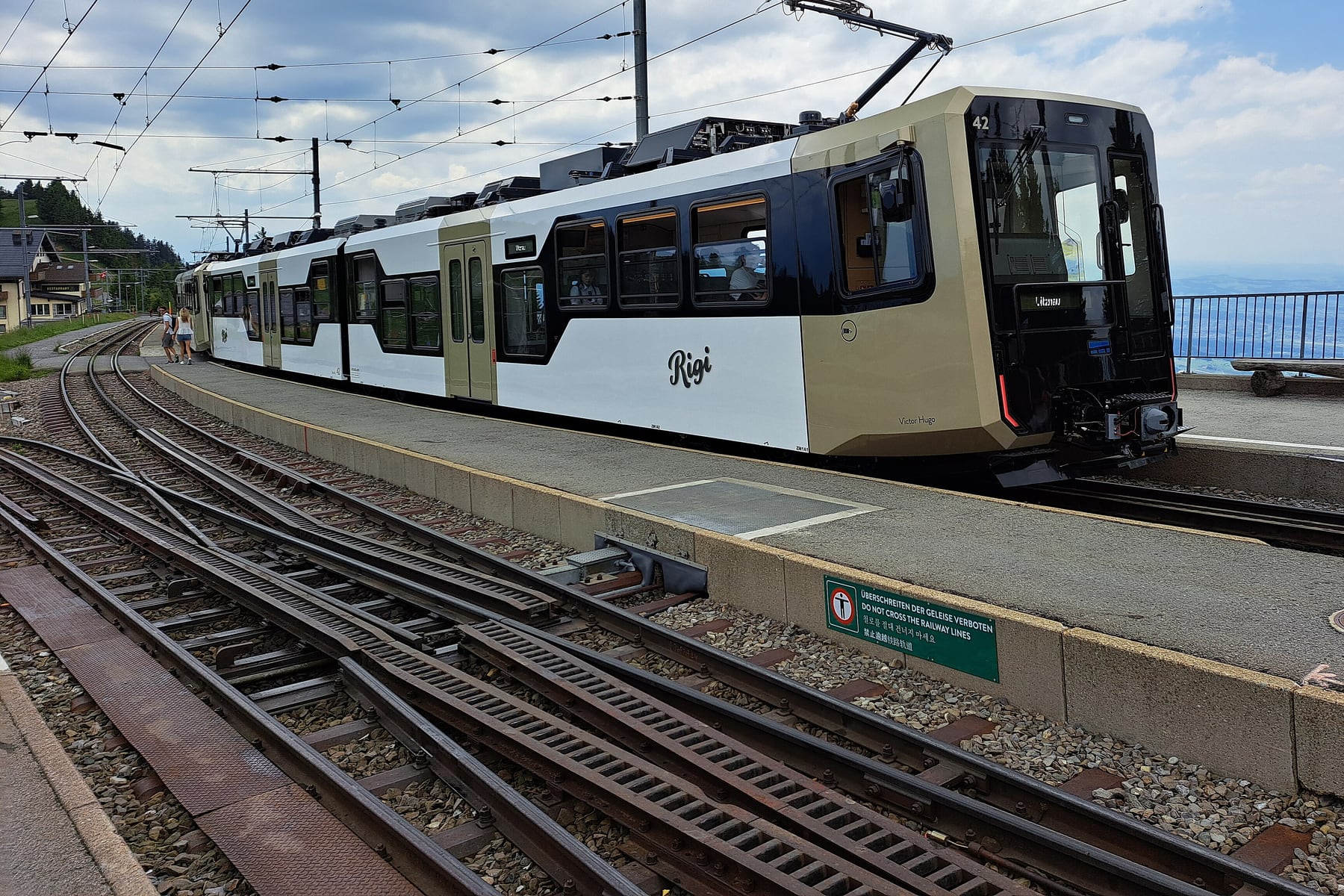
Rigi Railway
Chris.urs-o / Wikimedia Commons · CC BY-SA 4.0 · cropped
- Distance6.9 km
- Duration32 minutes up · 40 down
- Best seasonAll year · hourly from Vitznau
Introduction
Europe's first mountain railway spent its first hundred and nineteen years paying rent to reach the top of its own mountain.
The Rigi stands by itself between two arms of Lake Lucerne, and in 1870 the news that a company on the Lucerne side meant to build a railway up it travelled quickly round to the other. The citizens of Arth, in canton Schwyz, went to their own cantonal council and came away with the concession for the Schwyz ground — which is to say the summit, and the approach to it. So when the line from Vitznau opened on 21 May 1871, on the fifty-fourth birthday of the engineer who designed it, it stopped at Rigi Staffelhöhe, two hundred metres short of the top. It reached Rigi Kulm two years later on rails belonging to the rival Arth–Rigi Bahn, under a lease it went on paying until the two companies merged in 1992, and the Swiss timetable still numbers the two halves separately.
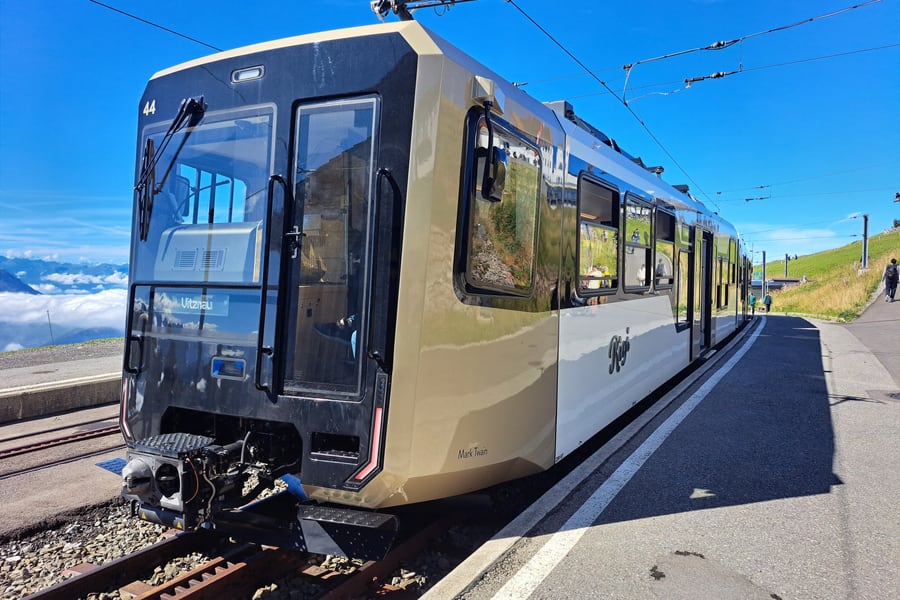
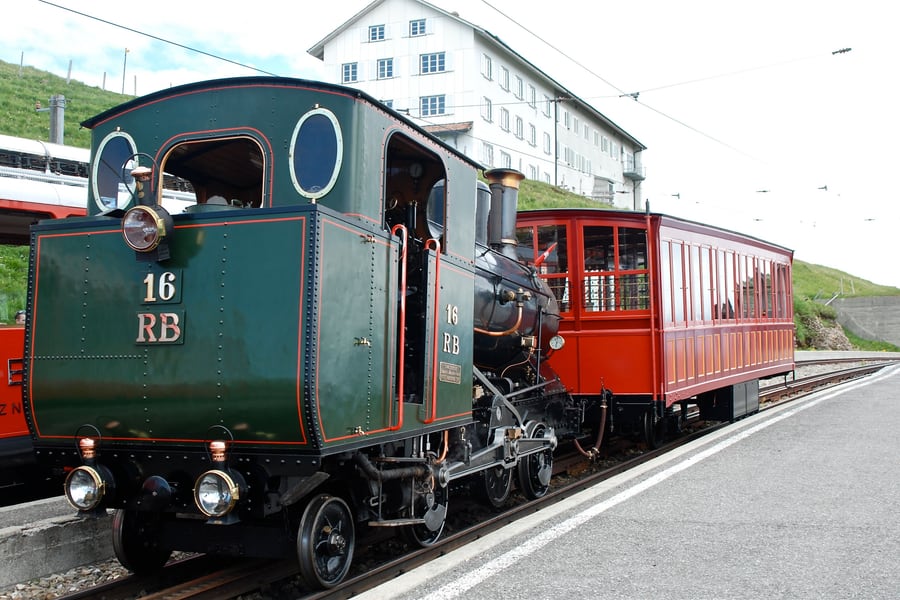
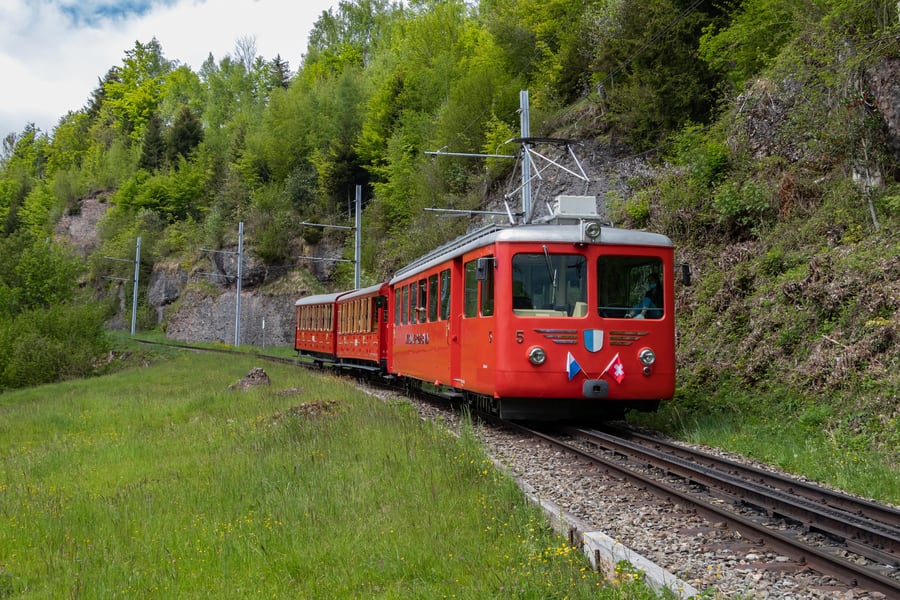
None of which a passenger notices. What a passenger gets is just under seven kilometres of standard gauge climbing 1,300 metres out of a lakeside village, through a cutting, over a viaduct, past four request stops with names like Grubisbalm and Romiti-Felsentor, into the spa village of Rigi Kaltbad and out along an open shoulder to a summit from which twenty-four of Switzerland's twenty-six cantons are visible on a clear day. The railway runs every day of the year, roughly hourly, and the fleet is younger than most people expect: six articulated railcars delivered by Stadler in 2021 and 2022, named after the travellers who made the Rigi famous before there was any way up it but a horse. Two steam locomotives of 1923 and 1925 are still in the shed at Vitznau, and on Wednesdays through the summer the ordinary scheduled trains are worked by vehicles more than fifty years old.
The Journey
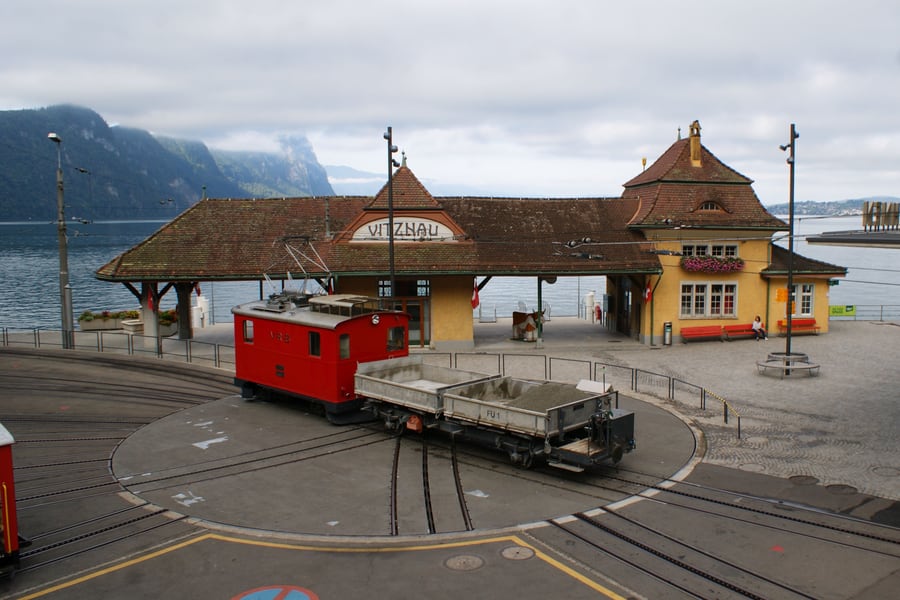
The station at Vitznau is a few paces from the pier, which is the point: for most of the railway's life its passengers arrived by boat, and a good many still do. In front of the station building there is a turntable set into the forecourt, and beside the platform a carved wooden figure of Niklaus Riggenbach sits on a bench with his hands in his lap, looking at the mountain he talked Switzerland into climbing by rail.
The train leaves at 435 metres above the sea and is inside a tunnel within a few seconds — a short one, forty-nine metres, cut immediately behind the station. Then the gradient arrives and does not really let go for half an hour. The steepest part of the climb is 250 parts in a thousand, one in four, and the tightest curve has a radius of sixty metres.
Riggenbach's ladder
Under the train, between the running rails, is the rack that made all of this possible. Niklaus Riggenbach patented it in France in 1863 — a ladder, essentially: two steel channels with round rungs pinned between them, and a toothed wheel on the locomotive that walks up the rungs. It is strong, tolerant of dirt and snow, and cheap to make in quantity, and it went on from this mountain to be laid on rack railways all over the world.
The Rigi lines are racked continuously from end to end, which has a consequence you can see in the current fleet. Because the cogwheel does all the work of hauling and all the work of braking, the wheels themselves are free-running, and the railcars carry no brakes on their wheels at all: on a gradient of one in four a wheel brake would achieve very little. What stops the train are band brakes clamped on the pinion shafts, two per driven axle for ordinary stops and two more, without any means of adjustment, as parking brake and emergency brake.
The other thing worth knowing about this railway is its gauge. Mountain lines are usually narrow; this one is 1,435 mm, ordinary standard gauge, the same as an express to Zurich. It was built that way in 1871 because nobody had yet decided that mountain railways ought to be narrow, and the result is a train three metres wide with seats five across.
Up through the woods
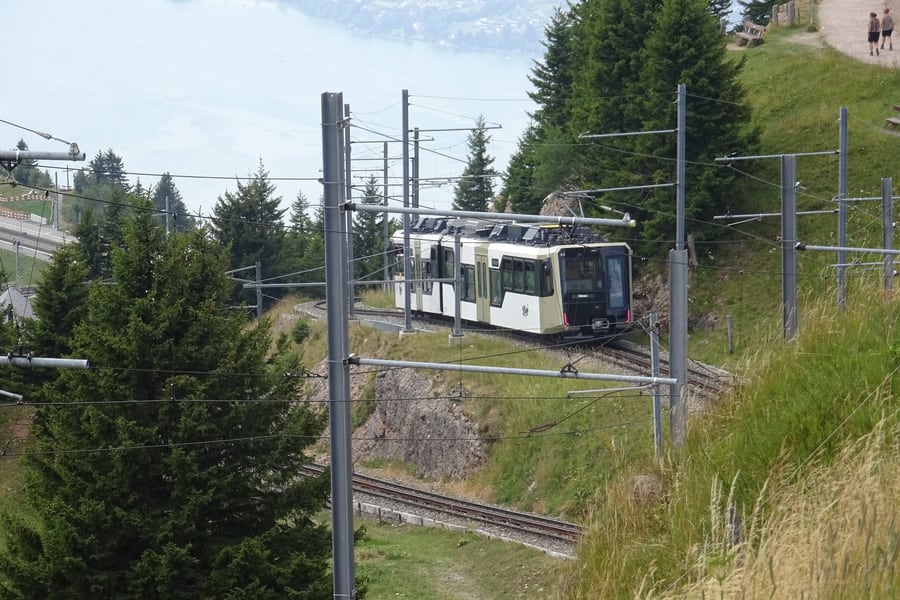
Mittlerschwanden at 699 metres and Grubisbalm at 910 are request stops, small platforms in the trees where the train pauses only if somebody has asked. Between them the line runs through the Schwanden tunnel and then out onto the Schnurtobel viaduct, eighty-four metres of bridge over the Widibach gorge, which has been photographed by every visiting photographer since the 1870s and is still the picture the railway is best known for.
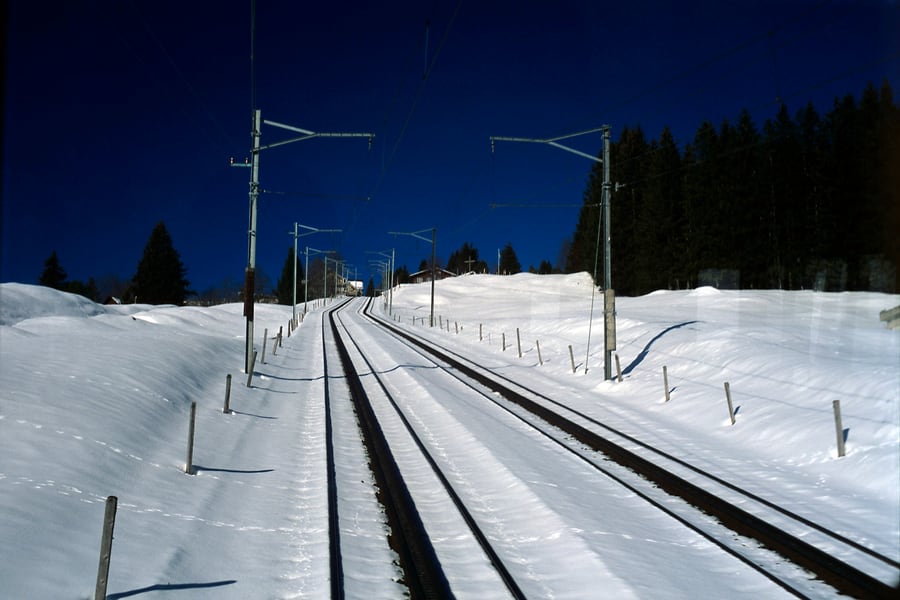
At Freibergen, 1,022 metres, the line doubles. From here up to Rigi Kaltbad-First there have been two tracks since 1874 — three years after opening, because the traffic was already more than one track could hold. In 1874 alone the railway carried more than a hundred thousand people, which for a four-year-old line up a mountain was a worldwide sensation.
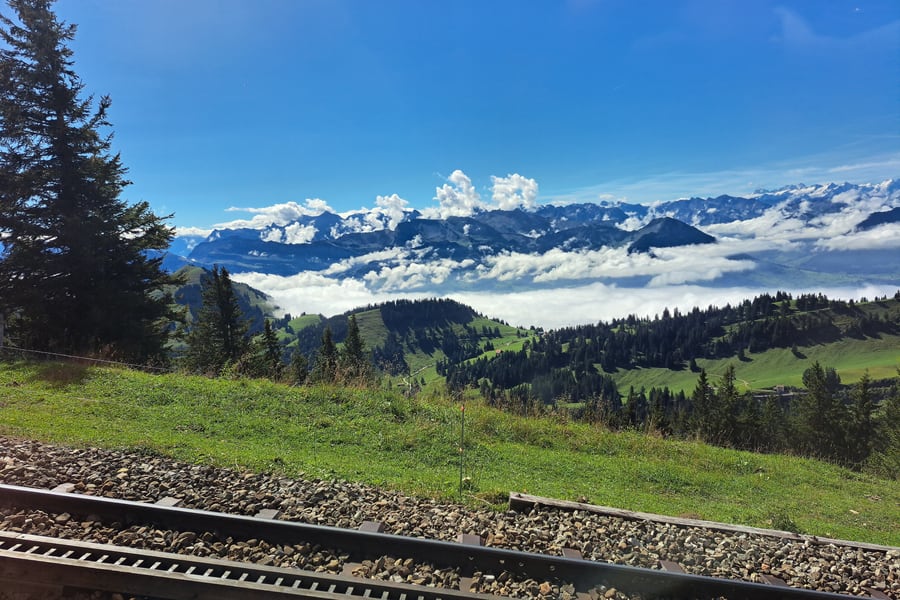
Romiti-Felsentor at 1,195 metres is the last of the request stops. The trees thin, the lake opens out below on the left, and Pilatus appears across the water.
Rigi Kaltbad
At 1,436 metres the train runs into Rigi Kaltbad-First, which is a village rather than a halt: a spa settlement that has been taking guests since long before the railway, with the cable car up from Weggis arriving two hundred metres away and Mario Botta's mineral bath and spa built into the slope above the station. The station itself was rebuilt in 2012, gaining a second platform, and the new building opened in March 2015 with a grass roof.
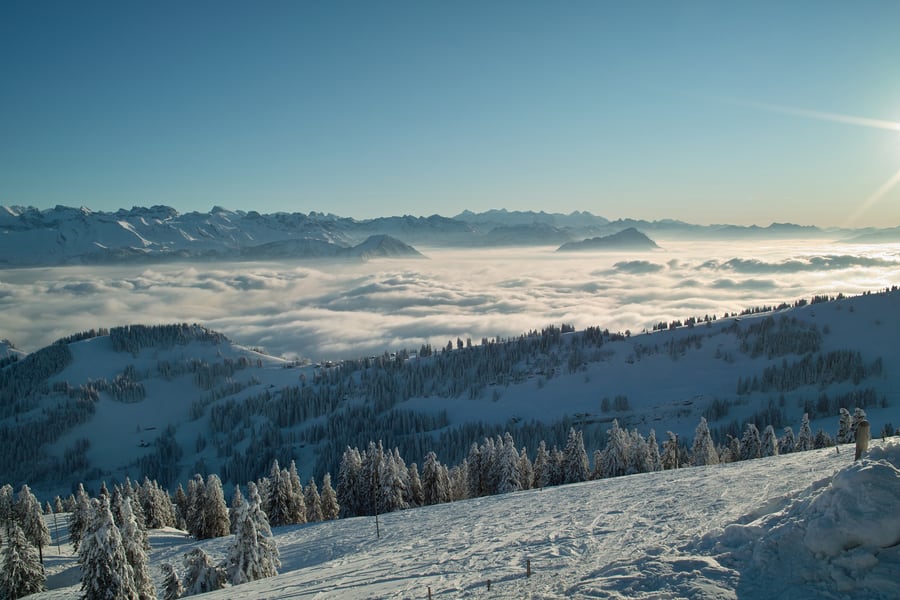
Above Kaltbad the mountain changes character. The forest gives out, the line runs along an open shoulder, and at Rigi Staffelhöhe — 1,550 metres, the terminus for the first two years of the railway's life — the whole Alpine chain comes into view to the south.
Where the two railways meet
A few hundred metres further, at Rigi Staffel, another track comes in from the right. That is the Arth–Rigi Bahn, up from Arth-Goldau on the other side of the mountain, and this is the junction that was not built until 1990. Before then the two companies shared a summit station and nothing else. The Arth line lost the race to open — it got there on 4 June 1875, four years late — and is remembered instead for the better view along its route and the more luxurious carriages.
It also got its own back in 1907, when it became the first standard-gauge rack railway anywhere in the world to run on electricity. The Vitznau line stayed with steam for another thirty years and was not electrified until 3 October 1937.
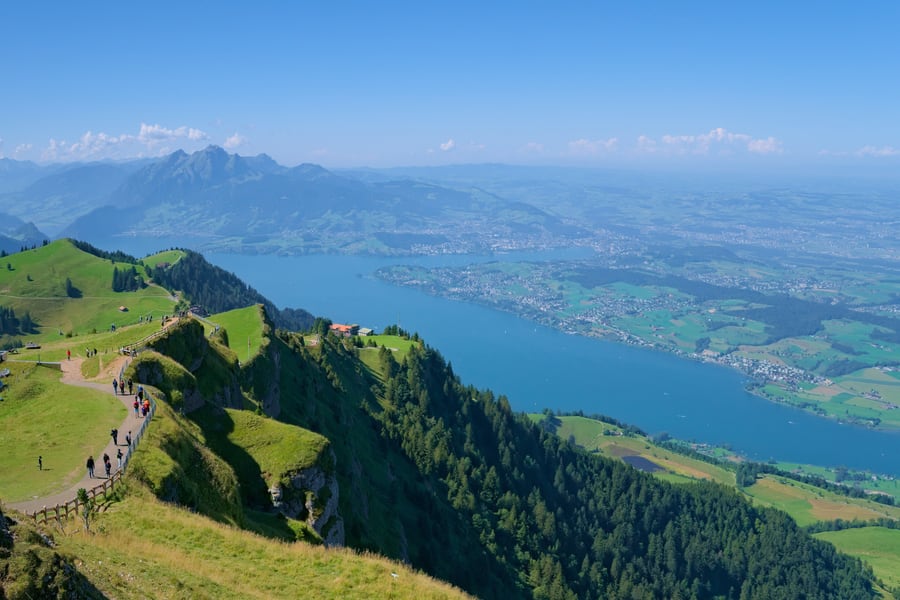
The last stretch from Staffel to Rigi Kulm is the Paradestrecke, the parade section, and it is where the mountain finally lets go of the train: open grass on both sides, the drop away to Lake Lucerne on one hand and to Lake Zug and the Lauerzersee on the other.
The top
Rigi Kulm station stands at 1,749 metres, and the summit itself is another fifty metres up and five minutes' walk, marked by a cross and a 96-metre Swisscom mast. On a clear day the count is twenty-four of the twenty-six cantons — Geneva and Basel are the two that cannot be seen — thirteen named lakes, and around six hundred and twenty Alpine summits, of which five are above four thousand metres.
There has been a guesthouse up here since 1816, three years before the visitor count first passed a thousand a year, and the Rigi Kulm-Hotel that stands there now is the descendant of it. Everything around it was built for the same reason the railway was: from about 1830 the Rigi was the single most fashionable view in Europe, and Weggis at the foot of the mountain kept thirty stables and something like a thousand horses to get people up it, along with guides and teams of men who carried visitors in chairs. Queen Victoria rode up from Küssnacht on horseback in 1868. Mark Twain came a decade later and wrote a very funny account of it. King Ludwig II of Bavaria came in 1881 and left the hotelier a tea set, which is still in a cabinet in the dining hall.
The railway put the chair-carriers out of business and then, within four years, was carrying a hundred thousand people a year up the same slope.
Coming down
The descent takes forty minutes against thirty-two going up, because a rack train comes down under brake and the brakes set the pace. The railcars of the current fleet return their braking energy to the overhead line — the first vehicles this railway has had that can — and when the wire will not take it, the surplus goes to resistors on the roof.
The six Stadler railcars are numbered 41 to 46 and each carries a name: the company chose travellers who came to look at Switzerland in the eighteenth and nineteenth centuries, so the train that pulls in may be Victor Hugo, or Mark Twain, or Queen Victoria. Four more were ordered in December 2025, for the Goldau side, and are due in service in 2030.
Along the route
 JoachimKohler-HB / Wikimedia Commons · CC BY-SA 4.0 · 2017 · cropped
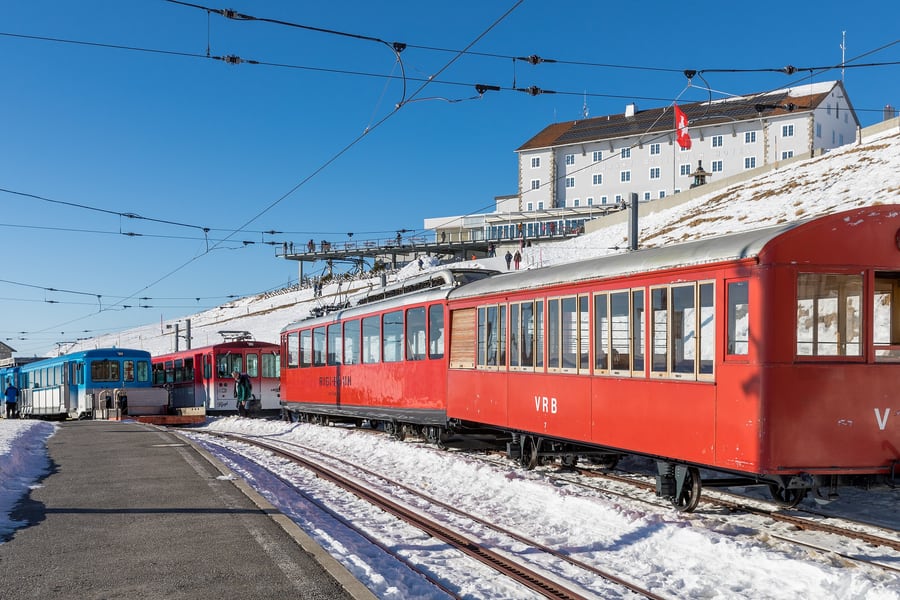
The last mile belonged to the rival
Arth took the concession for the Schwyz ground, summit included, so the line from Vitznau opened in 1871 two hundred metres below the top. It reached Rigi Kulm two years later on the Arth–Rigi Bahn's rails, and paid a lease on them until the two merged in 1992.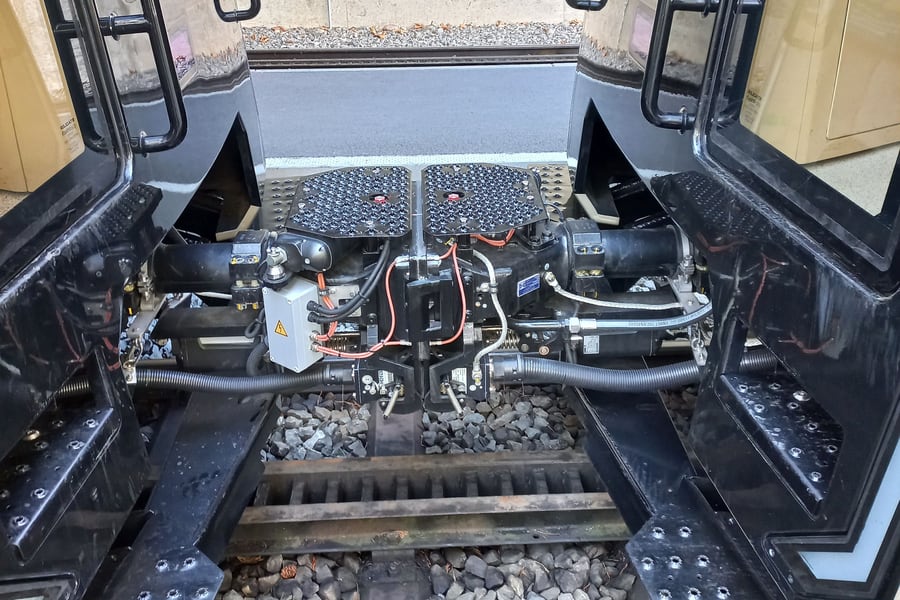 Asurnipal / Wikimedia Commons · CC BY-SA 4.0 · cropped
Riggenbach's ladder
Niklaus Riggenbach patented his rack in 1863 and laid the first one up this mountain eight years later. It is a ladder — two steel channels with round rungs pinned between them — and from here it went out to rack railways worldwide.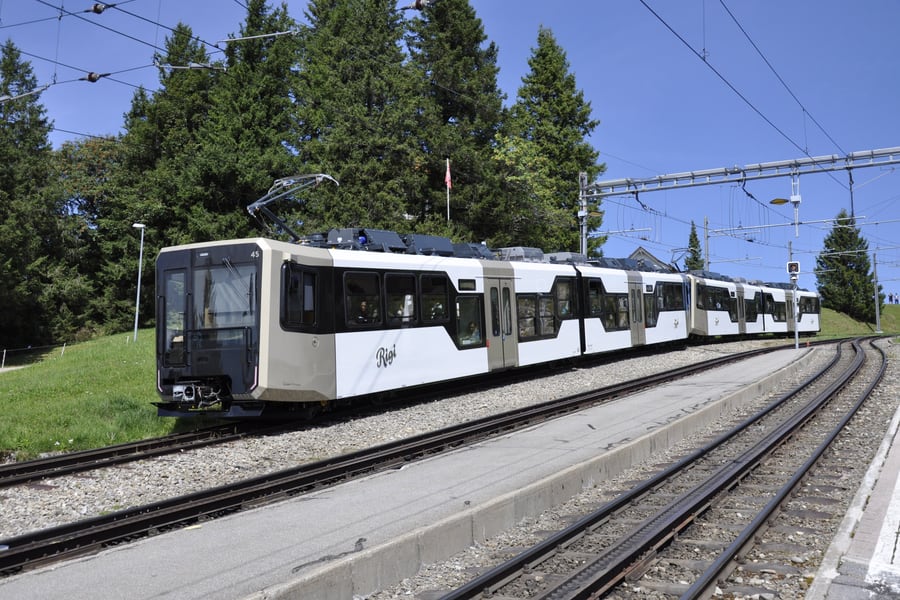 Heitersberg / Wikimedia Commons · CC BY-SA 4.0 · 2022 · cropped
Six railcars with no brakes on their wheels
On a gradient of one in four a wheel brake would achieve very little, so the Stadler sets of 2021 run their wheels free and do everything through the cogwheels: two band brakes per driven axle for stopping, two more for parking and emergencies.A bit of history
Culture & experiences along the way
 Stefan K-50678 / Wikimedia Commons · CC BY-SA 4.0 · 2016 · cropped
Rigi Historic Wednesday
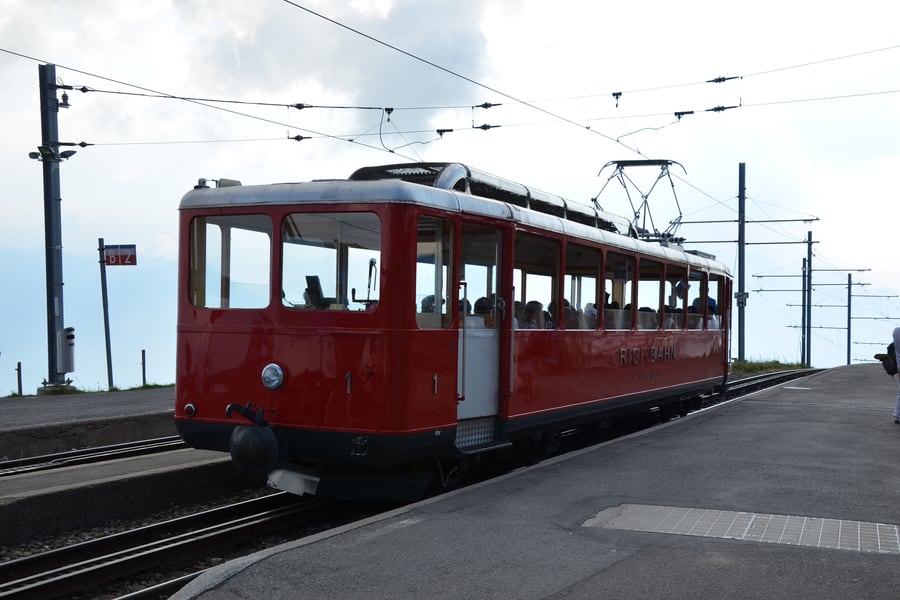
Ordinary scheduled trains worked by vehicles more than fifty years old, at the ordinary fare, every Wednesday from late May to early October.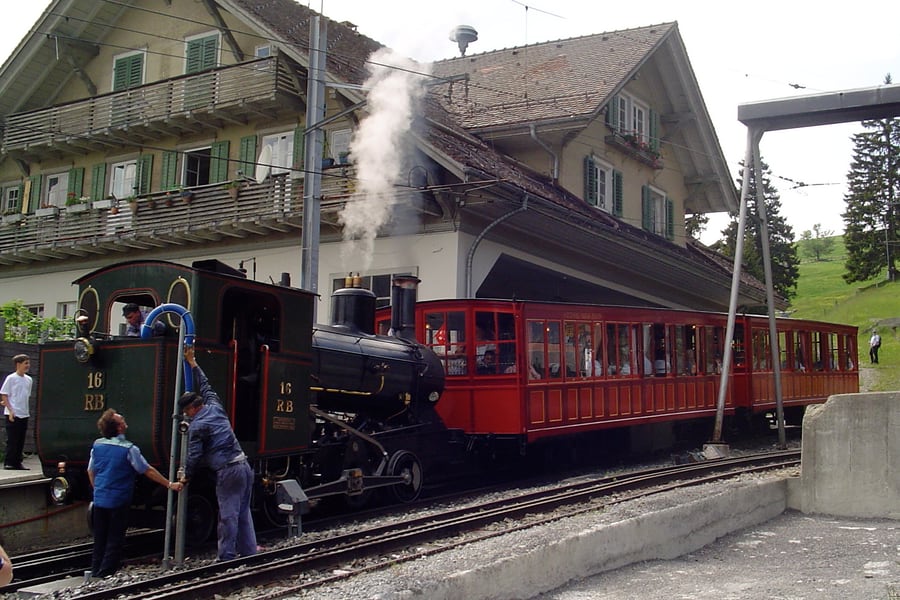 Marc Oliver Rieger / Wikimedia Commons · CC BY-SA 3.0 · cropped
Summer steam from Vitznau
Locomotive 16, built in 1923, on the original route with restored open carriages. Four hours of firing up before it can move.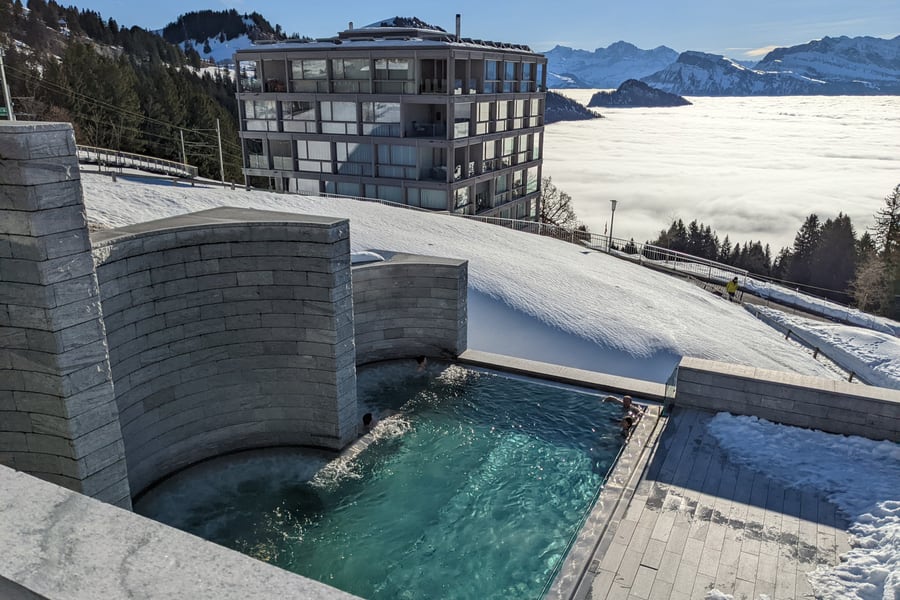 Jpatokal / Wikimedia Commons · CC BY-SA 4.0 · cropped
Mineral bath and spa, Rigi Kaltbad
Mario Botta's bath house built into the slope above the station, open since July 2012, with an outdoor pool that looks down on the cloud.Timetables
The Rigi Railway runs every day of the year. There is no closed season on this mountain: the Vitznau line took up winter working in 1906 and has kept it ever since, and the pattern below changes only in how many extra trains are added at the busy times of year.
Times are the operator's own printed timetables for 2026, checked against rigi.ch in August 2026. Rigi Bahnen publishes the Vitznau line in three periods — summer, 23 May to 6 September; autumn, 7 September to 11 October; autumn and winter, 12 October to 12 December. The core service is the same in all three: an hourly departure at a quarter past from Vitznau, and on the hour from Rigi Kulm.
Vitznau → Rigi Kulm · summer, 23 May – 6 September 2026
| Vitznau | Rigi Kaltbad-First | Rigi Staffel | Rigi Kulm |
|---|---|---|---|
| 06:35 | 06:55 | — | — |
| 08:15 | 08:35 | 08:42 | 08:47 |
| 09:15 | 09:35 | 09:42 | 09:47 |
| 10:15 | 10:35 | 10:42 | 10:47 |
| 10:50 ⁷ | 11:13 | 11:20 | 11:25 |
| 11:15 | 11:35 | 11:42 | 11:47 |
| 11:50 ⁸ | 12:13 | 12:20 | 12:25 |
| 12:15 | 12:35 | 12:42 | 12:47 |
| 13:15 | 13:35 | 13:42 | 13:47 |
| 14:15 | 14:35 | 14:42 | 14:47 |
| 15:15 | 15:35 | 15:42 | 15:47 |
| 16:15 | 16:35 | 16:42 | 16:47 |
| 17:15 | 17:35 | 17:42 | 17:47 |
| 18:15 | 18:35 | 18:42 | 18:47 |
| 19:15 | 19:35 | 19:42 | 19:47 |
| 22:05 | 22:25 | 22:32 | — |
| 00:05 ⁶ | 00:23 | — | — |
Rigi Kulm → Vitznau · summer, 23 May – 6 September 2026
| Rigi Kulm | Rigi Staffel | Rigi Kaltbad-First | Vitznau |
|---|---|---|---|
| — | — | 07:15 | 07:40 |
| 09:00 | 09:05 | 09:15 | 09:40 |
| 10:00 | 10:05 | 10:15 | 10:40 |
| 11:00 | 11:05 | 11:15 | 11:40 |
| 12:00 | 12:05 | 12:15 | 12:40 |
| 13:00 | 13:05 | 13:15 | 13:40 |
| 14:00 | 14:05 | 14:15 | 14:40 |
| 14:30 ⁸ | 14:35 | 14:50 | 15:13 |
| 15:00 | 15:05 | 15:15 | 15:40 |
| 16:00 | 16:05 | 16:15 | 16:40 |
| 17:00 | 17:05 | 17:15 | 17:40 |
| 18:00 | 18:05 | 18:15 | 18:40 |
| 19:00 | 19:05 | 19:15 | 19:40 |
| 20:00 | 20:05 | 20:15 | 20:40 |
| 22:40 | 22:45 | 22:55 | 23:20 |
⁶ — night to Sunday. ⁷ — Sundays, plus 25 May and 1 August. ⁸ — Sundays, plus 25 May and daily in the summer holidays, 4 July to 16 August.
Mittlerschwanden, Grubisbalm, Freibergen and Romiti-Felsentor are request stops and are left out of the tables above for room. Boarding and alighting there is possible only at the leading end of the train, and groups cannot use them.
Autumn and winter
From 7 September to 11 October the pattern is the summer one without the Sunday extras. From 12 October to 12 December it is hourly from Vitznau at 06:35, then 08:15 through to 16:15, with a 17:40 and a 19:15, and hourly back from Rigi Kulm from 09:00 to 17:00. The 18:20 and 20:00 down and the 18:11 and 19:47 up run Fridays and Saturdays only. The 22:05 up and the 22:40 down keep going all year, and the 00:05 from Vitznau still runs on the night into Sunday.
Extra trains are laid on between Vitznau and Rigi Kaltbad on weekdays from 16 to 20 and 23 to 27 November 2026, while the Weggis cable car is shut for maintenance.
How long it takes
Thirty-two minutes up and forty minutes down. The operator quotes "around 30 minutes" for the climb; its own printed timetable gives 08:15 to 08:47 going up and 09:00 to 09:40 coming back. The descent is slower because a rack train comes down under brake, and the brakes set the pace.
Getting to Vitznau
By boat, from Lucerne, about an hour, with the pier a few paces from the station. This is how the railway's passengers have arrived since 1871 and it is still the best way to do it. Sailings are the Lake Lucerne company's; its timetable is at lakelucerne.ch (opens in a new tab).
By bus, from Küssnacht or Brunnen, about thirty minutes, routes 502 and 508.
By car, to two covered car parks in the village — one on Seestrasse, a hundred metres from the station, and one on Altdorfbachweg, two hundred and fifty.
There is no railway station at Vitznau other than the rack line's own. Arriving by train means going to Arth-Goldau instead and taking the other Rigi line up the far side of the mountain, which takes about forty-five minutes from a station five minutes' walk from the main-line platforms.
Special workings
- Rigi Historic Wednesday, 27 May to 7 October 2026: several of the ordinary scheduled trains in the table above run with vehicles at least fifty years old. They are marked in the operator's timetable and cost no more than an ordinary ticket.
- Steam with locomotive 16, 24 May to 20 September 2026, from Vitznau; and locomotive 7, built 1873, from Goldau between 3 and 11 October. Both are booked separately.
- Rigi Historic XXL, at Whitsun and on 1 August, when a large part of the scheduled service is worked by historic stock and there is live commentary at Rigi Staffel.
- A special timetable with extra trains runs on 19 July 2026 for the Rigi Schwingen wrestling festival — postponement date 2 August — and on 1 August, Swiss National Day.
Current times and any disruption notices are at rigi.ch (opens in a new tab).
Tickets
Every price here is Rigi Bahnen's own tariff, valid from 1 June 2026 and read off rigi.ch in August 2026. There is one class, one fare all year, and no peak or off-peak. A GA travelcard, a Swiss Travel Pass, the Lucerne Travel Pass or the Tell-Pass carries you free — the Rigi is one of only three Swiss mountains a Swiss Travel Pass covers outright rather than at a discount — and so does any child up to fifteen accompanied by an adult. The Half-Fare travelcard, Eurail and Interrail each halve the fare.
Worth knowing before buying: a return from Vitznau to Rigi Kulm and the Mount Rigi Railways day pass cost exactly the same. The day pass covers both cogwheel railways and the cable cars from Weggis and Kräbel, so anyone going up one side and down the other should not be buying the return. There are no seat reservations, and none are needed.
Book your tickets
Vitznau – Rigi Kulm return
CHF 84 full fare · CHF 42 with a Half-Fare Card, Interrail or Eurail · free with a Swiss Travel Pass or GA
The whole line and back, thirty-two minutes up and forty down.
Book Tickets (opens in a new tab, on RIGI BAHNEN AG)via RIGI BAHNEN AGMount Rigi Railways day pass
The same price as the return, and it covers a great deal more
Both cogwheel railways and both cable cars, for a whole day.
Book Tickets (opens in a new tab, on RIGI BAHNEN AG)via RIGI BAHNEN AG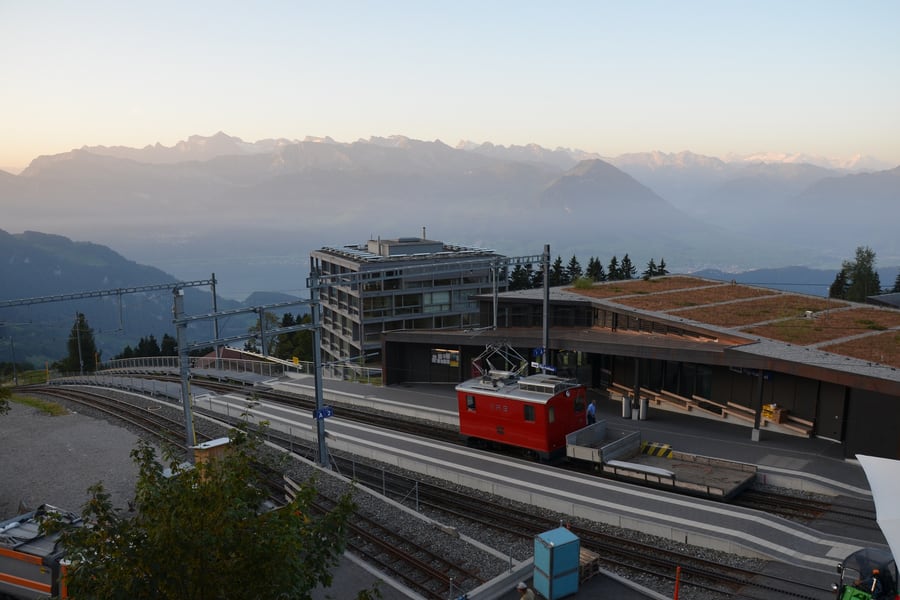
Vitznau – Rigi Kaltbad return
For the spa, the cable car down to Weggis, or the walk on from there
Two thirds of the way up, to the village with the mineral bath above the station.
Book Tickets (opens in a new tab, on RIGI BAHNEN AG)via RIGI BAHNEN AGRail Passes
The Rigi is the most generously covered mountain railway in Switzerland, and knowing which of the passes actually pays here saves real money. Everything below was checked in August 2026 against Rigi Bahnen's own discount list and against the SBB validity map that Interrail publishes for 2026.
The passes that carry you free
Swiss Travel Pass, Swiss Travel Pass Flex and the Swiss Transfer Ticket are valid outright on both Rigi cogwheel railways and on the cable cars from Weggis and Kräbel. There is no supplement, no class upgrade and no reservation to buy, because the railway has one class and sells no reservations. Nothing has to be exchanged at the counter: the pass is the ticket.
This is worth pausing on. The Swiss Travel Pass covers only three Swiss mountains outright — the Rigi, the Stanserhorn and the Stoos. On the Jungfraujoch, the Gornergrat, the Pilatus and the Schilthorn it buys a discount and the holder still pays. If a Swiss Travel Pass is already in your pocket, the Rigi is the mountain it does most for.
The GA travelcard and the SBB day passes sold against it are equally valid, as are the Lucerne Travel Pass — which was called the Tell-Pass until the spring of 2026 — and municipal and saver day passes.
The Lucerne Travel Pass is the regional option and covers trains, buses, boats and most of the mountain railways of central Switzerland: CHF 240 for three consecutive days, 265 for four, 290 for five and 365 for ten, with children of six to sixteen at a flat CHF 30. Days have to run consecutively, and holders of a Half-Fare Card, GA or Swiss Travel Pass get no further reduction on the price of the pass itself.
Interrail and Eurail
Fifty per cent, not free. Rigi Bahnen lists Eurail and Interrail among its half-price cards, and Interrail's own 2026 validity map for Switzerland puts "RB Rigi-Bahnen: Arth-Goldau–Rigi Kulm / Vitznau–Rigi Kulm" under Bonuses for pass holders, at 50 %, rather than under free rides. A pass holder therefore pays CHF 42.00 for the return from Vitznau instead of CHF 84.00, and buys the ticket at the counter or in the web shop by selecting the 50 % reduction card.
That is better than these passes manage on most Swiss mountains. On the Gornergrat, the Brienz Rothorn and the line up to the Rochers de Naye they are worth nothing at all.
The boat from Lucerne to Vitznau is also half price on an Interrail or Eurail pass: the same document lists SGV Vierwaldstättersee at 50 % under boat services. A pass day spent on the Rigi therefore costs half the railway and half the boat, with the main-line journey to Lucerne covered in full.
Is a pass worth buying for this journey alone?
No. A return from Vitznau to Rigi Kulm is CHF 84.00, or CHF 42.00 with a Half-Fare Card, and no pass on sale costs less than that for a single day's use. The calculation changes as soon as the Rigi is one stop among several: a visitor doing the Rigi, the Pilatus and a day on the lake from a base in Lucerne will find the Lucerne Travel Pass or a Swiss Travel Pass earns its price quickly, and the Rigi is the item on that list that a Swiss Travel Pass covers completely.
For a single ascent with no other travel, the Mount Rigi Railways day pass at CHF 84.00 is the better buy than the return ticket of the same price, since it also opens the Arth-Goldau line and both cable cars.
Children
Every child up to and including fifteen travels free on the Rigi railways when accompanied by an adult, which is a straight local rule and does not depend on any pass. Unaccompanied children between six and fifteen pay half. Groups and school classes are excluded from the free-travel rule and use the group tariff instead.
Conditions were current at August 2026 and are published at rigi.ch (opens in a new tab).
Places to Visit
The Rigi is not a summit with a railway attached; it is a mountain with villages, hotels, a spa and a hundred and twenty kilometres of footpath on it, and nine mountain railways and cableways serving different parts. The stops below are the ones on the Vitznau line, and every one of them is a place a passenger can get off and spend an afternoon.
Nothing on this mountain has to be reached by car, and almost nothing can be.
 Asurnipal / Wikimedia Commons · CC BY-SA 4.0 · cropped
Vitznau
A village on the lake with the boat pier and the station a few paces apart, which is how almost everybody arrived for the railway's first century and how a good many still do. A turntable is set into the station forecourt, the depot and works are alongside, and on the platform a carved wooden figure of Niklaus Riggenbach sits on a bench looking at the mountain he talked Switzerland into climbing by rail. Buses come in from Küssnacht and Brunnen; there is no main-line station here.Stefan K-50678 / Wikimedia Commons · CC BY-SA 4.0 · croppedRigi Kaltbad
A spa settlement that was taking guests long before the railway reached it, on a sunny shelf two thirds of the way up. Mario Botta's mineral bath opened above the station in July 2012, and the station itself was rebuilt the same year with a second platform, the new building following in March 2015 under a grass roof. The cable car from Weggis arrives two hundred metres away, so a round trip by rail and rope is easy. The Känzeli viewpoint is where Queen Victoria rode up to in 1868.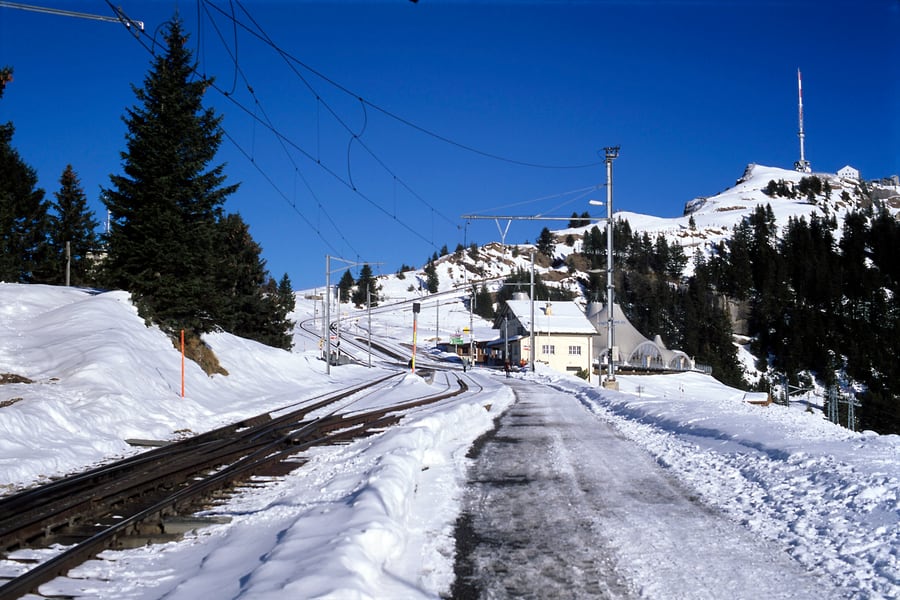 Falk2 / Wikimedia Commons · CC BY-SA 4.0 · cropped
Rigi Staffel
The junction, and for a hundred and fifteen years the thing that was missing. The track coming in from the right is the Arth–Rigi Bahn from Arth-Goldau, and the connection between the two systems was not built until 1990 — before that the Vitznau line ran as an island. Passengers changing for the Goldau side do it here rather than at the summit. The points are Riggenbach rack switches, and there is an insulated gap in the overhead where the two railways' wires meet.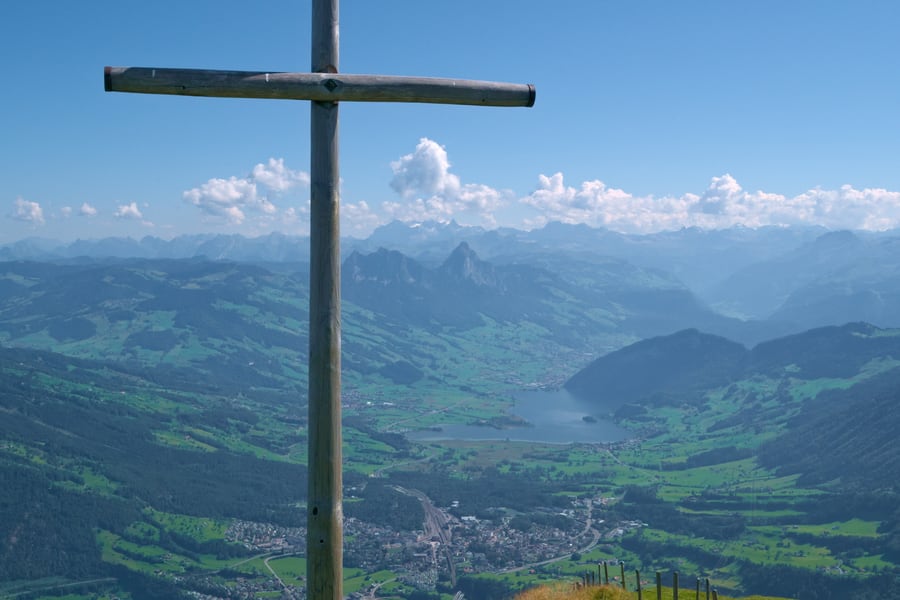 Daniel Kraft / Wikimedia Commons · CC BY-SA 3.0 · cropped
Rigi Kulm
The station is at 1,749 metres and the top another five minutes' walk, marked by a wooden cross and a 96-metre Swisscom mast. Twenty-four of Switzerland's twenty-six cantons are visible from here — Geneva and Basel are not — along with thirteen named lakes and some six hundred and twenty Alpine summits, five of them above four thousand metres. There has been a guesthouse up here since 1816, and within three years a thousand people a year were climbing to it on foot, on horseback or in a chair.Where to Sleep
Staying on the mountain is the point of the exercise for a good many visitors: the first and last trains of the day are quiet, the sunrise from Rigi Kulm is what brought Victorian tourists here in the first place, and an overnight guest with a Rigi guest card travels the railways at half price for the rest of the stay.
Both houses below are on the line, above the cloud more often than not, and reachable only by railway or cableway.
Where to stay
 Bybbisch94 / Wikimedia Commons · CC BY 4.0 · cropped
Rigi Kulm-Hotel
At the top of the line, and the oldest address on the mountain
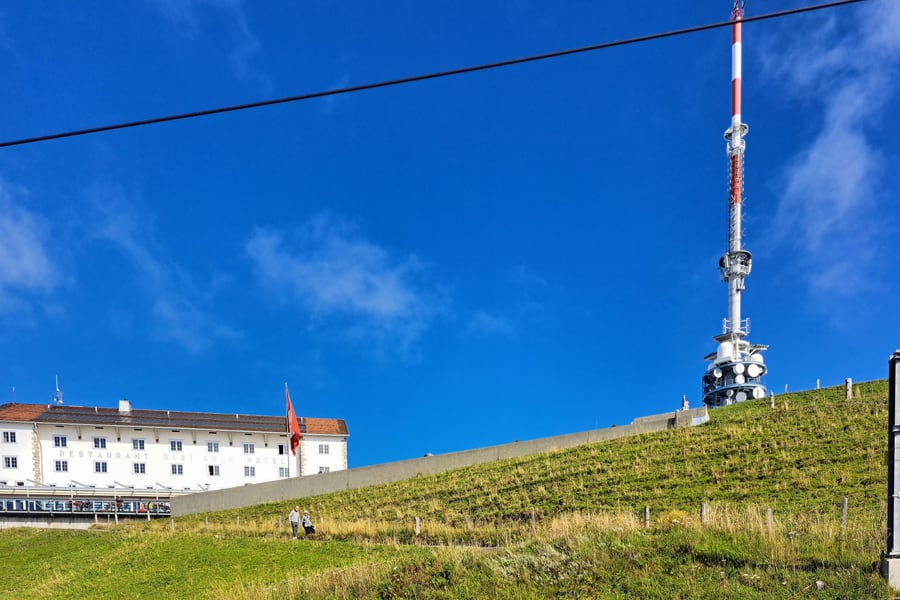
The descendant of the guesthouse that opened on this summit in 1816, still run as a family business and still the reason the sunrise on the Rigi is a thing people plan a trip around. Thirty-three rooms and sixty-six beds, a self-service restaurant and an à la carte dining room, and the summit cross five minutes' walk above it. The summer and autumn season runs from 24 April to 6 December 2026.
Check Availability (opens in a new tab, on rigikulm.ch)via rigikulm.chHotel Rigi Kaltbad
On the terrace two thirds of the way up, beside the spa
Fifty rooms in the middle of Rigi Kaltbad, a few steps from the station and with direct access to Mario Botta's mineral bath, whose 35-degree water comes from the Drei-Schwestern-Brunnen spring. The village has been a place of pilgrimage for six hundred years and the first bath house was built here in 1545; the hotel's bar is named for Mark Twain. No cars reach it. Guests staying overnight on the Rigi are given a guest card that halves the fare on the mountain railways.
Check Availability (opens in a new tab, on hotelrigikaltbad.ch)via hotelrigikaltbad.chQuestions or corrections
Planning this trip and stuck on something, or spotted a time, fare or detail that has changed? Send us a message about Rigi Railway. We read every one, and we update this page when something has changed.