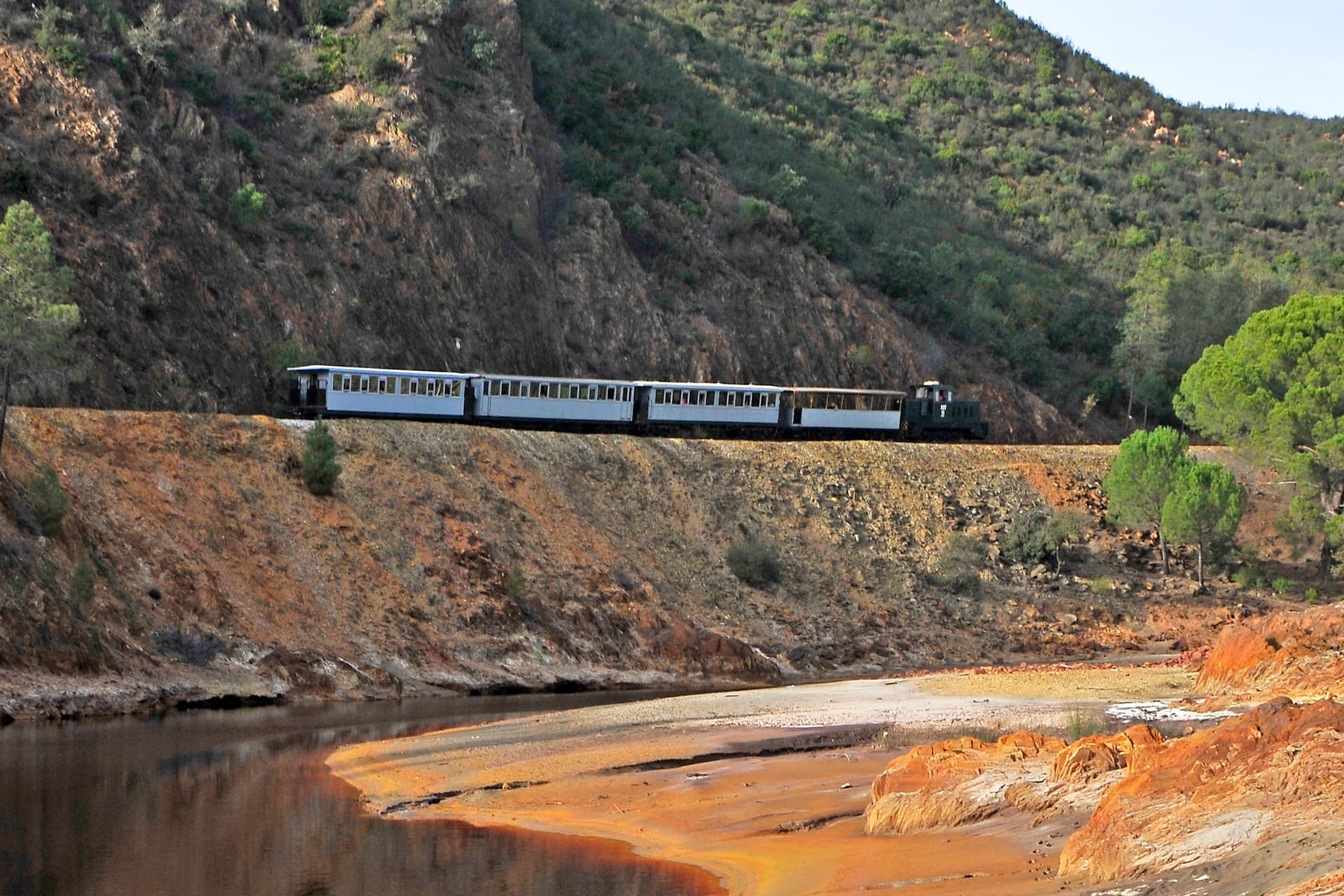
The Río Tinto Mining Railway — the ground that stands in for Mars
LBM1948, derivative work by CFA1877 / Wikimedia Commons · CC BY-SA 4.0 · cropped
- DistanceTalleres Mina–Los Frailes · 22 km there and back
- DurationAbout 1 hour 30 minutes
- Best seasonAll year · steam on the first Sunday of the month, November to April
Introduction
There is a stretch of Andalusia where the river runs the colour of rust, the hills are stacked in ochre and violet terraces, and space agencies come to practise. The Río Tinto rises in the Sierra Morena and reaches the sea at Huelva about a hundred kilometres later, and for much of that distance it carries a pH of around 2 and a heavy load of dissolved iron. That combination — strongly acidic water, thick with metals, and alive with microbes that make their living from oxidising them — is the closest thing on Earth to conditions scientists expect to find on Mars. Researchers have drawn the comparison directly with Martian deposits at Meridiani Planum.
The mining railway runs straight through the middle of it.
Twenty-two kilometres there and back, from a station called Talleres Mina out to Los Frailes and home again, on the trackbed of a line that carried copper ore down to the port of Huelva from 1875 until 1984. When the ore traffic stopped, the railway was left where it stood. It came back as a passenger operation on 4 November 1994, run by the Fundación Río Tinto, and reached Los Frailes three years after that.
What makes the ride unusual is not the engineering, which is modest, or the speed, which is slow. It is that the landscape outside the window is not being presented as a view. It is a working analogue for another planet, and the operator says so in as many words — the Fundación sells a circuit here under the title Marte en la Tierra, Mars on Earth, and advertises it with the line "it is now possible to reach Mars by train". In 2016 the European MOONWALK programme ran trials on this ground in which a suited operator and a wheeled rover rehearsed working together, of the kind that would be needed on a Martian surface.
What the journey is
The train leaves from a station on the A-476 between the towns of Minas de Riotinto and Nerva, which is to say in neither of them. Boarding is twenty minutes before departure. The carriages are wooden and open-gangwayed, the traction is usually a diesel in Fundación Río Tinto green, and the whole round trip takes about an hour and a half, including a stop at Los Frailes long enough to walk down to the water and look at it properly.
On the first Sunday of each month between November and April, the working is steam instead, over the shorter leg between Talleres Mina and Zarandas. The two engines involved are worth the trip on their own: number 14 was built in 1875 and number 51 in 1890, and nothing older is still in steam anywhere in Spain.
A landscape that has been worked for five thousand years
The red of the river is not simply pollution, and it is not simply natural either. The rock in this part of the Iberian Pyrite Belt was weathering into acid long before anyone put a pick into it, and the mines have been adding to that process for a very long time — the museum in Minas de Riotinto covers five thousand years of extraction here, Roman workings included. The honest answer is that the colour is both, and the science of the place is interesting precisely because the two are hard to separate.
The railway is the best way to see it, because the ore trains were routed along the river and the tourist trains still are. For an hour and a half the water is rarely out of sight, and neither is the evidence of what was taken out of the ground beside it.
The Journey
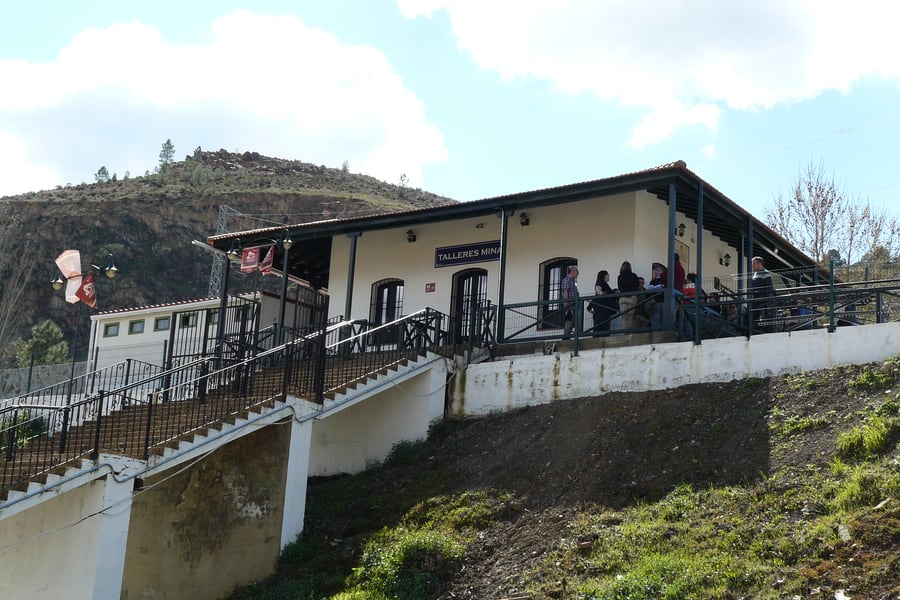
The journey begins at Talleres Mina, a long white building with a deep canopy along its platform, standing beside the A-476 between Minas de Riotinto and Nerva. The name means the mine workshops, which is what the site was: this is where the mining company maintained its locomotives, and it is where the surviving fleet still lives. Passengers are asked to be there twenty minutes before the advertised departure.
From Talleres Mina the line runs out through Casa de Palancas Norte, Zarandas-Naya, Casa de Palancas Sur and Jaramar to Los Frailes, and then comes back the same way. Twenty-two kilometres in total, which is the recovered fraction of a railway that once ran the full eighty-four from the mines to the quays at Huelva.
The traction
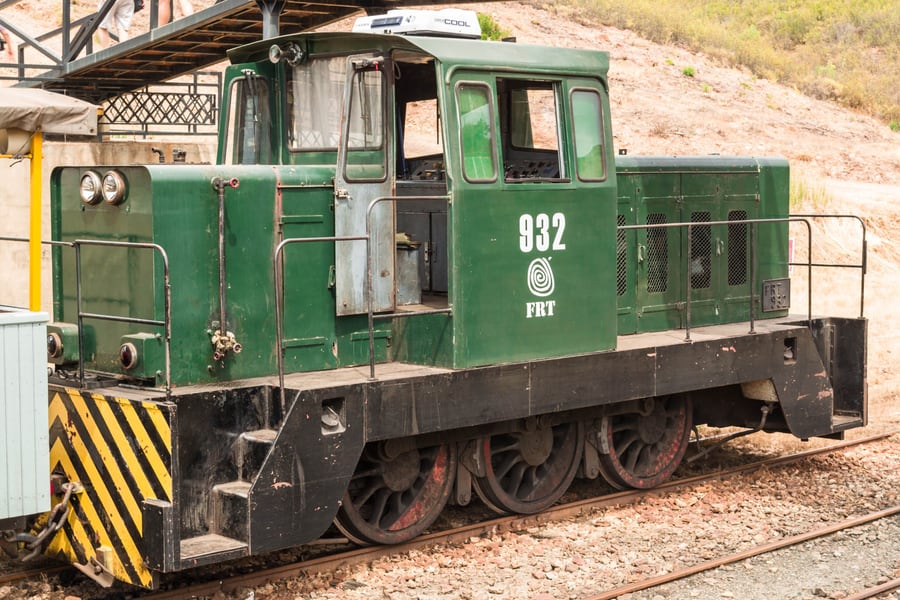
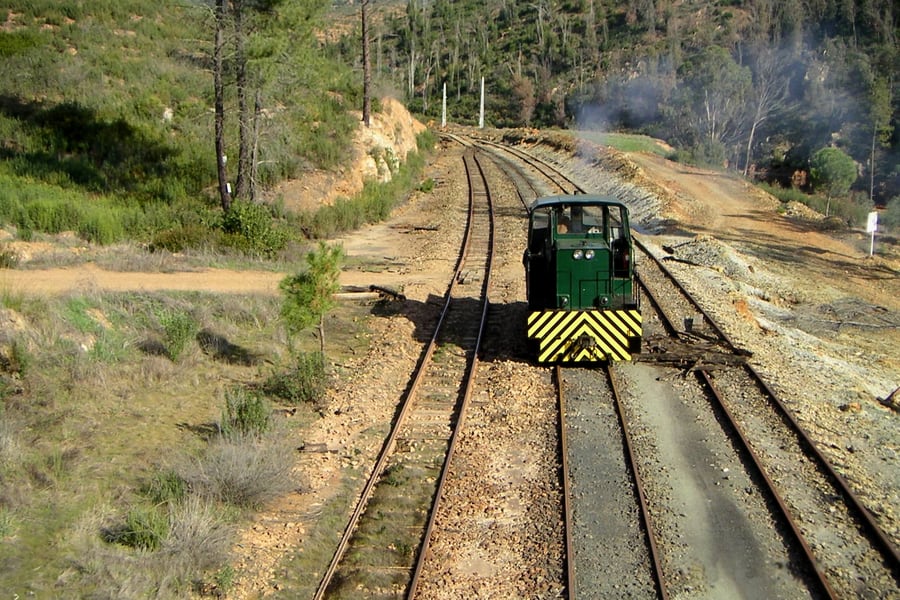
Everyday work is done by diesel. Locomotive 932 is the one most often photographed, in the Fundación's dark green with the initials FRT beneath the cab window, and it is a squat, four-axle industrial machine rather than anything built for passengers. It suits the line, which was engineered for loaded mineral trains taking their time downhill.
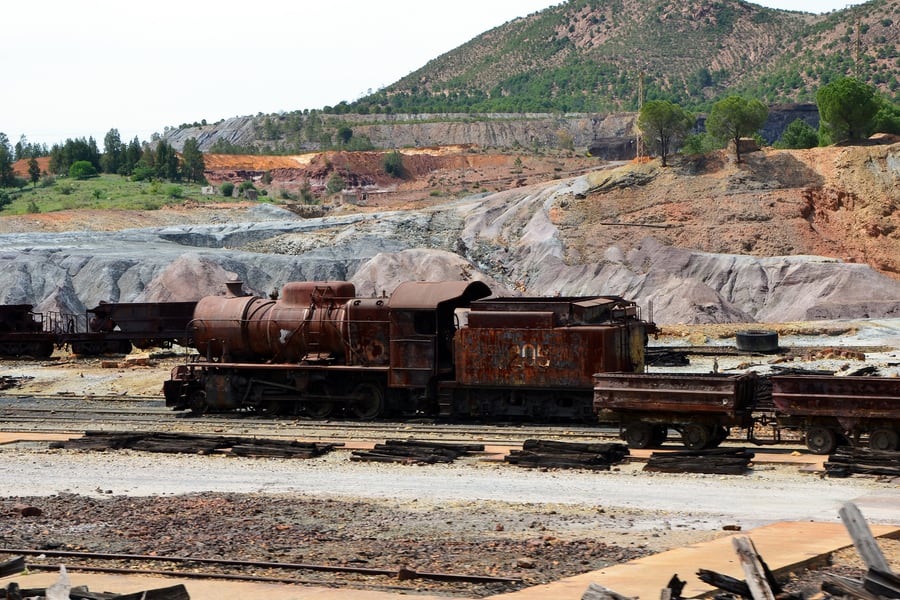
The steam is a different proposition and it does not run often. On the first Sunday of each month from November to April, and on 5 January instead of the 4th when the new year gets in the way, the train is worked by steam over the shorter leg between Talleres Mina and Zarandas. The Fundación keeps two engines in traffic for it: number 14, built in 1875, and number 51, built in 1890. They are the oldest working steam locomotives in Spain, and their build dates are contemporary with the railway itself, which opened in 1875.
The carriages
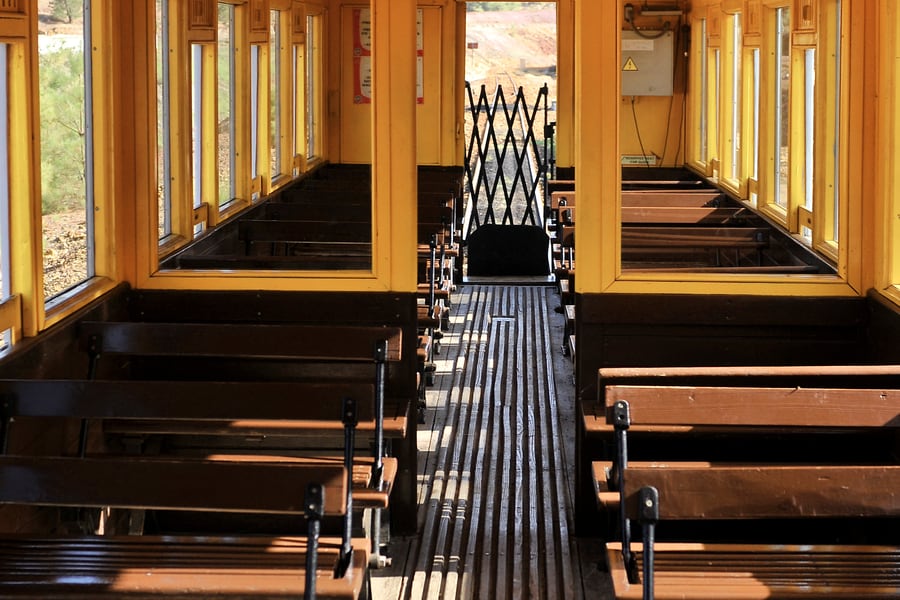
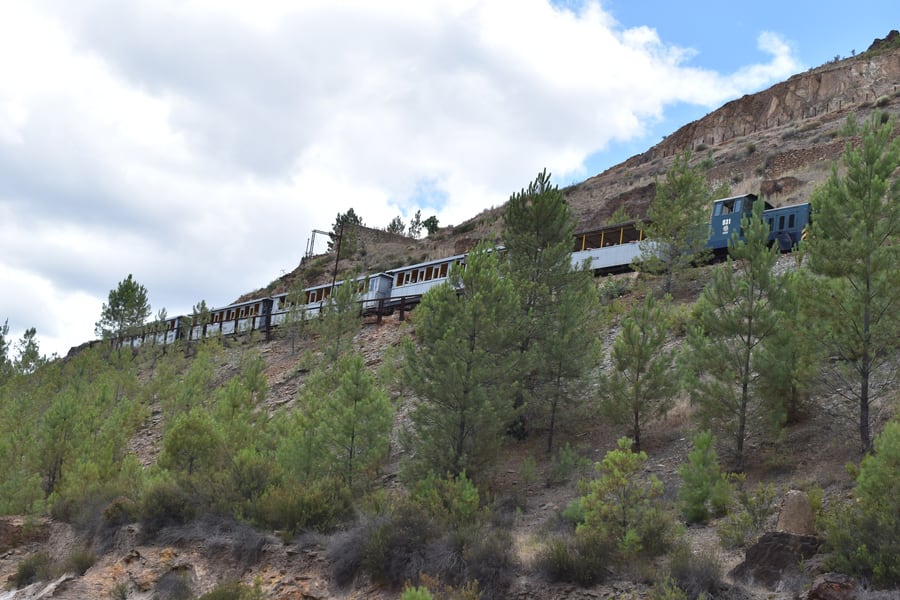
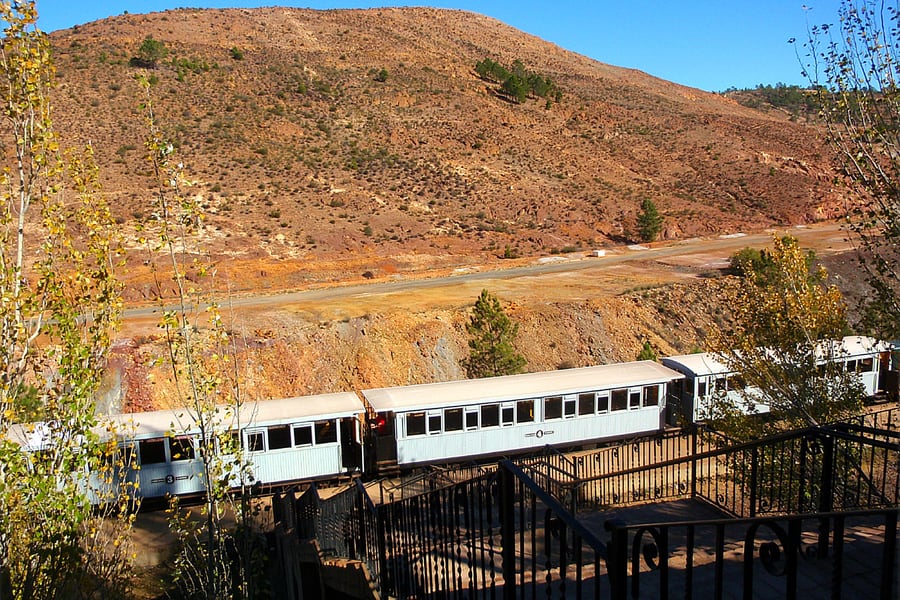
The stock is wooden — varnished panelling, slatted bench seats, brass fittings and open gangways between vehicles, with windows that come down. There is a genuine disagreement about what it is. The operator's own booking pages describe vagones restaurados de principios del siglo XX, restored carriages of the early twentieth century, running on the old Riotinto–Huelva main line. Other accounts describe them instead as reproductions, built in modern times from surviving nineteenth-century drawings. Both descriptions come from sources worth taking seriously, and they cannot both be right, so this page leaves the question open and notes only that the ride is slow, loud and pleasantly draughty.
Along the river
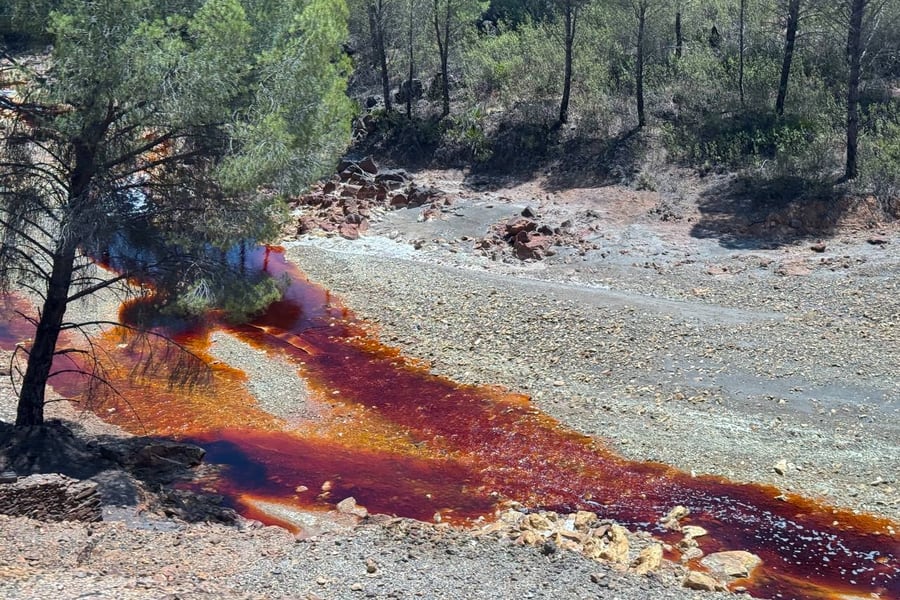
The reason the route is worth an hour and a half is the water. The Tinto is never far from the window, and its colour changes with the light and the depth — orange over gravel shallows, a deep rust in the pools, almost black where it runs still and shaded. The banks are stained in bands where the level has dropped and risen. The hills behind are terraced and benched from a century and a half of open-cast work, in ochres, greys and purples that look less like geology than like something spilled.
At Los Frailes the train stops long enough for passengers to walk down to the water's edge. The operator makes a point of this in its own description of the trip, and it is the part people remember: the river stops being a colour seen through glass and becomes a thing with a bank and a smell. It is also, at pH 2 to 2.5, roughly as acidic as vinegar, and full of organisms that thrive in exactly those conditions — which is the whole reason astrobiologists keep coming back.
What it adds up to
This is not a scenic railway in the ordinary sense. Nothing about the route is picturesque and the engineering makes no particular claim. What it offers instead is access: an hour and a half spent inside a landscape that has been dug, smelted, poisoned, protected and finally studied as a stand-in for another world, on the same rails that did most of the digging's carrying.
Along the route
Deepcom / Wikimedia Commons · CC0 · croppedA river that is roughly as acidic as vinegar
The Tinto holds a pH of 2 to 2.5 and a heavy load of dissolved iron, which is what gives it the colour. The chemistry is both natural and the consequence of mining: the rock was already weathering into acid long before anyone cut into it.Gzzz / Wikimedia Commons · CC BY-SA 4.0 · croppedThe oldest working steam in Spain
Two steam locomotives are kept in traffic here, of 1875 and 1890, and nothing older still turns a wheel under its own steam anywhere in Spain. They run on the first Sunday of the month from November to April, over the shorter leg only.LBM1948 / Wikimedia Commons · CC BY-SA 4.0 · croppedA hundred and nine years of copper, then thirty of silence
The line opened in 1875 to bring ore down to the port of Huelva and worked until 1984. The infrastructure was then simply left. The first tourist passengers ran on 4 November 1994.A bit of history
Culture & experiences along the way
Jose A. / Wikimedia Commons · CC BY 2.0 · croppedWhat the ride is, in practice
The station sits on the A-476 between Minas de Riotinto and Nerva, which is not in either town — it is worth knowing before setting out. Boarding is twenty minutes before departure, the round trip is 22 kilometres, and the whole thing takes about an hour and a half. The train runs out along the river and comes back the same way, because Los Frailes is the end of the recovered track.Yolanda / Wikimedia Commons · CC BY-SA 2.0 · croppedThe stop at Los Frailes
At the far end the train stands at Los Frailes long enough to walk down to the water. The operator's own description makes a point of it: this is where passengers can reach the red river rather than watch it through glass. It is also the moment the colour stops being a photograph and becomes something with a bank, a smell and a temperature.LBM1948 / Wikimedia Commons · CC BY-SA 4.0 · croppedRiding in the old stock
The carriages are wooden, varnished inside, with slatted benches and open gangways between them. The operator describes them as restored carriages of the early twentieth century running on the old Riotinto–Huelva main line; other accounts call them reproductions built from nineteenth-century drawings. What is not in dispute is how they ride — slowly, noisily, with the windows down.Estevoaei / Wikimedia Commons · CC BY-SA 4.0 · croppedA night run at the full moon
On selected dates the Fundación runs El Tren de la Luna, which goes out in daylight and returns under a full moon, with about an hour at Los Frailes in between for a picnic on the station tables and live music while the moon comes up. It sells out, and it is sold only through the operator's own site.Timetables
The Ferrocarril Turístico Minero runs from Talleres Mina, on the A-476 between Minas de Riotinto and Nerva. Boarding is twenty minutes before departure, and the round trip to Los Frailes and back takes about an hour and a half.
Departures
Times shift through the year, and the Fundación Río Tinto publishes them only inside its booking system rather than as a fixed public timetable. The departures below were read directly off that system for Saturday 22 August 2026, and are the summer pattern:
| Service | Departs Talleres Mina |
|---|---|
| Ferrocarril Turístico Minero | 13:30 |
| Ferrocarril Turístico Minero | 17:30 |
As of August 2026. Two departures a day is the usual summer shape. Outside the high season the times move earlier, and the number of runs varies with demand and daylight.
The steam workings
On the first Sunday of each month from November to April, the train is worked by steam rather than diesel, over the shorter leg between Talleres Mina and Zarandas — roughly half the distance of the diesel run, and about an hour. In January the steam day falls on the 5th rather than the first Sunday.
The steam departure times are not published in advance: the operator's booking calendar only opens about two months ahead, so in late summer the winter dates cannot yet be inspected. They appear in the booking system once those dates open for sale, alongside the diesel times for the same day.
Opening times of the rest of the park
The railway ticket is normally sold together with the Museo Minero and Casa 21, and their hours matter for planning a day:
| Open | |
|---|---|
| Museo Minero | 10:30–15:00 and 16:00–20:00 · closed 15:00–16:00 |
| Casa 21, Bellavista | 16:00–20:00 |
The park is closed on 25 December and on 1 and 6 January, and closes at 15:00 on 24 and 31 December and on 5 January.
Booking
Places are limited and individual departures fill before the day, so tickets are sold online through the Fundación's own platform. Tickets bought in advance can be changed by contacting the park at least 48 hours ahead, and are not refundable once bought.
Times, dates and availability are published by the operator at parquemineroderiotinto.es (opens in a new tab).
Tickets
The railway is not sold as a stand-alone ride. The Fundación Río Tinto runs it as one of five visit points in the Parque Minero, and the tickets are combinations — the commonest pairs the train with the Museo Minero and Casa 21 in the Bellavista English quarter, at €17.00 for an adult, €15.00 for children of 4 to 12 and visitors over 65, and €3.00 under 4. The reduced rate is checked on arrival.
Everything is sold online, because places on each departure are limited and individual times fill before the day — and the booking flow is also the only place the day's train times appear. Tickets can be changed up to 48 hours ahead and are not refundable. The five-point ticket, adding Peña de Hierro and Corta Atalaya, is a full day rather than a long morning. Prices read August 2026.
Book your tickets
Jose A. / Wikimedia Commons · CC BY 2.0 · croppedRailway, museum and Casa 21
€17.00 adult · €15.00 reduced · €3.00 under 4
The combination most visitors buy, and about a comfortable half-day.
Book Tickets (opens in a new tab, on parquemineroderiotinto.es)via parquemineroderiotinto.es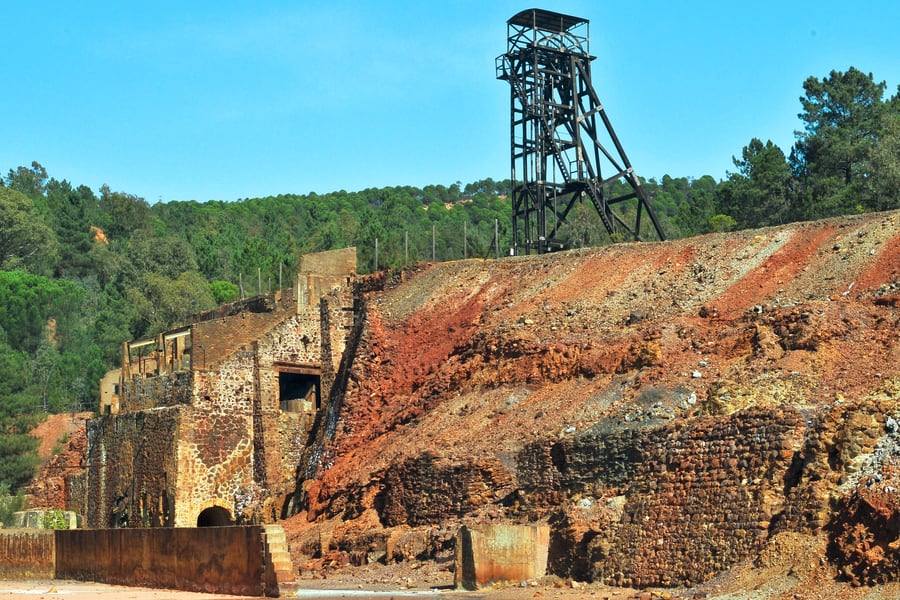 LBM1948 / Wikimedia Commons · CC BY-SA 4.0 · cropped
The five-point visit
Adds Peña de Hierro and Corta Atalaya
A gallery 200 metres into the hill and a guided afternoon at the open pit — a full day.
Book Tickets (opens in a new tab, on parquemineroderiotinto.es)via parquemineroderiotinto.es COMEX / Wikimedia Commons · CC BY-SA 4.0 · cropped
Marte en la Tierra
On selected dates only
The ground NASA and the European Space Agency have used, walked with the railway.
Book Tickets (opens in a new tab, on parquemineroderiotinto.es)via parquemineroderiotinto.esRail Passes
A rail pass is of no use on this railway, and it is worth saying so plainly rather than leaving it ambiguous.
The Ferrocarril Turístico Minero is not part of the national network. It is a preserved industrial line run by the Fundación Río Tinto on the trackbed of a private mineral railway, and it is sold as a museum attraction rather than as transport. Interrail's table of railway companies for Spain names five that a pass covers — RENFE, iryo, SNCF, FEVE Cercanías and CP — and the Fundación is not one of them. There is no pass-holder discount, and the fare is bought from the operator like any other admission ticket.
There is also no rail connection to reach it by. The Riotinto–Huelva main line closed in 1984 and the twenty-two kilometres the tourist train uses are the only part still in place. The nearest station on the national network is in Huelva, and getting from there to Talleres Mina means a road journey.
Where a pass does help
If the mining railway is one stop on a wider Spanish trip, a pass may still earn its keep on the long-distance legs either side. Seville is the natural base — Renfe's AVE reaches it from Madrid in around two and a half hours, and Huelva is served by Media Distancia trains from Seville. Both of those are pass-eligible; the drive out to the mines at the end is not.
Whether that adds up depends entirely on the rest of the itinerary rather than on this journey. For a trip built around Andalusia alone, individual advance-purchase tickets on the AVE are usually cheaper than a pass, because Renfe's early fares fall a long way below the walk-up price.
Pass conditions checked against Interrail's published list of railway companies on 20 August 2026.
Places to Visit
The railway is one part of a site that spreads across two towns and several square kilometres of worked ground. The stops below are the ones that add something the train ride does not, and most of them are covered by one or another of the combined tickets.
A word on geography: Talleres Mina, where the train leaves from, is out on the A-476 between Minas de Riotinto and Nerva, while the museum and Casa 21 are in the town of Minas de Riotinto itself, and Peña de Hierro is above Nerva. Nothing is far, but nothing is walkable from anything else either, so a car makes the difference between a comfortable day and an awkward one.
The Bellavista quarter is the strangest thing here and the easiest to overlook. When the British company took over the mines it built its staff a piece of England on the hillside — detached houses with gardens, a Presbyterian church, a club, a cricket ground. Casa 21 is the house kept as a museum of that life, and it is included with the standard railway ticket. It opens in the afternoon only, from 16:00.
 Zandcee / Wikimedia Commons · CC BY-SA 4.0 · cropped
Talleres Mina
A long white building with a deep canopy over the platform, standing on the road between Minas de Riotinto and Nerva rather than in either of them. It was the railway's workshop site — the name means the mine workshops — and it is where the tourist train is based, boarded and stabled. Arrival is asked for twenty minutes before departure, which in practice is the time it takes to walk up from the car park and find the platform.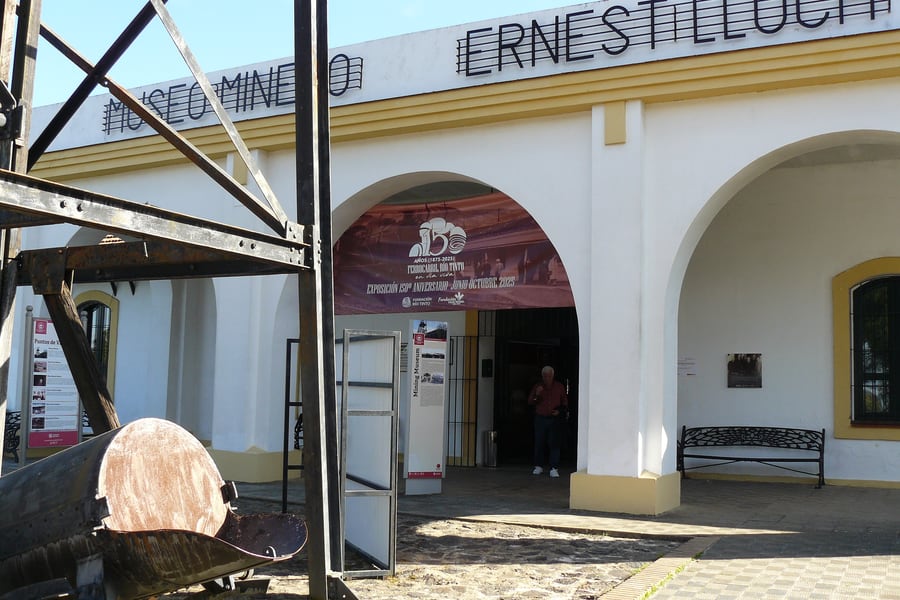 Zandcee / Wikimedia Commons · CC BY-SA 4.0 · cropped
The Museo Minero
The mining museum occupies a former hospital in the town and runs to seventeen rooms covering five thousand years of extraction here, from the Roman workings onward. It holds a 250-metre reproduction of a Roman mine that visitors walk through, and it is the operating centre for the whole park. It closes between 15:00 and 16:00, which catches people who plan a morning train and an afternoon museum.LBM1948 / Wikimedia Commons · CC BY-SA 4.0 · croppedPeña de Hierro
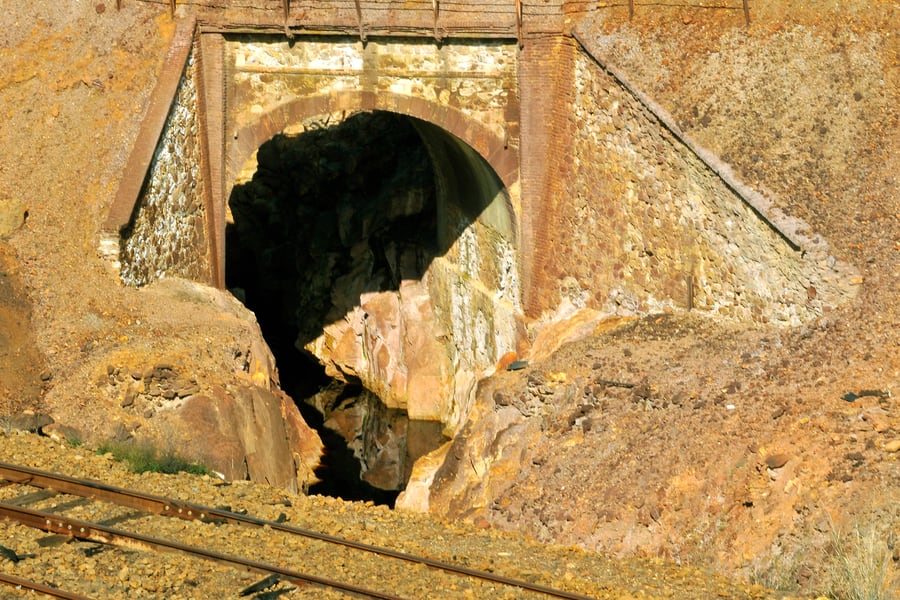
A separate mine a few kilometres from the railway, where a recovered gallery runs more than 200 metres underground and emerges at a viewpoint looking straight down into the open cast. The headframe still stands over the workings. It is also one of the places where the scientific interest in this valley is most concentrated, because the Tinto rises very near here.COMEX / Wikimedia Commons · CC BY-SA 4.0 · croppedThe ground the space agencies use
In 2016 the EU-funded MOONWALK programme ran trials here in which a suited operator and a rover worked together on the red spoil, rehearsing how the two would cooperate on Mars. The photograph is from those trials. The valley is used this way because a river at pH 2 full of iron-oxidising microbes is the nearest analogue on Earth to deposits identified on Mars at Meridiani Planum.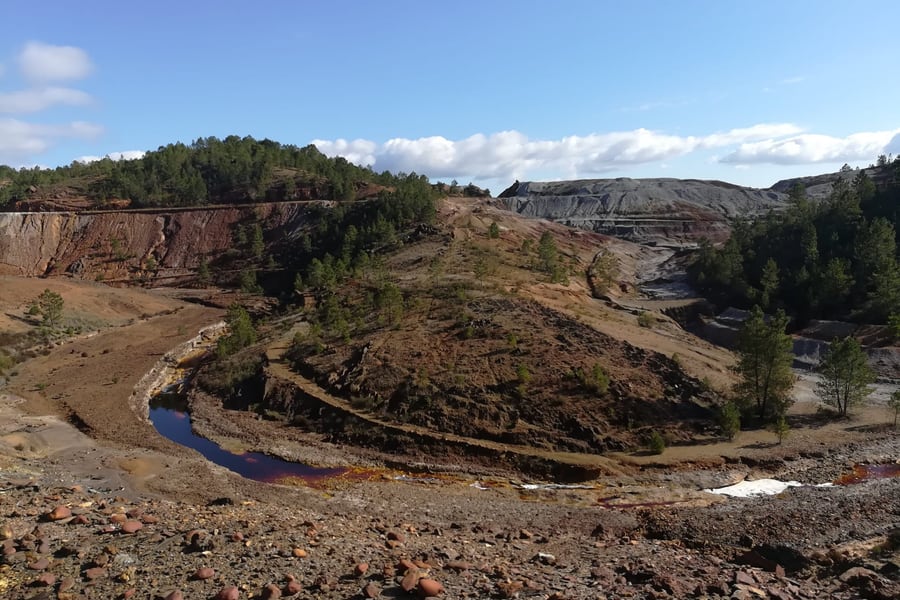 Alberto Sánchez / Wikimedia Commons · CC BY-SA 2.0 · cropped
The worked landscape itself
Terraces, benches, spoil in ochre and purple, and standing water the colour of tea — the shape of the ground for kilometres around is not natural and has not been for a very long time. It is the reason the area carries protection as a mining landscape rather than as countryside, and the reason a train ride here reads less like a scenic excursion than like a tour of an enormous, quiet works.Where to Sleep
The Riotinto basin is not hotel country. It is a working landscape with two small towns in it, and the visitor accommodation reflects that: a handful of places, mostly modest, and a couple of unusual ones.
Staying locally is worth it for one specific reason. The railway's departures are early afternoon in summer and earlier still outside it, the museum shuts for an hour in the middle of the day, and the guided visits to Corta Atalaya go in the afternoon. Fitting the five-point ticket into a day trip from Seville — about ninety minutes each way by road — means watching the clock throughout. A night in Nerva or Minas de Riotinto removes that problem entirely.
Seville and Huelva are the alternatives for anyone who would rather sleep in a city, and both are within a comfortable drive. There is no useful passenger railway to the mining basin itself; the line the tourist trains run on is the only track left here, and it goes nowhere but Los Frailes.
Neither of the places below is illustrated on this page. There is no photograph of either building under a licence this site can use, and rather than caption something else as a hotel, the cards carry no image.
Where to stay
Hotel Vázquez Díaz
Nerva, a few minutes from the station
The hotel describes itself as the only hotel in the Riotinto mining basin. It opened in 1987 and was refurbished in 2012, and lists 31 rooms in single, double and suite categories, a restaurant seating up to 350, a cafeteria and bar, free wi-fi throughout, and air conditioning and a television in every room. It quotes a set lunch and a breakfast charge on its own site and takes bookings directly.
Check Availability (opens in a new tab, on hotelvazquezdiaz.com)via hotelvazquezdiaz.comOld England House
In the Bellavista English quarter, Minas de Riotinto
A Victorian house in Bellavista, the quarter the British mining company built for its staff and the same neighbourhood as Casa 21, which the railway ticket includes. Its website is made entirely of images and carries no descriptive text, so the only thing it states plainly is that it takes availability requests directly, for stays of up to four rooms, through its own booking form.
Check Availability (opens in a new tab, on oldengland.house)via oldengland.houseQuestions or corrections
Planning this trip and stuck on something, or spotted a time, fare or detail that has changed? Send us a message about The Río Tinto Mining Railway — the ground that stands in for Mars. We read every one, and we update this page when something has changed.