The Namibia Safari — Walvis Bay to Pretoria
Rovos Rail Tours
- DistanceAbout 3,400 km, Walvis Bay to Pretoria
- Duration12 days, 11 nights (9 on board)
- Best seasonA few departures a year, April–May and October–November
Introduction
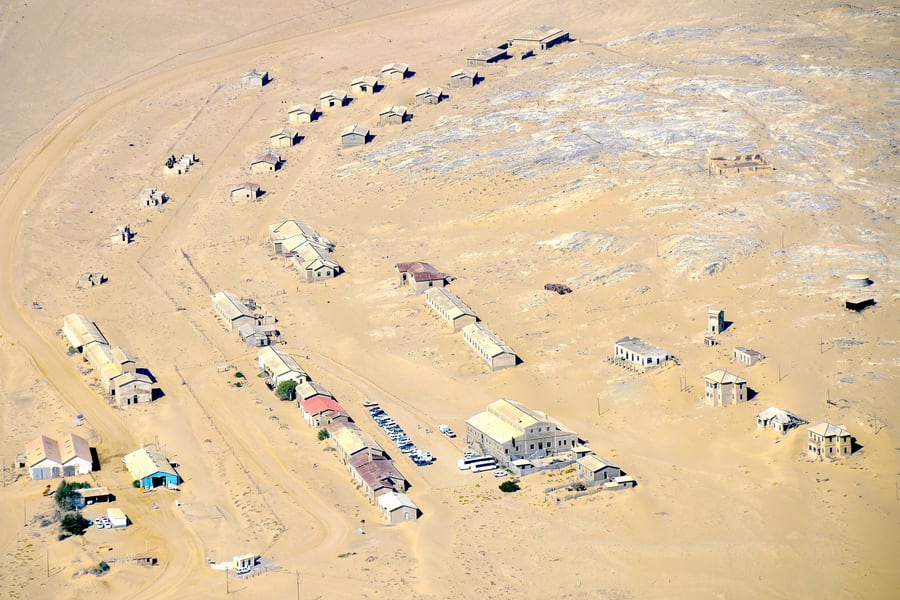
In 1908 a railway worker named Zacharias Lewala, working on the line inland from Lüderitz, picked up a stone near Kolmanskop and showed it to his supervisor, the railway inspector August Stauch. It was a diamond. The German administration soon closed off a great stretch of the coast as the Sperrgebiet, the forbidden zone, and a town with a hospital, a ballroom and a theatre went up on the spot. It was abandoned in 1956, and the sand has been coming in through the doors ever since.
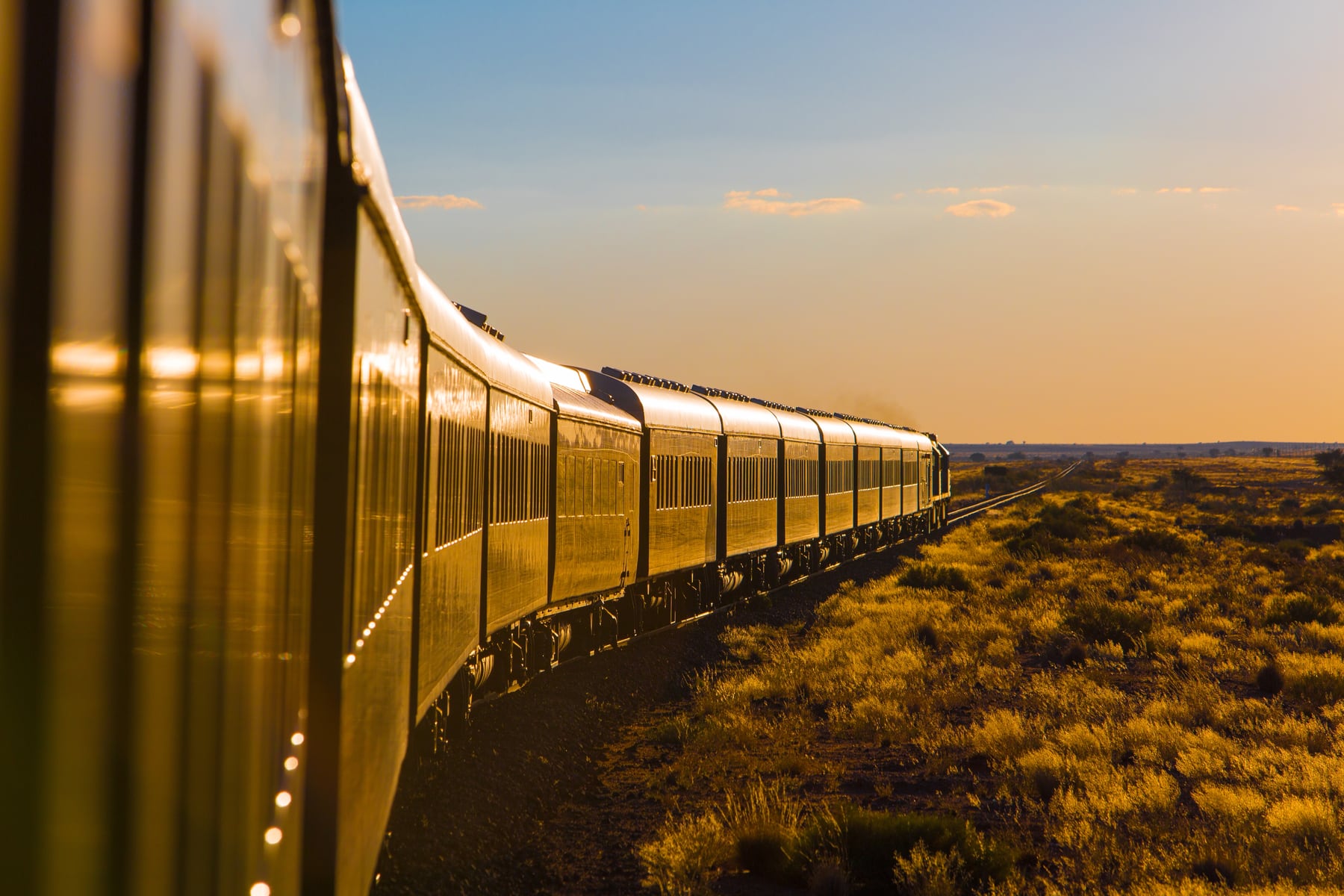
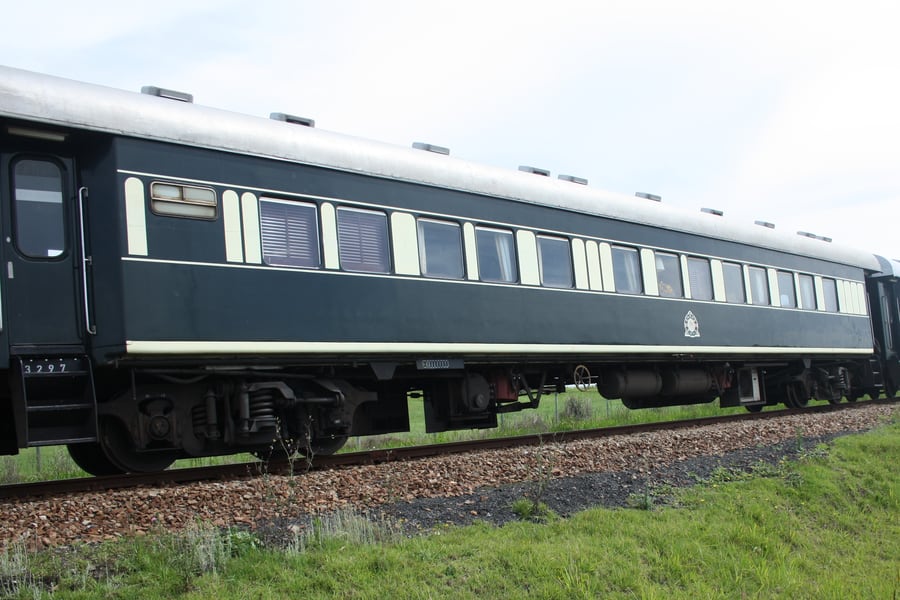
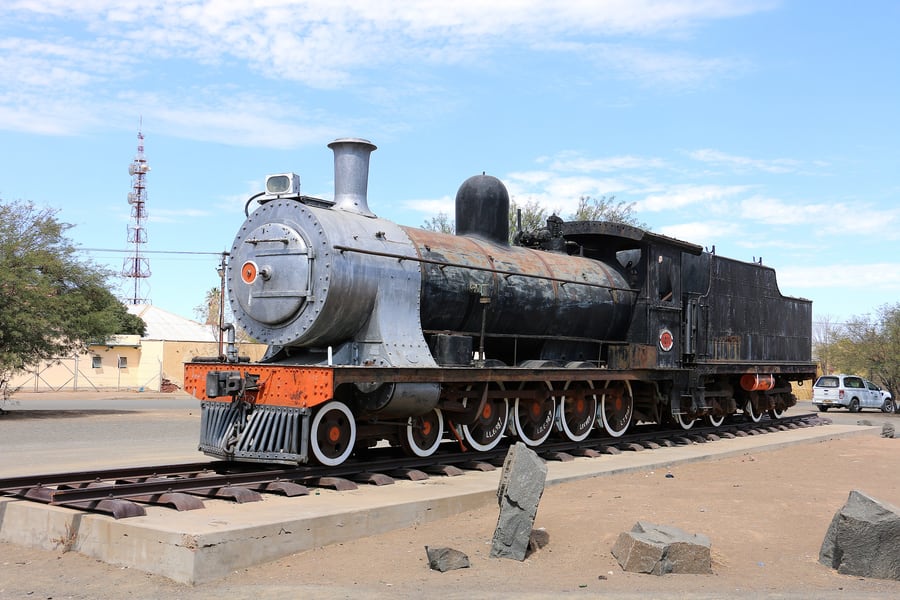
Rovos Rail's Namibia Safari stops a short drive from it. Rovos is the Pretoria company that has run its own private train since 1989, and this route takes it about 3,400 kilometres over twelve days, from the Atlantic at Walvis Bay to Rovos's own station in Pretoria. Nine of the eleven nights are spent in a compartment, one at a lodge in Etosha and one in the dunes at Sossusvlei. On the way it uses two of the railways Germany built across the colony: the Otavi line north to Tsumeb, and the southern line from Keetmanshoop towards Lüderitz.
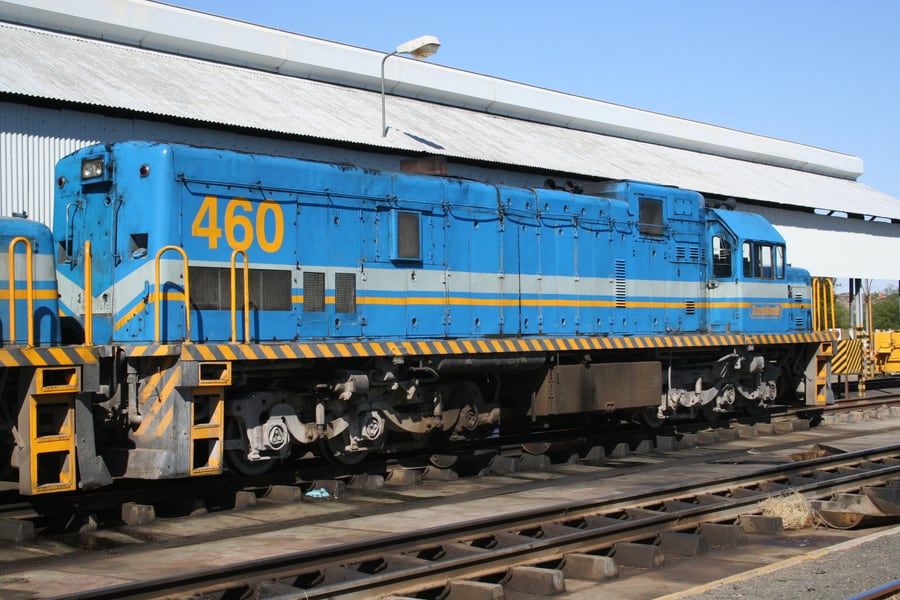
TransNamib's own passenger trains are out of service, so a private train like this is the way to ride Namibia's railways at present. It is booked as a whole tour, months ahead, on one of a handful of dates a year, and in Namibia it runs with a TransNamib pilot in the cab beside the Rovos driver.
The Journey
The train leaves Walvis Bay and heads straight into the Namib. The first stretch, to Swakopmund, was laid along the shore in 1914 and moved inland behind the dunes in 1980, and the wind still drifts sand across the rails. At Kranzberg, east of Usakos, the line forks: the train turns north-east onto the route of the old Otavi railway, built between 1903 and 1906 to carry copper down from Tsumeb, and rebuilt to Cape gauge on a largely new alignment, reopening in 1961.
North to Etosha, then back to the capital
The second day brings the Cheetah Conservation Fund outside Otjiwarongo, and the train runs on to Tsumeb, where the Otavi line ends. Guests go by road into Etosha for a night at a lodge and two game drives, then rejoin the train for the run south to Windhoek. From there a light aircraft takes everyone to Sossusvlei for a night among the dunes and brings them back next day for lunch, a city tour and the railway museum in the station building.
The southern line
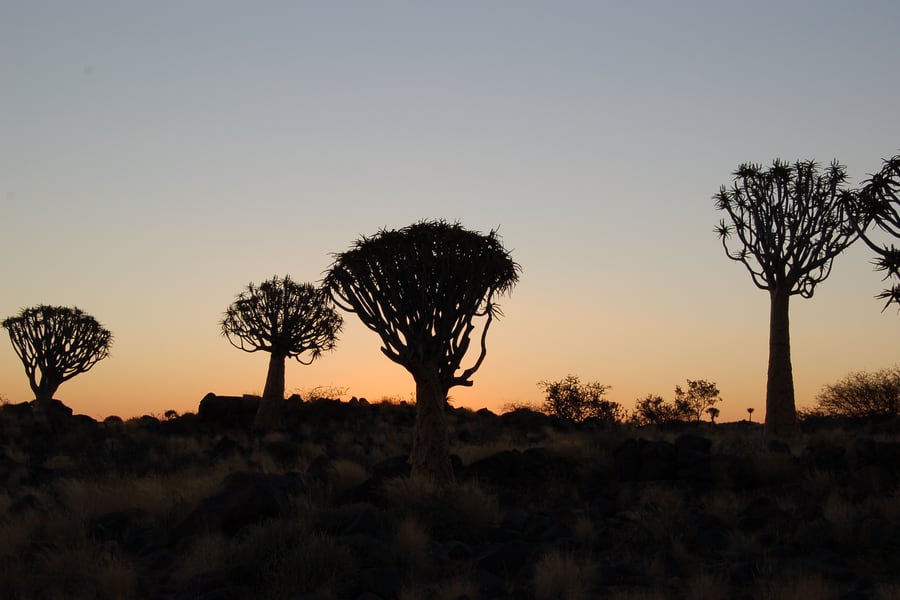
South of Windhoek the train crosses the edge of the Kalahari to Keetmanshoop, where the line from Lüderitz arrived in 1908, and stops for the quiver trees at Garas Park. It then runs west on that line to Aus, and the coast is reached by road: the ghost town of Kolmanskop in the morning, lunch in Lüderitz. The train meanwhile doubles back to Holoog, a halt within reach of the Fish River Canyon, and crosses into South Africa after the canyon visit.
Upington and a cruise on the Orange River follow, then the Big Hole at Kimberley, and the train runs into Rovos's Capital Park station in Pretoria after lunch on the twelfth day. Rovos also runs the route the other way, Pretoria to Walvis Bay, and some departures start or finish in Cape Town.
Along the route
 Olga Ernst & Hp.Baumeler / Wikimedia Commons · CC BY-SA 4.0 · 2017 · cropped
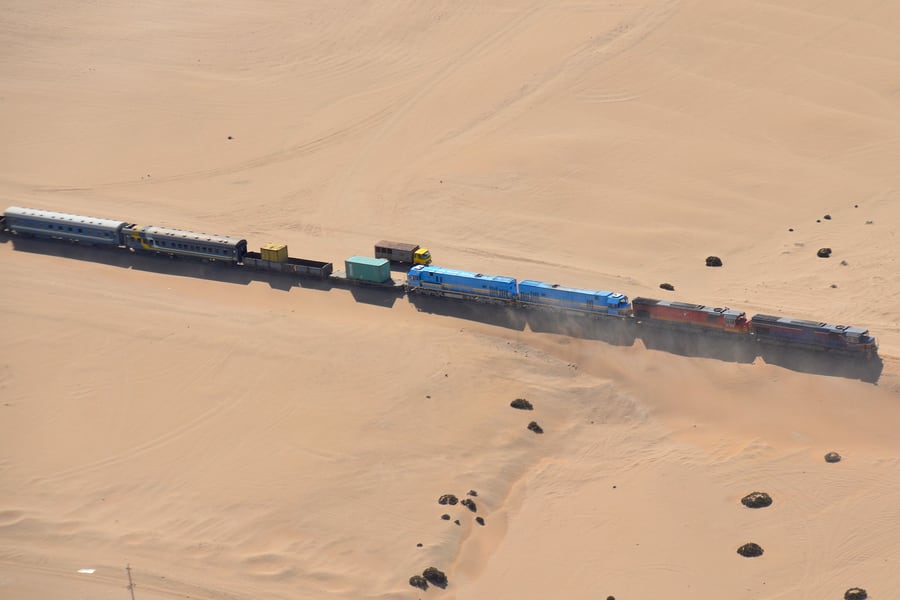
Behind the dunes
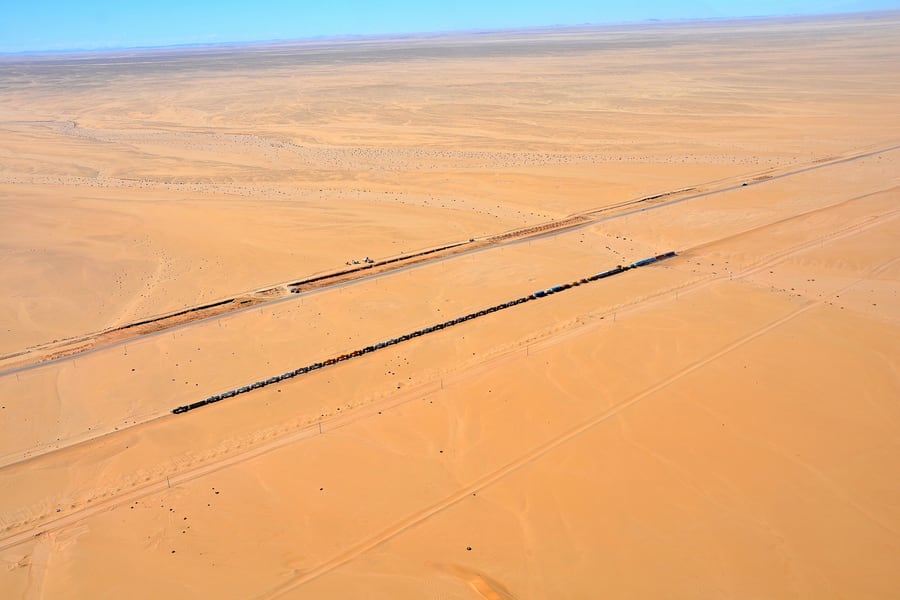
Out of Walvis Bay the line runs inland of the coastal dunes, on the alignment that replaced the 1914 shore line in 1980. Sand still blows across it, and from the air the rails are a thin line across the Namib.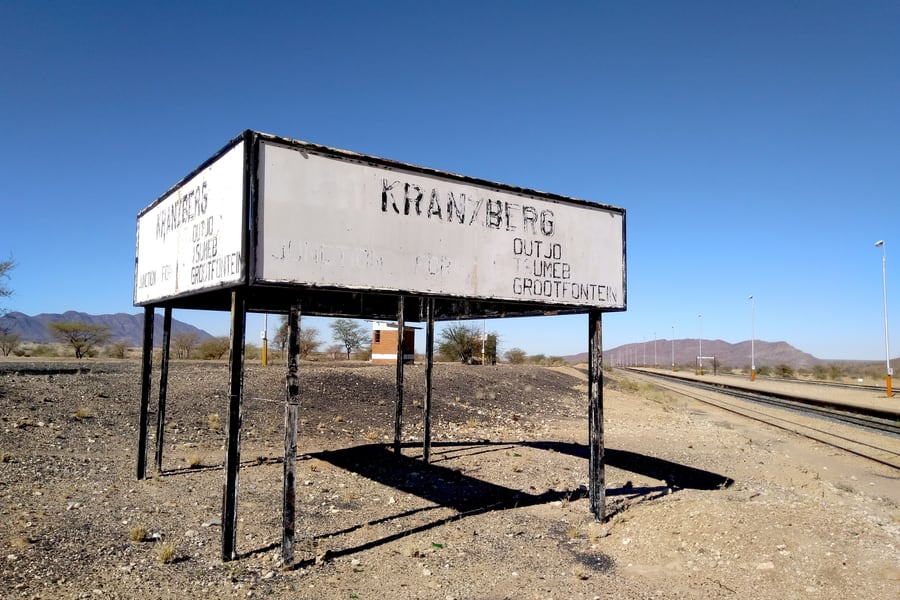 Louise Kapp / Wikimedia Commons · CC BY-SA 4.0 · 2018 · cropped
The fork at Kranzberg
The signboard at Kranzberg still points to Outjo, Tsumeb and Grootfontein. This is where the Otavi line leaves the Windhoek main line, and where the train turns north-east for Otjiwarongo and Etosha.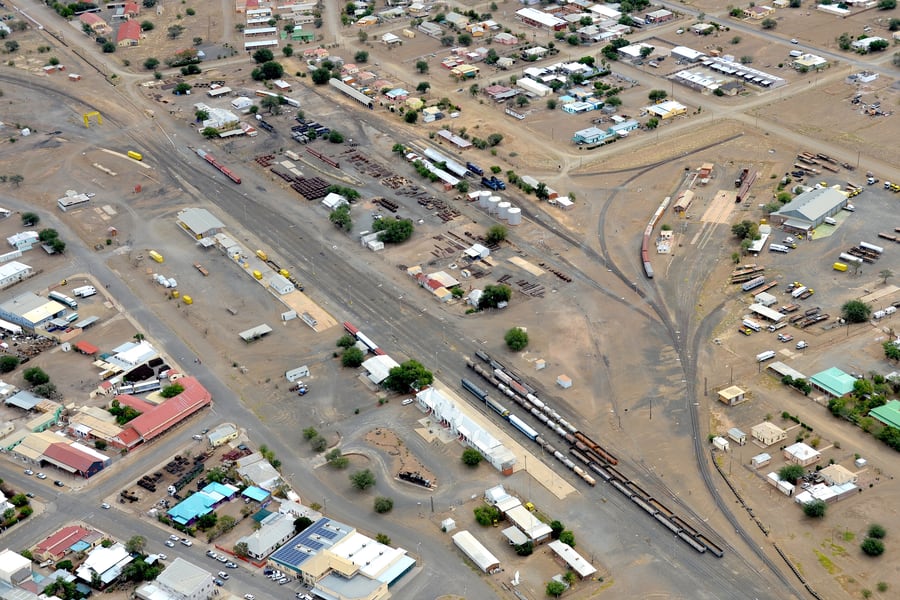 Olga Ernst & Hp.Baumeler / Wikimedia Commons · CC BY-SA 4.0 · 2017 · cropped
Keetmanshoop junction
Keetmanshoop's station went up in 1908, and its yard is where the line from Windhoek meets the branch west to Seeheim, Aus and Lüderitz. The tour stops here for Garas Park and its quiver trees.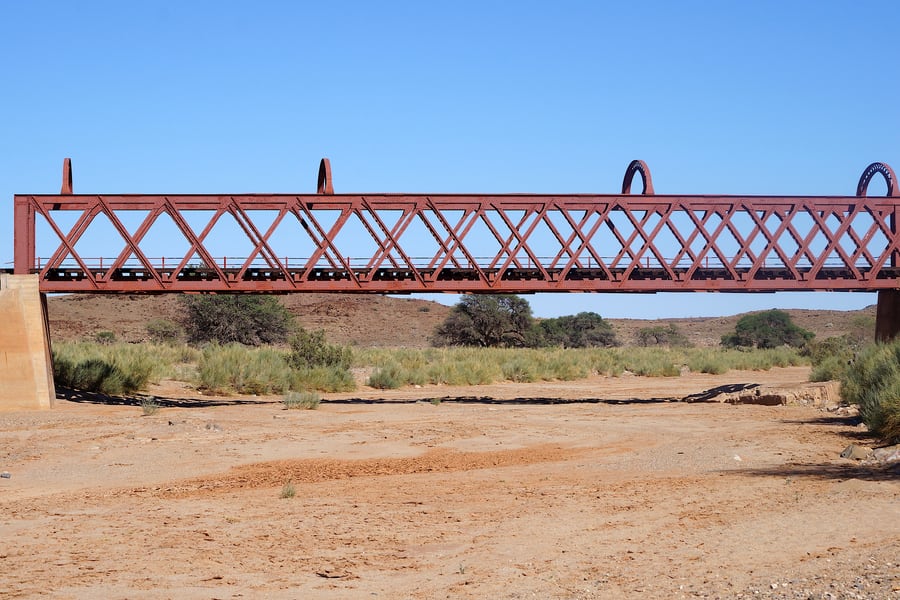 Niggi Imboden & Hp.Baumeler / Wikimedia Commons · CC BY-SA 4.0 · 2018 · cropped
Over the Gaab at Holoog
Near Holoog the line crosses the dry bed of the Gaab River on a steel lattice girder. Holoog is little more than a halt, and the train waits there while guests drive to the Fish River Canyon.A bit of history
Culture & experiences along the way
 Ralf Hüsges / Wikimedia Commons · CC BY 4.0 · cropped
The diamond on the line
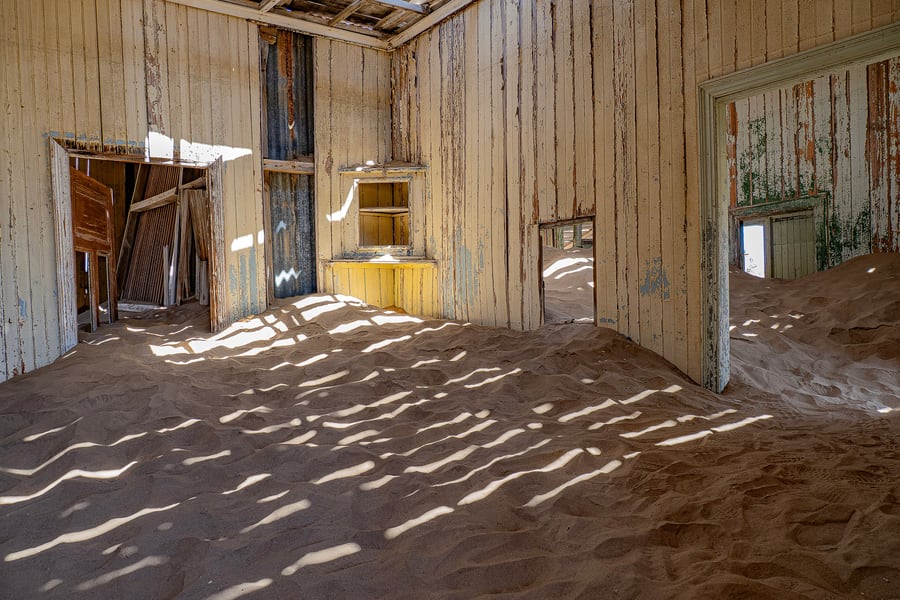
Zacharias Lewala was working on the Lüderitz railway in 1908 when he found a diamond near Kolmanskop and took it to the railway inspector, August Stauch. A German town grew on the spot, with a hospital and a ballroom, and emptied when richer fields were found further south. Visitors now walk through rooms half full of sand.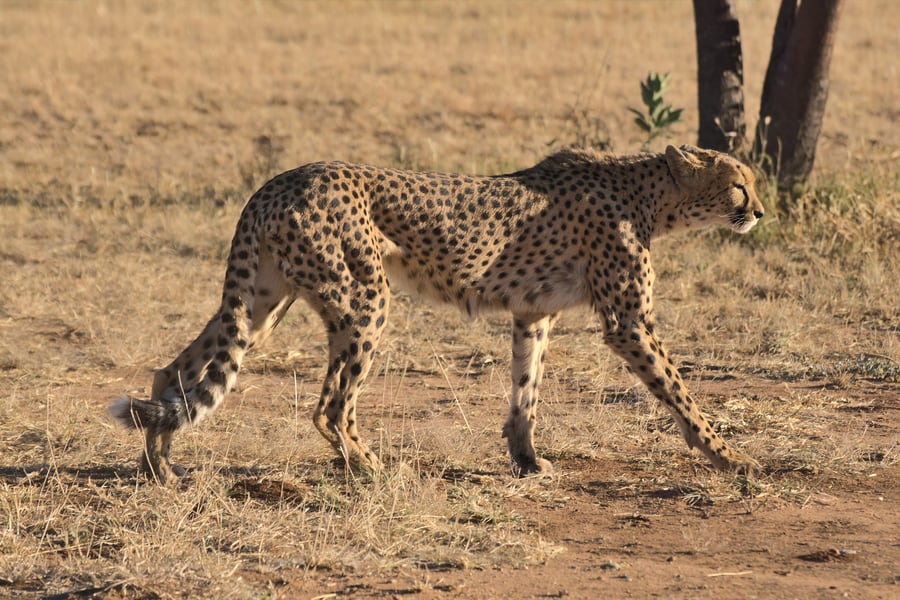 Alexander Klink / Wikimedia Commons · CC BY 4.0 · 2018 · cropped
Cheetahs at Otjiwarongo
The Cheetah Conservation Fund was founded in Namibia in 1990 by the biologist Laurie Marker, and works with the farmers on whose land most of the country's wild cheetahs live. Its centre east of Otjiwarongo is the second day's visit, with the research explained and the centre's own cheetahs to see.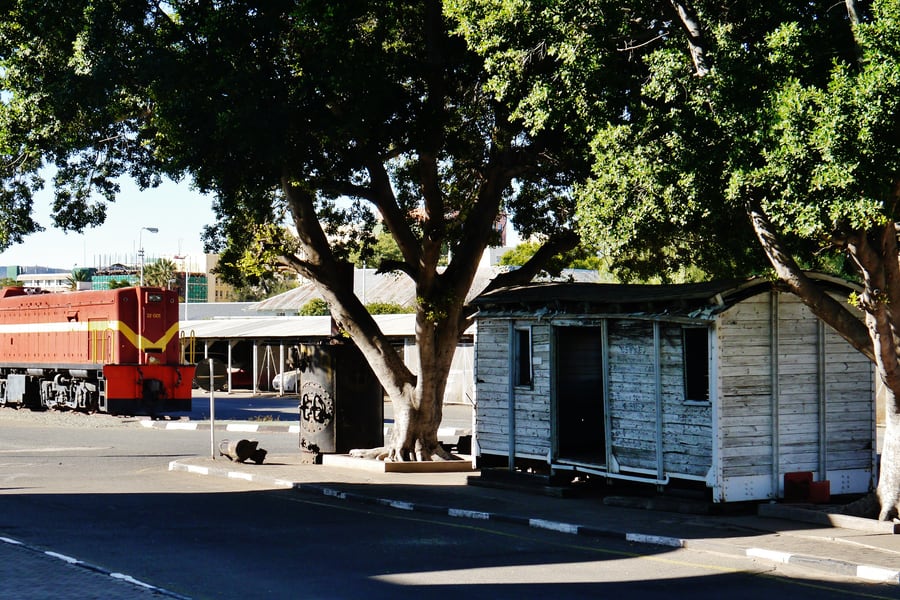 Zairon / Wikimedia Commons · CC BY-SA 4.0 · 2017 · cropped
Windhoek's railway museum
The Trans-Namib Transport Museum opened in Windhoek station in 1993, with railway equipment, maps, telegraph gear and dining-car crockery going back to German colonial times. Outside stands Poor Ole Joe, half of a German twin locomotive, and old rolling stock lines the forecourt. The city tour calls here.Timetables
The Namibia Safari is a tour, not a scheduled train. It runs on a handful of fixed dates, each sold whole, and nobody boards who has not booked. Every departure takes twelve days and eleven nights: nine aboard, one at a lodge in Etosha and one at Sossusvlei.
| Leaves Walvis Bay | Arrives Pretoria |
|---|---|
| 22 November 2026 | 3 December 2026 |
| 19 April 2027 | 30 April 2027 |
| 17 May 2027 | 28 May 2027 |
| 23 October 2027 | 3 November 2027 |
Departures fall in autumn and spring. Some run between Cape Town and Walvis Bay instead of Pretoria (6–17 April 2027 is one), and Rovos also sells the route from Pretoria to Walvis Bay, so check the direction of any date before booking.
| Day | Where the day is spent |
|---|---|
| 1 | Walvis Bay: board, then across the Namib towards Otjiwarongo |
| 2 | Otjiwarongo: the Cheetah Conservation Fund; on to Tsumeb |
| 3 | Etosha: by road to a lodge in the park, afternoon game drive |
| 4 | Etosha: morning drive, back to the train at Tsumeb |
| 5 | Windhoek: fly to Sossusvlei, night at a lodge |
| 6 | Sossusvlei and Windhoek: Deadvlei at dawn, city tour, south overnight |
| 7 | Keetmanshoop: Garas Park; on to Aus |
| 8 | Aus: by road to Kolmanskop and Lüderitz; train to Holoog |
| 9 | Holoog: the Fish River Canyon; the border in the evening |
| 10 | Upington: walking tour and Orange River cruise |
| 11 | Kimberley: the Big Hole and the mine museum |
| 12 | Pretoria: arrive at Capital Park after lunch |
The southern line has a recent history a traveller should know. On 1 March 2026 the last span of a bridge near Naute, south-east of Keetmanshoop, was washed away under a southbound Rovos train. The Rovos driver and the TransNamib pilot were killed; no passengers or other staff were hurt, and the guests went on by road to Upington and by air to Cape Town. The Namibian police and TransNamib both opened investigations.
Dates as of November 2026, as listed by the agents that sell the tour, among them The IRT Society (opens in a new tab), Jules Verne (opens in a new tab) and Distant Journeys (opens in a new tab). Confirm any date with Rovos Rail (opens in a new tab) before booking.
Tickets
Rovos prices the Namibia Safari per person sharing a suite, in South African rand, and the fare covers nearly everything: the suite, all meals and drinks on board, room service, the excursions and entrance fees, the two lodge nights and the flights to and from Sossusvlei. French champagne is extra, and so are the flights to Walvis Bay and home from Pretoria.
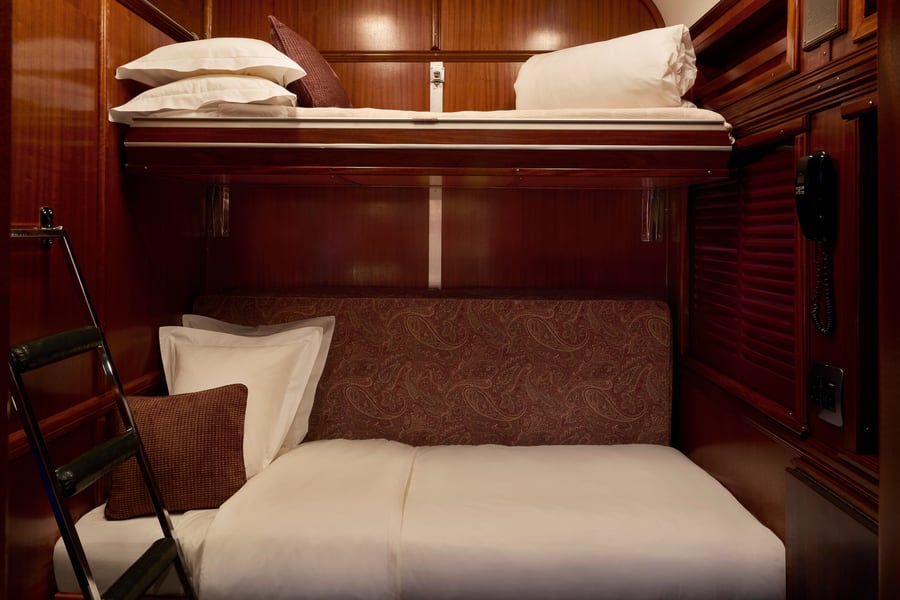
There are three grades of suite: Pullman Gold at about 7 m², Deluxe at about 10 m² with a small sitting area, and Royal, half a carriage with its own bath. The 2027 rates are below; for 2028 they rise to R280,000, R355,000 and R438,200. British operators such as Distant Journeys and Jules Verne sell the same departures as packages with flights and hotel nights.
Things to do
 Rovos Rail Tours
Pullman Gold Suite
About 7 m², the smallest grade
A compartment that is a sofa by day and twin or double beds by night, with its own shower.
Book Experience (opens in a new tab, on rovos.com)via rovos.com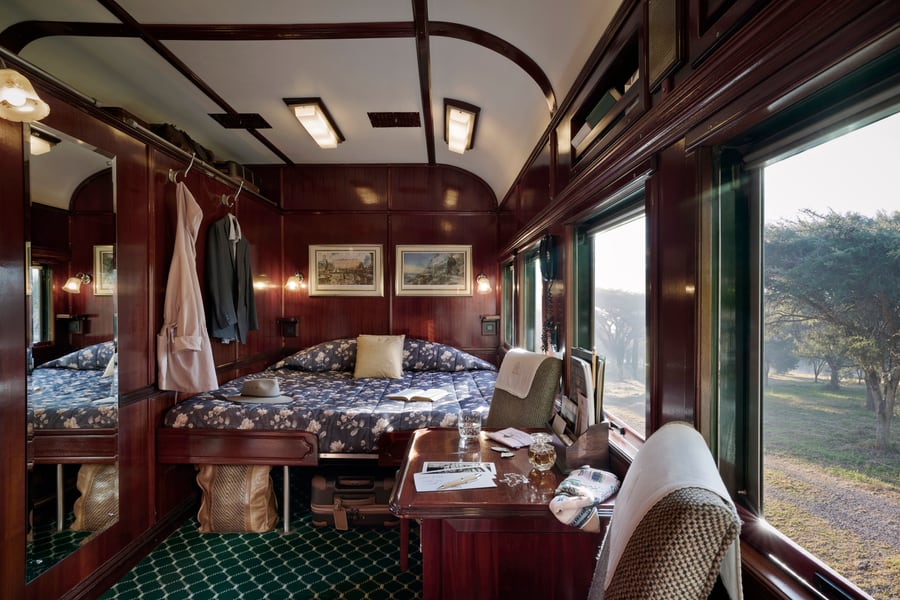 Rovos Rail Tours
Deluxe Suite
About 10 m², with a sitting area
A larger compartment with a small lounge area that stays in place when the beds are made up.
Book Experience (opens in a new tab, on rovos.com)via rovos.com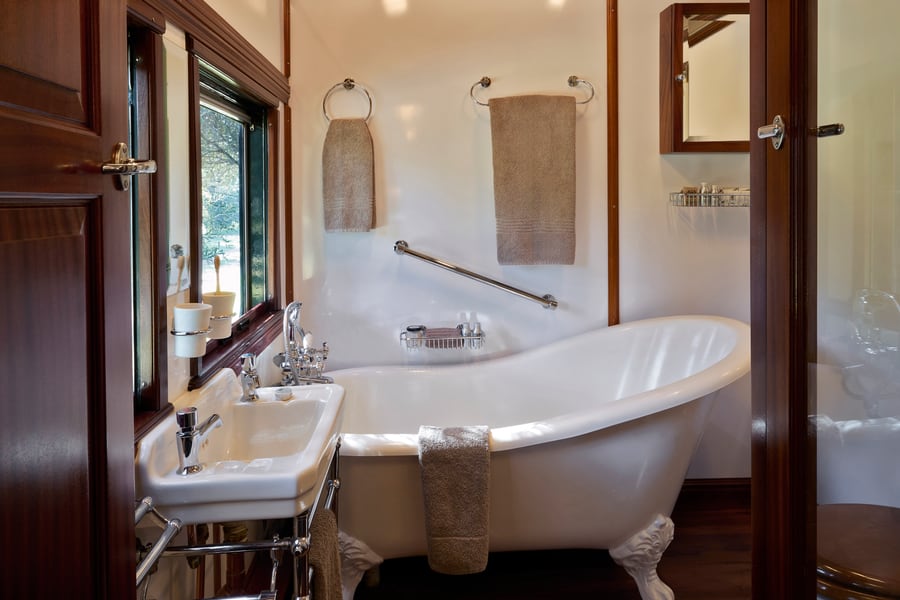 Rovos Rail Tours
Royal Suite
Half a carriage, about 16 m²
Half a carriage with a private lounge, a Victorian bath and a separate shower.
Book Experience (opens in a new tab, on rovos.com)via rovos.comRail Passes
No rail pass covers the Namibia Safari. It is sold as a whole tour, suite, meals, excursions and lodge nights together, and the rail journey cannot be bought on its own. Interrail and Eurail are European schemes, and neither Namibia nor South Africa appears in Interrail's list of covered railway companies (opens in a new tab).
TransNamib sells no pass of its own, and with its passenger trains out of service there would be nothing for one to cover.
Checked November 2026 against Interrail's list of covered railway companies (opens in a new tab).
Places to Visit
Most of what the tour is booked for lies a drive or a flight from the rails: guests leave the train at a station or a bare halt and are taken to the place itself, sometimes for a morning and sometimes overnight. The six below are the Namibian stops, in the order the train reaches them.
 Visem / Wikimedia Commons · CC BY-SA 4.0 · 2018 · cropped
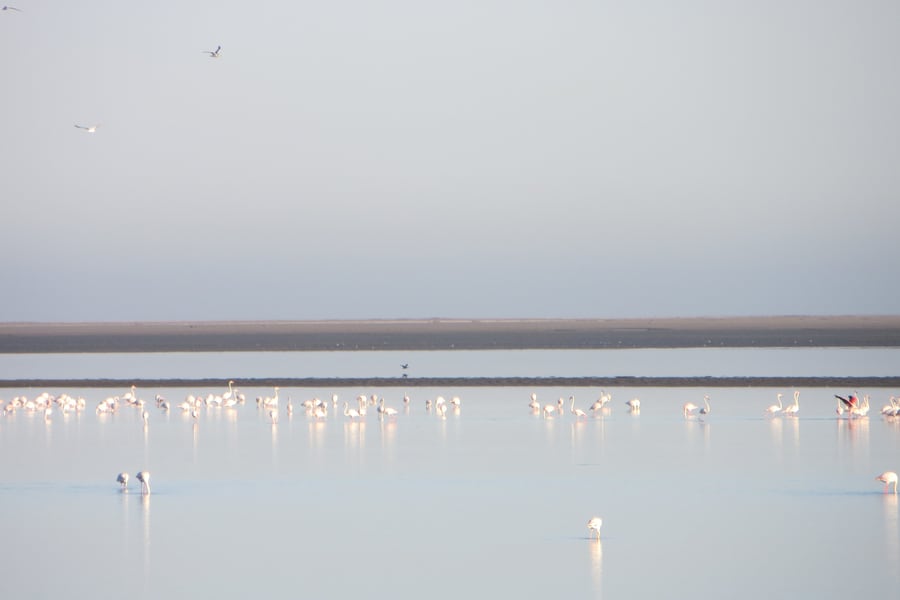
Walvis Bay
The port town where the train starts has a natural lagoon on its edge where pelicans and flamingos gather in their thousands, feeding in the shallows a short way from the town. South of it, at Sandwich Harbour, dunes around a hundred metres high run straight into the Atlantic. Give it a day before boarding.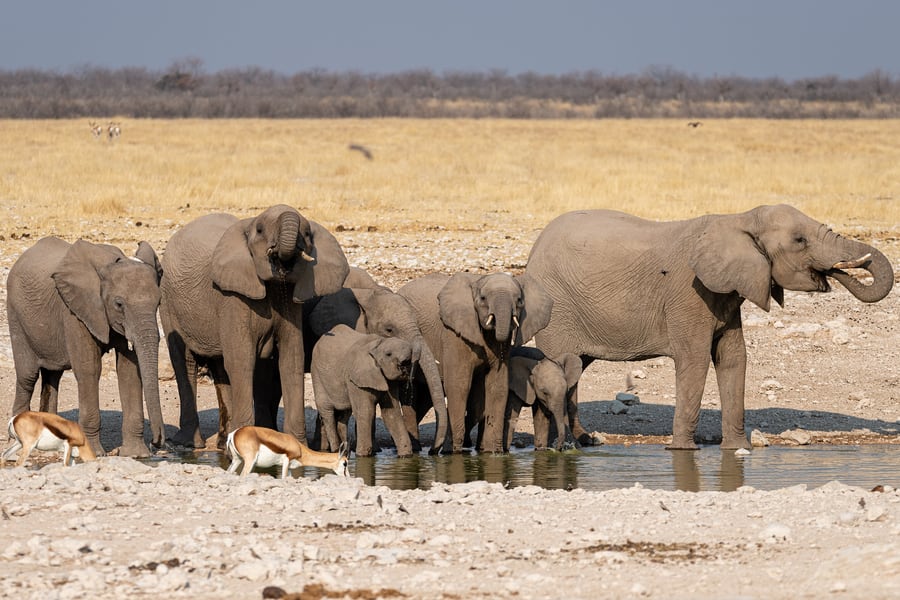 Christoph Strässler / Wikimedia Commons · CC BY-SA 2.0 · cropped
Etosha National Park
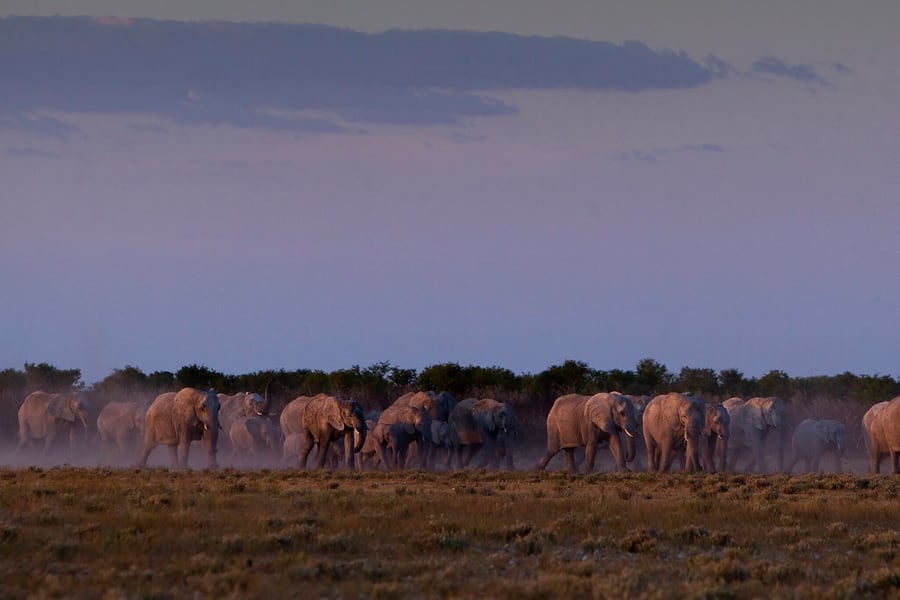
Proclaimed a game reserve in 1907 and now a national park of 22,270 square kilometres, Etosha takes its name from the salt pan that covers almost a quarter of it. Elephant, springbok, zebra and the endangered black rhino come to the waterholes at its edge. The tour drives in from Tsumeb for a night at a lodge and two game drives.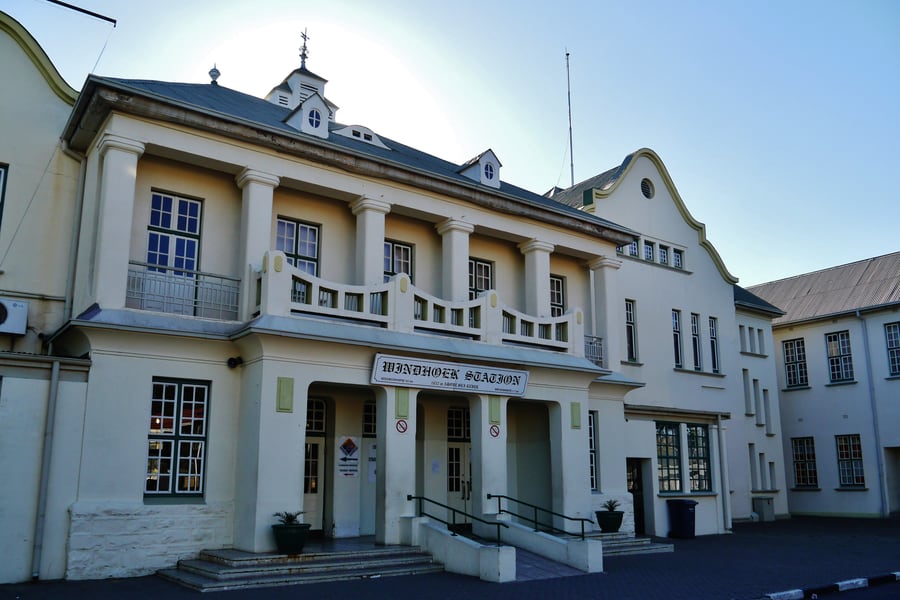 Zairon / Wikimedia Commons · CC BY-SA 4.0 · 2017 · cropped
Windhoek
The capital stands on the central plateau, and its Cape Dutch station from the German colonial years still serves TransNamib and houses the railway museum. The tour has lunch at the Windhoek Country Club, then visits the Independence Memorial Museum, the Evangelical Lutheran Church and the Namibia Craft Centre in a former brewery.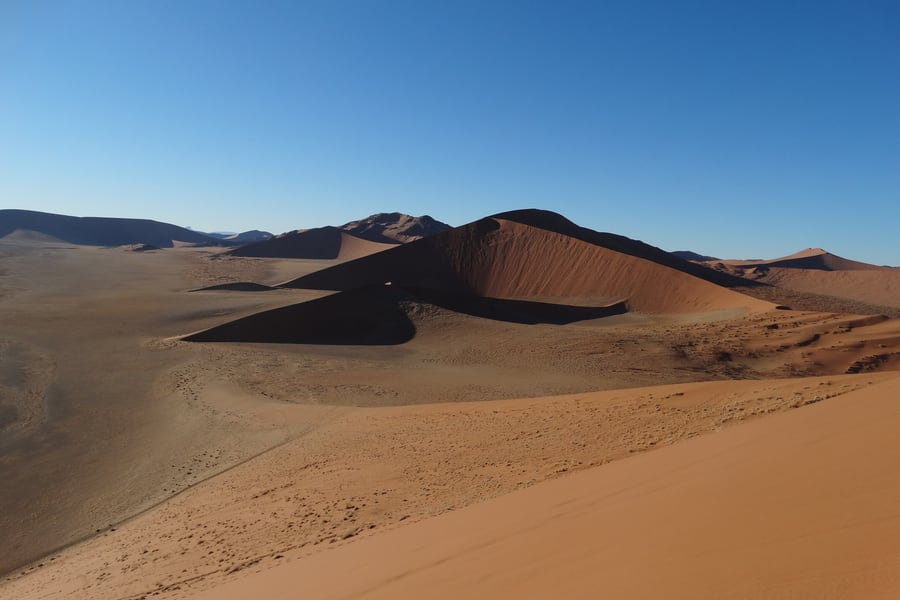 Vicartb / Wikimedia Commons · CC0 · 2014 · cropped
Sossusvlei
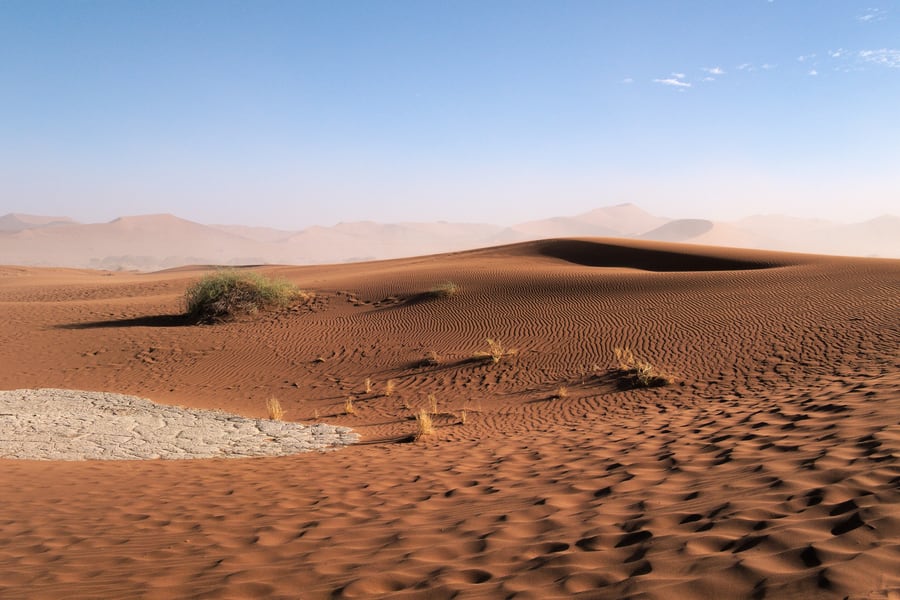
The red dunes around Sossusvlei, in the Namib-Naukluft park, are built of sand blown in from the coast and coloured by iron oxide, and wind from every side piles them into star shapes. The tour flies in from Windhoek for an afternoon drive and a bush dinner, then goes out at dawn to Deadvlei and its dead camel thorns.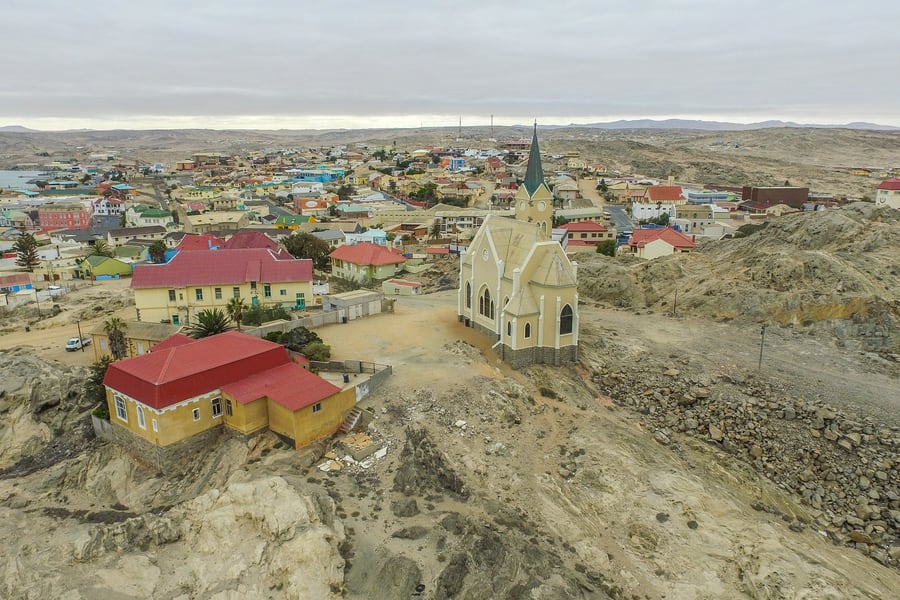 SkyPixels / Wikimedia Commons · CC BY-SA 4.0 · 2016 · cropped
Lüderitz
A harbour town on bare rock, where the southern railway began in 1906. German-era houses climb the hill below the Felsenkirche, and seals, penguins and flamingos live along the shore. The tour comes here for lunch after a morning at Kolmanskop, ten kilometres inland, then drives back to the train.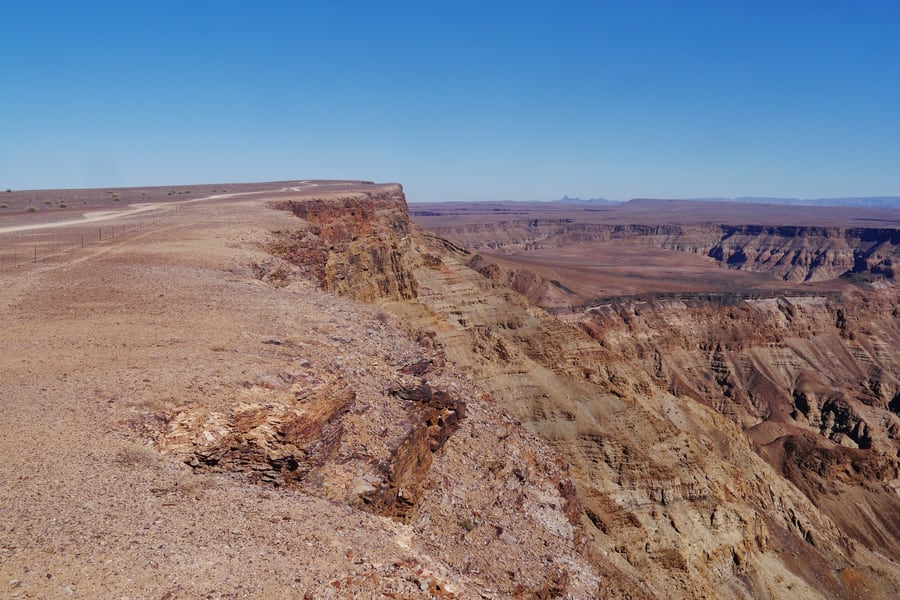 Zairon / Wikimedia Commons · CC BY-SA 4.0 · 2017 · cropped
The Fish River Canyon
About 161 kilometres long, up to 27 wide and around 550 metres deep, the Fish River Canyon is the largest in Africa. The river runs hard in the rainy season and shrinks to a stream in the dry one. The train sets guests down at Holoog for the drive to the rim and its viewpoints.Where to Sleep
Nine of the eleven nights are spent aboard, and the tour books the other two: a lodge in Etosha (Mokuti, on the itineraries the agents print) and a lodge at Sossusvlei.
The cards below are for the nights either side. The Strand Hotel in Swakopmund, up the coast from the Walvis Bay departure, is where one British operator starts its version of the tour; The Capital Menlyn Maine in Pretoria is where the same operator finishes it.
Where to stay
Strand Hotel Swakopmund
On the Mole, Swakopmund
A 125-room hotel on Swakopmund's Mole, with the Atlantic on three sides and its own microbrewery.
Check Availability (opens in a new tab, on ol-leisure.com)via ol-leisure.comThe Capital Menlyn Maine
Pretoria, at the end of the line
Rooms and serviced apartments in Pretoria's Menlyn Maine precinct, with an outdoor pool and a spa.
Check Availability (opens in a new tab, on thecapital.co.za)via thecapital.co.zaQuestions or corrections
Planning this trip and stuck on something, or spotted a time, fare or detail that has changed? Send us a message about The Namibia Safari — Walvis Bay to Pretoria. We read every one, and we update this page when something has changed.