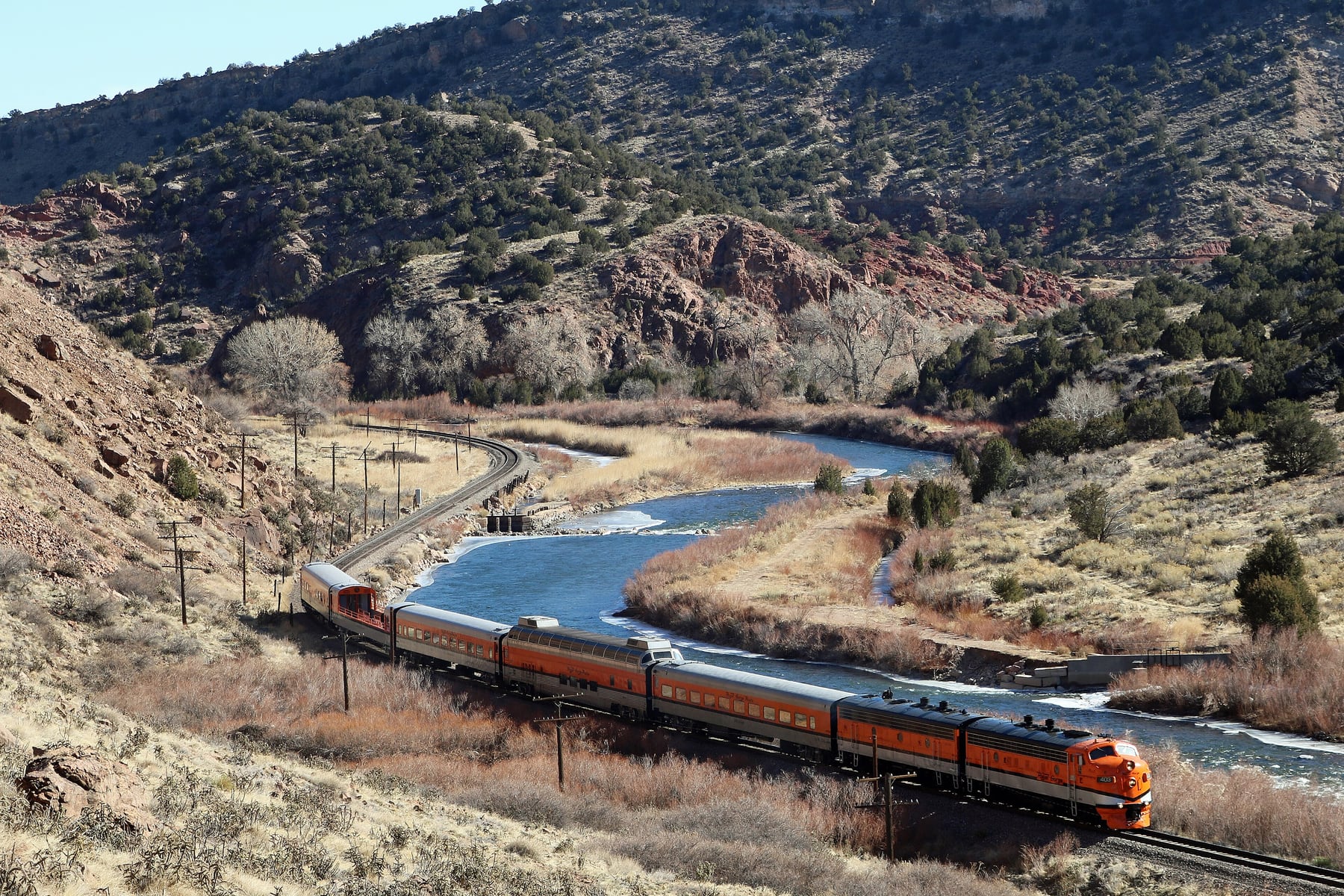
Royal Gorge Route Railroad
Jeffrey Beall / Wikimedia Commons · CC BY 4.0 · cropped
- Distance24 miles round trip, Cañon City to Parkdale and back
- Duration1 hour 50 minutes; evening trains about 2½ hours
- Best seasonAll year; up to four trains a day in summer
Introduction
West of Cañon City, Colorado, the Arkansas River has cut a canyon through the granite six miles long and more than 1,000 feet deep, so narrow at its tightest point that the walls fall straight into the water. In 1878 two railroads fought over the right to lay track through it — the Royal Gorge War, two years of court cases, sabotage and hired gunmen — and the Denver & Rio Grande won. Its main line ran through the gorge until 1997, and passenger trains until 1967.
Since 1998 the Royal Gorge Route Railroad has run excursion trains over the 12 miles that were saved. They leave the 1914 Santa Fe Depot in Cañon City, run up the floor of the gorge beside the river, under the Royal Gorge Bridge and over the Hanging Bridge of 1879, and come back from Parkdale without turning round. The round trip is 24 miles and takes just under two hours, in coaches, dining cars and full-length domes from the great streamliners of the 1950s, with an open-air car for everyone.
Trains run every day of the year.
The Journey
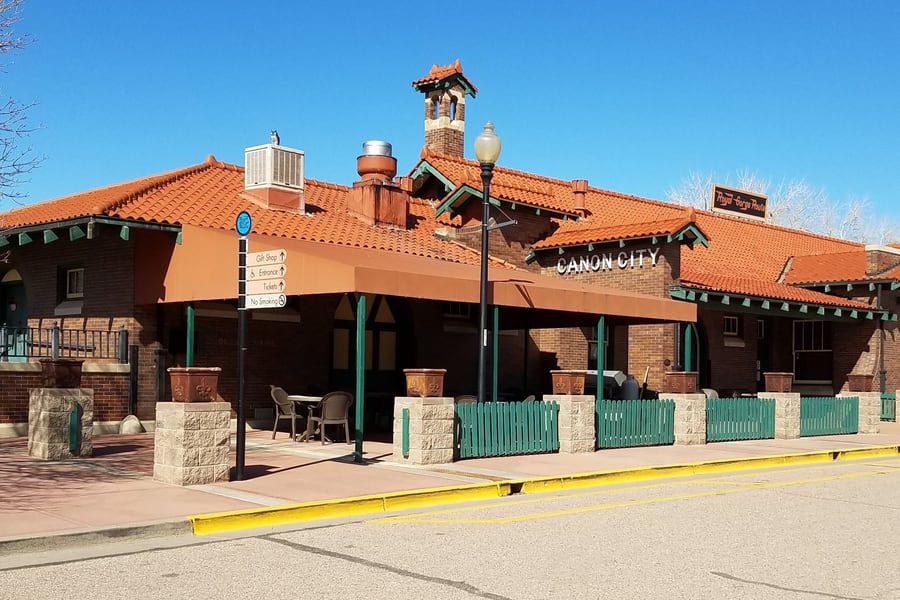
Trains leave from the Santa Fe Depot on Water Street in Cañon City, a brick station with a red-tiled roof, finished by the Santa Fe in 1914. Pick up your tickets inside; next door, a caboose has been turned into a café. Every seat is reserved and assigned, and the class you book decides where you sit: Coach, with high-backed seats in groups of four around a table; Deluxe, in a restored dining car with big plate-glass windows; or upstairs in a Vista Dome. Whichever you choose, you can step out onto the open-air car at any time.
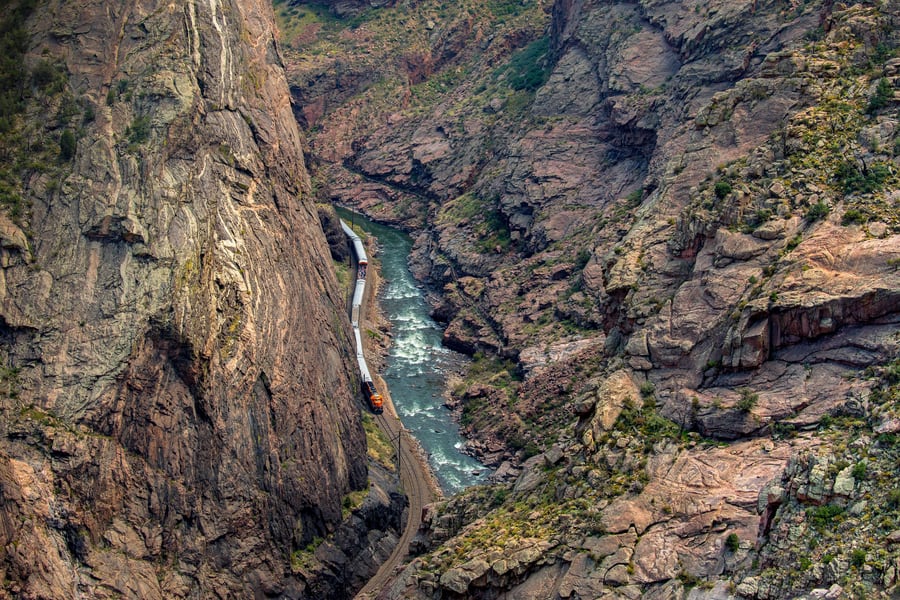
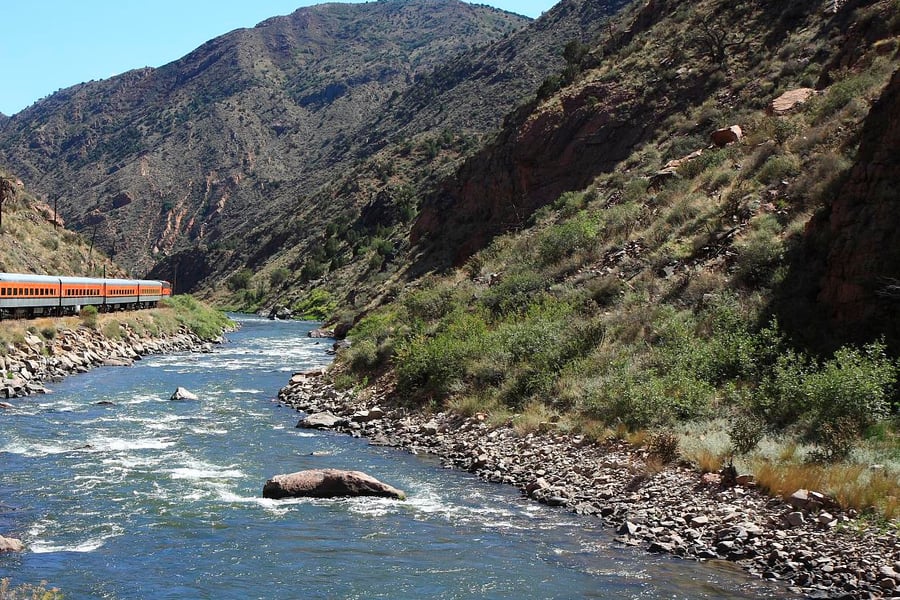
The train heads west past the walls of the territorial prison, opened in 1871 and still in use, and along the river beneath Tunnel Drive. A couple of miles out the valley closes in and the Royal Gorge begins. From here the track is on a narrow shelf beside the Arkansas, with granite walls rising more than 1,000 feet on either side; watch for bighorn sheep on the slopes, and for rafters in the rapids. At milepost 166 the train passes under the Royal Gorge Bridge, a thin line against the sky, and a quarter of a mile on it crosses the Hanging Bridge, at the narrowest point of the gorge, where the walls stand 30 to 40 feet apart. The canyon then opens out towards Parkdale, 12 miles from Cañon City, where the train simply reverses and runs back. It runs push-pull, so nothing needs to turn.
The Hanging Bridge
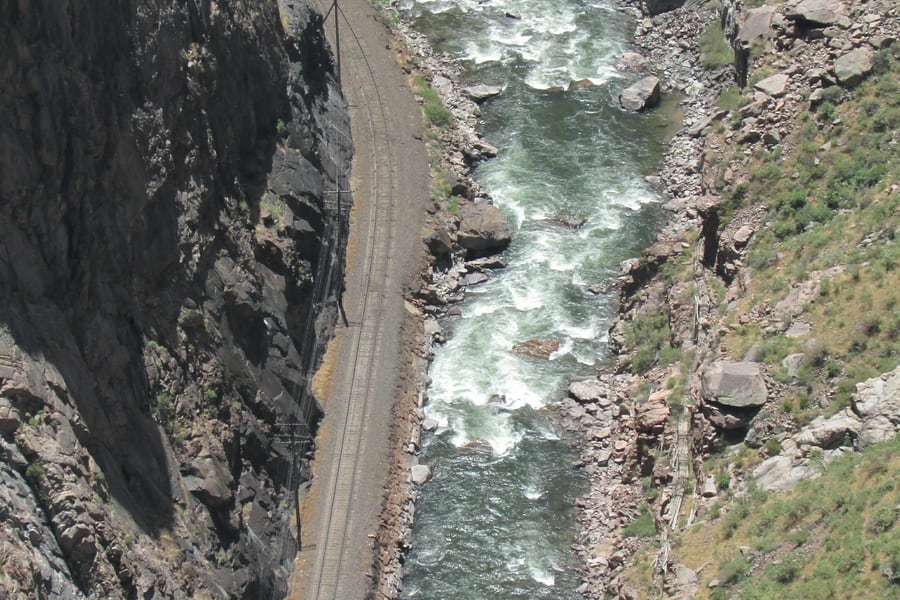
In 1879 the Santa Fe's crews reached a point where both walls plunged straight into the river and there was no ledge left to build on. The Kansas engineer C. Shaler Smith hung the track over the water: a 175-foot plate girder, suspended on one side from A-frame girders that span the river and are anchored in the rock. It cost $11,759. Strengthened over the years, it still carries every train.
The trains
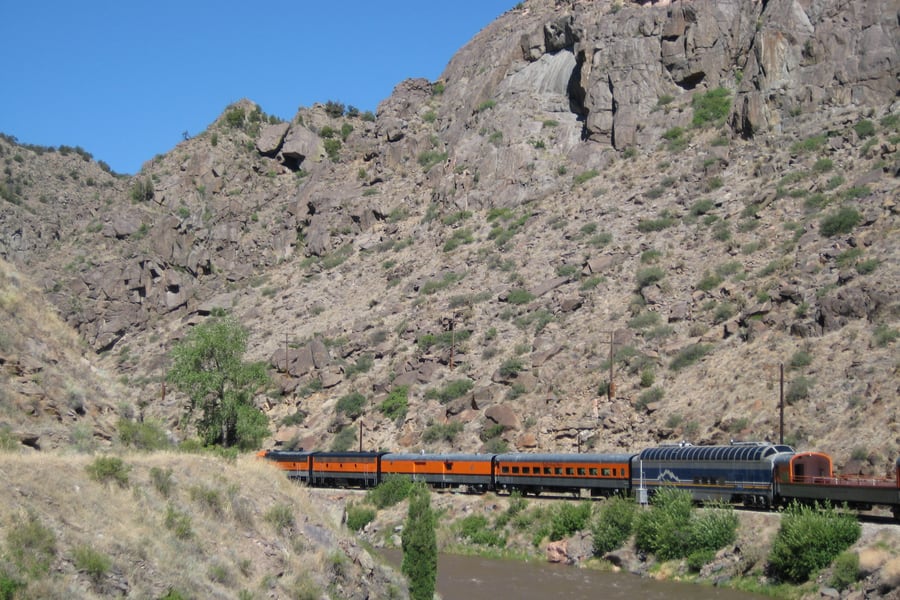
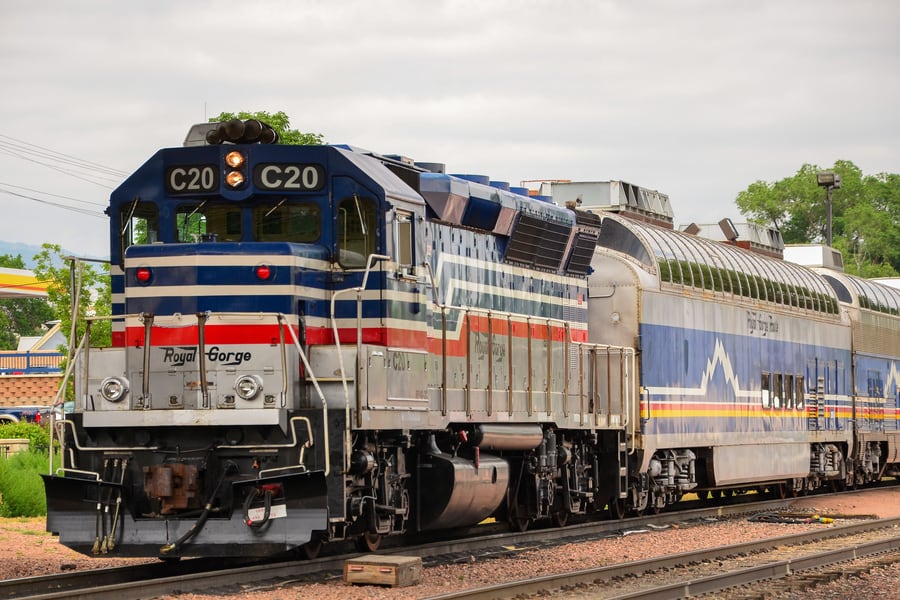
The best known of the locomotives are a pair of EMD F7s, Nos. 402 and 403, built in 1949 for the Chicago & North Western and painted in the orange and silver of the Denver & Rio Grande Western, the company that ran this line for a century. The cars came from all over North America. The coaches were built in 1954 for Canadian National. The full-length domes are among only 30 ever built, with glass running the whole length of the upper deck: two are Santa Fe Big Domes of 1954, and two are Milwaukee Road Superdomes of 1952. All four spent years carrying cruise passengers to Denali in Alaska before the railroad bought them in 2005 and 2006.
Meals are cooked on board on every departure, and served at your seat.
Along the route
 Xnatedawgx / Wikimedia Commons · CC BY-SA 4.0 · cropped
Santa Fe Depot
Every trip starts at the brick depot on Water Street, completed by the Santa Fe in 1914. Passenger trains to Pueblo ended in 1921, and it served for freight until 1984. Collect your tickets here; the café is in a caboose next door.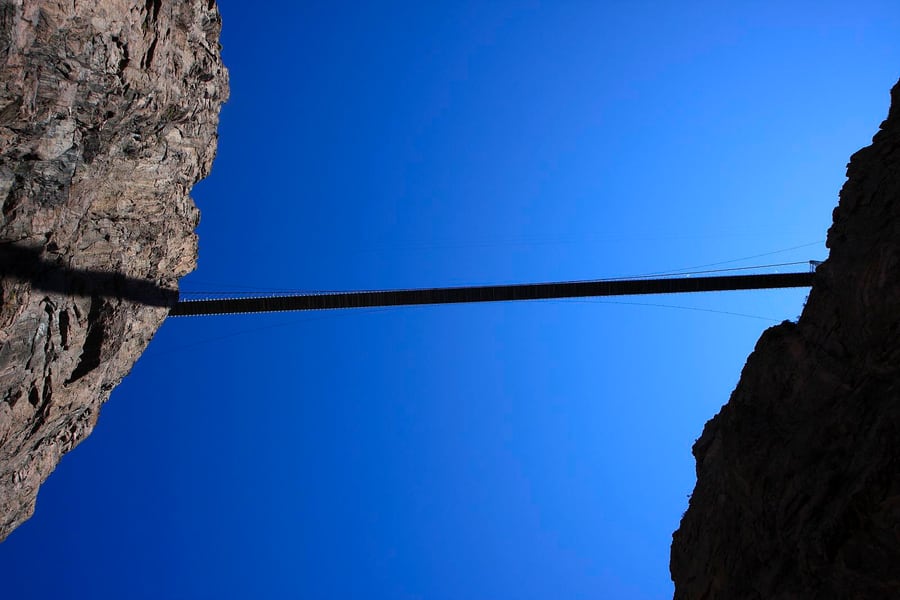 Brokentaco / Flickr · CC BY 2.0 · cropped
Under the Royal Gorge Bridge
At milepost 166 the train passes under the Royal Gorge Bridge, opened in 1929 and still the highest bridge in the United States. From the floor of the gorge its deck is a thin line against the sky; step out onto the open-air car to see it.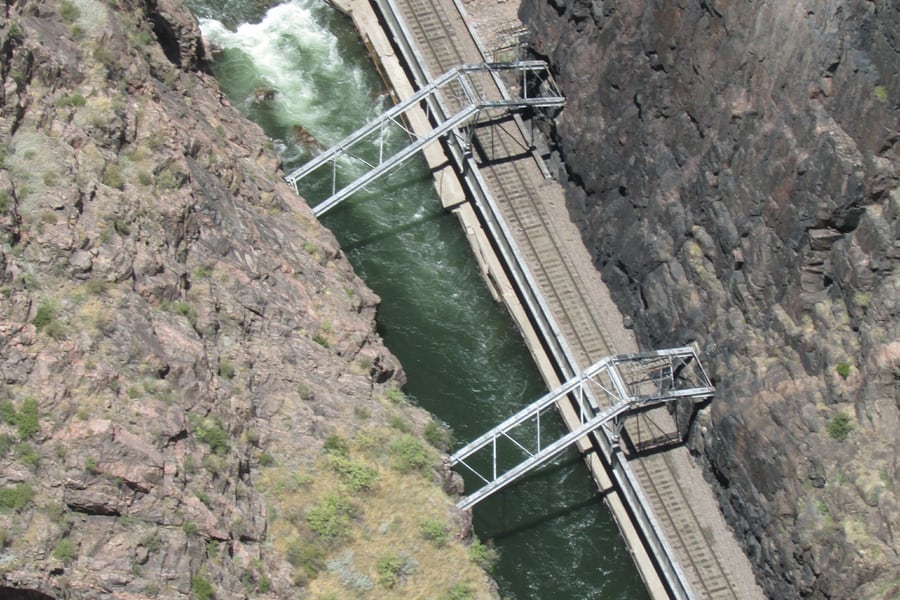 Chris Light / Wikimedia Commons · CC BY-SA 4.0 · cropped
The Hanging Bridge
At the narrowest point of the gorge, where the walls stand 30 to 40 feet apart, the track runs on a girder slung over the river from A-frames anchored in the rock. It was built in 1879 for $11,759, and has carried trains ever since.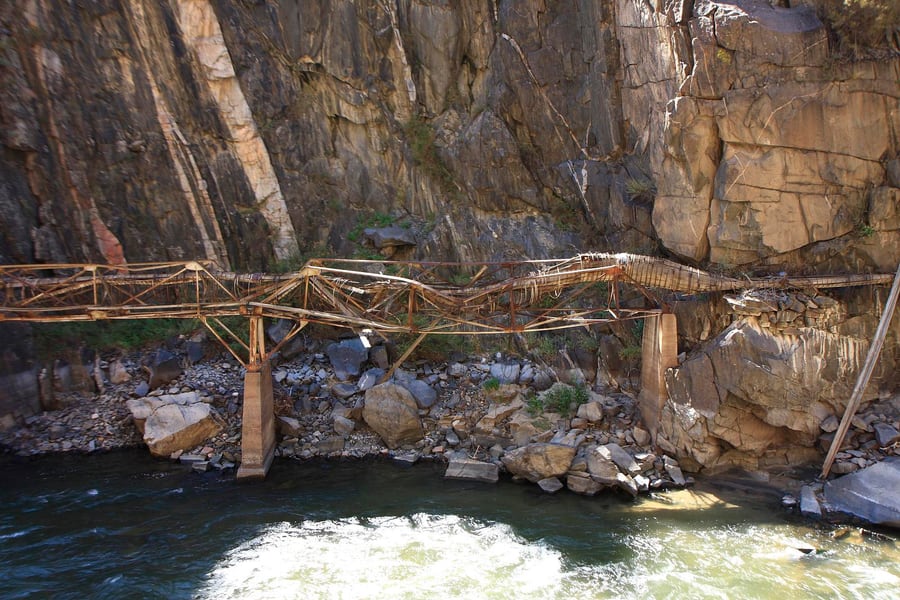 Brokentaco / Flickr · CC BY 2.0 · cropped
The old water line
Across the river, the remains of Cañon City's wooden water line, built between 1908 and 1910, still cling to the rock. It carried water to the town by gravity until 1972, and a caretakers' house and warming shacks still stand along it.A bit of history
Culture & experiences along the way
 Mark Levisay / Flickr · CC BY 2.0 · cropped
Up in the Vista Dome
Only 30 full-length domes were ever built, glassed from one end of the car to the other, and four of them run here: two Santa Fe Big Domes of 1954 and two Milwaukee Road Superdomes of 1952. Booth seats at tables of four look up at the rim, and the Big Domes have a kitchen downstairs.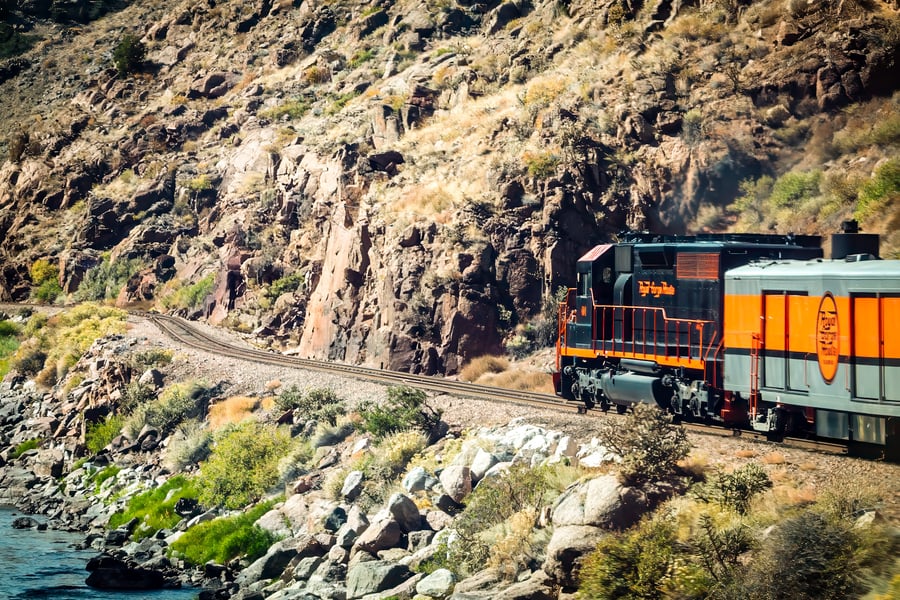 John F. Mortin / Flickr · CC BY-SA 2.0 · cropped
Ride with the Engineer
On the 09:00 and 12:30 trains, up to two riders can spend the whole trip in the locomotive cab, beside the engineer, hearing the history of the line from the crew. Riders must be 13 or over, wear long trousers and closed shoes, and manage steep steps; a photo and a gift bag are included.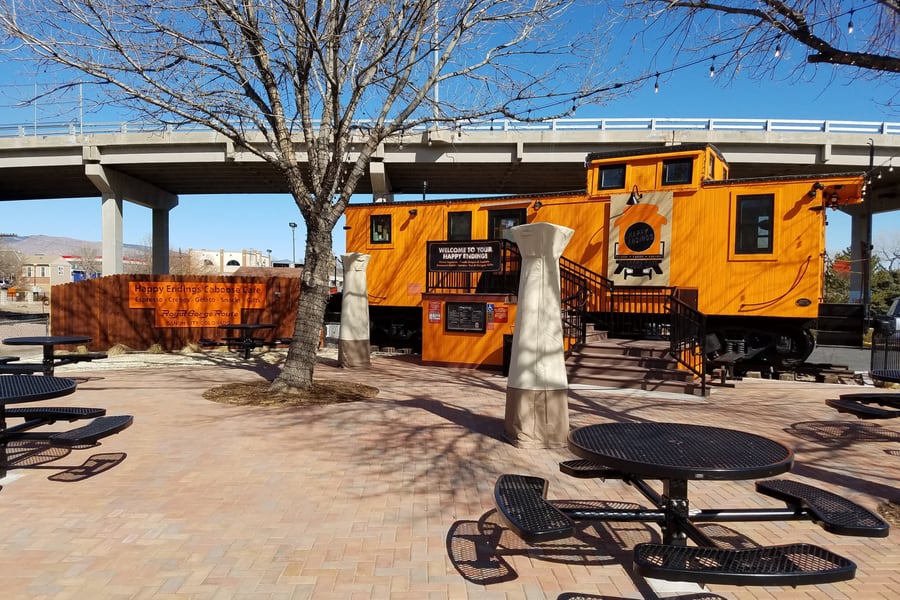 Xnatedawgx / Wikimedia Commons · CC BY-SA 4.0 · cropped
Happy Endings Caboose Café
The café beside the depot is in an old caboose, with tables out on the plaza. From breakfast to happy hour it serves Italian-style espresso, breakfast wraps, burgers, scoops of ice cream and beer — a good place to wait for the train.Timetables
The train runs every day of the year, from the Santa Fe Depot in Cañon City to Parkdale and back. Daytime trips take about 1 hour 50 minutes; the evening train takes about 2½ hours.
| Departure | Back in Cañon City | Runs |
|---|---|---|
| Morning, 09:00 (09:30 in spring) | about 10:50 | Daily in summer; weekends in spring and October |
| Mid-day, 12:30 | about 14:20 | Every day of the year |
| Afternoon, 15:30 | about 17:20 | Daily in summer and October; mostly Fridays to Sundays in winter and spring |
| Twilight, 19:00 (18:30 from mid-August) | about 2½ hours later | Most Thursdays to Sundays in summer; Saturdays, and some Fridays, in October |
In November the 12:30 runs daily and the 15:30 at weekends. In December the regular trains give way to the Holiday Train at 12:30 and the Santa Express in the evening, both about 1½ hours long.
Good to know:
- Book ahead. Trains sell out. You can book online up to an hour before departure; tickets bought in person at the depot cost $10 more.
- From December to February the evening train runs in the dark, with lasers and floodlights on the walls of the gorge. For the scenery, ride in daylight.
- Rain or snow, the train runs. If the railroad cancels for weather, you can rebook free within a year.
- Parking at the depot, 401 Water Street, is free.
Departures as of September 2026, from the railroad's own pages and its booking system, for June 2026 to May 2027. Confirm before travelling on royalgorgeroute.com (opens in a new tab).
Tickets
You book a train, a time and a class, and every seat is assigned. The ticket covers the ride only: food, drinks and tips are extra, and a historic preservation fee is added at checkout. Fares are lower on the 09:00 and 15:30 trains than on the 12:30 and evening ones, and rise in high season and on holidays. Children under 2 ride free on a lap; every class includes the open-air car.
There are no refunds. Up to 48 hours before departure you can cancel for a $20 fee a ticket, or move to another date for $10; after that, you can only reschedule. Fares checked September 2026 at royalgorgeroute.com (opens in a new tab); US dollars.
Book your tickets
Coach
Round trip · 1 hour 50 minutes
High-backed seats in groups of four around a table, with meals ordered from the grill.
Book Tickets (opens in a new tab, on Royal Gorge Route Railroad)via Royal Gorge Route RailroadVista Dome
Round trip · booths upstairs in a full-length dome
The best view of the walls, at tables of four under the glass.
Book Tickets (opens in a new tab, on Royal Gorge Route Railroad)via Royal Gorge Route RailroadFirst Class Lunch
Three courses in the dome or dining car
Sparkling wine, a salad, a main course and dessert, served on selected trains.
Book Tickets (opens in a new tab, on Royal Gorge Route Railroad)via Royal Gorge Route RailroadRide with the Engineer
The whole trip in the locomotive cab
Two seats beside the engineer on the 09:00 and 12:30 trains, for riders aged 13 and over.
Book Tickets (opens in a new tab, on Royal Gorge Route Railroad)via Royal Gorge Route RailroadRail Passes
No rail pass covers the Royal Gorge Route. It is a private, family-owned railroad that sells its own tickets. Amtrak's USA Rail Pass is valid only on Amtrak's own trains and Thruway buses, and Interrail and Eurail do not apply anywhere in the United States.
The railroad rarely discounts its own fares. Military discounts are sold through the ticket offices of the nearby bases, and any other offers go out to subscribers of its newsletter.
Checked September 2026 against royalgorgeroute.com (opens in a new tab) and amtrak.com (opens in a new tab).
Places to Visit
Cañon City, a town of about 17,000 people and the seat of Fremont County, is the line's only station. The prison museum, Tunnel Drive and Skyline Drive are all on its western edge, and the rim of the gorge, where the Royal Gorge Bridge crosses, is a short drive further west.
 Bmila7141 / Wikimedia Commons · CC BY-SA 4.0 · cropped
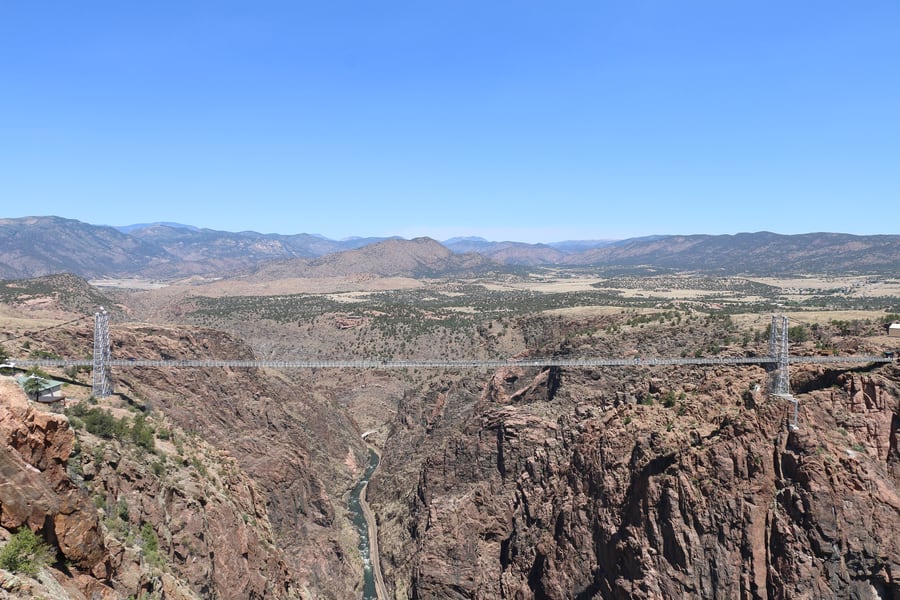
Royal Gorge Bridge & Park
Built in seven months and opened in December 1929, the bridge hangs 956 feet above the river and is still the highest in the United States. You walk its 1,257 wooden planks from rim to rim, then take the gondolas, the zip line or the via ferrata. A wildfire in 2013 burned most of the park's buildings but barely touched the bridge.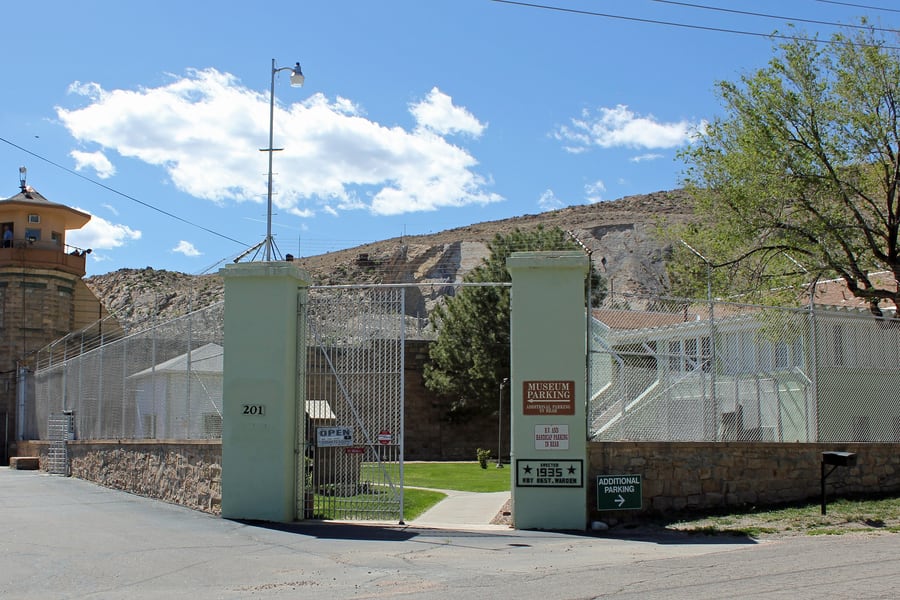 Jeffrey Beall / Wikimedia Commons · CC BY-SA 3.0 · cropped
Museum of Colorado Prisons
Cañon City has been a prison town since the territorial penitentiary opened in 1871, and it is still in use next door. The museum fills the cell house of the women's prison of 1935, one story to each cell upstairs: the riots of 1929 and 1947, Warden Roy Best's office, and inmates such as Alfred Packer, convicted of cannibalism.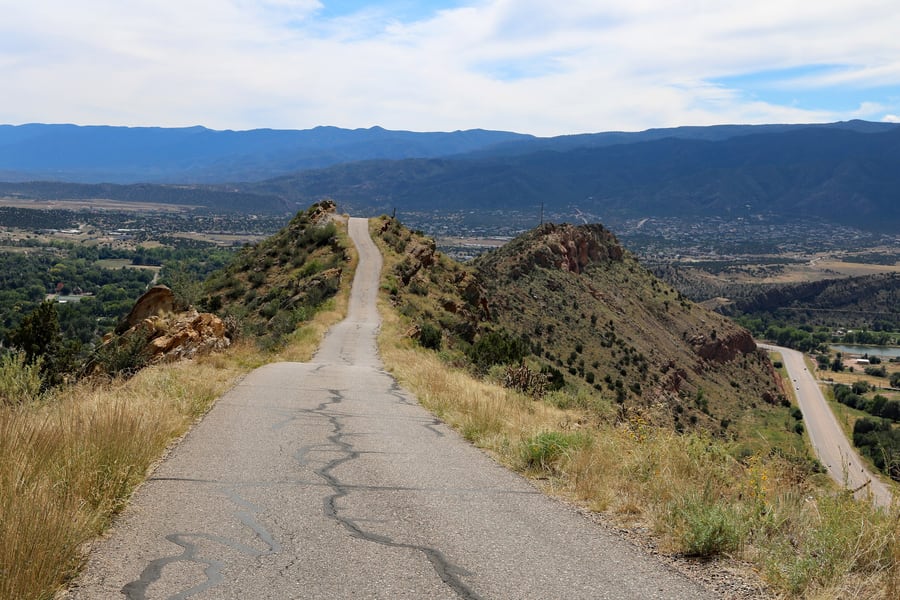 Jeffrey Beall / Wikimedia Commons · CC BY 4.0 · cropped
Skyline Drive
Sixty inmates from the prison built this narrow one-way road along the crest of a hogback in 1905. It climbs 2.8 miles along the ridge above Cañon City, past a large "C" for the town on a neighbouring hogback, and from the road you can see the rock where some 50 footprints of armoured dinosaurs, ankylosaurs, were found in 2000. Take it slowly: the road is narrow.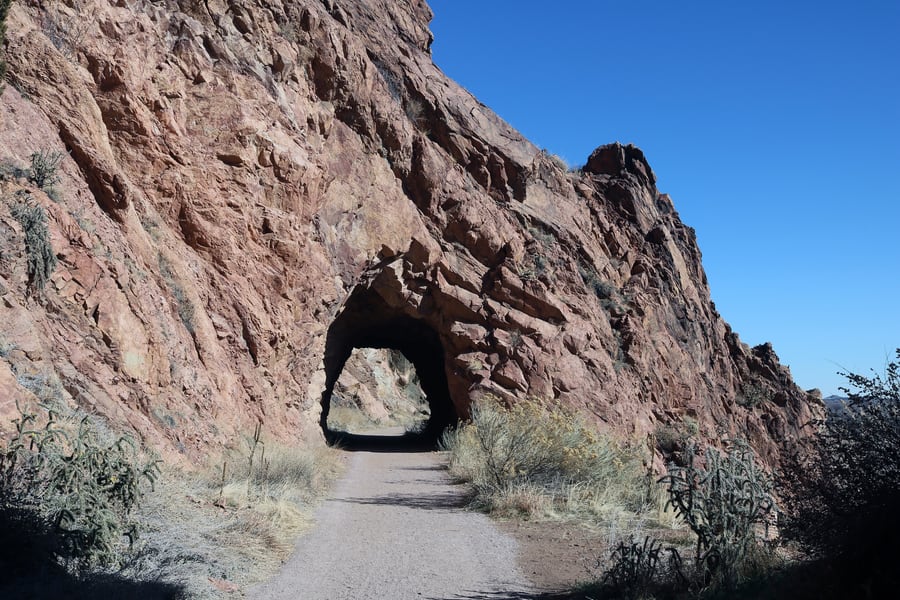 Jeffrey Beall / Wikimedia Commons · CC BY 4.0 · cropped
Tunnel Drive
A wide, gently graded trail cut into the cliffs above the Arkansas, running through tunnels in the rock at the mouth of the gorge. It is about three miles long, open to walkers and cyclists, and winds through piñon pine and juniper with views up the valley to the mountains. It looks straight down on the railroad — a good place to watch the train go by.Where to Sleep
Cañon City has hotels and holiday rentals within reach of the depot, and there are cabins along US Route 50 on the way to the gorge. The railroad also lets rooms and houses of its own in town, as Royal Gorge Route Inns.
Where to stay
Hotel St. Cloud
Cañon City · a restored Victorian hotel
A mansard-roofed hotel first built in the mining town of Silver Cliff and taken apart and rebuilt in Cañon City, now with 36 rooms, a restaurant and two bars.
Check Availability (opens in a new tab, on hotelstcloud.com)via hotelstcloud.comRoyal Gorge Cabins
US Route 50 · cabins and glamping tents
One- and two-bedroom cabins and canvas glamping tents on the road west towards the gorge, with a seasonal bar and grill across the highway.
Check Availability (opens in a new tab, on royalgorgecabins.com)via royalgorgecabins.comQuestions or corrections
Planning this trip and stuck on something, or spotted a time, fare or detail that has changed? Send us a message about Royal Gorge Route Railroad. We read every one, and we update this page when something has changed.