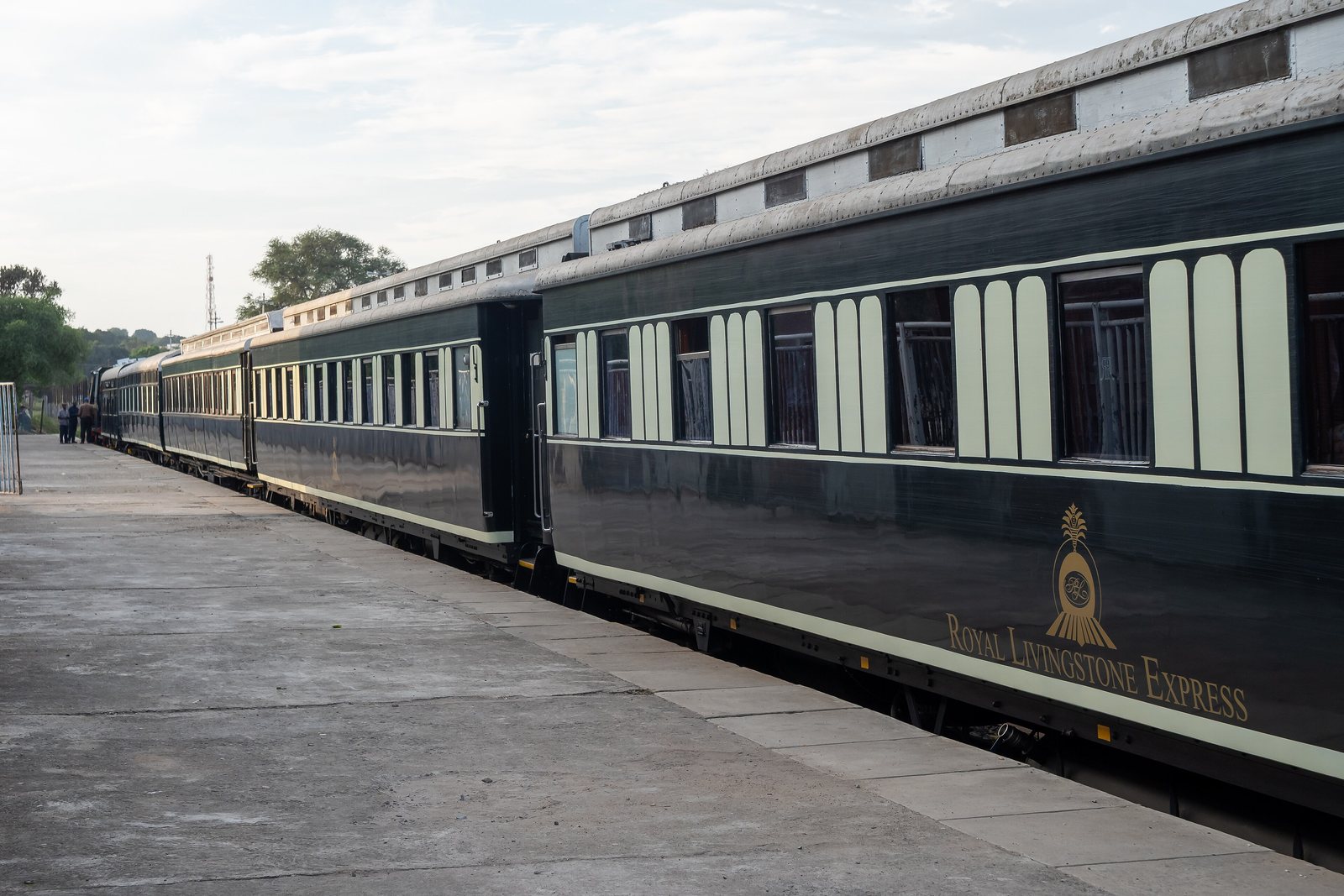
The Royal Livingstone Express
Matti Blume / Wikimedia Commons · CC BY-SA
- DistanceLivingstone to the Victoria Falls Bridge
- DurationAbout 4 hours
- Best seasonFebruary–May for the falls in flood · dry season for the light
Introduction
In 1975, delegations from the Rhodesian government and the African nationalist movements met to negotiate an end to a war. They met on the Victoria Falls Bridge, in a railway carriage poised over the gorge, because the bridge belongs to neither country — the Zambian border post is at one end and the Zimbabwean at the other, and the span between them is nobody's.
They sat there for nine and a half hours and agreed nothing.
Fifty years later you can have dinner in the same place.
What the Royal Livingstone Express is
A steam locomotive of 1922, a dining car built in 1923, and a five-course meal served while the train stands still in the middle of a bridge over the Zambezi with the spray of Victoria Falls drifting across the windows.
It runs from Livingstone in southern Zambia, out along the original Rhodesian railway alignment, and onto the bridge. The whole thing takes about four hours. It is, comfortably, the most civilised railway experience in central Africa, and it is not cheap.
The engines are real
Worth saying plainly, because plenty of "steam trains" turn out not to be: this one genuinely is.
Number 156 is a 10th Class, built by the North British Locomotive Company in 1922 — and built not for a railway but for Zambezi Sawmills Ltd, hauling timber on the Mulobezi Line. It was rescued and restored by the British wildlife artist David Shepherd, who spent much of his life and money saving locomotives, handed to Zambia National Heritage in 1971, and rebuilt again by Bushtracks in 2005. It alternates with Number 204, a 12th Class of 1924.
One honest caveat: the operator also keeps a diesel, nicknamed the "Funkey Monkey", explicitly to reduce wear on the historic steam engines. So steam is the norm, not a guarantee. If it matters to you — and it should — ask when you book.
The dining car went to Wembley
The restaurant car is called Wembley, and the name is not a flourish.
It was built in 1923 by the Birmingham Railway Carriage and Wagon Company and originally named Umhlatuzi. Before it ever reached Africa it was exhibited at the British Empire Exhibition at Wembley in 1924–25, which is where the new name came from, and it entered service in South Africa on 19 May 1926. It belongs to the A22 series, the design that first separated dining saloon from kitchen into two vehicles — known to South African railwaymen as the "Hendrie Twins".
It was rescued by Christopher Tett of Bushtracks Africa and Rohan Vos of Rovos Rail, and rebuilt in Rovos Rail's workshops.
And the bridge is the point
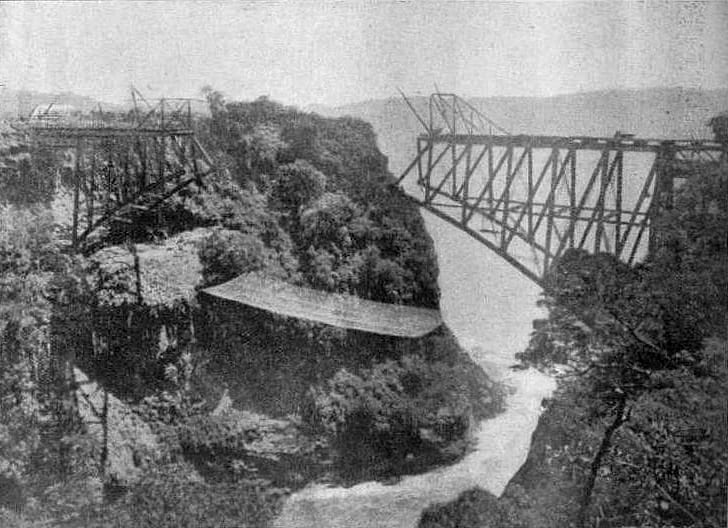
The Victoria Falls Bridge was prefabricated in Darlington by the Cleveland Bridge & Engineering Company, shipped to Beira in Portuguese Mozambique and railed up to the gorge. It took fourteen months to erect and was opened on 12 September 1905 by Professor Sir George Darwin — son of Charles. Its stress calculations were done by Ralph Freeman, who went on to be the principal designer of the Sydney Harbour Bridge.
There is a wonderful detail from the building of it. Rhodes insisted the railway north from Livingstone to Kalomo be laid before the bridge was finished, so a locomotive was taken across the gorge in pieces on the temporary electric cableway the engineers had nicknamed the "Blondin", after the tightrope walker, reassembled on the far bank, and put to work months before there was any bridge for it to have crossed.
One thing to be clear about
Regular cross-border passenger services over this bridge stopped during the Rhodesian war and never properly came back. Trains still cross it — at less than walking pace, because of its age — but this dinner train is not a survivor of a scheduled service. It is a heritage operation, honestly presented as one, running on one of the most extraordinary pieces of railway engineering in Africa.
Bring your passport. You will need it to get onto the bridge.
The Journey
The train leaves from Livingstone, the Zambian town named after the missionary who reached the falls in 1855 and which was the capital of Northern Rhodesia until 1935. Departure is late in the afternoon — 15:45 from April to October, 16:30 from October to March — and the timing is entirely about where the sun will be when you reach the bridge.
Transfers from the hotels in Livingstone and on the Zimbabwean side are included, so most passengers arrive by minibus rather than making their own way to the station.
Out along the old line
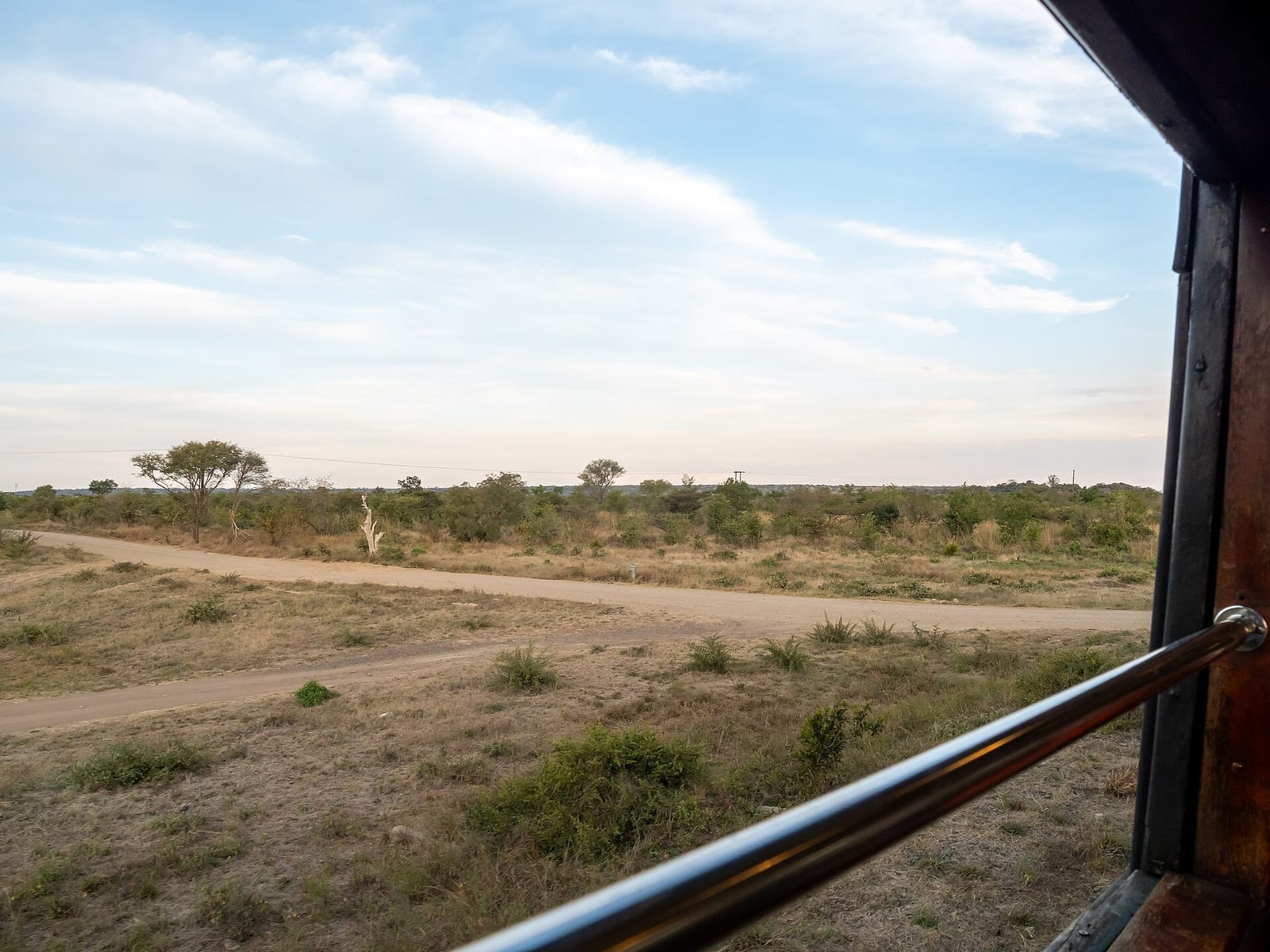
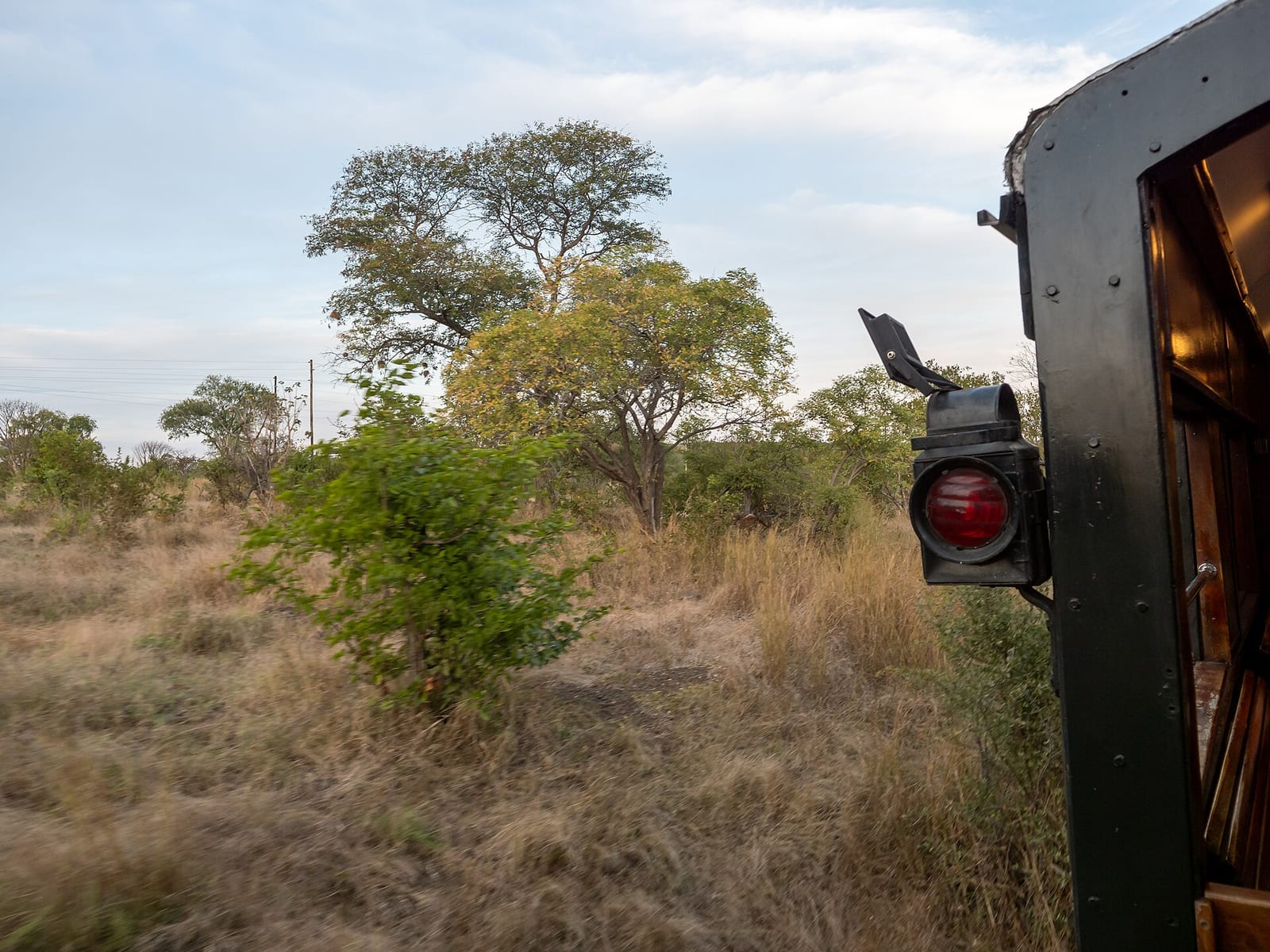
The locomotive — 156 or 204, depending on the day — takes the train out of Livingstone on the original Rhodesian alignment, through mopane bush and scrub. It is not fast and is not meant to be.
This is the drinks-and-canapés stretch. The carriages are 1920s stock with panelling, brass, white linen and proper glassware, restored seriously rather than themed, and the windows are open. You can stand on the balcony at the end of the car.
The country here is flat and dry and the interest is not really in the view: it is in the fact that you are riding a hundred-year-old train through the Zambian bush with a gin in your hand, which is a thing very few places in the world can offer.
Mosi-oa-Tunya
Then, ahead, a column of white.
The Kololo people called the falls Mosi-oa-Tunya — the smoke that thunders — and that is exactly what you see first: spray standing several hundred metres above the escarpment, visible from many kilometres away, with the noise arriving afterwards.
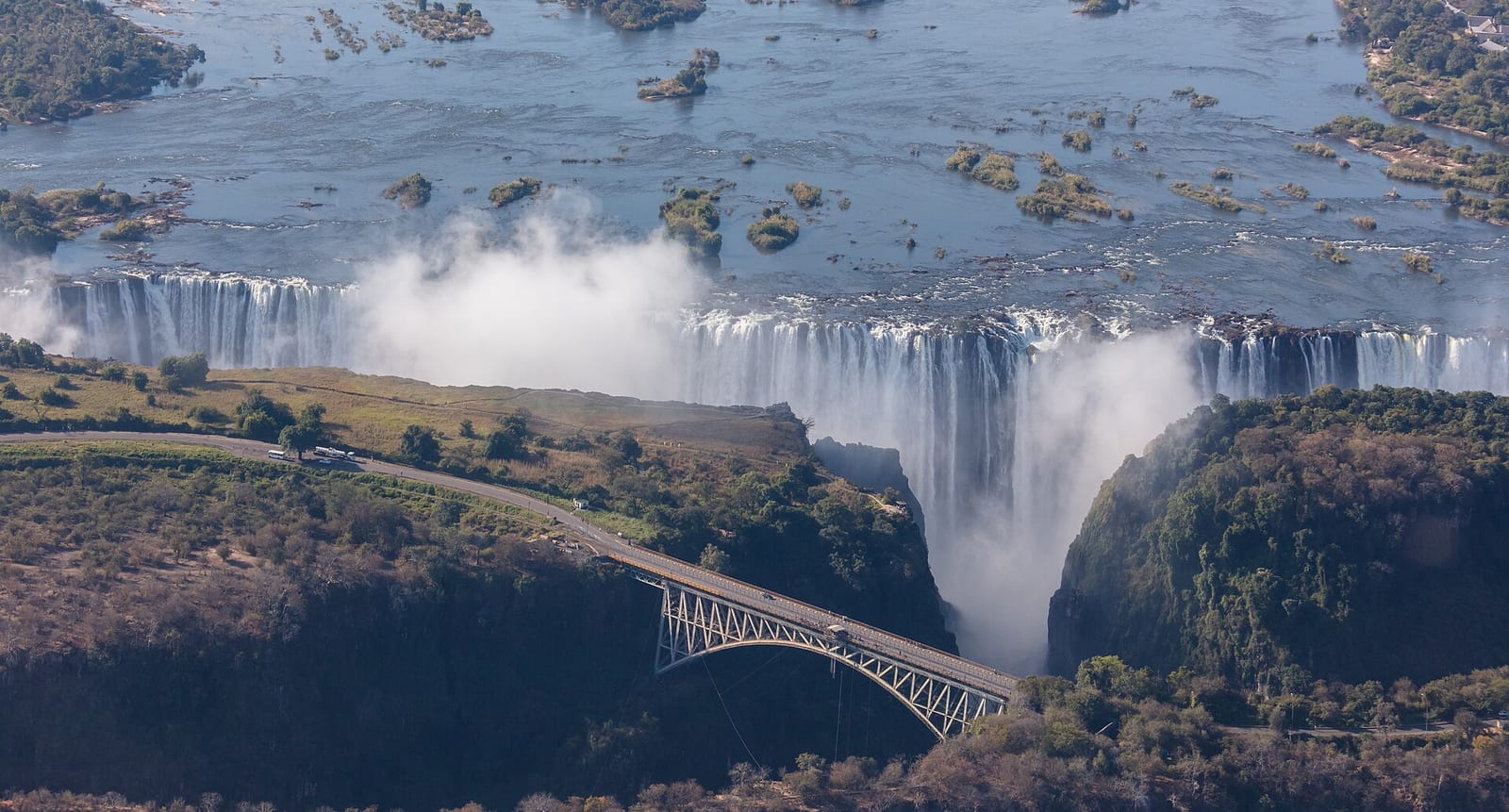
The Zambezi here drops into a series of zigzag gorges cut back through the basalt over hundreds of thousands of years. The bridge crosses the second gorge.
On the bridge
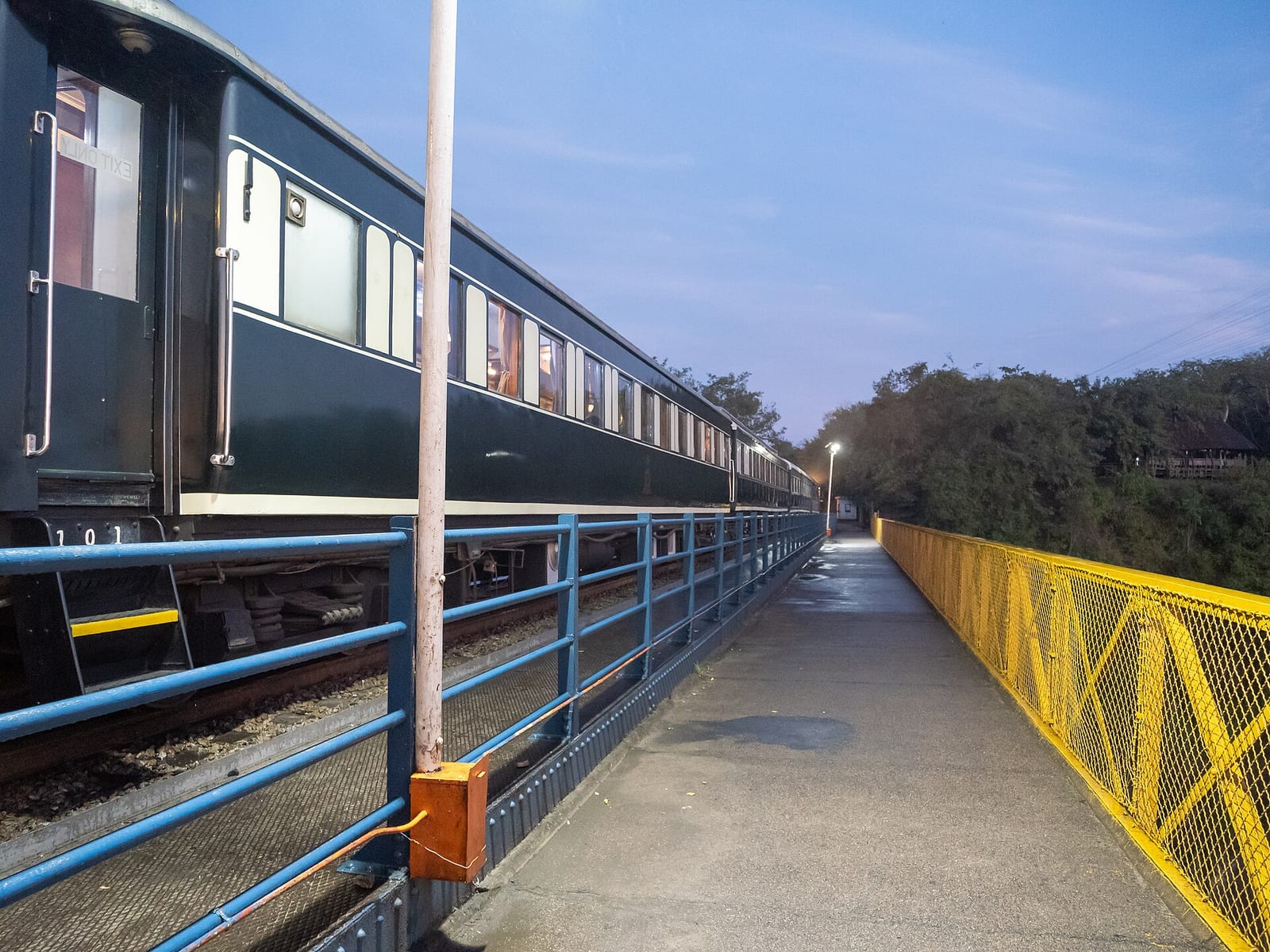
The train runs out onto the Victoria Falls Bridge and stops.
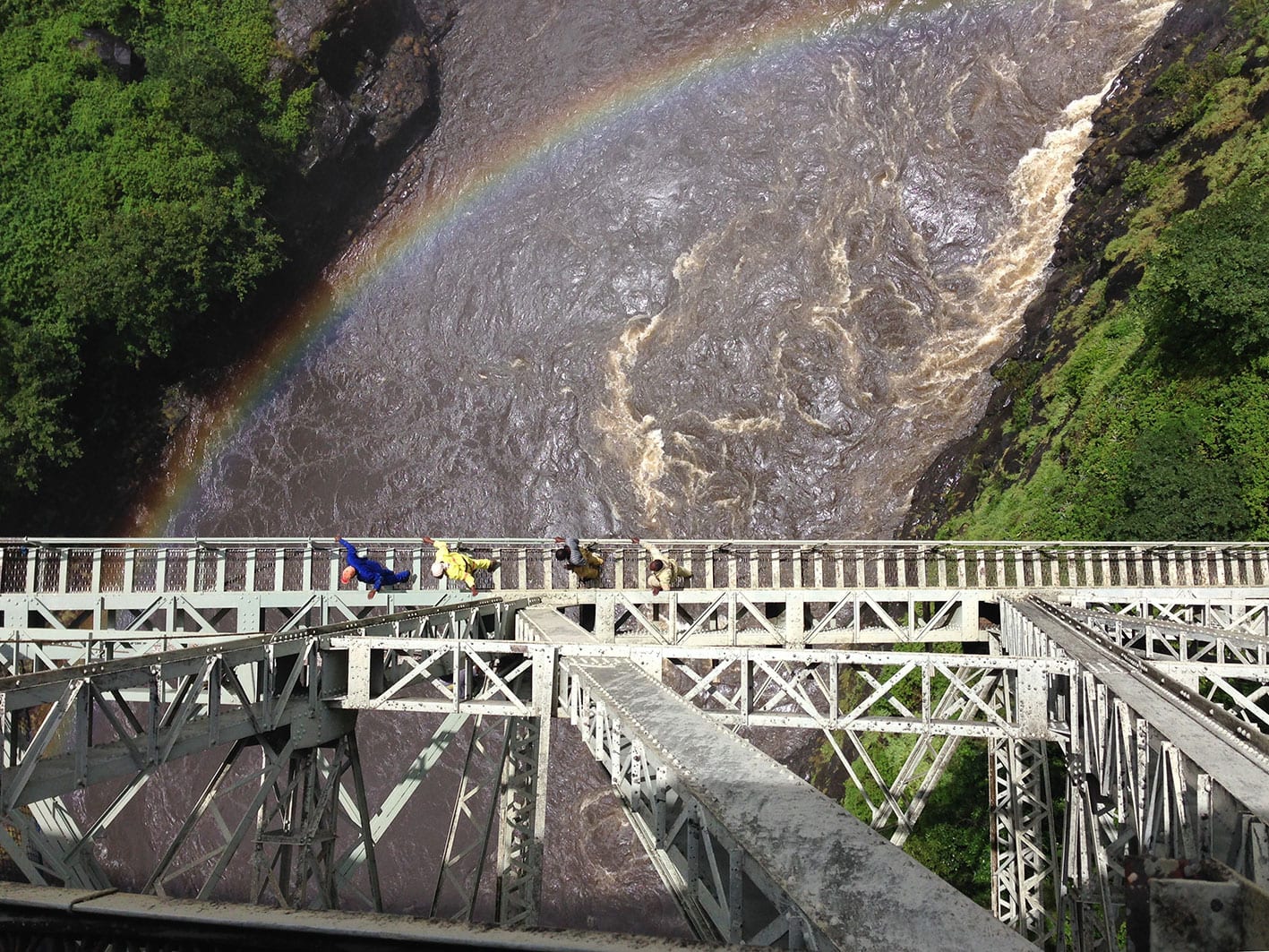
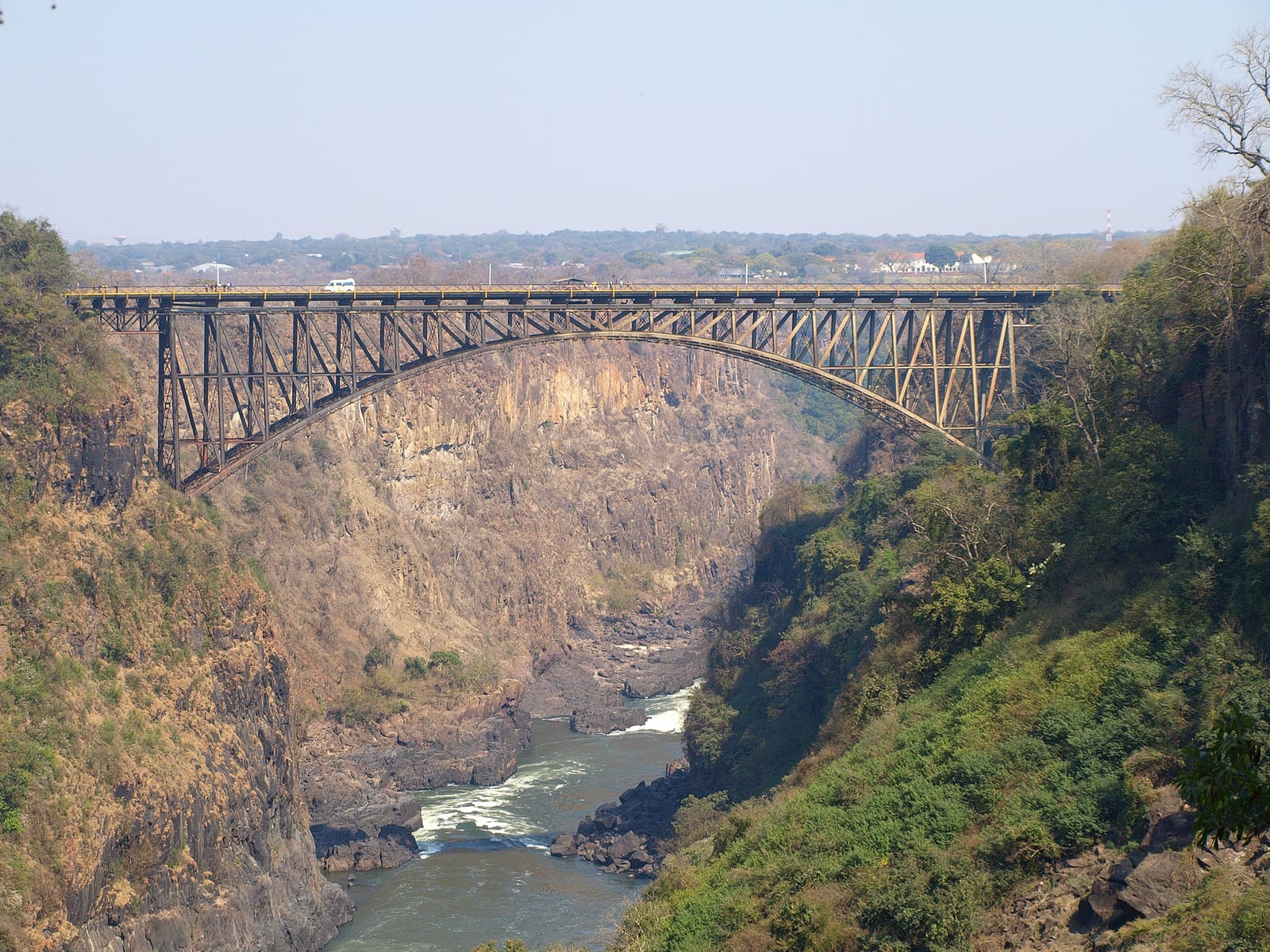
The steel arch under you has a main span of 156.5 metres and a total length of 198 metres. Below is the Zambezi in the Batoka Gorge — the commercial bungee jump from this deck is 111 metres. Upstream, the falls; downstream, the gorge running away in a series of hairpins.
Passengers get down and stand on the bridge, which is the moment everyone remembers. There is spray in the air even in the dry season, and in February to May, when the Zambezi is in flood, the whole structure can be soaked.
Remember where you are: the Zambian border post is behind you at one end, the Zimbabwean at the other, and the bridge itself lies between them, which is why you were asked for a passport and why, in 1975, it was chosen as neutral ground for peace talks held in a railway carriage for nine and a half fruitless hours.
Dinner
Then back inside for five courses, served as the light goes and the gorge fills with shadow. Selected drinks are included. The service is formal without being stiff, the food is genuinely good, and the whole trip runs about four hours door to door.
The train returns to Livingstone in the dark.
Practical notes
- Passport. Not optional — the bridge is between two border posts.
- Smart casual, and they mean it. No shorts and sandals.
- Minimum age 12.
- Ask whether it is steam. The operator keeps a diesel to spare the historic engines, so confirm when booking if it matters.
- Take a light jacket. Evenings on the bridge can be cool and damp with the spray, especially April to July.
- Mosquito repellent for the balcony after dark.
- See the falls in daylight separately. The train gives you the bridge and the gorge, not the falls face-on.
Along the route
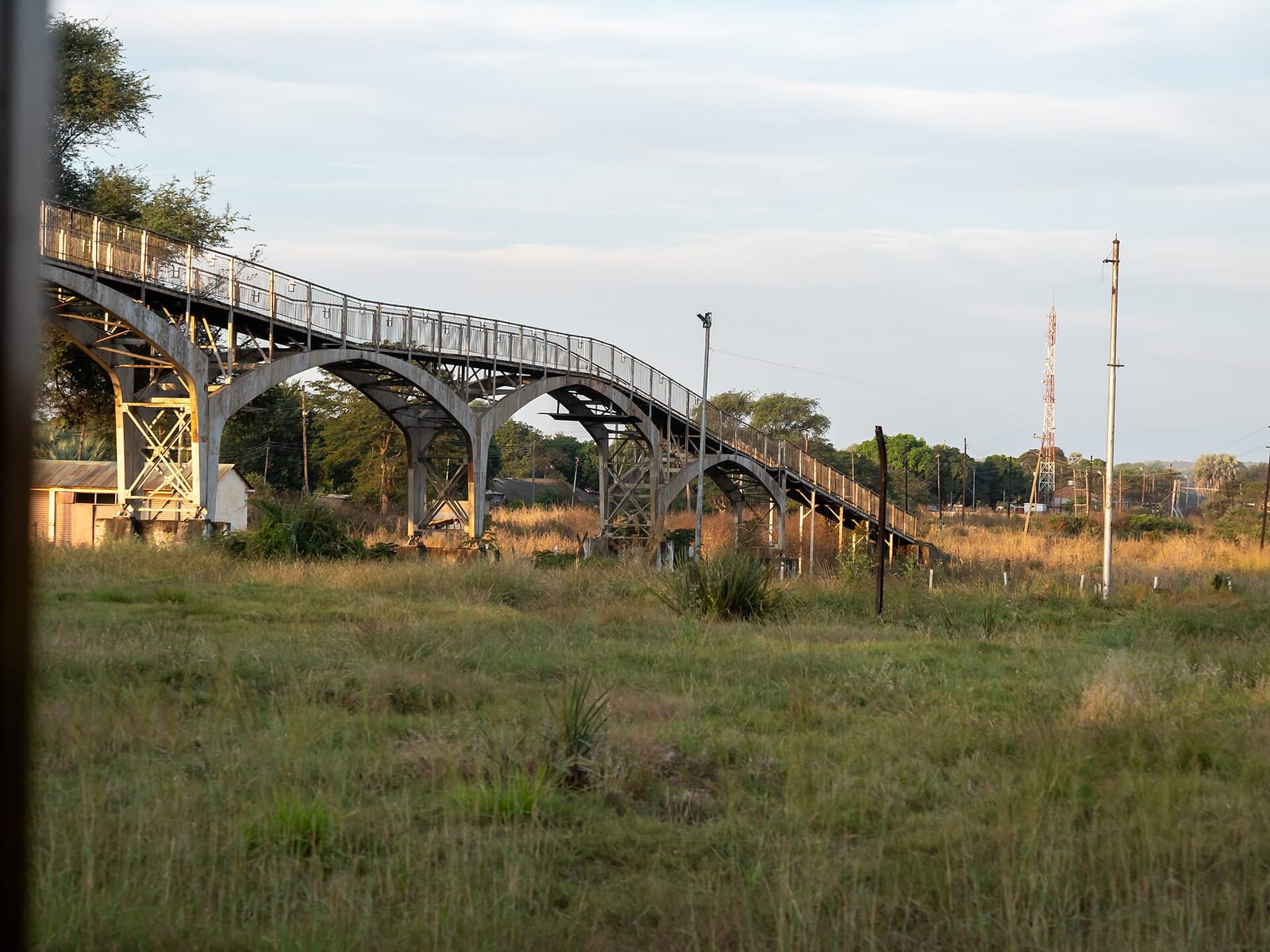
Matti Blume / Wikimedia Commons · CC BY-SAA locomotive that used to haul timber
Number 156 was built by the North British Locomotive Company in 1922 — not for a railway company but for Zambezi Sawmills, hauling logs. It was rescued and restored by the wildlife artist David Shepherd, and alternates with a 12th Class of 1924. Both are genuinely in steam.Matti Blume / Wikimedia Commons · CC BY-SAThe dining car that went to Wembley
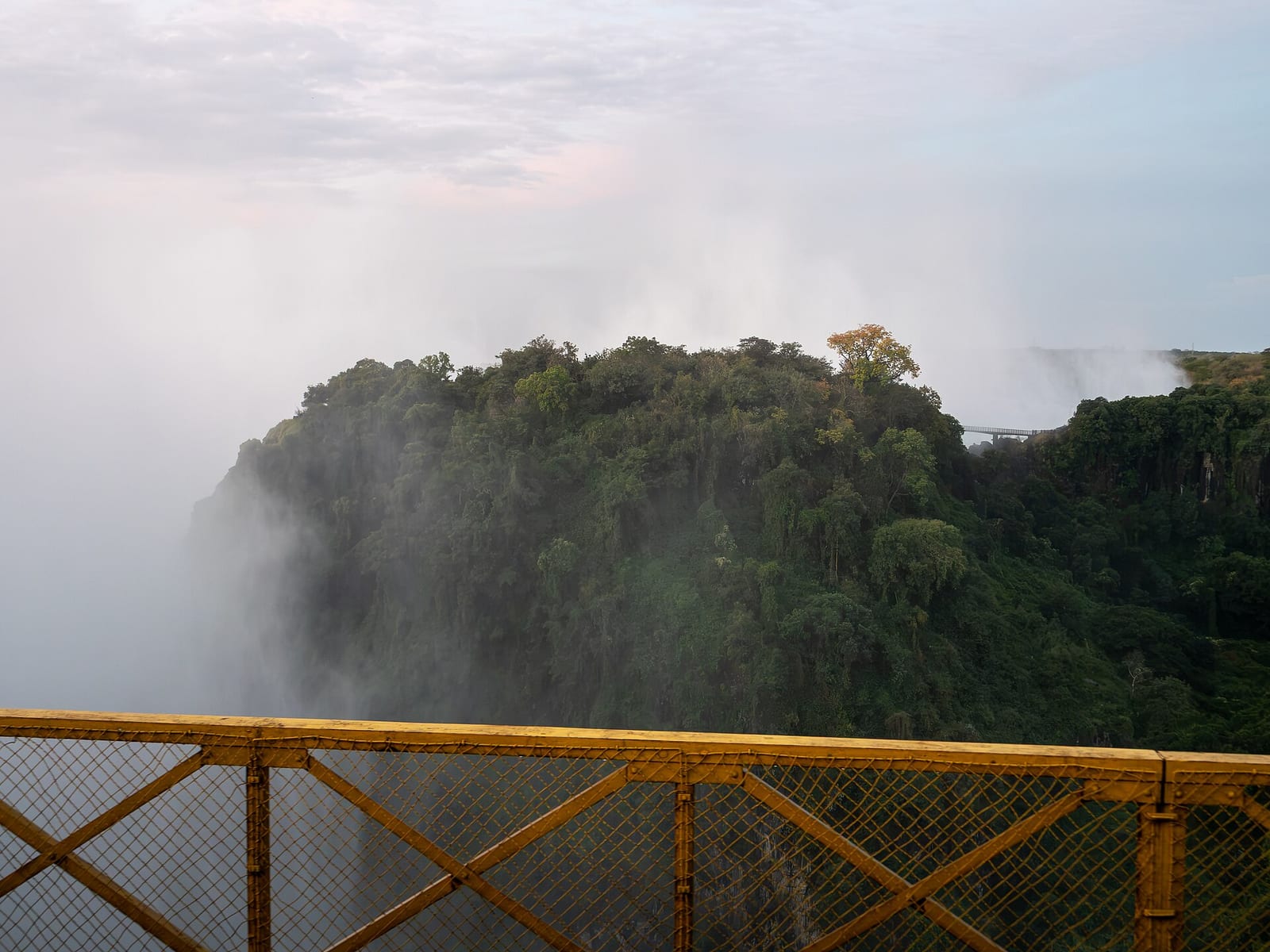
The restaurant car is called Wembley, and the name is literal: built in Birmingham in 1923, it was exhibited at the British Empire Exhibition at Wembley in 1924–25, then shipped to South Africa and put into service in 1926.Wikimedia Commons · Public domainDinner in no-man's-land
The Victoria Falls Bridge was prefabricated in Darlington, shipped to Beira and railed up, and opened in September 1905. Its stress calculations were done by Ralph Freeman, later principal designer of the Sydney Harbour Bridge. It also spans a border, with a post at either end.A bit of history
Culture & experiences along the way
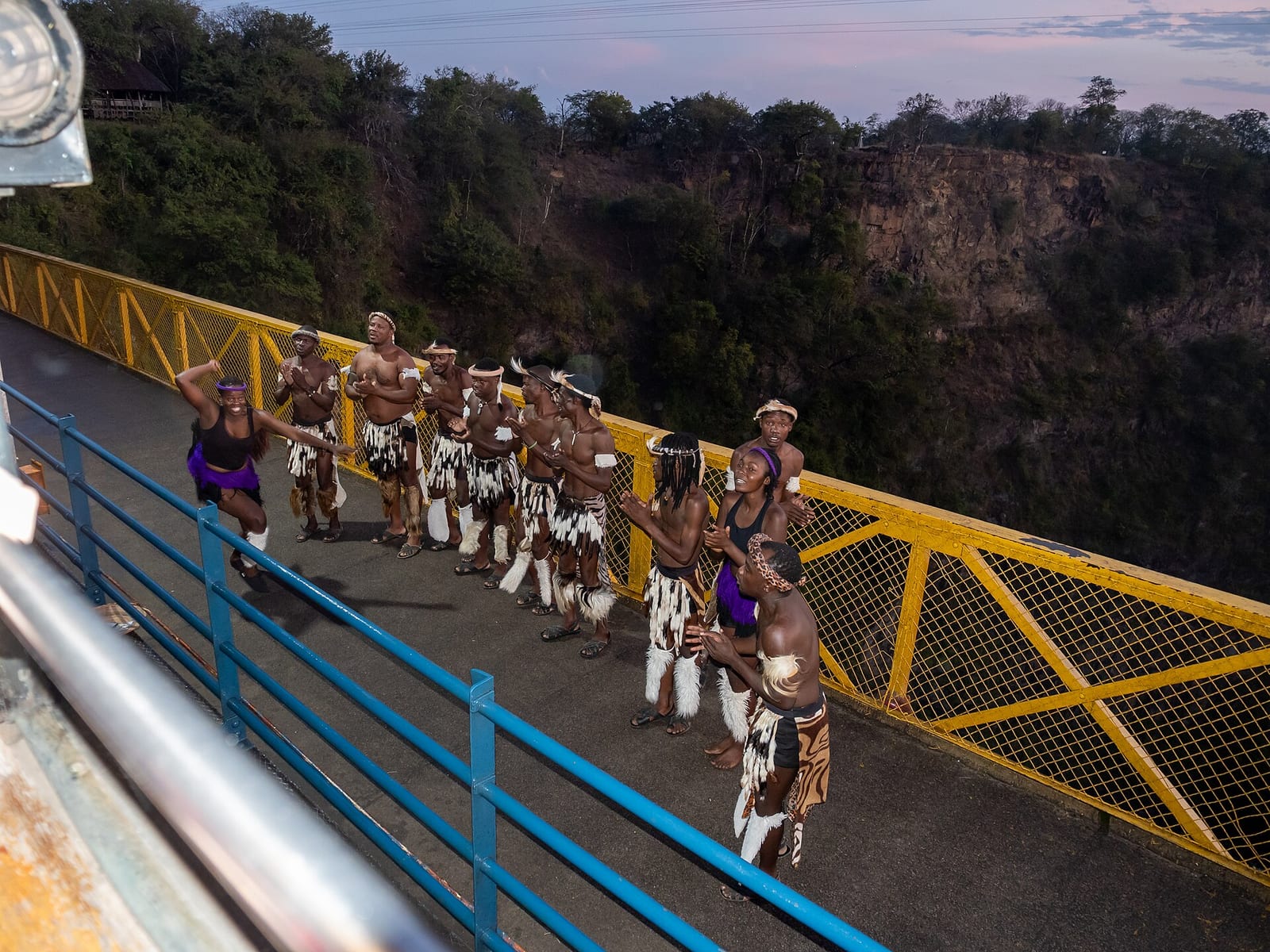
Matti Blume / Wikimedia Commons · CC BY-SAStand on the bridge at sunset
The whole point of the timing. The train departs in the late afternoon, works out along the old line, and stops on the bridge with the sun going down over the gorge and the spray of the falls drifting across. You get out and stand on the deck. Below is the Zambezi, and around you is the only place in the world where dinner is served between two countries.Matti Blume / Wikimedia Commons · CC BY-SAFive courses, and dress for it
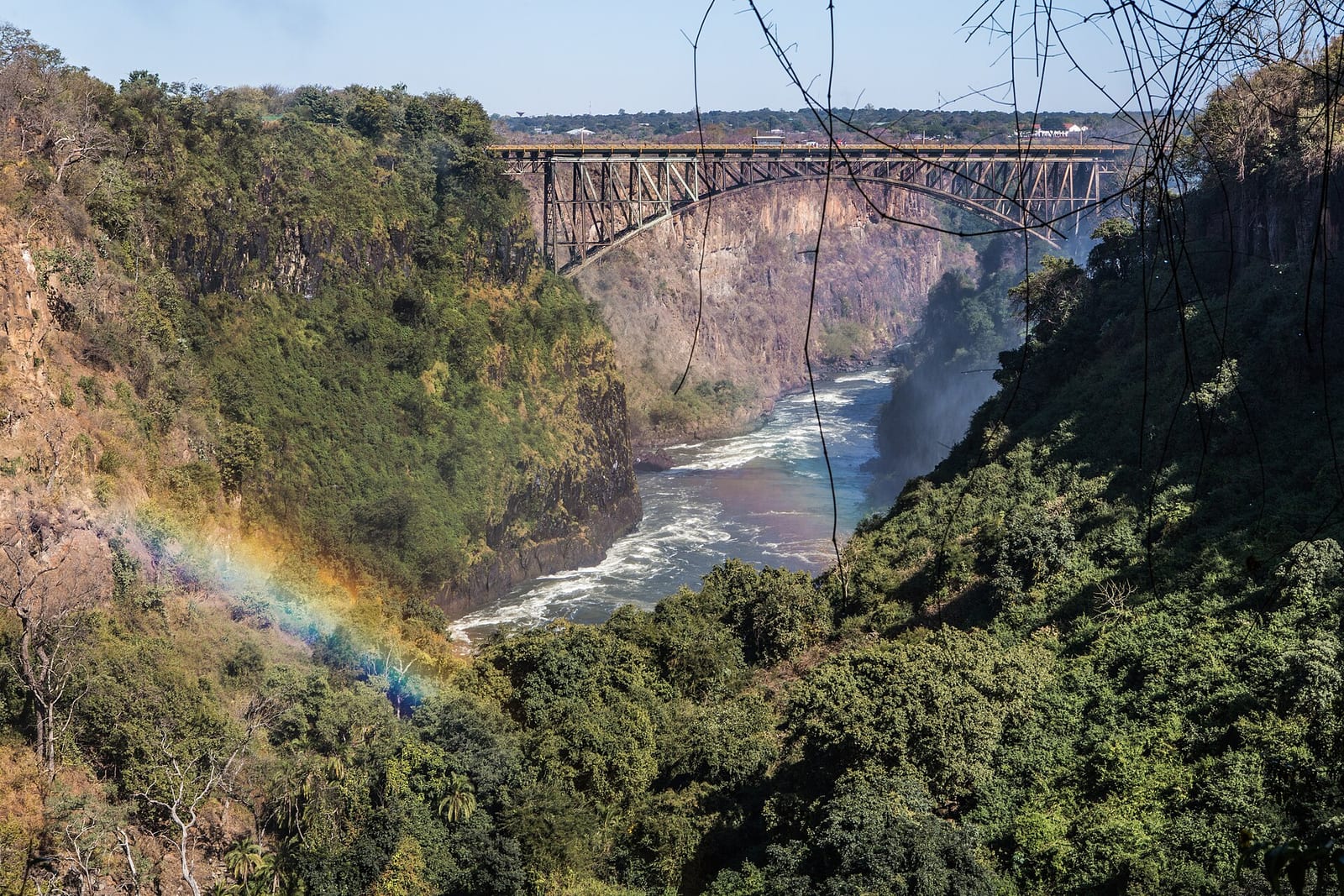
Dinner is five courses with selected drinks, served in the 1920s carriages under panelling and brass, and the whole thing runs about four hours door to door including transfers. The dress code is smart casual and it is meant. Minimum age 12. It is not cheap — from around US$215 a head — and it is, by some distance, the most comfortable railway experience in central Africa.Diego Delso, delso.photo, License CC BY-SA · Wikimedia CommonsSee the falls properly first
The train gives you the bridge and the gorge, not the falls themselves. Go to Mosi-oa-Tunya — "the smoke that thunders" — in daylight beforehand: the Knife Edge Bridge on the Zambian side puts you directly opposite the Eastern Cataract, and in February to May, when the Zambezi is in flood, you will be soaked. Then dry off and get on the train.Timetables
This is a booked excursion rather than a scheduled service, so the "timetable" is a pattern of operating days and one departure time that changes with the season.
The service
| Low season | Wednesdays and Saturdays |
| High season | Wednesdays, Saturdays and Mondays |
| Departs April–October | 15:45 |
| Departs October–March | 16:30 |
| Duration | About 4 hours, including transfers |
| From | Livingstone station, Zambia |
| To | The Victoria Falls Bridge, and back |
| Capacity | Up to 92 |
| Minimum age | 12 |
| Operator | Bushtracks Africa |
The departure time moves because the whole trip is built around being on the bridge at sunset. Transfers from hotels in Livingstone and on the Zimbabwean side of the falls are included in the fare.
What it costs
Reported from about US$215 per person, including the journey, dinner, selected drinks and return transfers. That is a reseller's figure — confirm the current price when you book.
Motive power — worth asking about
The train is normally hauled by one of two genuine steam locomotives:
- No. 156, a 10th Class built by the North British Locomotive Company in 1922 for Zambezi Sawmills, restored by David Shepherd and rebuilt in 2005.
- No. 204, a 12th Class of 1924, refurbished in 2008.
They alternate. However, the operator also runs a diesel locomotive — the "Funkey Monkey" — specifically to reduce wear on the steam engines. If steam haulage is the reason you are booking, ask which locomotive is rostered for your date.
Documents
You need your passport. The Victoria Falls Bridge spans the Zambia–Zimbabwe border and lies between the two border posts, so identification is required to go out onto it. This applies even though you are not entering Zimbabwe.
If you are staying on the Zimbabwean side and crossing for the train, check your Zambian visa position — the KAZA UNIVISA covers both countries for many nationalities, but confirm current eligibility.
When to come
- February to May — the Zambezi is in flood and the falls are at their most spectacular, but the spray is so heavy that views can be completely obscured and you will get wet.
- June to September — dry season, clear light, easier viewing, and the most comfortable weather.
- October to January — the falls are at their lowest, with parts of the Zambian side reduced to bare rock, but the gorge is more visible and it is much quieter.
The train runs all year.
Booking
Direct with Bushtracks Africa, or through the Anantara Royal Livingstone hotel, which gives the train its name and sells the excursion as one of its offers. Most Livingstone and Victoria Falls hotels will also arrange it.
Book ahead — there are only two or three departures a week, and it is a well-known fixture.
Operator: Bushtracks Africa — bushtracksafrica.com (opens in a new tab). Position as of July 2026.
Tickets
Book ahead. There are only two or three departures a week and this is one of the best-known things to do at Victoria Falls. It is sold directly by Bushtracks Africa, who own the train and the locomotives, through the Anantara Royal Livingstone hotel it is named after, and through most tour desks in Livingstone and Victoria Falls — the same trip at different prices, so compare. Reported from about US$215 a person, covering the return run to the bridge, the stop on it, five courses, selected drinks and hotel transfers.
Two things to confirm when booking. Is it steam? Normally yes, but Bushtracks also runs a diesel to spare the historic engines. What time? The departure moves with the season, because the trip is timed for sunset. Bring your passport — the bridge lies between the two border posts. Smart casual is enforced, and the minimum age is 12.
Book your tickets
Steam train dinner
Livingstone to the bridge and back
The full experience — about four hours, five courses, selected drinks and return transfers from Livingstone and Victoria Falls hotels, with the stop on the bridge. Wednesdays and Saturdays, plus Mondays in high season. Smart casual, over-12s only, and bring your passport for the bridge.
Book Tickets (opens in a new tab, on Bushtracks Africa)via Bushtracks AfricaThrough the Anantara Royal Livingstone
Booked with the hotel
The train takes its name from the Anantara Royal Livingstone hotel on the riverbank above the falls, and the excursion is sold as one of its offers. Convenient if you are staying there, and the transfers are included either way — but compare, since the operator sells it directly too.
Book Tickets (opens in a new tab, on Anantara Royal Livingstone)via Anantara Royal LivingstoneRail Passes
No rail pass covers the Royal Livingstone Express. It is sold as an evening package, dinner, drinks and transfers together. Interrail and Eurail are European schemes, and Zambia is not among the 33 countries in Interrail's list of covered railway companies (opens in a new tab).
Checked October 2026 against Interrail's list of covered railway companies (opens in a new tab).
Places to Visit
Livingstone is one of the most concentrated adventure destinations in Africa, and almost everything is within twenty minutes of the town.
Three things worth knowing that did not take a card of their own. The Victoria Falls Bridge does more than carry this train: there are historical guided tours including a walk beneath the main deck, a small free museum at the Zambian end with a café, and the 111-metre bungee jump, a bungee swing and a zip line. Livingstone town itself, named for the man who reached the falls in 1855 and capital of Northern Rhodesia until 1935, keeps a good deal of its colonial main street and holds the Livingstone Museum, the oldest and largest in Zambia, with Livingstone's own letters and possessions. And the Mulobezi Railway — the Zambezi Sawmills line that ran north-west into the teak forests, and for years one of the longest privately owned railways in Africa — is where locomotive 156 came from; it carries no passengers now, but the Livingstone Railway Museum keeps its locomotives and stock.
And at the other end of the country, the TAZARA Railway runs from the Copperbelt all the way to the Indian Ocean.
 Hans Hillewaert / Wikimedia Commons · CC BY-SA 4.0 · cropped
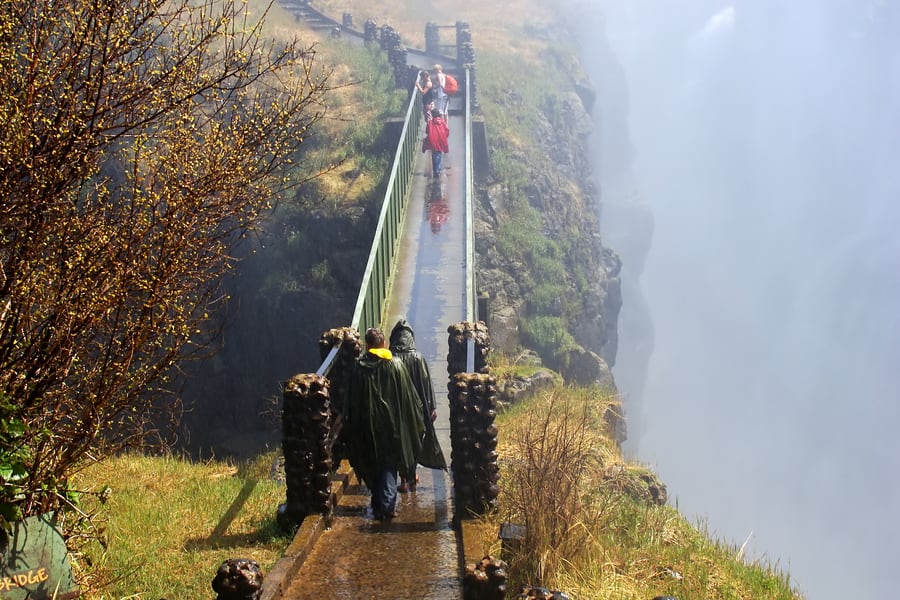
The Knife Edge Bridge
The Zambian side does not give you the panorama — it gives you the noise and the water. The Knife Edge footbridge crosses a chasm directly opposite the Eastern Cataract, and in flood you will be soaked through in seconds, which is the point. February to May is peak flow, spectacular and often lost in its own spray; October to January is low water, when parts of the Zambian face dry to rock — and when Devil's Pool can be swum.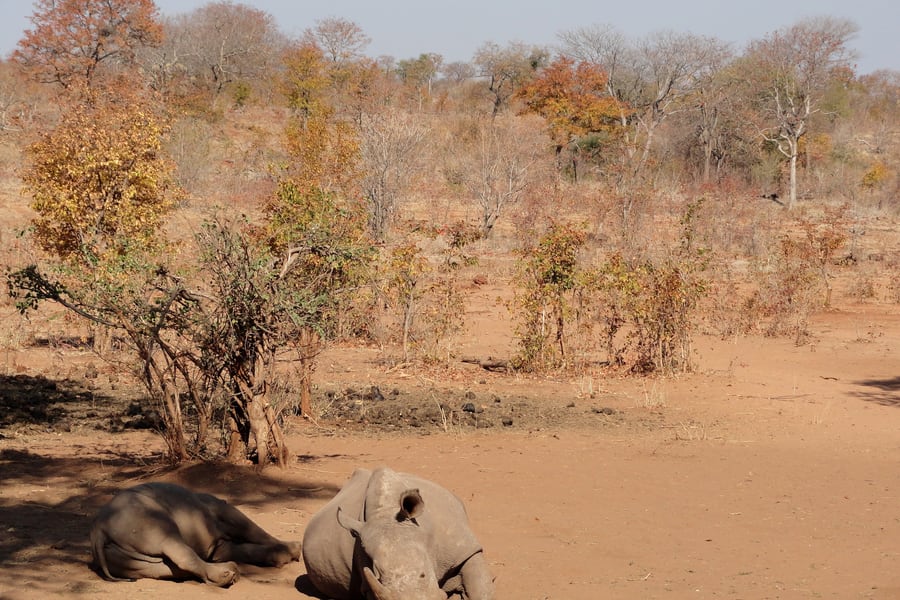 Fabio Achilli / Wikimedia Commons · CC BY 2.0 · cropped
Mosi-oa-Tunya National Park
A small park along the river upstream of the drop, and easily done in a morning. The draw is white rhino, kept under permanent armed guard against poaching, which you track on foot with rangers rather than from a vehicle — a very different thing from a game drive. Giraffe, zebra and buffalo too. It is a modest park by Zambian standards, and it is twenty minutes from the town.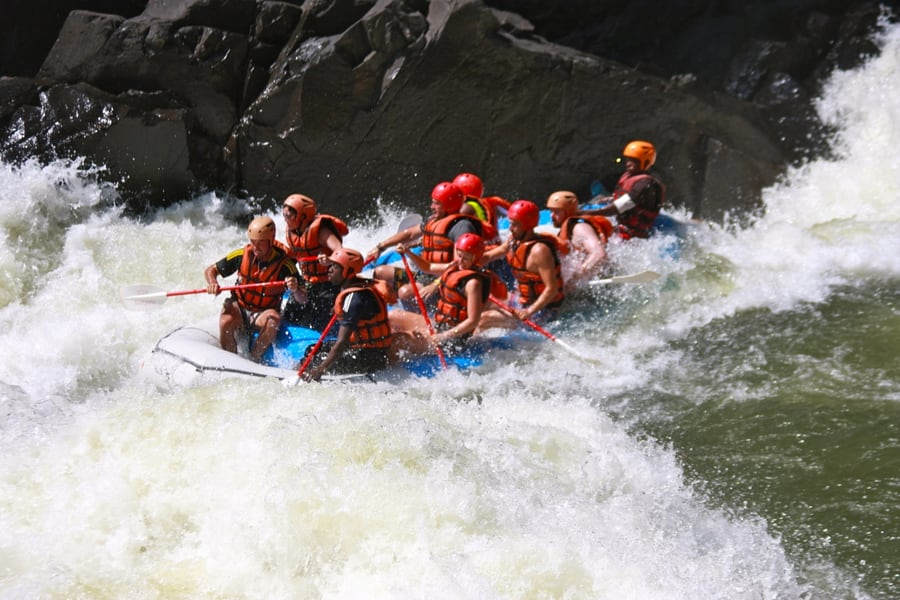 Martijn.Munneke / Wikimedia Commons · CC BY 2.0 · cropped
The Batoka Gorge
Below the falls the Zambezi turns hard through a zigzag of basalt gorges, and the white-water rafting here is among the most serious commercially run anywhere — big-volume grade five, in a canyon you have to climb out of at the end. August to December is the season, when the water is low enough to run it. Not a gentle introduction to rafting; go with one of the established Livingstone operators.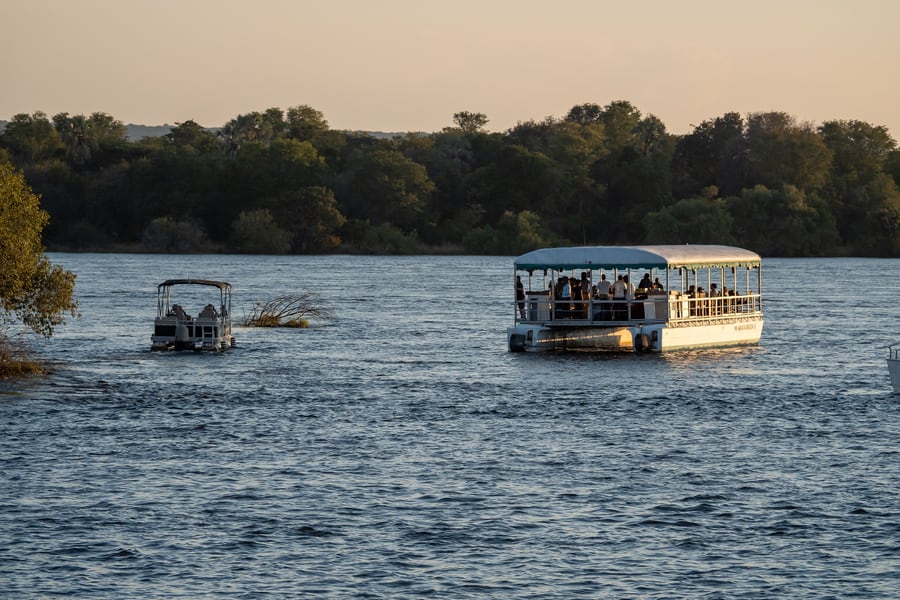 Matti Blume / Wikimedia Commons · CC BY-SA 2.0 · cropped
The upper Zambezi
Above the falls the river is wide, slow and entirely unbothered by what happens to it a few kilometres downstream, and going out on it at the end of the day is the one thing every visitor to Livingstone ends up doing. Hippo and elephant come down to drink on both banks, the light goes copper, and the boats turn for home about the time the falls start throwing their column of spray up behind you.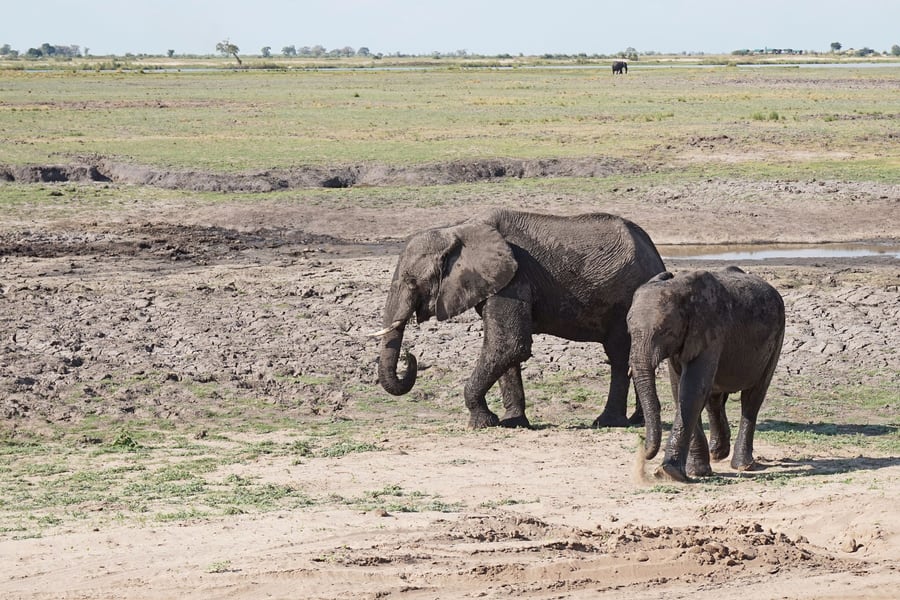 Bernard Gagnon / Wikimedia Commons · CC BY-SA 4.0 · cropped
Chobe National Park
Across the border and worth the early start: 11,700 km² declared a national park in 1968, holding something like 50,000 elephant — the largest herds of any known population anywhere. The Chobe riverfront in the north-east is where they come down to drink in the dry season, in numbers that are genuinely hard to take in. Day trips run from Livingstone; an overnight at Kasane is better.Where to Sleep
Transfers are included from hotels on both sides of the falls, so where you sleep is a question of taste and budget rather than logistics.
The Anantara Royal Livingstone
The hotel the train is named after, and the obvious choice if you want the full colonial-revival experience: a low white building on the bank of the upper Zambezi, a few hundred metres above the lip of the falls, with zebra and giraffe wandering the lawns and a terrace where you watch the spray rise while the sun goes down. Expensive, and it knows it.
You can walk to the falls entrance from the grounds.
The riverside lodges
A string of smaller lodges runs along the Zambezi upstream of Livingstone — Tongabezi, Sindabezi, Thorntree and others — offering river frontage, canoeing and a good deal more quiet than the town. Most are mid to high end and all run transfers.
Livingstone town
Considerably cheaper, and perfectly pleasant: guesthouses, backpackers and mid-range hotels in and around the old colonial centre, ten minutes from the station and twenty from the falls. Jollyboys and its neighbours have made Livingstone a long-standing backpacker hub, and the town has decent restaurants and a museum.
If you are riding the train, this puts you closest to it.
Victoria Falls town, Zimbabwe
The other side of the bridge, and a genuine alternative — the Victoria Falls Hotel, opened in 1904 to serve the railway, is a period piece of the first order, with a terrace framing the bridge itself. Transfers to the train are included from this side too; you will just need your passport twice.
Mosi-oa-Tunya National Park
A handful of lodges sit inside or beside the park along the river, which means game on the doorstep and a short drive to everything.
When to come
- February–May — the falls at maximum flow. Overwhelming, and often invisible behind their own spray.
- June–September — the sweet spot: strong flow, clear views, dry, cool nights. Busiest.
- October–January — hot, low water, thinner falls, but the best rafting and the season for the Devil's Pool. Cheapest.
The train runs all year, so let the water decide.
A practical note
Livingstone has its own airport with regional connections, and Victoria Falls airport is across the border. If you are combining this with the TAZARA at the other end of Zambia, be aware that the two are about a thousand kilometres apart and there is no through railway between them — you will fly or take a long bus via Lusaka.
Questions or corrections
Planning this trip and stuck on something, or spotted a time, fare or detail that has changed? Send us a message about The Royal Livingstone Express. We read every one, and we update this page when something has changed.