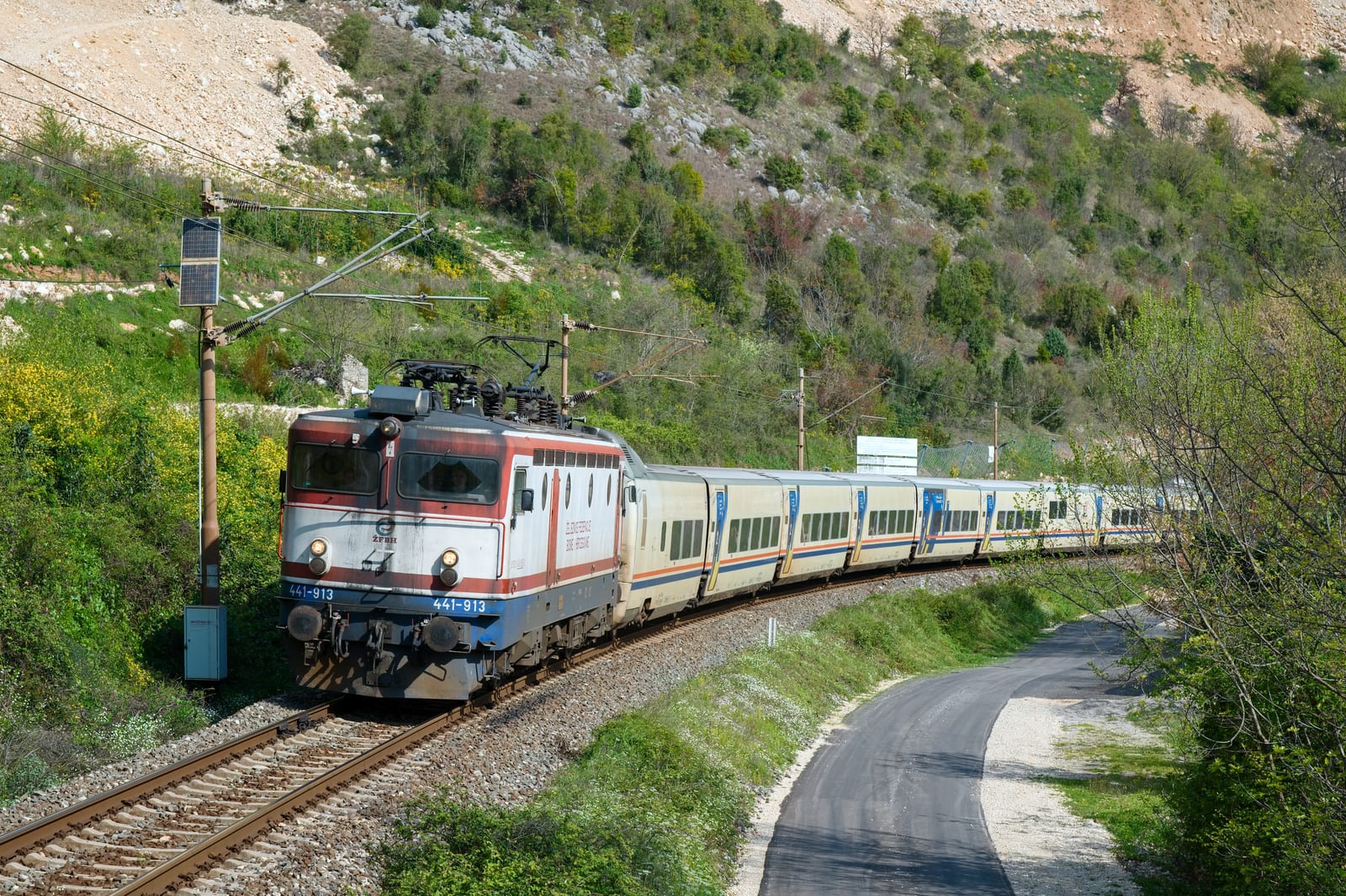
Sarajevo to Mostar — the Neretva Canyon Railway
Petr Štefek / Wikimedia Commons · CC BY-SA 3.0
- DistanceSarajevo–Ploče · 194 km
- DurationSarajevo–Mostar about 2 hours
- Best seasonLate spring to early autumn (green river, the Ploče service runs)
Introduction
There are train journeys you take to get somewhere, and train journeys you take for the sheer beauty of the going. The line from Sarajevo to Mostar is emphatically the second kind — a ride so consistently spectacular that it is regularly called the most beautiful in the Balkans, and it earns the title within the first half hour.
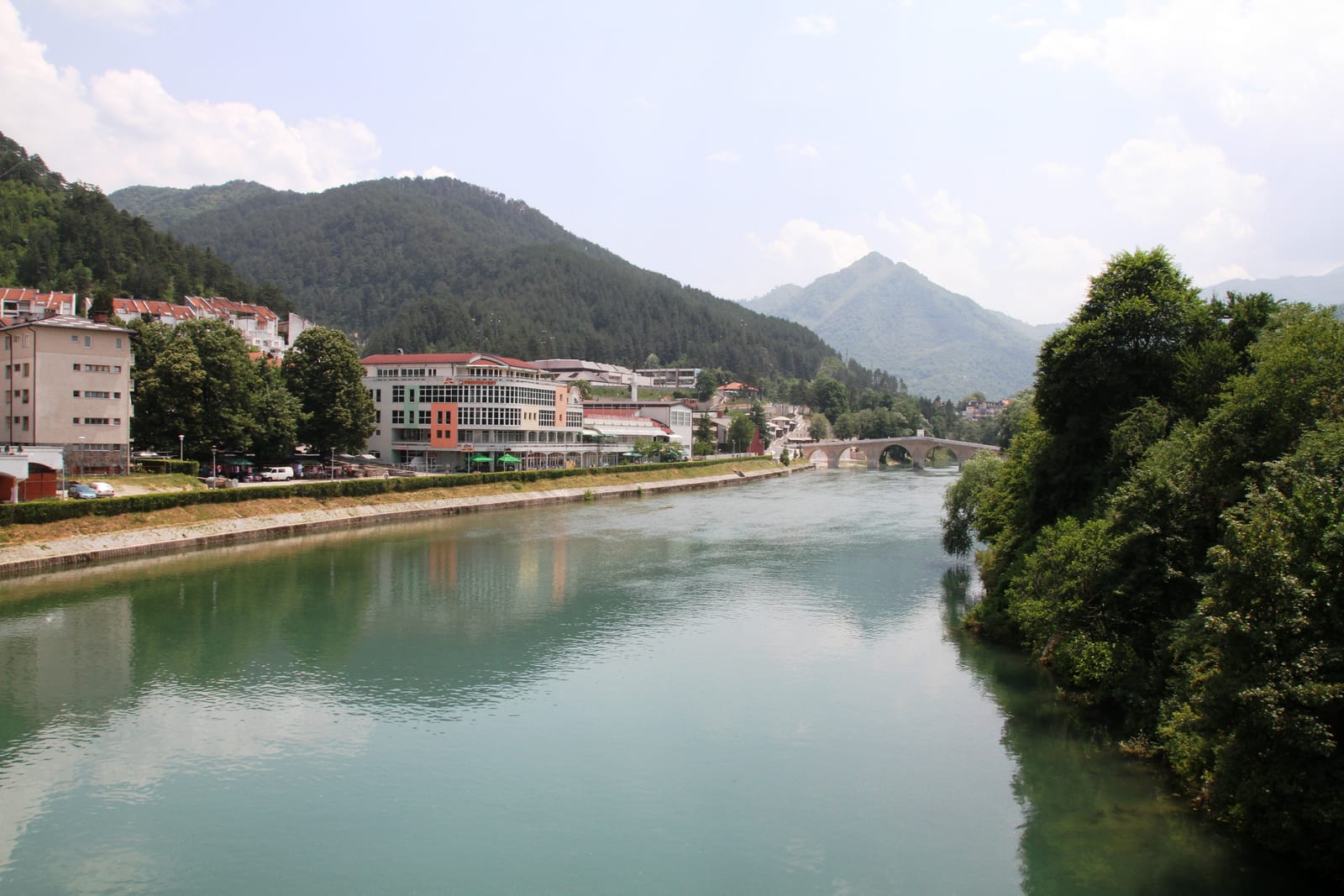
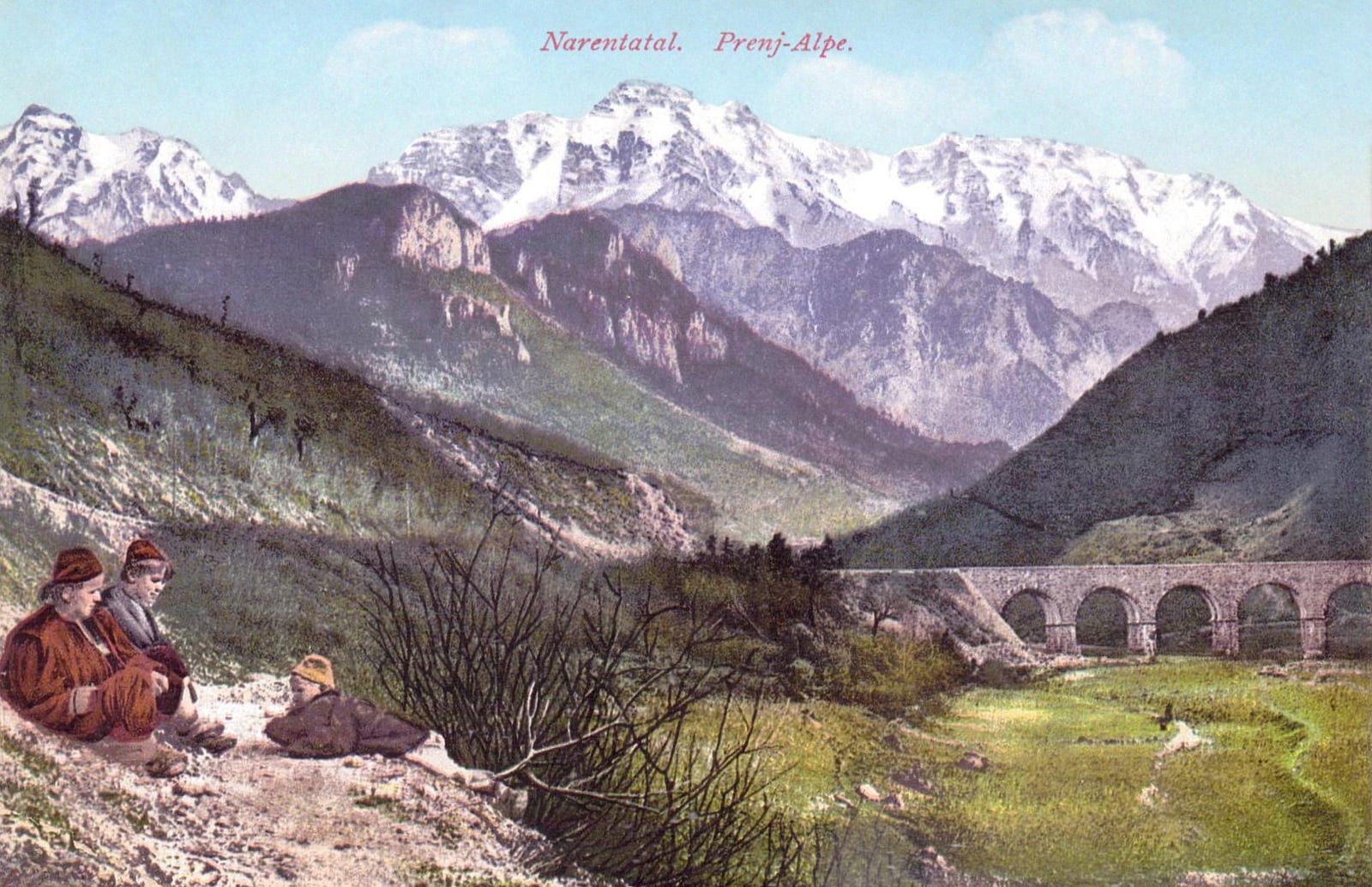
The secret is a river. The whole way south, the railway follows the Neretva, whose water is a startling, luminous green, as it cuts down out of the high Bosnian mountains toward the sea. Below the town of Konjic the valley tightens into a genuine canyon, and the line goes with it — clinging to ledges blasted from the rock, crossing the torrent again and again on high bridges, plunging through tunnel after tunnel after tunnel. There are 106 of them in under 200 kilometres, and in between each one another view opens: the green river far below, the grey walls of the Prenj and Čvrsnica massifs above, a turquoise lake, a minaret in a village clinging to the slope.
Halfway down is the reward that would justify the trip on its own: Mostar, the exquisite Ottoman city on the Neretva, with its famous humpbacked Stari Most bridge. And in summer the train doesn't stop there but carries on across the Croatian border to Ploče on the Adriatic — so you can ride, in a single day, from the mountains to the sea.
Best of all, none of this is a heritage excursion or a luxury cruise-train. It is the ordinary public railway, run with comfortable air-conditioned Talgo trains, and it costs next to nothing. You simply buy a ticket, take a window seat, and watch one of Europe's great river canyons unfold.
The Journey
The train leaves Sarajevo — itself one of the most atmospheric cities in Europe, ringed by green hills — and for the first stretch it climbs gently through a broad upland valley, giving no hint of the drama ahead. Then it tops the watershed at the long Ivan tunnel, over three kilometres of darkness, and everything changes. On the far side the train begins to drop, and it picks up the infant Neretva, and from here to the coast the two never part.
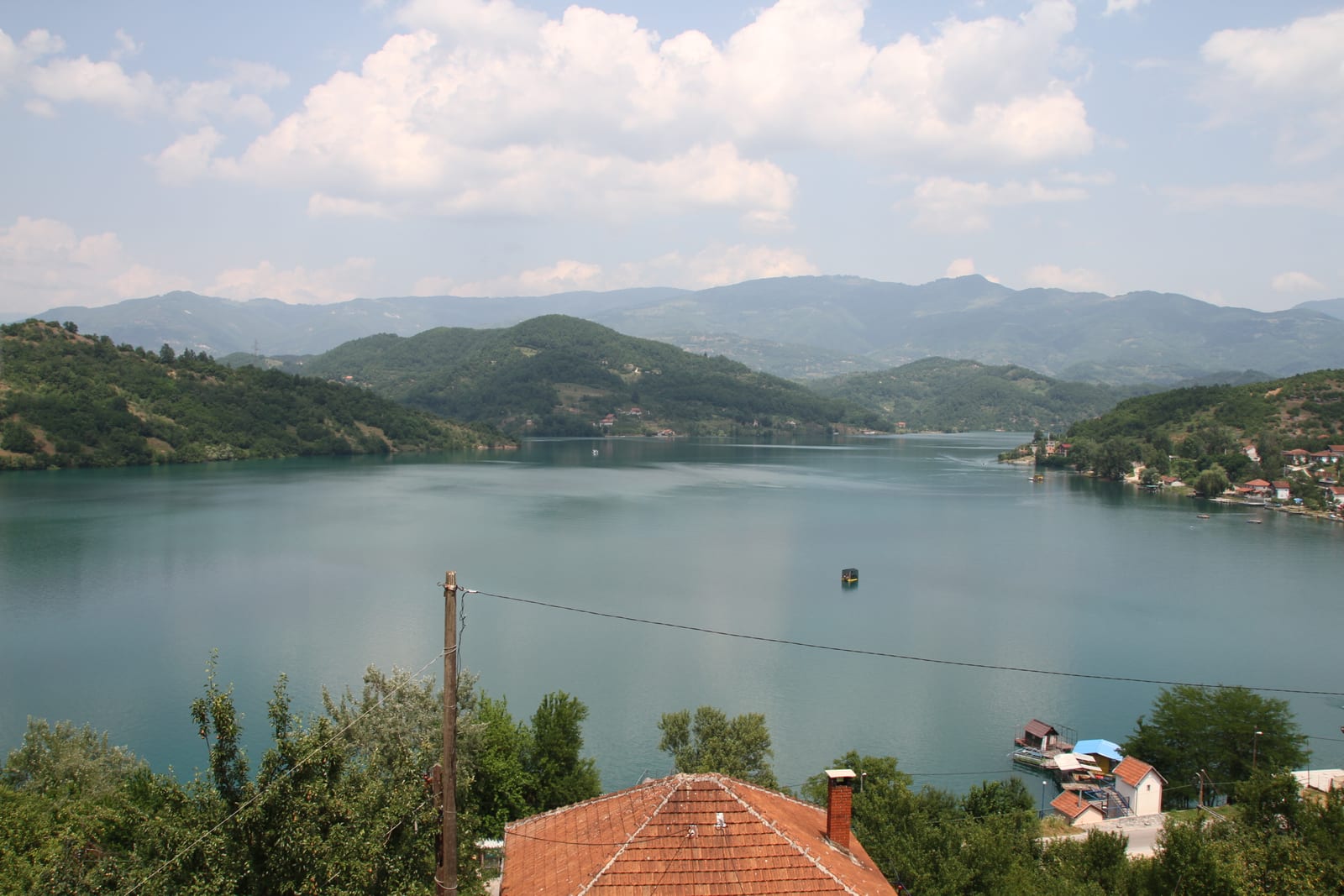
The first town is Konjic, where the river is already the electric green that will astonish you all the way down, spanned by an old Ottoman bridge. Below it the line runs along the shore of Jablaničko lake, a turquoise reservoir held between steep wooded slopes, and reaches Jablanica — a name every Bosnian knows, for the 1943 Battle of the Neretva, when Partisans blew the bridge here to escape encirclement; the wreck still lies in the gorge as a monument.
Then comes the best of it. Below Jablanica the valley closes into the true canyon, and the railway earns its keep: it burrows through tunnel after tunnel, bursts out onto ledges high above the water, crosses the river on bridge after bridge as it hunts for the easiest bank. You lose count of the tunnels. Between them, the view is relentless — the green Neretva threading the gorge, the huge grey ramparts of Prenj and Čvrsnica overhead, occasionally a tiny village or a lone house on an impossible slope. This is the stretch people ride the line for, and it goes on for the best part of an hour.
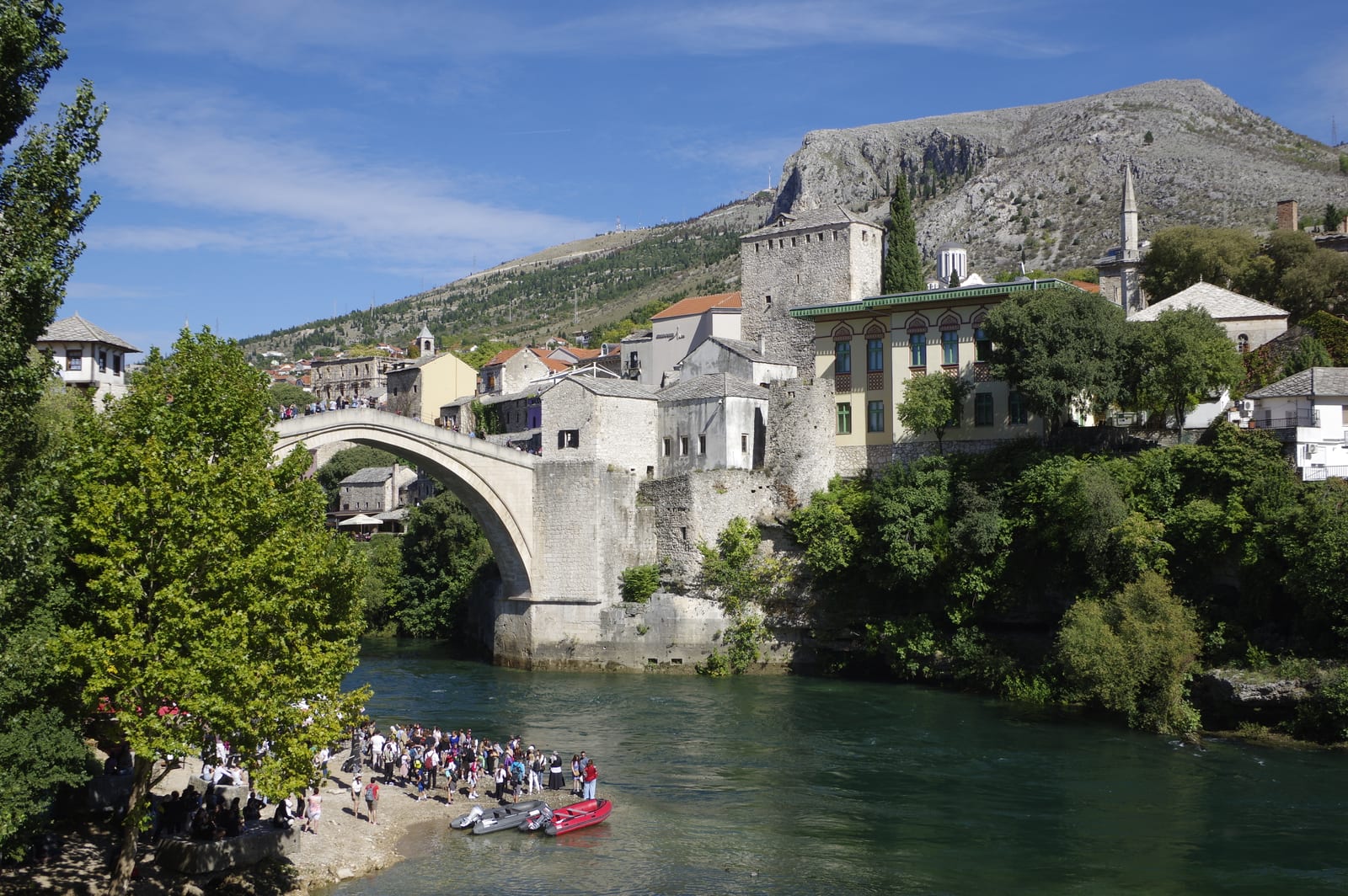
Gradually the mountains draw back and the light changes — warmer, Mediterranean — as you come down into Herzegovina. And then Mostar: the minarets, the terracotta roofs, and somewhere among them the perfect stone arc of the Stari Most, the bridge from which divers still throw themselves into the river. Many travellers get off here, and rightly. But if you stay aboard in the summer season, the train rolls on down the widening valley through Čapljina, over the border into Croatia, and delivers you at Ploče, on the blue Adriatic — a full day's journey from the mountains to the sea, down the length of one unforgettable river.
Along the route
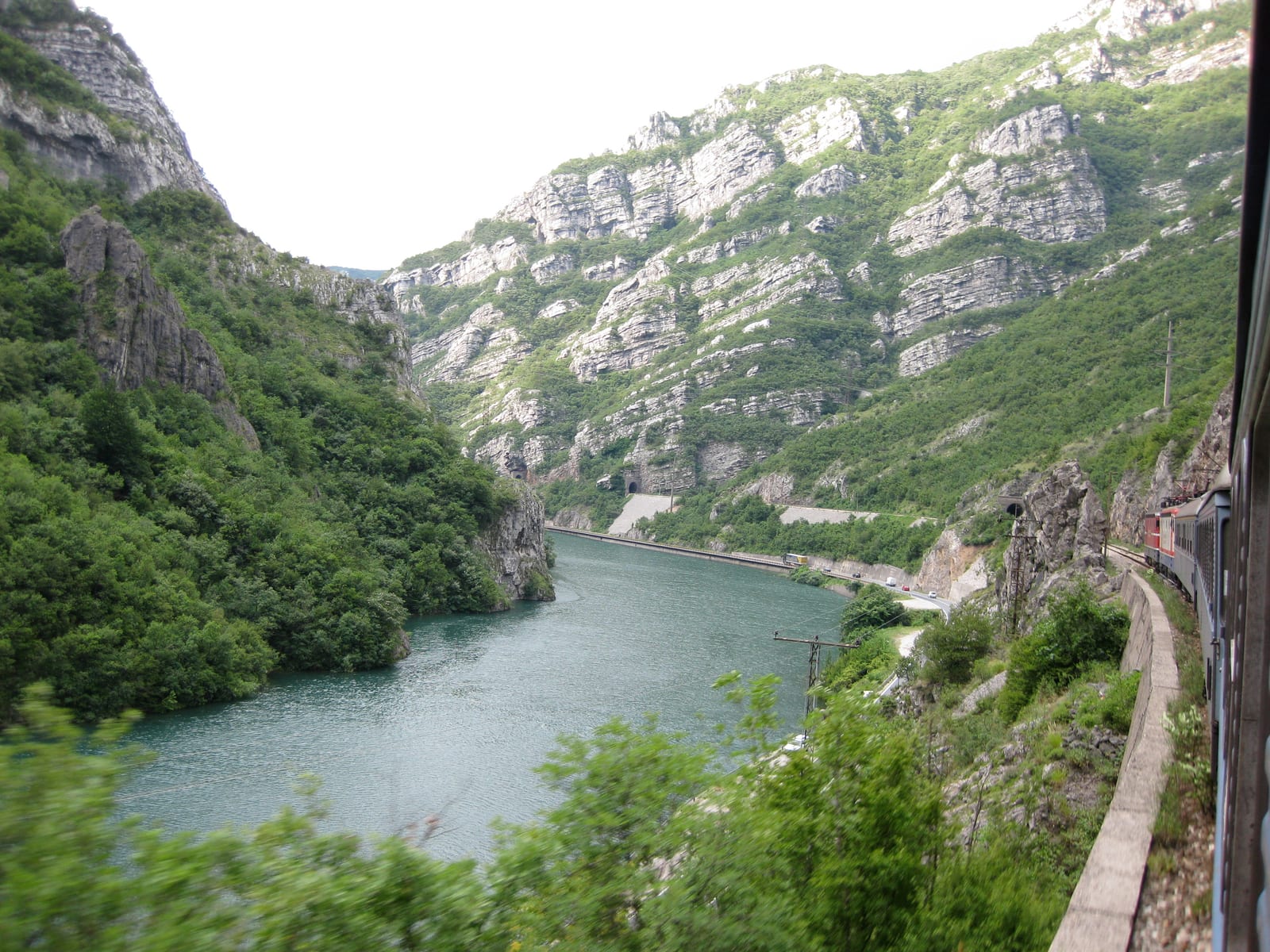
Webmice / Wikimedia Commons · Public domainDown the Neretva canyon
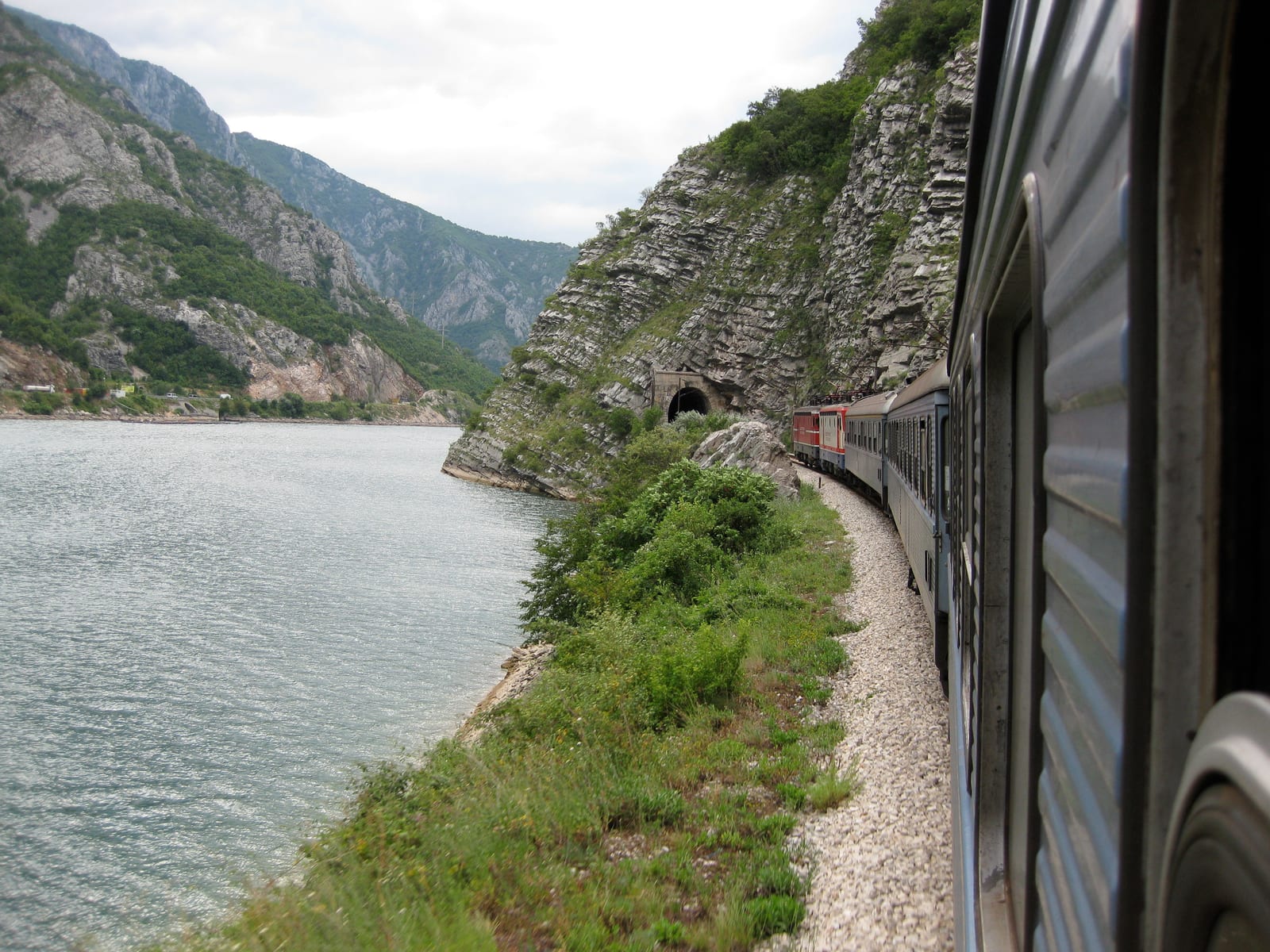
The whole journey follows one river — the Neretva, whose water is an astonishing milky-green — as it carves south out of the mountains. Below Konjic the valley narrows into a true canyon, the railway clinging to ledges between great walls of rock.Webmice / Wikimedia Commons · Public domainA hundred tunnels
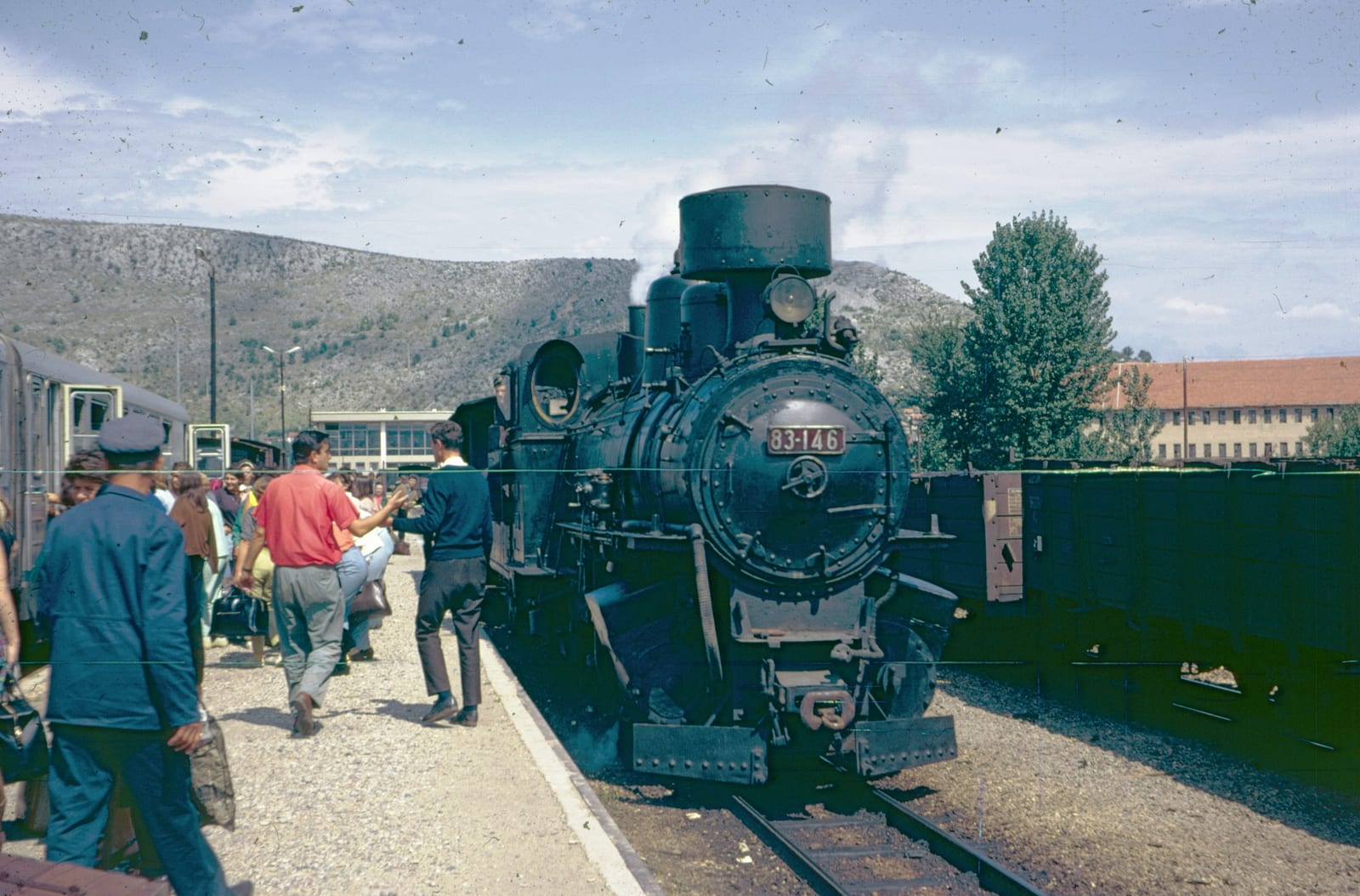
To force a modern railway through this terrain the engineers bored 106 tunnels and threw 71 bridges across the gorge in 194 kilometres. The line you ride, opened in 1966, replaced a slender 760 mm narrow-gauge railway of 1891.Berthold Werner / Wikimedia Commons · CC BY-SA 4.0Mostar and its bridge
Halfway down waits Mostar, the Ottoman city on the Neretva, famous for the Stari Most — the sixteenth-century bridge from which young men still dive into the river. Destroyed in the 1990s war and painstakingly rebuilt.A bit of history
Culture & experiences along the way
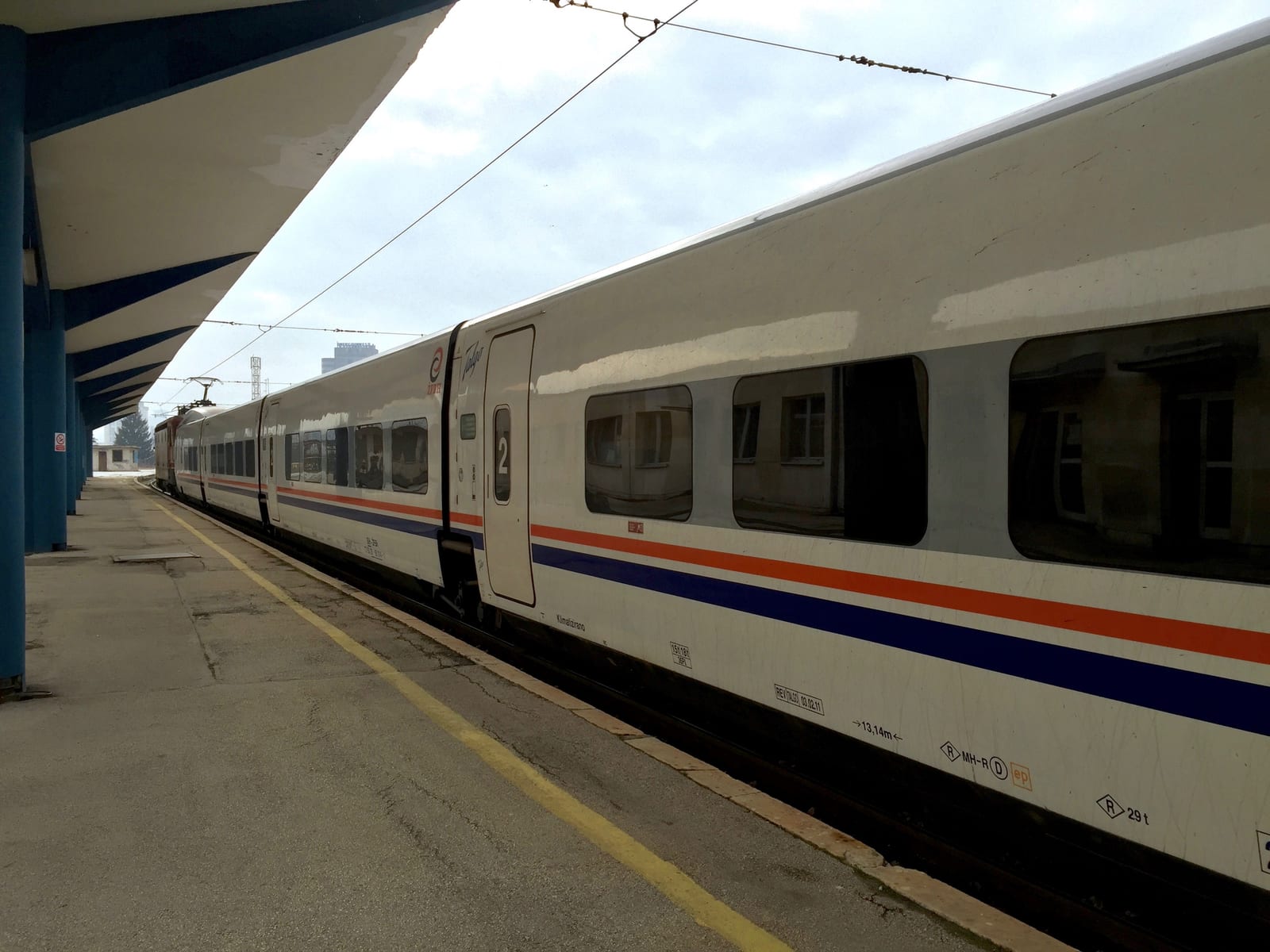
RFMONLINE.DE / Wikimedia Commons · CC BY-SA 4.0Riding the Talgo
The trains are comfortable, air-conditioned Talgo sets — a surprise on a line this remote — with big windows made for the scenery. The river swaps from one side to the other as the line crosses it, so don't fix yourself in one seat; the Jablanica lake shows best on the right going south. Keep your camera ready between Konjic and Jablanica.Bjoertvedt / Wikimedia Commons · CC BY-SA 3.0Break the journey at Jablanica
The little town of Jablanica, on its turquoise lake, is worth a stop: it was the scene of the famous 1943 Battle of the Neretva, and the destroyed bridge and a museum recall it. It is also known, more happily, for the best spit-roast lamb in Bosnia, sold at roadside grills — a fine excuse to pause between trains.Tom Burnham / Wikimedia Commons · CC BY 2.0On to the Adriatic
In the tourist season the train doesn't stop at Mostar but carries on through Čapljina, across the Croatian border, to Ploče on the Adriatic coast — turning the ride into a full mountains-to-sea journey. From Ploče the beaches of the Dalmatian coast, and Dubrovnik, are within easy reach.Timetables
Two kinds of service run down the Neretva: a daily domestic train linking Sarajevo, Mostar and Čapljina, and a seasonal international Talgo that continues across the border to Ploče on the Adriatic (currently on Fridays, Saturdays and Sundays).
International Talgo (Sarajevo ⇄ Ploče), real times as of the 2026 timetable — weekends in season:
| Southbound (1391) | Northbound (1390) | ||
|---|---|---|---|
| Sarajevo | 07:15 | Ploče | 18:26 |
| Mostar | 09:15 | Čapljina | 19:29 |
| Čapljina | 09:52 | Mostar | 19:56 |
| Ploče | 10:36 | Sarajevo | 21:54 |
Sarajevo to Mostar takes about two hours; the full run to Ploče about three and a half.
Good to know:
- A daily domestic train also links Sarajevo–Mostar–Čapljina year-round, in addition to the weekend Ploče service. Its exact times change with the timetable — confirm current departures with ŽFBH (linked below) before you plan.
- The Ploče train is seasonal. The cross-border service runs on set days over the tourist season (broadly late spring to early autumn); outside those dates you can still ride Sarajevo–Mostar–Čapljina and continue by other means.
- Which side to sit. The river crosses from side to side, so no seat wins throughout — but the Jablanica lake shows best on the right going south (left coming north). Move around; the whole train has views.
- It's cheap and rarely full, but the Talgo has limited seats — for the popular weekend Ploče service in high summer, buy ahead where you can.
Times as of the 2026 timetable and subject to change, and the international service is seasonal. Confirm current schedules and running days with the operator before you travel (see the Tickets section below).
Tickets
The line is run by ŽFBH — Railways of the Federation of Bosnia and Herzegovina — with Croatian Railways (HŽ) handling the short final stretch to Ploče. The trains are Spanish-built Talgo sets, comfortable and air-conditioned.
Fares are very low by European standards — the Sarajevo–Mostar ride costs only a few euros — and the trains are rarely crowded, so booking far ahead is seldom essential. Tickets for the domestic service are bought at ŽFBH station counters (card acceptance can be patchy, so carry some local convertible marks). For the international Ploče train, passengers from Bosnia buy at the station, while those boarding on the Croatian side can pay the conductor on board.
The one thing to check before you travel is the running days: the domestic Sarajevo–Mostar–Čapljina train runs daily, but the cross-border extension to Ploče is seasonal and runs only on certain days. Confirm the current timetable with the operator below, and note that schedules here change more often than in Western Europe.
Book your tickets
Sarajevo → Mostar → Ploče
The Neretva canyon train
The scenic run down the Neretva from Sarajevo to Mostar and Čapljina, extended to Ploče on the Adriatic in the tourist season. Comfortable Talgo trains, run by ŽFBH. Inexpensive; buy at the station, or on board for the international service.
Book Tickets (opens in a new tab, on ŽFBH (Railways of the Federation of BiH))via ŽFBH (Railways of the Federation of BiH)Timetable & booking · ŽFBH
Departures and the Ploče season
Live schedules and fares from Railways of the Federation of Bosnia and Herzegovina. A daily domestic service links Sarajevo, Mostar and Čapljina; the cross-border Ploče train runs on set days in the summer season, so check both before you travel.
Book Tickets (opens in a new tab, on ŽFBH (Railways of the Federation of BiH))via ŽFBH (Railways of the Federation of BiH)Rail Passes
This is the one Bosnian journey where a rail pass makes real sense, because it is the country's flagship line and it is explicitly inside the network.
Which pass
There is no One Country Pass for Bosnia and Herzegovina. Interrail states plainly that one "is not available", so the only pass that covers this country is the Interrail Global Pass (Eurail Global Pass, if you live outside Europe). That is not the drawback it sounds like: almost nobody comes to Bosnia by rail without also crossing Croatia, Serbia or Montenegro, and a Global Pass covers those too.
The operator here is ŽFBH, and the Doboj–Sarajevo–Mostar–Čapljina–Ploče main line — this journey — is named as covered.
No reservations, at all
Unusually for a scenic route, Bosnian trains carry no seat reservations. In Interrail's own words: "You can board all trains and find your preferred seat." Nothing to book, nothing to pay on top, no reservation fee eating into the value of the pass. Turn up, get on, sit where you like.
That is worth knowing in contrast with the rest of the region — a Global Pass on French or Italian high-speed trains means compulsory paid reservations, and here it means none.
The paper-pass trap
⚠️ One real catch, and it does not apply to this journey but will if you continue north. On ŽRS trains — the Republika Srpska operator, which runs Doboj–Banja Luka–Novi Grad and Doboj–Petrovo Novo — only a paper Interrail pass is accepted. A mobile pass on your phone is not, at the time of writing. ŽFBH services like this one are unaffected, but if your itinerary crosses into the ŽRS network, that distinction decides whether you can travel at all.
Is it worth it?
For this line alone, no. Bosnian domestic fares are low enough that a pass will not pay for itself on a single Sarajevo–Mostar run. A Global Pass earns its keep when this journey is one leg of a wider Balkans trip — which, given where the line ends, is exactly how most people ride it.
Pass conditions checked against Interrail's Bosnia-Herzegovina page, August 2026.
Places to Visit
This one line strings together the best of Bosnia and Herzegovina, from a mountain capital to the sea. Sarajevo at the top is one of Europe's most rewarding cities — where East and West meet in a single street, the Ottoman bazaar giving way to Habsburg boulevards — and it deserves a couple of days before you take the train south.
On the descent, Konjic and Jablanica both reward a stop: Konjic for its old Ottoman bridge and the surreal Cold-War nuclear bunker (Tito's Bunker, ARK) hidden in the hillside, Jablanica for the Battle of the Neretva museum and its famous roadside lamb. Mostar is the star, and the Stari Most the great prize — cross it, watch the divers, then climb a minaret for the classic view of the bridge against the green river.
And at the end of the line, Ploče opens onto the Dalmatian coast — the Pelješac peninsula, the Neretva delta, and the road south to Dubrovnik. Few railways deliver you from a mountain city to the Adriatic through such continuous beauty.
 Natalie Wilson / Wikimedia Commons · CC BY 2.0 · cropped
Baščaršija
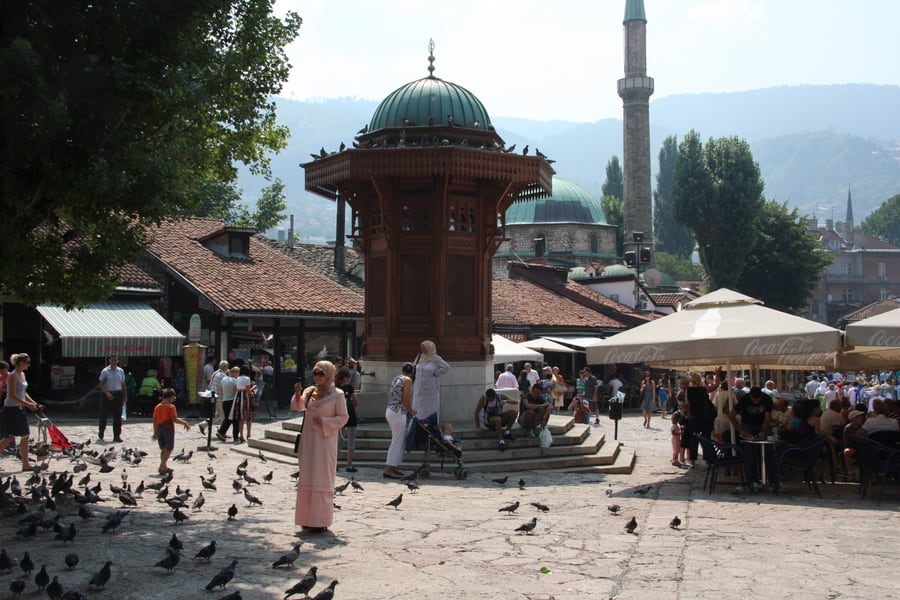
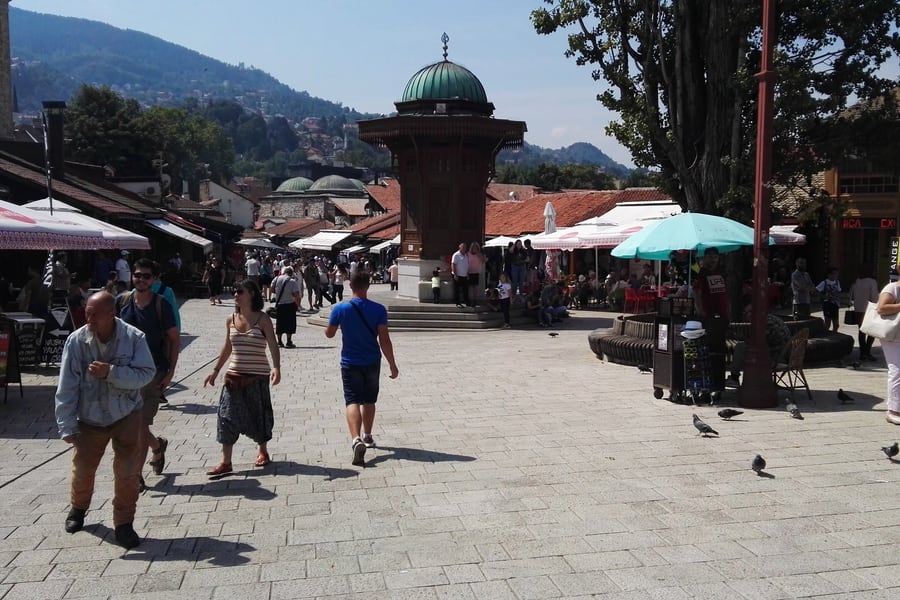
The city began here: Isa-beg Ishaković built his han in 1462, and by the 16th century Baščaršija held something like 12,000 shops and craft workshops, with Venetian and Ragusan trading colonies among them. It is still coppersmiths, cafés and grilled ćevapi. At its heart stands the Sebilj, a wooden Ottoman fountain of 1753 rebuilt by Alexander Wittek in 1891 — drink from it, they say, and you will come back to Sarajevo.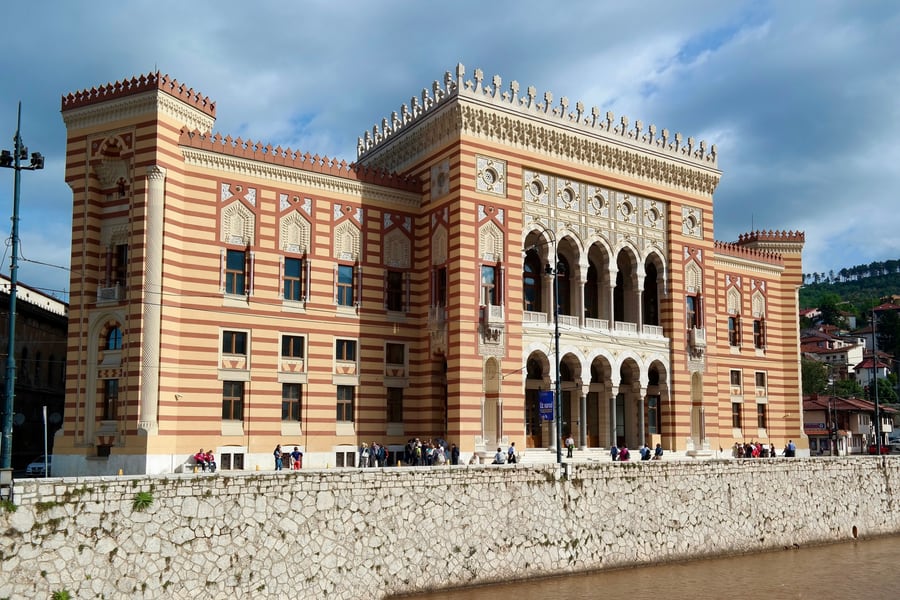 Choinowski / Wikimedia Commons · CC BY-SA 4.0 · cropped
The Vijećnica
The most extravagant thing the Habsburgs built in Bosnia — striped Moorish Revival on the bank of the Miljacka, begun 1892, finished 1894 for 984,000 crowns and opened on 20 April 1896. It became the National and University Library in 1949, and on 25 August 1992 shelling burned it and about 1.5 million volumes with it. Restored over two decades, it reopened on 17 July 2014.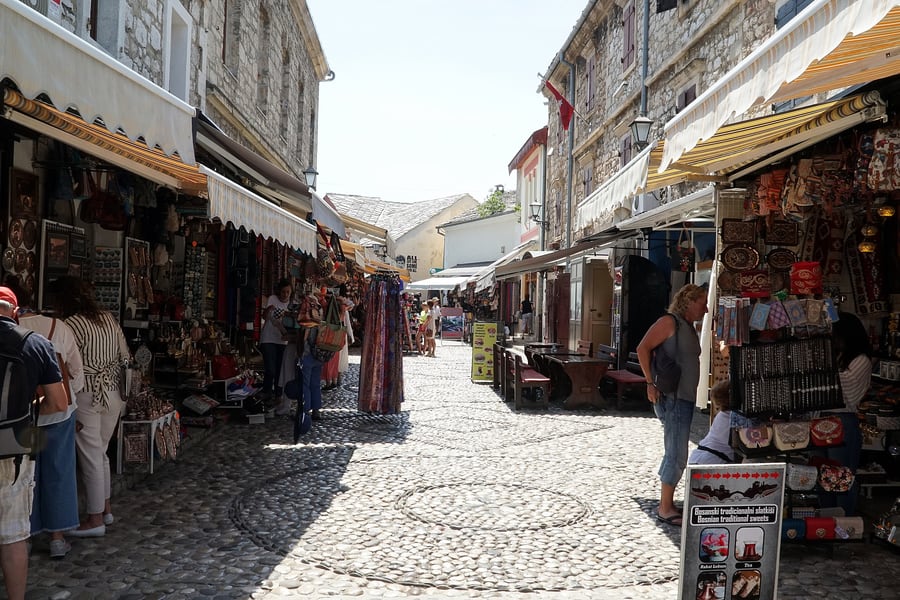 Adam Harangozó / Wikimedia Commons · CC BY-SA 4.0 · cropped
Kujundžiluk
The coppersmiths' street — kujundžija means metalworker — running in worn cobbles down to the Stari Most between stalls of hammered trays, lamps and jewellery. It is the oldest working part of Mostar's old town and the approach everybody remembers, because the bridge only reveals itself at the last moment. Come early or late: by mid-morning in summer the lane is shoulder to shoulder.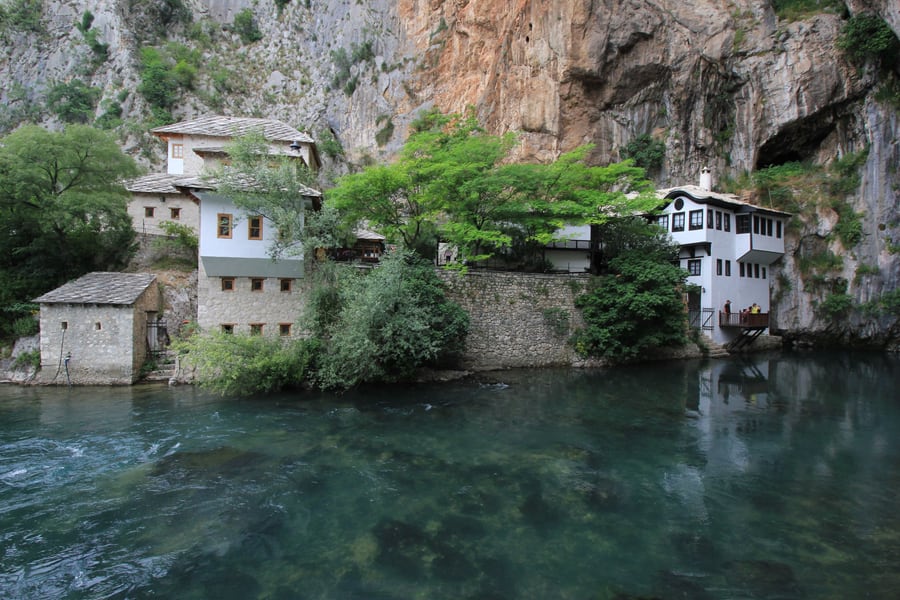 Julian Nyča / Wikimedia Commons · CC BY-SA 3.0 · cropped
Blagaj
A white dervish house set at the foot of a sheer cliff, with the Buna bursting out of a cavern behind it — one of the largest karst springs in Europe. The tekija belongs to the Ottoman Mediterranean tradition and the ensemble dates back to about 1520; the guest house and the türbe are built so tightly into the rock that they read as part of it. Old mills still stand along the water. Southeast of Mostar, an easy trip.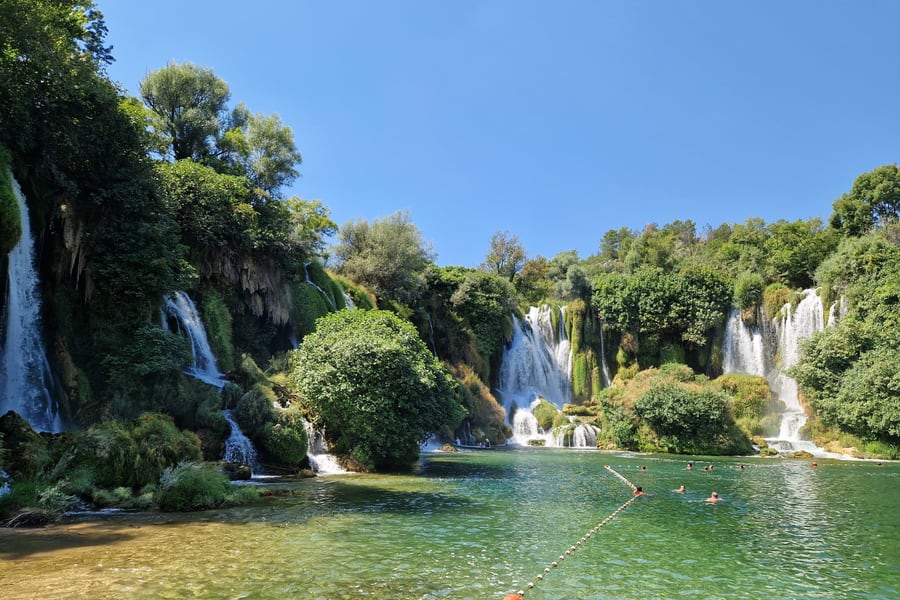 Rkoster / Wikimedia Commons · CC BY 4.0 · cropped
Kravice
A tufa amphitheatre on the Trebižat where the whole river comes over at once — about 25 metres high into a pool with a radius of some 120 metres. People swim in it, picnic beside it and jump off the rocks; it is the best hot-afternoon stop in Herzegovina. Go in spring, when the falls are at full volume and the burnt karst around them has briefly turned green.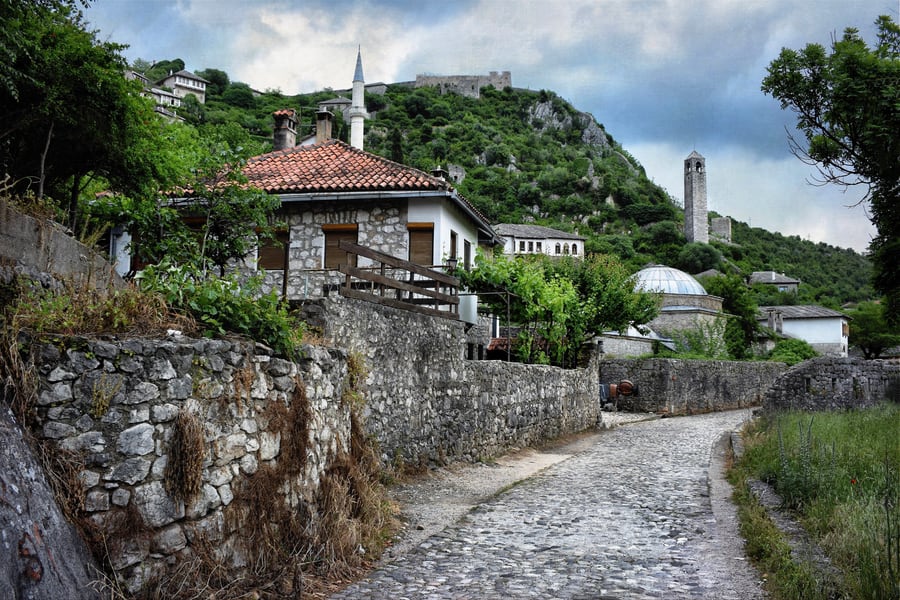 Jocelyn Erskine-Kellie / Wikimedia Commons · CC BY-SA 2.0 · cropped
Počitelj
A walled Ottoman town stacked up a limestone amphitheatre above the Neretva, and one of the loveliest places in the country. It was probably fortified by King Tvrtko I around 1383, held a Hungarian garrison from 1463, and fell to the Ottomans in 1471, staying in the empire until 1878. Climb the cobbled lane past the mosque and the hamam to the tower for the view down the valley.Where to Sleep
The obvious plan is to sleep at the two ends and ride between them, though the towns of the Neretva reward a night too.
In Sarajevo, the most atmospheric base is Baščaršija, the old Ottoman quarter, where boutique hotels and guesthouses sit among the coppersmiths and cafés within walking distance of everything; there are also comfortable modern hotels along the central Ferhadija and Titova streets. Prices are low and the welcome is warm.
In Mostar, stay in the Old Town near the Stari Most if you can — waking to the bridge and the muezzin, with the divers and the day-trippers not yet arrived, is the memory people carry home. There is a good range of small family-run hotels, pansions and guesthouses right by the river, plus quieter options a short walk out.
If you break the journey, Konjic and Jablanica both have simple lakeside and riverside guesthouses, handy for the rafting and the lamb. And at the coastal end, Ploče itself is a workaday port, but it puts you within reach of the Pelješac wine villages, the Neretva delta and the whole Dalmatian coast for your next stop.
Wherever you stay, Bosnian accommodation is inexpensive and easygoing; book ahead in Mostar in high summer, when the little Old Town fills up, and around any festival in Sarajevo.
Where to stay
 Fred Romero / Wikimedia Commons · CC BY 2.0 · cropped
Hotel Europe
Sarajevo, at the edge of Baščaršija
Sarajevo's grand old house, trading since 1882 on the line where the Ottoman city meets the Austro-Hungarian one, a few minutes from the station end of the old town. Its own Bečka Kafana — the Viennese café — is worth an hour whether or not you sleep here.
Check Availability (opens in a new tab, on hoteleuropegroup.ba)via hoteleuropegroup.ba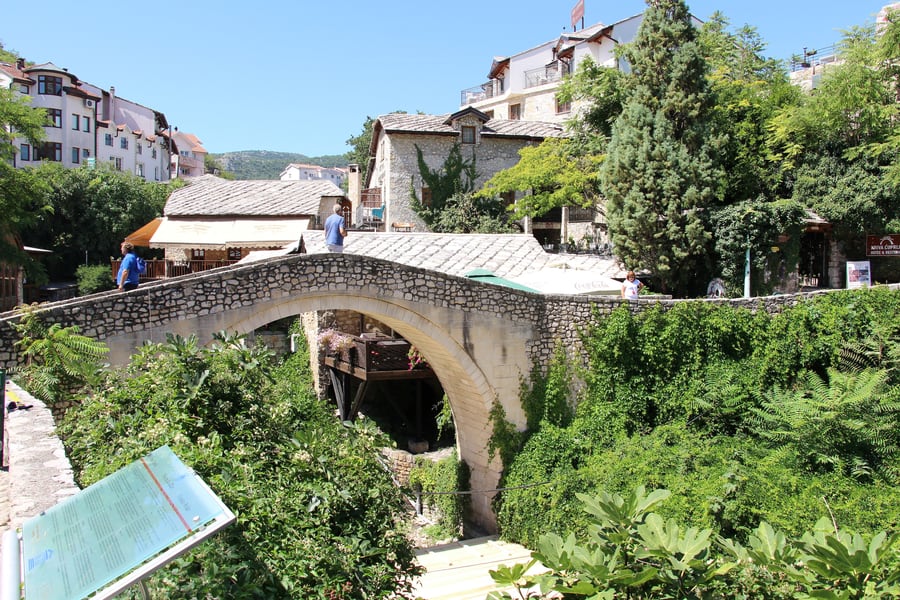 Fred Romero / Wikimedia Commons · CC BY 2.0 · cropped
Hotel-Restoran Kriva Ćuprija
Mostar old town, by the Crooked Bridge
A small hotel and restaurant inside Mostar's old town, named for the Kriva Ćuprija — the little Ottoman arch upstream of the Stari Most that the picture shows. Walking distance from the bridge, the bazaar and the Neretva.
Check Availability (opens in a new tab, on hotel-mostar.ba)via hotel-mostar.baQuestions or corrections
Planning this trip and stuck on something, or spotted a time, fare or detail that has changed? Send us a message about Sarajevo to Mostar — the Neretva Canyon Railway. We read every one, and we update this page when something has changed.