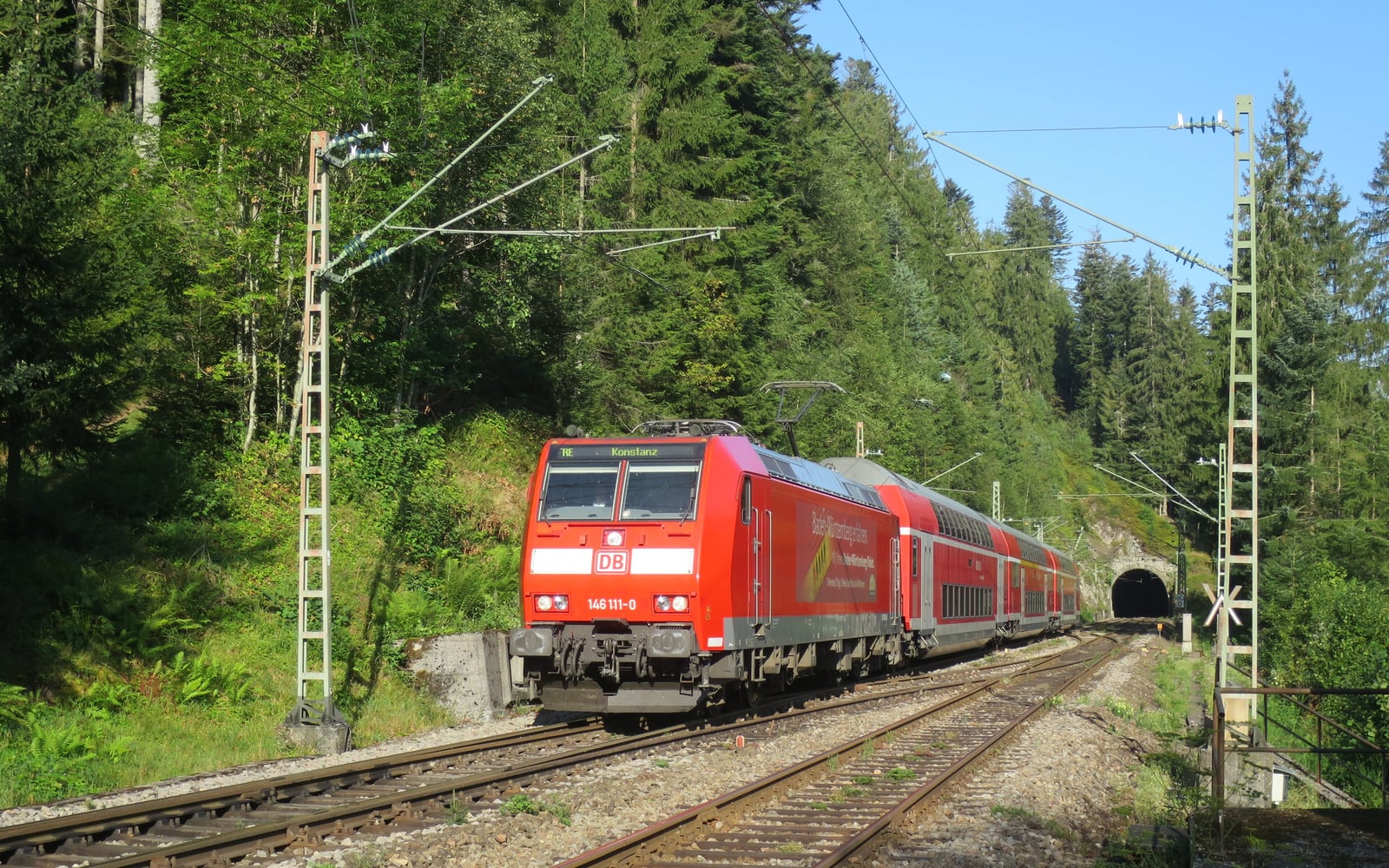
Schwarzwaldbahn
Reinhard Dietrich / Wikimedia Commons · CC BY 4.0
- Distance179 km (Offenburg–Konstanz)
- Duration2 hours 18 minutes
- Best seasonYear-round
Introduction
The Schwarzwaldbahn — the Black Forest Railway — is one of the great mountain railways of Europe, and one of the very few you can ride on an ordinary regional ticket, on an ordinary weekday, once an hour.
Built between 1866 and 1873 to the design of the Baden engineer Robert Gerwig, it climbs from the warm Rhine plain at Offenburg (159 m) over the watershed of the Black Forest and down to Lake Constance. In 149 km it passes through 39 tunnels, and it gains height so relentlessly that Gerwig had to invent his way out of the problem: rather than fight the gradient, he lengthened the line, curling it back on itself in two great double spirals in the Gutach valley near Triberg so the ruling gradient never had to exceed a gentle two per cent.
The result is a railway that behaves like a corkscrew laid on a forested mountainside. Between Hausach and St Georgen — barely 36 km apart on the map — the line climbs 564 metres and burrows through 37 separate tunnels, sometimes emerging just long enough to show you the same village from a different height before diving back into the rock.
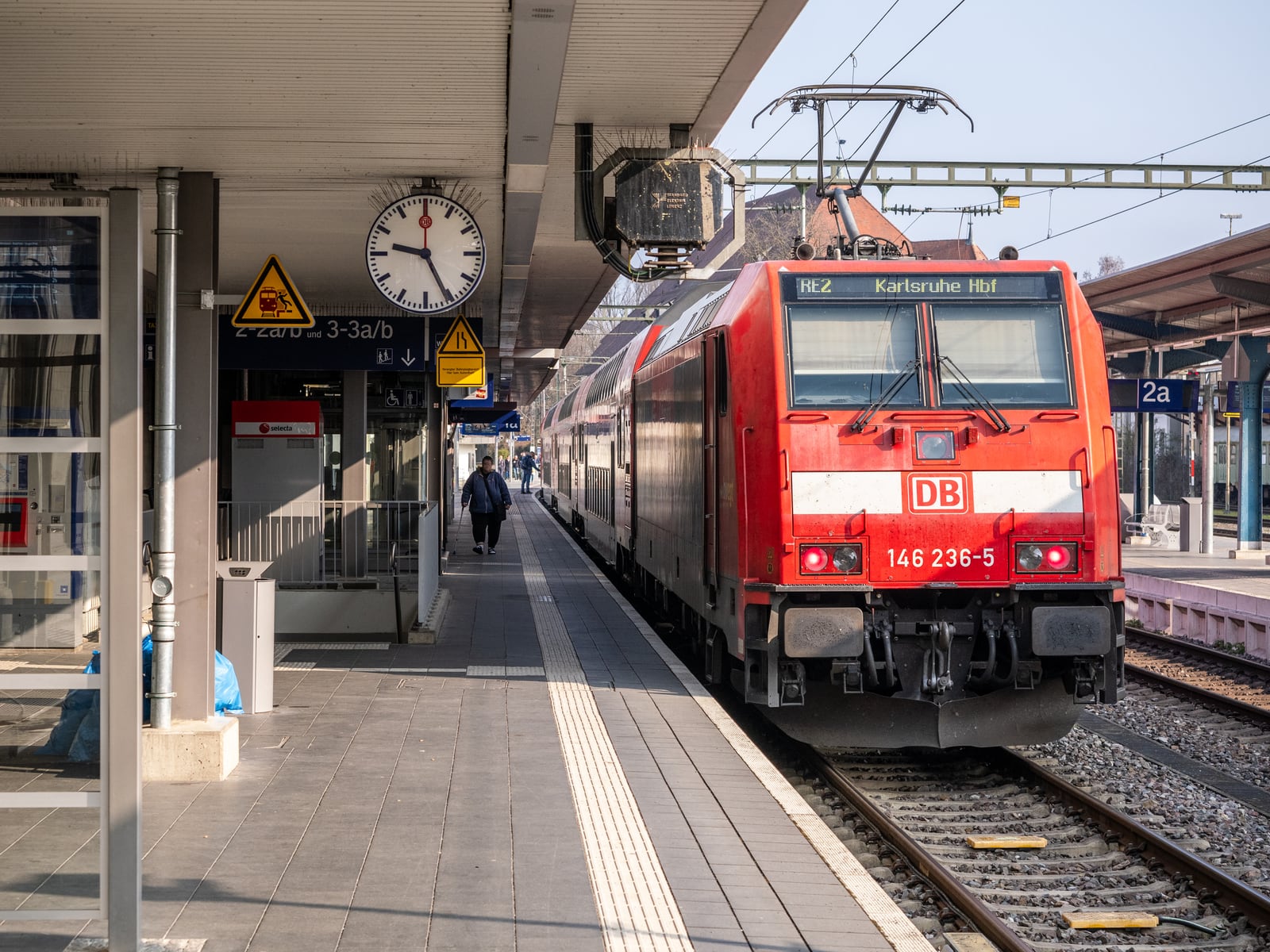
What makes it unusual today is that none of this is preserved, ticketed or staged. The Schwarzwaldbahn is a working main line. The trains that spiral up through the tunnels are the same red double-deck RE 2 regional expresses that carry commuters and school students, running through from Karlsruhe to Konstanz every hour of the day. You can join one with a day ticket and get off wherever the view or the town looks worth it.
It is, in other words, a piece of nineteenth-century mountain engineering that never stopped being useful — and the whole traverse, cuckoo-clock forest to lake steamer, takes about two and a quarter hours.
The Journey
The journey divides cleanly into three acts: a gentle run up a widening valley, a ferocious spiral climb through the forest, and a long, easy descent to the water.
Out of the Rhine plain: Offenburg to Hausach
Trains leave Offenburg (159 m), a busy junction on the Rhine valley main line, and turn east into the Kinzig valley. This first half-hour is deceptively easy — vineyards and orchards on the valley sides, half-timbered towns strung along the river. Gengenbach (172 m) and Haslach (215 m) slip past, both worth a stop in their own right, and the valley narrows steadily until the train reaches Hausach (241 m).
Hausach is where the railway's problem begins. The Black Forest watershed lies ahead, nearly 600 metres higher, and the valley that leads to it is far too short and far too steep for a nineteenth-century locomotive to climb directly.
The spirals: Hausach to St Georgen
Gerwig's answer was to stop going where the valley went. Between Hausach and St Georgen (806 m) the line gains 564 metres and passes through 37 tunnels — the great majority of the 39 on the whole route — because the track is deliberately wound back and forth across the hillsides to stretch the distance and flatten the climb.
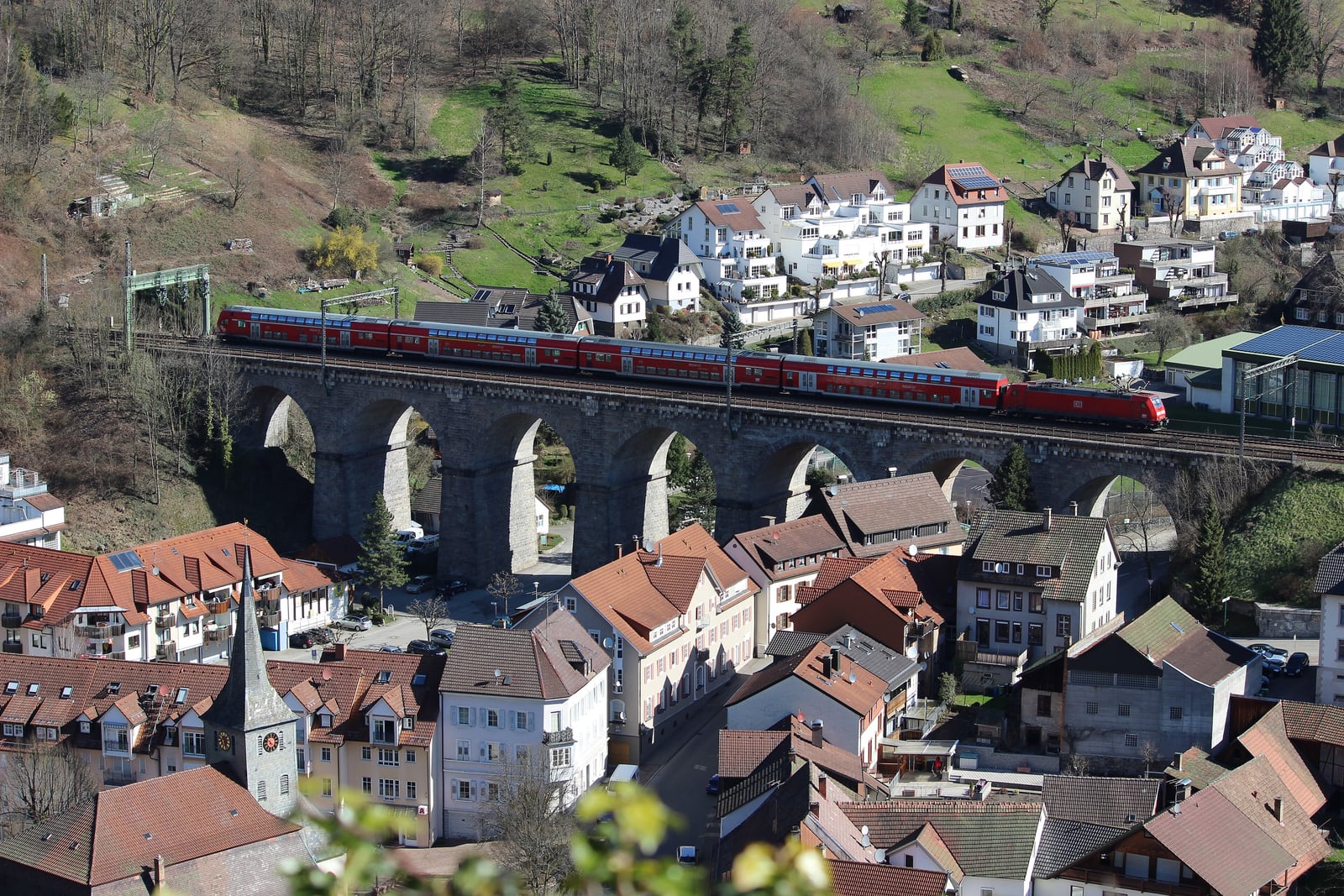
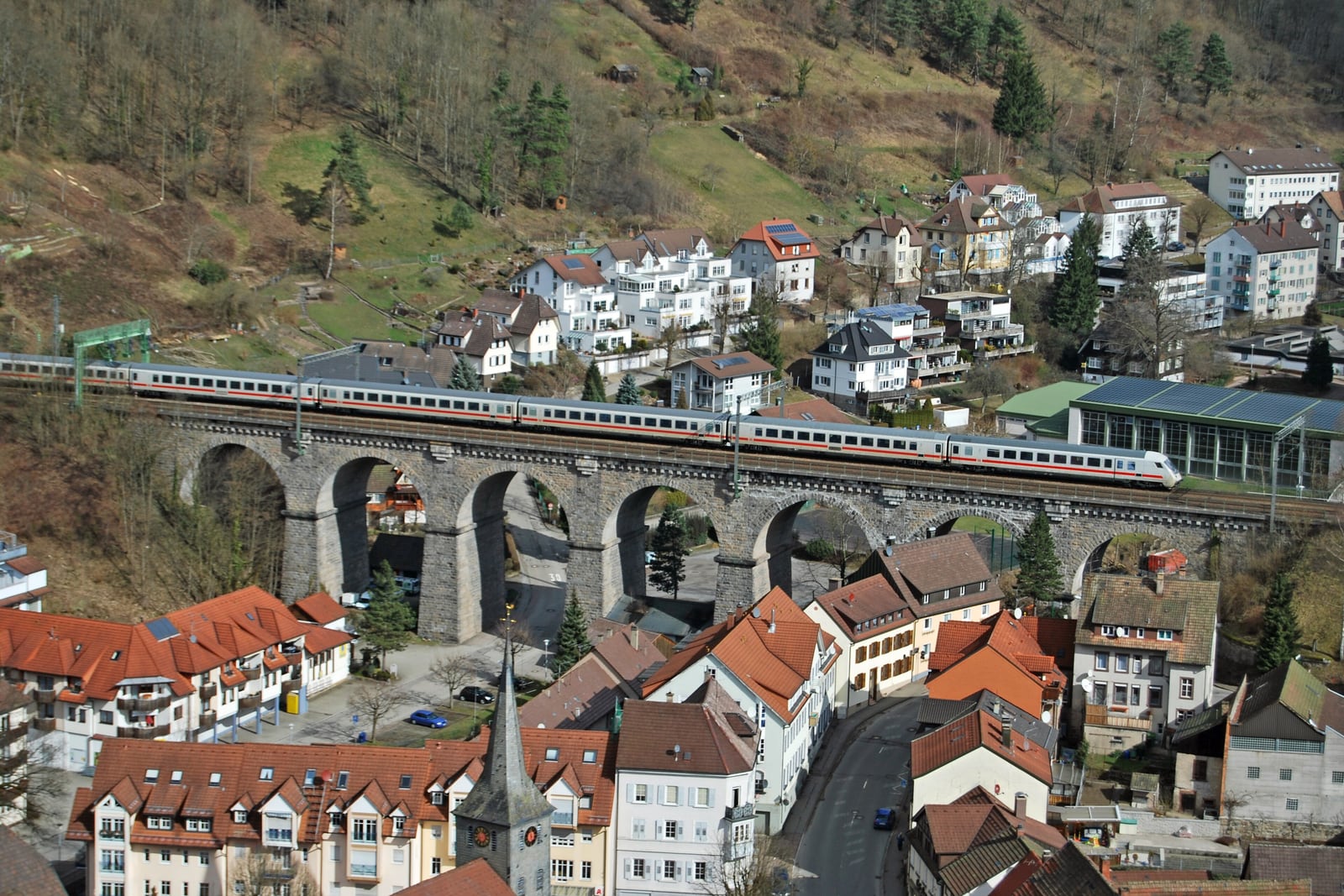
At Hornberg (384 m) the train crosses the town on a tall stone viaduct, high enough that you look down on church spires and rooftops from the carriage window. Then the serious work starts. The line swings into the Gutach valley and begins to climb in two enormous double spirals, curling through tunnel after tunnel, so that the same stretch of forest appears repeatedly — a little further off and a little further below each time.
Triberg (616 m) sits in the middle of it, in a steep wooded cutting above the town. The station is the jumping-off point for Germany's best-known waterfalls, and the train has risen 232 metres in the 13 km since Hornberg.
Above Triberg the forest thins and the gradient eases through St Georgen to the line's summit at Sommerau, 832 metres, where the railway passes under the watershed in a tunnel nearly 1.7 km long. This is the roof of the journey — and the point at which rain falling on one side of the train eventually reaches the North Sea, and on the other, the Black Sea.
Down to the water: Villingen to Konstanz
The descent is a different landscape entirely: open, high and rolling, the Baar plateau rather than the dark forest. Villingen (704 m) is the first town, a walled medieval survivor. At Donaueschingen (677 m) the train passes the ceremonial source of the Danube, a stone basin in a palace park from which the river begins its 2,840 km run to the sea.
From here the line runs south through Immendingen and Engen (520 m), and the country begins to open into the volcanic cones of the Hegau. At Singen (428 m) the Schwarzwaldbahn proper ends after 149 km — but the trains do not. They carry on along the shore to Radolfzell and into Konstanz (398 m), where the platforms sit a few minutes' walk from the harbour, the lake steamers and the Swiss border.
Along the route
BillHearts / Wikimedia Commons · CC BY-SA 3.0Two double spirals
Faced with a climb the valley was far too short to take, Gerwig simply made the railway longer: between Hornberg and Triberg it curls back on itself in two great double spirals. The same patch of forest appears again and again, each time further below.Reinhard Dietrich / Wikimedia Commons · CC BY 4.039 tunnels in 149 kilometres
Thirty-seven of them fall between Hausach and St Georgen alone, where the railway gains 564 metres. The train spends much of the climb underground, surfacing just long enough to show you how much height it has stolen since the last portal.JoachimKohler-HB / Wikimedia Commons · CC BY-SA 4.0An everyday train, not an excursion
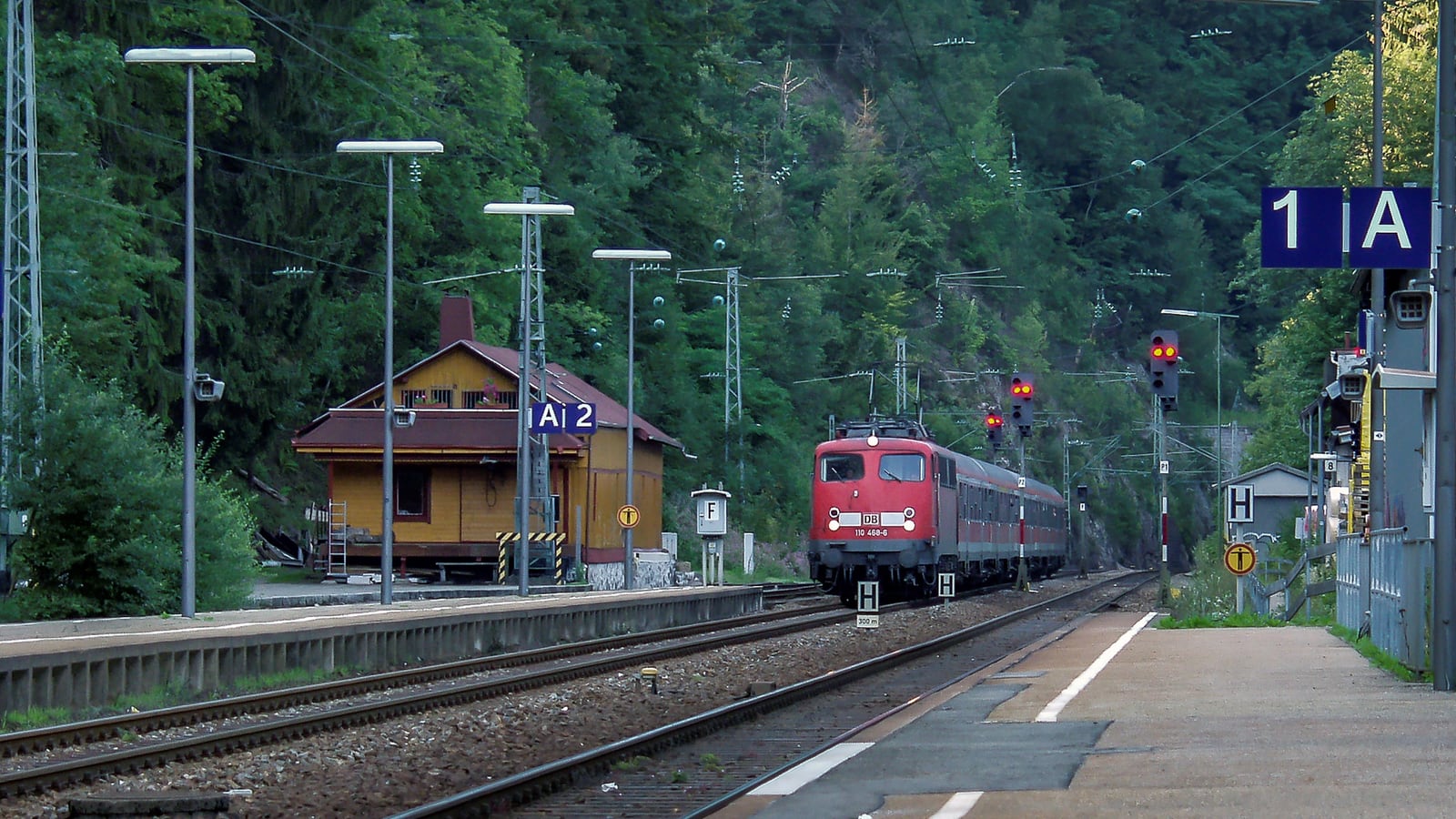
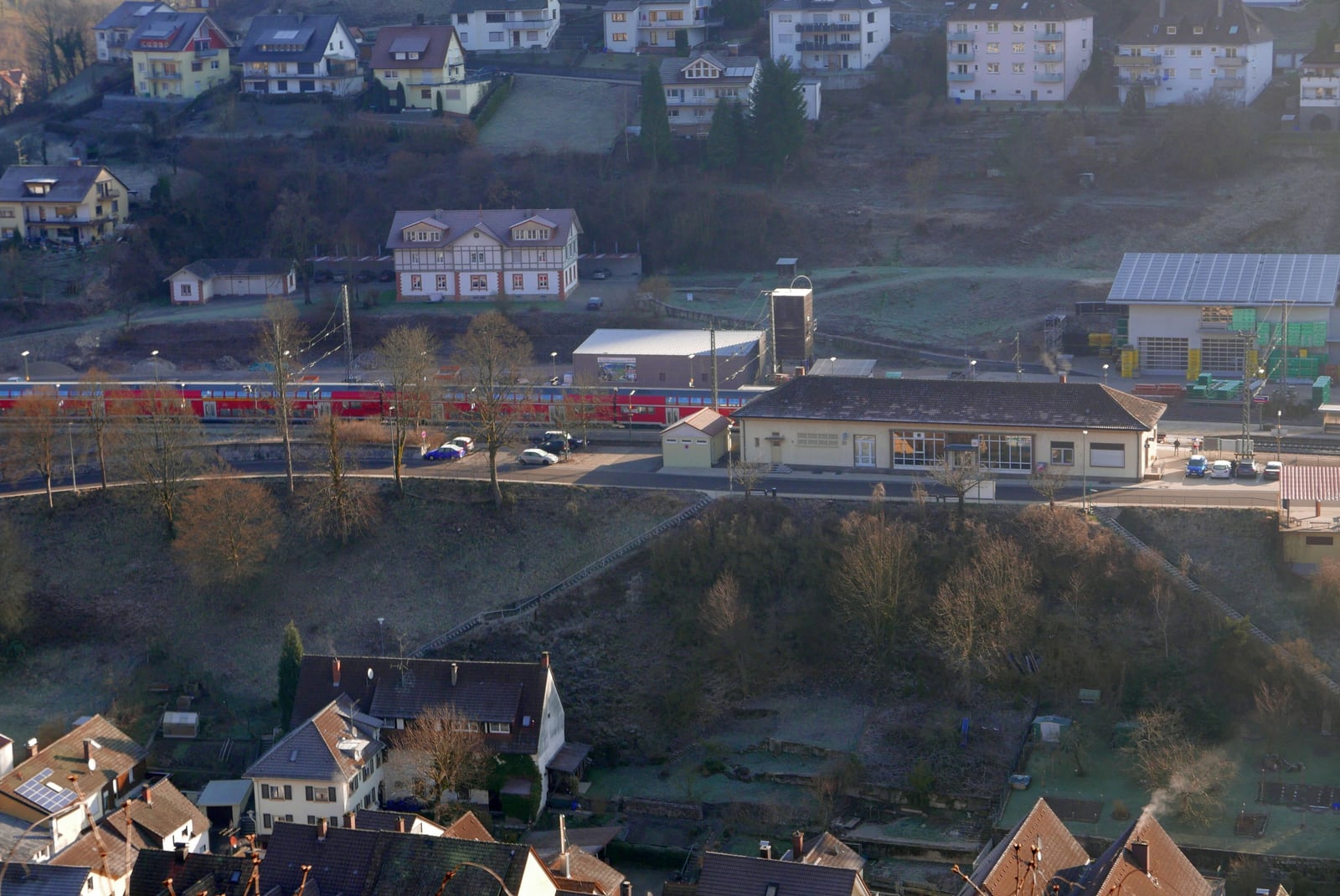
The trains that spiral through the Black Forest are the ordinary hourly regional expresses, carrying commuters and school students — which means you can ride one of Europe's great mountain lines on a day ticket, and get off wherever you like.A bit of history
Culture & experiences along the way
Gargolla / Wikimedia Commons · CC BY-SA 3.0Cross the Hornberg viaduct
The line strides over the town of Hornberg on a tall stone viaduct, high enough that from the window you look down on church spires and roof tiles. It is the last easy moment before the railway turns into the Gutach valley and starts to climb in earnest.Frans Berkelaar / Wikimedia Commons · CC BY 2.0Take the upper deck
The RE 2's double-deck carriages put you a storey higher than the lineside trees, which matters more on this railway than on most: in the spirals the view is the whole point, and the upper deck is where you can see down into the valley you have just left.Geolina163 / Wikimedia Commons · CC BY-SA 4.0Cross the watershed at Sommerau
At 832 metres the line passes under the crest of the Black Forest in a tunnel nearly 1.7 km long. It is the roof of the journey, and a genuine divide: rain falling on one side of the train ends up in the North Sea, and on the other, in the Black Sea.Timetables
The Schwarzwaldbahn is an everyday scheduled service, not an excursion train. Line RE 2 runs hourly, all day, all year, through from Karlsruhe Hbf to Konstanz, and the Black Forest crossing is simply the middle of its run.
Southbound, the pattern is the same past every hour:
| Station | Height | Time |
|---|---|---|
| Offenburg | 159 m | :58 (depart) |
| Hausach | 241 m | :19 |
| Hornberg | 384 m | :27 |
| Triberg | 616 m | :41 |
| St Georgen | 806 m | :55 |
| Villingen | 704 m | :04 |
| Donaueschingen | 677 m | :13 |
| Immendingen | 658 m | :25 |
| Engen | 520 m | :37 |
| Singen (Hohentwiel) | 428 m | :50 |
| Konstanz | 398 m | :16 (arrive) |
Intermediate figures are the minute the train reaches each stop; where it waits, it leaves a minute or two later.
So a train leaving Offenburg at 09:58 reaches Konstanz at 12:16 — 2 hours 18 minutes for the full traverse. The next one leaves an hour later, and the one after that an hour after that, from early morning until about 22:00.
Good to know:
- Hourly is the base, and it is often better. Between Offenburg and Hornberg, and again from Engen to Konstanz, the Schwarzwaldbahn's hourly service is thickened by other regional trains and by Gäubahn Intercity services, so short hops are easier than the table suggests.
- You do not need to ride it end to end. The classic compromise is Offenburg to Triberg — just 43 minutes, and it contains the viaduct and both spirals — then a later train onward or back.
- Sit on the right leaving Offenburg for the Kinzig valley and the Hornberg viaduct. After Triberg it stops mattering — the spirals show you both sides.
- ⚠️ Engineering work at Offenburg. Work on the signalling in the Offenburg area is causing part-cancellations on RE 2 (and lines RE 7 and RB 27) in the nights from Sunday into Monday, with replacement buses for the cancelled trains. Exceptions, when trains run normally, are the nights of 28/29 December, 4/5 January, 5/6 April and 12/13 April.
Times above are from Deutsche Bahn's Kursbuch table KBS 720 (Offenburg–Villingen–Singen–Konstanz), revision date 21 November 2025, valid 14 December 2025 to 12 December 2026 — verified as of August 2026. Confirm your own train before travelling: see the operator's page linked in the Tickets section below.
Tickets
Because the Schwarzwaldbahn is a scheduled regional service rather than a tourist train, there is no special ticket and no reservation. Any valid ticket for the route lets you board any RE 2, and second class is perfectly comfortable — the double-deck carriages have large windows, and the upper deck is the best seat in the house for the spirals.
Two things are worth knowing. The line crosses three regional fare unions, so a local day ticket is excellent value inside one of them but a journey spanning the whole route is simpler bought as a single DB ticket. And a day ticket usually beats point-to-point if you intend to break the journey — which on this line you should. Nationwide monthly passes are valid throughout, because this is a regional service from end to end.
Book your tickets
The full traverse
Offenburg ⇄ Konstanz on RE 2
The whole line end to end, hourly, on an ordinary regional ticket — 2 hours 18 minutes from the Rhine plain to Lake Constance. No reservation is possible or needed.
Book Tickets (opens in a new tab, on Deutsche Bahn)via Deutsche BahnOffenburg to Triberg
The spirals, in 43 minutes
The short version, and the one to take if you have half a day: it contains the Hornberg viaduct and both double spirals, and leaves you at the top of the waterfalls.
Book Tickets (opens in a new tab, on Deutsche Bahn)via Deutsche BahnRail Passes
The Schwarzwaldbahn is a scheduled DB Regio service on the national network, so every German pass works on it exactly as you would expect. That makes this one of the easier journeys to plan and one of the harder ones to justify buying a pass for.
Interrail and Eurail
Fully valid. Interrail's own operator table covers RE, RB and IRE services from "DB and all other Regional carriers", and the Schwarzwaldbahn's through trains are RE 2.
The same table's excluded column names FlixTrain and GoVolta, neither of which runs here, and then adds a third line: anything not named falls to Interrail's linked list of the German companies a pass is valid on. That list is closed, and it is what puts the Black Forest's narrow-gauge and mountain railways outside a pass while leaving the RE 2 comfortably inside it.
No reservations exist and none are needed. Turn up, board, sit on the side you want.
The Deutschland-Ticket
€63 a month, digital, personal, subscription-only, and valid on "allen Nahverkehrszügen (RB, RE, S-Bahn)" — which includes the RE 2 the whole way from Offenburg to Konstanz. If you already carry one, this journey costs nothing.
⚠️ Not valid on IC, EC or ICE, but nothing you need on this line is one.
The Baden-Württemberg-Ticket
For a day out, and especially for two or more people, this is usually the cheapest ticket on the line. €27 for the first traveller and €9 for each of up to four more, covering "alle Nahverkehrszüge aller Eisenbahnunternehmen und alle Verbundverkehrsmittel" — every regional train of every operator, plus the local buses and trams.
- It runs from midnight to 03:00 the following morning, every day of the week, with no 9 a.m. restriction.
- Both ends of the line and everything between are in Baden-Württemberg, so one ticket covers the whole ride.
- Two people doing Offenburg to Konstanz and back are ahead on this before they have stopped anywhere.
- ⚠️ Bicycles are not included — they need a separate Fahrradtageskarte.
And the one that beats all of them
⭐ If you are staying overnight anywhere in the Black Forest, ask your accommodation for the KONUS guest card. It carries you free on this railway and on the local buses for the length of your stay, at no cost — see the Tickets section. No pass on this page competes with free.
Is a pass worth it for this journey?
Not for the journey alone. A single Offenburg–Konstanz fare is modest, and neither an Interrail pass nor a monthly subscription earns its keep on one crossing.
Carry a pass if the Schwarzwaldbahn is a day inside a longer German or European trip; buy a Baden-Württemberg-Ticket if you are two or more and doing it in a day; and if you are sleeping in the Black Forest, use KONUS and buy nothing at all.
Pass conditions checked against Deutsche Bahn and Interrail's own operator list, August 2026.
Places to Visit
The Schwarzwaldbahn is unusually generous to anyone who wants to break the journey. Every town below has its own station on the line, served by the same hourly train, so getting off costs you an hour and nothing else.
The stops divide neatly by character. Offenburg and Gutach belong to the warm, wine-growing lower Kinzig valley. Hornberg and Triberg are the mountain heart of the line, where the railway is at its most spectacular and the forest closes in. Villingen, Donaueschingen and Konstanz are the far side of the watershed — a walled medieval town, the source of the Danube, and finally the lake.
If you only have one day and one stop, make it Triberg: it has the waterfalls, the forest, and the spirals immediately above the station. If you have two, add Hornberg for the viaduct, which is best appreciated from the town beneath it rather than from the train crossing it.
 Peter Poschadel / Wikimedia Commons · CC BY-SA 4.0 · cropped
Offenburg
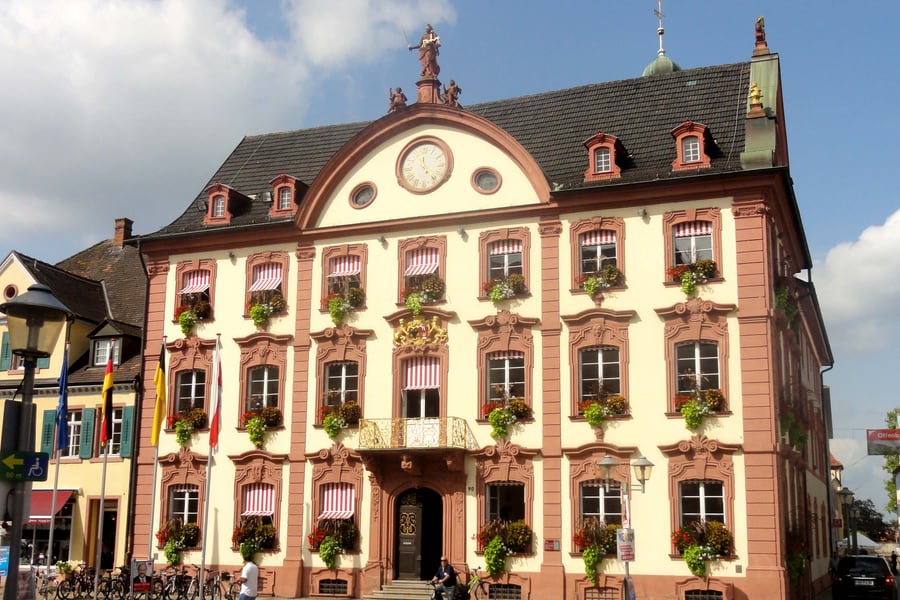
A working Baden town at the foot of the hills, and the junction where the Schwarzwaldbahn leaves the Rhine valley main line. The market square is dominated by an ornate baroque town hall, and the surrounding streets are wine country — this is the warm, low end of the journey, and a sensible place to spend the night before an early train.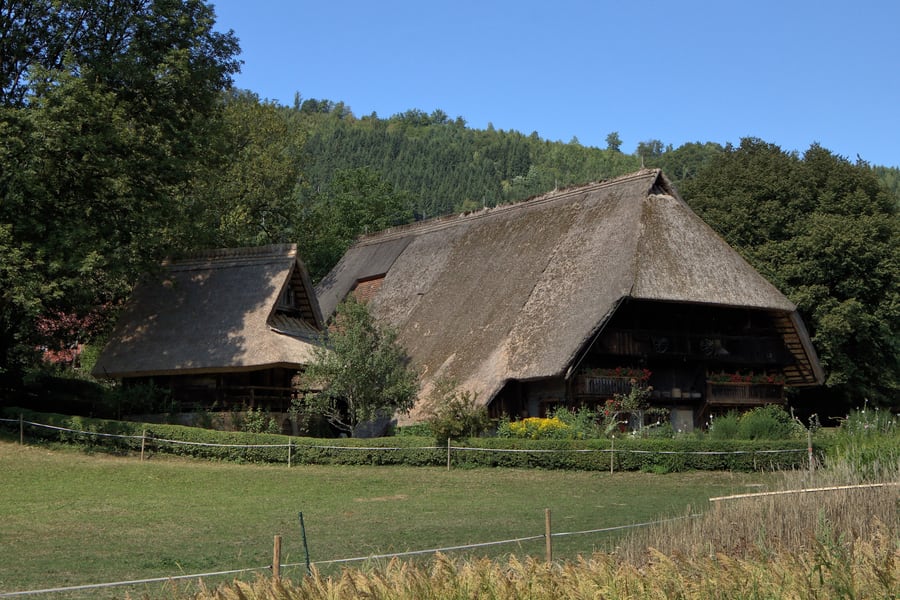 H. Zell / Wikimedia Commons · CC BY-SA 3.0 · cropped
Gutach
The Vogtsbauernhof open-air museum stands in the meadow beside the line, and it is the reason the Black Forest farmhouse looks the way it does in every picture you have seen: an enormous hipped roof sweeping almost to the ground over house, byre and barn together. Original buildings have been brought here from across the region and rebuilt.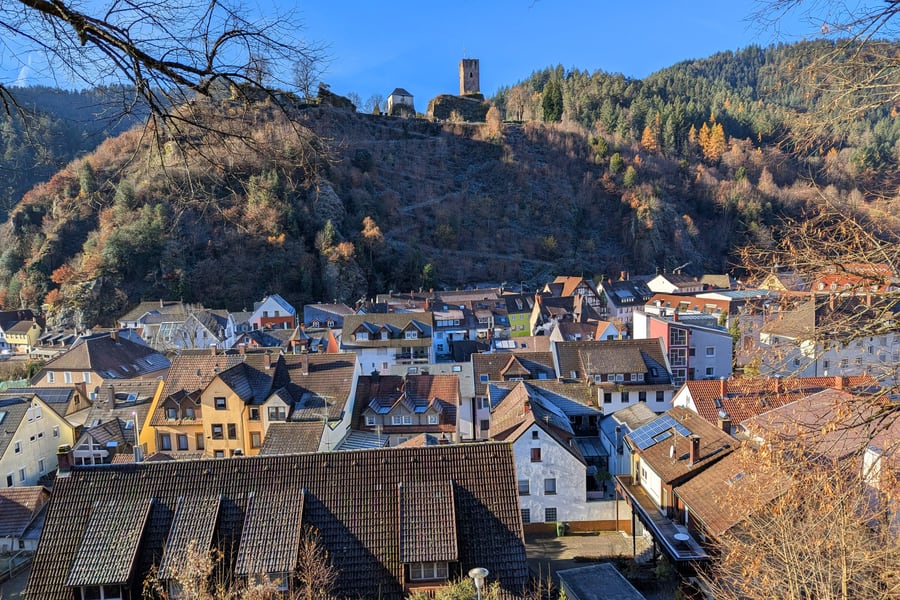 Gerd Eichmann / Wikimedia Commons · CC BY 4.0 · cropped
Hornberg
A steep little town wedged into the valley, with the ruins of its castle on the wooded bluff above and the railway striding over the rooftops on its viaduct. Hornberg is the best place to watch the Schwarzwaldbahn rather than ride it — the viaduct is far more impressive from the streets underneath than from the carriage crossing it.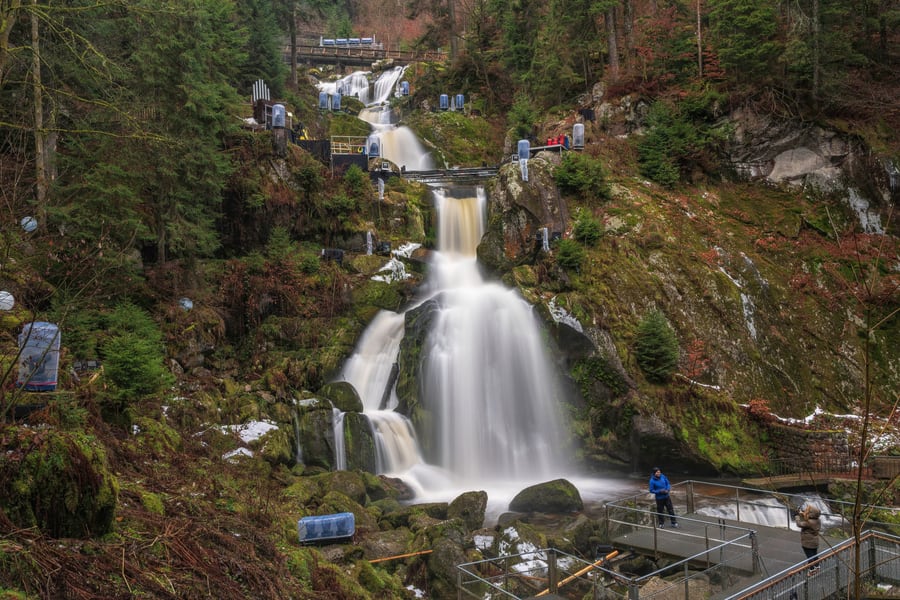 PantaRhei / Wikimedia Commons · CC BY-SA 4.0 · cropped
Triberg
The mountain heart of the line, 616 m up and surrounded by spruce. The Gutach falls drop through the forest in a series of cascades right beside the town, reached by a network of made-up paths and viewing platforms, and the walks above them run straight into the woods the railway spirals through. The town is also the centre of the cuckoo-clock trade.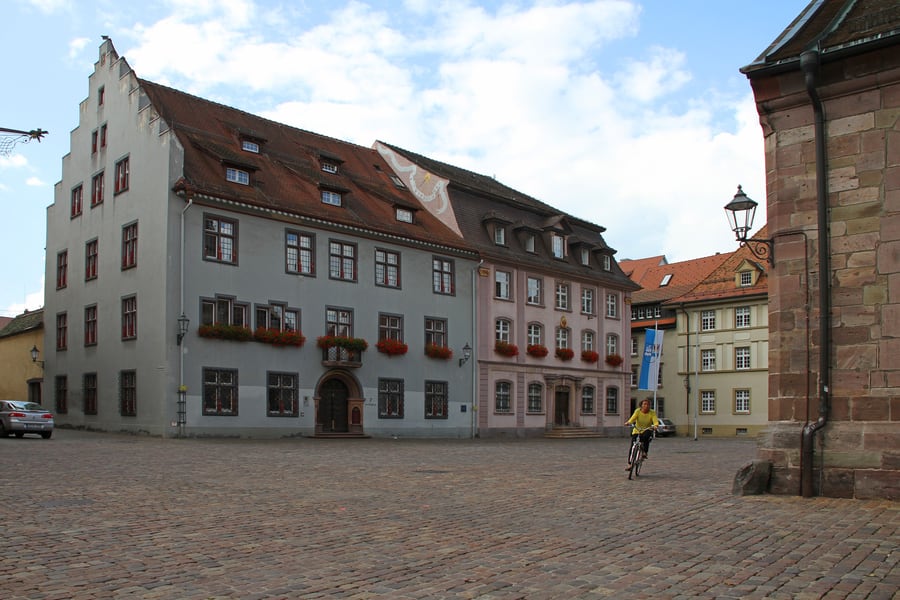 Gerd Eichmann / Wikimedia Commons · CC BY 4.0 · cropped
Villingen
Over the watershed and onto the open Baar plateau, Villingen keeps its medieval street plan almost intact — a cross of four main streets inside a ring of wall and gate towers, with a minster whose two mismatched towers are the town's signature. A complete piece of old Germany that most travellers on this line ride straight past.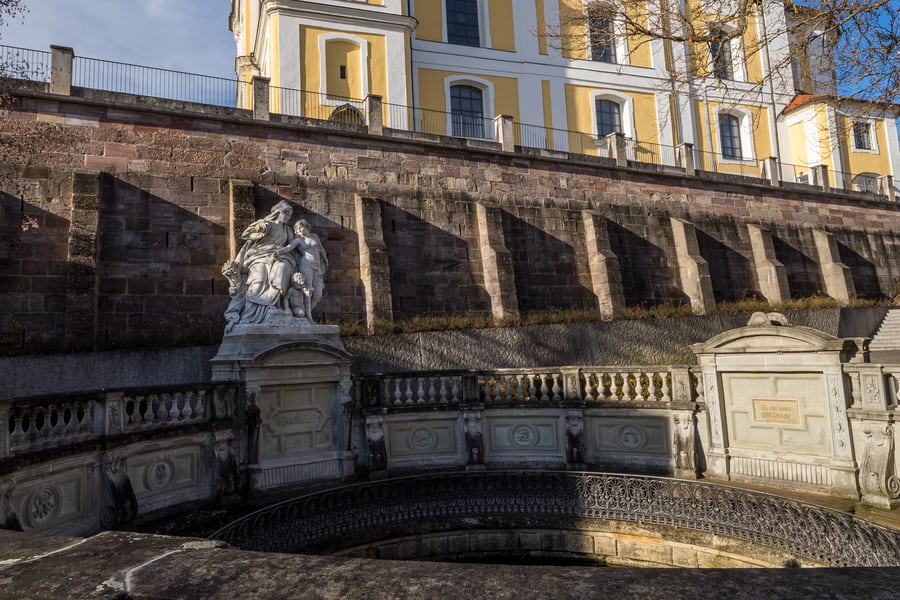 JoachimKohler-HB / Wikimedia Commons · CC BY-SA 4.0 · cropped
Donaueschingen
In the park beside the palace, a stone basin ringed by a balustrade holds the ceremonial source of the Danube. From this pool the river runs 2,840 kilometres to the Black Sea, through ten countries and four capital cities — a fact the town states plainly on a plaque, and one worth the ten-minute walk from the station.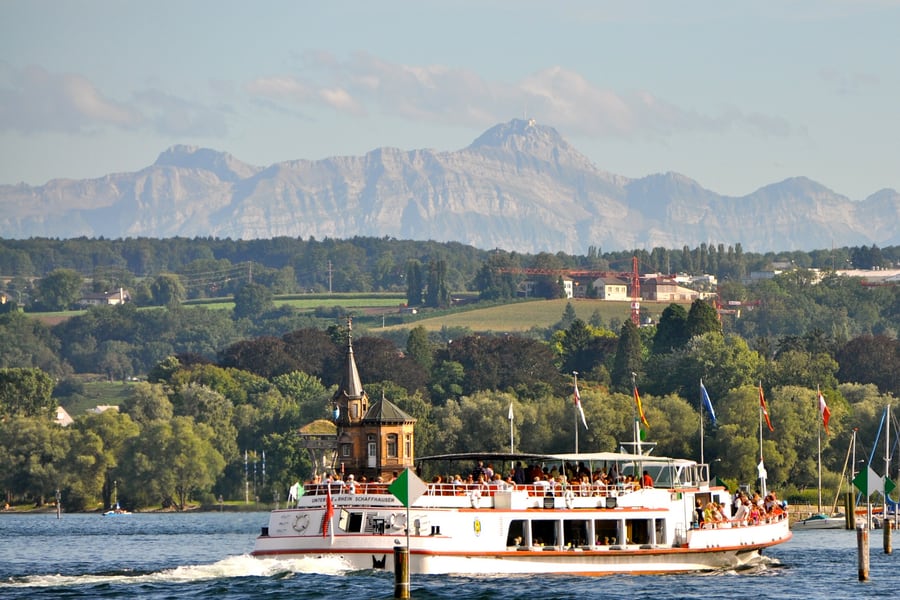 Achim / Wikimedia Commons · CC BY-SA 3.0 · cropped
Konstanz
The line delivers you to the shore of Lake Constance, in a university town that escaped the war intact because it sat too close to neutral Switzerland to bomb safely. The old quarter is a tangle of painted houses; the harbour is full of lake steamers; and the Swiss frontier runs through the streets on the far side of town.Where to Sleep
Because the Schwarzwaldbahn runs hourly and every town on it has a station, you can base yourself almost anywhere along the line and still ride the whole thing. Where you sleep depends mostly on which half of the journey you want to wake up in.
Offenburg is the practical base at the northern end — a real working town rather than a resort, well connected to the Rhine valley main line, and the place to start if you are arriving from Frankfurt, Karlsruhe or Strasbourg and want an early train into the hills.
Triberg is the atmospheric choice, and the one most travellers should make. It sits at 616 m in the middle of the spirals, with the waterfalls and the forest walks on the doorstep, and the sound of trains working up the gradient below the town.
Konstanz is the reward at the far end: a lakeside university town with a walkable old quarter, a harbour full of steamers and the Swiss border running through the suburbs. It is worth a night rather than a connection.
One practical point: the mountain section fills up in high summer and over Christmas, when Triberg's waterfalls and clock shops draw crowds well out of proportion to the size of the town. Book the middle of the line early, or sleep at either end and ride in.
Where to stay
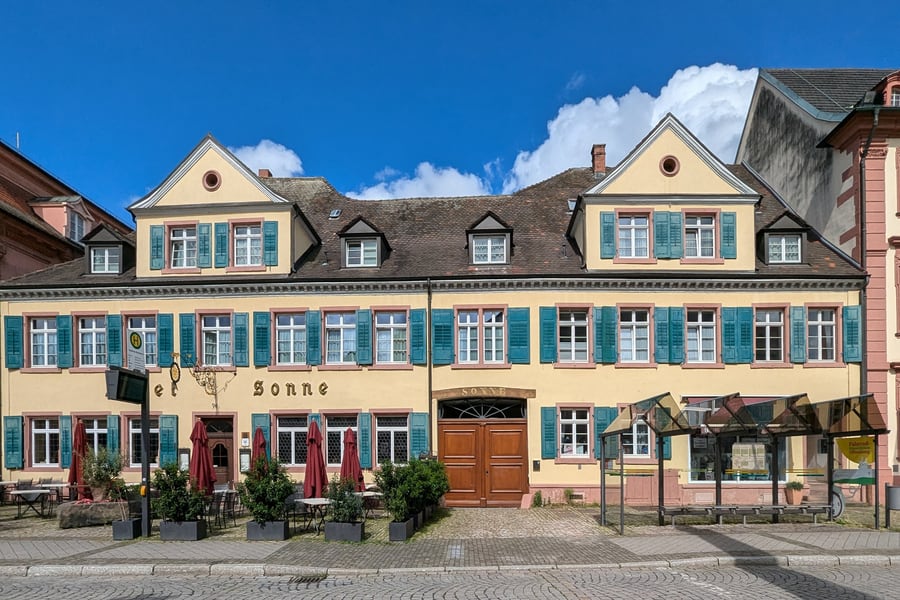
Sonne Offenburg
Restaurant and boarding house, Offenburg old town
A historic house on the Hauptstraße in the pedestrianised centre, a few minutes from Offenburg station. It runs today as a restaurant with rooms rather than a full hotel, with regional cooking downstairs and period rooms in the old building above.
via sonne-offenburg.de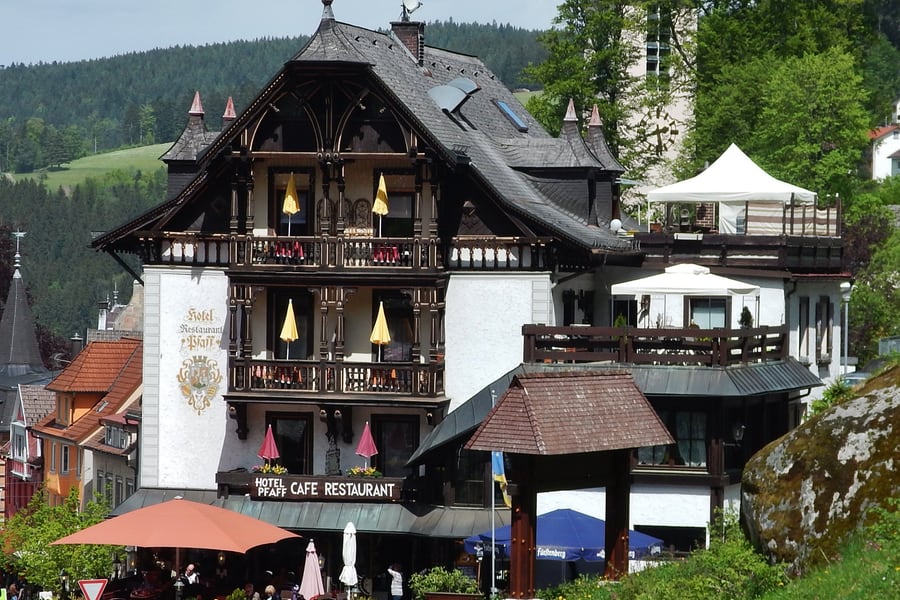
Hotel Restaurant Pfaff
In Triberg, near the waterfalls
An elaborately carved Black Forest house on Triberg's main street, a few hundred metres from the market square and the foot of the falls. Family-run, with its own café and restaurant, and about as central as it is possible to be for the middle of the line.
via hotelpfaff.com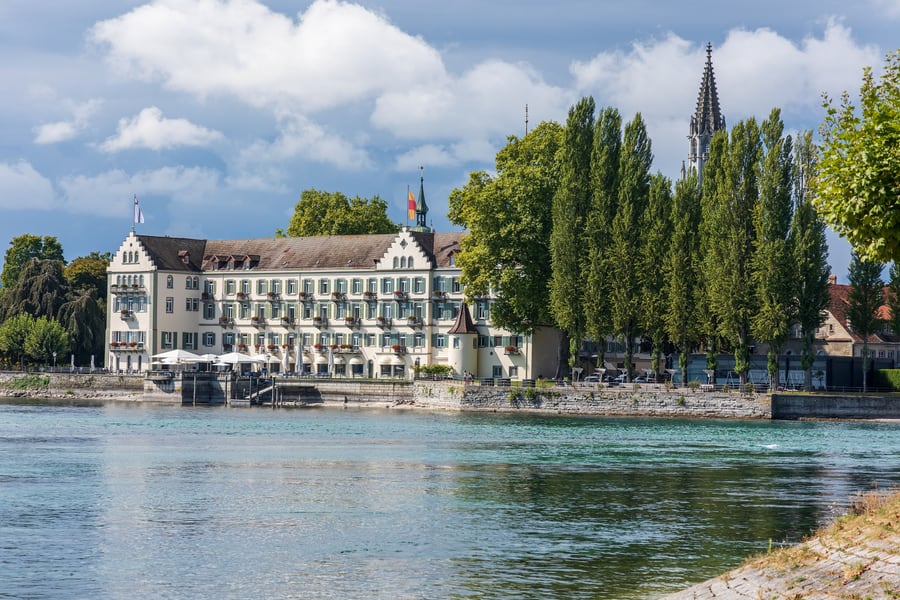
Steigenberger Inselhotel
A former Dominican monastery on the water, Konstanz
Thirteenth-century cloisters on their own small island at the edge of the Konstanz old town, in use as a hotel since 1874. The lake is on the doorstep and the minster tower is a few minutes' walk away — the most striking building to sleep in at journey's end.
via hrewards.comQuestions or corrections
Planning this trip and stuck on something, or spotted a time, fare or detail that has changed? Send us a message about Schwarzwaldbahn. We read every one, and we update this page when something has changed.