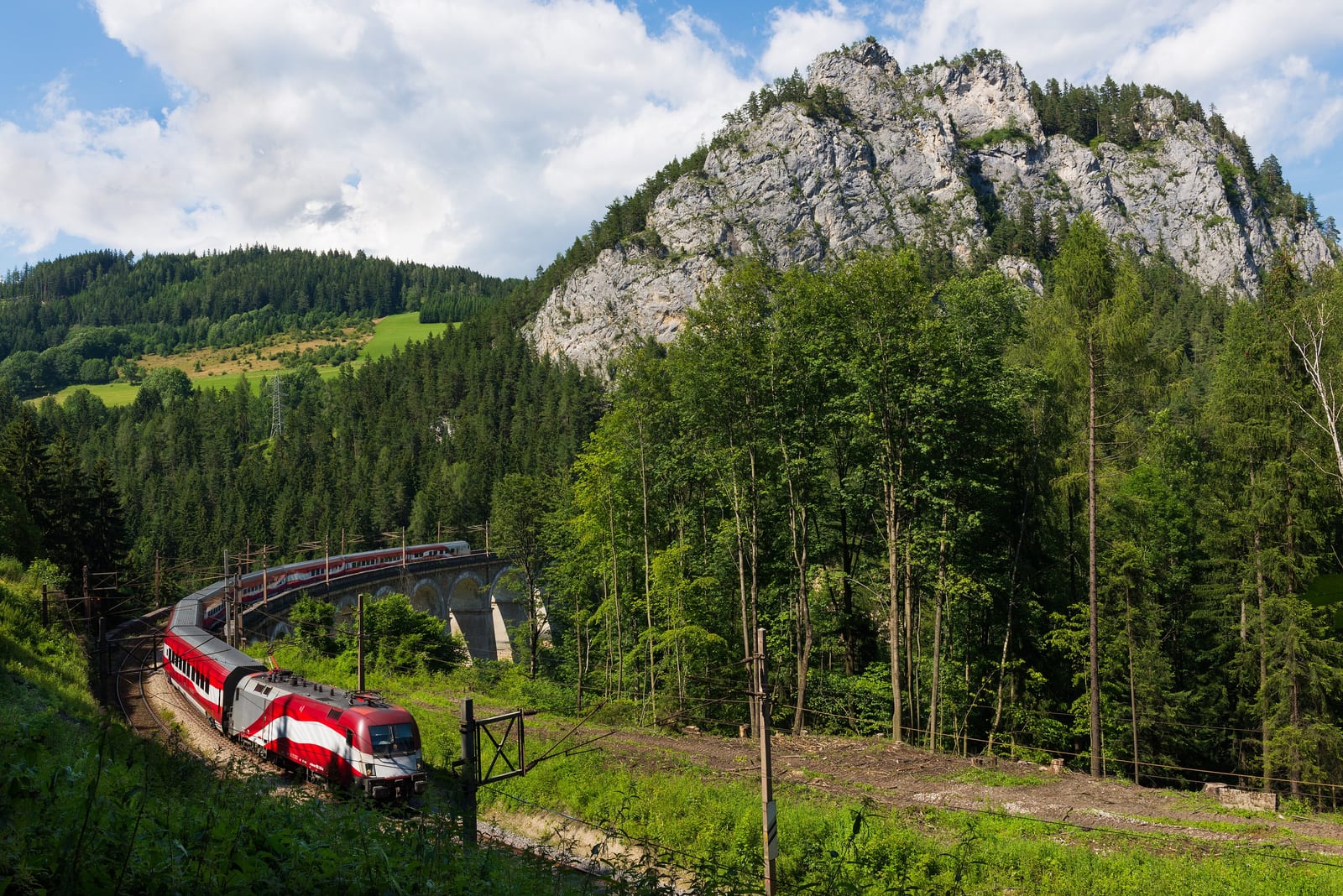
Semmering Railway
Liberaler Humanist / Wikimedia Commons · CC BY-SA 4.0
- Distance41 km · standard gauge
- DurationAbout 1 hour, Gloggnitz–Mürzzuschlag
- Best seasonMay–Oct · Dec–Mar for snow
Introduction
In 1848 nobody knew whether a railway could cross a mountain range. Not "hadn't got round to it" — genuinely did not know. The gradients were thought impossible, the curves too tight, the whole idea faintly ridiculous.
Carl Ritter von Ghega built one anyway — Europe's first mountain railway laid to standard gauge — and it is still there, and you can ride it this afternoon for the price of a sandwich.
There was a reason to try. Austria-Hungary had exactly one sea port, Trieste, and the empire wanted a railway to it: the Südbahn, 577 kilometres from Vienna to the Adriatic. Every part of that was buildable except one — the wall of mountains at the Semmering. These forty-one kilometres were the piece everyone said couldn't be done, and the through train from Vienna to Trieste didn't run until 1857 because of them.
The Semmeringbahn runs 41 kilometres from Gloggnitz to Mürzzuschlag, over a pass at 895 metres. It took six years — 1848 to 1854 — and some twenty thousand workers, and it was done entirely without the things you would now consider essential: no power tools, no concrete, no idea whether the finished thing would work. Ghega, born in Venice as Carlo Ghega to an Albanian family, both designed it and ran the building of it.
The numbers are worth sitting with. Fourteen tunnels, totalling 1,477 metres — nearly a tenth of the entire line is underground. Sixteen major viaducts, which — by a coincidence UNESCO itself points out — total exactly 1,477 metres too. A hundred and eighteen smaller stone arch bridges, and eleven iron ones. A ruling gradient of 1 in 40. All of it in cut stone, and all of it still carrying trains a hundred and seventy years later.
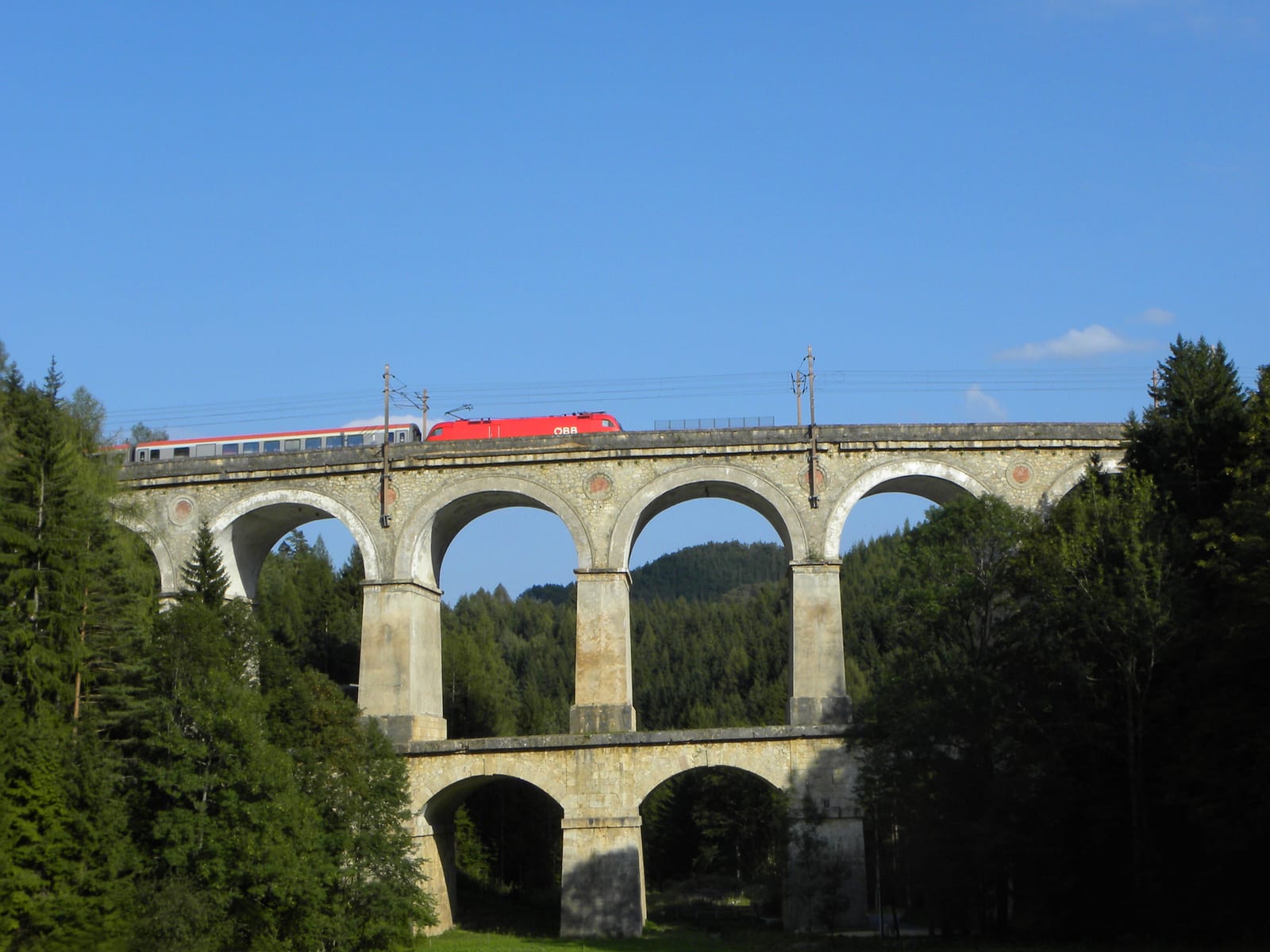
In 1998 it became the first railway line in the world to be inscribed as a UNESCO World Heritage Site. Not the first station, not part of some wider landscape — the first railway, full stop, listed for being, in UNESCO's phrase, "one of the greatest feats of civil engineering during the pioneering phase of railway building."
And here is what makes it worth your afternoon rather than just your respect: it is not a museum. There is no heritage train, no special ticket, no costumed guard. The Semmering is a working ÖBB main line. Ordinary regional trains run over it. So do the Railjets between Vienna and Graz. You buy a normal ticket and ride a World Heritage Site to work.
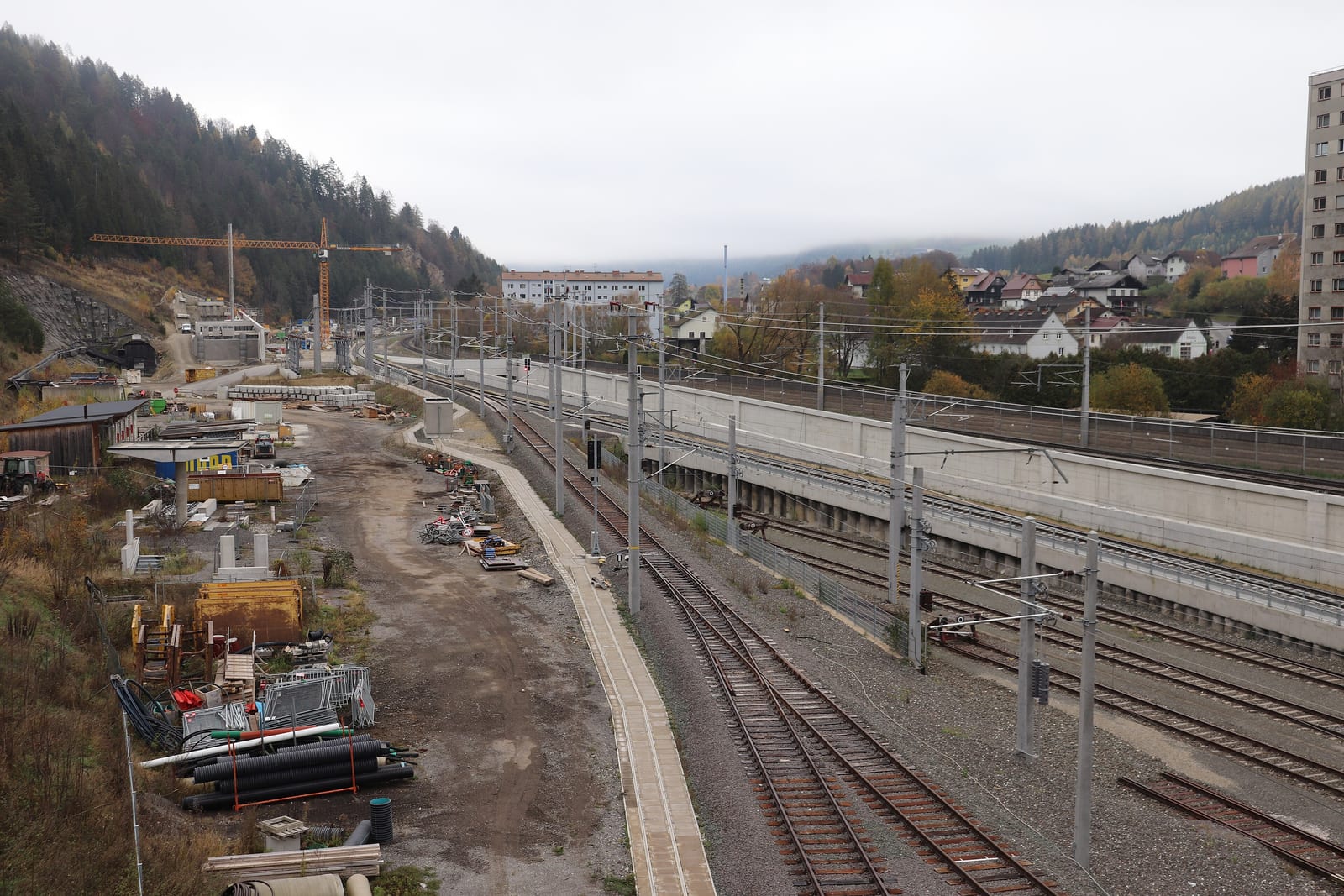
One thing is changing. The Semmering Base Tunnel — 27.3 kilometres, begun in 2012, due around 2030 — will take the long-distance trains under the mountain and cut Vienna to Graz by about half an hour. The old line is not closing: ÖBB is modernising it, and regional services are expected to stay, though nobody will commit to how many. But the era of expresses climbing Ghega's viaducts is ending.
Which is reason enough to go now — not because it's dying, but because there is a difference between a mountain railway that is still the way over the mountain, and one that is merely still there.
The Journey
It starts at Gloggnitz, an hour or so south of Vienna, at 436 metres. It is an ordinary station in an ordinary town, and there is nothing to tell you that the next forty-one kilometres are a World Heritage Site.
The line follows the Schwarza valley at first, along the left-hand slopes, and the climbing is gentle enough that you might miss it starting. Then the Schwarza viaduct carries you across to Eichberg, and the character changes: the train swings into the Auerbach valley and goes into dense forest, and the mountains close in.
Klamm-Schottwien, the Klamm tunnel, and then the Alps proper. The line threads the Weinzettelwand, the Krauselklause and the Polleroswand in a rapid series of tunnels and viaducts, and this is where you understand what Ghega actually did. There is no room here. The railway is not crossing this landscape; it is inserted into it, on ledges and arches, going in and out of the rock, gaining height in a series of moves that look less like engineering than like an argument being won.
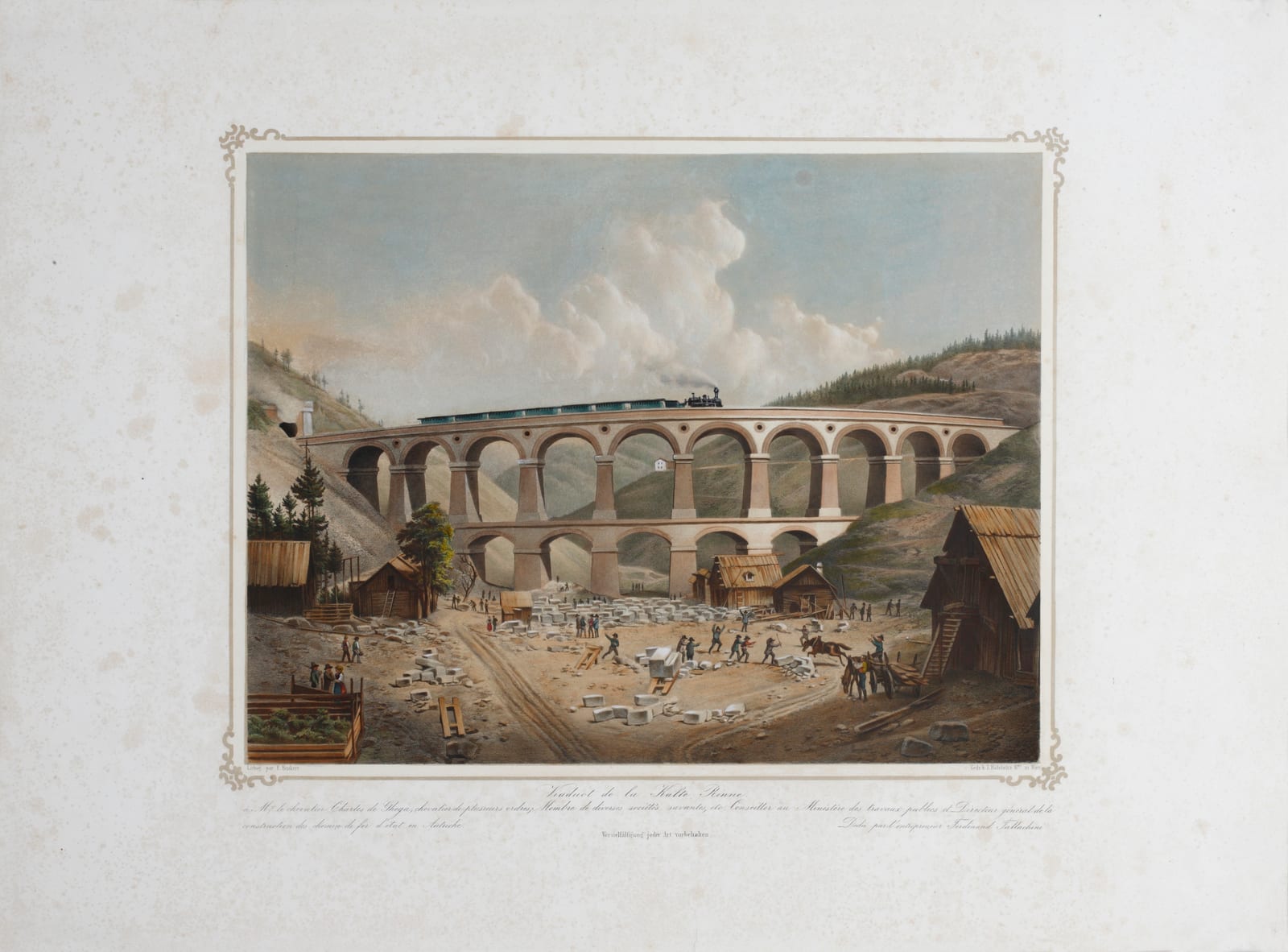
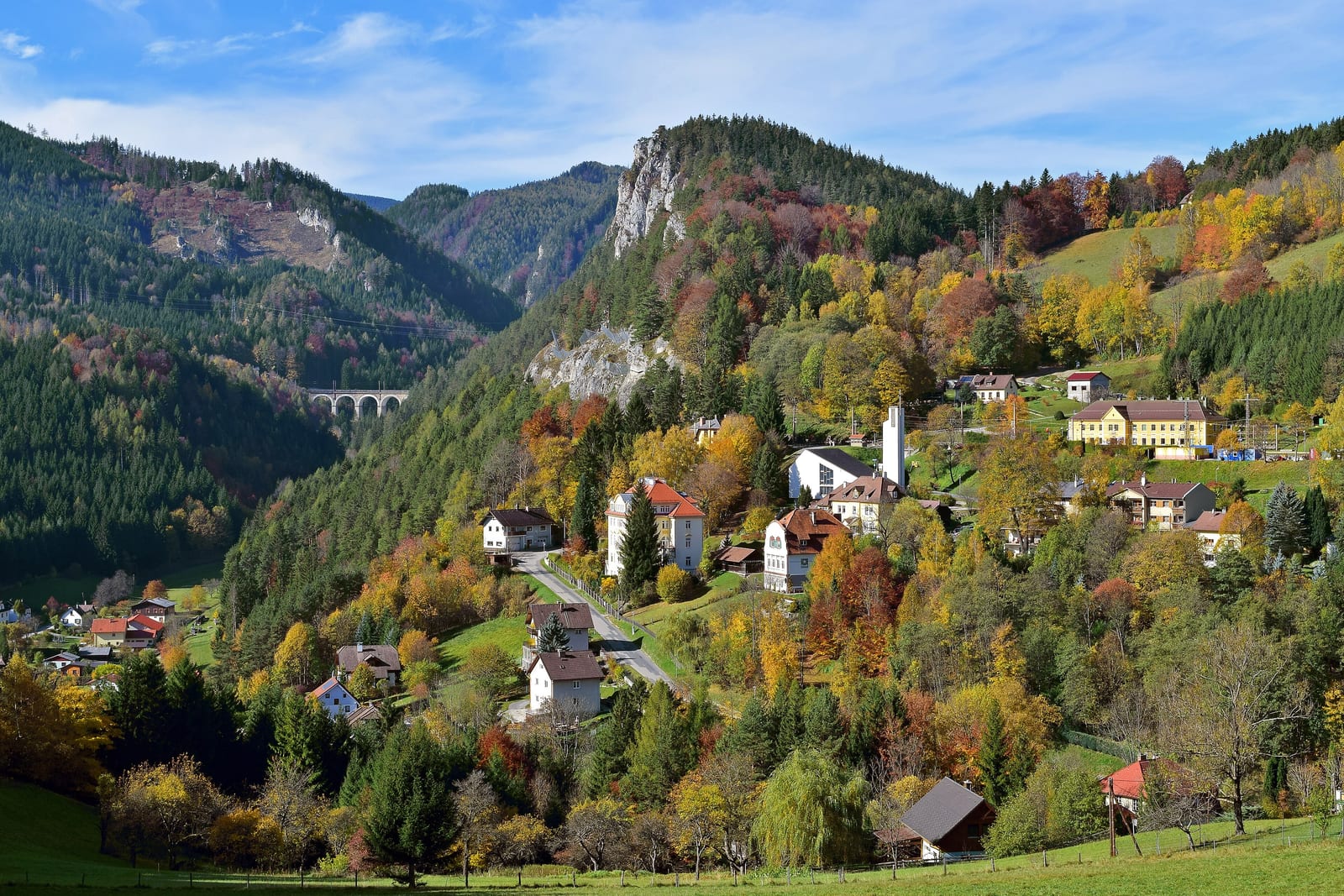
And then, the thing itself: the Kalte Rinne. A curving, two-storey stone viaduct, 184 metres long and 46 metres high, striding across a ravine on arches stacked on arches. It is the most photographed structure on the line and it deserves to be. It was drawn while it was being built — scaffolding, spoil heaps, several hundred men — and the drawing looks like the construction of a cathedral, which in a sense it was.
Then the Wolfsberg and Kartnerkogel tunnels, and the 1,431-metre Semmering Tunnel under the pass itself, and you come out at Semmering station at the top: 895 metres, twenty-nine kilometres from Gloggnitz.
From here it is downhill — along the right-hand slope of the Roschnitz valley, through Steinhaus and Spital am Semmering, and into Mürzzuschlag at 677 metres, twelve kilometres on.
The whole thing takes about an hour.
Two things to know. First: look for the little houses. There are fifty-seven two-storey attendants' houses along the line, at roughly seven-hundred-metre intervals, built of coursed rubble with brick trim — UNESCO calls them "a very characteristic feature", and once you notice the first, you will count the rest. Second: the best view is not from the train. The famous vista of stacked viaducts — the one on the old 20 schilling banknote — is about twenty minutes' walk from Semmering station along the Bahnwanderweg. Get off. Go and look. Get the next train.
Because the odd truth of the Semmering is that it was built to be seen. The portals are monumental when they needn't be, the viaducts curve when straight would have been cheaper, and the hotels went up along the line almost immediately for people who came simply to look at it. Ghega built a piece of infrastructure that is also, deliberately, a view.
Along the route
Haeferl / Wikimedia Commons · CC BY-SA 3.0 ATThe first railway UNESCO ever listed
In 1998 the Semmering became the first railway line in the world inscribed on the World Heritage list — not for what it carries, but for what it is: in UNESCO's words, "one of the greatest feats of civil engineering during the pioneering phase of railway building."Emerich Maria Benkert (1825–1855) / Wikimedia Commons · Public domainGhega's arithmetic
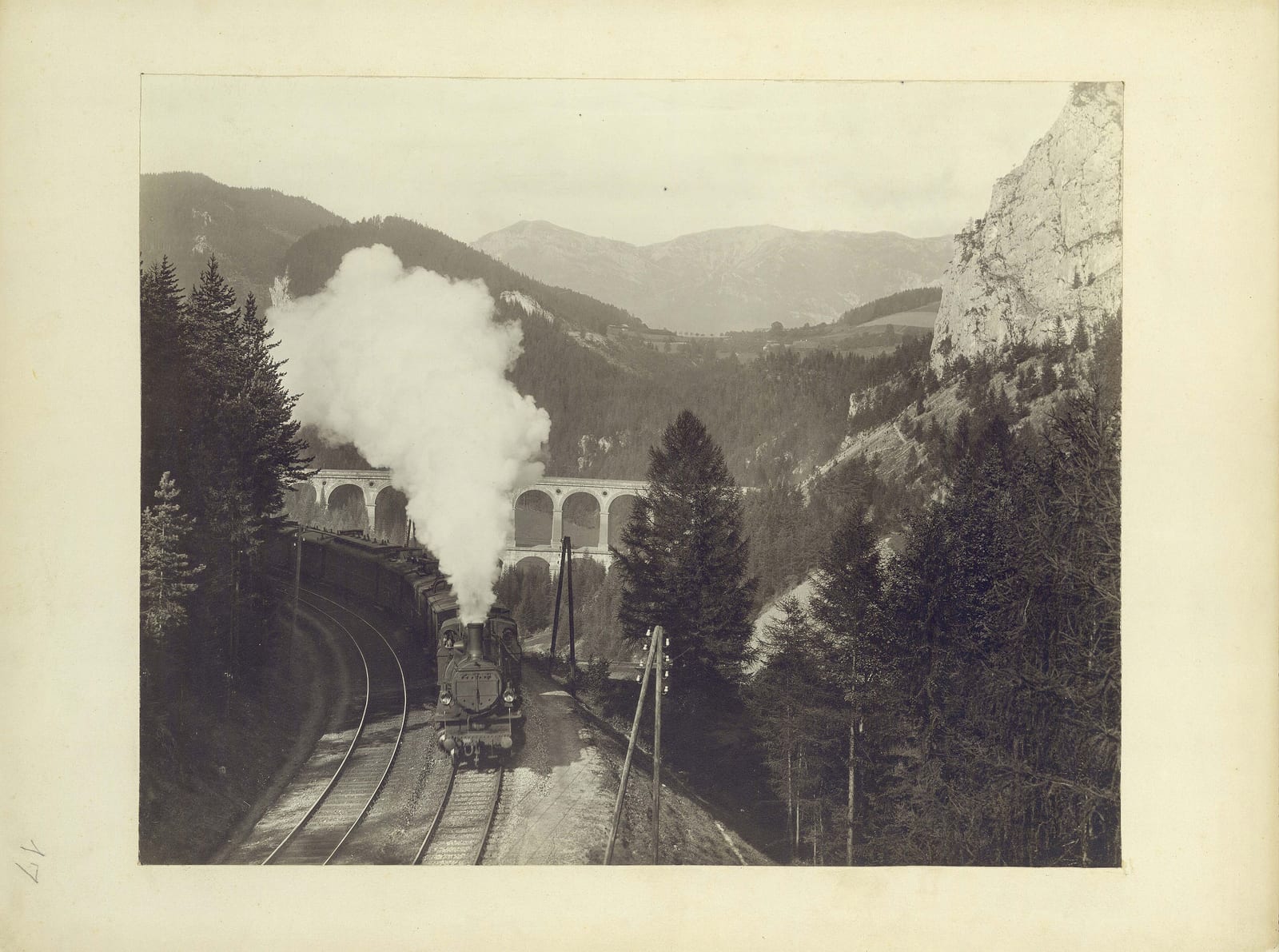
Carl Ritter von Ghega got a railway over an Alpine pass in 1854, before anyone knew it could be done. 14 tunnels totalling 1,477 metres — and, by coincidence UNESCO itself notes, 16 viaducts totalling exactly 1,477 metres too. Plus 118 stone bridges and 11 iron ones. Gradient: 1 in 40.Fortepan / Budapest Főváros Levéltára / Wikimedia Commons · Public domainBuilt to be looked at
This is the strange thing about the Semmering: it is decorated. The tunnel portals are monumental, the viaducts curve when they could have been straight, and 57 two-storey attendants' houses stand along it at roughly 700-metre intervals. Ghega built a railway that was also a landscape.A bit of history
Culture & experiences along the way
 Herbert Ortner / Wikimedia Commons · CC BY 2.5 · cropped
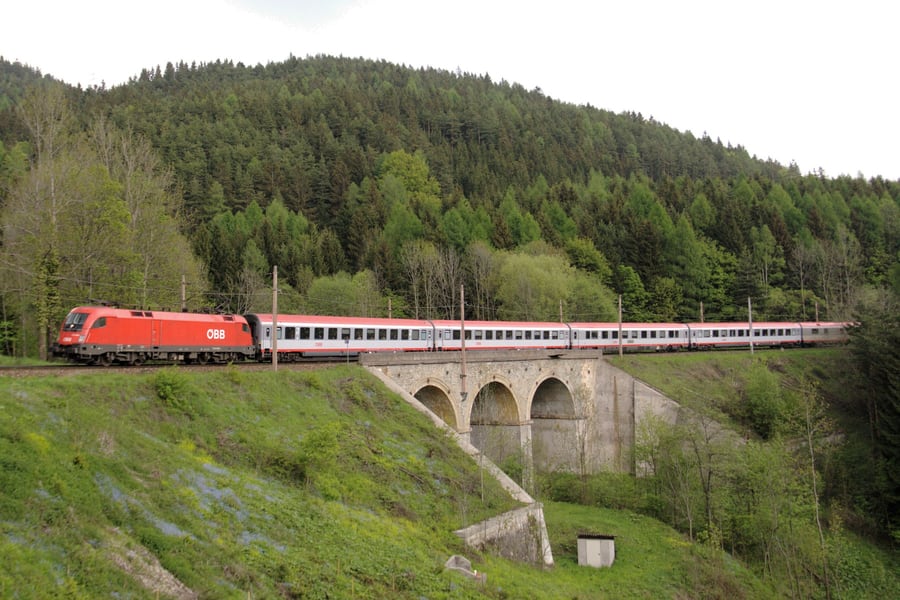
It costs the price of a local ticket
There is no heritage train and no special fare. The Semmering is a working ÖBB main line — you buy an ordinary ticket, get on an ordinary train, and ride a World Heritage Site for a few euros. Almost nothing else on this site is that cheap.Haeferl / Wikimedia Commons · CC BY-SA 4.0The 20-Schilling view
The classic vista of the stacked viaducts — the one that was on the old Austrian 20 schilling banknote — is about three-quarters of an hour's walk above Semmering on the Bahnwanderweg. You cannot see it from the train. Get off and go and look.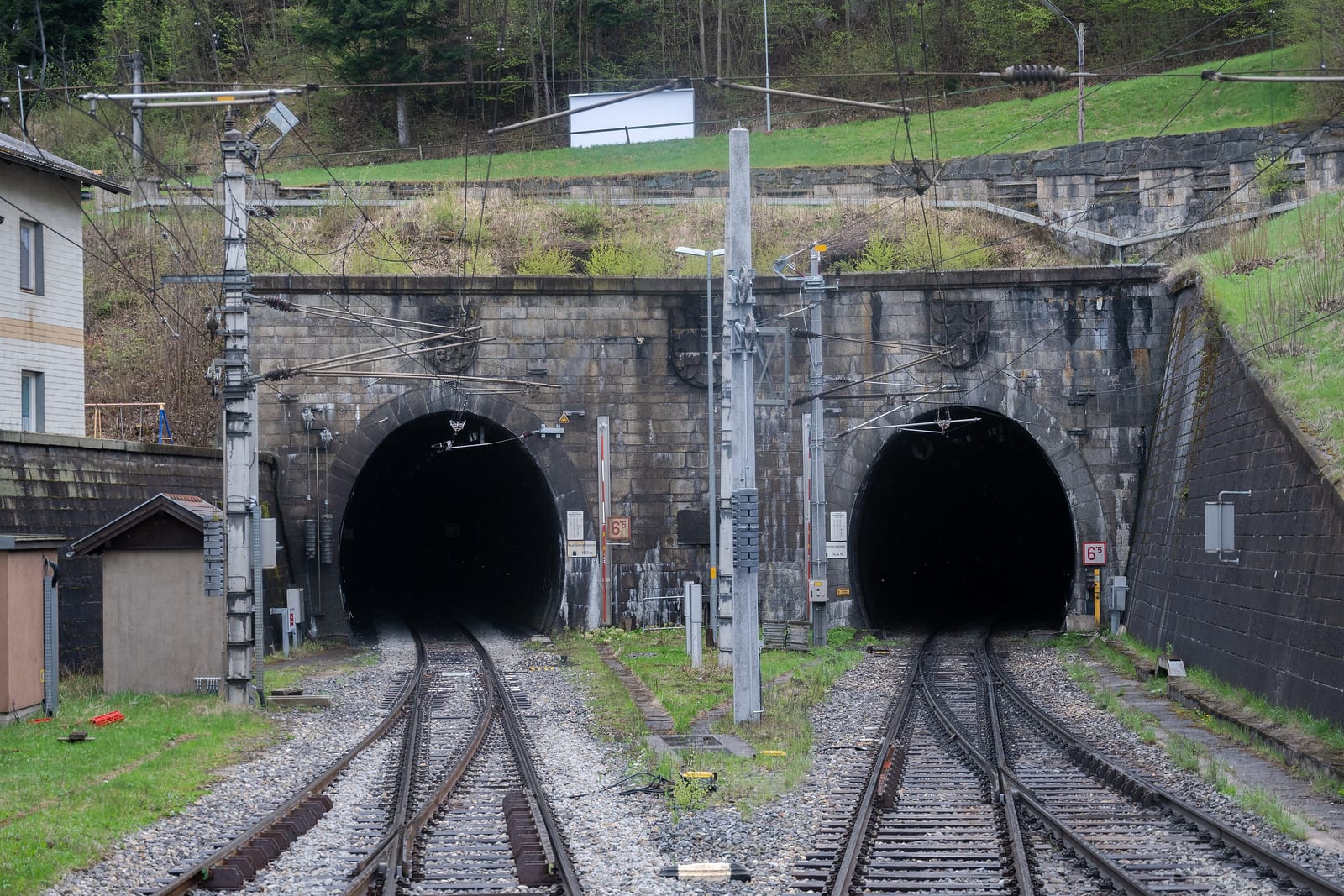 Linie29 / Wikimedia Commons · CC BY-SA 4.0
Walk the line
The Bahnwanderweg follows the railway on foot from Payerbach over the pass to Mürzzuschlag, along the viaducts and under the portals. Ride it one way, walk part of it back, and the engineering stops being scenery and becomes something you can touch.Timetables
There is no timetable to hunt down, because there is no special train. The Semmering is a main line, and you ride it on whatever ÖBB is running — and it runs a lot: up to about 30 trains a day cross the pass (Wien–Graz is ~2 h 40 overall, the mountain stretch Gloggnitz–Mürzzuschlag about 40 minutes), a mix of REX regional, Railjet, IC/EC and overnight Nightjet services.
How it works:
| Detail | What to expect |
|---|---|
| The line | Gloggnitz ⇄ Mürzzuschlag · 41 km · standard gauge |
| Profile | Gloggnitz 436 m → the pass at 895 m (after 29 km) → Mürzzuschlag 677 m |
| Journey time | About an hour end to end |
| Trains | ÖBB REX regional services, plus Railjet long-distance Vienna–Graz |
| From Vienna | Gloggnitz is roughly an hour out; the pass is an easy day trip |
| From 2030 | The Semmering Base Tunnel takes long-distance trains under the mountain |
Good to know:
- Sit on the right leaving Gloggnitz for the valley side and the viaducts. Coming the other way, sit on the left.
- The REX is better than the Railjet for this. It is slower, it stops at Payerbach, Klamm-Schottwien and Semmering, and it lets you get off — which you should.
- The best view isn't from the train. The 20-Schilling-Blick is a twenty-minute walk from Semmering station. Trains are frequent enough that stopping costs you an hour at most.
- Go on a clear day. In cloud you are riding a very good railway through a grey wall, and the whole point is the landscape it was built to sit in.
- Winter is spectacular and awkward. Snow on the viaducts is magnificent; the walking trails are not always passable. December to March if you want the picture, May to October if you want to walk.
- 2030 is coming, slowly. The base tunnel will divert the expresses and shorten Vienna–Graz by about half an hour. Regional trains are expected to keep running over the pass — but ÖBB has published no commitment about how many. Don't panic; don't dawdle either.
Frequency as of the 2026 timetable. Confirm current times with the operator — see the Tickets section below.
Tickets
This is the cheapest World Heritage Site you will ever visit. There is no heritage train, no excursion fare and nothing to book: the Semmering is an ordinary ÖBB main line, so you buy an ordinary ticket — Gloggnitz to Mürzzuschlag, or any part of it — and get on whatever is next. A local REX ticket over the pass is the right answer, a few euros and stopping where you want to get off. If you are travelling Vienna to Graz anyway, the World Heritage line comes free with the Railjet.
Eurail and Interrail are valid, and Railjet reservations are optional. Break the journey: a single over the pass is so cheap that stopping at Semmering for the walk costs almost nothing, and it is the best advice on this page. And take the train at least one way — it is tempting to drive to a viewpoint and photograph the viaducts, but this thing was built to be ridden.
Book your tickets
An ordinary ÖBB ticket
Gloggnitz–Mürzzuschlag
There is nothing special to buy. Any ÖBB regional (REX) or long-distance train over the pass runs the World Heritage line, and a point-to-point ticket costs a few euros. Rail passes are valid. Sit on the right leaving Gloggnitz.
Book Tickets (opens in a new tab, on ÖBB)via ÖBBVienna–Graz, the scenic way
The long-distance option
Railjet services between Vienna and Graz cross the Semmering as a matter of course, so the UNESCO section comes free with a journey you might be making anyway. From 2030 many of these will run under the mountain instead — take the slow way while it is the only way.
Book Tickets (opens in a new tab, on ÖBB)via ÖBBRail Passes
Interrail passes are valid. Interrail's table of railway companies lists ÖBB's regional trains and Railjets as included in Austria, so the whole Semmering line is covered by an Interrail Austria Pass or a Global Pass. Regional trains need no reservation; on a Railjet it is optional and costs €3.
For the Semmering alone, a pass is not worth buying. A regional ticket over the pass costs a few euros. A pass pays when the line is part of a longer trip, such as Vienna to Graz and on.
Checked October 2026 against interrail.com (opens in a new tab), Interrail's Austria page (opens in a new tab) and its reservation fees (opens in a new tab).
Places to Visit
The Semmering is an hour from Vienna, which means the whole thing works as a day trip — but the pass itself was a resort long before it was a World Heritage Site, and there is more here than the railway.
One stop deliberately left off the list below, because you have already seen it further up this page: Breitenstein, the village sitting directly underneath the Kalte Rinne. It is the best place on the whole line to see that viaduct in its landscape rather than from a distance, and the walking trail passes straight through it.
 Peakfocus / Wikimedia Commons · CC BY 4.0 · cropped
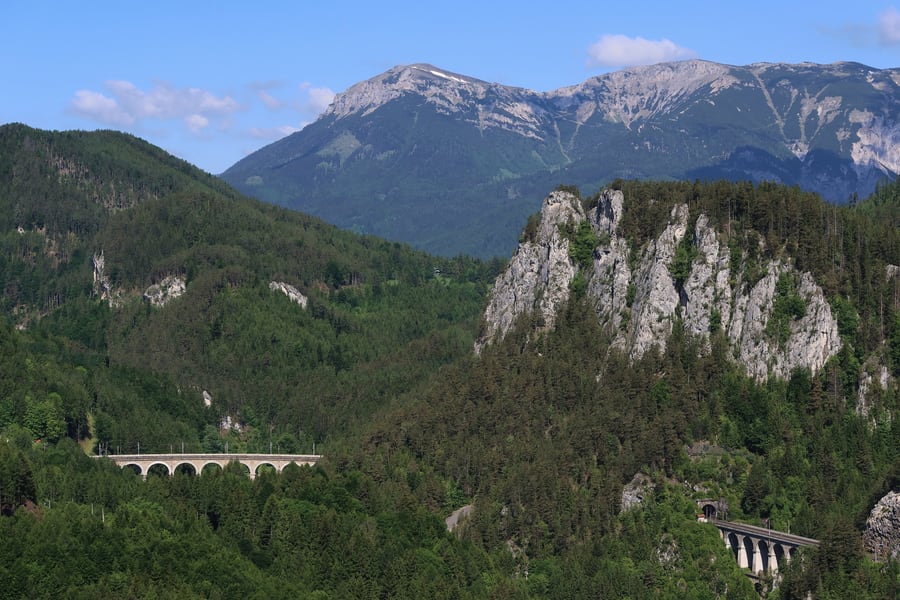
The Bahnwanderweg
The railway walking trail, and the reason to get off. It follows the line from the Schwarza valley over the pass to Mürzzuschlag — roughly 17 km from Semmering station — along the viaducts and past the tunnel portals. You do not have to walk all of it: three-quarters of an hour above Semmering gets you to the 20-Schilling-Blick, the view of the stacked viaducts that was printed on the old banknote and cannot be seen from the train.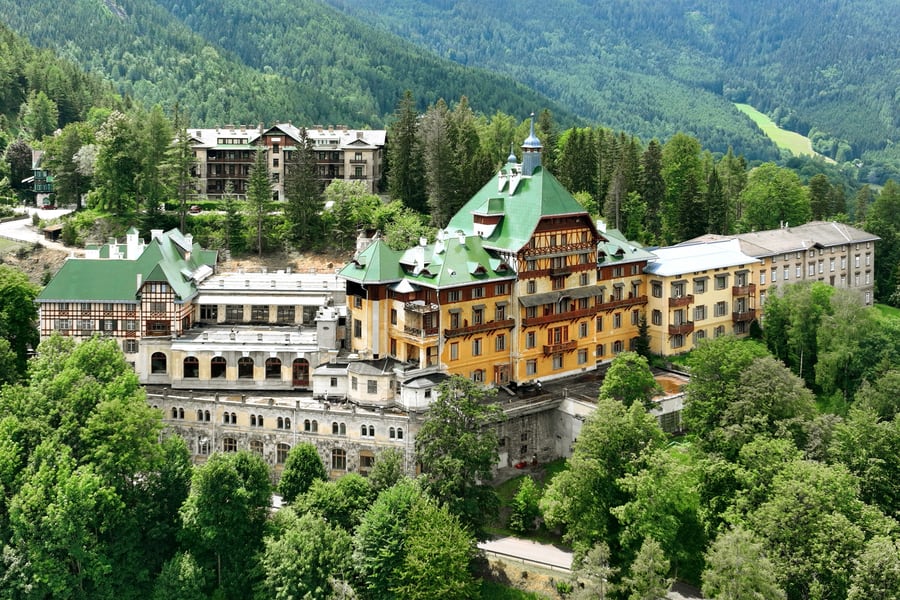 Foto: C.Stadler/Bwag / Wikimedia Commons · CC BY-SA 4.0 · cropped
Semmering
The village at the pass, at about 950 m, and a Habsburg-era resort the railway invented. Vienna came up for the air, and the Südbahnhotel — built by the railway company itself and opened on 15 July 1882 — filled with Kokoschka, Adolf Loos and Alma Mahler-Werfel. It emptied after 1938, when its Jewish clientele stopped coming, and shut as a hotel in 1976. Some 544 people live here now, against 1,910 a century ago.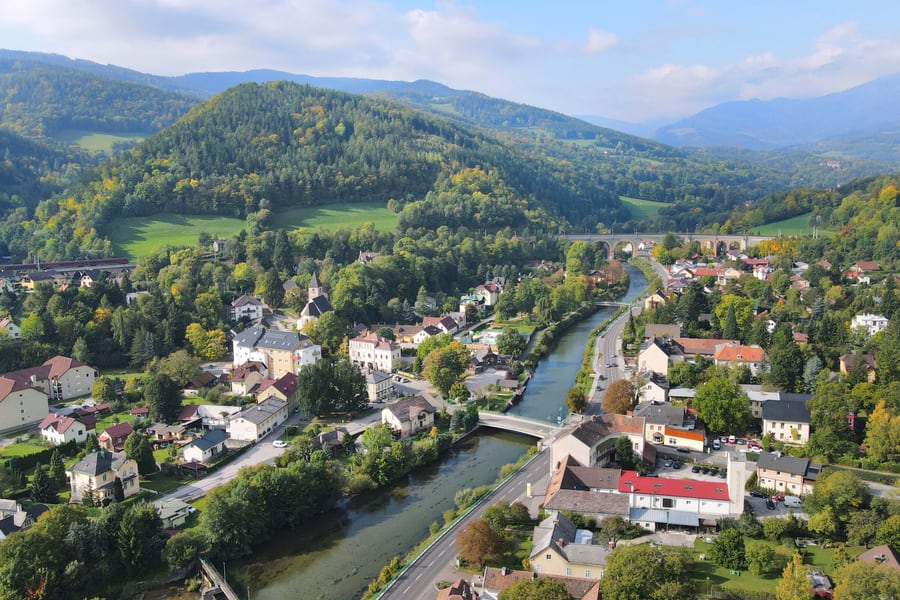 Foto: C.Stadler/Bwag / Wikimedia Commons · CC BY-SA 4.0 · cropped
Payerbach and Reichenau an der Rax
Two spa villages that exist because the train arrived: the Südbahn reached the valley in 1842 and Vienna's aristocracy followed. Franz Joseph and Crown Prince Rudolf summered at Reichenau, and Arthur Schnitzler wrote Leutnant Gustl at the Thalhof in six days in the summer of 1900. Above Payerbach the line crosses the Schwarza viaduct — 228 m of stone on thirteen arches, built 1849–51, the first of Ghega's great structures.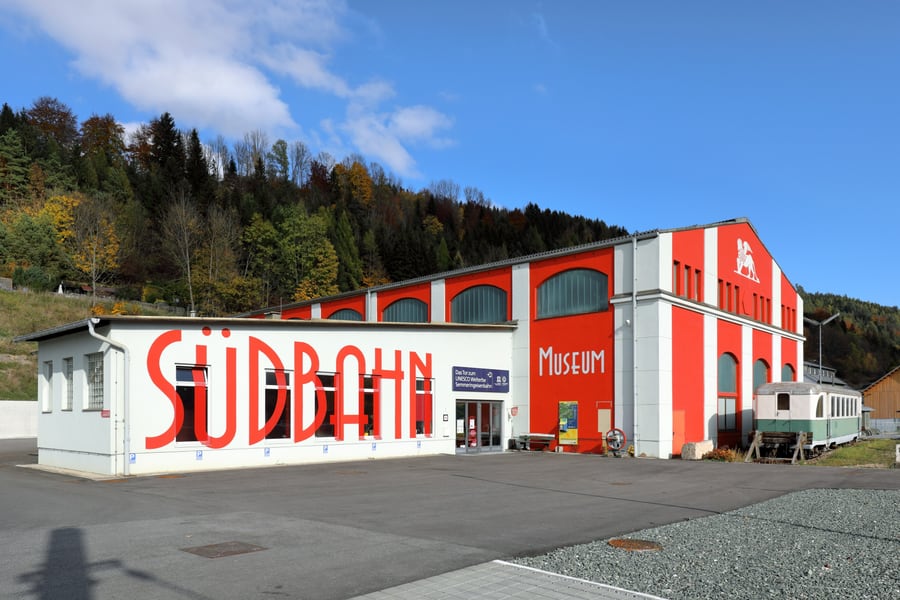 Foto: C.Stadler/Bwag / Wikimedia Commons · CC BY-SA 4.0 · cropped
Mürzzuschlag
The Styrian end of the line, at 670 m, and the serious place to understand what Ghega did: the Südbahn Museum occupies the old railway works. The town also keeps what it calls the world's largest winter sports museum, and a Brahms Museum on Wiener Straße — the composer spent the summers of 1884 and 1885 in that house and wrote the whole of his Fourth Symphony there, along with a great many songs.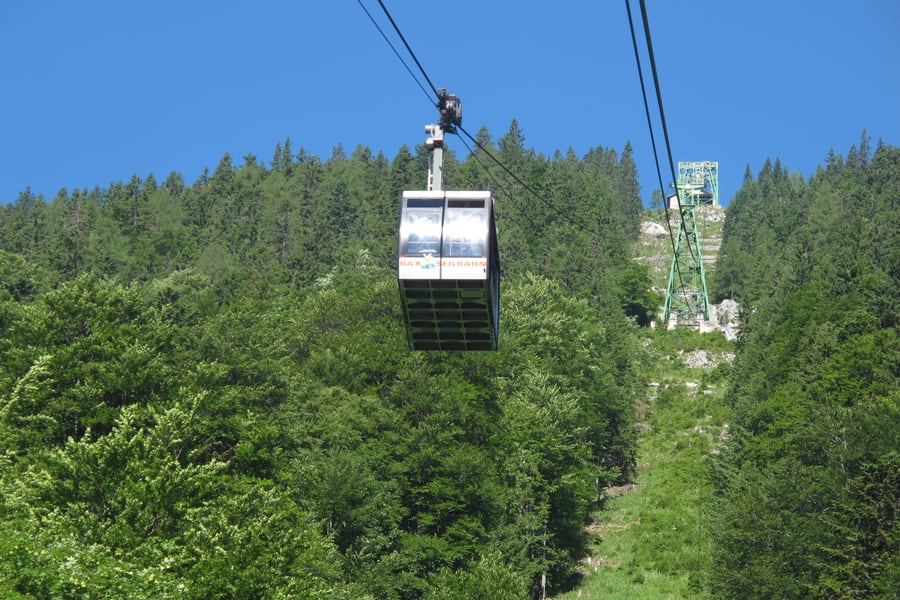 Kstipek / Wikimedia Commons · CC BY-SA 4.0 · cropped
The Rax
One of the two mountains that dominate the view from the line, and much the easier to get onto. The Raxseilbahn has run from Hirschwang, just up the valley from Payerbach, since June 1926, when it was the first tourist cable car built anywhere in Austria. It takes under ten minutes to haul you up 2,160 m of cable to a 1,546 m plateau of high meadow and limestone, with paths in every direction.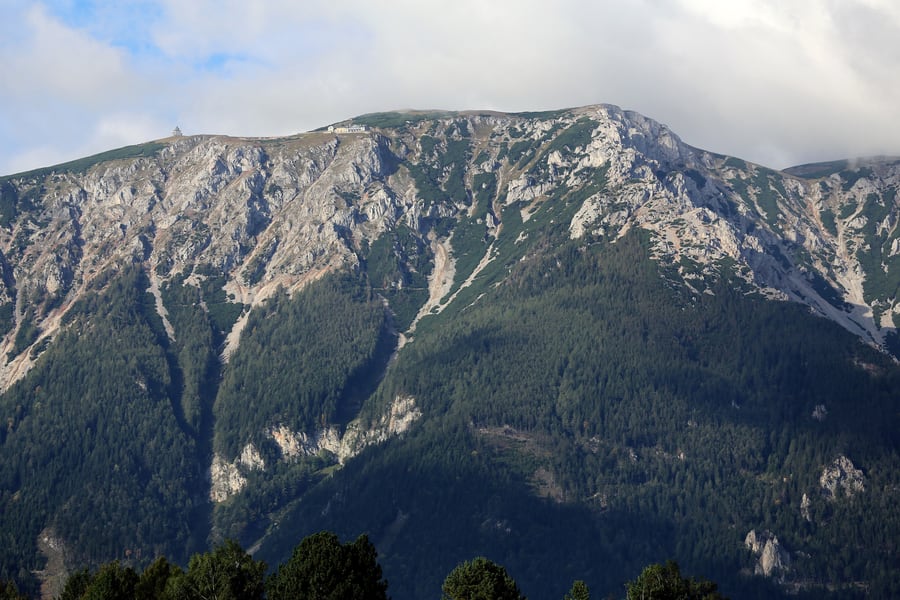 Manfred Werner - Tsui / Wikimedia Commons · CC BY-SA 3.0 · cropped
The Schneeberg
The other one, and the bigger: 2,076 m at the Klosterwappen, the highest mountain in Lower Austria and the easternmost peak in the Alps to top 2,000 m. The Schneebergbahn rack railway has climbed from Puchberg since 25 September 1897 — 9.8 km, the longest in Austria — and finishes at Hochschneeberg, 1,796 m, the highest railway station in the country. Franz Joseph rode up it in 1902.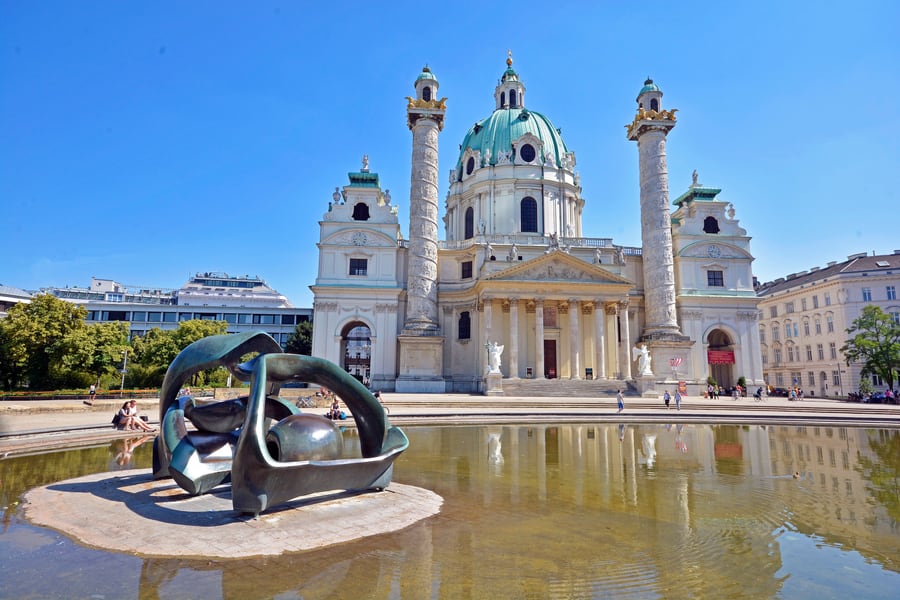 Guido Radig / Wikimedia Commons · CC BY-SA 4.0 · cropped
Vienna
An hour down the line, and the reason the Semmering exists at all. This pass was the missing link in the Südbahn, the railway from the imperial capital to Austria's only seaport at Trieste — everything Ghega built up here was built to get Vienna to the Adriatic. Which also makes the city the obvious base: ride out after breakfast, walk part of the line, and be back for dinner.Where to Sleep
Most people do the Semmering from Vienna and are back for dinner. It is an hour to Gloggnitz, an hour over the pass, and an hour home — a very civilised day, and there is no need to sleep anywhere near it.
But the pass is a resort, and staying up there is a genuinely different experience.
Semmering village became Vienna's mountain playground the moment the railway opened, and it never quite stopped. The hillside is covered in Habsburg-era hotels and villas — some restored to a high polish, some sliding gently into romantic decay, all of them built by people who came up on Ghega's line to look at the view. Staying in one is the closest you will get to understanding why a railway was decorated. It is quiet, slightly faded, and out of season it can feel like a film set with nobody on it.
Payerbach and Reichenau an der Rax, down in the valley, are the softer option: spa villages with good, ordinary hotels, on the line, and better placed for walking the Bahnwanderweg from the bottom up.
Mürzzuschlag, at the Styrian end, is a working town rather than a resort — cheaper, plainer, and the place to stay if the Südbahn Museum is your reason for coming.
Two practical notes. First, you don't need a car, and you'll enjoy it more without one: everywhere worth staying is on the railway, which is the point. Second, if you want the pass at its best, come out of season — the hotels are cheapest, the light in autumn on the Breitenstein hillside is extraordinary, and you will have the viewpoint to yourself.
Questions or corrections
Planning this trip and stuck on something, or spotted a time, fare or detail that has changed? Send us a message about Semmering Railway. We read every one, and we update this page when something has changed.