Frederikshavn to Skagen: the Skagensbanen
Mef.ellingen / Wikimedia Commons · CC BY-SA 4.0
- Distance39.7 km · 37 min
- Duration37 min
- Best seasonYear-round · half-hourly on weekdays
Introduction
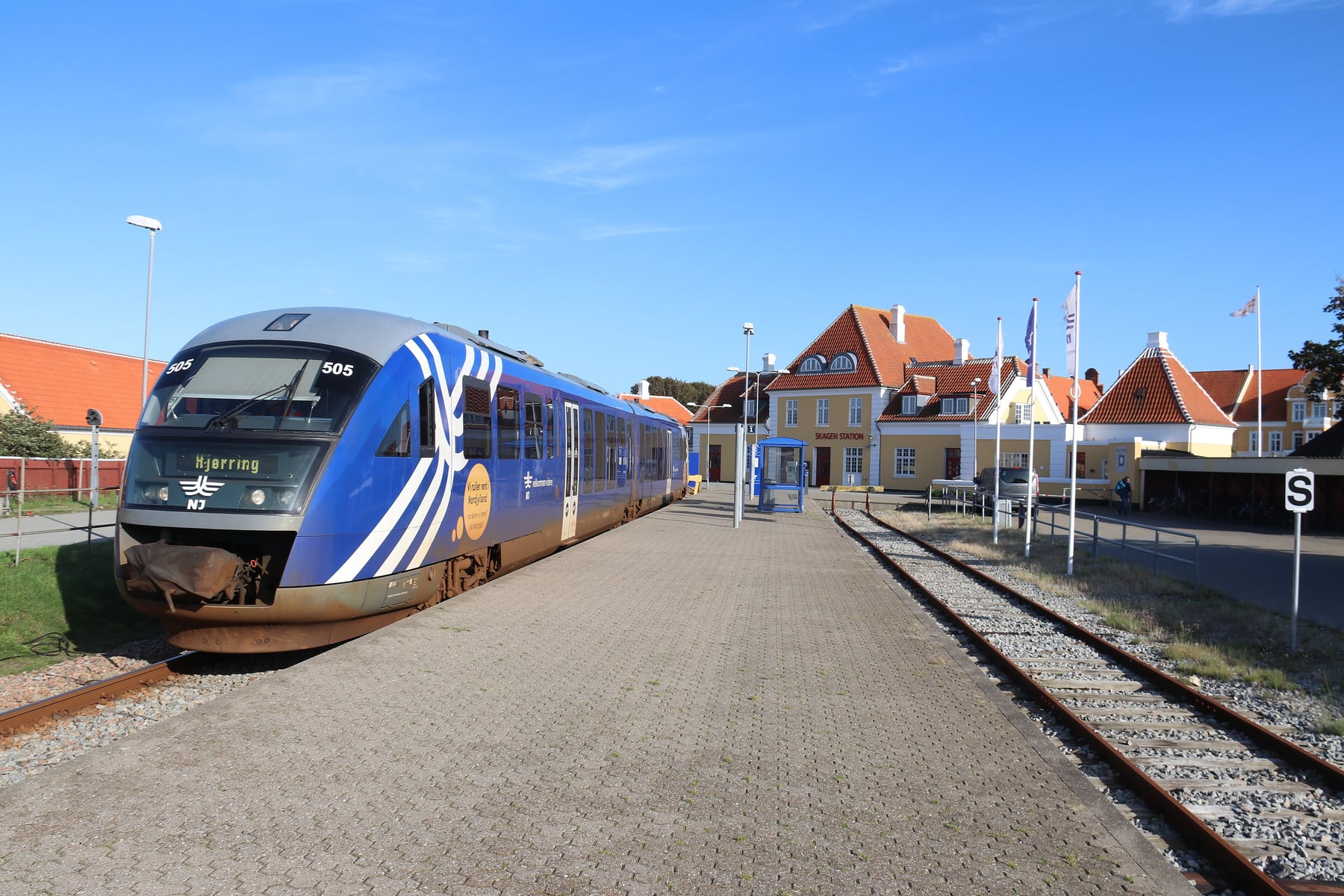
Denmark's railways mostly do what railways do everywhere: they connect one town to the next, on schedules built around commuters and schoolchildren. The Skagensbanen is one of those ordinary lines. It has no heritage season, no volunteers, no vintage rolling stock — just a Nordjyske Jernbaner regional train, running roughly every half hour on weekdays, over 39.7 kilometres of North Jutland coast.
What makes it worth a page is where it ends. Skagen is the northernmost town in Denmark, a former fishing port turned artists' colony turned seaside resort, and a few kilometres further on the land itself runs out at Grenen, where two seas meet. The train that gets you there is nothing special to look at. The place it goes to is one of the more distinctive spots on the Danish map.
The line has a second story worth knowing before you board: it was built as a narrow-gauge railway in 1890, and rebuilt to standard gauge in 1924 for a single, practical reason — to stop Skagen's fish catches being unloaded and reloaded at Frederikshavn on their way to market. The railway has been carrying ordinary passengers alongside that freight, in one form or another, for well over a century.
The Journey
The train leaves Frederikshavn, North Jutland's main ferry and rail hub, and almost immediately turns for the coast. Within six minutes it calls at Strandby, a small fishing harbour on Ålbæk Bay — and the town, and the diversion that carries the line through it, are both there because of the railway's own history: when the Skagensbanen was rebuilt to standard gauge in 1924, its route was moved off the original alignment through Elling and onto this one instead.
Up the coast
From Strandby the line runs close to the shore of Ålbæk Bay for most of its length, calling at small halts — Rimmen, Jerup, Napstjært, Ålbæk, Bunken — that serve villages and holiday-home settlements rather than towns of any size. The landscape alongside the track shifts from farmland to plantation to open heath: the line skirts Bunken Plantage, a planted forest laid out to stop the dunes migrating, and then Hulsig Hede, a stretch of open heath and dune grass that runs unbroken from coast to coast across the narrowing peninsula.
Hulsig, and the last stretch
At Hulsig, the train reaches its fastest permitted speed on the line — 120 km/h for the final approach, up from 100 km/h on the stretch south of here. One more halt, Frederikshavnsvej, and the train pulls into Skagen, 37 minutes and ten stops after leaving Frederikshavn.
Journey's end
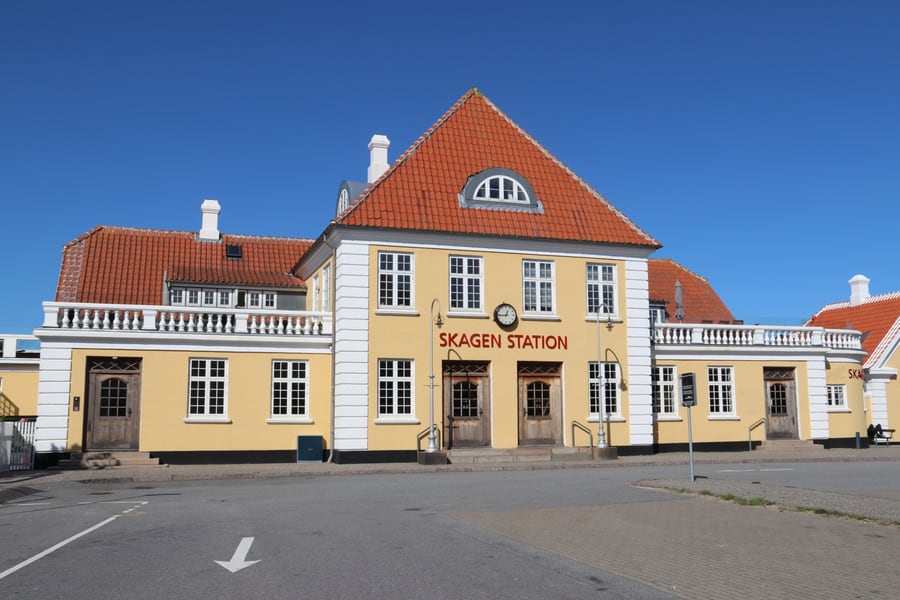
Skagen station itself is worth a look before heading into town: a 1919 building by the architect Ulrik Plesner, built in the same yellow-plastered, red-tiled style as the rest of the town, with a waiting room that was once furnished for the exclusive use of the king. From here it is a short walk into Skagen's old town, and about three kilometres further to Grenen, where the coastline finally gives out.
What this line is not
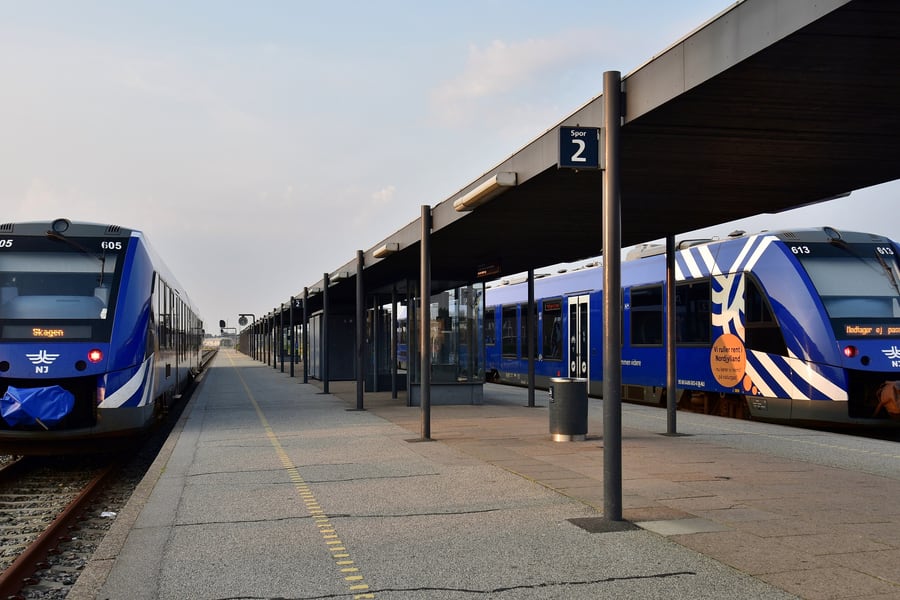
There is nothing special about the ride itself. This is standard regional rolling stock — Siemens Desiro units introduced in 2004, alongside newer Alstom Coradia LINT 41 sets delivered from 2017 — with no observation windows and no commentary. The appeal of the Skagensbanen is not the technology or the scenery from the window on any given stretch; it is that an ordinary half-hourly train will take you, on an ordinary ticket, to the very top of the country.
Along the route
Mef.ellingen / Wikimedia Commons · CC BY-SA 4.0Built for fish, rebuilt for fish
The line opened in 1890 as a narrow-gauge railway, cheap to build but awkward for freight: fish from Skagen had to be reloaded at Frederikshavn before it could go anywhere. In 1924 the whole line was rebuilt to standard gauge to remove that step, and the route itself moved.Mef.ellingen / Wikimedia Commons · CC BY-SA 4.0Denmark ends at the platform
Skagen is the northernmost town in Denmark, and its 1919 station once kept a waiting room furnished specially for King Christian X. From the platform it is a short walk into town and about three kilometres on to Grenen, where the land itself runs out.Bahnfrend / Wikimedia Commons · CC BY-SA 4.0An everyday train, not an excursion
There is no season here and no special ticket. The 39.7 km route runs an ordinary regional service — half-hourly on weekday daytimes — carrying commuters, schoolchildren and holidaymakers on the same trains, all year round.A bit of history
Culture & experiences along the way
 Duotoned / Wikimedia Commons · CC BY-SA 4.0 · cropped
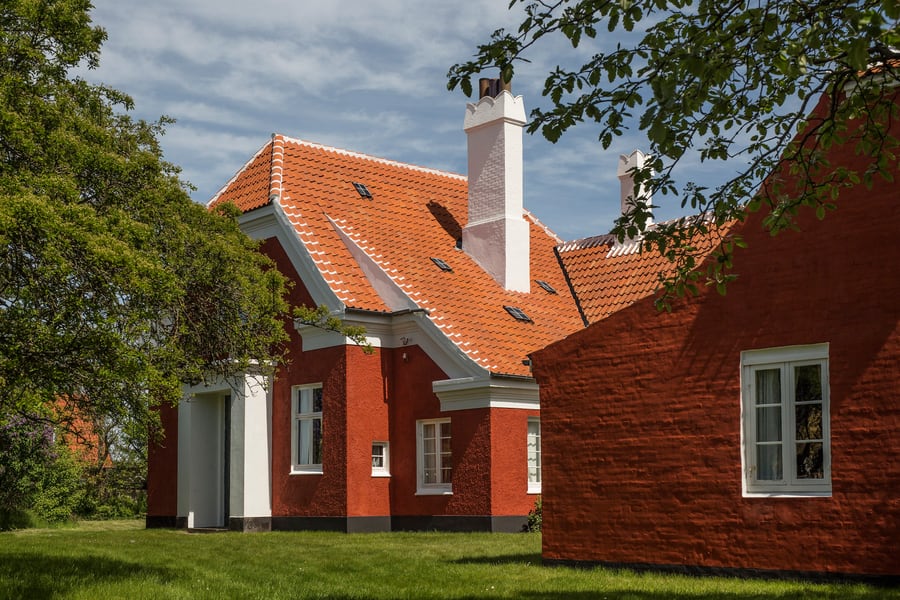
The Anchers' house, left as it was
Michael and Anna Ancher bought the house on Markvej and filled it with their own work and their friends' — Krøyer, Drachmann, Tuxen — and it is kept as a home rather than a gallery, down to the studio, the furniture and the paintings hung four deep. It is the quietest of Skagen's museums and the one that explains the rest.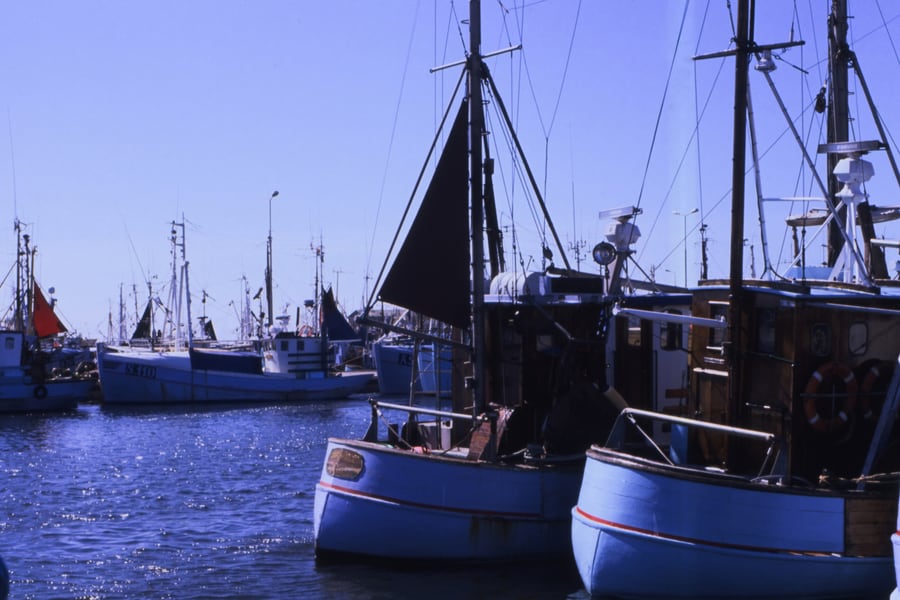 Rüdiger Stehn / Wikimedia Commons · CC BY-SA 2.0 · cropped
Eat what the harbour lands
Skagen is one of Denmark's biggest fishing ports and the whole town still turns on it. The quays are open to walk, the auction runs in the small hours, and the restaurants along the harbour front sell what came in that morning — plaice, cod, and the cold prawn sandwiches the town is quietly famous for.Timetables
This is a scheduled regional service, so there is no operating calendar to check and no season to plan around. Trains run every day of the year.
Times below are correct as of August 2026, taken from Rejseplanen's published schedules for the timetable period 18 August to 4 November 2026.
Frederikshavn → Skagen
| time | |
|---|---|
| Frederikshavn dep | :45 past the hour (daily) |
| Strandby | +6 min |
| Rimmen | +8 min |
| Jerup | +13 min |
| Napstjært | +15 min |
| Ålbæk | +19 min |
| Bunken | +22 min |
| Hulsig | +27 min |
| Frederikshavnsvej | +34 min |
| Skagen arr | +37 min |
So the 16:45 from Frederikshavn calls at Strandby 16:51, Jerup 16:58, Ålbæk 17:04, Hulsig 17:12 and reaches Skagen at 17:22 — a pattern verified against the operator's own connection search for this date.
On weekday daytimes, an extra service runs 30 minutes ahead of the daily pattern — for example 17:15 alongside the daily 17:45 — giving half-hourly service Monday to Friday during the day. Outside those hours, and on Saturdays and Sundays, the service is hourly.
First and last trains: the daily service starts at 05:45 and ends at 23:45; on weekdays an earlier working leaves at 05:15. Trains run in both directions on the same pattern.
Where to check before you travel
Live times, and any disruption to the pattern above: nj.dk (opens in a new tab), which links through to the regional operator Nordjyllands Trafikselskab's own journey planner, or rejseplanen.dk (opens in a new tab) for the national picture.
Tickets
There is nothing to book. This is an ordinary regional train, so an ordinary ticket between the two stations is all you need — no reservation and no seat allocation — sold at station machines, in the RejseBillet app and on Rejsekort. Danish regional fares are zone-based and change, so no figure is quoted here; as a guide, single Rejsekort fares in the region run from 24 kr for two zones up to 240 kr for twenty-four.
One thing worth comparing: DSB Orange advance fares are also valid here, so the state operator's cheap tickets are worth pricing against the regional zone fare. They are limited in number and not sold for every train. With a half-hourly weekday service you can break the journey anywhere without planning around it, and bicycles travel free.
Book your tickets
A regional single
Zone-based, from 24 kr for two zones
Sold at machines, in the RejseBillet app and on Rejsekort; no reservation.
Book Tickets (opens in a new tab, on ntrejse.dk)via ntrejse.dkDSB Orange
The national advance fare, valid on this line
Limited in number and not sold for every train, but worth pricing against the zone fare.
Book Tickets (opens in a new tab, on dsb.dk)via dsb.dkRail Passes
A rail pass covers this journey outright, which is not something every Danish private railway can say.
Interrail and Eurail
Nordjyske Jernbaner is fully included in an Interrail or Eurail pass — Interrail's own country information for Denmark lists NJ alongside DSB, the Copenhagen S-tog and Lokaltog as operators the pass carries you on, with nothing extra to pay. Øresundståg is included too.
That means the whole trip is covered end to end: a Global Pass or a Denmark One Country Pass takes you from Copenhagen or Aalborg to Frederikshavn on DSB, and from Frederikshavn to Skagen on Nordjyske Jernbaner, on the same pass day. No reservation is needed on any of it — these are ordinary regional and InterCity trains with no seat allocation.
Checked against Interrail's published country information in August 2026.
Whether a pass is worth buying for this
Only as part of something larger. Denmark is small and domestic fares are modest, so a pass day spent on a return to Skagen is an expensive way to buy a cheap ticket. Where the arithmetic changes is on a longer Danish itinerary — Copenhagen, Odense, Aarhus, Aalborg, then north to Skagen — or on a Nordic trip using Frederikshavn's ferries onward to Sweden and Norway, where the run up to the top of Jutland becomes a free afternoon rather than a separate purchase.
Interrail also sells the Nordic Pass (opens in a new tab), valid in Denmark, Norway, Sweden and Finland and across the borders between them: €218 for 3 travel days in a month for an adult in second class, against €137 for the Denmark Pass. It cannot be used in the country you live in, only in the other three. For a trip that carries on into Sweden or Norway, it is the pass to compare with a Global Pass. Checked October 2026.
If you are not on a pass
DSB Orange and Orange Fri, the national operator's advance discount fares, are valid on this line: DSB's own conditions state they apply between DSB, GoCollective and NJ stations, as well as Skånetrafiken's trains in Denmark, though not on buses, the metro, light rail or other local and private railways. They are limited in number and not sold for every train, so the regional zone fare is sometimes the better of the two.
The alternative is the zone fare sold by Nordjyllands Trafikselskab, which is the ordinary way to travel within North Jutland and needs no advance purchase at all.
Current pass rules: interrail.com (opens in a new tab) or eurail.com (opens in a new tab). DSB's fare conditions: dsb.dk (opens in a new tab). Correct as of August 2026.
Places to Visit
Skagen is a small town, and everything below is within walking distance of the station or a short bus ride away. Between them, the three places on this page cover what draws most visitors here: the geography, the history buried under it, and the art it produced.
 Olgierd Rudak / Wikimedia Commons · CC BY-SA 4.0
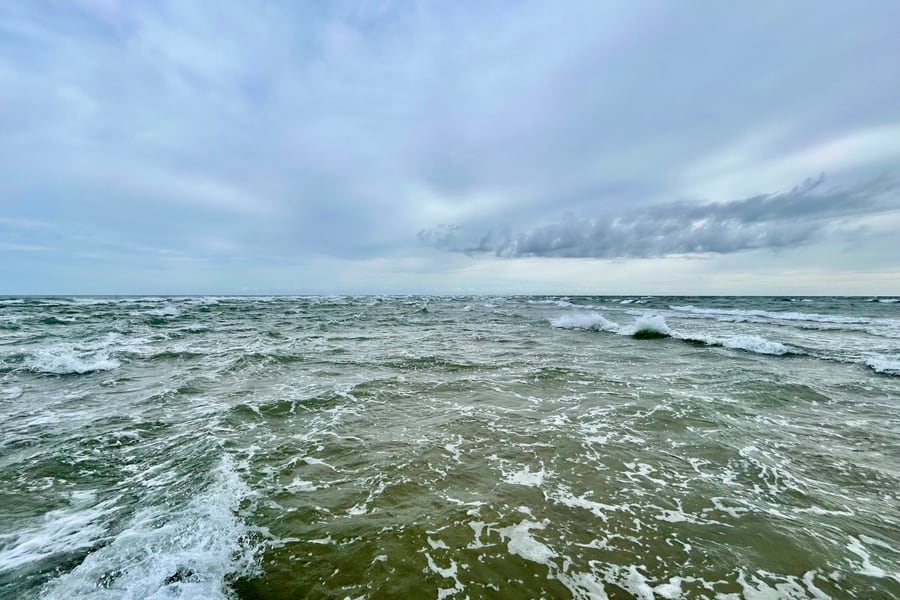
Grenen
The sandy spit at the very tip of Denmark, about 3 km north of Skagen station, where the Skagerrak and the Kattegat meet in crossing waves — dramatic to look at, and too dangerous to swim in where the currents collide. A tractor-drawn wagon, the Sandormen, has carried visitors out along the beach to the point since the 1970s, running from Easter to around week 43; four marked trails also cross the dunes on foot.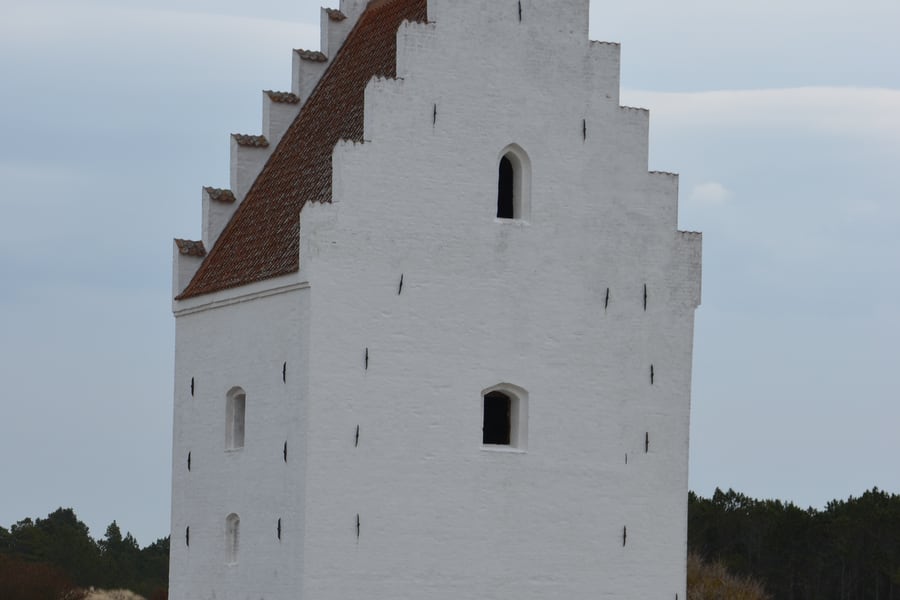 Bengt Oberger / Wikimedia Commons · CC BY-SA 3.0
Den Tilsandede Kirke
The buried church — a 14th-century Gothic church built of brick brought from Lübeck and the Netherlands, once the largest in the region. Drifting sand began burying it in the 17th century, and by 1795 a royal decree closed it for good and let the dunes take the rest. Only the 18-metre bell tower still stands clear of the sand; the grounds around it are free to visit.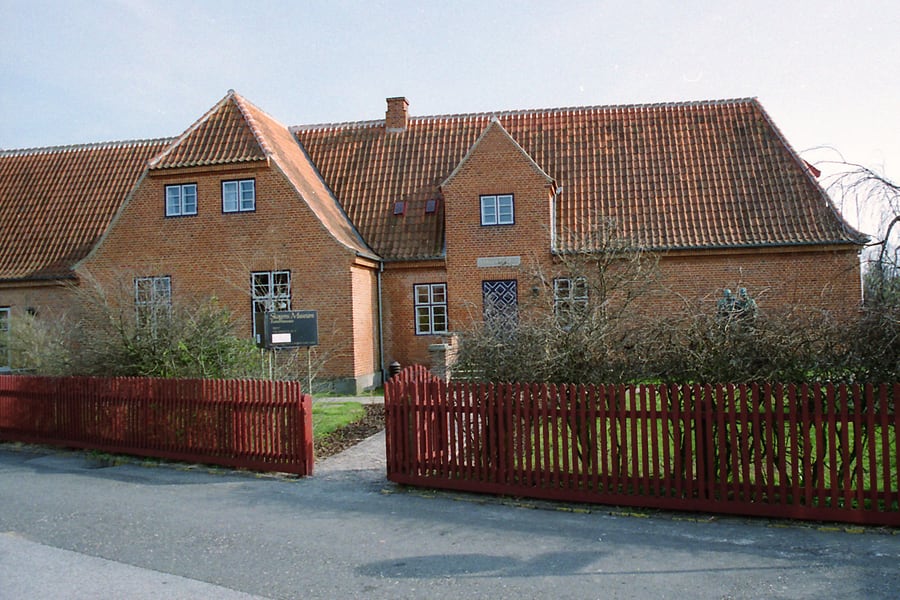 Zejo / Wikimedia Commons · Public domain
Skagens Museum
Founded in 1908 by a group that included the painters Michael Ancher and P.S. Krøyer, and the hotelier Degn Brøndum, this is the home of the Skagen Painters — the artists' colony drawn here from the 1870s by the quality of the northern light. The museum building was completed in 1928; a 2014 merger with two of the painters' own houses brought the collection to almost 11,000 works.Where to Sleep
Skagen has been a resort town for well over a century, and its older hotels are as much a part of its history as the museum or the artists' colony that made it famous. Both of the hotels below are survivors of that period, still trading under their original names.
Where to stay
 Toxophilus / Wikimedia Commons · CC BY-SA 4.0
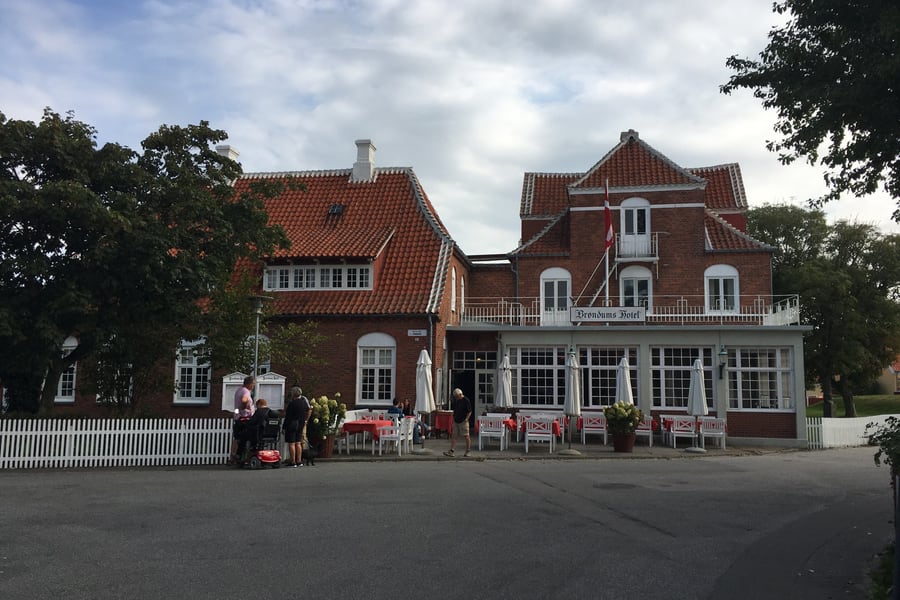
Brøndums Hotel
Historic, opposite Skagens Museum
A gathering place for the Skagen Painters since the 19th century, standing directly across from the museum that grew out of their work. It is about 600 metres from the centre of Skagen and around a kilometre from Skagen station.
Check Availability (opens in a new tab, on brondumshotel.dk)via brondumshotel.dk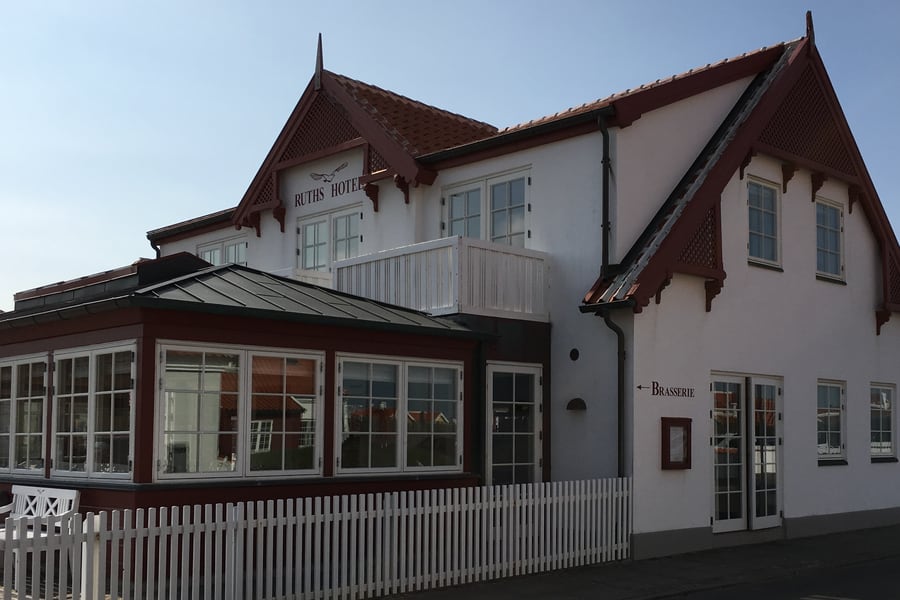 Toxophilus / Wikimedia Commons · CC BY-SA 4.0
Ruths Hotel
Beachfront at Gammel Skagen, Michelin-starred restaurant
Opened in 1904 as a bathing guesthouse in Gammel Skagen, on the western, Skagerrak side of the peninsula. Its restaurant, Ruths Gourmet, was awarded Skagen's first Michelin star in the 2026 Michelin Guide.
Check Availability (opens in a new tab, on ruths-hotel.dk)via ruths-hotel.dkQuestions or corrections
Planning this trip and stuck on something, or spotted a time, fare or detail that has changed? Send us a message about Frederikshavn to Skagen: the Skagensbanen. We read every one, and we update this page when something has changed.