The Sub-Balkan Line — Sofia to Burgas through Bulgaria's Longest Tunnel
Petr Štefek / Wikimedia Commons · CC BY-SA 3.0 cz
- DistanceSofia–Burgas · 418 km
- DurationAbout 6 hours
- Best seasonYear-round · the Rose Valley is in flower from late May
Introduction
There are two ways to reach the Black Sea from Sofia by train. One runs east through Plovdiv along the Thracian plain, which is the way most people go and the way the map suggests. The other turns north-east out of the capital, climbs into the valley between the Balkan Mountains and the Sredna Gora, and disappears into a hole in the hillside above Koprivshtitsa.
That hole is the Koznitsa tunnel: 5,808.5 metres under the Koznitsa ridge, opened on 6 June 1951, and still the longest railway tunnel in Bulgaria. For most of its working life it was also the thing that made this route slow. The bore had not been rebuilt in nearly fifty years, and trains crossed it at 25 km/h — a walking pace held for more than five kilometres, every single service, in both directions.
It was rebuilt in 2021. The line's speed limit through the tunnel went up to 100 km/h, and the consequence is visible in the timetable rather than in the ground. The Sub-Balkan route is 418 kilometres from Sofia to Burgas against 450 by way of Plovdiv, and today it carries the fastest train between the two cities — five hours and forty-nine minutes, against six hours forty-two by the plain. The mountain way is now the quick way.
What the ride is actually like
None of that is why you would take it. You would take it because it is one of the loveliest stretches of everyday railway in the Balkans, and it costs somewhere around twelve to fourteen euros in second class.
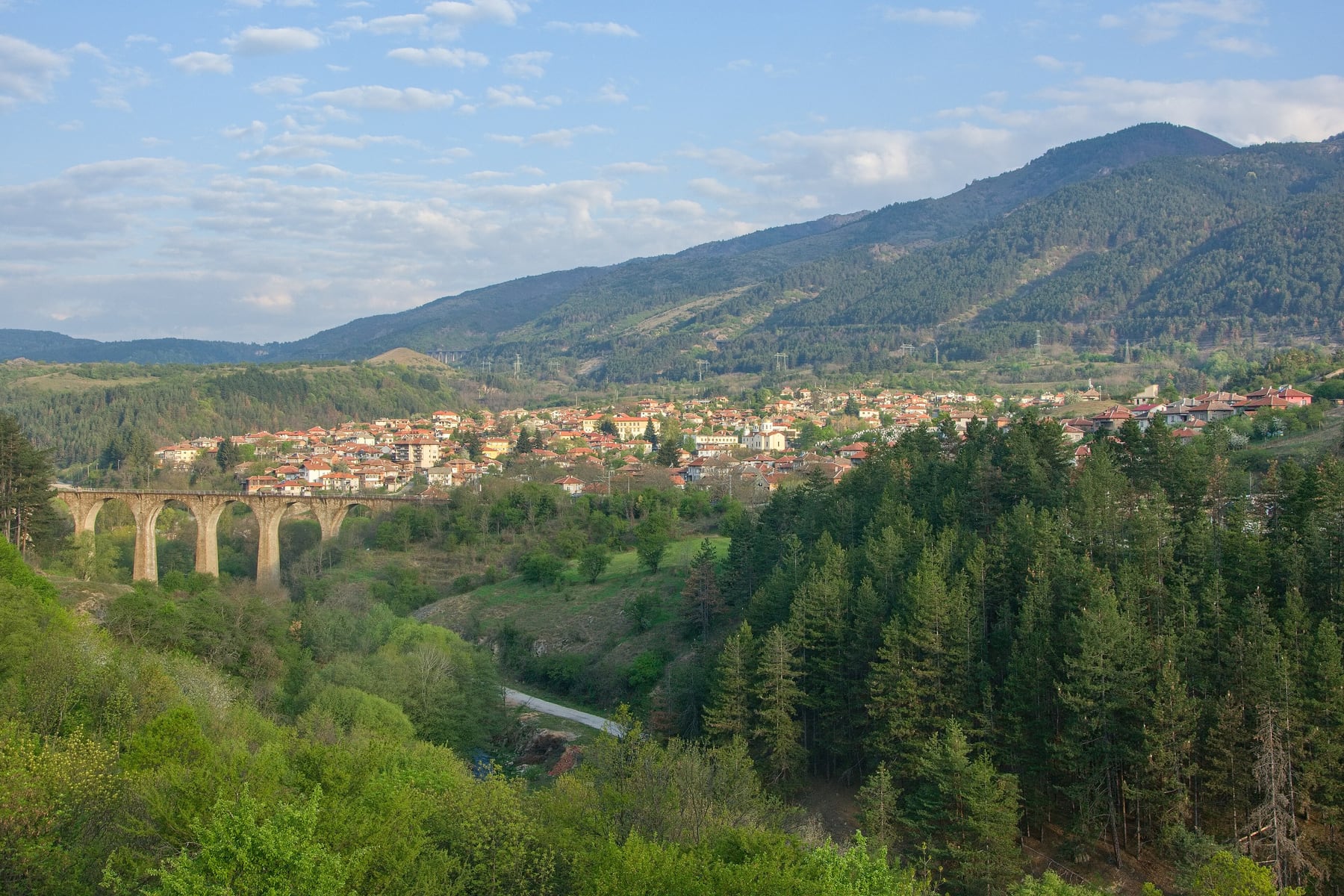
The train spends its first hour crossing the flat country east of Sofia, then begins to climb through Zlatitsa and Pirdop with the Balkan range rising steadily on the left. At Koprivshtitsa it stops in a river gorge with nothing around it but forest — the town it serves is nine kilometres away over the hill. Then the tunnel, and on the far side the whole character of the journey changes: the line comes out into the Stryama valley, drops down past Klisura on stone viaducts, and runs the length of the Rose Valley with the mountains on one side the entire way to Kazanlak. After Sliven it lets go of the hills, crosses the plain to Karnobat and reaches the sea at Burgas in the evening.
It is an ordinary BDŽ service — no heritage stock, no dome cars, no premium. Three trains a day each way, a compulsory seat reservation costing 51 cents, and some of the best mountain scenery in the country going past the window for the price of a sandwich.
The Journey
The Sub-Balkan line is Bulgaria's Main Railway Line 3, and it took forty-five years to finish. Its outer ends came first, built as ordinary lowland railways: Zimnitsa to Karnobat opened on 23 May 1907, Tulovo to Kazanlak on 21 November 1921, Dabovo to Tvarditsa in 1928, Tvarditsa to Sliven in 1930, and the western end from Iliyantsi to Makotsevo on 6 December 1931.
What stood between them was the mountains. The section from Makotsevo to Sopot was surveyed and re-surveyed for close to thirty years before a final alignment was adopted in 1940, and it was built piecemeal after that: Karlovo to Kazanlak on 3 October 1939, Karlovo to Sopot that November, Sopot to Klisura on 14 September 1947, Makotsevo to Dolno Kamartsi in 1949. The last piece went in last. A first train ran the whole way on 7 September 1952, and the complete Sofia–Karlovo–Karnobat–Burgas line was opened on 21 December 1952 — the country's third east–west artery.
The tunnel that held it up
The engineering that mattered is under the Koznitsa ridge, where the Balkan Mountains meet the Sredna Gora. The Koznitsa tunnel runs 5,808.5 metres between the stations of Koprivshtitsa and Stryama, single track, rising to a highest point of 818 metres. It was finished on 6 June 1951 and has been the longest railway tunnel in the country ever since; the Ministry of Transport calls it the longest on the Balkan peninsula. The line's second-longest bore, Galabets at 3,030 metres, was completed five months later.
Electrification came much later and in stages — Sofia to Karlovo in 1968, Karlovo to Tulovo in 1969, on to Sliven by 1971 — and the tunnel was wired with the rest of it. Then it was left alone. By the 2010s it had gone, in the ministry's own words, close to fifty years without reconstruction, and the speed through it had been cut to 25 km/h.
The rebuild was inspected and signed off on 23 August 2021. It cost 29,029,775.15 leva including VAT, renewed 5,812 metres of track bed, built drainage, laid partial waterproofing, replaced the overhead line and put lighting and video surveillance into the bore. The permitted speed went back up to 100 km/h.
Sofia to the tunnel
Trains leave Sofia Central and thread the eastern suburbs — Poduyane, Iskarsko Shose, Kazichene — before the country opens out. This is the Zlatitsa–Pirdop valley, a wide agricultural trough with the Balkan Mountains filling the windows on the left and the softer Sredna Gora on the right. Zlatitsa and Pirdop are the only substantial stops.
Thirteen minutes past Pirdop the line turns into the gorge of the Topolnitsa and stops at Koprivshtitsa, a 1951 station building by the architect Vello Debelyanov standing alone among wooded hills. Immediately beyond it the train enters the Koznitsa tunnel.
The Rose Valley and the run to the sea
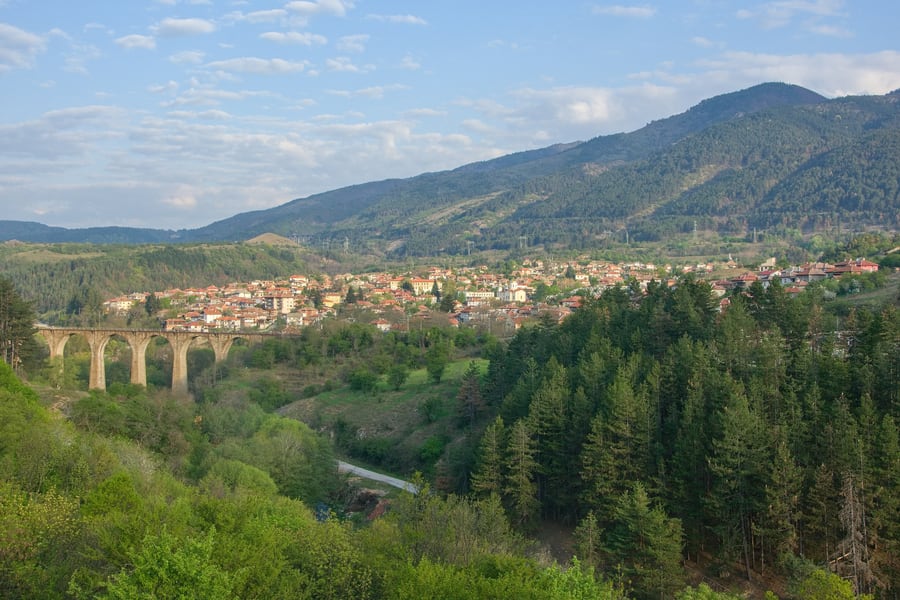
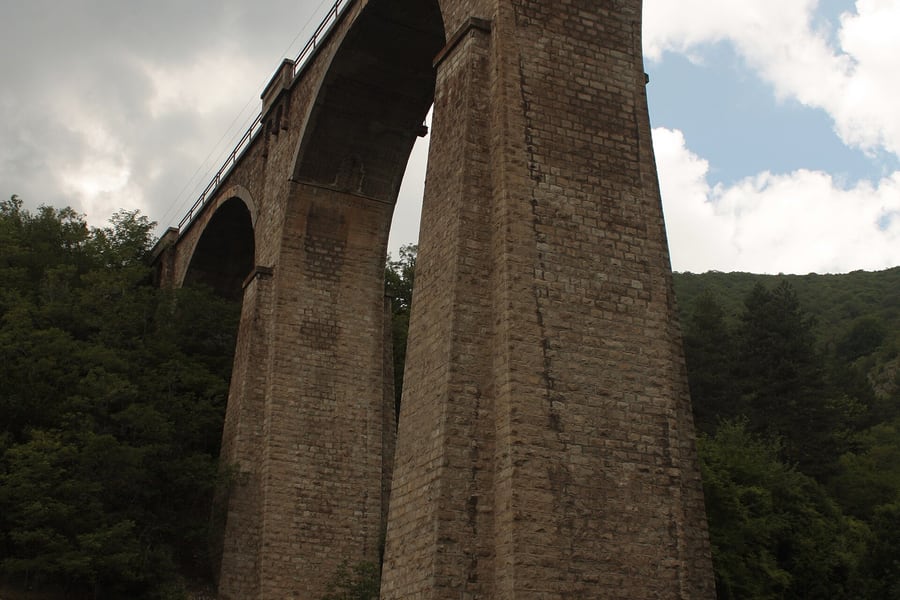
Out the far side is Stryama, then Klisura, where the railway crosses the valley on a tall stone viaduct above the roofs of the town. From here to Kazanlak the train runs the length of the Rose Valley, the strip of country between the two ranges where most of the world's rose oil is grown, calling at Karlovo — Vasil Levski's birthplace, at 452 metres — then Kalofer, Pavel Banya and Kazanlak.
The mountains stay alongside as far as Sliven, where the Blue Rocks rise straight out of the town. After that the line lets go: Karnobat, Aytos, the flat Burgas plain, and the terminus beside the port at Burgas.
Along the route
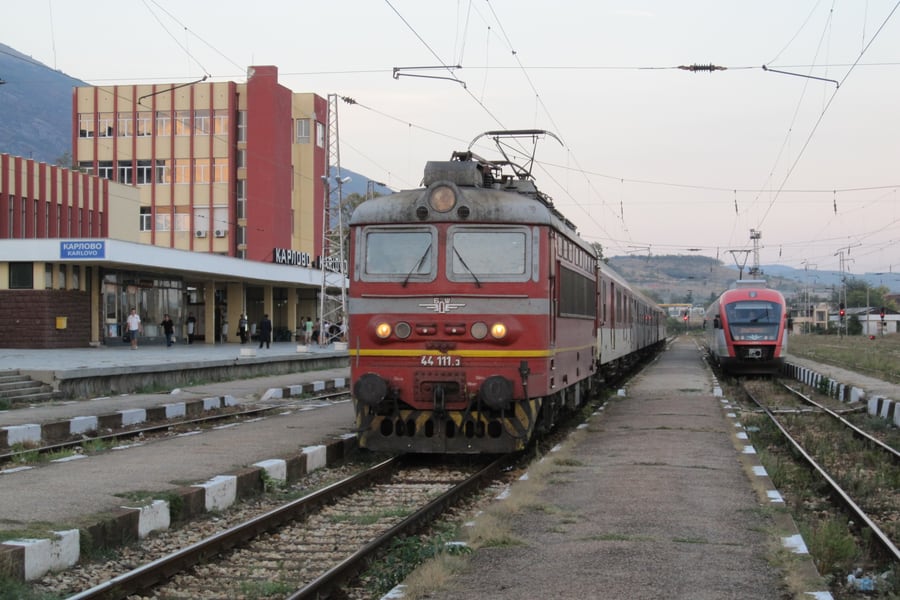
Petr Štefek / Wikimedia Commons · CC BY-SA 3.0 czFifty years at twenty-five kilometres an hour
The Koznitsa tunnel has been the longest in Bulgaria since 1951, and then went close to fifty years without reconstruction, with the speed through it cut to 25 km/h. The rebuild was signed off in 2021 — track bed, drainage, catenary and lighting — and the limit went back to 100.Petr Štefek / Wikimedia Commons · CC BY-SA 3.0 czThe long way round is now the short way
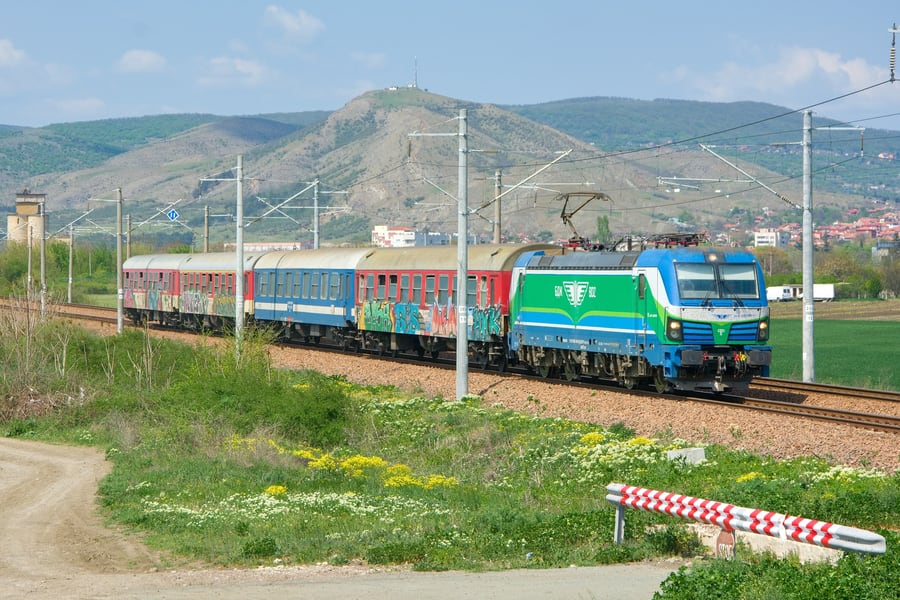
Two railways link Sofia to Burgas: 450 km via the plain, 418 over the mountains. The quickest train by the plain takes 6 h 42 and the quickest over the mountains 5 h 49 — and the mountain fare is the lower of the two as well.Спасимир / Wikimedia Commons · CC BY 3.0A station nine kilometres from its town
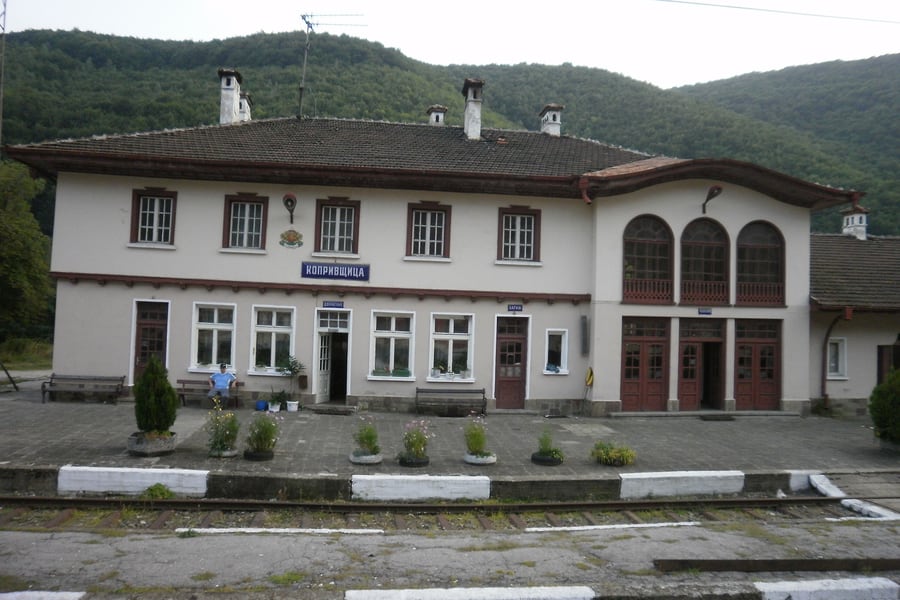
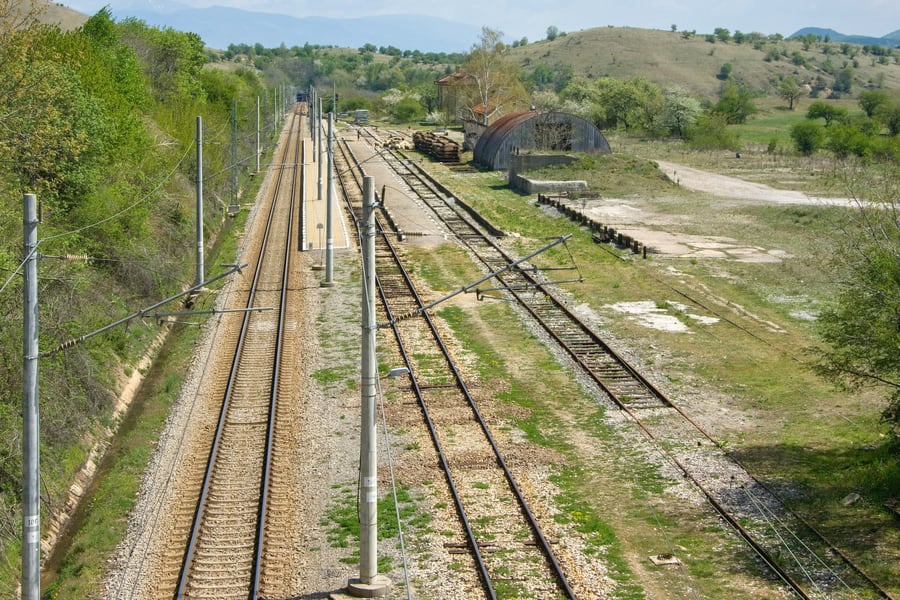
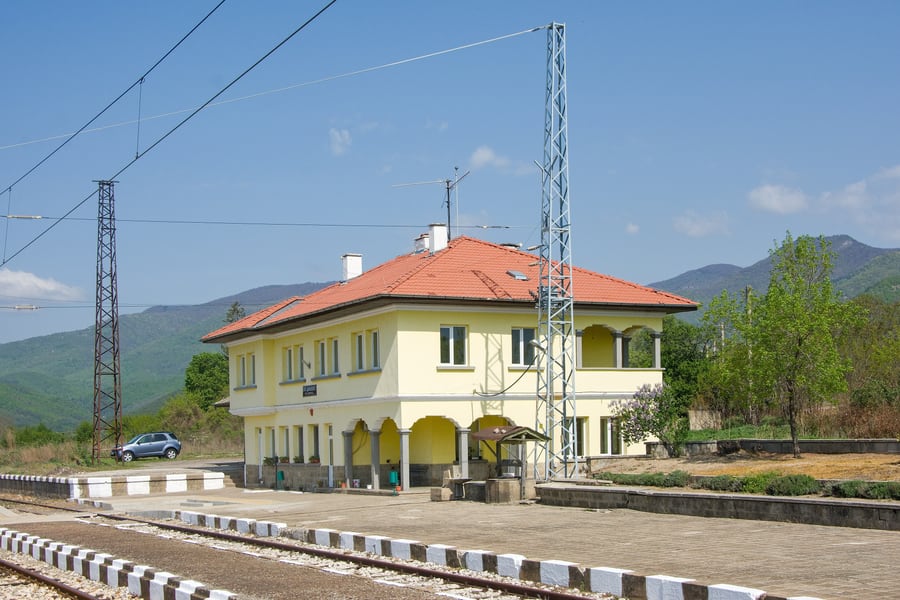
Koprivshtitsa sits at 1,030 metres in a bowl of the Sredna Gora, and the railway could not get to it. The station named for the town stands nine kilometres away, in the next municipality. An electric shuttle has met the trains since 2021.A bit of history
Culture & experiences along the way
 Vislupus / Wikimedia Commons · CC BY-SA 4.0
Breaking the journey at Koprivshtitsa
The 13:15 from Sofia reaches Koprivshtitsa at 14:59, and the 16:45 reaches it at 18:23 — so a little over three hours in the town, or a night there and the rest of the line the next day. Westbound the 13:21 returns to Sofia by 15:00. It is 1 h 44 each way on the fast train, at about €5, which makes the mountain half of this railway a very cheap day out of the capital.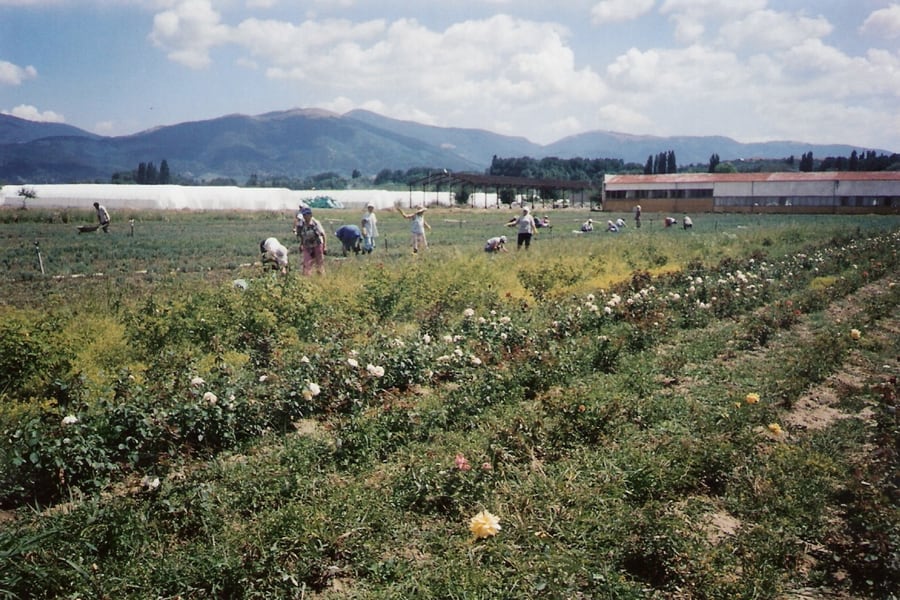 Avishai Teicher / Wikimedia Commons · Public domain
Seventy kilometres of the Rose Valley
Between Klisura and Kazanlak the train runs the length of the valley that grows most of the world's rose oil, with the Balkan range unbroken on the northern side. The harvest is a late-May and June affair, done at dawn while the oil is still in the flower, and the fields come right up to the railway either side of Karlovo and Pavel Banya.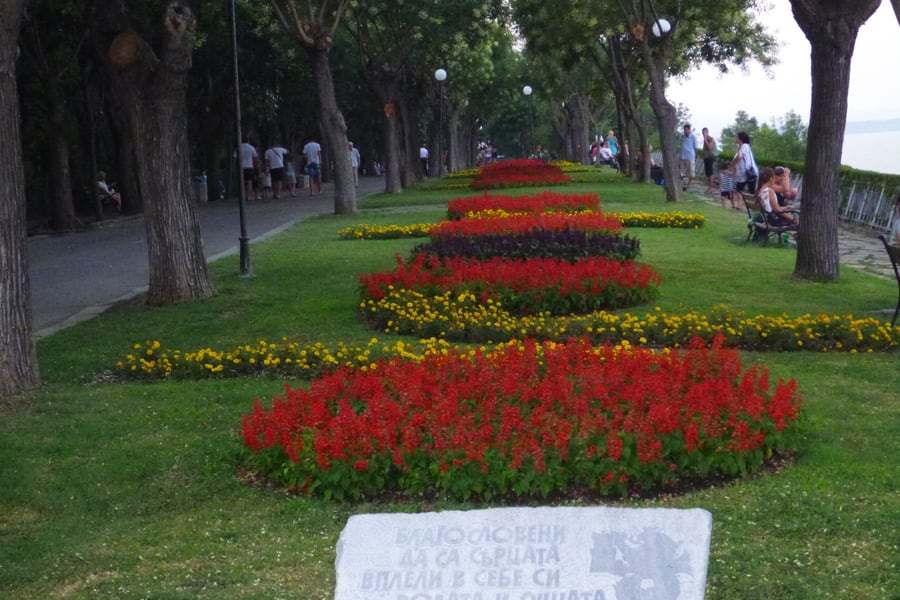 Roton Piotr / Wikimedia Commons · CC BY-SA 3.0
Arriving at the sea
The last hour is flat: Karnobat, Aytos, and the plain behind Burgas. The terminus sits beside the port, a few minutes' walk from the Sea Garden, the long municipal park along the shore that the city has grown around. The 11:59 arrival leaves the whole afternoon for it; the 19:22 gets in for dinner by the water.Timetables
Three fast trains a day run each way over the Sub-Balkan line, and all six are ICF — BDŽ's
Intercity Fast category, on which a seat reservation is compulsory. The times below are from
BDŽ's own live timetable at razpisanie.bdz.bg, read for Friday 14 August 2026.
Sofia to Burgas
| Train | Sofia | Koprivshtitsa | Karlovo | Kazanlak | Sliven | Burgas | Journey |
|---|---|---|---|---|---|---|---|
| ICF 3621 | 06:10 | passes | 08:22 | 09:23 | 10:42 | 11:59 | 5 h 49 |
| ICF 3623 | 13:15 | 14:59 | 15:36 | 16:32 | 18:03 | 19:22 | 6 h 07 |
| ICF 3625 | 16:45 | 18:23 | 19:00 | 19:58 | 21:19 | 22:40 | 5 h 55 |
Burgas to Sofia
| Train | Burgas | Sliven | Kazanlak | Karlovo | Koprivshtitsa | Sofia | Journey |
|---|---|---|---|---|---|---|---|
| ICF 3620 | 05:25 | 06:44 | 08:06 | 09:05 | 09:44 | 11:25 | 6 h 00 |
| ICF 3622 | 08:55 | 10:11 | 11:47 | 12:44 | 13:20 | 15:00 | 6 h 05 |
| ICF 3624 | 16:25 | 17:35 | 18:59 | 19:59 | passes | 22:27 | 6 h 02 |
Only four of the six stop at Koprivshtitsa. The 06:10 from Sofia and the 16:25 from Burgas run straight through it, and on the day checked BDŽ's planner answered a Sofia–Koprivshtitsa query with the 06:10 by routing it to Karlovo and back again — a three-and-a-half-hour version of a journey the 13:15 does in 1 h 44.
The slower way, and the other route
Regional trains also serve Koprivshtitsa from Sofia, taking about two to two and a half hours instead of an hour and three-quarters, with no reservation needed: 05:25, 07:55, 13:30, 18:00 and 19:15 on the day checked.
The Sub-Balkan line is not the only way from Sofia to Burgas. Trains numbered in the 8000s go via Plovdiv and the Thracian plain — 450 km against 418 — and the quickest of those, ICF 8611 at 06:30, takes 6 h 42. BDŽ's own board marks the 06:10 over the mountains as the fastest trip of the day.
Before travelling
BDŽ prints a standing notice on its timetable pages: because of repair works in various sections of the railway network, there may be changes in the trains' schedules, and it asks passengers holding a ticket bought in advance to check the schedule again on the day of travel. The live timetable is the authority, and it is worth a look the morning you go.
One quirk of that timetable is worth knowing: it answers for the next day or two and nothing beyond. A query for a date weeks ahead returns no trains at all, which reflects the planner's horizon rather than any gap in the service.
Times as of August 2026, from BDŽ's live timetable — razpisanie.bdz.bg (opens in a new tab).
Tickets
This is an ordinary domestic BDŽ service, priced like one, in euros since Bulgaria adopted them on 1 January 2026. The fare is not a fixed figure: BDŽ carries a calendar fare alongside its standard one and warns that prices vary by day. Read a day apart in August 2026, the same second-class Sofia to Burgas fare came back as €14.32 and then €11.71 — so the honest answer is somewhere in the region of twelve to fourteen euros for 418 kilometres. Sofia to Koprivshtitsa held steady at €5.11, which is the whole climb into the mountains for about the price of a sandwich.
Every ICF train on this route carries a compulsory reservation at €0.51, so a specific seat is allotted rather than left to chance. There is no sleeping car on the Sub-Balkan trains; the overnight services go the other way, via Plovdiv.
Book your tickets
Sofia – Burgas over the Sub-Balkan line
418 km, second class, with a compulsory reservation
BDŽ prices this route by the day rather than to a fixed tariff — two readings a day apart returned €14.32 and €11.71 in second class — so expect somewhere around twelve to fourteen euros for the 418 km. Every fast train on this route carries a compulsory reservation costing €0.51 on top. BDŽ's live timetable shows the day's departures and the fare panel for each train.
Book Tickets (opens in a new tab, on Bulgarian State Railways (BDŽ))via Bulgarian State Railways (BDŽ)Booking online with BDŽ
The operator's own ticketing site
BDŽ sells domestic tickets through its own booking system as well as at station counters. The operator notes that prices vary by day and booking conditions, and that the exact fare is confirmed at the point of purchase.
Book Tickets (opens in a new tab, on Bulgarian State Railways (BDŽ))via Bulgarian State Railways (BDŽ)Rail Passes
Bulgaria is covered by Interrail and Eurail passes, and the national operator BDŽ is the only railway they need to cover here — every train on the Sub-Balkan line is a BDŽ service.
Whether a pass is worth it for this journey
Almost certainly not. A pass earns its keep where point-to-point fares are high, and Bulgarian fares are among the lowest in Europe: the full 418 km from Sofia to Burgas over this line came back at between €11.71 and €14.32 in second class on two readings a day apart, and Sofia to Koprivshtitsa at €5.11. The Interrail Bulgaria Pass, second class, is €67 for three travel days within a month for an adult and €50 for a youth. It would take four or five long journeys inside its validity before the arithmetic turned in its favour.
Where a pass does make sense is as part of a wider European trip that happens to pass through Bulgaria — a Global Pass being used from Vienna or Belgrade, say, with this run to the Black Sea as one leg among many. In that case the pass is already paid for and the line costs nothing extra.
Reservations still apply
A pass does not remove the compulsory reservation. Interrail's own country page for Bulgaria says that reservations are required on the faster express services and puts the charge at approximately €0.25 (50 stotinki in the old currency); BDŽ's timetable shows €0.51 for the ICF trains on this route. Either way it is a trivial sum, but it has to be bought — at a Bulgarian station counter — before boarding.
The slower regional trains that also reach Koprivshtitsa carry no reservation requirement at all, which is one practical reason a pass-holder might prefer them.
Pass conditions as of August 2026, from interrail.com (opens in a new tab) and BDŽ's timetable.
Places to Visit
The line's stops are not incidental to it. Koprivshtitsa is where the April Uprising began, Karlovo is where Vasil Levski was born, Kazanlak sits on top of a Thracian royal necropolis, and Sliven has a mountain rearing out of its northern edge. All of them are reached on the same twelve-to-fourteen-euro ticket, and any of them will hold a day.
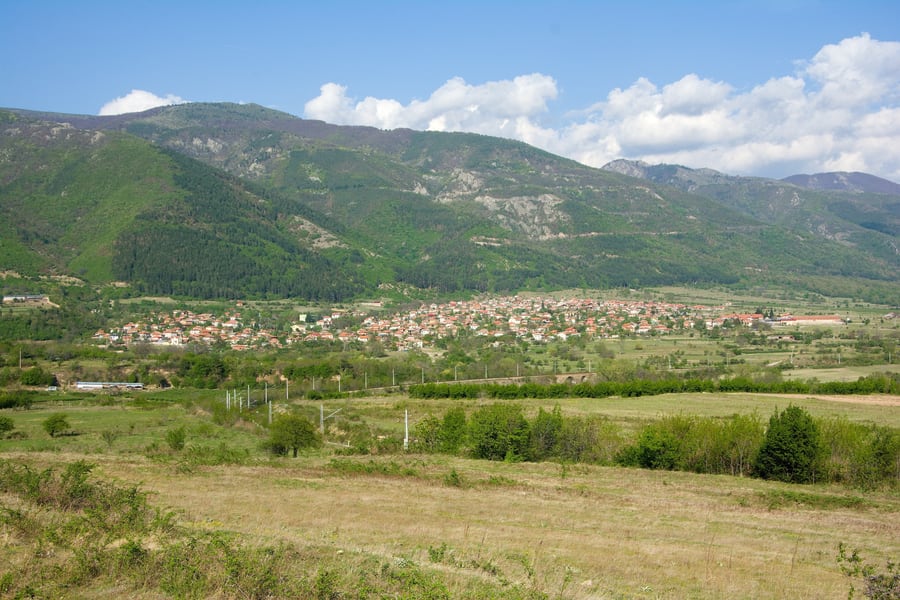
One caution about the first: Koprivshtitsa station is nine kilometres from Koprivshtitsa, on the far side of a ridge, in a river gorge with no town attached. The connection is covered by a shuttle rather than by walking.
Vislupus / Wikimedia Commons · CC BY-SA 4.0Koprivshtitsa, where the April Uprising began
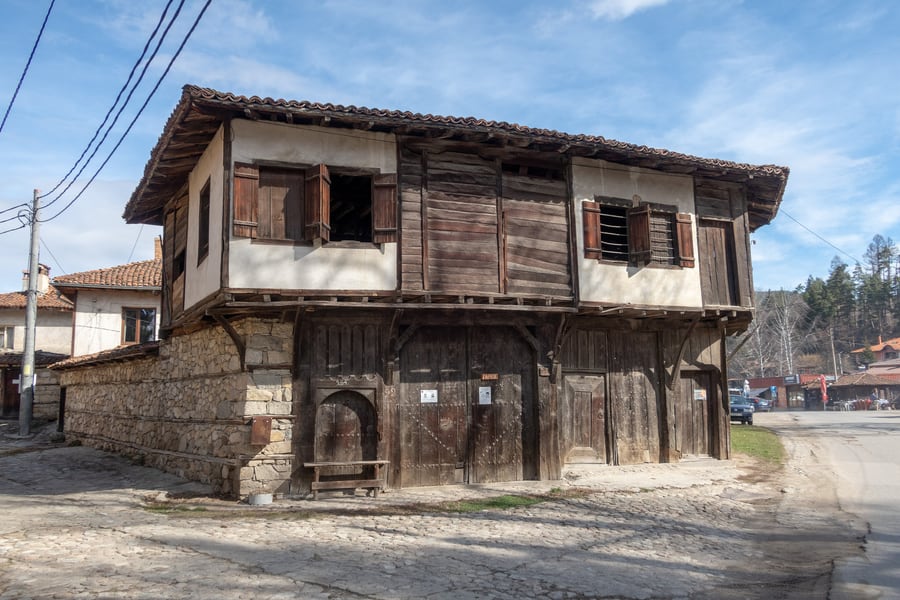
A town of 2,410 people at 1,030 metres, holding 383 listed monuments of the Bulgarian National Revival — timber upper floors oversailing stone ground floors, most of them restored and several open as house-museums. The April Uprising against Ottoman rule began here in 1876, with the first shot fired at the Kalachev bridge; Todor Kableshkov, who wrote the letter that started it, was born in the town and died the same year.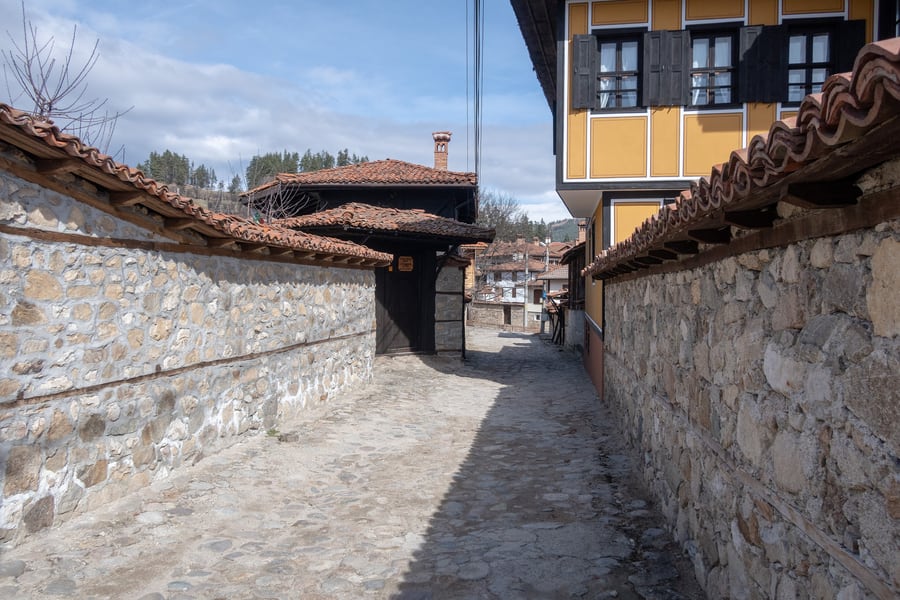 Vislupus / Wikimedia Commons · CC BY-SA 4.0
The lanes above the Topolnitsa
What the town is actually like is cobbles and walls. The streets climb between high stone garden walls with heavy timber gates set into them, and the painted houses show only their upper floors over the top. It is small enough to walk end to end in an afternoon. Since 1965 it has also hosted the National Festival of Bulgarian Folklore, held roughly every five years on the meadows above the town.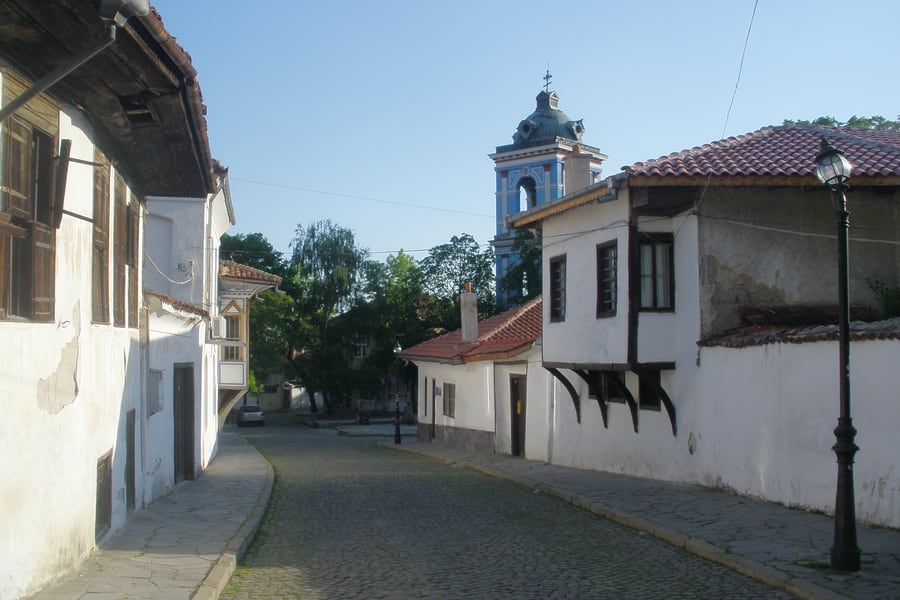 TodorBelomorski / Wikimedia Commons · CC BY-SA 4.0
Karlovo and the Levski house
Karlovo stands at 452 metres at the foot of the Balkan range, a town of 19,373 in the Rose Valley. Vasil Levski — the organiser of the Bulgarian revolutionary network, hanged in 1873 — was born here in 1837, and his birthplace is a museum complex in the old quarter. The Kurshum Mosque of 1485 and the church of St Nicholas of 1847 stand in the same few streets, and the Suchurum waterfall drops 15 metres at the edge of the town.Avishai Teicher / Wikimedia Commons · Public domainThe Valley of the Roses
The trough between the Balkan Mountains and the Sredna Gora grows Rosa damascena on a scale nowhere else matches, and Kazanlak's gardens are the largest in the world. Picking runs through the first weeks of June, in the early morning; the Rose Festival at Kazanlak was first held in 1903 and has kept to the first weekend of June ever since. The railway runs through the middle of it for the best part of seventy kilometres.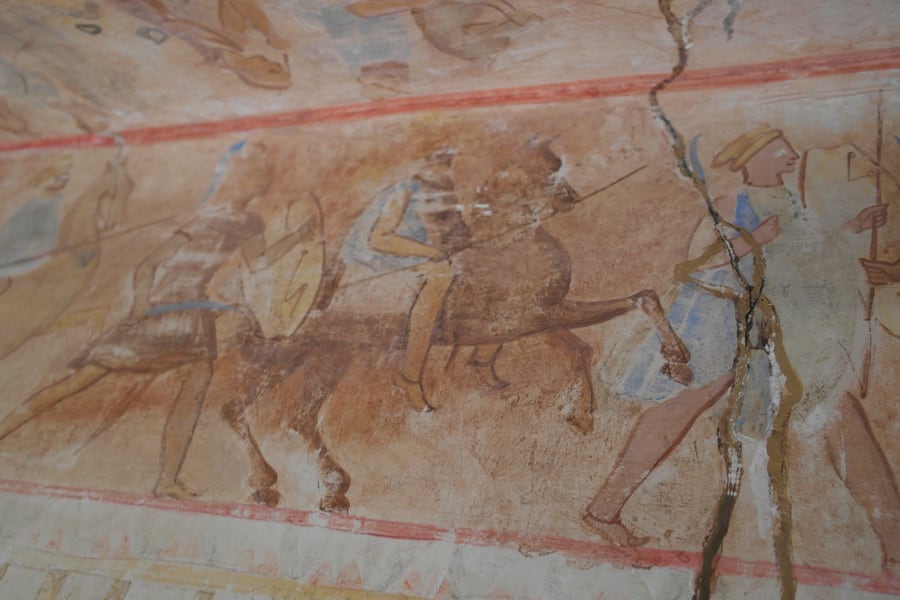 KLMircea / Wikimedia Commons · CC BY-SA 2.0
The Thracian Tomb of Kazanlak
A beehive tomb of the 4th century BC, its narrow corridor and domed chamber painted with a funeral feast and a chariot race — the finest Hellenistic painting surviving anywhere in the Thracian world, on UNESCO's list since 1979. The original is sealed to protect the plaster; what visitors walk into is a full-size replica beside it. Kazanlak stands in the Valley of the Thracian Kings, which holds more than a thousand burial mounds.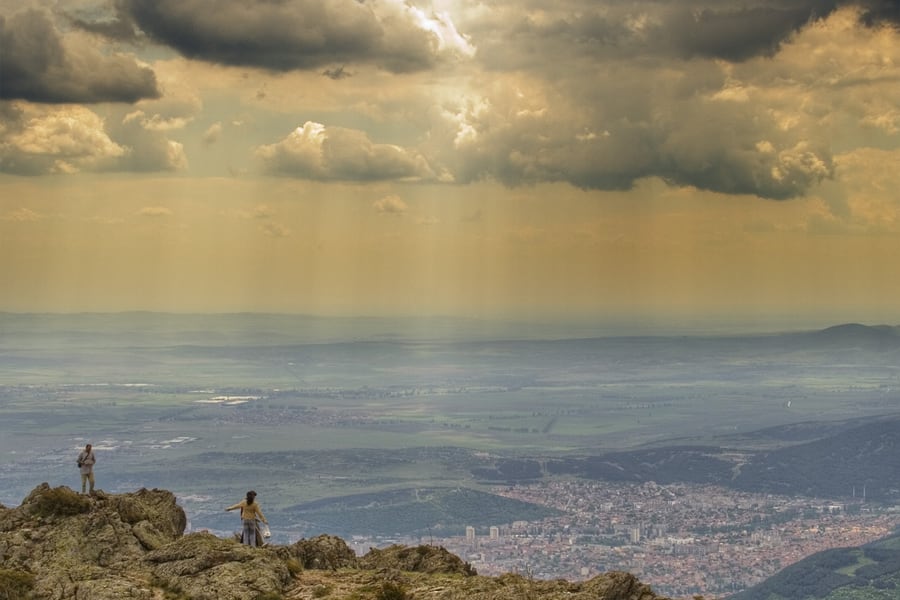 Evgeni Dinev / Wikimedia Commons · CC BY-SA 3.0
The Blue Rocks above Sliven
Sinite Kamani — the Blue Rocks — is a nature park of 11,380 hectares rising straight out of the northern edge of Sliven, a town of 83,740. The rock takes on a blue cast in certain light, which is where the name comes from. Bulgarka peak reaches 1,181 metres, and the plateau at Karandila looks south over the whole eastern Thracian plain. Sliven calls itself the city of the hundred voyvodi, after the outlaw bands that used these hills against Ottoman rule.Roton Piotr / Wikimedia Commons · CC BY-SA 3.0The Sea Garden at Burgas
Burgas put its municipal park along the shoreline rather than behind it, so the Sea Garden runs for well over a kilometre above the beach, with the pier at its centre and the old casino building on the cliff path. It begins a few minutes' walk from the station, which makes it the natural first thing to do on arriving, and the natural last thing to do before the 05:25 back.Where to Sleep
The whole line can be done in a day — six hours and change, three trains each way — but the interesting version breaks it. Koprivshtitsa is worth a night on its own, and Kazanlak makes a natural second stop halfway along the Rose Valley, with the Thracian tombs and the rose fields within a short drive.
The four places below sit at the departure, at the two stops most worth breaking for, and at the far end. None of them is booked through this site: each card links to the property's own website, and no price, rating or star count appears on any of them, because none has been verified here.
Where to stay
Hotel Rila
Central Sofia, for the morning departure
In downtown Sofia between Vitosha Boulevard, the Presidency and the Ivan Vazov National Theatre, within a few minutes of the Archaeological Museum and the cathedral. Useful for the 06:10, which is the fast train and the one that does the mountains in daylight from end to end.
Check Availability (opens in a new tab, on hotelrila.bg)via hotelrila.bgGuest House Kalina
Koprivshtitsa, on Hadzhi Nencho Palaveev Street
A Revival-style house with an enclosed courtyard on the town's main street, near the Lyuben Karavelov museum. The site lists a summer garden, a porch with a view, a fireplace and stables. Koprivshtitsa station is nine kilometres away, and the shuttle meets the trains.
Check Availability (opens in a new tab, on kushtakalina.com)via kushtakalina.comKings' Valley Medical & Spa Hotel
At the Kazanlak mineral baths, halfway along the line
A large spa hotel on Izvora Street at the Kazanlak thermal baths, with 266 rooms and suites, four indoor and four outdoor mineral pools and its own medical centre. It sits under the Balkan range at the eastern end of the Rose Valley, near the Thracian tombs.
Check Availability (opens in a new tab, on kingsvalleyhotel.bg)via kingsvalleyhotel.bgGrand Hotel & SPA Primoretz
In the Sea Garden at Burgas
The hotel stands inside the Sea Garden itself, close to the beach, with rooms facing either the old town or the sea and seaside park. Its restaurants and spa look out over the same shoreline the railway has spent six hours getting to.
Check Availability (opens in a new tab, on hotelprimoretz.bg)via hotelprimoretz.bgQuestions or corrections
Planning this trip and stuck on something, or spotted a time, fare or detail that has changed? Send us a message about The Sub-Balkan Line — Sofia to Burgas through Bulgaria's Longest Tunnel. We read every one, and we update this page when something has changed.