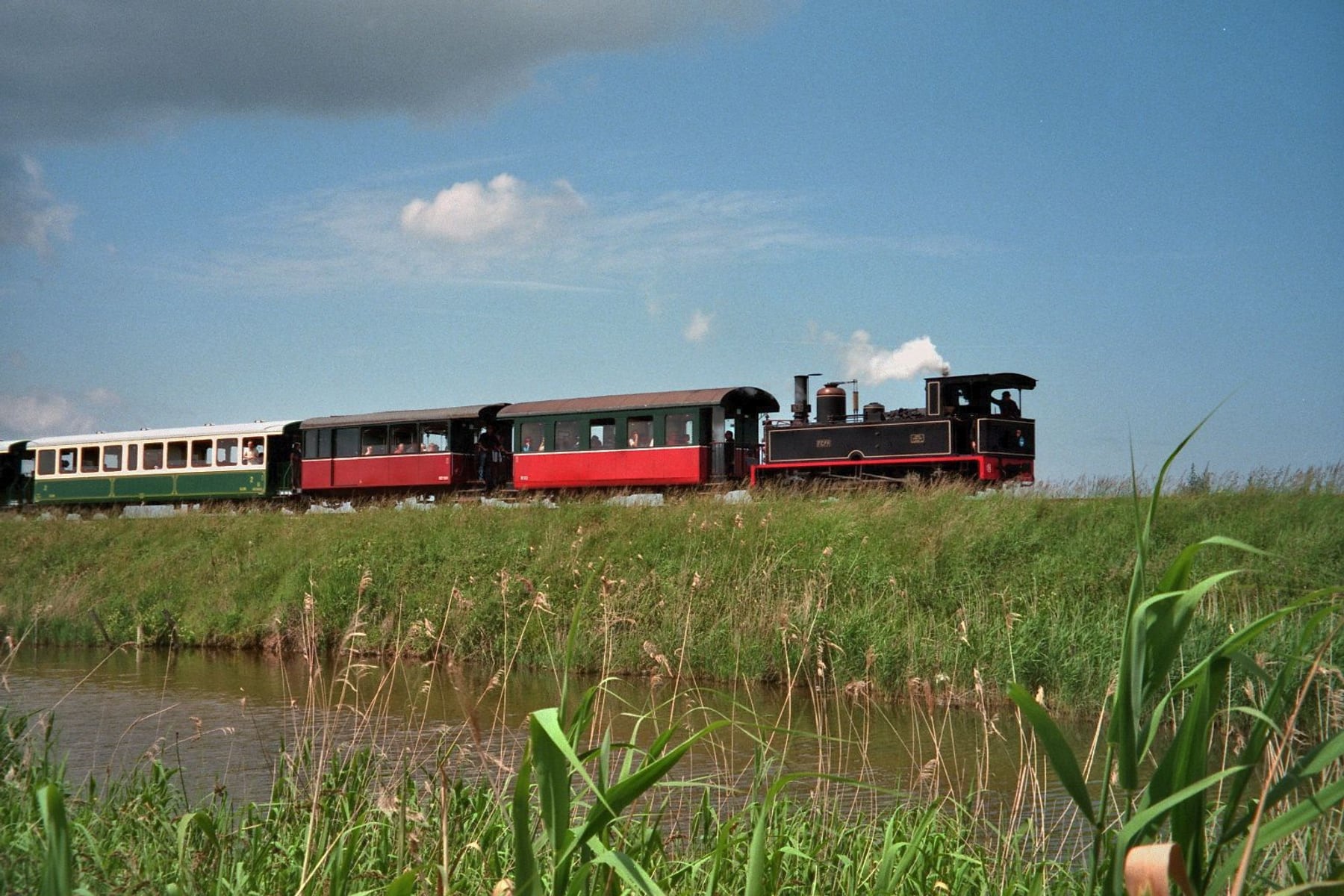
Somme Bay Railway
Pierre Poschadel / Wikimedia Commons · CC BY-SA 2.0 FR
- Distance27 km of metre-gauge railway on three lines
- Duration1 hour Le Crotoy–Saint-Valery; 35 minutes Saint-Valery–Cayeux
- Best seasonApril to 1 November; July and August for the most trains and the Cayeux line
Introduction
Between Noyelles-sur-Mer and Saint-Valery the little train of the Baie de Somme runs inside a main-line track. Four rails cross the bay on a dyke: the metre-gauge pair in the middle, laid in 1887, and outside them the standard-gauge rails of the branch the Chemin de fer du Nord opened in 1858, still in place.
That track is part of the Réseau des Bains de Mer, the "sea-bathing network" built to carry holidaymakers to three resorts on the bay: Le Crotoy, Saint-Valery-sur-Somme and Cayeux-sur-Mer. A volunteer association took over the Le Crotoy line in 1971 and the rest when it closed at the end of 1972, and it still runs all 27 kilometres, with steam engines, railcars and wooden coaches gathered from lines across France and Switzerland, at about 25 km/h through salt meadows, marshes and farmland.
The main run, Le Crotoy to Saint-Valery, takes an hour, with a stop at Noyelles to meet the SNCF trains from Paris and Amiens. Trains run from spring to 1 November.
The Journey
The railway is shaped like a V with Noyelles-sur-Mer at its point, where it meets the SNCF line from Amiens to Boulogne and Calais. One arm runs north-west to Le Crotoy, the other south-west across the bay to Saint-Valery, and from Saint-Valery a third line carries on to Cayeux-sur-Mer. On the main route a train leaves each end at the same time and the two meet at Noyelles, where they stop for ten minutes before going on to the other's terminus.
Le Crotoy to Noyelles
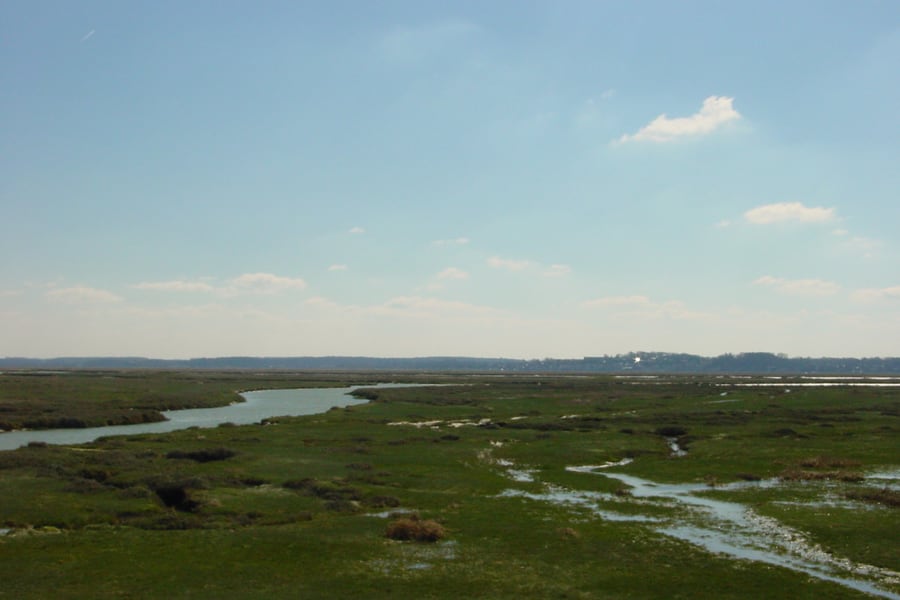
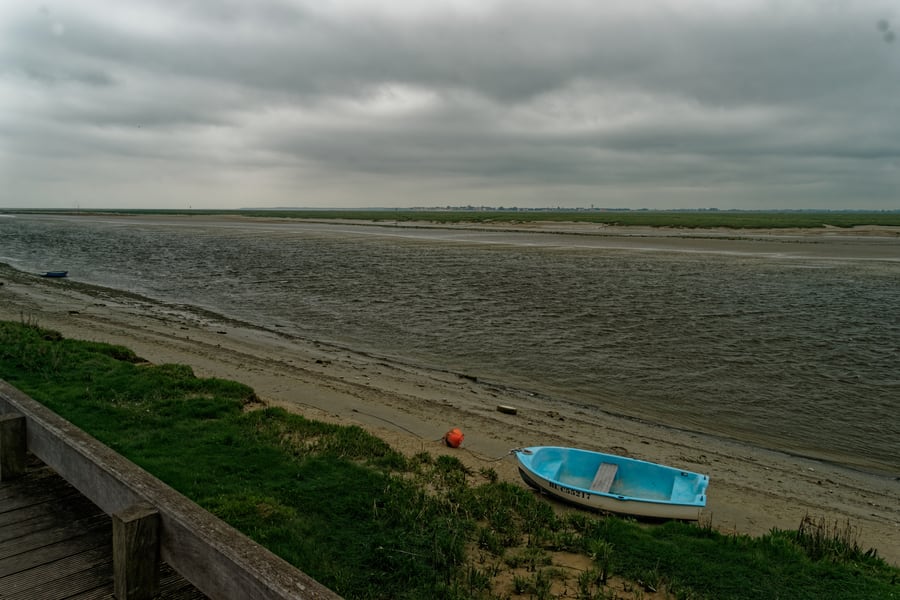
The Le Crotoy line, opened on 1 July 1887, runs seven and a half kilometres along the north shore of the bay, past halts at Favières and Morlay. This is open country: salt meadows grazed by sheep, marshes dotted with duck-hunters' huts, and pastures of the sand-coloured Henson horses bred on the bay. The operator is honest that the railway does not follow the shore, so the sea itself is not in view from the carriages; the reward is the birdlife and the long, flat light.
Across the bay on four rails
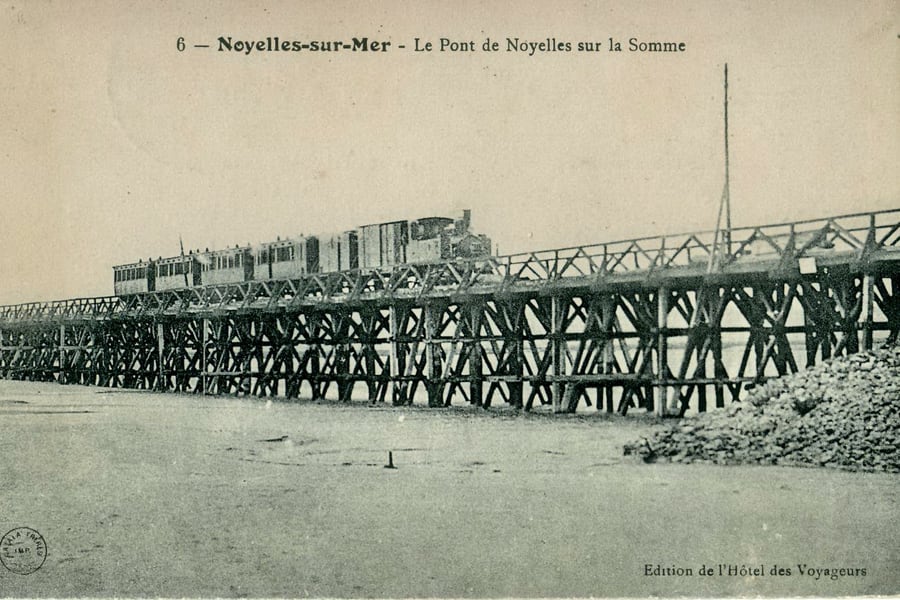
From Noyelles the line to Saint-Valery is older than the rest. The Chemin de fer du Nord opened a standard-gauge branch here on 5 June 1858, crossing the estuary on a timber trestle 1,367 metres long. When the metre-gauge lines came in 1887, their rails were laid between the main-line ones, so the track has four rails: the narrow pair in the middle, the standard pair outside. SNCF freight trains used the outer rails to reach Saint-Valery's port until 1989, and they are still there. In 1912 the trestle gave way to the dyke the trains run on today.
Past the depot at Saint-Valery-Canal the train crosses the Canal de la Somme at its sea lock and ends on the quay at Saint-Valery-Port, below the old town.
Saint-Valery to Cayeux
The Cayeux line, opened on 6 September 1887, leaves from a second station, Saint-Valery-Ville, so passengers going on from Le Crotoy change trains across town. It crosses the Bas-Champs, low land won from the sea, by way of Lanchères-Pendé, and ends at the station of Cayeux-sur-Mer and Brighton-Plage, about 800 metres from the town centre. The line once carried as much freight as holidaymakers: Cayeux's flint pebbles, sugar beet for the shredding plant at Lanchères, and shellfish.
The trains
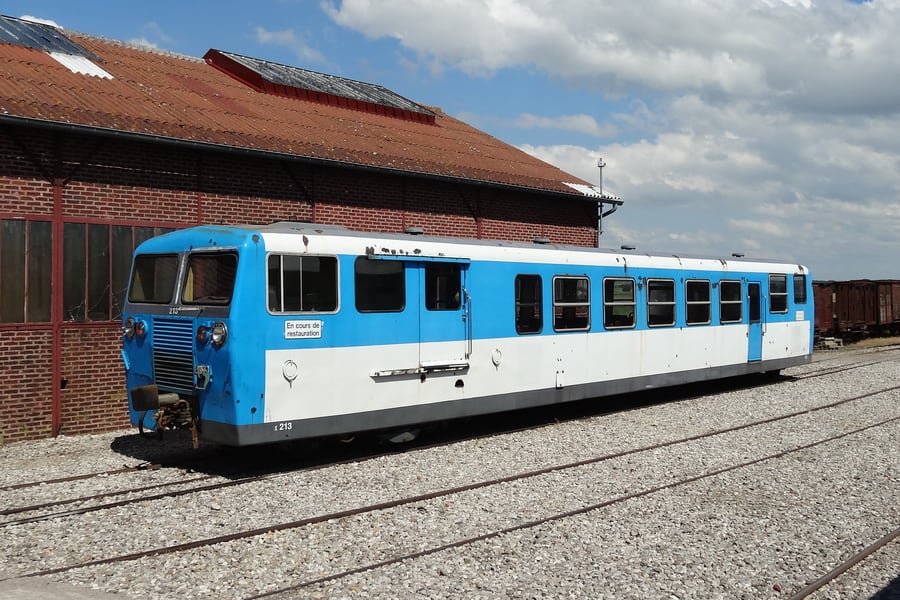
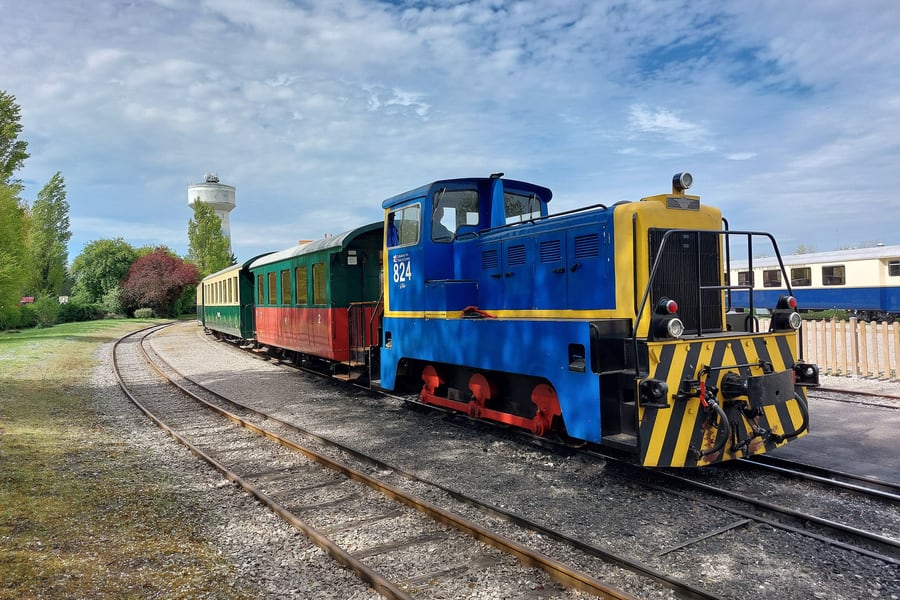
Steam is the heart of the fleet, small tank engines built for country lines: the 130T Corpet-Louvet No 1 of 1906, named Aisne; the 030T No 101, built by Pinguely of Lyon in 1905 for the Morbihan; the 130T Cail No 2, which worked in Puerto Rico before it came to the bay; and the green 031T No 3714, built by Buffaud et Robatel in 1909 to haul sugar beet in Seine-et-Marne. Diesel locomotives and Verney railcars work trains too. Behind them run wooden coaches with open end platforms, a few first-class cars with velvet seats, and a car with a lift for wheelchairs on the Le Crotoy–Saint-Valery trains. Bicycles travel free in the luggage van.

Along the route
 Roehrensee / Wikimedia Commons · CC BY 4.0 · cropped
Noyelles-sur-Mer
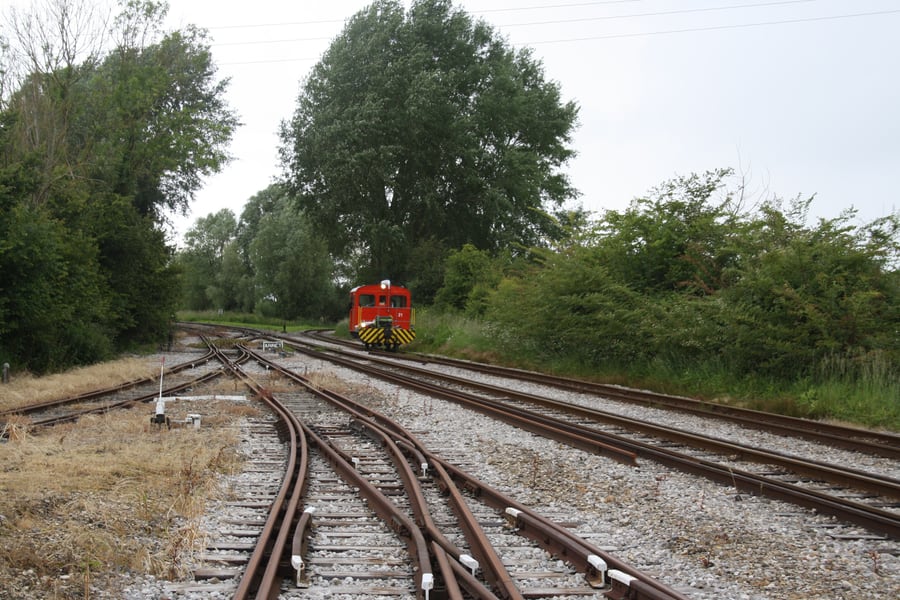
The junction with the SNCF line from Paris and Amiens, where both trains on the main route meet and stop for ten minutes. Passengers change here between the little train and the TER, and the yard's points carry both gauges.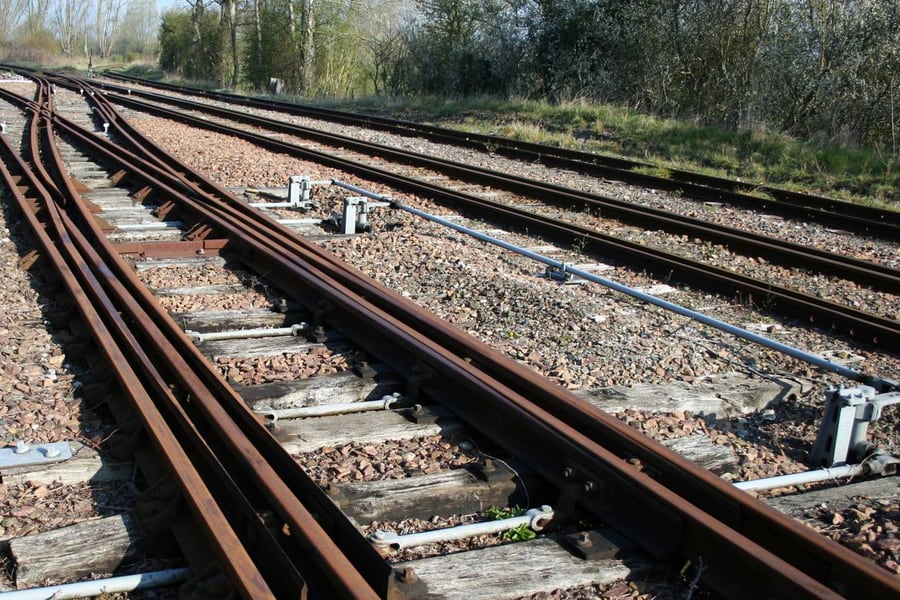 Fibo.cdn / Wikimedia Commons · CC BY-SA 3.0 · cropped
Four rails across the bay
To Saint-Valery the metre-gauge rails lie inside the standard-gauge ones laid in 1858, four rails on one track. SNCF freight used the outer pair to reach the port until 1989, and points like these let the two gauges part.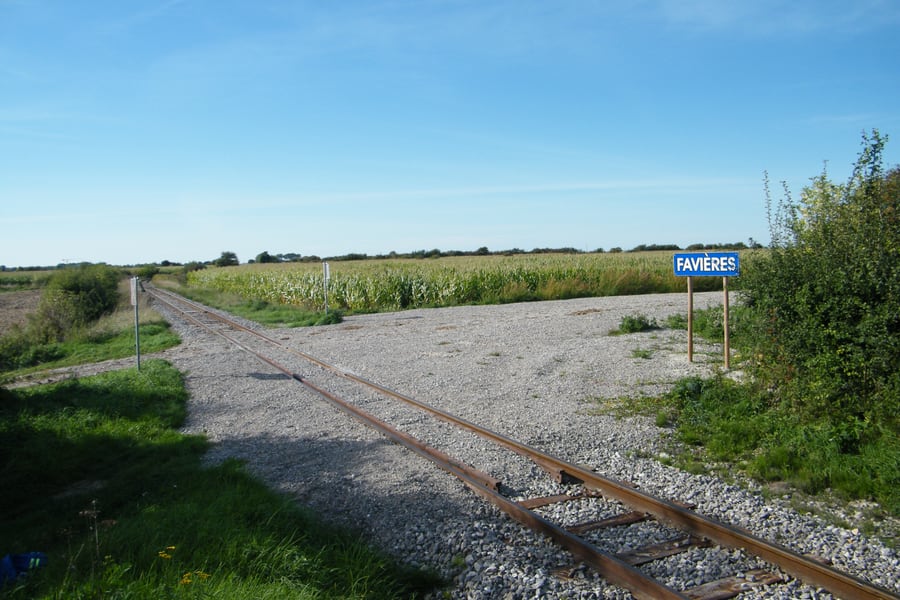 APictche / Wikimedia Commons · CC BY-SA 4.0 · cropped
Favières and Morlay
The Le Crotoy line runs along the north shore past two small halts among fields and salt meadows. Favières was brought back into use when the line was relaid in 2017–18, and Morlay was given a loop where trains can pass.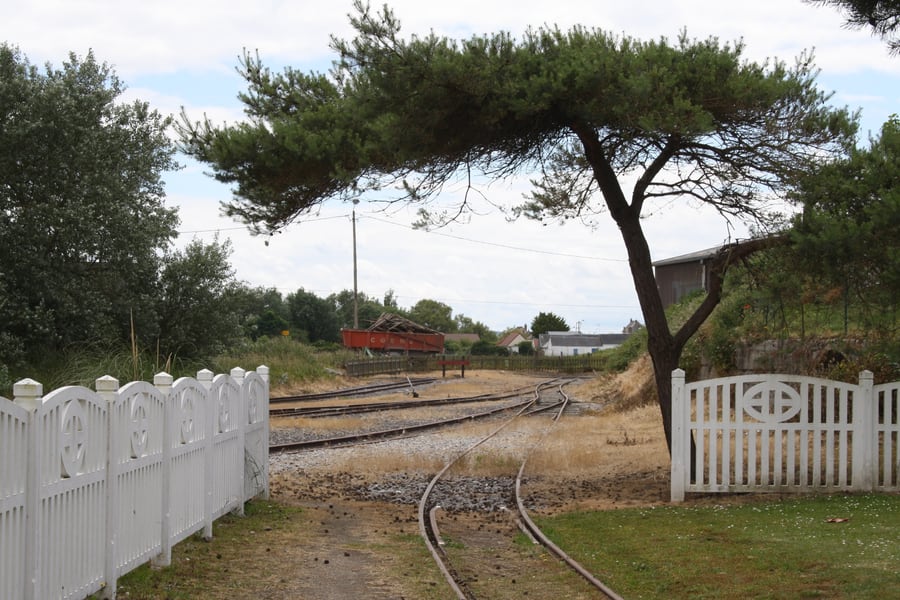 Roehrensee / Wikimedia Commons · CC BY 4.0 · cropped
Cayeux-sur-Mer
The Cayeux line ends at the station of Cayeux-sur-Mer and Brighton-Plage, named for the resort the British founded in the nineteenth century. The beach and its boardwalk are about 800 metres away on foot.A bit of history
Culture & experiences along the way
 Renhour48 / Wikimedia Commons · CC0
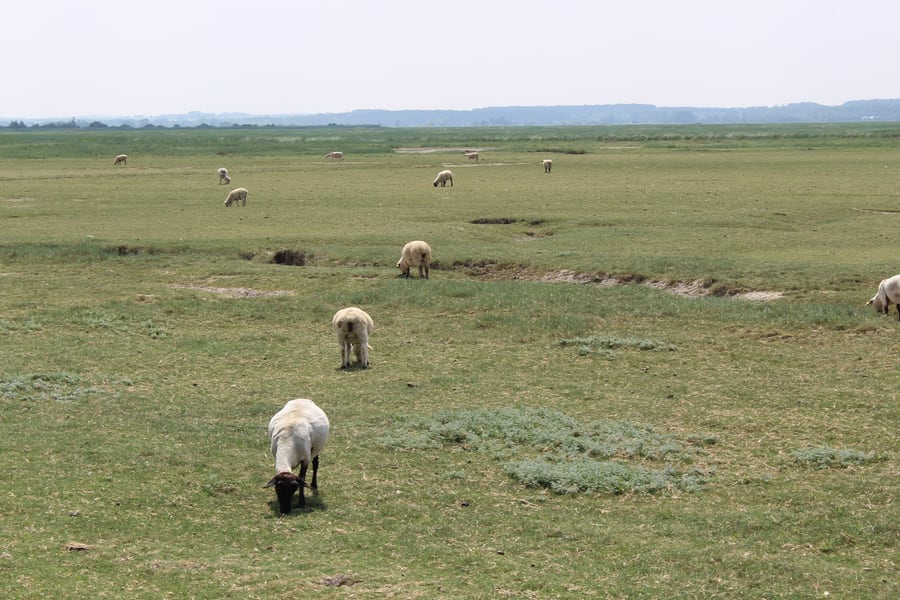
Salt-meadow lamb
Sheep graze the salt meadows of the bay, where the tide leaves a salty, iodine-rich grass, and the train passes their flocks on the way to Le Crotoy. Their lamb has its own protected designation, Prés salés de la baie de Somme.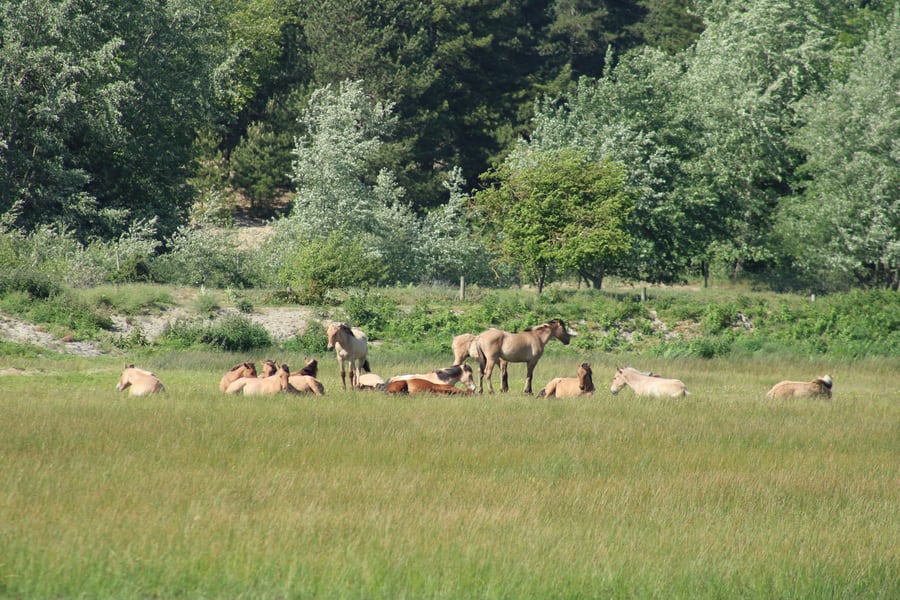 APictche / Wikimedia Commons · CC BY-SA 4.0 · cropped
Henson horses
The Henson is the horse of the Baie de Somme, bred here from the early 1970s by crossing Norwegian Fjords with French saddle horses, and recognised as a breed in 2003. Its coat is sand-coloured with a dark stripe down the back, and it is the mount for rides across the bay and its dunes.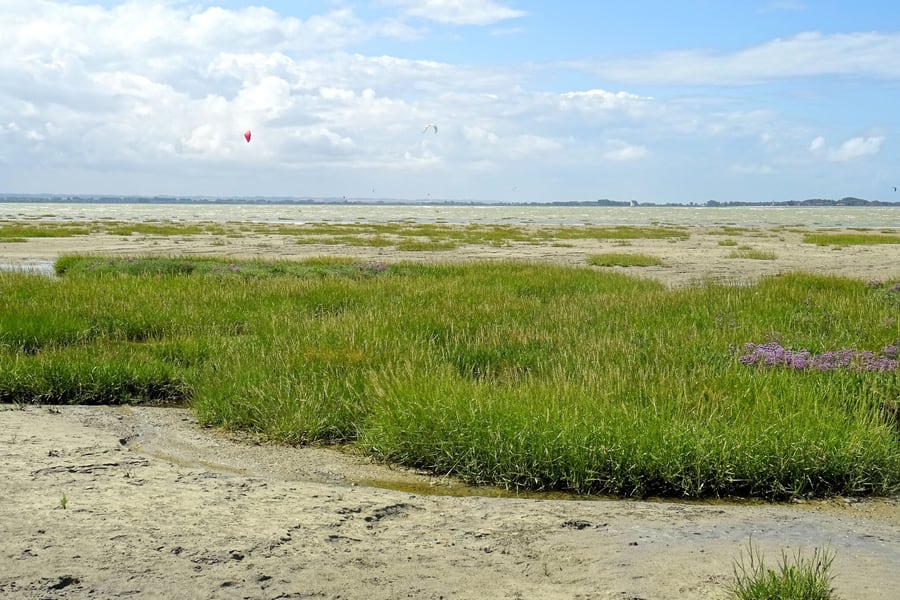 Pierre Poschadel / Wikimedia Commons · CC BY-SA 4.0 · cropped
Crossing the bay on foot
At low tide guides lead walks of about seven kilometres across the sands and channels from Le Crotoy to Saint-Valery, timed by the tide and lasting just under three hours. The return is not included, and the organisers suggest the little train for the ride back round the bay.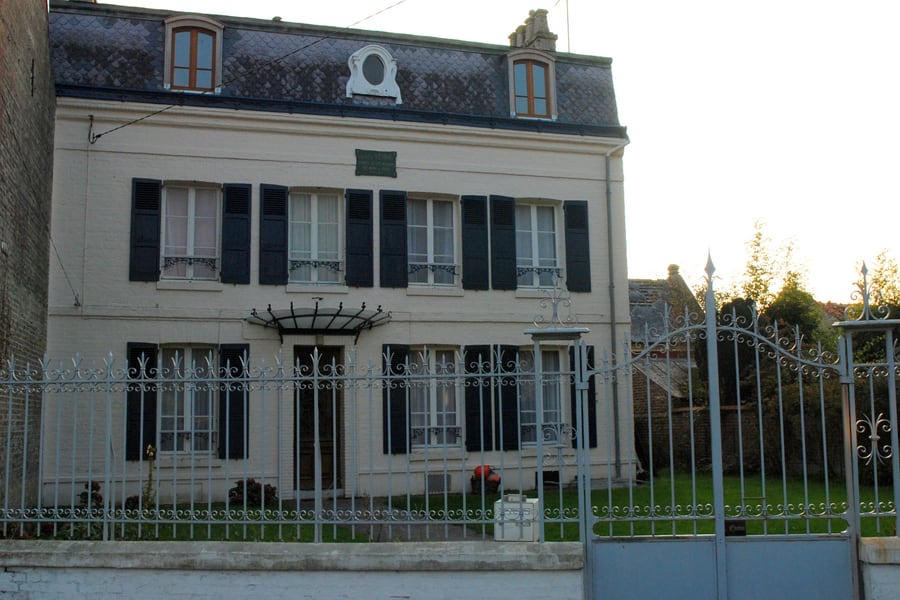 Paul Hermans / Wikimedia Commons · CC BY-SA 3.0 · cropped
Jules Verne in Le Crotoy
Jules Verne spent nearly eight years in Le Crotoy, in a house called La Solitude near the port that still stands, and wrote Twenty Thousand Leagues Under the Seas there. During the war of 1870 he commanded the local guard and patrolled the bay in his boat, the Saint-Michel.Timetables
The 2026 season runs to 1 November, with a few trains on chosen days from February. From late September trains run every day except Monday and Friday. The 2027 calendar is not yet published. On the main route a train leaves Le Crotoy and another leaves Saint-Valery-Port at the same time; they meet at Noyelles and stop there for ten minutes.
Le Crotoy – Noyelles – Saint-Valery, ordinary days
| Leaves Le Crotoy | Noyelles | Arrives Saint-Valery-Port |
|---|---|---|
| 11:00 | 11:25–11:35 | 12:00 |
| 14:30 | 14:55–15:05 | 15:30 |
| 16:00 | 16:25–16:35 | 17:00 |
| 17:30 | 17:55–18:05 | 18:30 |
Trains from Saint-Valery-Port leave at the same four times and reach Le Crotoy an hour later.
Busy days in summer
On the busiest days, such as 15 August, six trains run each way, leaving both ends at 10:00, 11:30, 13:30, 15:00, 16:30 and 18:00.
Saint-Valery-Ville – Cayeux-sur-Mer
The Cayeux line runs on selected days from April to mid-September, most of them in July and August, and takes 35 minutes. On 15 August 2026 trains left Saint-Valery-Ville at 09:45, 11:40, 15:10 and 18:10, and Cayeux at 10:50, 14:20, 17:20 and 18:55.
By train from Paris
Direct TER trains from Paris Nord reach Noyelles-sur-Mer in about 1 hour 45 minutes, five a day: the 07:29 arrives at 09:14, in good time for the 11:35 to Saint-Valery or Le Crotoy. Return trains leave Noyelles at 15:45, 17:46 and 18:46. TER trains from Amiens and Calais stop there too.
Times as of October 2026, from the operator's calendar and timetables (opens in a new tab), which gives the trains for any date, and from the SNCF timetable for the TER.
Tickets
Tickets are sold for a route, a date and a train, one way or return, online up to two hours before departure or at the stations. Online tickets cost €0.50 less, cannot be refunded and can be changed up to two hours before; there are no telephone bookings. Youth fares cover ages 4 to 16, under-fours travel free, and families of two adults and two young people pay a set fare.
Anyone arriving by SNCF gets 25% off with a ticket dated the same day. From the Hauts-de-France region, the TER Pack Baie de Somme bundles the return TER to Noyelles with the little train (€30.50 adult and €13.50 for ages 4 to 16 in 2025). Prices as of October 2026, from the operator.
Book your tickets
Le Crotoy – Saint-Valery
€18.90 adult return · €13 youth 4–16 · €57 family
The main route between salt meadows and marshes, return or one way, €0.50 less online.
Book Tickets (opens in a new tab, on Chemin de Fer de la Baie de Somme)via Chemin de Fer de la Baie de SommeLe Grand Large
€25 adult return · €17.50 youth 4–16 · €76.20 family
The whole network from Le Crotoy to Cayeux, April to mid-September, with the change at Saint-Valery.
Book Tickets (opens in a new tab, on Chemin de Fer de la Baie de Somme)via Chemin de Fer de la Baie de SommeTER Pack Baie de Somme
TER return to Noyelles plus the little train
From any station in Hauts-de-France, sold by TER Hauts-de-France online and at SNCF counters.
Book Tickets (opens in a new tab, on Chemin de Fer de la Baie de Somme)via Chemin de Fer de la Baie de SommeRail Passes
Interrail and Eurail passes are not valid on the Chemin de fer de la Baie de Somme. It is run by a volunteer association, not by SNCF, and Interrail's table of railway companies does not list it, so pass holders buy an ordinary ticket.
A pass does cover the TER trains to Noyelles-sur-Mer, with no reservation needed, including the direct trains from Paris Nord. For the bay alone a pass is not worth buying; it pays only as part of a longer trip through France. From anywhere in Hauts-de-France, the TER Pack Baie de Somme covers both trains in one ticket.
Checked October 2026 against Interrail's table of railway companies (opens in a new tab).
Places to Visit
Each terminus is a resort with its own character, and the operator suggests allowing at least two hours in each. Le Crotoy and Cayeux stations are about 800 metres from their town centres.
 Raimond Spekking / Wikimedia Commons · CC BY-SA 4.0 · cropped
Le Crotoy
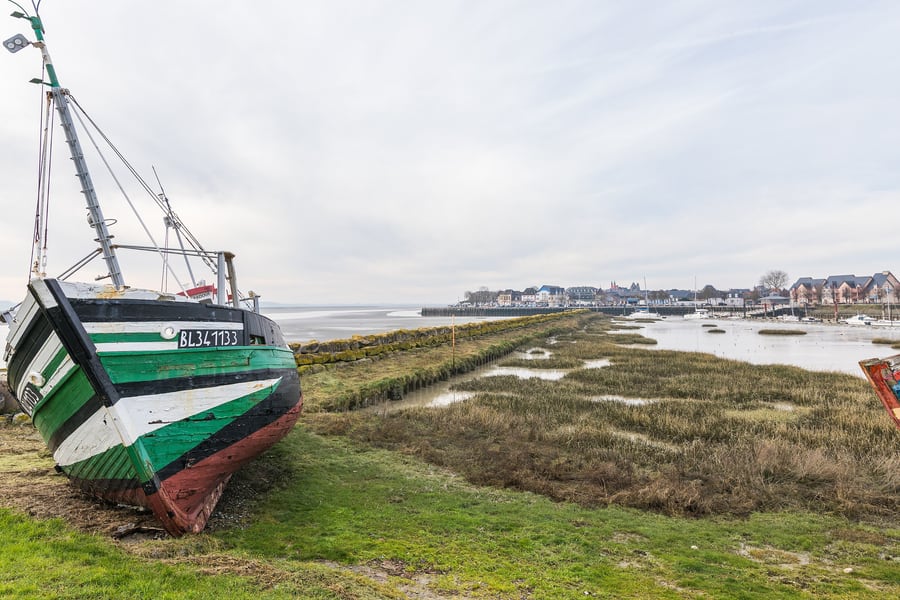
A fishing port and resort on the north shore, with a beach that faces south, a rarity on this coast. Joan of Arc was held in its castle from November to December 1430 before being taken across the bay on her way to trial in Rouen. The castle was pulled down in 1674; the port and the salt marsh beside it remain.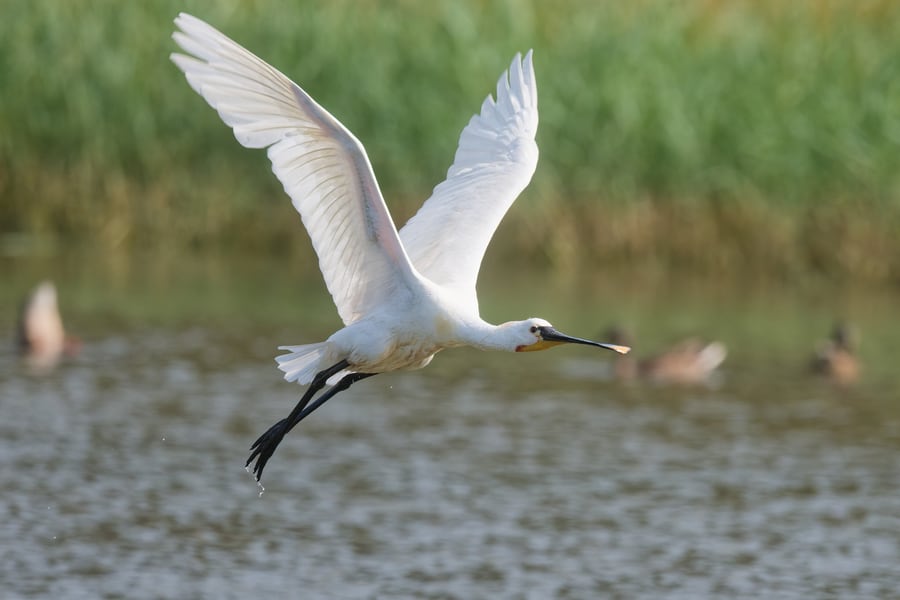 Marie-Lan Taÿ Pamart / Wikimedia Commons · CC BY 4.0 · cropped
Parc du Marquenterre
A bird reserve on the north edge of the bay, made from a polder of 200 hectares that a landowner turned over to wildlife and opened to the public in July 1973. It is part of the national nature reserve of the Baie de Somme, and spoonbills, avocets and storks breed there, watched from trails and hides.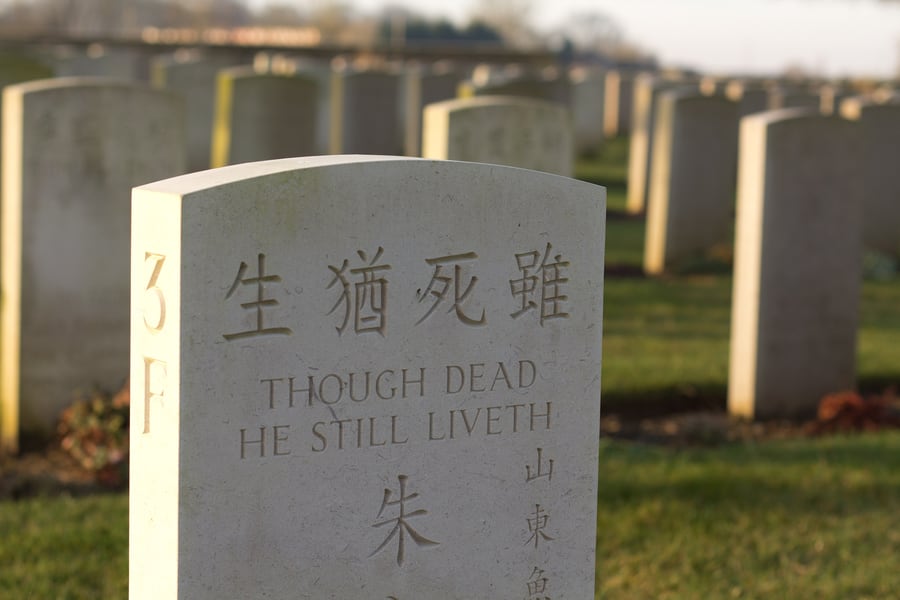 Elke Wetzig / Wikimedia Commons · CC BY-SA 4.0 · cropped
The Chinese cemetery at Nolette
In the First World War the British army ran a large camp at Noyelles for the Chinese Labour Corps, and 849 of its workers lie in the cemetery at Nolette, the largest Chinese cemetery in France. It was laid out under Edwin Lutyens and opened in 1921, and the headstones carry inscriptions in Chinese and English.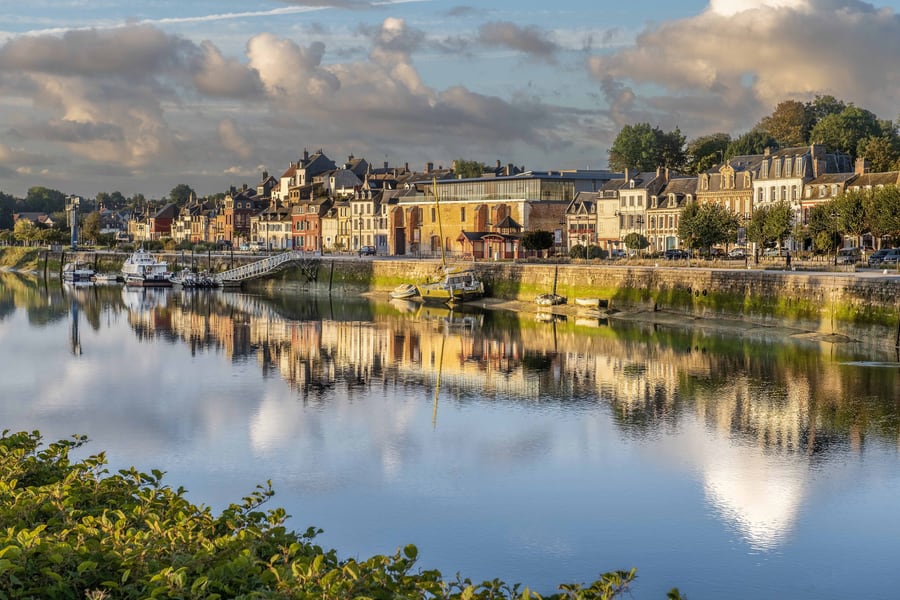 François laheyne / Wikimedia Commons · CC BY-SA 4.0 · cropped
Saint-Valery-sur-Somme
The upper town keeps its ramparts, the Porte Guillaume and the Porte de Nevers, and the church of Saint-Martin above the Courtgain, the old fishermen's quarter. William of Normandy's fleet sheltered in the bay before sailing for England at the end of September 1066. The train stops on the quay below.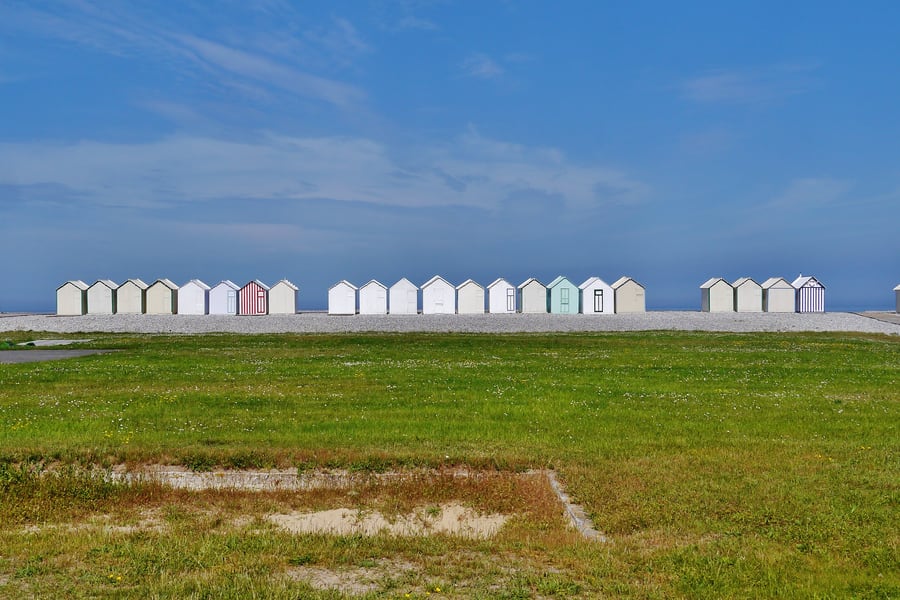 Zairon / Wikimedia Commons · CC BY-SA 4.0 · cropped
Cayeux-sur-Mer
A pebble beach backed by a boardwalk two kilometres long and lined with about 400 beach huts. The pebbles are almost pure silica, and gathering them was once the town's industry: the railway carried them to Saint-Valery's port, and a few gatherers still work the shore. The Brighton quarter along the dunes grew up after the line arrived in 1887.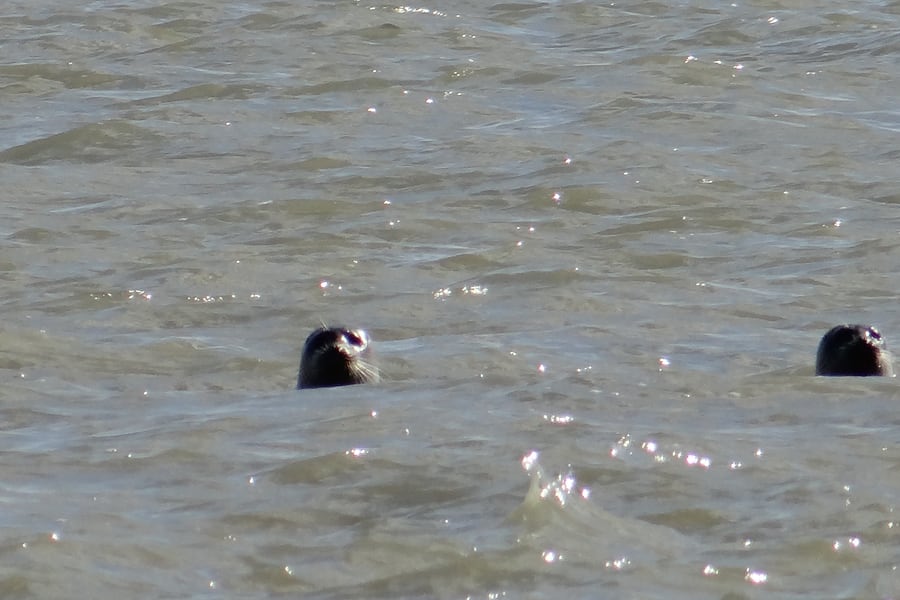 Ibex73 / Wikimedia Commons · CC BY-SA 4.0 · cropped
Le Hourdel
A hamlet and small fishing port at the southern tip of the bay, a few kilometres from Cayeux. It is the best-known place to watch the bay's seals: Le Hourdel has the largest colony of harbour seals in France. Its pebble spit is still growing northwards across the bay, and as the bay silts up most of its fishing boats have moved to Le Tréport.Where to Sleep
Le Crotoy and Saint-Valery both have hotels on the water a short walk from the trains, which makes it easy to arrive on one train and leave from the other end the next day.
Where to stay
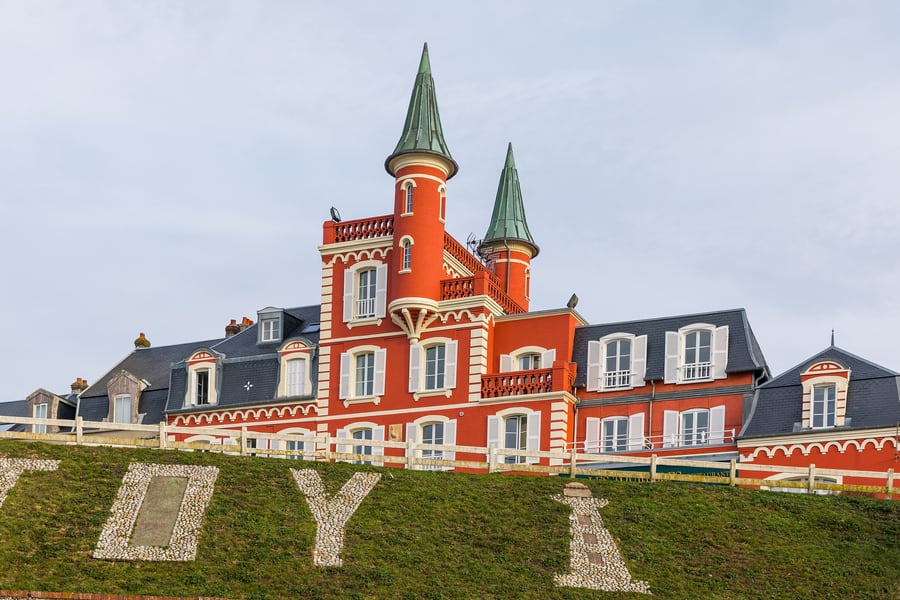 Raimond Spekking / Wikimedia Commons · CC BY-SA 4.0 · cropped
Les Tourelles
On the beach front, Le Crotoy
A turreted seaside villa of 35 rooms facing the bay or the garden, with a restaurant and terraces overlooking the bay.
Check Availability (opens in a new tab, on lestourelles.com)via lestourelles.com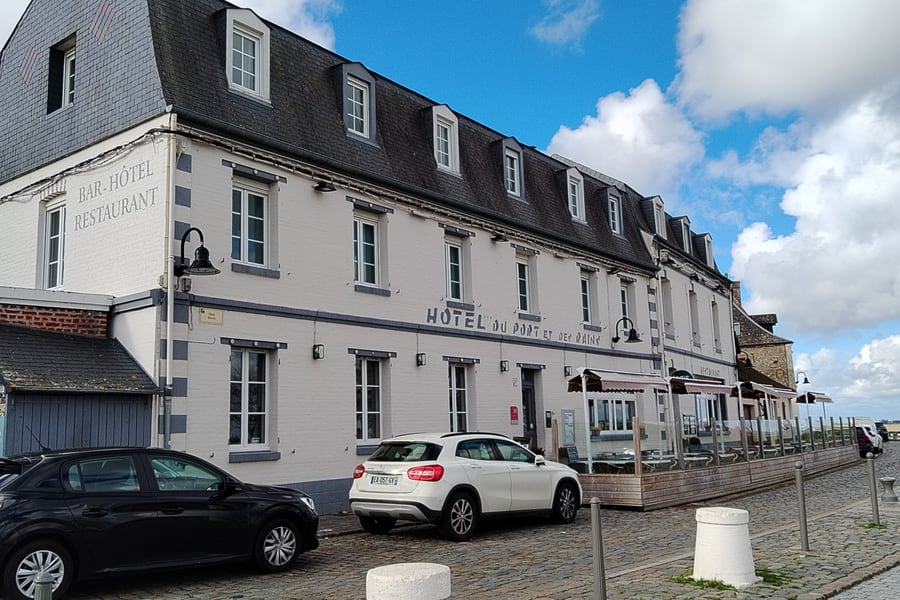 APictche / Wikimedia Commons · CC BY-SA 4.0 · cropped
Hôtel du Port et des Bains
On the quay, Saint-Valery-sur-Somme
Sixteen rooms and an apartment on the quay facing the bay, 100 metres from the old town, with a restaurant.
Check Availability (opens in a new tab, on hotelhpb.com)via hotelhpb.comQuestions or corrections
Planning this trip and stuck on something, or spotted a time, fare or detail that has changed? Send us a message about Somme Bay Railway. We read every one, and we update this page when something has changed.