The South-Link Line
Cassiopeia sweet / Wikimedia Commons · public domain · 2016 · cropped
- Distance98.2 km · 36 tunnels
- Duration1 hr 16 min by express · 3 hr 7 min by the Breezy Blue
- Best season15 trains a day each way, every day, all year
Introduction
Taiwan's railway runs round the island, and for most of a century it did not. The mountains come down to the sea at the southern tip and there was no way through them, so the west coast network and the east coast network were two railways that never met. The South-Link Line is the piece that joined them: ninety-eight kilometres from Fangliao on the Taiwan Strait to Taitung on the Pacific, cut through the last of the Central Mountain Range in thirty-six tunnels, and the last main line Taiwan ever built.
It took eleven years. Work began in 1980, the ceremonial opening was held on 16 December 1991, the inspectors failed it, and regular trains did not run until January 1992. What they had built was a railway almost nobody lives on. Between Fangliao and Dawu there are four stations in forty-four kilometres and the fast trains stop at none of them; the line spends that stretch inside the mountain, in tunnels laid end to end, rising at two parts in a thousand to a summit of 175 metres inside the 8,070-metre Central Tunnel — for twelve years the longest railway tunnel in Taiwan. Then it comes out on the east side above the Pacific and stays there, on a ledge between the surf and the hillside, all the way to Taitung.
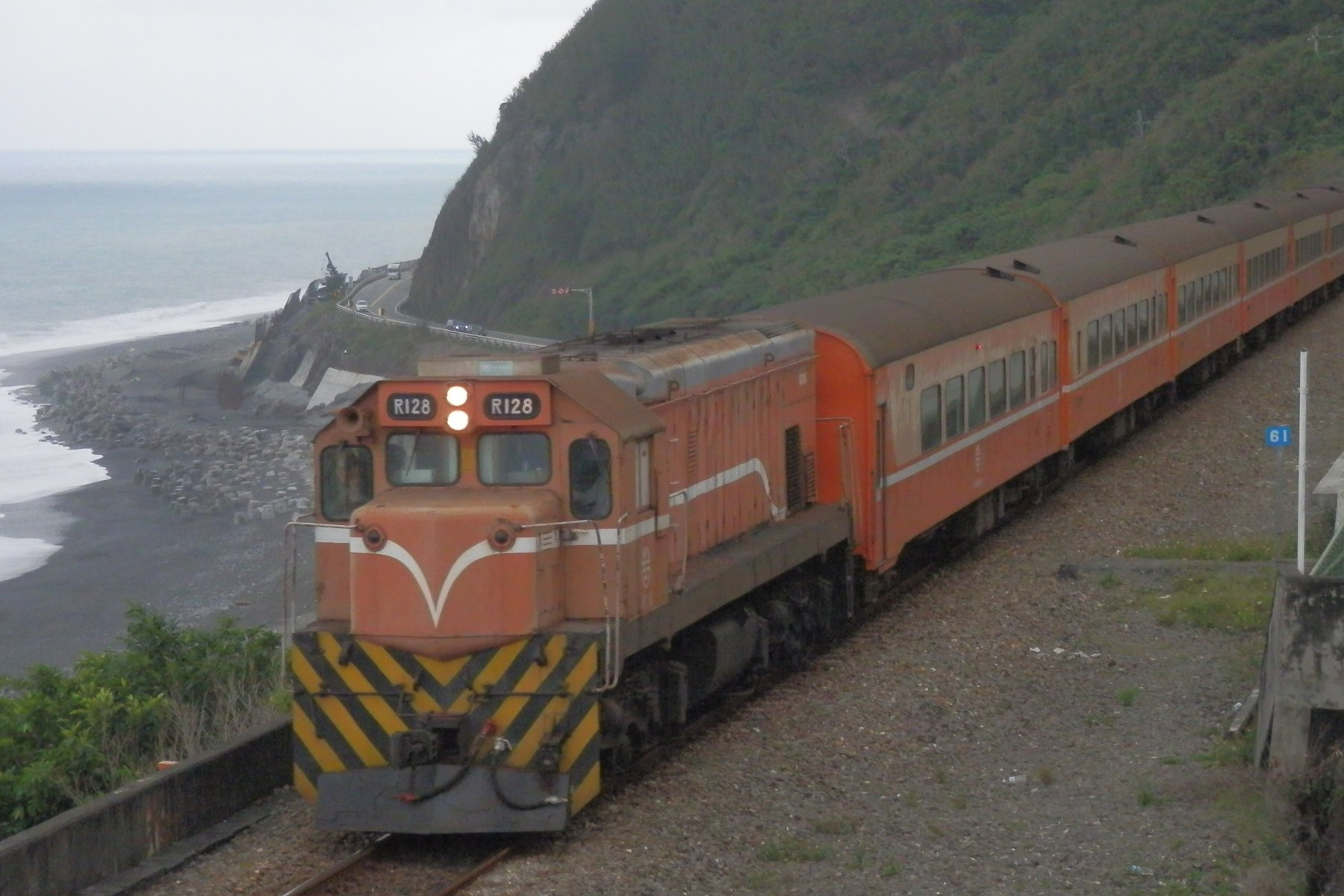
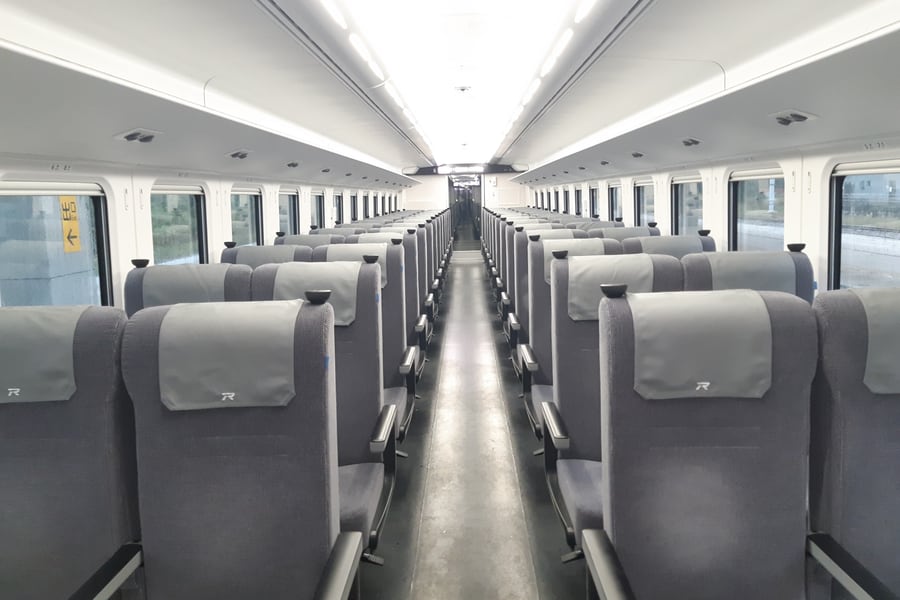
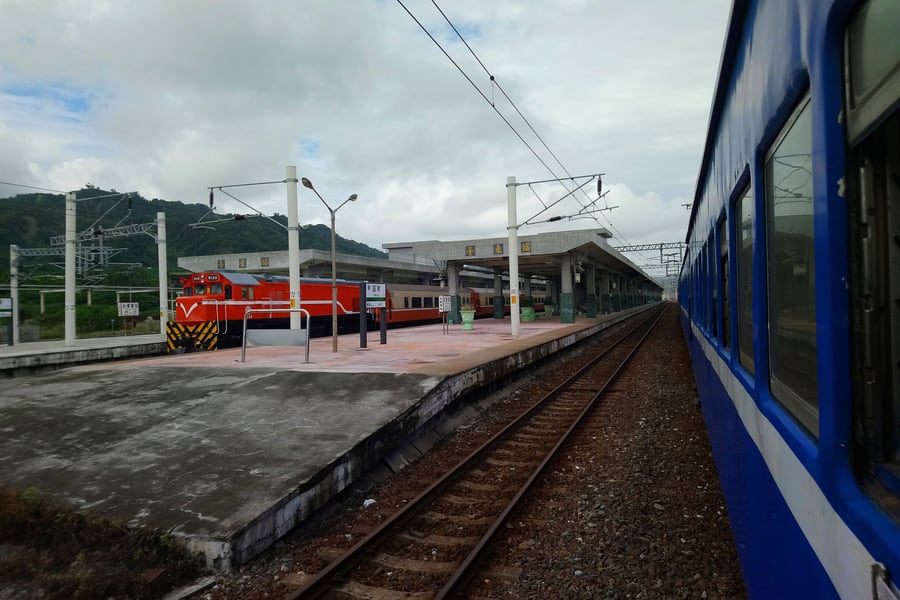
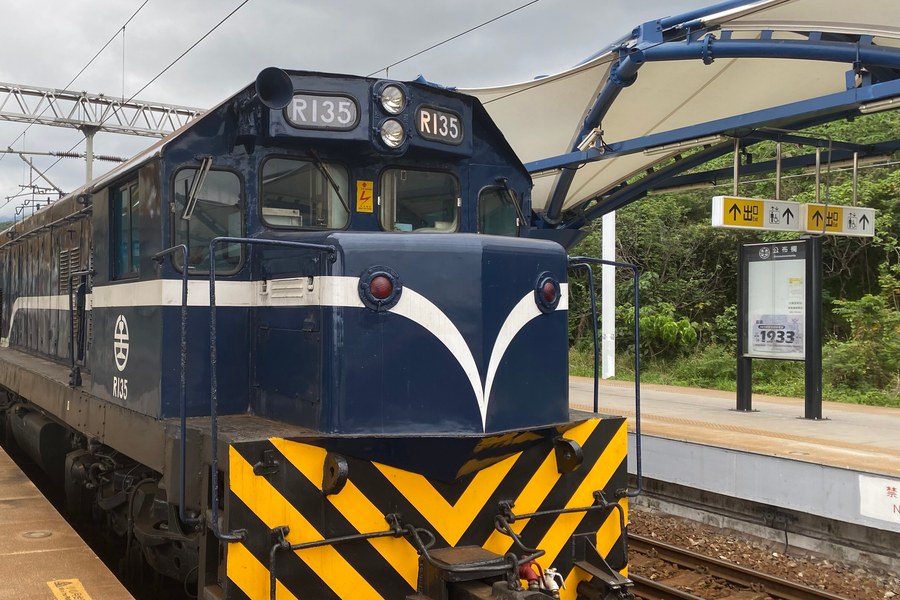
The operator calls it the Smiling Curve, and it is the only line in Taiwan from which you see both oceans. It is also the last place in the country where you can ride a train with the window open: one working each way, every day, in half-century-old blue carriages with ceiling fans and no air conditioning.
The Journey
Fangliao is where the western railway stops being western. It is the last town on the Pingtung plain, a fishing port with a station that handles the change of scene: everything north of it is flat, farmed and busy, everything east of it is mountain. Trains from Kaohsiung and Taipei run in, the Breezy Blue is made up in the yard, and the line turns inland.
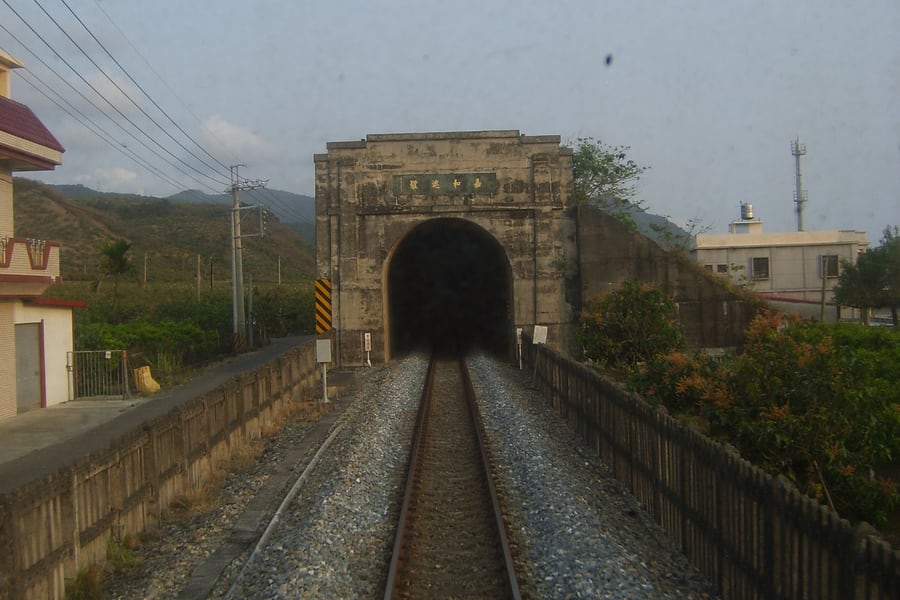
The first five kilometres are still level, through mango orchards, and then comes the strangest structure on the railway. Between Jialu and Neishi the track disappears into 1,180 metres of concrete tunnel built on completely flat ground — the Jiahe Covered Way, the only tunnel in Taiwan's railway system with no hill on top of it. The navy and the air force used a firing range on this coast for live coastal bombardment practice, and the covered way was built so a shell could not hit a train. By the time the line opened the range had been moved and it had nothing to protect against. It is still there, still used, and it does now keep the worst of the downslope winter wind off the track.
Into the mountain
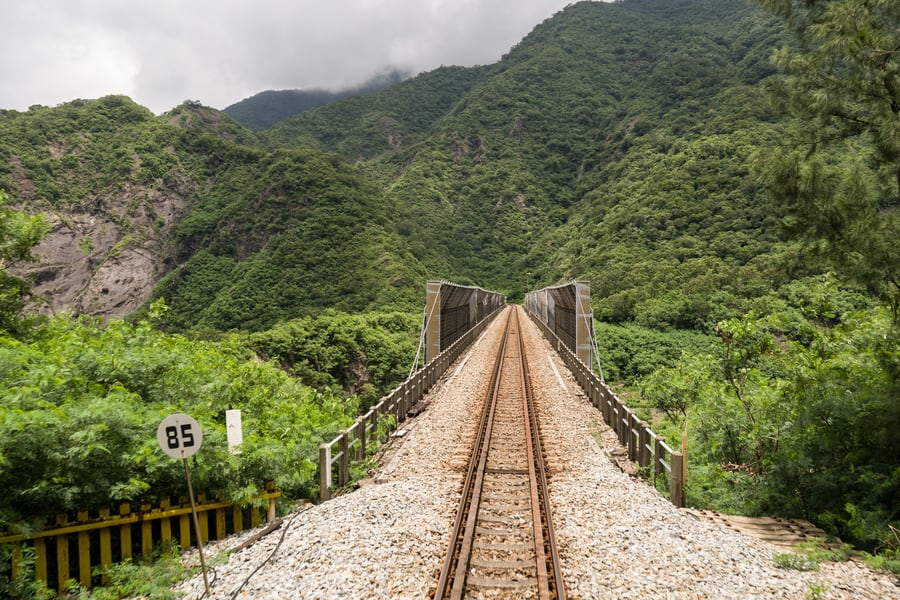
Fangshan, thirteen kilometres out, is the southernmost railway station in Taiwan. It has no staff and no ticket office, a footbridge, and a view west over the Taiwan Strait; the limited expresses go straight through. Seven kilometres further on is Fangye, which is not a station at all in the sense of being somewhere you can get off. It is a signal box with a building and no platform, and it does three jobs: it lets trains pass each other, it works the Central Signal Station remotely, and it watches the wind gauge on Fangye No. 2 Bridge. That bridge is the only one on the Taiwanese network with wind netting and an anemometer on it, and above twenty-five metres a second Fangye stops the trains.
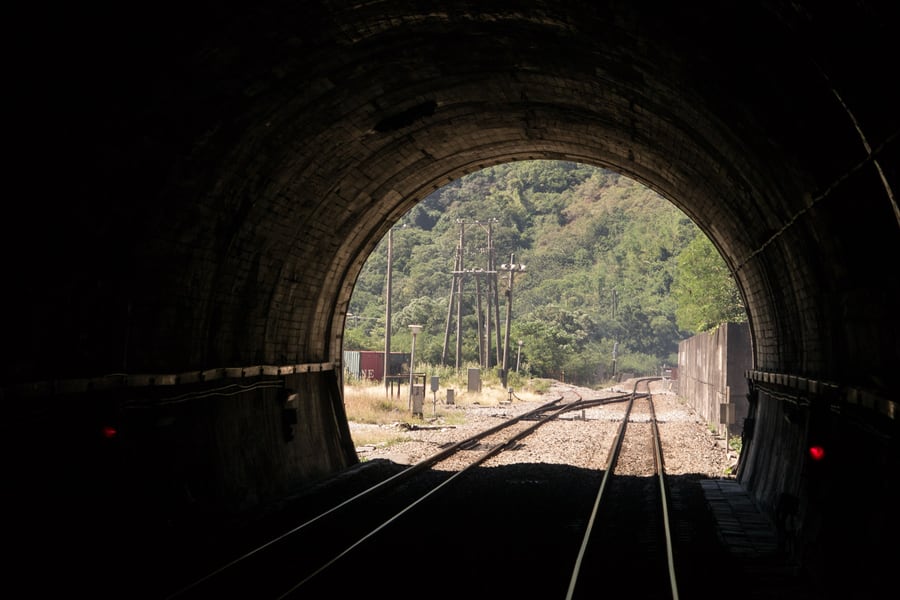
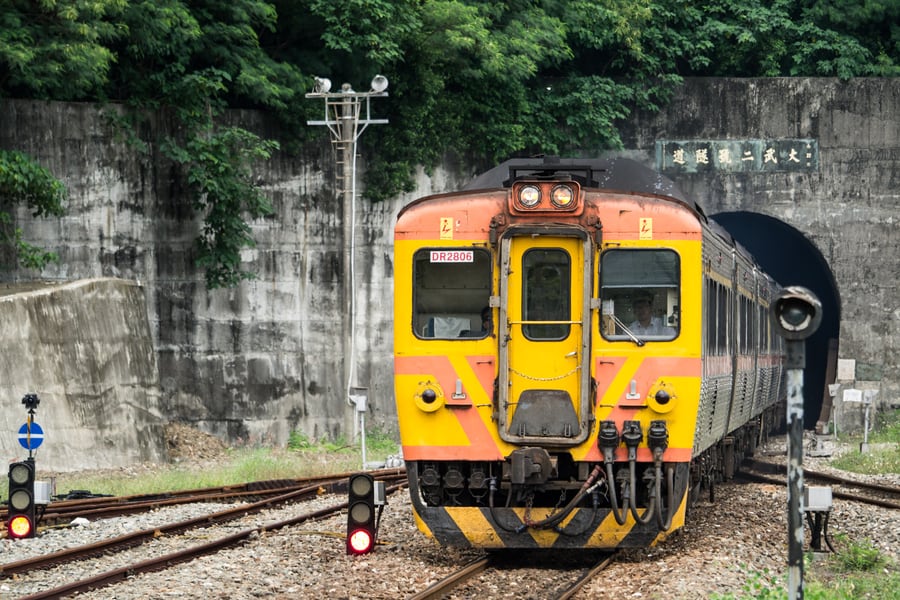
Then the Central Tunnel. It was started in March 1984 and finished in August 1991 — six years and nine months for 8,070 metres under Chaliufan Mountain, driven first by heading and then, when the rock turned out to be bad, by the New Austrian method. It is dead straight, it is the only double-track section of the whole railway, and it is where the line crosses from Pingtung County into Taitung County and from one side of Taiwan to the other. There is nothing to see. That is rather the point: the two halves of the island are ten minutes apart inside a hole in the dark, and every attempt to get between them before this took a day.
The Pacific side
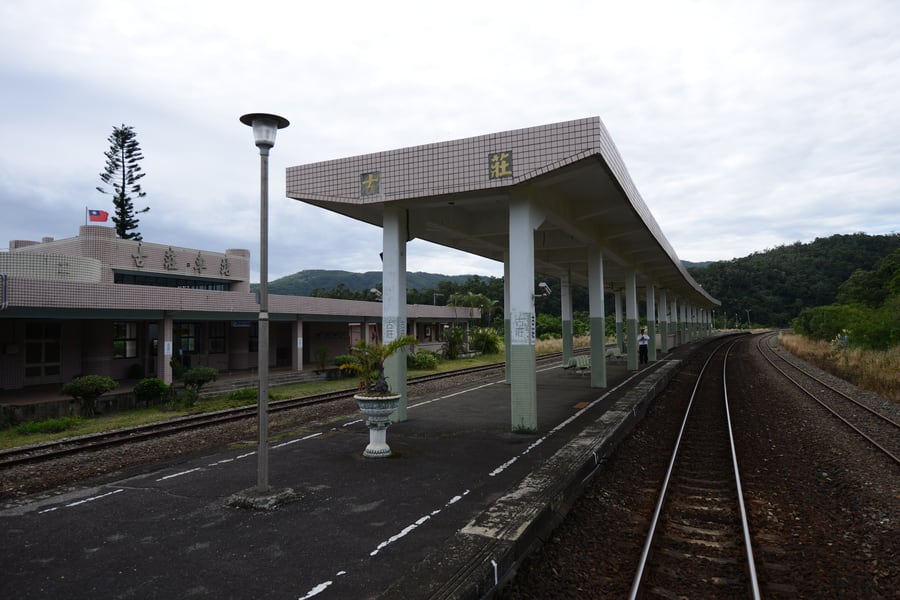
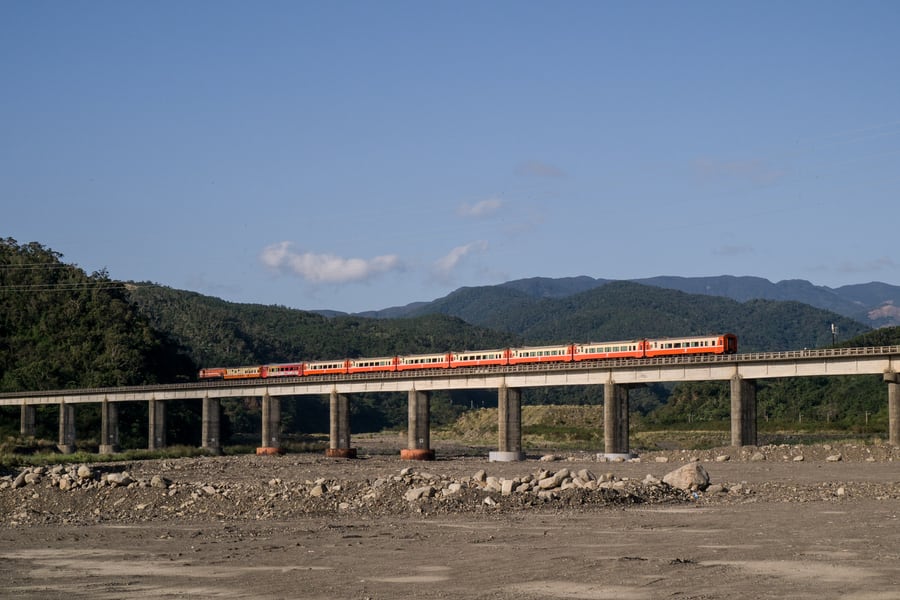
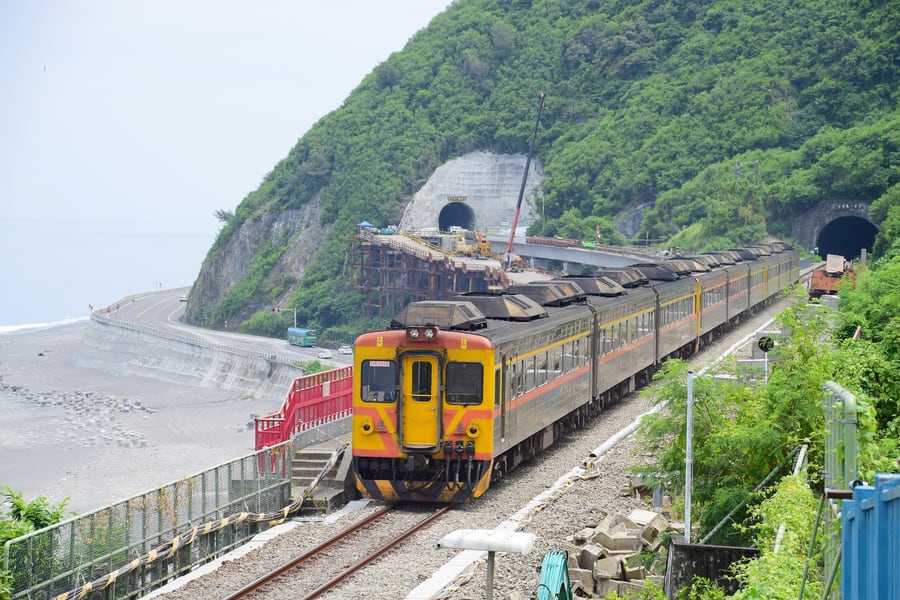
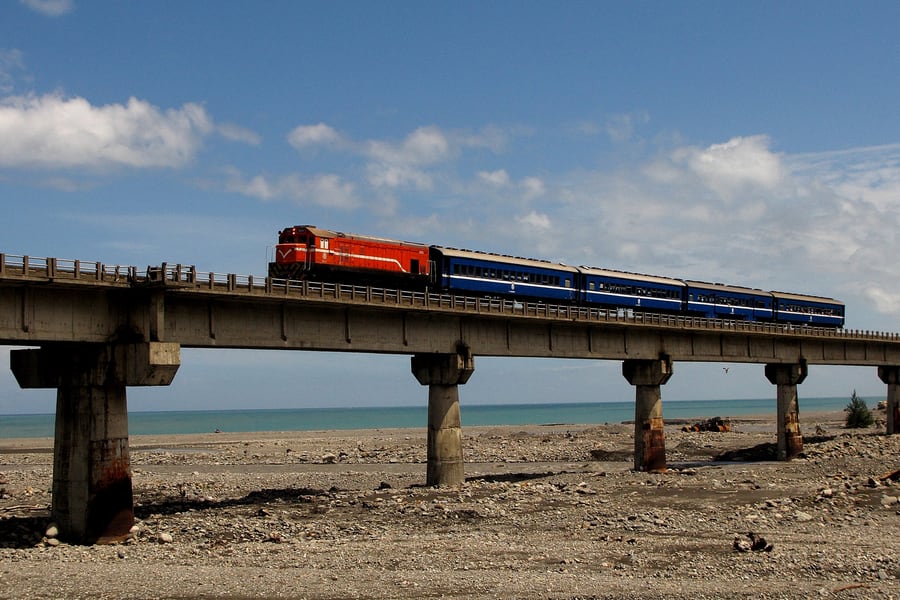
The train comes out at Guzhuang, drops through a string of shorter tunnels and arrives at Dawu, the first real town in fifty minutes and the only intermediate stop every train makes. From here the railway is a coast railway. It runs on a shelf cut into the hillside with the sea immediately below it, ducking into headlands and out again, crossing the Dawu, Jinlun and Taimali rivers on long concrete viaducts that stand on the beach.
The set piece is Duoliang. The station closed in 2006 and was pulled out of the timetable, but the platform is still there, hanging above a black shingle beach with nothing between it and the water, and the roof was turned into a viewing deck. It is now the most visited place in Taitung County — an abandoned railway station, with a NT$10 turnstile, where people come to watch other people's trains go by.
Below Duoliang the line was moved seaward in May 2020 to get the clearance for the overhead wires, so the newest stretch of it is also the closest to the Pacific. Jinlun sits at a river mouth with hot springs up the valley behind it; Taimali is the town under the daylily mountain; Zhiben is the hot-spring resort; and at Kangle the mountains finally let go and the train runs into Taitung across flat ground. The whole thing takes an hour and a quarter behind an EMU3000, or three hours and seven minutes behind a diesel with the windows down.
What changed in 2020
For its first twenty-eight years this was a diesel railway, and it was the last one. On 22 December 2020 the final unairconditioned ordinary train left Fangliao; the next day the electrification opened, the last mile of Taiwan's round-island scheme, and the modern tilting expresses came over the mountain for the first time. The blue carriages went to a works at Nanzhou, were rebuilt, and came back on 23 October 2021 as the Breezy Blue. Both things are true at once, which is why the railway has a good documentary about it — Hsiao Chu-chen's On The Train, released in June 2023 and the first feature-length railway documentary made in Taiwan.
Along the route
 Bullettrain700 / Wikimedia Commons · CC BY-SA 3.0 · 2008 · cropped
A tunnel with no hill on it
Between Jialu and Neishi the line runs into 1,180 metres of concrete on completely flat ground. The navy and air force fired live rounds at this coast, and the Jiahe Covered Way was built so a stray shell could not hit a train. The range moved before the railway opened.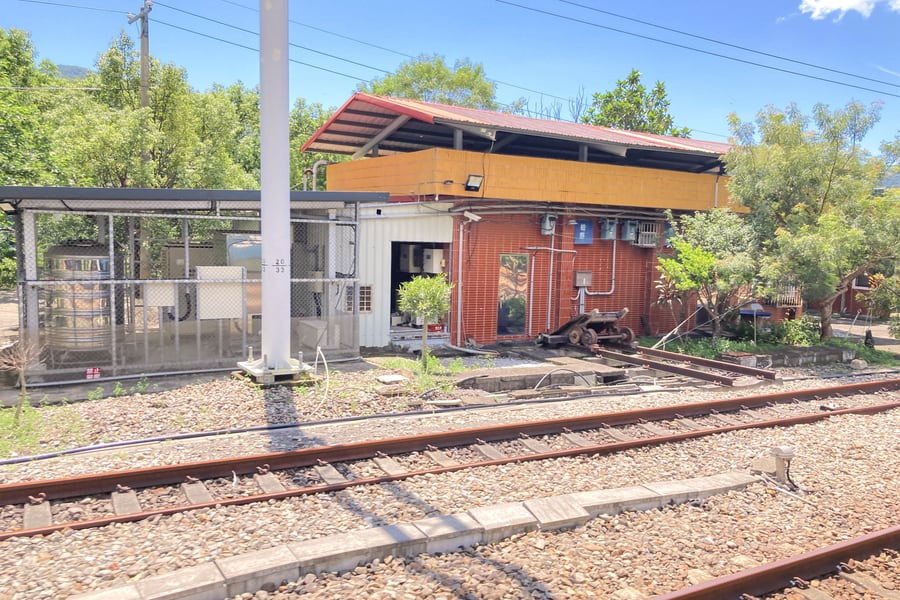 Tze Chiang Hao / Wikimedia Commons · CC BY 4.0 · 2023 · cropped
The box that watches the wind
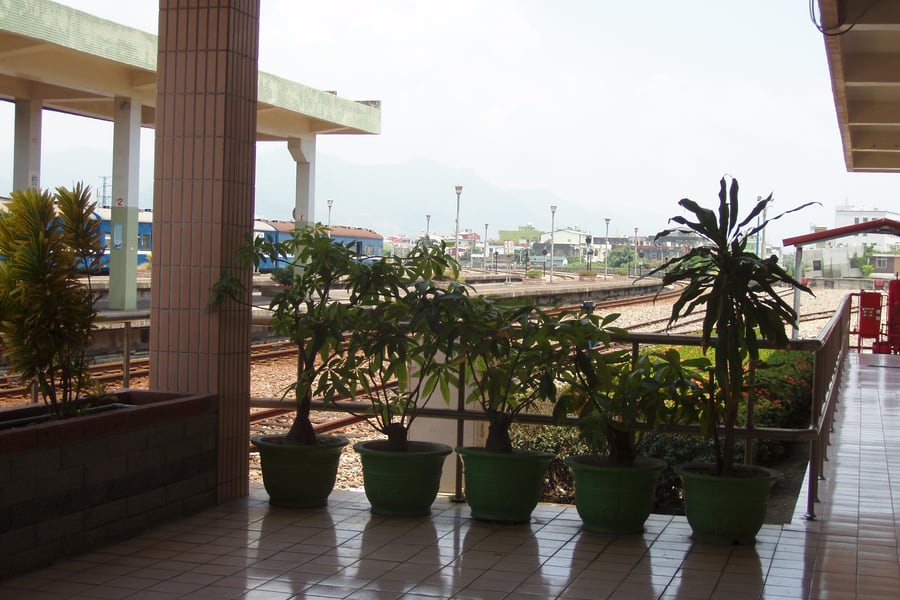
Fangye has a building and no platform, and nothing stops there. It lets trains pass, works the Central Signal Station remotely, and reads the anemometer on Fangye No. 2 Bridge — the only wind gauge on a Taiwanese railway bridge. Over twenty-five metres a second it stops the trains.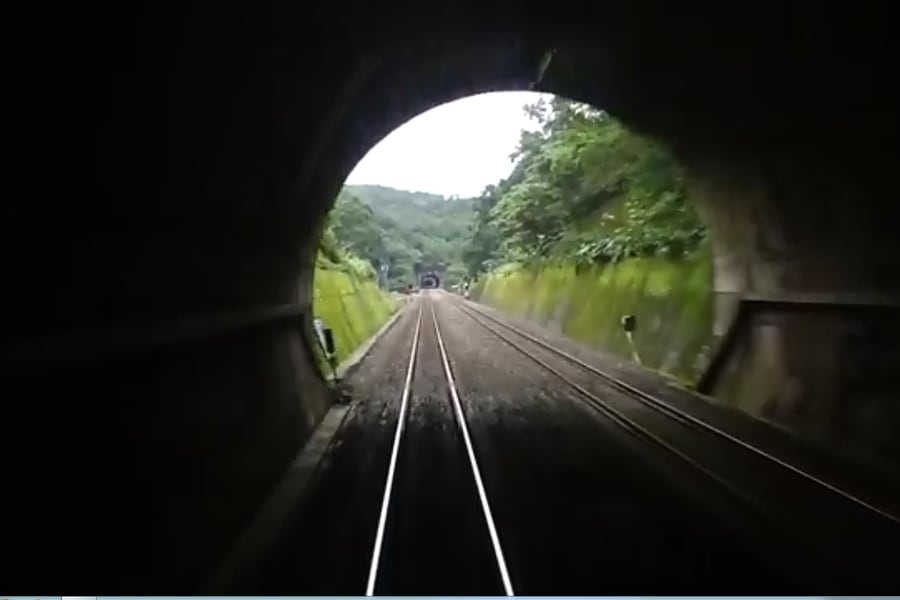 Shi0925887601 / Wikimedia Commons · CC BY-SA 4.0 · 2017 · cropped
Ten minutes under the mountains
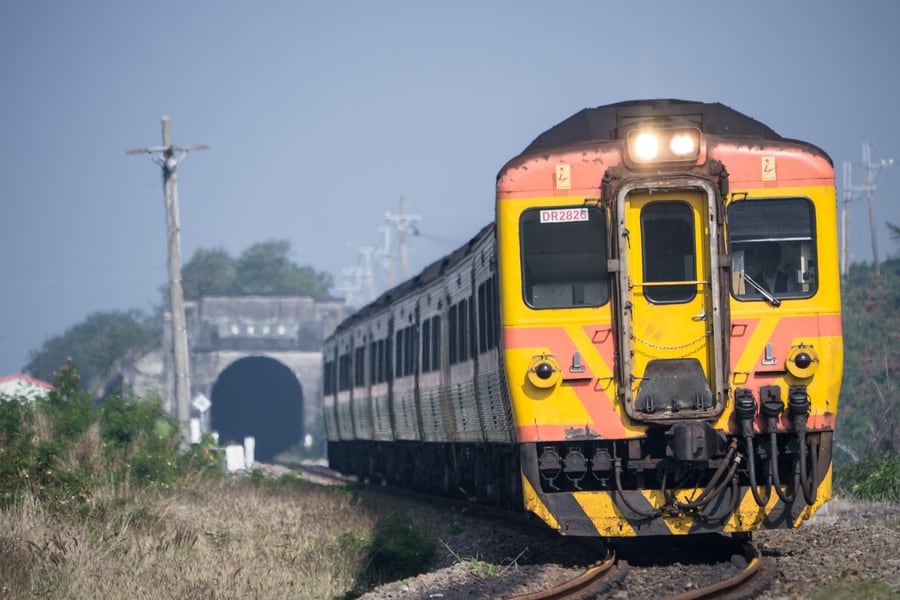
The Central Tunnel took six years and nine months to drive and is dead straight for 8,070 metres. Inside it the line reaches its summit, 175 metres above the sea, and crosses from Pingtung County into Taitung County. There is nothing to look at, which is the whole achievement.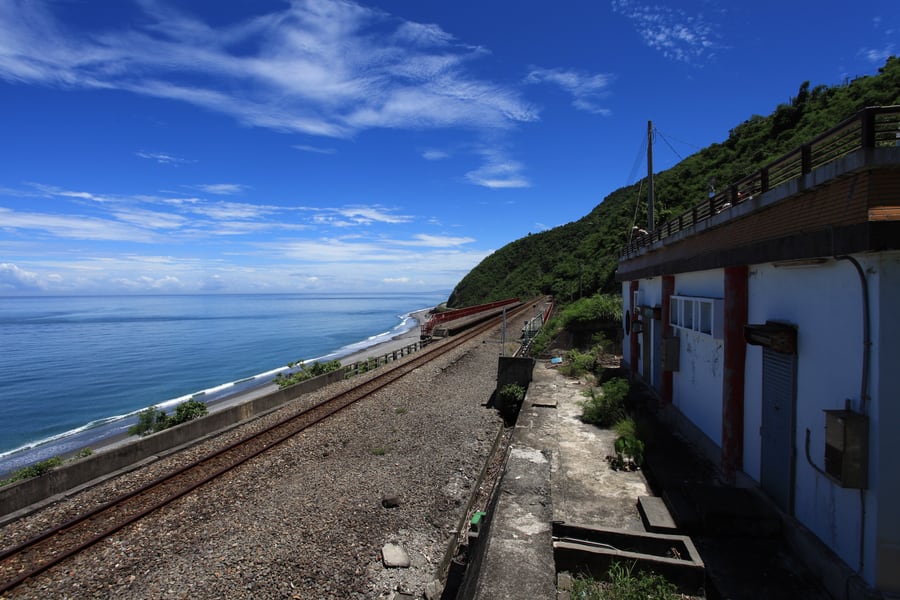 明章徐 / Wikimedia Commons · CC BY-SA 2.0 · 2013 · cropped
The station they closed
Duoliang was built on a shelf above a black shingle beach and shut in 2006 for want of passengers. Its roof became a viewing deck, and it is now the most visited place in Taitung County — an abandoned halt where people pay to watch other people's trains.A bit of history
Culture & experiences along the way
 Taiwan Railways Administration / Wikimedia Commons · Attribution · 2023 · cropped
The last windows that open
The blue carriages are half a century old and have never had air conditioning: manual sliding doors, ceiling fans on brackets, hard green seats, and windows you push up yourself. Since October 2021 they have run once a day each way as the Breezy Blue, the only train in Taiwan you can put your head out of.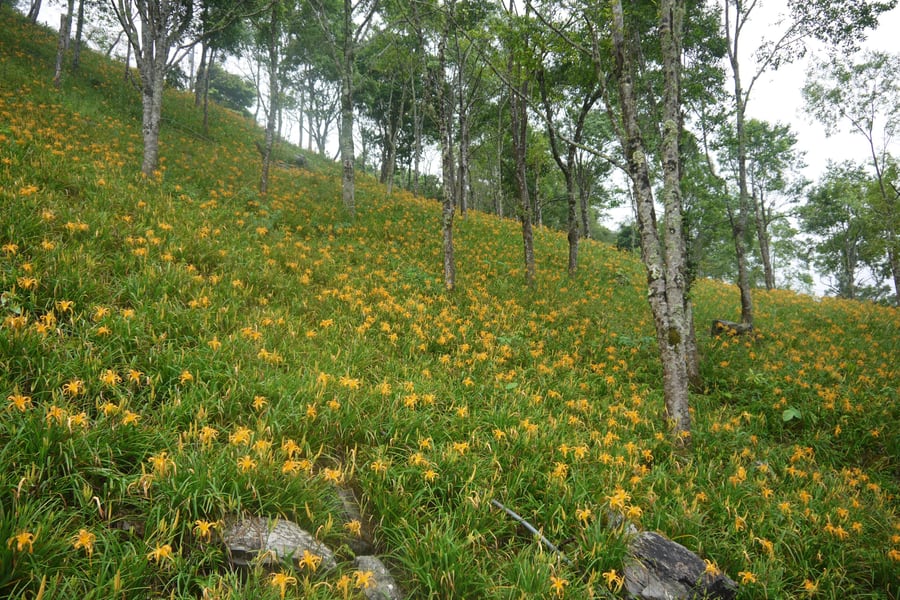 Chi-Hung Lin / Wikimedia Commons · CC BY-SA 3.0 · 2014 · cropped
A flower you eat
Above Taimali the hillsides turn orange from August to October, when the daylilies open on Jinzhen Mountain at 1,300 metres. The edible kind is picked the day before it flowers and comes back down as fritters, cold salad and tea eggs. The ornamental kind is mostly poisonous, so buy it rather than pick it.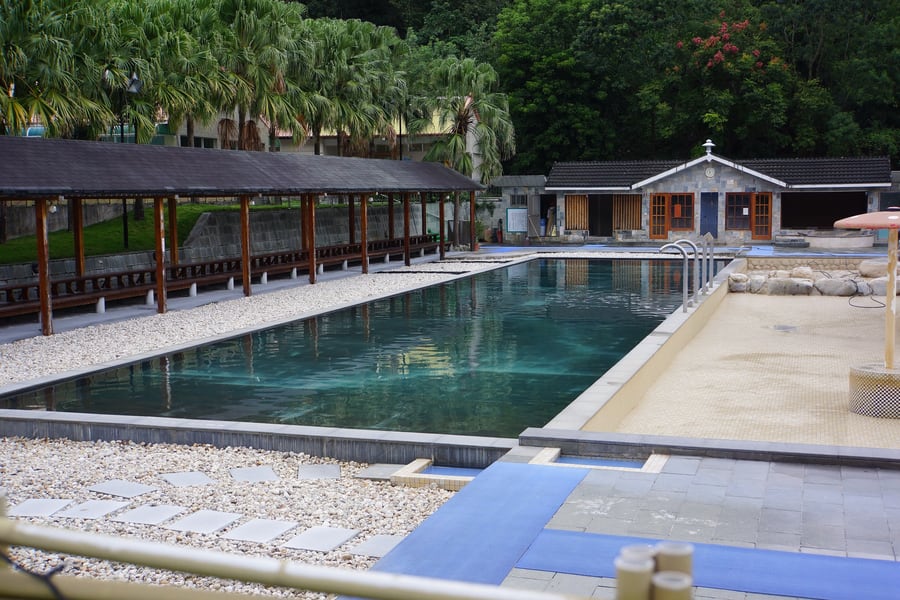 lienyuan lee / Wikimedia Commons · CC BY 3.0 · 2013 · cropped
Getting into the water
Both hot-spring valleys on this line are a short ride from a station. Zhiben has been a bathing town since the Japanese built a public bathhouse there, and its water is clear and odourless; Jinlun's is a weakly alkaline sodium bicarbonate spring that comes out of the ground between seventy and ninety degrees, so everything there is blended.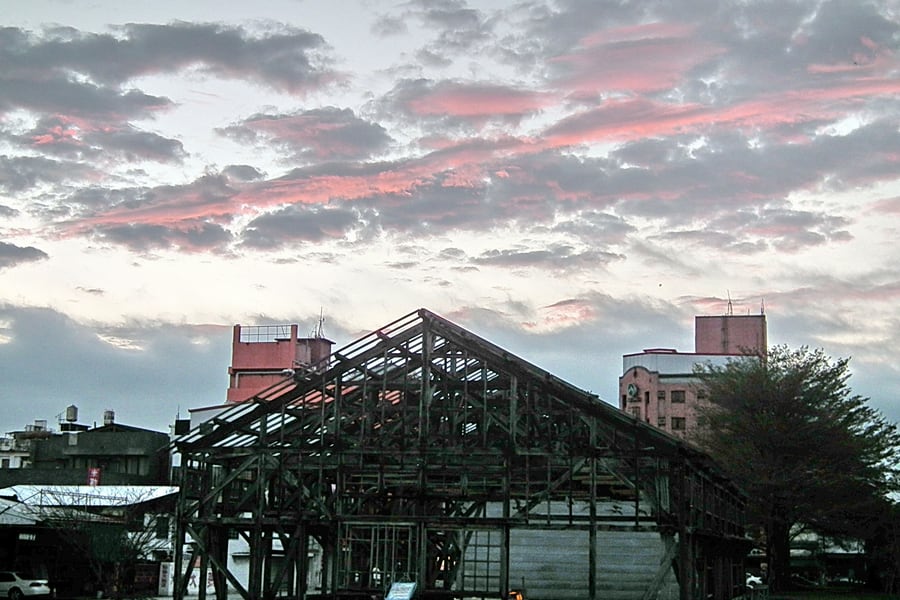 lienyuan lee / Wikimedia Commons · CC BY 3.0 · 2012 · cropped
The terminus before this one
Taitung's first station opened in the middle of town in 1922 and closed on 1 June 2001, when the trains moved out to Beinan. Nothing was demolished. The engine shed — listed as a county historic building the next year — the turntable, the semaphores and a length of track are still there, as the Taitung Railway Art Village.Timetables
Fifteen trains a day run each way between Fangliao and Taitung from Monday to Friday, and sixteen eastbound on a Saturday. They start before six in the morning and the last one east leaves Fangliao at 22:36. Almost all of them are through workings from somewhere much further away — Xinzuoying, Chaozhou, Taichung, Shulin, Hualien — so Fangliao is a stop on a long journey rather than the start of one, and nothing terminates there.
Times and fares below were read from the operator's own English journey planner on 15 September 2026, for Wednesday 16 and Saturday 19 September.
The fast way: 1 hour 16 minutes
The Tze-Chiang 3000 Express is the EMU3000 tilting train, and it is the reason the crossing now takes an hour and a quarter. It calls at Fangliao, Dawu, Jinlun, Taimali, Zhiben and Taitung and nothing else, so the run from Fangliao to Dawu — forty-four kilometres and the whole mountain — is twenty-nine minutes without a stop.
| Station | 411 | 371 |
|---|---|---|
| Fangliao | 06:24 | 10:17 |
| Dawu | 06:54 | 10:47 |
| Jinlun | 07:08 | 11:02 |
| Taimali | 07:18 | 11:11 |
| Zhiben | 07:29 | 11:22 |
| Taitung | 07:40 | 11:32 |
Eastbound departures from Fangliao are at 06:24, 06:28, 07:56, 08:02, 10:11, 10:17, 11:51, 12:29, 13:42, 15:52, 17:04, 18:30, 19:56, 21:14 and 22:36; on Saturdays a Puyuma Express is added at 09:34. Westbound from Taitung they leave at 05:52, 06:20, 07:16, 08:37, 10:14, 11:08, 12:35, 13:41, 14:13, 15:17, 17:00, 17:30, 18:33, 19:30 and 20:50.
The slow way: every station
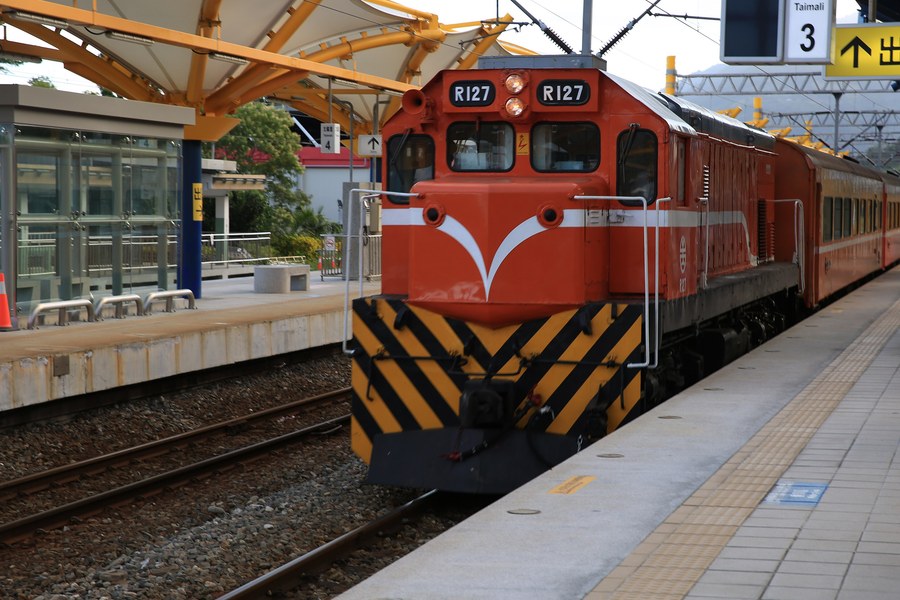
One train a day each way still calls everywhere, including Jialu and Neishi, which nothing else does. It is the Chu-Kuang Express, the old locomotive-hauled class, and it takes two hours seventeen minutes eastbound.
| Station | 727 (east) | 708 (west) |
|---|---|---|
| Fangliao | 12:29 | 17:17 arr |
| Jialu | 12:35 | 17:05 arr · 17:09 dep |
| Neishi | 12:40 | — |
| Fangshan | 12:47 arr · 12:50 dep | 16:50 arr · 16:56 dep |
| Dawu | 13:16 arr · 13:24 dep | 16:18 arr · 16:20 dep |
| Longxi | 13:34 | 16:07 arr · 16:08 dep |
| Jinlun | 13:44 | 15:56 arr · 15:58 dep |
| Taimali | 13:57 arr · 14:09 dep | 15:45 arr · 15:46 dep |
| Zhiben | 14:21 arr · 14:30 dep | 15:32 arr · 15:34 dep |
| Kangle | 14:38 | 15:23 arr · 15:24 dep |
| Taitung | 14:46 | 15:17 dep |
The Fast Local Train (區間快) is the cheap middle option — about an hour and fifty minutes, unreserved, four or five a day, calling at every station except Neishi and sometimes Longxi.
The Breezy Blue
The tourist train runs one working each way, every day, as Ordinary Train 5899 down and 5898 up. It is not on the ordinary timetable and it is not sold as an ordinary ticket — see Tickets below. These times took effect on 1 July 2026.
| Station | 5899 (Fangliao → Taitung) | 5898 (Taitung → Fangliao) |
|---|---|---|
| Fangliao | 10:25 dep | 17:39 arr |
| Jialu | 10:32 arr · 10:52 dep | — |
| Fangshan | — | 17:06 arr · 17:24 dep |
| Dawu | 11:33 arr · 11:53 dep | 16:29 arr · 16:36 dep |
| Jinlun | 12:19 arr · 12:20 dep | 15:00 arr · 16:02 dep |
| Taimali | 12:35 arr · 13:04 dep | 14:44 arr · 14:46 dep |
| Zhiben | 13:17 arr · 13:18 dep | 14:30 arr · 14:31 dep |
| Taitung | 13:32 arr | 14:17 dep |
Those long stands are deliberate: twenty minutes at Jialu, twenty at Dawu, twenty-nine at Taimali going east, and a full hour at Jinlun coming back. Three hours seven minutes east, three hours twenty-two west, for a journey the express does in seventy-six minutes.
Check before you travel on the operator's own English pages: Taiwan Railway Corporation (opens in a new tab), and for the tourist train its own timetable (opens in a new tab).
Tickets
Ordinary trains are straightforward. Fangliao to Taitung was NT$313 on a Tze-Chiang 3000 Express in September 2026, NT$241 on the Chu-Kuang and NT$201 on a Fast Local, with the concession fare at half. The EMU3000 and the Puyuma are reserved and should be booked, particularly in summer and at holidays, when this is the only rail route to Taitung that does not go the long way round the island; the Fast Local is unreserved and you simply get on.
The Breezy Blue is a different product. It is not sold at the ticket window: the operator has given the concession to a tour company, and you buy a package rather than a fare — NT$799 one way, NT$1,399 for the same-day return. It sells out at weekends and in the daylily season.
Book your tickets
Kazehayashi / Wikimedia Commons · CC BY-SA 4.0 · 2021 · croppedFangliao to Taitung, Tze-Chiang 3000
NT$313 one way · NT$157 concession
The EMU3000 tilting express, reserved, six stops, one hour sixteen minutes.
Book Tickets (opens in a new tab, on railway.gov.tw)via railway.gov.twbilly1125 / Wikimedia Commons · CC BY 2.0 · 2015 · croppedFangliao to Taitung, Fast Local
NT$201 one way · NT$101 concession
Unreserved, no booking, about an hour and fifty minutes, four or five a day.
Book Tickets (opens in a new tab, on railway.gov.tw)via railway.gov.twbilly1125 / Wikimedia Commons · CC BY 2.0 · 2013 · croppedThe Breezy Blue
NT$799 one way · NT$1,399 same-day return
Sold as a package by the operator's concessionaire, not as a railway ticket.
Book Experience (opens in a new tab, on railway.gov.tw)via railway.gov.twRail Passes
The operator's island-wide ticket is TR-PASS, and the general version comes in two lengths: NT$2,400 for three consecutive days and NT$3,200 for five, with children, seniors, disabled passengers and their companions at half — NT$1,200 and NT$1,600. There are longer student versions. Within the validity it covers every class of train, with no limit on zones or trips.
For this journey alone it is not worth buying. A Tze-Chiang fare from Fangliao to Taitung is NT$313, so a three-day pass has to cover almost eight such rides before it pays, and nobody rides the South-Link Line eight times. What it is worth buying for is the thing the South-Link Line made possible: a lap of the island. Fangliao–Taitung is one leg of a round-island circuit that also takes in the North-Link Line down the Pacific cliffs and the Taitung Line through the East Rift Valley, and on that trip a five-day pass is comfortably ahead.
Four conditions matter. Reserved-seat trains still need a reservation — Puyuma, Taroko, Tze-Chiang Limited Express EMU3000 and group trains — which you make at a station counter with the pass in your hand, and you then travel on both documents together. The pass has been sold under real-name registration since 15 October 2024, so you buy it in person with a passport or ID card and carry that document with you; a conductor who cannot match the two treats it as travelling without a ticket. You choose the start date when you buy, any day within thirty days of purchase, it runs on consecutive days from there, and it cannot be changed or refunded once that date has begun. And it is not valid on sightseeing trains, which rules out the Breezy Blue on this line.
Pass conditions were read on the operator's own English page on 15 September 2026, where they were last updated on 4 September 2026: TR-PASS (opens in a new tab).
Places to Visit
This is not a line to hop along. Eleven stations in ninety-eight kilometres, a train every hour or so and nothing at all between Fangliao and Dawu — get off at the wrong one and you wait. The sensible shape of a trip here is two or three nights strung along the eastern half, where the stops are close together and each has a reason to stay, with the mountain crossing ridden straight through in either direction.
The stops below run west to east. One of them, Duoliang, has no trains at all: the station shut in 2006 and you reach it by road from Taimali or Dawu. It is still the busiest place on the railway.
 Taiwan Railways Administration / Wikimedia Commons · Attribution · 2022 · cropped
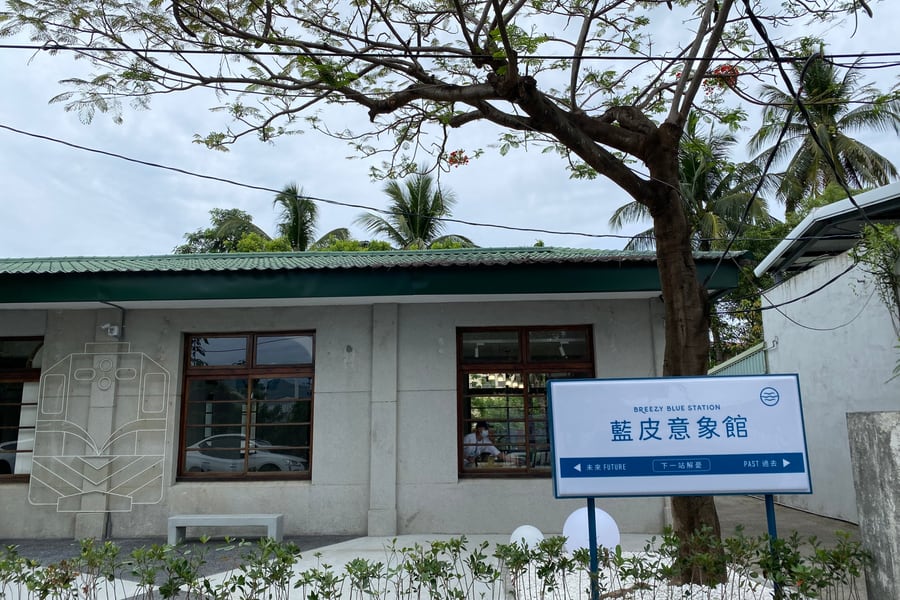
Fangliao
A fishing town on the Taiwan Strait that is also a change of railway: north of it the network is flat and busy, east of it there is one line and a mountain. The station's old goods yard now holds the Breezy Blue Station, the operator's own exhibition hall about the blue train, and the harbour a few streets away sends boats to Xiao Liuqiu. It is the last place to buy anything for the next fifty kilometres.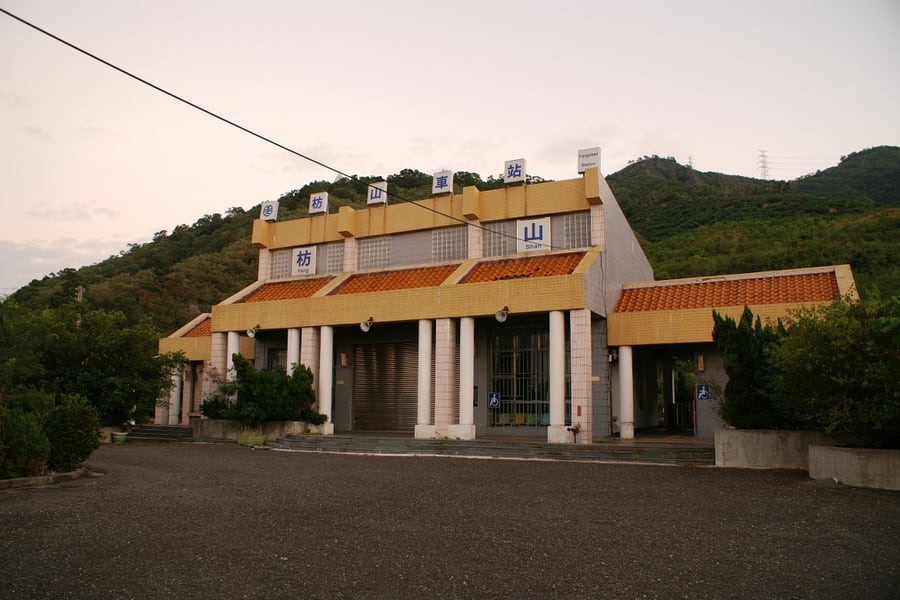 MickeyDisney / Wikimedia Commons · CC BY-SA 3.0 · 2010 · cropped
Fangshan
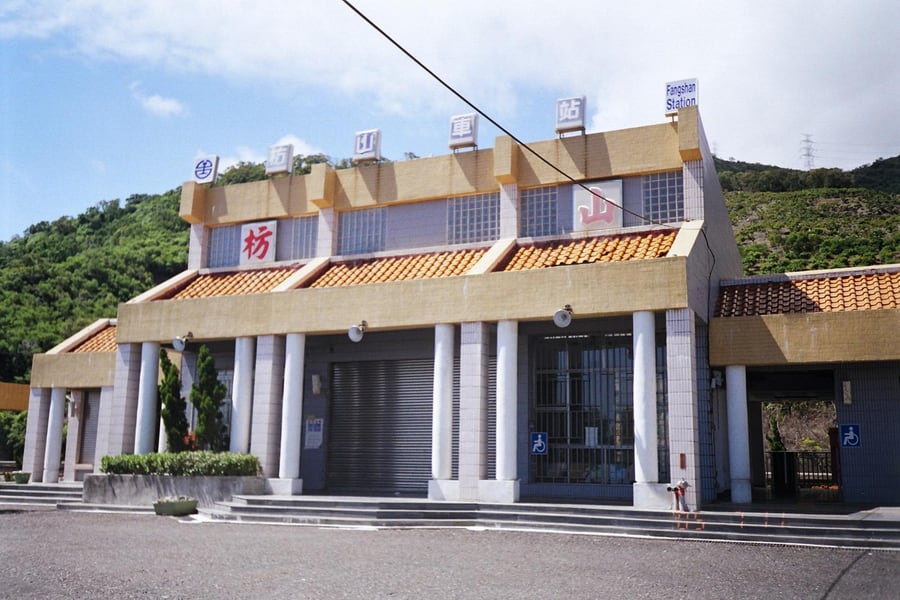
The most southerly railway station in Taiwan, and one of the emptiest. There is no ticket office and no staff; there is a temple-roofed station building, a footbridge, a view west over the strait and, in winter, the downslope wind that the covered way further back was accidentally useful against. One train a day in each direction stops here.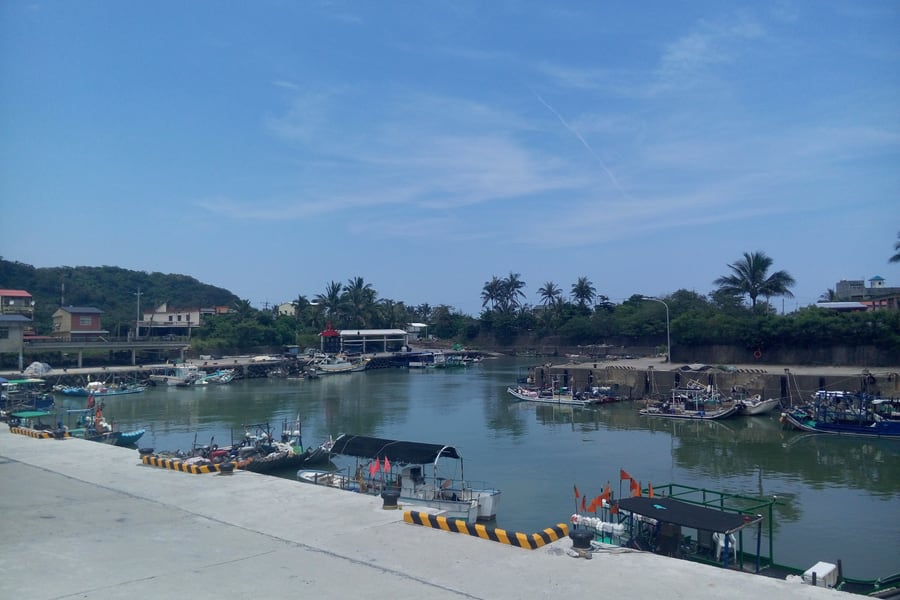 Eric850130 / Wikimedia Commons · CC BY-SA 4.0 · 2015 · cropped
Dawu
Fifty minutes out of Fangliao and the first place with shops. Dawu is a fishing harbour under a green headland, and beside it stands Dawu Heart — South-Link Station, the largest roadside stop in Taitung County, two floors of local stalls open 07:00 to 19:00. This is where to eat abai, the millet-and-pork parcel steamed in leaves that is the standard indigenous food of the south-east.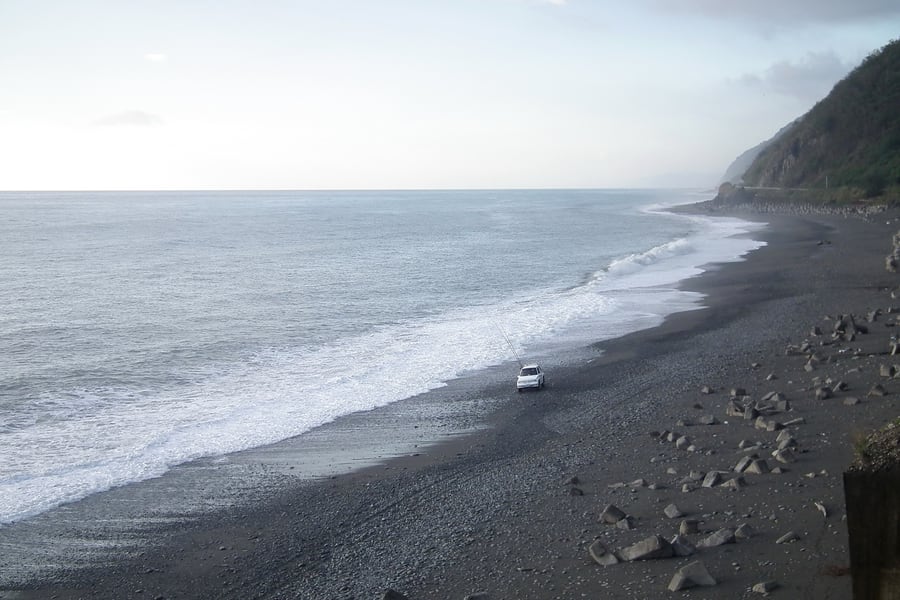 lienyuan lee / Wikimedia Commons · CC BY 3.0 · 2012 · cropped
Duoliang
Called the most beautiful station in Taiwan and abolished in 2006 for lack of custom. The platform and its red railings sit directly above a black shingle beach, the roof is a viewing deck, and the trains still come through. Entry is NT$10 and it opens 08:00 to 17:00; there is no railway service, so you come by road from Taimali or Dawu. It draws more visitors than anywhere else in the county.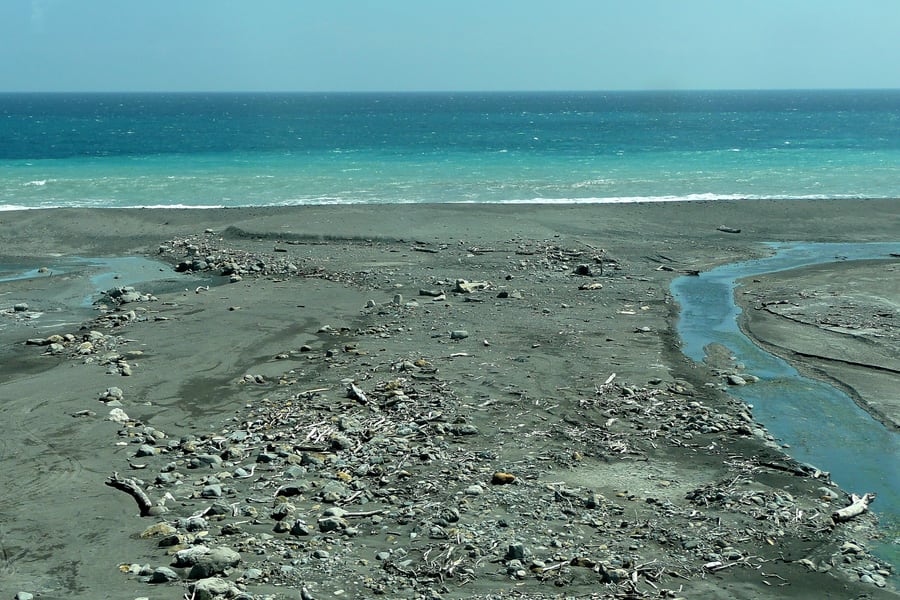 lienyuan lee / Wikimedia Commons · CC BY 3.0 · 2011 · cropped
Jinlun
The line crosses the Jinlun river on its longest bridge right at the river mouth, and the village behind is a Paiwan hot-spring settlement ten minutes up the side valley by road. The water is weakly alkaline sodium bicarbonate at pH 7 to 8 and leaves the rock between seventy and ninety degrees. The red steel arch of the Rainbow Bridge, finished in 1999, looks east down the valley to the sea.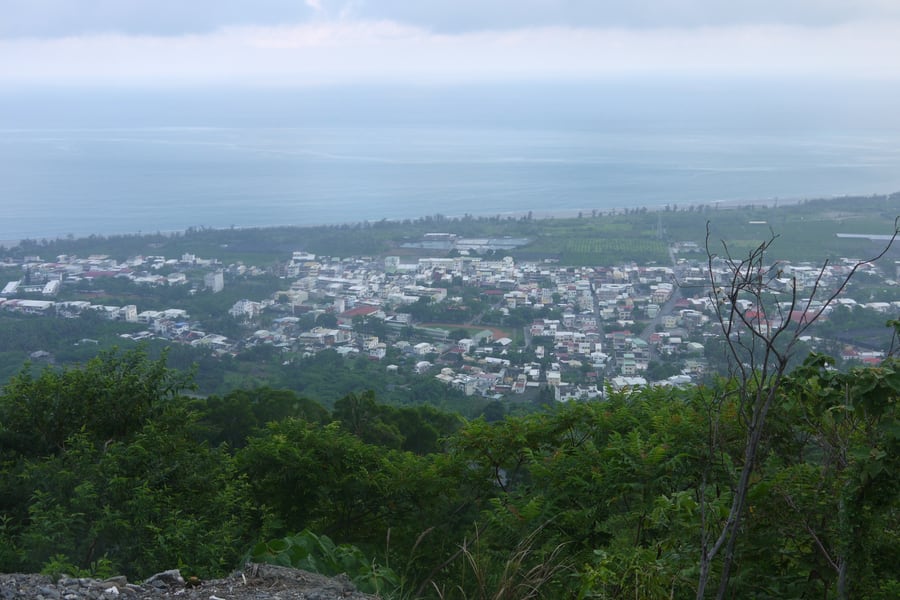 Chi-Hung Lin / Wikimedia Commons · CC BY-SA 3.0 · 2014 · cropped
Taimali
A small coastal town with a wide grey beach and a mountain road behind it that climbs past 1,300 metres to Jinzhen Shan. Something is in flower up there most of the year — cherry in the early spring, wild lilies, hydrangeas, daylilies from August, maples in December — and the ridge looks down on the town, the railway and the Pacific at once. The station is the only way up without a car.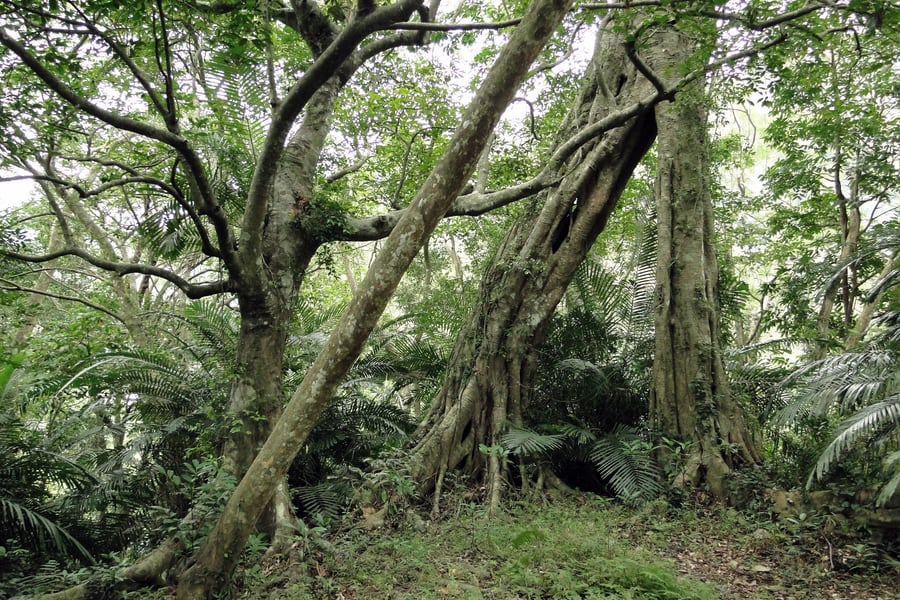 Bernard Gagnon / Wikimedia Commons · CC BY-SA 3.0 · 2011 · cropped
Zhiben
Twelve minutes short of Taitung and the biggest hot-spring resort in eastern Taiwan, developed from the Japanese period around water that runs clear and without a smell. Behind the hotels the valley narrows into the Zhiben National Forest Recreation Area, open 07:30 to 17:00, where the trails run under enormous banyans and there is a waterfall at the head of it. This is Puyuma country.Where to Sleep
The two ends of this line are the two places to sleep on it, and they are very different propositions. Fangliao is a working fishing town with one modern hotel on the seafront, two minutes' walk from the station, and it is the right base if you want to be on the first Breezy Blue of the morning without a dawn start. Taitung and the hot-spring valley at Zhiben, seventy minutes further on, are where the accommodation actually is — a whole resort town of it, developed since the Japanese colonial period around water that comes out of the ground clear and odourless.
In between there is very little, and what there is clusters at Jinlun. The hot springs there are ten minutes by road from the station up a side valley, and the guesthouses are small, family-run and mostly bookable only by telephone or LINE, which is why none is listed here. The three below were opened and read in September 2026.
Where to stay
Fangliao Hotel
Fangliao, Pingtung — two minutes from the station
The hotel's own account of itself: a sea-facing house in the fishing town at the foot of the line, with an infinity pool, a rooftop bar that has live singers at weekends, and its own boat trips out to Xiao Liuqiu. Its English pages give the walk from Fangliao station as two minutes across the junction, which makes it the one place on this railway you can stay and still catch the first train without a car.
Check Availability (opens in a new tab, on fangliaohotel.com.tw)via fangliaohotel.com.tw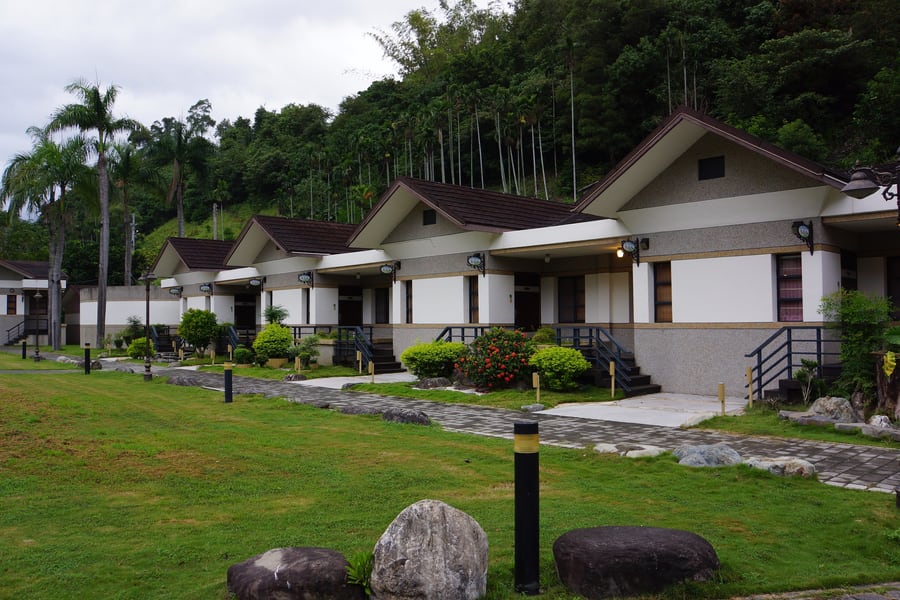 lienyuan lee / Wikimedia Commons · CC BY 3.0 · 2013 · cropped
Toyugi Hot Spring Resort
Zhiben, Beinan Township — run by the Taitung Farmers' Association
A hot-spring resort up the Zhiben valley owned by the Taitung County Farmers' Association, with rooms in a main block and detached cypress-roofed cabins on a lawn, open-air pools and a restaurant that cooks what the association's members grow. Its own site publishes in English and Japanese as well as Chinese and takes bookings directly.
Check Availability (opens in a new tab, on toyugi.com.tw)via toyugi.com.twHotel Royal Chihpen
Longquan Road, Zhiben — in the hot-spring valley
The large hotel at the top of the Zhiben valley, closed through 2026 for a full refurbishment and taking bookings again from September. It lists five room types facing the forested slope, two hot-spring bathing areas — one of them open to the sky at night — and a restaurant named with the Puyuma and Amis greeting. Zhiben station is a bus ride down the valley.
Check Availability (opens in a new tab, on hotelroyal.com.tw)via hotelroyal.com.twQuestions or corrections
Planning this trip and stuck on something, or spotted a time, fare or detail that has changed? Send us a message about The South-Link Line. We read every one, and we update this page when something has changed.