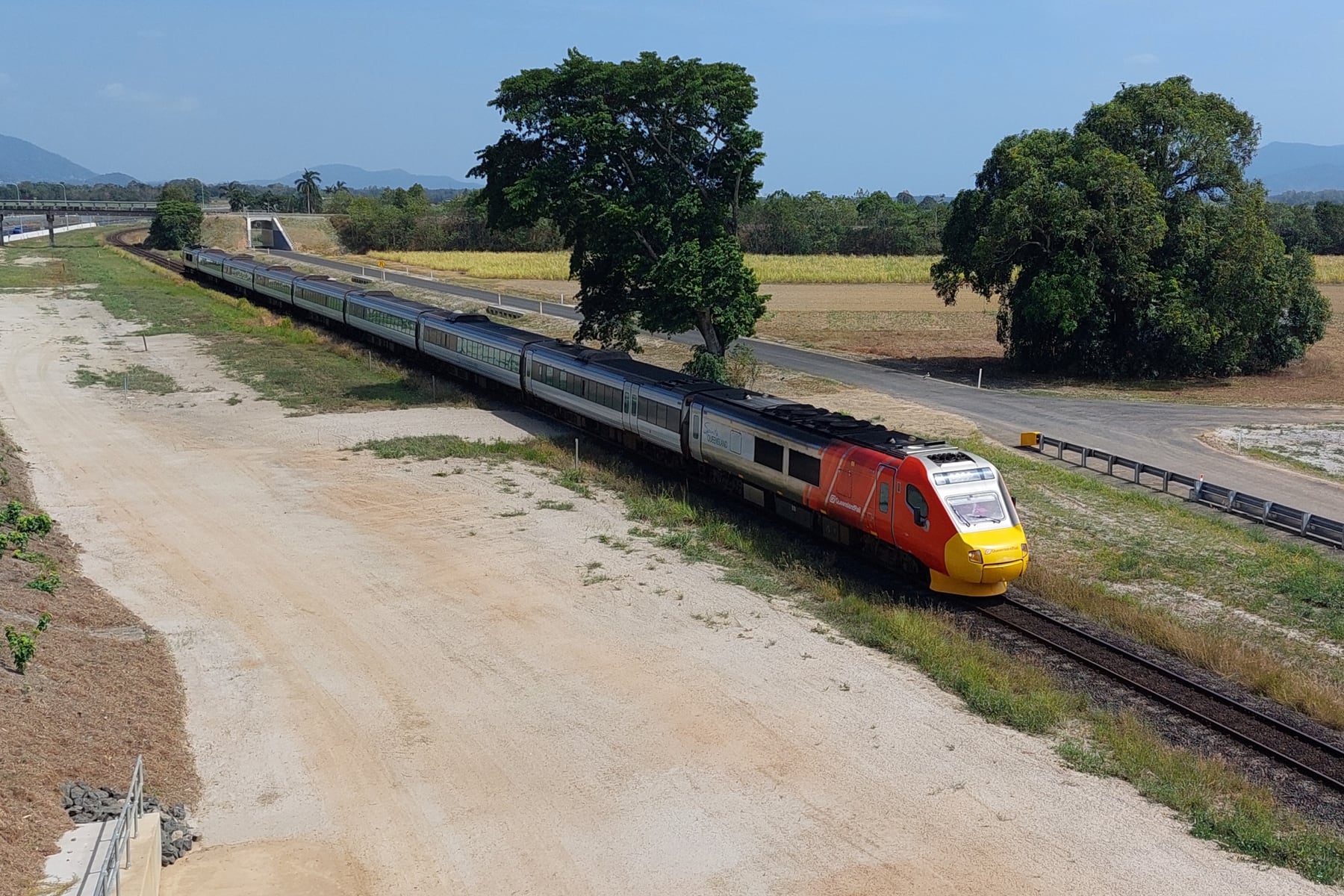
Spirit of Queensland
J.christianson / Wikimedia Commons · CC0 · cropped
- Distance1,681 km, Brisbane to Cairns
- Duration25 h 20 min each way
- Best seasonYear-round; four trains a week each way
Introduction
The Spirit of Queensland runs 1,681 kilometres from Brisbane to Cairns, up the length of the Queensland coast between the Great Dividing Range and the sea, in a little over 25 hours. It leaves Brisbane in the middle of the afternoon, runs through the night past Bundaberg, Gladstone and Rockhampton, and spends the whole of the next day in the tropics: Proserpine for the Whitsundays, the Burdekin, Townsville, the coast at Cardwell, the cane towns of Tully and Innisfail, and Cairns at five in the evening.
The railway under it was never planned as one line. It opened in more than sixty separate pieces between 1881 and 1924, many of them short local railways running inland from a port, and a few of them tramways built by the shire councils, which the state bought up and rebuilt. Coastal steamers carried passengers between the gaps. The last section, 94 kilometres with major bridges at Daradgee, near Innisfail, opened on 10 December 1924, and Cairns was joined to Brisbane by rail for the first time — 52 hours away.
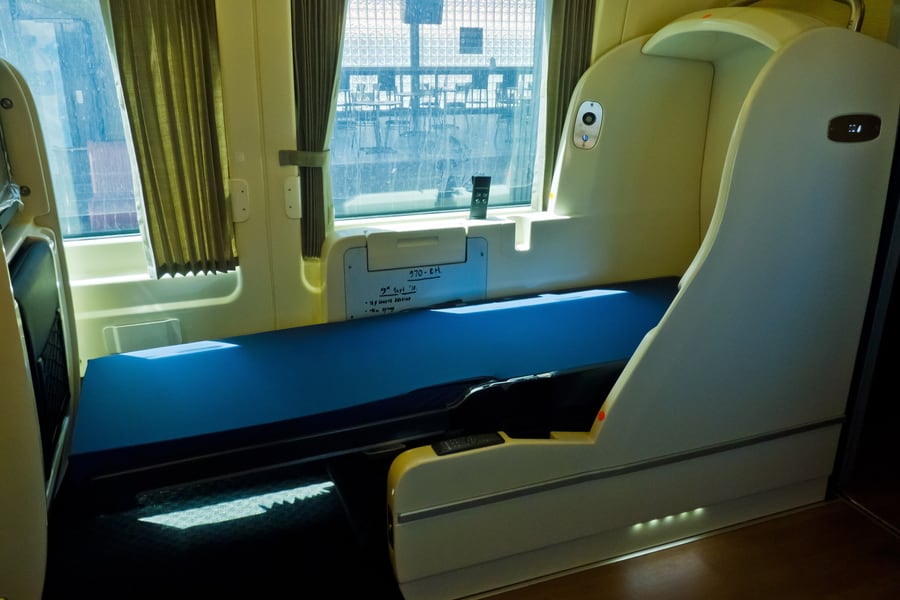
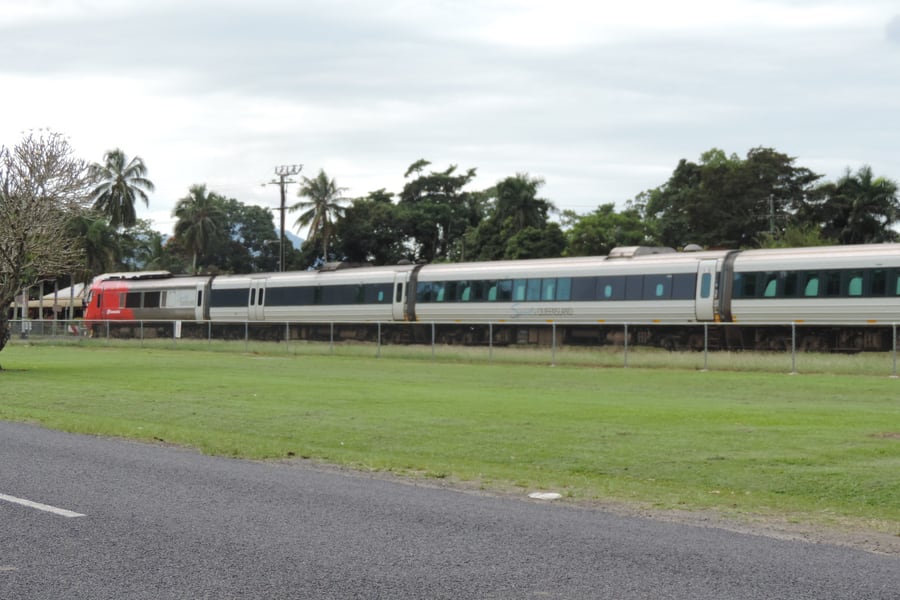
The train is a diesel tilt train with two kinds of accommodation: Economy Seats, and RailBeds, wide reclining seats that the crew make up at night into flat beds, with every main meal served at your seat. It runs four times a week in each direction.
The Journey
Brisbane to Bundaberg
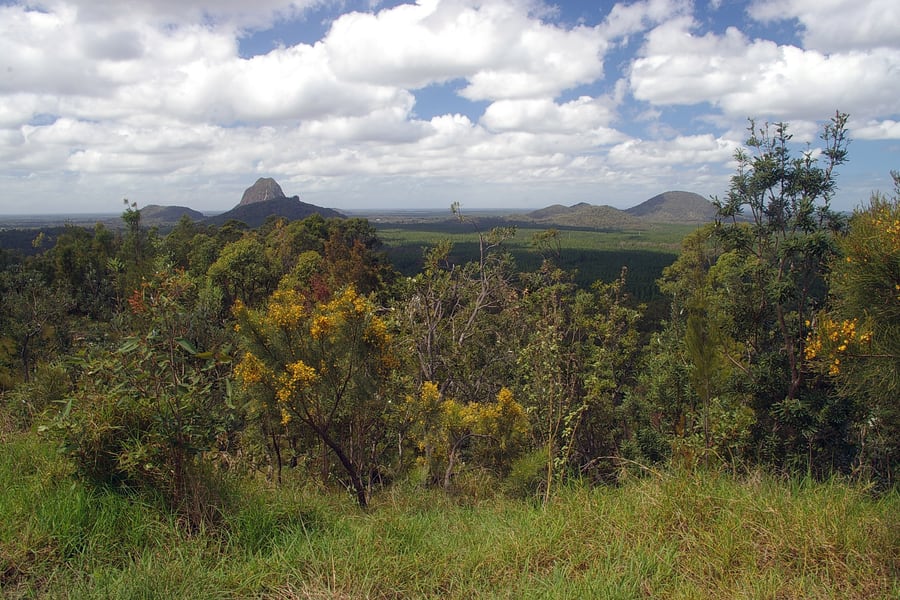
Northbound trains leave Roma Street at 15:45. For the first hour the line runs out through Brisbane's northern suburbs, under the wires of the city network; past Caboolture it crosses open country below the Glass House Mountains, the volcanic plugs James Cook named from the sea in 1770, and runs on through the hinterland of the Sunshine Coast at Nambour and Cooroy. By Gympie and Maryborough, where coaches meet the train for Hervey Bay, it is dusk or dark, and the train reaches Bundaberg, the sugar and rum city, at 20:35.
Through the night
The stretch from Bundaberg to Mackay passes in the dark in both directions. Northbound, the train calls at Gladstone towards eleven and at Rockhampton just after midnight, where the line runs down the middle of Denison Street through the centre of the city. Somewhere north of Rockhampton it passes its highest point, only 136 metres above the sea. It reaches Mackay at 05:08, and it is light by Proserpine, two hours later.
The tropical north
The second day is the reason to go. From Proserpine, the stop for Airlie Beach and the Whitsundays, the line runs on through Bowen and across the Burdekin River at Home Hill and Ayr, into Townsville at 10:25. Beyond Ingham it comes down to the coast at Cardwell, facing Hinchinbrook Island across its mangrove channel, then turns inland through the wet tropics: Tully, Innisfail, the cane fields under the mountains at Gordonvale, and Cairns at 17:05. Southbound trains cover the same country in daylight on the way down, leaving Cairns at 07:40 and reaching Proserpine at 17:16.
The train
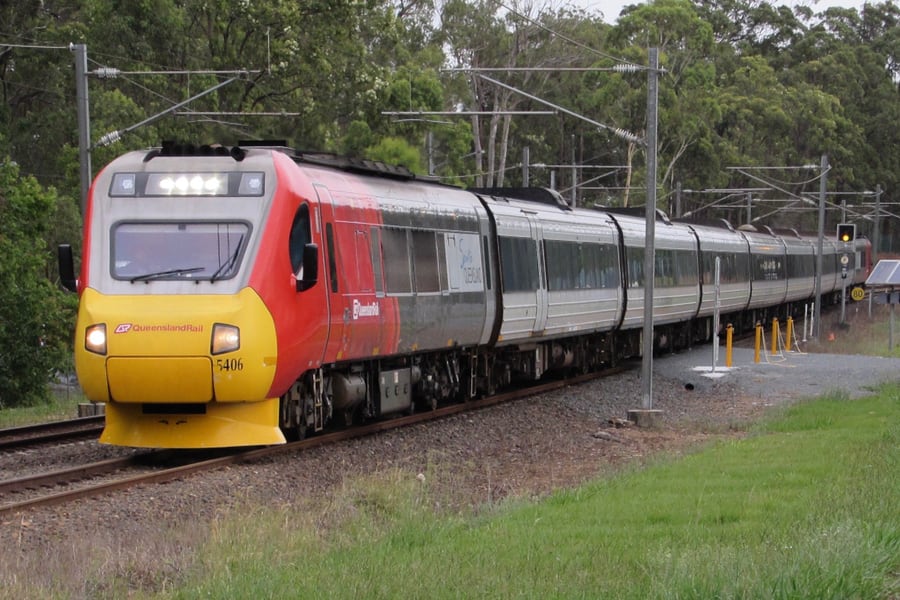
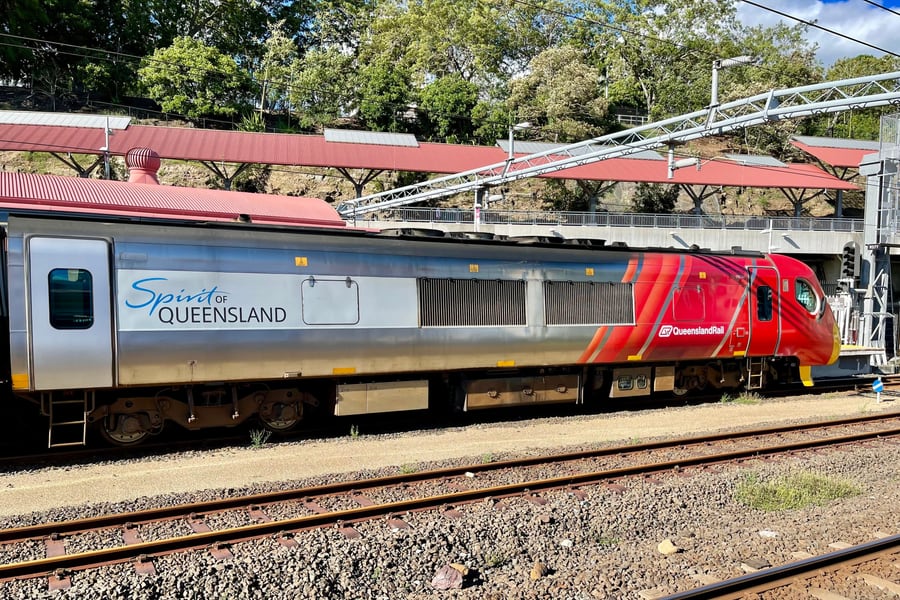
The Spirit of Queensland is a diesel tilt train, built to lean into curves on Queensland's 1,067-millimetre narrow gauge and run at up to 160 km/h. Downer built new power cars and carriages and rebuilt the two older tilt trains, and the first train entered service in October 2013; by the end of 2014 it had replaced the Sunlander, which had run the coast since 1953. Each train has a power car at either end, two RailBed cars in a two-and-one layout, Economy Seat carriages in two-and-two, a club car with the café, and a luggage van. There are showers at the end of each carriage. There is no Wi-Fi, and the mobile signal fails for long stretches.
Along the route
 Bidgee / Wikimedia Commons · CC BY 3.0 · cropped
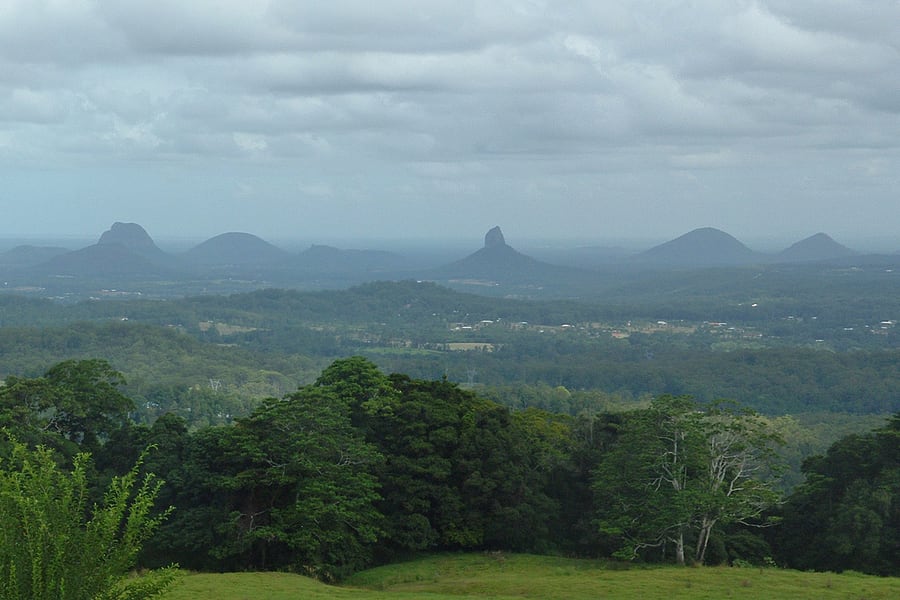
The Glass House Mountains
Between Caboolture and Nambour the line crosses the plain below the Glass House Mountains, volcanic plugs some 26 million years old. James Cook named them in 1770 after the glass furnaces of Yorkshire; the tallest, Mount Beerwah, is 556 metres.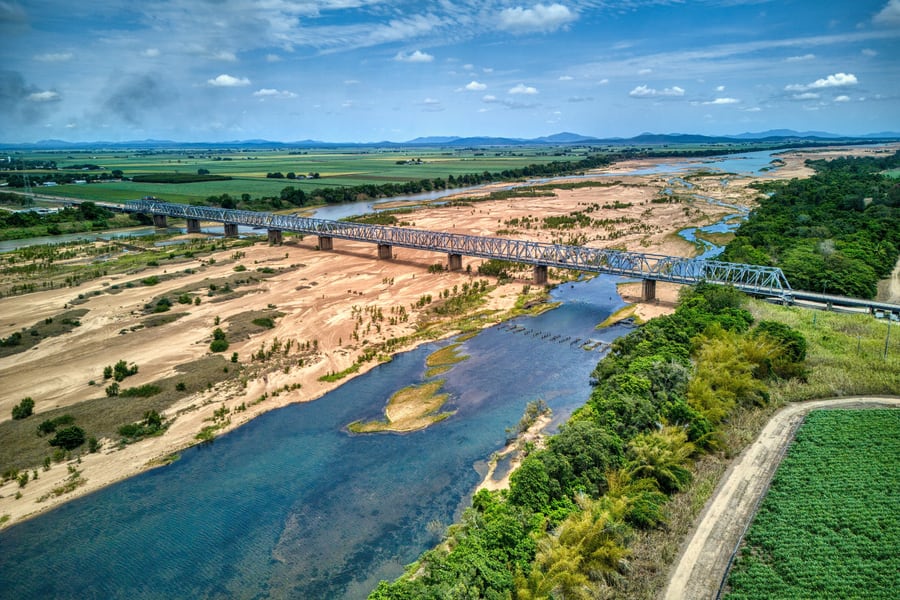 Hagai Agmon-Snir / Wikimedia Commons · CC BY-SA 4.0 · cropped
The Burdekin Bridge
Between Home Hill and Ayr the train crosses the Burdekin River on a road-and-rail bridge more than a kilometre long, opened in 1957 after ten years' work. No rock could be found under the riverbed, so it stands on concrete caissons sunk into the sand.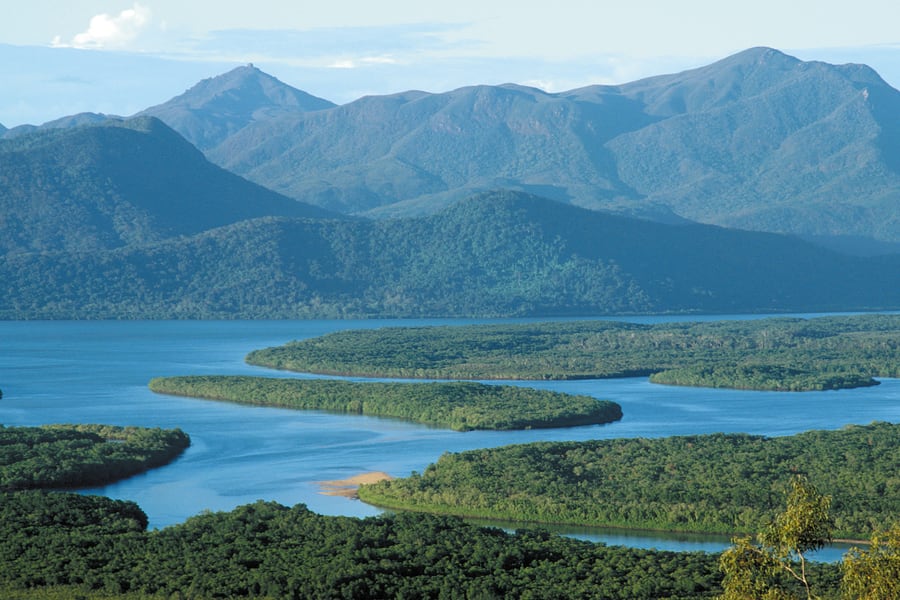 Willem van Aken, CSIRO / Wikimedia Commons · CC BY 3.0 · cropped
Hinchinbrook Channel
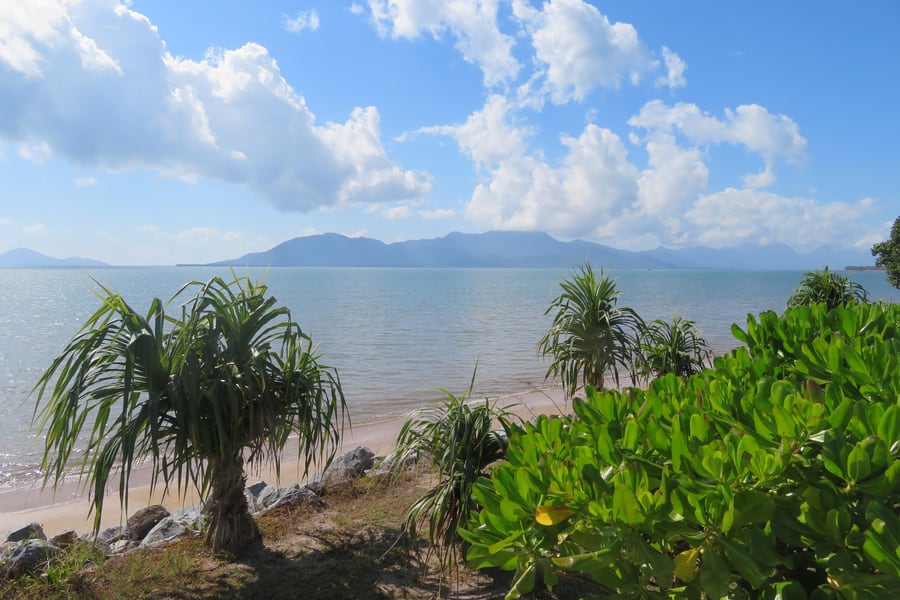
At Cardwell the line comes down to the coast opposite Hinchinbrook Island, across a channel lined with mangroves. The island, the largest on the Great Barrier Reef, is a national park; Mount Bowen, its highest peak, rises to 1,121 metres.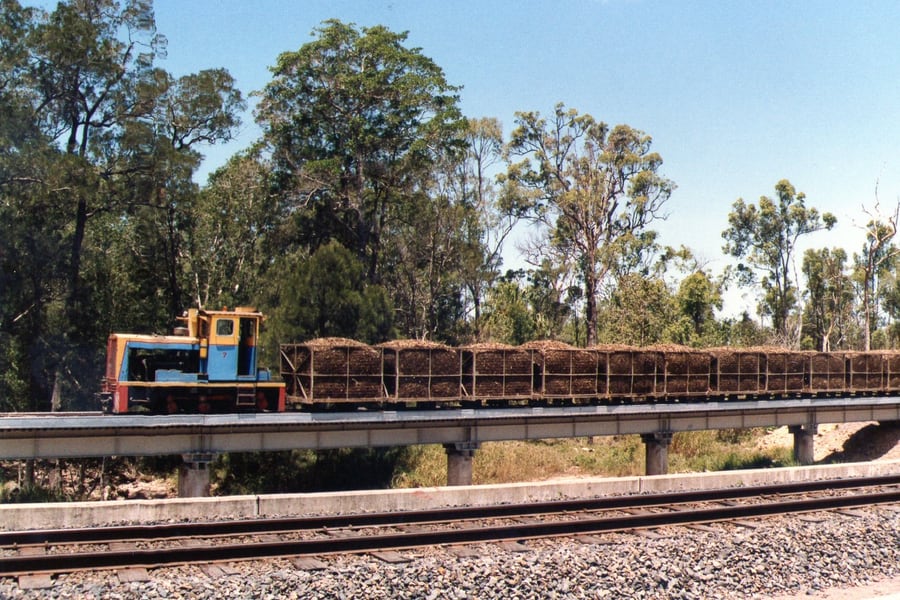 Ellis678 / Wikimedia Commons · CC BY-SA 3.0 · cropped
Cane country
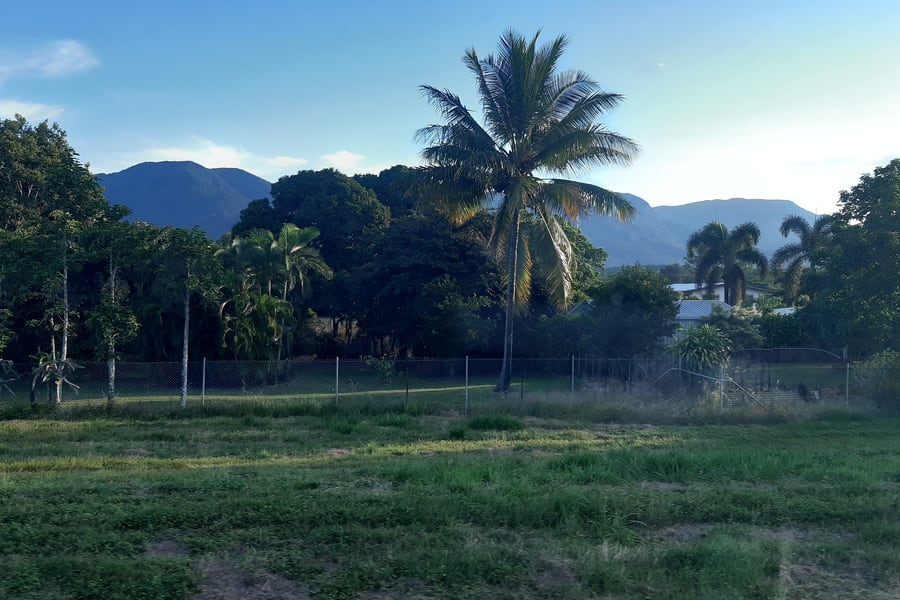
For much of the way north the train runs through sugar cane, and the cut cane reaches the mills on railways of its own: two-foot-gauge lines that in places run right beside the main line. Tully and Innisfail are both mill towns.A bit of history
Culture & experiences along the way
 Chris Olszewski / Wikimedia Commons · CC BY-SA 4.0 · cropped
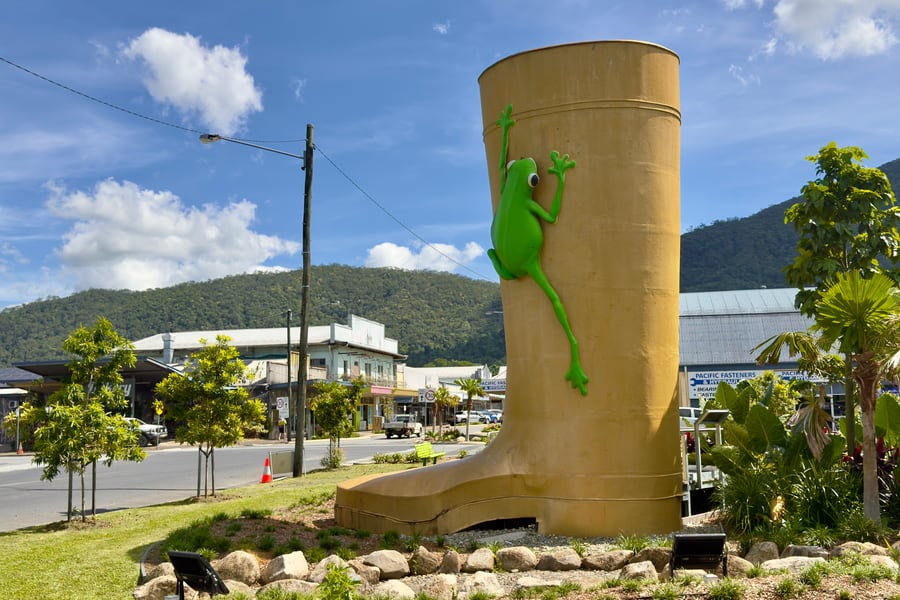
The Golden Gumboot
Tully, Innisfail and Babinda have competed since 1970 for the Golden Gumboot, the prize for Australia's wettest town. Tully's answer is a fibreglass boot 7.9 metres tall, the depth of rain that fell there in 1950. A spiral stair inside climbs past photographs of old floods to a view over the town.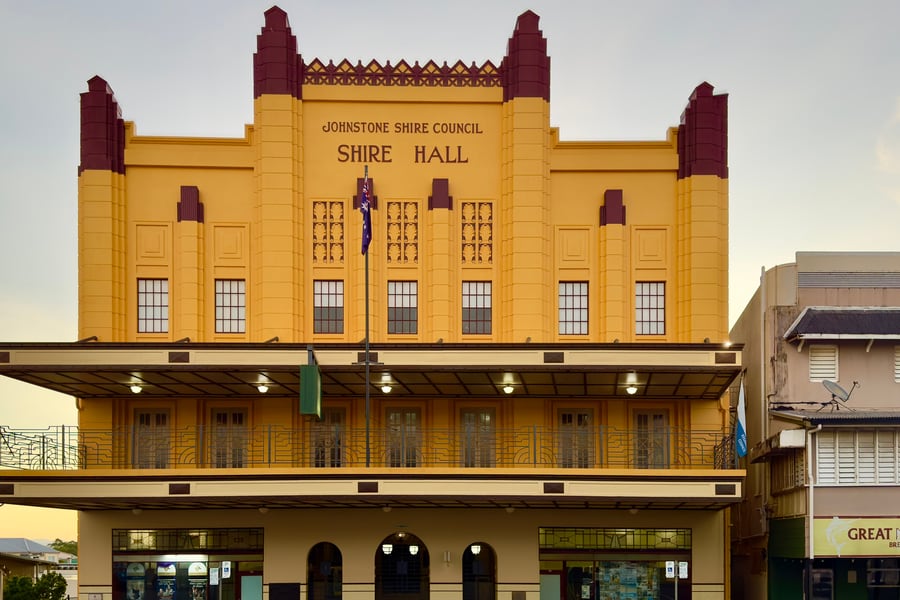 Chris Olszewski / Wikimedia Commons · CC BY-SA 4.0 · cropped
Innisfail's art deco
A cyclone destroyed much of timber Innisfail in 1918, and the sugar town rebuilt in concrete and brick in the style of the day. Its showpiece is the Johnstone Shire Hall of 1935–38, by the architects Hill and Taylor, with moulded panels of sugar cane across its facade.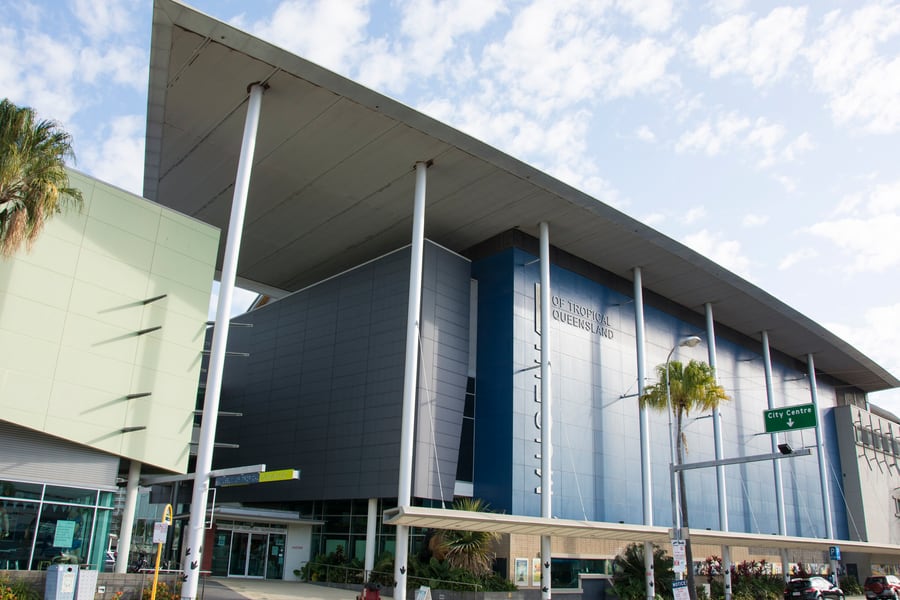 Rabs003 / Wikimedia Commons · CC BY-SA 4.0 · cropped
The Pandora gallery
Queensland Museum Tropics in Townsville is built around a shipwreck: HMS Pandora, the ship sent to capture the Bounty mutineers. Its gallery shows what was raised from the wreck beside a full-size replica of the bow. Entry to the galleries is free, daily from 9:00 to 16:00.Timetables
The Spirit of Queensland runs four times a week in each direction, all year. Northbound trains leave Brisbane on Monday, Wednesday, Friday and Saturday; southbound trains leave Cairns on Monday, Wednesday, Friday and Sunday. Every seat and RailBed must be booked.
| Northbound | Southbound | ||
|---|---|---|---|
| Brisbane (Roma Street) | 15:45 | Cairns | 07:40 |
| Nambour | 17:31 | Innisfail | 09:23 |
| Bundaberg | 20:35 | Townsville | 13:41 |
| Gladstone | 22:45 | Proserpine | 17:16 |
| Rockhampton | 00:34 | Mackay | 18:49 |
| Mackay | 05:08 | Rockhampton | 23:35 |
| Proserpine | 07:16 | Gladstone | 01:17 |
| Townsville | 10:25 | Bundaberg | 03:14 |
| Innisfail | 15:20 | Nambour | 07:11 |
| Cairns | 17:05 | Brisbane (Roma Street) | 09:00 |
Times at the larger stations are arrivals; the train waits there for 10 to 30 minutes. The journey takes 25 hours 20 minutes either way, arriving the next day. Smaller stations — among them Cooroy, Miriam Vale, St Lawrence, Sarina, Bowen, Home Hill, Ingham, Cardwell, Tully, Babinda and Gordonvale — are request stops: the train calls only if a passenger has booked to or from them.
Connections
A RailBus meets the train at Maryborough West for Hervey Bay, and at Proserpine for Airlie Beach and the Shute Harbour jetty; book it with the rail ticket, and confirm the Airlie pick-up with Whitsunday Transit two days before travelling. At Cairns, the Kuranda Scenic Railway leaves from the same station.
Times are from Queensland Rail Travel's timetable, effective from September 2024 and updated August 2025, which the booking system still shows — as of October 2026. Bookings are open to 31 March 2027. Check the Spirit of Queensland timetable (opens in a new tab) before travelling.
Tickets
Tickets are sold by Queensland Rail Travel, online, by phone or through travel agents, one way and for a seat or RailBed on a named train. The cheapest are BQuick advance fares, limited in number and paid at once; AChoice is the standard fare. Both can be changed for A$15 or cancelled for a fee. Breaking the journey means buying two tickets, priced by sector.
Children aged 4 to 15 save up to half the AChoice fare, and students and international backpackers up to 40%; an infant in a RailBed needs its own bed at the child fare. The prices below are for travel until 31 March 2027; fares rise by about 3.4% from 1 April 2027.
Book your tickets
Kgbo / Wikimedia Commons · CC BY-SA 4.0 · croppedEconomy Seat, Brisbane to Cairns
Reclining seat · 25 h 20 min
One way from A$229.20 on a BQuick advance fare, A$382 on the flexible AChoice fare; meals from the café.
Book Tickets (opens in a new tab, on queenslandrailtravel.com.au)via queenslandrailtravel.com.auJohn Robert McPherson / Wikimedia Commons · CC BY-SA 4.0 · croppedRailBed, Brisbane to Cairns
Lie-flat bed · meals included
One way from A$411 on a BQuick fare, A$548 on AChoice, with every main meal served at your seat.
Book Tickets (opens in a new tab, on queenslandrailtravel.com.au)via queenslandrailtravel.com.auRidiculopathy / Wikimedia Commons · CC0 · croppedNorthern Xplorer, Cairns to Townsville
Seat · about 6 hours in daylight
A$50 one way between Cairns and Townsville, the daylight half of the line past Hinchinbrook.
Book Tickets (opens in a new tab, on queenslandrailtravel.com.au)via queenslandrailtravel.com.auRail Passes
Queensland Rail Travel sells two passes for overseas visitors, and the Spirit of Queensland is covered by both. The Queensland Coastal Pass (A$209) gives a month of travel in one direction between Brisbane and Cairns, with as many stops as you like and the RailBus to Hervey Bay and Airlie Beach included; the Queensland Explorer Pass (A$299 for a month, A$389 for two) covers every long-distance train in the state, the outback lines included. Both are for Economy Seats; a RailBed costs the difference in fare, and every journey must still be reserved.
Is it worth it? Only if you stop. The Coastal Pass does not allow the trip straight through — at least one break of 24 hours is compulsory — but at A$209 it costs less than the cheapest Economy fare from Brisbane to Cairns (A$229.20), however many stops you make. You need a foreign passport and a second proof of residence abroad, or a return air ticket. Interrail and Eurail do not cover Australia.
Checked October 2026 against Queensland Rail Travel's fare types (opens in a new tab).
Places to Visit
The train calls at most of these itself; Hervey Bay and Airlie Beach are reached by the RailBus that meets it, and K'gari and Magnetic Island by ferry. Breaking the journey means a stay of two or three days, since the next train in the same direction is that long away.
 Brisbane City Council / Wikimedia Commons · CC BY 2.0 · cropped
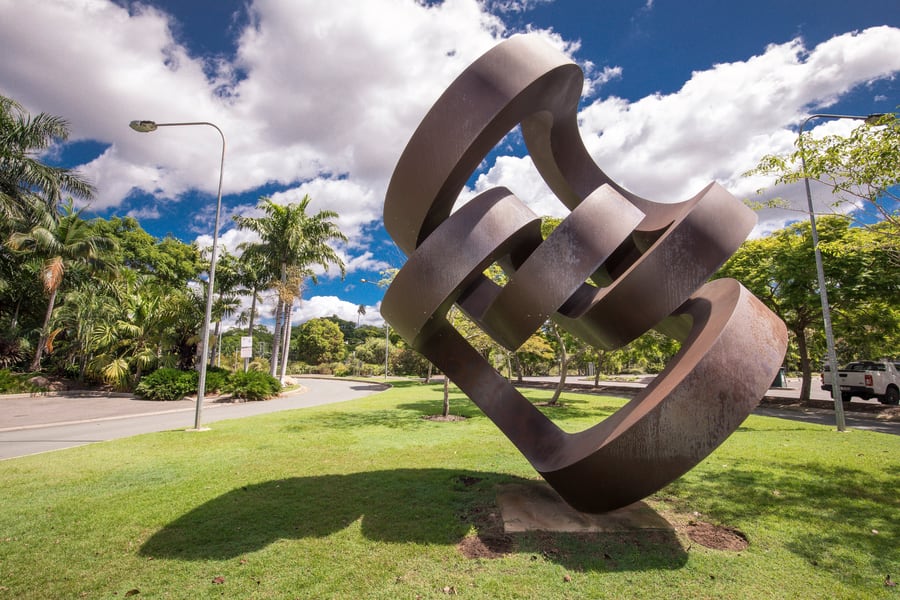
Brisbane
A path leads from Roma Street station into Roma Street Parkland, 11 hectares of gardens in the middle of the city, billed as the world's largest subtropical garden in a city centre. Paths and boardwalks wind past waterfalls, rock outcrops and works by 16 local artists, and the park is open around the clock, a good way to fill the hours before a 15:45 departure.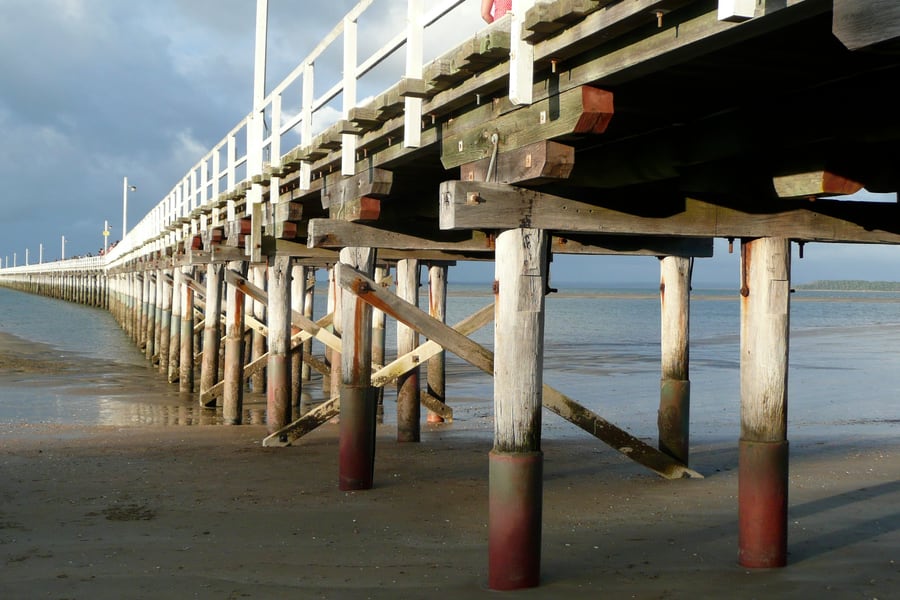 Kgbo / Wikimedia Commons · CC BY-SA 3.0 · cropped
Hervey Bay
A coach meets the train at Maryborough West for the run to Hervey Bay, on calm, north-facing beaches. The bay is a whale-watching centre, named the world's first Whale Heritage Site in 2019, and Urangan Pier, built from 1913 to load sugar, timber and coal, still runs 868 metres out to sea.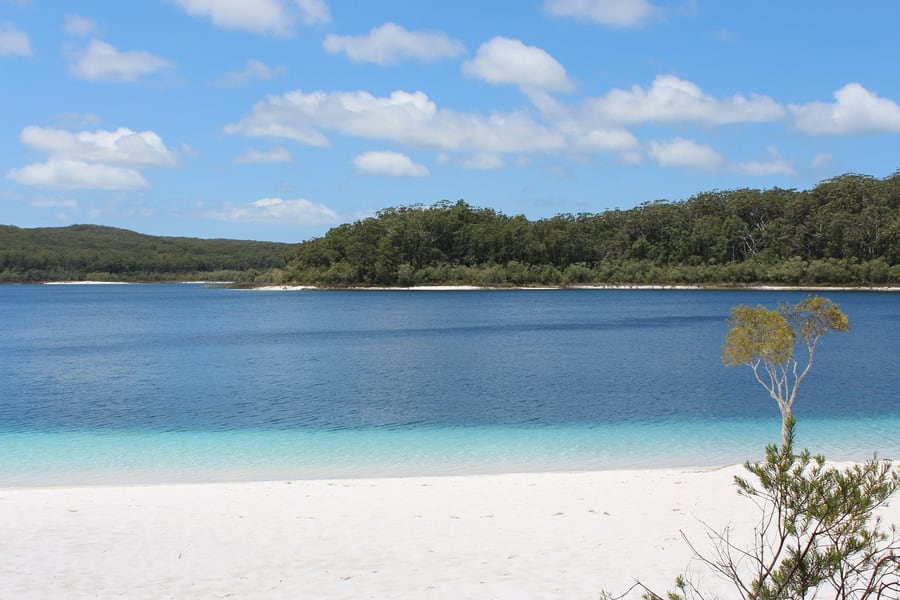 UrbanDruid / Wikimedia Commons · CC BY-SA 4.0 · cropped
K'gari
The ferries from Hervey Bay cross to K'gari, known until 2023 as Fraser Island: a World Heritage-listed island made of sand, and the traditional land of the Butchulla people. Its freshwater lakes, among them Lake McKenzie, lie between forested dunes, and the World Heritage area takes in the waters around it as part of the Great Sandy National Park.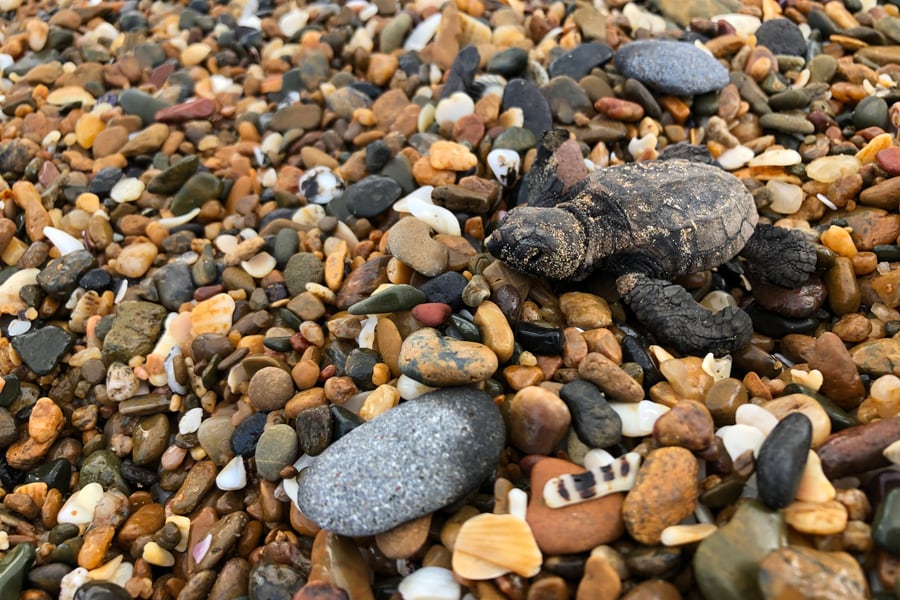 Kgbo / Wikimedia Commons · CC BY-SA 4.0 · cropped
Bundaberg and Mon Repos
A sugar city on the Burnett River, the home of Bundaberg Rum and of the aviator Bert Hinkler. Fourteen kilometres east, Mon Repos has the largest concentration of nesting marine turtles on the eastern Australian mainland. From November to March rangers lead tours at night to watch the turtles lay, and from mid-January the hatchlings run for the sea.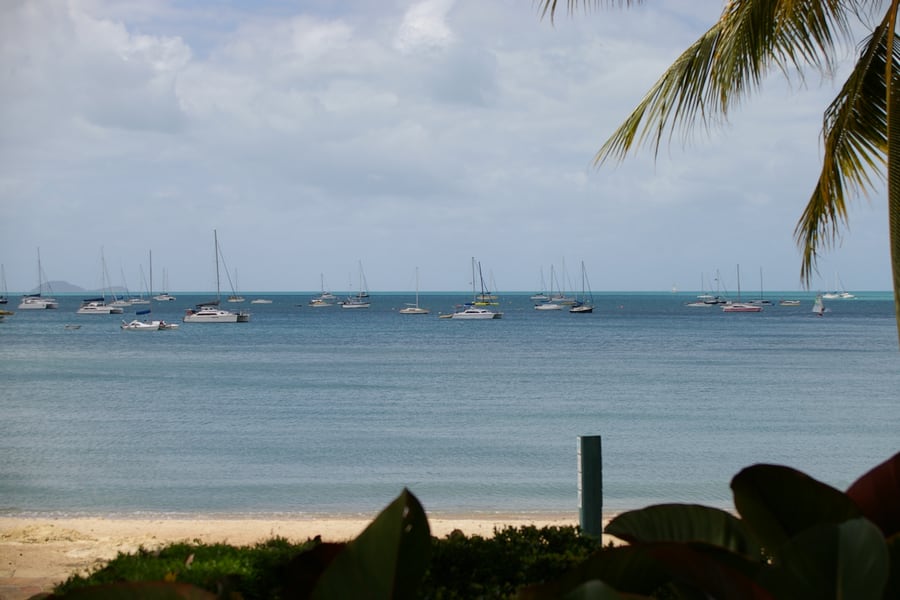 John Robert McPherson / Wikimedia Commons · CC BY-SA 4.0 · cropped
Airlie Beach and the Whitsundays
A RailBus meets the train at Proserpine and runs on to Airlie Beach and the ferry jetty at Shute Harbour. Airlie is the departure point for the 74 Whitsunday Islands and for trips out to the Great Barrier Reef. Confirm the pick-up with Whitsunday Transit two days before you travel.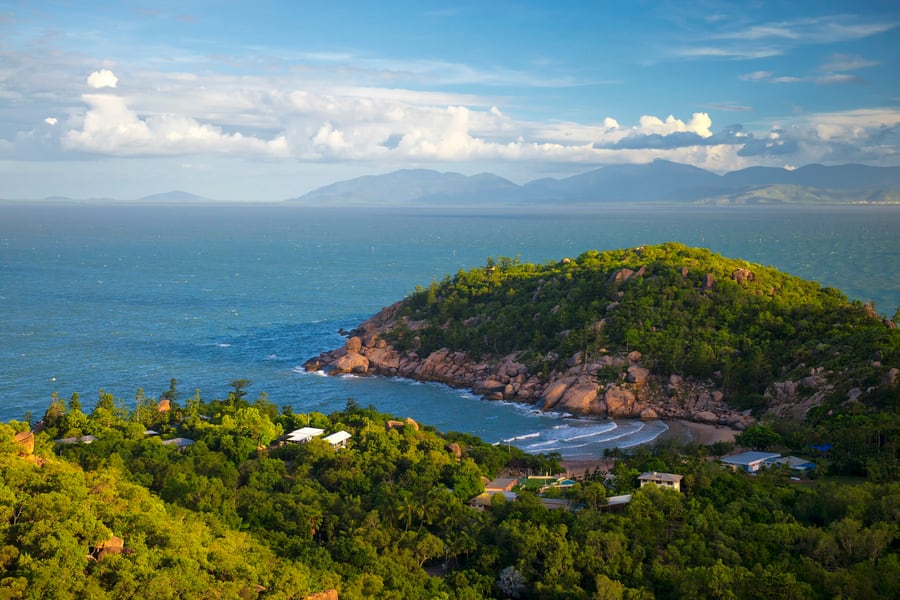 Joshua Tagicakibau / Wikimedia Commons · CC BY-SA 4.0 · cropped
Townsville and Magnetic Island
The train waits a quarter of an hour at Townsville, but the city deserves a break of journey: The Strand, a long beach and garden promenade, Castle Hill above the centre, and the museum's Pandora gallery. Ferries run eight kilometres across to Magnetic Island, most of it national park, with walking tracks between its bays.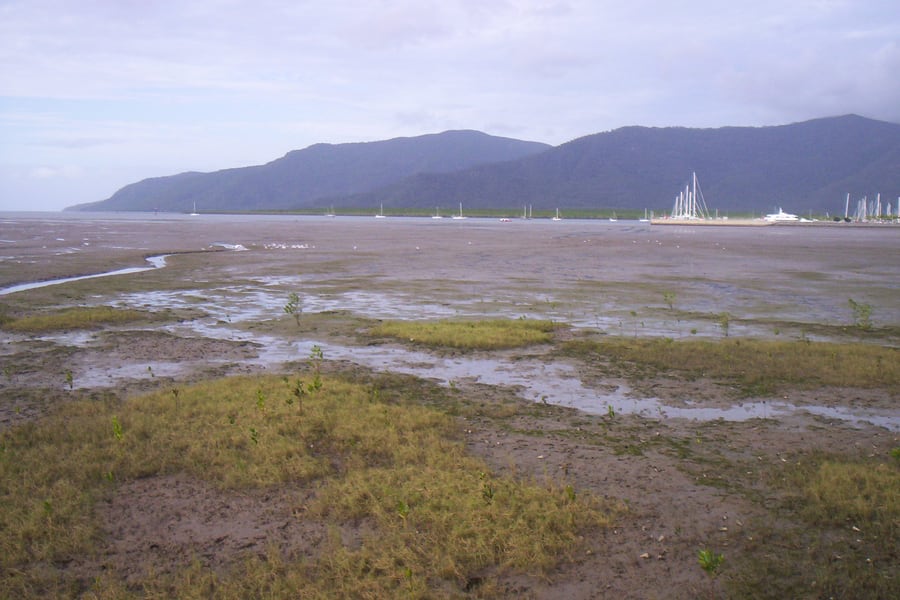 John Robert McPherson / Wikimedia Commons · CC0 · cropped
Cairns
The train ends at Cairns, gateway to two World Heritage areas, the Wet Tropics rainforest and the Great Barrier Reef. The Esplanade runs along Trinity Bay, whose mudflats are bared at low tide, and the Kuranda Scenic Railway leaves from the same station for the climb to the Atherton Tableland.Where to Sleep
The RailBed is the night on the train. For a night either side of it, or a break of journey halfway, the places below are in central Brisbane, Townsville and Cairns.
Where to stay
 Kgbo / Wikimedia Commons · CC BY-SA 4.0 · cropped
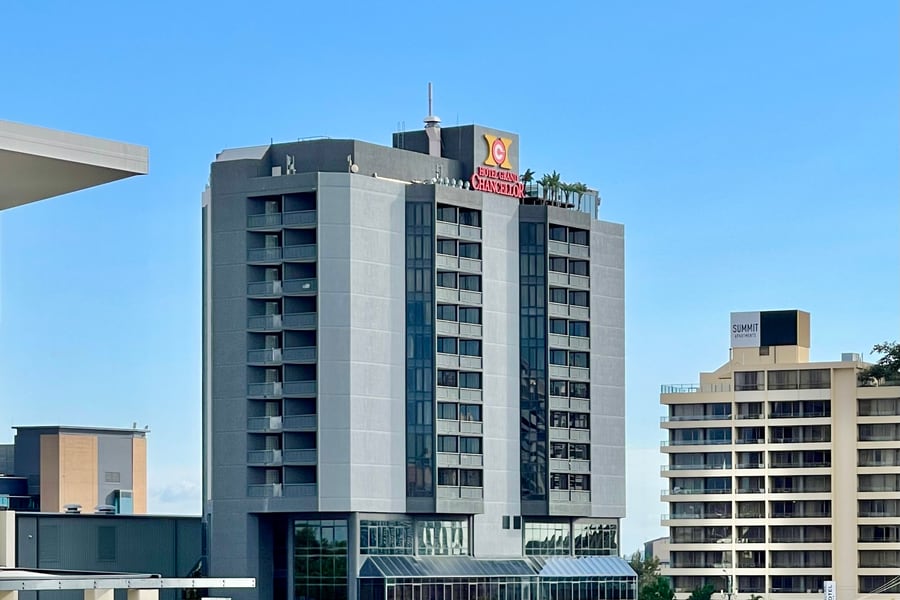
Hotel Grand Chancellor Brisbane
Spring Hill, above the city centre
A 230-room hotel with a rooftop pool on Leichhardt Street, on the Spring Hill edge of the city centre.
Check Availability (opens in a new tab, on grandchancellorhotels.com)via grandchancellorhotels.com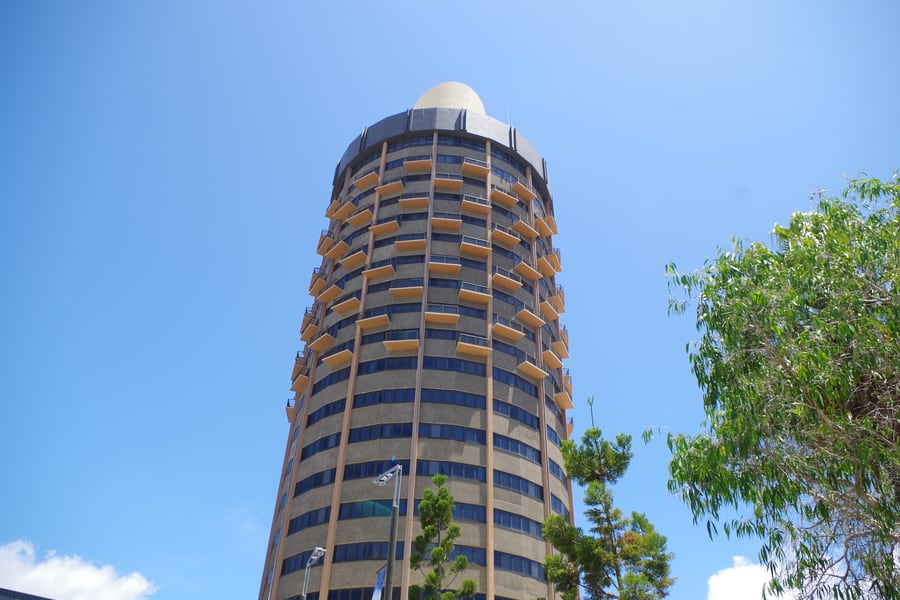 Greditdesu / Wikimedia Commons · CC BY-SA 4.0 · cropped
Hotel Grand Chancellor Townsville
The round tower in the city centre
The cylindrical tower Townsville calls the Sugar Shaker, near the city's convention centre — for a break of journey.
Check Availability (opens in a new tab, on grandchancellorhotels.com)via grandchancellorhotels.comHides Hotel
Heritage-listed, in central Cairns
A heritage-listed corner hotel of 1928 on Lake Street, a few minutes' walk from the Esplanade and Cairns station.
Check Availability (opens in a new tab, on hideshotel.com.au)via hideshotel.com.auQuestions or corrections
Planning this trip and stuck on something, or spotted a time, fare or detail that has changed? Send us a message about Spirit of Queensland. We read every one, and we update this page when something has changed.