Kuranda Scenic Railway
JustARandomEditor123 / Wikimedia Commons · CC BY-SA 4.0
- Distance37 km · 1,067 mm narrow gauge
- DurationAbout 1h 55m one way
- Best seasonMay–Oct (the dry) · falls best in the wet
Introduction
Australia's famous trains are the enormous ones — the Ghan, the Indian Pacific, three-night crossings of an empty continent. This is the other kind entirely: thirty-seven kilometres, under two hours, and one of the best mornings you can have on rails anywhere.
The Kuranda Scenic Railway climbs from Cairns, on the tropical Queensland coast, up the wall of the Great Dividing Range to the rainforest village of Kuranda on the tableland above. It is short, it is cheap, anyone can do it — and it was every bit as hard to build as the long ones.
The numbers tell you why it matters. Between 1886 and 1891, with no machinery, they cut fifteen tunnels and thirty-seven bridges into the side of a mountain, shifting three million cubic metres of earth to lift the line from sea level to 328 metres in thirty-seven kilometres. It was hand-drilling, hand-digging, black powder and muscle, in the heat and the wet of the tropics. Many people died doing it — the records don't say how many, but they say that plainly. The first passenger train ran on 25 June 1891.
What they built the line through is the reason you ride it. The railway climbs the Barron Gorge, curves right beside Stoney Creek Falls, and pauses at Barron Falls for the view — all of it deep in World Heritage rainforest, ferns and vines and dripping green, with the cane fields and the Coral Sea opening up below you as you climb.
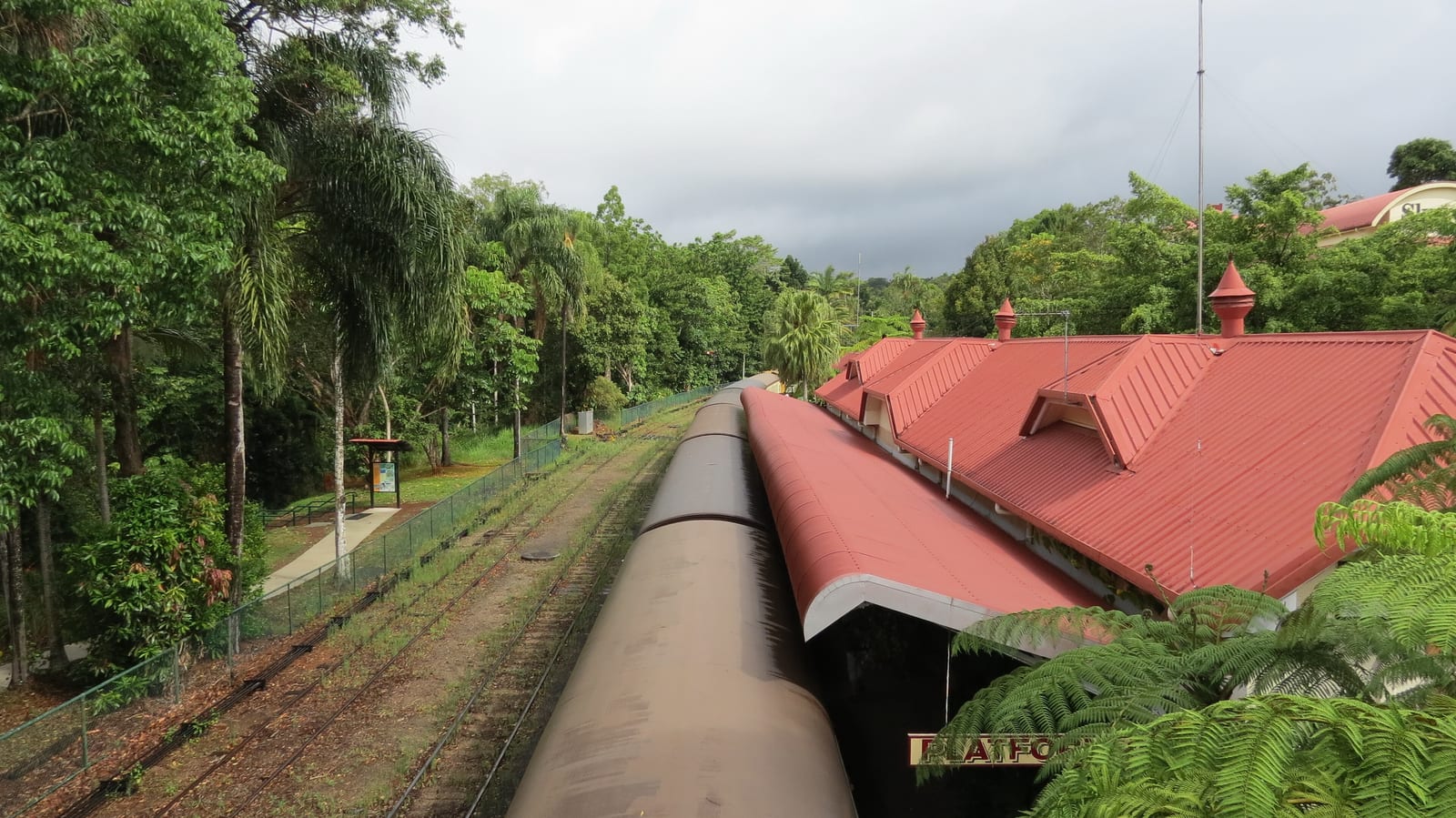
At the top, Kuranda is a rainforest village of markets and wildlife, and the station is a listed period piece so buried in tropical planting it looks abandoned to the jungle. Most people spend the afternoon there and come back down — and the classic way back is not the train at all but the Skyrail, a cableway that glides over the top of the forest canopy, giving you the whole range a second time from above.
It is the proof that a great railway journey doesn't have to be a long one. Two hours, a handful of dollars, a wall of rock beaten by hand in the 1880s, and a rainforest the whole way up.
The Journey
You start on the coast, at sea level, in the heat. Cairns is tropical Queensland's capital — cane fields, palms, the Coral Sea — and for the first few kilometres the railway runs flat across the plain, giving no hint of what it is about to do.
Then it reaches the range, and starts to climb, and does not stop for a long time.
The Great Dividing Range rises like a wall behind the coast, and the railway goes straight at it — climbing steadily, curving constantly, hauling itself up the escarpment through fifteen tunnels and over thirty-seven bridges, every one of them cut and built by hand in the 1880s. This is the stretch that makes the journey: you are climbing the side of a mountain in a rainforest, and the line has been threaded through the only gaps the terrain allowed.
The rainforest is the constant. This is World Heritage wet tropics, and it presses right up to the track: tree ferns, strangler figs, vines, the lot, dripping and green and loud with birds. Every so often the forest opens and you get the reveal: the whole coastal plain laid out below, the cane fields, Cairns, and the sea, dropping further away with every curve.
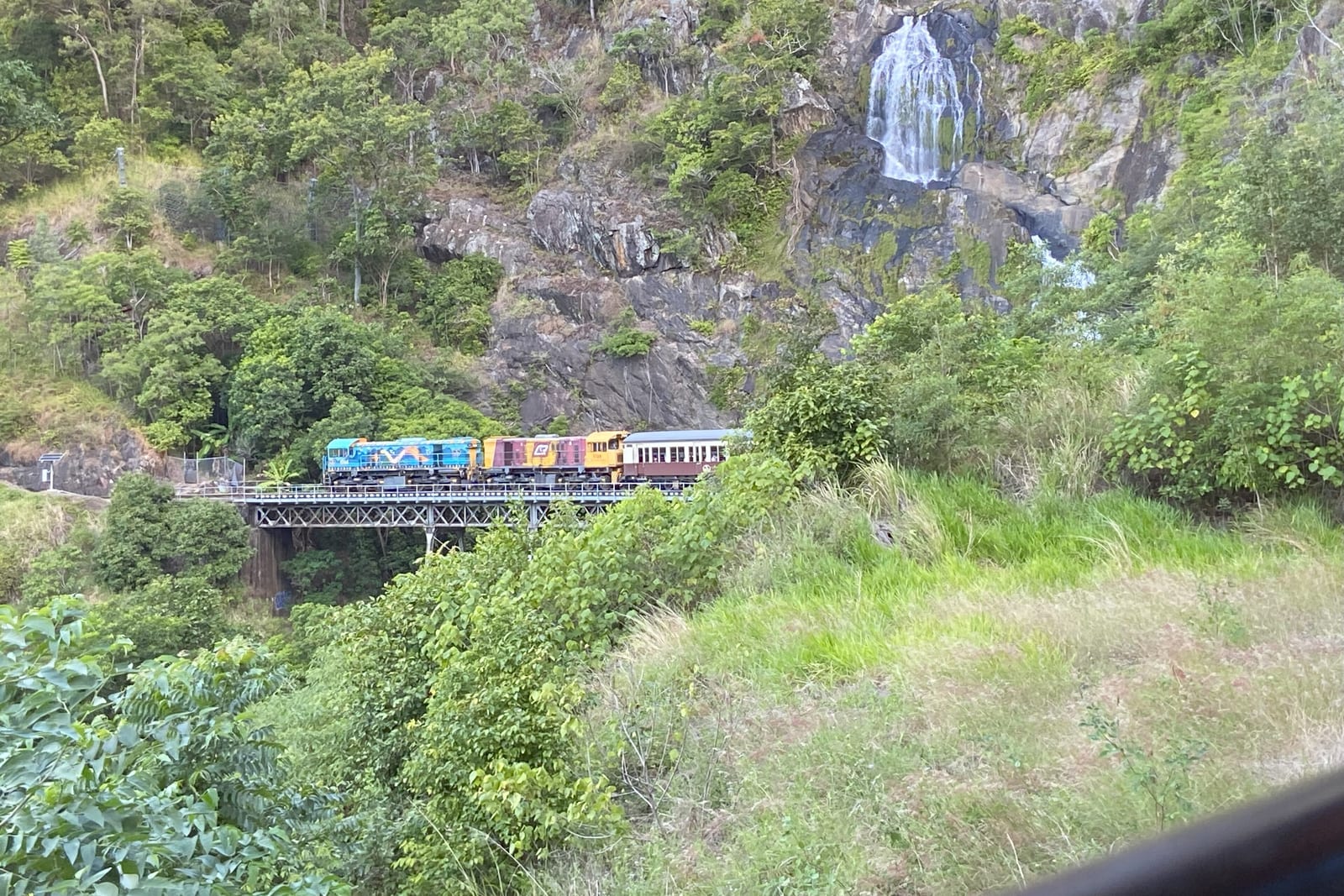
Two moments stand out. At Stoney Creek Falls, the train swings onto a curving bridge right at the foot of the waterfall — close enough to feel the spray on a wet-season day, and the single most photographed spot on the line. And at Barron Falls, the train stops so you can get out and look: in the wet the falls are a wall of brown water and thunder; in the dry they're a thinner, gentler thing, and the gorge is the star instead.
Then the gradient eases, the air cools slightly, and you arrive at Kuranda — a station so smothered in ferns, orchids and tropical planting that it looks like the forest is reclaiming it. About an hour and fifty-five minutes, all told, for thirty-seven kilometres. That tells you how hard the climb is.
Most people spend the afternoon in the village and come back down — and here is the recommendation: don't take the train both ways. Ride it up, and come down on the Skyrail, the cableway that runs just above the rainforest canopy. The train shows you the range from inside the forest; the Skyrail shows you the same gorge and falls from above it. Two entirely different views of one mountain, in a single day, and between them they are the whole reason to come to Cairns and go up.
Along the route
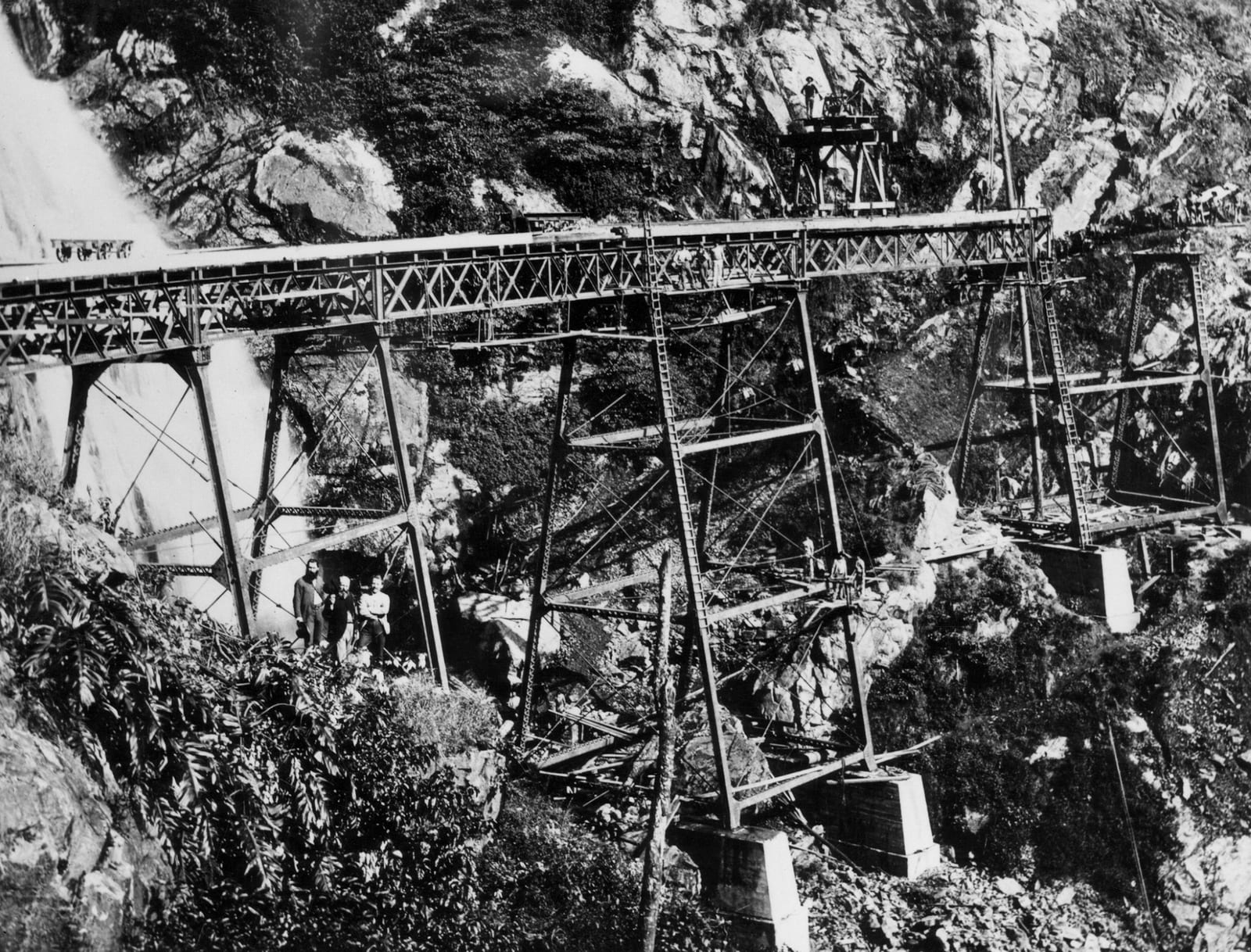
Kgbo / Wikimedia Commons · CC BY-SA 4.0Fifteen tunnels, dug by hand
Between 1886 and 1891, without machines, they cut 15 tunnels and 37 bridges into the side of the Great Dividing Range and shifted three million cubic metres of earth to climb 37 kilometres from the coast. Many people died doing it.JustARandomEditor123 / Wikimedia Commons · CC BY-SA 4.0Waterfalls and gorge
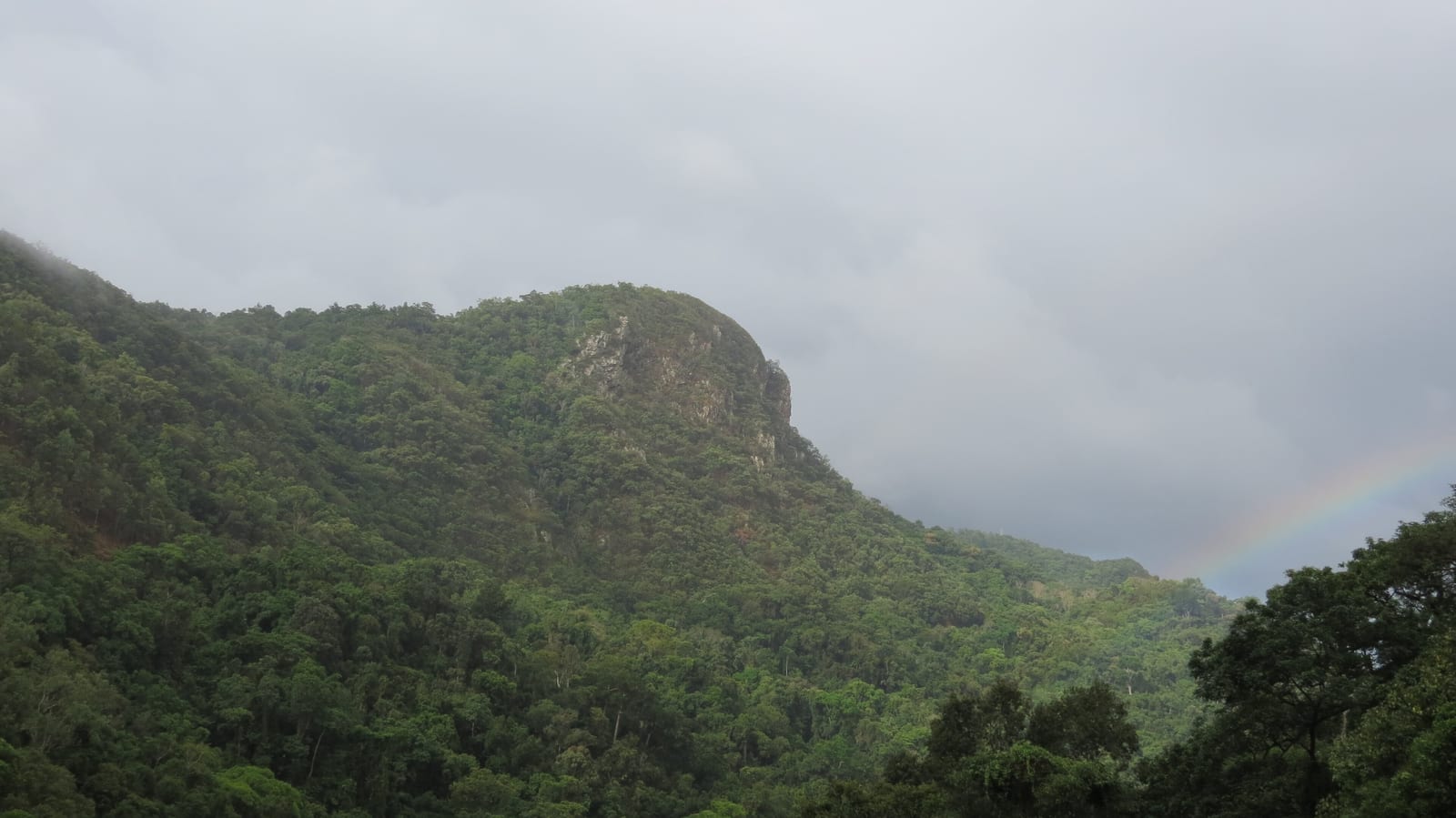
The line climbs through Barron Gorge National Park, past Stoney Creek Falls — which the train curves right beside — and Barron Falls, where it pauses for the view. In the wet season the falls are thunderous.Robert Linsdell / Wikimedia Commons · CC BY 2.0The short, cheap great railway
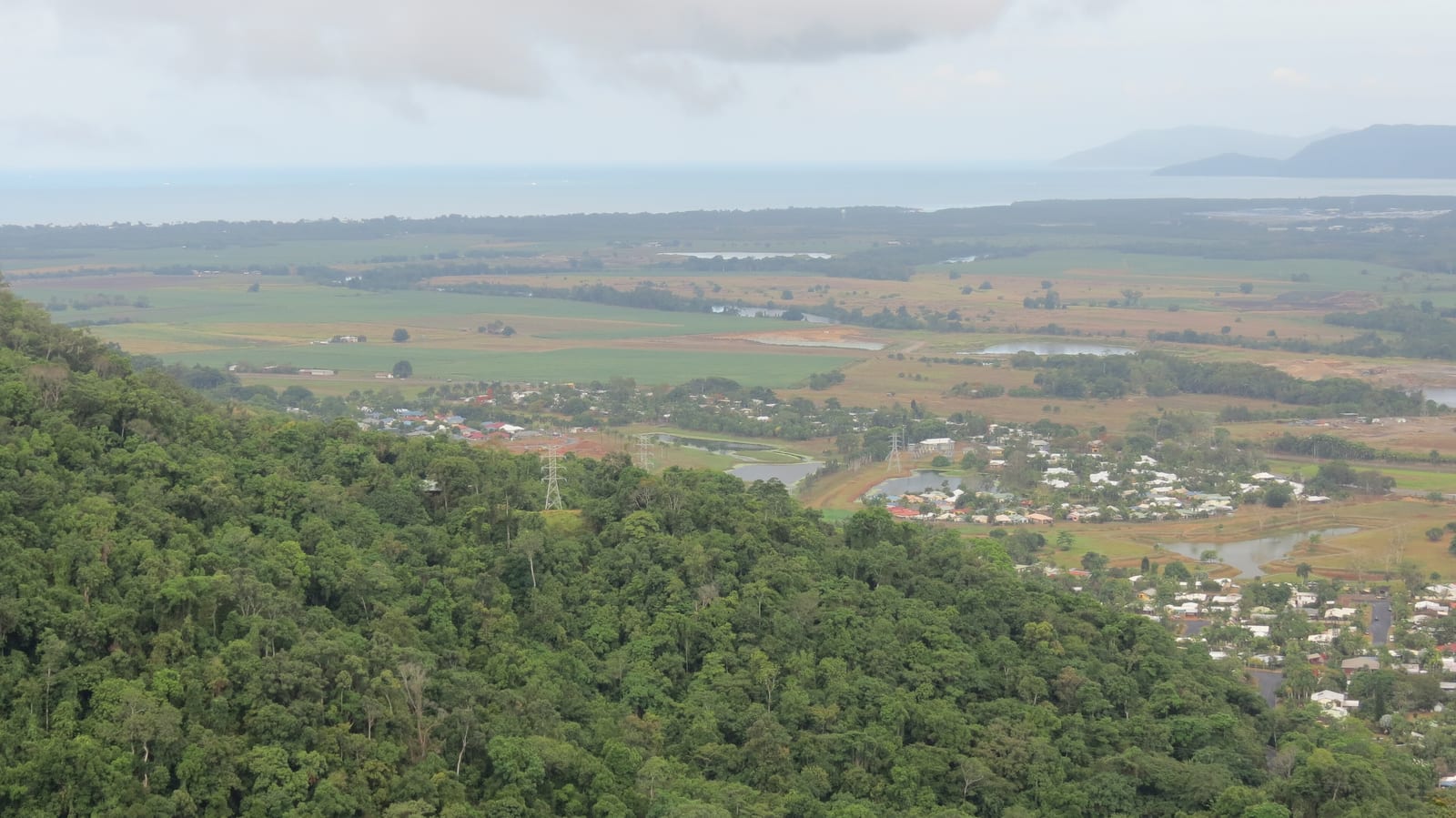
Australia's other famous trains are three-night, four-figure crossings. This is a two-hour day trip that anyone can afford — and every bit as much a feat of railway building. Proof that the great ones are not only the long ones.A bit of history
Culture & experiences along the way
Queensland State Archives / Wikimedia Commons · Public domainDown beside Stoney Creek Falls
The train swings onto a curving bridge right at the foot of the falls — close enough to feel the spray on a wet-season day. It is the single most photographed moment on the line, and it earns it.Robert Linsdell / Wikimedia Commons · CC BY 2.0Kuranda at the top
The village at the summit is a rainforest town of markets, walks and wildlife — koalas, butterflies, birds — and the station itself is a listed period piece drowning in ferns. Give yourself the afternoon before heading back down.Robert Linsdell / Wikimedia Commons · CC BY 2.0Down by Skyrail
The classic way to do it: train up, Skyrail Rainforest Cableway down — a gondola that glides just over the forest canopy, with the gorge and the falls beneath you. Two completely different views of the same range in one day.Timetables
Unlike Australia's transcontinental trains, this one runs to a proper daily timetable and needs no expedition planning — but it is popular, so book. It runs twice daily, every day except Christmas Day.
Real departures (2026 — confirm before travelling):
| Direction | Departures |
|---|---|
| Cairns Central → Kuranda | 08:30 & 09:30 (via Freshwater 08:50 & 09:50) |
| Kuranda → Cairns | 14:00 & 15:30 |
The climb takes about 1 h 55 each way. Heritage Class is on every service; Gold Class on the second morning and the afternoon trains. ⚠️ Temporary timetable 20 July–20 September 2026: the morning Cairns departure runs at 08:45 (arriving Kuranda ~10:40) — check the operator for the current pattern.
Good to know:
- Do it as a round trip, not there-and-back on the train. The classic combination is the railway one way and the Skyrail cableway the other — inside the forest, then above it.
- Sit on the correct side. Going up from Cairns, the valley and the falls are generally on the left — but ask when you board.
- The waterfalls depend on the season. In the wet (November–April) Barron and Stoney Creek Falls are spectacular; in the dry (May–October) they're gentler but the weather is far more comfortable.
- Give Kuranda the afternoon — markets, wildlife parks and rainforest walks are worth several hours.
Times as of the 2026 timetable. Confirm current schedules with the operator — see the Tickets section below.
Tickets
Tickets come from the Kuranda Scenic Railway, direct or through the many Cairns tour agents, and this is the affordable end of great railway travel — a day trip, not a mortgage. You can ride the railway up and back, roughly two hours each way in Heritage or Gold Class carriages; or take the train up and the Skyrail down, which is the combination almost everyone chooses and the one to book. Two completely different journeys through the same gorge, for not much more than a return train fare.
Book ahead in high season, because Cairns is a major tourism hub and both the trains and the Skyrail fill. Most packages bundle the hotel pick-up and the transfer between terminals, which saves fiddling with logistics on the day. Gold Class is a pleasant but modest upgrade on a two-hour ride — put the money into the Skyrail combination instead.
Book your tickets
Kuranda Scenic Railway
Cairns to Kuranda, or return
The heritage train up the range and back, roughly two hours each way. Book ahead in peak season — this is one of tropical Queensland's most popular day trips. Heritage and Gold Class carriages are offered.
Book Tickets (opens in a new tab, on Kuranda Scenic Railway)via Kuranda Scenic RailwayTrain up, Skyrail down
The classic combination
The way most people do it and the way we'd recommend: the railway one direction, the Skyrail cableway the other, for two completely different perspectives on the gorge. Sold as combined tickets by the operators and local agents.
Book Tickets (opens in a new tab, on Kuranda Scenic Railway / Skyrail)via Kuranda Scenic Railway / SkyrailRail Passes
No rail pass covers the Kuranda Scenic Railway. Interrail and Eurail are European schemes, and Australia is not among the 33 countries in Interrail's list of covered railway companies (opens in a new tab). The railway sells its own tickets, alone or combined with the Skyrail cableway, direct or through Cairns tour agents.
Checked October 2026 against Interrail's list of covered railway companies (opens in a new tab).
Places to Visit
The railway is a half-day; tropical North Queensland is one of the great corners of Australia, and Cairns is the base for all of it.
On planning around it: the train one way and the Skyrail cableway the other will fill a day between them, and everything else here — the reef, the tableland, the Daintree — wants a day of its own. Most people give the region a week and treat the railway as the morning that starts it.
 Bahnfrend / Wikimedia Commons · CC BY-SA 4.0 · cropped
Cairns
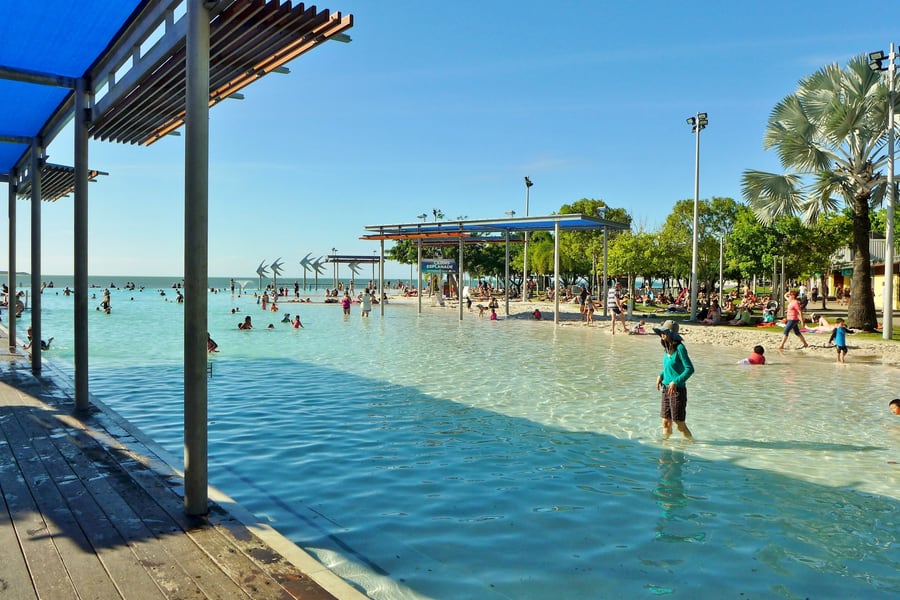
The coastal city where the line starts, founded in 1876 on the back of a gold rush and now the base most people use for a week of tropical North Queensland. Its city foreshore is a mudflat rather than a beach, which is why the Esplanade Lagoon exists — a public swimming pool of 4,800 square metres on the waterfront, opened in March 2003. Day boats leave from here for the outer reef.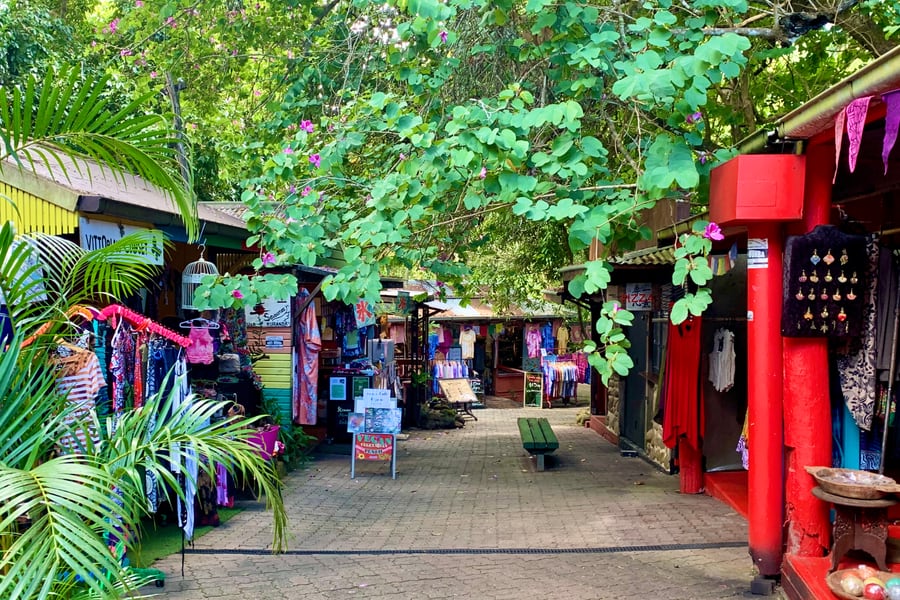 Kgbo / Wikimedia Commons · CC BY-SA 4.0 · cropped
Kuranda
The village at the top of the climb, 328 metres up and buried in rainforest. The markets are the draw — stalls under the trees selling craft, opals and tropical fruit — along with wildlife parks for butterflies, koalas and birds, and walking tracks down towards the Barron River. Your ticket implies an afternoon here, which is about right; most people ride the Skyrail cableway back down.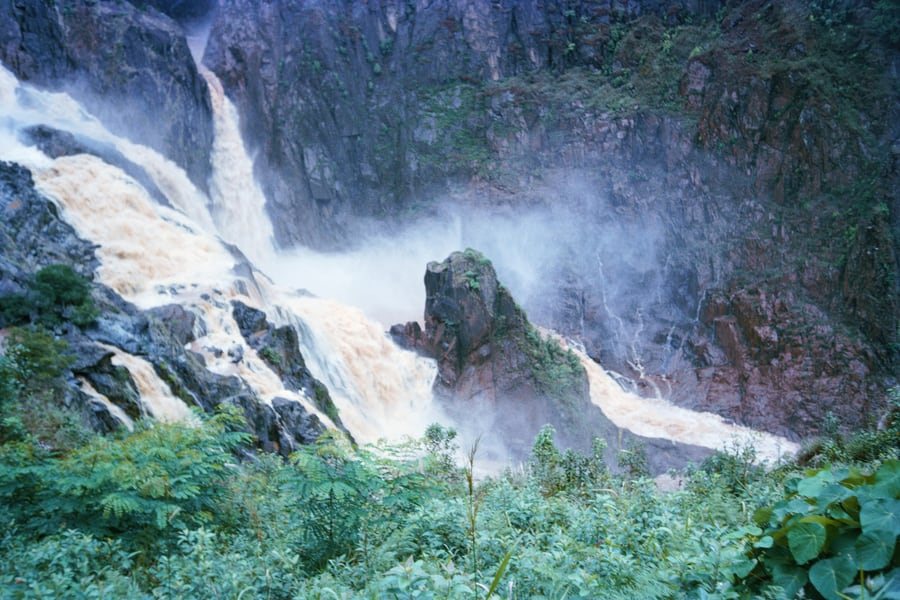 Jack Bain / Queensland University of Technology · CC BY 4.0 · cropped
Barron Falls
Din Din to its traditional owners, and the set piece of the ride: a 125-metre fall in Barron Gorge National Park with a single drop of 107 metres. Be warned that a weir upstream diverts most of the water to the Barron Gorge hydroelectric station, so for much of the year it runs thin. After heavy wet-season rain it becomes the photograph on every poster, and both train and Skyrail stop for it.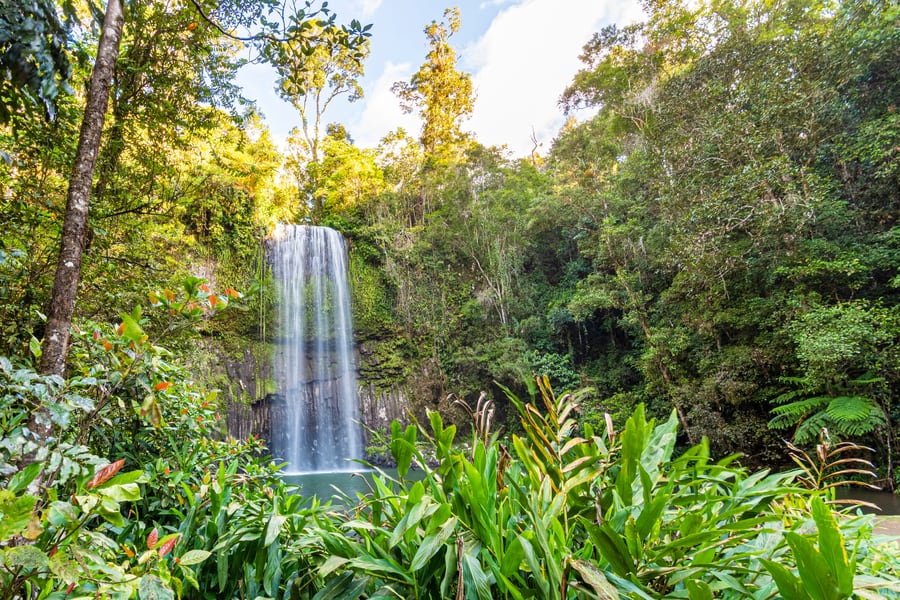 Steven Penton / Wikimedia Commons · CC BY 2.0 · cropped
The Atherton Tableland
The fertile plateau beyond Kuranda, part of the Great Dividing Range and about 50 km southwest of Cairns: cooler, greener and completely unlike the coast, with deep volcanic soils, small farming towns and waterfalls. Millaa Millaa Falls is the one everybody photographs. Lake Eacham and Lake Barrine fill maar craters blown out by old eruptions. You need a car, and it is worth a whole day.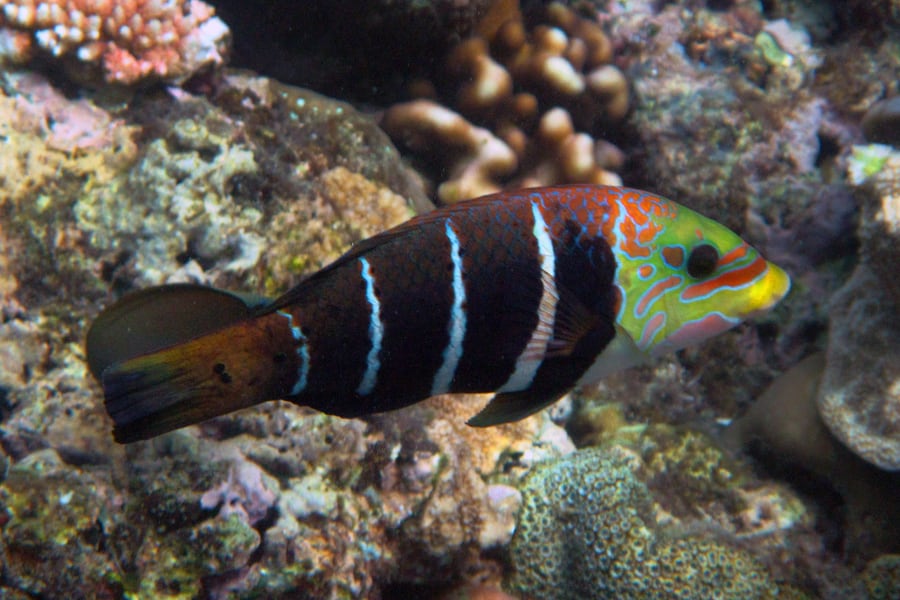 Steve Evans / Wikimedia Commons · CC BY 2.0 · cropped
The Great Barrier Reef
The obvious reason most people are in Cairns at all: over 2,300 kilometres of coral covering some 344,400 square kilometres, World Heritage listed in 1981, the largest single structure on earth built by living organisms and visible from space. Day boats run out to the outer reef for snorkelling and diving, and pontoons make it manageable if you would rather not dive.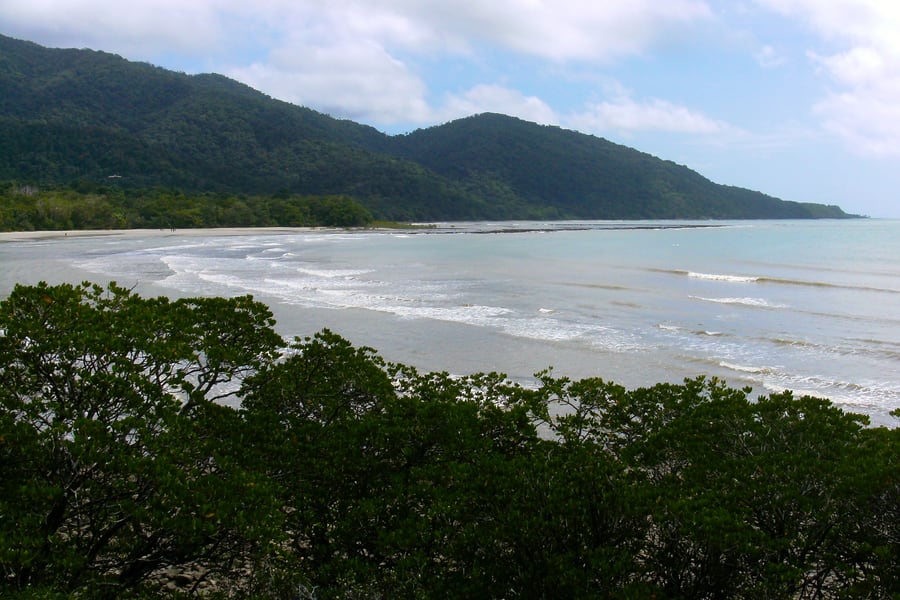 Paul Holloway / Wikimedia Commons · CC BY-SA 2.0 · cropped
The Daintree & Cape Tribulation
North of Cairns, where roughly 1,200 square kilometres of rainforest — about 180 million years old, older than the Amazon by nearly 100 million years — runs down to the sea. At Cape Tribulation two World Heritage areas, reef and rainforest, meet at the shoreline; there are very few places on earth where that happens. The eastern Kuku Yalanji won formal ownership of 160,213 hectares in September 2021. Chris Olszewski / Wikimedia Commons · CC BY-SA 4.0 · cropped
Port Douglas
Sixty kilometres and about an hour up the coast, and the other common base for the reef and the Daintree: a town of some 3,650 people, smaller and smarter than Cairns, strung along Four Mile Beach. It sits between two World Heritage areas, and boats leave the marina daily for the outer reef and the Low Isles. Stay here instead if you want the tropics without a city attached.Where to Sleep
This is a day trip, so you sleep in Cairns — before and after — and there is nothing to arrange along the line.
Cairns is a full-blown tropical tourism town and has beds for every budget: backpacker hostels along the Esplanade, mid-range hotels near the lagoon, and resorts on the fringes. Prices climb in the dry-season peak (roughly June to September) and around school holidays; book ahead then. Anywhere central puts you within easy reach of the railway transfers, and most Kuranda packages will collect you from your hotel anyway.
Two alternatives, if you'd rather not base yourself in Cairns:
- Kuranda itself — you can stay up in the rainforest village, in lodges and B&Bs among the trees. It is quiet, green and lovely once the day-trippers have gone home, and it lets you ride the railway down in the morning rather than up. A genuinely nice way to do it in reverse.
- Port Douglas — an hour up the coast, smarter and more relaxed than Cairns, and the choice if the reef and the Daintree matter to you as much as the train. You'd drive or transfer in for the railway.
The practical notes are simple. You don't need a car for the railway — the train, the Skyrail and the transfers between them are all packaged. And don't rush the top: the whole point of staying in Cairns for a few days is that the railway is one morning of a much bigger trip, with the reef, the Daintree and the tableland all within reach. Ride the train for the railway; stay in the north for everything around it.
Questions or corrections
Planning this trip and stuck on something, or spotted a time, fare or detail that has changed? Send us a message about Kuranda Scenic Railway. We read every one, and we update this page when something has changed.