St Petersburg to Kuznechnoye
Neu-Zwei / Wikimedia Commons · CC BY-SA 4.0 · cropped
- Distance156 km
- Duration2 h 16 min
- Best seasonYear-round
Introduction
Finland built this railway, as it built the one to Vyborg. The Grand Duchy's own trunk route to St Petersburg needed a second approach, and in the summer of 1913 Finnish State Railways began one: 179 kilometres from the Finland Station north-east across the Karelian Isthmus to Hiitola, where it met the line from Vyborg to Joensuu. Construction finished in January 1917, eleven months before Finland became a country and the railway became two railways. For the next twenty-two years the Finnish trains stopped at Nuijala and the Soviet ones at Lembolovo, and the track between them lay broken.
The Moscow Peace Treaty of 1940 made the isthmus Soviet and the line whole again, and the Soviet Union then did what Finland never had: it strung wire over it. The catenary crept north for a quarter of a century — Vaskelovo in 1959, Sosnovo the same year, Priozersk in 1975 — and stopped in 1976 at Kuznechnoye, a granite village 156 km out and 20 km short of the Karelian border. It has stopped there ever since, which is why this is a journey and not just a commute.
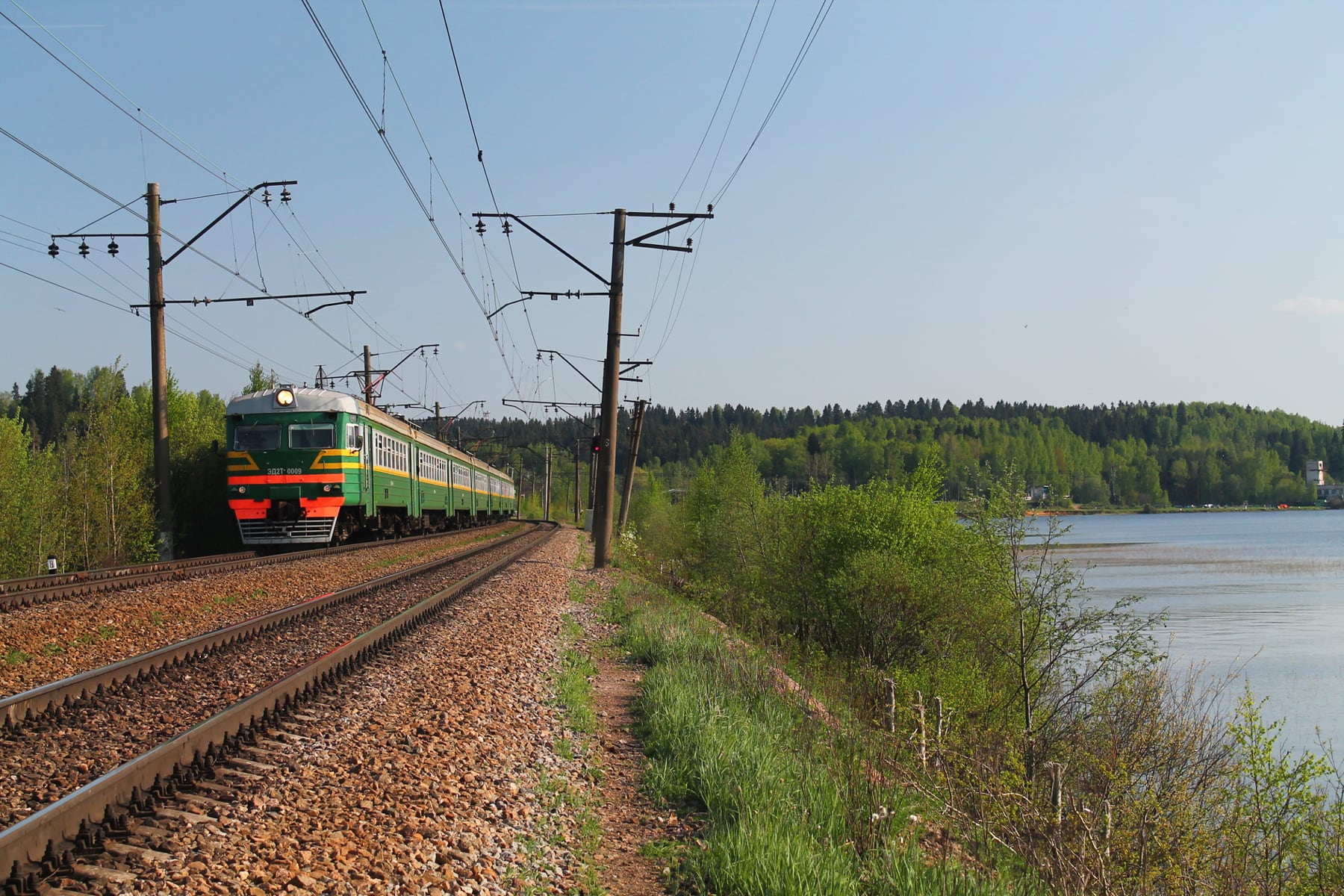
What runs on it is an ordinary suburban electric train: six or seven departures a day, a flat regional fare, no reservation, no class. It leaves the Finland Station among the tower blocks, climbs into the lake-and-moraine country at Toksovo that Petersburgers have called their Switzerland since the 1890s, threads the causeway between two lakes, crosses the Vuoksa where the river breaks into rapids at Losevo, and runs the last hour down the western shore of Lake Ladoga to the fortress town of Priozersk and the end of the wires.
The Journey
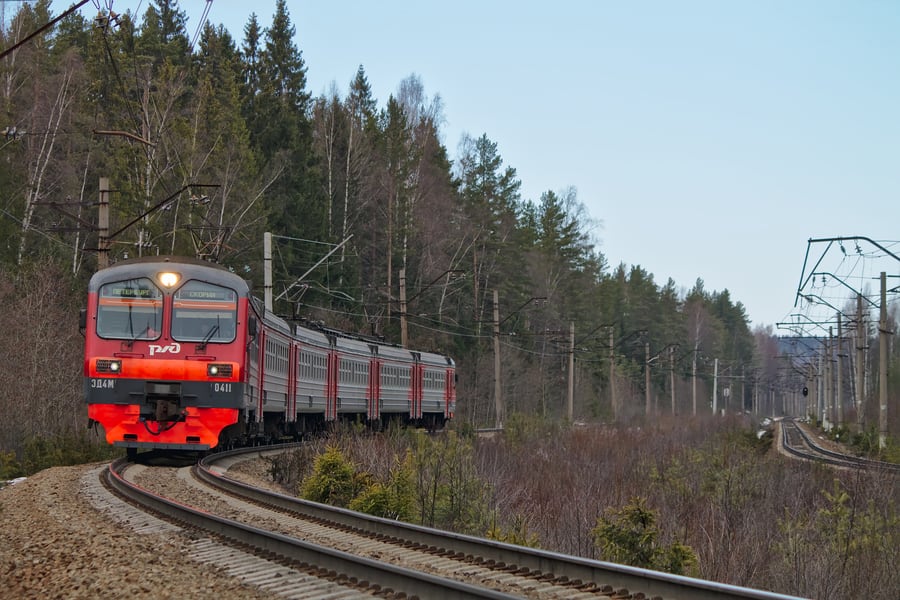
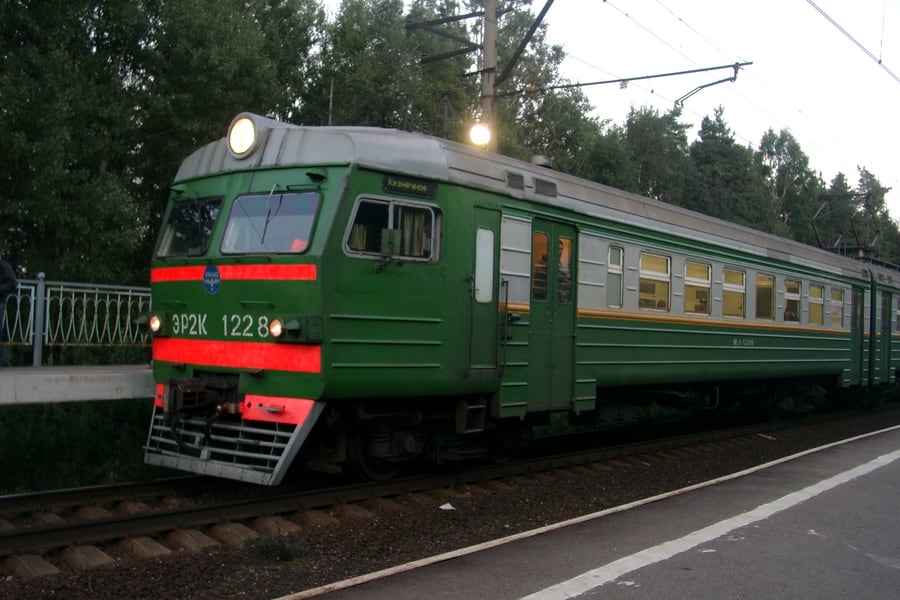
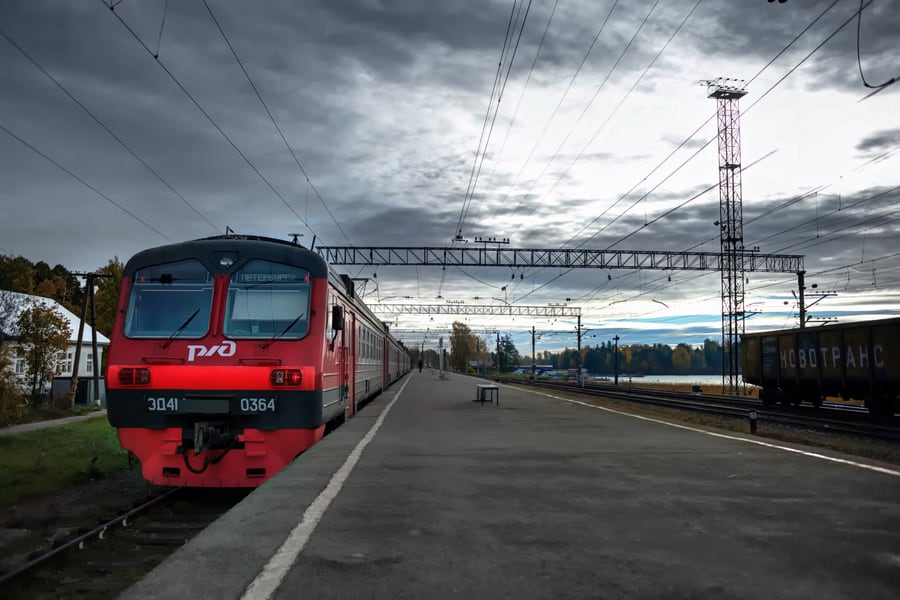
The train that leaves the Finland Station for Kuznechnoye is the same red-and-grey ED4M or green ET2M that has taken half of St Petersburg to its allotment for fifty years. There is no catering, no seat number and no announcement in English. There is a hard bench, a window that opens, and 156 kilometres of the Karelian Isthmus.
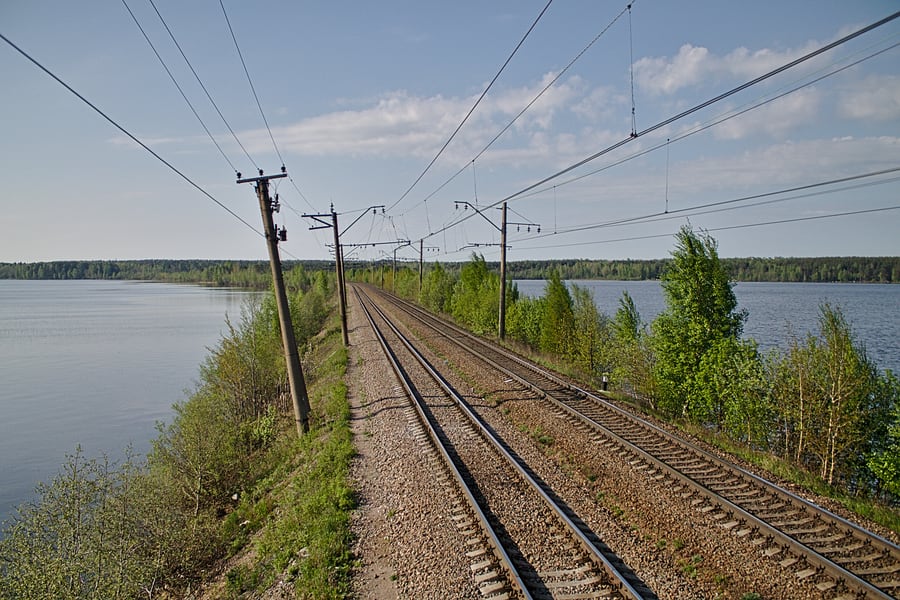
The city goes quickly. Piskaryovka, Ruchyi, then Devyatkino, where most of the standing passengers get off: the metro's northern terminus is across the platform, the only station on the St Petersburg underground that is not in St Petersburg, and for four years after it opened in 1978 the northernmost metro station in the world. After that the line begins to climb, and by Toksovo — 25 minutes out — it is running through moraine hills, pine and small deep lakes, the landscape a Petersburg guidebook of 1892 was already calling the Petersburg Switzerland. Just beyond the station the track crosses the narrow neck of land between Lake Kavgolovskoye and Lake Khepoyarvi on a low embankment with water on both sides. It is the best five minutes of the first hour, and it comes up on the right.
Then the isthmus flattens into forest. Vaskelovo, Lembolovo, Orekhovo — Raasuli until 1948, and the point where the old administrative border between the Grand Duchy and Russia crossed the line. Between 1918 and 1940 that border was an international one and the railway was cut here: Nuijala, one stop north, was as far as the Finnish trains came, and Lembolovo, one stop south, as far as the Soviet ones. Today the platforms have nothing behind them but allotment plots and a path into the trees. Sosnovo, at the halfway mark, is where the train empties: it was Rautu, the end of the double track, and it is still the biggest place between the city and Priozersk.
The Vuoksa, and what the Finns did to it
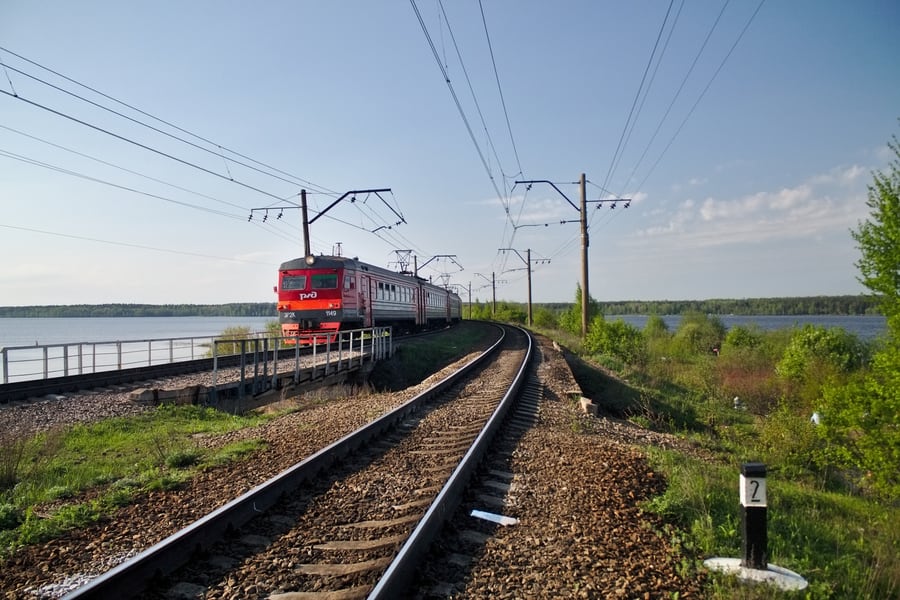
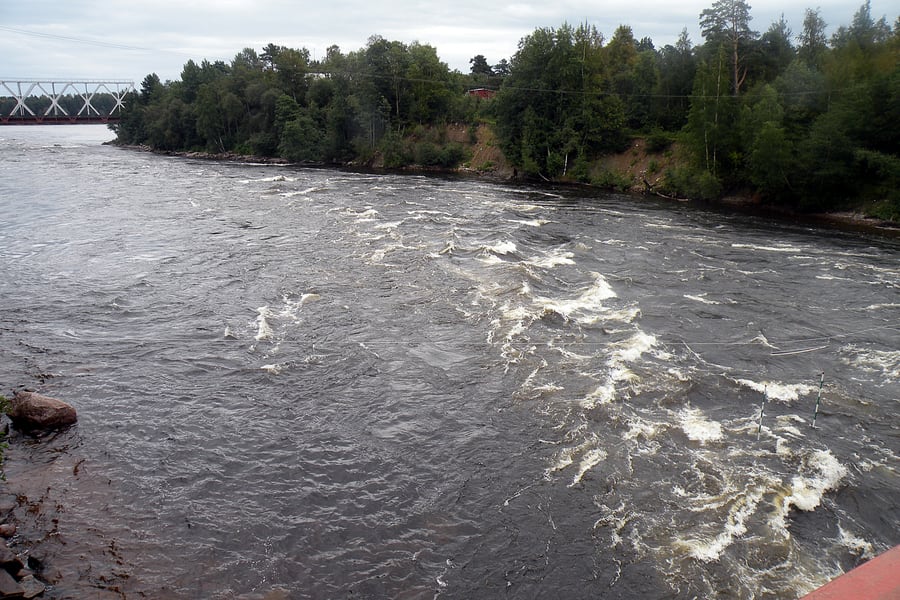
North of Sosnovo the line reaches water it cannot avoid. At Losevo it crosses the short, violent channel that carries the Vuoksa into Lake Sukhodolskoye, and the story of that channel is worth knowing before the bridge arrives. Until the nineteenth century this was a wide, calm strait that boats used. In 1818 a ditch dug for farmland breached the sandy ridge between Lake Suvanto and Ladoga; the breach tore itself into a valley within a week, the lake dropped five metres, and the Vuoksa reversed its course into it. In 1857 the Finns dynamited the shallowed channel meaning to widen it into a shipping canal; the rock underneath turned out to be too hard, and what they got instead was 800 metres of grade-II whitewater with a fall of two and a half metres and a boulder in the middle that everyone calls the Gendarme. Under the road bridge the water is two to four metres deep. Under the railway bridge it is seventeen.
Beyond Losevo come Gromovo (Sakkola), Sukhodolye, Otradnoye and Myullyupelto, and the country turns to birch, granite outcrop and long views west over the Vuoksa's lakes. Priozersk arrives after about two and three-quarter hours: a red timber station of 1916, built to Ture Hellström's standard Finnish design in the northern-modern manner and restored in 2007–08, and beyond it the stone island fortress of Korela, which is the reason there has been a town here since the thirteenth century.
The last twenty kilometres
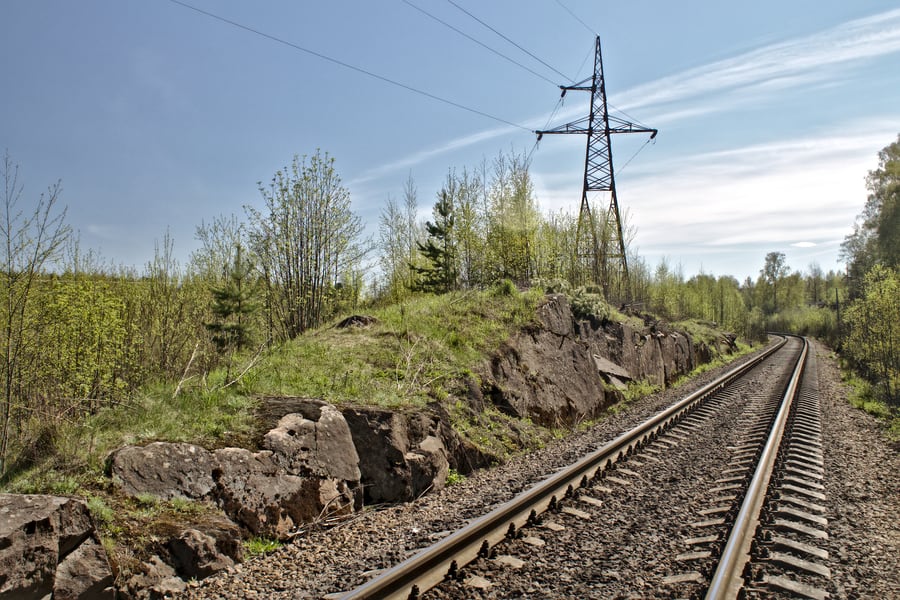
Most passengers have gone by Priozersk. What is left is twenty minutes of single track through cuttings blasted out of pink Karelian granite, past the quarries and the crushing plant that give this end of the line its freight, to Kuznechnoye — Kaarlahti, the curved bay, a settlement that was a village until the railway arrived in 1916 and did not become a town of any kind until 1961.
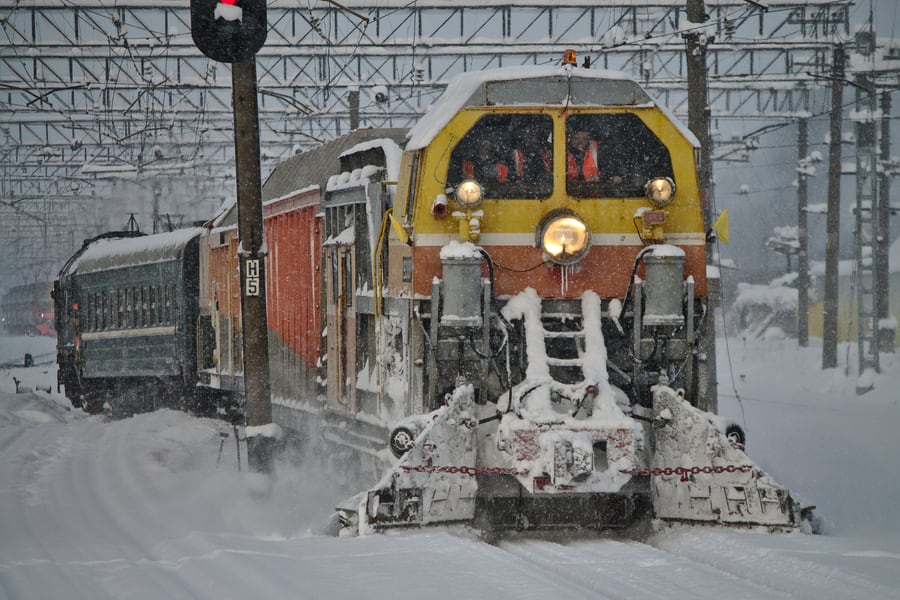
The station is a wooden building with a waiting room and a booking office, one side platform whose high section takes only the first three carriages, and a great many sidings. Walk to the north end and you can see the point of the whole trip: the overhead wire simply ends. Ahead the rails run on unelectrified towards Hiitola and Karelia, worked by diesel; behind, everything is under wire, all the way back to the city. Freight trains change engines here for exactly that reason.
Lake Ladoga is a walk to the east, the Karelian border 20 kilometres north. There is nothing to do at Kuznechnoye except look at that, and then catch the train back.
Along the route
 volhovst / Wikimedia Commons · CC BY 3.0 · cropped
Toksovo and the hills
Twenty-five minutes out the flat ends. Moraine ridges, pine and a dozen small lakes — a Petersburg guide of 1892 already called it the Petersburg Switzerland — and the track crosses the neck between two of the lakes on a bare embankment.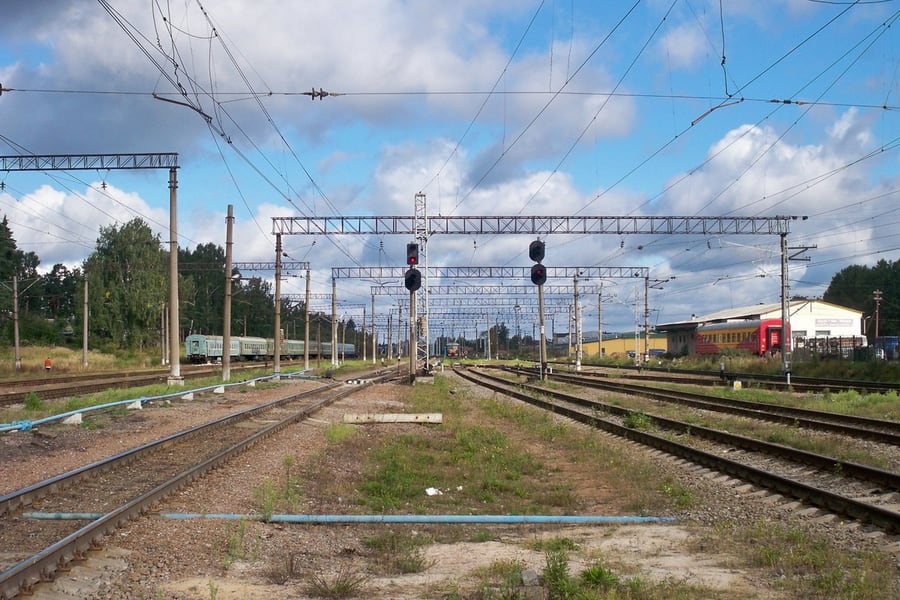 Postoronniy-13 / Wikimedia Commons · CC BY-SA 3.0 · cropped
Sosnovo, the halfway point
Rautu until 1948, and the end of the double track until the second line was pushed on to Losevo in 2013. Half the train gets off here, and the platforms north of it stop having villages behind them: just plots, paths and forest.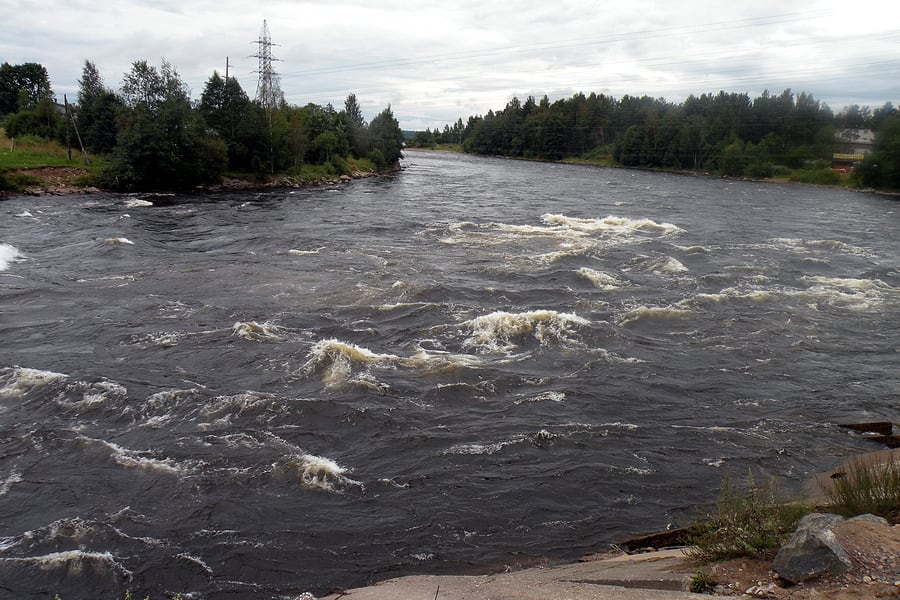 Витольд Муратов / Wikimedia Commons · CC BY-SA 3.0 · cropped
Losevo and the rapids
The line crosses the Vuoksa where it falls into Lake Sukhodolskoye. What looks like a natural rapid is the result of a Finnish attempt in 1857 to blast a shipping canal through rock that turned out to be too hard.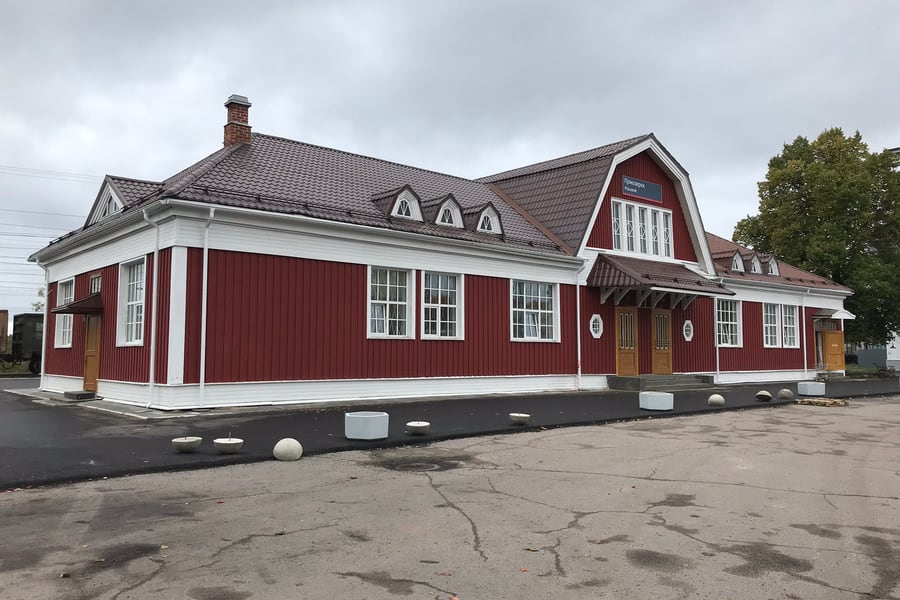 Timofeevandrew / Wikimedia Commons · CC BY-SA 4.0 · cropped
Priozersk
Käkisalmi, Kexholm, Korela — the town has had three names and four owners. Its station is a red timber building of 1916 to Ture Hellström's standard Finnish design, restored in 2007–08 and listed as a heritage object.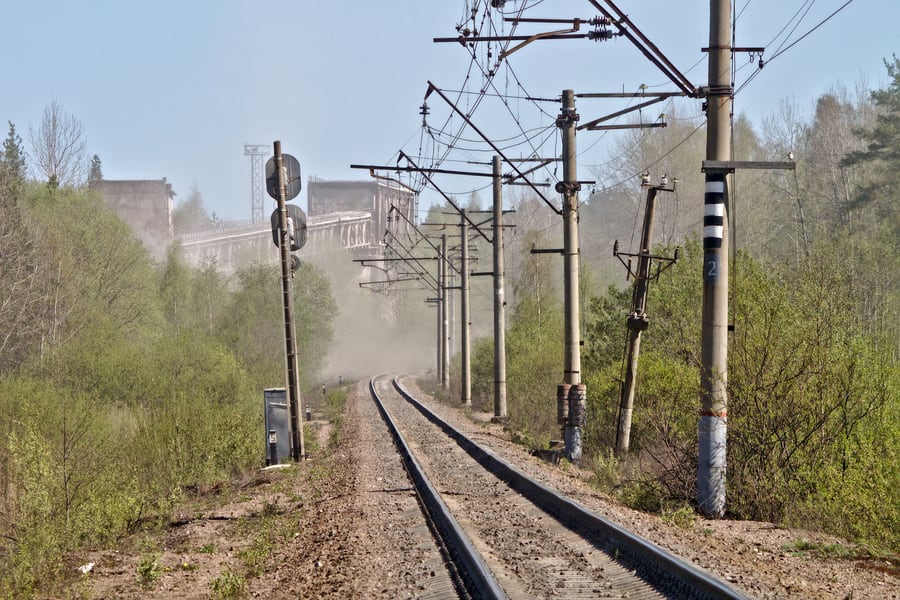 Neu-Zwei / Wikimedia Commons · CC BY-SA 4.0 · cropped
Kuznechnoye, the end of the wire
The last twenty kilometres run single-track through blasted granite to the quarry village of Kaarlahti. Walk to the north end of the platform and the catenary stops: beyond it the rails carry on into Karelia under diesel.A bit of history
Culture & experiences along the way
 Андрей Бобровский / Wikimedia Commons · CC BY 3.0 · cropped
The dacha ticket
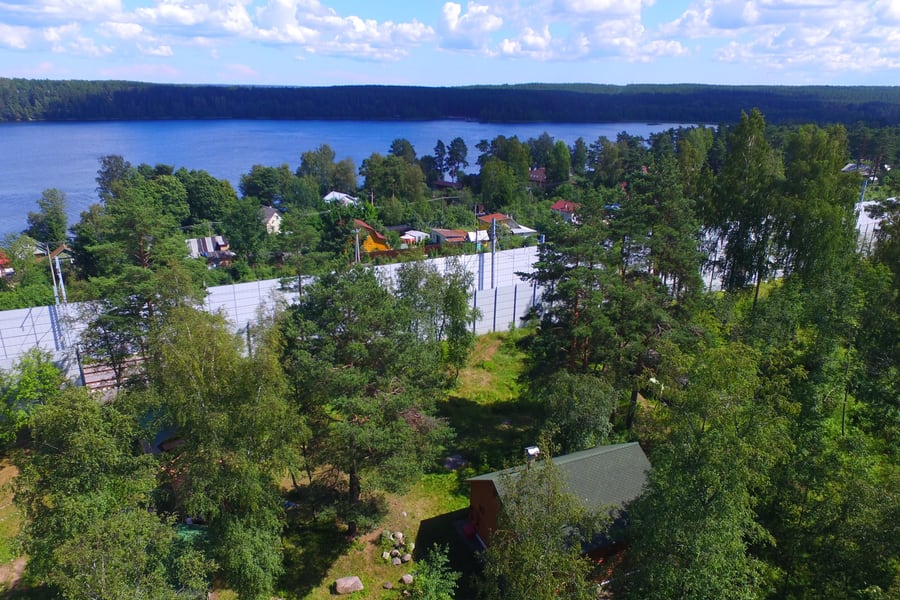
From the last Friday in April to 30 September, SZPPK sells a season called «Дачный» — the dacha ticket. It is valid at weekends and on holidays, plus Friday out and Monday back, and it costs ₽4,504 a month. It exists because for four months of the year this is not a commuter line: it is how the city reaches its garden.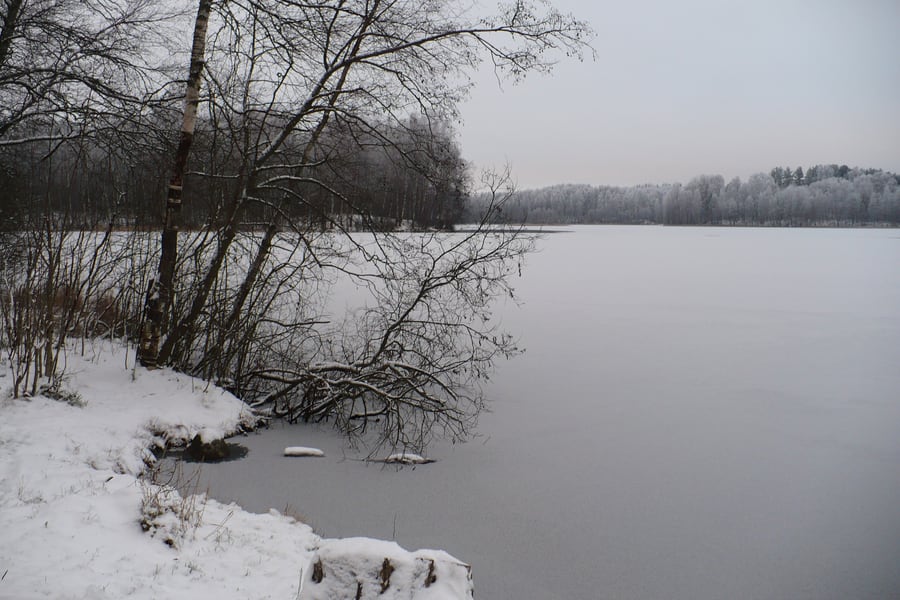 deniszakharov / Wikimedia Commons · CC BY 3.0 · cropped
Ski country at Kavgolovo
Since the war Toksovo has been north-west Russia's centre for winter sport, with the largest ski bases and downhill slopes in Leningrad Oblast on the hills above the lakes. The practical detail: get off at Kavgolovo platform, not at Toksovo station — the slopes are at the northern end of the village.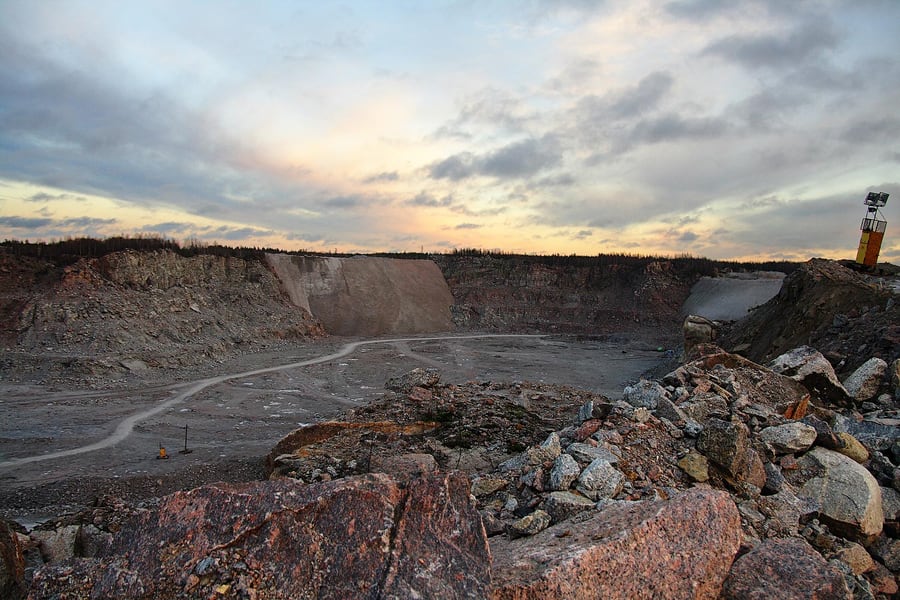 401 / Wikimedia Commons · CC BY-SA 3.0 · cropped
The granite the line was built for
Passengers are not what pays for this railway. Kuznechnoye works pink Karelian granite — quarries, a crushing and screening plant, a stone-cutting works — and the line exists to carry the crushed stone out and to run freight down to the ports of the Gulf of Finland. Engines change here, electric for diesel.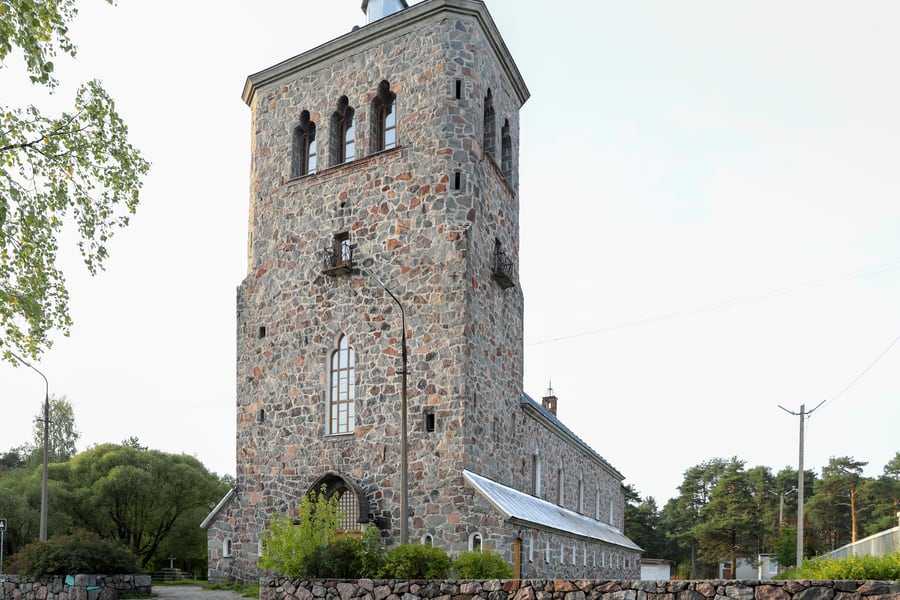 Ninaras / Wikimedia Commons · CC BY 4.0 · cropped
The kirkha of Käkisalmi
Armas Lindgren's Lutheran church at Priozersk was consecrated in 1930 and faced in whole reddish granite boulders, deliberately echoing the fortress walls. It has been an NKVD base, a house of culture and a nightclub; a fire in 2002 gutted it. The shell still stands, and a granite memorial of 1997 marks the Finnish war graves at its west wall.Timetables
AO "North-West Suburban Passenger Company" (SZPPK) runs six trains a day each way over the full length of the line, and seven at weekends. Five of the six are ordinary all-stations elektrichki taking three hours or a little over; the sixth is a limited-stop Lastochka, which does it in 2 h 16. The weekend extra is a second Lastochka.
The pattern does not change with the season. The board below was pulled for a Wednesday, a Saturday and a Sunday in September 2026 and for a Wednesday and a Saturday in December 2026, and the times were identical to the minute on all five.
All times are Moscow time, taken from the operator's own board and correct as of September 2026.
St Petersburg (Finlyandsky) → Kuznechnoye
| Train | Type | Departs | Arrives | Journey |
|---|---|---|---|---|
| 6511 | Elektrichka, all stations | 07:25 | 10:30 | 3 h 05 |
| 6523 | Elektrichka, all stations | 09:34 | 12:39 | 3 h 05 |
| 7577 | Lastochka — Saturdays and Sundays | 11:20 | 13:38 | 2 h 18 |
| 6639 | Elektrichka, all stations | 14:19 | 17:28 | 3 h 09 |
| 6549 | Elektrichka, all stations | 16:18 | 19:18 | 3 h 00 |
| 7579 | Lastochka — daily | 17:35 | 19:51 | 2 h 16 |
| 6567 | Elektrichka, all stations | 20:35 | 23:40 | 3 h 05 |
Kuznechnoye → St Petersburg (Finlyandsky)
| Train | Type | Departs | Arrives | Journey |
|---|---|---|---|---|
| 6508 | Elektrichka, all stations | 05:03 | 08:15 | 3 h 12 |
| 7582 | Lastochka — daily | 06:39 | 09:05 | 2 h 26 |
| 6524 | Elektrichka, all stations | 08:18 | 11:25 | 3 h 07 |
| 7584 | Lastochka — Saturdays and Sundays | 14:27 | 16:50 | 2 h 23 |
| 6548 | Elektrichka, all stations | 14:56 | 18:05 | 3 h 09 |
| 6554 | Elektrichka, all stations | 16:17 | 19:37 | 3 h 20 |
| 6568 | Elektrichka, all stations | 18:11 | 21:50 | 3 h 39 |
| 6580 | Elektrichka, all stations | 20:25 | 23:36 | 3 h 11 |
The Lastochka calls at Devyatkino, Toksovo, Orekhovo, Nikitino, Sosnovo, Losevo, Gromovo and Priozersk, and nowhere else; the weekend 11:20 drops Orekhovo. Everything else stops at every platform on the isthmus, which is what makes it a three-hour ride and, if you have the day, the better one.
For Priozersk alone there is one more train. The 18:46 (6557) from Finlyandsky terminates there, giving seven arrivals a day at the fortress town instead of six. Journey time to Priozersk is 2 h 40 – 2 h 49 on a stopper and 2 h 00 on the Lastochka.
There is no reservation and no allocated seat on any of them.
⚠️ Beyond Kuznechnoye the wires stop and so does the online board. SZPPK's own notices name a Kuznechnoye – Sortavala service, worked by diesel over the unelectrified line into Karelia, but its schedule engine returns nothing for that pair on any date tried — so we cannot give you its times, and you should ask at the Kuznechnoye booking office rather than assume a connection. That train runs through districts adjoining the state border, where the border service is entitled to check identity documents; Kuznechnoye itself is not in the border zone and needs no permit.
⚠️ Check before you travel. Suburban timetables here are revised seasonally and at short notice. The live board, by station and date, is on the operator's own site: ppk-piter.ru (opens in a new tab).
Tickets
This is a regulated suburban fare, worked out by the kilometre: for Leningrad Oblast in 2026, ₽48.44 for the first 14 km and ₽3.46 for each one after on an ordinary train, or ₽56.14 and ₽4.01 on a Lastochka. End to end that comes to ₽563 and ₽642. Priozersk is ₽511 and ₽582. A dog or a cat costs ₽140. There is no class, no seat number and nothing to reserve.
One rule catches visitors out. A single ticket issued for a Standard train — the 6000-numbered ones — is not valid on a Lastochka, and the guard will sell you a new one. A Lastochka ticket works the other way round, on any suburban train. Buy at a window or a terminal at either end, or in the operator's app, and keep it: the city-end stations are gated.
Book your tickets
All-stations ticket
Finlyandsky ↔ Kuznechnoye, about 3 h 05
The ordinary elektrichka at the regulated suburban tariff — no class, no reservation, and every platform on the isthmus.
Book Tickets (opens in a new tab, on ppk-piter.ru)via ppk-piter.ruLastochka ticket
The limited-stop train, 2 h 16
Forty-nine minutes quicker for seventy-nine roubles more, once a day and twice at weekends. An ordinary ticket is not valid on it.
Book Tickets (opens in a new tab, on ppk-piter.ru)via ppk-piter.ruPriozersk ticket
For the fortress town, 2 h 40 – 2 h 49
Most visitors go no further than Priozersk, which has one more train a day than Kuznechnoye does.
Book Tickets (opens in a new tab, on ppk-piter.ru)via ppk-piter.ruRail Passes
Interrail and Eurail do not cover Russia, so the European passes are not in play on this line at all. What SZPPK sells instead is a range of abonementy — season tickets — and for a visitor making one round trip none of them is worth the arithmetic. A monthly everyday season to Kuznechnoye costs ₽23,928; the return fare is ₽1,126.
They are worth knowing about anyway, because one of them explains the railway. The «Дачный» season — the dacha ticket — runs every year from the last Friday in April to 30 September and is valid on Saturdays, Sundays and public holidays, plus the Friday outbound and the Monday back. It costs ₽4,504 a month to Kuznechnoye and ₽4,088 to Priozersk, and it exists because for four months of the year this train is not a commuter service at all: it is how St Petersburg gets to its garden.
Two practical notes if you do buy one. Seasons are issued only on SZPPK's own contactless smartcard, sold at staffed booking offices, and go on sale 30 days before they start. They are valid on every category of suburban train, Lastochka included — which the ordinary single ticket is not — and they carry a bicycle free.
Checked September 2026 against the operator, ppk-piter.ru (opens in a new tab).
Places to Visit
Almost everything worth stopping for on this line is at Priozersk, and almost all of it is within twenty minutes' walk of the station. The rest is water: the Vuoksa's lakes on one side of the train, Lake Ladoga on the other, and an island in the middle of it that has had a monastery on it since the fourteenth century.
If you have one day, take an early elektrichka to Priozersk, walk the fortress and the river park, and come back on the evening train. If you have two, go on to Kuznechnoye for the Ladoga shore and sleep in Priozersk between them.
 GAlexandrova / Wikimedia Commons · CC BY-SA 4.0 · cropped
Korela Fortress
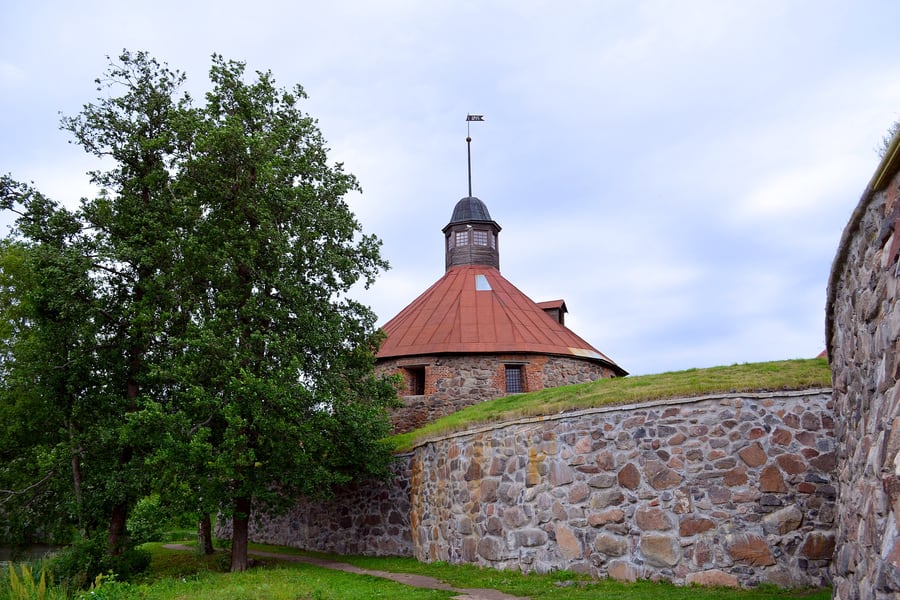
Novgorodians built a fort on this island in the Vuoksa around 1300, and its walls of 1310 burned so completely that the chronicle says the townsmen "were left with only their souls". The squat round gate tower everyone photographs is not Novgorodian but Swedish — excavation in the 1970s settled that — built in the second half of the 1500s with walls four metres thick at the base. Swedish from 1611, Russian from 1710, a prison for Pugachev's family, museum since 1962.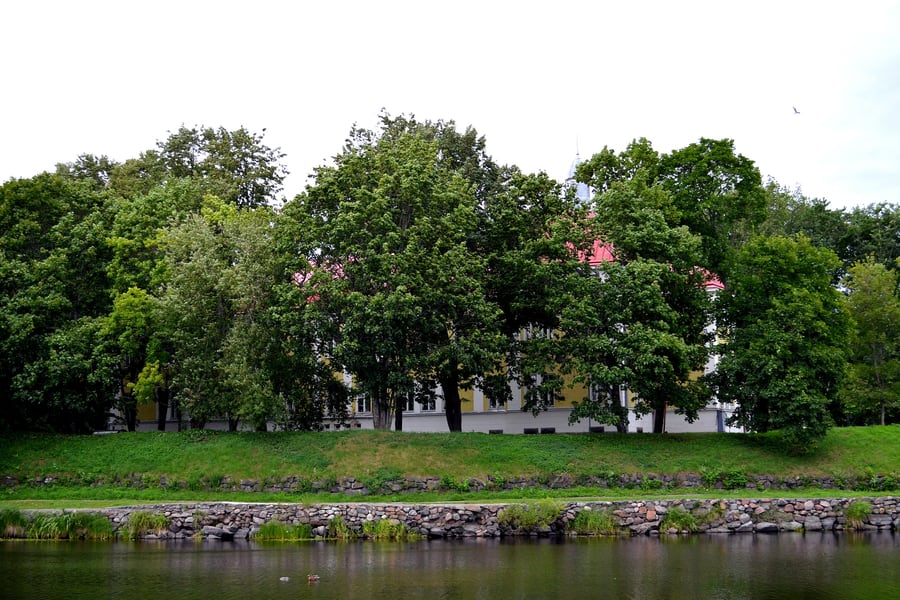 GAlexandrova / Wikimedia Commons · CC BY-SA 4.0 · cropped
The New Fortress and the river park
The eighteenth-century outworks north of the old castle are the quieter half of Priozersk and the better walk. The Chasseur regiment barracks stand in trees above the water, and the paths run along the Vuoksa between them and the town. When the river changed course after 1857 the channels that separated the two fortresses dried up, which is why the "island" castle is no longer on an island.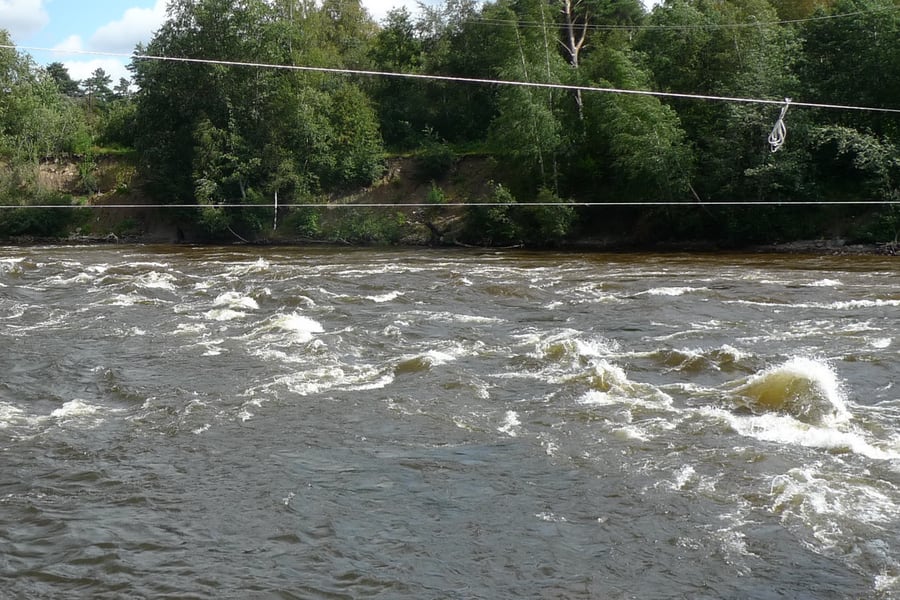 Макс Колчин / Wikimedia Commons · Public domain · cropped
The Losevo rapids
Eight hundred metres of grade-II whitewater with a two-and-a-half-metre fall and a boulder in the middle that the kayakers call the Gendarme. It was a salmon and whitefish fishery before the revolution, licensed and policed, supplying the best restaurants in St Petersburg; since the 1960s it has been where Leningrad — and now St Petersburg — learns to paddle. The railway bridge crosses the head of it.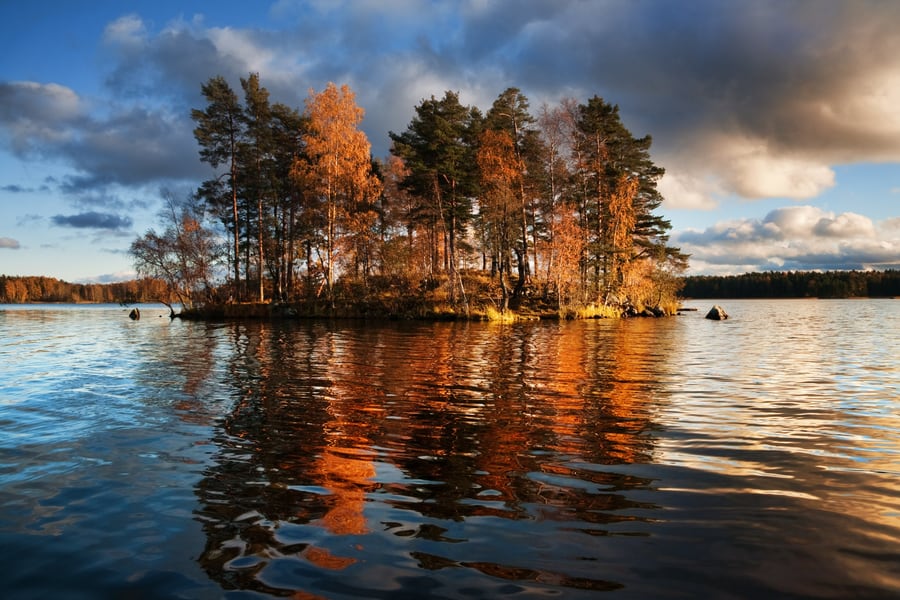 Dmitry A. Mottl / Wikimedia Commons · CC BY-SA 3.0 · cropped
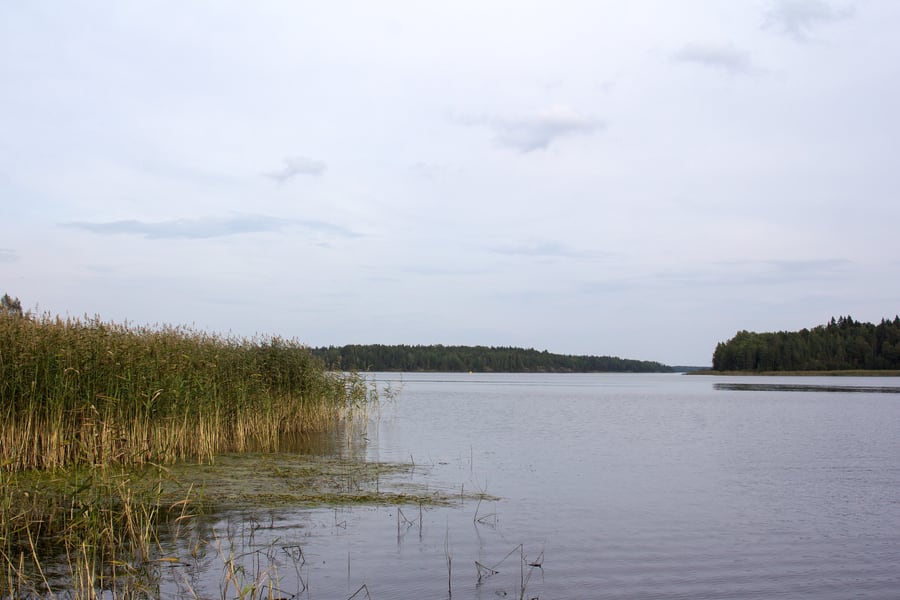
Lake Vuoksa
Not one lake but a drowned river system of islands, channels and reed bays spread across the isthmus, and for an hour of the journey it is what is out of the left-hand window. The rock is bare granite, the trees are pine and birch, and in late September the whole thing turns the colour of the photograph.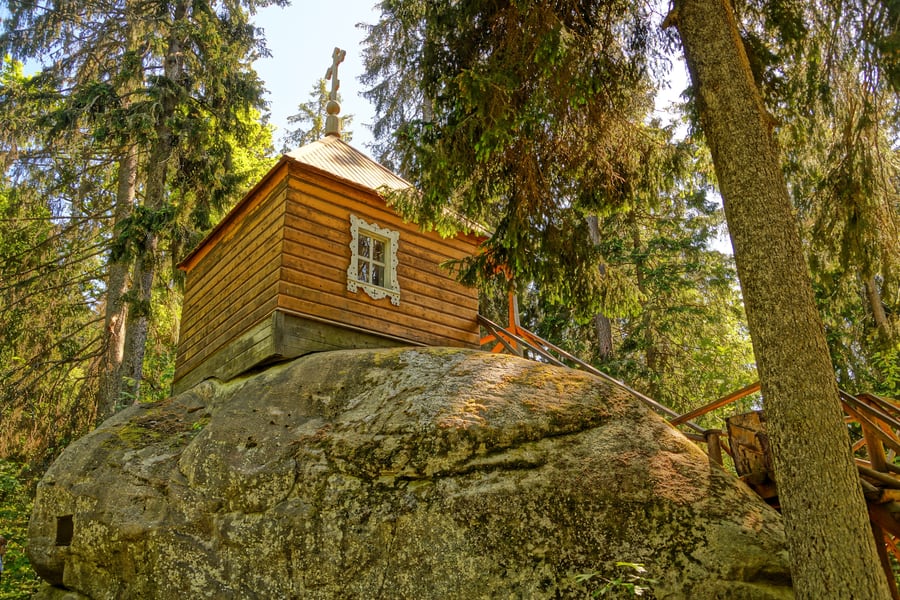 Moneycantbuy / Wikimedia Commons · CC BY-SA 4.0 · cropped
Konevets and the Horse Stone
An island of 8.5 km² in Lake Ladoga, 30 kilometres by water from Priozersk, with a monastery on it that dates from the fourteenth century. Its name comes from the Kon-Kamen, the Horse Stone: a glacial boulder of more than 750 tonnes with a small wooden chapel built on top of it. ⚠️ Boats to the island run from Vladimirovka and are not on a fixed schedule — arrange the crossing before you plan the day.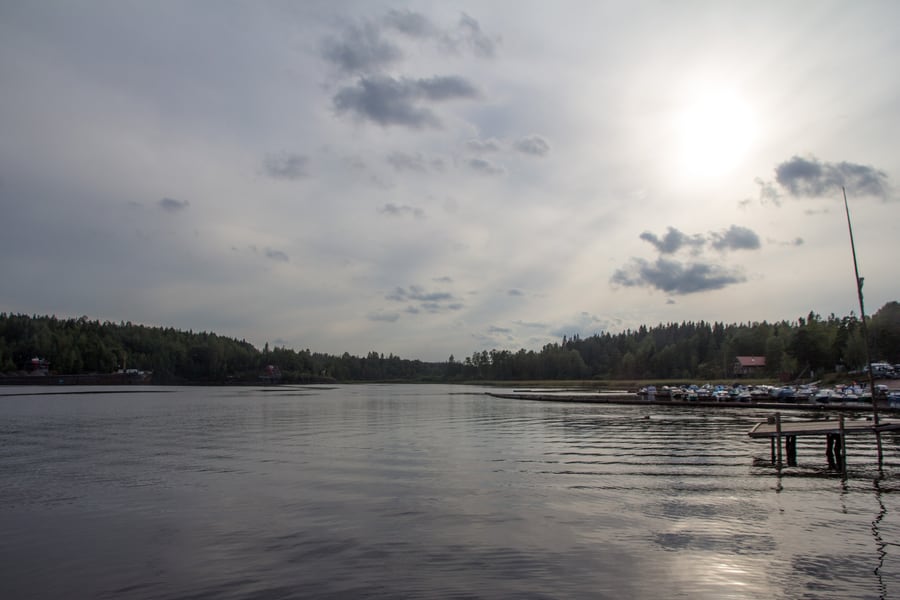 Alexey Komarov / Wikimedia Commons · CC BY 3.0 · cropped
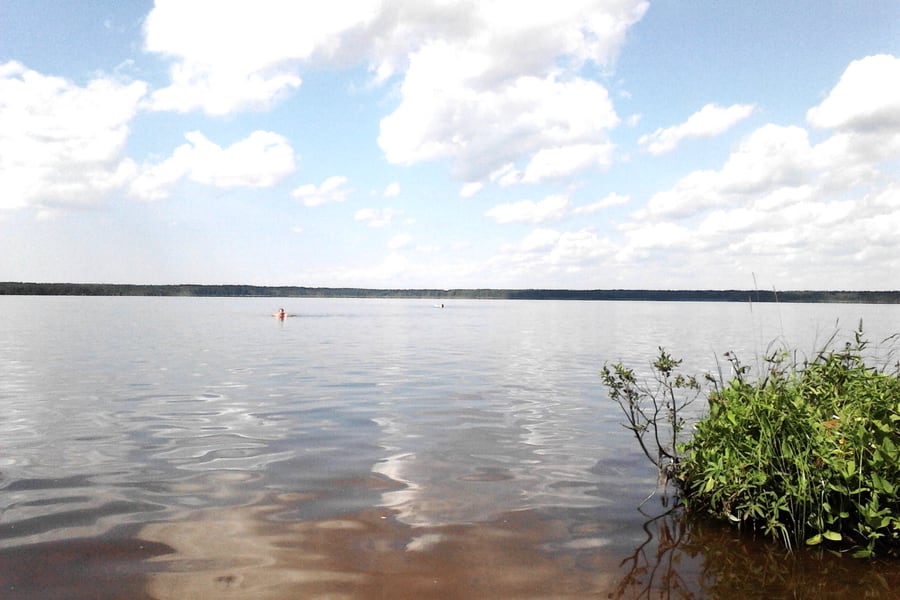
The Ladoga shore at Kuznechnoye
The reason to ride to the terminus rather than stop at Priozersk. East of the village the land runs out into Europe's largest freshwater lake — granite, shallows, reeds and a horizon with nothing on it. It is an hour's walk from the station and there is no bus, no café and nothing organised; take the water and the sandwiches with you from the city.Where to Sleep
Priozersk is the only place on the line with hotels: a small one in the centre, within a short walk of the fortress, and a design hotel in the pines on the edge of town. Kuznechnoye is a quarry settlement with no accommodation at all, so if you are riding to the end you either come straight back on the same evening or stay 20 kilometres short of it.
The alternative is to break the journey halfway. Losevo has holiday bases along the Vuoksa built around the rapids and the water sports that go with them — a different kind of night, and much the busier one in summer.
Where to stay
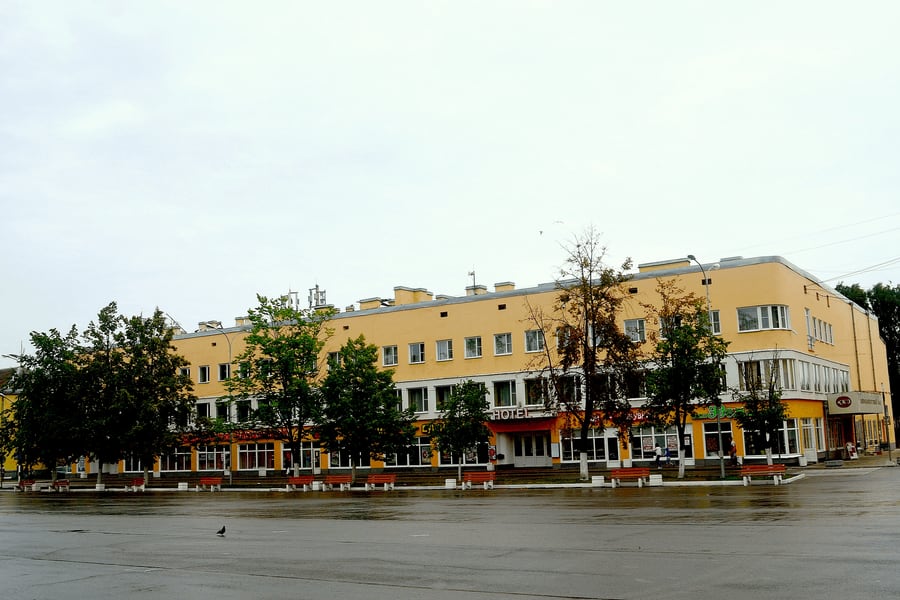 GAlexandrova / Wikimedia Commons · CC BY-SA 4.0 · cropped
Korela
On the central square, Priozersk
In a town building by the Finnish architect Lankinen, five minutes' walk from the fortress, with the kirkha in view from the windows and two restaurants downstairs.
Check Availability (opens in a new tab, on hotel-korela.tilda.ws)via hotel-korela.tilda.wsTochka na Karte Priozersk
In the pines on the edge of Priozersk
A two-storey design hotel among the pines, every room with its own entrance and panoramic windows, and a café and banya on site.
Check Availability (opens in a new tab, on tochkanakarte.ru)via tochkanakarte.ruLosevo Park
At Losevo, halfway up the line
A 145-room holiday base on the shores of the Vuoksa and Lake Sukhodolskoye, right beside the rapids, with restaurants and a round-the-clock reception.
Check Availability (opens in a new tab, on losevopark.ru)via losevopark.ruQuestions or corrections
Planning this trip and stuck on something, or spotted a time, fare or detail that has changed? Send us a message about St Petersburg to Kuznechnoye. We read every one, and we update this page when something has changed.