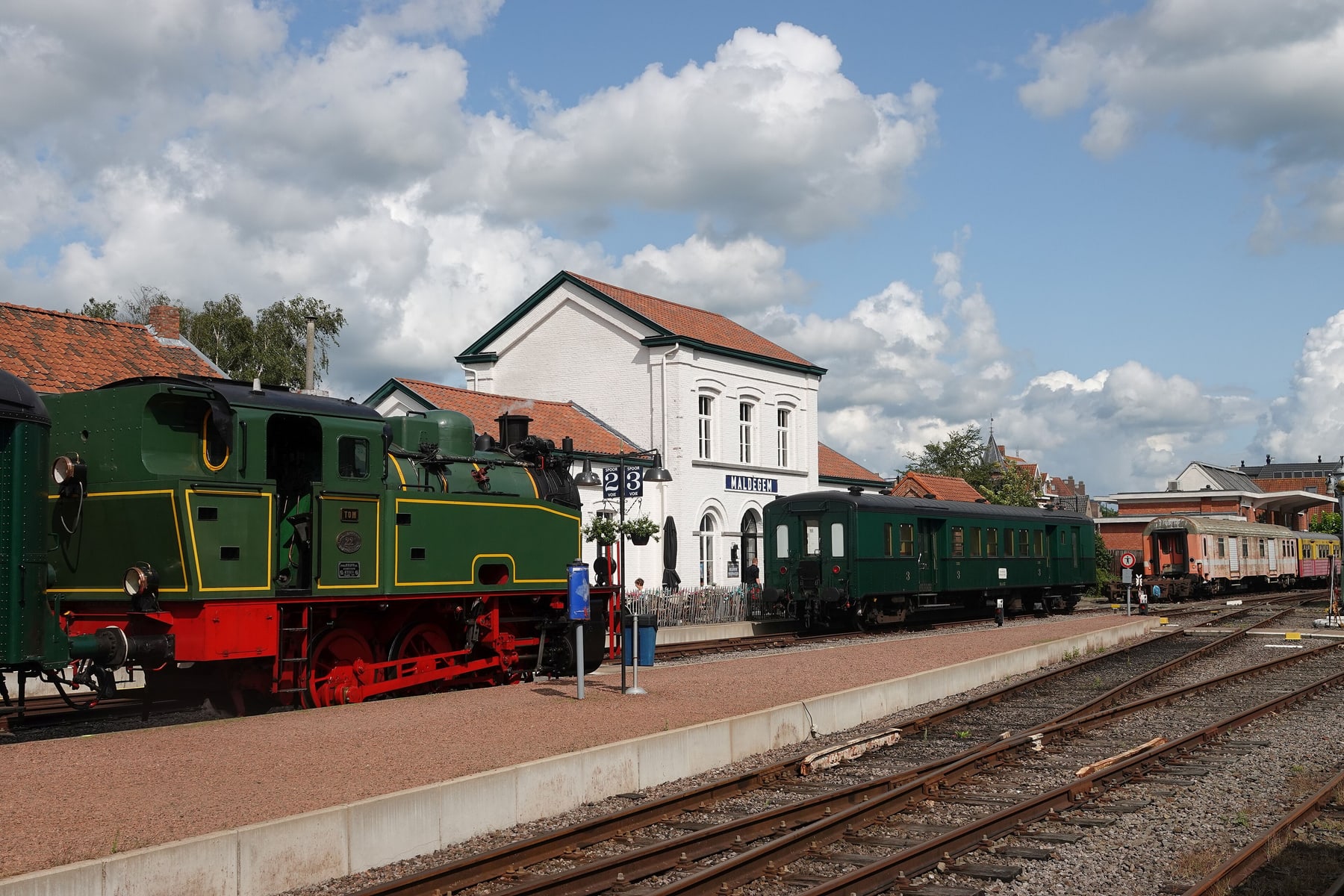
Stoomtrein Maldegem-Eeklo
Nenea hartia / Wikimedia Commons · CC BY-SA 4.0
- Distance10 km · Maldegem–Eeklo
- Duration≈30 min each way
- Best seasonMay–September, Sundays and holidays
Introduction
Belgium's national railway ran its last scheduled passenger train between Maldegem and Eeklo on 26 February 1959. Goods trains kept the line alive for another twenty-nine years and then stopped too, on 26 April 1988. What happened next is the unusual part: rather than let the track go, a group of enthusiasts who had been gathering since December 1985 bought the whole of the abandoned station at Maldegem — the passenger building, the goods shed, the lineman's house — and set about running trains on it themselves.
Nearly forty years on, the result is the largest working steam collection in Flanders. On summer Sundays a full-size steam locomotive backs onto a rake of elderly carriages at Maldegem and works the ten kilometres of Line 58 across the flat, canal-cut farmland of the Meetjesland to Eeklo, where it joins the national network again. It takes about half an hour each way.
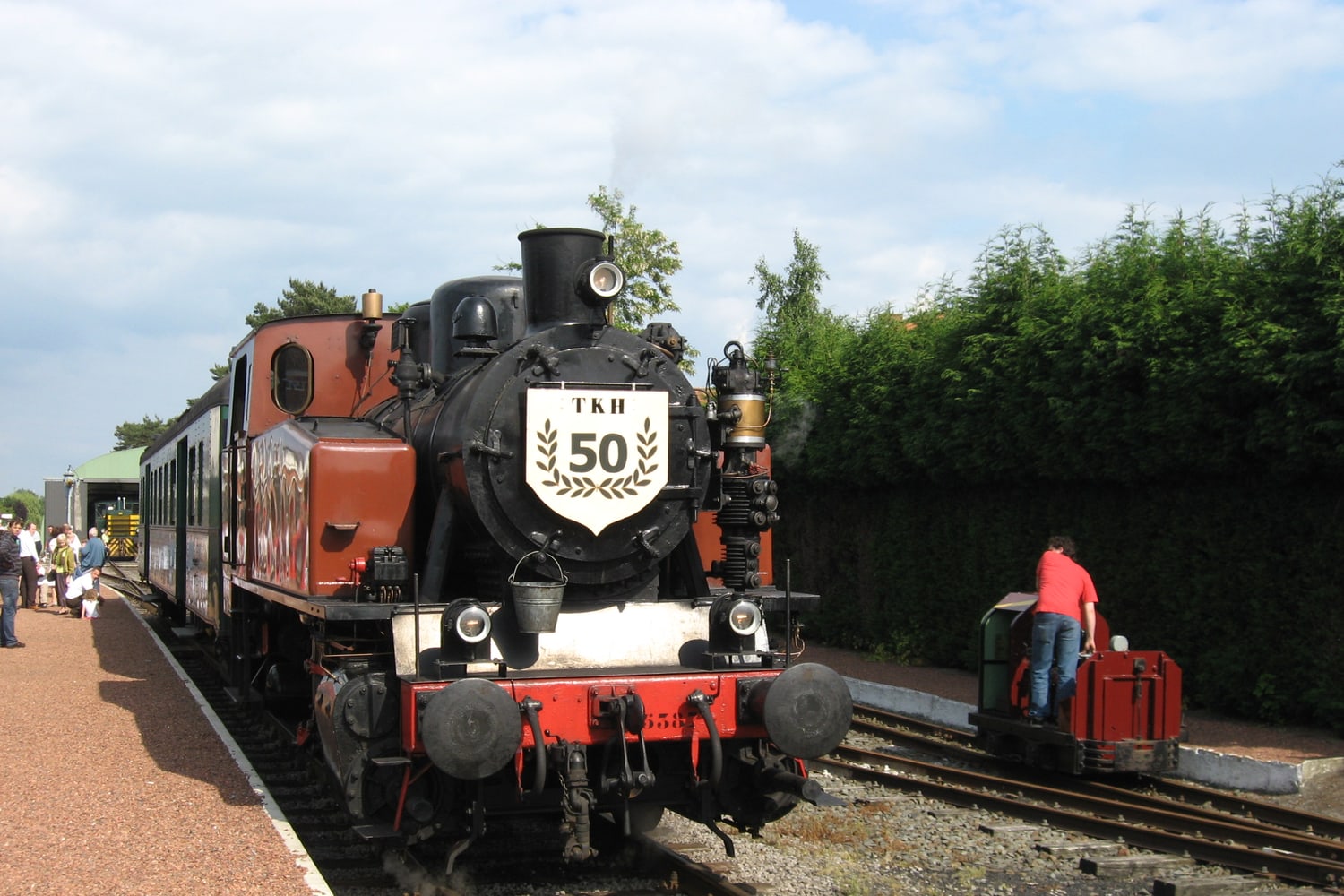
But the standard-gauge train is only half of what is here. On the old trackbed heading the other way, towards Bruges, the society has laid a 600-millimetre narrow-gauge line and runs small industrial steam engines along it — the kind that once shunted brickworks and beet fields rather than hauling passengers. One of the locomotives in the collection was built by St-Léonard of Liège in 1893 and spent its working life at the collieries of Soumagne; it carries the name Yvonne.
That is what makes Maldegem worth the trip rather than simply worth a look: two entirely different railways, at two different gauges, running out of the same station yard on the same afternoon, and one ticket that covers both of them and the depot in between.
The Journey
Everything starts at Maldegem, and the station is worth arriving early for. The society owns the whole site — the white station building with its café terrace facing the platform, the goods shed, the depot — and on an operating day the yard is busy in a way a preserved railway rarely manages: locomotives in steam, a narrow-gauge engine simmering on the far track, volunteers walking between them.
The standard-gauge run to Eeklo
The main train leaves from the platform in front of the station and heads east along Line 58, ten kilometres of single track through the Meetjesland — flat, open, intensively farmed country of poplar rows, drainage ditches and long straight roads. This is not mountain scenery and does not pretend to be. What it has instead is the particular Flemish quality of enormous sky over very level ground, and a steam locomotive working through the middle of it.
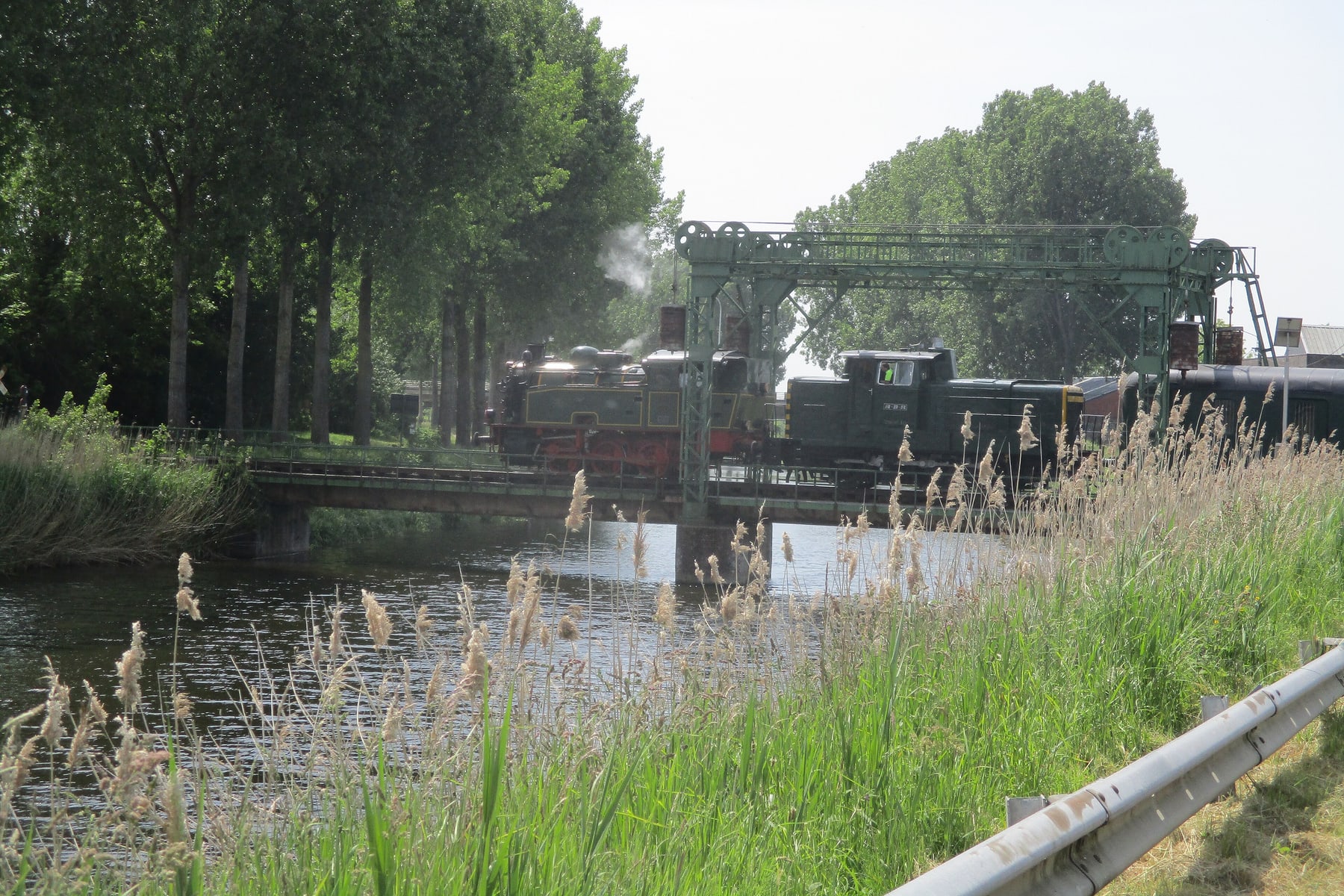
The one piece of real drama is the crossing of the Schipdonk canal at Balgerhoeke, where the line goes over the water on a steel bridge. It is the moment most photographers wait for, and from the carriage window it is the only point on the run where you get a sense of height.
At the far end the train comes into Eeklo, alongside the national-network station, and pauses before working back. The whole run takes about thirty minutes each way.
The other railway, at 600 millimetres
Back at Maldegem, on the trackbed heading west towards Bruges, is a completely separate line built to 600-millimetre gauge — less than half the width of the main line — running out to Donk. The engines here are industrial: small, upright, built to shunt factory yards and field tramways rather than to carry anyone. Riding behind one in a little enclosed coach is a quite different experience from the main line, and it is included in the same ticket.
What to expect of the locomotives
The society keeps a substantial collection and not all of it runs on any given day. The standard-gauge engines that work the line include machines by Avonside, La Meuse, St-Léonard, Hunslet and Hanomag, and there are diesels in the fleet as well — the railway's own ticket wording covers "all normal gauge trains (steam or diesel)", which is a fair warning that traction is not guaranteed to be steam on every working.
If a particular locomotive is the reason you are coming, check the railway's event calendar first rather than turning up hopeful. And if you want the depot as much as the ride, the day ticket includes access to it — for a lot of visitors the yard, not the journey, turns out to be the best part of the afternoon.
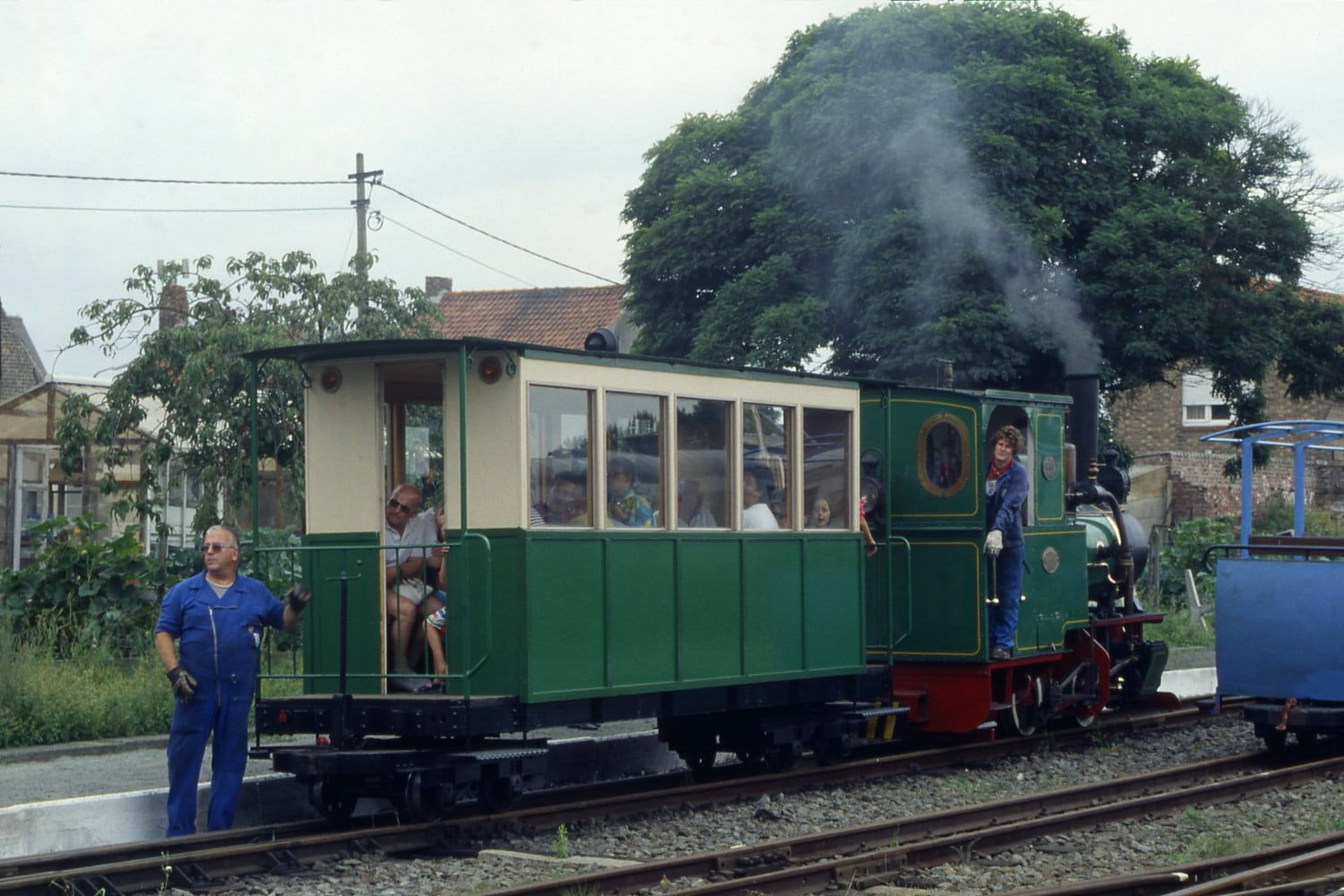
Along the route
Smiley.toerist / Wikimedia Commons · CC BY-SA 4.0Two railways, two gauges, one ticket
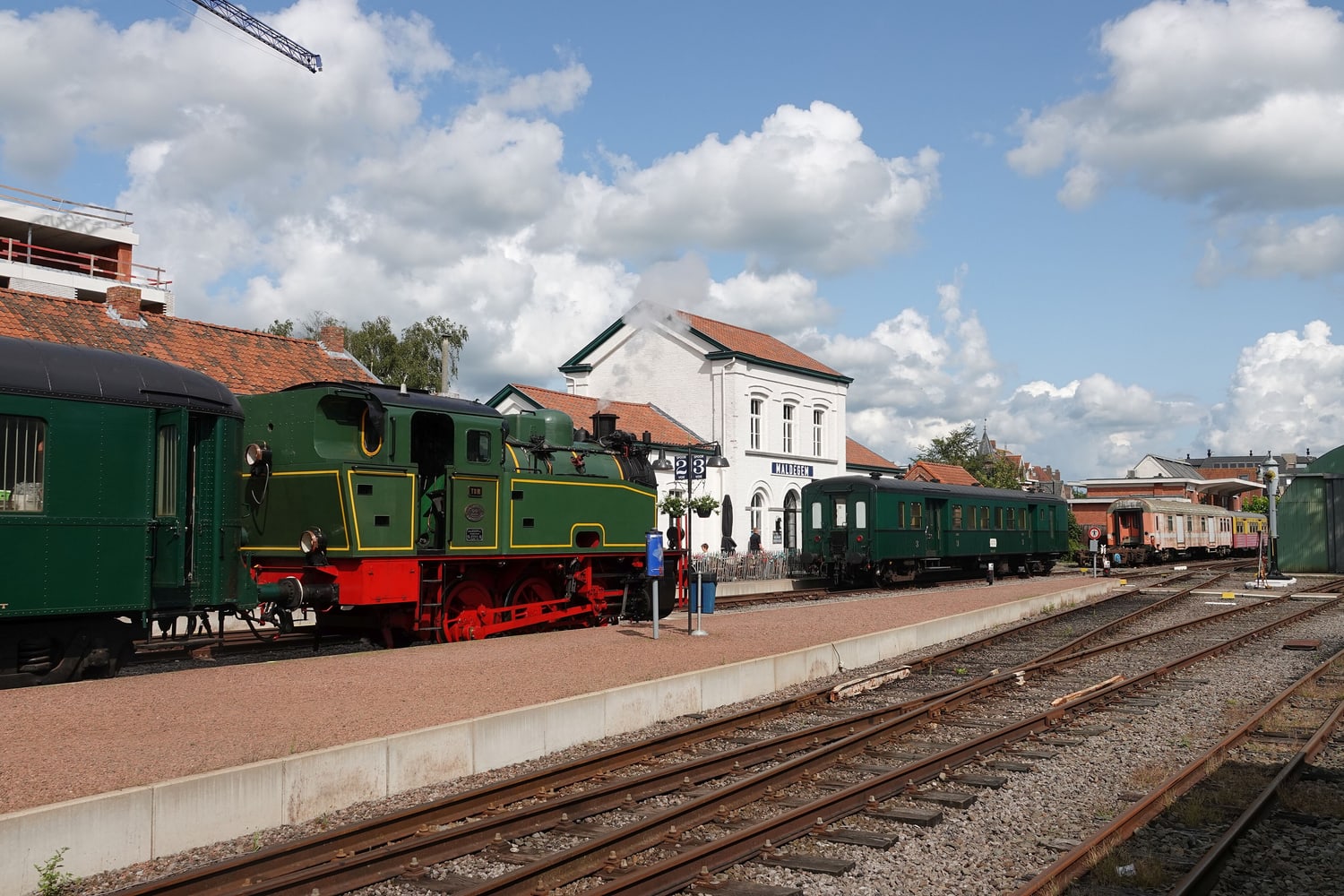
Most preserved railways offer one line. Maldegem runs two, at different gauges, out of the same yard: standard gauge east to Eeklo, and a 600-millimetre line west towards Bruges. The all-in ticket covers both plus the depot — and for many visitors the yard is the best part of the afternoon.Nenea hartia / Wikimedia Commons · CC BY-SA 4.0They bought the whole station
When the national railway walked away, the society bought everything NMBS abandoned at Maldegem: the station building, the goods shed, the lineman's house. That is why the site feels like a working railway rather than a siding with a locomotive on it.Spotter2 / Wikimedia Commons · CC BY-SA 4.0Crossing the Schipdonk canal
The Meetjesland is flat — sky-and-poplars country — and the run's one piece of theatre is the steel bridge over the Schipdonk canal. It is where the photographers stand, and the only point where you feel the train lifted above the landscape.A bit of history
Culture & experiences along the way
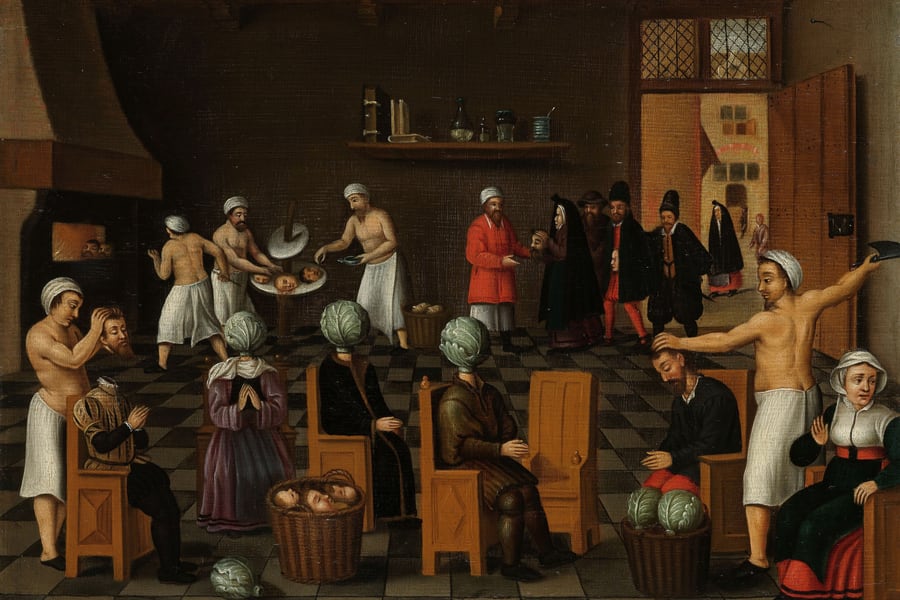 After Cornelis van Dalem and Jan van Wechelen, Rijksmuseum · public domain · cropped
The baker who re-baked heads
Eeklo's own tall tale: a baker who would cut off a dissatisfied customer's head, knead it into a better one and put it back, with a cabbage on the neck meanwhile to stop the bleeding. A sixteenth-century painting records the whole procedure. The town has put the Herbakker up in bronze on the Markt.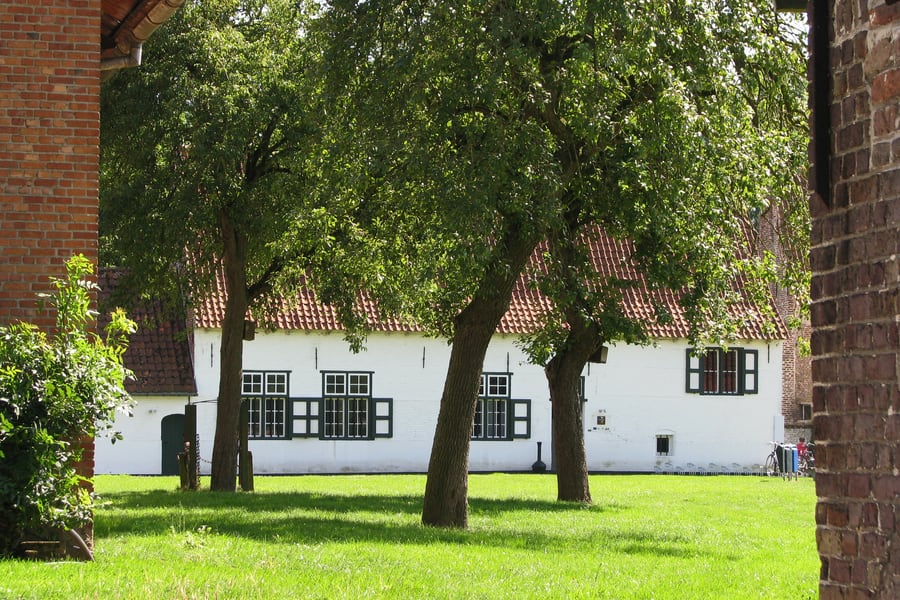 Ivo Van Hecke / Wikimedia Commons · CC BY-SA 4.0 · cropped
A farm that explains the Meetjesland
The Huysmanhoeve on the edge of Eeklo is a moated farmstead turned visitor centre for this quiet corner of East Flanders — orchard, bakehouse, a herd of Flemish red cattle, and a shop of things made within a few kilometres of it. Entry to the grounds costs nothing.Timetables
The railway runs from early May until late September, on every Sunday and Belgian public holiday, and additionally on Wednesdays in July and August. It does not run daily, and it does not run in winter outside special events.
The timetable changes three times across the season, and — unusually — the high-summer service is the sparest of the three, with the station opening an hour earlier and closing an hour earlier. All times below are the operator's own, correct as of August 2026.
May and September
Site open 10:00–18:00.
| Maldegem dep | Eeklo arr | Eeklo dep | Maldegem arr |
|---|---|---|---|
| 12:00 | 12:30 | 13:00 | 13:30 |
| 14:10 | 14:50 | 15:05 | 15:45 |
| 15:50 | 16:20 | 16:30 | 17:00 |
Narrow-gauge departures to the museum shed: 13:00, 13:40, 15:55, 17:05.
June
Site open 10:00–18:00. The fullest service of the year — four round trips.
| Maldegem dep | Eeklo arr | Eeklo dep | Maldegem arr |
|---|---|---|---|
| 10:30 | 11:00 | 11:10 | 11:40 |
| 12:30 | 13:15 | 13:30 | 14:10 |
| 14:20 | 14:50 | 15:00 | 15:30 |
| 15:45 | 16:30 | 16:40 | 17:20 |
Narrow-gauge departures: 11:00, 13:30, 17:30.
July and August
Site open 10:00–17:00. Two round trips only — but this is also the period with the extra Wednesday operating days.
| Maldegem dep | Eeklo arr | Eeklo dep | Maldegem arr |
|---|---|---|---|
| 11:20 | 11:50 | 12:00 | 12:30 |
| 14:30 | 15:00 | 15:05 | 15:35 |
Narrow-gauge steam departures: 12:35, 13:35, 15:40.
Planning around it
The run between Maldegem and Eeklo takes about thirty minutes. Eeklo is on the national network, so you can reach the railway by ordinary Belgian train and pick the steam service up at that end — but note that the timetable is built around Maldegem, where the depot, the narrow-gauge line and the café are, so most visitors are better off starting there.
With only two or three round trips on most days, the sensible plan is to fix on one departure and build the afternoon around it rather than assume you can turn up and catch the next one.
Event days — the railway runs several through the season, including extended timetables with additional stock — carry their own times and prices. Current calendar and any changes: stoomtreinmaldegem.be (opens in a new tab).
Tickets
One ticket covers the whole site, which is the sensible way to buy — the narrow-gauge line and the depot are as much of the day as the train ride. The all-in day ticket is €18.00 for an adult and €12.00 for a child of 4 to 11, and covers all standard-gauge trains, the narrow gauge and the depot; a narrow-gauge-only ticket is €10.00 and €8.00. Unless you specifically want just the little trains, buy the all-in: the eight-euro difference is the ten-kilometre run to Eeklo behind a full-size locomotive.
⚠️ Traction is not guaranteed to be steam — the ticket wording covers steam or diesel, so check the event calendar if steam is the point of the visit. Event days are priced separately and may run a different timetable. Eeklo is on the Belgian national network, so you can arrive by ordinary train and join at that end. Prices as of August 2026.
Book your tickets
All-in day ticket
€18.00 adult · €12.00 child 4–11 · under-4s free
Every standard-gauge train, the narrow-gauge line and the depot, for the day.
Book Tickets (opens in a new tab, on stoomtreinmaldegem.be)via stoomtreinmaldegem.beNarrow gauge only
€10.00 adult · €8.00 child 4–11
The little trains and the depot, but not the main line to Eeklo.
Book Tickets (opens in a new tab, on stoomtreinmaldegem.be)via stoomtreinmaldegem.beGroup rate
€12.00 adult all-in, for parties of fifteen or more
The same day ticket at a third off, arranged with the railway in advance.
Book Tickets (opens in a new tab, on stoomtreinmaldegem.be)via stoomtreinmaldegem.beRail Passes
No rail pass is valid on the steam train. The Stoomtrein Maldegem-Eeklo is run by an independent non-profit association, not by SNCB/NMBS, and it sells its own all-in day ticket — covered in the previous section. Interrail, Eurail and SNCB's own products buy you nothing on it.
They are, however, the sensible way to reach it, and this railway is unusually well placed for that.
Using a pass to reach the line
Interrail and Eurail Global Passes are valid on SNCB/NMBS services, with no reservation and no supplement on Belgian domestic trains. Eeklo is on the national network, and it is one end of the heritage line — so you can arrive on a pass and join the steam train where it terminates, without a car or a bus.
⚠️ But start at Maldegem if you can. The depot, the 600-millimetre narrow-gauge line, the workshops and the café are all at Maldegem, and the timetable is built around departures from there. Eeklo is the easy arrival by national train; Maldegem is the better visit. If you are coming by pass, the usual answer is to reach Eeklo by train and cover the last stretch to Maldegem by bus or by riding the heritage line itself in both directions.
Ghent is the practical hub either way — a short national-network hop from Eeklo, and the base most pass-holders will already be using.
If you are not on a pass
SNCB's ordinary fares reach Eeklo perfectly well: Youth (under 26), Senior (65+) and Child (under 12) bands, the Train+ subscription if you are making several journeys, and mini-group fares from four people, which suit a family visiting the railway.
Budget for two tickets: a national one to Eeklo, and the railway's own all-in day ticket on top.
SNCB products: belgiantrain.be (opens in a new tab). Correct as of August 2026.
Places to Visit
The railway sits in the Meetjesland, the quiet stretch of East Flanders between Ghent and the Dutch border, and its two terminal towns are the obvious places to spend the rest of the day. Bruges is close enough — a little over twenty kilometres west of Maldegem — that many visitors combine the two.
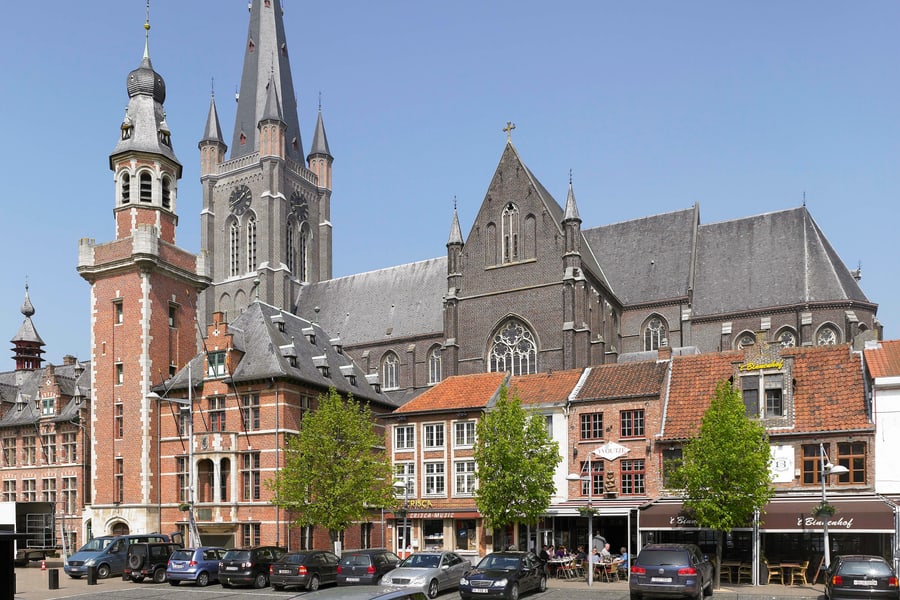 Kris Vandevorst / Wikimedia Commons · CC BY 4.0
Eeklo
The eastern terminus is a market town whose centre is dominated by a tall brick town hall belfry standing beside the great grey bulk of the Sint-Vincentius church — an unexpectedly grand pairing for a town this size, with the square's cafés underneath. Eeklo is on the national rail network, which makes it the easy end to reach without a car.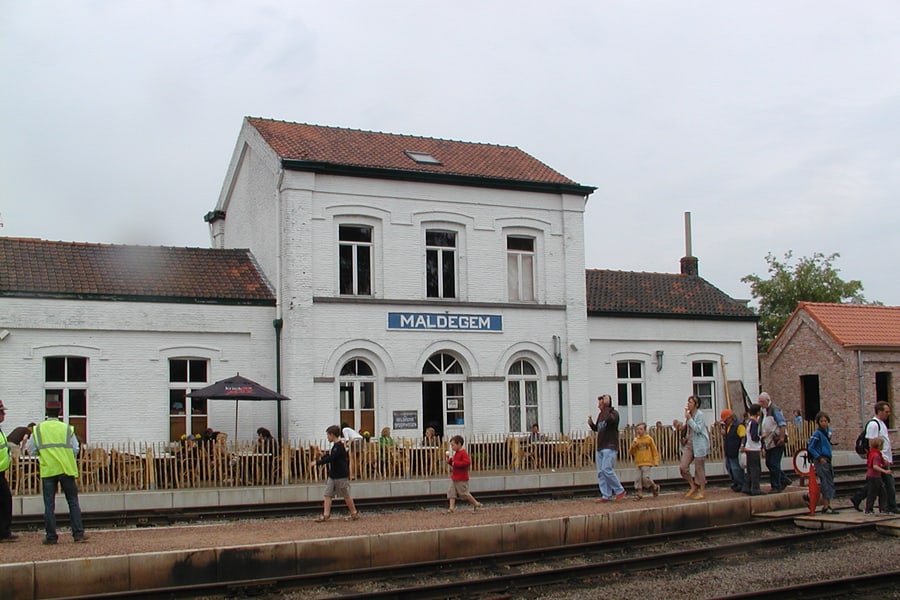 Yvesn / Wikimedia Commons · CC BY-SA 3.0
Maldegem station
Worth treating as a destination rather than a departure point. The white station building carries a café whose terrace looks straight onto the platform, the goods shed holds the collection, and on an operating day there is usually something in steam within a few metres of your coffee. Arrive before your train rather than for it.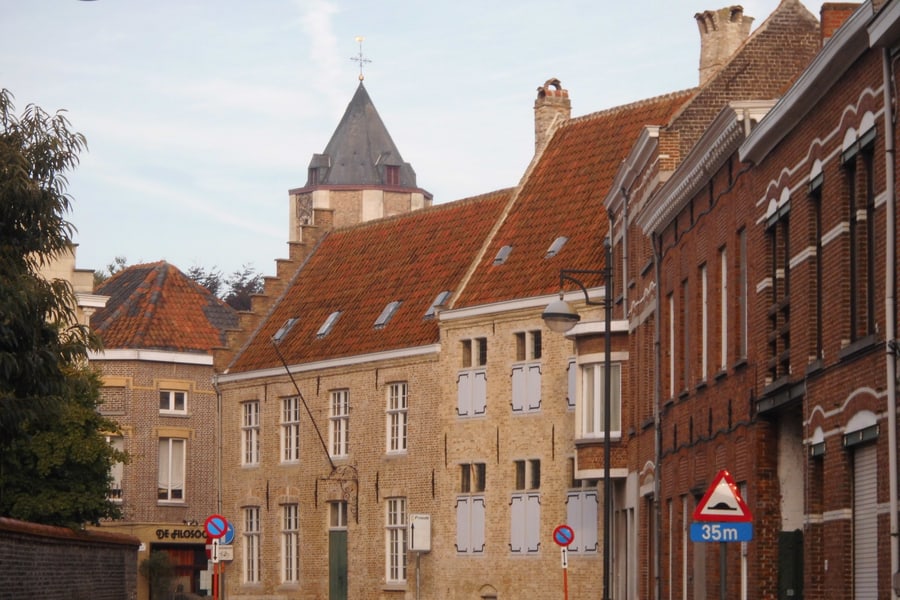 Spotter2 / Wikimedia Commons · CC BY-SA 4.0
Maldegem town
A quiet Flemish town of brick terraces and stepped gables in the Meetjesland, the farming country between Ghent and the Dutch border. There is no great monument here — the appeal is that it is an ordinary working town rather than a preserved one, and that Bruges is only a little over twenty kilometres further west.Where to Sleep
Almost nobody stays in Maldegem for the railway alone, and there is no need to — this is a corner of Flanders where everything is within half an hour of everything else, and the obvious base is a town you would want to visit anyway.
Bruges is the answer for most people. It is roughly twenty kilometres west of Maldegem, it has more hotels than the rest of the Meetjesland combined at every price from hostel to canal-side grand, and it is one of the best-preserved medieval towns in Europe. The catch is the obvious one: it is busy and priced accordingly in season, and you will want to book well ahead for a summer weekend.
Ghent, about the same distance to the south-east, is the alternative and in some ways the better one — a large university city with a working centre rather than a preserved one, cheaper beds, and fast trains onward to Eeklo.
Eeklo itself, at the far end of the line, is a modest market town with a handful of hotels and guesthouses. It is the practical choice if you are travelling by train and want to be on the spot, and it puts you a short walk from where the steam train comes in.
Maldegem and around have the usual Flemish scattering of B&Bs and vakantiewoningen rather than hotels — a few rooms in a farmhouse, self-catering cottages — which suit a family visiting the railway with children better than a hotel would.
One practical note whichever you choose: the railway runs on Sundays, public holidays and summer Wednesdays only, from early May to late September. Fix the operating day first and book the bed around it, not the other way round.
Where to stay
Cleythil Hotel
Just outside Maldegem, facing the Drongengoed
The closest hotel to the railway's own station, with a large garden looking out over the fields and woods of the Drongengoed. Its own description makes the geography plain: about twenty minutes' drive from Bruges and under thirty from Ghent, which is exactly the position you want if the steam railway is one item in a longer Flanders trip.
Check Availability (opens in a new tab, on cleythil.be)via cleythil.beBoutique Hotel Shamon
An Art Nouveau villa at the Eeklo end
A listed building designed by Paul Cauchie, the architect-decorator best known for the sgraffito facades of Brussels — stained glass, sgraffito murals and rooms styled after Cauchie and Mackintosh. It sits near the centre of Eeklo, the far end of the heritage line and a stop on the national network, so you can reach it by ordinary train.
Check Availability (opens in a new tab, on hotelshamon.be)via hotelshamon.beQuestions or corrections
Planning this trip and stuck on something, or spotted a time, fare or detail that has changed? Send us a message about Stoomtrein Maldegem-Eeklo. We read every one, and we update this page when something has changed.