Tadami Line
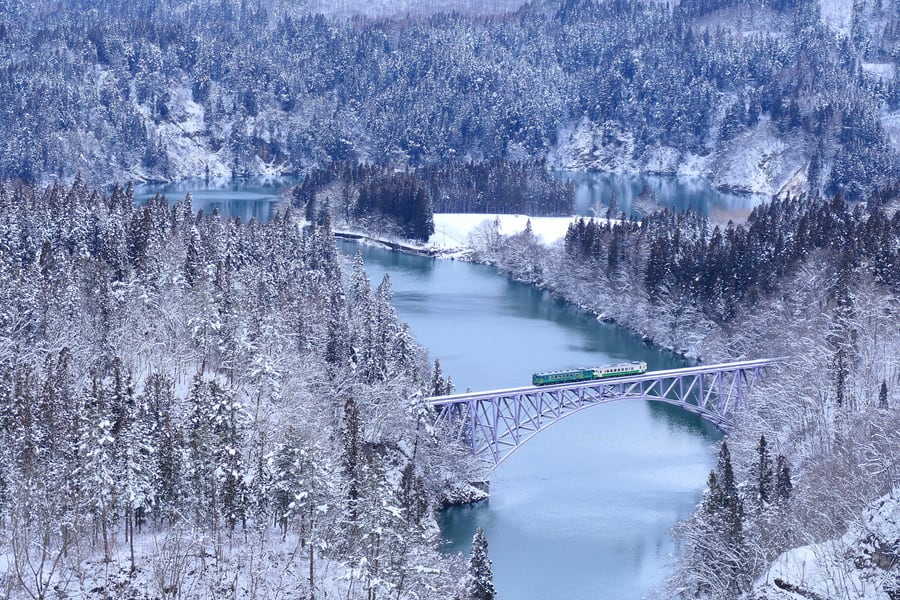
Koichi Hayakawa / Find47 / Wikimedia Commons · CC BY 4.0 · cropped
- Distance135.2 km
- DurationAbout 4½ hours end to end, three through trains a day
- Best seasonYear-round · autumn colour late Oct–Nov, deep snow in winter
Introduction
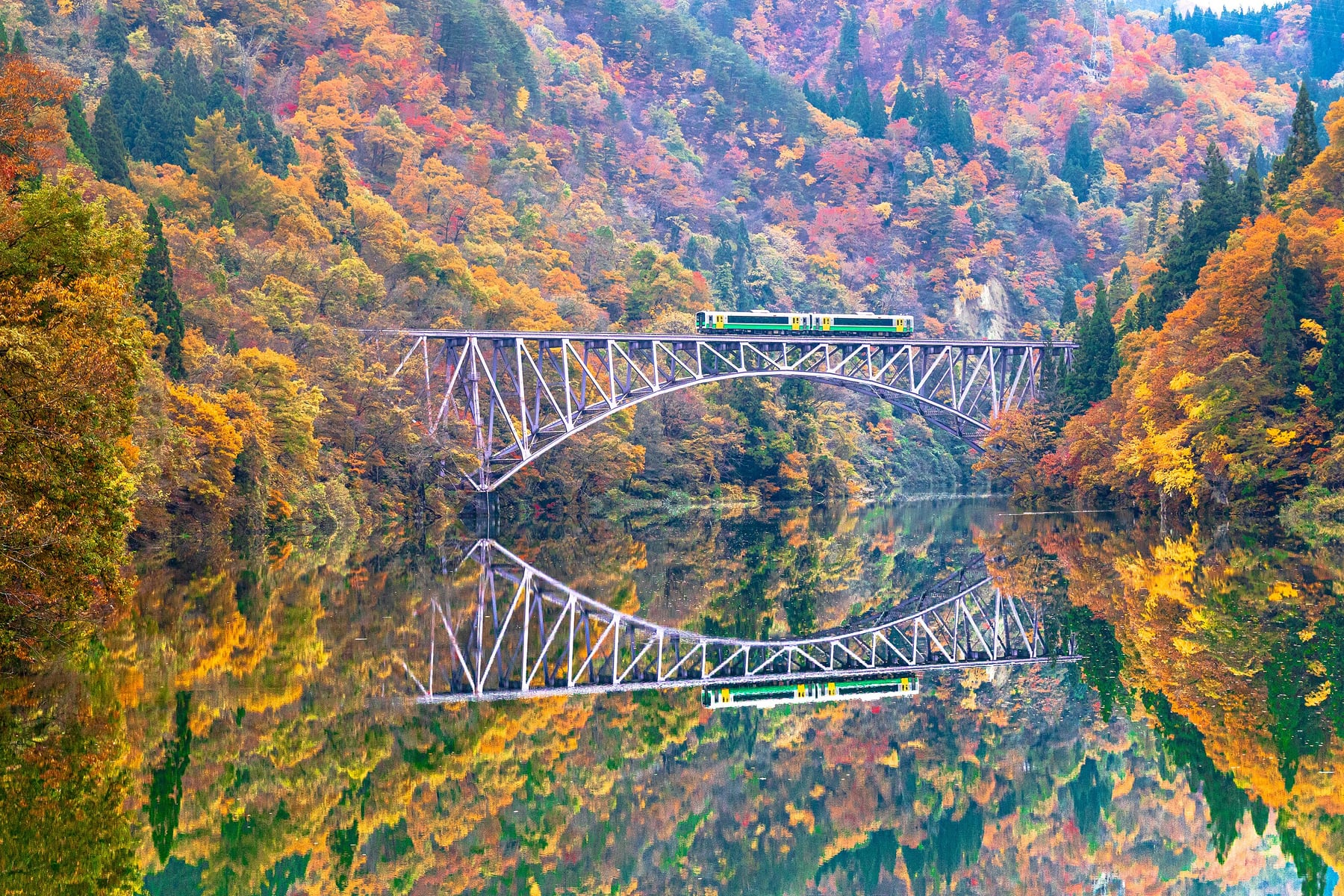
The Tadami Line runs 135.2 km from Aizu-Wakamatsu, the castle town of Fukushima Prefecture, to Koide in Niigata. For most of the way it follows the Tadami River into the mountains of Oku-Aizu, crossing the water again and again on iron bridges, before a long tunnel takes it under the prefectural border. The trains are one or two railcars, stop at every station and never go faster than 65 km/h; the whole line takes about four and a half hours.
In July 2011 heavy rain washed three of its bridges away beyond Aizu-Kawaguchi. JR East put the repairs at about ¥8.5 billion, and for eleven years a bus covered the gap. In 2017 Fukushima Prefecture agreed to take on the track of the damaged section so that JR East would run trains over it again, and on 1 October 2022 the whole line reopened, with people lining the valley to wave the first trains through.
It is a line for looking out of the window. Three trains a day run all the way, so plan the day around them, and take the morning one if you can.
The Journey
Trains leave Aizu-Wakamatsu heading west, and for the first half hour swing round the southern edge of the Aizu basin through rice fields, calling at Aizu-Bange. At Aizu-Yanaizu the hills close in and the line meets the Tadami River, which it will follow for most of the next two hours.
The bridges of Oku-Aizu
Beyond Aizu-Hinohara the train crosses the No. 1 Tadami River Bridge, the steel arch the line is best known for, passes the three arches at Aizu-Miyashita and crosses the No. 3 bridge towards Hayato. The river is held back by a string of small dams, and their lakes are still enough on a calm morning to mirror the hills and the train. In 2021 seventeen of the line's structures, its Tadami River bridges among them, were listed as civil engineering heritage.
At Aizu-Kawaguchi, on the riverbank, trains often wait a few minutes. From here to Tadami is the section that was closed from 2011 to 2022: new bridges, the No. 6 and No. 7 among them, and the peak of Mt Gamō, 828 m, which the prefecture's guide calls the Matterhorn of Aizu.
Into Niigata
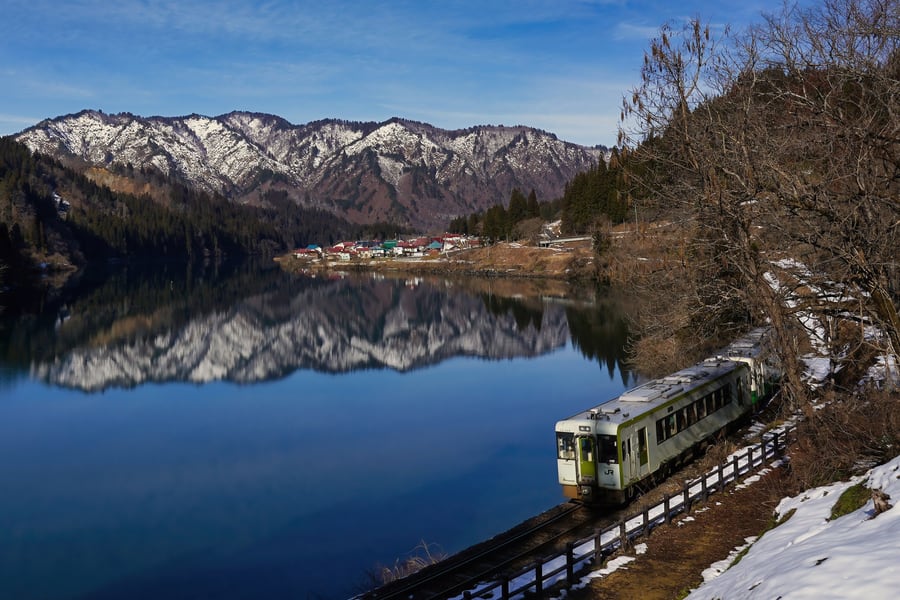
Past Tadami the line climbs beside Lake Tagokura, the reservoir of the dam that brought the railway this far in the 1950s, and enters the Rokujūrigoe Tunnel under the border. The road over the pass above is closed in winter, leaving the railway as the only link; in very heavy snow the trains stop too, and in the winter of 2025 snow closed the line on both sides of Tadami, the last part reopening only in mid-May. The line comes out in Niigata at Ōshirakawa and runs down the Aburuma valley to Koide, on the Jōetsu Line.
The trains
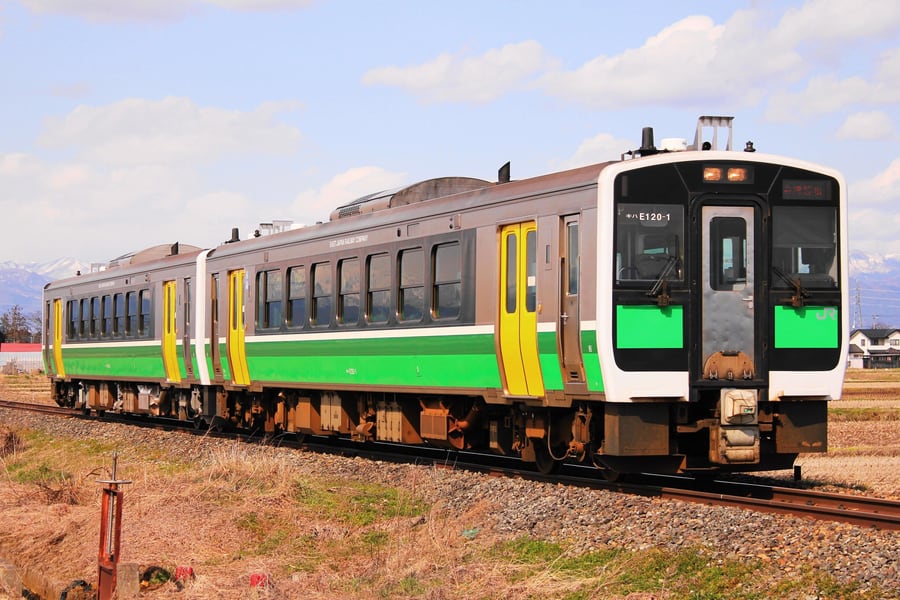
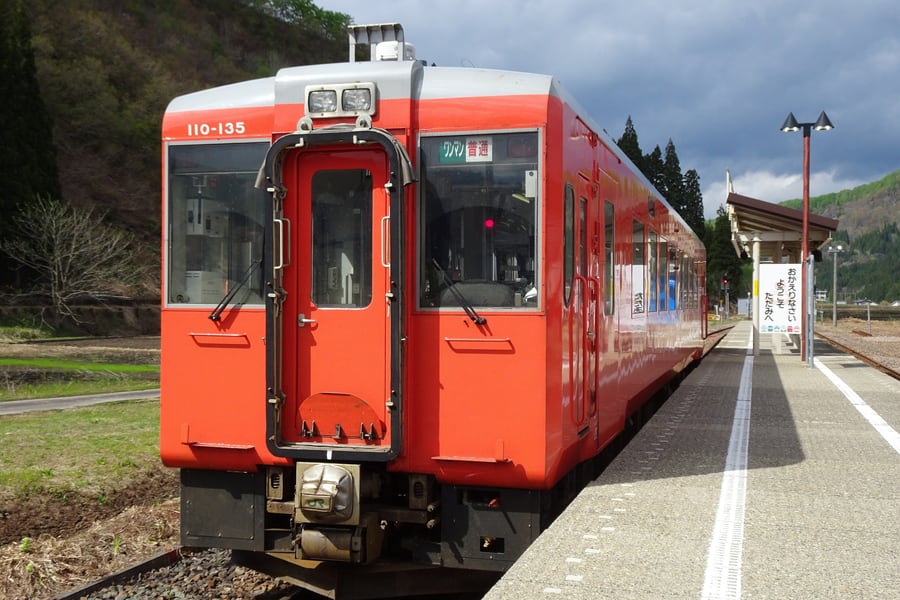
The line is worked by two types of diesel railcar. The KiHa E120, green and white, arrived in March 2020 and is based at Aizu-Wakamatsu; the KiHa 110 came from the Niigata end that July. Since the reopening both run the length of the line. Between them they replaced the KiHa 40 railcars that had run here since 1979. Two cars carry heritage colours: KiHa E120-2 in the old national railways' cream and red, and KiHa 110-223 in the green of the KiHa 40s it replaced.
Along the route
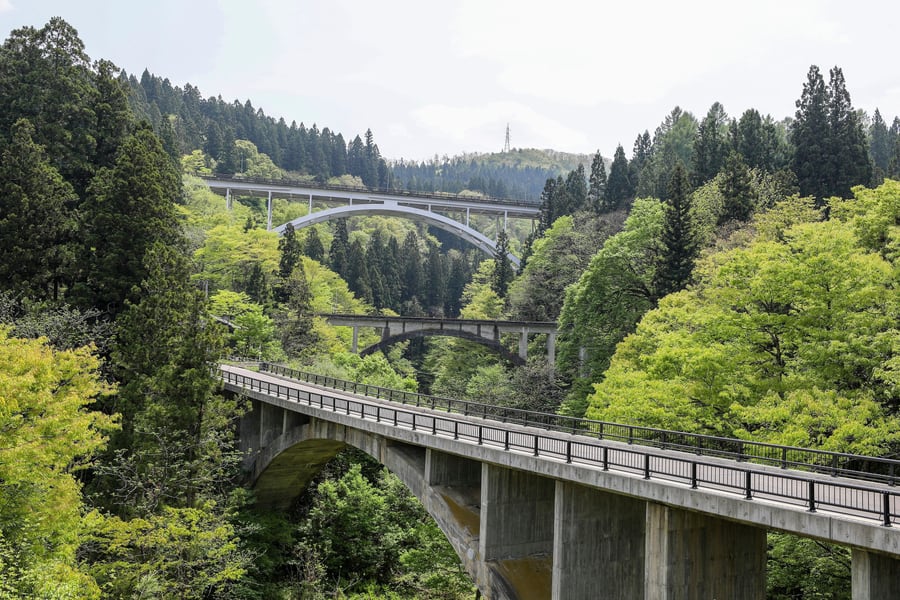 bryan... / Wikimedia Commons · CC BY-SA 2.0
Three arches at Miyashita
A few minutes' walk from Aizu-Miyashita, three arch bridges span one gorge, one above another: the road, the Tadami Line and a prefectural road. Local people call them the Miyashita Arch Triplets, and from the train the silver arch stands out against the autumn hills.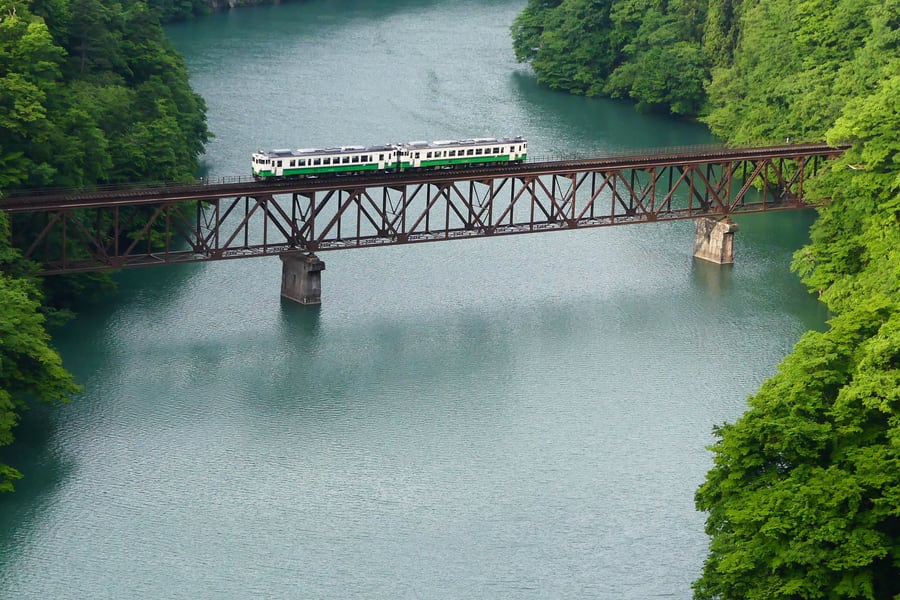 MaedaAkihiko / Wikimedia Commons · CC BY-SA 4.0
The No. 3 bridge
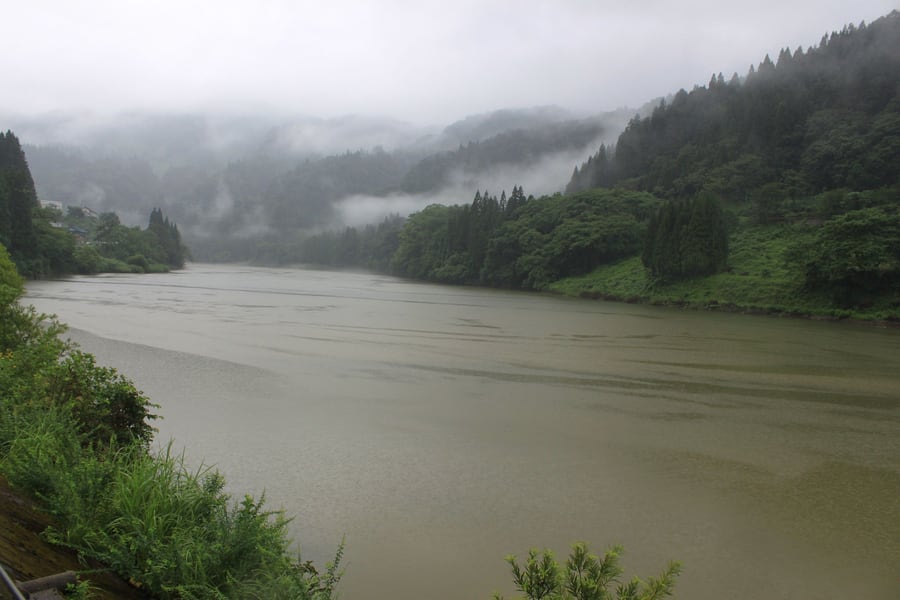
Between Aizu-Miyashita and Hayato the line crosses the river again, and the view opens suddenly onto slow green water and forest. The prefecture's guide names this bridge for its river mists, and for the autumn colour along the banks.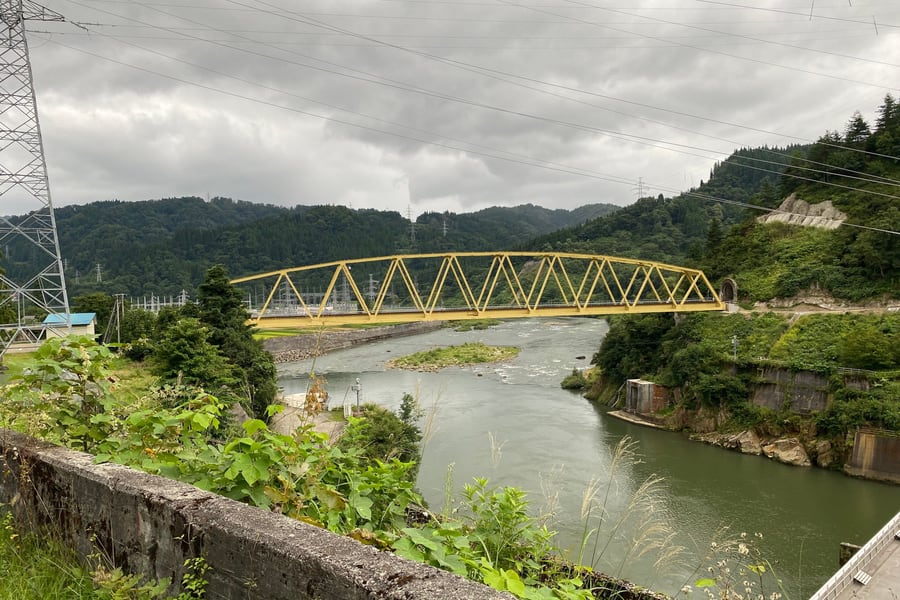 Knyel / Wikimedia Commons · CC0
The rebuilt bridges
Beyond Aizu-Kawaguchi the July 2011 floods carried away the No. 5, 6 and 7 bridges, and for eleven years a bus ran instead. From the new No. 6 bridge, a yellow truss, look northwest for the Honna Dam, whose crest was the old main road.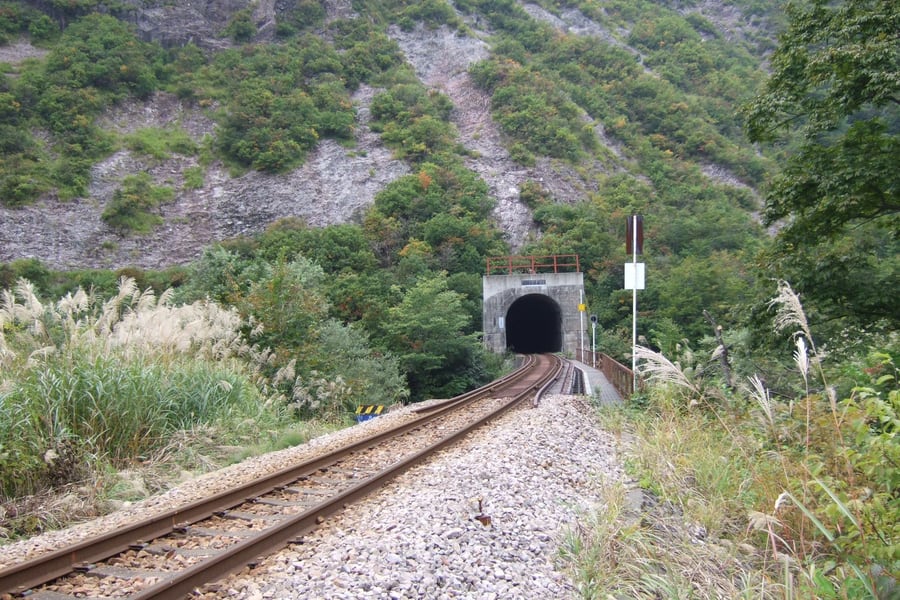 Aburatsubo / Wikimedia Commons · CC BY-SA 3.0 · cropped
Over the mountains
After Tadami the train runs beside Lake Tagokura, then enters the long Rokujūrigoe Tunnel under the prefectural border into Niigata. The road over the pass above it closes in winter, which is why this line has been the area's lifeline through the snow.A bit of history
Culture & experiences along the way
 Rory trains / Wikimedia Commons · CC BY-SA 4.0 · cropped
The Kazekko
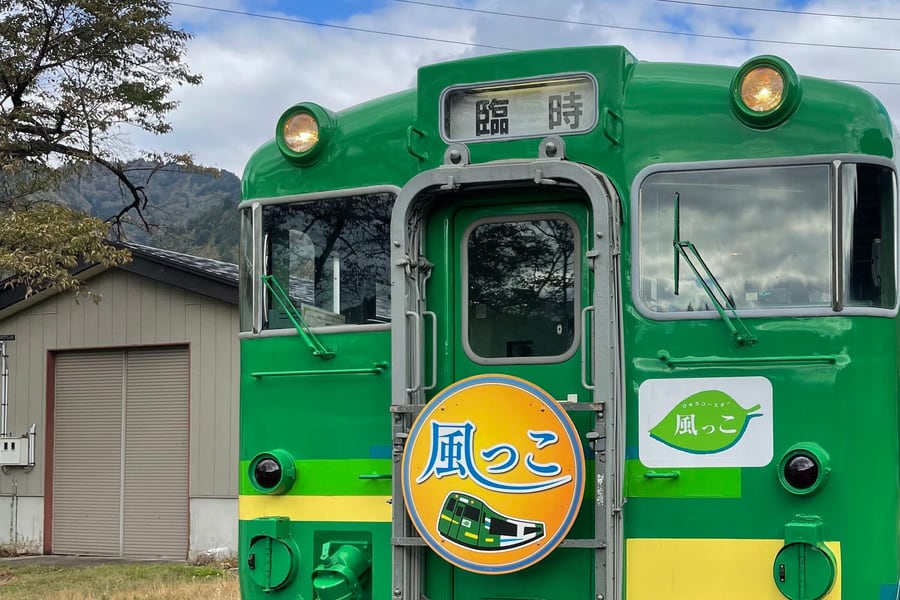
On a few autumn weekends JR East sends its Kazekko sightseeing train up the line, two old railcars with the window frames taken out so the breeze and the river come straight in. It runs as a rapid from Aizu-Wakamatsu to Tadami and back, every seat reserved.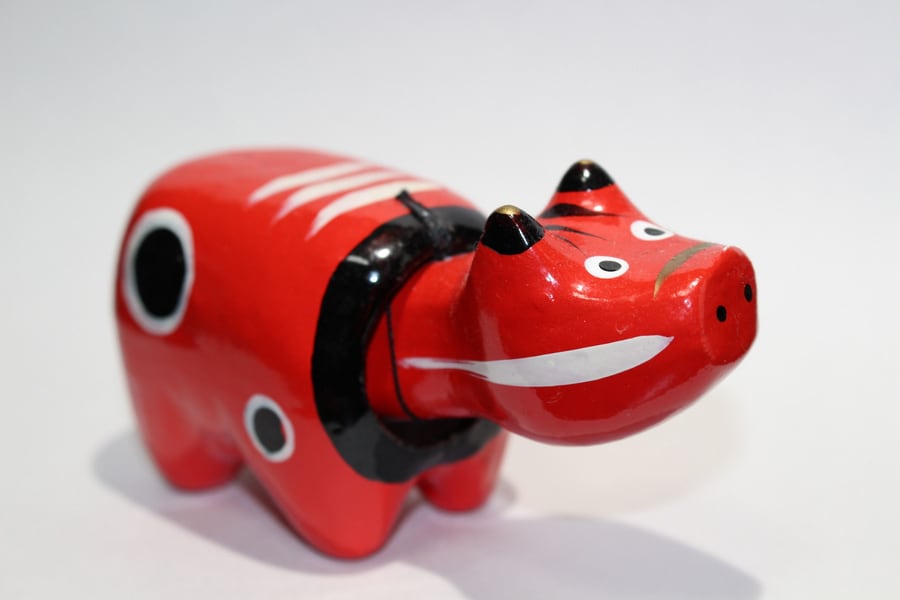 Wdqh / Wikimedia Commons · CC BY-SA 4.0
Akabeko, the red cow
Yanaizu calls itself the birthplace of the akabeko, the red papier-mâché cow of Aizu folk craft. The station building houses an akabeko workshop and café, and in the town you can paint your own for ¥2,000.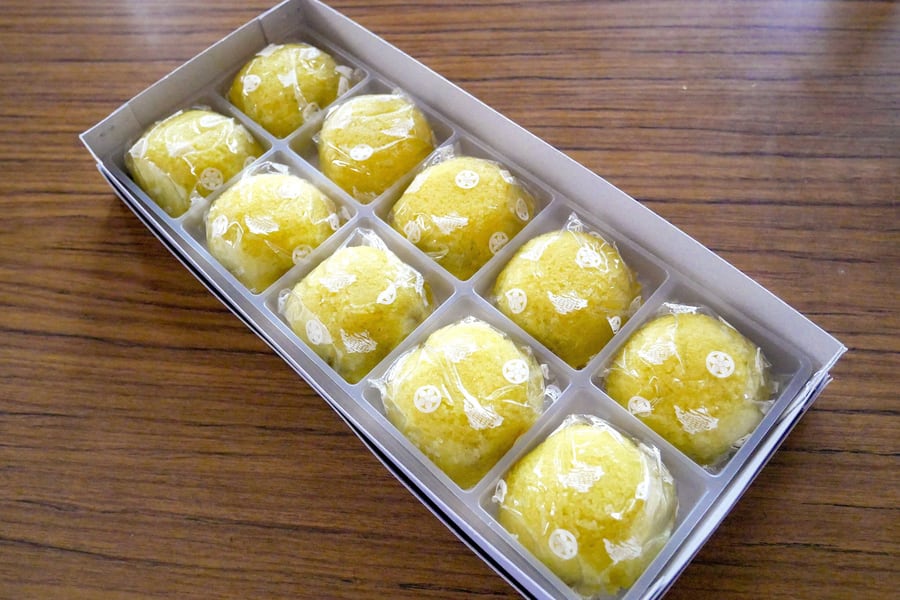 くろふね / Wikimedia Commons · CC BY-SA 4.0 · cropped
Awa manjū
Yanaizu's sweet is the awa manjū, a bun of glutinous rice and foxtail millet around sweet bean paste, made here since the Edo period. The old confectioners sell it a few minutes from the station, and one runs a short class where you make your own.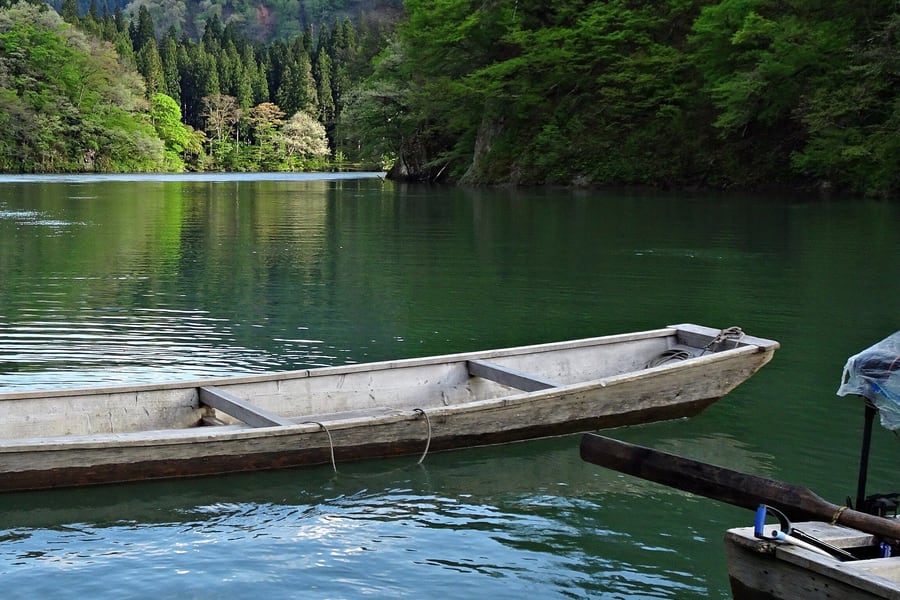 ブルーノ・プラス / Wikimedia Commons · CC BY 4.0 · cropped
The Mugenkyo ferry
Near Hayato a local boatman rows a flat wooden ferry across the Tadami River, revived after the old crossing died out. The trip, with a walk around the area, takes about an hour and a half; it runs from mid-April to mid-November and must be booked five days ahead.Timetables
Three trains a day run the whole line in each direction, every day of the year, with the same times at weekends. Every train stops at every station, and none needs a booking. Other trains run only part of the way, between Aizu-Wakamatsu and Aizu-Kawaguchi or between Ōshirakawa and Koide.
Aizu-Wakamatsu to Koide
| Aizu-Wakamatsu | Aizu-Yanaizu | Aizu-Kawaguchi | Tadami | Koide |
|---|---|---|---|---|
| 06:08 | 07:04 | 08:15 | 09:30 | 10:41 |
| 13:05 | 14:05 | 15:29 | 16:31 | 17:47 |
| 17:00 | 17:58 | 19:01 | 20:03 | 21:17 |
Koide to Aizu-Wakamatsu
| Koide | Tadami | Aizu-Kawaguchi | Aizu-Yanaizu | Aizu-Wakamatsu |
|---|---|---|---|---|
| 05:36 | 07:11 | 08:41 | 09:38 | 10:32 |
| 13:12 | 14:35 | 15:35 | 16:27 | 17:24 |
| 16:12 | 18:01 | 19:08 | 20:00 | 20:55 |
Good to know:
- Ride the river valley by day. The 06:08 from Aizu-Wakamatsu and the 13:12 from Koide pass the Tadami River bridges in daylight; the last train each way does most of the valley in the dark.
- Long stops. Trains wait 10 to 40 minutes at Aizu-Kawaguchi and Tadami to pass each other; the times above are departures.
- Kazekko, autumn 2026. The open-window sightseeing train leaves Aizu-Wakamatsu at 09:13, reaching Tadami at 11:56, and returns from Tadami at 13:13, on 3, 4, 10, 11, 12 and 17 October. Every seat is reserved.
- 5–9 October 2026. The 06:08 from Aizu-Wakamatsu runs only as far as Tadami.
- Winter. Snow can stop the trains, sometimes for weeks; check JR East's service information before setting out between December and April.
Times as of October 2026, from JR East's timetable. Check your date on JR East's Aizu-Wakamatsu station timetable (opens in a new tab).
Tickets
The local trains need only an ordinary ticket, priced by distance: ¥2,750 from Aizu-Wakamatsu to Koide, half for children. Buy it at the ticket office at either end, because almost every station along the line is unstaffed and IC cards such as Suica cannot be used on it. The trains are driver-only, with no conductor on board.
The Kazekko sightseeing train is the one service that needs a booking: a reserved seat costs ¥840 on top of the fare, bookable through JR East's online reservations or at a JR ticket office. Fares checked October 2026 against JR East's timetable and its March 2026 fare table; Japanese yen.
Book your tickets
Aizu-Wakamatsu to Koide
One way, adult · ordinary ticket
The whole line on any local train, bought at the ticket office at either end; children pay half.
Book Tickets (opens in a new tab, on JR East)via JR EastKazekko reserved seat
Rapid Kazekko Tadami-sen Mankitsu · added to the fare
A reserved seat on the open-window sightseeing train between Aizu-Wakamatsu and Tadami, on its autumn dates.
Book Tickets (opens in a new tab, on JR East)via JR EastRail Passes
The Tadami Line is a JR East line, and the JR passes cover it end to end, including the section whose track Fukushima Prefecture owns, since JR East runs the trains. The JR EAST PASS, ¥35,000 for five days, covers every JR East line, and so does the Japan Rail Pass, ¥50,000 for seven days. A pass holder still needs a reserved seat for the Kazekko.
For this journey alone, a pass is not worth buying: the whole line costs ¥2,750. It pays when the Tadami Line is one day of a longer trip. Aizu-Wakamatsu is on the Ban'etsu West Line from Kōriyama, on the Tōhoku Shinkansen, and Koide is on the Jōetsu Line, so the line makes a loop from Tokyo out on one shinkansen and back on the other; price that loop as single tickets before buying a pass.
Checked October 2026 against the JR EAST PASS (opens in a new tab) page and the Japan Rail Pass prices (opens in a new tab).
Places to Visit
With three through trains a day, a stop along the way costs several hours, so pick one or two: the castle and the temple town at the Aizu end, the bridge viewpoint and the river villages in the middle, Tadami for the snow country.
 くろふね / Wikimedia Commons · CC BY 4.0 · cropped
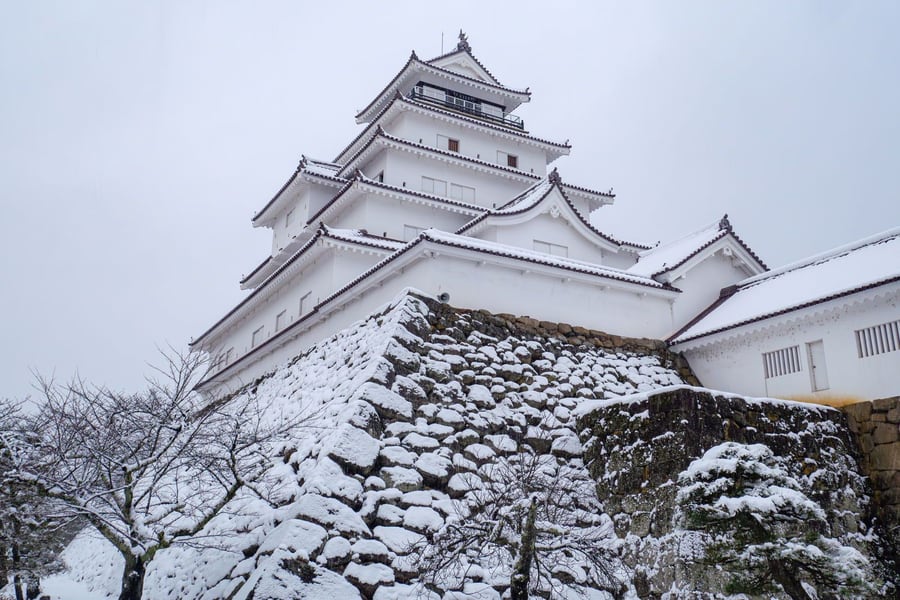
Aizu-Wakamatsu
The old castle town of the Aizu domain. Tsuruga Castle has the only red-tiled castle tower in Japan, with a museum of Aizu's history inside; it is open daily, ¥410 for adults, five minutes' walk from a town loop-bus stop. Give it the afternoon before, as the first through train leaves at 06:08.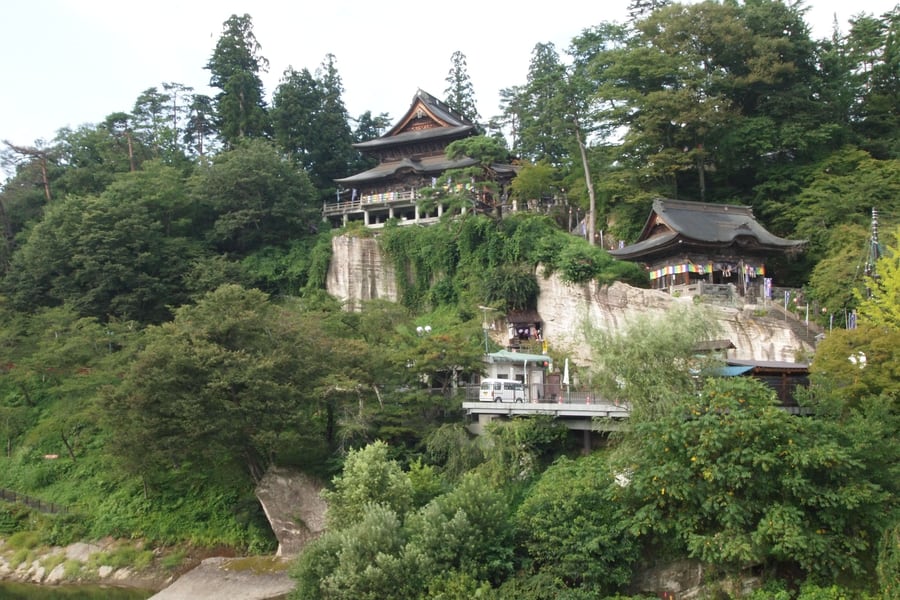 くろふね / Wikimedia Commons · CC BY 3.0
Aizu-Yanaizu
Ten minutes' walk from the station, Enzō-ji stands on a cliff above the river. It was founded about 1,200 years ago and is counted among Japan's three great temples of the bodhisattva Kokūzō; entry is free. Yanaizu is also the line's largest hot-spring town, its water drawn from the temple grounds.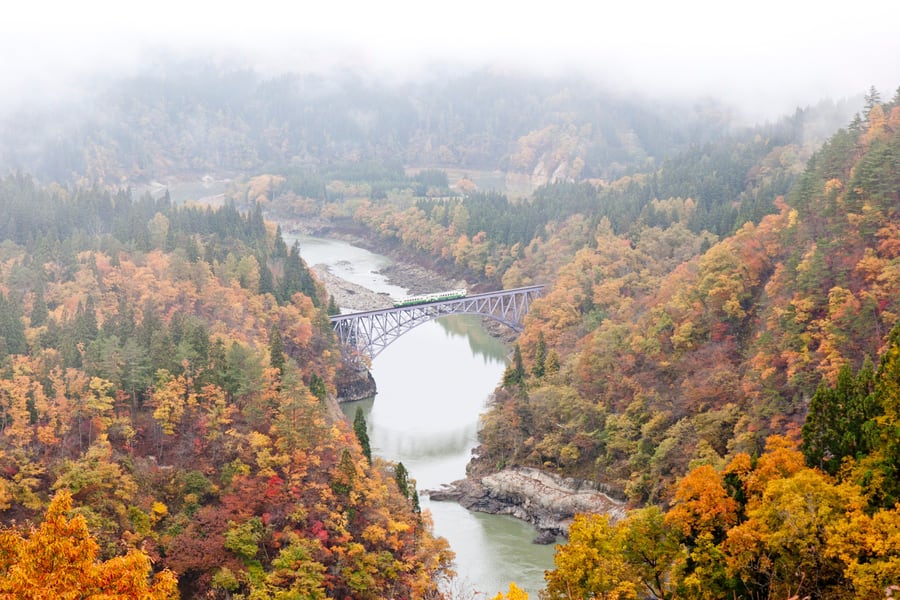 Ippukucho / Wikimedia Commons · CC BY 3.0
Aizu-Miyashita
The line's most famous view is from a ridge above the No. 1 Tadami River Bridge, ten minutes' climb from the Mishima-juku roadside station; there are three viewpoints, so wear good shoes. From Aizu-Miyashita it is 3.5 km, about 45 minutes on foot, or rent a bicycle near the station from April to late November.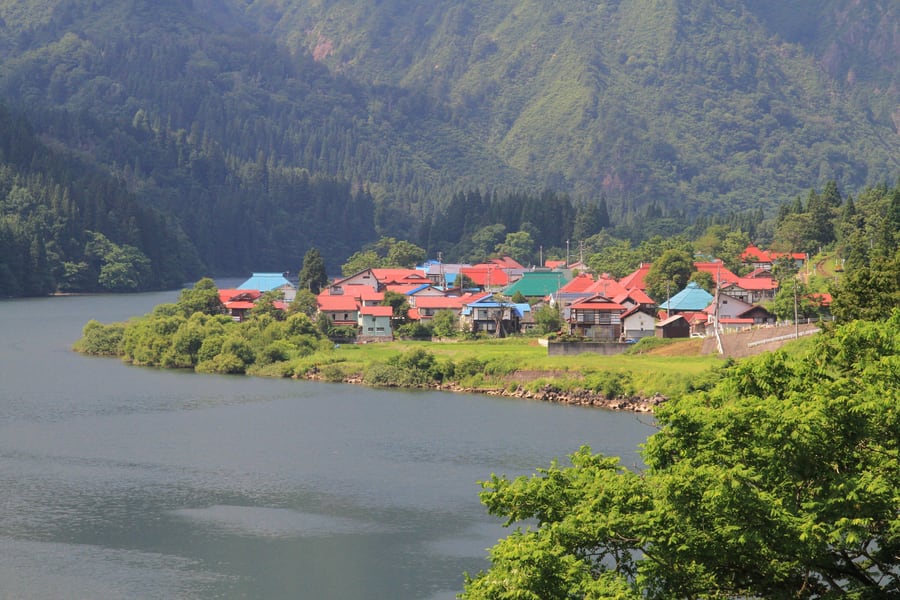 Fumihiko Ueno / Wikimedia Commons · CC BY 3.0
Aizu-Kawaguchi
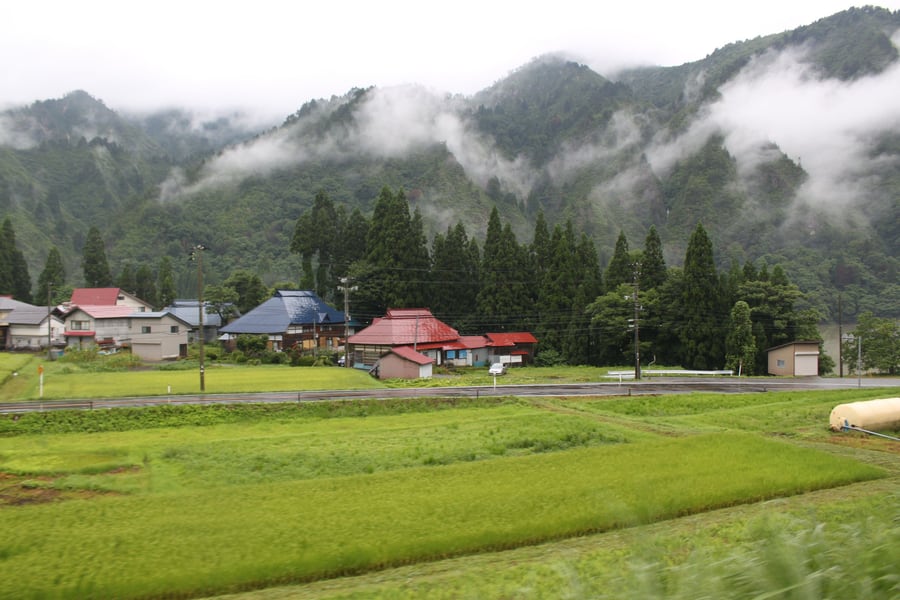
A ten-minute walk along the main road brings you to a viewpoint over the village of Ōshi, its houses at the water's edge, often wrapped in river mist after rain. Electric bicycles are for hire at the station from April to November, and Lake Numazawa, a caldera lake about 5,600 years old, is 17 minutes away by car.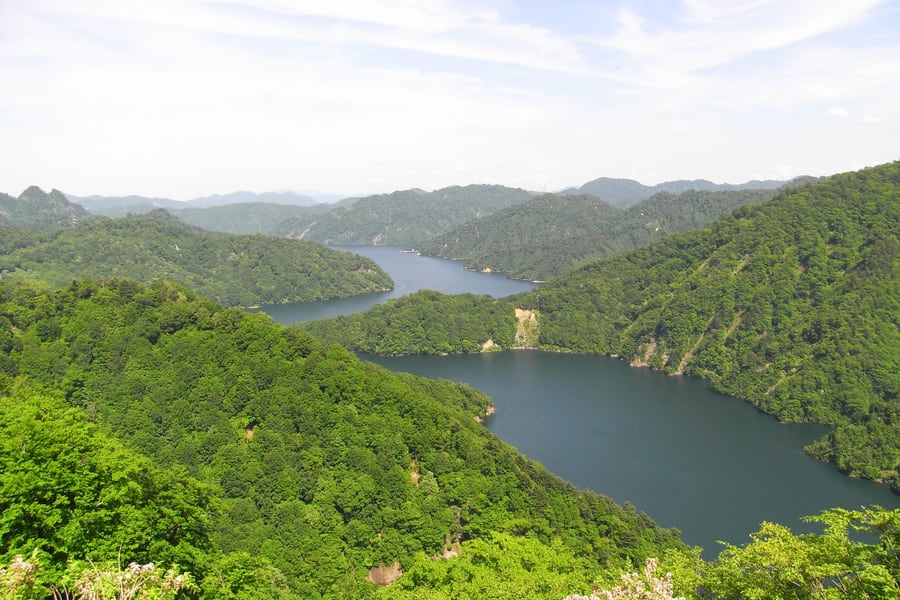 河川一等兵 / Wikimedia Commons · public domain
Tadami
Five minutes from the station, Furusato-kan Tagokura keeps the belongings of the village drowned by the Tagokura Dam, and the Beech Forest and River Museum explains the Tadami UNESCO Eco Park, the first in Tohoku; one ¥310 ticket covers both, closed on Tuesdays. Bicycles are for hire beside the station.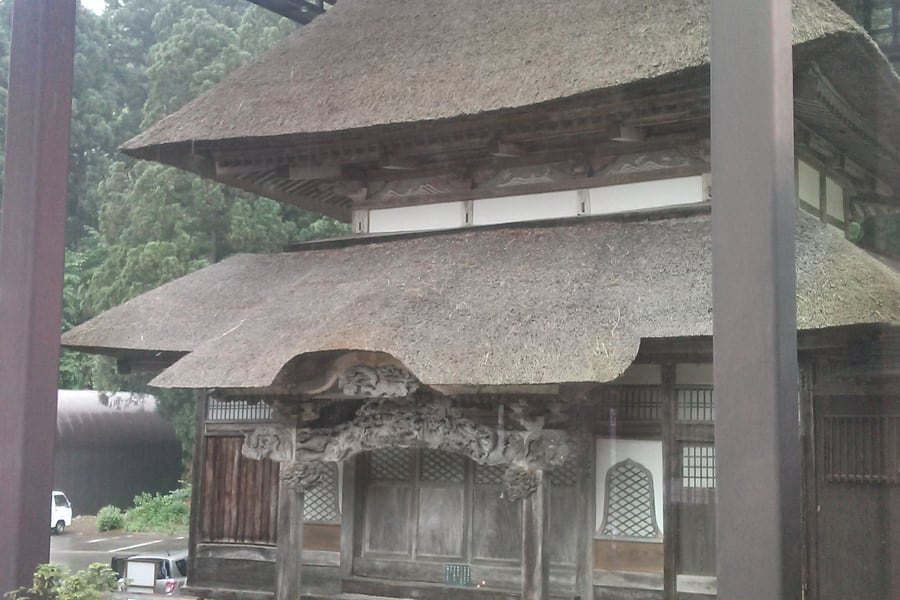 Fwataru / Wikimedia Commons · CC BY-SA 4.0 · cropped
Koide
A local bus and a 15-minute walk from Koide, the Kaisandō of Saifuku-ji, a temple founded in 1534, is covered in carving, painting and plasterwork by Ishikawa Unchō, the late-Edo craftsman known as the Michelangelo of Echigo. Entry is ¥500. Koide is also on the Jōetsu Line, towards Urasa and Echigo-Yuzawa.Where to Sleep
A night at Aizu-Wakamatsu puts you on the 06:08, the best train of the day. A night along the line turns the journey into two easy days, with a hot-spring inn at Yanaizu or a family inn by the station at Tadami.
Where to stay
Aizuwakamatsu Washington Hotel
Aizu-Wakamatsu · about 3 minutes' walk from the station
A city hotel by the station, convenient for the 06:08 through train to Koide.
Check Availability (opens in a new tab, on washington-hotels.jp)via washington-hotels.jpHana Hotel Takinoya
Aizu-Yanaizu · in the temple town
A small hot-spring inn in Yanaizu's old temple quarter, with a private open-air bath on the roof.
Check Availability (opens in a new tab, on hanahotel.jp)via hanahotel.jpEkimae Ryokan Tadami-so
Tadami · in front of the station
A family inn of wood and an irori hearth, serving handmade soba and the local cooking of Oku-Aizu.
Check Availability (opens in a new tab, on tadamiso.com)via tadamiso.comQuestions or corrections
Planning this trip and stuck on something, or spotted a time, fare or detail that has changed? Send us a message about Tadami Line. We read every one, and we update this page when something has changed.