Tehran to Sari
Kabelleger / David Gubler / Wikimedia Commons · CC BY-SA 4.0 · 2017 · cropped
- DistanceTehran–Sari via Garmsar and Firuzkuh; no operator distance is published
- Duration7 hours 55 minutes, Tehran 06:50 to Sari 14:45
- Best seasonAll year · greenest April to June, snow at Gaduk December to March
Introduction
Two trains a day leave Tehran for Sari, and only one of them shows you what you came for. The 06:50 takes seven hours and fifty-five minutes to cross the Alborz; the 19:25 does the same mountains in the dark and sets you down on the Caspian plain at ten past three in the morning. On a railway whose engineering is the reason it exists, that is not a small difference.
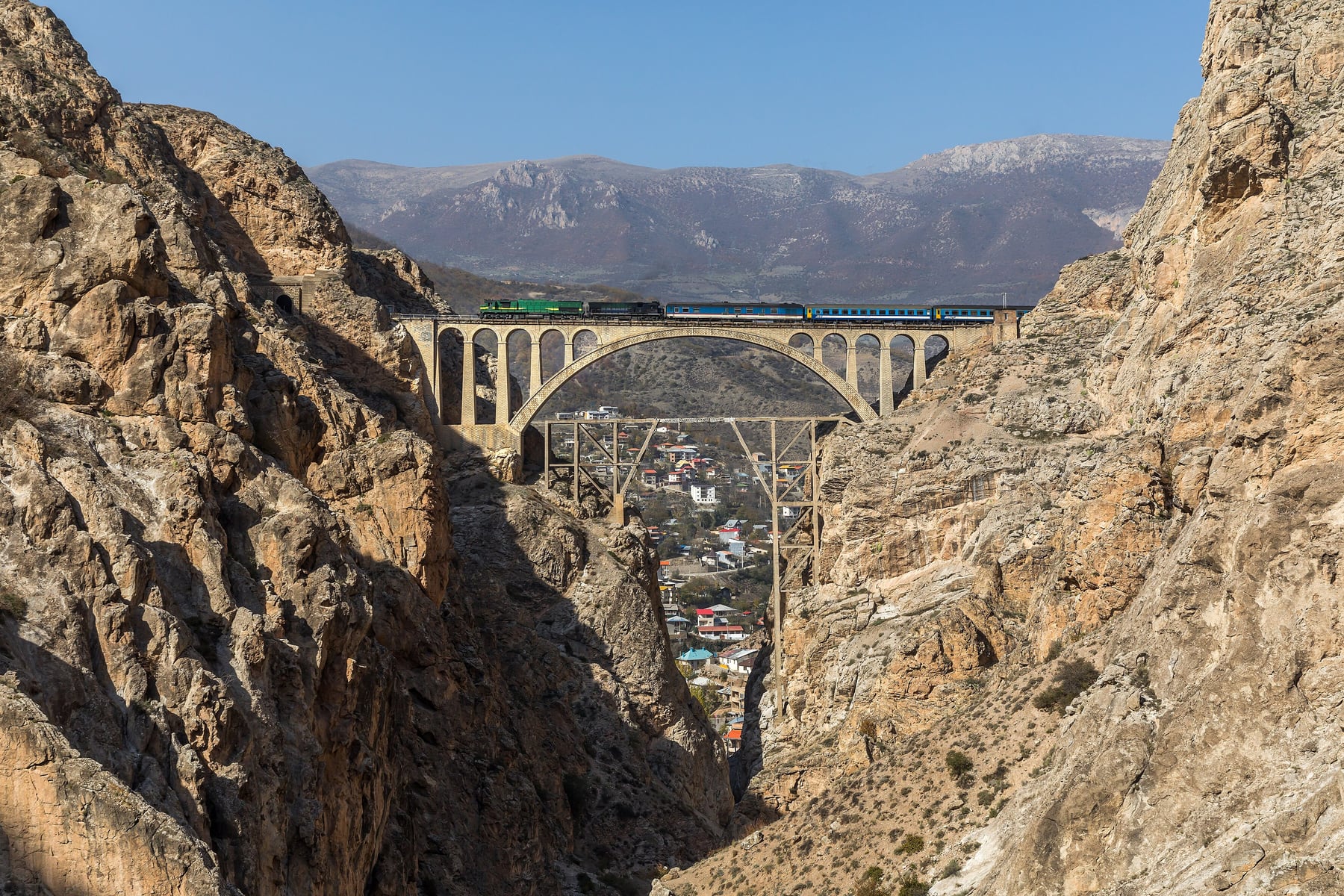
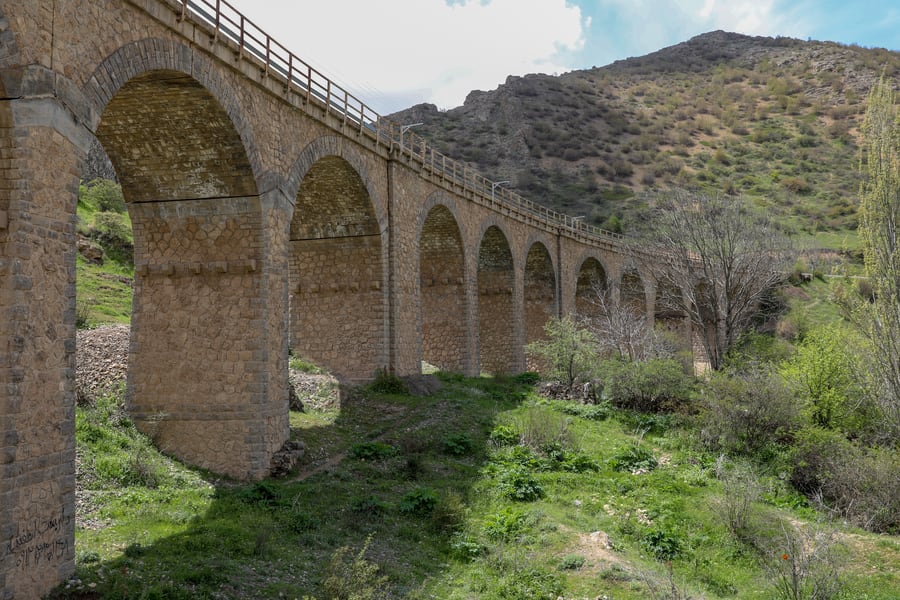
What the daylight train crosses is a World Heritage Site. The Trans-Iranian Railway runs 1,394 km from the Persian Gulf to the Caspian, was built between 1927 and 1938 entirely out of Iranian taxes rather than foreign loans, and was inscribed by UNESCO in 2021 — not for a building on it, but for the railway itself. The northern branch is the hard half. In under 50 km the formation lifts 1,200 m, and to do it at gradients no steeper than 3 per cent the engineers stacked the line on the same hillside at three separate heights above Veresk, turning it inside the tunnels between the ledges. Iranians call that section Se Khat-e Tala, the Three Golden Lines. Just below it the line crosses a gorge on a single 66-metre arch, 110 m above the valley floor, which the Second World War renamed the Bridge of Victory.
You leave in a salt desert and arrive in a temperate rain forest, and the ticket is a berth in a six-person compartment either way.
The Journey
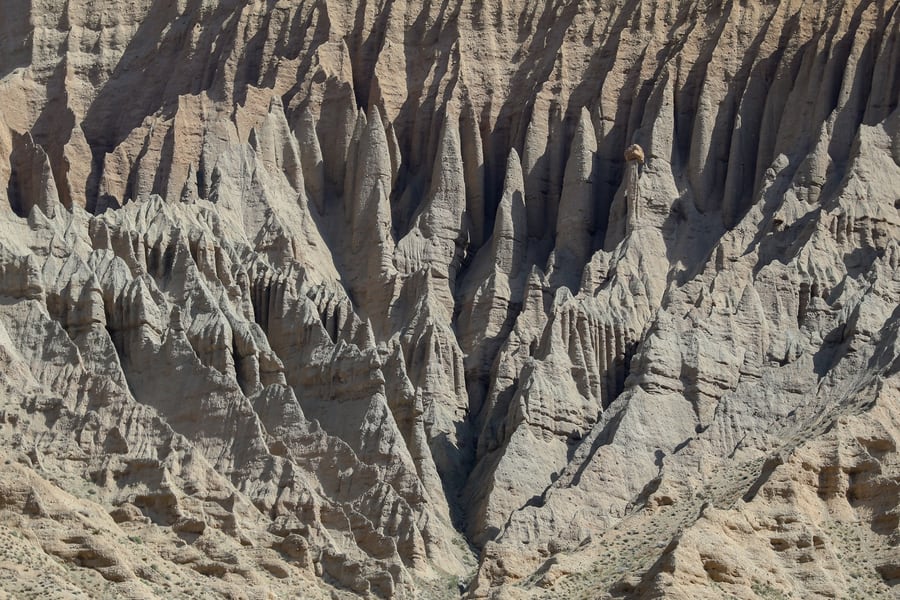
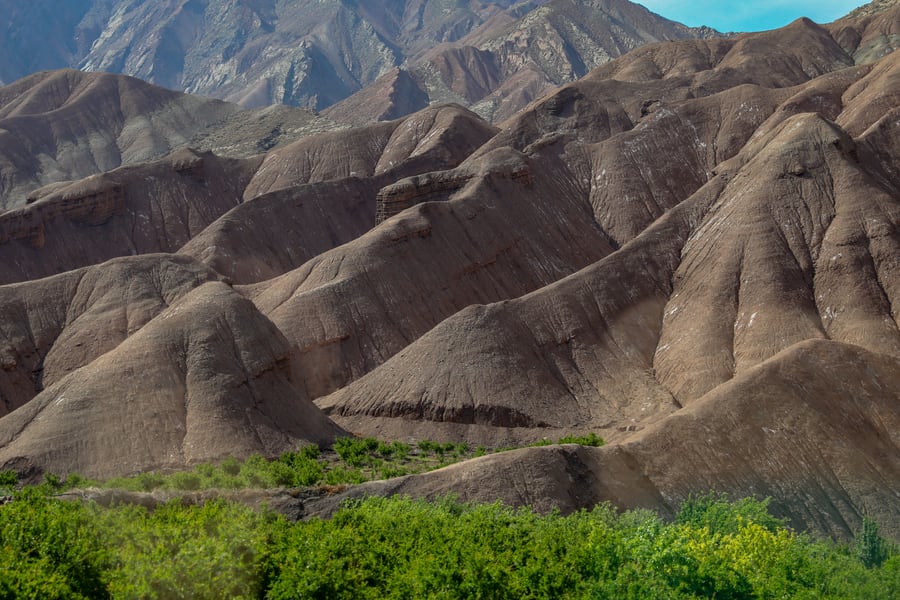
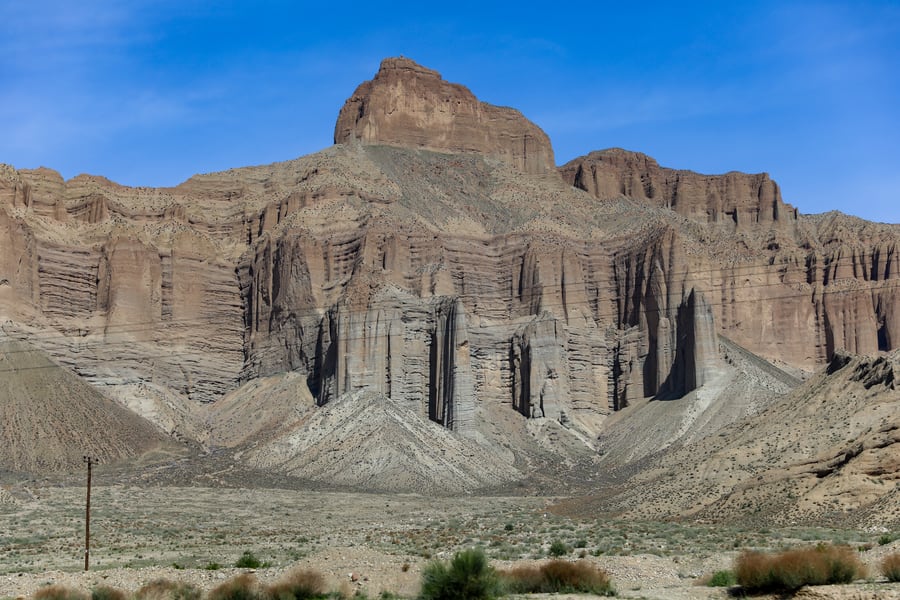
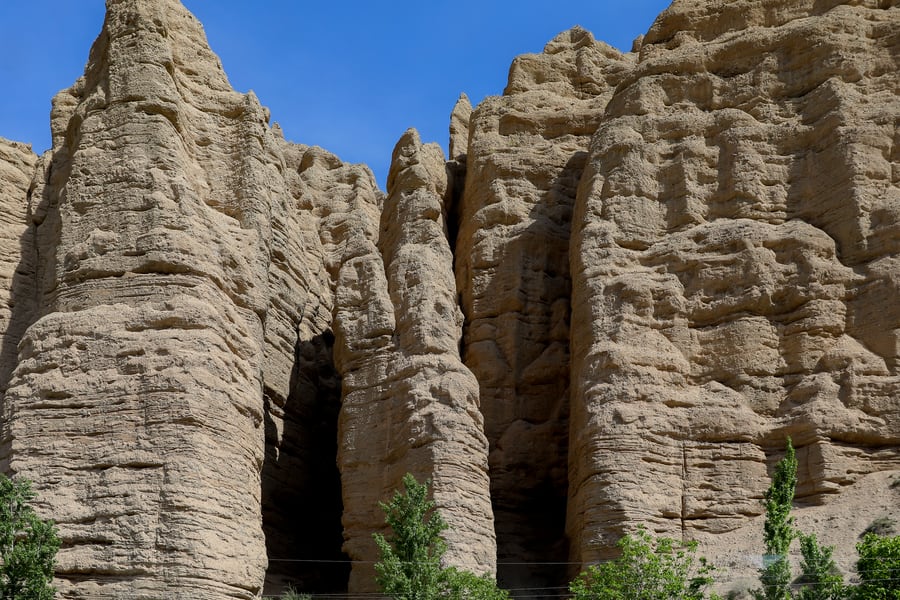
The 06:50 leaves Tehran while the city is still cool and runs east-south-east across the plain towards Garmsar, where the northern branch turns off for the mountains. For the first two hours there is nothing green. The line runs under soft sedimentary cliffs worked for salt, limestone and chalk, eroded into pillars and hollows that Iranians call the genie's chimneys, and the ground is the colour of the rock all the way to the horizon.
Then the orchards start. Simin Dasht and Zarrin Dasht — the silver plain and the golden plain — are walnut, plum, pomegranate, apricot and apple, planted right up to the fence, with dry banded rock standing over them in folds so clean they look drawn. The train is climbing by now. Past Firuzkuh it goes into a tunnel about three kilometres long and comes out somewhere else entirely: the Alborz proper, bare and enormous, and a good deal colder.
The stacked ledges
The section between Firuzkuh and Pol-e Sefid is why the railway is on the World Heritage list. The formation has to fall 1,200 m in less than 50 km, and it had to do it at gradients under 3 per cent — the practical limit for a main line worked by ordinary locomotives. The answer was to lay the railway across the same hillside three times at three heights and turn it inside the mountain between them, through the twin tunnels at Dogol. From the valley you can see all three ledges at once. Iranians call it Se Khat-e Tala, the Three Golden Lines, and it was the most expensive thing built on the northern branch.
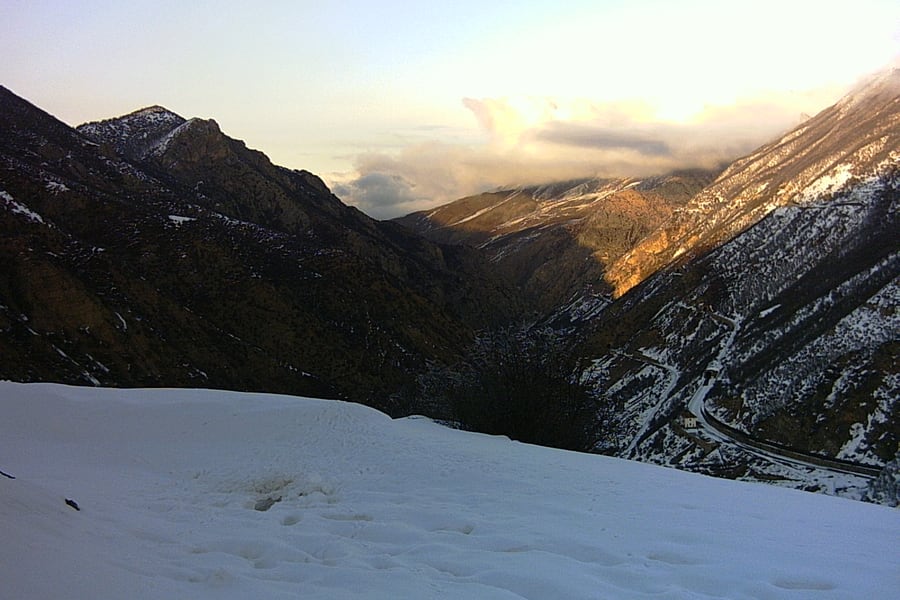
The summit comes first, at Gaduk, over 2,100 m — the high point of the whole northern line, in a place where snow has been measured at two metres. The Italian firm that held these lots, Impresit, put in about 50 km of track here and 73 tunnels to do it. Then the descent, and Veresk: a single masonry arch of 66 m carrying the track 110 m above the valley, finished in December 1935, with the steel erection tower still standing underneath it. The train is over it in a few seconds. People get up anyway.
Into the forest
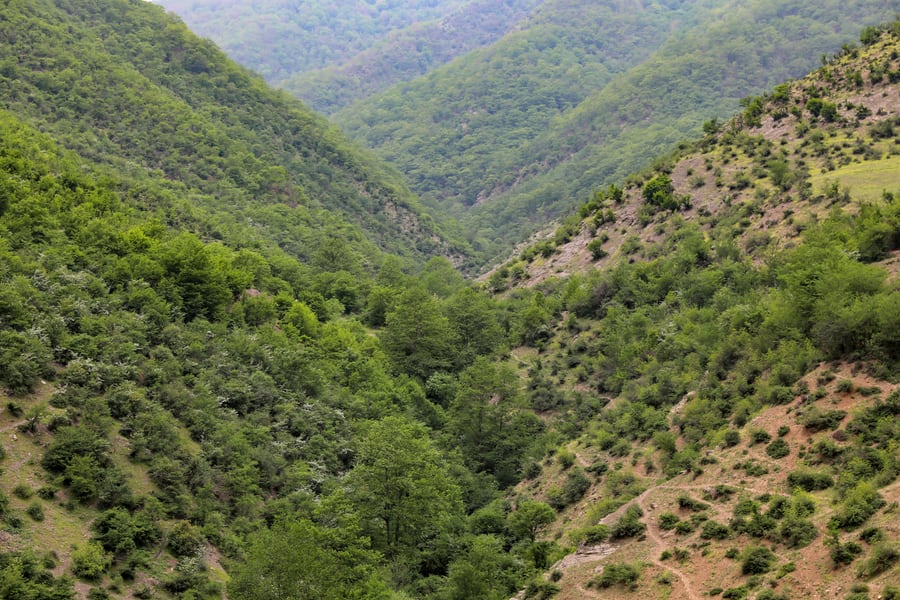
Below Veresk the air changes. The Alborz catches the moisture coming off the Caspian and holds it on the northern slope, and within half an hour of bare rock the train is running through broad-leaved forest — the Hyrcanian forest, which has been growing here for twenty-five to fifty million years and is a World Heritage Site of its own. At Shirgah it is at its densest.
Then the mountains simply stop. The line comes out onto the Mazandaran plain among rice fields, citrus and tea, calls at Qaem Shahr, and runs level into Sari at 14:45. The station is a first-Pahlavi building of the same eclectic Persian-and-Western design as the rest of the line, registered as a national monument of Iran in 2017, and it is older than the through route — the first train ran from here to Bandar Torkaman on the Caspian in 1929, nine years before the railway reached Tehran.
What pulls it
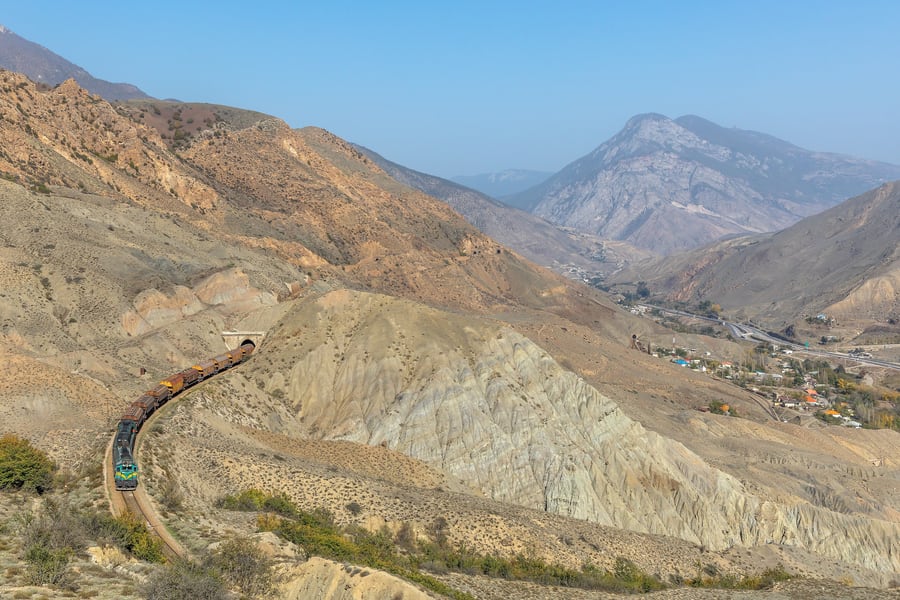
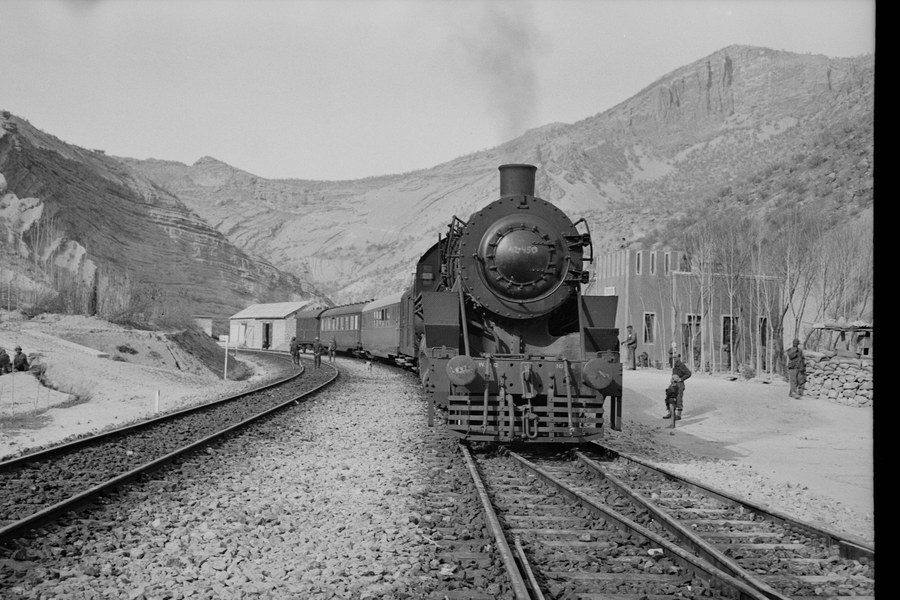
The traction is American, and old. Sari–Tehran passenger trains are worked by EMD GT26CW-2 diesels of Iranian Railways' 60 class, six-axle machines in green with the national emblem on the nose, hauling a rake of Raja stock; ballast trains on the ramp above Sorkhabad go double-headed with two of them. Behind them is ordinary Raja stock: the 06:50 and the 19:25 are both booked as six-berth compartments, of the classes Raja calls Parsi and Milad. Nobody is selling you the view. It is simply the train to Sari.
Along the route
 Ninara / Wikimedia Commons · CC BY 2.0 · 2018 · cropped
Out of Tehran, into the salt
The first two hours are desert. Past Garmsar the train runs under eroded cliffs quarried for salt, limestone and chalk, and the wind through their hollows is why Iranians call them the genie's chimneys.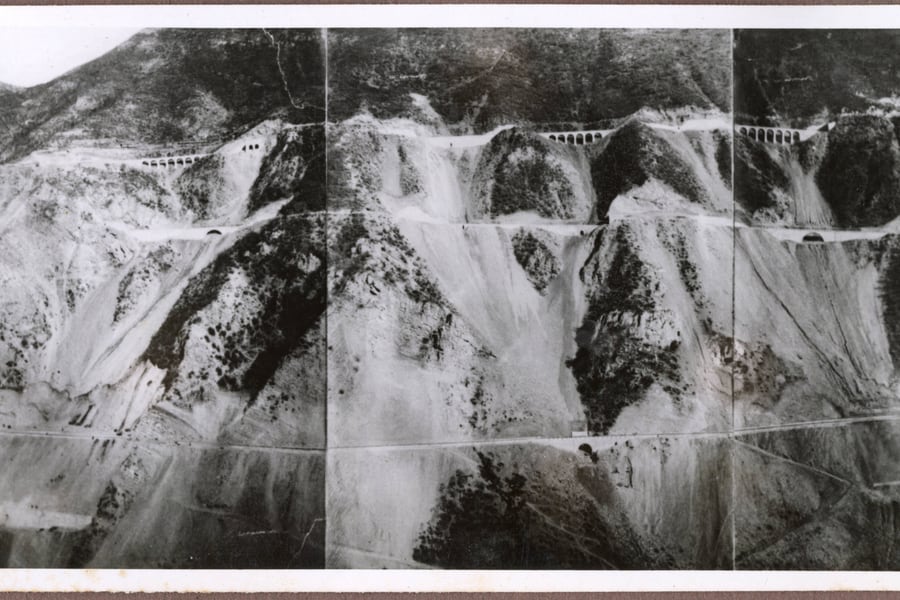 Stanley Scott Collection, US Army Corps of Engineers via Wikimedia Commons · public domain · c. 1943 · cropped
The Three Golden Lines
Above Veresk the railway is stacked on the same hillside at three heights. A train climbing it passes the same ground three times, turning inside the tunnels between the ledges. It was the hardest and costliest thing on the northern branch.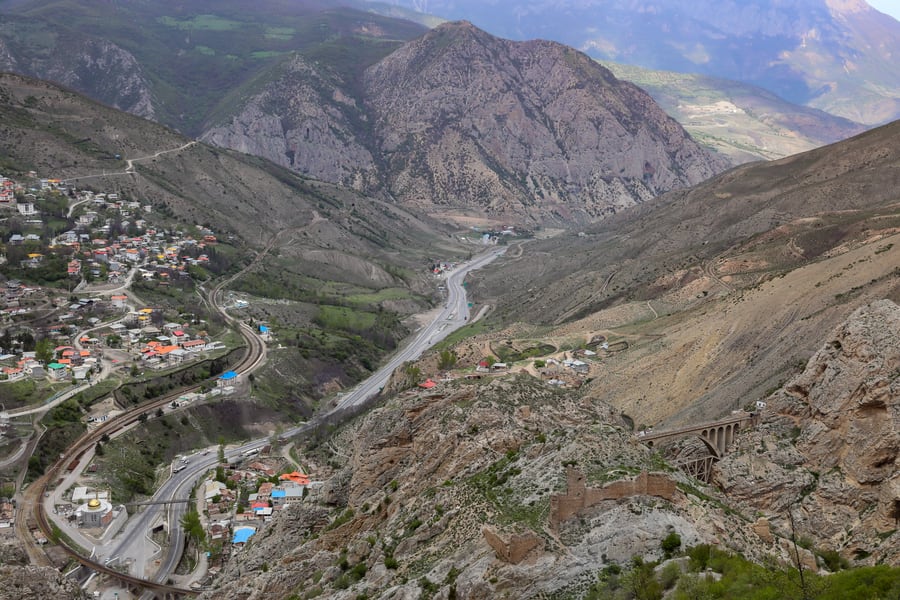 Ninara / Wikimedia Commons · CC BY 2.0 · 2018 · cropped
Down to the plain
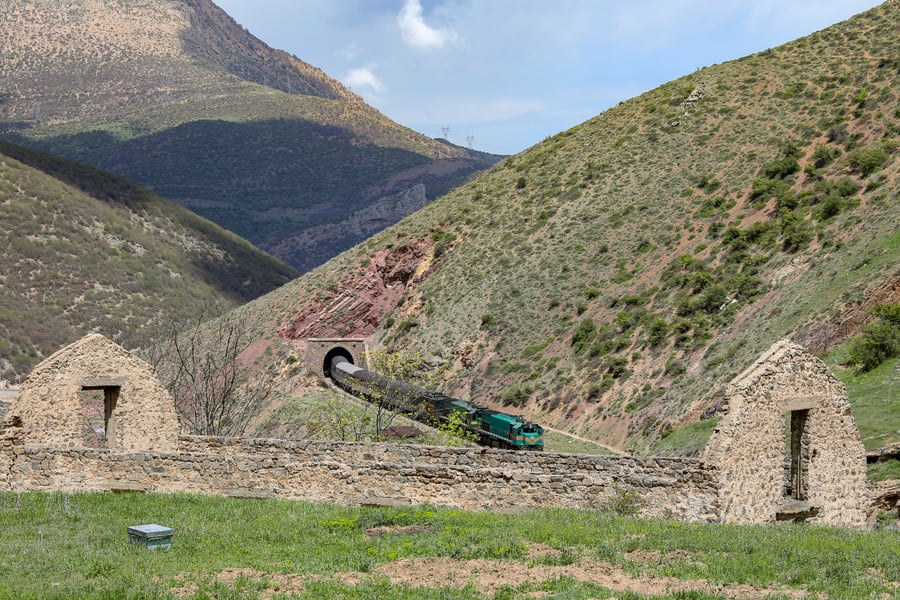
Below Shirgah the mountains stop. The train comes out into Mazandaran — rice, tea and citrus, villages every few minutes — and runs level for the last hour into Sari.A bit of history
Culture & experiences along the way
 Mehdixciii / Wikimedia Commons · CC BY-SA 4.0 · 2015 · cropped
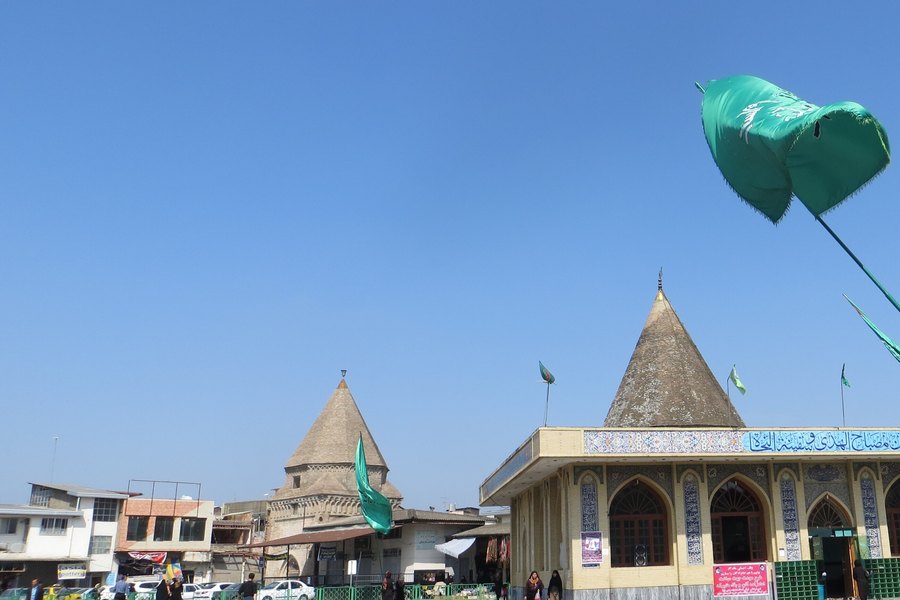
The tomb towers in the middle of Sari
Behind a modern arcade in the centre of town stand two conical brick towers, the tombs of Yahya and Zayn al-Abedin, put up in the fifteenth century and still a working shrine with people coming and going all day. The clock tower of 1930, a few streets away in Clock Square, is the other thing everyone in Sari meets at.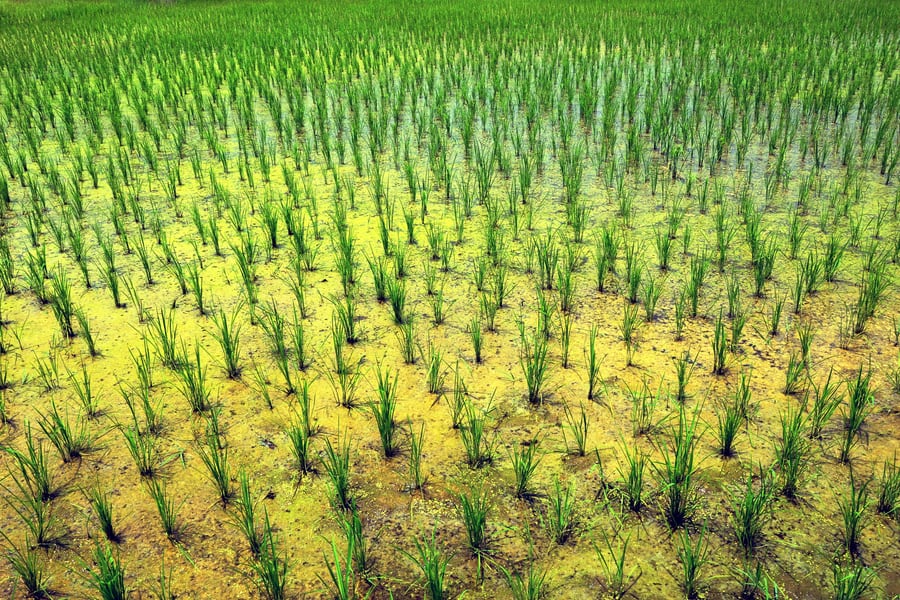 Alireza Javaheri / Wikimedia Commons · CC BY 3.0 · 2013 · cropped
Rice, and the kitchen that comes with it
You can tell you have crossed the Alborz by what is growing. South of the tunnels the ground is salt and stone; north of them it is flooded paddy. Mazandaran is Iran's rice country, and Sari mills the crop and grows oranges, tangerines and lemons besides — so the food at the end of the line is nothing like the food at the start.Timetables
Two trains a day run from Tehran to Sari and one comes back, all of them Raja workings, and the evening train out of Tehran carries on to Gorgan. Times below were read from the Iranian ticketing platform alibaba.ir — a reseller, not the railway, but the only channel reachable from outside the country — on 2 September 2026, and checked again against 11 September 2026; the same services appeared on both dates at the same fares, so this is the everyday pattern rather than a single day's board.
Tehran to Sari
| Departs | Tehran | Sari | Gorgan | Train |
|---|---|---|---|---|
| Morning | 06:50 | 14:45 | — | Raja, six-berth Parsi |
| Evening | 19:25 | 03:12 | 06:50 | Raja, six-berth Milad |
Sari to Tehran
| Departs | Sari | Tehran | Train |
|---|---|---|---|
| Evening | 17:50 | 01:45 | Raja, six-berth Parsi |
The daylight working is the 06:50, and only in that direction. Southbound there is no daytime train: the 17:50 out of Sari climbs to Gaduk after dark. If you want to see the Three Golden Lines and the Veresk bridge, book Tehran to Sari on the morning train and come back another way.
Trains fill. Both Tehran departures were showing sold out for the following day when this page was written, and the 19:25 had a single berth left three weeks ahead. Book as far in advance as you can.
As of September 2026. Live times and availability: alibaba.ir/train/THR-SRY (opens in a new tab).
Tickets
Fares are quoted in toman, the unit Iranians count in — ten rials to the toman. In September 2026 a berth from Tehran to Sari was 480,000 toman on the morning train and 442,850 on the overnight; through to Gorgan it was 550,000 in a six-berth compartment and 610,000 in a four-berth.
Paying is the hard part, and the reason is sanctions. Visa and Mastercard do not work anywhere
in Iran, because Iranian banks are cut off from the international payment networks. Neither the
national railway (rai.ir) nor Raja (raja.ir) will answer a connection from outside the country
either, so there is no operator channel to buy from — the card below goes to the Iranian reseller
that does work. Since April 2025 the Central Bank has issued rial debit cards to non-residents,
obtainable at bank branches, airport counters and ATMs; that card, an Iranian agency, or the
ticket window in person are the three ways in. Allow time — these trains sell out.
Book your tickets
The 06:50 to Sari
Raja, six-berth Parsi compartments
The only daylight working, and the only one that shows you the mountain.
Book Tickets (opens in a new tab, on alibaba.ir)via alibaba.irThe 19:25 overnight
Raja, six-berth Milad — Sari 03:12, Gorgan 06:50
Cheaper, and it crosses the Alborz in the dark.
Book Tickets (opens in a new tab, on alibaba.ir)via alibaba.irRail Passes
No rail pass covers Iran, and none comes close. Interrail's One Country Passes list, checked in September 2026, runs to thirty-three countries with Türkiye at its eastern edge; Iran does not appear on it, and there is no Iranian national multi-journey ticket either. Every seat is sold as a single journey on a single train.
That is less of a loss than it sounds. The constraint on this journey is not the price of the ticket but whether there is a berth left on it, and a pass would not help with that. What matters here is booking early, not buying in bulk.
Places to Visit
Most of what is worth stopping for on this line is outside the window rather than at the end of it. The four below run in the order the morning train reaches them, from the salt country two hours out of Tehran to the forest that starts once the railway is over the top.
 Ninara / Wikimedia Commons · CC BY 2.0 · 2018 · cropped
The genie's chimneys at Garmsar
Two hours out, the line enters Semnan province and a landscape of soft sedimentary rock eroded into pillars and cavities. The wind moves through the holes and makes a noise, which is how they got the name Doodkesh-e Jenn — the genie's chimneys. The same ground is mined for salt, limestone and chalk, and the railway threads between the workings. It is the last of the desert; from here the gradient starts.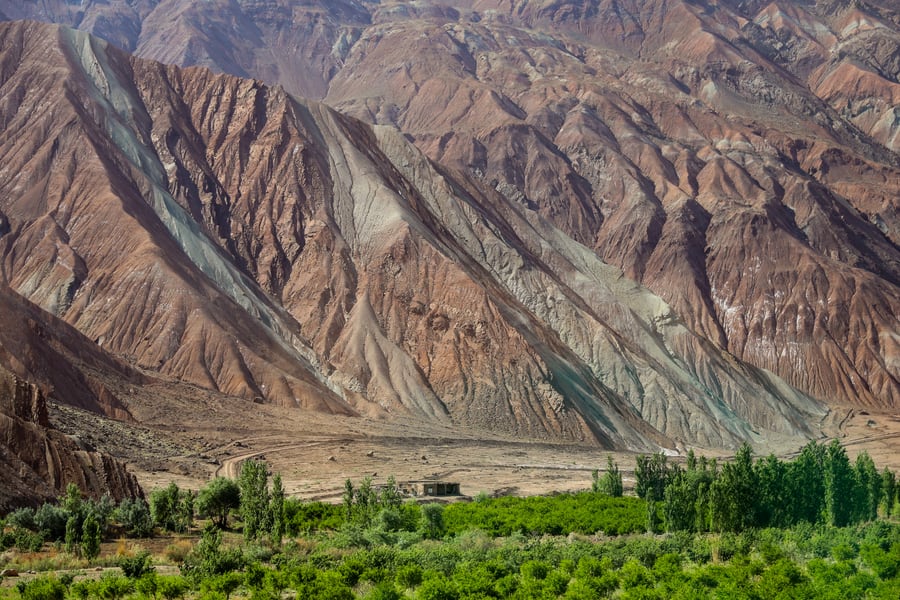 Ninara / Wikimedia Commons · CC BY 2.0 · 2018 · cropped
Zarrin Dasht and Simin Dasht
The golden plain and the silver plain, between Garmsar and Firuzkuh, and the surprise of the first half. Orchards of walnut, plum, pomegranate, apricot and apple run right up to the track, with dry, banded rock standing over them — the folding is so clean it looks drawn. This is where the climb begins in earnest, and where the train slows enough to look at it properly.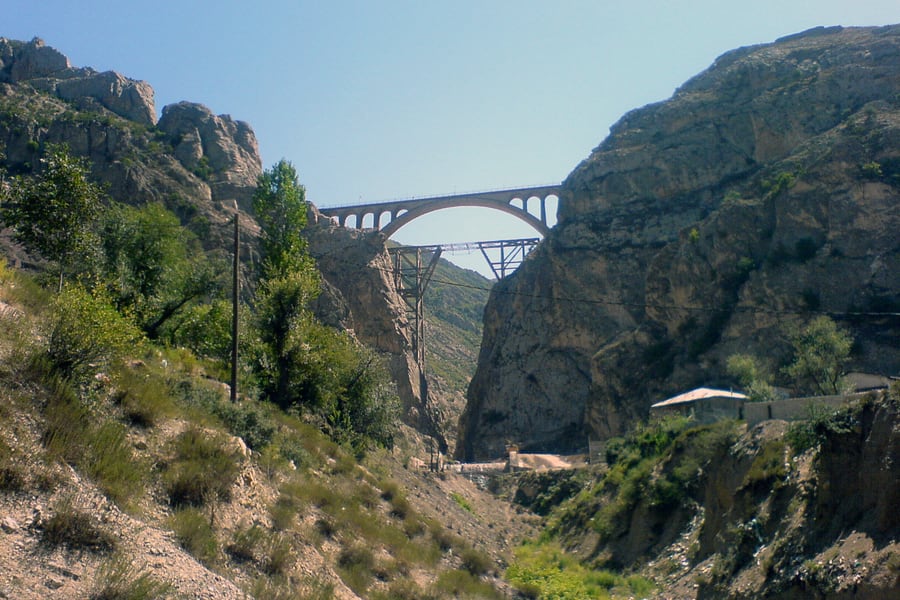 Behrooz Rezvani / Wikimedia Commons · CC BY 3.0 · 2007 · cropped
Veresk
A village in a gorge in Savadkuh, under the most photographed structure in Iran. The bridge stands 110 m above the valley floor on a 66 m arch and was finished in 1935; the light steel trestle beneath it is the erection tower, left in place. Veresk station is one of the line's stations registered as a national monument of Iran, along with Savadkuh, Gaduk, Dogol, Sorkhabad, Sari and Tehran.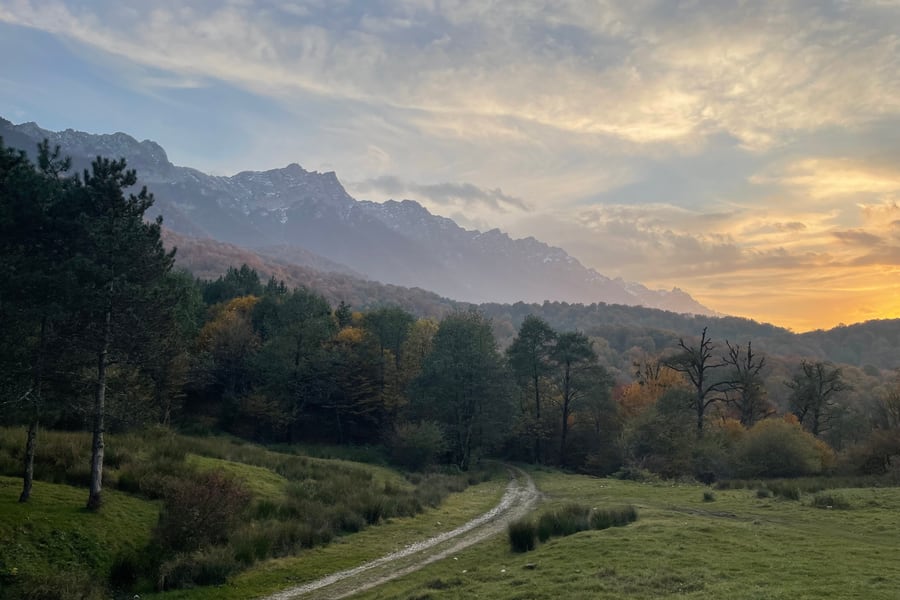 Soheiloladzad / Wikimedia Commons · CC0 · cropped
The Hyrcanian forest
The northern slope is covered in broad-leaved forest that has been there for 25 to 50 million years, and it is a World Heritage Site in its own right — inscribed in 2019, seventeen component parts in Iran and Azerbaijan, over 3,200 vascular plant species, 58 mammals including leopard, wolf and brown bear. The oldest trees are three to four hundred years old. The train runs through it for the best part of an hour below Shirgah.Where to Sleep
Both cards below are in Tehran, and that is a limitation worth stating rather than hiding. Sari has hotels; none that could be reached from here keeps a website worth sending a reader to. The Badeleh resolves and shows a menu whose every page turns out to be an empty video frame, last dated 2021, and the others either fail to resolve at all or serve a suspension notice. A card is not written for a hotel whose own page states nothing checkable.
Neither card carries a photograph, for a reason that applies to the whole country. Iran has no freedom of panorama, so a photograph of a modern building cannot be published freely whoever took it — and Wikimedia Commons holds no picture of either hotel in any case. An imageless card is the honest version.
If you are travelling on the morning train, the night before is the one that matters: the 06:50 means leaving central Tehran around six.
Where to stay
Ferdowsi International Grand Hotel
Central Tehran, twenty minutes from the station
Twenty-two thousand square metres in the historic and business centre of the city, with five restaurants and its own conference halls.
Check Availability (opens in a new tab, on ferdowsihotel.com)via ferdowsihotel.comEspinas Hotel Group
Three hotels in Tehran, and a fourth on the Caspian at Astara
An Iranian group that takes reservations in English by email, which very few in the country do.
Check Availability (opens in a new tab, on espinashotels.com)via espinashotels.comPractical information
Which direction. Tehran to Sari on the 06:50 is the only working that crosses the Alborz in daylight. Coming back by train means the 17:50 from Sari, which is over the summit after dark.
Which side. No source states one, and this page will not guess. The line turns on itself repeatedly through Savadkuh, so a compartment window does not settle it either way — stand in the corridor for the half hour between Gaduk and Pol-e Sefid.
Language. The railway, its stations and its ticketing all work in Persian. There is no English timetable, no English booking channel, and station nameboards carry a Latin transliteration but nothing more. A phone with an offline Persian keyboard and a translation app is not optional.
Money. Sanctions keep Visa and Mastercard out of Iran entirely. Bring cash to convert, or arrange a rial debit card for non-residents — see the ticket section above.
Season. The line runs all year. April to June is the greenest on the northern slope; between December and March there is snow at Gaduk, which is spectacular and occasionally disruptive.
Onward. The evening train from Tehran runs through to Gorgan, three and a half hours beyond Sari at the eastern end of the Caspian plain, and it is sold as a single ticket. North of Sari runs the oldest piece of the whole system, the 1929 line to Bandar Torkaman — the World Heritage property's northern terminus, and the reason the listing describes a railway from sea to sea. No passenger service on it could be confirmed from here.
Questions or corrections
Planning this trip and stuck on something, or spotted a time, fare or detail that has changed? Send us a message about Tehran to Sari. We read every one, and we update this page when something has changed.