Train de l'Ardèche
Celeda / Wikimedia Commons · CC BY-SA 4.0 · cropped
- Distance28 km · metre gauge
- Duration1 h 45 each way to Lamastre
- Best seasonApril–October
Introduction
Above Tournon the Doux runs through a gorge its railway calls inaccessible, and the train is the way in, clinging to the canyon wall high above the river.
The line was cut along the valley between 1886 and 1891 to join Tournon, on the Rhône, to Lamastre in the hills of the Haut-Vivarais: 28 kilometres of metre gauge pinned to the rock above the river on walls, arches and a tunnel. It was part of a network of departmental lines that closed in 1968, and the following summer a group of enthusiasts started running it for visitors. It has carried tourists ever since, apart from a five-year gap after 2008, when the money ran out and the steam engines were laid up. Trains came back in July 2013.
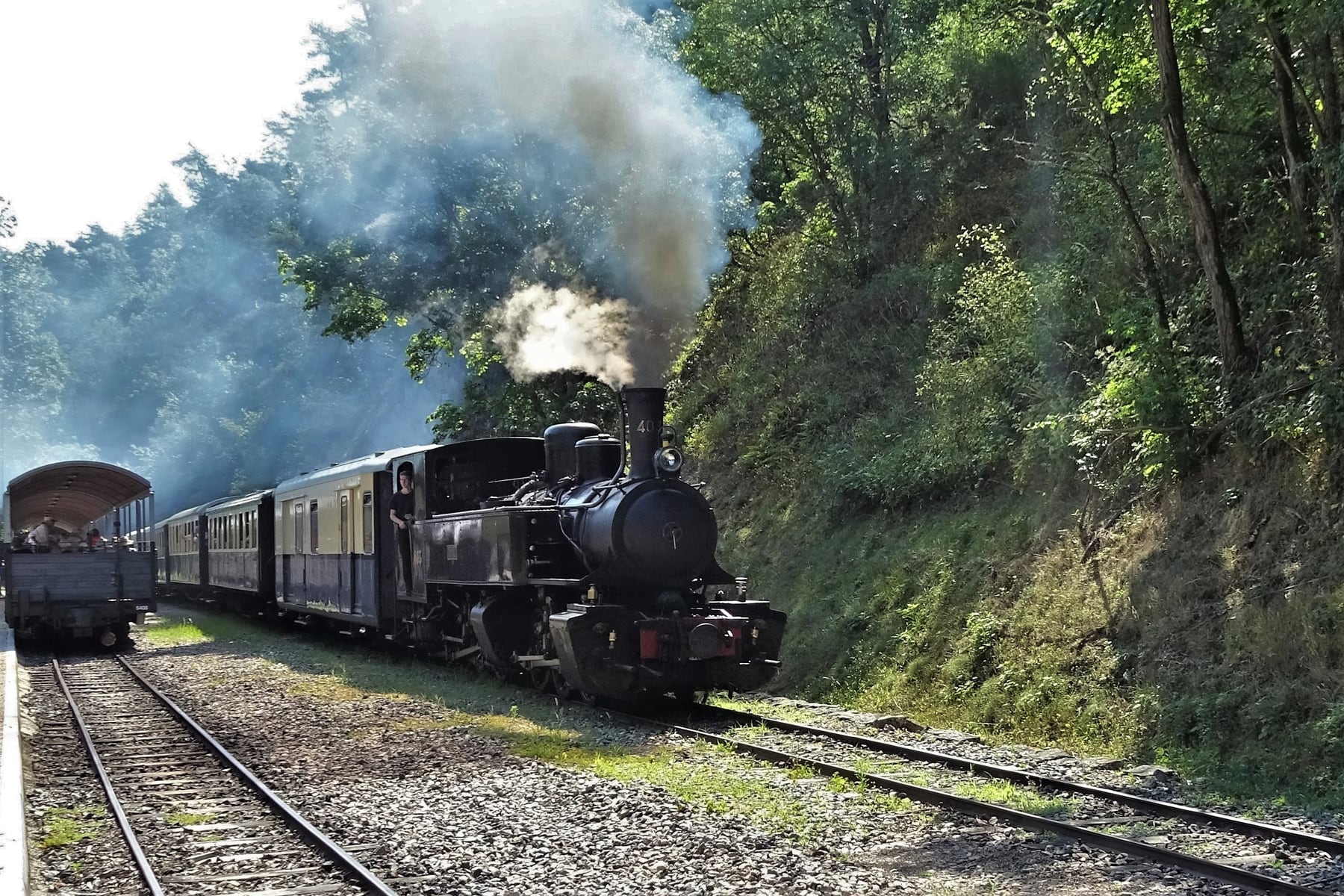
Today the trains still leave from Tournon–Saint-Jean behind the line's own articulated Mallet engines of 1903 and 1932, pulling varnished wooden coaches and open summer cars. The Train des Gorges goes eight kilometres into the wildest part of the canyon and back in about an hour and a half; the Mastrou, named after the line's old nickname, runs the whole way to Lamastre in an hour and three quarters.
The Journey
Trains leave from Tournon–Saint-Jean, the railway's own station at Saint-Jean-de-Muzols, four kilometres from the centre of Tournon, with a free car park, a museum and a buvette. Within a few minutes the line is over the Doux, and from there to Colombier-le-Vieux it is in the gorges: track on stone walls above the water, a 265-metre tunnel, and the river far below on one side. This is the stretch the Train des Gorges covers, and at Colombier the engine is turned on the turntable by hand while passengers wait twenty minutes or so before the run back.
The Mastrou carries on. At Boucieu-le-Roi the valley opens out round a broad meander, and above it the line leaves the canyon for orchards and chestnut woods, crossing the Doux again on stone viaducts before it reaches Lamastre, 28 kilometres and 1 h 45 from the start, including a fifteen-minute halt halfway. The return leaves Lamastre in mid-afternoon, which gives time for lunch in the town; the operator advises booking a restaurant table before the train arrives.
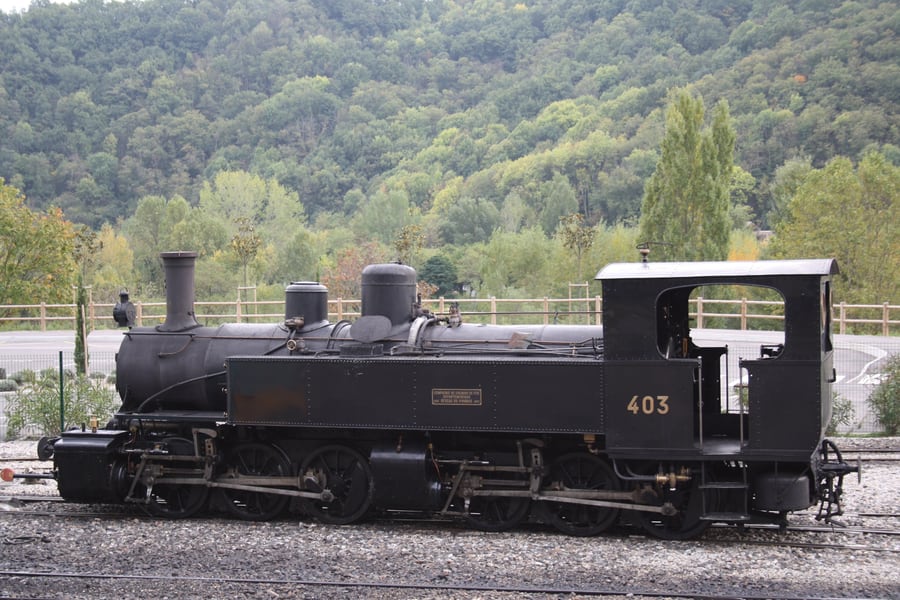
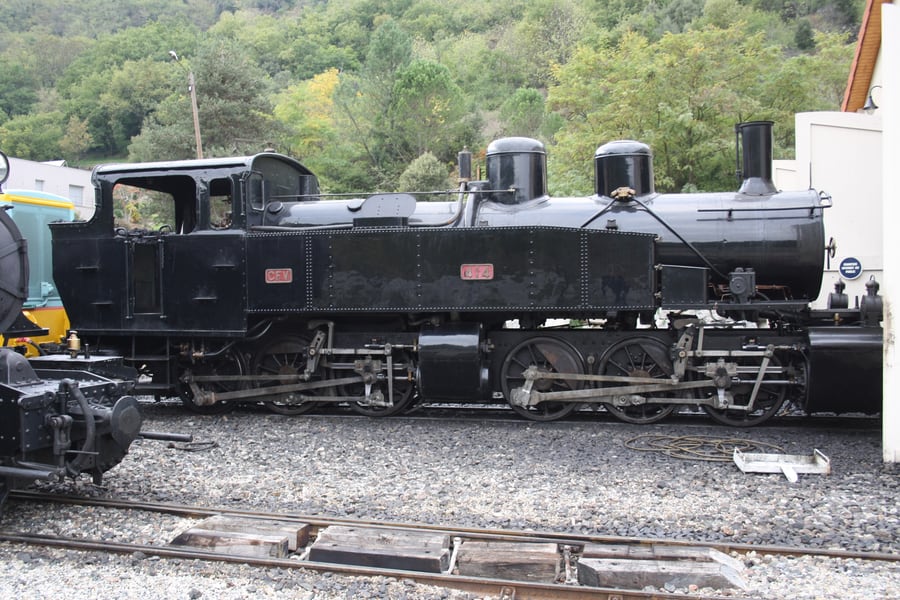
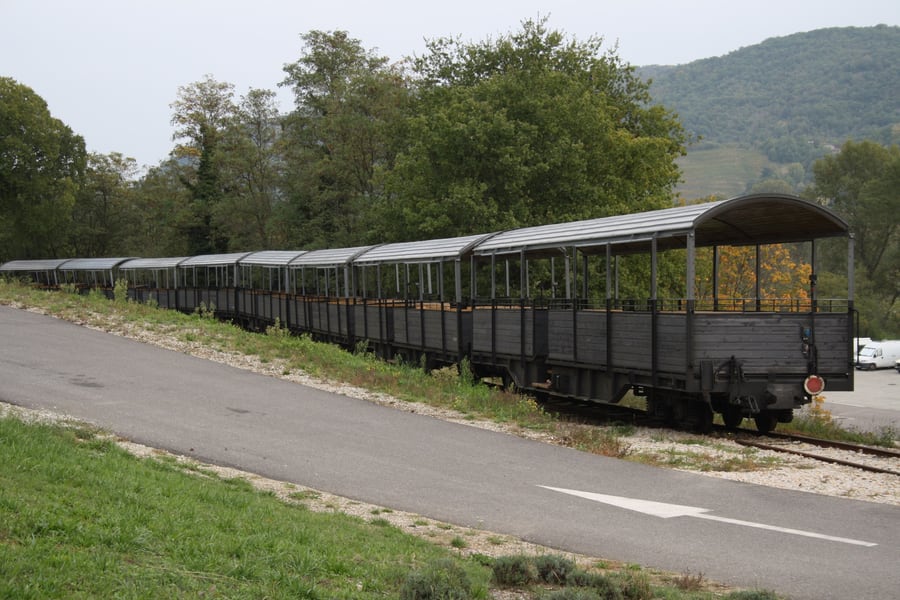
The steam engines are the line's two Mallets, No. 403 of 1903 and No. 414 of 1932, articulated tank engines built for its tight curves. The operator keeps the right to change the traction, and some trains run behind a diesel: the T66, a 600-horsepower diesel-electric of 1950 that came to the line in 2022, or the 1963 diesel built for the railway itself. The coaches are a mix of varnished wooden stock from Brittany and Switzerland, three first-class coaches with velvet seats, and roofed panoramic cars with no glass, which run in all weathers. The Mastrou also carries a van for bicycles, prams and luggage.
Along the route
 Хрюша / Wikimedia Commons · CC BY-SA 3.0 · cropped
The Grand Pont
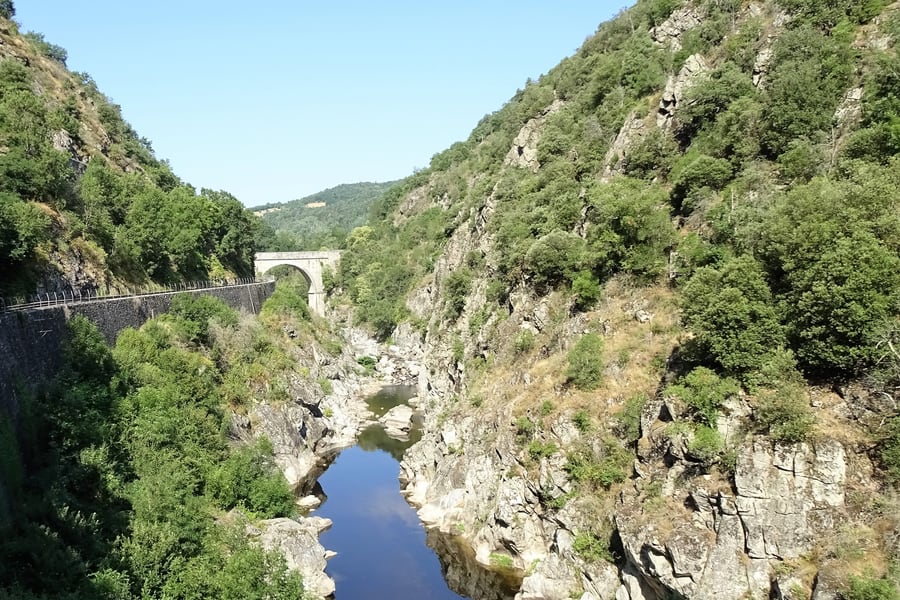
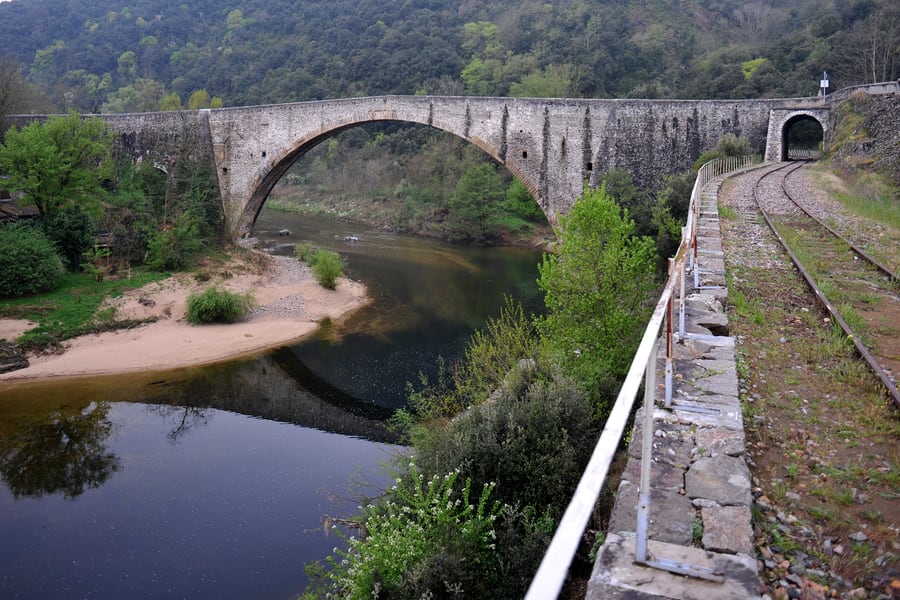
Within minutes of leaving Tournon–Saint-Jean the line runs out above the Doux beside the Grand Pont, a single high stone arch over the river, listed as a historic monument in 1954, and dives into a tunnel at its far end.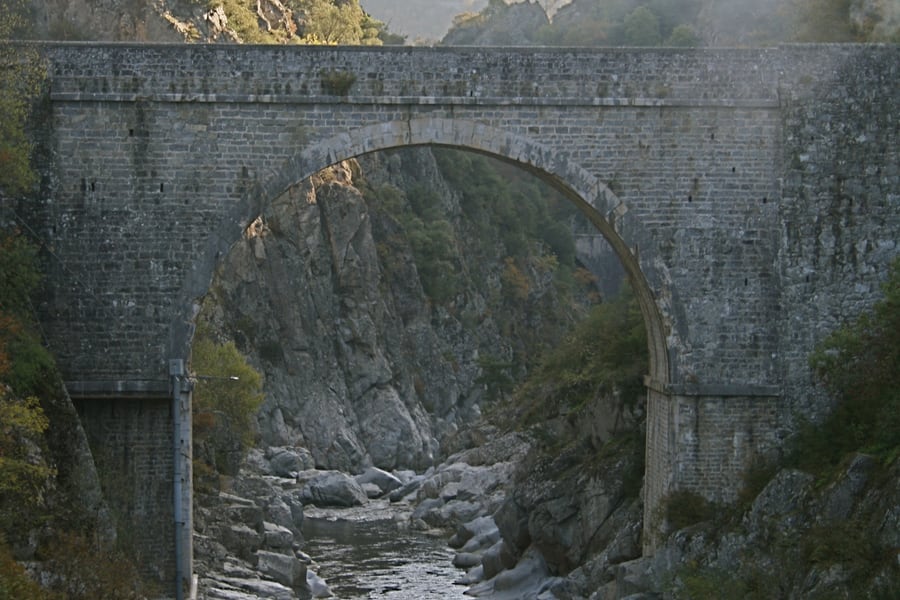 Roehrensee / Wikimedia Commons · CC BY-SA 4.0 · cropped
Into the gorges
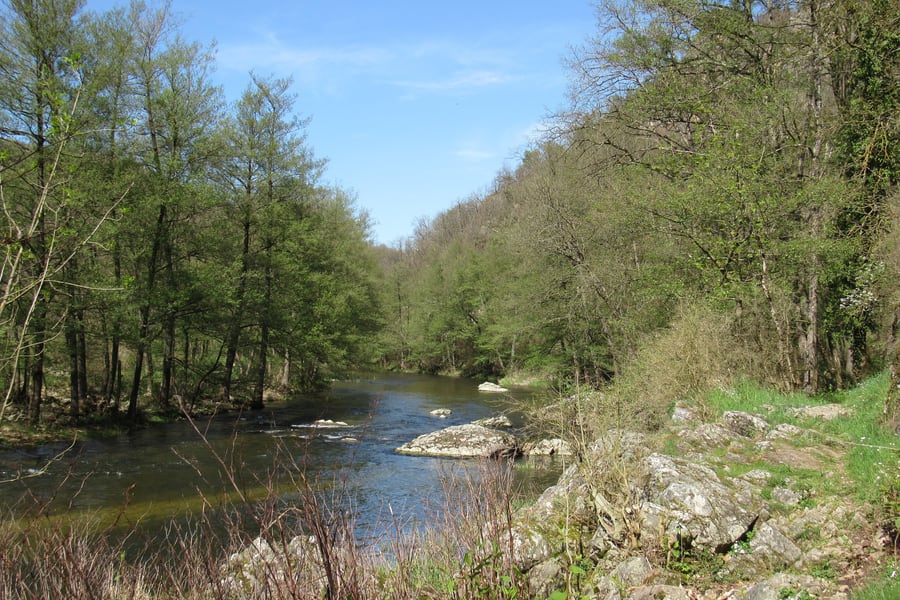
The next eight kilometres are the wildest of the line: the track is pinned to the rock wall above the river, passes a 265-metre tunnel and stays in the canyon to Colombier-le-Vieux, where the Train des Gorges turns back.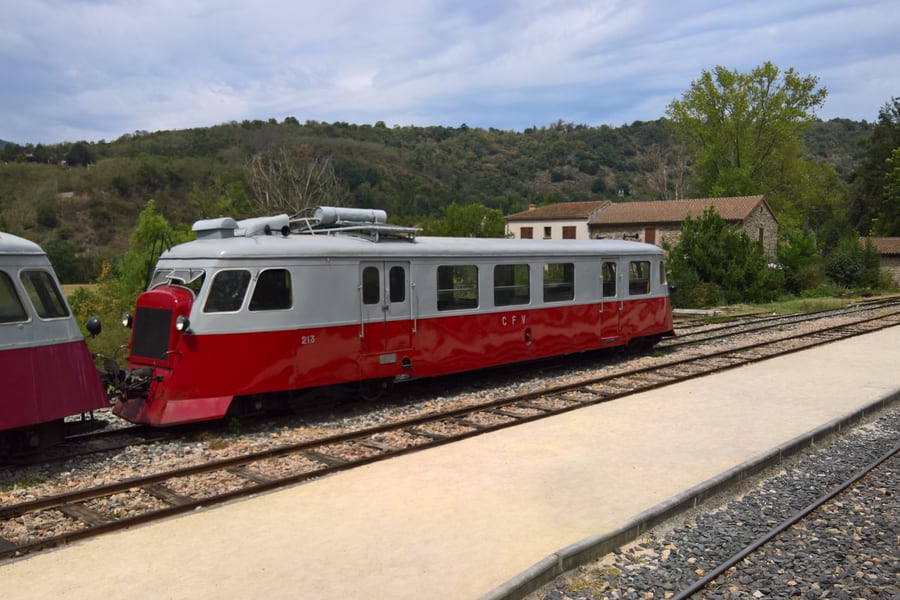 Antoine Boudon / Wikimedia Commons · CC BY-SA 4.0 · cropped
Boucieu-le-Roi
Halfway up, the valley widens at Boucieu-le-Roi, the only station on the line besides Tournon–Saint-Jean with a ticket office. Its old station building still stands by the platform, and the railway's preserved Billard railcars are often parked beside it.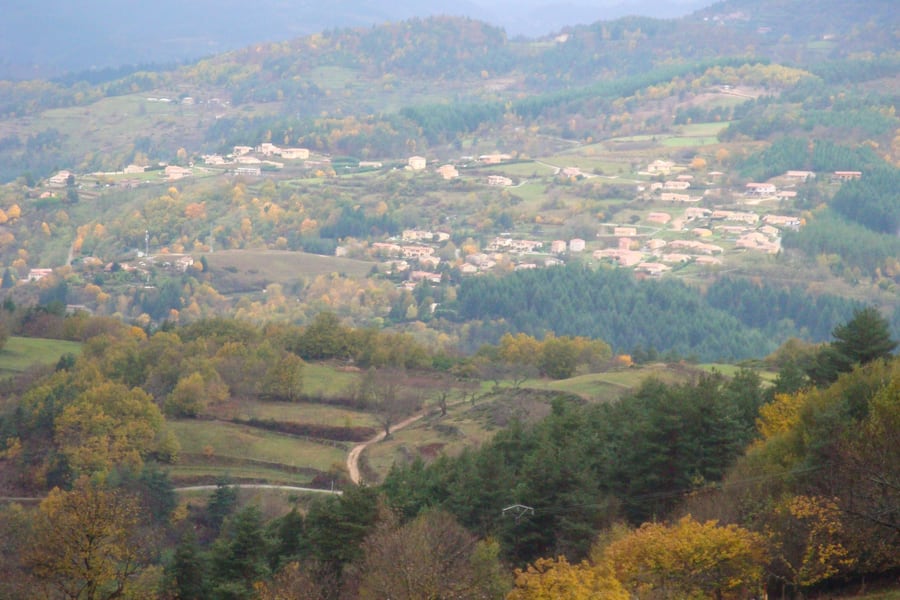 Gaillard Jérôme / Wikimedia Commons · CC BY-SA 3.0 · cropped
Up to Lamastre
Beyond Boucieu the train climbs through orchards and chestnut woods, crossing the Doux on the viaducts of Arlebosc and Le Garnier, to Lamastre at 373 metres, where the engine is turned by hand for the run back down.A bit of history
Culture & experiences along the way
 Celeda / Wikimedia Commons · CC BY-SA 4.0 · cropped
The Mallet engines
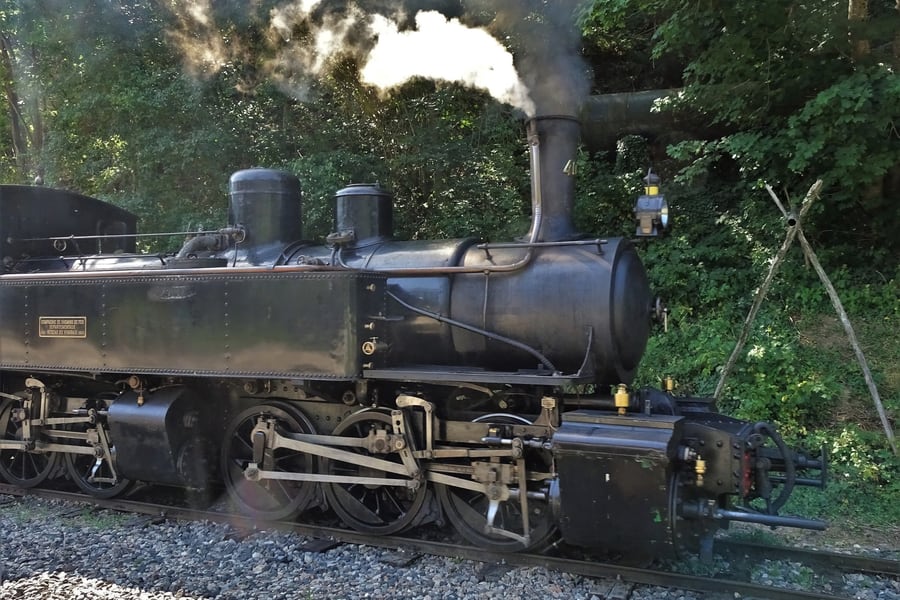
The railway is known for its articulated Mallet tank engines, designed for this line to the system of the Franco-Swiss engineer Anatole Mallet. No. 403 of 1903 is a listed historic monument and No. 414 dates from 1932; each develops 400 horsepower and can pull a train of more than 600 seats.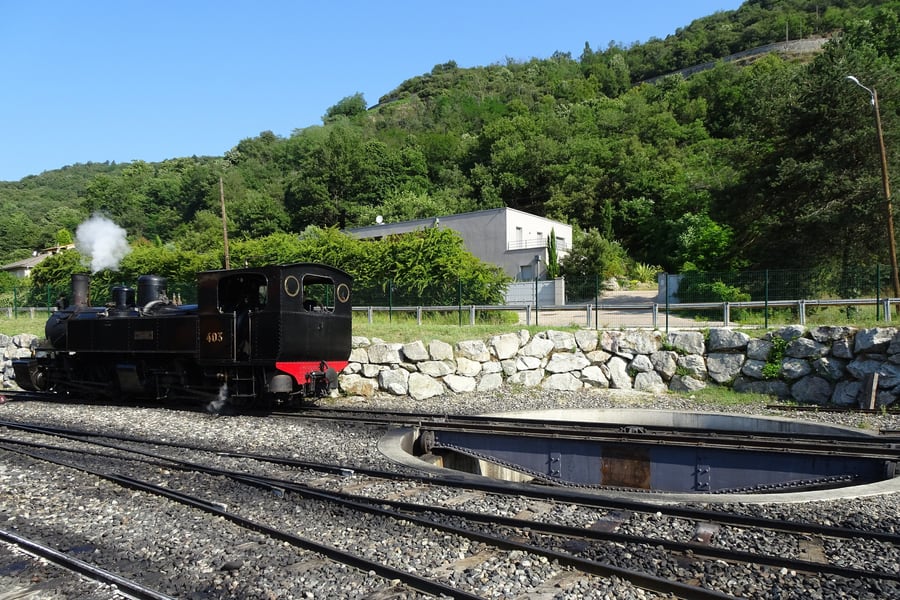 Celeda / Wikimedia Commons · CC BY-SA 4.0 · cropped
Turned by hand
At the end of each run the 44-tonne engine rolls onto a turntable and the crew push it round by hand to face the other way. On the Train des Gorges there are about twenty minutes at Colombier-le-Vieux to watch it before the climb back.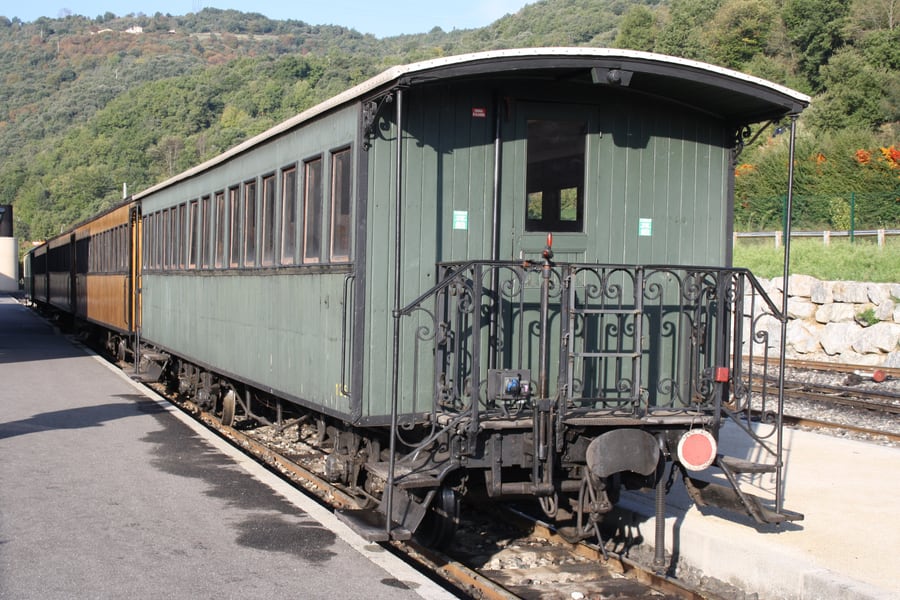 Roehrensee / Wikimedia Commons · CC BY-SA 4.0 · cropped
Varnished wood from Brittany
The oldest passenger coach in use dates from 1891 and came from Brittany in the 1970s with its sisters; others, built between 1903 and 1946, came from Swiss lines. Three first-class coaches keep their varnished panelling and velvet seats, for a supplement.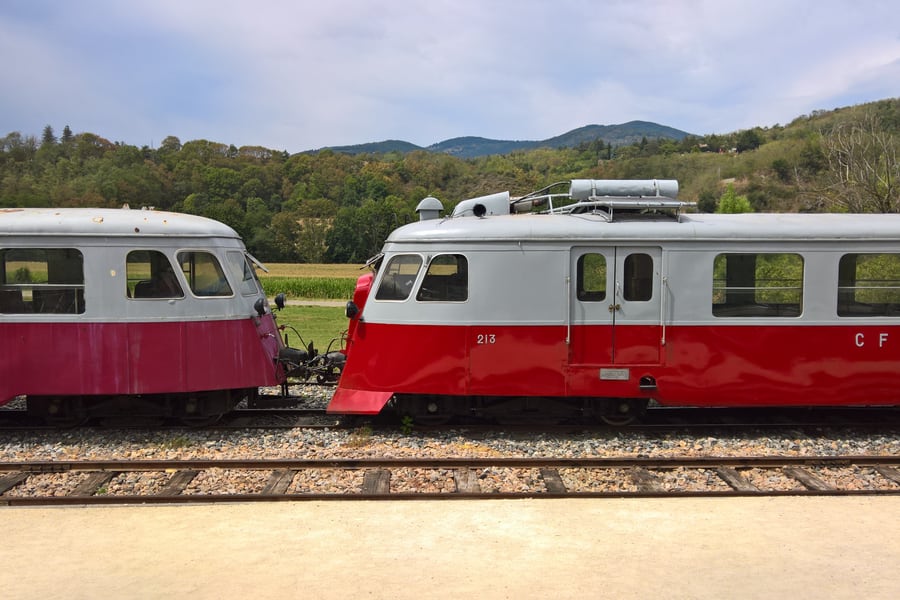 Antoine Boudon / Wikimedia Commons · CC BY-SA 4.0 · cropped
The Billard railcars
Billard railcars came to the line in 1938 to modernise its passenger service. Three have been restored in the railway's own workshops, and No. 213, red and silver, has been a listed historic monument since 1992.Timetables
The 2026 season has ended, and the operator has not yet published dates for 2027. The pattern below is the 2026 one; expect the 2027 season to start again in early April. Two Christmas trains run on 21 and 28 December 2026.
Train des Gorges — Tournon–Saint-Jean to Colombier-le-Vieux and back
| Departs Tournon–Saint-Jean | Back at Tournon–Saint-Jean |
|---|---|
| 10:00 | about 11:30 |
| 15:00 | about 16:30 |
In 2026 it ran from 2 April to 29 October, mostly on Tuesdays, Thursdays, Saturdays and Sundays, with extra days around the May holidays and in July and August. Depending on the date there is one departure, at 10:00 or 15:00, or both.
Mastrou — Tournon–Saint-Jean to Lamastre
| Tournon–Saint-Jean | Lamastre | |
|---|---|---|
| Up | 10:15 | about 12:00 |
| Down | about 17:00 | 15:15 |
In 2026 it ran from 5 April to 27 September: on Wednesdays and Sundays in April, on Wednesdays, Thursdays and Sundays from May to early July and in September, plus a few holiday Fridays and Mondays in May, and every day except Saturday from 13 July to 30 August.
Trains run in all weathers. There are no toilets on board, only at the stations, and the operator asks passengers to arrive 45 minutes before departure; seats are not numbered.
Getting there: the nearest SNCF station is Tain-l'Hermitage–Tournon, across the Rhône. Bus line 11 towards Saint-Félicien stops at Tournon–Saint-Jean on request, booked by 16:00 the day before on 04 28 70 79 75. The ViaRhôna cycle route has a signed greenway along the Doux to the station.
Times as of November 2026, from the operator's timetables and fares (opens in a new tab), which shows the day-by-day calendar. The operator may change the traction or cancel a departure in case of force majeure.
Tickets
Tickets are sold on the operator's website, at the Tournon–Saint-Jean and Boucieu-le-Roi stations, and at the tourist offices of Tournon, Tain-l'Hermitage, Saint-Félicien, Lamastre and Saint-Donat. Booking is not compulsory, but the operator advises buying ahead because seats are limited; it takes no bookings by phone.
Children under 10 travel free but still need a ticket; young people aged 10 to 13 pay a reduced fare. First class on the Mastrou costs a €9 supplement per person, children included. A bicycle or trailer costs €8 on the Mastrou, booked with the ticket. Groups of 20 or more have their own fare. Prices for the 2026 season, as of November 2026, from the operator.
Book your tickets
Train des Gorges
€18.50 adult · €10.50 aged 10–13 · under 10 free
The return trip into the gorges to Colombier-le-Vieux, about an hour and a half.
Book Tickets (opens in a new tab, on Train de l'Ardèche)via Train de l'ArdècheMastrou
€27.50 return · €23 one way · €9 first-class supplement
The whole line to Lamastre and back in a day, with a bicycle van on board.
Book Tickets (opens in a new tab, on Train de l'Ardèche)via Train de l'ArdècheRail Passes
Interrail passes are not valid on the Train de l'Ardèche. Interrail's table of railway companies does not list it; in France the pass covers SNCF and a few other operators, so it gets you to Tain-l'Hermitage–Tournon on a regional train, and you buy an ordinary ticket for the steam train.
The pass that does include it is the Pass'Ardèche, at €48 for three days, €68 for six and €98 for a year, which gets you into some 40 sites across the Ardèche, among them the Château-musée of Tournon. It covers only the Train des Gorges, not the Mastrou, and pays only if you plan to visit several of the other sites; for the train alone, buy the ticket.
Checked November 2026 against Interrail's table of railway companies (opens in a new tab) and the operator's Pass'Ardèche page (opens in a new tab).
Places to Visit
The line starts in the Rhône valley and ends in the hills, so a day on the Mastrou can take in a wine town on the river and a market town on the plateau. Tournon and Tain-l'Hermitage face each other across the Rhône, a short walk apart over the footbridge.
 PRA / Wikimedia Commons · CC BY 2.5 · cropped
Tournon-sur-Rhône
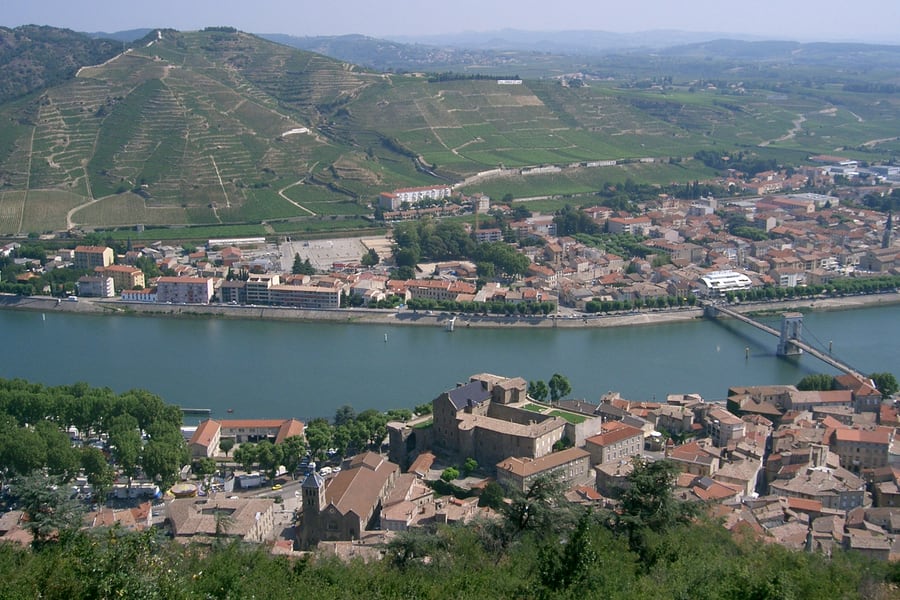
The town lies on the right bank of the Rhône, four kilometres from the station. Its château, built mostly in the fifteenth and sixteenth centuries, was the seat of the lords of Tournon, held a prison until 1926 and is now a museum; the suspension footbridge of Marc Seguin crosses the river to Tain-l'Hermitage.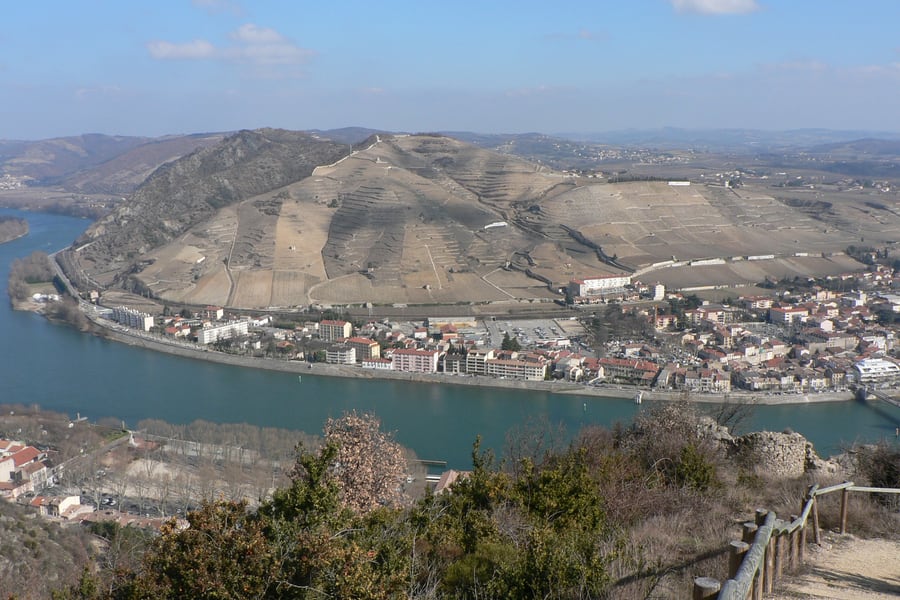 David.Monniaux / Wikimedia Commons · CC BY-SA 3.0 · cropped
The Hermitage hill
Facing Tournon on the left bank, the steep terraced hill above Tain-l'Hermitage gives its name to Hermitage, the red and white wine of the appellation shared between Tain-l'Hermitage, Crozes-Hermitage and Larnage. It is the view from the heights of Tournon and from the bridge.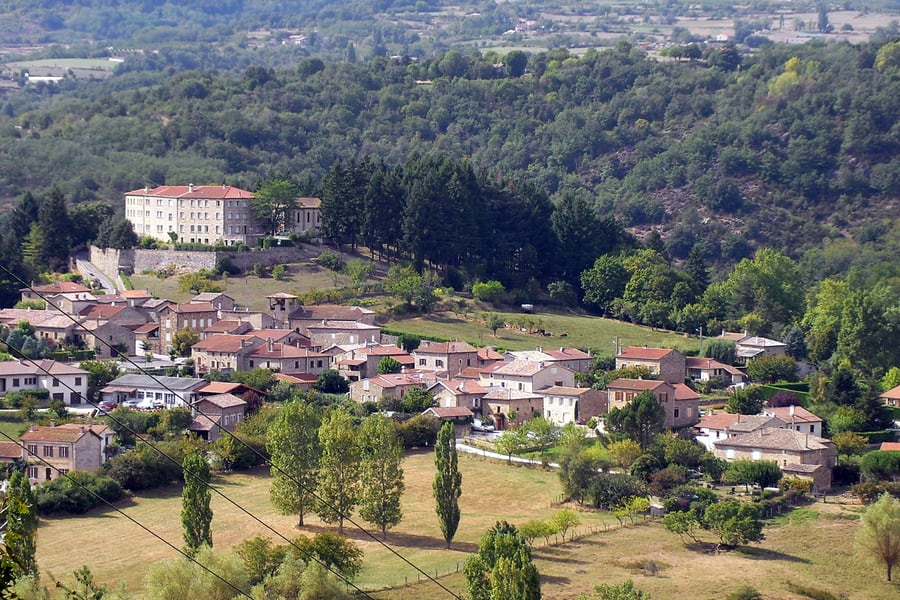 Sequajectrof Jacques Forêt / Wikimedia Commons · CC BY-SA 4.0 · cropped
Boucieu-le-Roi
The village stands above a wide meander of the Doux. The operator calls it "the village of a thousand secrets": it was once the capital of the Haut-Vivarais and takes its name from King Philip the Fair. Some Mastrou days the train can be joined or left here.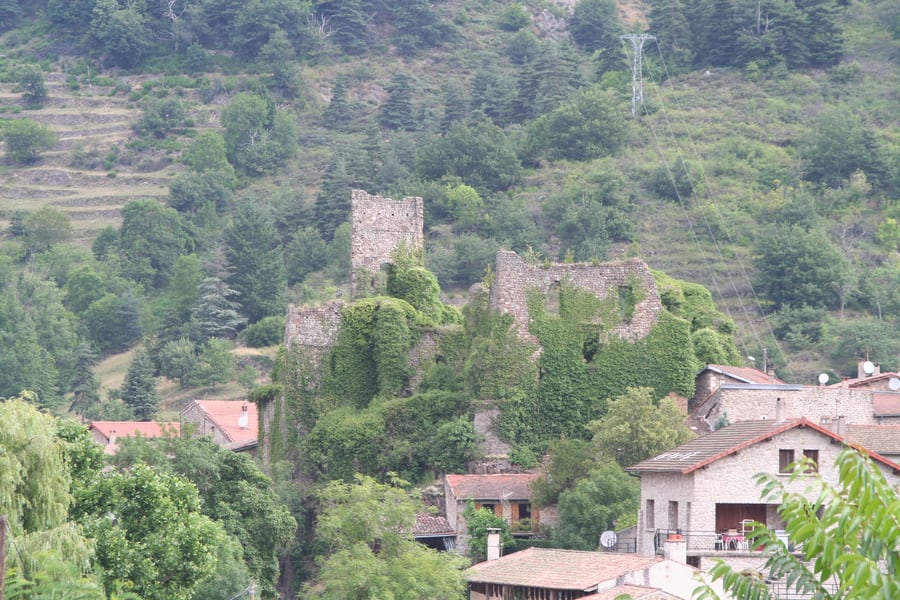 Charcutaille / Wikimedia Commons · CC BY-SA 3.0 · cropped
Lamastre and Retourtour
Lamastre is the market town at the top of the line, and its station connects with the Dolce Via cycle path. On a mound in a loop of the Doux stand the ruins of the castle of Retourtour, built in the tenth century by the Pagan-Retourtour family and left to decay after family quarrels over its succession in the fourteenth.Where to Sleep
Tournon-sur-Rhône is the place to stay: its hotels are a short drive or bus ride from the departure station, and Tain-l'Hermitage, across the river, has the SNCF station. Lamastre, at the top of the line, has a few smaller hotels and guest houses for anyone riding the Mastrou one way and going on by bicycle along the Dolce Via.
Where to stay
Hôtel de la Villeon
In Tournon-sur-Rhône
An eighteenth-century town house with sixteen rooms and a pool on terraced gardens facing the Hermitage vineyards.
Check Availability (opens in a new tab, on hoteldelavilleon.com)via hoteldelavilleon.comHôtel Le Château
On the Rhône quay at Tournon
A small hotel on Quai Marc Seguin, with rooms looking across the river to the Hermitage hill.
Check Availability (opens in a new tab, on hotel-le-chateau.fr)via hotel-le-chateau.frQuestions or corrections
Planning this trip and stuck on something, or spotted a time, fare or detail that has changed? Send us a message about Train de l'Ardèche. We read every one, and we update this page when something has changed.