El Transcantábrico
Xuliu Pombar / Wikimedia Commons · CC0
- DistanceSan Sebastián–Santiago de Compostela
- Duration8 days / 7 nights
- Best seasonSpring to autumn
Introduction
Most people picture Spain as sun and dust. The north is the other Spain — a green, rain-fed coast of pastureland and cider apples, where the Atlantic breaks on cliffs and the Picos de Europa rise almost straight out of the sea. It has its own railway, too: a narrow, metre-gauge line that threads the whole coast, built for coal and fishing villages rather than for speed.
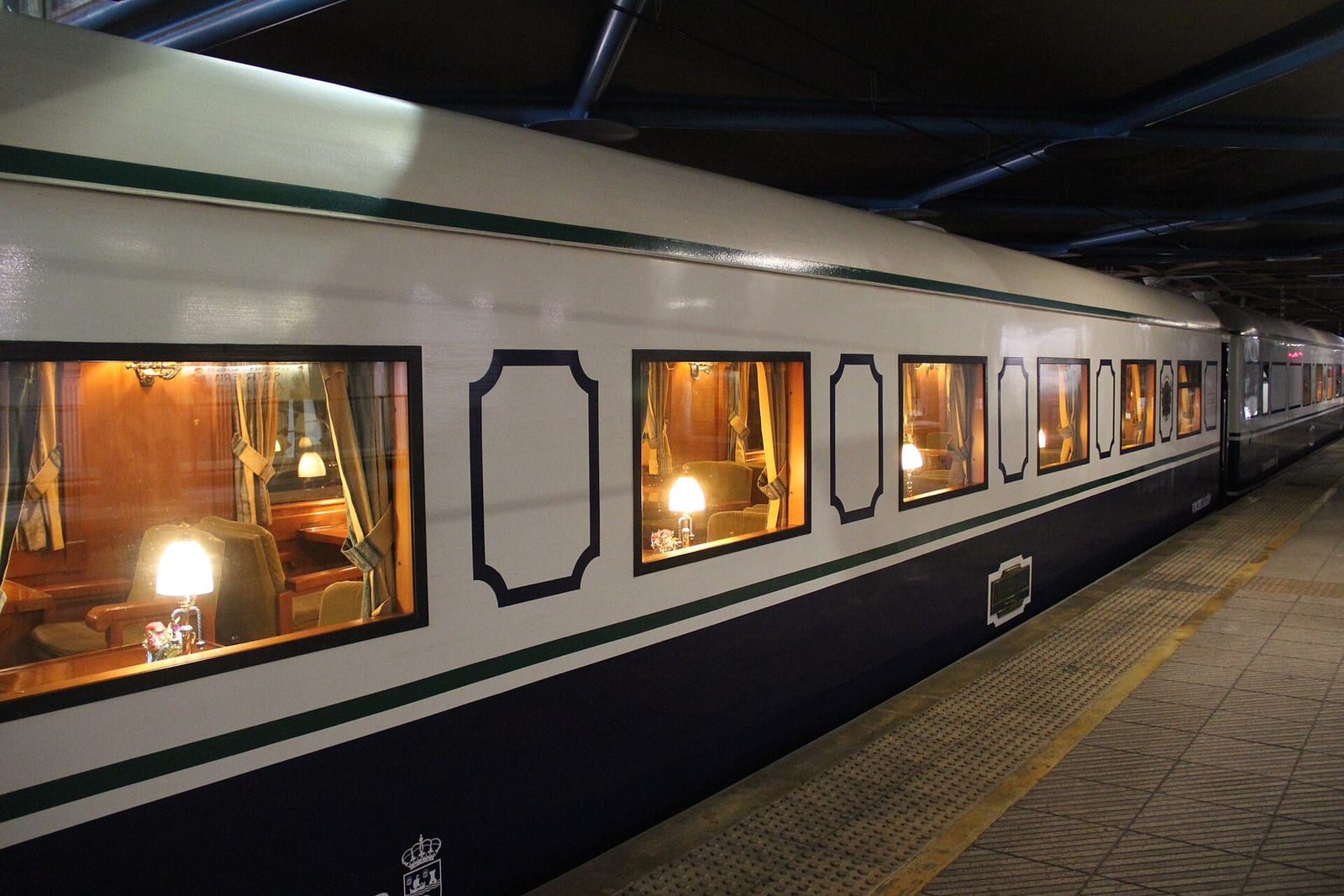
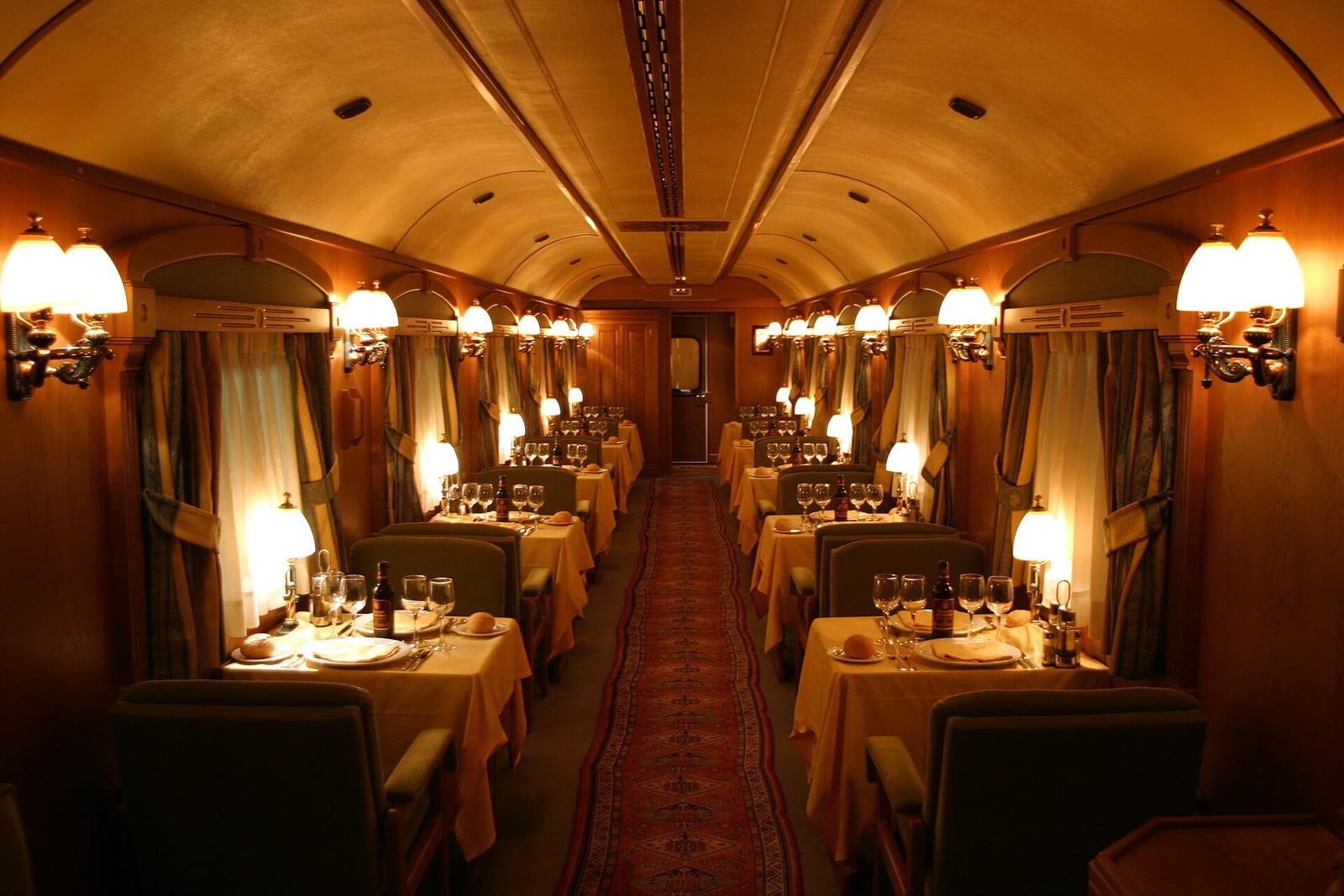
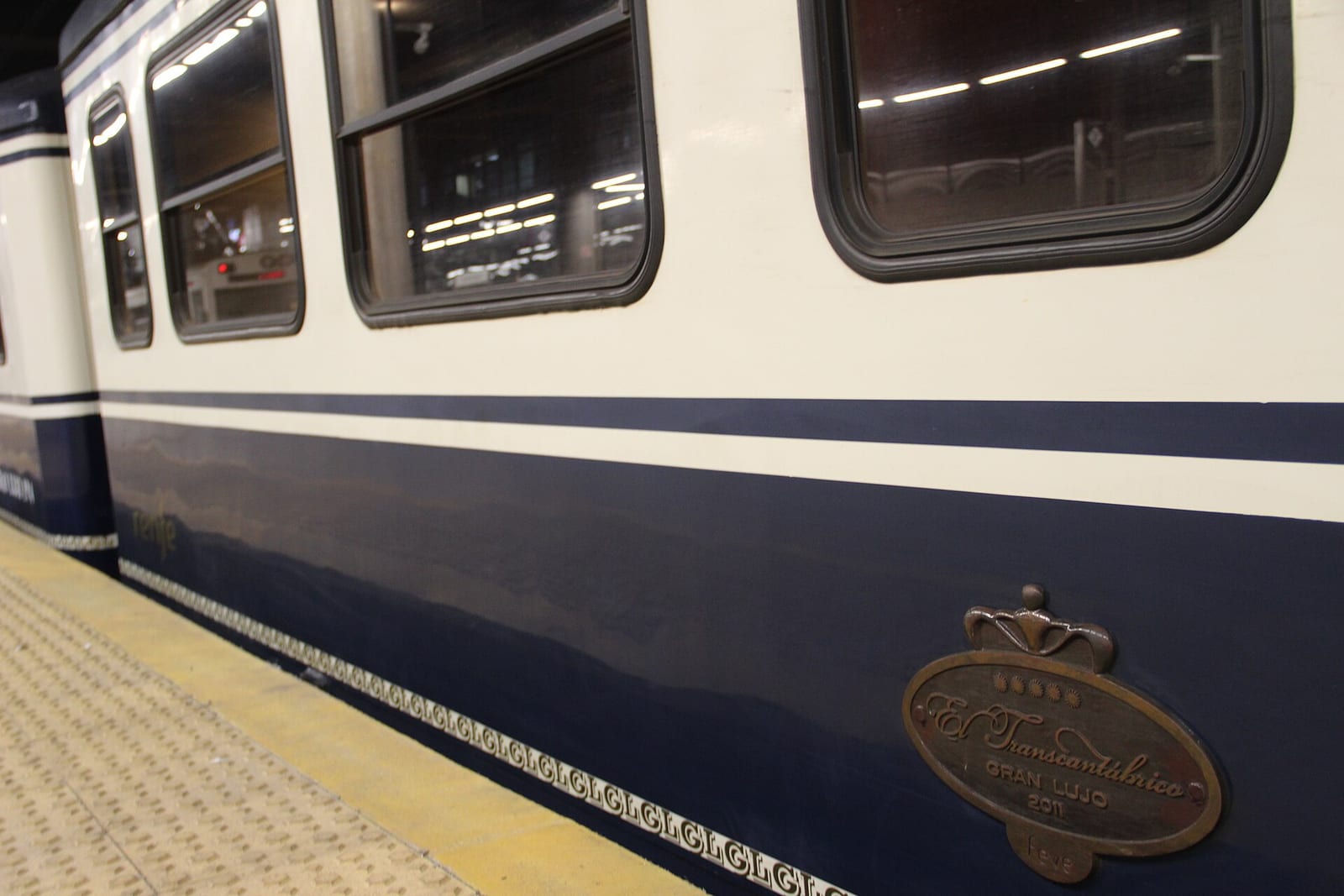
Since 30 July 1983, one train has been making that line famous. El Transcantábrico is less a service than a hotel on rails — it takes eight unhurried days to cross from the Basque Country to Galicia, and it is in no hurry whatsoever. The Gran Lujo version carries just 28 guests in fourteen suites, and its lounge and dining cars are genuine British Pullmans built in 1923, a century old and still laying up white linen every evening.
The trick of it is that the train barely travels at night. It runs short, scenic distances by day, parks in a station while you sleep, and sends you off each morning by coach to the things the rails can't reach — the Guggenheim, the caves of Altamira, the Picos. You wake up somewhere new without ever having been rocked awake. It has been called one of the most luxurious trains in the world, and it earns it not through speed but through the opposite: a whole week to travel a coast most people cross in an afternoon.
The Journey
The journey is sold as San Sebastián to Santiago de Compostela (or the reverse), and it is worth knowing how that actually works: the train's rail termini are Bilbao-Concordia and Ferrol, and a luxury coach carries you the last stretch at each end. That coach is not an afterthought — it shadows the train all week, and it is what makes the whole thing possible.
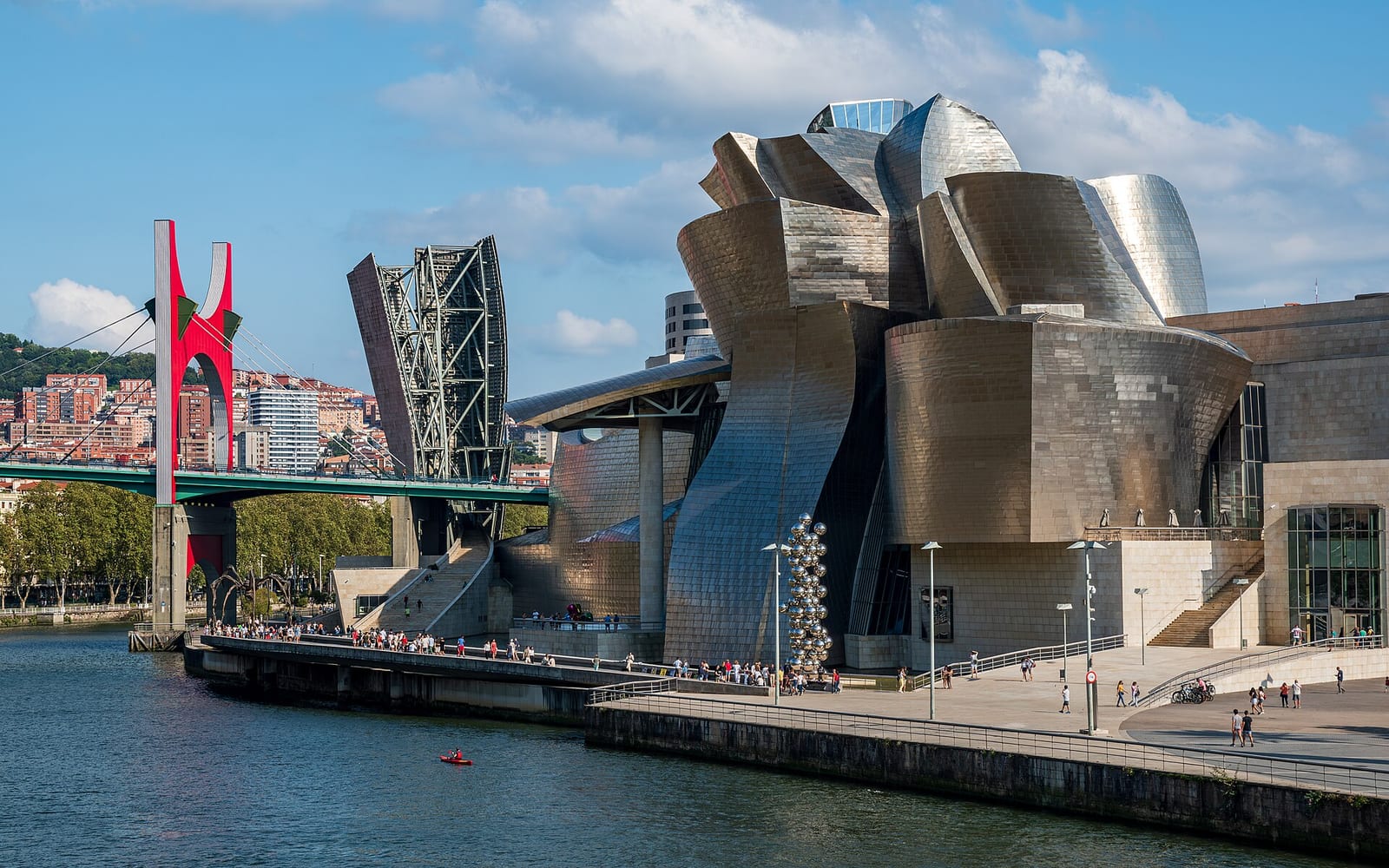
Day one begins in San Sebastián, arguably the best place to eat in Europe, before the transfer to Bilbao where the train is waiting. Gehry's titanium Guggenheim is the first excursion, and then you board: a suite, a Pullman lounge, dinner, and the discovery that the train will simply sit quietly in the station while you sleep.
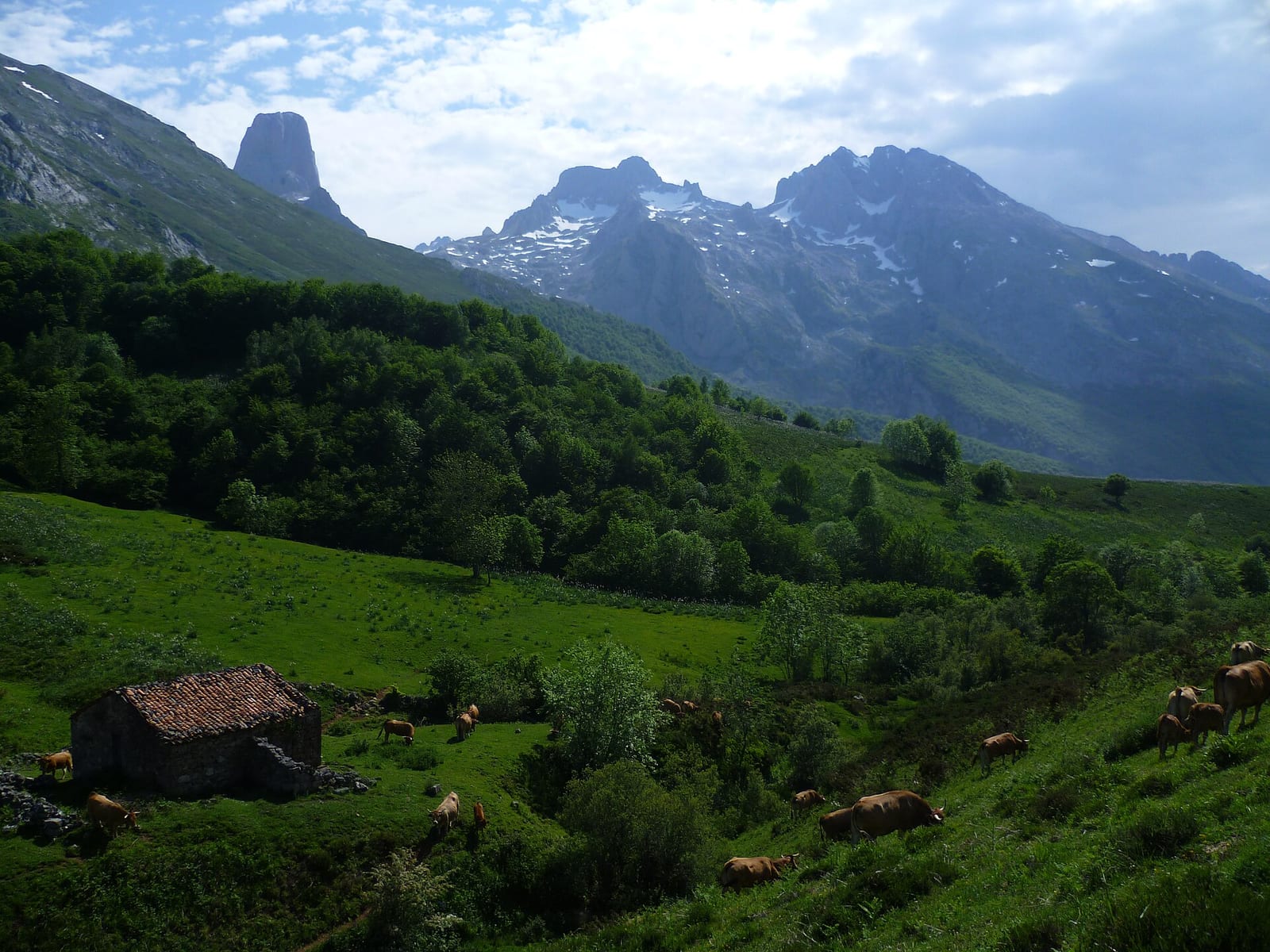
From Bilbao the line turns west and becomes wonderful. It climbs inland through the Valle de Carranza, then drops back to the coast for Santander and the Cantabrian shore — the medieval streets of Santillana del Mar, the astonishing painted bulls of the Altamira cave replica, Gaudí's playful El Capricho at Comillas. The mountains close in around Llanes, where the Picos de Europa stand a few kilometres inland, grey and vertical above green meadows.
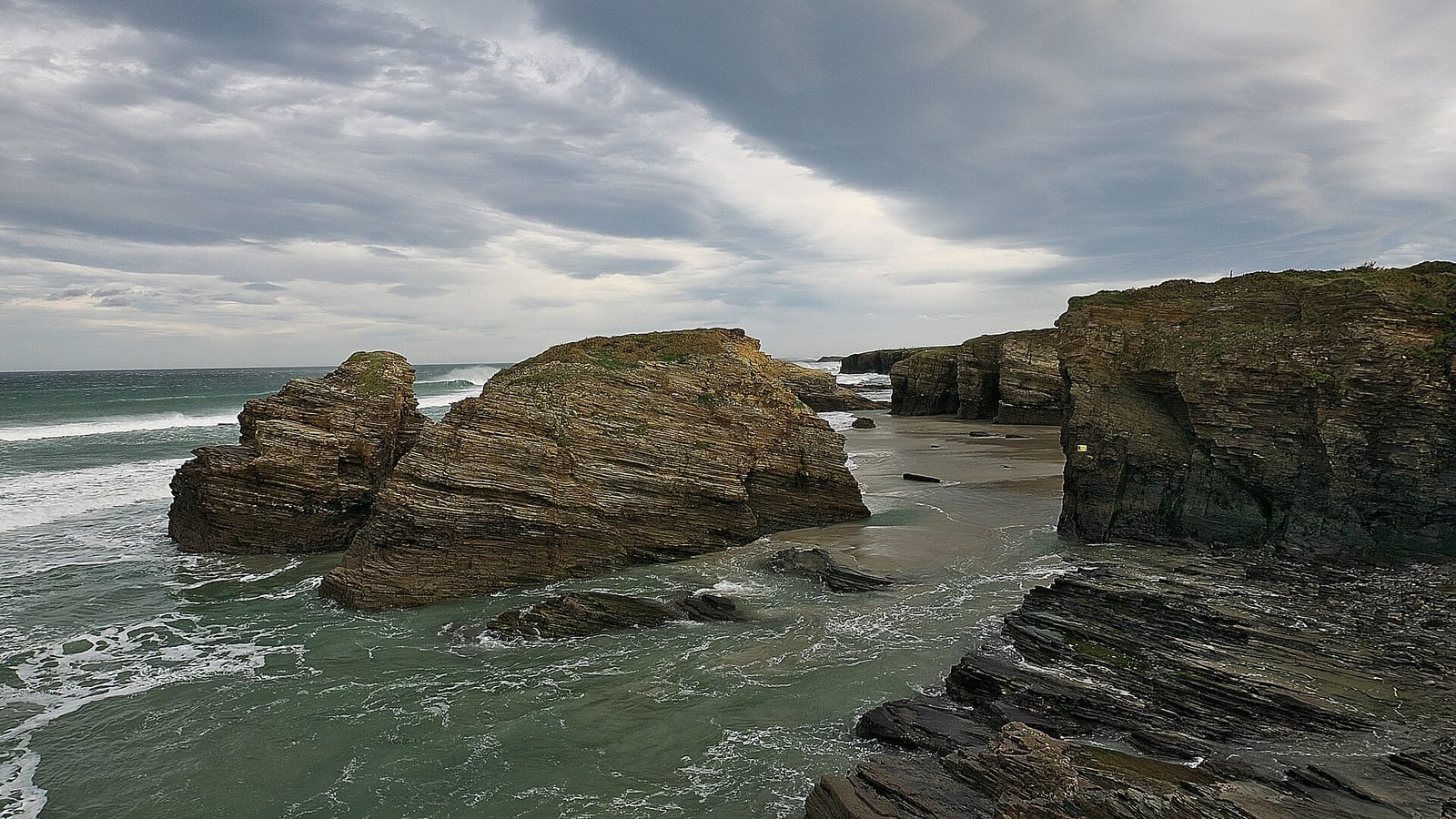
Into Asturias, the train reaches Oviedo, a handsome city of pre-Romanesque churches and cider poured from a great height. Then Luarca, a fishing town tucked into a ravine, and the long, lovely run into Galicia — a coast of estuaries and small ports, ending at Ribadeo with the Playa de las Catedrales, where the Atlantic has cut flying buttresses and arches into the cliffs, walkable only at low tide.
The last morning brings breakfast as the train rolls into Ferrol, and a final transfer to Santiago de Compostela, where a thousand years of pilgrims have finished their own, considerably harder, journey. You arrive at the cathedral having walked almost none of it — which, after a week of Pullman dinners, feels like exactly the right way to end.
Along the route
Xuliu Pombar / Wikimedia Commons · CC0A hotel on metre-gauge rails
The Gran Lujo carries just 28 guests in 14 suites of 12.8 m², each with a proper bed and a private bathroom — and because the train parks overnight in a station, you sleep in silence and stillness rather than to the rattle of the rails.Simon Pielow / Wikimedia Commons · CC BY-SA 2.01923 Pullmans
The lounge and dining cars are genuine British Pullman saloons built in 1923 — a century old and still working every evening, all marquetry, lamps and white linen. They are the soul of the train.AnaisGoepner / Wikimedia Commons · CC BY-SA 4.0Green Spain, coast to coast
This is the Spain of rain and pasture: the Basque Country, Cantabria, Asturias and Galicia, where the Picos de Europa fall almost into the Atlantic and the cider houses and seafood are as much the point as the scenery.A bit of history
Culture & experiences along the way
 Basotxerri / Wikimedia Commons · CC BY-SA 4.0 · cropped
Dinner in a century-old Pullman
Northern Spain is arguably the best place to eat in Europe, and the train leans into it — Basque pintxos, Cantabrian anchovies, Asturian cider and cheese, Galician seafood, with regional wines poured throughout. It is all included.José Ligero Loarte / Wikimedia Commons · CC BY-SA 4.0Off the train every day
A luxury coach shadows the train the whole way, so each day brings excursions the rails can't reach — the Guggenheim, the Altamira cave replica, medieval Santillana del Mar, Gaudí's Capricho at Comillas, the Picos de Europa.Jl FilpoC / Wikimedia Commons · CC BY-SA 4.0The road to Santiago
The journey ends where a thousand years of pilgrims have ended theirs — at the cathedral of Santiago de Compostela — by way of the extraordinary sea-carved arches of the Playa de las Catedrales at Ribadeo.Timetables
El Transcantábrico is not a scheduled service you can turn up for — it is an all-inclusive package with fixed departure dates, run by Renfe across a defined season. Departures run on set dates (roughly weekly) from about April to October, so pick a date first and build the trip around it.
| Detail | What to expect |
|---|---|
| Route | San Sebastián ⇄ Santiago de Compostela (both directions) |
| Duration | 8 days / 7 nights — plus a shorter 4-day / 3-night option |
| Train termini | Bilbao-Concordia ⇄ Ferrol; luxury coach covers each end |
| Guests | 28 in the Gran Lujo (14 suites); the Clásico carries 54 |
| Gauge | Metre gauge (1,000 mm) — the narrow northern network |
Good to know:
- You sleep in a station, not in motion. The train parks overnight, so nights are silent and still — unusual, and one of the best things about it.
- The days are short on rails, long on excursions. Running distances are modest; most of each day is spent off the train with a guide.
- Everything is included — meals, regional wines, excursions, entry fees and the coach.
- Departures are limited and sell out. With only 28 places on the Gran Lujo, dates go a long way ahead — book many months in advance.
- Pack for green Spain. This coast is green because it rains; bring a layer and something waterproof even in high summer.
Season and dates as of 2026. Confirm the dated departure calendar with the operator — see the Tickets section below.
Tickets
This is a package, not a ticket, booked through Renfe's luxury trains department, and the price covers essentially the whole week: the suite, all meals and regional wines, every excursion, and the coach that follows the train. The headline trip is eight days and seven nights between San Sebastián and Santiago de Compostela, with twenty-eight guests in fourteen suites; a four-day version covers a shorter section of the coast for those who cannot spare a week. Fares are seasonal, so Renfe holds the live price.
Two things to check. The Gran Lujo and the Clásico are different trains — Gran Lujo carries 28 guests in larger suites, the Clásico 54 in smaller cabins — so confirm which one your date is. And ask early if you are travelling alone: suite configurations are limited and supplements vary a lot by departure.
Book your tickets
Gran Lujo · 8 days
San Sebastián ⇄ Santiago
The full journey: seven nights aboard in a Gran Lujo suite, with all meals, regional wines, daily excursions and the accompanying luxury coach included. Just 28 guests. Booked as a package through Renfe's luxury trains department.
Book Tickets (opens in a new tab, on Renfe)via RenfeShort route · 4 days
A taste of the coast
A shorter three-night option over part of the route — the same train, suites and Pullman dining, for travellers who can't give the coast a full week.
Book Tickets (opens in a new tab, on Renfe)via RenfeRail Passes
No rail pass covers El Transcantábrico. Interrail's table of railway companies names RENFE Luxury trains among the trains excluded in Spain. The train is sold only as a package through Renfe.
A pass can still bring you to San Sebastián or home from Santiago. RENFE's long-distance trains are included in Spain, with compulsory reservations from €6.50 on an Alvia or Intercity and €10 on the AVE, in second class.
Checked October 2026 against interrail.com (opens in a new tab) and its reservation fees (opens in a new tab).
Places to Visit
The excursions are the journey as much as the train is, and they cover four regions of "Green Spain" in a week.
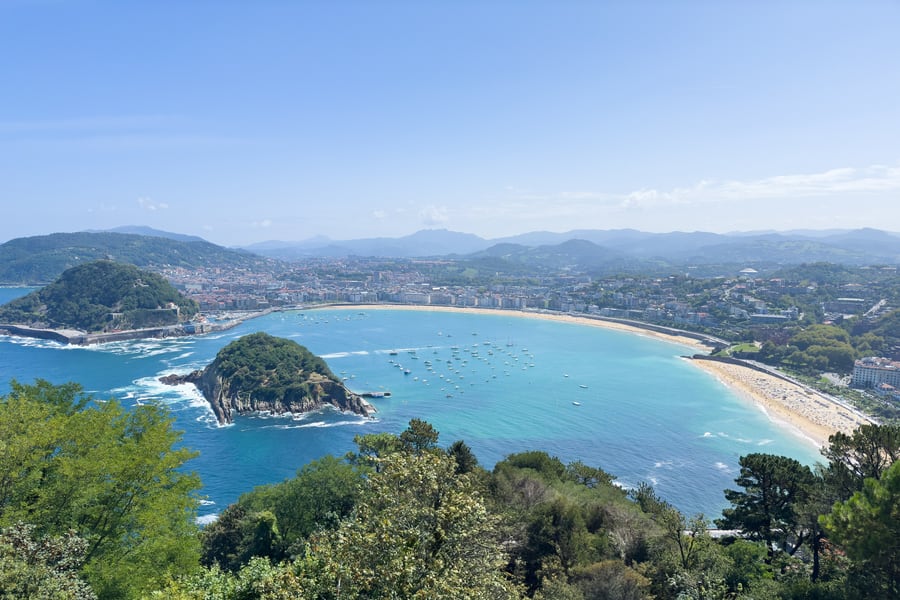
- San Sebastián — where it starts: a perfect shell-shaped bay, an old town wall-to-wall with pintxos bars, and more Michelin stars per head than almost anywhere on earth.
- Bilbao — reinvented around Gehry's titanium Guggenheim, one of the buildings that changed what a museum could be, and still startling from the riverbank.
- Santillana del Mar — a small, impossibly well-preserved medieval town of cobbles and stone manor houses, and next door the Altamira cave replica with its 20,000-year-old painted bison.
- Comillas — for El Capricho, an early Gaudí villa dressed in sunflower tiles, as playful as anything he built in Barcelona.
- The Picos de Europa — a wall of limestone a few kilometres from the sea, with gorges, cable cars and the famous blue cheese of Cabrales ripened in mountain caves.
- Oviedo — the Asturian capital: elegant streets, slender pre-Romanesque churches on the hill above, and cider poured theatrically from arm's length.
- Playa de las Catedrales — near Ribadeo, where the Atlantic has carved arches and buttresses into the cliff. Walkable only at low tide, and unforgettable when it is.
- Santiago de Compostela — the end: a granite city built around the cathedral where the Camino finishes, at its best in the rain, when the stone shines.
 Kent Wang / Wikimedia Commons · CC BY-SA 4.0 · cropped
La Concha
The Bahía de la Concha is a near-perfect shell of a bay, all but closed off by Santa Clara island, with Monte Igueldo at one end and Monte Urgull at the other — which is why the city looks the way it does the moment you get above it. San Sebastián sits on the Bay of Biscay about 20 kilometres from the French border, and the old town behind the sand is wall-to-wall pintxos bars.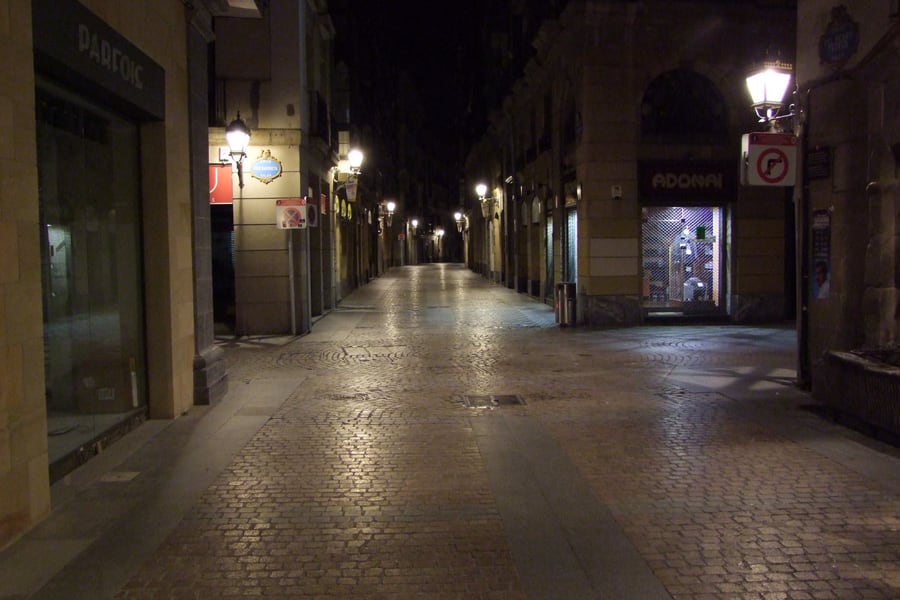 Andrzej Harassek / Wikimedia Commons · CC BY-SA 3.0 · cropped
Bilbao's Casco Viejo
Before the titanium, Bilbao was this — the Siete Calles, the seven medieval streets on the right bank that were the original town. Arcades, shuttered fronts, a covered market down at the river, and cobbles that shine after rain, which in Biscay is most of the time. Come early enough and you get the whole quarter to yourself, which is easily the best hour of the day to see it.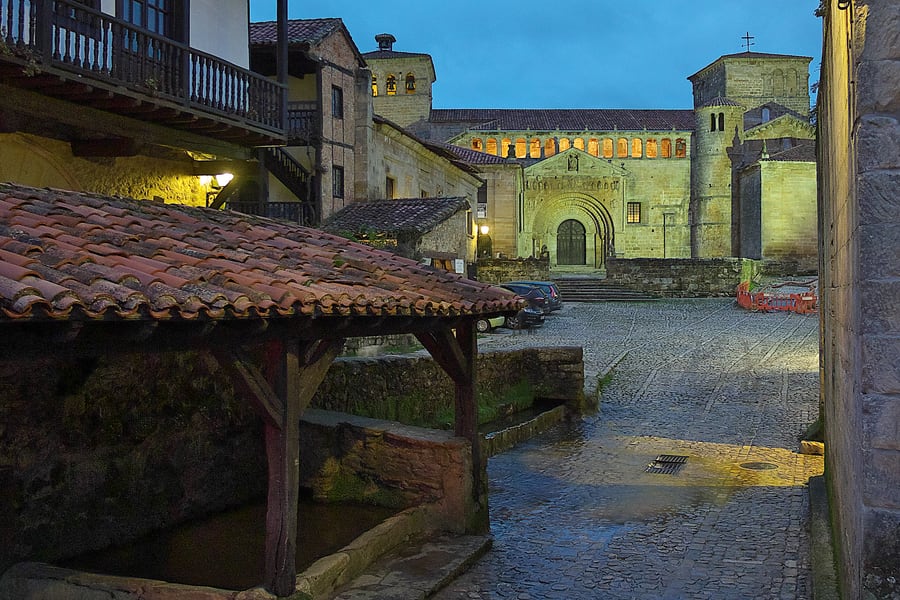 José Luis Filpo Cabana / Wikimedia Commons · CC BY 3.0 · cropped
Santillana del Mar
Known as the town of three lies — not holy, not flat, and not on the sea — though the name in fact comes from Santa Juliana, whose remains lie in the Romanesque Colegiata at the end of the main street. The whole place is a few lanes of cobbles and stone manor houses. The Altamira cave is next door; the original was closed to protect the paintings, and visitors now see a replica.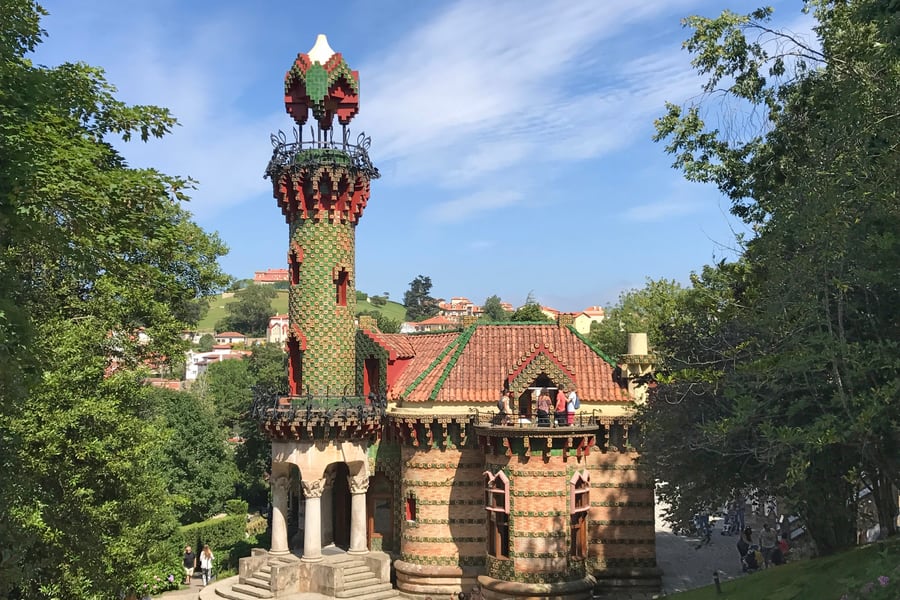 Triplecaña / Wikimedia Commons · CC BY-SA 4.0 · cropped
El Capricho
One of very few Gaudí buildings anywhere outside Catalonia, built in 1883–1885 for Máximo Díaz de Quijano — who died the year before it was finished. It belongs to Gaudí's orientalist period, and it shows: a minaret of a tower sheathed in sunflower tiles, standing over a low villa of brick and ceramic. Playful, faintly absurd, and unmistakably his work.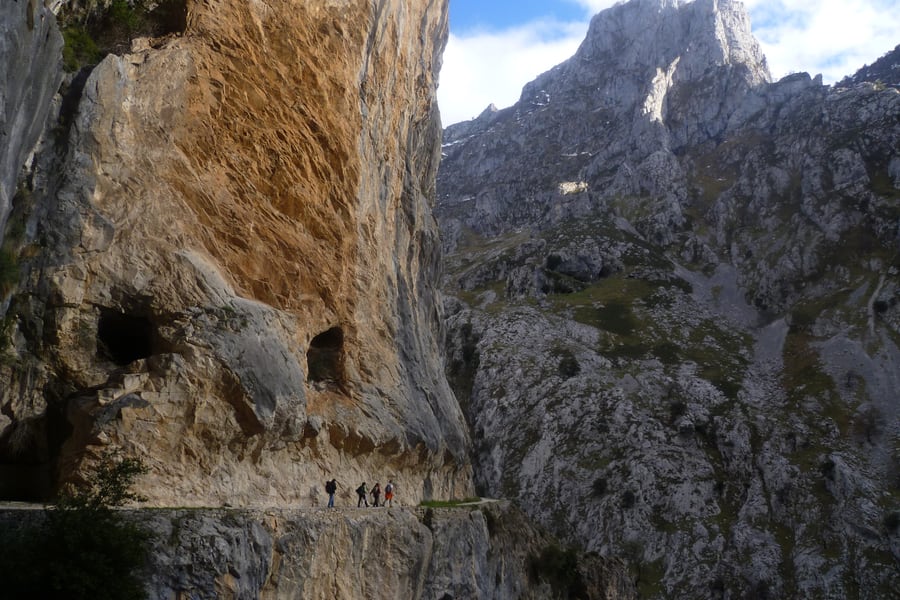 AnaisGoepner / Wikimedia Commons · CC BY-SA 4.0 · cropped
The Cares gorge
The Ruta del Cares is the classic Picos walk — a path cut into the sheer wall of the Cares canyon between Poncebos in Asturias and Caín in León, which in the snow months was once the only link between the two. It runs high and almost level above the river, through short tunnels in the rock. Cabrales, the blue cheese, is made from milk from these same mountains.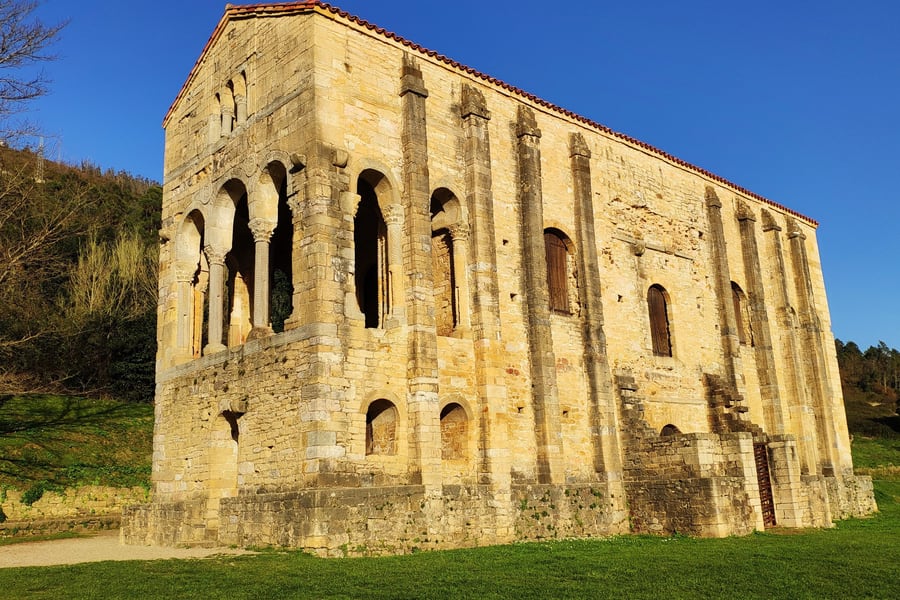 Alonso de Mendoza / Wikimedia Commons · CC BY-SA 4.0 · cropped
Santa María del Naranco
Three kilometres up the hill from the city, this was raised as a royal palace for Ramiro I of Asturias — completed in 842 and consecrated as a church in 848 — and its barrel vault with transverse ribs makes it a clear forerunner of Romanesque building. San Miguel de Lillo stands a hundred metres off. Small, severe, and a great deal older than it looks.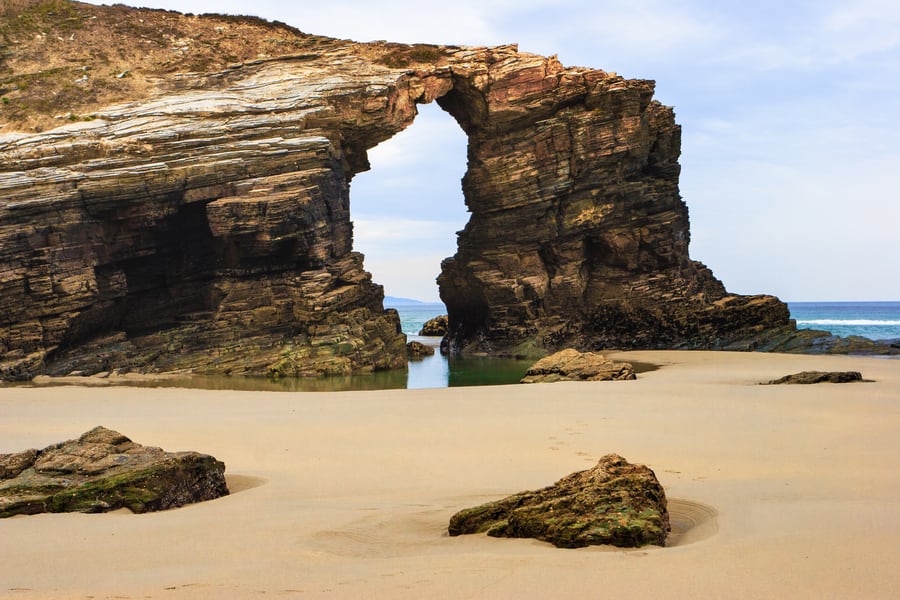 Pedro M. Martínez Corada / Wikimedia Commons · CC BY-SA 3.0 ES · cropped
Playa de las Catedrales
The Atlantic has cut arches and buttresses out of this stretch of Galician cliff, and at low water you can walk out across the sand and stand underneath them — which is where the cathedral comparison comes from. At high tide it is simply a rock coast with the sea against it and the arches out of reach. Check the tide tables first, because the difference between the two is the entire visit.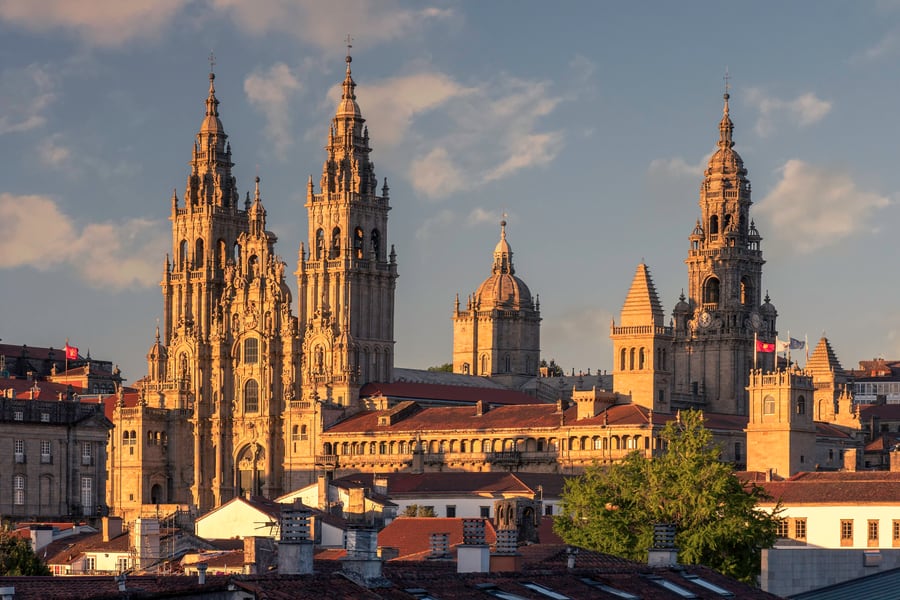 Fernando Pascullo / Wikimedia Commons · CC BY-SA 4.0 · cropped
Santiago de Compostela
The cathedral is the reputed burial place of St James, and one of only a handful of churches anywhere built over an apostle's tomb — which is the whole reason the Camino finishes here. Pilgrims arrive into the Praza do Obradoiro all day long. Granite everywhere, and the city really is at its best in the rain, when the stone darkens and starts to shine.Where to Sleep
For seven of the eight nights the question doesn't arise — you sleep on the train, in a suite, in a quiet station. The Gran Lujo's fourteen suites run to about 12.8 m², with a proper double or twin bed, a sitting area and a private bathroom; it is a hotel room that happens to have wheels.
What you do need to think about is the nights on either end.
- San Sebastián — worth arriving a day or two early. Stay in the Parte Vieja for the pintxos crawl, or along La Concha for the bay. It is not a cheap city, and in summer it is a busy one — book ahead.
- Bilbao — an alternative first base, with more choice and better value, and the Guggenheim on the doorstep.
- Santiago de Compostela — stay a night at the end rather than rushing off. The old town is compact and granite and lovely, and the Hostal dos Reis Católicos on the cathedral square has been putting up travellers since 1499 — one of the oldest hotels in the world.
- Oviedo or Santander — good stops if you want to extend the trip into the Picos or along the Cantabrian coast afterwards.
Northern Spain is busiest in July and August, and Santiago fills around the Feast of St James (25 July) — plan around those if you can.
Questions or corrections
Planning this trip and stuck on something, or spotted a time, fare or detail that has changed? Send us a message about El Transcantábrico. We read every one, and we update this page when something has changed.