The Tren de la Fresa — the carriages that Westerns saved
Ivan Gonzalez / Wikimedia Commons · CC BY-SA 3.0 · cropped
- DistanceMadrid Delicias–Aranjuez · 49 km each way
- DurationAbout 1 hour each way · a full day out
- Best seasonWeekends in spring and autumn · one train a day, 10:00 from Delicias
Introduction
Four wooden carriages on this train are alive today because Spain once needed somewhere to shoot Westerns.
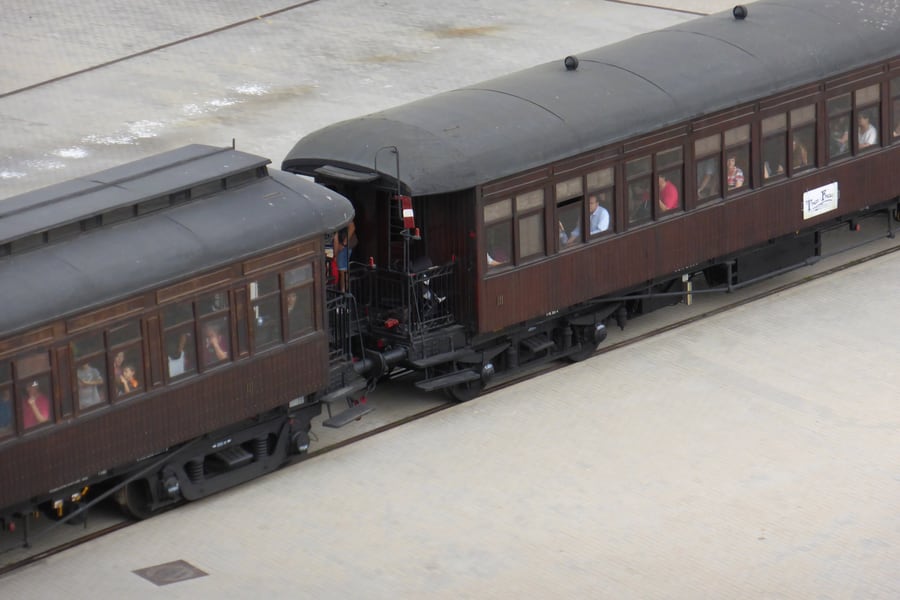
They were built for the Compañía de los Ferrocarriles de Madrid a Zaragoza y Alicante between 1914 and 1930, for suburban work — plain wooden vehicles with open balconies at each end, gas lighting and steam heat, the sort of stock that gets used up and quietly cut apart. MZA built them in wood on purpose: the company reckoned metal carriages too hot for its southern lines. They ran until the late 1960s, by which time they were finished, and nothing about them was worth preserving to a railway that had moved on.
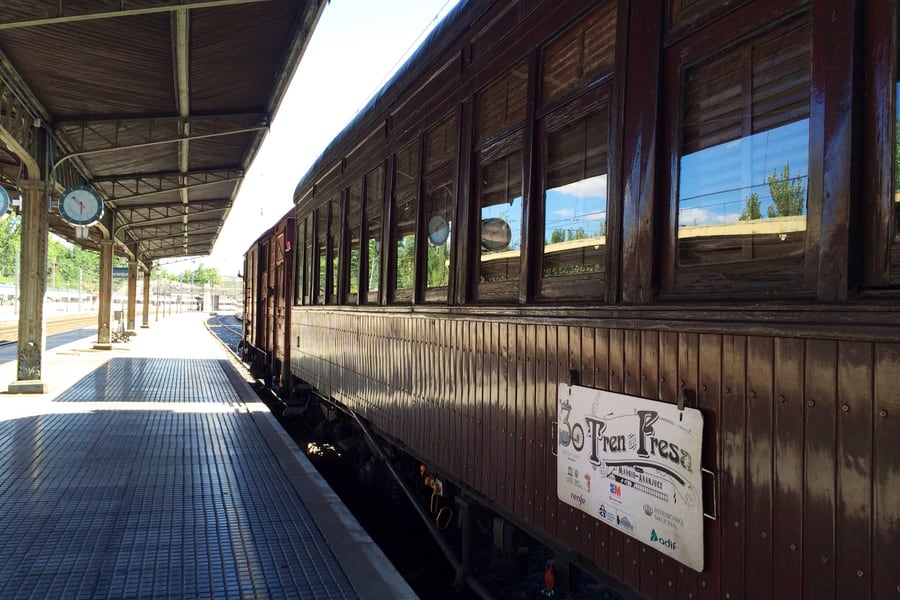
What saved them was the cinema. Spain in the 1960s was making Westerns in industrial quantities, and a film crew needs period rolling stock more urgently than a railway needs to keep it. Four of these carriages were held back for film work, and it is only because of that detour through the studios that they survived long enough for anyone to want them back. They are called coches Costa, after the Catalan coast services they once worked — Barcelona to Mataró, Sitges — and today they are the body of the Tren de la Fresa.
The oldest railway in Madrid
The line they run on is older than they are by seventy years. The Madrid–Aranjuez railway opened on 9 February 1851, forty-nine kilometres from the capital to the royal summer residence on the Tagus. It was the second line built on the Iberian peninsula, after Barcelona–Mataró in 1848, and the first anywhere in the region of Madrid — which makes 2026 its 175th year.
It was promoted by the Marqués de Salamanca, whose Sociedad del Ferrocarril de Madrid a Aranjuez was formed in December 1845 with a capital of forty-five million reales. Queen Isabel II presided at the opening, having given up land of her own west of the Royal Palace so the railway could reach the town, and more than a thousand guests attended a celebration that Salamanca paid for out of his own pocket. Three months later the line was taking fifty thousand reales a day.
What it carried, besides passengers, is the reason the train has the name it does. The market gardens along the Tagus at Aranjuez grew strawberries and asparagus, and the railway got them to Madrid while they were still worth eating. Hostesses in period dress still hand strawberries round the carriages on the way home.
What the journey is now
The tourist train first ran on 27 May 1984, out of Atocha behind a Mikado. It leaves today from Madrid Delicias — the 1880 terminus that is now the Museo del Ferrocarril, and the oldest station in Madrid still standing in its original design — at 10:00, and reaches Aranjuez about an hour later. The return leaves in the early evening and is back in Madrid by half past seven, which makes the whole thing a day out rather than a transfer.
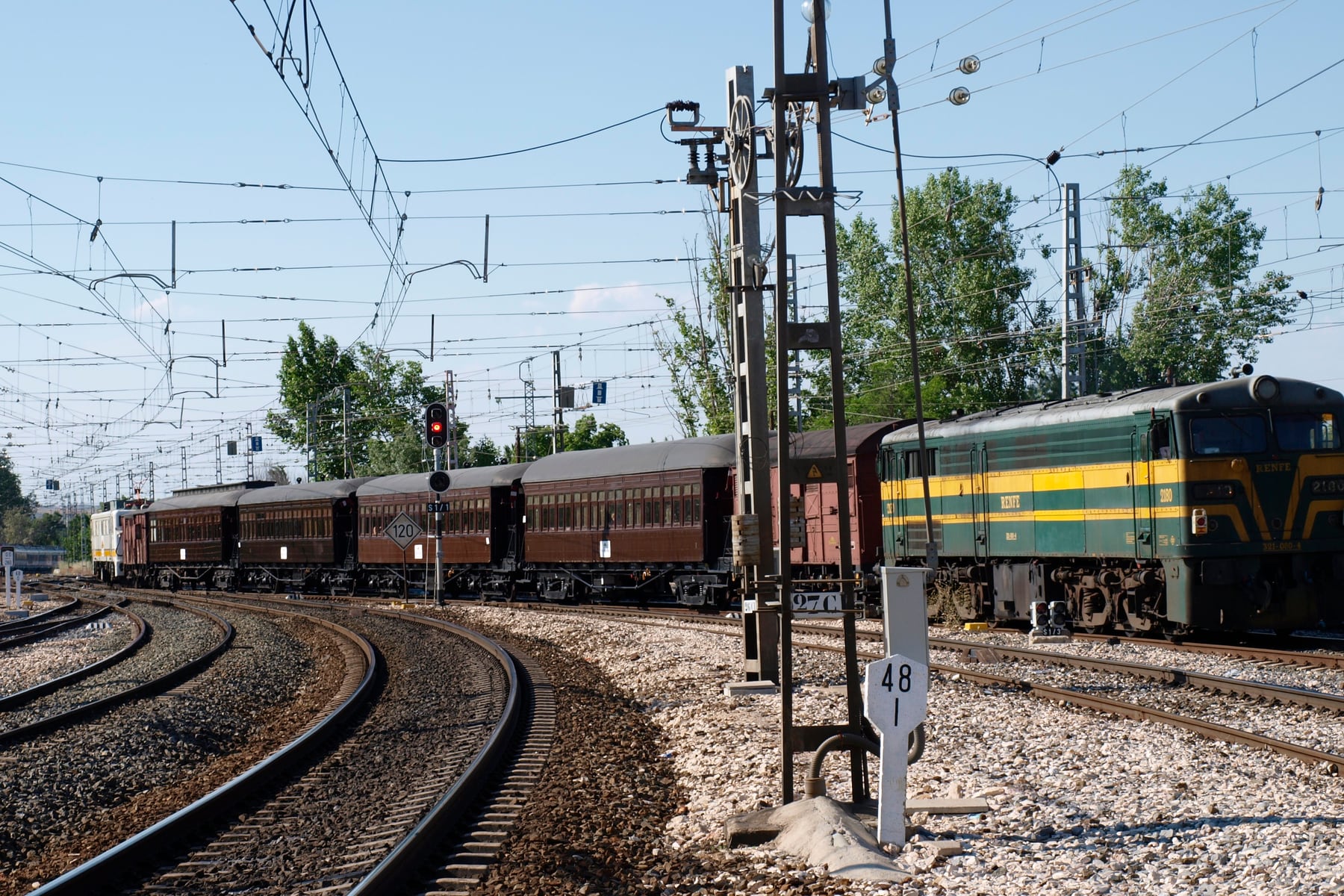
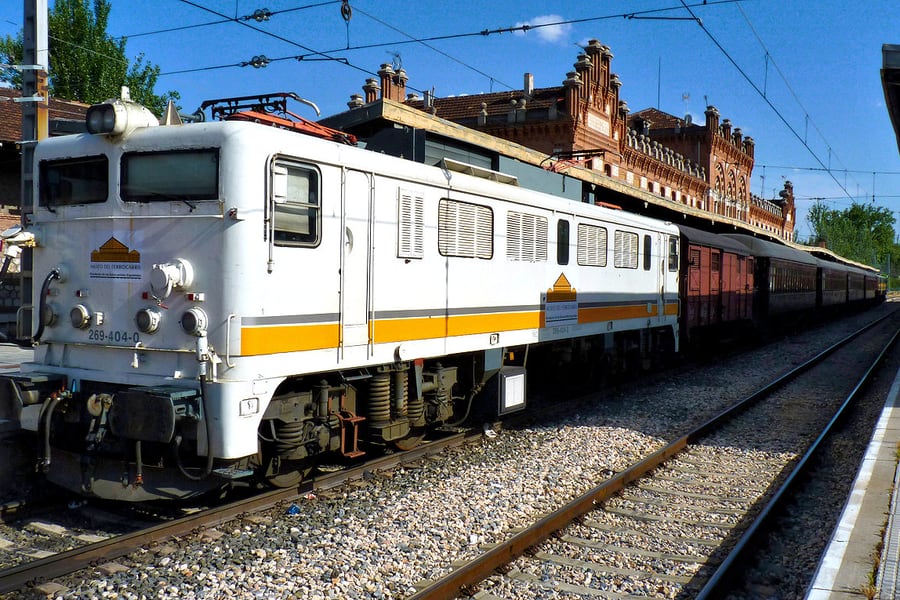
Behind the locomotive there are the four Costa carriages, a metal side-corridor coach of the late 1940s, and two vans: a 1960s box wagon that does duty as the service, power and workshop vehicle, and a guard's van with vigías — the little bay windows that let a guard watch his train without standing out in the weather. Three hundred and eighty-five seats in total.
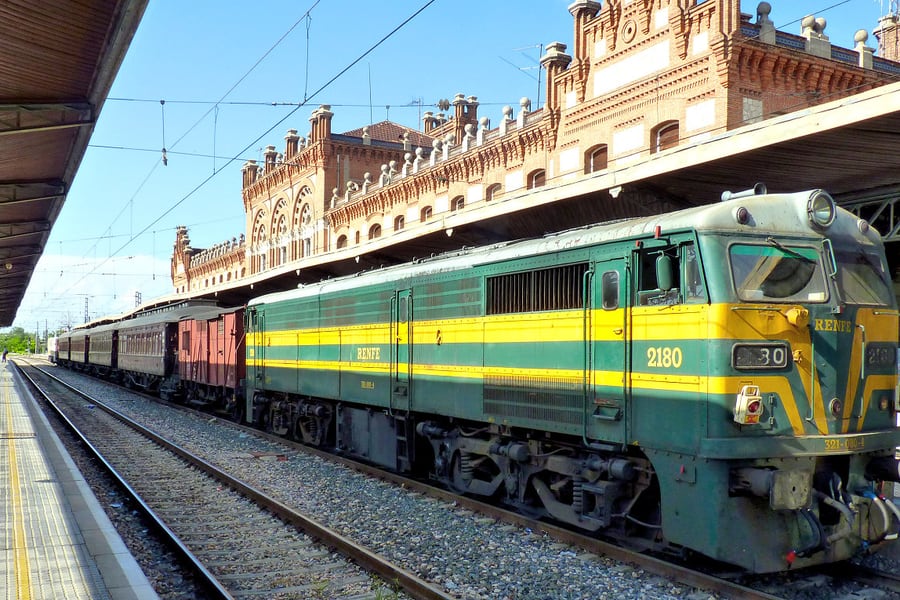
The one thing the operator does not promise is the locomotive. Steam has worked this train, and so have historic diesels and historic electrics; the composition page on the operator's own site describes every carriage and van in detail and never once names an engine. The carriages are the constant. Whatever is on the front on the day is a bonus.
The Journey
The train is stabled where it starts. Madrid Delicias is a museum now, and the Tren de la Fresa stands on museum tracks under a shed that was built to take main-line trains from Portugal.
Delicias opened on 30 March 1880 to the design of the French engineer Émile Cachelièvre, four tracks under a metal roof a hundred and seventy metres long, thirty-five wide and twenty-two and a half high, the whole structure fabricated in Belgium. It was the most monumental station in nineteenth-century Madrid, and because the city built bigger elsewhere and then rebuilt those, it is now the oldest Madrid station surviving in its original form. Boarding a wooden carriage inside it is the closest thing the journey has to a stage set, except that none of it is a set.
Out through the southern suburbs
The line drops gently south, out of the valley of the Manzanares and across to the Jarama and then the Tagus. There is almost no engineering to it: bridges over those three rivers and very little else, because the ground gave the surveyors an easy run. That was the point — Madrid to Aranjuez was only ever meant to be the first stage of a railway to the Mediterranean, and the easy forty-nine kilometres came first.
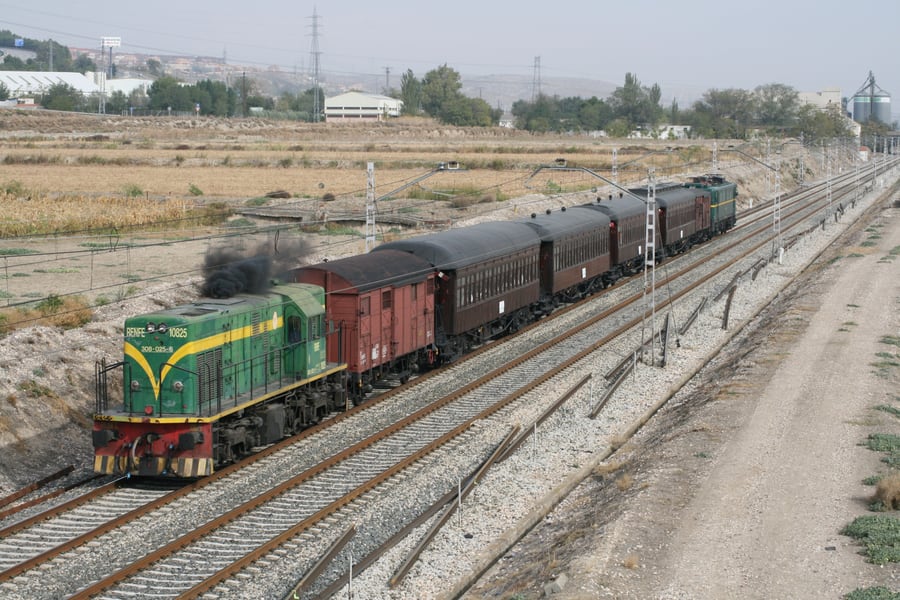
The stations named on the original line are still on the map: Getafe, Pinto, Valdemoro, Ciempozuelos, and Seseña just over the boundary in Toledo province. The alignment survives practically intact, and it is busy — today it carries Cercanías line C-3, so the historic train threads between electric units on a live suburban railway. Modern catenary hangs over the whole route, which is why photographs of this train nearly always have wires in them.
What is behind the engine
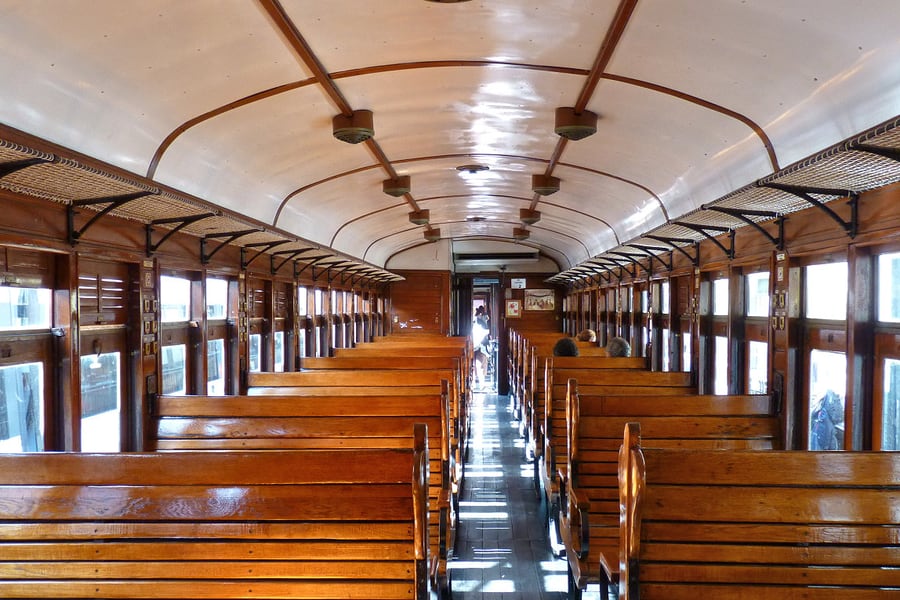
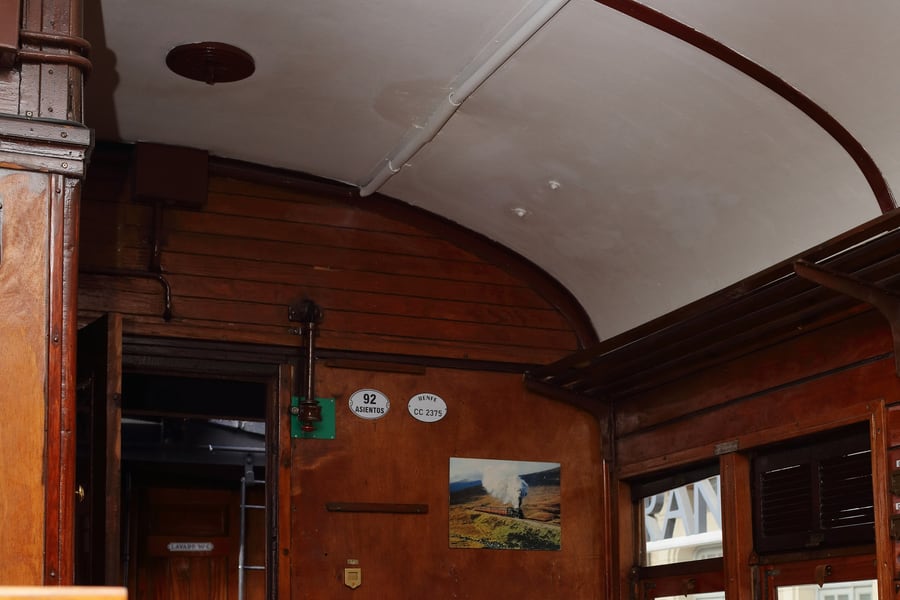
The four Costa carriages are the heart of it. CC-2435 was built in 1923 by the Sociedad de Material para Ferrocarriles y Construcciones for MZA, and seats ninety-two on slatted wooden benches in one open saloon with a central aisle. CC-2375 came from further afield — built in 1920 by the American Car and Foundry Export Company of New York, again for MZA, and identifiable by the bulged roof that American builders favoured. It later served the Servicio Militar de Ferrocarriles as a school coach under the number VE-6M, and was restored into the Tren de la Fresa's regular formation in 1985.
The odd one out is BB-5045, a metal coach from RENFE's Serie 5000 — three hundred and forty-five vehicles, among the first metal carriages RENFE ordered, and the series with which second class arrived in Spain in bulk, the old private companies having barely used it. This one comes from the sixty-six-coach batch numbered BB 5001 to 5066, built between 1947 and 1953 by Astilleros de Cádiz, Devis and Macosa. It has a side corridor and eight compartments of eight seats, sixty-four in all, originally trimmed in cloth and retrimmed in green scay in the 1960s. In the 1980s it was modernised for an export order to Cuba that never happened; the better seats are what is left of that.
The locomotive is not the promise
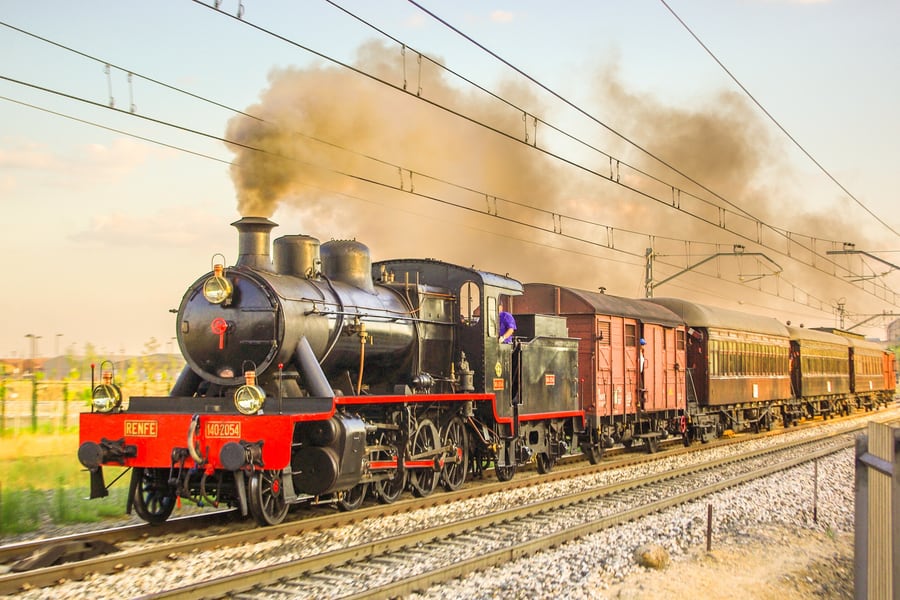
It is worth saying plainly, because a photograph can mislead. This train has been hauled by steam — RENFE 140-2054, a tank engine known as Guadix, worked it for years and is what most of the best pictures show. It has also run behind heritage diesels in RENFE's green and yellow, including the class the railway numbered in the 2100 series, and behind historic electrics; in 2016 the train was electric-hauled. The operator does not publish which engine is rostered on a given date.
So the honest expectation is a rake of century-old wooden carriages with something interesting on the front, rather than a guaranteed steam locomotive. On this railway that is enough. The point of the exercise is the ride in a coach with the windows down and the balcony doors open, on the oldest piece of railway in Madrid, arriving somewhere worth the day.
Arrival
Aranjuez station is not the one the 1851 trains used. Salamanca ran the rails on past the first terminus to the Puerta de Damas of the Royal Palace, and legend has always insisted the last lengths were laid in silver. That station has gone, and so has a second one built southwest of the old town for the Cuenca trains after the line was extended there in 1883. Both were replaced in 1923 by the station still in use, which belonged to MZA until RENFE was created in 1941 — as the decorative mosaics in its vestibule still announce to anyone who looks up.
Along the route
Carlos Teixidor Cadenas / Wikimedia Commons · CC BY-SA 4.0 · croppedFour carriages that outlived their railway by accident
The Costa coaches were built for MZA's suburban services between 1914 and 1930, in wood because metal was thought too hot for southern lines. Four survived only because they were kept back for Western film shoots, which is how they came to be available for this train.Juan Enrique Gilardi / Wikimedia Commons · CC BY-SA 2.0 · croppedOne of them was built in New York
CC-2375 came off the line at the American Car and Foundry Export Company in New York in 1920, and its bulged roof is the American builder's signature. It was restored into the Tren de la Fresa's regular formation in 1985.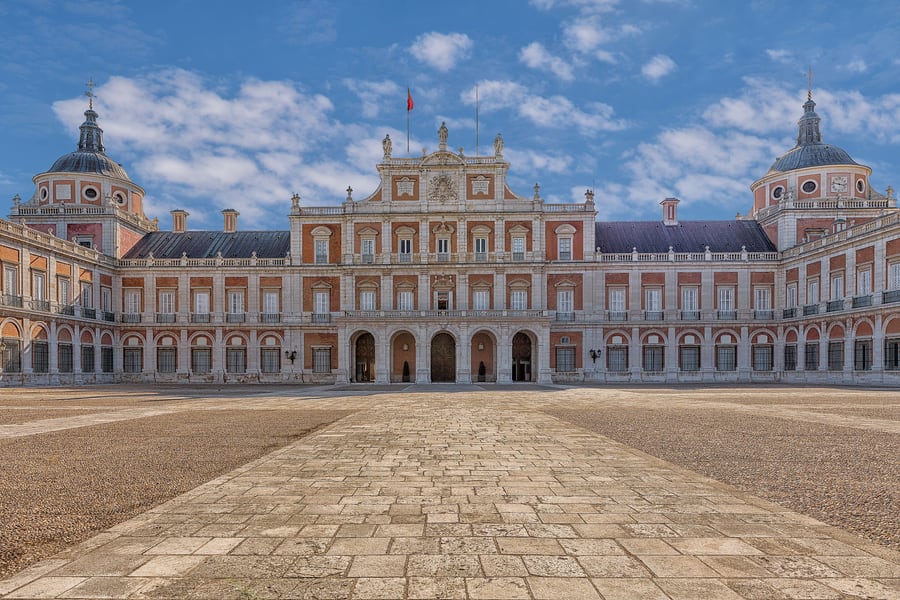 Javier Montes / Wikimedia Commons · CC BY-SA 4.0 · cropped
A queen, a marquis, and rails said to be silver
The line was opened on 9 February 1851 by the Marqués de Salamanca, with Queen Isabel II presiding and a thousand guests at a party he paid for himself. The story has always been that the last lengths into the palace were laid in silver.A bit of history
Culture & experiences along the way
JaviJG / Wikimedia Commons · CC BY-SA 4.0 · croppedWhat the day actually looks like
One train out at 10:00 from Madrid Delicias, about an hour to Aranjuez, then roughly seven and a half hours on the ground before the 18:38 back. There is no second departure in either direction, which is the single most important planning fact: a missed return train is a Cercanías ticket home, and a sold-out date is simply gone.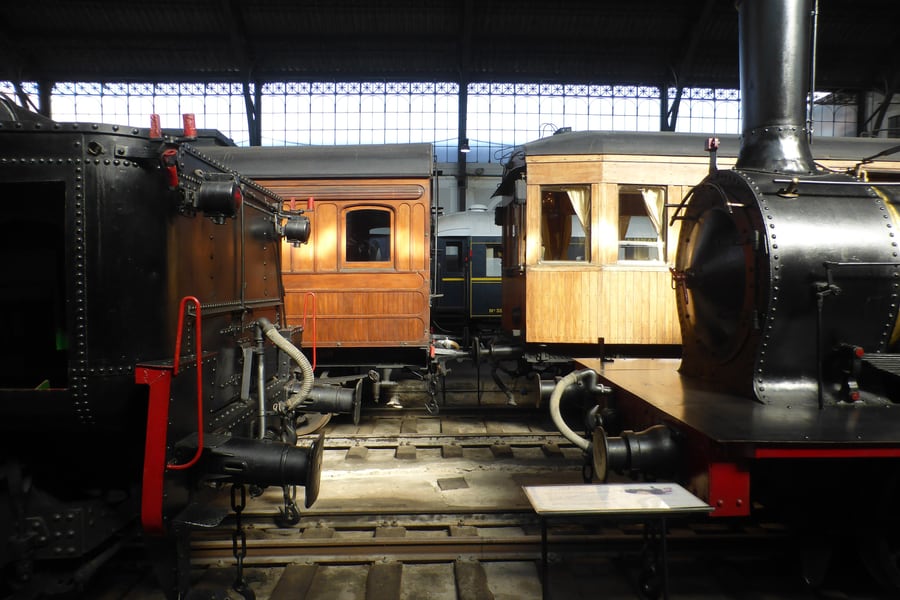 Carlos Teixidor Cadenas / Wikimedia Commons · CC BY-SA 4.0 · cropped
Boarding inside a museum
The train stands in Madrid Delicias, which stopped being a working terminus long ago and is now the Museo del Ferrocarril. The shed dates from 1880 — a hundred and seventy metres long and twenty-two and a half high, fabricated in Belgium — and it is the oldest station in Madrid still standing in its original design. You walk past the museum's locomotives to reach your carriage.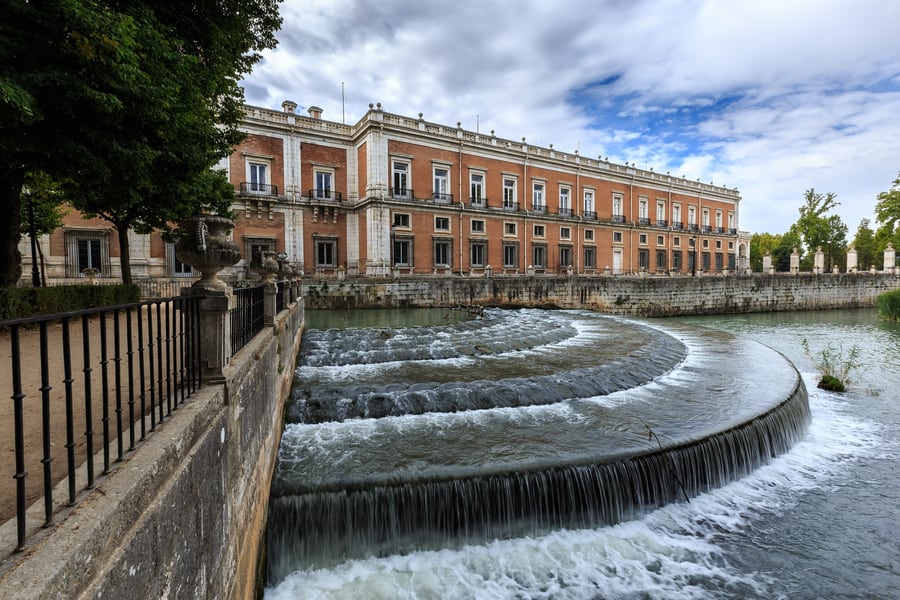 Barcex / Wikimedia Commons · CC BY-SA 3.0 · cropped
The strawberries, and why they are the point
Hostesses in period dress hand strawberries round the carriages on the return leg, not the outward one. It is not a gimmick bolted on afterwards: the market gardens along the Tagus grew strawberries and asparagus, and the whole commercial case for the railway in 1851 was getting them to Madrid while they were still worth eating.Luis miguel / Wikimedia Commons · CC BY-SA 3.0 · croppedRiding a heritage train on a live suburban railway
The 1851 alignment is now Cercanías line C-3, electrified and busy, so the wooden carriages thread between modern electric units the whole way. Catenary hangs over the entire route — which is why almost every photograph of this train has wires in it, and why the journey feels less like a preserved branch line than like a survivor still using the main road.Timetables
The Tren de la Fresa runs on weekends in spring and autumn only, one train out and one train back, and does not operate at all in high summer or deep winter. There is a single departure time and a single return time; the variation between tickets is what happens in Aranjuez in between, not when the train moves.
The daily pattern
| Departs Madrid Delicias (Museo del Ferrocarril) | 10:00 |
| Arrives Aranjuez | about 11:00 |
| Departs Aranjuez | 18:38 |
| Arrives Madrid Delicias | about 19:30 |
As of August 2026. The operator publishes these as horarios orientativos and reserves the right to move them for operational reasons, so they are the shape of the day rather than a contract.
Autumn 2026 dates
These were read directly off the operator's live booking calendar in August 2026. Every one of them departs at 10:00:
| Month | Dates |
|---|---|
| October 2026 | 3, 4, 10, 11, 12, 17, 18, 24, 25, 31 |
| November 2026 | 1, 7, 8 |
Saturdays and Sundays throughout, plus Monday 12 October, which is Spain's national holiday. 8 November is the last date of the season — nothing was on sale beyond it, and September carried no departures at all while October in the same calendar was fully loaded, so the empty month is the end of the summer break rather than a gap in the data.
Spring 2026, for the pattern
The spring campaign ran from 22 March to 7 June 2026, on 22, 28 and 29 March; 3, 4, 5, 11, 12, 18, 19, 25 and 26 April; 1, 2, 3, 9, 10, 16, 17, 23, 24, 30 and 31 May; and 6 and 7 June. Spring is the longer and busier of the two campaigns, and it is the one that actually coincides with the strawberry season it is named for.
Practical notes
The train has 385 seats and a single departure, so a sold-out date is simply gone — there is no later train. Tickets are sold through the operator's own online system and dates go on sale by campaign rather than continuously.
Children between 1 metre and 1.40 metres in height travel on the reduced fare and the operator asks to be told about them in advance; under a metre they travel free if they do not occupy a seat. Measuring by height rather than age is unusual and catches people out.
Dates, times and availability are published by the operator at trendelafresa.es (opens in a new tab) and through the Museo del Ferrocarril de Madrid at museodelferrocarril.org (opens in a new tab).
Tickets
There is no plain train ticket in the ordinary sense. Every fare is a package: the return trip in the historic train, the strawberries on the way home, and a chosen amount of Aranjuez in between. The cheapest option is the train and nothing else, at €32 for an adult and €24 for a child between 1 metre and 1.40 metres tall; the rest add guided visits, a boat, a bicycle or the palace, up to €60. Prices read from the operator's site in August 2026.
For anyone whose interest is the railway, the baseline fare is the right answer — the carriages are what you came for, Aranjuez is walkable, and the palace, the gardens and the Falúas museum all sell admission on the door. The English Tour is worth flagging for anyone who does not follow Spanish, because the guiding on every other route is in Spanish. There is one train a day, with 385 seats, and autumn weekends go first.
Book your tickets
JaviJG / Wikimedia Commons · CC BY-SA 4.0 · croppedFresas al Natural
€32.00 adult · €24.00 child
The train, the strawberries and a free hand in Aranjuez — no organised programme.
Book Tickets (opens in a new tab, on trendelafresa.es)via trendelafresa.es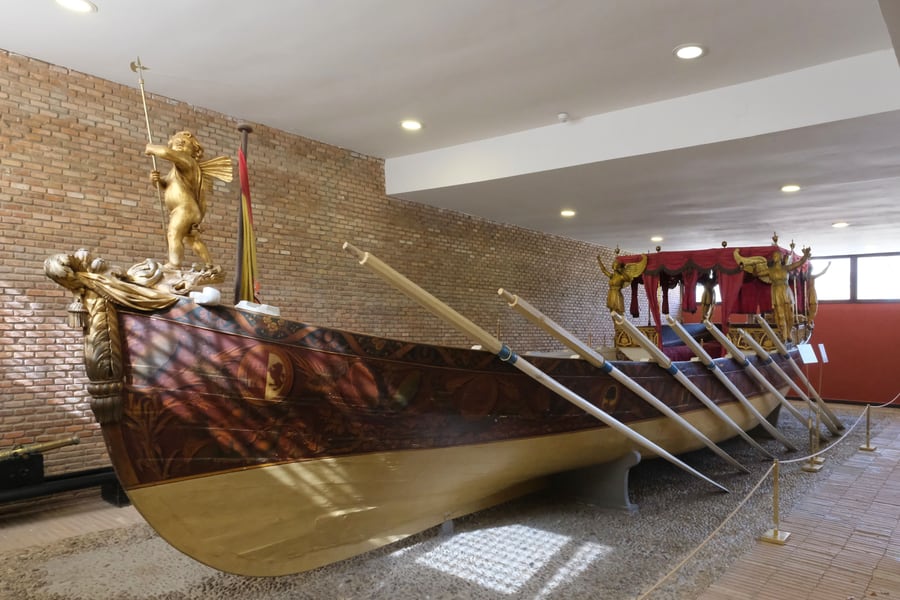 Herbert Frank / Wikimedia Commons · CC BY 2.0 · cropped
Fresas Reales
€49.00 adult · €38.00 child
Adds the Royal Palace, the Prince's Garden and the Falúas museum, with transfers arranged.
Book Tickets (opens in a new tab, on trendelafresa.es)via trendelafresa.esJavier Montes / Wikimedia Commons · CC BY-SA 4.0 · croppedEnglish Tour
€53.00 adult · €42.00 child
The same ground guided entirely in English, which no other route is.
Book Tickets (opens in a new tab, on trendelafresa.es)via trendelafresa.esRail Passes
No rail pass covers the Tren de la Fresa, and none is worth buying for it.
The train is not a scheduled railway service. It is an excursion assembled and sold by the Fundación de los Ferrocarriles Españoles — the foundation that also runs the Museo del Ferrocarril de Madrid — and the fare is a package that includes strawberries, guides and in most cases admission to buildings.
An Interrail or Eurail pass is a travel document for participating companies' scheduled trains, and Interrail names those companies for Spain: RENFE, iryo, SNCF, FEVE Cercanías and CP. The Fundación is not among them, and the same table excludes Renfe's own tourist trains by name, so the excursion falls outside a pass twice over. The ticket is bought from the operator or not at all.
The ordinary way to Aranjuez, which a pass does cover
This matters mainly because it makes the comparison honest. The historic alignment is now Cercanías line C-3, and Renfe runs suburban trains from Madrid to Aranjuez all day, every day, over the same forty-nine kilometres. That is an ordinary Renfe service: no reservation, a low walk-up fare, and a journey of well under an hour.
So a rail-pass holder already in Spain can reach Aranjuez essentially for free on the strength of a travel day they have paid for, see the palace and the gardens, and go home. What they will not have is the 1920s carriages, which are the entire reason this page exists.
How to think about it
The Fresa is best thought of as an attraction that happens to move, priced like an attraction. €32 buys a return trip in century-old wooden stock behind a heritage locomotive on the oldest railway in Madrid, on one of roughly thirteen autumn dates. The Cercanías train costs a few euros and runs every day, and does none of that.
For a day in Aranjuez, the C-3 is what the pass is for. For a day on the Tren de la Fresa, its own ticket is the only thing that works, and the pass simply does not come into it.
Checked against operator information and Interrail's published list of railway companies on 20 August 2026.
Places to Visit
Aranjuez is a Royal Site, which in Spain means a town that exists because the crown wanted somewhere to spend a season. The palace, the gardens, the market gardens and the grid of streets around them were laid out together, and UNESCO inscribed the whole of it as a Cultural Landscape in 2001 — not the palace alone, but the relationship between the buildings, the water and the cultivated ground.
That is why the railway came. The court moved here in spring, and a line that could carry the court in an hour was worth forty-five million reales to the Marqués de Salamanca.
The train gives you roughly seven and a half hours on the ground, from around eleven in the morning until the 18:38 back. That is enough for the palace and one garden at a walking pace, or for both gardens and the river if you skip the interiors. It is not enough for all of it, and the places below are listed in the order most people should drop them.
Javier Montes / Wikimedia Commons · CC BY-SA 4.0 · croppedThe Palacio Real de Aranjuez
The reason the town, and then the railway, exist. The palace is the centrepiece of a Royal Site — a place the Spanish crown built to spend a season in — and its long brick-and-stone front faces a parade ground big enough to make the scale obvious before you go in. UNESCO inscribed Aranjuez as a Cultural Landscape in 2001, and it is this building's relationship with the gardens and the river that earned it.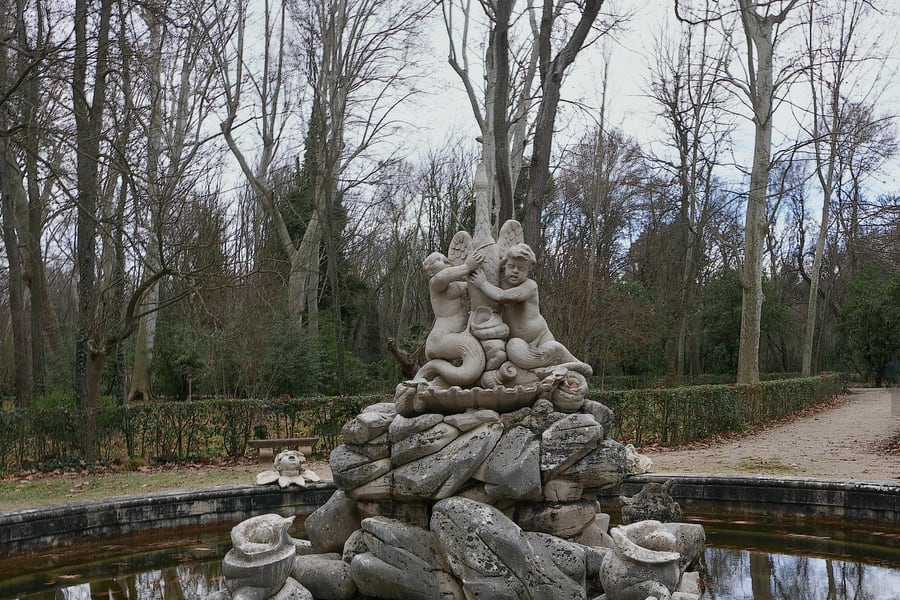 Jl FilpoC / Wikimedia Commons · CC BY-SA 4.0 · cropped
The Jardín del Príncipe
A hundred and fifty hectares of formal and landscape garden running along the Tagus, laid out with avenues, water and a scatter of fountains and pavilions among very old trees. It is the garden to choose if you only have time for one, because it is the one you can simply walk into and keep walking through — the interiors elsewhere all have timed admission and the train gives you a fixed afternoon.Herbert Frank / Wikimedia Commons · CC BY 2.0 · croppedThe Museo de Falúas Reales
A boathouse of royal barges, which is a stranger and better museum than it sounds. The crown kept a fleet for use on the Tagus here, and the survivors are gilded, carved and absurd — vessels built to carry a monarch a few hundred metres of river in front of an audience. The falúa of Carlos IV and the barge of Isabel II of 1860 are the showpieces.Barcex / Wikimedia Commons · CC BY-SA 3.0 · croppedThe Tagus and its weirs
The river is the whole explanation for Aranjuez: it is why a court could keep gardens and market gardens in the middle of dry Castile, and it is what the strawberries were grown with. The weirs below the palace turn it into a series of broad curved falls, and the walk along the bank between the palace and the gardens is the best twenty minutes in the town.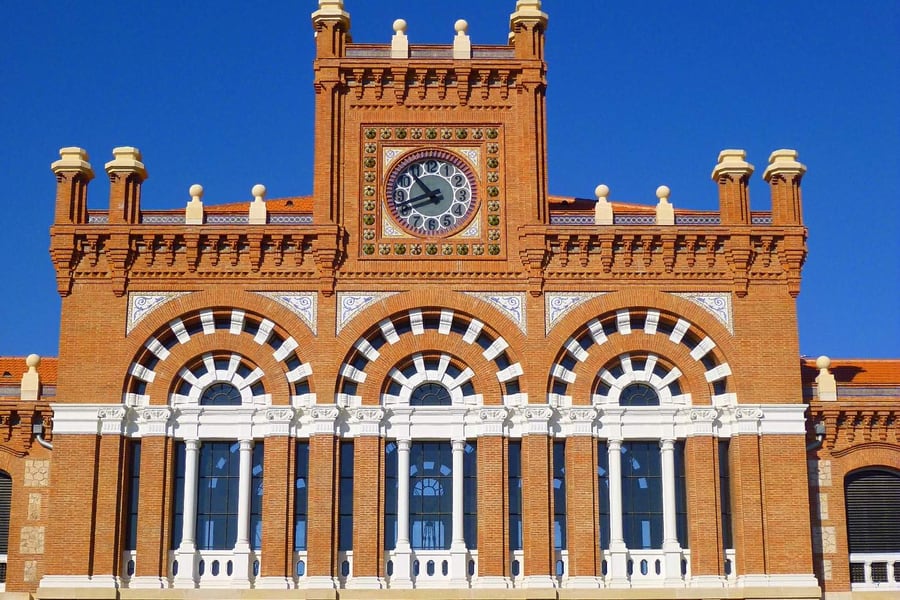 Zarateman / Wikimedia Commons · CC BY-SA 3.0 · cropped
Aranjuez station
Not the station the first trains used. The 1851 terminus stood by the palace and a second served the Cuenca line after 1883; both were replaced by this one in 1923. It belonged to MZA until RENFE was created in 1941, and the decorative mosaics in its vestibule still carry the old company's name — worth thirty seconds and a look upward before you walk into town.Carlos Teixidor Cadenas / Wikimedia Commons · CC BY-SA 4.0 · croppedThe Museo del Ferrocarril de Madrid
The departure station is itself the attraction, and the ticket gets you into the shed whether or not you look at anything in it. Delicias opened in 1880 to a design by the French engineer Émile Cachelièvre, its metal roof fabricated in Belgium, and it holds the national collection — including locomotives old enough to have worked the line the Fresa runs on.Where to Sleep
The Tren de la Fresa is built as a day out. It leaves Madrid at ten and is back by half past seven, and the overwhelming majority of people who ride it sleep in Madrid the night before and the night after, near enough to Delicias to make a ten o'clock departure comfortable.
Staying in Aranjuez is the other way to do it, and it is a better idea than it sounds. The town empties in the evening once the day trippers have gone, the gardens are open early, and the C-3 Cercanías runs back to Madrid all day, so the historic train can be used one way and the ordinary railway the other. Both hotels below are inside the old town and within a walk of the palace.
Neither card quotes a price, a rating or a star count, because those are the hotels' own claims rather than anything checked here. Both sites were opened and read in August 2026.
Where to stay
NH Collection Palacio de Aranjuez
Calle San Antonio, metres from the Royal Palace
An eighteenth- and nineteenth-century building that was begun as a residential palace for Manuel Godoy, chief minister to Carlos IV, and never finished; the wide vaulted ceilings of that original construction now form the hotel's entrance hall. It lists 86 rooms, with the Premium rooms and Junior suites looking directly at the Palacio de Aranjuez, and has indoor parking, a gym and a courtyard terrace.
Check Availability (opens in a new tab, on nh-collection.com)via nh-collection.comHotel El Cocherón 1919
Calle de Montesinos, inside the old town
A small hotel in an early-twentieth-century building in the historic centre, a short walk from the Jardín del Príncipe, the Jardín de la Isla and the palace. The ground floor holds the lounge, cafeteria and meeting room; the 18 rooms are all different, sharing timber floors, hydraulic-tile bathrooms, feather duvets, air conditioning and a safe. The hotel states plainly that it has no lift and no restaurant.
Check Availability (opens in a new tab, on elcocheron1919.com)via elcocheron1919.comQuestions or corrections
Planning this trip and stuck on something, or spotted a time, fare or detail that has changed? Send us a message about The Tren de la Fresa — the carriages that Westerns saved. We read every one, and we update this page when something has changed.