Tren dels Llacs — the line its passengers refused to lose
Willtron / Wikimedia Commons · CC BY-SA 2.0 · cropped
- Distance89.35 km
- DurationAbout 2 hours each way
- Best seasonSaturdays only, April to October
Introduction
On the first day of January 1985 the railway from Lleida to La Pobla de Segur was supposed to close. Madrid's contract with RENFE had ordered the shutting of every line that could not earn a fixed share of its own costs, and this one — eighty-nine kilometres of single track running up from the plain of Lleida into the foothills of the Pyrenees — was near the bottom of the list.
It is still open. The people who used it would not have it, and campaigned under three words in the Lleidatan dialect, Volem lo tren: we want our train. The Generalitat and the Diputació de Lleida agreed to pay the losses rather than watch the line lift, and then spent twenty years arguing with Madrid over who should own it, because the state wanted paying for something it had wanted to be rid of. The transfer finally went through for nothing, on the last day of 2004.
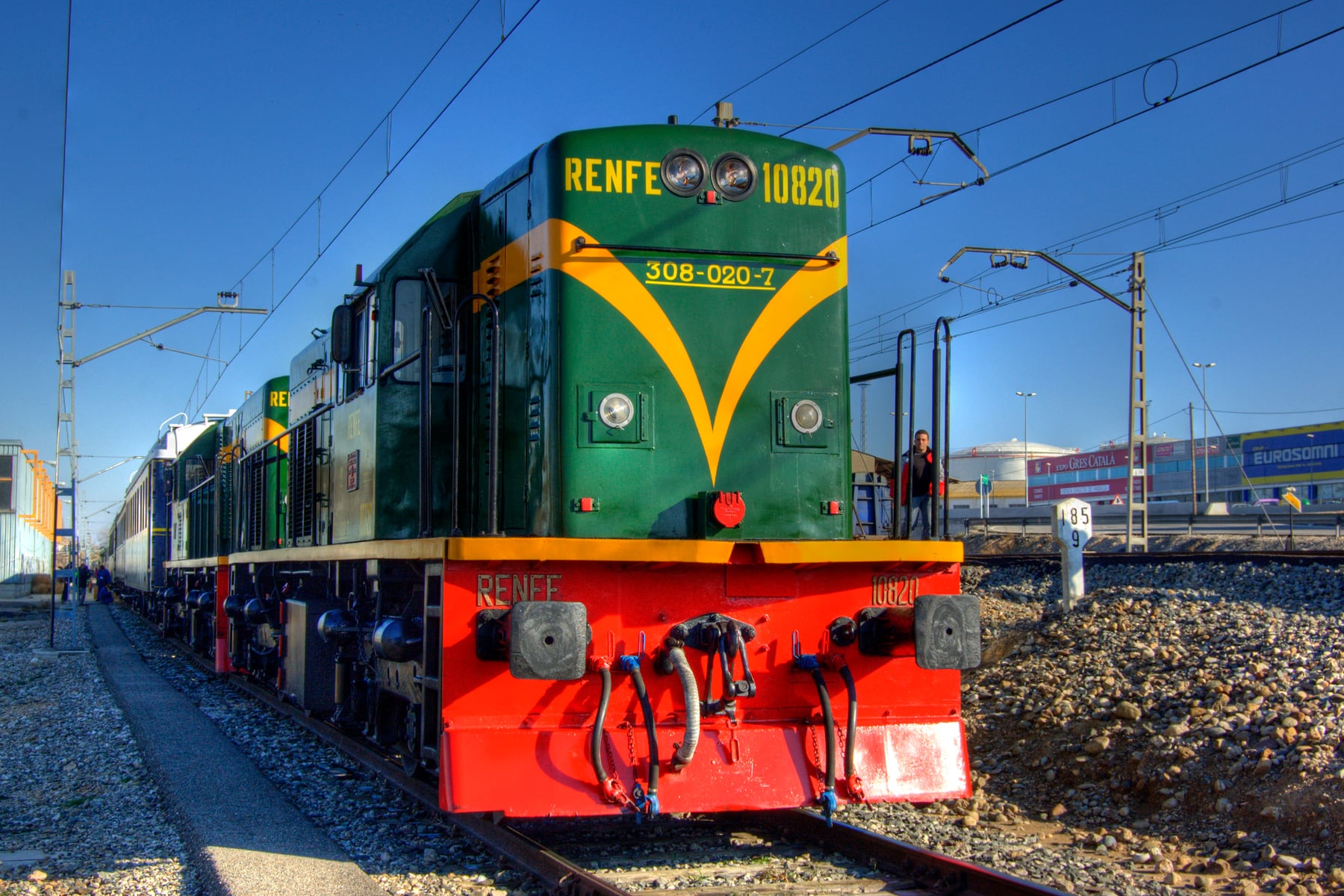
Everything on this page follows from that. The Catalan government rebuilt the track. Ferrocarrils de la Generalitat de Catalunya took over the running of it and, in 2016, bought trains of its own. And in 2009 it put a name on the line for visitors — Tren dels Llacs, the train of the lakes — and began running a rake of 1960s carriages behind a pair of green-and-yellow diesels on summer Saturdays, over metals that carry schoolchildren and commuters the rest of the week.
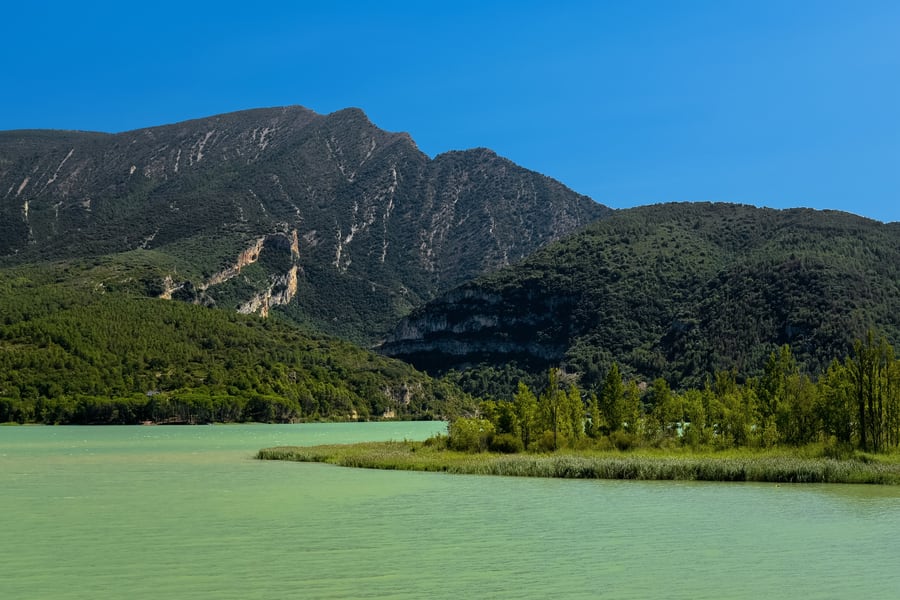
The lakes are the reason anyone comes. There are four of them along the route, and not one is a lake: they are the reservoirs of Sant Llorenç de Montgai, Camarasa, Terradets and Sant Antoni, impounded between 1913 and 1935 by a Barcelona electricity company for the power stations that lit the city. The railway arrived decades later and threads along their shores, through forty tunnels and over seventy-five bridges, from irrigated fruit country to a gorge in the Montsec where the water lies a long way below the window.
It ends at La Pobla de Segur because that is where the money stopped. The line was begun as the Catalan section of a railway meant to run from Andalusia across the Pyrenees into France; the earthworks were graded onward towards Sort and never used. Today a bus stands in the station yard at La Pobla and finishes the journey by road.
The Journey
The Tren dels Llacs leaves Lleida-Pirineus at 10:40 on a Saturday morning and is at La Pobla de Segur, eighty-nine kilometres north, a little before half past twelve. Two hours for eighty-nine kilometres is not slow so much as unhurried, and the operator has an on-board guide talking through the window for most of it.
The train itself
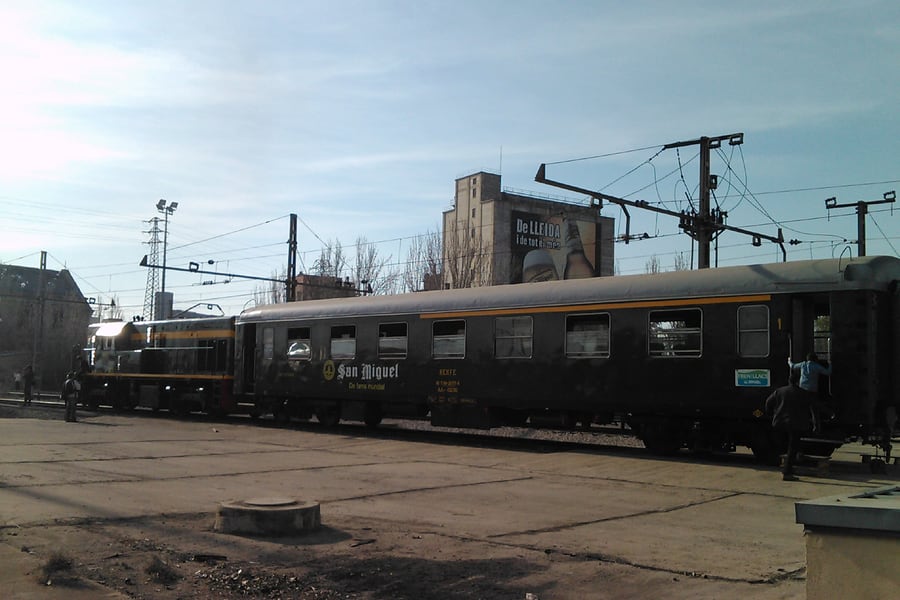
Traction is a pair of diesel locomotives, 10817 and 10820, in RENFE's green and yellow — squat, blunt-nosed machines of the 1960s that later carried the number series 308. Behind them run four 6000-series carriages built in 1968, which the operator describes as having been known as ye-yés, after the pop music of the decade that produced them. The rake also includes a period mail van and a dining car with a bar and proper tables, which is where a good part of the train spends the journey.
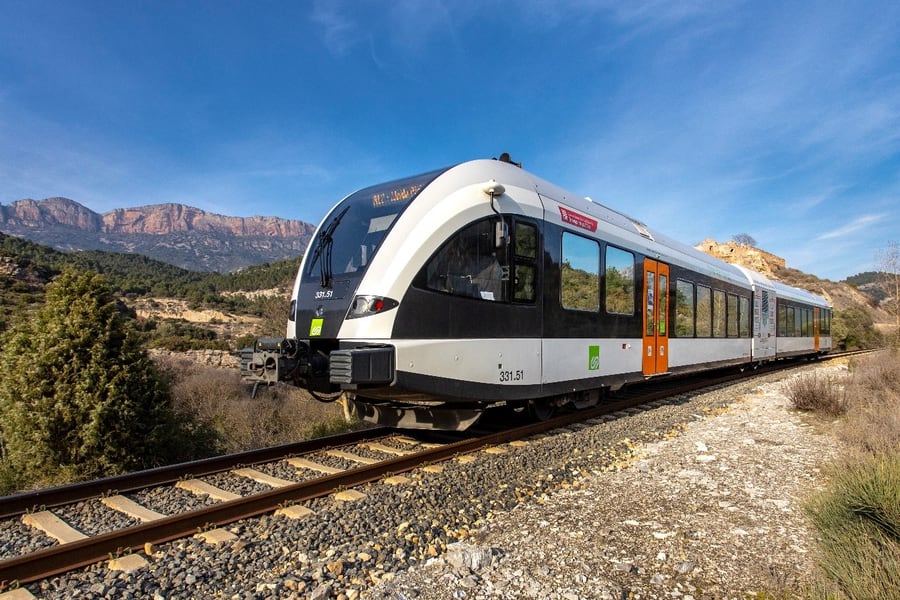
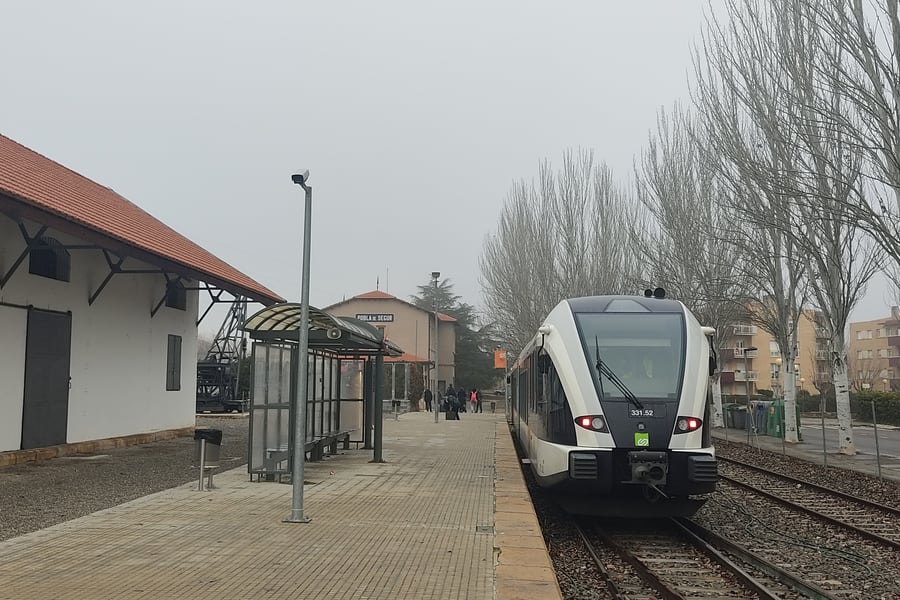
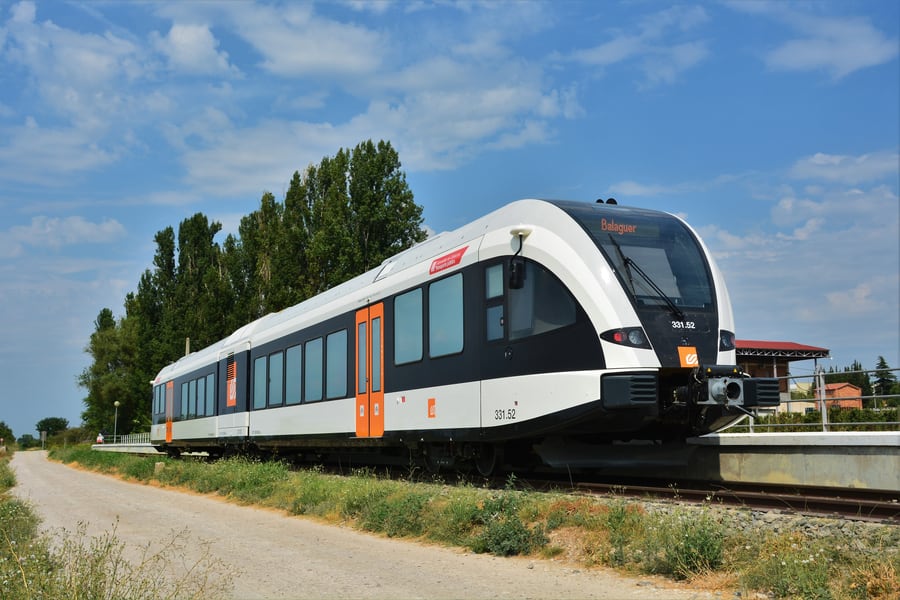
For a few weeks in high summer the historic set stands down and a Panoramic Train runs instead: a modern series 331 railcar built by Stadler, two air-conditioned cars, ninety seats, large windows, sockets, space for bicycles and step-free access. It is the same class of train that works the ordinary service, and the two products are sold separately.
Out of the plain
The first half-hour is flat. The line runs north out of Lleida beside the Segre, through Alcoletge, Vilanova de la Barca and Térmens, across orchard country under irrigation, and reaches Balaguer at about five past eleven. Balaguer is the capital of La Noguera and the only intermediate station on the tourist train's board; it is also where the line ceases to be a commuter railway. Seventy per cent of the traffic on the route never goes any further.
Beyond it the Segre is dammed almost at once. Sant Llorenç de Montgai, built between 1928 and 1930, is the first of the four sheets of water, shallow and reedy and now a protected wetland. The line then crosses to the Noguera Pallaresa and enters the second and longest, the twenty kilometres of the Camarasa reservoir, whose cliffs carry griffon and Egyptian vultures and, sometimes, a bearded vulture.
Into the Montsec
This is where the engineering starts. The operator counts forty tunnels and seventy-five bridges in the eighty-nine kilometres, and most of them are here, where the railway works its way along ledges above the water and through the ridges of the Montsec. The longest bore, the Coll de Porta, runs for three and a half kilometres under the Serra del Mont-roig.
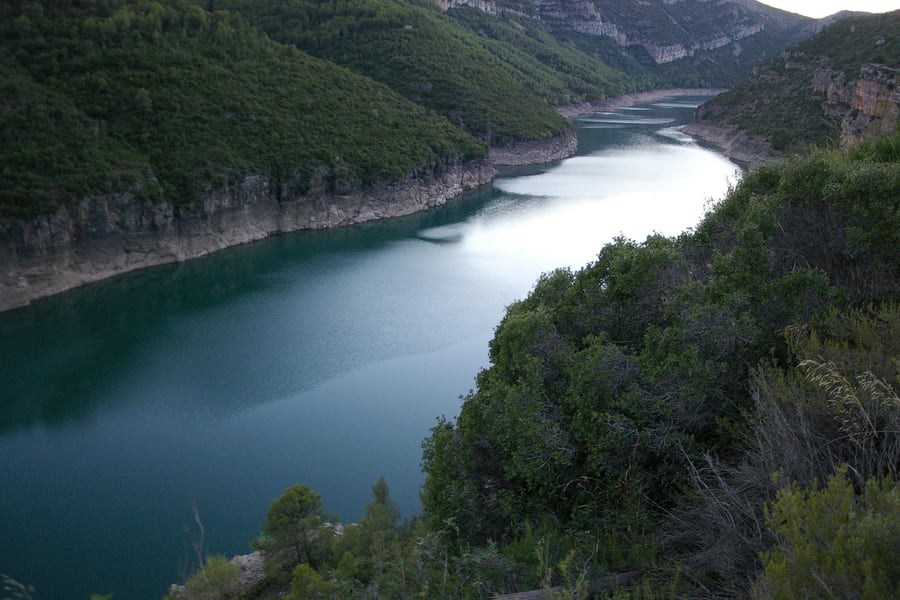
The train comes out at Cellers-Llimiana, on the Terradets reservoir — the narrowest and most theatrical of the four, held in a gorge between the Montsec d'Ares and the Montsec de Rúbies, with the water a green-blue that does not look like a river at all. Under it lies the twelfth-century monastery of Sant Miquel de Cellers, flooded when the dam was finished in 1935.
The Pallars
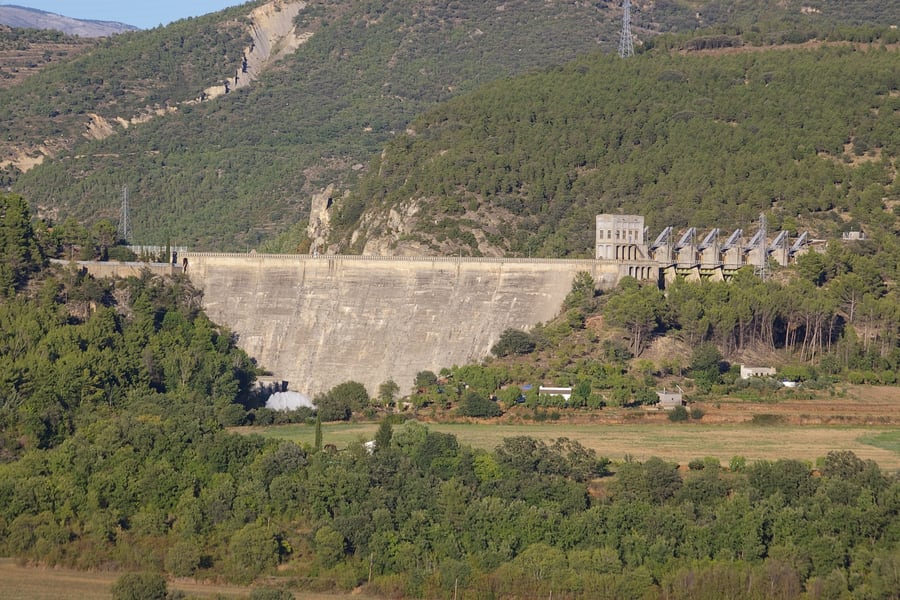
Past Guàrdia de Tremp and Palau de Noguera the country opens into the Conca de Tremp, a broad basin ringed by mountains, and the train calls at Tremp, the capital of the Pallars Jussà. The last of the lakes, Sant Antoni, begins at Salàs de Pallars: the oldest of the four, begun in 1913, its dam a great curved wall at Talarn with the powerhouse and penstocks stacked against the hillside beside it.
La Pobla de Segur is the end. The buffers are where a trans-Pyrenean main line was supposed to carry on north, and the town's old station now houses an interpretation centre for the wildlife of the Pyrenees. The historic train waits until five o'clock before starting back.
Along the route
Gustau Erill i Pinyot / Wikimedia Commons · CC BY-SA 3.0 · croppedThree words that kept the line open
In 1984 the ministry declared this line "highly loss-making" and set it to close. Its users campaigned under the slogan Volem lo tren! — lo, not el, in the Lleidatan of the place. The clause that condemned it also let a regional government save it by paying, and the Generalitat did.Arnaucc / Wikimedia Commons · CC BY-SA 4.0 · croppedTwenty years arguing over a gift
Catalonia wanted the line transferred outright; Madrid wanted a thousand million pesetas for a railway in the state it was in. The deadlock lasted through three national governments before a free handover was agreed in 2004. Rebuilding began the following July.Hector Blanco de Frutos / Wikimedia Commons · CC BY 2.5 · croppedFour lakes, and not one of them is a lake
All four are reservoirs, built between 1913 and 1935, three of them to generate electricity for Barcelona. The water was already there when the railway arrived: this valley did not see a train until 1949.A bit of history
Culture & experiences along the way
The STB / Wikimedia Commons · CC BY-SA 4.0 · croppedThe flat half-hour
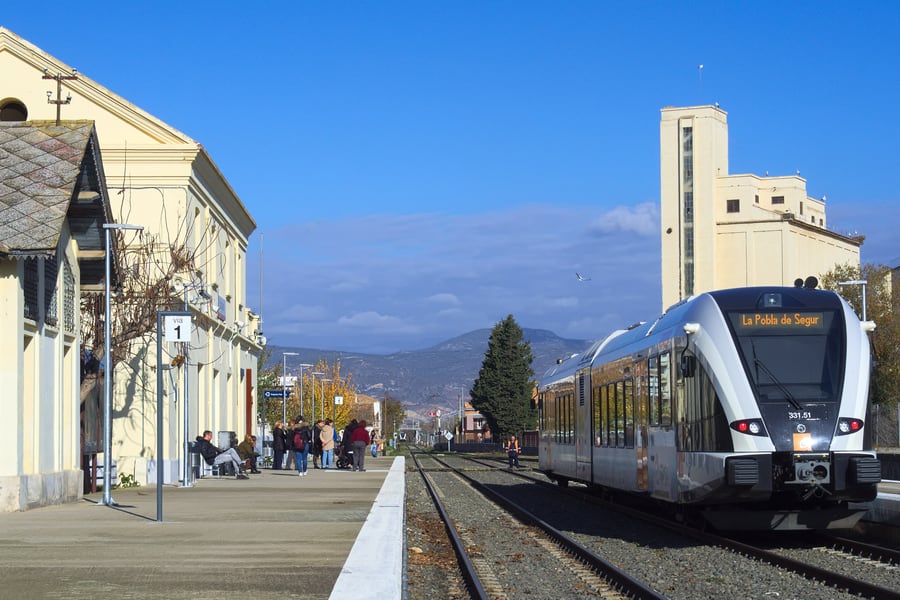
North out of Lleida the line runs beside the Segre through orchards and irrigation canals, calling at Alcoletge, Vilanova de la Barca and Térmens. Balaguer comes up at about 11:05, and with it the end of the busy part of the railway.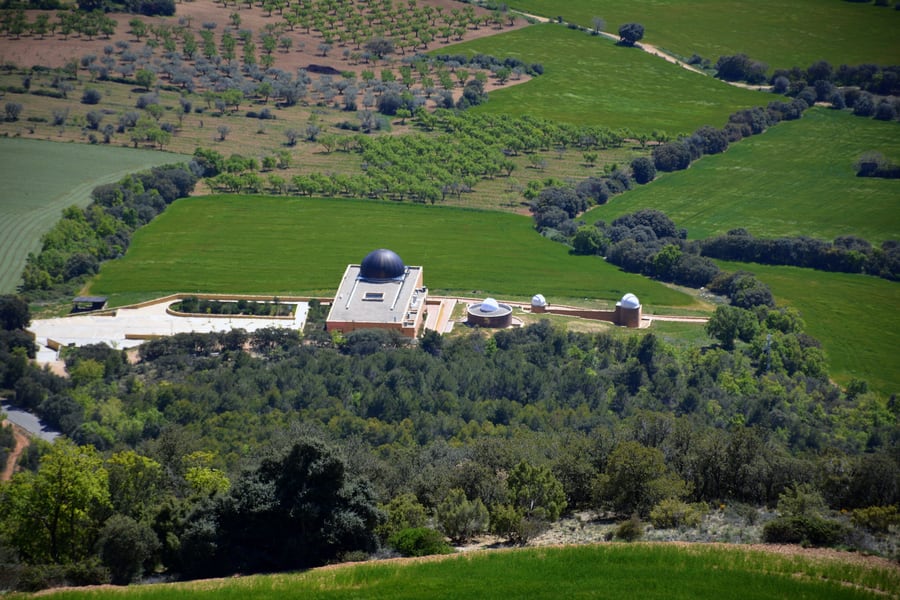 Angela Llop / Wikimedia Commons · CC BY-SA 2.0 · cropped
Stay for the dark
The Montsec the line runs under carries one of the darkest skies in western Europe, and the Parc Astronòmic Montsec at Àger was built to use it — a planetarium under a dome you lie back in, and telescope sessions on clear nights. The ridge has held Starlight certification for its sky since 2013.Jorge Franganillo / Wikimedia Commons · CC BY 2.0 · croppedThe gorge at Terradets
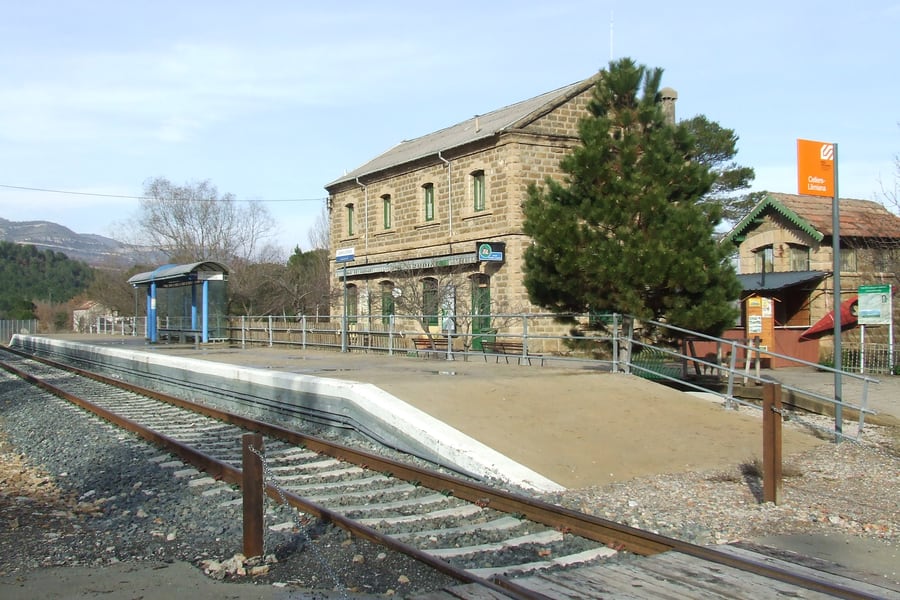
The narrowest and best of the four lakes fills a gorge between the Montsec d'Ares and the Montsec de Rúbies, and the railway runs along the side of it to the station at Cellers-Llimiana. The water here is a flat green-blue that reads as anything but a river.Timetables
Every time below was read from the operator's own board at turistren.cat (opens in a new tab) and from its booking system, as of August 2026.
The season, and how few trains there are
The Tren dels Llacs runs on Saturdays only, and the 2026 season is 11 April to 31 October — twenty-nine departures in the whole year:
- Historic Train — 23 Saturdays. Every Saturday from 11 April to 27 June, then from 22 August to 31 October.
- Panoramic Train — 6 Saturdays. 4 July to 8 August, in place of the historic set.
That is the whole service. There is nothing midweek, nothing on a Sunday, and nothing at all between November and April.
The historic train
One round trip, with a five-hour stop at the top end:
| Lleida-Pirineus | Balaguer | La Pobla de Segur | |
|---|---|---|---|
| Northbound | dep 10:40 | arr 11:05 · dep 11:10 | arr 12:35 |
| Southbound | arr 19:00 | arr 18:15 · dep 18:30 | dep 17:00 |
Cellers and Tremp are optional stops. Neither appears on the board: a passenger who wants to get off at either has to ask for it when booking, by email to the address the operator gives on the ticket page.
The panoramic train
In the six weeks of high summer the same path is worked by a modern railcar, roughly forty minutes quicker over the day. It leaves Lleida-Pirineus at 10:47 and reaches La Pobla de Segur at 12:22; it starts back at 16:35 and is in Lleida at 18:23.
The Balaguer times are the one place the operator's page contradicts itself — its summary table gives an 11:15 arrival and an 11:20 departure, its detailed table 11:12 and 11:15. The difference is a few minutes and matters only to anyone joining there, for whom the ticket office is the safer source.
Booking ahead is not optional
The 2025 season carried 6,692 passengers across 27 departures at 98.41% occupancy, and it shows in the calendar. Checking the booking system on 17 August 2026, the next departure — Saturday 22 August — was already sold out, as were 12 and 19 September. The first dates still on sale were 29 August, 5 September, 26 September and every Saturday in October.
The ordinary train, which runs every day
The tourist train is a guest on a working railway, and the working railway is often the more useful of the two. FGC's RL2 service covers the same eighty-nine kilometres in about an hour and three-quarters. On a Saturday it runs from Lleida-Pirineus at 07:57 (La Pobla 09:45) and 15:05 (16:38), and back from La Pobla de Segur at 13:00 (Lleida 14:33) and 19:21 (20:54). Sundays and public holidays have three each way; weekdays have four, plus a much denser service as far as Balaguer.
Those times are worth having, because a Tren dels Llacs ticket is valid on them for the return leg — which is the difference between five hours at La Pobla de Segur and a night there. The Tickets section covers how that works.
Tickets
Tickets are sold only through the operator's online shop. There is no ticket office for this train at Lleida-Pirineus, and most departures sell out weeks ahead. The booking system charged €40.50 for an adult return on 17 August 2026, €22.30 for a child of 4 to 13 and €20.25 for a passenger with a disability, with under-fours free. ⚠️ The operator's own prices page still shows €34.00 for the same ticket; the checkout is the figure that binds.
The part most worth knowing: a Tren dels Llacs ticket brings you back on the ordinary scheduled train, any day up to six days later. The historic set turns round at five and gives five hours at La Pobla de Segur — enough for the town, not for much else. Coming back on the RL2 instead turns the ticket into a way of reaching the Pallars Jussà and staying.
Book your tickets
Arnaucc / Wikimedia Commons · CC BY-SA 3.0 · croppedTren dels Llacs, from Lleida
€40.50 adult return · €22.30 child 4–13
Sold online only, usually weeks ahead, and valid back on the scheduled train for six days.
Book Tickets (opens in a new tab, on turistren.cat)via turistren.catGeneralitat de Catalunya · free licence with attribution · croppedThe everyday train over the same line
€7.60 one way on FGC service RL2
Identical scenery, every day of the year, with no dining car, no guide and no booking.
Book Tickets (opens in a new tab, on fgc.cat)via fgc.catRail Passes
No rail pass covers this journey, and the reason is the one that runs through the whole page: the line stopped being a Spanish state railway on the last day of 2004.
Interrail and Eurail publish, for Spain, a list of the operators their passes cover — RENFE, iryo, SNCF, FEVE Cercanías and CP — and, beside it, a list of what is excluded. Ferrocarrils de la Generalitat de Catalunya is named on the excluded list. That rules out both trains on this route: the Tren dels Llacs, which FGC runs, and the everyday RL1 and RL2 services, which FGC also runs. The same list excludes RENFE tourist trains as a category, so a pass would have bought nothing here even before the transfer.
A pass is still worth having for getting to the start. Lleida-Pirineus is a RENFE and Adif station on the Madrid–Barcelona high-speed line and on the conventional line through Zaragoza, and both are pass territory. The pass takes you to Lleida; the ticket for the lakes is bought separately.
What does bring the price down
- The Turistren Passport. Free and digital, but it is registered rather than handed over: you sign up by email on FGC's own site, and after the journey you stamp it by scanning a QR code — for this line, at the historic train café or the La Pobla de Segur tourist office. Each stamp releases a discount code of up to 20% towards one of FGC's other tourist railways, which is only useful for someone also visiting Montserrat, Núria or the Tren del Ciment, but those are all in Catalonia and all within a few hours of here. ⚠️ The code applies to return tickets bought in the online shop, for up to five people, and cannot be combined with any other offer. The promotion runs to 31 December 2027.
- The ATM Lleida integrated fare. The ordinary trains as far as Àger are inside Lleida's integrated ticketing area, so a single ticket covers a transfer between the train and the local and intercity buses. This applies to the RL1 and RL2 services, not to the Tren dels Llacs.
- Travelling on the ordinary train instead. At €7.60 for the full eighty-nine kilometres it is a fifth of the tourist fare, and it is the same line.
Pass conditions were checked against Interrail's published list of railway companies, and the Passport against FGC's own Turistren site, on 20 August 2026.
Places to Visit
The line passes through three counties that have very little in common: the irrigated plain of the Segrià, the dry limestone country of La Noguera, and the mountain basin of the Pallars Jussà. Six places along it are worth a stop, and the six-day return ticket makes stopping practical.
Two of them are not railway stops at all. The Congost de Mont-rebei is reached from Àger by road, and the Vall Fosca cable car from La Pobla de Segur by bus — but FGC times the buses at La Pobla to the trains, so both are doable without a car.
 IM027 / Wikimedia Commons · CC BY-SA 4.0 · cropped
Lleida
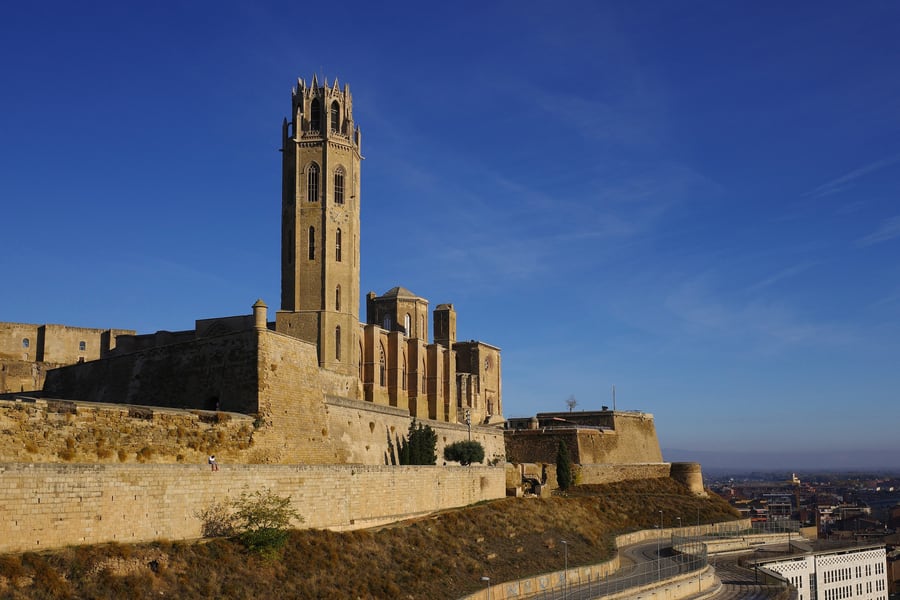
The trains leave from Lleida-Pirineus, on the far bank of the Segre from the old town. Above everything stands the Seu Vella, the old cathedral: a Romanesque and Gothic church on a hill, walled about by an eighteenth-century fortress that took it over as a barracks. Its bell tower is visible from most of the plain the railway crosses.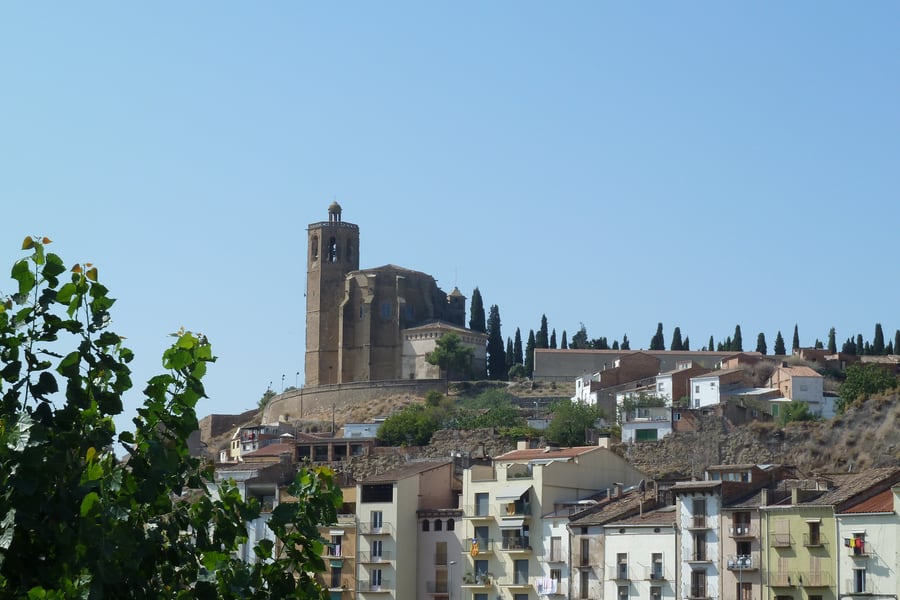 Deosringas / Wikimedia Commons · CC BY-SA 3.0 · cropped
Balaguer
The capital of La Noguera, twenty-five minutes up the line, stacked on a slope above the Segre with the church of Santa Maria on the crown of it — a listed monument of national interest. Below it the Plaça del Mercadal is one of the largest arcaded squares in Catalonia, and still holds its market.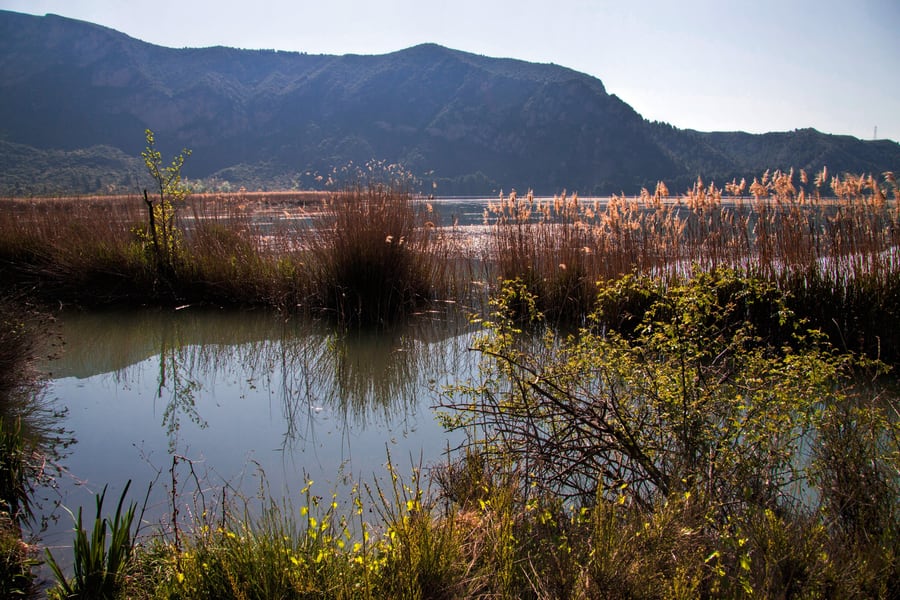 Mikipons / Wikimedia Commons · CC BY-SA 3.0 · cropped
Sant Llorenç de Montgai
A small reservoir on the Segre, built between 1928 and 1930 to feed the auxiliary canal of Urgell rather than to make electricity, and shallow enough that its head has silted into reedbed. It is now a protected wetland, and the stretch between the dam and Camarasa is one of the better bird sites in western Catalonia.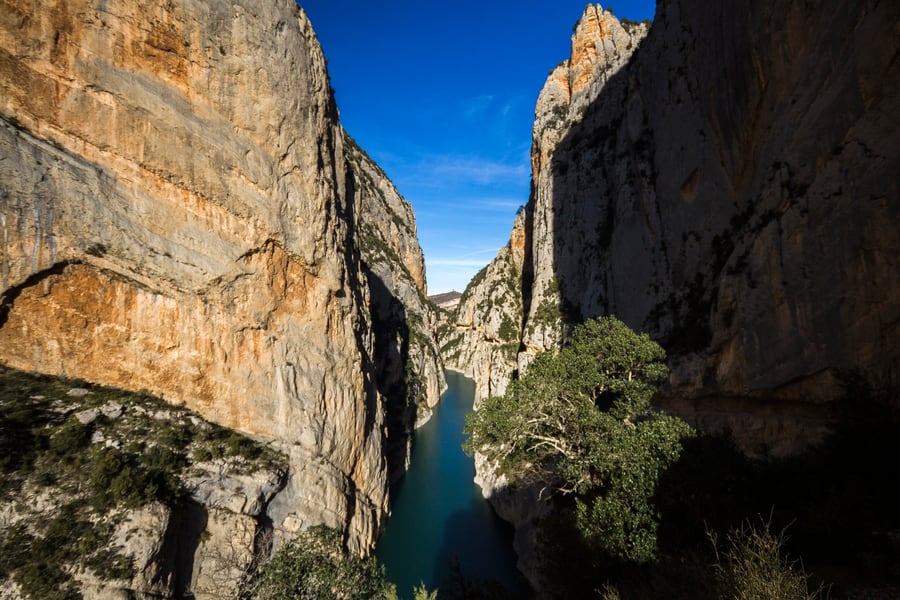 Jordi Montilla / Wikimedia Commons · CC BY-SA 3.0 · cropped
Congost de Mont-rebei
The Noguera Ribagorçana cuts clean through the Montsec in a gorge with no road in it at all — the only way through is a path blasted into the rock face above the water. It is a partial nature reserve on the boundary between Catalonia and Aragon, looked after by the Fundació Catalunya-La Pedrera, and it is the walk everybody in the Pallars recommends.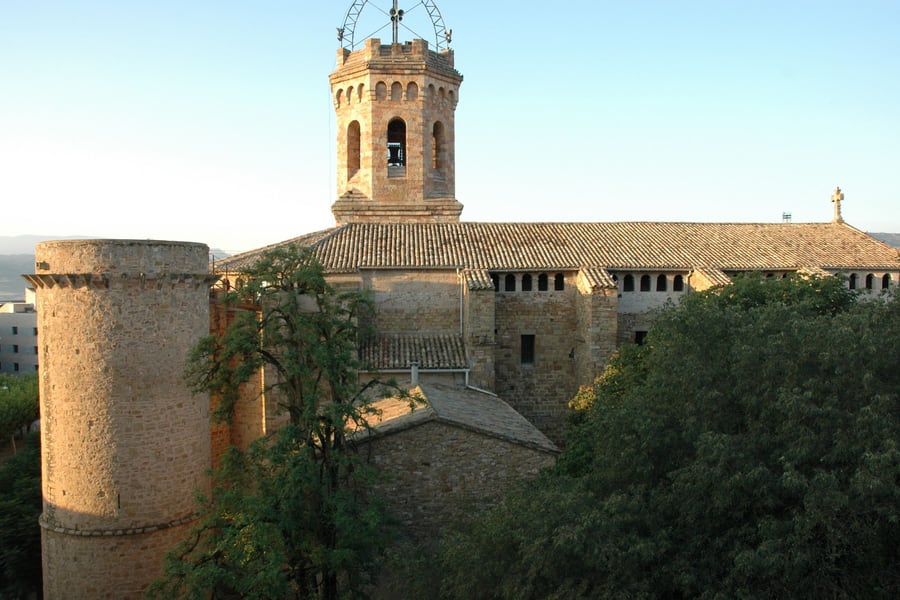 Josep Renalias / Wikimedia Commons · CC BY-SA 3.0 · cropped
Tremp
A town on a shelf at 468 metres, in a basin ringed by mountains and known to geologists the world over — the Orígens Geopark visitor centre in the town explains the rock, which records the end of the age of the dinosaurs. The collegiate church of Santa Maria de Valldeflors is Romanesque in origin, with a great round tower of the old walls standing beside it.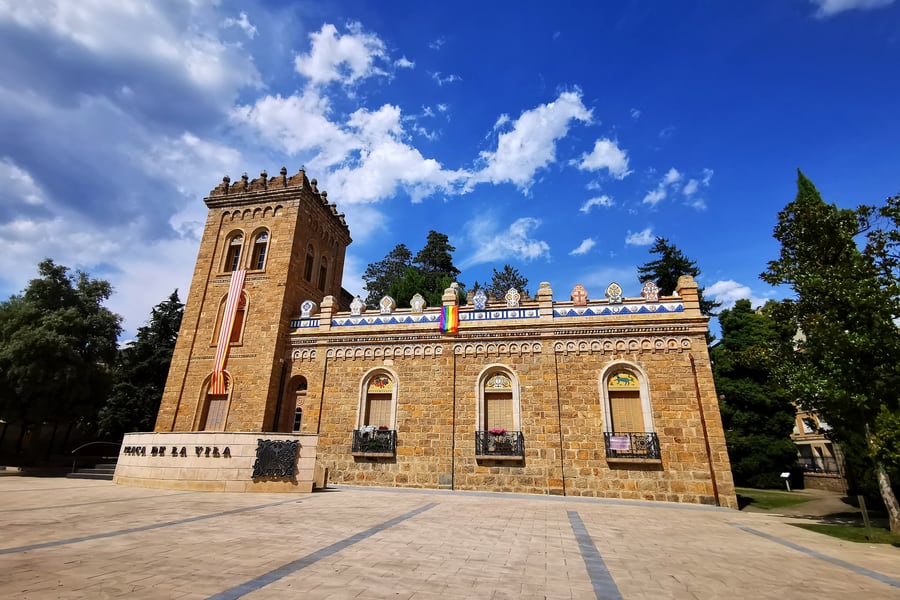 Nuria Gómez Delgado / Wikimedia Commons · CC BY-SA 4.0 · cropped
La Pobla de Segur
Where the rails stop. The town was the home of the raiers, the log rafters who floated timber down the Noguera Pallaresa until the dams closed the river — a craft UNESCO inscribed on its intangible heritage list in 2022, and one the Espai Raier beside the station keeps alive. Casa Mauri is the town's Modernista set piece, and the old station now holds an interpretation centre for the wildlife of the Pyrenees.Where to Sleep
The five hours the historic train gives at La Pobla de Segur are enough for the town and no more. Anyone using the six-day return ticket has the run of the Pallars Jussà instead, and the sensible bases are along the line rather than at the end of it.
All three of the establishments below were opened and read in August 2026. Prices, ratings and star counts are deliberately absent: we have verified none of them.
Where to stay
Hotel Terradets
On the lake at Cellers, beside the line
The one hotel actually on the route, at kilometre 75 of the C-13 at Cellers, a short way from Cellers-Llimiana station — which is one of the two stops the Tren dels Llacs will make on request. Its own account is of a lakeside hotel with a restaurant, Del Llac, and it markets itself to cyclists, to walkers on the Montsec and to anyone who has come for the dark skies above it.
Check Availability (opens in a new tab, on hotelterradets.com)via hotelterradets.comHotel Segle XX
In the centre of Tremp
Founded in 1880 and run by the same family from one generation to the next, which its own history puts at more than 130 years in the trade. It gives 47 rooms, a restaurant serving Catalan cooking, an outdoor pool with a view of the mountains, a games room and free parking, and it accepts pets. Tremp station is a walk from the door.
Check Availability (opens in a new tab, on hotelseglexxtremp.com)via hotelseglexxtremp.comHotel Solé
At La Pobla de Segur, by the station
The hotel opened in 1951, in its own words "coinciding with the arrival of the train", and the third generation of the family runs it now. Its account gives 40 soundproofed rooms, a bar, an outdoor pool, step-free access and a separate aparthotel opened in 2000. It stands on the Avinguda de l'Estació, which is to say two minutes from the buffers.
Check Availability (opens in a new tab, on hotelsole.es)via hotelsole.esParador de Lleida
Lleida old town, for the 10:40 departure
A seventeenth-century convent in the historic centre of Lleida, a few metres off the Carrer Major and below the Seu Vella. Rooms are arranged around a three-storey cloister, and the convent church is now the restaurant. It is a walk of about fifteen minutes from Lleida-Pirineus, which makes the Saturday morning departure straightforward.
Check Availability (opens in a new tab, on paradores.es)via paradores.esQuestions or corrections
Planning this trip and stuck on something, or spotted a time, fare or detail that has changed? Send us a message about Tren dels Llacs — the line its passengers refused to lose. We read every one, and we update this page when something has changed.