Tren Solar de la Quebrada
Argentina.gob.ar / Wikimedia Commons · CC BY 4.0 · 2025 · cropped
- Distance42 km (Volcán–Tilcara)
- DurationAbout 10 hr 40 min as a day out; 1 hr 35 min to 2 hr 10 min for the short return
- Best seasonMost days, all year (280 days in 2025); no trains on Wednesdays
Introduction
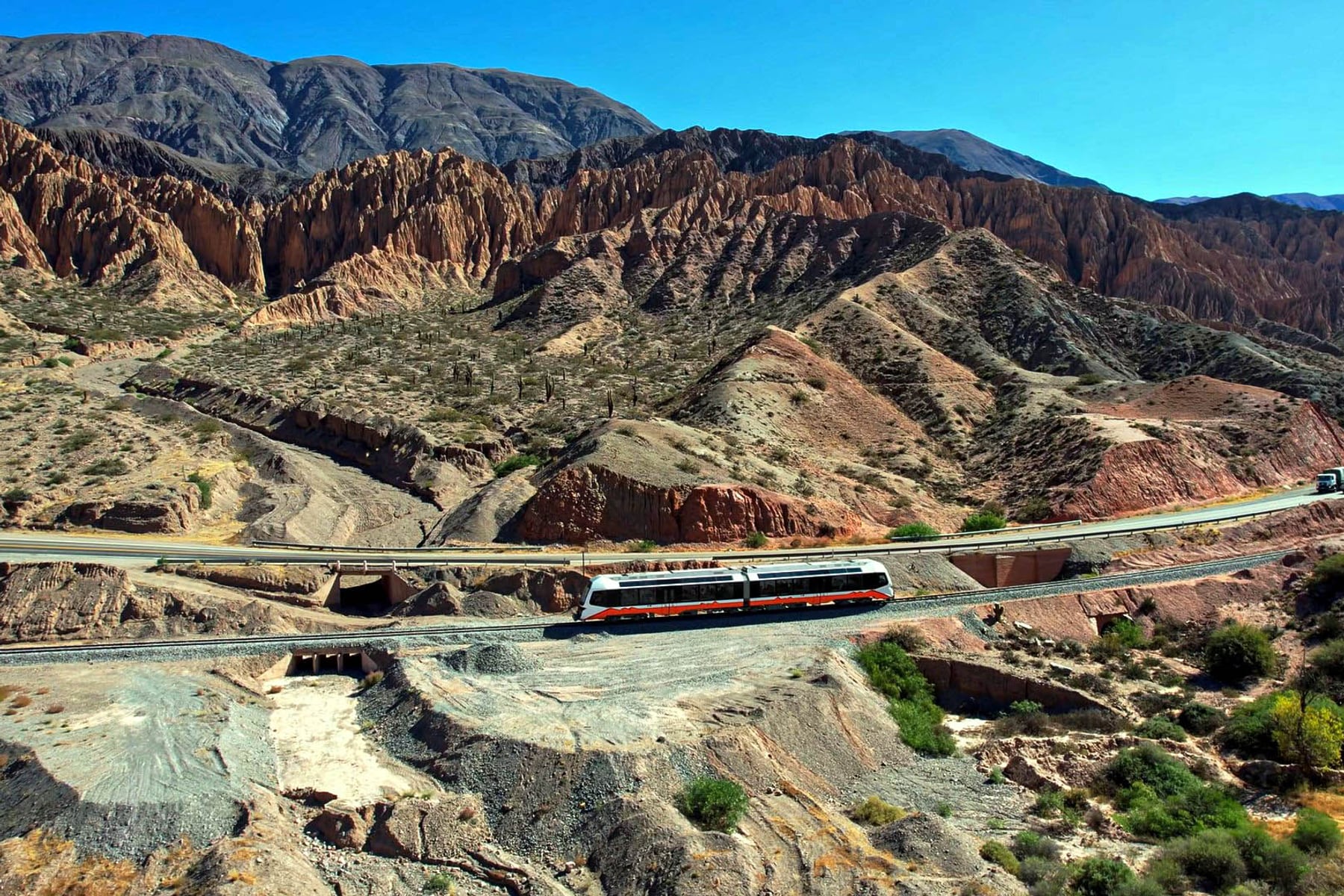
For thirty years no passenger train ran through the Quebrada de Humahuaca. The metre-gauge line up the valley from Jujuy towards Bolivia lost its long-distance trains in 1993, the province that took it on two years later let it go, and time and the weather destroyed much of the track. In June 2024 a train came back to 42 kilometres of it, between Volcán and Tilcara, and this one runs on sunlight: two articulated railcars built in China, with lithium batteries charged by solar power and nothing coming out of an exhaust.
The Tren Solar de la Quebrada climbs the valley of the Río Grande through a landscape UNESCO inscribed as a World Heritage Site in 2003, a corridor people have travelled for ten thousand years. It calls at six stations: Volcán, Tumbaya, the colonial village of Purmamarca under its striped hill, the staging post of Hornillos, Maimará below the Paleta del Pintor and Tilcara, at 2,465 metres. The operator calls it the first solar train in Latin America.
It is run as a day out rather than a commuter line. The main ticket buys the whole valley in one day, with a guide on board and an hour or more at every stop to walk round; a shorter one is a return of an hour and a half to two hours from Purmamarca. It is run by a public body of the Province of Jujuy, and it carried 49,357 passengers in 2025.
The Journey
The day begins at Volcán, at 2,084 metres, where the trains are kept and charged. Two groups leave each morning, Group A at 09:00 and Group B at 10:00, and both cover the same six stations in a different order. Each stop is long enough to leave the train: an hour at most stations, two hours and twenty-five minutes at Purmamarca, an hour and forty minutes at Tilcara. Guides travel on the train and meet it at each station.
Up the valley
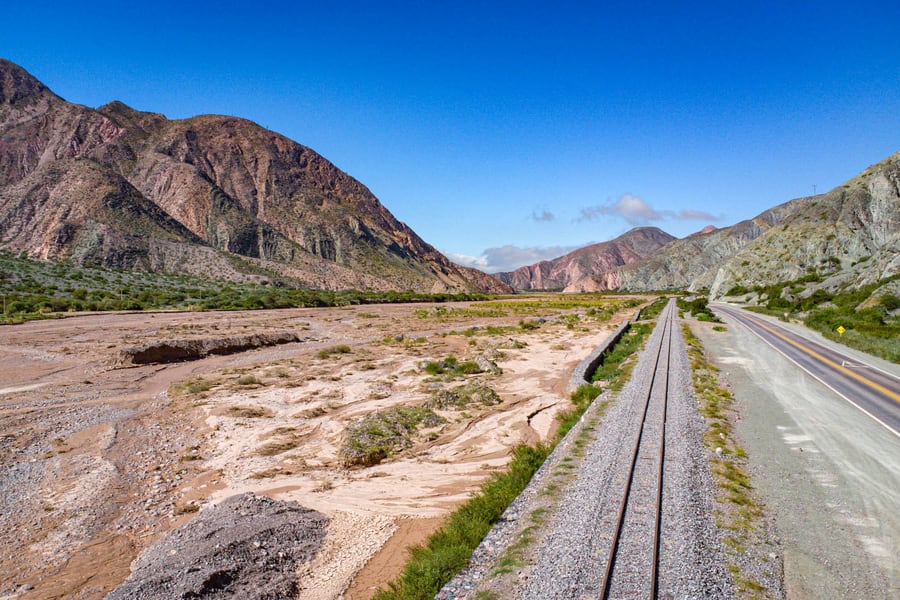
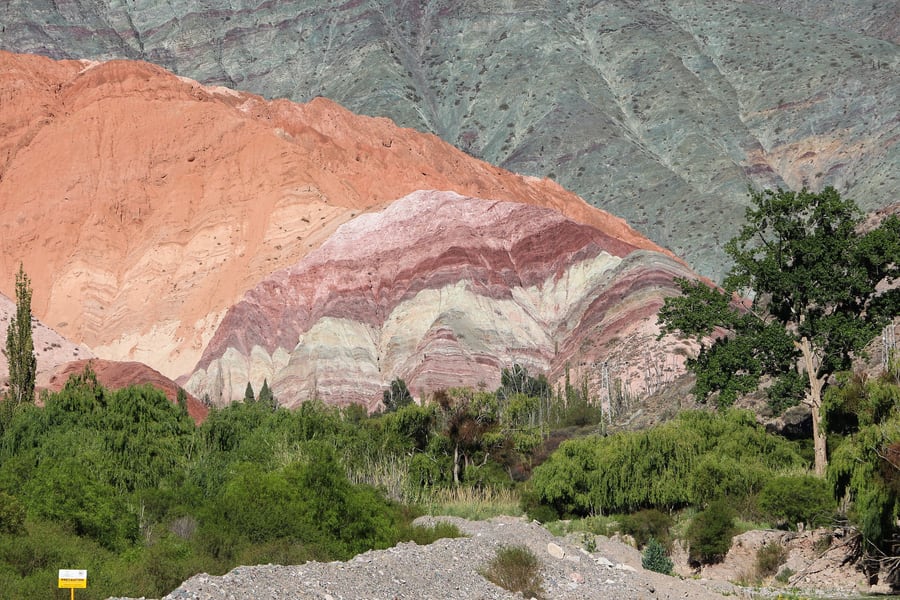
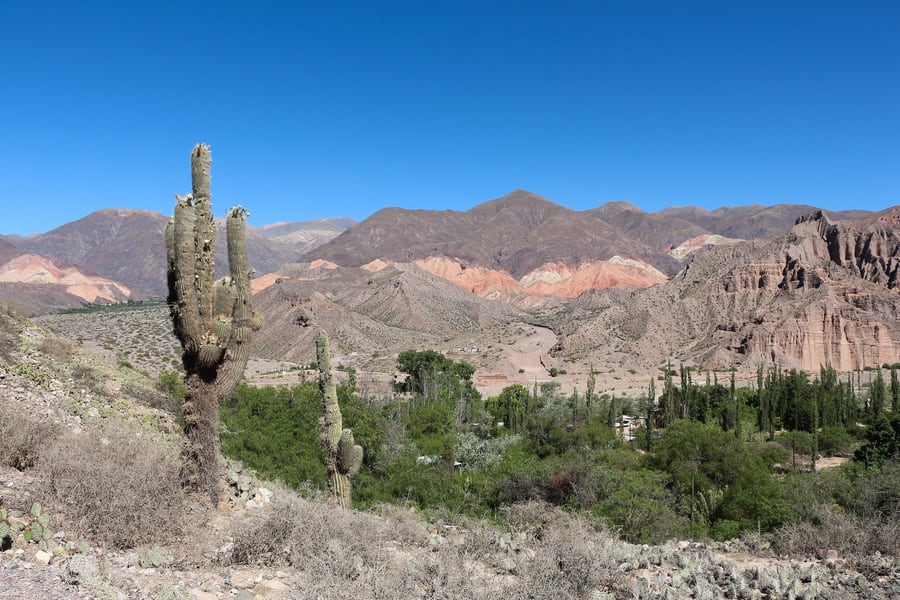
From Volcán the line follows the Río Grande north between bare, folded mountains. Tumbaya, at 2,099 metres, has a church of 1796. Purmamarca is the longest stop, time enough to reach the village, three kilometres up a side valley under the Cerro de los Siete Colores, the hill of seven colours. North of it, the train calls at the Posta de Hornillos, an eighteenth-century staging post on the old road from Potosí to Buenos Aires, and at Maimará, where the mountainside behind the village is striped like a painter's palette. The line ends at Tilcara, 42 kilometres from Volcán, below the stone walls of its Pucará.
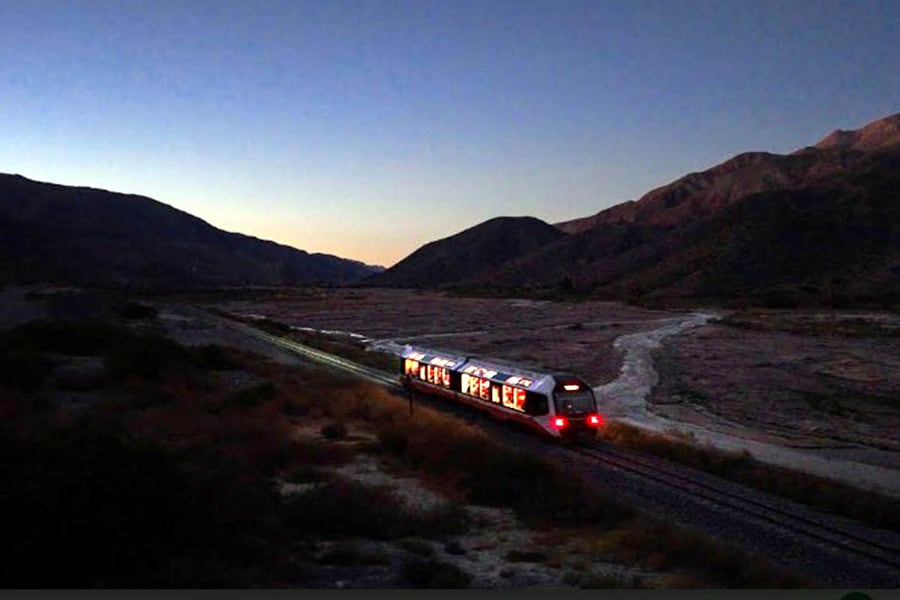
Group A goes up in the morning with a long stop at Purmamarca and comes back in the afternoon through Hornillos and Tumbaya, reaching Volcán at 19:40. Group B stops on the way up at every station and comes back in the evening without stopping for long, reaching Volcán at 20:40.
The train
The Tren Solar runs with two articulated battery railcars built by CRRC Tangshan in China, which reached Volcán in November 2023. Each seats 72, has a top speed of 60 km/h and carries six lithium batteries with a reserve, good for 100 to 120 kilometres on a charge; the operator lists fast-charging points at Volcán and Purmamarca, with Tilcara to follow. Inside are panoramic windows, seats that turn, screens and wireless chargers. There is no food or drink on board, apart from a small bottle of water.
The railway itself is much older. The line through the Quebrada was built in the early twentieth century as part of the state railway to La Quiaca on the Bolivian border, and Volcán grew up around its station in 1905. Work to bring it back began in 2017, and the 42 kilometres to Tilcara were rebuilt from 2022, paid for out of the dividends of the province's Cauchari solar park.
Along the route
 Jorgevelasqz / Wikimedia Commons · CC BY 4.0 · 2026 · cropped
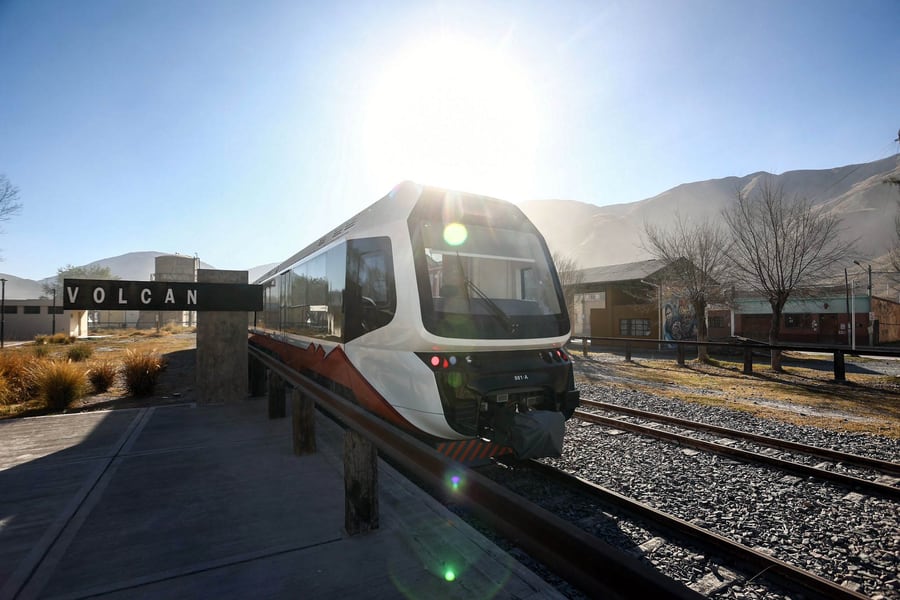
Volcán
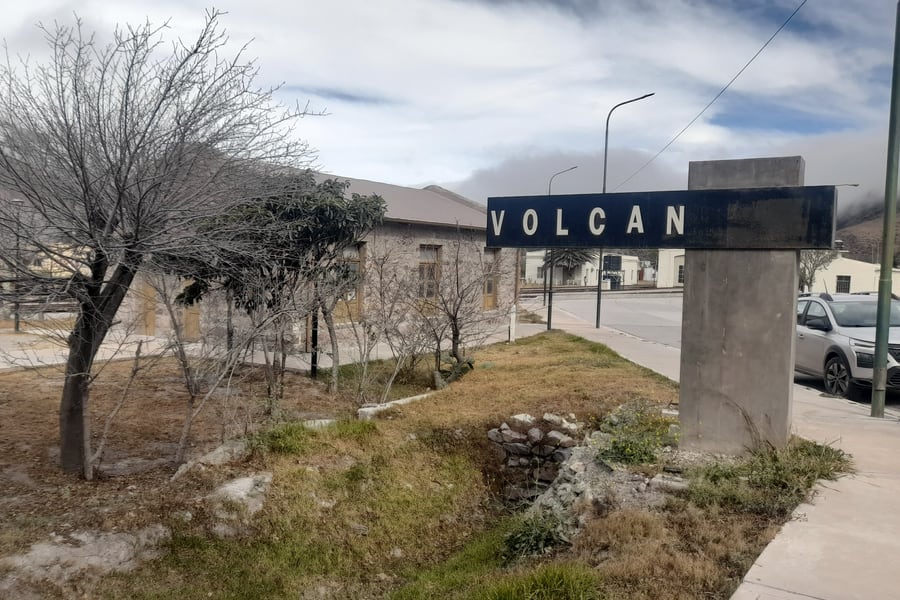
The line starts at 2,084 metres in a village that grew up with the railway in 1905. It is named for the mudflows that pour off its slopes in summer storms like lava; one buried it in January 2017. The train's depot and workshops are here.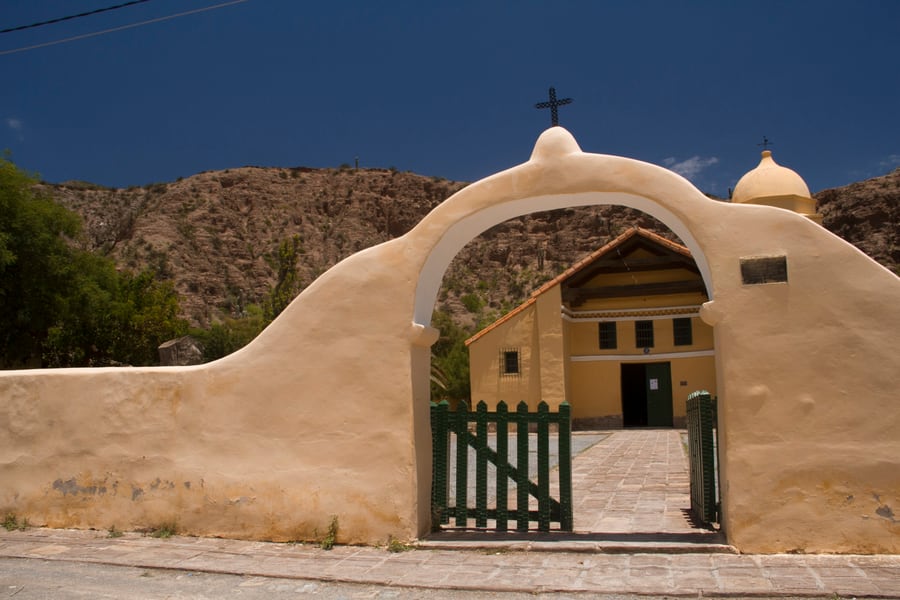 darcacha / Wikimedia Commons · CC BY-SA 3.0 · 2012 · cropped
Tumbaya
At 2,099 metres, Tumbaya's church dates from 1796 and keeps paintings of the Cuzco school; it is a National Historic Monument. Group B trains stop here for an hour on the way up, Group A for an hour on the way back.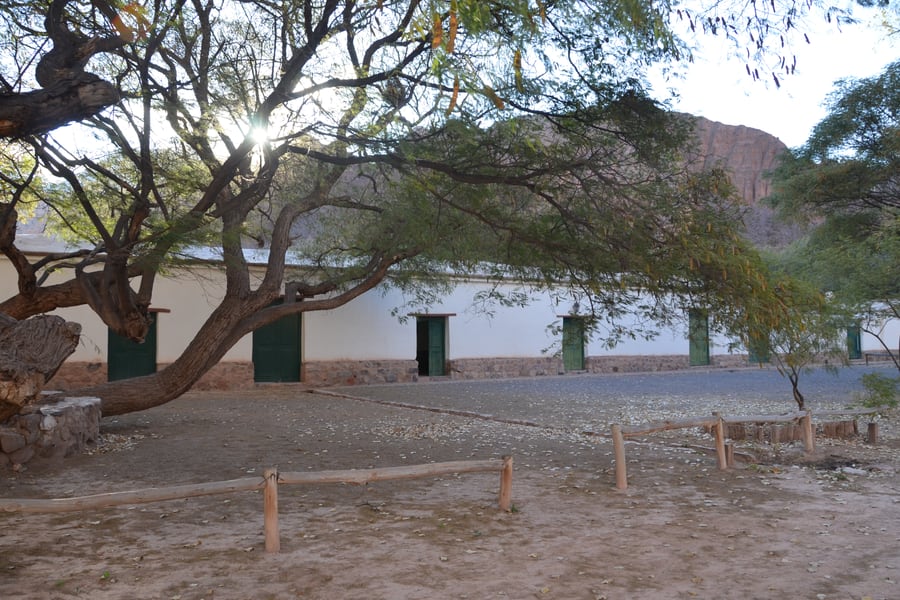 Abeljorge / Wikimedia Commons · CC BY-SA 3.0 · 2012 · cropped
Posta de Hornillos
A staging post of 1772 on the road from Potosí to Buenos Aires, where travellers changed horses. It became an army post in the wars of independence, and Manuel Belgrano rested here in 1813. A museum since 1979; both groups stop an hour.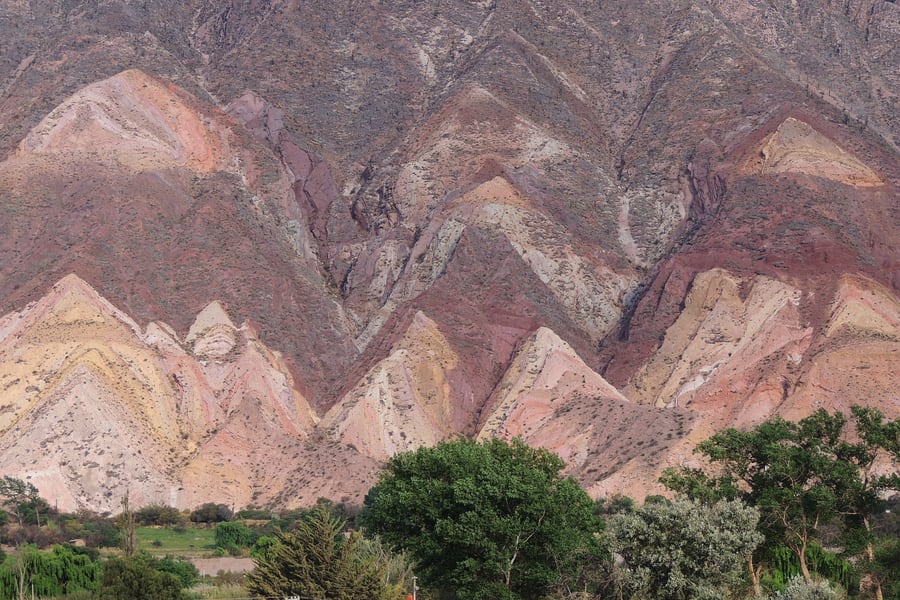 Miguel / Wikimedia Commons · CC BY-SA 2.0 · 2014 · cropped
The Paleta del Pintor
Behind Maimará the mountainside folds into stripes of pink, ochre and grey-green: the Paleta del Pintor, the painter's palette. The colours come up most strongly in the late afternoon, when Group B arrives.A bit of history
Culture & experiences along the way
 P. Hughes / Wikimedia Commons · CC BY 4.0 · 2025 · cropped
Wine from the Quebrada
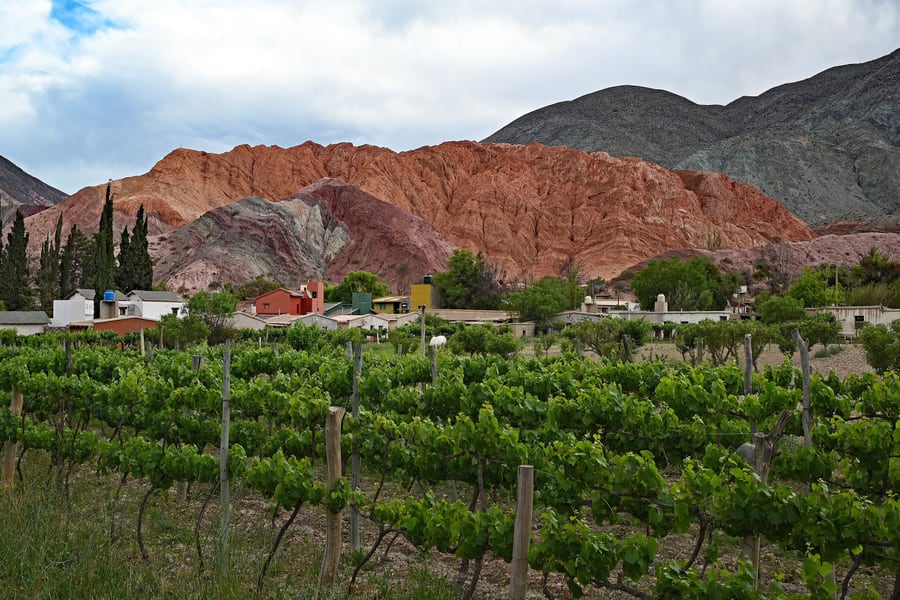
Vines grow in the valley, as here under the coloured hills of Purmamarca. On set Saturdays the operator's Tren del Vino runs the line with sommeliers on board: tastings at Tumbaya and Maimará, lunch with wine in Purmamarca, a halt at the El Bayeh winery, and the train's own wine shop in Tilcara.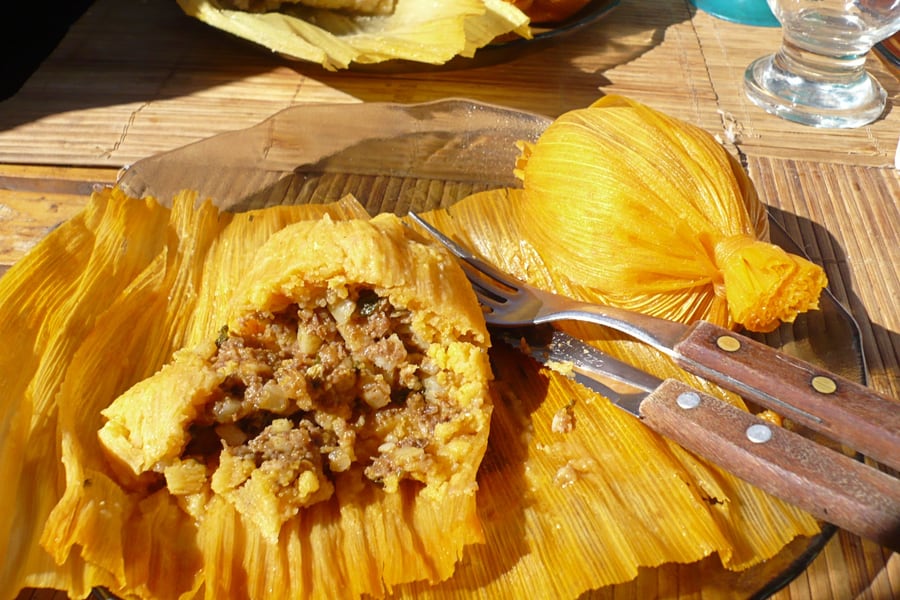 Gonzalo Rivero / Wikimedia Commons · CC BY-SA 3.0 · 2009 · cropped
Tamales and humitas
The tamal of Argentina's north-west is cornmeal and squash wrapped round beef or chicken, raisins, olives and egg, tied in a sun-dried corn husk like a sweet and boiled. Its cousin the humita is fresh grated corn with cheese, folded in a green husk. Both belong to the cooking of the Quebrada.Timetables
Trains run on most days of the week, all year. In the weeks we checked, from late October to late November 2026, the operator's booking site sold no trains on Wednesdays and none on most Mondays. The times below are the operator's own, from Tren Solar de la Quebrada's published timetables, read in October 2026. Where a station shows two times, the train arrives at the first and leaves at the second; a dash means the train does not stop.
Experiencia 360°: the full day from Volcán
Two groups a day, each with its own timetable. A ticket is for one group, and you keep to its train.
| Station | Group A, up | Group A, back | Group B, up | Group B, back |
|---|---|---|---|---|
| Volcán | dep 09:00 | arr 19:40 | dep 10:00 | arr 20:40 |
| Tumbaya | — | 18:20 · 19:20 | 10:20 · 11:20 | 20:20 |
| Purmamarca | 09:50 · 12:15 | — | 11:50 · 14:15 | 19:45 · 19:50 |
| Posta de Hornillos | — | 16:20 · 17:20 | 14:45 · 15:45 | 19:15 |
| Maimará | 12:55 · 13:55 | 16:05 · 16:10 | 15:55 · 16:55 | 19:05 |
| Tilcara | arr 14:10 | dep 15:50 | arr 17:10 | dep 18:50 |
Experiencia 180°: a short return from Purmamarca
| Trip | Leaves Purmamarca | Stop at the far end | Back in Purmamarca |
|---|---|---|---|
| To Maimará | 10:00 | 15 minutes | 11:35 |
| To Volcán | 12:00 | 15 minutes | 14:10 |
The station ticket offices open Thursday to Tuesday, 09:00 to 17:00. Seats are allocated, not chosen, and the operator warns that on a full train some passengers may have no seat assigned.
Departures are published by the operator: Tren Solar de la Quebrada · trensolar.com.ar (opens in a new tab).
Tickets
Tickets are sold on the operator's booking site, by WhatsApp and email, and at the ticket office in San Salvador de Jujuy's Cabildo. Fares are in Argentine pesos and come in two bands: one for holders of an Argentine identity card, a higher one for everyone else. From 15 September 2026 the full day costs a visitor from abroad $113,000, and the short return $60,000.
Children from 2 to 11 pay less, and under-twos travel free on an adult's lap. Bring a small bag of no more than 3 kg. Cancelling costs 10% of the fare 60 days out, rising to 90% in the last week, and nothing can be changed the day before.
Book your tickets
Experiencia 360°, train only
$113,000 visitors from abroad · $90,000 Argentine nationals
The whole day from Volcán to Tilcara and back, with a guide on board and timed stops at every station.
Book Tickets (opens in a new tab, on reservadirecta.sittnet.net)via reservadirecta.sittnet.netExperiencia 360° with a transfer
From Jujuy $148,000 · from Salta $166,000, visitors from abroad
The same day out with a road transfer to Volcán and back from San Salvador de Jujuy or Salta.
Book Tickets (opens in a new tab, on trensolar.com.ar)via trensolar.com.arExperiencia 180°
$60,000 visitors from abroad · $50,000 Argentine nationals
A short return from Purmamarca to Maimará or to Volcán, with a 15-minute stop at the far end.
Book Tickets (opens in a new tab, on trensolar.com.ar)via trensolar.com.arRail Passes
No rail pass covers the Tren Solar de la Quebrada. Interrail and Eurail are European schemes, and Argentina is not among the countries in Interrail's list of covered railway companies. Every ticket is bought from the operator, day by day.
Checked October 2026 against Interrail's list of railway companies (opens in a new tab).
Places to Visit
Every station gets at least an hour on the full-day ticket, so the villages are part of the trip, not a view from the window. Volcán, Tumbaya and Hornillos are described along the route above; these are the three places worth the longest look, and the ruined town above the last of them.
 Preyes / Wikimedia Commons · CC BY-SA 4.0 · 2019 · cropped
Purmamarca
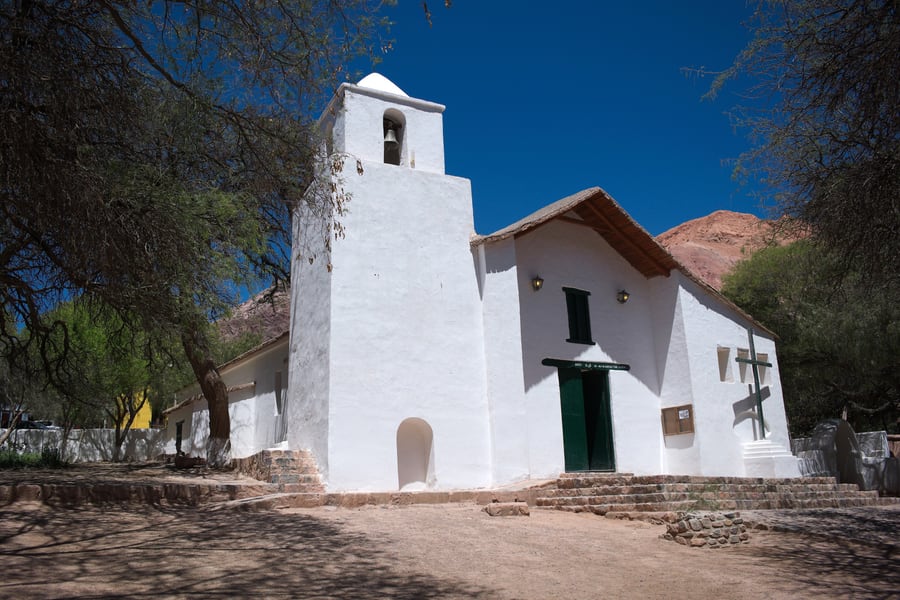
A village at 2,324 metres in a side valley, three kilometres west of the main road, under the striped Cerro de los Siete Colores. Its church of Santa Rosa de Lima dates from 1648, with adobe walls and a roof of cardón cactus wood under mud; it was declared a National Historic Monument in 1941, and the village itself a Historic Place in 1975.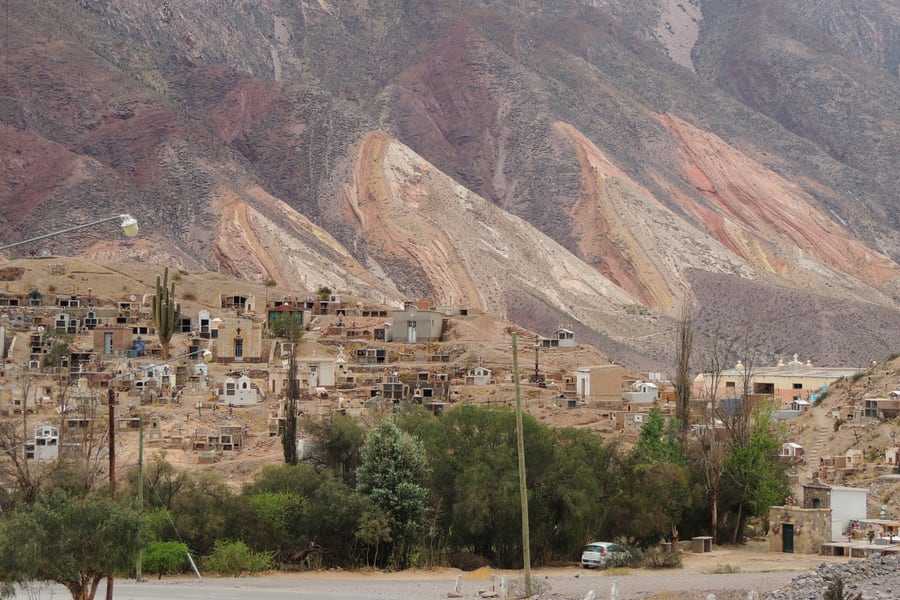 Miguel / Wikimedia Commons · CC BY-SA 2.0 · 2014 · cropped
Maimará
A farming village at 2,390 metres beside the Río Grande, whose orchards and market gardens supply the towns around it. Its cemetery climbs a knoll at the north entrance, a hillside of small painted tombs, some with pointed and curved tops from the early twentieth century, with the Paleta del Pintor rising behind.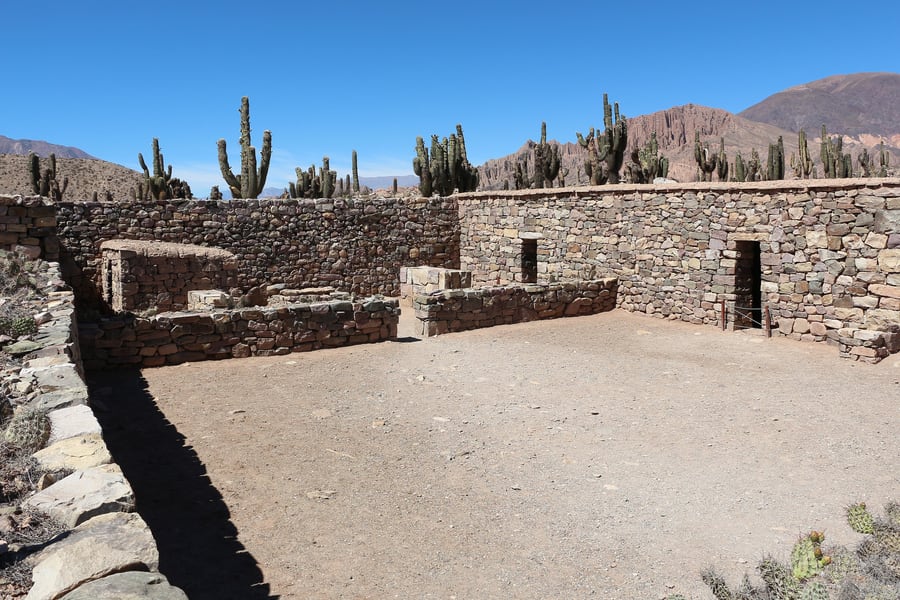 Bernard Gagnon / Wikimedia Commons · CC BY-SA 4.0 · 2018 · cropped
The Pucará de Tilcara
A walled town of the Tilcara, one of the Omaguaca peoples, on an 80-metre hill above the meeting of the Huasamayo and the Río Grande. Under the Incas it became the capital of their province of Humahuaca. Juan Bautista Ambrosetti found it in 1908; part of it was rebuilt from 1948, and there is a high-altitude botanical garden beside the ruins.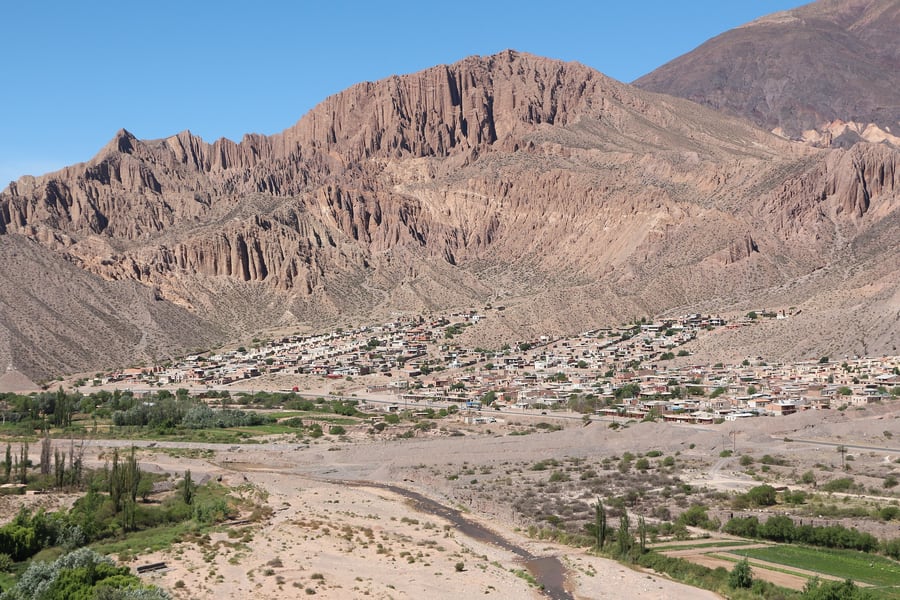 Bernard Gagnon / Wikimedia Commons · CC BY-SA 4.0 · 2018 · cropped
Tilcara
A town at the foot of the Sierra de Tilcara with no founding date: its people held out against the Spanish until 1598, and its street plan goes back to colonial times. It has the Eduardo Casanova archaeological museum, the José A. Terry museum of regional painting and a museum of the Tilcara-born painter Medardo Pantoja. Both groups have 1 hr 40 min here.Where to Sleep
The trains start and finish at Volcán, 42 km by road from San Salvador de Jujuy, and the operator sells a transfer from Jujuy or Salta with the ticket. Staying in the Quebrada itself makes for an easier morning and a quieter night: one hotel under the coloured hill at Purmamarca, and one in Tilcara at the end of the line.
Where to stay
La Comarca Hotel
Route 52, km 4.2, Purmamarca
Rooms and cabins at the foot of the Cerro de los Siete Colores, built to recall an Andean hamlet, with a heated pool.
Check Availability (opens in a new tab, on lacomarcahotel.com.ar)via lacomarcahotel.com.arLas Marías Hotel Boutique
Sorpresa 573, Tilcara
A small hotel three blocks from Tilcara's main square, whose kitchen cooks with Andean potatoes, quinoa and maize.
Check Availability (opens in a new tab, on lasmariastilcara.com.ar)via lasmariastilcara.com.arQuestions or corrections
Planning this trip and stuck on something, or spotted a time, fare or detail that has changed? Send us a message about Tren Solar de la Quebrada. We read every one, and we update this page when something has changed.